
EMD "FP7" Locomotives: Specs, Roster, History
Last revised: December 18, 2024
By: Adam Burns
The incredible success of Electro-Motive's F7, and earlier F3, led the builder to catalog a variant sporting a larger steam generator for passenger service, the FP7. Internally and visually, the locomotive was nearly identical to its counterpart save for its increased length.
Interestingly, despite already offering a standalone passenger series, some railroads found the B-B trucked F units more to their liking in passenger service as the locomotives offered better tractive effort in mountainous territory. The E models' A1A-A1A trucks, with an unpowered center axle, had trouble on stiff grades.
Surprisingly, for a variant, the FP7 sold quite well with nearly 400 examples manufactured (including those constructed by subsidiary General Motors Diesel for Canadian lines). Today, numerous FP7s remain preserved and in operation around the country.
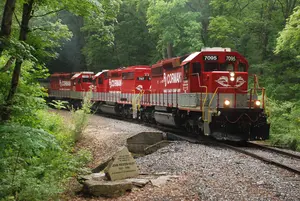
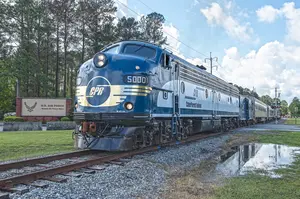
Notable units include a pair of demonstrator units (#7001 and #9051), Clinchfield #200 at the West Virginia Central, Southern Railway #6133 at the North Carolina Transportation Museum, and Southern Railway #6141 and #6138 which pull RJ Corman's My Old Kentucky Dinner Train.
Photos
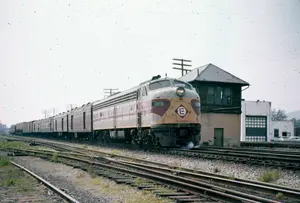
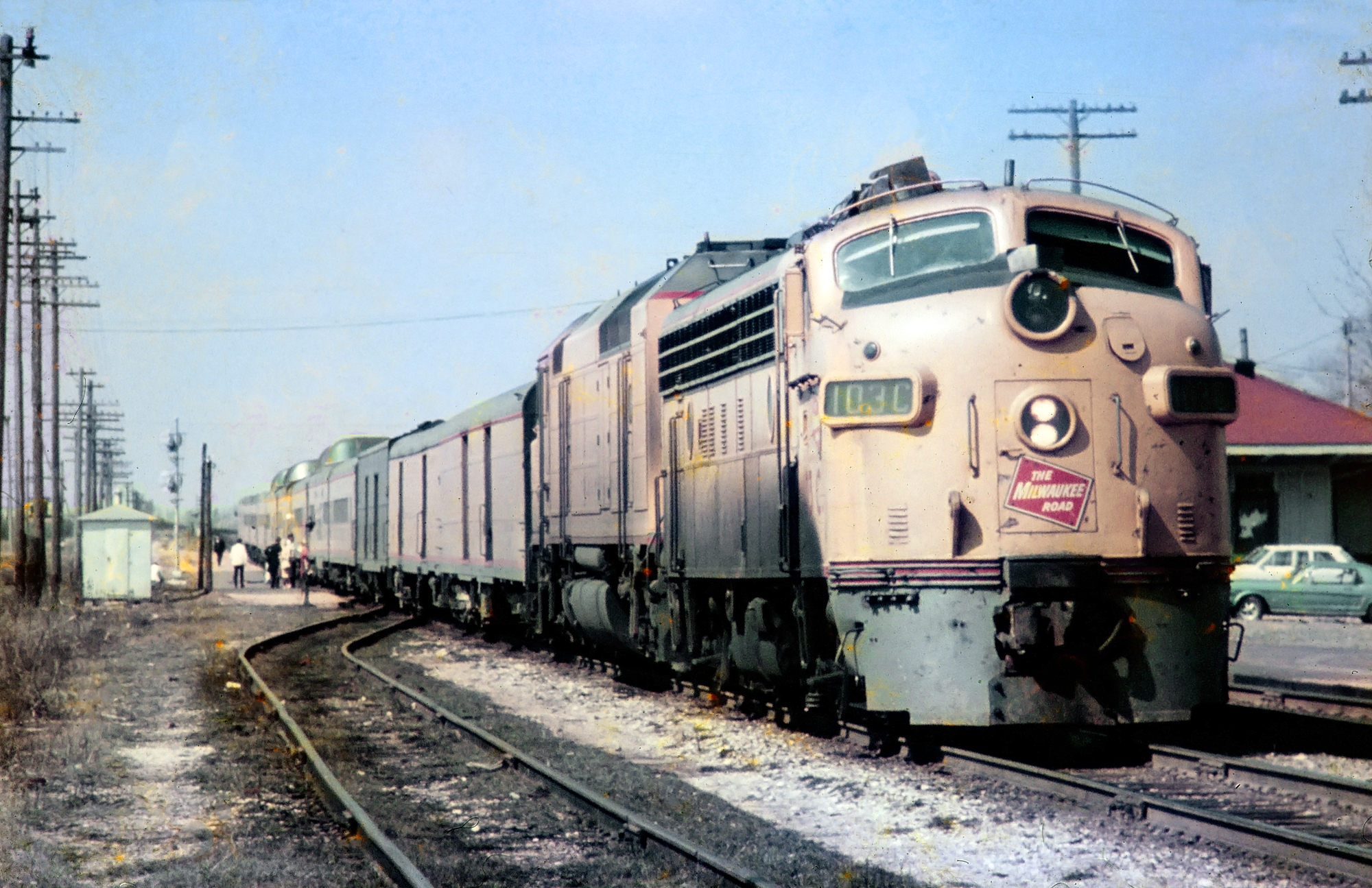 Milwaukee Road FP7 #103-C has one of Union Pacific's "City" streamliners at Davis Junction, Illinois in April, 1969. American-Rails.com collection.
Overview
The FP7 entered production in June, 1949 when Rock Island #402 rolled out of EMD's McCook plant that month. As the builder ramped up production of its "E" series catalog, some roads, like the previously-mentioned AT&SF and SP, realized the locomotives' A1A-A1A trucks provided relatively poor traction in mountainous environments.
In his book, "Southern Pacific Historic Diesels, Vol. 3," author Joseph A. Strapac notes the Southern Pacific considered the E7, for example, "...a frail device, better suited to the water-level New York Central than the harsh operating environment of the far West. Far too often, SP's combination of heavy trains and rugged profiles forced dispatchers to assign helpers to E7 consists."
To remedy this, SP took the somewhat unique approach of purchasing a large fleet of PAs, especially the later PA-2, which sported the more rugged and robust GE-built 752 traction motors. The Santa Fe took a somewhat different approach, deciding to equip its top trains with the sure-footed F3 and F7.
With their B-B trucks, the Fs placed their full weight on the rails. As a result, the FP7 could offer tractive efforts between 29,500 to 40,000 lbs (depending on gear settings) while the best an E7 could provide was 27,000 lbs at the lowest gear setting.
EMD already cataloged the F2, F3, F7, and later F9 with optional steam generators. However, the engine compartment did not have sufficient room for both the generator and needed water supply. To get around this, Louis A. Marre notes in his book, "Diesel Locomotives: The First 50 Years," EMD placed water tanks under the frames of these models. In addition, the steam generator exhaust stack was located at the rear of the locomotive's roof.
In the Santa Fe's case, it attempted to provide amble water supply by placing a generator in the F3's "A" unit and the water tank in the accompanying B unit. Such a maneuver did work but always required at least two units in every train consist, thus increasing operating costs.
The FP7 solved all of these issues. In his book, "Electro-Motive: E-Units and F-Units," author Brian Solomon notes the model provided a 970-gallon water tank for the steam generator with a total water capacity of 1,750 gallons, nearly twice as much as a comparable F3.
This allowed the locomotive to operate much longer between necessary water stops. It also carried an added benefit of doubling in freight assignments; such redundancy was always cherished by railroads.
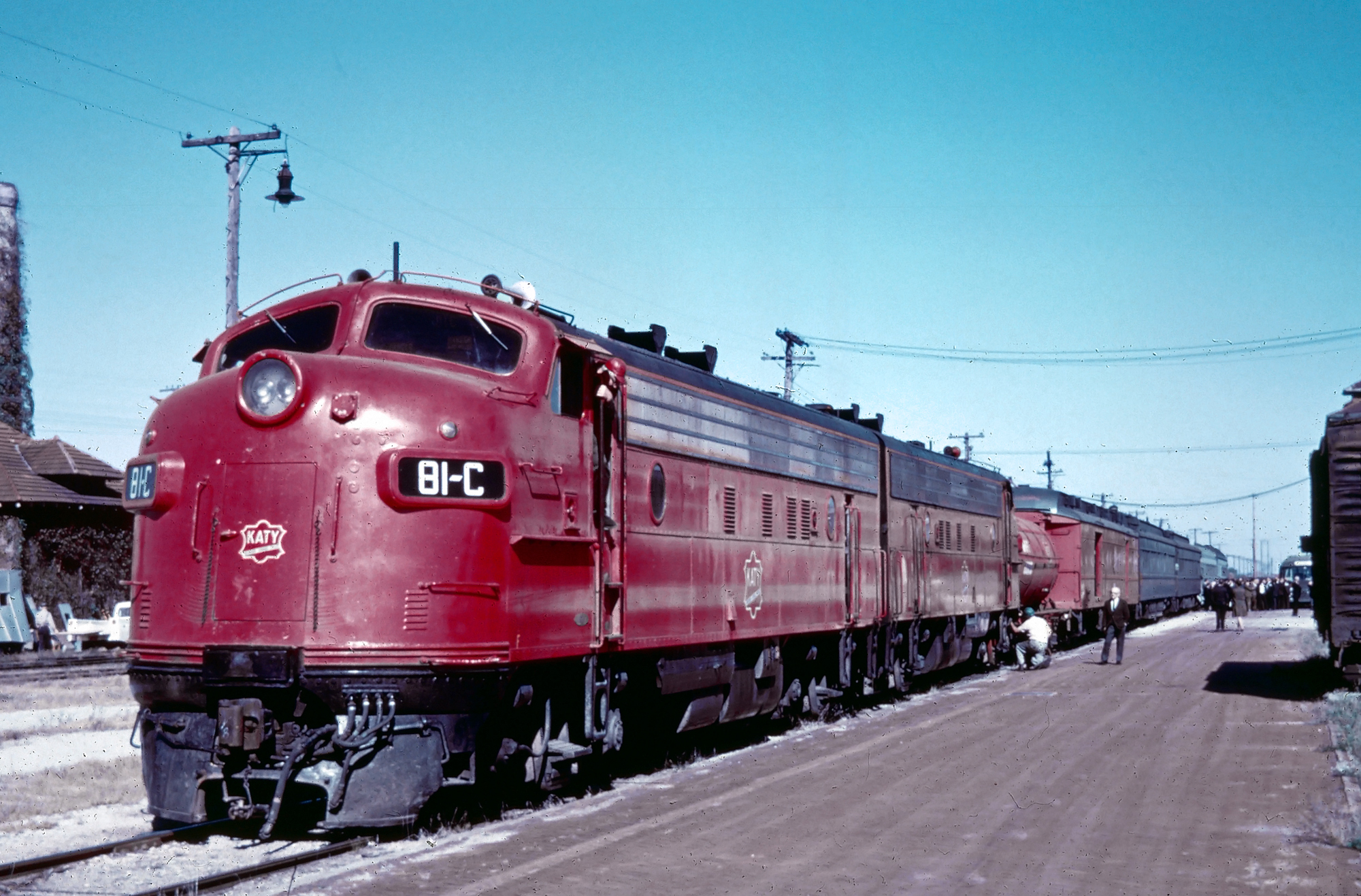 Katy FP7 #81-C is seen here stopped at Parsons, Kansas with the company business train on October 4, 1968. Mac Owen photo. American-Rails.com collection.
To house the steam generator and water tank inside the cab, the FP7 was 54' 8" in length, four feet longer than a typical F7. In his book, "Diesel Locomotive Cyclopedia - Volume 2," author Bob Hayden notes the stretched out carbody can be seen between the first porthole (nearest the cab) and first set of louvers.
Aside from its steam generator components, the FP7 was nearly identical to the F7. It featured EMD's 16-cylinder, model 567B prime mover - that could produce 1,500 horsepower - and carried the company's D27C traction motors, which offered as much as 40,000 pounds of continuous tractive effort.
It did, however, use a slightly upgraded main generator, the model D12D. Since the FP7 already housed all of the components needed for passenger service, there was little need to offer a cabless "B" variant.
In comparison to the FT, F3, and F7's success, the FP7's sales numbers appear low; only 379 were produced by the time production ended on the model in late 1953.
However, as a variant, it solved a specific and very important need for railroads either after greater tractive effort in passenger assignments or wanting a dual-service locomotive.
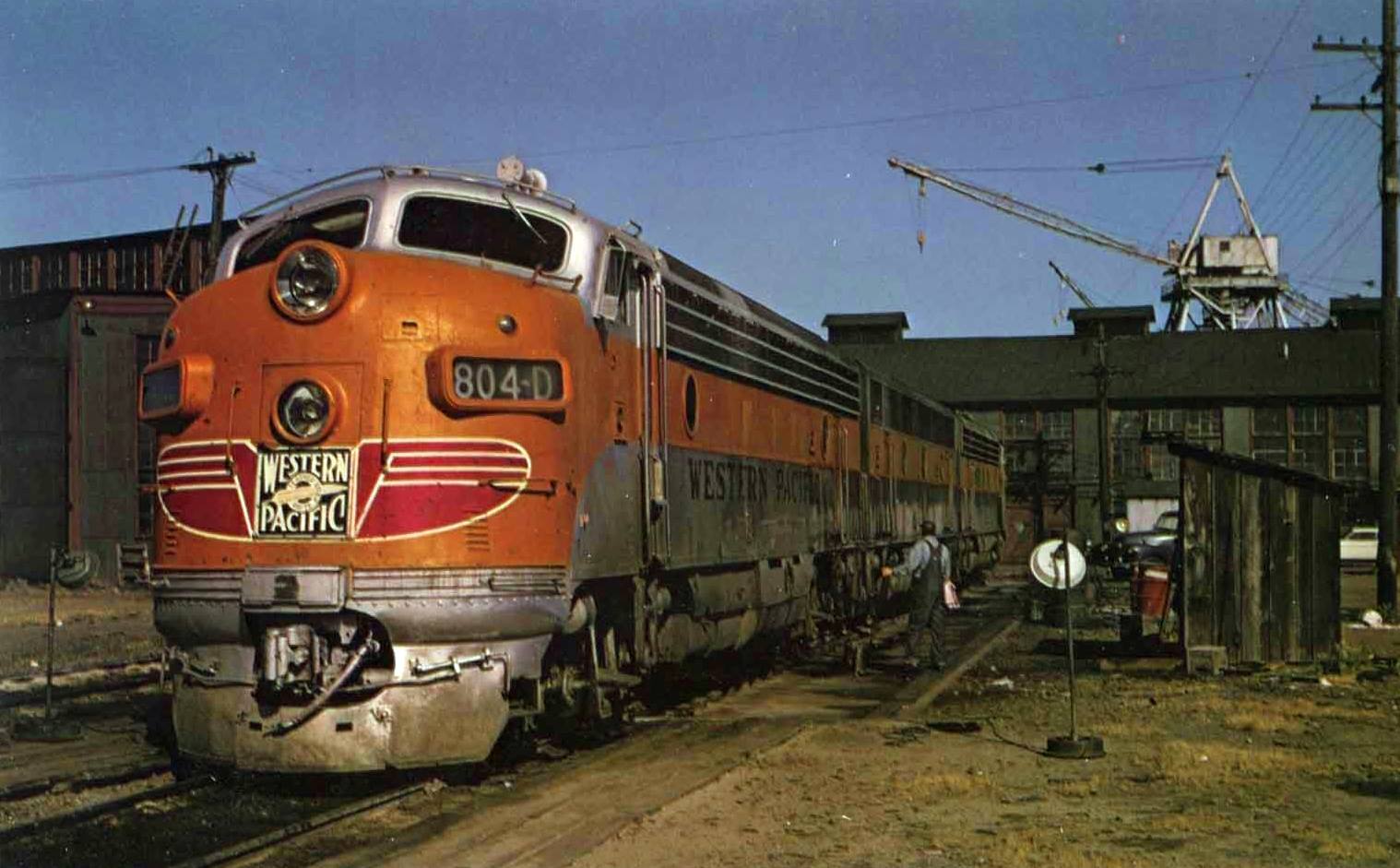 Western Pacific FP7 #804-D and other power have just cut-off from the westbound "California Zephyr" and arrived at the Adeline Street Roundhouse in Oakland, California during October of 1963. Virgil Staff photo.
Data Sheet and Specifications
| Entered Production | 6/1949 (Rock Island #402) |
| Years Produced | 6/1949 - 12/1953 |
| Engine | 567B |
| Engine Builder | GM |
| Horsepower | 1500 |
| RPM | 800 |
| Cylinders | 16 |
| Length | 54' 8" |
| Height (Top Of Rail To Top Of Cab Horn) | 15' 0" |
| Width | 10' 8" |
| Weight | 258,000 Lbs |
| Fuel Capacity | 1,200 Gallons |
| Air Compressor | Gardner-Denver |
| Air Compressor Model | WBO |
| Air Brake Manufacturer | Westinghouse |
| Air Brake Schedule | 24RL |
| Trucks | B-B |
| Truck Type | Blomberg |
| Truck Wheelbase | 9' |
| Wheel Size | 40" |
| Traction Motors | D27C (4), GM |
| Primary Generator | D12D, GM |
| Auxiliary Generator | Delco (A8102) |
| Alternator | D14 |
| MU (Multiple-Unit) | Yes |
| Dynamic Brakes | Yes |
| Gear Ratio | 62:15, 61:16, 60:17, 59:18, 58:19 |
| Tractive Effort (Continuous, at 9.3 mph) | 40,000 lbs; 37,000 lbs; 34,000 lbs; 32,000 lbs; 29,500 lbs |
| Top Speed | 65 mph, 71 mph, 77 mph, 83 mph, 89 mph |
* Despite intended use in general passenger service, steam generators were still optional in the FP7. They were produced by Vapor Clarkson; model OK4625 (2,000 Lbs/Hr).
Production Roster
Total Built = 299
| Owner | Road Number(s) | Serial Number(s) | Order Number | Date Built |
|---|---|---|---|---|
| Chicago & Eastern Illinois | 1600-1609 | 7535-7544 | E1076 | 08-09/49 |
| Georgia Railroad | 1002 | 7605 | E1091 | 11/1949 |
| Western Railway of Alabama | 502-503 | 8018-8019 | E1131 | 11/1949 |
| Atlanta & West Point | 551-552 | 8020-8021 | E1176 | 8/1949 |
| Georgia Railroad | 1003 | 8322 | E1091 | 11/1949 |
| Rock Island | 402-411 | 8623-8632 | E1199 | 6/1949-7/1949 |
| Georgia Railroad | 1004 | 8870 | 3003 | 2/1950 |
| Western Pacific | 804A, 804C-805A, 805C | 9002-9005 | 6043 | 1/1950 |
| Milwaukee Road | 90A, 90C-95A, 90C | 10323-10334 | 3050 | 6/1950-7/1950 |
| Milwaukee Road | 96A, 96C-97A, 97C | 10361-10364 | 3073 | 1/1951 |
| Soo Line (Minneapolis, St Paul & Sault Ste Marie) | 501A | 10897 | 6134 | 1/1950 |
| Electro-Motive (Demonstrator) | 7001 (became Soo Line/Wisconsin Central #2500A) | 11012 | 6061 (sold on 6136) | 11/1949 |
| Electro-Motive (Demonstrator) | 9051 (became Soo Line #500A) | 11015 | 6062 (sold on 6136) | 11/1949 |
| Reading | 900-905 | 11387-11392 | 6091 | 5/1950-6/1950 |
| Southern (Cincinnati, New Orleans & Texas Pacific) | 6130-6139 | 11507-11516 | 6113 | 4/1950-5/1950 |
| St. Louis Southwestern Railway (Cotton Belt) | 330 | 11628 | 3056 | 4/1950 |
| St. Louis-San Francisco Railway (Frisco) | 5040-5045 | 11637-11642 | 6127 | 12/1950 |
| Soo Line (Wisconsin Central) | 2501A | 12211 | 6137 | 6/1950 |
| Southern (Cincinnati, New Orleans & Texas Pacific) | 6140-6149 | 12336-12345 | 6144 | 10/1950-12/1950 |
| Pennsylvania | 9832A-9866A | 12410-12444 | 3066 | 4/1952-8/1952 |
| Richmond, Fredericksburg & Potomac | 1201-1203 | 12908-12910 | 6171 | 11/1950 |
| Atlantic Coast Line | 850-859 | 13051-13060 | 6179 | 4/1951 |
| Louisville & Nashville | 663-668 | 13430-13435 | 3075 | 12/1951-1/1952 |
| Chicago Great Western | 116A, 116C | 13559-13560 | 6222 | 12/1950 |
| Atlanta & West Point | 553-554 | 13569-13570 | 6202 | 2/1951 |
| Louisville & Nashville | 600-621 | 13834-13855 | 6216 | 1/1951-3/1951 |
| Atlantic Coast Line | 860-869 | 13971-13980 | 6179 | 4/1951-5/1951 |
| Soo Line | 502A-503A | 13997-13998 | 3080 | 3/1951 |
| St Louis-San Francisco Railway (Frisco) | 5046-5051 | 14087-14092 | 6235 | 2/1951 |
| Louisville & Nashville | 622-634 | 14465-14477 | 6271 | 6/1951-8/1951 |
| Louisville & Nashville | 669-672 | 14588-14591 | 3075 | 1/1952 |
| Clinchfield | 200 | 14804 | 6310 | 2/1952 |
| Missouri-Kansas-Texas (Katy) | 121A, 121C-124A, 124C | 14805-14812 | 6318 | 1/1952-2/1952 |
| Atlantic Coast Line | 870-889 | 14839-14858 | 3083 | 8/1951-10/1951 |
| Milwaukee Road | 98A, 98C-103A, 103C | 15227-15238 | 3111 | 10/1951-12/1951 |
| Florida East Coast | 571-575 | 15568-15572 | 3088 | 12/1951 |
| Pennsylvania | 9867A-9871A | 15643-15647 | 3066 | 8/1952 |
| Northern Pacific | 6600-6601 | 15681-15682 | 3135 | 2/1952 |
| Chesapeake & Ohio | 8000-8013 | 16050-16063 | 3096 | 2/1952-4/1952 |
| Soo Line | 504-505 | 16472-16473 | 3136 | 9/1952 |
| Reading | 906-907 | 16681-16682 | 3150 | 9/1952 |
| Milwaukee Road | 104A, 104C-105A, 105C | 16944-16947 | 3130 | 9/1952 |
| Union Pacific | 911-912 | 17231-17232 | 6444 | 4/1952 |
| Atlantic Coast Line | 890-893 | 17256-17259 | 6445 | 8/1952-9/1952 |
| Chesapeake & Ohio | 8014-8015 | 17490-17491 | 3163 | 12/1952 |
| Southern Pacific | 6446-6461 | 18130-18145 | 3160 | 2/1953-3/1953 |
| Alaska Railroad | 1510-1514 (Evens) | 19064-19066 | 3169 | 12/1953 |
Rebuilds
Total Built = 2
| Owner | Road Number | Serial Number | Order Number | Completion Date | Heritage |
|---|---|---|---|---|---|
| Chicago Great Western | 116C | 13560 | 8000 | 10/1951 | Original #116C built in 12/1950 |
| Chicago & Eastern Illinois | 1609 | 7544 | 8003 | 1/1952 | Original #1609 built in 9/1949 |
 Chicago Great Western FP7 116C in freight service is crossing the Illinois Central at Elmhurst, Illinois in May ,1962. Rick Burn photo.
General Motors Diesel (GMD)
Total Built = 57
| Owner | Road Number(s) | Serial Number(s) | Order Number | Date Built |
|---|---|---|---|---|
| Canadian Pacific | 4028-4037 | A100-A109 | C100 | 9/1950-10/1950 |
| Ontario Northland | 1500-1505 | A174-A179 | C111 | 3/1951-4/1951 |
| Canadian Pacific | 4038-4041 | A242-A245 | C116 | 9/1951-10/1951 |
| Canadian Pacific | 4058-4063 | A306-A311 | C132 | 1/1952-4/1952 |
| Canadian Pacific | 4066-4075 | A367-A376 | C147 | 8/1952-10/1952 |
| Ontario Northland | 1506-1513 | A377-A384 | C121 | 6/1952 |
| Canadian Pacific | 4099-4103 | A520-A524 | C165 | 4/1953-6/1953 |
| Ontario Northland | 1514-1521 | A525-A532 | C166 | 7/1953-10/1953 |
Export
Total Built = 21
| Owner | Road Number(s) | Serial Number(s) | Order Number | Date Built |
|---|---|---|---|---|
| Secretaría de Comunicaciones y Obras Públicas (Mexico) | 9888-9889 | 23035-23036 | E1313 | 9/1949 |
| Ferrocarriles Nacionales de México | 10888-10896 | 6300-6308 | 6052 | 12/1949-1/1950 |
| Ferrocarriles Nacionales de México | 11011 | 6309 | 6052 | 1/1950 |
| Ferrocarriles Nacionales de México | 15158-15164 | 6328A-6334A | 6335 | 11/1951 |
| Arabian-American Oil Company (Saudi Arabia) | 17497-17498 | 1006-1007 | 7019 | 1/1953 |
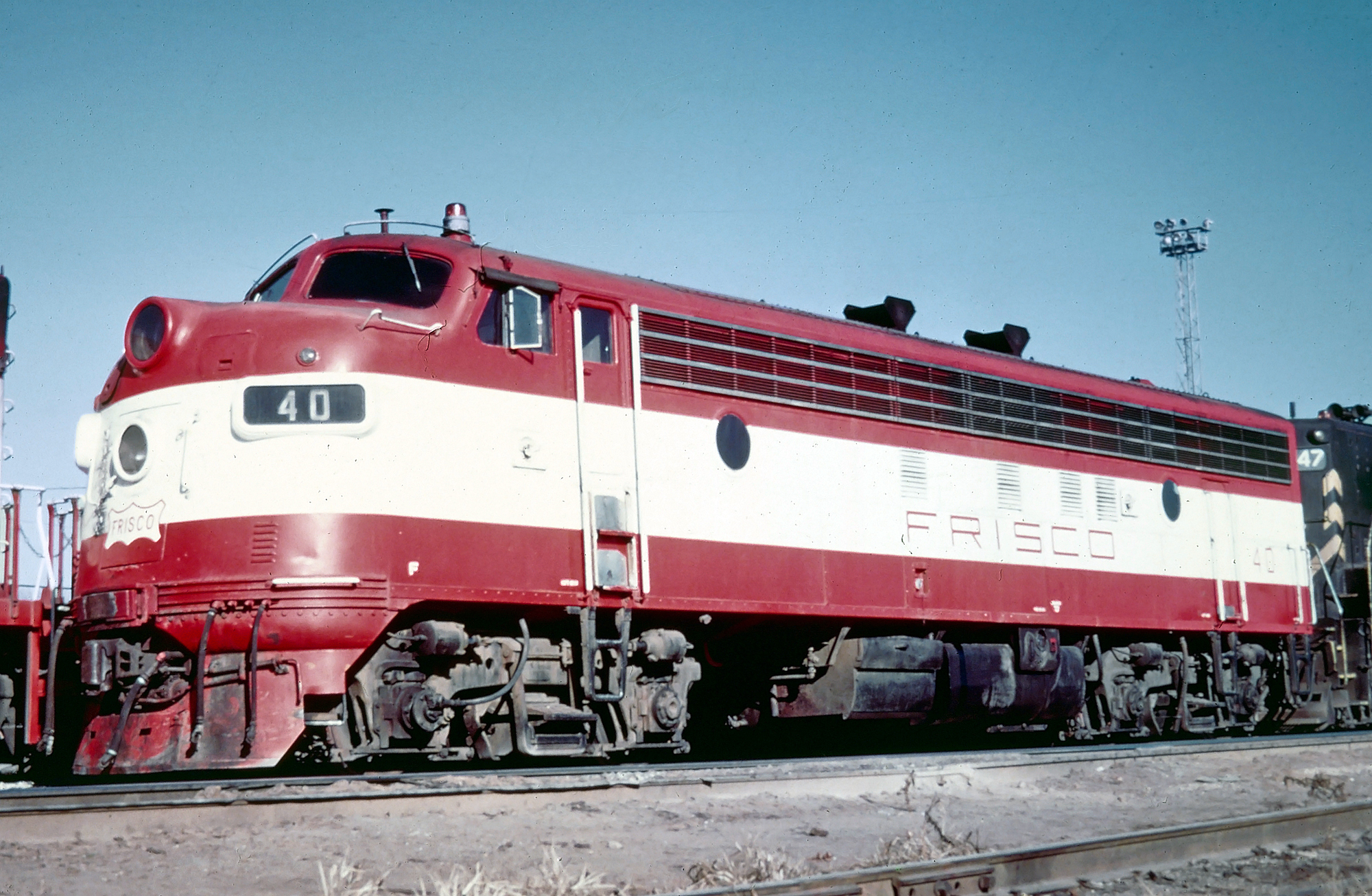 St. Louis-San Francisco ("Frisco") FP7 #40 (built as #5040) is seen here at the engine terminal in Springfield, Missouri, circa 1968. American-Rails.com collection.
Preservation
A little more than two dozen railroads bought the FP7 along with foreign lines Arabian American Oil Company and Ferrocarriles Nacionales de México. For General Motors Diesel, it sold another 57 to the Canadian Pacific and Ontario Northland Railway.
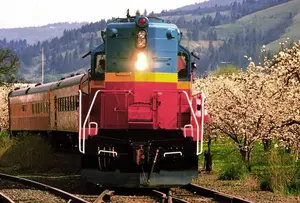
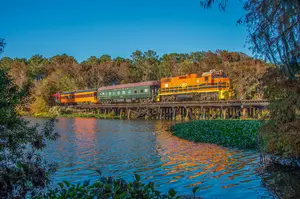
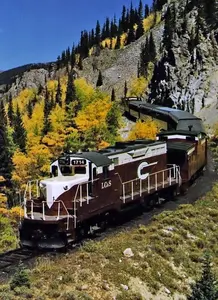
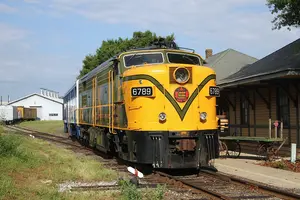
Interestingly today, numerous FP7s remain preserved, many still operable in excursion service. Tourist railroads like the West Virginia Central, Stone Mountain Railroad, and Verde Canyon Railroad all use FP7s.
Additionally, R.J. Corman operate a few on its dinner train and the Canadian Pacific uses a fleet to power the luxurious Royal Canadian Pacific train.
Sources
- Foster, Gerald. A Field Guide To Trains. New York: Houghton Mifflin, 1996.
- Hayden, Bob. Diesel Locomotives: Cyclopedia, Volume 2 (Model Railroader). Milwaukee: Kalmbach Publishing Company, 1980.
- Marre, Louis A. Diesel Locomotives: The First 50 Years, A Guide To Diesels Built Before 1972. Milwaukee: Kalmbach Publishing Company, 1995.
- Pinkepank, Jerry A. Diesel Spotter's Guide. Milwaukee: Kalmbach Publishing Company, 1967.
- Solomon, Brian. EMD Locomotives. Minneapolis: MBI Publishing Company, 2006.
- Solomon, Brian. Electro-Motive E-Units and F-Units: The Illustrated History of North America's Favorite Locomotives. Minneapolis: Voyageur Press, 2011.
Recent Articles


-
Seaboard Coast Line Timetables (September, 1968)
Apr 21, 26 11:47 PM
 This article highlights the Seaboard Coast Line's complete listing in the September, 1968 issue of "The Official Guide of the Railways."
 -
Rock Island Public Timetables (1952)
Apr 21, 26 11:32 PM
 The information presented here highlights the Rock Island's August, 1952 public timetable in the "Official Guide Of The Railways."
 -
Erie Lackawanna Diesel Roster: All-Time
Apr 21, 26 09:52 PM
 The Erie Lackawanna was a classic railroad which linked New Jersey with Chicago from 1960-1976. This article highlights its eclectic diesel roster.
 -
Chesapeake & Ohio Timetables (March, 1940)
Apr 21, 26 12:55 PM
 The information presented here features the Chesapeake & Ohio timetables listed in the March, 1940 "Official Guide of the Railways."
 -
Oregon Dinner Train Rides At Hood River (2026)
Apr 21, 26 10:33 AM
 The Mt. Hood Railroad is the moving part of that postcard—a century-old short line that began as a working railroad.
 -
Maryland Dinner Train Rides At Cumberland (2026)
Apr 21, 26 10:31 AM
 The Western Maryland Scenic Railroad (WMSR) has become one of the Mid-Atlantic’s signature heritage operations—equal parts mountain railroad, living museum, and “special-occasion” night out.
 -
Massachusetts Dinner Train Rides At Cape Cod (2026)
Apr 21, 26 10:29 AM
 The Cape Cod Central Railroad (CCCR) has carved out a special niche by pairing classic New England scenery with old-school hospitality, including some of the best-known dining train experiences in the…
 -
South Dakota Beer Tasting Train Rides (2026)
Apr 21, 26 10:28 AM
 While the 1880 Train's regular runs are a treat in any season, the Oktoberfest Express adds an extra layer of fun: German-inspired food, seasonal beer, and live polka set against the sound and spectac…
 -
New Mexico Wine Tasting Train Rides (2026)
Apr 21, 26 10:21 AM
 For oenophiles and adventure seekers alike, wine tasting train rides in New Mexico provide a unique opportunity to explore the region's vineyards in comfort and style.
 -
Connecticut Whiskey Tasting Train Rides (2026)
Apr 21, 26 10:20 AM
 While the Naugatuck Railroad runs a variety of trips throughout the year, one event has quickly become a “circle it on the calendar” outing for fans of great food and spirited tastings: the BBQ & Bour…
 -
American Freedom Train 250 Project Suspended
Apr 21, 26 09:42 AM
 Plans to revive one of America’s most iconic traveling exhibits—the American Freedom Train—for the nation’s 250th anniversary have officially been abandoned, organizers confirmed in mid-April.
 -
Chesapeake & Ohio Timetables (August, 1952)
Apr 20, 26 11:03 PM
 Presented here is the C&O's complete timetable listing in the August, 1952 "Official Guide."
 -
Northern Pacific Timetables (August, 1952)
Apr 20, 26 10:46 PM
 Presented here is Northern Pacific's public timetables from the August, 1952 edition of "The Official Guide Of The Railways."
 -
Chicago Great Western Timetables (August, 1952)
Apr 20, 26 02:30 PM
 Presented here is Chicago Great Western's public timetables from the August, 1952 edition of the "Official Guide."
 -
Rhode Island Dinner Train Rides In Portsmouth (2026)
Apr 20, 26 09:43 AM
 Despite its small size, Rhode Island is home to one popular dinner train experience where guests can enjoy the breathtaking views of Aquidneck Island.
 -
Maine Dinner Train Rides At Portland (2026)
Apr 20, 26 09:40 AM
 While this isn’t generally a “dinner train” railroad in the traditional sense—no multi-course meal served en route—Maine Narrow Gauge does offer several popular ride experiences where food and drink a…
 -
Maryland Murder Mystery Dinner Train Rides (2026)
Apr 20, 26 09:38 AM
 Maryland is known for its scenic landscapes, historical landmarks, and vibrant culture, but did you know that it’s also home to some of the most thrilling murder mystery dinner trains?
 -
Minnesota Murder Mystery Dinner Train Rides (2026)
Apr 20, 26 09:34 AM
 Murder mystery dinner trains offer an enticing blend of suspense, culinary delight, and perpetual motion, where passengers become both detectives and dining companions on an unforgettable journey.
 -
Ohio Wine Tasting Train Rides (2026)
Apr 20, 26 09:32 AM
Among the intriguing ways to experience Ohio's splendor is aboard the wine tasting trains that journey through some of Ohio's most picturesque vineyards and wineries. -
Pennsylvania Wine Tasting Train Rides (2026)
Apr 20, 26 09:31 AM
 Wine tasting trains are a unique and enchanting way to explore the state’s burgeoning wine scene while enjoying a leisurely ride through picturesque landscapes.
 -
GM&O Railroad Timetables (April, 1948)
Apr 19, 26 09:21 PM
 Featured here is the Gulf, Mobile & Ohio's public timetables from the April, 1948 issue of the "Official Guide."
 -
Monon Timetables (August, 1952)
Apr 19, 26 04:21 PM
 Highlighted here is the Monon's brief public timetables presented in the August, 1952 issue of the "Official Guide.
 -
Western Maryland Timetables (August, 1952)
Apr 19, 26 12:10 PM
 Western Maryland's public timetables presented in the August, 1952 issue of "The Official Guide Of The Railways."
 -
Nevada Dinner Train Rides From Ely (2026)
Apr 19, 26 10:38 AM
 If you’ve ever wished you could step through a time portal into the hard-working world of a 1900s short line the Nevada Northern Railway in Ely is about as close as it gets.
 -
Michigan Dinner Train Rides In Owosso (2026)
Apr 19, 26 10:36 AM
 The Steam Railroading Institute is best known as the home of Pere Marquette #1225 and even occasionally hosts a dinner train!
 -
West Virginia Wine Tasting Train Rides (2026)
Apr 19, 26 10:34 AM
 West Virginia, often celebrated for its breathtaking landscapes and rich history, offers visitors a unique way to explore its rolling hills and picturesque vineyards: wine tasting trains.
 -
Utah Wine Tasting Train Rides (2026)
Apr 19, 26 10:32 AM
 Utah, a state widely celebrated for its breathtaking natural beauty and dramatic landscapes, is also gaining recognition for an unexpected yet delightful experience: wine tasting trains.
 -
Georgia Murder Mystery Dinner Train Rides (2026)
Apr 19, 26 10:30 AM
 In the heart of the Peach State, a unique form of entertainment combines the thrill of a murder mystery with the charm of a historic train ride.
 -
Colorado Murder Mystery Dinner Train Rides (2026)
Apr 19, 26 10:03 AM
 Nestled among the breathtaking vistas and rugged terrains of Colorado lies a unique fusion of theater, gastronomy, and travel—a murder mystery dinner train ride.
 -
Soo Line Timetables (August, 1952)
Apr 19, 26 12:11 AM
 The information presented here features the Soo Line's complete listing in the August, 1952 edition of the "Official Guide."
 -
Rio Grande Timetables (1940 and 1952)
Apr 18, 26 11:57 PM
 Presented here is the Rio Grande's public timetables from the 1940 and 1952 "Official Guide."
 -
Kentucky Dinner Train Rides From Bardstown (2026)
Apr 18, 26 11:01 AM
 The essence of My Old Kentucky Dinner Train is part restaurant, part scenic excursion, and part living piece of Kentucky rail history.
 -
Arizona Dinner Train Rides In Williams (2026)
Apr 18, 26 10:54 AM
 While the Grand Canyon Railway does not offer a true, onboard dinner train experience it does offer several upscale options and off-train dining.
 -
Michigan Beer Tasting Train Rides (2026)
Apr 18, 26 10:51 AM
 If you’re looking for a pure slice of autumn in West Michigan, the Coopersville & Marne Railway (C&M) has a themed excursion that fits the season perfectly: the Oktoberfest Express Train.
 -
South Dakota Murder Mystery Dinner Train Rides (2026)
Apr 18, 26 10:47 AM
 While the state currently does not offer any murder mystery dinner train rides, the popular 1880 Train at the Black Hills Central recently hosted these popular trips!
 -
Wisconsin Murder Mystery Dinner Train Rides (2026)
Apr 18, 26 10:45 AM
 Whether you're a fan of mystery novels or simply relish a night of theatrical entertainment, Wisconsin's murder mystery dinner trains promise an unforgettable adventure.
 -
Vermont Wine Tasting Train Rides (2026)
Apr 18, 26 10:39 AM
 Known for its stunning green mountains, charming small towns, and burgeoning wine industry, Vermont offers a unique experience that seamlessly blends all these elements: wine tasting train rides.
 -
Rhode Island Wine Tasting Train Rides (2026)
Apr 18, 26 10:34 AM
 It may the smallest state but Rhode Island is home to a unique and upscale train excursion offering wide aboard their trips, the Newport & Narragansett Bay Railroad.
 -
Seaboard Air Line Timetables (August, 1952)
Apr 17, 26 11:30 PM
 Presented here is Seaboard Air Line's public timetables featured in the August, 1952 edition of the "Official Guide." The SAL had a significant presence in the the publication.
 -
Reading Railroad Timetables (August, 1952)
Apr 17, 26 11:08 PM
 The information presented here covers the Reading Railroad's listing in the August, 1952 edition of the "Official Guide of the Railways."
 -
Burlington (CB&Q) Timetables: August, 1952
Apr 17, 26 09:47 PM
 Presented here is the Chicago, Burlington & Quincy's public timetables listed in the August, 1952 edition of the "Official Guide."
 -
Louisville & Nashville Timetables (August, 1952)
Apr 17, 26 09:27 PM
 Presented here is the Louisville & Nashville's public timetables from the August, 1952 issue of the "Official Guide."
 -
Erie Lackawanna Timetables (May, 1962)
Apr 17, 26 02:48 PM
 From the early Erie Lackawanna era, presented here is the railroad's public timetables from the May, 1962 issue of "The Official Guide Of The Railways."
 -
Katy Railroad (MKT) Timetables: August, 1952
Apr 17, 26 02:28 PM
 Presented here is the Missouri-Kansas-Texas Railroad's, better known as the Katy, public timetables from the August, 1952 issue of the "Official Guide."
 -
Kansas Dinner Train Rides From Abilene (2026)
Apr 17, 26 01:46 PM
 If you’re looking for a heritage railroad that feels authentically Kansas—equal parts prairie scenery, small-town history, and hands-on railroading—the Abilene & Smoky Valley Railroad delivers.
 -
Georgia Dinner Train Rides At Nashville (2026)
Apr 17, 26 01:42 PM
If you’ve ever wished you could slow down, trade traffic for jointed rail, and let a small-town landscape roll by your window while a hot meal is served at your table, the Azalea Sprinter delivers tha… -
Illinois Dinner Train Rides At The MRM (2026)
Apr 17, 26 01:38 PM
 The Monticello Railway Museum (MRM) is one of those places that quietly does a lot: it preserves a sizable collection, maintains its own operating railroad, and—most importantly for visitors—puts hist…
 -
Vermont Dinner Train Rides At Burlington (2026)
Apr 17, 26 01:34 PM
 There is one location in Vermont hosting a dedicated dinner train experience at the Green Mountain Railroad.
 -
Connecticut Dinner Train Rides At Essex (2026)
Apr 17, 26 01:31 PM
 Connecticut's rail heritage can be traced back to the industry's earliest days and a few organizations preserve this rich history by offering train rides. The Essex Steam Train also hosts dinner-theme…
 -
Minnesota Dinner Train Rides At Duluth (2026)
Apr 17, 26 01:27 PM
 One of the best ways to feel the region's history in motion today is aboard the North Shore Scenic Railroad (NSSR), which operates out of Duluth’s historic depot.








%20FP7%20%2340%20(built%20as%20%235040)%20is%20seen%20here%20at%20the%20engine%20terminal%20in%20Springfield%2C%20Missouri%2C%20circa%201968.%20%20American-Rails.com%20collection.)