EMD "SD60" Locomotives: Data Sheet, Specs, Roster
Last revised: December 18, 2024
By: Adam Burns
Debuting in the mid-1980s, the SD60 represented EMD's concerted effort to rectify the shortcomings of the SD50, which had been plagued by reliability issues and lackluster sales. While the SD60 bore a striking external resemblance to its predecessor, it boasted significant internal improvements, including an upgraded prime mover and modernized equipment.
Although the initial model achieved only modest sales figures, its various iterations proved far more successful, ultimately surpassing 1,000 units produced by the time production ceased in the mid-1990s. This resurgence proved pivotal for EMD, enabling the company to maintain its competitive edge against rival General Electric and, arguably, avert a near-total market share collapse.
The SD60's success paved the way for its successor, the SD70 series. While this new model did not fully restore EMD's dominance in the industry, it nonetheless proved to be a successful design, selling over 2,000 units and further solidifying EMD's position as a major player in the locomotive market.
Photos
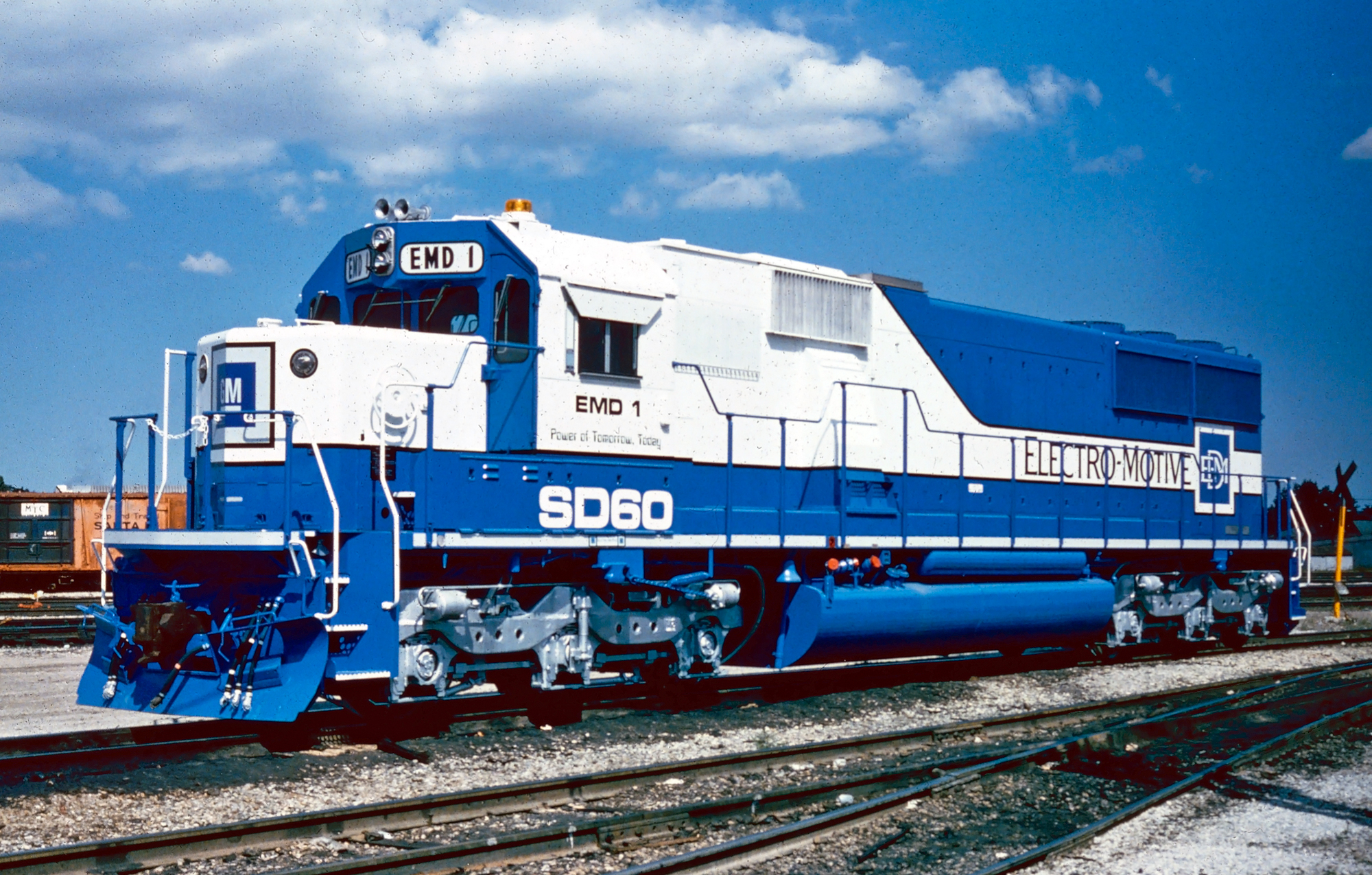 Seen here is Electro-Motive demonstrator EMD-1 in the summer of 1984. This unit became Conrail 6840. Mike Bledsoe photo. American-Rails.com collection.
Background
By the 1980s, La Grange's reputation for building dependable locomotives began to falter, and the SD50 played a significant role in this shift.
EMD, in a bold move, attempted to extract the same horsepower from its 16-cylinder, 645 engine as it did from the larger 20-cylinder, 645E3 power plant found in the SD45.
This ambitious approach, however, raised concerns within the industry. The SD50, as some feared, did encounter mechanical issues, a consequence of pushing the smaller engine to its absolute limits. Despite these challenges, the model managed to achieve a respectable sales figure of over 400 units during its abbreviated production run.
The SD60, which entered production in the spring of 1984, represented EMD's strategic response to the challenges posed by its predecessor.
Determined to deliver a more robust and reliable locomotive, EMD equipped the SD60 with its latest technological advancement: the 16-cylinder model 710G prime mover. This powerful engine boasted an impressive 3,800 horsepower, firmly positioning the SD60 as a heavy-haul and drag service powerhouse.
The SD60 featured GM's innovative D87B traction motor, delivering a remarkable 98,250 pounds of starting and 100,000 pounds of continuous tractive effort.
This represented a substantial increase over not only the troubled SD50 but also the venerable SD38 and SD40 series, which typically offered tractive effort ratings in the 80,000 to 90,000-pound range.
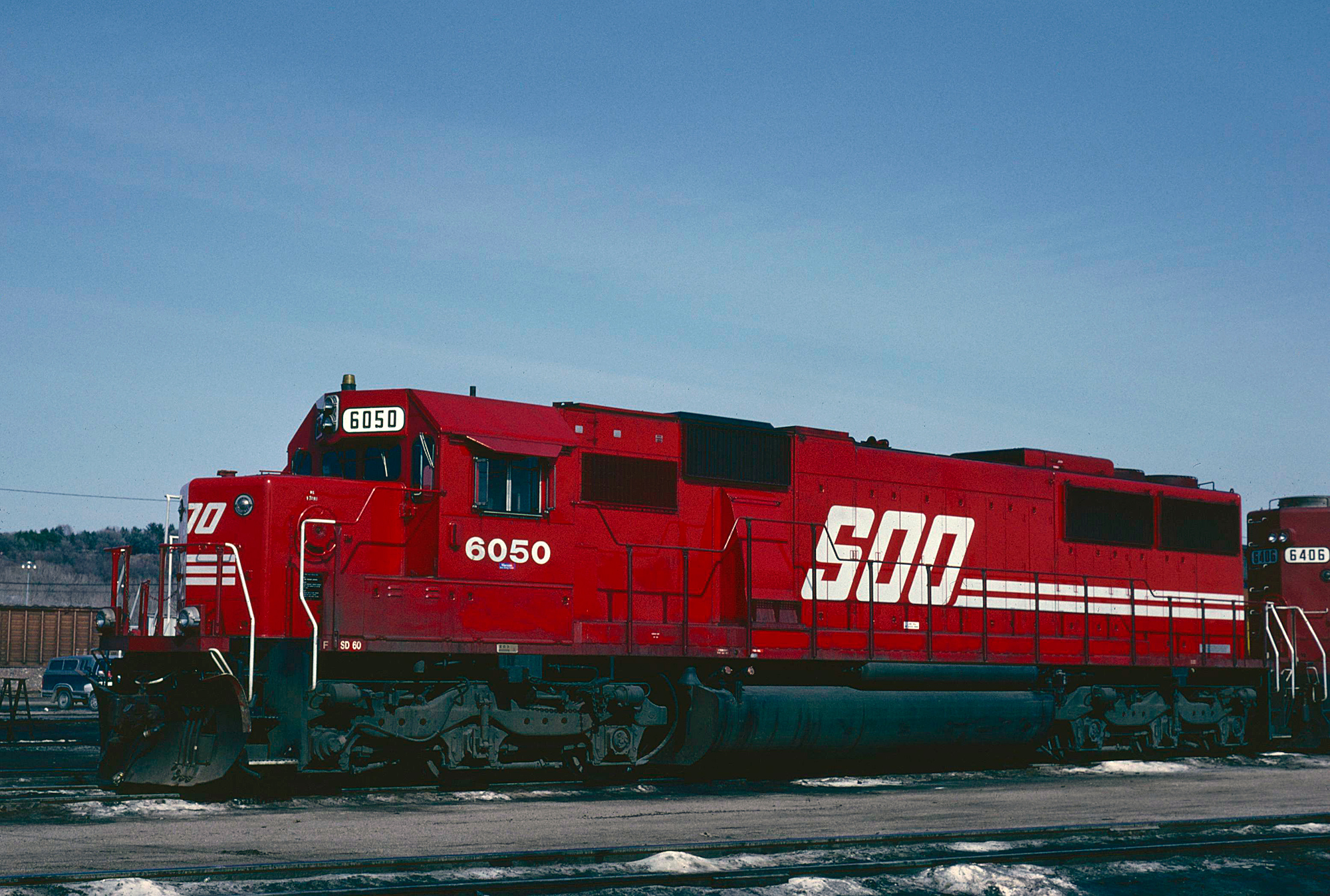 Soo Line SD60 #6050 was photographed here by Jim Shepard at St. Paul, Minnesota on March 19, 1992. American-Rails.com collection.
Despite being a significant improvement over the SD50 in terms of reliability and ease of maintenance, the original SD60 garnered only modest sales figures, particularly when compared to the competing offerings from General Electric at the time.
A mere 537 units were purchased by eight Class I railroads—Burlington Northern, CSX, Conrail, Chicago & North Western, Kansas City Southern, Norfolk Southern, Soo Line, and Union Pacific—along with a leasing firm (an additional four units were built directly by EMD). Canadian National also acquired 64 units featuring the distinctive "cowl" carbody, designated as SD60Fs.
These underwhelming sales numbers can likely be attributed to a lingering hesitancy within the industry towards EMD products following the widely publicized issues that plagued the SD50.
Ironically, the SD60 itself proved to be a mechanically sound and relatively low-maintenance locomotive. This inherent quality, however, would be more fully realized in the model's subsequent variants, which enjoyed significantly greater commercial success.
SD60M
The most successful variant was the SD60M; the "M" designated the model featuring the then-new wide "safety" cab that would eventually become standard across the industry.
Four Class Is purchased the SD60M including the Burlington Northern, Conrail, Soo, and Union Pacific. Among these four, 460 examples were produced between 1989-1993.
SD60I and SD60MAC
EMD also built an SD60I for Conrail, which purchased 81 units. The "I" designation stood for "isolated cab", also known as a whisper cab as it was meant to greatly reduce engine noise and vibrations for the crew by literally isolating the cab from the frame of the locomotive.
It should also be noted that EMD built four SD60MAC units (the "AC" referred to the model having alternating-current traction motors) as demonstrators for a new variant of the model.
While tested on the Burlington Northern, none were built, and the first AC model EMD released and ultimately cataloged was the SD70MAC.
Data Sheet and Specifications
| Entered Production | 5/1984 (Demonstrator #1) |
| Years Produced (SD60) | 5/1984 - 5/1991 |
| Years Produced (SD60M) | 1/1989 - 6/1993 |
| Years Produced (SD60I) | 4/1993 - 9/1995 |
| Years Produced (SD60MAC) | 6/1991 - 9/1992 |
| Engine | 710G |
| Engine Builder | GM |
| Horsepower | 3800 |
| RPM | 904 |
| Cylinders | 16 |
| Length | 71' 2" |
| Height (Top Of Rail To Top Of Cab) | 15' 7 ½" |
| Width | 10' 3" |
| Weight | 368,000 Lbs |
| Fuel Capacity | 3500 Gallons |
| Air Compressor | Gardner-Denver |
| Air Compressor Model | WBO |
| Air Brake Manufacturer | Westinghouse |
| Air Brake Schedule | 26L |
| Trucks | C-C |
| Truck Type | HT-C |
| Truck Wheelbase | 13' 7" |
| Wheel Size | 40" |
| Traction Motors | D87B (6), GM |
| Primary Generator | AR11, GM |
| Auxiliary Generator | Delco (A8102) |
| Alternator | GMD18 |
| MU (Multiple-Unit) | Yes |
| Dynamic Brakes | Yes |
| Gear Ratio | 77:17 |
| Tractive Effort (Starting) | 98,250 Lbs at 25% |
| Tractive Effort (Continuous) | 100,000 Lbs at 9.8 mph |
| Top Speed | 70 mph |
Production Rosters
SD60
Total Built = 537
| Owner | Road Number(s) | Serial Number(s) | Order Number | Completion Date |
|---|---|---|---|---|
| Electro-Motive (Demonstrators) | 1-4 (1, 2, 4 became Conrail #6840-6842) | 836054-1 thru 836054-4 | 836054 | 5/1984-7/1984 |
| Norfolk Southern | 6550-6553 | 836069-1 thru 836069-4 | 836069 | 12/1984 |
| Norfolk Southern | 6564-6603 | 847023-1 thru 847023-40 | 847023 | 7/1985-10/1985 |
| Union Pacific | 6000-6059 | 847028-1 thru 847028-60 | 847028 | 4/1986-6/1986 |
| Norfolk Southern | 6554-6563 | 847051-1 thru 847051-10 | 847051 | 6/1985-7/1985 |
| Burlington Northern | 8300-8302 | 847070-1 thru 847070-3 | 847070 | 11/1985 |
| Norfolk Southern | 6604-6628 | 857107-1 thru 857107-25 | 857107 | 2/1986-3/1986 |
| Norfolk Southern | 6629-6640 | 857124-1 thru 857124-12 | 857124 | 6/1986-8/1986 |
| Norfolk Southern | 6641-6650 | 857125-1 thru 857125-10 | 857125 | 8/1986 |
| Chicago & North Western | 8001-8055 | 867147-1 thru 867147-55 | 867147 | 8/1986-10/1986 |
| Oakway Inc. | 9000-9099 | 867150-1 thru 867150-100 | 867150 | 10/1986-12/1986 |
| Soo Line | 6000-6020 | 867164-1 thru 867164-21 | 867164 | 8/1987-11/1987 |
| Norfolk Southern | 6651-6665 | 877025-1 thru 877025-15 | C472 (built at GMDD) | 11/1988-12/1988 |
| Norfolk Southern | 6666-6675 | 877026-1 thru 877026-10 | C472 (built at GMDD) | 12/1988 |
| Union Pacific | 6060-6084 | 876030-1 thru 876030-25 | 876030 | 2/1988-6/1988 |
| Conrail | 6843-6867 | 886006-1 thru 886006-25 | 886006 | 8/1989-9/1989 |
| Kansas City Southern | 714-723 | 886014-1 thru 886014-10 | 886014 | 11/1989-12/1989 |
| Soo Line | 6042-6057 | 886019-1 thru 886019-16 | C485 (built at GMDD) | 10/1989-11/1989 |
| CSX Transportation | 8700-8709 | 886031-1 thru 886031-10 | 886031 | 10/1989-11/1989 |
| Soo Line | 6021-6041 | 897003-1 thru 897003-21 | C479 (built at GMDD) | 3/1989-4/1989 |
| Kansas City Southern | 724-735 | 896028-1 thru 896028-12 | 896028 (built at GMDD) | 11/1990-12/1990 |
| Norfolk Southern | 6676-6695 | 897056-1 thru 897056-20 | 897056 (built at GMDD) | 11/1990-12/1990 |
| Norfolk Southern | 6696 | 897057-1 | 897057 (built at GMDD) | 12/1990 |
| Kansas City Southern | 736-759 | 906114-1 thru 906114-24 | 906114 (built at GMDD) | 3/1991-4/1991 |
| Norfolk Southern | 6697-6700 | 907147-1 thru 907147-4 | 907147 (built at GMDD) | 5/1991 |
SD60M (Built at GMDD)
Total Built = 460
| Owner | Road Number(s) | Serial Number(s) | Order Number | Completion Date |
|---|---|---|---|---|
| Union Pacific | 6085-6109 | 886010-1 thru 886010-25 | C474 | 1/1989-2/1989 |
| Union Pacific | 6110-6159 | 886015-1 thru 886015-50 | C482 | 4/1989-5/1989 |
| Union Pacific | 6160-6209 | 886023-1 thru 886023-50 | C482 | 6/1989-7/1989 |
| Burlington Northern | 9200-9249 | 887033-1 thru 887033-50 | C491 | 12/1989-3/1990 |
| Union Pacific | 6210-6215 | 886036-1 thru 886036-6 | C482 | 6/1989 |
| Soo Line | 6058-6062 | 886055-1 thru 886055-5 | C494 | 11/1989 |
| Union Pacific | 6216-6267 | 886061-1 thru 886061-52 | C497 | 9/1990-11/1990 |
| Burlington Northern | 9250-9298, 1991 | 897049-1 thru 897049-50 | C493 | 1/1991-3/1991 |
| Union Pacific | 6268 | 896050-1 | 896050 | 12/1990 |
| Union Pacific | 6269-6315 | 906100-1 thru 906100-47 | 906100 | 11/1991-4/1992 |
| Conrail | 5500-5529 | 916246-1 thru 916246-30 | 916246 | 12/1992-2/1993 |
| Union Pacific | 6316-6365 | 926302-1 thru 926302-50 | 926302 | 8/1992-10/1992 |
| Conrail | 5530-5543 | 926330-1 thru 926330-14 | 926330 | 3/1993 |
| Conrail | 5545-5574 | 936400-1 thru 936400-30 | 936400 | 4/1993-6/1993 |
SD60I (Built at GMDD)
Total Built = 81
| Owner | Road Number(s) | Serial Number(s) | Completion Date |
|---|---|---|---|
| Conrail | 5544 | 926331-1 | 4/1993 |
| Conrail | 5575-5614 | 946506-1 thru 946506-40 | 12/1994-4/1995 |
| Conrail | 5615-5654 | 946530-1 thru 946530-40 | 3/1995-9/1995 |
SD60MAC
Total Built = 4
| Owner | Road Numbers | Serial Numbers | Completion Date |
|---|---|---|---|
| Burlington Northern | 9500-9501 | 896011-1 thru 896011-2 | 6/1991 |
| Burlington Northern | 9502-9503 (built by GMDD) | 906127-1 thru 906127-2 | 6/1992, 9/1992 |
General Motors Diesel Division (GMDD)
Total Built = 64
| Owner | Road Numbers | Serial Numbers | Completion Date | |
|---|---|---|---|---|
| Canadian National | 9900-9903 | A4468-A4471 | C448 | 8/1985-10/1985 |
| Canadian National | 5504-5523 | A4709-A4728 | C480 | 2/1989-3/1989 |
| Canadian National | 5524-5563 | A4761-A4800 | C480 | 8/1989-11/1989 |
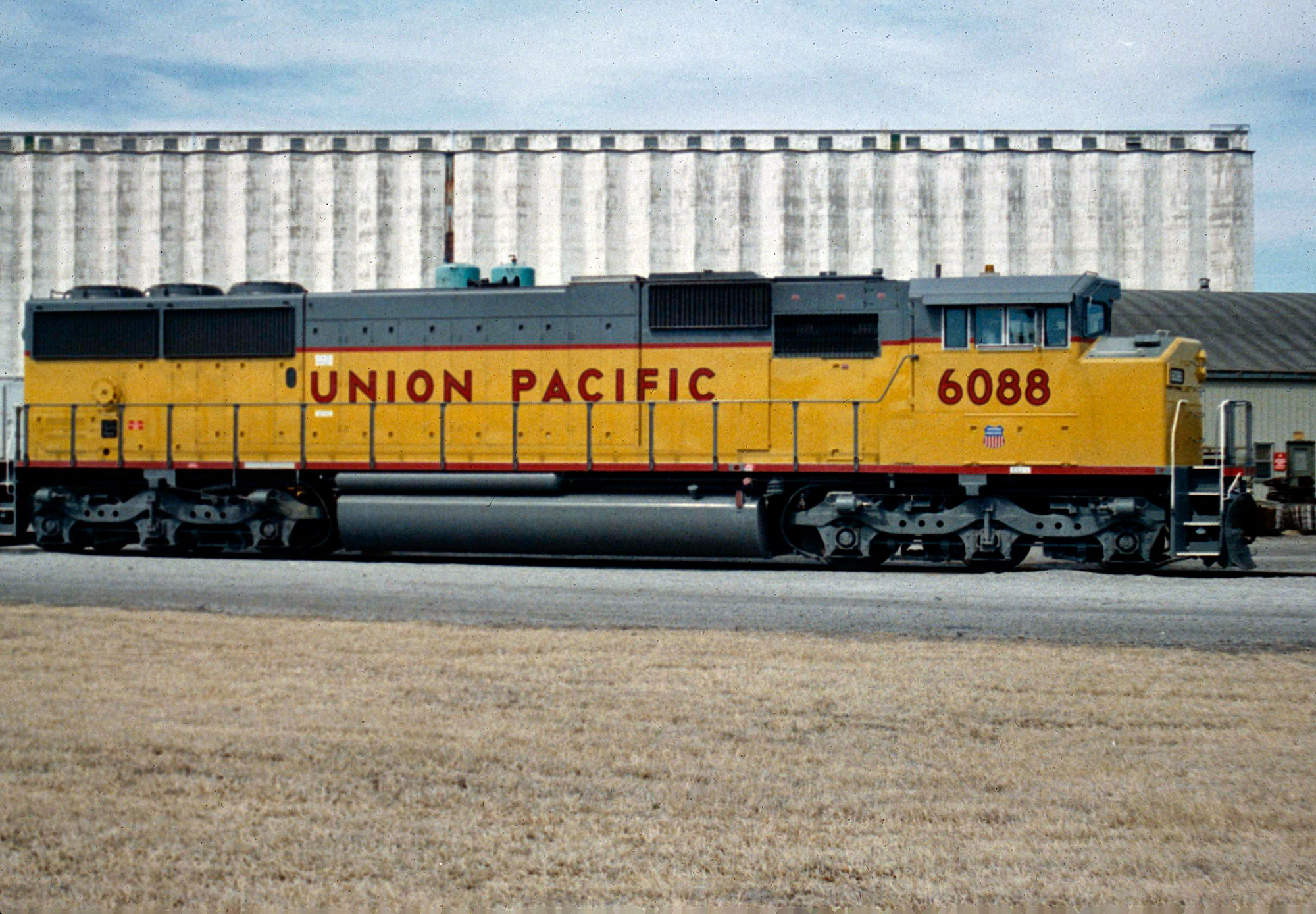 Union Pacific SD60M #6088 is seen here in February, 1990. Location not listed. American-Rails.com collection.
It should be noted that there was another variant known as the SD60MAC. This model was essentially an SD60M that used alternating current (AC) traction motors and EMD constructed four that tested on Burlington Northern.
Today, while many original SD60s have been retired or rebuilt into newer models, a significant number remain in service. Their robust design and proven reliability have ensured their longevity, with some units logging millions of miles over their lifespan. Many railroads continue to utilize SD60s for mainline freight duties, while others have relegated them to secondary lines or local switching operations.
Sources
- Foster, Gerald. A Field Guide To Trains. New York: Houghton Mifflin, 1996.
- Marre, Louis A. and Pinkepank, Jerry A. Contemporary Diesel Spotter's Guide, The: A Comprehensive Reference Manual To Locomotives Since 1972. Milwaukee: Kalmbach Publishing Company, 1989.
- Marre, Louis A. Contemporary Diesel Spotter's Guide, The: A Comprehensive Reference Manual To Locomotives Since 1972, Including Rebuilding, Upgrading, And Leasing Programs (2nd Edition). Milwaukee: Kalmbach Publishing Company, 1995.
- McDonnell, Greg. Locomotives: The Modern Diesel & Electric Reference, 2nd Edition. Buffalo: Boston Mills Press/Firefly Books, 2015.
- Solomon, Brian. American Diesel Locomotive, The. Osceola: MBI Publishing, 2000.
- Solomon, Brian. EMD Locomotives. Minneapolis: MBI Publishing Company, 2006.
- Solomon, Brian. GE and EMD Locomotives: The Illustrated History. Minneapolis: Voyageur Press, 2014.
Recent Articles


-
Pennsylvania Independence Day Train Rides
May 25, 26 11:58 AM
 Pennsylvania’s rich railroad heritage comes alive every Independence Day, but 2026—the nation’s semiquincentennial—offers extra patriotic flair.
 -
Ohio 'Wild West' Train Rides
May 25, 26 11:40 AM
 For those enamored with tales of the Old West, Ohio's railroad experiences offer a unique blend of history, adventure, and natural beauty.
 -
New York 'Wild West' Train Rides
May 25, 26 11:37 AM
 Join us as we explore wild west train rides in New York, bringing history to life and offering a memorable escape to another era.
 -
Kentucky "Father's Day" Train Rides
May 25, 26 11:34 AM
 Kentucky offers a variety of historic and scenic train excursions that provide an unforgettable way to honor and spend quality time with fathers.
 -
Kansas "Father's Day" Train Rides
May 25, 26 11:33 AM
 In this guide, we'll explore some of the best train rides available for Father's Day in Kansas.
 -
Vermont Independence Day Train Rides
May 25, 26 11:21 AM
 On Independence Day, elements come together to offer a unique experience in Vermont: train rides that combine scenic beauty with patriotic celebrations.
 -
Georgia Independence Day Train Rides
May 24, 26 12:26 PM
 As the 4th of July approaches in 2026, the Blue Ridge Scenic Railway in Blue Ridge, Georgia, invites you to celebrate America in true patriotic style aboard its Firecracker Special.
 -
Illinois Independence Day Train Rides
May 24, 26 11:58 AM
 As America gears up for the 4th of July in 2026, the Illinois Railway Museum (IRM) in Union, Illinois, offers the perfect blend of patriotic festivities, family-friendly excitement, and living railroa…
 -
Alabama Independence Day Train Rides
May 24, 26 11:55 AM
 For those seeking a unique way to celebrate the Fourth of July, Alabama offers a distinctive experience: honoring veterans and active military personnel on Independence Day by train.
 -
Ohio Independence Day Train Rides
May 24, 26 11:47 AM
 In this guide, we will explore some of the best Independence Day train ride experiences available in Ohio.
 -
Alabama 'Wild West' Train Rides
May 24, 26 11:45 AM
 Although Alabama isn't the traditional setting for Wild West tales, the state provides its own flavor of historic rail adventures that draw enthusiasts year-round.
 -
Missouri 'Wild West' Train Rides
May 24, 26 11:29 AM
 In Missouri, a state rich in history and natural beauty, you can experience the thrill of a bygone era through the scenic and immersive Wild West train rides.
 -
Indiana 'Wild West' Train Rides
May 24, 26 11:27 AM
 Indiana offers a unique opportunity to experience the thrill of the Wild West through its captivating train rides.
 -
Independence Day Train Rides (2026): A Complete Guide
May 24, 26 11:25 AM
 Americans celebrate Independence Day with fireworks, barbecues, and parades, but there's another unique way to experience the spirit of freedom: train rides.
 -
Illinois 'Father's Day' Train Rides
May 24, 26 11:23 AM
 If you're in Illinois and searching for something distinctive, consider taking your dad on a train ride through the picturesque landscapes of the Prairie State.
 -
Florida 'Father's Day' Train Rides
May 24, 26 11:21 AM
 For those looking for something a little different this year, why not consider celebrating dad on Father's Day by train?
 -
South Dakota 'Beer Tasting' Train Rides
May 23, 26 12:51 PM
 While the 1880 Train's regular runs are a treat in any season, the Oktoberfest Express adds an extra layer of fun: German-inspired food, seasonal beer, and live polka set against the sound and spectac…
 -
Michigan 'Beer Tasting' Train Rides
May 23, 26 12:49 PM
 If you’re looking for a pure slice of autumn in West Michigan, the Coopersville & Marne Railway (C&M) has a themed excursion that fits the season perfectly: the Oktoberfest Exp…
 -
Indiana 'Murder Mystery' Dinner Train Rides
May 23, 26 12:47 PM
 This piece explores the allure of murder mystery trains and why they are becoming a must-try experience for enthusiasts and casual travelers alike.
 -
Maryland 'Ice Cream' Tasting Train Rides
May 23, 26 12:46 PM
 Among WMSR's shorter outings, one event punches well above its “simple fun” weight class: the Ice Cream Train.
 -
Colorado 'Father's Day' Train Rides
May 23, 26 12:43 PM
 With its rugged mountains, rich railroading history, and picturesque landscapes, Colorado sets the perfect stage for a memorable Father's Day outing aboard a vintage train.
 -
California 'Father's Day' Train Rides
May 23, 26 12:41 PM
 Celebrate and honor dad by train on a scenic rail experience! Find out which locations in California host these unique trips.
 -
Kentucky 'Wine Tasting' Train Rides
May 23, 26 12:40 PM
 Kentucky, often celebrated for its rolling pastures, thoroughbred horses, and bourbon legacy, has been cultivating another gem in its storied landscapes; enjoying wine by rail.
 -
Florida 'Wine Tasting' Train Rides
May 23, 26 11:56 AM
 Wine by train not only showcases the beauty of Florida's lesser-known regions but also celebrate the growing importance of local wineries and vineyards.
 -
Southern 2-8-2 4501 Debuts In "Virginia Green"
May 23, 26 11:54 AM
 Southern Railway 2-8-2 #4501 debuted in its return to Virginia Green at the Tennessee Valley Railroad Museum today, May 23, 2026.
 -
NS Unveils First America250 Locomotive: 1776, "The Bell"
May 22, 26 11:15 PM
 On May 22, 2026 Norfolk Southern unveiled its first in the America250 heritage locomotives series, 1776, "The Bell".
 -
Reading & Northern Issues Safety Directive Ahead Of 4014 Visit
May 22, 26 12:01 PM
 With thousands of tickets sold for its upcoming series of Semiquincentennial Steam Celebration excursions, Reading & Northern Railroad is also anticipating thousands more trackside spectators to bear…
 -
Ohio 'Murder Mystery' Dinner Train Rides
May 22, 26 11:36 AM
The murder mystery dinner train rides in Ohio provide an immersive experience that combines fine dining, an engaging narrative, and the beauty of Ohio's landscapes. -
Tennessee 'Murder Mystery' Dinner Train Rides
May 22, 26 11:31 AM
 Amidst the rolling hills and scenic landscapes of Tennessee, an exhilarating and interactive experience awaits those with a taste for mystery and intrigue.
 -
Alabama 'Father's Day' Train Rides
May 22, 26 11:29 AM
 Alabama, with its rich railway heritage and scenic countryside, is a wonderful way to experience by train. One location even hosts a special trip for Father's Day!
 -
North Carolina 'Father's Day' Train Rides
May 22, 26 11:26 AM
 Celebrating dad on a scenic train in North Carolina can be found at the New Hope Valley Railway which hosts a special event for the day.
 -
Texas 'Wine Tasting' Train Rides
May 22, 26 11:25 AM
 This article invites you on a metaphorical journey through some of these unique wine tasting train experiences in Texas.
 -
New York 'Wine Tasting' Train Rides
May 22, 26 11:22 AM
This article will delve into the history, offerings, and appeal of wine tasting trains in New York, guiding you through a unique experience that combines the romance of the rails with the sophisticati… -
The Spirit of America: George H.W. Bush’s 1992 Campaign Train
May 22, 26 11:11 AM
 In the fading days of summer 1992, President George H. W. Bush embarked on a classic American political tradition: the whistle-stop tour.
 -
Burlington Northern Timetables (May, 1972)
May 21, 26 11:56 PM
 Presented here is the Burlington Northern's condensed freight timetables from the May, 1972 edition of the "Official Guide Of The Railways."
 -
Whiskey Tasting Train Rides (2026)
May 21, 26 11:12 PM
 These rides across the United States offer a sensory journey through lush landscapes and historical corridors, often pairing scenic vistas with curated whiskey tastings.
 -
Father's Day Train Ride Locations (2026)
May 21, 26 10:54 PM
Celebrate dad by train! Several heritage railroads and museums host trips honoring dads. Learn more about which locations offer such excursions. -
The Chessie Safety Express: Steam-Powered Advocacy for Railroad Safety
May 21, 26 10:44 PM
 In the fall of 1980, a gleaming Chesapeake & Ohio (C&O) 4-8-4 steam locomotive named No. 614 thundered across the rails of the Chessie System, pulling a colorful consist of passenger cars filled with…
 -
Frankfort and Cincinnati Railroad: "The Kentucky Midland Route"
May 21, 26 06:08 PM
 The Frankfort & Cincinnati was a small shortline located in north-central Kentucky that was known as "The Whiskey Route" for the many distilleries it served. The F&C shutdown in 1985.
 -
North Carolina 'Whiskey Tasting' Train Rides
May 21, 26 12:43 PM
 One of the GSMR's most distinctive special events is Spirits on the Rail, a bourbon-focused dining experience built around curated drinks and a chef-prepared multi-course meal.
 -
Connecticut 'Whiskey Tasting' Train Rides
May 21, 26 12:42 PM
 While the Naugatuck Railroad runs a variety of trips throughout the year, one event has quickly become a “circle it on the calendar” outing for fans of great food and spirited tastings: the BBQ & Bour…
 -
Kansas "Dinner" Train Rides From Abilene
May 21, 26 12:37 PM
 If you’re looking for a heritage railroad that feels authentically Kansas—equal parts prairie scenery, small-town history, and hands-on railroading—the Abilene & Smoky Valley Railroad delivers.
 -
Vermont "Dinner" Train Rides At Burlington
May 21, 26 12:34 PM
 There is one location in Vermont hosting a dedicated dinner train experience at the Green Mountain Railroad.
 -
New Jersey "Father's Day" Train Rides
May 21, 26 12:24 PM
 There are a few locations in New Jersey celebrating dads with a train ride. Learn more about these unique trips here!
 -
Massachusetts "Father's Day" Train Rides
May 21, 26 12:16 PM
 The Cape Cod Central is the one location in the state hosting an event just for dads, a special brunch train. Learn more here!
 -
Historic Steam Locomotive Heads To Charleston For America250 Exhibit
May 21, 26 11:58 AM
 A rare piece of West Virginia industrial history, an 0-4-0F fireless steam locomotive by H.K. Porter in 1945, is being installed near the West Virginia State Capitol Complex in Charleston as part of a…
 -
Connecticut 'Dinner' Train Rides At Essex
May 20, 26 11:55 AM
 Connecticut's rail heritage can be traced back to the industry's earliest days and a few organizations preserve this rich history by offering train rides. The Essex Steam Train also hosts dinner-theme…
 -
Arkansas 'Dinner 'Train Rides On The A&M
May 20, 26 11:54 AM
If you want a railroad experience that feels equal parts “working short line” and “time machine,” the Arkansas & Missouri Railroad delivers in a way few modern operations can. -
Illinois 'Dinner' Train Rides At The MRM
May 20, 26 11:52 AM
The Monticello Railway Museum (MRM) is one of those places that quietly does a lot: it preserves a sizable collection, maintains its own operating railroad, and—most importantly for visitors—puts hist… -
California 'Murder Mystery' Dinner Train Rides
May 20, 26 11:51 AM
 When it comes to experiencing the allure of crime-solving sprinkled with delicious dining, California's murder mystery dinner train rides have carved a niche for themselves among both locals and touri…