The Chessie Safety Express: Steam-Powered Advocacy for Railroad Safety (1980–1981)
Published: May 21, 2026
By: Adam Burns
In the fall of 1980, a gleaming Chesapeake & Ohio (C&O) 4-8-4 steam locomotive named No. 614 thundered across the rails of the Chessie System, pulling a colorful consist of passenger cars filled with excited riders and an important message. This was the Chessie Safety Express (CSE), a ambitious public relations and safety education campaign that combined the romance of mainline steam excursions with a serious push to reduce grade-crossing accidents. Running from September 13, 1980, to November 1, 1981, the train crisscrossed the Chessie System’s network and even ventured onto Family Lines routes, promoting the national “Operation Lifesaver” program under the motto “Look, Listen, and Live.”
The initiative proved highly successful, contributing to a measurable 10% drop in grade-crossing accidents on the Chessie System in 1981. It represented one of the last great steam-powered publicity tours by a major U.S. railroad before the full consolidation into CSX and the decline of such elaborate excursions.
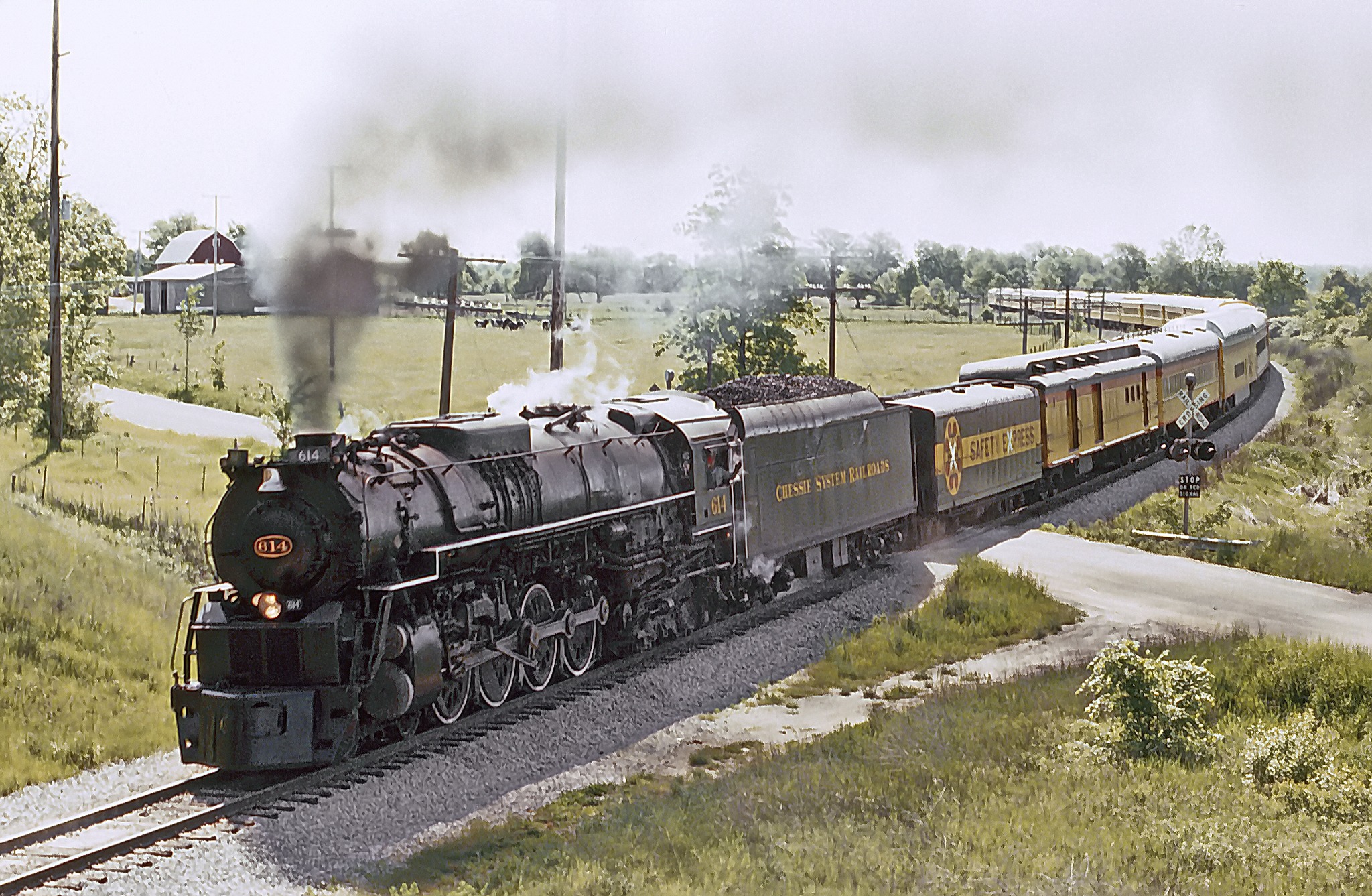 Chesapeake & Ohio 4-8-4 #614 leads the "Chessie Safety Express" westbound crossing Beck Road just east of Howell, Michigan in June, 1981. Karl Miller photo.
Background: The Chessie System and Operation Lifesaver
The Chessie System was a major Eastern U.S. railroad holding company formed in the early 1970s from the Chesapeake & Ohio (C&O), Baltimore & Ohio (B&O), and Western Maryland (WM) railroads. Officially launched as Chessie System, Inc. in 1973, it became known for its innovative marketing—most famously the “Chessie” kitten logo—and profitable coal-hauling operations. By the late 1970s, the system had already gained experience with high-profile steam excursions through the 1977–1978 Chessie Steam Special, which celebrated the sesquicentennial of the B&O Railroad using Reading T-1 No. 2101 and carried nearly 55,000 passengers over thousands of miles.
By 1980, however, the focus shifted from celebration to safety. Grade-crossing accidents—collisions between trains and motor vehicles or pedestrians at highway-rail intersections—remained a persistent problem despite improvements in signage and signals. Operation Lifesaver, a national public awareness campaign launched in the 1970s, sought to educate drivers and pedestrians to “Look, Listen, and Live” before crossing tracks. Chessie System Vice President William F. Howes Jr., who had been instrumental in the earlier Steam Special, spearheaded the railroad’s involvement. The goal was to use the spectacle of steam power to draw crowds and deliver safety messaging directly to communities along the lines.
The Star of the Show: C&O No. 614
At the heart of the Chessie Safety Express was C&O No. 614, a J-3a class 4-8-4 “Greenbrier” type locomotive built by the Lima Locomotive Works in June 1948 (builder’s number 9306). One of the last main-line steam locomotives constructed by a major American manufacturer, the 614 was designed for high-speed passenger service, capable of 100 mph with a tractive effort of 66,450 lbf (or higher with a booster). Its specifications included a 255 psi boiler pressure, 27½ × 30-inch cylinders, and impressive heating surface area, making it a powerful and modern steam engine for its era.
After revenue service hauling passenger trains like the George Washington and later freight (briefly renumbered to 611 in 1955 due to a power shortage), No. 614 was retired in 1956 and stored for nearly two decades in Russell, Kentucky. In 1975 it was donated to the B&O Railroad Museum in Baltimore for static display. A fortuitous opportunity arose in 1979 when a roundhouse fire damaged the Chessie Steam Special’s Reading No. 2101. Preservationist Ross Rowland and the Steam Locomotive Corporation of America (SLCA) arranged a swap: 614 was traded to Rowland’s group and restored at Western Maryland shops in Hagerstown, Maryland, at a cost of about $1.5 million. Key modifications included enlarging the main tender’s coal capacity and adding a permanent auxiliary water tender (former L&N diesel fuel tender) to extend range.
No. 614’s first major assignment after restoration was the Chessie Safety Express. It performed reliably across diverse terrain—from flat Midwestern lines to challenging Appalachian grades—often without helpers. During Michigan runs, its whistle was temporarily swapped for one from a New York Central Hudson. Ross Rowland Jr. frequently served as engineer.
The Train Consist and Operations
The CSE consist evolved over its two seasons but typically included a mix of heritage coaches, parlor cars, a concessions car, a safety exhibit/kitchen car, and support equipment. Season One (1980) featured around 19 cars, including ex-Clinchfield open-window coaches for better viewing, air-conditioned coaches from Pennsylvania Railroad heritage, a power car for electrical needs between trips, a dormitory/tool car, and a parlor-observation car. The safety car housed Operation Lifesaver exhibits and first-class amenities. For Season Two (1981), the train was lengthened by four cars to accommodate more passengers.
Lettering changed with the seasons: “Chessie System Railroads” and “Chessie’s Safety Express” in 1980; “Family Lines’ Safety Express” during winter Florida trips; and simplified “Safety Express” later. The bright Chessie livery—blue, yellow, and vermilion—made the train visually striking and instantly recognizable.
The Tours: A System-Wide Journey
The Chessie Safety Express operated 67 tours total: 55 on Chessie System lines and 12 on Family Lines (Seaboard Coast Line/Louisville & Nashville) routes in Florida during the off-season. It covered routes from the Midwest to the Mid-Atlantic and South, often coordinated with local National Railway Historical Society (NRHS) chapters.
The inaugural run on September 13, 1980, departed Baltimore for Harpers Ferry and Martinsburg, West Virginia, with ceremonial fanfare including a banner-breaking at Camden Station. Subsequent 1980 trips included runs to Cumberland, Pittsburgh, Richmond, the scenic New River Gorge in West Virginia (multiple round trips from Huntington to Hinton), and Cincinnati. Notable highlights included autumn foliage runs and climbs over steep grades like Cranberry in West Virginia, where the big 4-8-4 demonstrated its power.
After a brief winter hiatus, the train re-emerged as the Family Lines’ Safety Express for 12 Florida excursions in early 1981 (Jacksonville–Tampa–Miami–Orlando area), sponsored in part by the state and local museums. Season Two resumed in April 1981 from St. Louis eastward and northward, covering Illinois (East St. Louis to Flora with stops in Carlyle and Salem), Indiana, Ohio, Michigan (Detroit to Grand Rapids and beyond), and other Chessie territories. The final sold-out trip on November 1, 1981, ran through the New River Gorge.
The program generated significant media coverage in magazines, television, and radio, drawing large crowds at station stops and runbys. Passengers enjoyed not only the steam experience but also safety presentations and souvenirs.
 Chesapeake & Ohio 4-8-4 #614 with the "Chessie Safety Express" near Brighton, Michigan in June, 1981. Karl Miller photo.
Impact and Legacy
The CSE was more than a railfan attraction—it was effective advocacy. By bringing the message directly to communities via a high-visibility steam train, Chessie helped raise awareness of grade-crossing dangers. The railroad reported a 10% reduction in such accidents in 1981, and officials credited the campaign with likely saving lives.
After the tours concluded, No. 614 returned to Hagerstown for storage. It later gained fame in 1985 as “614-T” for the ACE 3000 Project, hauling coal trains in West Virginia to test modern steam technology against diesels (demonstrating competitive fuel efficiency). The locomotive saw further excursion service in the 1990s (including New Jersey Transit runs) and periods of storage and partial restoration attempts. As of 2025, it is under new ownership and being restored to operating condition at the Strasburg Rail Road.
The Chessie Safety Express marked the end of an era for grand steam publicity tours by Class I railroads as the industry consolidated under CSX. It remains fondly remembered by rail enthusiasts for showcasing both engineering heritage and a commitment to public safety. Today, its story serves as a reminder of how railroads once used spectacle to engage communities on critical safety issues.
Recent Articles


-
Bessemer & Lake Erie Railroad: "The Bessemer Road"
Sep 15, 26 05:20 PM
 Bessemer & Lake Erie—Bear Creek 1865, Carnegie 1897, U.S. Steel 1901. Ore south from Conneaut, coal north. 2-10-4s, Missabe sister road. CN May 10, 2004. Complete corporate history.
 -
Bangor and Aroostook Railroad: "Serving Northern Maine"
Sep 15, 26 05:05 PM
 Bangor & Aroostook—chartered February 13, 1891, first trains January 1, 1894. Potatoes, paper, Searsport, State of Maine reefers. MM&A 2003, Lac-Mégantic 2013, CP 2020, CPKC today. Complete co…
 -
Baltimore & Ohio Chicago Terminal Railroad: Map and History
Sep 15, 26 03:11 PM
 B&OCT—formed January 6, 1910 to buy Chicago Terminal Transfer. Grand Central, Barr Yard, 78 route-miles. Assigned B&O steam. Complete diesel roster. CSX paper subsidiary, mark BOCT.
 -
The "Alphabet Route" (Railroad): Photos and History
Sep 15, 26 02:53 PM
 Alphabet Route—eight railroads, not one company. P&WV to Connellsville February 11, 1931. Alpha Jets Chicago/St. Louis–New York/Boston. NKP, W&LE, P&WV, WM, Reading, CNJ, L&HR, New Hav…
 -
Milwaukee Road Livestock Operations: Cattle, Dakotas & Montana
Sep 15, 26 02:36 PM
 Milwaukee Road livestock traffic—Dakota and Montana cattle, Iowa hogs, Chicago markets, 28-hour law, head-end stock cars. By 1974 mostly Montana. Rick Burn’s Helena speech. Operations history, not the…
 -
Spirit of Jasper Ride & Dine (2026): Season Pause
Sep 15, 26 02:29 PM
 Spirit of Jasper Ride & Dine in Jasper, Indiana—seated meal on board. Operator: not running public trains for 2026. Depot remains open as a rental. Confirm on spiritofjaspertrain.com.
 -
South Carolina Canal & Rail Road Company: Map and History
Sep 15, 26 01:59 PM
 South Carolina Canal & Rail Road—chartered December 19, 1827. Best Friend of Charleston, 136 miles Charleston–Hamburg October 1833, Aiken inclined plane. South Carolina Railroad 1844, Southern 189…
 -
The Practice of Double-Heading: The Steam Era
Sep 15, 26 01:43 PM
 Doubleheading—two locomotives on the point, each with its own steam crew. Not a rear helper, not diesel MU. How it worked, PRR 1877, mountain grades, and what MU ended.
 -
Mohawk and Hudson Railroad: Map, Pictures, Locomotives
Sep 15, 26 01:20 PM
 Mohawk & Hudson Railroad—New York’s first railroad, chartered April 17, 1826. DeWitt Clinton, inclined planes, Albany & Schenectady 1847, first New York Central May 17, 1853. Complete corporat…
 -
Essex Clipper Dinner Train (2026): Dates, Tickets & What to Expect
Sep 15, 26 01:09 PM
 2026 Essex Clipper Dinner Train in Essex, CT—2.5 hours, four-course meal $129.99, 18+. Fall dates through Oct. 25. Confirm on essexsteamtrain.com.
 -
Camden & Amboy Railroad: Map, History, Photos
Sep 15, 26 12:53 PM
 Camden & Amboy Railroad—chartered February 4, 1830. Joint Companies monopoly with the Delaware & Raritan Canal, John Bull, T-rail. United New Jersey 1872, PRR 999-year lease 1871. Complete corpora…
 -
Cafe Lafayette Dinner Train (2026): Dates, Tickets & What to Expect
Sep 15, 26 12:47 PM
2026 Cafe Lafayette Dinner Train in North Woodstock, NH—2 hours, 20 miles, five-course meal from $125. May–October. Confirm on nhdinnertrain.com. -
Christmas Train Ride Locations (2026): A Complete Guide
Sep 15, 26 10:47 AM
 2026 Christmas train rides by state—Santa, North Pole Express, and holiday trains. Not Polar Express. State guides and product pages. Confirm dates on each railroad.
 -
Baltimore & Ohio Railroad: Linking 13 Great States With The Nation
Sep 15, 26 10:22 AM
 Baltimore & Ohio Railroad—first U.S. common carrier, chartered February 28, 1827. Wheeling 1853, Chicago 1874, C&O control 1963, Chessie 1973, into CSX April 30, 1987. Complete corporate history.
 -
Delaware & Hudson Railway: The Bridge Line
Sep 15, 26 09:59 AM
 Delaware & Hudson Railway—Wurts brothers canal 1823, gravity railroad 1829, Stourbridge Lion, Bridge Line to Montreal. Guilford 1984, CP 1991, NS south line 2015, CPKC north.
 -
Delaware & Hudson Diesel Roster (All-Time)
Sep 15, 26 12:17 AM
 All-time Delaware & Hudson diesel roster—Alco S-2s through C-628s and PA-4s, GE U-boats, Baldwin RF-16s, EMD SD45s and GP38-2/GP39-2s. Serials, dates, dispositions.
 -
Granite Railway, Our Country's First Railroad
Sep 14, 26 11:28 PM
 Granite Railway of Quincy, Massachusetts—chartered March 4, 1826, opened October 7, 1826. Gridley Bryant, 5-foot gauge, horses, Bunker Hill Monument stone. First commercial U.S. railroad.
 -
Milwaukee Road Skytop Lounges: History, Specs & Floor Plans
Sep 14, 26 11:09 PM
 Milwaukee Road Skytop observation cars—Brooks Stevens, 1948. Four Rapids parlor-lounges from Milwaukee Shops, six Creek sleeper-lounges from Pullman-Standard. Floor plans, roster, preservation.
 -
West Virginia Christmas Train Rides (2026): A Complete Guide
Sep 14, 26 11:02 PM
2026 West Virginia Christmas trains—Potomac Eagle North Pole Express in Romney and Christmas at Cass. Not Polar Express. Elkins Polar is not listed for 2026. -
Railroads Of Today: Class I Map, PSR & the 2026 Industry
Sep 14, 26 10:30 PM
 U.S. freight rail in 2026—six Class I railroads on a nearly 140,000-mile network. PSR as everyday practice, how the STB works, traffic mix, short lines and regionals.
 -
Railroad History (USA): Timeline, Facts & How the Network Was Built
Sep 14, 26 10:03 PM
 Full U.S. railroad history hub—origins and inventors, Golden Age peak mileage, Civil War and transcontinental, streamliners, ICC regulation, Penn Central and Conrail, Staggers Act, PSR, and today’s Cl…
 -
Railroads In The 2020s: CPKC, East Palestine & the UP–NS Case
Sep 14, 26 09:51 PM
 U.S. railroads 2020–2026—Class I mileage 91,773 in 2020. COVID traffic drop, CPKC April 14 2023, East Palestine Feb. 3 2023, UP–NS $85 billion case still before the STB.
 -
Railroads In The 2010s: PSR, Coal’s Decline & Positive Train Control
Sep 14, 26 03:51 PM
 U.S. railroads 2010–2020—Class I mileage 95,573 to 91,773. Buffett closed BNSF Feb. 12 2010, Harrison at CP June 29 2012 and CSX 2017, PTC deadline Dec. 31 2018.
 -
Virginia Christmas Train Rides (2026): A Complete Guide
Sep 14, 26 03:46 PM
 2026 Virginia Christmas trains—Virginia Scenic Railway Santa Express from Staunton, about 60 minutes. Confirm dates. Not Polar Express.
 -
MARC Train: Maryland Commuter Rail History, Lines & Roster
Sep 14, 26 01:16 PM
 MARC Train history—Maryland Rail Commuter 1984, B&O and PRR corridors, Penn/Camden/Brunswick lines, Silver Spring 1996, all-time locomotive roster.
 -
Railroads In The 2000s: Merger Freeze, Wisconsin Central & Buffett
Sep 13, 26 07:57 AM
 U.S. railroads 2000–2010—Class I mileage 99,250 to 95,573. STB merger freeze March 17 2000, CN–WC Oct. 9 2001, BNSF Railway Jan. 24 2005, Buffett Nov. 3 2009.
 -
Railroads In The 1990s: Mega-Mergers, Conrail’s Split & the STB
Sep 13, 26 12:13 AM
 U.S. railroads 1990–2000—Class I mileage 119,758 to 99,250. BNSF Sept. 22 1995, UP–SP Sept. 11 1996, Conrail split June 1 1999, ICC Termination Dec. 29 1995.
 -
Railroads In The 1980s: Staggers, Mega-Mergers & Conrail’s IPO
Sep 12, 26 11:12 PM
 U.S. railroads 1980–1990—Class I mileage 164,822 to 119,758. Staggers Oct. 14 1980, CSX and Norfolk Southern, UP–Missouri Pacific–Western Pacific, Conrail IPO March 26 1987.
 -
Wabash Class O-1 4-8-4s: History, Roster & Specifications
Sep 12, 26 11:01 PM
 Wabash Class O-1 4-8-4s—Baldwin 1930–31, twenty-five engines 2900–2924. Fast freight, complete roster, specifications. None preserved.
 -
Staggers Rail Act of 1980: Statute, Contract Rates & the ICC
Sep 10, 26 11:23 PM
 Staggers Rail Act, Pub. L. 96-448, signed October 14, 1980. Harley Staggers, S.1946, contract rates, 180% variable-cost test, abandonments, short lines.
 -
Rock Island E8A 652: Bicentennial Independence Paint & History
Sep 10, 26 10:42 PM
 Rock Island E8A 652—EMD March 1952, serial 15199. 20th Century Railroad Club Independence bicentennial scheme, Peoria and Quad Cities Rockets, Midland Railway, Manly Junction Museum.
 -
Vermont Christmas Train Rides (2026): A Complete Guide
Sep 10, 26 10:37 PM
2026 Vermont Christmas trains—Okemo Valley Holiday Express from Chester Depot Dec. 19–20. Polar is Burlington Dec. 5–6 only. -
Railroads In The 1970s: Penn Central, Amtrak & Conrail
Sep 10, 26 10:18 AM
 U.S. railroads 1970–1980—196,479 miles at the decade’s start. Penn Central bankruptcy June 21 1970, Amtrak May 1 1971, 3R/4R Acts, Conrail April 1 1976, Rock Island 1975, Milwaukee 1977.
 -
Railroads In The 1960s: Mergers, Passenger Collapse & Penn Central
Sep 10, 26 10:03 AM
 U.S. railroads 1960–1970—207,334 to 196,479 miles. Erie Lackawanna 1960, C&O–B&O 1963, N&W–Nickel Plate 1964, SCL 1967, Penn Central Feb. 1 1968.
 -
South Carolina Christmas Train Rides (2026): A Complete Guide
Sep 10, 26 08:36 AM
 2026 South Carolina Christmas trains—South Carolina Railroad Museum Santa Train in Winnsboro. Confirm December dates. Not Polar Express. Drop light-festival padding.
 -
Steam Locomotive Feedwater Heaters: Elesco, Coffin & Worthington
Sep 10, 26 08:29 AM
 Steam locomotive feedwater heaters—open Worthington vs closed Elesco and Coffin. How they work, how to identify them on a smokebox, and why not every engine had one.
 -
Oregon Christmas Train Rides (2026): A Complete Guide
Sep 10, 26 08:22 AM
2026 Oregon Christmas trains—Portland Holiday Express, Garibaldi Candy Cane Express, Sumpter Valley Christmas Trains Dec. 11–13. Polar is Mount Hood. -
Lake Shore & Michigan Southern: Map, History, Timetables
Sep 10, 26 08:12 AM
 Lake Shore & Michigan Southern Railway—Erie & Kalamazoo 1833, Michigan Southern to Chicago 1852, LS&MS April 6 1869, Vanderbilt, Ashtabula 1876, NYC merger Dec. 22 1914. 1910 map and Official Guide.
 -
Big Four Route (CCC&StL): Map, History
Sep 10, 26 12:19 AM
Cleveland, Cincinnati, Chicago & St. Louis Railway—Bee Line 1868, Ingalls’s first Big Four 1880, CCC&StL June 30, 1889, NYC lease Feb. 1, 1930. 1910 and 1930 maps, what still runs. -
Railroads In The 1950s: Diesel, the Interstate & Passenger Collapse
Sep 10, 26 12:15 AM
 U.S. railroads 1950–1960—223,779 to 211,459 miles. Interstate June 29, 1956, dieselization, passenger collapse, TOFC, 1957–58 recession, NYO&W 1957, N&W–Virginian 1959.
 -
New Jersey Christmas Train Rides (2026): A Complete Guide
Sep 10, 26 12:06 AM
 2026 New Jersey Christmas trains—Black River & Western Santa Express from Flemington and Pine Creek Christmas trains in Wall Township. Polar is Whippany and Phillipsburg.
 -
New Mexico Christmas Train Rides (2026): A Complete Guide
Sep 09, 26 11:57 PM
 2026 New Mexico Christmas trains—Cumbres & Toltec Santa’s Holiday Express from Chama Dec. 5–6 (and Antonito, Colo., Dec. 12–13). Coach $25/$15. Not Polar Express.
 -
Grand Trunk Railway: Map, History, Timetables
Sep 09, 26 11:47 PM
 Grand Trunk Railway of Canada—charter Nov. 10, 1852, Montreal–Toronto 1856, Portland, Sarnia, Victoria Bridge, St. Clair Tunnel 1891, Great Western 1882, GTPR, CN Jan. 20, 1923. 1893 map and Official…
 -
Troop Trains In World War II: Sleepers, Kitchen Cars & Movements
Sep 09, 26 11:42 PM
 WWII U.S. troop trains—almost 44 million armed-services passengers, Pullman troop sleepers, ACF kitchen cars, hospital trains, monthly movement tables 1942–45. Not the Military Railway Service. ODT an…
 -
Railroads In The 1940s: War Traffic, Last Steam & the Diesel Flood
Sep 09, 26 11:37 PM
 U.S. railroads 1940–1950—233,670 to 223,779 miles. World War II as the decade’s center, last new steam, diesel flood after V-J Day, 1945 car orders, California Zephyr 1949.
 -
Railroads In World War II: ODT, Record Traffic & Private Operation
Sep 09, 26 03:00 PM
 U.S. railroads in World War II—Lend-Lease freight, Pearl Harbor, Office of Defense Transportation, 1944 peak ~740 billion ton-miles, Dec. 1943–Jan. 1944 seizure. Private operation, not a USRA sequel.
 -
Montana Christmas Train Rides (2026): A Complete Guide
Sep 09, 26 02:54 PM
2026 Montana Christmas trains—Charlie Russell Chew Choo North Pole Adventure from Hanover/Lewistown, Nov. 27–Dec. 19, $71, about 1.5 hours. Not Polar Express. -
Railroads In The 1930s: Depression, Streamliners & the FT
Sep 09, 26 09:32 AM
 U.S. railroads 1930–1940—249,052 to 233,670 miles. Section 77, Eastman, Motor Carrier Act, M-10000 and Pioneer Zephyr 1934, EMC FT 1939. Decade frame, not the streamliner encyclopedia.
 -
Sugar Cane Train (Lahaina): LK&P History, Roster & 2026 End
Sep 09, 26 08:19 AM
 Lahaina, Kaanapali & Pacific Sugar Cane Train—3-foot tourist line 1970–2014. Anaka, Myrtle, 2023 and 2025 fires, September 2026 scrapping. Roster, Hahakea trestle, Pioneer Mill corridor.
 -
Massachusetts Christmas Train Rides (2026): A Complete Guide
Sep 09, 26 08:16 AM
 2026 Massachusetts Christmas trains—Shelburne Falls Moonlight Magic Friday Nov. 27; Edaville Festival of Lights in Carver. Polar is Cape Cod Central in Buzzards Bay.