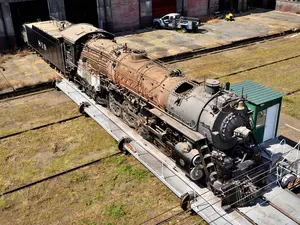
Rutland Railroad: Map, Rosters, History, Logo
Last revised: September 24, 2026
By: Adam Burns
The Rutland was the railroad Vermonters called their own. Reporting mark RUT. Headquarters in the city the company was named for. Timothy Follett chartered it, as the Champlain & Connecticut River Rail Road, on November 1, 1843, so his Lake Champlain steamboats would have a railroad to the Connecticut River. The first train ran from Bellows Falls to Burlington on December 18, 1849. Marble, lumber, and milk were the freight that belonged to the line. Bridge cars, and for a few years a fleet of lake boats, were the freight that paid the bills when they paid at all. After November 1, 1950, the company was the Rutland Railway, and the Alcos wore forest green and yellow under the slogan The Green Mountain Gateway.
The last Rutland train ran on September 25, 1961. Vermont bought the lines worth keeping, and the Vermont Railway opened on January 6, 1964.

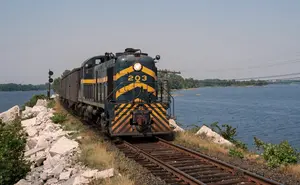
Rutland RS3 #203 on the marble causeway across South Hero, Grand Isle, and North Hero, with what appears to be a milk train, in the 1950s. Tom Stewart photo. The fill is the Island Line Rail Trail.
On this page: At a glance · Follett and Paine · July 9, 1867 · The islands and Ogdensburg · The Corkscrew · New York Central years · System map, 1940 · The Whippet · Flyer and Mount Royal · Steam after 1900 · Six RS-1s, nine RS-3s, one 70-tonner · 1953, 1960, 1961 · What Vermont kept
At a glance
The Rutland Railroad logo. Author’s work.
| Item | Detail |
|---|---|
| Railroad | Rutland Railroad, then Rutland Railway from November 1, 1950. Mark RUT |
| Headquarters | Rutland, Vermont |
| Genesis | Champlain & Connecticut River Rail Road, chartered November 1, 1843. Renamed Rutland & Burlington November 6, 1847 |
| First train | December 18, 1849, Bellows Falls–Burlington |
| Reorganized | Rutland Railroad, effective July 9, 1867 |
| Last train | September 25, 1961 |
| Abandonment | ICC approval September 18, 1962. Effective date postponed to May 20, 1963 |
| States | Vermont, New York. A short reach into Quebec at Noyan |
| Route-miles | 415 (1930). An upside-down L, Chatham to Alburgh, then west to Ogdensburg, plus the original main line Rutland–Bellows Falls |
| Gauge | 4 ft 8½ in |
| Slogan | The Green Mountain Gateway |
| Steam since 1900 | 74 locomotives. Drury’s grid is below. Last steam: Mountains 90–93, March 1955 |
| Diesel | 6 Alco RS-1s, 9 RS-3s, 1 GE 70-tonner. All below |
| Successor | State of Vermont, August 1963. Vermont Railway from January 6, 1964. Green Mountain Railroad on Rutland–Bellows Falls |
Follett and Paine
Timothy Follett already ran steamboats on Lake Champlain. He wanted a railroad from the Connecticut, up the Williams River, through Mount Holly and Rutland, and north along the lake to Burlington. The Vermont General Assembly chartered that idea on November 1, 1843. The same session chartered Charles Paine’s Vermont Central on a more northerly line, through Northfield, Paine’s own town, by way of the White and Onion river valleys. The two men stayed rivals. The two railroads stayed rivals for the rest of the century. That other company is the Central Vermont.
On November 6, 1847, Follett renamed his road the Rutland & Burlington, which is what he meant to build. Construction finished in 1849. To mark it, the railroad raced a team of horses with the mail between Bellows Falls and Burlington. The train won, by a good two hours. The first train over the whole line ran on December 18, 1849.
Traffic did not follow the grading. Jim Shaughnessy’s verdict in The Rutland Road is that the railroad connected nowhere with nowhere, and Paine’s Vermont Central refused a friendly interchange. Mortgage trustees took the property on November 19, 1853. On June 25, 1867, the owners reorganized it as the Rutland Railroad, effective July 9. John Page became president in 1868.
July 9, 1867
Page went looking for railroads that would actually trade cars. The Cheshire, later Boston & Maine, was the partner at Bellows Falls. The Rensselaer & Saratoga, later a piece of the Delaware & Hudson, was the partner toward Whitehall and Troy. Across the lake, the Whitehall & Plattsburgh was trying to build its own line north into Canada. The Rutland leased that road’s Ticonderoga–Port Henry segment on September 26, 1870, leased the Vermont & Massachusetts on December 1, and leased the little Addison Railroad, Leicester Junction to Larrabee’s Point, on December 7 for 99 years. In 1852 the Rutland & Burlington had bought the Champlain Transportation Company. The boats came and went. The idea of a water connection did not.
The Vermont Central answered by leasing the whole Rutland. The lease is dated December 30, 1870, for 20 years from January 1, 1871. On December 31, 1890, the Central Vermont renewed it for 99 years from January 1, 1891. Charles Clement was president of the Rutland from 1884. His father, Percival W. Clement, took the chair in 1888. The Central Vermont went into receivership and handed the Rutland back to its owners on May 7, 1896. The feud was over. The building was not.
The islands and Ogdensburg
Between Burlington and the Ogdensburg & Lake Champlain at Rouses Point there was open lake and a string of islands. The Rutland-Canadian closed that gap in 1899: about 40 miles, built in a year, leaping South Hero, Grand Isle, and North Hero on a marble causeway riprapped against the ice, then a short crossing from Alburgh to Rouses Point. The Rutland leased the new company on July 1, 1899, and consolidated it on January 21, 1901.
The Ogdensburg & Lake Champlain, Alburgh to the St. Lawrence at Ogdensburg, came in at the end of October 1901, consolidated October 26–28. Online freight on that line was thin. Milk and other farm products were not, and Ogdensburg was a port. Until the boats were taken away, Chicago freight moved across the lakes in ships of the Rutland Transit Company and then the length of the railroad. At Norwood the Rome, Watertown & Ogdensburg, later New York Central, took cars. At Malone the Mohawk & Malone, also later Central, did the same. A short branch off Alburgh reached Noyan, Quebec.

RS3 #205 passes the covered bridge at Bartonsville, on the Williams River, in the early 1950s. Jim Shaughnessy photo. The 1870 bridge, 151 feet, went out in the flood from Hurricane Irene on August 28, 2011. A new bridge opened January 26, 2013.
The Corkscrew
South of Rutland the railroad still ended in the air. The Bennington & Rutland, Rutland to Bennington, was consolidated on September 6, 1901. The Chatham & Lebanon Valley, the rest of the way to the Boston & Albany and the New York Central at Chatham, New York, was consolidated December 23–24, 1901. Together they were the Chatham Division. Trainmen called it the Corkscrew: 263 curves, steep grades, and the only southern outlet the Rutland owned. Commodore Vanderbilt had already guessed it would be a hard railroad to run. He was right. Passenger trains came off the division on June 25, 1932. The Interstate Commerce Commission approved abandonment on May 20, 1953, 57 miles, and scrap crews pulled the iron that summer, reaching Bennington on August 7. The division has its own page, the Corkscrew.
New York Central years
Dr. W. Seward Webb, William H. Vanderbilt’s son-in-law and the builder of the Mohawk & Malone, became president on May 1, 1902. In 1904–05 the New York Central & Hudson River bought control. From 1905 to 1913, Rutland locomotives carried Central numbers and were built to Central designs, a step behind the engines Schenectady was building for the parent. In February 1911 the Central sold half its Rutland stock to the New York, New Haven & Hartford. The two roads together held about 52 percent until 1941, when both sold out to private investors.
The good years were real. By 1906 the accounts were strong enough to pay for new locomotives and cars. Dividends started in 1909. An express milk train ran the length of the system, filled out to more than 40 cars at Rutland, and sent some of them east on the Boston & Maine at Bellows Falls and most of them south over the Corkscrew to New York. The lake boats made Ogdensburg a Chicago port. On July 1, 1914, the Panama Canal Act’s rule against a railroad competing with itself by water took the Rutland Transit Company away. The docks at Ogdensburg went quiet. The Central’s interest thinned with them.
The United States Railroad Administration ran the property from December 28, 1917, to March 1, 1920. The 1920s brought the milk business back up. Then the Great Flood of November 3–5, 1927, tore up long stretches of the railroad. On May 5, 1938, the company went into receivership. Vermont, its towns, and a “Save the Rutland” club formed that July put up money and forgave taxes. In August the unions took a wage cut that kept the trains moving.
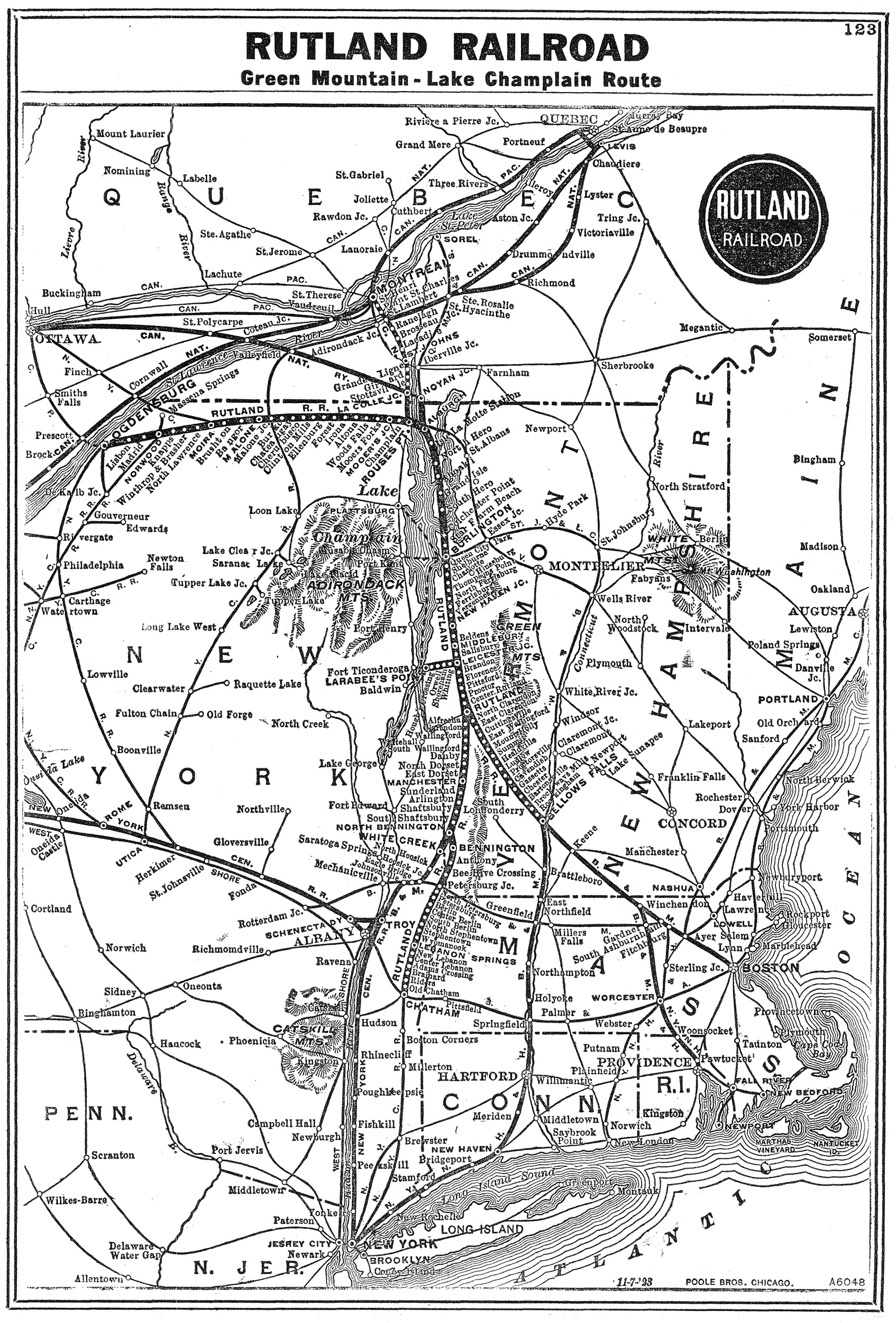
An official system map of the Rutland Railroad, 1940. Author’s collection. Chatham is still on the map. It came out in 1953.
The Whippet
Online customers were never enough, so the traffic department went after bridge freight. On January 9, 1939, the railroad put on The Whippet, a timed fast freight from the Boston & Maine at Bellows Falls to the New York Central at Norwood, via Rutland and the Ogdensburg line. To advertise it, shop forces skirted Consolidation No. 28, a 1913 Alco classed G-34d, and painted her black and silver with the name on the tender. One of the print advertisements pictured a Southern Pacific Daylight 4-8-4. Early in the war the skirting came off, the steel was turned in, and the name was dropped. The fast schedule stayed. The train’s own story is the Whippet.
Flyer and Mount Royal
The Rutland’s named passenger trains were the Green Mountain Flyer and the Mount Royal, New York and Boston to Montreal with the New York Central, the Boston & Maine, and Canadian connections. Ten-Wheelers and Pacifics were the usual power. After 1946 a Mountain sometimes drew them. The Central Vermont had its own north–south railroad across the state, and the Rutland never owned that market. The three-week strike that began June 26, 1953, was the first in the company’s history. When the men went back, the passenger trains did not.
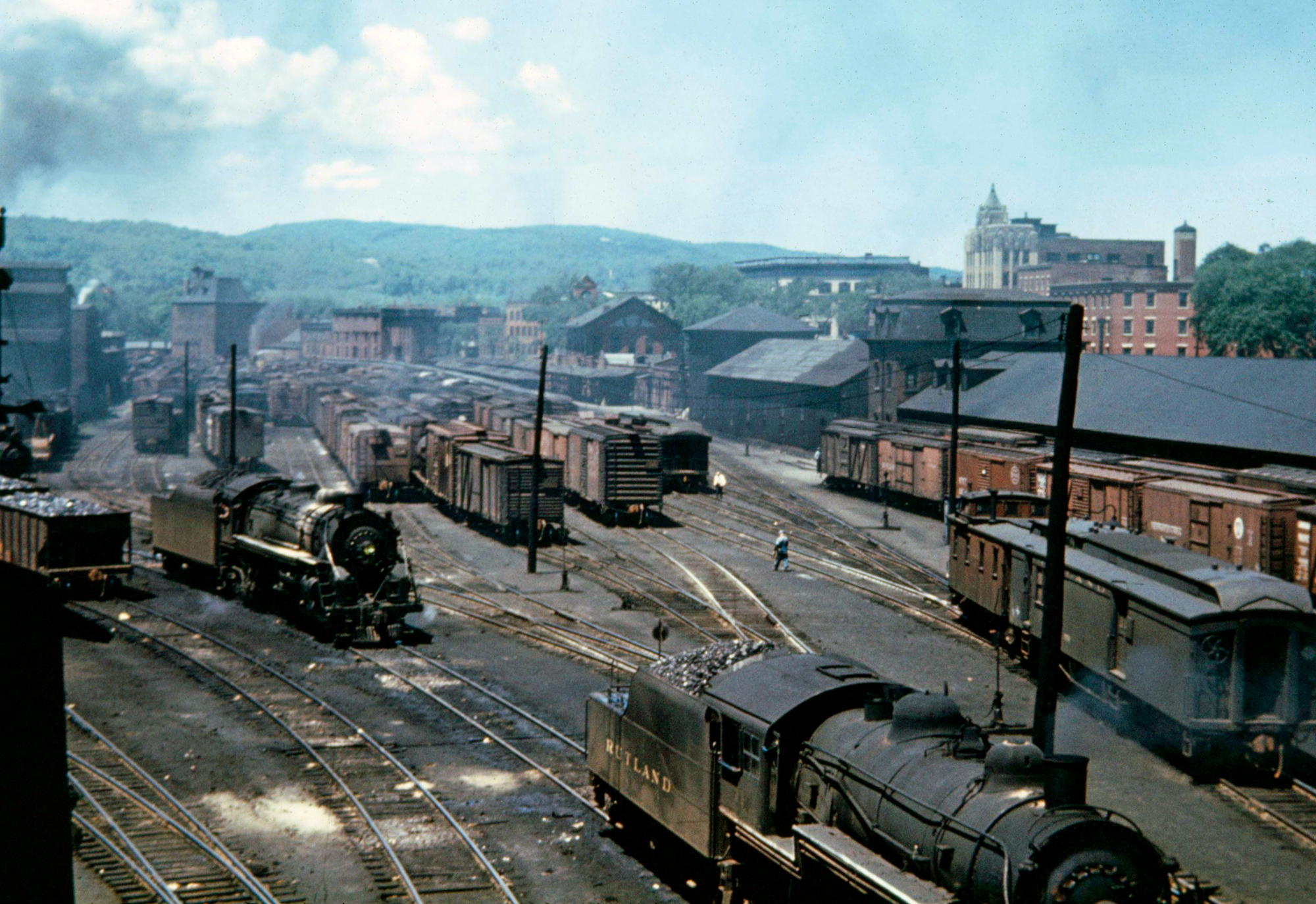
The yard and terminal at Rutland, looking north, late 1940s or early 1950s. American-Rails.com collection.
Steam after 1900
In 1913 the railroad renumbered and reclassed what it owned. Drury’s chapter counts engines built since 1900. Americans, the Ogdensburg & Lake Champlain Consolidations of 1897 (later 10–12, class G-14, retired in the first half of 1934), and the nineteenth-century Moguls inherited from the Bennington & Rutland sit outside that grid. The Moguls that were still on the books after 1913, including those older engines, are the Mogul page. Only two Moguls in the since-1900 list survived into the Rutland’s own numbering as a pair: E-1-d 144 and 145, Schenectady, 1900, retired in 1946.
Ten-Wheelers were the dual-purpose engine, and they have no separate article. Two groups arrived in 1902. F-12s 40–49, ten engines from Schenectady and Manchester, were the passenger engines: 69-inch drivers, about 156,000 pounds. F-11s 50–57, eight Schenectady engines, were the dual-service engines, with 63-inch drivers. Many of the F-12s were gone by the early 1930s. The rest, and the F-11s, lasted into the diesel years. Four more came in 1910, class F-2h, later 70–73 (they had been 2036–2039): 63-inch drivers, inside piston valves, Stephenson gear, about 10,000 pounds heavier than an F-12. Numbers 70 and 71 were superheated in 1913 and 1914. Numbers 72 and 73 received Walschaerts gear in 1920. Six of 1912, class F-2j, later 74–79 (they had been 2074–2079), were the modern Ten-Wheelers: superheated, piston valves, Walschaerts, fireboxes over the rear drivers, 198,000 to 211,000 pounds. They worked through dieselization. A 1912 engine of this family was still in service when the Alcos arrived.

Ten-Wheeler #76 on the Armstrong turntable at Bennington, April 12, 1952. Steven Payne photo. She is one of the 1912 F-2j engines, 74–79.
Consolidations came first with the Ogdensburg & Lake Champlain. In 1897 that road bought three from Schenectady, later Rutland 10–12, class G-14, about 123 tons and roughly 31,000 pounds tractive effort. They were retired between January and June 1934. Built in 1897, they sit ahead of the since-1900 grid below. The engines bought new from 1907 to 1913 were the heavy freight power until the Mikados: about 210,000 pounds, wide fireboxes over the rear drivers, and, even on the last of them, inside valves and Stephenson gear. They were classed G-34. In the 1913 numbers they are 14–31. G-34a is 18–23 (1907), G-34b is 14–17 (1910), G-34c is 24 and 25 (1911), and G-34d is 26–31 (1913). The 1911 and 1913 engines were superheated when built. Numbers 14–23 were superheated between May 1915 and January 1926. In 1939, during the campaign to keep the bankrupt railroad, No. 28 briefly wore running-board skirting for the Whippet. The last of the G-34s left the roster in 1952.
The United States Railroad Administration assigned the Rutland six USRA light Mikados in 1918, the same design the New York Central used. Schenectady built them. On the Rutland they were class H-6a, numbers 32–37. They carried the freight trains for thirty years and were retired in 1951 and 1952. That roster is the Mikado page.
Three Pacifics of 1925, class K-1, numbers 80–82, were about the size of a USRA light Pacific and had 69-inch drivers. Three more, class K-2, numbers 83–85, came from Schenectady in 1929: 73-inch drivers, 292,500 pounds, and a 28-inch piston stroke where the New York Central’s K-14 used 26. They were close to that Central class in most other dimensions, with a front-end throttle, cast trailing truck, and paired air pumps on the pilot. They drew the Flyer and the Mount Royal, and the hot milk. The class page is the Pacifics. Retirement ran from 1951 to 1953.
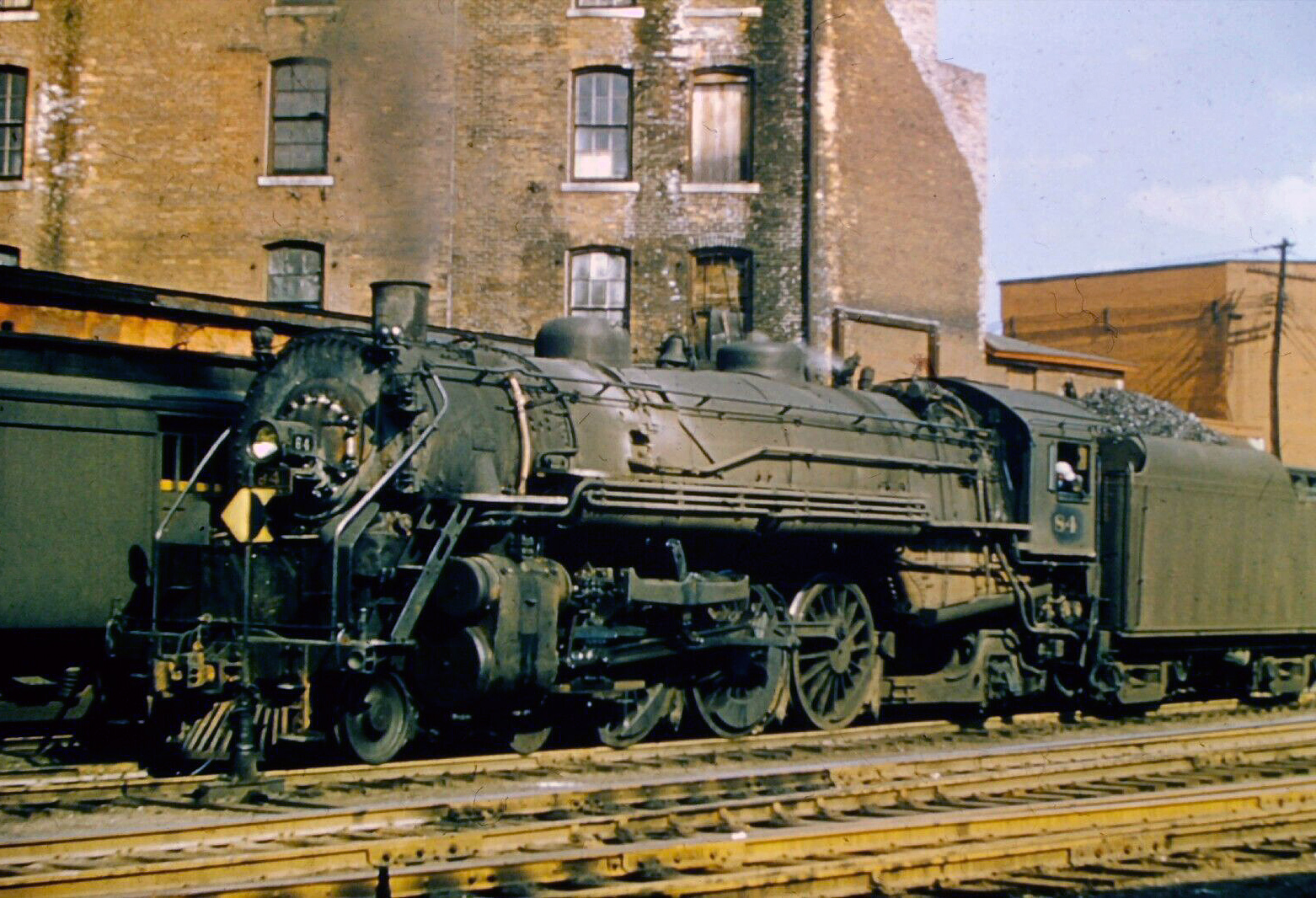
Pacific #84, class K-2, moving slowly in reverse at the station in Rutland in 1951, likely heading for her train. Ralph Phillips photo. Schenectady built 83–85 in 1929. The three K-2s were retired between 1951 and 1953.
At the end of the Second World War the power was worn out. In 1946 the road found the money for four Mountains, class L-1, numbers 90–93, from Schenectady. They had 73-inch Boxpok drivers, 26-by-30-inch cylinders, and weighed 348,000 pounds, a little under a USRA heavy Mountain. They were light enough to go anywhere on the railroad, and they often worked passenger trains. Delivered in dark green, they later went to black. The smokebox front and the air-pump shields echoed the 4-8-4s of the Toledo, Peoria & Western and the Union Pacific. Number 93 was the last of the four, and the four were the last 4-8-2s built by a commercial builder in North America. Neighbors were already buying road-switchers. Four years on, a steam shop kept open for four engines had no arithmetic left in it. The Mountains were retired in March 1955 and cut up. Their page is the L-1 Mountains.
Switchers. Most of the 0-6-0s had 51-inch drivers, slide valves, and Stephenson gear, and differed mainly in weight. B-9s 102–104, Manchester, 1902, were gone in 1945 and 1946. Cooke built 100 and 101 in 1907. Manchester built 105 in 1913. Number 106, Schenectady, 1914, was bought after Central control ended and had piston valves and Walschaerts gear. Number 107, also Schenectady, 1914, had 57-inch drivers and weighed 168,000 pounds. The Rutland bought her secondhand from the neighboring Clarendon & Pittsford in 1946, for $500, and kept her until 1953. Two USRA 0-8-0s, class U-3, numbers 109 and 110, were built at Pittsburgh in 1918. They had been allotted to the Rutland, went to the New York Central instead, and reached Vermont after the war. They were retired in 1951.
| Type | Class | Numbers | Qty | Builder | Built | Retired | Notes |
|---|---|---|---|---|---|---|---|
| 0-6-0 | B-2-a | 100, 101 | 2 | Cooke | 1907 | 1951, 1952 | |
| 0-6-0 | B-9 | 102–104 | 3 | Manchester | 1902 | 1945, 1946 | |
| 0-6-0 | B-2-b | 105 | 1 | Manchester | 1913 | 1951 | |
| 0-6-0 | B-2-c | 106 | 1 | Schenectady | 1914 | 1951 | Piston valves, Walschaerts. Bought after NYC control ended |
| 0-6-0 | B-3 | 107 | 1 | Schenectady | 1914 | 1953 | To Rutland 1946 from the Clarendon & Pittsford, $500. 57-inch drivers, 168,000 lb |
| 0-8-0 | U-3 | 109, 110 | 2 | Pittsburgh | 1918 | 1951 | USRA. Allotted to the Rutland, diverted to the NYC, arrived after the war |
| 2-6-0 | E-1-d | 144, 145 | 2 | Schenectady | 1900 | 1946 | Only Moguls in the since-1900 grid. Older engines: Mogul page |
| 2-8-0 | G-34a | 18–23 | 6 | Schenectady | 1907 | 1939–1951 | No. 28 skirted for the Whippet, 1939 |
| 2-8-0 | G-34b | 14–17 | 4 | Schenectady | 1910 | 1948, 1951 | |
| 2-8-0 | G-34c | 24, 25 | 2 | Schenectady | 1911 | 1950, 1951 | |
| 2-8-0 | G-34d | 26–31 | 6 | Schenectady | 1913 | 1951, 1952 | Superheated when built |
| 2-8-2 | H-6a | 32–37 | 6 | Schenectady | 1918 | 1951, 1952 | USRA light Mikado. Mikado page |
| 4-6-0 | F-11 | 50–57 | 8 | Schenectady | 1902 | 1946–1951 | Dual service. 63-inch drivers |
| 4-6-0 | F-12 | 40–49 | 10 | Schenectady, Manchester | 1902 | 1932–1951 | Passenger. 69-inch drivers, about 156,000 lb |
| 4-6-0 | F-2h | 70–73 | 4 | Schenectady | 1910 | 1951, 1952 | ex-2036–2039. Inside piston valves, Stephenson gear |
| 4-6-0 | F-2j | 74–79 | 6 | Schenectady | 1912 | 1951–1953 | ex-2074–2079. Superheat, Walschaerts, firebox over the rear drivers |
| 4-6-2 | K-1 | 80–82 | 3 | Schenectady | 1925 | 1952 | 69-inch drivers. Pacific page |
| 4-6-2 | K-2 | 83–85 | 3 | Schenectady | 1929 | 1951–1953 | 73-inch drivers, 292,500 lb, 28-inch stroke |
| 4-8-2 | L-1 | 90–93 | 4 | Schenectady | 1946 | 1955 | Last commercial 4-8-2s in North America. Mountain page. Retired March 1955 |
George H. Drury, Guide to North American Steam Locomotives, revised edition, pp. 281–282. Built since 1900. Retirement years are Drury’s. Month-level dates, where a class page has them, stay on that page.
Six RS-1s, nine RS-3s, one 70-tonner
The reorganization of November 1, 1950, made the company a railway and put Gardner A. Caverly in charge of making it cheaper to run. The steam engines, the Mountains aside, were old, tired, and expensive. Scrap from the steam fleet was the down payment on nine Alco RS-3s, one of them the builder’s demonstrator, six RS-1s, and a General Electric 70-tonner. The RS-1s were 1,000-horsepower road-switchers, class DRS-1, numbers 400–405, good for the way freights and the passenger trains that were still running. The RS-3s were 1,600-horsepower, classes DRS-6a, DRS-6b, and DRS-6c, numbers 200–208. Number 200 had been Alco demonstrator 1601, built September 13, 1950. The 70-tonner, No. 500, class DES-2, was a 600-horsepower branch engine, serial 31175, order 281-7040, outshopped in December 1951. Sixteen locomotives replaced the steam roster. The Mountains outlasted the purchase. They were gone in March 1955.
| Model | Class | No. | Builder | Serial | Order | Built | Notes |
|---|---|---|---|---|---|---|---|
| RS-3 | DRS-6a | 200 | Alco-GE | 78252 | September 13, 1950 | ex-Alco demonstrator 1601. To L&N 256, April 1963 | |
| RS-3 | DRS-6a | 201 | Alco-GE | 78594 | May 1, 1951 | To L&N 257 | |
| RS-3 | DRS-6b | 202 | Alco-GE | 78880 | June 7, 1951 | To L&N 258 | |
| RS-3 | DRS-6b | 203 | Alco-GE | 78881 | June 8, 1951 | To L&N 259 | |
| RS-3 | DRS-6b | 204 | Alco-GE | 78882 | June 12, 1951 | To L&N 260 | |
| RS-3 | DRS-6c | 205 | Alco-GE | 80155 | August 13, 1952 | To L&N 261 | |
| RS-3 | DRS-6c | 206 | Alco-GE | 80156 | August 13, 1952 | To L&N 262. Shipped from Ogdensburg | |
| RS-3 | DRS-6c | 207 | Alco-GE | 80157 | August 13, 1952 | To L&N 263 | |
| RS-3 | DRS-6c | 208 | Alco-GE | 80158 | August 14, 1952 | To L&N 264 | |
| RS-1 | DRS-1 | 400 | Alco-GE | 79349 | 1951 | Sold September 1956 to the Tennessee Railroad as No. 4. Later Arkansas & Missouri 20 | |
| RS-1 | DRS-1 | 401 | Alco-GE | 79350 | October 19, 1951 | Vermont Railway, 1964. Later Consumers Power, Essexville, Michigan | |
| RS-1 | DRS-1 | 402 | Alco-GE | 79572 | October 30, 1951 | Vermont Railway. Later Coopersville & Marne, Michigan | |
| RS-1 | DRS-1 | 403 | Alco-GE | 79573 | November 8, 1951 | Vermont Railway. Sold 1972 to the Sabine River & Northern | |
| RS-1 | DRS-1 | 404 | Alco-GE | 79574 | November 16, 1951 | Norwood & St. Lawrence, 1964 | |
| RS-1 | DRS-1 | 405 | Alco-GE | 79575 | November 21, 1951 | Leased 1964 to Nelson Blount. Sold April 1, 1965, to the Green Mountain Railroad. Still there | |
| 70-ton | DES-2 | 500 | GE | 31175 | 281-7040 | December 1951 | Sold August 1962 to the Clarendon & Pittsford. Later Vermont Railway, then Kelley’s Creek & Northwestern 11 |
Builder numbers and RS-3 / RS-1 dates: Rutland Railway Corp. chart of July 31, 1962, in the Rutland Railroad Historical Society Newsliner (Robert W. Adams), except RS-1 400, from the society’s diesel roster. GE serial and order: The Diesel Shop. Dispositions: Rutland Railroad Historical Society. Alco specification numbers were not on those lists. The nine RS-3s went to the Louisville & Nashville in April 1963 as 256–264, in order, and were traded back to Alco and to Electro-Motive about 1964–66.
1953, 1960, 1961
Dieselization, the loss of the Corkscrew, a cut that took the payroll from nearly 1,200 people to about 400, and a new fleet of freight cars were the railway’s attempt to live inside its traffic. Milk was leaving for the highway. On June 26, 1953, the unions struck, the first time they ever had. The shutdown lasted three weeks. Freight came back. Passengers did not. The later 1950s were briefly kinder. By 1960 the only cut left was in the work rules.
President William Ginsburg wanted two operating divisions instead of three. Crews had long changed at Rutland: Bellows Falls or Bennington into Rutland, Rutland to Alburgh, Alburgh to Ogdensburg. The new plan met the trains at Burlington and ran them through. The men walked out on September 16, 1960. A federal injunction under the Railway Labor Act ended that strike on November 1, after 41 days, and started a year of cooling off. The year changed nothing. On September 25, 1961, the strike resumed, and the last Rutland train ran that day.
The company applied to the Interstate Commerce Commission for abandonment of the entire railroad on December 4, 1961. Hearings ran seven days in Rutland and two in Malone in March and April 1962. On September 18, 1962, the Commission approved abandonment effective January 29, 1963. The Railway Labor Executives’ Association won an injunction in Cleveland on January 28, and the effective date moved to May 20, 1963, so Vermont could find a buyer. In mid-June the unions and the company did settle. The railroad was already gone.
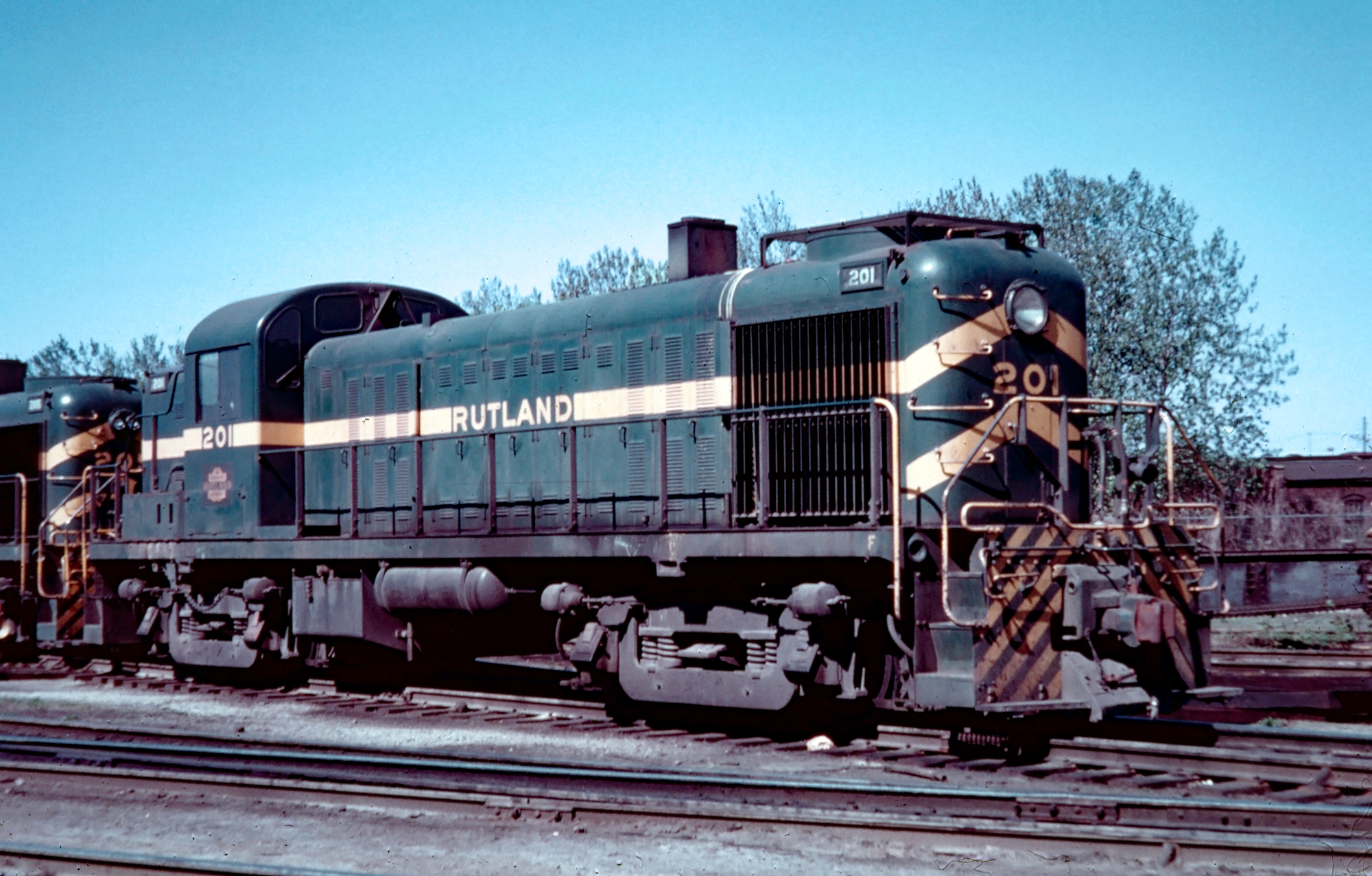
Former Rutland RS3s at Louisville, Kentucky, April 4, 1963, after the sale to the Louisville & Nashville. American-Rails.com collection. Eight of the nine left via the Delaware & Hudson at Rutland. No. 206 was shipped from Ogdensburg. On the L&N they were 256–264.
What Vermont kept
On May 29, 1963, the legislature passed a $2.7 million bill so the state could buy pieces of the Rutland and lease them to operators. The purchase of the Vermont lines closed in August 1963: Burlington south through Rutland toward Bennington and White Creek, and the line from Rutland to Bellows Falls. The Ogdensburg extension, and the causeway from Burlington across the islands to Alburgh, were left out and taken up. The causeway is the Island Line Rail Trail. A 31-mile piece of the old Ogdensburg line, Norfolk to Ogdensburg, came back under the Vermont Rail System in 2002 as the New York & Ogdensburg.
The Vermont Railway was incorporated October 25, 1963. Jay Wulfson, from the Middletown & New Jersey, was the first president. The first train ran January 6, 1964, on 128.6 miles the state had bought south of Burlington. Nelson Blount took operating rights from Rutland to Bellows Falls, called the railroad the Green Mountain, and in 1964 leased RS-1 405, which the Green Mountain bought outright on April 1, 1965. She is still in Vermont. The two roads, and the green and yellow that came off the Rutland’s Alcos, are the Vermont Rail System.
Related reading on American-Rails.com
- Rutland Moguls · Rutland Mikados · Rutland Pacifics · Rutland Mountains
- The Whippet · Chatham Division, the Corkscrew
- Green Mountain Flyer · Mount Royal
- Central Vermont · Vermont Railway · Vermont railroads
- Boston & Maine · Delaware & Hudson · GE 70-tonner
Sources
- Drury, George H. Guide to North American Steam Locomotives. Revised ed. Waukesha: Kalmbach, pp. 281–282. Since-1900 class table; NYC numbers 1905–1913; Ten-Wheelers; Consolidations and Whippet No. 28; USRA Mikados; Pacifics including K-2 in 1929 and the 28-inch stroke; Mountains 90–93 as the last commercial 4-8-2s, retired 1955; switchers, including 107 from the Clarendon & Pittsford in 1946 and USRA 0-8-0s 109–110; diesel purchase as scrap down-payment on nine RS-3s (one a demonstrator), six RS-1s, and a GE 70-tonner. Recommended reading named there: Jim Shaughnessy, The Rutland Road, second edition
- Rutland Railroad Historical Society timeline. Charter November 1, 1843; first train December 18, 1849; reorganization effective July 9, 1867; leases of 1870; Central Vermont lease and the return on May 7, 1896; 1899–1901 consolidations; Webb May 1, 1902; NYC control 1904–05; New Haven half-interest February 1911; Panama Canal Act water rule July 1, 1914; USRA December 28, 1917–March 1, 1920; flood November 3–5, 1927; Chatham passenger June 25, 1932; receivership May 5, 1938; Whippet January 9, 1939; stock sold by NYC and New Haven in 1941; Railway November 1, 1950; Chatham abandonment May 20, 1953; strike June 26, 1953; strikes of September 16, 1960, and September 25, 1961; ICC dates through May 20, 1963; Vermont funding bill May 29, 1963
- Rutland Railroad Historical Society diesel roster, and the July 31, 1962 Rutland Railway Corp. chart published in the society Newsliner (Robert W. Adams, “How Rutland RS1 #405 Became GMRC #405”). RS-3 serials 78252–80158 and build dates; RS-1 401–405 serials 79350 and 79572–79575; demonstrator 200; L&N 256–264; RS-1 and 70-ton dispositions. RS-1 400 serial 79349 from the society roster
- The Diesel Shop, John Komanesky, GE 70-ton production roster. Rutland 500, serial 31175, order 281-7040, December 1951. Same figures on the American-Rails 70-tonner page
- Shaughnessy, Jim. The Rutland Road. Second edition. Howell-North. The “nowhere to nowhere” line, the milk trains, and the operating narrative behind the society timeline. Railroad magazine, November 1922, p. 130; August 1946, p. 33; April 1970, p. 26. Railway & Locomotive Historical Society Bulletin No. 101, p. 82. Trains, March 1946, p. 34
- Railfan & Railroad. “Silence in Rutland: Epilogue.” The 41-day strike of 1960, the cooling-off year, RS-3s stored at Rutland, No. 206 shipped from Ogdensburg, and the April 4, 1963, delivery to the Louisville & Nashville
Recent Articles


-
West Side Lumber Company Railroad: Roster, History, Lines
Sep 30, 26 09:45 AM
 West Side Lumber at Tuolumne, California. Three-foot Shay and Heisler logging railroad. Lima shop numbers, builder specs, and where the engines are in 2026.
 -
Kansas Halloween Train Rides (2026)
Sep 30, 26 09:41 AM
 2026 Kansas Halloween train. Abilene & Smoky Valley Pumpkin Harvest Express, October 17 through 31. About one hour. Shop prices $35.56 to $41.02. Everyone picks a pumpkin.
 -
Iowa Halloween Train Rides (2026)
Sep 29, 26 11:58 PM
 2026 Iowa Halloween train. Boone & Scenic Valley Pumpkin Express, October 10, 10:00 a.m. from 225 10th Street. About 1 hour 15 minutes. Children pick a pumpkin.
 -
Arizona Halloween Train Rides (2026)
Sep 29, 26 11:43 PM
 2026 Arizona Halloween train. Grand Canyon Railway Pumpkin Patch Train from Williams, $39 with a pumpkin included. Select October dates on the ticket calendar. Haunted train cars are optional.
 -
Nevada Northern Halloween Trains (2026)
Sep 29, 26 06:18 PM
 Nevada Northern 2026 Halloween trains in Ely. Pumpkin Patch Caper to Keystone Gulch and the Haunted Ghost Train. Adult tickets start at $45. Dates are on the railroad’s calendar. Confirm on nnry.com.
 -
Grand Canyon Railway Pumpkin Patch Train (2026)
Sep 29, 26 02:42 PM
 Grand Canyon Railway Pumpkin Patch Train—select October 2026 dates from Williams, $39 with a pumpkin included. Haunted train cars are optional. Days are on the ticket calendar. Confirm on thetrain.com…
 -
Cass Scenic Railroad Halloween Trains (2026)
Sep 29, 26 02:37 PM
 Cass Scenic Halloween Trains—October 30 and 31, 2026, steam, 5:00 p.m. from Cass Depot. About two hours to Whittaker. Adult $75. Candy for every child. Confirm on mountainrailwv.com.
 -
Halloween Train Rides (2026): Pumpkin Patch, Haunted & Spooky Trips
Sep 29, 26 11:26 AM
 2026 Halloween train rides in nine checked states. Conway Scenic Halloween Express October 24–25. Strasburg’s three fall tickets. Great Smoky Mountains Railroad’s October trains are the gorge and rive…
 -
Maine Halloween Train Rides (2026)
Sep 29, 26 11:08 AM
 2026 Maine Halloween trains. Seashore Pumpkin Patch Trolley through October 18, adult $17. Happy Trolleyween October 23–25 at $15. WW&F Pumpkin Pickin’ October 3, 12, 17, and 24. Downeast’s booking it…
 -
Kentucky Halloween Train Rides (2026)
Sep 29, 26 10:58 AM
 2026 Kentucky Halloween trains. Kentucky Railway Museum Trick and Track Express, October 24 and 31, from $17. Bluegrass Scenic pumpkin trains in Versailles. Confirm on the ticket shop.
 -
Connecticut Halloween Train Rides (2026)
Sep 29, 26 10:26 AM
 2026 Connecticut Halloween trains. East Windsor Pumpkin Patch Fridays through Sundays, October 2–31. Naugatuck coach $20. Shore Line Pumpkin Patch on nine October days. Confirm on each site.
 -
Pennsylvania Halloween Train Rides (2026)
Sep 29, 26 09:45 AM
 2026 Pennsylvania Halloween trains—Everett October 3, 4, 10, and 17, Strasburg’s three fall shows, Oil Creek on October 24, plus Kutztown, Kempton, Honesdale, Middletown, and West Chester.
 -
New York Halloween Train Rides (2026)
Sep 29, 26 12:08 AM
2026 New York Halloween trains—Catskill Pumpkin Express October 17–18 and 24–25, Adirondack pumpkin and family trains, Arcade & Attica haunt, Cooperstown patch and trick-or-treat, Tupper Lake triv… -
North Carolina Halloween Train Rides (2026)
Sep 28, 26 11:56 PM
 2026 North Carolina Halloween trains—New Hope Valley Track or Treat on October 10, 17, 23, and 24, and Tweetsie Ghost Train Friday and Saturday nights through October 31. GSMR’s October menu is the go…
 -
Tweetsie Railroad Ghost Train Halloween Festival (2026)
Sep 28, 26 11:44 PM
 Tweetsie Ghost Train—Friday and Saturday nights September 25–October 31, 2026, in Blowing Rock. Adult $65, child $45. One reserved steam ride plus the park. Ages 8 and up for the haunt.
 -
Milwaukee Road Class A 4-4-2: Specs, Roster, History
Sep 28, 26 11:20 PM
 Milwaukee Road Class A Atlantics 1–4, Alco 1935–1937, for the Hiawatha. Order S-1740, 84-inch drivers, 19x28, 300 psi, 30,685 lb. Full builder specs, roster, and the May 15, 1935 run at 112.5 mph. All…
 -
Strasburg Rail Road Halloween Trains (2026)
Sep 28, 26 11:00 PM
 Strasburg’s 2026 Halloween tickets—Pumpkins in Paradise on October 3, The Haunting of Pumpkin Junction, and The Brakeman’s Curse through October 25. Three fares. Legacy of Sleepy Hollow is an earlier…
 -
GSMR Peanuts Pumpkin Train (2026): Not on This Year’s Ticket Menu
Sep 28, 26 10:50 PM
Great Smoky Mountains Railroad’s September 28, 2026 ticket menu lists Nantahala and Tuckasegee excursions. A Peanuts Great Pumpkin train is not on that menu. Polar Express is on the November calendar. -
New Jersey Halloween Train Rides (2026)
Sep 28, 26 06:45 PM
2026 New Jersey Halloween trains—Black River & Western to Everitt Farms through October 25, Delaware River Great Pumpkin through November 1, Whippany October 4, 10, and 11, Pine Creek night trains. -
New Hampshire Halloween Train Rides (2026)
Sep 28, 26 05:17 PM
 2026 New Hampshire Halloween train—Conway Scenic Halloween Express, October 24 and 25, about 1 hour from North Conway. Coach adult $30. Confirm on conwayscenic.com.
 -
Conway Scenic Pumpkin Patch Express (2026): Dates, Tickets & Tips
Sep 28, 26 05:09 PM
 Conway Scenic Halloween Express—October 24 and 25, 2026, about 1 hour from North Conway. Coach adult $30. A pumpkin after the ride while supplies last. Confirm on conwayscenic.com.
 -
Black River & Western Pumpkin Trains (2026): Dates, Tickets & Tips
Sep 28, 26 02:20 PM
 Suggested meta description: Black River & Western Pumpkin Train—Flemington to Everitt Farms, weekends September 26–October 25, 2026. Pumpkin patch, maze, and wagon rides. Confirm on blackriverrail…
 -
Scenic Dinner Train Rides (2026): A Complete Guide
Sep 28, 26 01:30 PM
 2026 scenic dinner trains by state—a seated meal on the train. Branson through October 30, Cincinnati Saturdays, Potomac Eagle, and the full state list. Confirm on the railroad.
 -
West Virginia Dinner Train Rides (2026): A Complete Guide
Sep 28, 26 11:58 AM
 2026 Potomac Eagle dining from Romney—about 3 hours in the Trough. Premium three courses $124. Superior four courses $159, ages 17 and older. Confirm on potomaceagle.com.
 -
Washington Dinner Train Rides (2026): A Complete Guide
Sep 28, 26 11:51 AM
 2026 Chehalis-Centralia dinner trains have run. The July 18 Roaring 20s dinner was $89. The planning calendar lists no later dinner. Confirm on steamtrainride.com.
 -
Texas Dinner Train Rides (2026): A Complete Guide
Sep 28, 26 11:27 AM
 2026 Texas has no plated dinner aboard the train. Grapevine sells snacks. The Texas State Railroad Dogwood lunch was served at the Rusk depot. Confirm on the railroad.
 -
Ohio Dinner Train Rides (2026): A Complete Guide
Sep 28, 26 10:15 AM
2026 Ohio dinner trains—Cincinnati Saturdays, $140, about 3 hours, ages 12 and up. Hocking Valley Elegant Dinner Train October 17 and November 7, from $95. -
Missouri Dinner Train Rides (2026): A Complete Guide
Sep 28, 26 10:09 AM
 2026 Branson Scenic Railway dinner train—three courses, about 2 hours, Fridays and Saturdays through October 30. Dome $123.50 plus tax. Confirm on bransontrain.com.
 -
Minnesota Dinner Train Rides (2026): A Complete Guide
Sep 28, 26 09:40 AM
 2026 North Shore Scenic Northwoods Dinner Train in Duluth—four courses in the SkyView dome, 2½ hours, $90, through September 26. Confirm on duluthtrains.com.
 -
Maine Dinner Train Rides (2026): A Complete Guide
Sep 28, 26 09:29 AM
 2026 Maine has no dining-car dinner. WW&F Pig Roast at SeaLyon Farm was June 13 and has run, $54.95. Sunset Express was a drink and ended September 5.
 -
Greenbrier, Cheat & Elk Railroad: Western Maryland's Logging Line
Sep 26, 26 11:59 PM
 Greenbrier, Cheat and Elk—the logging railroad the Western Maryland bought in 1927. Cass to Spruce, Summit Cut at 4,066.6 feet, Elk River Branch, Laurel Bank.
 -
Elkins (Western Maryland): Yard, History, Operations
Sep 26, 26 11:56 PM
 Western Maryland at Elkins—the Elkins Division yard, roundhouse, and wash rack. Belington, Durbin, Black Fork, and the Elk River branches met here.
 -
B&O's "Cincinnatian" (Train): Route, Consist, Timetable
Sep 26, 26 11:51 PM
 B&O Cincinnatian—Mount Clare five-car streamliner, January 19, 1947, trains 75 and 76. P-7d Pacifics 5301–5304. Detroit–Cincinnati from June 25, 1950, trains 53 and 54. Last run April 30, 1971.
 -
The Semaphore: Railroading's Classic Signal
Sep 26, 26 11:51 AM
 Railroad semaphore signals: blade and spectacle, lower quadrant and upper quadrant, US&S Style B and GRS Model 2A, Robinson’s track circuit, and the last blades on the Raton Subdivision.
 -
Black Fork Grade (Western Maryland): History and Operations
Sep 26, 26 11:47 AM
 Black Fork Grade—the Western Maryland climb through Blackwater Canyon. Thomas to Hendricks, past 3 percent, an H-9 and ten loads, helpers off at Fairfax.
 -
Western Maryland Steam Locomotives: History & Roster
Sep 26, 26 11:39 AM
 Western Maryland steam—H-9 Consolidations, I-2 Decapods, Lima 2-8-8-2s, Baldwin Challengers, and twelve Baldwin Potomac 4-8-4s. Post-1900 roster.
 -
Western Maryland Diesel Roster: All-Time
Sep 26, 26 11:32 AM
 Western Maryland diesels—S1 102 in 1941, fourteen F7 boosters, BL2s, hammerhead RS3s, Circus SD40s, and Chessie GP40-2s. Serials and order numbers.
 -
The Dutch Line (Western Maryland): History, Map, Operations
Sep 25, 26 09:38 PM
 Western Maryland Dutch Line—the Hanover Subdivision. Emory Grove to Highfield via Hanover and Gettysburg, York branch 1893, stone trains, and the route CSX still runs.
 -
The Durbin Branch (Western Maryland): History, Map, Operations
Sep 25, 26 09:13 PM
 Western Maryland Durbin Branch—the Coal & Iron Railway, 46.9 miles Elkins to Durbin, opened July 27, 1903. Mixed train until April 10, 1959. H-7B Consolidations.
 -
Western Maryland Railway: Map, Rosters, Logo, History
Sep 25, 26 10:24 AM
 Western Maryland Railway—the Fast Freight Line. Baltimore, Carroll & Frederick, May 27, 1852. Connellsville Extension 1912. Chessie, then into the B&O May 1, 1983.
 -
Illinois Dinner Train Rides (2026): A Complete Guide
Sep 25, 26 09:52 AM
2026 Monticello Railway Museum Murder Mystery Dinner Train—June 13, July 11, August 1, and September 5 have run. Three courses, about 2 hours, $112. Confirm on mrym.org. -
Georgia Dinner Train Rides (2026): A Complete Guide
Sep 25, 26 12:29 AM
 2026 Azalea Sprinter dinner train from Nashville and Willacoochee, Georgia—2½ hours. Club Car adult $147, Executive adult $177. Confirm on azaleasprinter.com.
 -
Baldwin "Centipede" Locomotives: Specs, Roster, Photos
Sep 25, 26 12:02 AM
 Baldwin DR-12-8-1500/2 Centipede—2-D+D-2, two 608SC engines, 3,000 hp. SAL 4500 from the 1943 test bed. 54 on the serial list, 52 sold. PRR BP60 then BH50. None preserved.
 -
Florida Dinner Train Rides (2026): A Complete Guide
Sep 24, 26 11:56 PM
 2026 Seminole Gulf Murder Mystery Dinner Train in Fort Myers—five courses cooked onboard, 3½ hours, $129 or $135 Saturday, plus tax and gratuity. Confirm on semgulf.com.
 -
West Virginia Northern Railroad: Map, Photos, History
Sep 24, 26 11:27 PM
 West Virginia Northern—Kingwood to Tunnelton, 11 miles of Preston County coal. Narrow gauge 1888, standard gauge 1895. Last freight February 19, 1991. Consolidations 8 and 9 survive.
 -
Rutland Railroad: Map, Rosters, History, Logo
Sep 24, 26 01:18 PM
Rutland Railroad—Follett’s Champlain & Connecticut River, November 1, 1843. Bellows Falls–Burlington December 18, 1849. Green Mountain Gateway. Last train September 25, 1961. Vermont Railway Janua… -
Arkansas Dinner Train Rides (2026): A Complete Guide
Sep 24, 26 01:12 PM
 2026 Eureka Springs & North Arkansas Dinner Train—Eurekan dining car, about 2 hours, $53.62 tax included, opens May 9, Tuesday, Wednesday, Friday, and Saturday. Confirm on esnarailway.com.
 -
Arizona Dinner Train Rides (2026): A Complete Guide
Sep 24, 26 01:01 PM
2026 Arizona has no plated dinner train. Grand Canyon Railway sells snacks in the cars and meals in Williams or at the rim. Verde Canyon includes a charcuterie tray. -
Rail News, The Latest
Sep 24, 26 12:36 PM
This page provides a portal to the latest in rail news, from preservation and restortation subjects to other notable topics. -
Cotton Belt 819 Moved Outside at Pine Bluff for Evaluation
Sep 24, 26 12:35 PM
Cotton Belt 819 left the Pine Bluff shop on September 22, 2026, first time outside in about 30 years. RDG Steam Services is evaluating the engine. No donation link posted.