“Stourbridge Lion” Locomotive: Facts, History, Photos
Last revised: September 18, 2026
By: Adam Burns
The Stourbridge Lion is the first steam locomotive that ran in the United States. Foster, Rastrick & Company finished it at Stourbridge, England, in 1829. The Delaware & Hudson Canal Company had ordered it, with three sisters, to try steam on the easier levels of a gravity railroad that was supposed to drop Carbondale anthracite to the canal basin at Honesdale, Pennsylvania. Horatio Allen, twenty-six, who had bought the engines in England, took it out alone on August 8, 1829. About three miles of timber-and-strap track had been laid. A trestle carried that track some thirty feet over the Lackawaxen. The machine ran. It came back. It was too heavy. The company put it in a shed and went back to horses and gravity.
It is not the first steam machine Americans had tried. Colonel John Stevens ran a steam wagon on a circular track at Hoboken in 1825–26. It is not the first American-built locomotive. That is Peter Cooper’s Tom Thumb on the Baltimore & Ohio in 1830. It is not the first locomotive in regular American revenue service. That is the South Carolina Canal & Rail Road’s Best Friend of Charleston, Christmas Day 1830. It is the English 0-4-0 that proved, on D&H rails, that a full-size locomotive would move in this country.
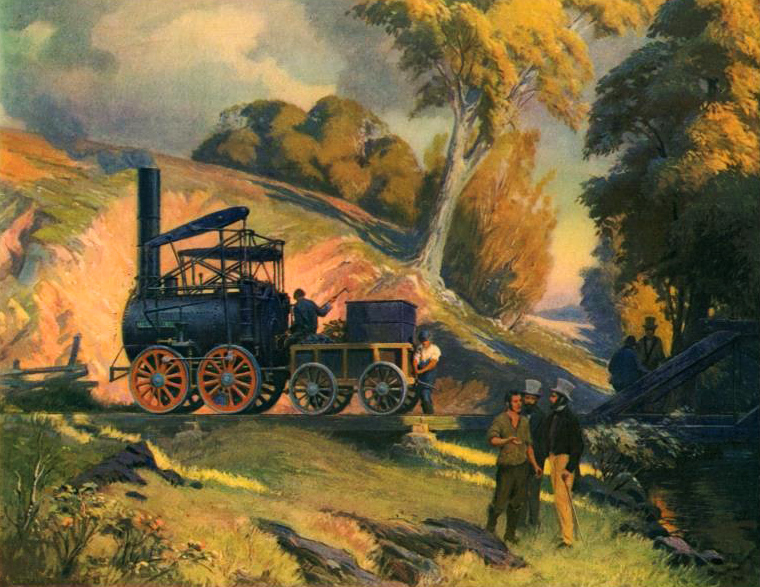
The Stourbridge Lion, a 1931 painting by Sheldon Pennoyer. Later artists put a lion’s head on the boiler front; the engine was named for that face and for Stourbridge, where Foster, Rastrick built it.
On this page: At a glance · What it was—and was not · Jervis, Allen, four English locomotives · As built · Honesdale, August 8 and September 9, 1829 · Sisters and Agenoria · Shed, foundry, Chicago · Smithsonian, 1890 · The Colonie replica · Specifications · Where to see them
At a glance
| Item | Detail |
|---|---|
| What it is | First steam locomotive to operate in the United States. Horatio Allen, Honesdale, Pennsylvania, August 8, 1829. Second trial September 9 |
| What it is not | Not the first steam machine in America (Stevens, Hoboken, 1825–26). Not the first American-built engine (Tom Thumb, 1830). Not the first U.S. revenue locomotive (Best Friend of Charleston, December 25, 1830). Not a regular D&H engine |
| Builder | Foster, Rastrick & Company, Stourbridge, England, 1829. Named for a lion’s head on the boiler and for the town |
| Ordered by | Delaware & Hudson Canal Company. John B. Jervis, chief engineer. Horatio Allen bought four locomotives in England in 1828 |
| Cost / arrival | $2,914.90 on delivery. Ship John Jay, New York, May 13, 1829. Assembled at the West Point Foundry’s New York works and steamed on blocks in late May |
| As built | 0-4-0, 4 ft 3 in gauge. Horizontal boiler, vertical cylinders, grasshopper walking beams, wooden wheels with iron tires. Engine about 14,000 lb (~7.5 tons). Jervis had asked for about 4 tons |
| Track | About three miles of wooden rail faced with wrought-iron strap, including a trestle over the Lackawaxen. The gravity railroad opened October 8, 1829 |
| Sisters | Stephenson Pride of Newcastle (often called America in later American accounts). Foster, Rastrick Delaware and Hudson. English sister Agenoria survives at York |
| After 1829 | Stored. Attempted sale 1834 failed. Boiler in a Carbondale foundry by the mid-1840s. Smithsonian 1890 |
| What you can see | Boiler and remaining parts: Smithsonian, on loan since 1999 to the B&O Railroad Museum (National Museum of Railroad History & Innovation), Baltimore. Full-size replica: Wayne County Historical Society, Honesdale, built at Colonie for the 1933 Century of Progress |
Trial dates follow Shaughnessy and the Smithsonian object record. Canal and gravity dates are on the Delaware & Hudson page. Information compiled September 18, 2026.
What it was—and was not
Steam on rails is an English story first. Richard Trevithick showed a locomotive at Penydarren on February 21, 1804. George and Robert Stephenson were still at it when Allen walked their Newcastle shop in 1828. The Rainhill Trials that made Rocket famous were still two months in the future when the Lion ran at Honesdale. The United States imported the idea before it built its own.
Order of the American firsts, scoped tightly:
- 1825–26, Hoboken. Colonel John Stevens ran a steam wagon on a circular track on his estate. Demonstration, not a common carrier.
- August 8, 1829, Honesdale. The English Stourbridge Lion was the first steam locomotive to operate in the United States. Too heavy for Delaware & Hudson track; it did not become a regular engine.
- Summer 1830, Baltimore. Cooper’s engine was the first American-built steam locomotive to run on a common-carrier railroad. It was a test machine. That page is Tom Thumb.
- December 25, 1830, Charleston. Best Friend of Charleston was the first American locomotive in regular revenue service. Allen, by then, was chief engineer of the South Carolina Canal & Rail Road.
- 1831, Bordentown. The Camden & Amboy’s John Bull was the first steam on a New Jersey railroad, and the oldest steam locomotive that still exists complete.
The founding decade is the 1820s and 1830s page. This page stays with one English 0-4-0.
Jervis, Allen, and four locomotives
Brothers Maurice and William Wurts wanted Carbondale anthracite in New York. Pennsylvania authorized a canal along the Lackawaxen on March 13, 1823; New York followed April 23. A canal all the way from the mines to the Hudson was impractical: the Moosic Mountains rise more than 1,200 feet. The answer was a gravity railroad from the mines to Honesdale and a canal from Honesdale to the Hudson at Eddyville. The first through canal trip to Honesdale was October 16, 1828. Pennsylvania had authorized the gravity railroad April 5, 1826. It opened October 8, 1829, about seventeen miles, 4-foot-3-inch gauge—after the Lion had already been tried on the first three miles. The company story is the Delaware & Hudson.
John B. Jervis became chief engineer in 1827. He laid out a chain of inclined planes, worked by stationary engines, connected by level stretches of railroad. On those levels he wanted locomotives. In 1828 he sent Horatio Allen, a former coworker, to England with two jobs: buy strap iron, and look at steam locomotives. Allen had authority to order as many as four engines if they looked useful. He was twenty-five going on twenty-six.
He went first to Newcastle. Robert Stephenson & Company was building for the Liverpool & Manchester. Allen ordered one locomotive there, works No. 12. In his letter of June 22, 1829, he called it Pride of Newcastle. Later American accounts, and the D&H company page, usually call it America—a reading of the Stephenson description book that a clerk later titled as an engine “for America.” It cost $3,663.30 delivered, arrived at New York on the Columbia on January 15, 1829, and was steamed on blocks on May 27.
Allen then went to Stourbridge and met John Urpeth Rastrick of Foster, Rastrick & Company. That firm was cheaper. He ordered three locomotives: Stourbridge Lion, Delaware, and Hudson. He also bought about 390 tons of strap iron from a Wolverhampton foundry. The Lion was $2,914.90. It came over on the John Jay and reached New York on May 13, 1829. The West Point Foundry’s New York agent, William Kemble, put it together. Steamed on blocks in late May, it drew crowds who came, a contemporary said, to see the “critter” go through the motions. Delaware ($2,944.40) and Hudson ($2,992.90) arrived in August and September and were sent on to Rondout. They were never tried on D&H track the way the Lion was.
Grasshopper beams on a horizontal boiler
The Lion was already a conventional English locomotive in outline: horizontal boiler, tall stack, four coupled wheels, a small tender behind. The cylinders stood vertically on top of the boiler. Piston rods worked a pair of grasshopper walking beams; connecting rods from those beams drove the rear axle and coupling rods took the front. The boiler was a simple single-flue vessel, about 48 inches in diameter and 10½ feet long, with an external exhaust pipe into the stack. Wheels were wood with iron tires. Gauge was the gravity railroad’s 4 feet 3 inches. Driver diameter was 48 inches. Cylinders were 8½ by 36 inches. Engine weight was about 14,000 pounds, a little over 7 tons; with tender, about 19,800 pounds. Jervis had specified something closer to 4 tons so the timber road would hold.
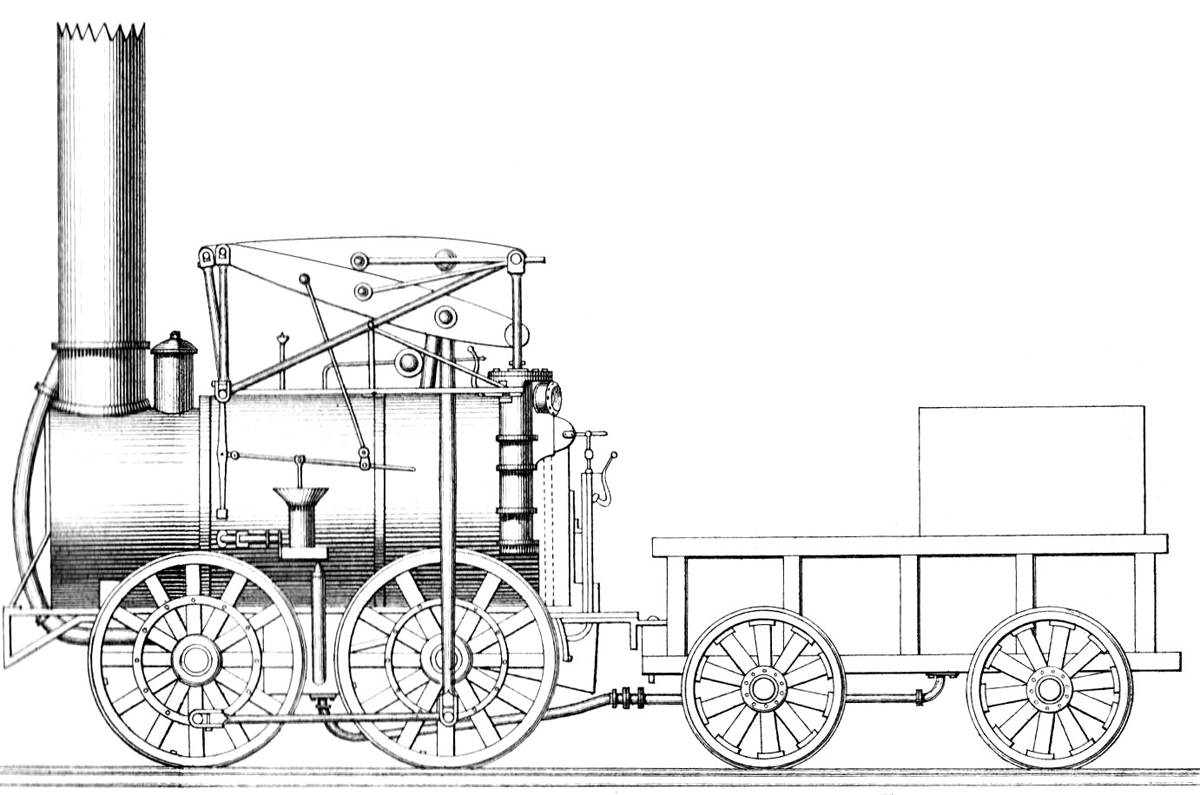
Side elevation of the Stourbridge Lion and its four-wheel tender. Vertical cylinders and grasshopper beams sit on top of the boiler; coupling rods join the two axles.
A lion’s head was painted on the front of the boiler. That is the name. Whether the paint was English or American work is argued; the face is how people remembered the engine.
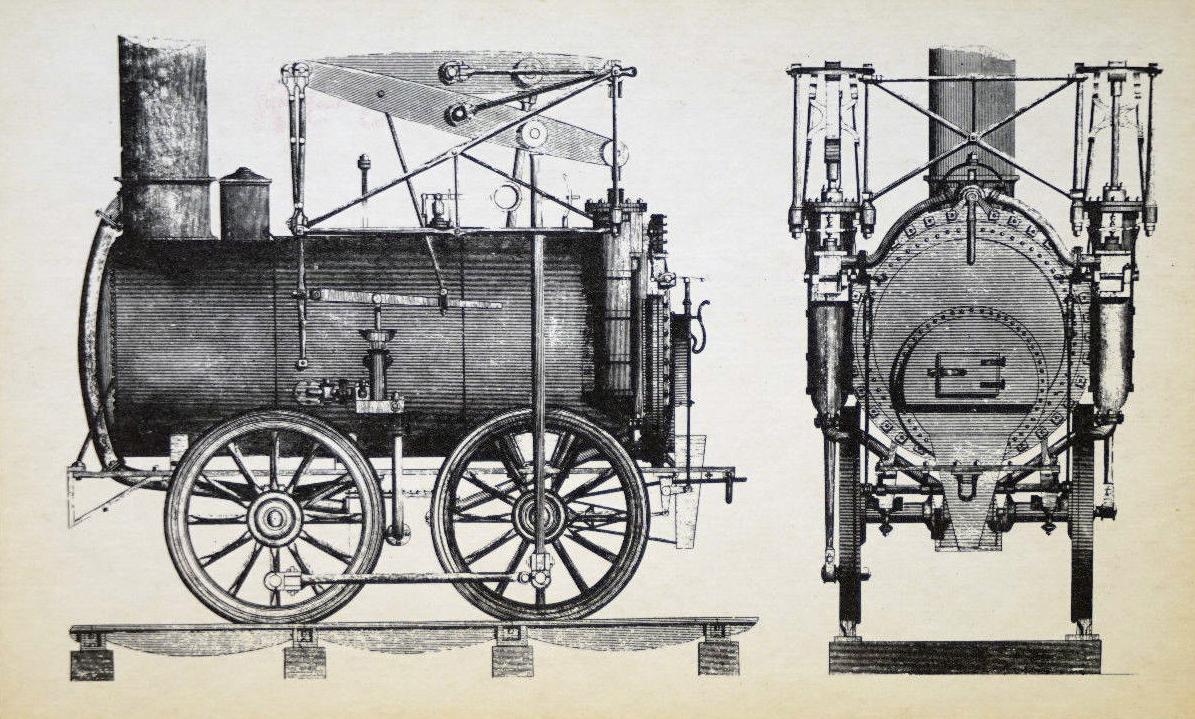
Side and front elevations. The boiler front carries the builder’s name. Cylinders and beams frame the smokebox door.
August 8, then September 9
On July 2, 1829, the Lion and the Stephenson engine went up the Hudson on the steamboat Congress and reached Rondout the next day. Canal boats took them toward Honesdale. The Lion arrived July 23. By August 5 it was on the track. About three miles of wooden rail, faced with wrought-iron strap screwed down, ran west from the canal basin, across the Lackawaxen trestle, toward Seelyville. The rest of the gravity line was still coming.
August 8 was a Saturday. People came to watch, some sure the thing would not move, some standing back in case the boiler went. Nobody would ride with Allen. He had never driven a locomotive. He opened the throttle and went. The engine crossed the trestle, ran out of sight, and came back in reverse. The round trip was on the order of three miles. The locomotive did what it was built to do. The track did not. Strap iron on timber, thirty feet in the air over a creek, was not a road for a 7½-ton engine. A second trial on September 9 confirmed it. The D&H stored the Lion and finished the gravity railroad for horses and stationary engines. It did not buy another locomotive until 1860.
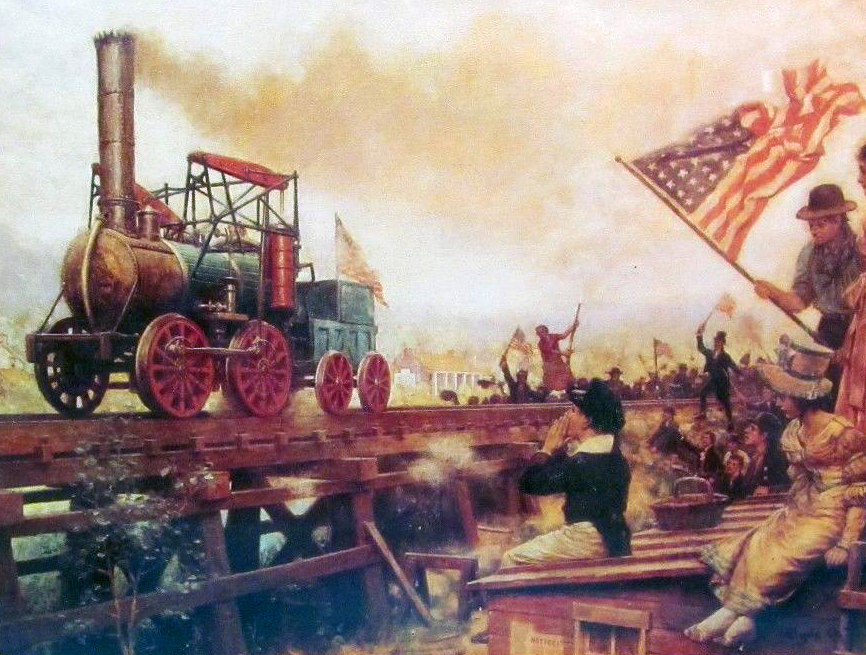
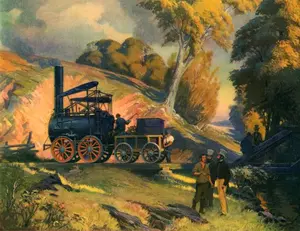
Clyde O. DeLand’s painting of the first run, the locomotive on the Lackawaxen trestle with the crowd below. The trestle was the weak point as much as the strap rail.
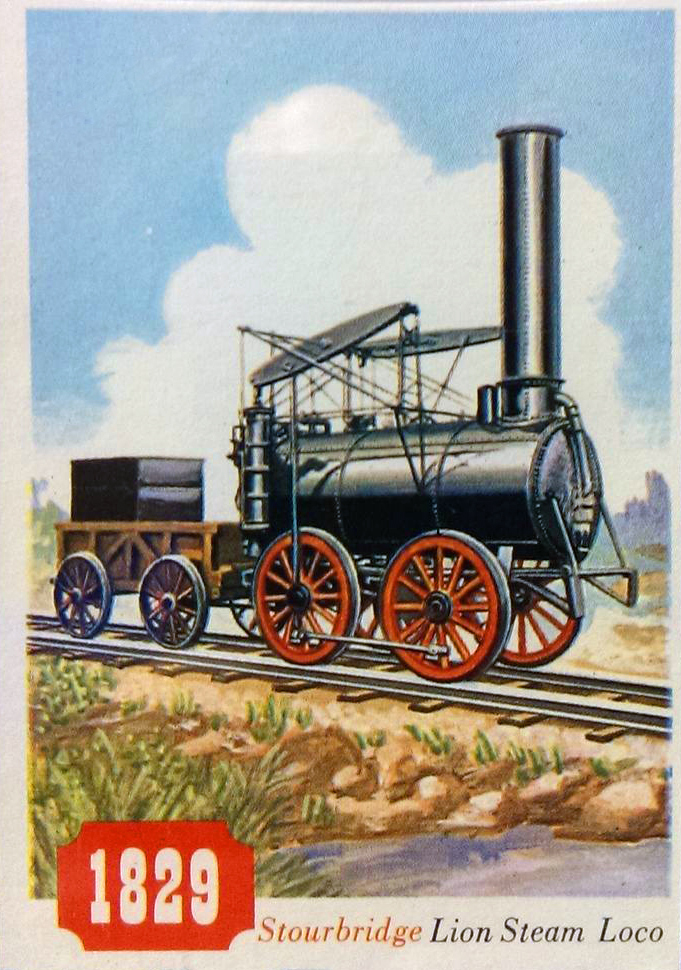
A later color card of the engine. Period photographs of the original do not exist; every picture of a complete Lion is a drawing, a painting, or the 1930s replica.
Delaware, Hudson, and Agenoria
Foster, Rastrick built only four locomotives. Three went to the D&H. The fourth, Agenoria, went to work in England in June 1829, ran more than thirty years, and is at the National Railway Museum in York. It is the closest surviving sister: same grasshopper layout, different gauge, a taller stack. When Colonie needed drawings a century later, Kensington’s Agenoria plans were part of the packet.
The Stephenson engine and the two later Rastrick engines never got the Honesdale trial the Lion got. By 1834 the D&H was trying to sell the lot to the Pennsylvania Canal Commission. The deal failed. American shops were already turning out lighter engines. The four imports became a source of English wrought-iron bar until the middle of the 1840s.
A foundry boiler, then Chicago souvenir hunters
By about 1845 the Lion was a boiler. That boiler still worked. A Carbondale foundry used it as a stationary engine into the early 1870s. The Smithsonian’s later object note puts the foundry service to 1871. New owners recognized it as a relic and in 1874 asked $1,000; nobody bought. In 1883 the D&H borrowed the boiler for the Exposition of Railway Appliances in Chicago. Security on the trip was thin. Souvenir hunters took everything loose, and used hammers and chisels on what was not. What came home was more wreck than locomotive.
Smithsonian, 1890
The Smithsonian Institution acquired the boiler in 1890. A walking beam, a cylinder, and four driving-wheel tires are in the same collection; some of those pieces may be from a sister rather than from the Lion itself. The museum tried more than once to rebuild a complete engine around the boiler. The parts list would not support it. Reconstruction was never finished.
Since 1999 the boiler and the assembled remnants have been on loan in Baltimore, first as the B&O Railroad Museum and, from July 14, 2026, as the National Museum of Railroad History & Innovation. The object is still the Smithsonian’s. The museum page is B&O Railroad Museum.
Colonie, 1933, then Honesdale
The Delaware & Hudson built a full-size replica at Colonie for Chicago’s Century of Progress. The company’s own Railroad Bulletin of May 1, 1933, described the job: drawings from Agenoria blueprints at Kensington, a drawing of the original made under Professor James Renwick of Columbia in 1829, and the boiler, cylinder, and walking beam then in Washington. Iron parts were hand-forged. The replica burned anthracite and was meant to run. It is not a tracing of lost 1829 shop drawings. Those drawings were not on the bench.
After Chicago the replica went to the New York World’s Fair in 1939–40, later the Chicago Railroad Fair, and then to Honesdale. The Wayne County Historical Society keeps it in the old D&H Canal office on Main Street, at the basin where the original started. That is the complete Lion you can stand next to. It is a 1933 Colonie engine in the shape of 1829.
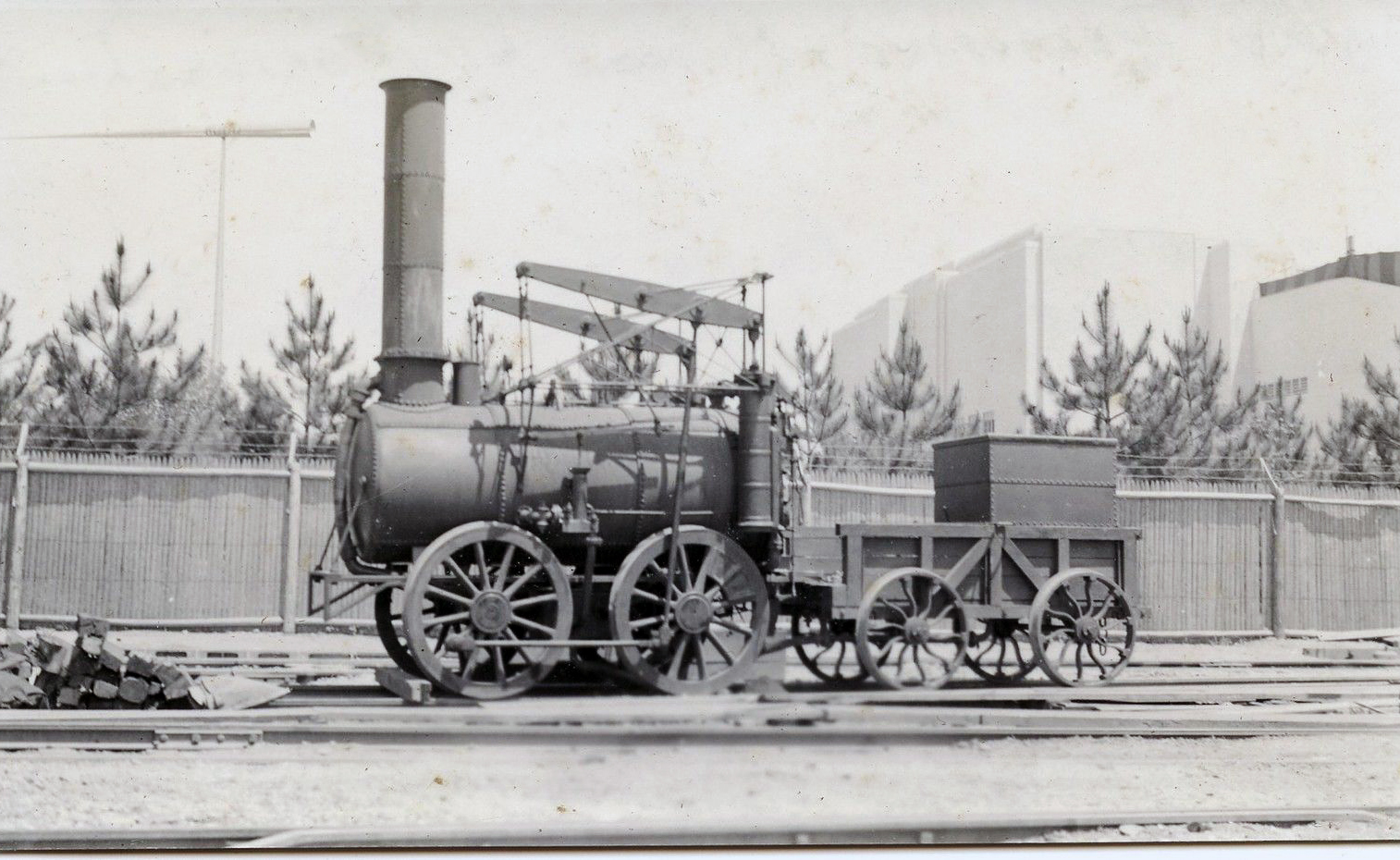
The Delaware & Hudson replica at the 1939 New York World’s Fair. Colonie built it for the Century of Progress; Honesdale has it now.
Specifications
Figures below follow the Bridge Line Historical Society summary that Wikipedia reprints, checked against the Smithsonian model note. They describe the 1829 engine, not the Colonie replica. Jervis’s four-ton specification is the number the track was built for, not the number Foster, Rastrick delivered.
| Item | Stourbridge Lion (1829) |
|---|---|
| Builder | Foster, Rastrick & Company, Stourbridge, England |
| Year | 1829 |
| Whyte | 0-4-0 |
| Gauge | 4 ft 3 in (D&H gravity railroad) |
| Drivers | 48 in. Wood centers, iron tires |
| Cylinders | 8½ × 36 in, vertical, on top of the boiler. Grasshopper walking beams |
| Boiler | 48 in diameter, 10½ ft long. Single flue. Grate about 8 sq ft |
| Engine weight | About 14,000 lb (~7.5 short tons). Jervis specification about 4 tons |
| Tender | About 5,800 lb. Four-wheel coal wagon used as tender on the trial |
| Engine and tender | About 19,800 lb |
| First run | August 8, 1829, Honesdale. Second trial September 9, 1829 |
Where to see them
The original is a boiler and a few pieces in Baltimore, Smithsonian property on loan to the National Museum of Railroad History & Innovation. The complete locomotive in Honesdale is Colonie’s 1933 replica, inside the Wayne County Historical Society’s museum in the old canal office. Agenoria, the English sister, is at York. Excursion trains still leave Honesdale on the old canal-basin track as the Stourbridge Line; that operation is a tourist railroad with the Lion’s name, not a surviving gravity road. Confirm hours on waynehistorypa.com and nationalrailroad.org before a trip.
Related reading on American-Rails.com
- Delaware & Hudson · D&H steam roster · The Stourbridge Line
- Tom Thumb · Best Friend of Charleston · John Bull · Stephenson’s Rocket
- Railroads in the 1820s/1830s · Steam locomotives · B&O Railroad Museum
Sources
- Shaughnessy, Jim. Delaware & Hudson. Berkeley, Calif.: Howell-North, 1967. Gravity railroad, August 8, 1829 trial, too heavy for timber-and-strap. Company construction authority
- Oliver, Smith Hempstone. The First Quarter-century of Steam Locomotives in North America. Smithsonian Institution, 1956, pp. 14–21. Delivery, John Jay, West Point Foundry, Honesdale trials
- Smithsonian Institution. Model of the 1829 steam locomotive Stourbridge Lion, object nmah_687356. August 8 and September 9, 1829; foundry service of the boiler to 1871; Smithsonian 1890; walking beam, cylinder, and four tires; replica 1933
- Delaware & Hudson Railroad. “Stourbridge Lion Runs Again.” Delaware and Hudson Railroad Bulletin, May 1, 1933, pp. 75–76. Colonie replica; Agenoria drawings from Kensington; Renwick 1829 drawing; Smithsonian boiler, cylinder, walking beam
- Brown, William Henry. The History of the First Locomotives in America. New York: D. Appleton, 1874. Contemporary “critter” notice; Allen on August 8
- Wayne County Historical Society. The Stourbridge Lion and the Birthplace of America’s Commercial Railroad. Allen in England; $2,915; three miles of wooden track and the Lackawaxen trestle
- State, Raymond. “The Truth Behind the Pride of Newcastle.” Railroad History, 2009. And The Pride and the Lion, Wayne County Historical Society, 2011. Stephenson works No. 12 as Pride of Newcastle; America as a later reading
- Bridge Line Historical Society. Stourbridge Lion notes (weight, grate, boiler, cylinders) as reprinted in later summaries
- American-Rails.com, Delaware & Hudson. Canal first through trip October 16, 1828; gravity railroad opened October 8, 1829; second trial September 9; 1933 Colonie replica at Honesdale
- American-Rails.com, Railroads in the 1820s/1830s and Tom Thumb. Order of the American firsts
- B&O Railroad Museum / National Museum of Railroad History & Innovation. Smithsonian boiler on loan. Rebrand July 14, 2026, name change note
Recent Articles


-
Boone & Scenic Valley Wolf Dinner Train (2026)
Sep 19, 26 08:15 PM
 2026 Boone & Scenic Valley Wolf Dinner Train—Des Moines River valley, Bass Point Creek High Bridge, Union Pacific dining cars. Confirm on bsvrr.com.
 -
C&NW 4-6-2s 1617 & 1620: Minnesota 400 Yellow Jackets
Sep 19, 26 11:28 AM
 C&NW Class E Pacifics 1617 and 1620—Alco Schenectady 1917, yellow-and-green E-4-style shrouds 1941 for the Minnesota 400. Crews called them Yellow Jackets. Renumbered 617/620. Scrapped 1956.
 -
Erie Lackawanna Diesel Roster: All-Time
Sep 19, 26 10:13 AM
 Erie Lackawanna diesel—Erie and DL&W inheritance, GP35s, U25Bs, SD45/SDP45/SD45-2, U34CH. All-time roster with serials and orders. Conrail April 1 1976.
 -
Erie Lackawanna Railway: Map, History, Logo
Sep 19, 26 10:06 AM
 Erie Lackawanna Railway—Erie and DL&W, October 17 1960–March 31 1976. Von Willer, White revival, Dereco, Agnes, Conrail. High-and-wide Chicago main. Map, logo, what remains.
 -
"Empire State Express" (1941 Train): Timetables, Route, Consist
Sep 18, 26 10:59 PM
 NYC Empire State Express—George Daniels 1891 day train, 999’s 112.5 mph claim, Budd stainless streamliner December 7 1941, Cleveland and Detroit sections, diesels, 1967 name drop. Timetables, consist…
 -
New York Central 4-6-4s 5426 & 5429: Empire State Express Hudsons
Sep 18, 26 10:32 PM
 NYC J-3a Hudsons 5426 and 5429—Alco 1937, Budd stainless shrouds 1941 for the Empire State Express. Pearl Harbor inaugural. Shrouds off by 1950. Neither preserved.
 -
"Stourbridge Lion" Locomotive: Facts, History, Photos
Sep 18, 26 10:27 PM
 Stourbridge Lion—Foster, Rastrick 0-4-0, first steam locomotive in the United States. Horatio Allen, Honesdale, August 8, 1829. Too heavy for D&H gravity track. Boiler in Baltimore; Colonie replic…
 -
Delaware & Hudson Steam Roster (Post 1900)
Sep 18, 26 10:01 PM
 Delaware & Hudson steam—Camelback 2-8-0s, Loree high-pressure compounds, Class K 4-8-4s, forty Challengers. Post-1900 class roster after Drury. Last steam July 21, 1953.
 -
Boston & Maine Steam Roster (Post 1900)
Sep 18, 26 02:57 PM
 Boston & Maine steam—B-15 Moguls, K-8 Consolidations, P-4 Lima Pacifics, T-1 Limas, R-1 Mountains. Post-1900 class roster after Drury. Last steam July 23, 1956.
 -
Boston & Maine Diesel Roster (All-Time)
Sep 18, 26 01:25 PM
 Boston & Maine diesel—boxcab 1100 1935, Flying Yankee 6000, FTs, E7s, BL2s, GP7/GP9, GP38-2s and GP40-2s. All-time roster. Last steam July 23, 1956.
 -
Mid-Continent Railway Museum Dining (2026)
Sep 18, 26 01:21 PM
 2026 Mid-Continent dining in North Freedom—select-date seated meals in luxury cars, reservations required. Pizza Limited June 28. Confirm on midcontinent.org.
 -
Bessemer & Lake Erie Steam Roster (Post 1900)
Sep 18, 26 12:11 PM
 Bessemer & Lake Erie steam—C3A 150–151, D1A/D2A Santa Fes, 47 H1 Texas types after Burlington. Post-1900 class roster after Drury. Last steam 2-8-0 156, May 14, 1953.
 -
Bessemer & Lake Erie Diesel Roster (All Time)
Sep 18, 26 12:09 PM
 Bessemer & Lake Erie diesel—Westinghouse 281 1936, Baldwin DRS-6-6-1500s, F7s 1950–53, SD7/SD9/SD18/SD38 family, RSD-15s. All-time roster. Last steam 2-8-0 156, May 14, 1953.
 -
Bangor & Aroostook Steam Roster (Post 1900)
Sep 18, 26 11:21 AM
 Bangor & Aroostook steam—Manchester Ten-Wheelers, Alco Mountains 100–109, G-2 Consolidations, Pacifics 250–254. Post-1900 class roster after Drury. Last steam Pacific 251, July 22, 1951.
 -
Bangor & Aroostook Diesel Roster (All Time)
Sep 18, 26 11:09 AM
 Bangor & Aroostook diesel—F3s 1947, eight BL2s, E7s, GP7s leased to the PRR, GP9s, GP38s. All-time roster. Last regular steam July 22, 1951.
 -
B&O Steam Locomotive Roster (Post 1900)
Sep 18, 26 10:33 AM
 Baltimore & Ohio steam—Old Maude, E-27 Consolidations, Q Mikados, Big Sixes, EM-1 Yellowstones, President Pacifics. Post-1900 class roster after Drury. Last public steam May 17, 1958.
 -
Baltimore & Ohio (B&O): Diesel Roster (All-Time)
Sep 18, 26 10:28 AM
 Baltimore & Ohio diesel—boxcab 1925, EMC 50 1935, EA 1937, FTs, F3s, F7s, FA-2s, sharks, GP7/GP9, GP30s after C&O 1963, SD50s 8576–8595 1984. All-time roster. Last steam 1958.
 -
Detroit & Toledo Shore Line Railroad: Map, Roster, History
Sep 18, 26 12:32 AM
 Detroit & Toledo Shore Line—Pleasant Bay 1898, named 1899, Detroit–Toledo freight bridge, GTW and Clover Leaf/NKP/N&W. Merged into Grand Trunk Western June 26, 1981.
 -
Lackawanna Steam Locomotives: History, Roster & Photos
Sep 18, 26 12:17 AM
 Delaware, Lackawanna & Western steam—Camelback 2-8-0s, Mikados, freight Pacifics, Poconos 4-8-4s, Hudsons. Post-1900 roster after Drury. Last steam July 13, 1953.
 -
Lackawanna (DL&W) Diesel Roster: All Time
Sep 18, 26 12:11 AM
Delaware, Lackawanna & Western diesel—boxcabs 1926, EMC SC 425–426 1935, FTs 1945, F3/F7/E8, GP7s, RS-3s, FM Train Masters. All-time roster. Last steam 1953. -
Lackawanna Railroad: Map, History, Viaducts, Rosters
Sep 18, 26 12:04 AM
 TDelaware, Lackawanna & Western—Liggett’s Gap 1832, named March 11 1853, Hoboken–Buffalo, anthracite, Phoebe Snow, Cutoff and Tunkhannock. It merged with the Erie to form Erie Lackawanna on Octobe…
 -
Rail News, The Latest
Sep 17, 26 11:56 PM
This page provides a portal to the latest in rail news, from preservation and restortation subjects to other notable topics. -
Union Pacific Big Boy 4014 Sets First Holiday Tour for Make-A-Wish
Sep 17, 26 11:54 PM
 Union Pacific Big Boy 4014’s first holiday tour: Cheyenne–Denver tickets, Nov. 21 Denver-area display, Make-A-Wish. Museum patrons Oct. 16; public Oct. 19.
 -
Conrail Diesel Roster (All Time)
Sep 17, 26 10:27 PM
Conrail diesel—~5,000 inherited 1976, Big Blue, GP15-1s, SD40-2s, SD50s, Dash-8s, SD60/60M/60I, SD80MACs. All-time CR-number roster. -
Chessie System (Railroad): The C&O, B&O, And WM
Sep 17, 26 09:38 PM
 Chessie System, Inc.—C&O, B&O, and Western Maryland. Kitten-C paint 1972, holding company February 26 1973, CSX November 1 1980, C&O into CSXT August 31 1987.
 -
Chesapeake & Ohio (C&O) Diesel Roster: All-Time
Sep 17, 26 06:01 PM
 Chesapeake & Ohio diesel—late steam, no Fairbanks-Morse, E7s 1946, GP7/GP9 flood, F7s, GP40-2s, B30-7s, SD50s 1984–85. All-time roster. Steam ended 1956.
 -
Chesapeake & Ohio (C&O) Steam Roster: Post-1900
Sep 17, 26 03:18 PM
 Chesapeake & Ohio steam—H-8 Alleghenies, K-4 Kanawhas, T-1 Texas, Greenbriers, H-6 1949 Mallets. Post-1900 class roster including Pere Marquette and Hocking Valley. Last steam 1956.
 -
Chesapeake and Ohio Railway: Map, Logo, History
Sep 17, 26 02:36 PM
 Chesapeake & Ohio Railway—Louisa Railroad 1836, named August 31 1868, Ohio River 1873. Coal, Chessie the kitten, Pere Marquette 1947, B&O control 1963, into CSX August 31 1987. Complete corporate…
 -
TVRM Valentine Train Ride (2026)
Sep 17, 26 02:31 PM
 2026 TVRM Valentine Train Ride in Chattanooga—Feb. 6–15, plated dinner, Grand Junction Depot. Confirm on tvrail.com.
 -
River Fox Train Dining (2026)
Sep 17, 26 02:29 PM
 2026 River Fox Train in West Sacramento—Brunch Train and Murder Mystery dinner. 18095 County Road 117. Confirm on riverfoxtrain.com.
 -
Weehawken Terminal, Serving The West Shore Railroad
Sep 17, 26 01:38 PM
 Weehawken Terminal—West Shore / New York Central Hudson waterfront station, opened 1884. Five ferry slips, sixteen tracks, Weehawken Tunnel 4,014 feet. Last ferry March 25, 1959. Port Imperial and HBL…
 -
West Shore Railroad: Map, History, Timetables
Sep 17, 26 01:32 PM
 West Shore Railroad—New York, West Shore & Buffalo 1880–83, Weehawken to Buffalo. PRR-backed rival to the Central. Morgan settlement, 475-year NYC lease January 1 1886. CSX River Sub today.
 -
Jersey Central Diesel Locomotives: History, Roster & Photos
Sep 17, 26 01:20 PM
 Central Railroad of New Jersey diesel—boxcab 1000, Baldwin double-enders, F3s, Train Masters, SD35s, GP40Ps. All-time roster. Steam ended July 1, 1954.
 -
Jersey Central Steam Locomotives: History, Roster & Photos
Sep 17, 26 01:17 PM
 Central Railroad of New Jersey steam—Camelback Ten-Wheelers, USRA Mikados, G-class Pacifics, suburban tanks. Post-1900 class roster after Drury. Dieselized July 1, 1954.
 -
Jersey Central Railroad (CNJ): Map, Rosters, History
Sep 17, 26 01:14 PM
 Central Railroad of New Jersey—Elizabethtown & Somerville 1831, named April 23 1849. Communipaw, anthracite, Blue Comet, Reading/B&O control. Conrail April 1 1976. Complete corporate history.
 -
Central Vermont Diesel Locomotives: History, Roster & Photos
Sep 17, 26 11:35 AM
 Central Vermont diesel—Alco S-2s 1942, RS-3s, RS-11s from DW&P, EMD GP9s 1956–57, GP38ACs 1971. All-time roster. Last steam April 4, 1957.
 -
Central Vermont Steam Locomotives: History, Roster & Photos
Sep 17, 26 11:19 AM
 Central Vermont steam—ten Alco 2-10-4s of 1928, four U-1-a Mountains, Consolidations. Post-1900 class roster after Drury. Last steam April 4, 1957.
 -
Central Vermont Railway: Map, Logo, Rosters
Sep 17, 26 11:03 AM
 Central Vermont Railway—Vermont Central charter October 1843, Bethel–White River Junction June 26, 1848. Grand Trunk 1898, CN 1923, RailTex/NECR 1995. Complete corporate history.
 -
Fitchburg Railroad: Map, History, Timetables
Sep 17, 26 10:40 AM
 Fitchburg Railroad—chartered March 3, 1842, Boston–Fitchburg March 5, 1845. Alvah Crocker, Hoosac west door, Vermont & Massachusetts, Cheshire. B&M 99-year lease July 1, 1900. Complete corpora…
 -
Steam Railroading Institute Dining (2026)
Sep 17, 26 10:30 AM
 2026 SRI Owosso dining—vintage dining cars, select evenings. 2026 dinner calendar not posted; 2025 Up In Smoke is the recent example. Confirm on michigansteamtrain.com.
 -
Canadian Pacific Railway: Map, History, Logo, Photos
Sep 17, 26 12:06 AM
 Canadian Pacific Railway—incorporated February 16, 1881. Last spike Craigellachie November 7, 1885. Soo, Milwaukee, D&H, DM&E. CPKC April 14, 2023. Complete corporate history.
 -
Canadian Pacific Diesel Locomotives: History, Roster & Photos
Sep 17, 26 12:03 AM
 Canadian Pacific diesel—E8A 1800 in 1949, FP7/FP9, FA-2, C424, SD40-2, SD40-2F Red Barns, AC4400CW, ES44AC, SD30C-ECO, SD70ACu heritage. All-time roster. Last steam November 6, 1960.
 -
Canadian Pacific Steam Locomotives: History, Roster & Photos
Sep 16, 26 11:35 PM
 Canadian Pacific steam—3,257 engines 1881–1949. D10 Ten-Wheelers, G3 Pacifics, Royal Hudsons, Selkirk 2-10-4s. Post-1900 class roster after Drury. Last steam November 6, 1960.
 -
Woodstown Central Dining in Motion (2026)
Sep 16, 26 11:31 PM
 2026 Woodstown Central Dining in Motion—Salem County table car, 50–60 minutes, private table of four from $190. Confirm on woodstowncentral.com.
 -
NCTM Wine & Dine on the Rails (2026)
Sep 16, 26 11:28 PM
 2026 NCTM Wine & Dine on the Rails in Spencer—Feb. 13–15, three-course dinner, 21+, $145/$140. Sold out. Confirm next season on nctransportationmuseum.org.
 -
Southern Railway 4-6-2 1380: The Streamlined Ps-4
Sep 16, 26 10:34 PM
 Southern Railway Ps-4 4-6-2 1380—Alco 1923, serial 64857. Otto Kuhler streamlining at Spencer 1940–41 for the Tennessean. Only streamlined steam locomotive on the Southern. Scrapped Baltimore 1953.
 -
Texas Mexican Railway: Serving The Border Since The 1880s
Sep 16, 26 09:58 PM
 Texas Mexican Railway—Corpus Christi, San Diego & Rio Grande March 1875, 3-foot. Tex-Mex June 1881, Laredo Sept 1881, Rio Grande bridge 1883. Standard gauge July 17 1902. Mexican government 1900–1…
 -
Mount Hood Railroad Dining (2026): No Plated Dinner Train This Season
Sep 16, 26 09:53 PM
 2026 Mount Hood Railroad in Hood River is scenic Fruit Loop trains with snacks and sandwiches—not a plated dinner train. Confirm on mthoodrr.com.
 -
Peoria and Eastern Railway: Map, Timetables, History
Sep 16, 26 09:39 PM
 Peoria & Eastern—Danville, Urbana, Bloomington & Pekin 1866, IB&W 1869, OI&W 1887. Incorporated Feb 21 1890, Big Four next day. NYC 1930, Conrail 1976. GP7s 5612–5625. Complete corporate history.
 -
Boston and Maine Railroad: "Route Of The Minute Man"
Sep 16, 26 11:30 AM
 Boston & Maine—Andover & Wilmington 1833, NH charter June 27 1835. Eastern, Boston & Lowell, Fitchburg/Hoosac, Concord & Montreal. Section 77 March 12 1970. Guilford June 30 1983. CSX June 1 2…