
Burlington Railroad (CB&Q): Map, History, Rosters, Photos
Last revised: October 16, 2024
By: Adam Burns
Some railroads were seemingly destined to become strong, profitable operations. The Chicago, Burlington and Quincy was one such example. Its history traces back to the pre-Civil War period when trains near or west of the Mississippi River remained a relative novelty.
During the mid-19th century the "Q's" earliest predecessor had established through service to Chicago and then spent the next several decades rapidly expanding. Its slogan, "Everywhere West," was quite befitting for this classic Midwestern granger.
While the CB&Q did operate many secondary, agricultural branches it also boasted important through corridors to the Twin Cities, Denver, Kansas City, Omaha, southern Montana, and even reached the Gulf Coast! The Burlington was also quite close with the communities it served and highly visible in the public eye.
It maintained an impressive fleet of high-class trains in addition to hosting its allying roads' transcontinental services.
The long sought merger with the Great Northern, Northern Pacific, and the Spokane, Portland & Seattle, finally became a reality in early 1970 forming the gigantic Burlington Northern system. Today, all of the Burlington's principal lines remain in operation under successor BNSF Railway.
Photos
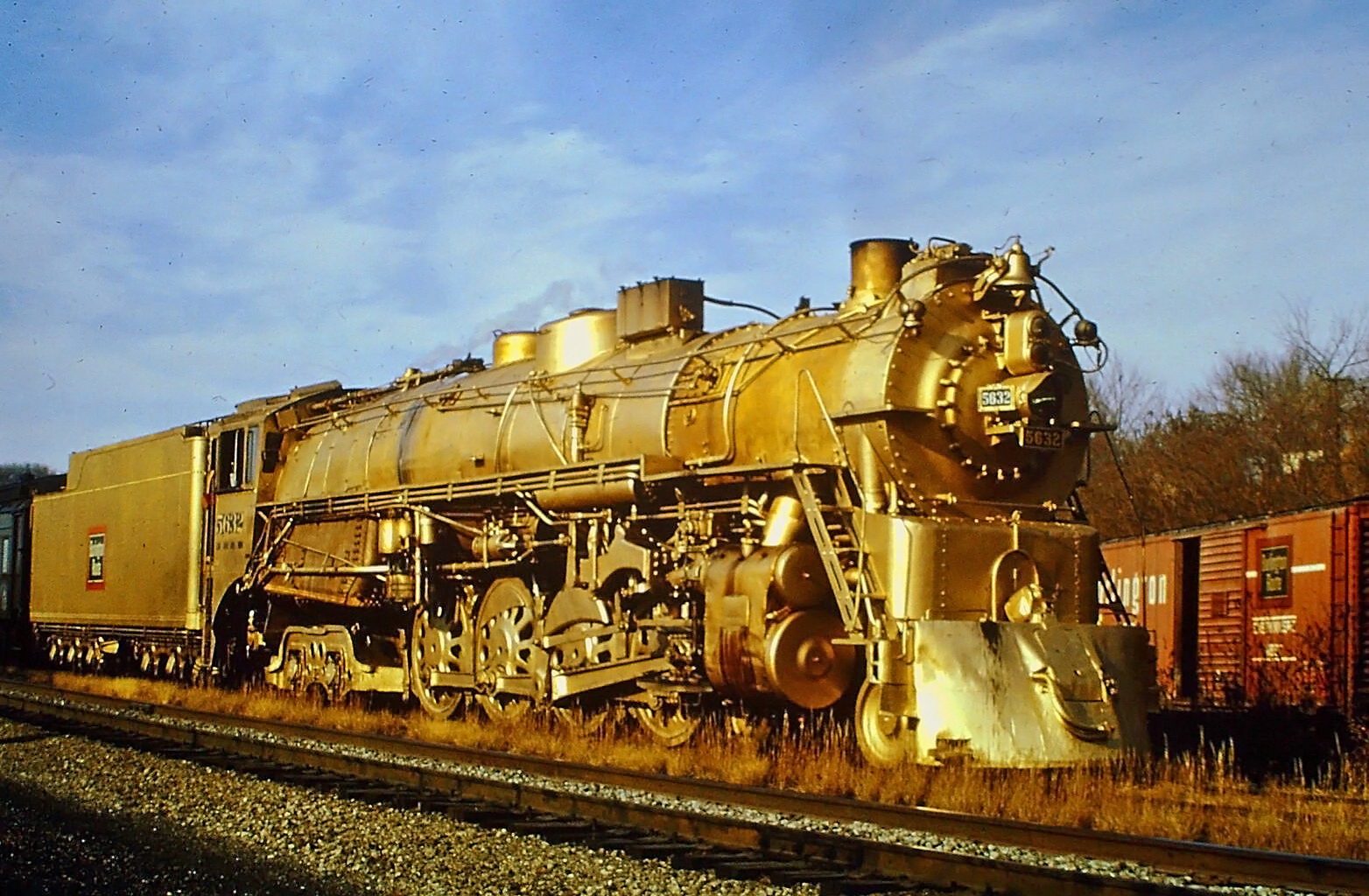 Chicago, Burlington & Quincy 4-8-4 #5632 (O-5b) wearing a special gold livery in November, 1964 to celebrate the 50th anniversary of Kansas City Union Station's opening. Earlier that year the locomotive was also dressed in gold to mark the centennial of Burlington's Chicago - Aurora main line. Photographer unknown.
History
The complete corporate history of the Burlington could encompass many books and the railroad has already been covered extensively over the years, including its narrow-gauge network in central Colorado. Presented here will be only a brief synopsis.
During the road's height it spanned the Midwest and thanks to acquisitions like the Colorado & Southern and Fort Worth & Denver also reached Texas, New Mexico, Wyoming, and Colorado. Its legend lives on today through its Zephyr name and Chicago main line which continues to see hundreds of freight and commuter trains daily.
Overview
Colorado & Southern Railway (748 Miles) Fort Worth & Denver Railway (1,364 Miles) |
|
Chicago - Aurora - Rochelle - Minneapolis/St. Paul Chicago - Omaha - Lincoln - Denver Galesburg, Illinois - Quincy - Kansas City/St. Joseph Savanna/Rock Island - Paducah, Kentucky Burlington, Iowa - Quincy - St. Louis Omaha - St. Joseph - Kansas City Napier, Missouri - Oxford, Nebraska Table Rock, Nebraska - Lincoln - Billings, Montana Billings - Denver - Cheyenne - Dallas/Fort Worth - Galveston Ashland, Nebraska - Sioux City, Iowa Galesburg - Peoria Kansas City - St. Louis |
|
Steam: 10 Diesel: 691 | |
Freight Cars: 41,099 Passenger Cars: 925 | |
If you can find a copy the most thorough title available on the CB&Q is Richard Overton's, "Burlington Route: A History Of The Burlington Lines." The book was originally published in 1965 to celebrate the railroad's centennial and is currently out-of-print but copies can be found floating around from time to time and occasionally appear on Amazon.com.
The Burlington's heritage is quite fascinating, owing its start to a predecessor of future rival Chicago & North Western, the Galena & Chicago Union (G&CU). By the early 1850's railroad fever had spread across the Midwest as promoters clamored to reach the growing metropolis of Chicago, the future railroad capital of America.
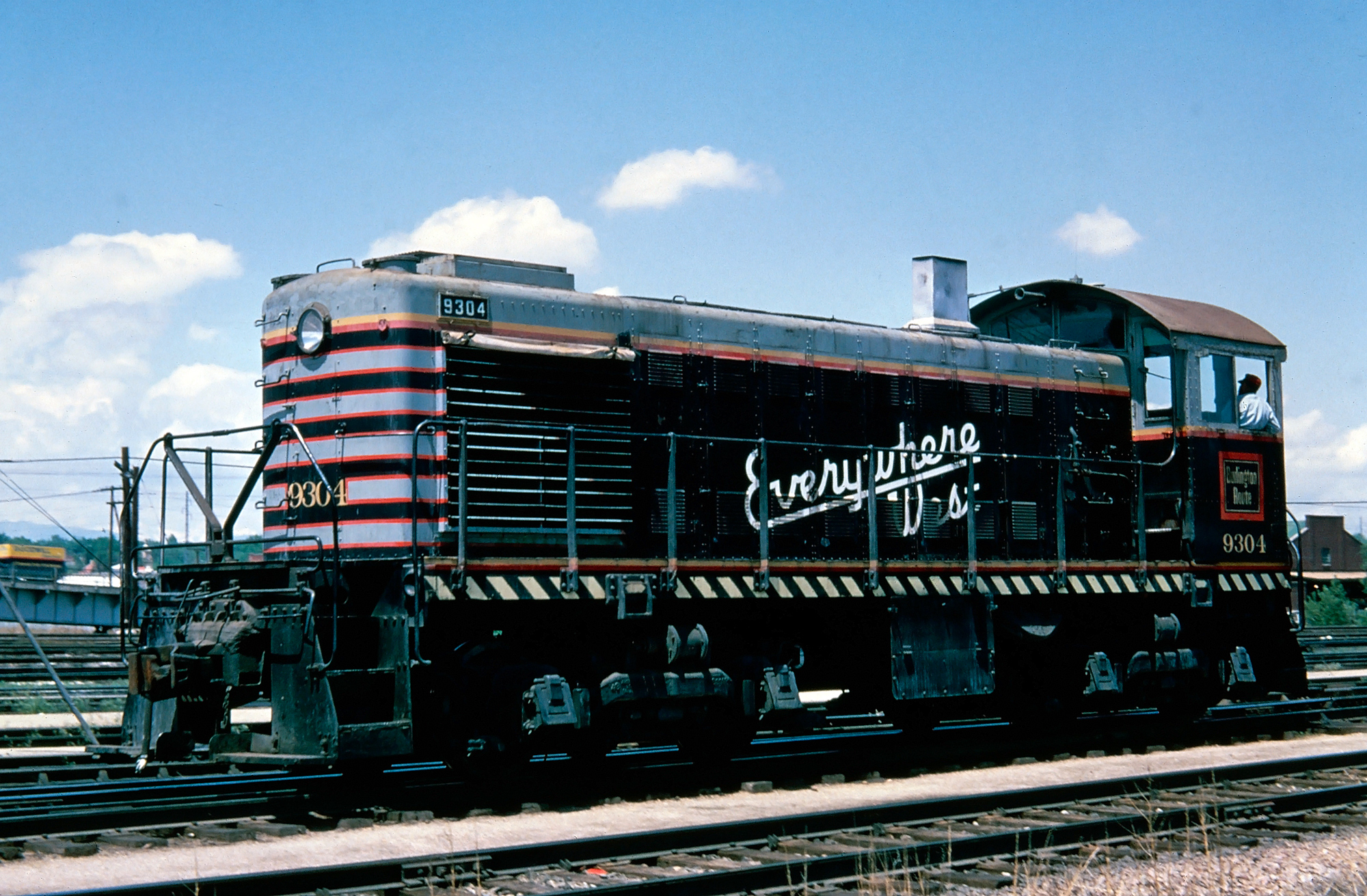 Burlington (CB&Q) S2 #9304 is seen here at work in Denver, Colorado, circa 1965. American-Rails.com collection.
Predecessors
The G&CU was chartered in 1836 and had opened from Chicago to Elgin by January of 1850. It then extended to Freeport during September of 1853. Like so many communities of that era, the town of Aurora, Illinois yearned for its own railroad. In particular, they were growing increasingly concerned about the G&CU.
The neighboring towns it served would potentially render theirs obsolete. Since the 1820's railroads were proving themselves as the revolutionary vehicle for a prosperous economic future, able to move freight and people at unprecedented speeds.
Aurora secured chartering rights through the Illinois state legislature for the Aurora Branch Railroad (ABRR) on February 12, 1849. On February 22nd the company was formally organized. This little system was the Chicago, Burlington & Quincy's genesis.
It was intended to run north out of Aurora, along the Fox River, reach Batavia and then turn slightly northeastward to Turner Junction (now West Chicago) where an interchange would be established with the G&CU for direct service into Chicago.
In those days, such fledgling operations had extreme difficulty in just getting started, particularly in the case of a local system like the Aurora Branch. Without strong financial backing the ABRR was forced to rely on its directors going door-to-door to sell stock subscriptions individually.
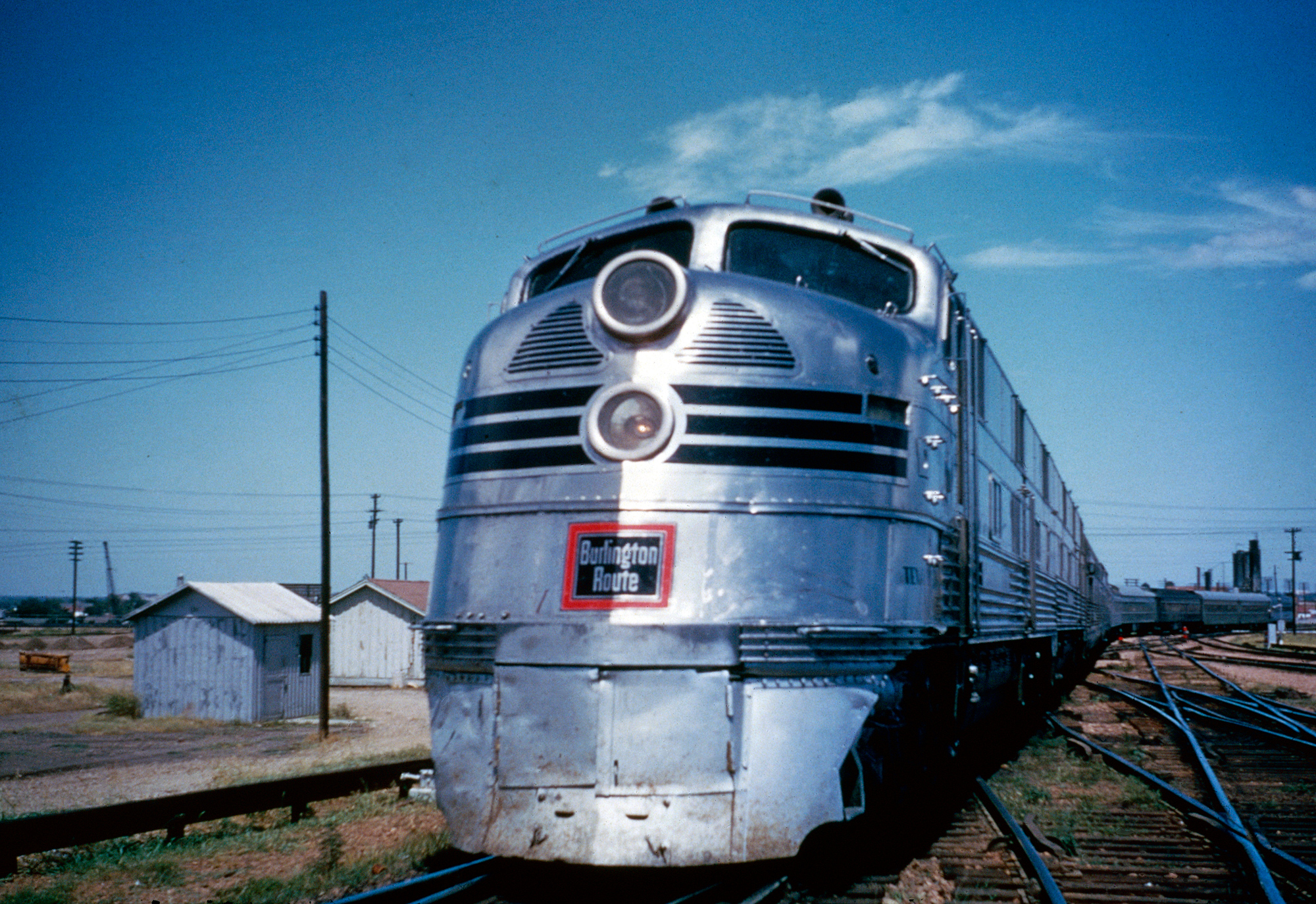 A Burlington E5A departs Fort Worth, Texas with the "Texas Zephyr" during the 1960s. American-Rails.com collection.
Such tactics usually have mixed results but the group was successful enough that actual construction began within a year. By the spring of 1850 grading was underway as crews worked their way south from Turner Junction and on August 22nd tracks had reached Batavia.
In a most interesting historical footnote the Aurora Branch held special festivities on September 2nd to inaugurate rail service. However, without any actual equipment of its own the company had to borrow a locomotive and coach from the G&CU.
The locomotive was none other than the 4-2-0 named Pioneer, the very same iron horse which had been honored as the first ever to operate out of Chicago on October 24, 1848. As rails of the Aurora Branch pushed southward the line was completed into Batavia on October 4th and only a few weeks later, on October 21st, the railroad launched regular service over the G&CU into Chicago.
Its promoters were onto something as the small pike proved a financial success. However, with elements of future rivals either underway or in the planning stages there was little time to celebrate.
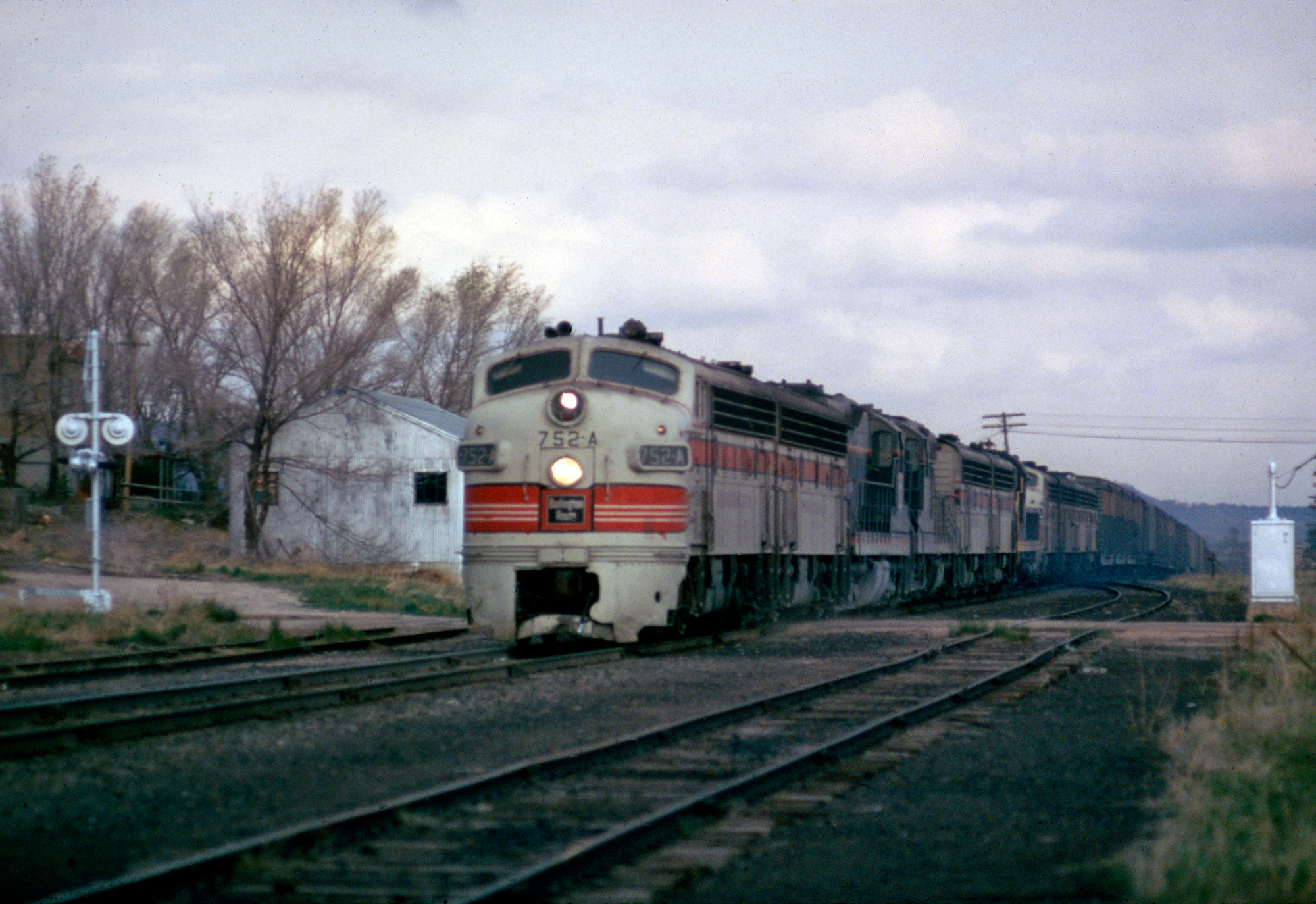 In this classic scene, a wonderful lashup of Burlington F7s and six-axle SDs lug a northbound upgrade on the "Joint Line," south of Denver, Colorado during the 1960s. Location not recorded. American-Rails.com collection.
Expansion
With an eye towards expansion the company was renamed as the Chicago & Aurora Railroad on June 22, 1852. Ironically, its original intention here was not to build east to Chicago but rather west towards, "a point 15 miles north of La Salle...to connect with any railroad to built northward from that town."
At the same time much more prominent financial backing arrived from eastern sources, notably those financing the Michigan Central (the "Forbes Group"), who became interested in the C&A project.
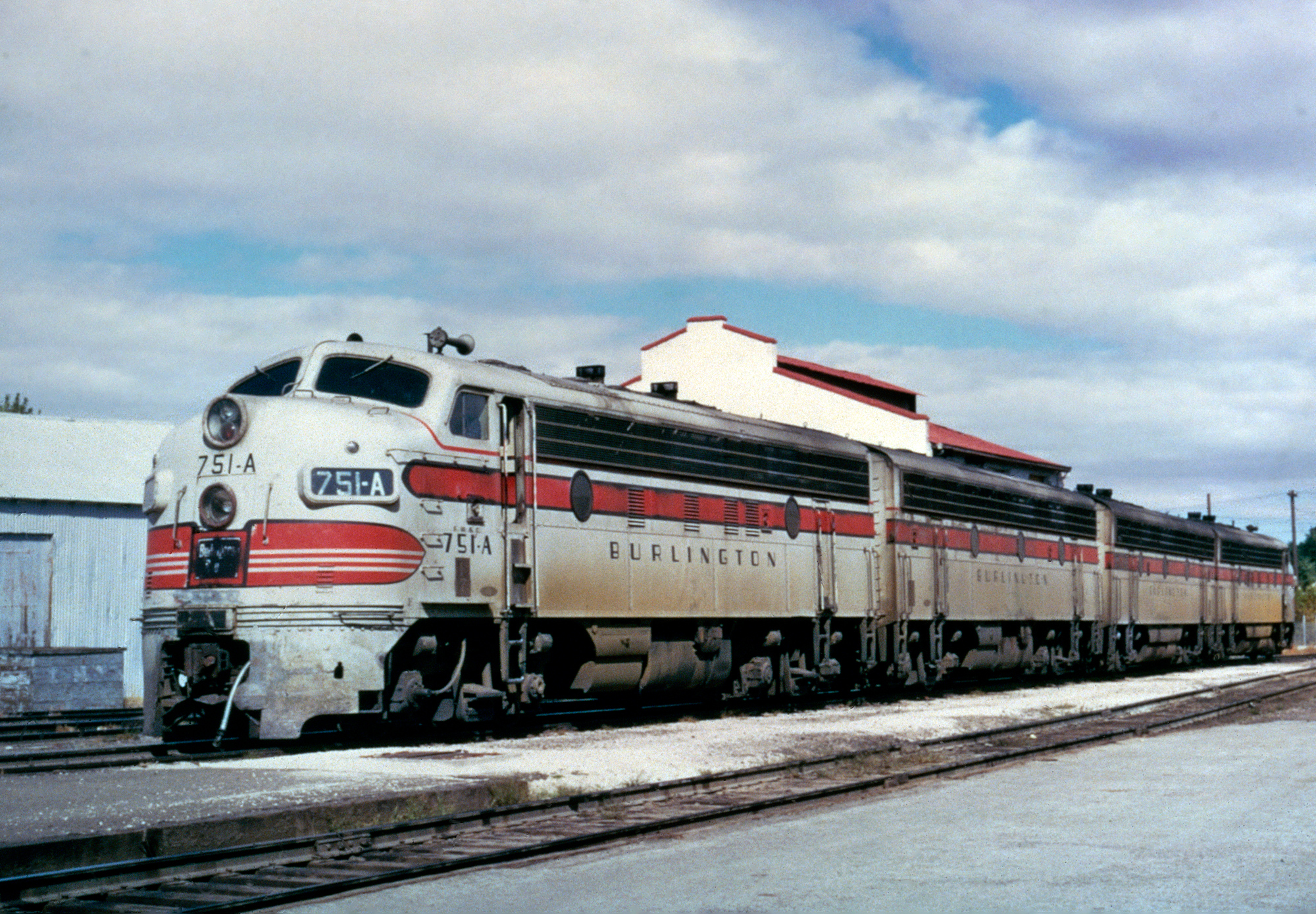 In this undated photo that also did not identify the location, a handsome A-B-B-A set of Burlington F7's, led by #751-A (sublettered for subsidiary Fort Worth & Denver), is seen here probably during the 1960s. American-Rails.com collection.
The "point 15 miles north of La Salle" was Mendota and the 45.61 miles to this town, which established a connection with the expanding Illinois Central, was officially completed on October 20, 1853. In short order the former Aurora Branch was fast becoming one of the Midwest's prominent systems.
Its successor was later merged with the Northern Cross Railroad (This company had been chartered on February 10, 1849 from the remnants of another carrier by same name established in 1837. Most of this failed predecessor eventually became the Wabash except for a stretch of grading completed north of Quincy.), Central Military Tract Railroad (chartered on February 15, 1851), and Peoria & Oquawka (incorporated on February 12, 1849).
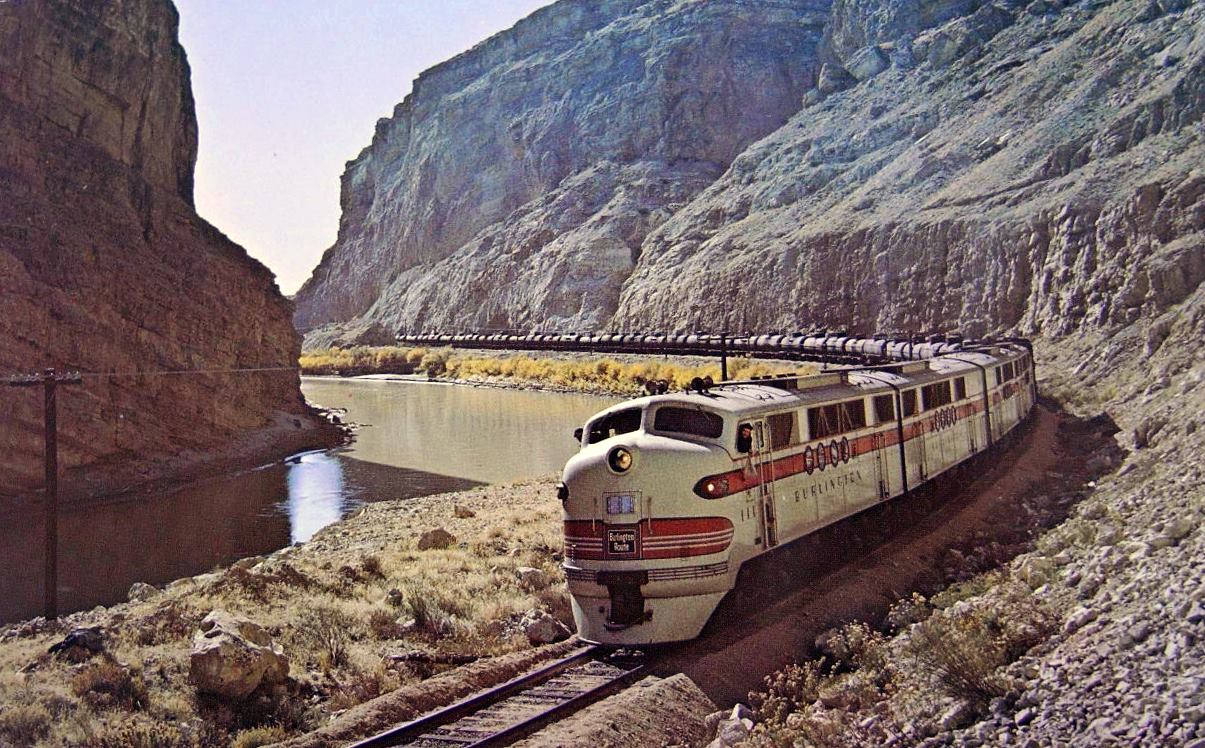 A Chicago, Burlington & Quincy company photo featuring new FT's ahead of a string of northbound tank cars within the Wind River Canyon of northern Wyoming along the Bighorn River circa 1945. Fred Lehman photo.
Formation
The 1850's were a whirlwind decade that witnessed a great deal of expansion and the official creation of the Chicago, Burlington & Quincy Railroad. On February 14, 1855 the state legislature authorized the C&A to adopt this new name and what followed included the railroads previously mentioned joining it.
On December 7, 1854 the Central Military Tract began operation between Mendota and Galesburg, then merged with the CB&Q on July 9, 1856. The Peoria & Oquawka was completed between Galesburg and East Burlington on March 17, 1855 which was subsequently followed by the Northern Cross opening between Quincy and Galesburg on January 31, 1856.
The former was renamed as the Peoria & Burlington Rail Road before merging with the CB&Q on June 24, 1864; the latter was also renamed, as the Quincy & Chicago, and had joined a few months earlier on April 28th. That year also witnessed the Burlington constructing its own route into Chicago to obviate the need of G&CU trackage rights.
The line officially opened on December 26, 1865 and gave the CB&Q a network shaped roughly like an "X" extending from Chicago to Galesburg before splitting west to Burlington, southwest to Quincy, and southeast to Peoria.
System Map (1950)
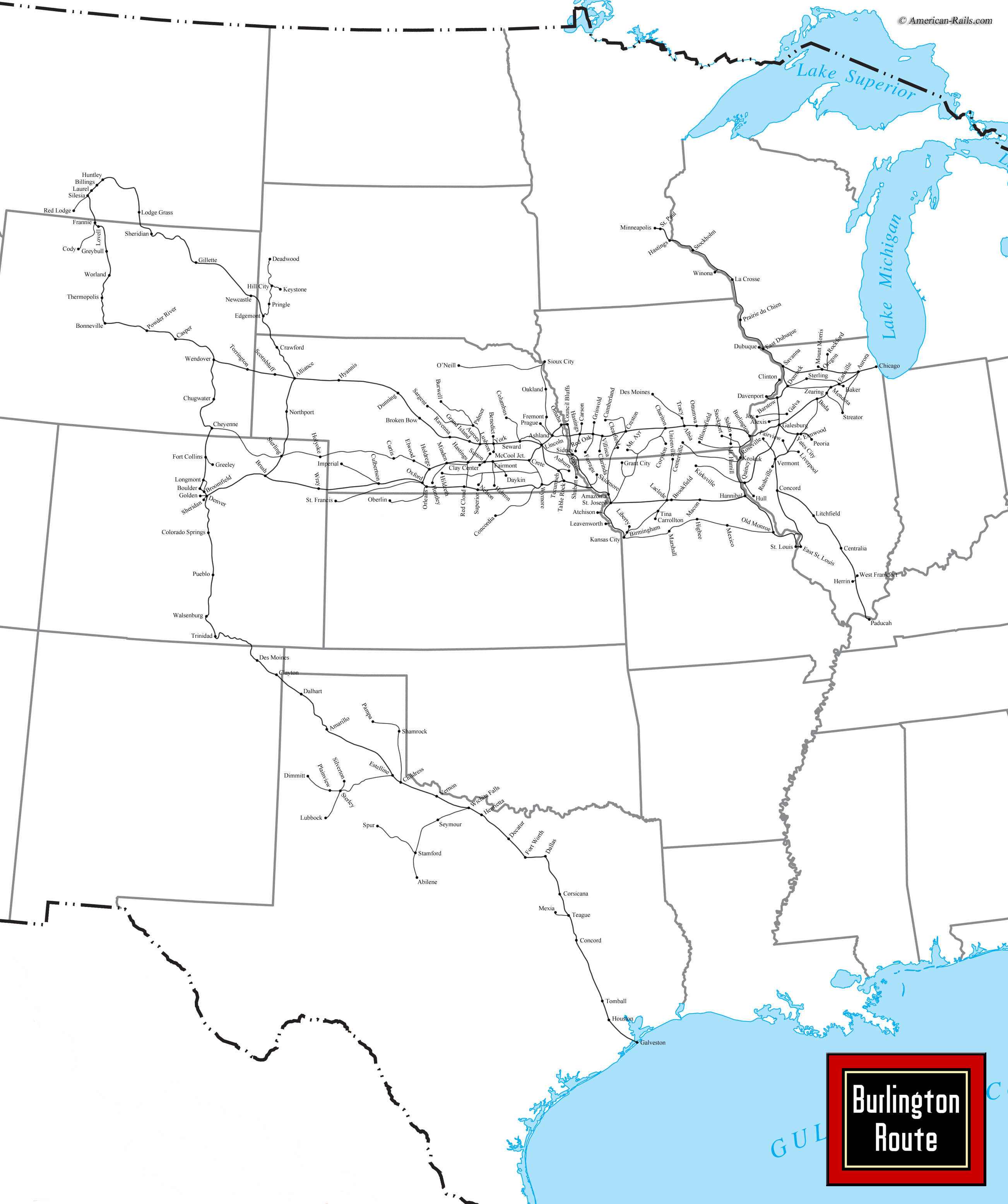
Modern Network
These roads constituted the original core of the Burlington system. However, like every other major Midwestern granger many more predecessors went in to creating the modern CB&Q network. Two other notables included the Hannibal & St. Joseph Railroad (chartered on February 16, 1847) and the Burlington & Missouri River Rail Road.
The former, acquired by the Forbes Group in 1854, was the first to complete an east-west route across Missouri, opening on February 15, 1859. The railroad connected its namesake cities and interchanged with another Forbes road, the Quincy & Palmyra, at Palmyra.
This system was only 14 miles but provided a connection to the CB&Q at Quincy once a bridge had opened over the Mississippi River on November 9, 1868. Finally, there was the Kansas City, St. Joseph & Council Bluffs, an 1870 formation of various systems which had opened service between all three of its namesake cities on November 25, 1869.
This had offered a direct, if somewhat roundabout, link to Council Bluffs. Following the H&StJ's completion the B&MR was chartered on May 12, 1869 to build another lengthy route, this time from Burlington directly across the state to Council Bluffs/Omaha at the eastern point of the recently completed Transcontinental Railroad (Union Pacific).
Work on the road proceeded quickly and, via lease, had reached Council Bluffs on January 3, 1870 by way of the St. Joseph & Council Bluffs Rail Road from Pacific Junction. A direct link into Omaha was established by July 19, 1871 (Omaha & South Western Railroad). The CB&Q took lease of the B&MR on December 31, 1872.
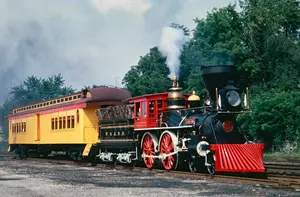
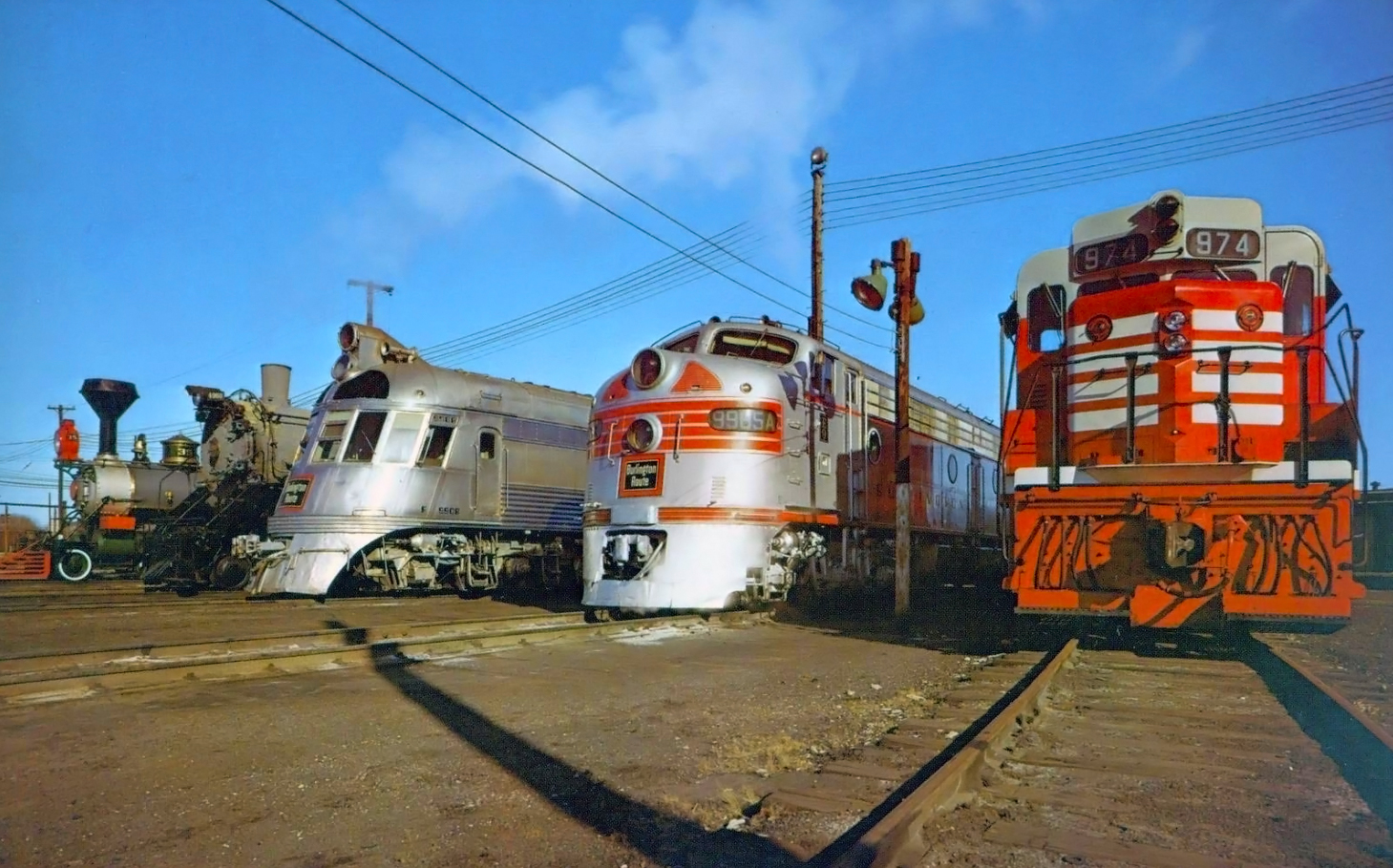 A Chicago, Burlington & Quincy company photo displaying five examples of motive power during its many years of service to celebrate its 1964 centennial of reaching Chicago. It also repainted 4-8-4 #5632 (O-5a) solid gold for this event. A real life brass model! The railroad held several festivities over the years celebrating centennials and milestones. From right to left: GP30 #974, E9A #9985-A, "Zephyr" power car #9908 (the "Silver Charger"), 2-8-2 #4968 (O-1a), and 4-4-0 #35.
With a route already established to Kansas City the Burlington was fast becoming one of the Midwest's preeminent carriers. The two men most instrumental behind its great expansion was John Murray Forbes and John L. Gardner. Forbes died on October 12, 1898, followed by Gardner on December 10th.
However, before their passing most of the modern CB&Q had been put into place. On May 29, 1882 the "Q" reached Denver, Colorado and then four years later finally had a coveted direct route into the Twin Cities, completed on August 23, 1886.
There was additional growth during the 1890's as a new corridor opened to St. Louis on March 4, 1894. The railroad pushed further west into Montana, completing a connection with the Northern Pacific at Huntley on October 28th that same year.
The transcontinental NP became more than just an interchange partner; the great "Empire Builder," James J. Hill, who was instrumental in finishing the Great Northern added the Northern Pacific to his portfolio in 1899, followed by the Burlington on May 21, 1901. Shortly thereafter he also established the Spokane, Portland & Seattle as a bridge road linking Spokane, Washington with Portland, Oregon.
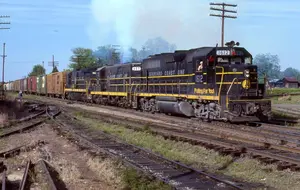
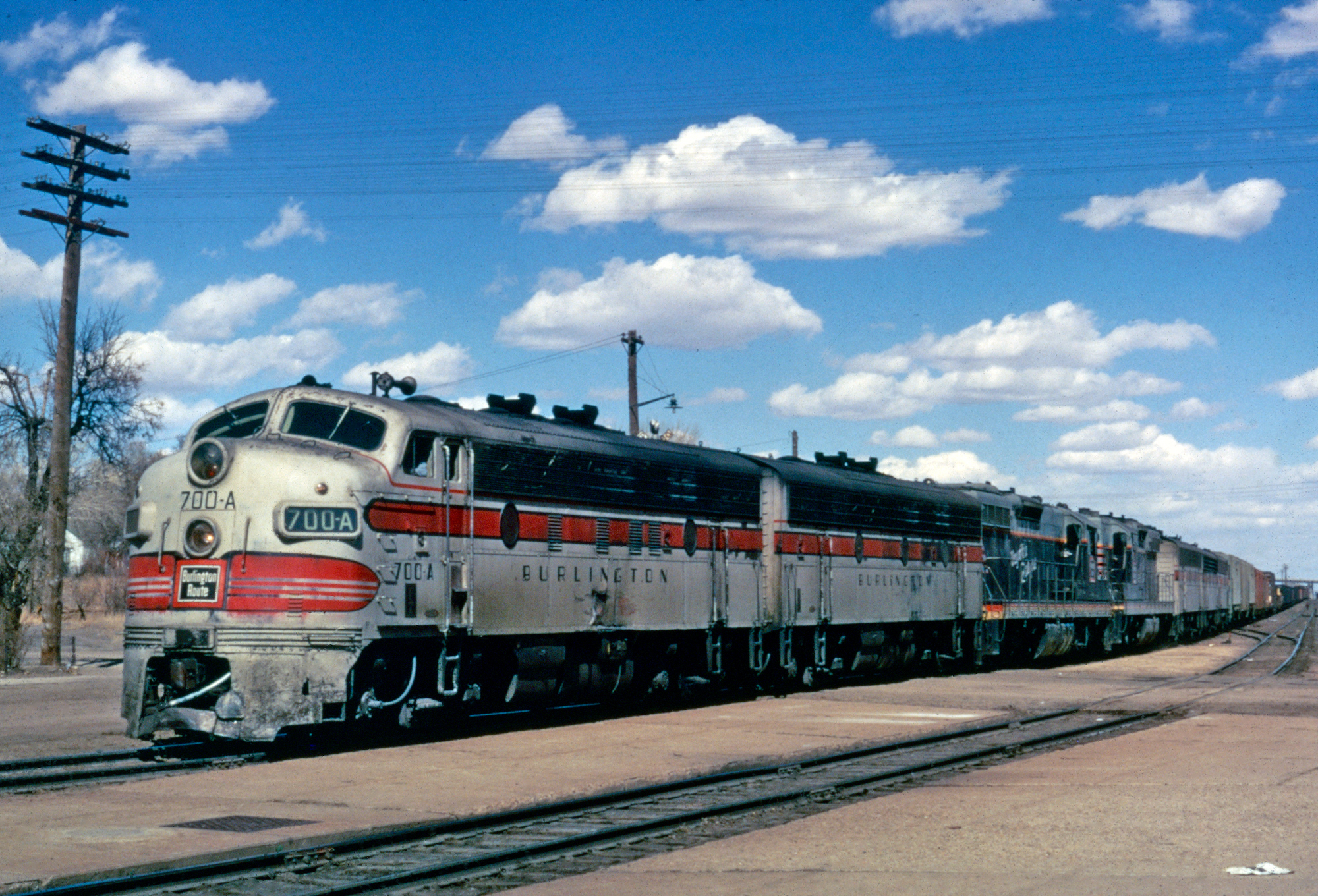 Another great lashup of Burlington power somewhere along the Colorado & Southern during the 1960s. Up front are F7s with SDs cut-in ahead of three more covered wagons. American-Rails.com collection.
Even into the 20th century the Burlington's expansion was not over. Its biggest acquisition came on December 19, 1908 via the Colorado & Southern Railway.
The C&S had been created on December 19, 1898 to take over the bankrupt Union Pacific, Denver & Gulf Railway stretching from Orin Junction, Wyoming to the Texas/New Mexico border via Cheyenne, Denver, and Pueblo.
The property, a former Union Pacific subsidiary, also included a segment of narrow-gauge trackage stretching southwest of Denver which reached the mining towns of Gunnison, Leadville, Como, Georgetown, and others.
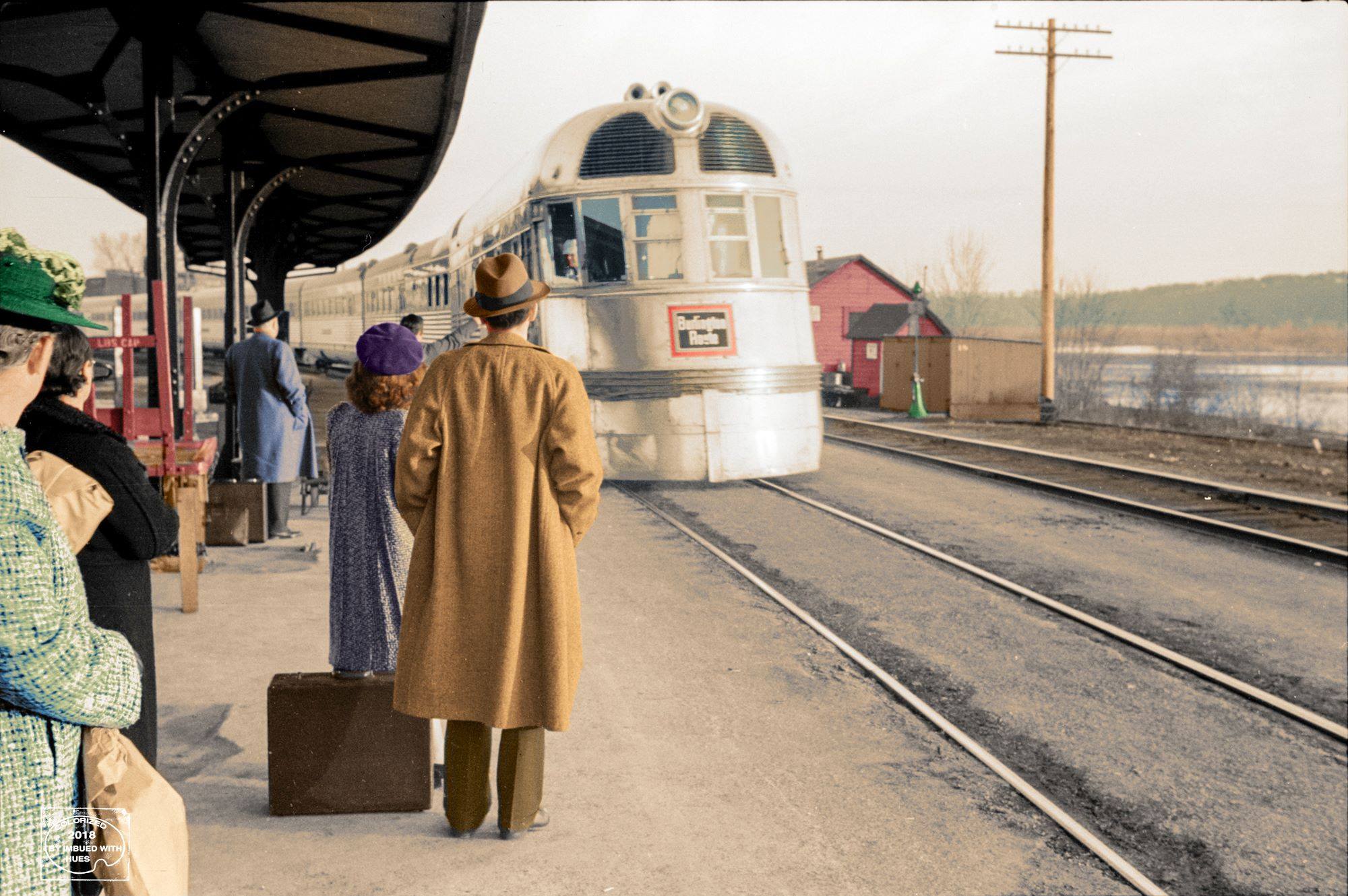 With folks waiting on the platform, Chicago, Burlington & Quincy's "Twin Cities Zephyr" pulls into the station at East Dubuque, Illinois in April, 1940. John Vachon photo/colorized by Patty Allison.
These fabled lines were operated by the Colorado Central and most notable of all the Denver, South Park & Pacific (until 1918 it also included the Colorado Midland Railway, operated jointly with the Rio Grande). Finally, there was the Fort Worth & Denver City, which fell under C&S control.
At Texline, Texas the FW&DC connected with the C&S end-of-track and offered through service to Fort Worth. On June 1, 1925 it acquired trackage rights over Rock Island's Chicago, Rock Island & Gulf to reach Dallas.
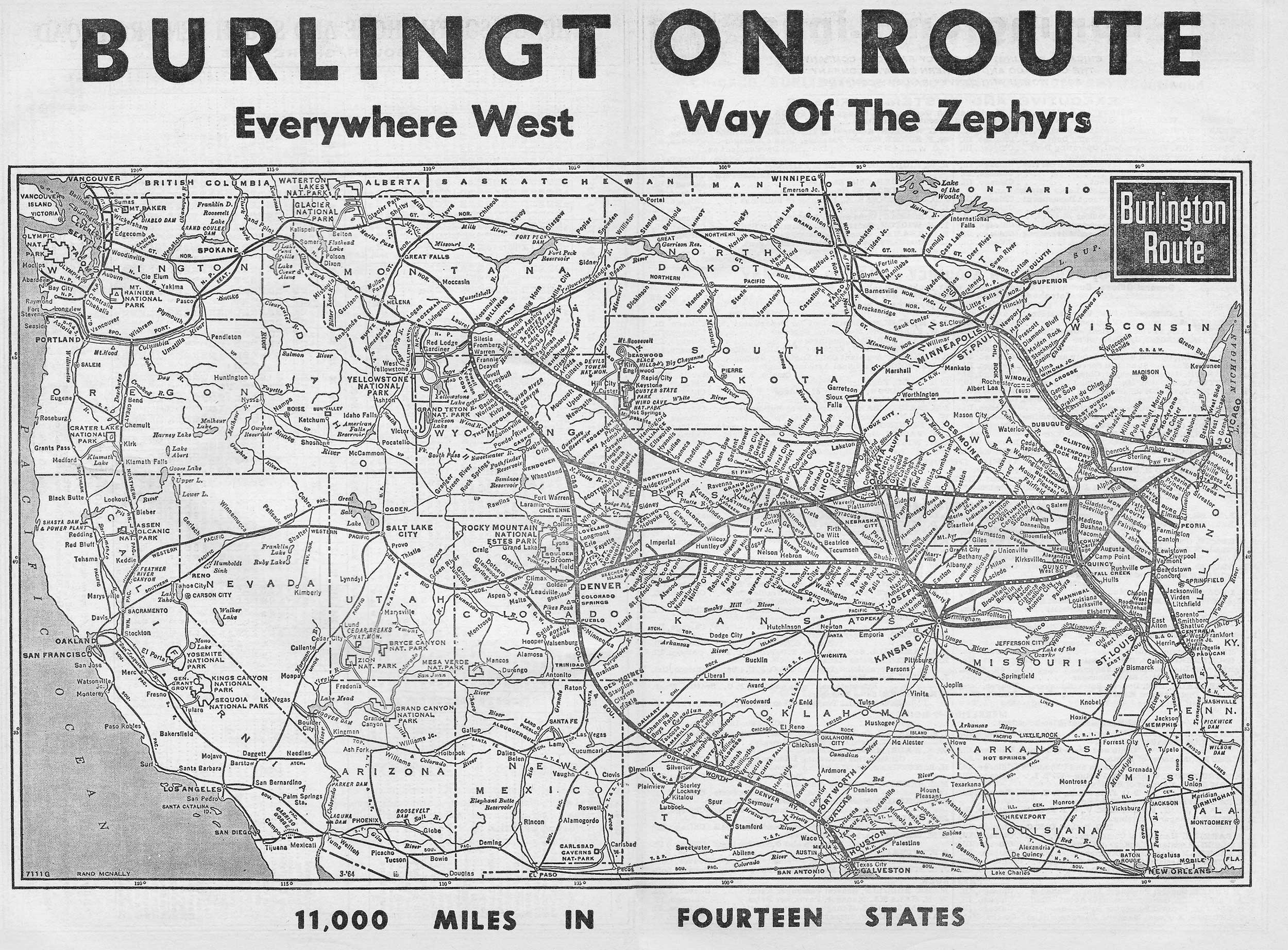
System Map (1969)
Beyond Dallas/Fort Worth the C&S took over the Trinity & Brazos Valley Railway (T&BV) in 1905. It was jointly owned with the Rock Island and originally extended from Cleburne to Mexia before expanding to Houston in 1907, which also included a branch from Teague to Waxahachie.
To reach nearby Galveston the road established trackage rights over the Texas & New Orleans (Southern Pacific). Chronic financial problems forced the T&BV into bankruptcy during 1914 and it was reorganized as the Burlington-Rock Island Railroad on July 7, 1930 with the two parent roads remaining in control.
The Cleburne-Mexia segment, which utilized trackage rights over the Gulf, Colorado & Santa Fe (Santa Fe) to reach Fort Worth was abandoned during the 1930's. This followed another change in the trackage rights agreement between Dallas and Waxahachie as the B-RI switched from the T&NO to the Missouri-Kansas-Texas (Katy) on June 1, 1931.
Beyond the great Lone Star State few other major expansions occurred (one notable addition was a new extension connecting the C&S at Orin Junction with the CB&Q's original trackage into Montana at Fromberg, which opened on October 18, 1914). The modern Chicago, Burlington & Quincy was a powerful system operating 11,000 route miles from the Midwest to the Rocky Mountains and Gulf Coast.
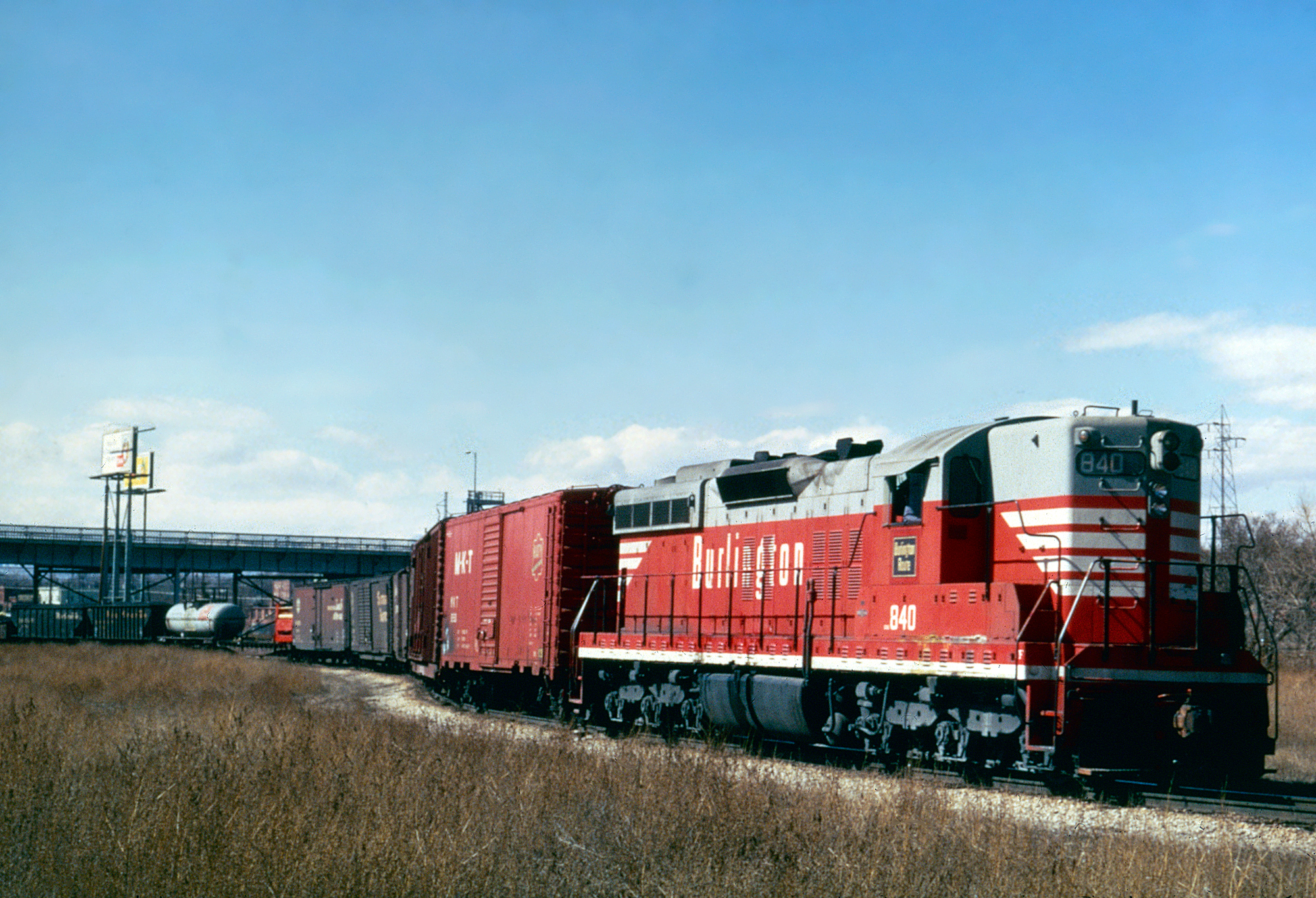 Burlington/Colorado & Southern SD9 #840 is on the "Freight Lead," just north of the Longmont Mill in Denver, Colorado during the 1960s. In the background is the 20th Street Viaduct. Urban sprawl has changed this scene drastically today. American-Rails.com collection.
Peak Years
The Burlington had long been a prosperous carrier throughout the 19th century and this continued into the 20th. The finely managed company was one of the few to never experience a bankruptcy throughout its corporate history. By the 1920's it was somewhat unique as a granger in that it did rely greatly on agriculture.
Instead, its freight was diversified and included everything from coal (tapped from the Ohio River valley in southern Illinois) to manufactured goods. There was also various less-than-carload movements and several interchange gateways.
Following the Great Depression of 1929 and the downtrodden economy of the 1930's the Burlington struggled but avoided bankruptcy.
According to Mike Schafer's book, "Classic American Railroads," its worst year ever was 1932, the same year that Ralph Budd became president. Arguably the road's most influential leader he turned the company into an even greater machine of efficiency.
Budd, unlike most railroaders, did not hold onto outdated operational practices. This issue, the lack of modernity and innovation, plagued the industry long after World War II.
He realized as early as the 1930s that railroads would continually need to find better ways of retaining and sustaining business if they were to survive in the modern age of highways and airliners.
Logo
The most publicly visible aspect of this was the Zephyr streamliner. Rival Union Pacific beat it to the punch by acquiring the first-ever such trainset on February 25, 1934 known as the M-10000. However, it was the Burlington's version which ultimately proved the most successful.
As Mike Schafer and Joe Welsh note in their book, "Streamliners: History Of A Railroad Icon," the railroad placed its order with the Budd Company on June 17, 1933 for a sleek, stainless-steel trainset which was 197-feet long and featured three cars (Railway Post Office, baggage-coach, and coach-parlor observation).
Received on April 7, 1934 it was the first of its kind to utilize a diesel engine; a 660 horsepower prime mover from the Winton Engine Company (a subsidiary of General Motors/Electro-Motive). The diesel proved much more reliable than the M-10000's gasoline-distillate prime mover.
The Zephyr #9900 (or Pioneer Zephyr) wowed the public with its sleek appearance and blazing fast speeds. During its legendary trial run held on May 26th the trainset left Denver at 5:05 AM in anticipation of reaching Chicago that same day. With an average speed of 78 mph it completed the 1,015-mile trip in just 14 hours, arriving in the Windy City at 7:10 PM later that evening.
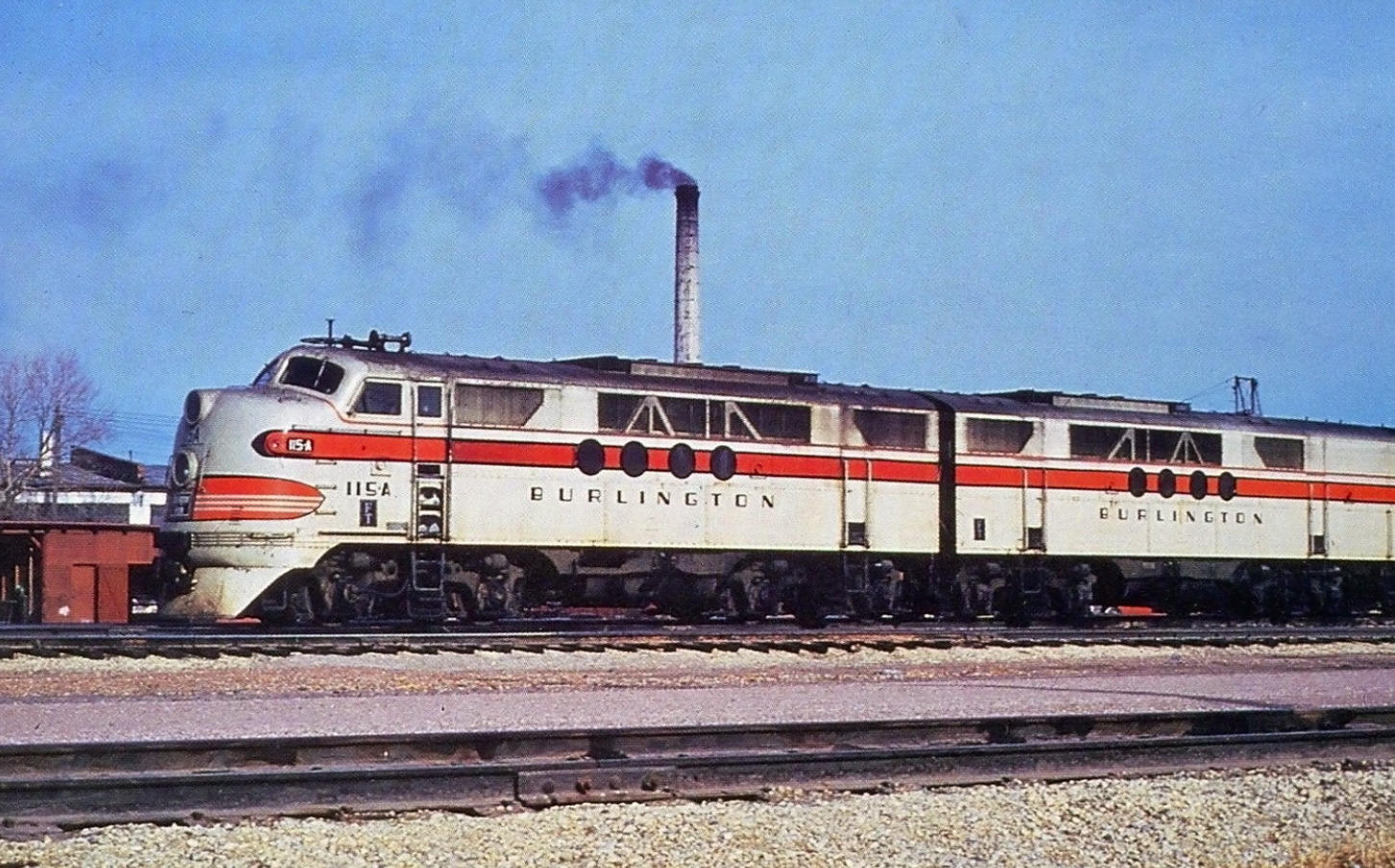 An A-B set of Burlington FTs, led by #115-A, at Lincoln, Nebraska in January of 1959. Richard Wallin photo.
Not surprisingly, this accomplishment and the train's good looks made it an instant publicity success and the Burlington went on to order several trainsets. Eventually, an entire fleet graced its rails with names like the Twin Cities Zephyr, Mark Twain Zephyr, Denver Zephyr, and Ozark State Zephyr.
Perhaps the railroad’s most famous was the California Zephyr, jointly run with the Rio Grande and Western Pacific. The train, launched in 1949, traveled through some of the most spectacular scenery in the country. Thanks to the train's top notch service it witnessed strong ridership through the 1960's.
As the financial fortunes of Western Pacific waned the train was discontinued in 1970 while the Rio Grande operated its segment as the Rio Grande Zephyr for several years following. While Budd retired from the CB&Q in 1949 his legacy carried on for many years.
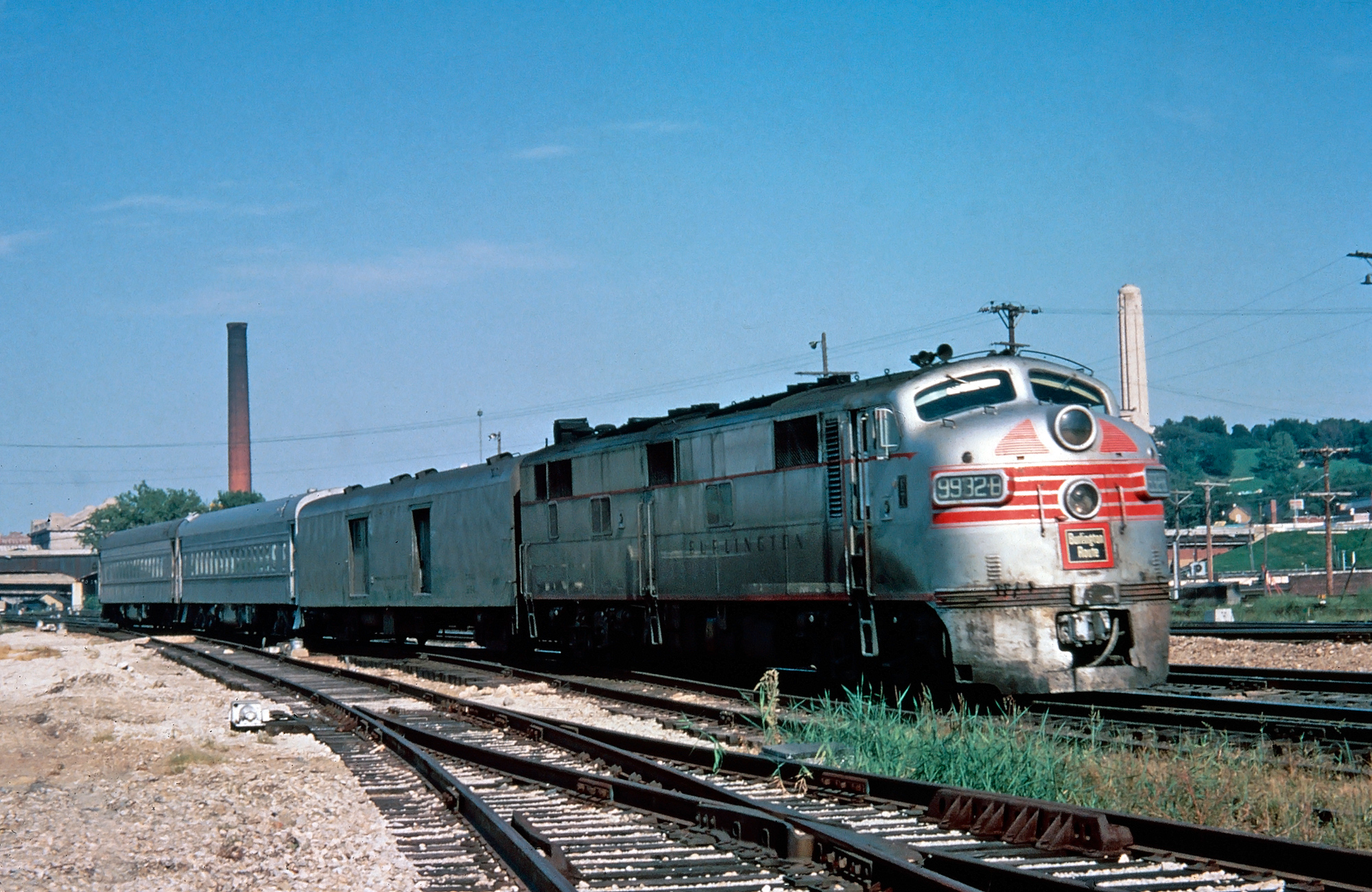
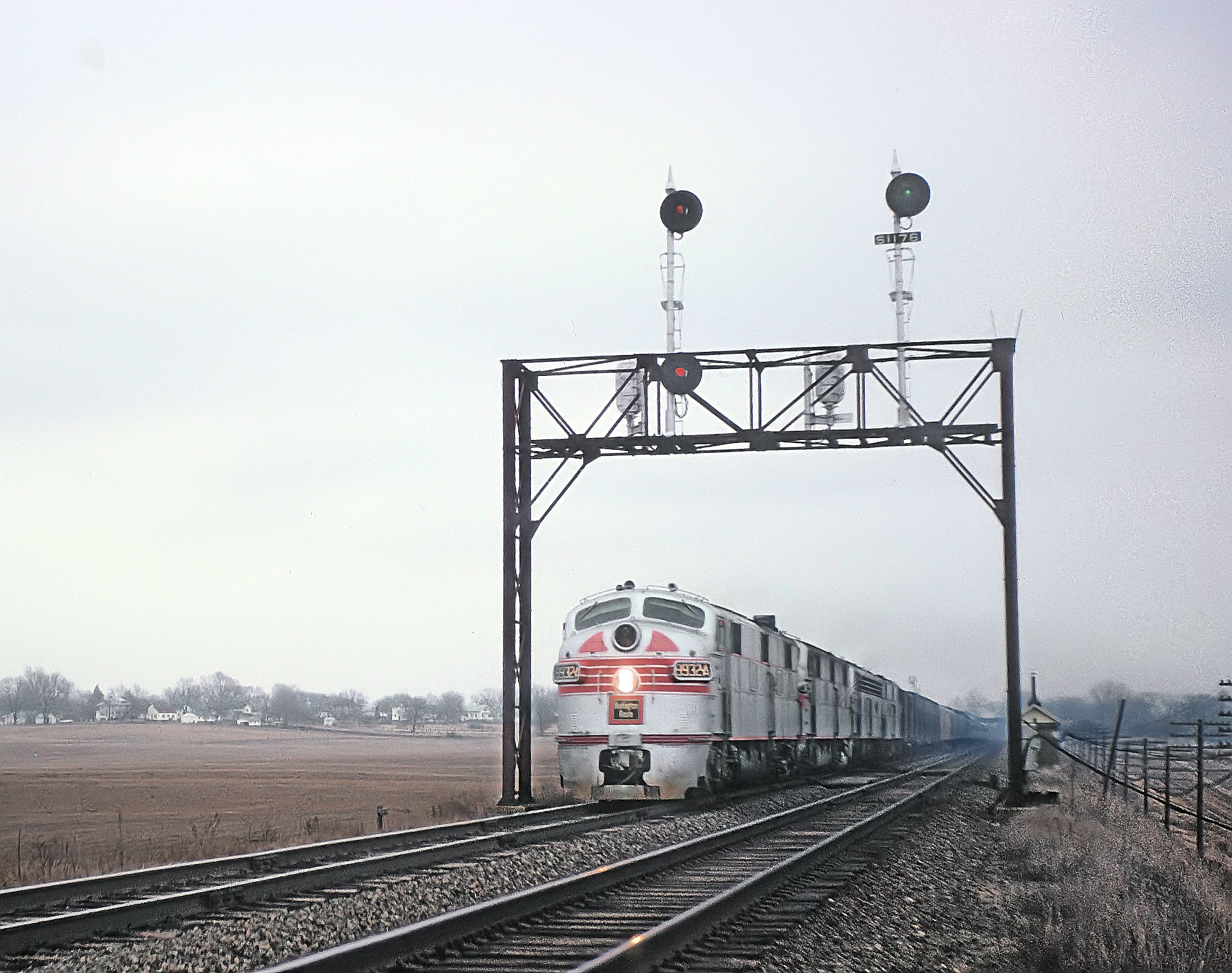 Burlington E7A #9932-A has Train #11, the "Nebraska Zephyr," at Buda, Illinois in March, 1963. Rick Burn photo.
Passenger Trains
Afternoon Zephyr: (Chicago - Twin Cities)
Ak-Sar-Ben Zephyr: (Chicago - Lincoln)
American Royal Zephyr: (Chicago - Kansas City)
Blackhawk: (Chicago - Twin Cities)
California Zephyr: (Chicago - San Francisco)
Denver Zephyr: (Chicago - Denver)
Empire Builder: (Chicago - Seattle)
Exposition Flyer: Operated in Junction with the Western Pacific and Rio Grande between Chicago and Oakland until the debut of the California Zephyr in 1949.
Kansas City Zephyr: (Chicago - Kansas City)
Mainstreeter: Operated between Chicago and Seattle via allying roads Northern Pacific and Spokane, Portland & Seattle.
General Pershing Zephyr: (St. Louis - Kansas City)
Morning Zephyr: (Chicago - Twin Cities)
Nebraska Zephyr: (Chicago - Lincoln)
North Coast Limited: (Chicago - Seattle)
Pioneer Zephyr: (West Quincy - Hannibal, Missouri)
Sam Houston Zephyr: (Dallas - Houston)
Texas Zephyr: (Denver - Dallas)
Western Star: Operated between Chicago and Seattle via allying roads Great Northern and Spokane, Portland & Seattle.
Zephyr Rocket: Operated between Minneapolis and St. Louis in conjunction with the Rock Island.
Always looking to cut costs and improve service he launched the transition from steam to diesel and implemented Centralized Traffic Control (CTC) as early as 1927.
- Steam was gone from main line service by the late 1950's although the C&S maintained a single locomotive in service into 1962. In addition, fan trips were maintained through President Harry Murphy, Budd's successor, until his retirement in 1965 when these were discontinued the following year. -
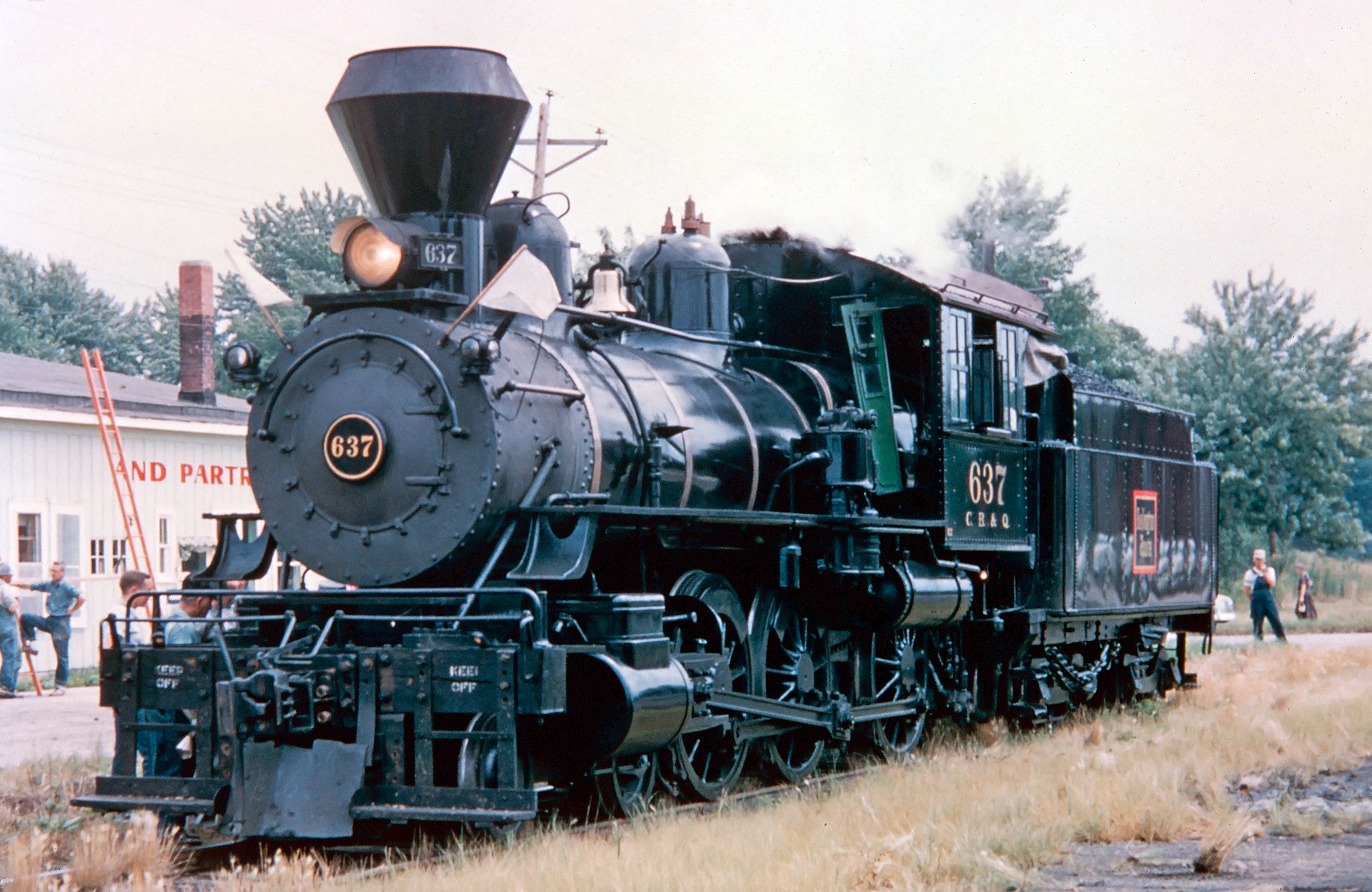 Chicago, Burlington & Quincy 4-6-0 #637 (Class K-2) is seen here on September 2, 1956 hosting the Illini Railroad Club's "Triangle" fan trip. This excursion ran along the main line from Chicago Union Station-Aurora then south to Streator, Illinois; back to the main line at Zearing, Illinois, and finally back to Aurora/Chicago. The little Ten-Wheeler, with GP7 #235 assisting, handled the loop from Aurora-Streator-Zearing-Aurora while 4-6-4 #4000 powered the run between Aurora-Chicago. The Ten-Wheeler was manufactured by the Rogers Locomotive & Machine Works in November, 1892 and today is on display at the Illinois Railway Museum. American-Rails.com collection.
Steam Roster
The CB&Q's nearly 9,000-mile network was largely concentrated in the Midwest. As a result, in the modern steam era it predominanetly relied on 2-8-2s for freight assignments and 4-6-2s to lead passenger trains.
However, there were areas which would be classified as mountain railroading, notably its line to Billings, Montana as well as its legendary Deadwood Branch in South Dakota's Black Hills.
The latter featured the Burlington's only articulated designs, 2-6-6-2s listed as Class T-1, T-1A, and T-2, for heavy drag service. It also rostered a single 2-8-8-2, #4200, which worked hump service at the yard in Galesburg, Illinois.
The CB&Q also operated a group of heavy 2-10-2s, which either pulled coal trains in southern Illinois or were sent over to subsidiary Colorado & Southern.
The railroad's most well known engines were its dual service 4-8-4s, many of which were produced by the CB&Q's own shop forces in West Burlington. Steam operations ended on the Burlington in the late 1950s although 4-8-4 #5632, along with 2-8-2 #4960, famously led fan trips west of Chicago until 1965.
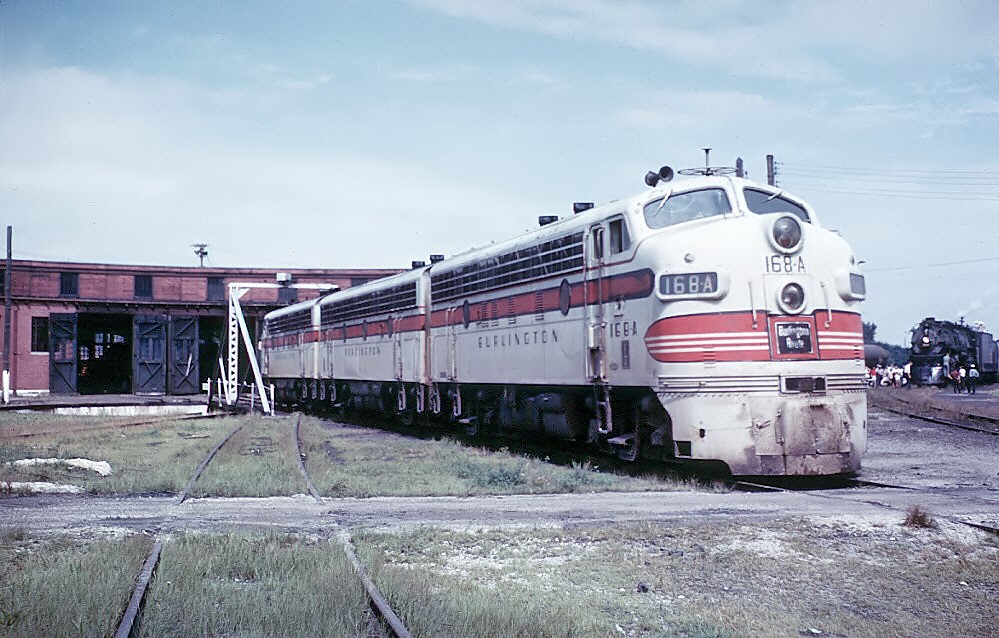 Burlington F7 set #168-A/B/C layover at the roundhouse in La Crosse, Wisconsin on September 9, 1962. In the background is 4-8-4 #5632 between fan trips. Rick Burn photo.
Switchers
| Wheel Arrangement | Class | Road Number(s) | Quantity | Builder(s) | Completion Date | Retirement Date | Notes |
|---|---|---|---|---|---|---|---|
| 0-6-0 | G-5 | 500-509 | 10 | Cooke (Alco) | 1919 | 1954 | A USRA design. |
| 0-6-0 | G-5A | 510-524 | 15 | Baldwin | 1921 | 1953-1955 | A USRA design. |
| 0-8-0 | F-1 | 540-549 | 10 | Brooks (Alco) | 1919 | 1953-1956 | A USRA design. |
| 0-8-0 | F-2 | 550-556 | 7 | CB&Q | 1926-1927 | 1946 | Rebuilt from 2-6-6-2s. |
| 0-6-0 | G-10 | 560-594 | 35 | CB&Q | 1928-1930 | 1951-1955 | Rebuilt from 2-6-2s. |
| 0-6-0 | G-3 | 1400-1579 | 180 | CB&Q, Baldwin | 1900-1913 | 1928-1947 | - |
| 0-6-0 | G-4A | 1600-1654 | 55 | CB&Q | 1900-1903 | 1909-1928 | Rebuilt from 2-8-0s. |
| 0-6-0 | G-4B, G-4C | 1601-1603, 1647, 1651, 1655-1677 | 28 | CB&Q | 1904-1921 | 1926-1939 | Rebuilt from 2-8-0s. |
| 0-6-0 | G-6 | 1678-1699 | 22 | CB&Q | 1905-1910 | 1931-1955 | - |
| 0-6-0 | G-7 | 1702, 170 | 2 | CB&Q | 1931, 1933 | Rebuilt from 2-6-2s. | |
| 0-6-0 | G-8 | 1710-1769 | 70 | CB&Q | 1917-1929 | 1938-1951 | Rebuilt from 2-6-2s. |
| 0-6-0 | G-9 | 1805-1848 | 22 | CB&Q | 1925-1928 | 1942-1951 | Rebuilt from 2-6-2s. |
| 0-8-0 | F-3 | 5020 | 1 | CB&Q | - | 1939 | - |
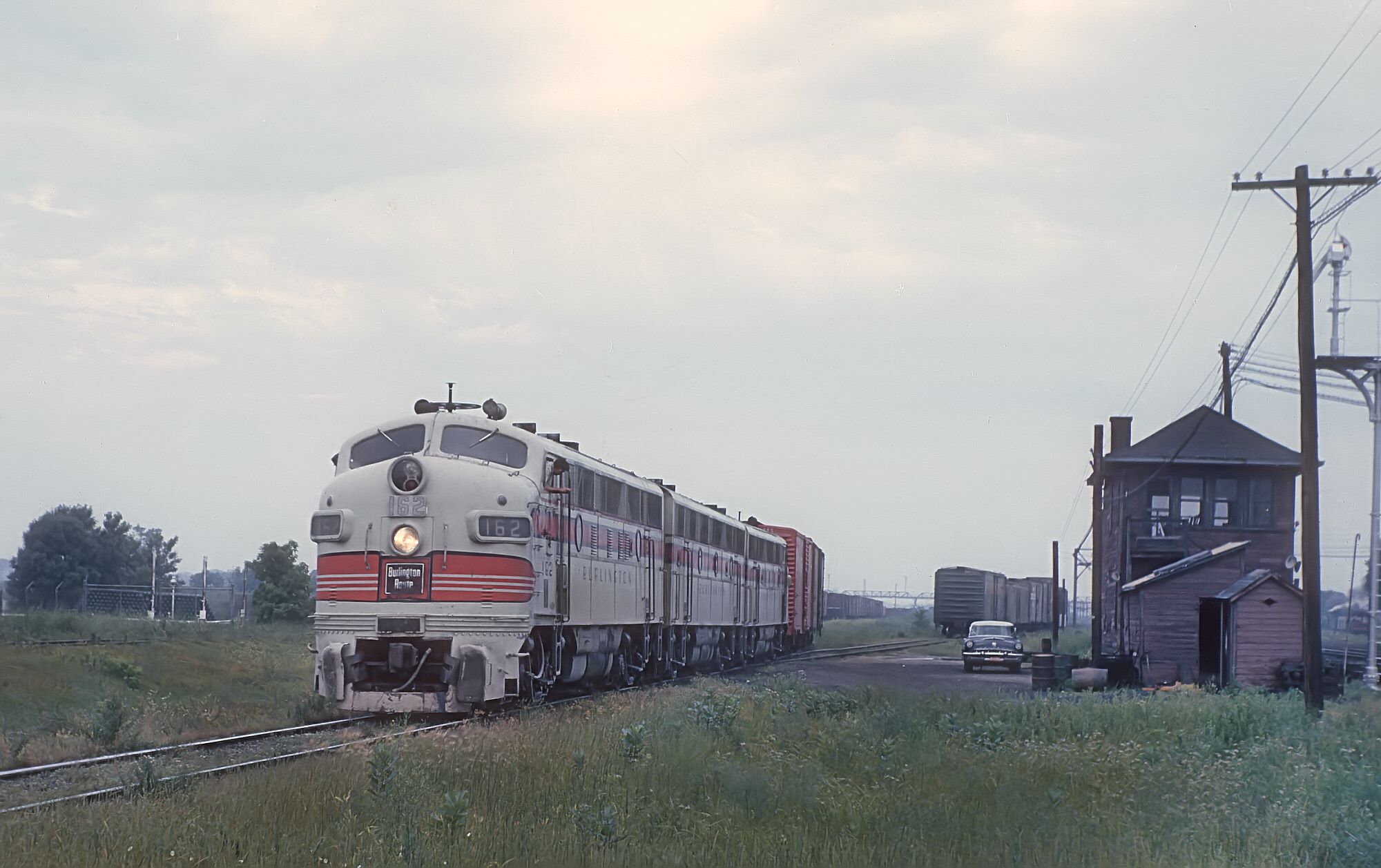 Burlington F3 graybacks at Eola Tower, at the east end of CB&Q's Eola Yard; July, 1962. Rick Burn photo.
Freight Locomotives
| Wheel Arrangement | Class | Road Number(s) | Quantity | Builder(s) | Completion Date | Retirement Date | Notes |
|---|---|---|---|---|---|---|---|
| 2-6-2 | R-1 | 1700-1703 | 4 | CB&Q | 1900 | 1929-1930 | Two engines were later rebuilt into 0-6-0s. |
| 2-6-2 | R-2 | 1710-1769 | 60 | Baldwin, CB&Q | 1901 | - | All were later rebuilt into 0-6-0s. |
| 2-6-2 | R-3 | 1800-1849 | 50 | Baldwin | 1902 | 1928-1930 | Several were later rebuilt into 0-6-0s. |
| 2-6-2 | R-4 | 1900-1939 | 40 | Baldwin | 1904 | 1928-1953 | A handful were rebuilt into 0-6-0s. |
| 2-6-2 | R-4 | 1940-1989 | 50 | Brooks (Alco) | 1905 | 1928-1954 | A handful were rebuilt into 0-6-0s. |
| 2-6-2 | R-4 | 2000-2049 | 50 | Baldwin | 1906 | 1928-1951 | A handful were rebuilt into 0-6-0s. |
| 2-6-2 | R-5 | 2050-2224 | 175 | Baldwin, Brooks (Alco) | 1906-1907 | 1928-1953 | - |
| 2-8-0 | D-7 | 3030-3031 | 2 | Baldwin | 1903 | 1928 | ex-Iowa & St. Louis Railway |
| 2-8-0 | D-4A | 3100-3174 | 75 | Schenectady (Alco) | 1903 | 1928-1946 | - |
| 2-8-0 | D-4B | 3175-3199 | 25 | Baldwin | 1903 | 1928-1932 | - |
| 2-8-2 | O-1A | 4940-4999 | 60 | Baldwin | 1923 | 1951-1957 | - |
| 2-8-2 | O-1 | 5000-5059 | 60 | Baldwin | 1910-1911 | 1927-1951 | - |
| 2-8-2 | O-1A | 5060-5147 | 88 | Baldwin | 1917-1922 | 1953-1957 | - |
| 2-8-2 | O-2 | 5200-5299 | 100 | Baldwin | 1912-1913 | 1931-1954 | - |
| 2-8-2 | O-3 | 5300-5359 | 60 | Baldwin | 1915-1919 | 1951-1956 | - |
| 2-8-2 | O-4 | 5500-5514 | 15 | Baldwin | 1919 | 1954-1957 | - |
| 2-10-2 | M-1 | 6000-6004 | 5 | Baldwin | 1912 | 1933, 1950 | - |
| 2-10-2 | M-2 | 6100-6107 | 8 | Baldwin | 1914 | 1951-1953 | - |
| 2-10-2 | M-2A | 6108-6109 | 2 | Baldwin | 1914 | 1952 | - |
| 2-10-2 | M-2 | 6110-6125 | 16 | Baldwin | 1914 | 1951-1954 | - |
| 2-10-2 | M-2A | 6126-6170 | 45 | Baldwin | 1915-1921 | 1951-1954 | - |
| 2-10-2 | M-3 | 6300-6309 | 10 | Brooks (Alco) | 1919 | 1953-1954 | A USRA design. Leased to subsidiary Colorado & Southern. |
| 2-10-4 | M-4 | 6310-6327 | 18 | Baldwin | 1927, 1929 | - | - |
| 4-8-2 | B-1 | 7000-7007 | 8 | Lima | 1922 | 1953 | |
| 4-8-2 | B-1A | 7008-7020 | 13 | Baldwin | 1925 | 1953-1955 |
Articulated Designs
| Wheel Arrangement | Class | Road Number(s) | Quantity | Builder(s) | Completion Date | Retirement Date | Notes |
|---|---|---|---|---|---|---|---|
| 2-6-6-2 | T-1 | 4000-4002 | 3 | Baldwin | 1908 | - | Rebuilt to Class F-2 0-8-0s in 1926-1927. |
| 2-6-6-2 | T-1A | 4003-4007 | 5 | Baldwin | 1909 | - | Rebuilt to Class F-2 0-8-0s in 1926-1927. |
| 2-6-6-2 | T-2 | 4100-4109 | 10 | Baldwin | 1910 | 1929 | - |
| 2-8-8-2 | T-3 | 4200 | 1 | Baldwin | 1911 | 1934 | - |
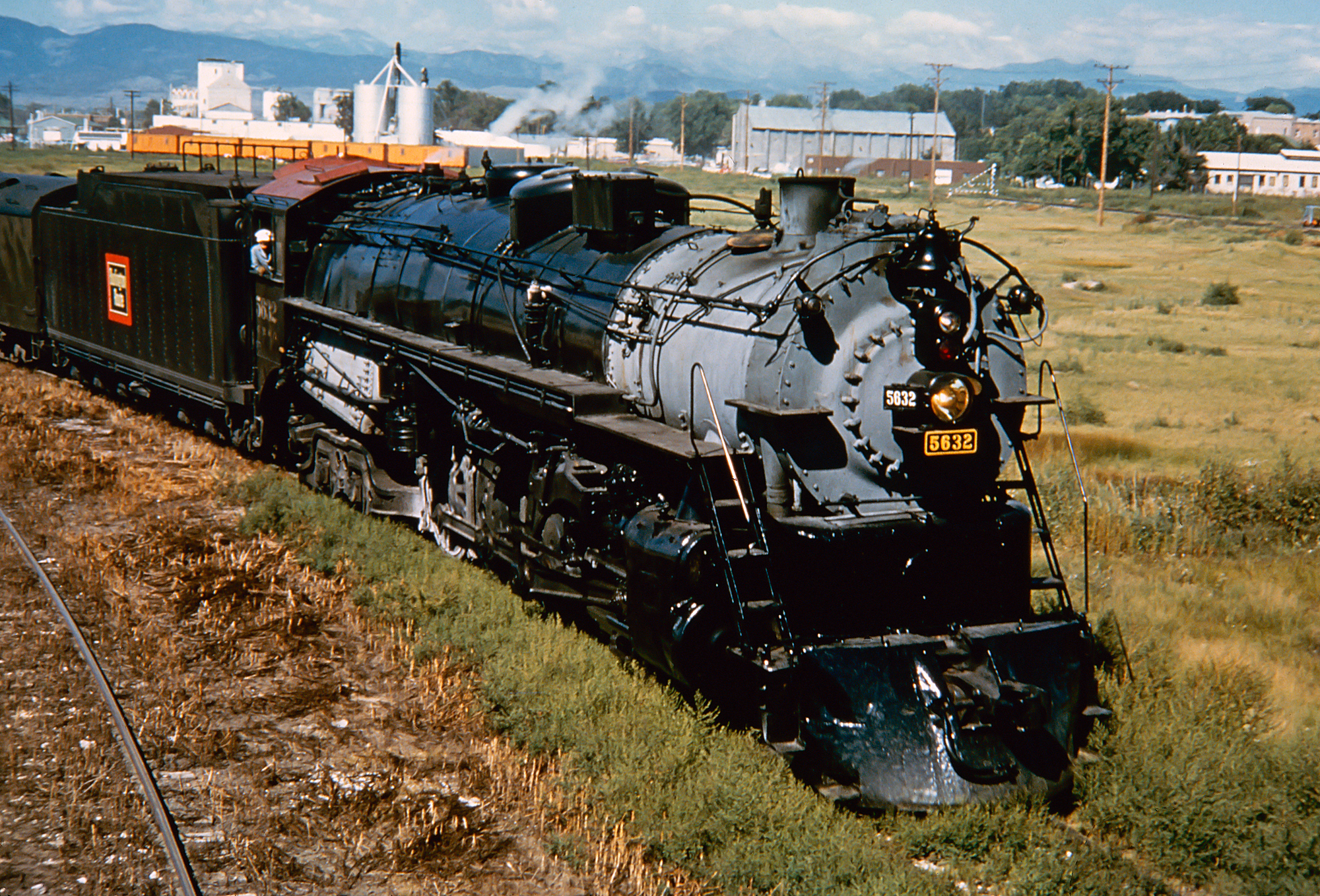 Chicago, Burlington & Quincy 4-8-4 #5632 (Class O-5B) sits in a weed-covered siding while hosting excursions at Longmont, Colorado in August, 1963. American-Rails.com collection.
Passenger Locomotives
| Wheel Arrangement | Class | Road Number(s) | Quantity | Builder(s) | Completion Date | Retirement Date | Notes |
|---|---|---|---|---|---|---|---|
| 4-6-0 | K-4 | 700-723 | 24 | CB&Q | 1900-1904 | 1931-1953 | - |
| 4-6-0 | K-5 | 800-807 | 8 | CB&Q | 1904-1905 | 1929-1930 | - |
| 4-6-0 | K-10 | 950-968 | 19 | CB&Q | 1908-1914 | 1931-1954 | Rebuilt from 2-6-0s |
| 4-4-2 | P-1C | 2500-2504 | 5 | Baldwin | 1899-1900 | 1932-1933 | Formerly #1591-1595. |
| 4-4-2 | P-2C | 2510-2515 | 6 | Baldwin | 1902 | - | Formerly #1584-1589. |
| 4-4-2 | P-2 | 2520-2527 | 8 | Rogers (Alco) | 1903 | 1930 | Formerly #1576-1583. |
| 4-4-2 | P-2 | 2528-2544 | 17 | Rogers (Alco) | 1902-1903 | 1930 | - |
| 4-4-2 | P-5 | 2550-2555 | 6 | CB&Q | 1915-1917 | 1942-1947 | Formerly Class P-2. |
| 4-4-2 | P-5 | 2558-2574 | 14 | CB&Q | 1924-1927 | 1942-1954 | Formerly Class P-3. |
| 4-4-2 | P-6 | 2580-2585 | 6 | CB&Q | 1927-1928 | 1951-1953 | Formerly Class P-3. |
| 4-4-2 | P-6A | 2590-2597 | 8 | CB&Q | 1927-1928 | 1947-1954 | Formerly Class P-2. |
| 4-4-2 | P-4 | 2599 | 1 | CB&Q | 1905 | 1929 | Rebuilt from 2-4-2. |
| 4-4-2 | P-3C | 2700-2719 | 20 | Baldwin | 1904-1905 | - | Rebuilt to Class P-5 and P-6. |
| 4-6-2 | S-1 | 2800-2869 | 70 | Baldwin, Schenectady (Alco) | 1906-1909 | 1933-1955 | Most rebuilt into Class S-1A. |
| 4-6-2 | S-2 | 2900-2949 | 50 | Baldwin | 1910 | 1933-1955 | Most rebuilt into Class S-2A. |
| 4-6-2 | S-3 | 2950-2974 | 25 | Baldwin | 1915, 1918 | 1951-1958 | - |
| 4-6-4 | S-4 | 3000-3011 | 12 | Baldwin | 1930 | 1955 | Four examples were rebuilt into Class S-4A. #3002 was streamlined in stainless-steel for the "Zephyrs" renumbered 4000, and named 'Aeolus.' Nicknamed "Big Alice the Goon" by CB&Q employees. |
| 4-6-4 | S-4 | 3012 | 1 | CB&Q | 1935 | 1955 | - |
| 4-6-4 | S-4A | 4001 | 1 | CB&Q | 1938 | 1955 | Built by the West Burlington Shops and a duplicate streamlined design of #4000. Also nicknamed "Big Alice the Goon." |
Dual Service
| Wheel Arrangement | Class | Road Number(s) | Quantity | Builder(s) | Completion Date | Retirement Date | Notes |
|---|---|---|---|---|---|---|---|
| 4-4-0 | A-2 | 374-478 | 105 | CB&Q | 1915-1918 | 1927-1935 | Rebuilt from 4-4-0s originally completed between 1868-1879. Many later spent time in freight service on secondary branch lines. |
| 4-4-0 | A-6 | 479 | 1 | Baldwin | 1901 | 1923 | ex-Davenport, Rock Island & Northwestern |
| 2-6-0 | H-4 | 1220-1262 | 43 | Baldwin, Rogers (Alco), CB&Q | 1899-1900 | - | A total of 19 engines were later rebuilt to 4-6-0 Class K-10 specs. |
| 4-8-4 | O-5 | 5600-5607 | 8 | Baldwin | 1930 | 1955 | - |
| 4-8-4 | O-5A | 5608-5635 | 28 | CB&Q | 1936-1940 | 1953 | #5632 used in excursion service until 1965. |
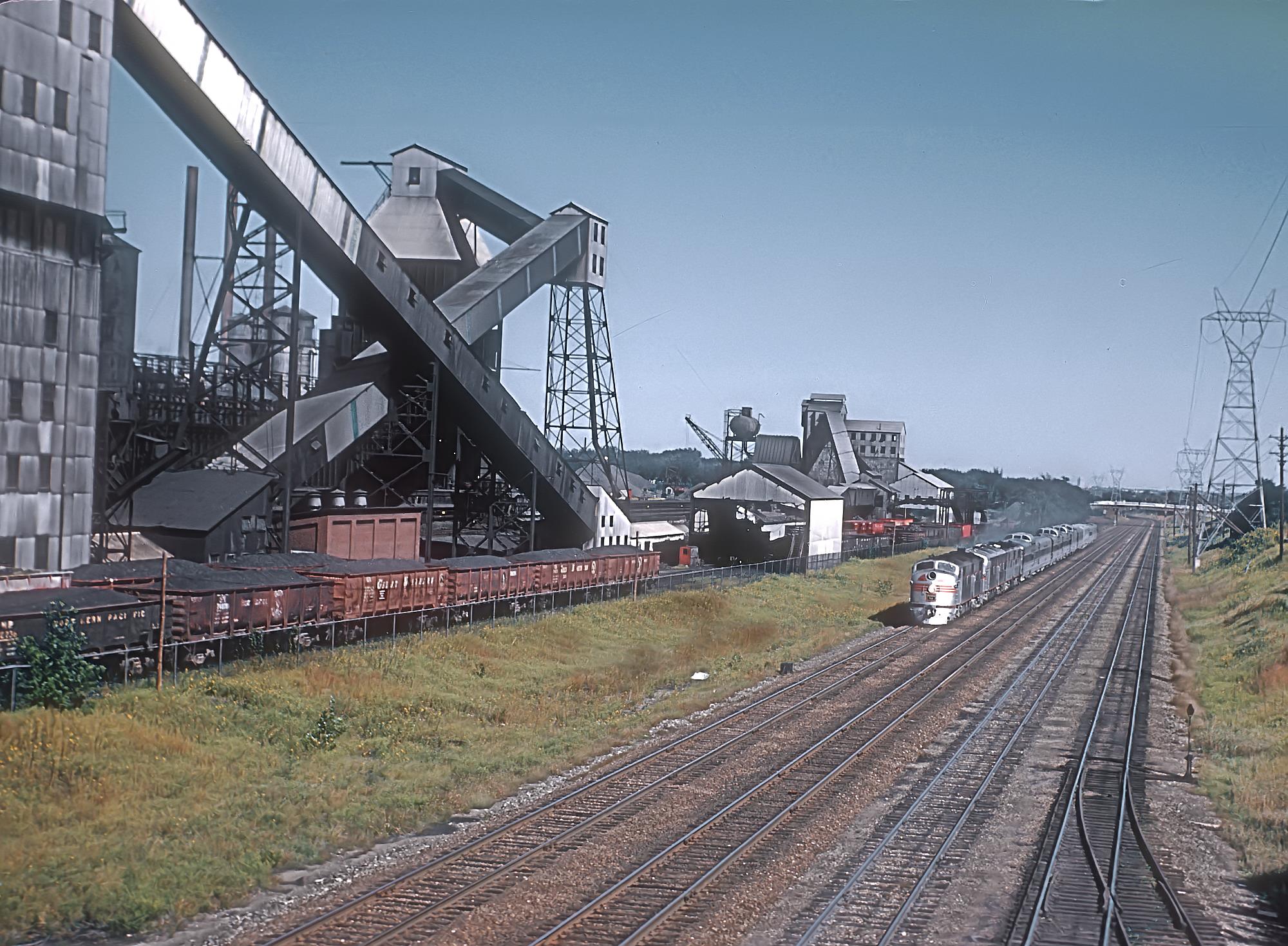 Burlington's train #21, the "Morning Zephyr," at Hamline Avenue in St. Paul, Minnesota in September, 1962. At left is the Koppers Coke facility, which closed long ago. Rick Burn photo.
Diesel Roster
American Locomotive Company
| Model Type | Road Number | Date Built | Quantity |
|---|---|---|---|
| S2 | 9300-9308 | 1943-1944 | 9 |
Baldwin Locomotive Works
| Model Type | Road Number | Date Built | Quantity |
|---|---|---|---|
| VO-1000 | 9350-9379 | 1943-1944 | 30 |
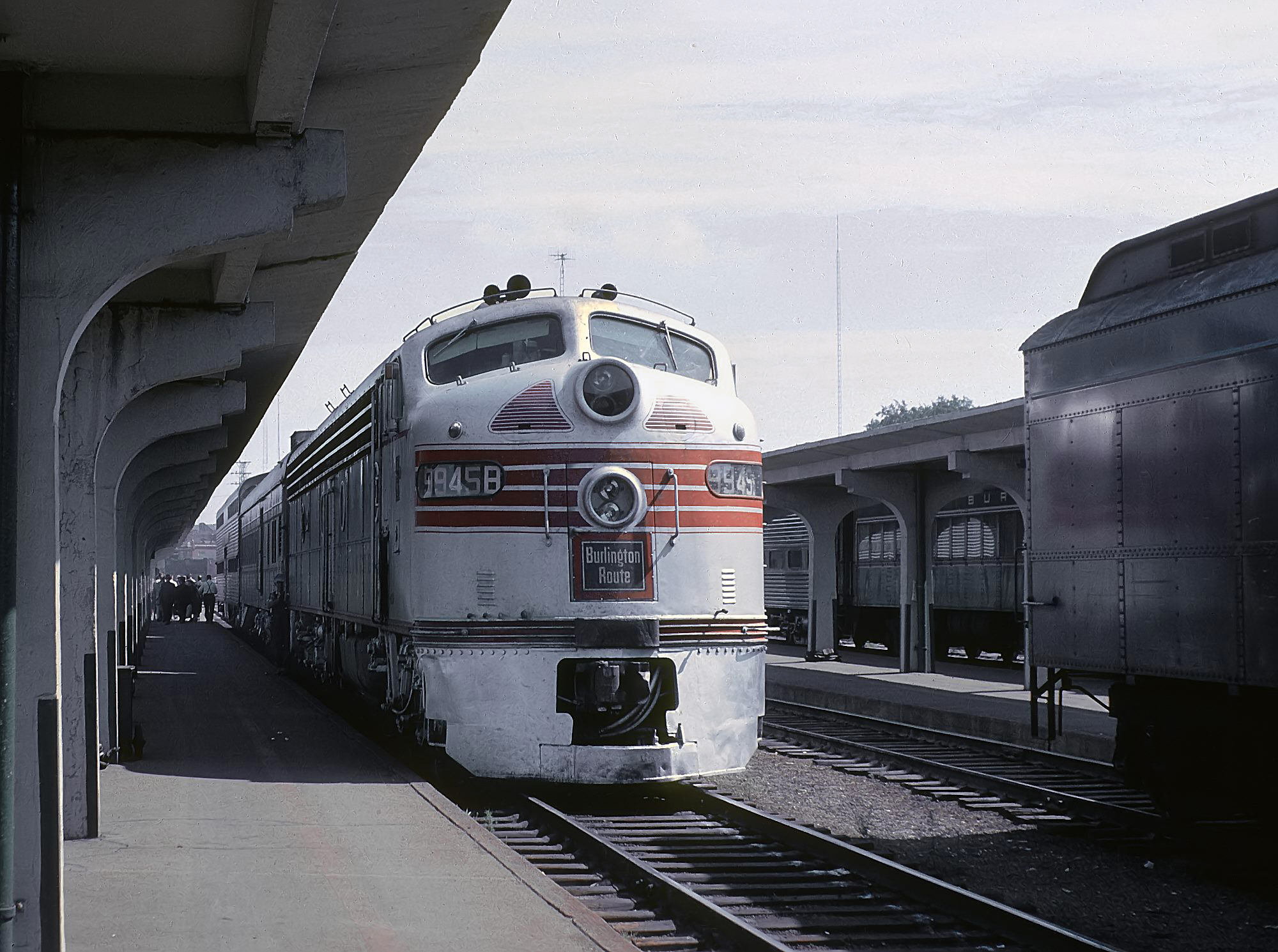 Burlington E8A #9945-B has an outbound "dinky" (commuter run) arriving at Aurora, Illinois in October, 1961. Rick Burn photo.
Electro-Motive Division
| Model Type | Road Number | Date Built | Quantity |
|---|---|---|---|
| FTA | 100A-115A, 100D-115D | 1944 | 32 |
| FTB | 100B-115B, 100C-115C | 1944 | 32 |
| F2A | 150A-154A, 156C-159C | 1946 | 9 |
| F3A | 116A-128A, 116D-129D, 130A-138A, 130D-138D, 160A-162A, 9960A-9962A, 9960D-9962D | 1947-1949 | 54 |
| F3B | 116B-138B, 116C-138C, 160B-162B, 160C-162C, 9960B-9962B | 1947-1949 | 55 |
| NW2 | 150-153 (C&S) | 1947-1948 | 4 |
| SW7 | 154 (C&S) | 1950 | 1 |
| SW1200 | 156-160 (C&S) | 1959 | 5 |
| F7A | 163A-169A, 167C-169C | 1950 | 10 |
| F7B | 167B-169B | 1950 | 3 |
| GP40 | 170-189, 620-639 | 1966-1968 | 40 |
| GP7 | 200-267 | 1951-1953 | 68 |
| GP9 | 270-289 | 1954 | 20 |
| SD7 | 300-324, 400-411 | 1952-1953 | 37 |
| SD9 | 325-374, 430-459 | 1954-1957 | 80 |
| SD24 | 500-515 | 1959 | 16 |
| SD45 | 516-530 | 1969 | 15 |
| NW2 | 603, 605-606 (FW&DC) | 1941-1946 | 3 |
| SW1200 | 607-610 (FW&DC) | 1959 | 4 |
| F7A | 700A-702A, 700D-702D (C&S) | 1950 | 6 |
| F7B | 700B-702B, 700C-702C (C&S) | 1950 | 6 |
| F9A | 700D (C&S) | 1959 | 1 |
| F9A | 750A (FW&DC) | 1959 | 1 |
| F7A | 750A-752A, 750D-752D (FW&DC) | 1950 | 6 |
| F7B | 750B-752B, 750C-752C (FW&DC) | 1950 | 6 |
| SD7 | 810-819 (C&S) | 1953 | 10 |
| SD9 | 820-846 (C&S) | 1957-1959 | 27 |
| SD7 | 850-860 (FW&DC) | 1953 | 11 |
| SD40 | 875-887 (C&S) | 1967-1968 | 13 |
| GP20 | 900-935 | 1961 | 36 |
| GP30 | 940-977 | 1962-1963 | 38 |
| GP35 | 978-999 | 1963-1964 | 22 |
| SW | 9130-9135 | 1937 | 6 |
| SW1 | 9136-9153 | 1939-1941 | 18 |
| NW | 9200-9201 | 1937 | 2 |
| NW2 | 9203-9248 | 1940-1949 | 46 |
| SW7 | 9249-9268 | 1950 | 20 |
| SW9 | 9269-9270 | 1951 | 2 |
| SW1200 | 9271-9292 | 1955-1965 | 22 |
| TR2 | 9400A-9413A, 9400B-9413B | 1947-1949 | 28 |
| Zephyr Trainset | 9900-9905, 9906A-9907A, 9906B-9907B, 9908 | 1934-1939 | 11 |
| E5A | 9909, 9910A-9912A, 9913, 9914A, 9914B, 9915A, 9915B | 1940-1941 | 8 |
| E5B | 9910B-9912B | 1940 | 3 |
| E7A | 9916A-9937A, 9916B-9936B, 9949 | 1945-1949 | 44 |
| SW1000 | 9310-9321 | 1966 | 22 |
| E8A | 9937B, 9938A-9949A, 9938B-9948B, 9964-9969 | 1950-1952 | 30 |
| E5A | 9950A (C&S) | 1940 | 1 |
| E5B | 9950B (C&S) | 1940 | 1 |
| E5A | 9980A (FW&DC) | 1940 | 1 |
| E5B | 9980B (FW&DC) | 1940 | 1 |
| E8A | 9981A, 9981B (FW&DC) | 1952 | 2 |
| E9A | 9985A-9989A, 9985B-9989B, 9990-9995 | 1954-1956 | 16 |
General Electric
| Model Type | Road Number | Date Built | Quantity |
|---|---|---|---|
| U25B | 100-105 | 1964 | 6 |
| U28B | 106-115, 140-149 | 1966-1967 | 20 |
| U30B | 150-154 | 1968 | 5 |
| U23C | 460-468 | 1969 | 9 |
| U25C | 550-561 | 1965 | 12 |
| U28C | 562-577 | 1966 | 18 |
| U30C | 890-893 (C&S) | 1968 | 4 |
| 44-Tonner | 9103-9107 | 1940-1941 | 5 |
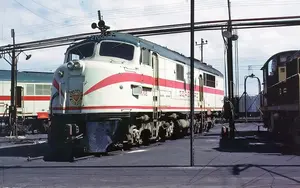
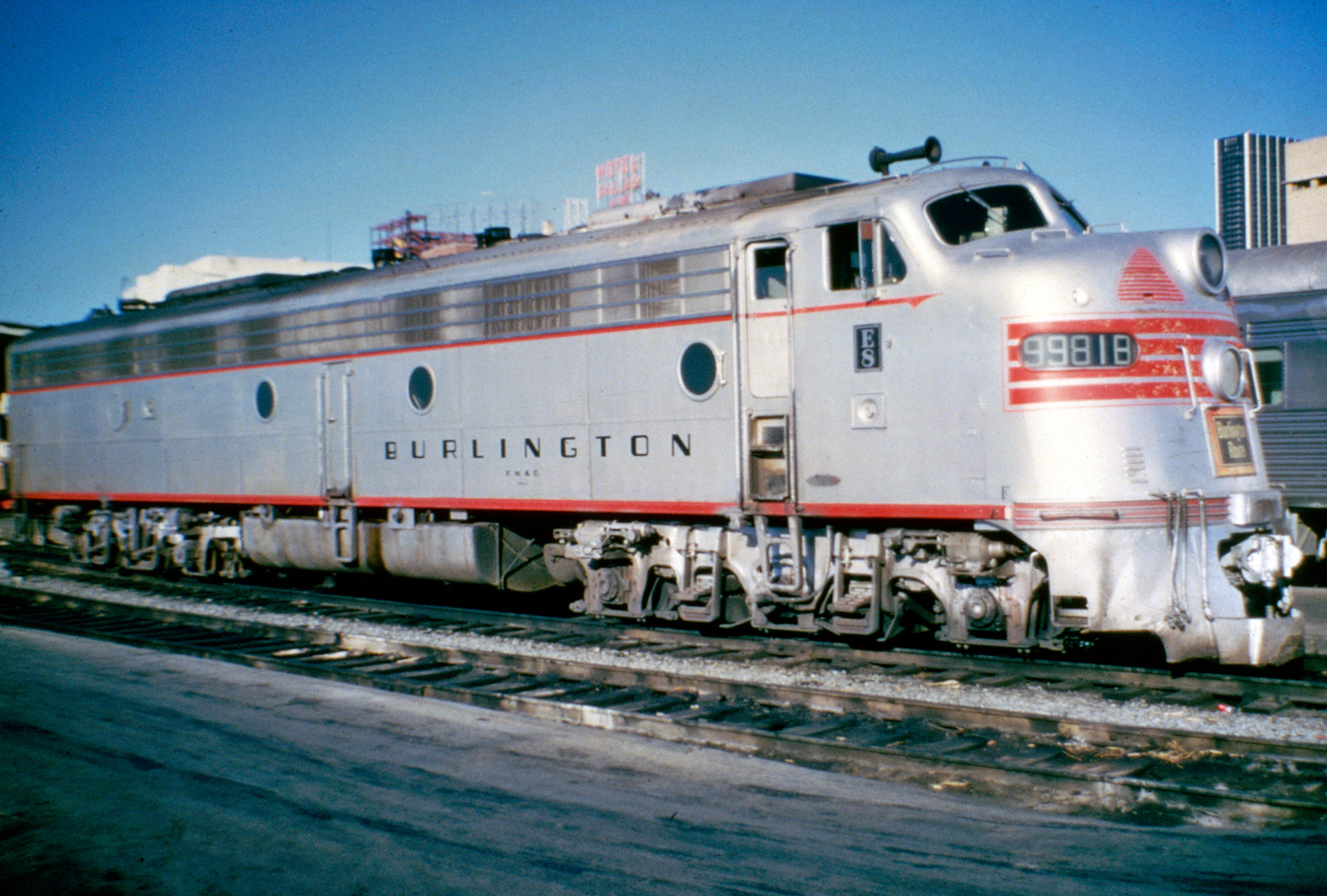 Burlington E8A #9981-B (sub-lettered for the Fort Worth & Denver) at Dallas Union Station during the 1960s. American-Rails.com collection.
Burlington Northern Merger
Murphy continued the improvements by updating the road's big classification yard in Chicago, Clyde Yard, into a modern hump facility, expanded CTC to protect 1,750 main line miles by the 1960's, opened the "Centennial Cutoff" on October 28, 1952 (this route shortened the distance between Chicago and Kansas City by 22 miles), and acquired the popular Vista-Domes for its top trains.
The railroad, however, was destined to be merged with its allying roads, a dream James Hill had envisioned since the early 20th century.
The attempt had been made numerous times until the Interstate Commerce Commission approved the deal in the late 1960's. On March 2, 1970 Burlington Northern was born through the CB&Q, GN, NP, and SP&S.
The BN lasted only 25 years before merging with the Atchison, Topeka & Santa Fe to become the Burlington Northern Santa Fe on September 22, 1995.
Even though the Burlington is no more today it continues to live on as almost all of its main lines remain important routes for its successor. Forever recognized as one of the best managed railroads of all time perhaps it is best remembered for maintaining a close relationship with the communities it served.
Photos
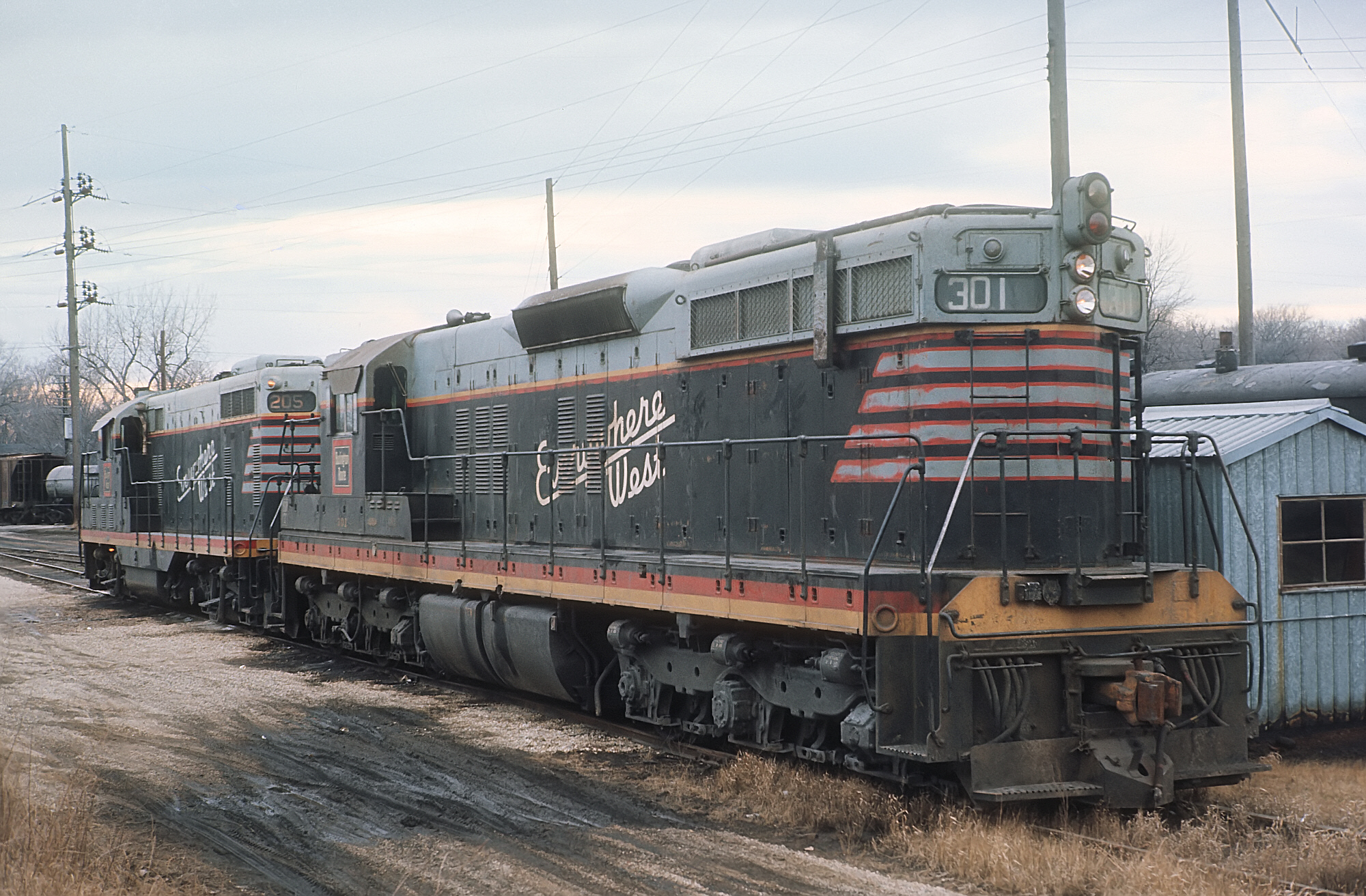 Burlington SD7 #301 and GP7 #205 lay over at the small engine terminal in Clinton, Iowa on December 31, 1965. Marty Bernard photo.
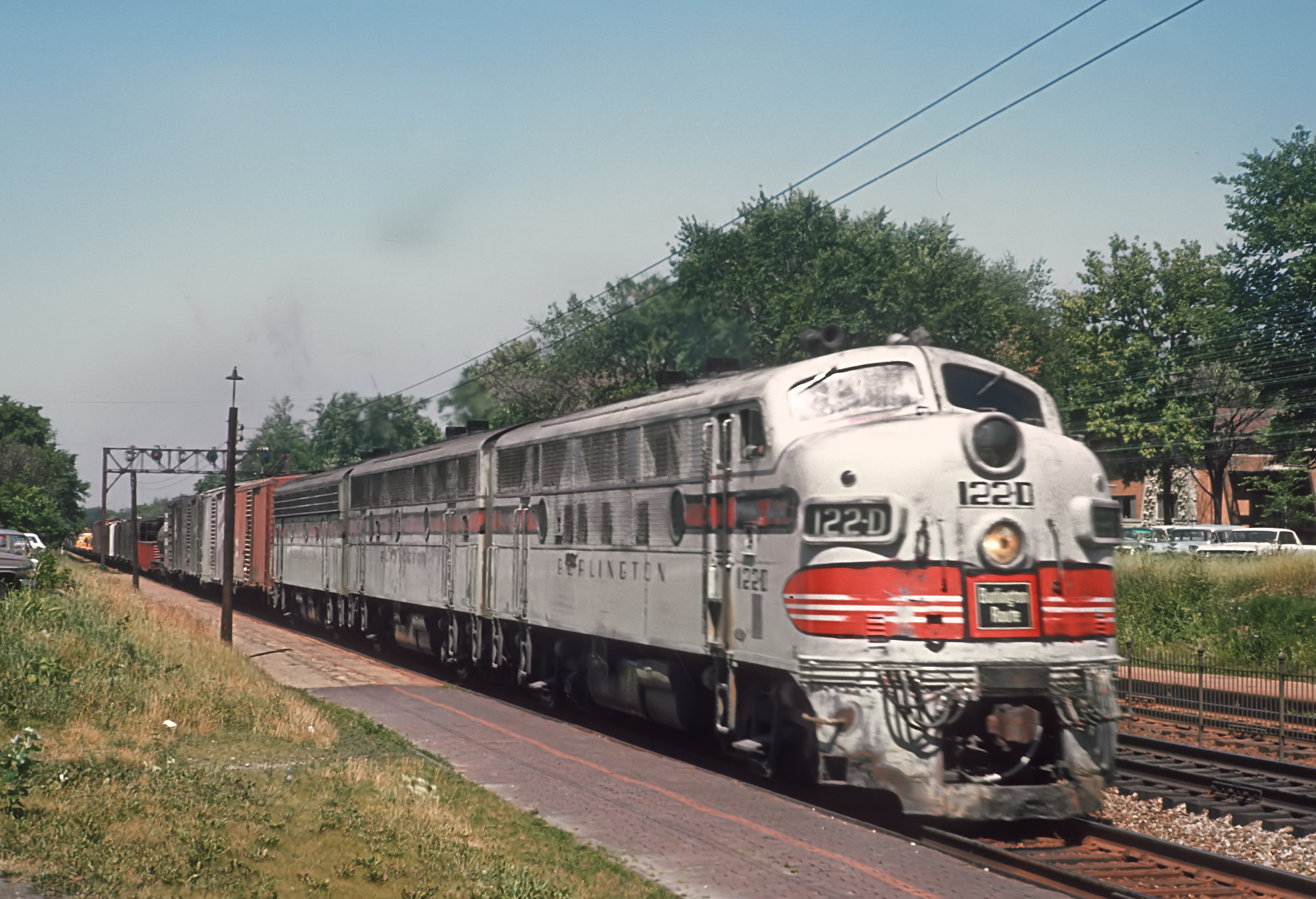 An A-B set of Burlington F3s, #122-D and #122-C, along with an F7A, hustle a freight through Westmont, Illinois on June 25, 1965. Marty Bernard photo.
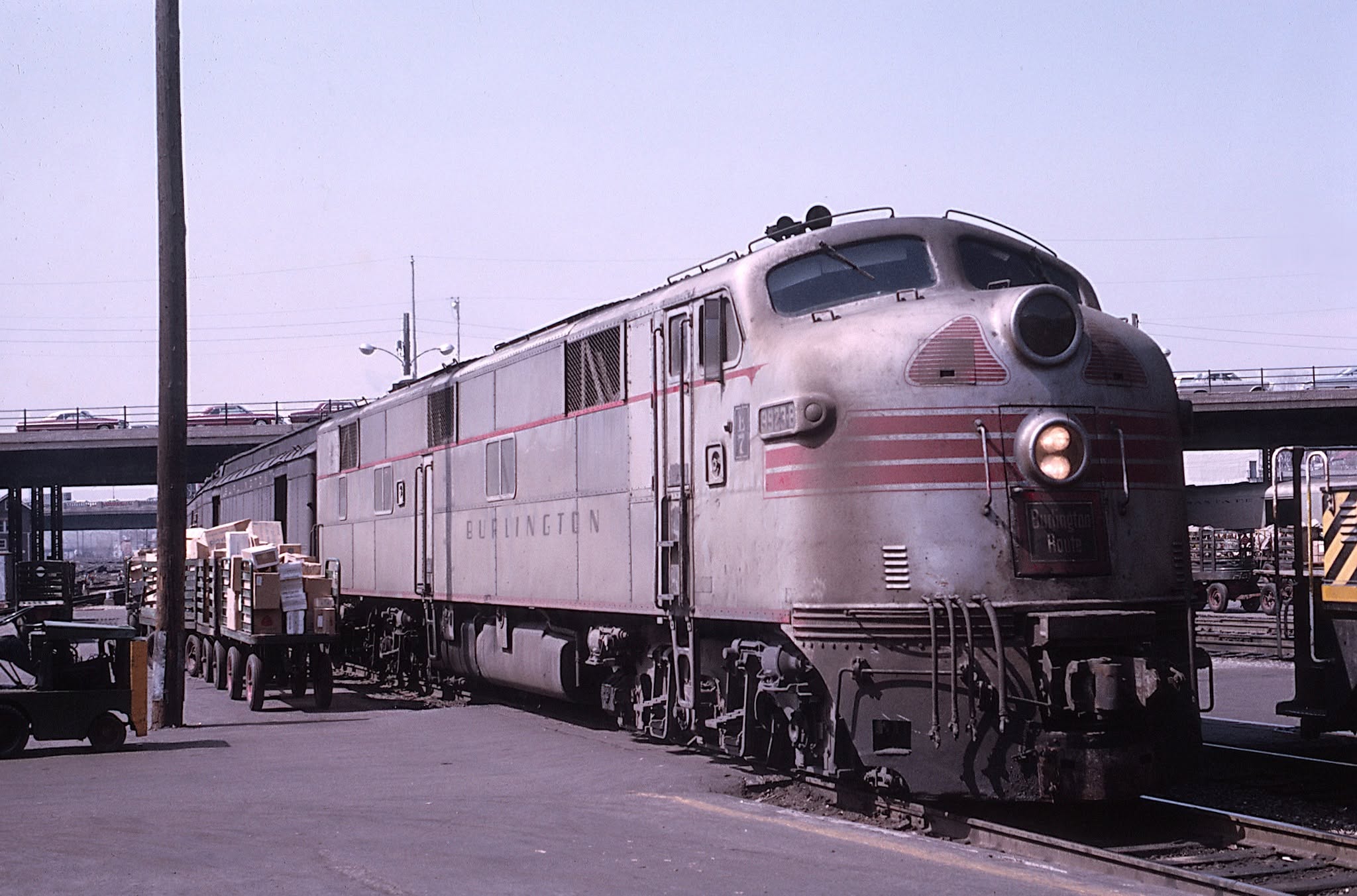 A rather grimy Burlington E7A, #9923B, has train 20, the former Silver Streak Zephyr arriving as Kansas City Union Station from Omaha on March 27, 1967. Roger Puta photo.
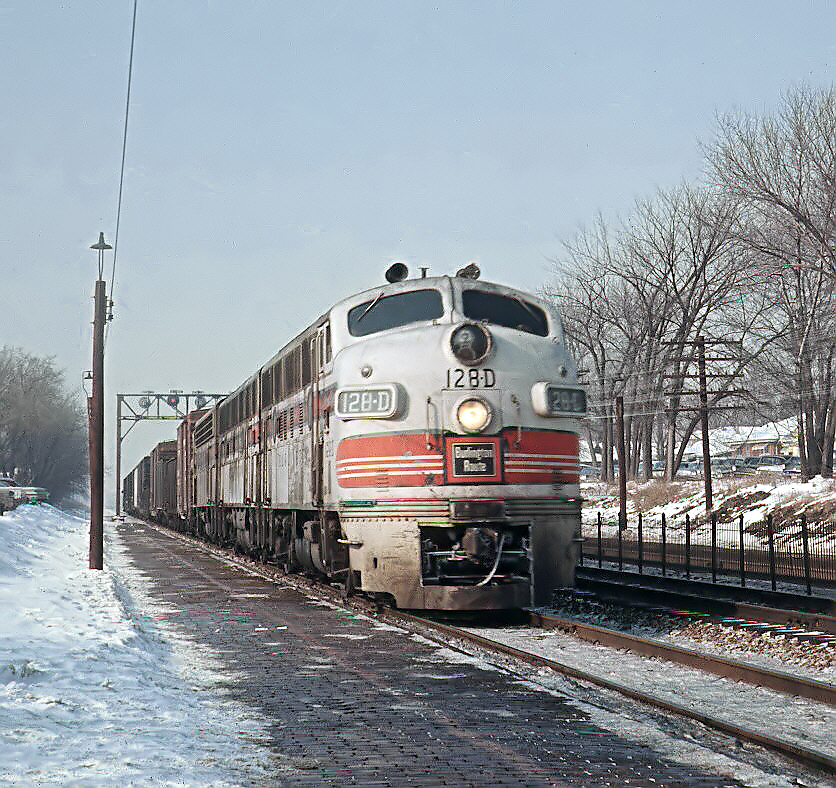 Burlington F3A #128-D, F3B #128-C, and an F7A make a perfect A-B-A set, as the group leads a freight through Westmont, Illinois on January 26, 1966. Marty Bernard photo.
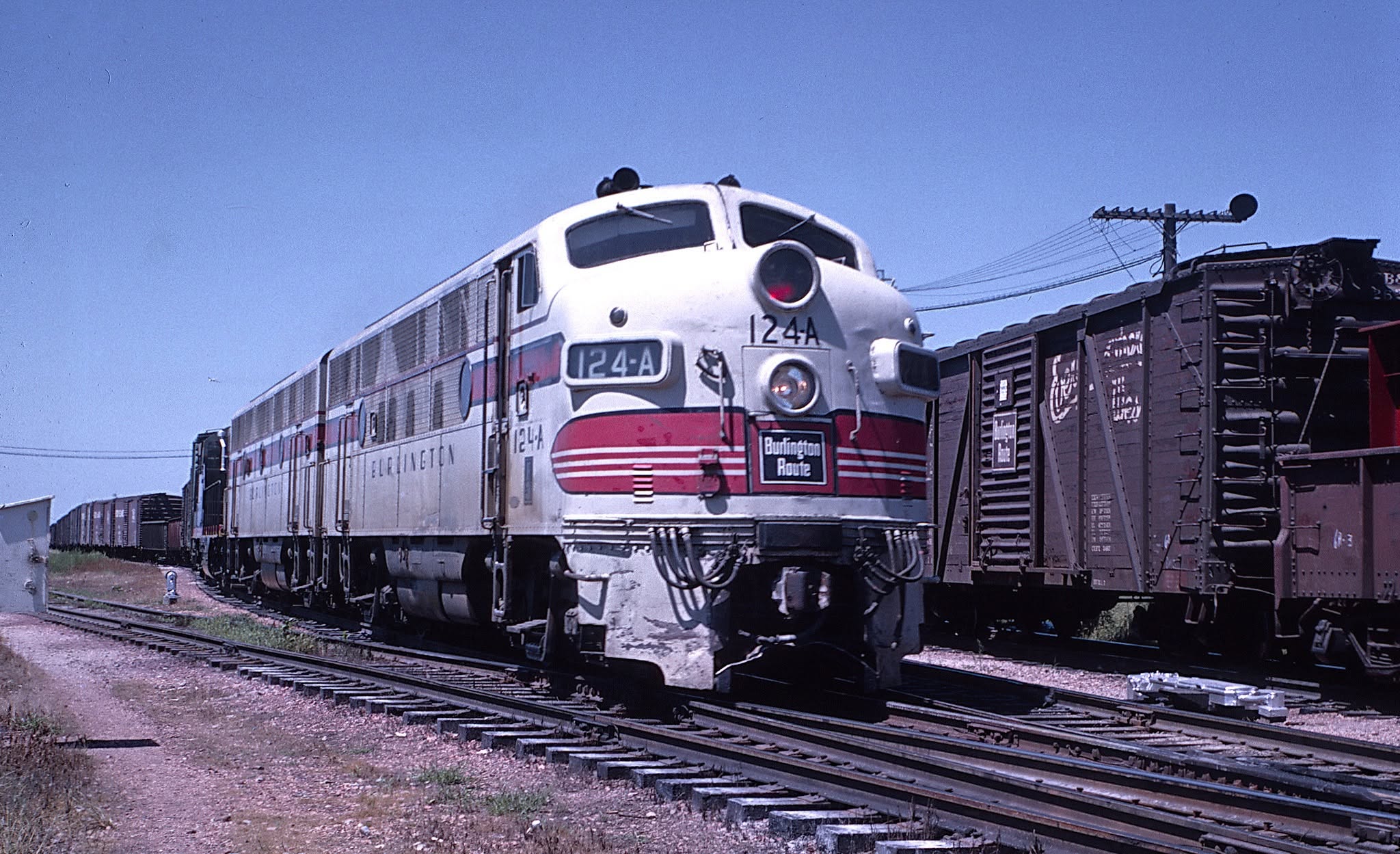 A handsome set of Burlington F3s, led by #124-A, depart the yard at Lincoln, Nebraska with an eastbound freight on August 9, 1962. Marty Bernard notes the train is passing a westbound freight train and approaching the bridge over Salt Creek. Roger Puta photo.
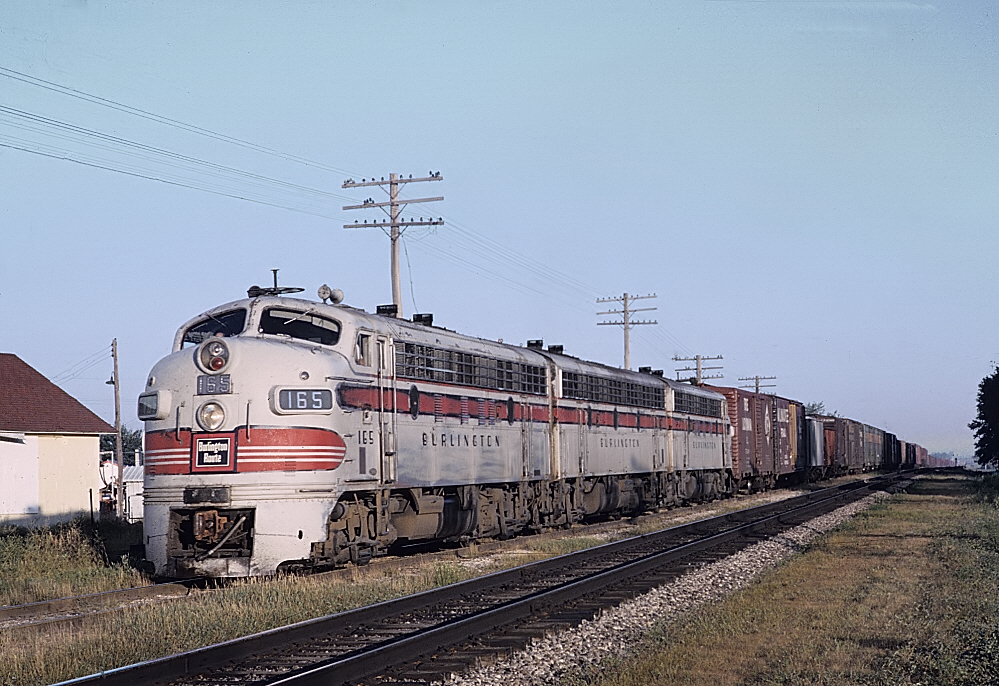 Chicago, Burlington & Quincy F3s #165A, #165B, and #165C have the early morning "Pick Up" at Milledgeville, IL on August 14, 1964. As Marty Bernard notes, "if the train had a number, it was never used on the dispatcher's line. It could run 80 cars long. It was a heck of a train to be doing local switching, but it did weekdays."
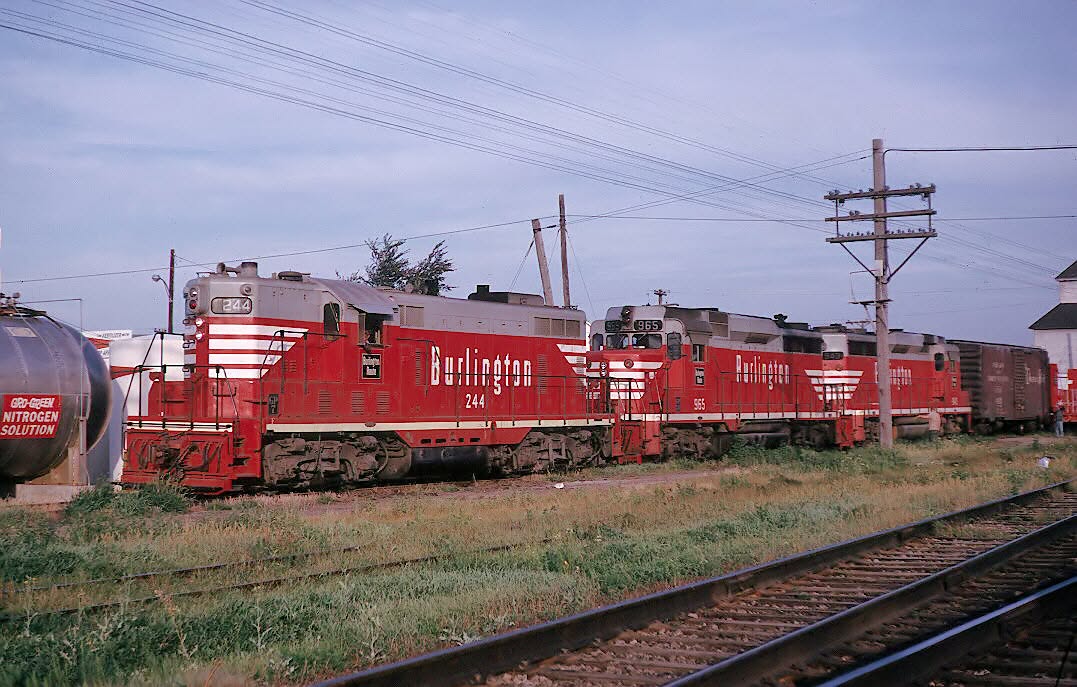 CB&Q GP7 #244 leads the "Pick Up" on one of the spurs at Milledgeville, Illinois on August 6, 1964. Marty Bernard notes the closest rail is the mainline and the next two rails are the siding. The "Pick Up" was a local freight that did the set outs and pick ups as needed. The other two units, 965 and 943, were GP30s. Milledgeville is located about 20 miles east of Savanna, Illinois on the Aurora/Savanna CTC single-track line. Marty Bernard photo.
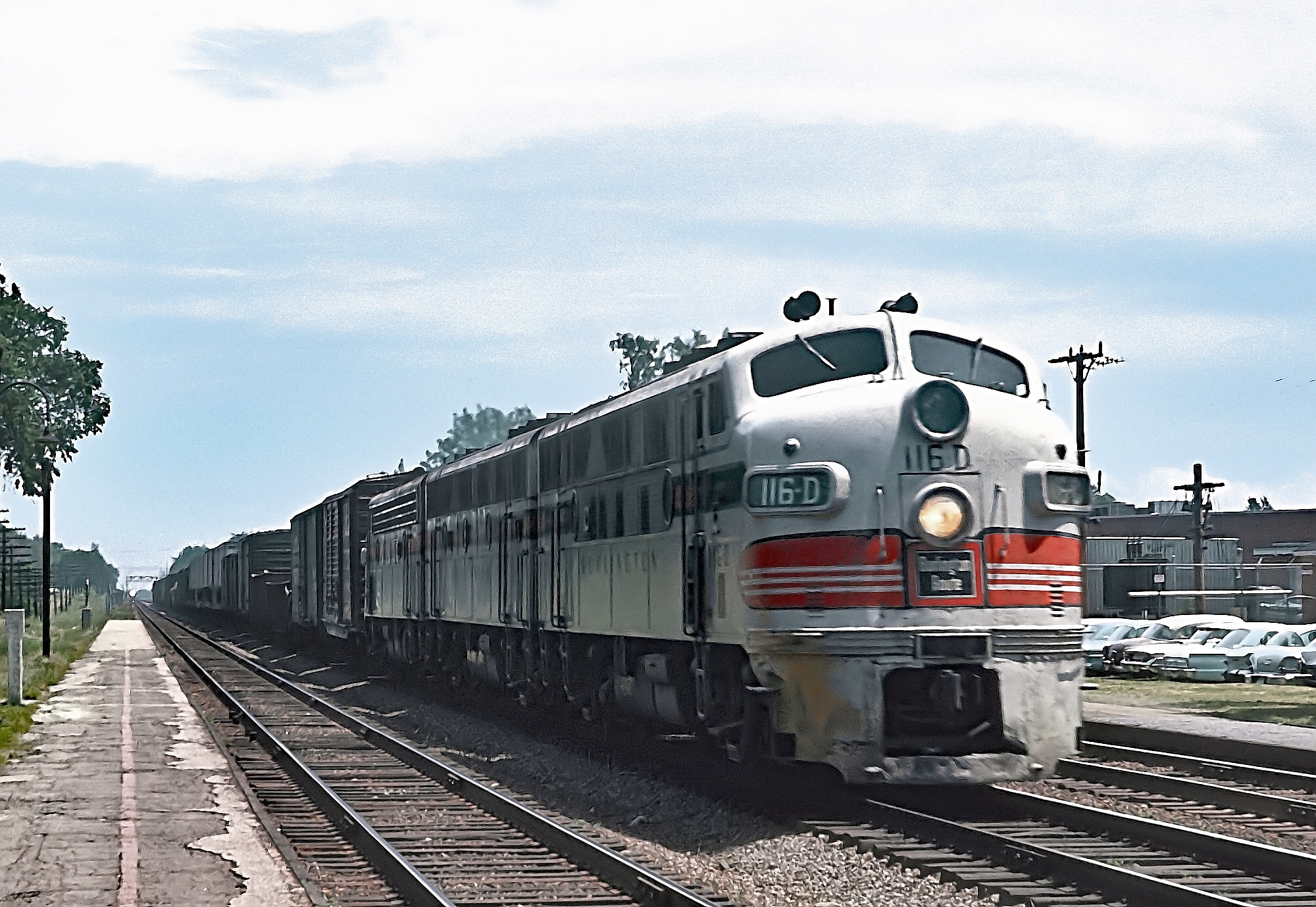 CB&Q F3A #116D, and F3B, and F7A hustle a freight past the station at Fairview Avenue in Downers Grove, Illinois on July 4, 1965. Marty Bernard photo.
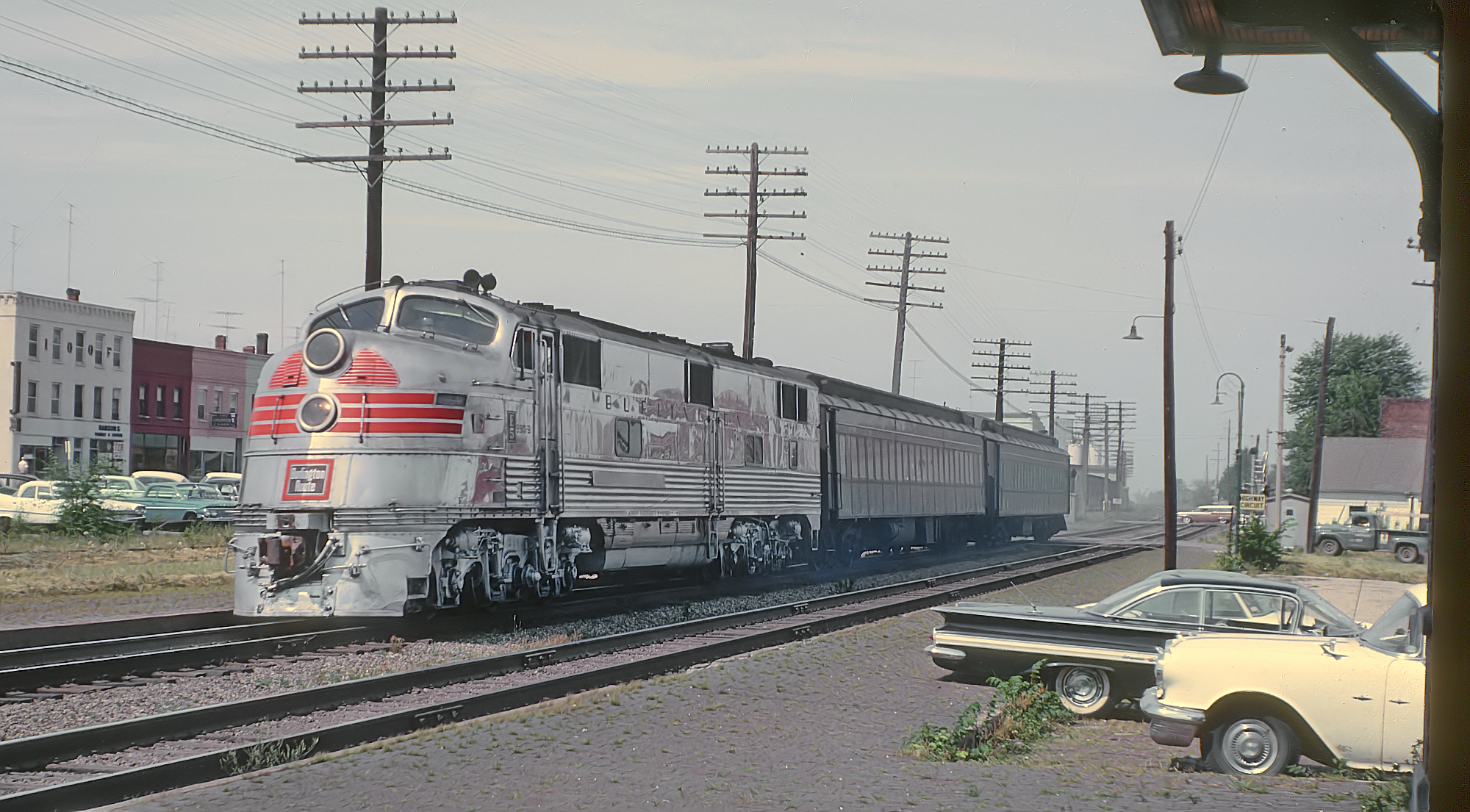 Burlington E5A #9915-B is the power for train #2, the Galesburg local, as it eases into the depot at Sandwich, Illinois on the morning of July 5, 1963. Marty Bernard photo.
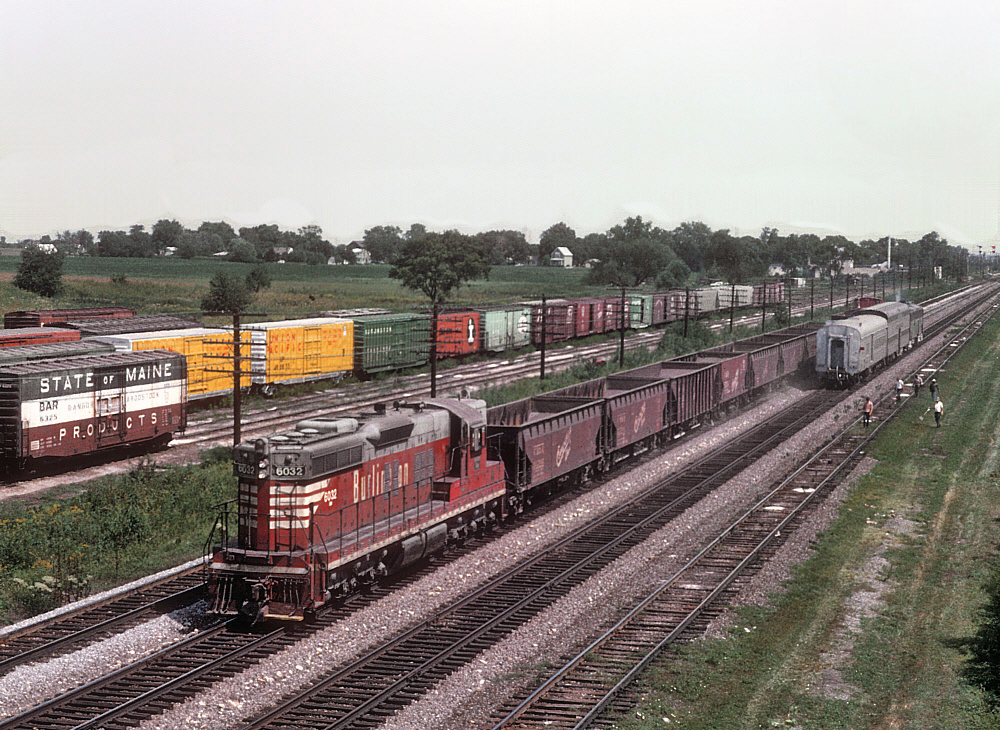 A former Burlington SD7, #6032, leads a short cut of hoppers along the main line at Eola, Illinois while a "Dinky" commuter consist can be seen to the right during the early Burlington Northern era on August 31, 1970. Marty Bernard photo.
 Burlington motorcar #9769 rests on New Year's Day, 1966 in Clinton, Iowa. Marty Bernard notes the car was then used as the local switcher. Marty Bernard photo.
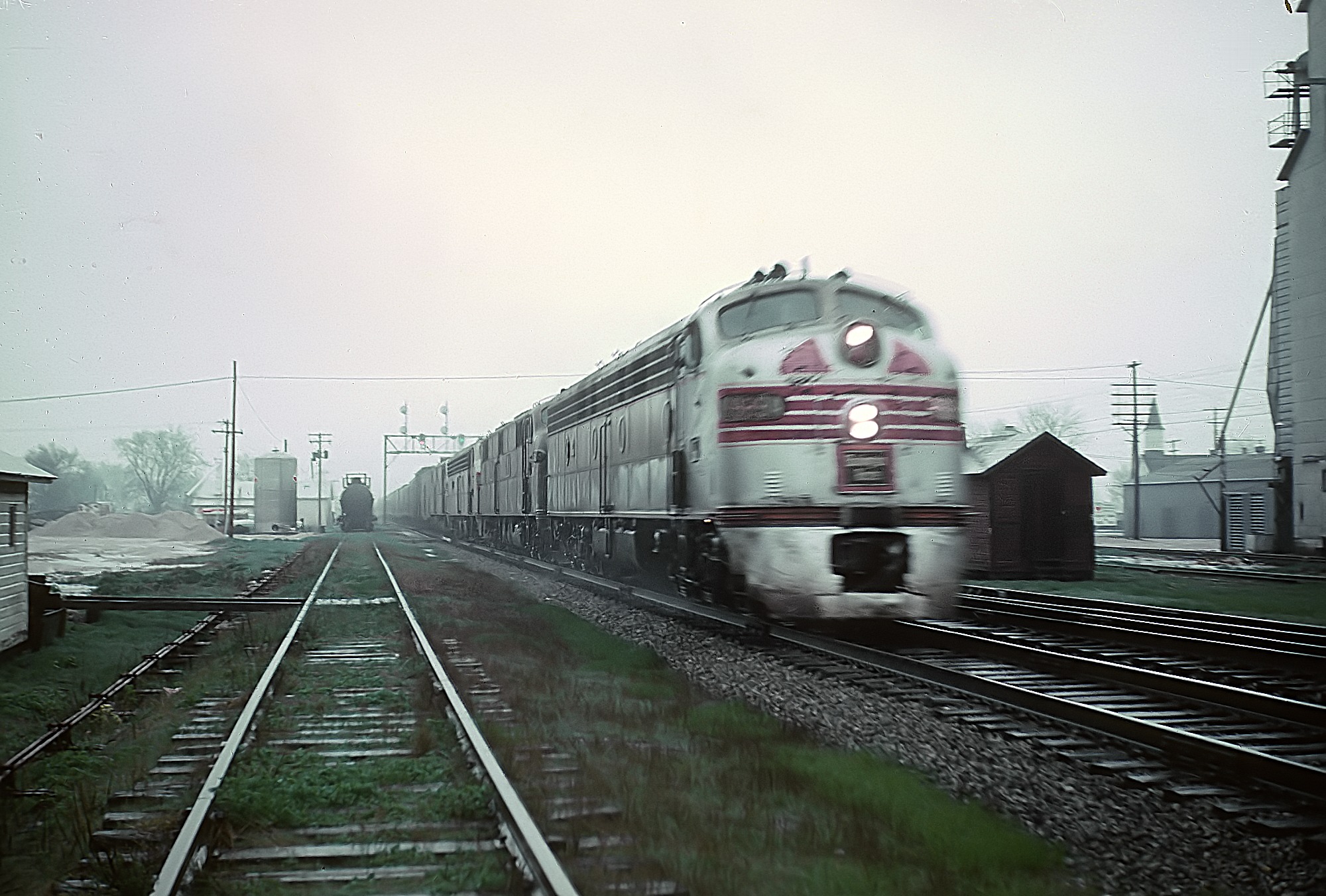 Burlington's train #11-35, the combined "Nebraska Zephyr"/"Kansas City Zephyr" at Wataga, Illinois in May, 1967. Rick Burn photo.
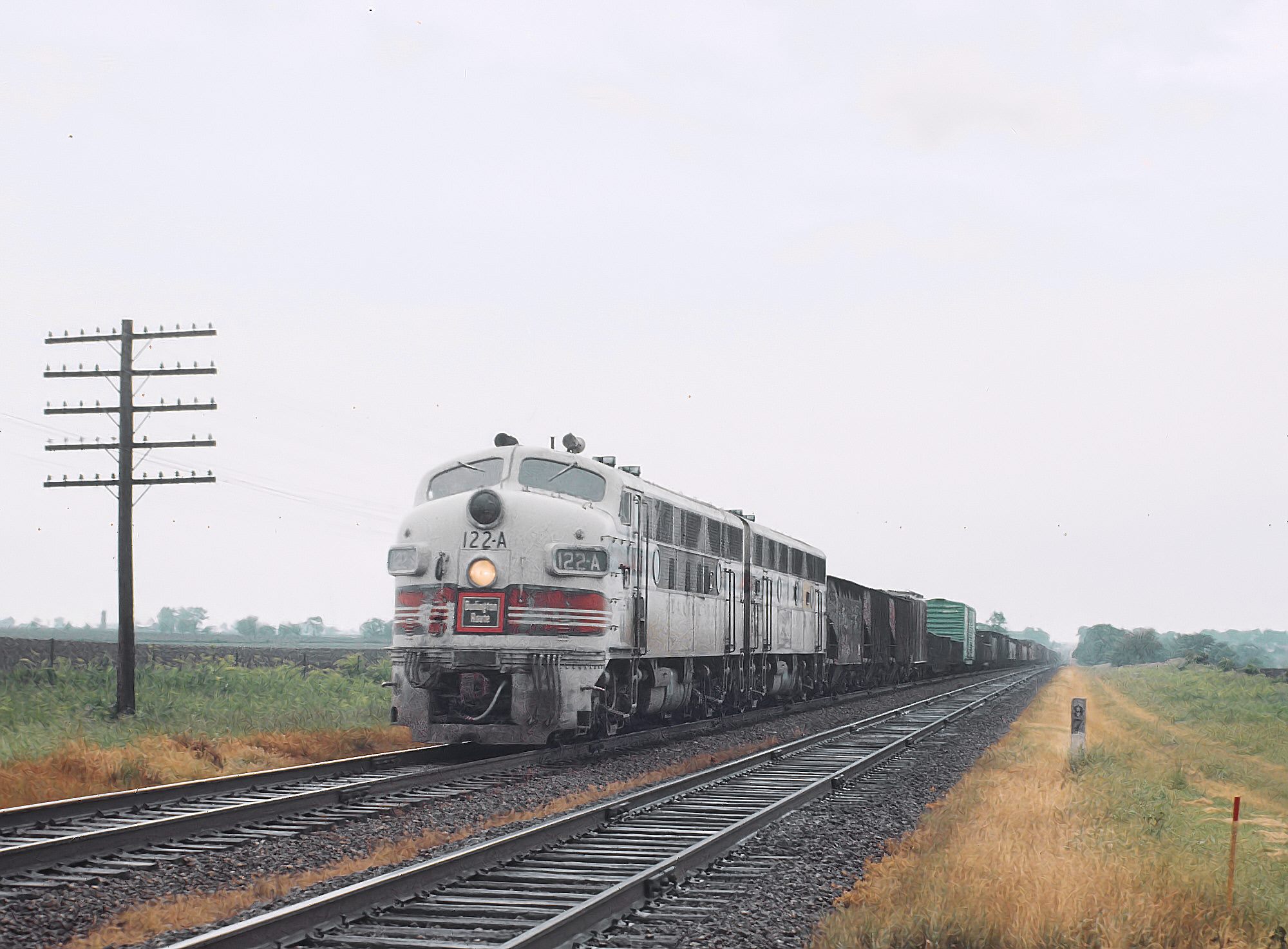 A classic set of Burlington F3 "Graybacks", led by #122-A, have a long freight on the main line at Zearing, Illinois in June 1966. Rick Burn photo.
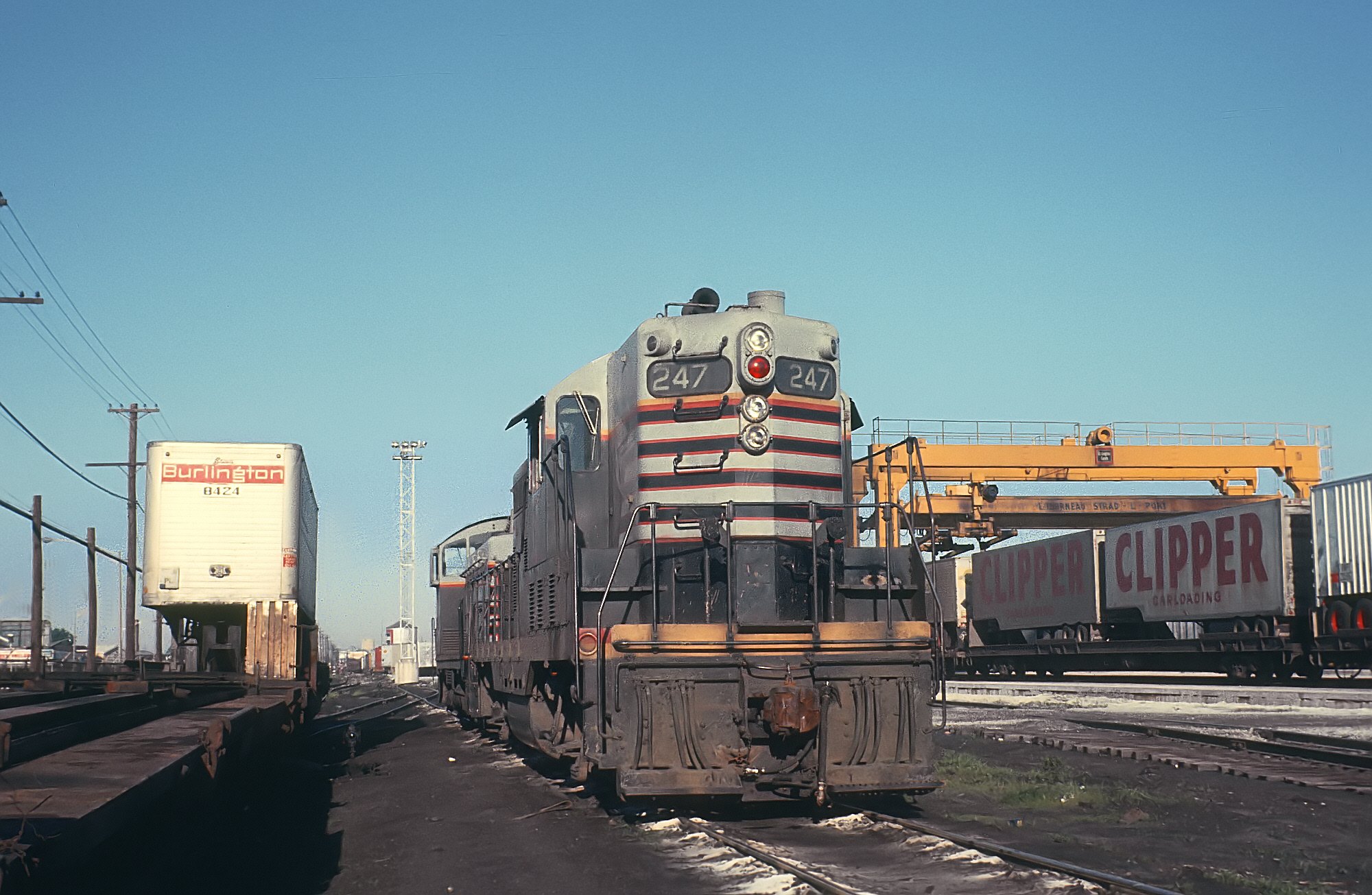 Burlington's Clyde Yard in Cicero, Illinois during June, 1966. Closest to the photographer is "Blackbird" GP7 #247. Rick Burn photo.
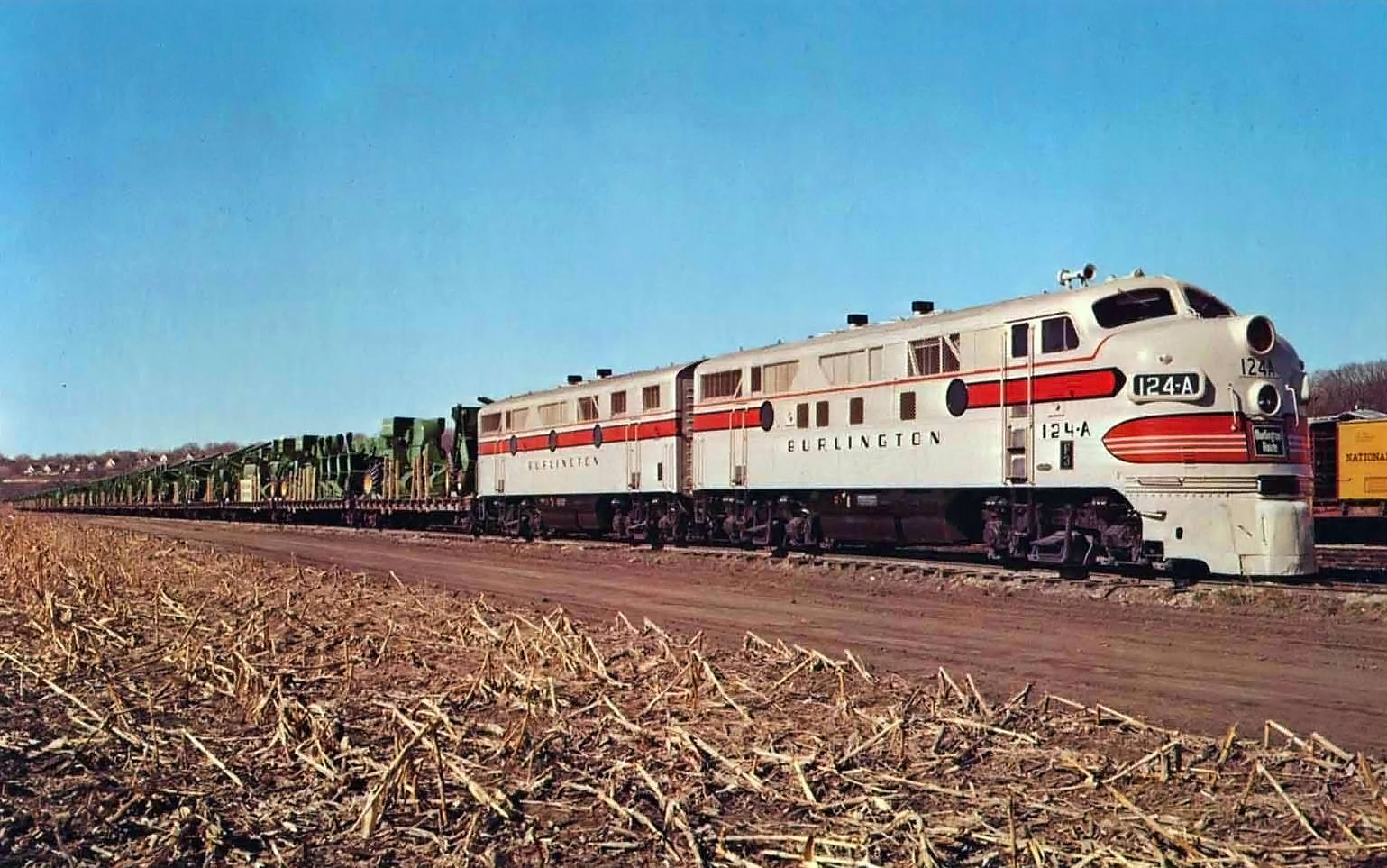 A Chicago, Burlington & Quincy company photo featuring an A-B set of new F3 “Graybacks” (#124-A/B) with John Deere farm equipment, circa 1948 (location not provided).
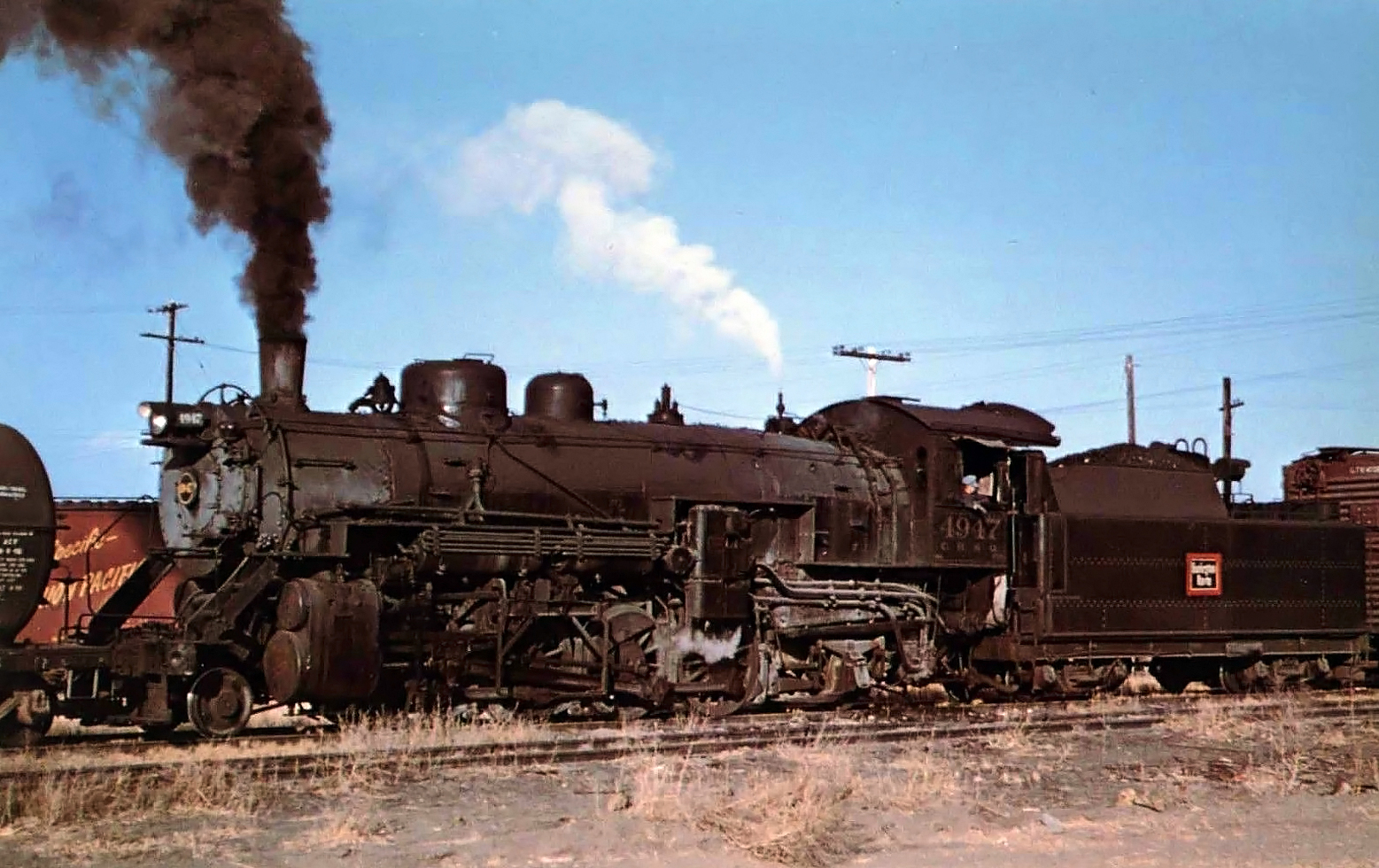 Burlington 2-8-2 #4947 is seen here at work in Longmont, Colorado on November 15, 1958. Bernard Corbin photo.
Recent Articles


-
West Point Route (Railroad): Map, History, Logo
Oct 16, 26 11:26 PM
 The West Point Route was a trademarked name comprising the Atlanta & West Point and Western Railway of Alabama, which were controlled by the Georgia Railroad.
 -
Virginian Railway Diesel Roster (All-Time)
Oct 16, 26 11:11 PM
 All-time diesel roster of the Virginian Railway. 40 Fairbanks-Morse H16-44s, 25 H24-66 Train Masters, and one GE 44-tonner. Serials included.
 -
Virginian Railway Steam Roster (Post 1900)
Oct 16, 26 10:55 PM
 Virginian Railway steam locomotives built since 1900. Mikados, 2-8-8-2s, the Triplex, class AE 2-10-10-2s, and the 1945 2-6-6-6s.
 -
Virginian Railway: Map, Rosters, History, Electrification
Oct 16, 26 10:51 PM
 Virginian Railway, Deepwater to Norfolk. Combined in 1907 and completed in 1909. Electrified from Roanoke to Elmore. Absorbed by the Norfolk & Western on December 1, 1959.
 -
Baldwin "Centipede" Locomotives: Specs, Roster, Photos
Oct 16, 26 03:58 PM
 Baldwin DR-12-8-1500/2 Centipede—2-D+D-2, two 608SC engines, 3,000 hp. SAL 4500 from the 1943 test bed. 54 on the serial list, 52 sold. PRR BP60 then BH50. None preserved.
 -
Louisville & Nashville Class M-1 2-8-4s: The Big Emmas
Oct 16, 26 03:52 PM
 Louisville & Nashville class M-1, 42 Big Emma 2-8-4s. Baldwin in 1942 and 1944, Lima in 1949. Coal trains from Neon to DeCoursey. No locomotive survives.
 -
Tennessee, Alabama and Georgia Railway: Map, History, Rosters
Oct 16, 26 03:21 PM
 Tennessee, Alabama and Georgia Railway, Chattanooga to Gadsden. The May 1929 card is 91.7 miles. Southern stock control closed on a January 1, 1971 schedule. Five diesels and Prince's steam list.
 -
Railroad Museums In The USA (2026): State Guides & Collections
Oct 16, 26 02:29 PM
 U.S. railroad museums—what they are vs tourist railroads, preservation history (R&LHS, NRHS, IRM, Steamtown), state guides, and destination collections. Confirm hours on each museum’s site.
 -
Wyoming Railroad Museums (2026): A Complete Guide
Oct 16, 26 02:26 PM
 Wyoming railroad museums—the Cheyenne Depot, Burlington 5633 at Douglas, Big Boy 4004, and the Laramie depot. Confirm hours and which locomotive is on the property.
 -
West Virginia Railroad Museums (2026): A Complete Guide
Oct 16, 26 12:52 PM
 West Virginia railroad museums—Cass Scenic’s geared steam, the Hinton C&O collection, and the Martinsburg B&O roundhouse. Confirm hours and which locomotive is assigned.
 -
Washington Railroad Museums (2026): A Complete Guide
Oct 16, 26 12:46 PM
 Washington railroad museums—Snoqualmie, Elbe, Chehalis, Reardan, and the Northern Pacific depot at Toppenish. Confirm hours and which locomotive is assigned.
 -
Vermont Railroad Museums (2026): A Complete Guide
Oct 16, 26 12:42 PM
 Vermont railroad museums—the Shelburne Museum’s 1890 station, Central Vermont No. 220, and the private car Grand Isle. Confirm hours on the site.
 -
Tennessee Central Railway: Map, Logo, Rosters, History
Oct 16, 26 11:32 AM
 Tennessee Central Railway, Harriman to Hopkinsville. Reorganized January 26, 1922. Last day August 31, 1968. Thirty-one diesels and the railroad's steam roster.
 -
Southern Railway Steam Roster (Post 1900)
Oct 16, 26 09:40 AM
Southern Railway steam locomotives built since 1900. Ps-4 Pacifics, Ts Mountains, USRA Santa Fes, and the subsidiary grids for the CNO&TP, Alabama Great Southern, and New Orleans and Northeastern. -
Southern Railway (USA): Map, Locomotives, Logo, History
Oct 16, 26 09:28 AM
 The Southern Railway, formed July 1, 1894 from the Richmond and Danville and the East Tennessee, Virginia and Georgia. Washington. Norfolk Southern Railway on December 31, 1990.
 -
Seaboard Coast Line Diesel Roster (All-Time)
Oct 15, 26 04:21 PM
 All-time diesel roster of the Seaboard Coast Line. Inherited Coast Line and Seaboard locomotives, then 623 new locomotives in the printed orders, plus 28 acquired from other railroads.
 -
Seaboard Coast Line Railroad: Map, History, Photos
Oct 15, 26 04:17 PM
 The Seaboard Coast Line, formed July 1, 1967 from the Atlantic Coast Line and the Seaboard Air Line. Jacksonville. Family Lines, then the Seaboard System on December 29, 1982.
 -
South Carolina Railroad Museums (2026): A Complete Guide
Oct 15, 26 02:54 PM
 South Carolina railroad museums—Winnsboro’s Rockton & Rion line, Spartanburg’s Hub City depot, Greenwood’s Baldwin No. 19, and the Best Friend replica. Confirm hours on each site.
 -
South Dakota Railroad Museums (2026): A Complete Guide
Oct 15, 26 10:55 AM
 South Dakota railroad museums—the Hill City museum beside the 1880 Train, and Prairie Village at Madison. Confirm hours, and confirm whether Hill City is still open.
 -
Seaboard Air Line Diesel Roster (All-Time)
Oct 15, 26 10:46 AM
 All-time diesel roster of the Seaboard Air Line. 734 locomotives: E4s in 1938, Centipedes, Alco road switchers, and GP40s through February 1967. Serials included.
 -
Seaboard Air Line Steam Roster (Post 1900)
Oct 15, 26 10:39 AM
 Seaboard Air Line steam locomotives built since 1900. Mikados, Russian Decapods, 2-10-2s, and the 2-6-6-4s sold to the Baltimore and Ohio in 1947. Drury's class grid.
 -
Seaboard Air Line Railroad: Map, Rosters, History
Oct 15, 26 10:34 AM
 The Seaboard Air Line, chartered in the Portsmouth and Roanoke of 1832 and formed July 1, 1900. Inland route to Florida. Merged into the Seaboard Coast Line on July 1, 1967.
 -
Utah Railroad Museums (2026): A Complete Guide
Oct 15, 26 12:04 AM
 Utah railroad museums—Ogden Union Station, Golden Spike at Promontory, the Helper mining museum, and the Heber Valley Railroad. Confirm hours on each site.
 -
Escanaba & Lake Superior Diesel Roster (All-Time)
Oct 14, 26 10:44 PM
All-time diesel roster of the Escanaba & Lake Superior. 30 locomotives: Baldwin switchers and RS-12s, two RF16s, three GP38s, three SD40-2s, and the Reserve Mining units. Serials and order numbers. -
Escanaba & Lake Superior Railroad: In Service Since 1898
Oct 14, 26 09:04 PM
 Escanaba & Lake Superior Railroad, chartered November 17, 1898, and still operating from Wells, Michigan. Logging line to Channing, the Milwaukee Road lines, and the diesel roster.
 -
Richmond, Fredericksburg & Potomac Diesel Roster (All-Time)
Oct 14, 26 08:49 PM
 All-time diesel roster of the Richmond, Fredericksburg and Potomac. 107 locomotives: 22 Alco S2s, one SW1, and an Electro-Motive road fleet from E8s to GP40-2s. Serials and order numbers.
 -
Richmond, Fredericksburg & Potomac Steam Roster (Since 1900)
Oct 14, 26 08:46 PM
 Richmond, Fredericksburg and Potomac steam locomotives built since 1900. Pacifics, Mountains, Berkshire-type 2-8-4s, and the named 4-8-4s. Last revenue run December 17, 1954.
 -
Richmond, Fredericksburg and Potomac Railroad: Map, Rosters, Logo
Oct 14, 26 08:36 PM
 The Richmond, Fredericksburg and Potomac, chartered February 25, 1834. A 113-mile Richmond–Washington bridge line. Named 4-8-4s, Potomac Yard, and the CSX sale of October 10, 1991.
 -
North Dakota Railroad Museums (2026): A Complete Guide
Oct 14, 26 08:29 PM
North Dakota railroad museums—Mandan’s state museum, the Railroad Museum of Minot, and Bonanzaville’s Northern Pacific 684. Confirm hours on each site. -
Oklahoma Railroad Museums (2026): A Complete Guide
Oct 14, 26 08:02 PM
Oklahoma railroad museums—the Oklahoma Railway Museum, Enid’s Frisco 1519, Waynoka’s Harvey House, and El Reno’s Rock Island depot. Confirm hours on each site. -
Oneida & Western Railroad: Map, History, Timetable
Oct 14, 26 06:47 PM
Oneida & Western Railroad, a Tennessee short line from Oneida to Jamestown. Chartered in 1912, opened to East Jamestown in 1921, and to Jamestown on December 10, 1930. Last revenue train March 4, 1954… -
Oneida and Western Railroad (Shamrock Coal Company)
Oct 14, 26 03:20 PM
 Shamrock Coal's mint-green coal trains, 1979–1987. Eight EMD SD40-2s, OWTX 9950–9957, order 786246. Two 72-car gondola sets. Louisville & Nashville, then CSX. Sold to BC Rail.
 -
Rhode Island Railroad Museums (2026): A Complete Guide
Oct 14, 26 03:03 PM
 Rhode Island railroad museums—the Friends’ museum in the 1875 Kingston depot, on the old New York, Providence and Boston. Confirm what is on view.
 -
Original Norfolk Southern Diesel Roster (All-Time)
Oct 14, 26 12:40 PM
 All-time diesel roster of the original Norfolk Southern Railway. 59 locomotives: Baldwin switchers and AS-416s, three GE 70-tonners, 17 GP18s, and seven GP38s. Serials and order numbers.
 -
Original Norfolk Southern Railway: Map, Rosters, History
Oct 14, 26 10:09 AM
 The original Norfolk Southern Railway, chartered in 1870 as the Elizabeth City & Norfolk. Norfolk to Charlotte. Merged into the Southern Railway on January 1, 1974. Baldwin diesels and the GP18s and G…
 -
Nebraska Railroad Museums (2026): A Complete Guide
Oct 14, 26 10:00 AM
 Nebraska railroad museums—the Durham Museum, Kenefick Park, Cody Park, and the Golden Spike Tower over Bailey Yard. Confirm hours on each site.
 -
Nevada Railroad Museums (2026): A Complete Guide
Oct 14, 26 09:51 AM
 Nevada railroad museums—Carson City, Boulder City, the Nevada Northern at East Ely, and the Virginia City depot. Confirm hours on each site.
 -
Montana Railroad Museums (2026): A Complete Guide
Oct 14, 26 12:17 AM
 Montana railroad museums—the Livingston depot, Fort Missoula’s Willamette, the Harlowton Milwaukee depot, and the Whitefish station. Confirm hours on each site.
 -
"Jawn Henry" Locomotive: Specs, Diagram, Photos
Oct 14, 26 12:03 AM
 Norfolk & Western No. 2300, class TE-1, the steam turbine-electric Jawn Henry. Baldwin-Lima-Hamilton, Westinghouse, and Babcock & Wilcox, May 1954. Specifications, the road tests, and the Dece…
 -
Atlantic and Danville Railway: Serving Southern VA
Oct 13, 26 04:32 PM
 Atlantic and Danville Railway, chartered in 1882, incorporated September 1883. Three-foot line to Claremont, then Norfolk to Danville. Southern lease from September 1, 1899, to July 1, 1949. Alco RS2s…
 -
Norfolk, Franklin and Danville Railroad: Map, Roster, History
Oct 13, 26 04:26 PM
 Norfolk, Franklin and Danville Railway, chartered October 2, 1962, and operating from November 1, 1962. Norfolk to Danville, 210.8 miles. Two Alco RS36s and four RS11s. Merged into the N&W on December…
 -
Norfolk & Western Diesel Roster (All-Time)
Oct 12, 26 11:59 PM
 Norfolk & Western diesel roster, all-time. 1,464 locomotives built new for the railroad, from the 1955 GP9s and RS-3s through the C36-7s, plus the merger fleets.
 -
Norfolk & Western Steam Roster (Post 1900)
Oct 12, 26 11:52 PM
 Norfolk & Western steam since 1898. The Roanoke grid: 1,266 locomotives, the J, the A, and the Y, and the last road steam on May 7, 1960.
 -
Norfolk & Western Railway: Map, Logo, Rosters, History
Oct 12, 26 11:45 PM
 The Norfolk & Western, from the City Point Railroad of 1838 to Norfolk Southern. Pocahontas coal, Roanoke steam, and the 1964 expansion.
 -
Louisiana Railroad Museums (2026): A Complete Guide
Oct 12, 26 11:24 PM
 Louisiana railroad museums—the DeQuincy depot, the Long Leaf sawmill, Jackson’s model railroad, and Southern Pacific 745. Confirm hours on each site.
 -
Michigan Railroad Museums (2026): A Complete Guide
Oct 12, 26 11:14 PM
 Michigan railroad museums—Pere Marquette 1225 at Owosso, Durand Union Station, The Henry Ford, and the Mount Clemens depot. Confirm hours on each site.
 -
Mississippi Railroad Museums (2026): A Complete Guide
Oct 12, 26 10:52 PM
Mississippi railroad museums—McComb’s rebuilt Illinois Central depot and Illinois Central 2542, and the Casey Jones museum at Water Valley. Confirm hours on each site. -
The "E2b": PRR's Experimental Freight Electrics
Oct 12, 26 10:33 PM
 PRR class E2b: six GE B-B freight electrics, 4939–4944, 2,500 hp, 11 kV AC. Specifications, roster, and the 1964 scrap.
 -
Alaska Railroad Museums (2026): A Complete Guide
Oct 12, 26 10:10 PM
 Alaska railroad museums—the Museum of Alaska in Wasilla, Tanana Valley No. 1 at Pioneer Park, and the Engine 557 shop. Confirm hours on each site.
 -
Western and Atlantic Railroad: Map, History, Timetables
Oct 12, 26 09:55 PM
 The Western & Atlantic Railroad of the State of Georgia, authorized December 21, 1836, from Atlanta to Chattanooga. The state still owns the 137.33-mile line. CSX leases it. The through railroad opene…
%20wearing%20a%20special%20gold%20livery%20in%20November%2C%201964%20to%20celebrate%20the%2050th%20anniversary%20of%20Kansas%20City%20Union%20Station's%20opening.%20Earlier%20that%20year%20the%20locomotive%20was%20also%20dressed%20in%20gold%20to%20mark%20the%20centennial%20of%20Burlington's%20Chicago%20-%20Aurora%20main%20line.%20Photographer%20unknown.)
%20S2%20%239304%20is%20seen%20here%20at%20work%20in%20Denver%2C%20Colorado%2C%20circa%201965.%20%20American-Rails.com%20collection.)
%20at%20Aurora%2C%20Illinois%2C%20circa%201969.%20%20American-Rails.com%20collection.)


%2C%20is%20seen%20here%20probably%20during%20the%201960s.%20American-Rails.com%20collection.)

%20solid%20gold%20for%20this%20event.%20A%20real%20life%20brass%20model!%20The%20railroad%20held%20several%20festivities%20over%20the%20years%20celebrating%20centennials%20and%20milestones.%20From%20right%20to%20left%3A%20GP30%20%23974%2C%20E9A%20%239985-A%2C%20%22Zephyr%22%20power%20car%20%239908%20(the%20%22Silver%20Charger%22)%2C%202-8-2%20%234968%20(O-1a)%2C%20and%204-4-0%20%2335.)


%20is%20seen%20here%20on%20September%202%2C%201956%20hosting%20the%20Illini%20Railroad%20Club's%20%22Triangle%22%20fan%20trip.%20American-Rails.com%20collection.)
%20sits%20in%20a%20weed-covered%20siding%20while%20hosting%20excursions%20at%20Longmont%2C%20Colorado%20in%20August%2C%201963.%20American-Rails.com%20collection.)
%20at%20Dallas%20Union%20Station%20during%20the%201960s.%20%20American-Rails.com%20collection.)
