Maine Central Railroad: Map, Logo, Rosters, History
Last revised: September 22, 2026
By: Adam Burns
The Maine Central was the Pine Tree Route. Reporting mark MEC. From Portland it reached Bangor and the Canadian border at Vanceboro, the paper mills and the coast, and, by way of Crawford Notch, St. Johnsbury, Vermont. At its largest, under the United States Railroad Administration in 1917, the system covered 1,358 miles, two-foot branches and a Quebec stub included. In ordinary years it was a New England railroad of under a thousand miles. What it had was the middle of Maine, a summer passenger business that filled the hotels, and a freight railroad of potatoes, pulp, and paper that the Boston & Maine and the Bangor & Aroostook both needed.
The company was created on October 28, 1862, when the Androscoggin & Kennebec and the Penobscot & Kennebec consolidated under a Maine act of April 1, 1856. The original railroad ran from Danville Junction, at Auburn, to Bangor, on the Grand Trunk’s 5-foot 6-inch gauge. Guilford Transportation Industries bought it in June 1981. CSX took the surviving main on June 1, 2022.
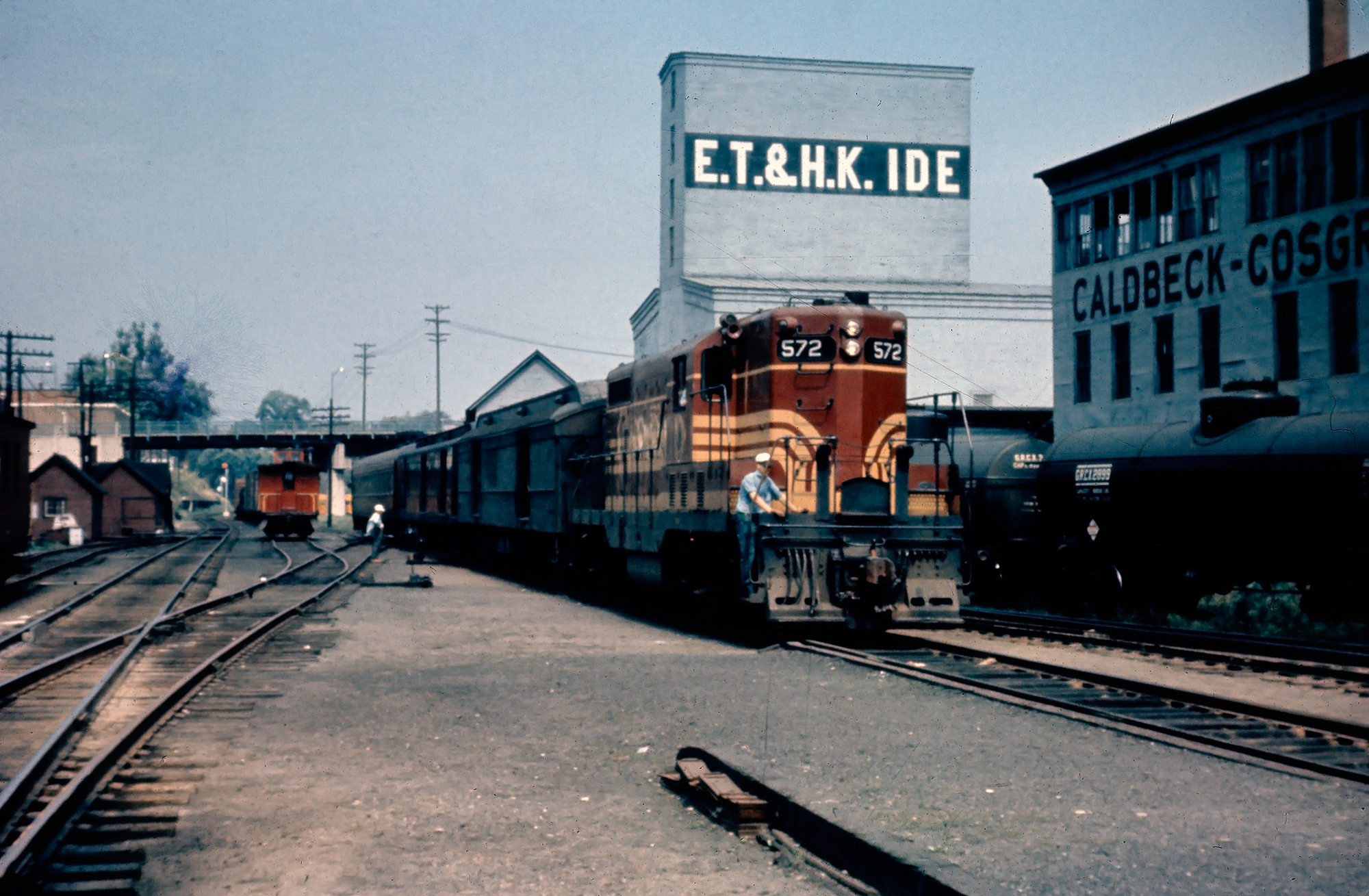
Maine Central GP7 #572 has arrived at St. Johnsbury, Vermont, with train #162 from Portland, about 1952. Meyer Pearlman photo. American-Rails.com collection. The 572 is one of the steam-generator Geeps, 571–573, built in September 1950 for the passenger trains that still climbed the Mountain Division.
On this page: At a glance · October 28, 1862 · Lower Road and Back Road · Vanceboro · Mountain Division · System map (1969) · Branches and the two-footers · Boston & Maine · Passenger trains · Guilford · What remains
At a glance
The Maine Central Railroad logo. Author’s work.
| Item | Detail |
|---|---|
| Railroad | Maine Central Railroad. Mark MEC. Slogan The Pine Tree Route |
| Headquarters | Portland, Maine. General office at 222 St. John Street, built 1916. Shops at Waterville |
| States | Maine, New Hampshire, Vermont. A leased line reached Lime Ridge, Quebec, until 1925 |
| Genesis | Androscoggin & Kennebec (chartered March 28, 1847) and Penobscot & Kennebec (chartered 1845), consolidated October 28, 1862 |
| Dates | October 28, 1862–June 1981 as an independent company. Guilford from June 1981. CSX from June 1, 2022 |
| Gauge | 5 ft 6 in on the 1862 main, the Grand Trunk’s Portland gauge. Standard gauge by 1871 |
| Route-miles | 1,358 (1917). 981 (1950). 921 miles of road at the end of 1970 |
| Principal lines | Portland–Waterville–Bangor, by the Lower Road (Brunswick and Augusta) and the Back Road (Lewiston); Bangor–Vanceboro; Portland–Crawford Notch–St. Johnsbury (Mountain Division); Rockland, Calais, Eastport, Rumford, Farmington, Bucksport, Bingham, Dover-Foxcroft, Skowhegan |
| Fleet (1950) | 74 steam, 57 diesel |
| Cars (1963) | Freight 4,593. Passenger 42 |
| Last steam | June 13, 1954. Pacific 470, Portland–Bangor and return |
| Last passenger | September 5, 1960. Mail and express on the old Gull schedule continued into 1963 |
| Successor | Guilford Transportation Industries, June 1981. Pan Am Railways, 2006. CSX, June 1, 2022 |
| Rosters | Steam · Diesel |
October 28, 1862
A private act of the Maine legislature, approved April 1, 1856, and amended March 17, 1862, allowed three companies to become one. Two of them did. The Androscoggin & Kennebec had been built from Danville Junction to Waterville. The Penobscot & Kennebec, leased to the A&K as its eastern extension in 1856, carried the line from Waterville to Bangor. On October 28, 1862, in the middle of the Civil War, they consolidated as the Maine Central Railroad Company. The principal office ended up in Portland. The shops, after a civic argument with Portland, stayed at Waterville, on the Kennebec, and by 1915 about 2,000 people worked the roundhouse, the shops, and the yard.
Danville Junction is why the first Maine Central was broad gauge. The Grand Trunk’s Portland–Montreal main crossed there, and the Grand Trunk used 5 feet 6 inches, the gauge Portland and the Canadian colonies had settled on so that cars could run through. The new company’s main was built to match. Bangor, at the other end, offered the Bangor & Piscataquis. Between those two connections the Maine Central owned the inland road across the middle of the state, and for a few years it did not yet own a standard-gauge door to Boston.
Lower Road and Back Road
That door was the Portland & Kennebec, heir of the Kennebec & Portland, chartered April 5, 1845. It ran from Portland through Brunswick and Augusta toward Skowhegan, and it was standard gauge because it met the Boston & Maine at Portland. The Maine Central leased it in 1870 and called it the Lower Road. The same year the company finished its own line from Royal Junction, near Yarmouth, over to Danville Junction, so the original inland railroad, the Back Road through Lewiston, reached Portland on Maine Central rails.
From South Portland to Royal Junction the later main was double track. There the railroad split. The Lower Road took Brunswick and Augusta. The Back Road took Lewiston. They met again at Waterville and went on, single track, to Bangor. Standard-gauge conversion of the broad-gauge Back Road was finished in 1871, so a freight car could be handed to the Boston & Maine at Portland without a change of trucks. Mike Schafer’s Classic American Railroads gives the 1950 system as 981 miles, headquarters still Portland. The 1917 figure of 1,358 miles is the railroad at its widest, before the narrow gauge, the Quebec stub, and a generation of branches came off.
Vanceboro
East of Bangor the company leased the European & North American Railway on April 1, 1882, for 999 years. The E&NA had been chartered in 1850 and opened from Bangor to Vanceboro, on the St. Croix, in 1871. It became the Eastern Division. In 1955 the Maine Central bought the property outright, $125 a share, $3,114,500 in all.
In 1889 the Canadian Pacific finished the International Railway of Maine from Megantic, Quebec, to Mattawamkeag and took trackage rights over the Maine Central from Mattawamkeag to Vanceboro, 56.1 miles. That piece, with the CPR’s own line west of Mattawamkeag, was the Montreal–Saint John short line. Canadian war freight used it in both world wars. On February 2, 1915, Werner Horn, a German reserve lieutenant, tried to blow the international bridge at Vanceboro. The charge damaged the span. The bridge stayed up, and Horn was arrested on the Maine side.
The Bangor & Aroostook met the Maine Central at Northern Maine Junction, in Hermon, and at Brownville. Potatoes, paper, and Searsport traffic came south over that handoff. Aroostook County stayed on the Bangor & Aroostook. The Maine Central was the railroad those cars used to reach Portland and Boston.
Mountain Division
The western line was somebody else’s dream. The Portland & Ogdensburg was chartered February 11, 1867, to put Portland on a road to the Great Lakes. Track reached Fabyan, New Hampshire, through Crawford Notch on August 7, 1875. The company was reorganized as the Portland & Ogdensburg Railway on June 8, 1884, and the Maine Central leased it on August 20, 1888, as the Mountain Division: Portland to St. Johnsbury, about 131 miles, past Willey Brook and the Frankenstein Trestle. West of St. Johnsbury the old Vermont Division went to the Boston & Lowell and then the Boston & Maine. The Maine Central leased that Vermont track in July 1912 and, on August 1, 1927, gave back everything west of St. Johnsbury. Beyond the Connecticut the connection was the St. Johnsbury & Lake Champlain, later the St. Johnsbury & Lamoille County.
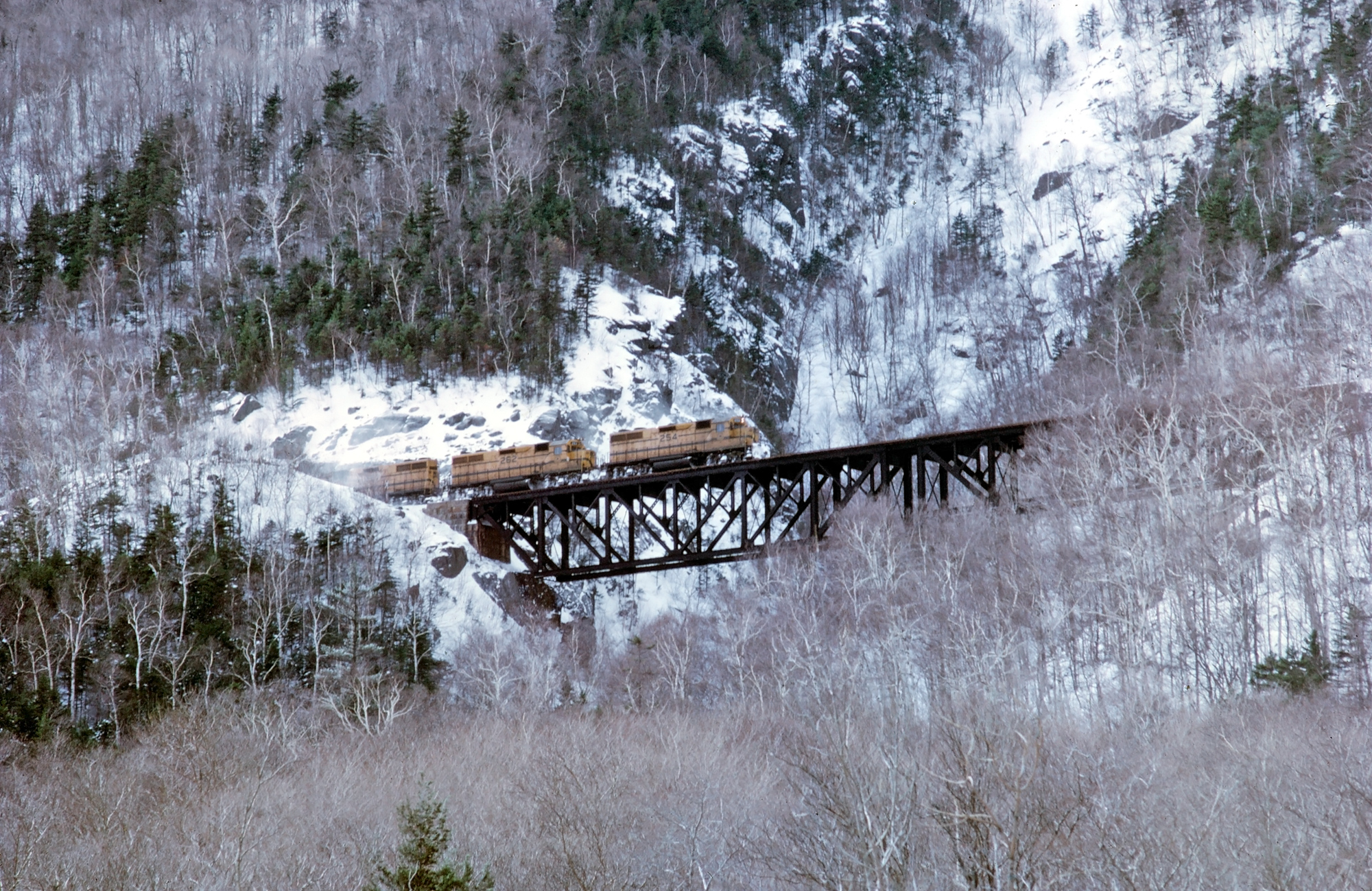
GP38s led by #254 and #262, westbound freight RY-2, cross the Willey Brook Bridge in Crawford Notch, New Hampshire, in February 1972, nearing the Mt. Willard section house. American-Rails.com collection. The grade through the notch is about two percent. In steam days the railroad double-headed here, and for a few years it used four former Boston & Maine 2-6-6-2s as helpers.
A north leg left the Mountain Division at Quebec Junction, near Fabyan. The Upper Coos line to Beecher Falls was leased in 1890, and for a time the Hereford Railway carried Maine Central trains on to Lime Ridge, Quebec. That lease ended in 1925. The Beecher Falls branch itself was about 55 miles.
The notch was the scenic advertisement and a hard piece of railroad. Milk, merchandise, and bridge freight moved over it, often with four or five diesel units after the Mallets and the Mikados were gone. Guilford ran the last through freight between Portland and St. Johnsbury in September 1983. The Conway Scenic Railroad later reopened the Crawford Notch segment for passengers, on track the State of New Hampshire owns. A through freight railroad from Portland to St. Johnsbury has not come back.
System map (1969)
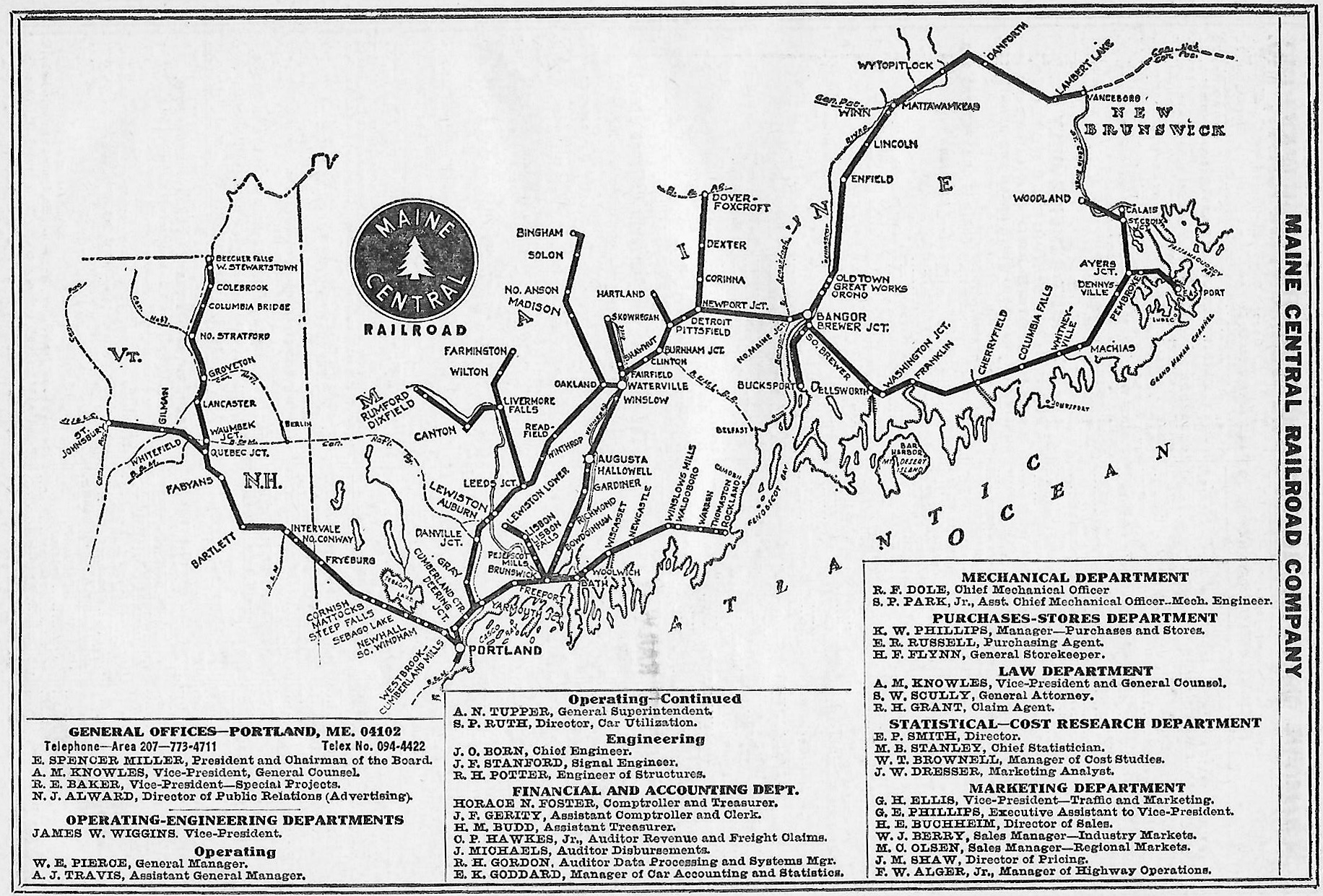
An official 1969 system map of the Maine Central. Author’s collection. The Lower Road and the Back Road both show between Portland and Waterville. The Mountain Division still reaches St. Johnsbury. Eastport is still on the map.
Branches and the two-footers
The branch list is the rest of settled Maine. Rockland was leased in 1891, the Knox & Lincoln line down the coast through Bath and Wiscasset. The Calais branch, majority control in 1904, ran southeast from Bangor through Ellsworth and Machias. Bar Harbor was an 1884 lease off that line. Eastport, reached from Ayers Junction, was the easternmost rail terminal in the United States and a light branch; a 44-ton switcher was as much as the rail would take, and service ended in 1978. Bucksport was leased in 1883. Farmington and a Lewiston branch came in 1871. The Portland & Rumford Falls was leased in 1907 and gave the railroad the Rumford paper mill, Livermore Falls, and the Rangeley branch. Harmony was leased in 1910. The Somerset Railroad, the Bingham and Kineo line to Moosehead Lake, was purchased in 1911 along with the Kineo House. Dover-Foxcroft was an 1869 lease. Skowhegan rode in with the Lower Road.
Portland Terminal Company was formed in 1911 to switch Portland for the Maine Central and the Boston & Maine. Rigby Yard, in South Portland, was its freight plant. The two railroads assigned switchers to it at once, including two new Maine Central 0-6-0s whose road numbers were reused the next year. Portland Terminal then bought its own 0-6-0s, two Boston & Maine 0-8-0s in 1935, and, much later, a GP7 and an RS-11 that came back onto the Maine Central roster.
The two-foot gauges were a Maine specialty the Maine Central briefly owned. It took stock control of the Sandy River & Rangeley Lakes in 1911 and the Bridgton & Saco River in 1912 and ran both as narrow-gauge branches. They were among the first things let go after the First World War. The Sandy River shut down in the mid-1930s. Bridgton, by then the Bridgton & Harrison, went in 1941. The story of that gauge is the narrow-gauge page.
Belfast was different. The Belfast & Moosehead Lake opened in 1870, 33 miles from Belfast to Burnham, and the Maine Central leased it in 1871 as the Belfast Branch. On June 30, 1925, president Morris McDonald gave the six months’ notice. The lease ended December 31, 1925. The B&ML, majority-owned by the city of Belfast, took its own railroad back on January 1, 1926. The stated reason was a loss on the branch, $113,230 in 1924. That railroad’s later life is its own page.
Boston & Maine
The Boston & Maine held control of the Maine Central from 1884 until 1914. After that the companies were separate again, connected at Portland and, on the Mountain Division, at Whitefield, New Hampshire, where a ball signal let one railroad over the other. The hardware behind the word highball is on the Boston & Maine page.
Beginning in 1933 they operated under a joint-management agreement: common officers, locomotives that ran through between Boston and Bangor, and a maroon-and-gold paint scheme that made the two fleets look like one railroad. Maine Central set up its own headquarters in Portland again in 1953. The agreement itself ran through 1955. Road engines delivered as the roads separated—the RS-3s, the last GP7s, an SW9, then the RS-11s of 1956—came in forest green and gold. E. Spencer Miller led the independent company and spent money on the plant. The railroad that Guilford bought in 1981 was still a solvent, well-kept New England carrier. The Boston & Maine, by contrast, had been in Section 77 since March 12, 1970.
Passenger trains
Summer was the passenger railroad. From Portland Union Station, opened in 1888, trains ran to Bangor by both roads, to Rockland, to Calais by way of Ellsworth, to Farmington, and toward Montreal over the Mountain Division and North Conway. Sporting camps, Bar Harbor hotels, and children’s summer camps filled the consists. Portland Union Station was razed in 1961, the year after the passenger trains stopped. Bangor Union Station had opened in 1907.
The named trains, run with the Boston & Maine, were the ones people remember:
- Bar Harbor Express, Washington–Ellsworth, summer only
- East Wind, Washington–Bangor, summer only
- Flying Yankee, the 1935 Budd shovel-nose, Boston–Bangor, owned with the Boston & Maine
- Gull, Boston–Halifax, Boston & Maine, Maine Central, Canadian National, and Canadian Pacific
- Kennebec and Pine Tree, Boston–Bangor
- Down Easter, Katahdin, Penobscot, and Skipper, Boston–Bangor; the Mountaineer, Boston–Littleton, New Hampshire, over the Mountain Division
The Flying Yankee made its last run on May 7, 1957, by then a Boston & Maine train. The Maine Central’s own last passenger train ran on September 5, 1960. Five E7s kept mail and express moving on the old Gull schedule until 1963, when those units were sold to the Kansas City Southern. Steam-generator GP7s still hauled camp specials of New Haven coaches for a few summers after the timetable trains were gone.
Guilford
U.S. Filter Corporation bought the Maine Central in late 1980 and was itself sold to Ashland Oil, which did not want a railroad. Timothy Mellon’s Guilford Transportation Industries, named for Guilford, Connecticut, took the company in June 1981. He already had a pattern in mind. The Boston & Maine followed on June 30, 1983, for $24.25 million, and the Delaware & Hudson on January 4, 1984. Locomotives were painted dark gray with an orange stripe and a large G, and sublettered for Maine Central, Boston & Maine, or Springfield Terminal.
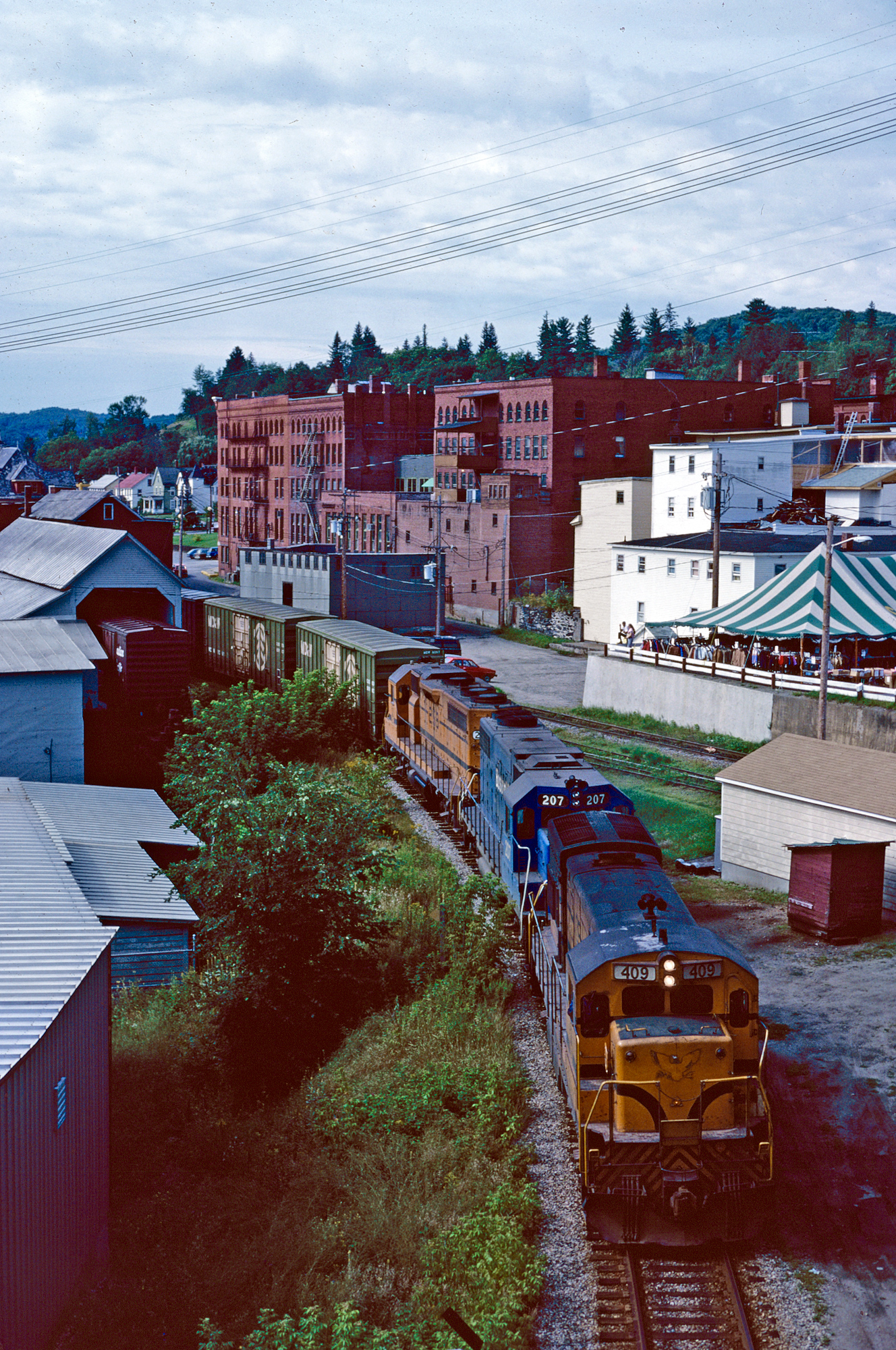
U18B #409, Boston & Maine GP38-2 #207, and Maine Central GP38 #258 leave St. Johnsbury, Vermont, with eastbound RY-1 on August 11, 1983. Terry Chicwak photo. American-Rails.com collection. St. Johnsbury was the west end of the Mountain Division. The last through freight over the notch followed the next month.
Guilford leased Maine Central and Boston & Maine operations to Springfield Terminal, the short line it used to put a larger railroad under short-line work rules. A strike followed in 1986. The Mountain Division, the Rockland branch, the Calais branch, and the Lower Road between Augusta and Brunswick came out of the through system. A stub at Woodland, reached through New Brunswick and the Canadian Pacific at St. Stephen, stayed to serve a pulp mill. Headquarters moved from Portland to North Billerica, Massachusetts. The Waterville shops stayed and became Guilford’s main back shop. In the early 1990s the full “Maine Central” name left the long hoods. The locomotives said Guilford Rail System, with a small MEC under the cab window.
In 2006 Guilford restyled itself Pan Am Railways. Blue paint replaced the G. The Maine Central mark remained a stencil. CSX closed on Pan Am on June 1, 2022.
What remains
CSX runs the old Portland–Bangor main and the line east toward the Canadian Pacific connection at Mattawamkeag. Amtrak’s Downeaster has used the Portland end since December 2001 and has reached Brunswick since November 1, 2012. The Rockland branch belongs to the Maine Department of Transportation. Cumberland & Knox, a Maine Switching Services company, ran its first revenue train over it on May 31, 2025, after a lease dated April 30. The Conway Scenic Railroad carries passengers through Crawford Notch. The Downeast Scenic Railroad rides a piece of the old Calais line at Ellsworth, and Pacific 470 is under restoration there.
Related reading
- Maine Central steam roster · Maine Central diesel roster
- Boston & Maine · Bangor & Aroostook · Pan Am Railways · Delaware & Hudson
- Flying Yankee · Gull · Pine Tree · Kennebec · Bar Harbor Express · East Wind
- Downeast Scenic Railroad · Belfast & Moosehead Lake · Maine railroads · CSX
Sources
- George H. Drury, Guide to North American Steam Locomotives, revised edition, Maine Central chapter, pp. 205–207. User photographs in Downloads/MEC_Steam.
- Interstate Commerce Commission valuation, Maine Central Railroad Company: the act of April 1, 1856, the October 28, 1862 consolidation, and the European & North American lease of April 1, 1882.
- Maine Central system chronology as summarized from Bradley L. Peters, Maine Central Railroad Company (1976), and the company’s own later corporate record: Lower Road 1870, gauge 1871, Mountain Division lease August 20, 1888, Portland Terminal 1911, Belfast lease ended December 31, 1925.
- Mike Schafer, Classic American Railroads, Volume III: 981 miles in 1950, and the named-train list.
- Edwin B. Robertson, Maine Central Steam Locomotives (1977) and Maine Central Diesel Locomotives (1978). 470 Railroad Club, Meet the Maine Central (1981).
- Extra 2200 South, issue 86, all-time Maine Central diesel roster. EMD order list at trainweb.us/emdloco/mec.htm.
- Boston & Maine page for the joint-management years, the June 30, 1983 sale, and Pan Am’s June 1, 2022 closing with CSX. Trains.com, June 3, 2025, for Cumberland & Knox’s first Rockland Branch train.
Recent Articles


-
Greenbrier, Cheat & Elk Railroad: Western Maryland's Logging Line
Sep 26, 26 11:59 PM
 Greenbrier, Cheat and Elk—the logging railroad the Western Maryland bought in 1927. Cass to Spruce, Summit Cut at 4,066.6 feet, Elk River Branch, Laurel Bank.
 -
Elkins (Western Maryland): Yard, History, Operations
Sep 26, 26 11:56 PM
 Western Maryland at Elkins—the Elkins Division yard, roundhouse, and wash rack. Belington, Durbin, Black Fork, and the Elk River branches met here.
 -
B&O's "Cincinnatian" (Train): Route, Consist, Timetable
Sep 26, 26 11:51 PM
 B&O Cincinnatian—Mount Clare five-car streamliner, January 19, 1947, trains 75 and 76. P-7d Pacifics 5301–5304. Detroit–Cincinnati from June 25, 1950, trains 53 and 54. Last run April 30, 1971.
 -
The Semaphore: Railroading's Classic Signal
Sep 26, 26 11:51 AM
 Railroad semaphore signals: blade and spectacle, lower quadrant and upper quadrant, US&S Style B and GRS Model 2A, Robinson’s track circuit, and the last blades on the Raton Subdivision.
 -
Black Fork Grade (Western Maryland): History and Operations
Sep 26, 26 11:47 AM
 Black Fork Grade—the Western Maryland climb through Blackwater Canyon. Thomas to Hendricks, past 3 percent, an H-9 and ten loads, helpers off at Fairfax.
 -
Western Maryland Steam Locomotives: History & Roster
Sep 26, 26 11:39 AM
 Western Maryland steam—H-9 Consolidations, I-2 Decapods, Lima 2-8-8-2s, Baldwin Challengers, and twelve Baldwin Potomac 4-8-4s. Post-1900 roster.
 -
Western Maryland Diesel Roster: All-Time
Sep 26, 26 11:32 AM
 Western Maryland diesels—S1 102 in 1941, fourteen F7 boosters, BL2s, hammerhead RS3s, Circus SD40s, and Chessie GP40-2s. Serials and order numbers.
 -
The Dutch Line (Western Maryland): History, Map, Operations
Sep 25, 26 09:38 PM
 Western Maryland Dutch Line—the Hanover Subdivision. Emory Grove to Highfield via Hanover and Gettysburg, York branch 1893, stone trains, and the route CSX still runs.
 -
The Durbin Branch (Western Maryland): History, Map, Operations
Sep 25, 26 09:13 PM
 Western Maryland Durbin Branch—the Coal & Iron Railway, 46.9 miles Elkins to Durbin, opened July 27, 1903. Mixed train until April 10, 1959. H-7B Consolidations.
 -
Western Maryland Railway: Map, Rosters, Logo, History
Sep 25, 26 10:24 AM
 Western Maryland Railway—the Fast Freight Line. Baltimore, Carroll & Frederick, May 27, 1852. Connellsville Extension 1912. Chessie, then into the B&O May 1, 1983.
 -
Illinois Dinner Train Rides (2026): A Complete Guide
Sep 25, 26 09:52 AM
 2026 Monticello Railway Museum Murder Mystery Dinner Train—June 13, July 11, August 1, and September 5 have run. Three courses, about 2 hours, $112. Confirm on mrym.org.
 -
Georgia Dinner Train Rides (2026): A Complete Guide
Sep 25, 26 12:29 AM
 2026 Azalea Sprinter dinner train from Nashville and Willacoochee, Georgia—2½ hours. Club Car adult $147, Executive adult $177. Confirm on azaleasprinter.com.
 -
Baldwin "Centipede" Locomotives: Specs, Roster, Photos
Sep 25, 26 12:02 AM
 Baldwin DR-12-8-1500/2 Centipede—2-D+D-2, two 608SC engines, 3,000 hp. SAL 4500 from the 1943 test bed. 54 on the serial list, 52 sold. PRR BP60 then BH50. None preserved.
 -
Florida Dinner Train Rides (2026): A Complete Guide
Sep 24, 26 11:56 PM
 2026 Seminole Gulf Murder Mystery Dinner Train in Fort Myers—five courses cooked onboard, 3½ hours, $129 or $135 Saturday, plus tax and gratuity. Confirm on semgulf.com.
 -
West Virginia Northern Railroad: Map, Photos, History
Sep 24, 26 11:27 PM
 West Virginia Northern—Kingwood to Tunnelton, 11 miles of Preston County coal. Narrow gauge 1888, standard gauge 1895. Last freight February 19, 1991. Consolidations 8 and 9 survive.
 -
Rutland Railroad: Map, Rosters, History, Logo
Sep 24, 26 01:18 PM
 Rutland Railroad—Follett’s Champlain & Connecticut River, November 1, 1843. Bellows Falls–Burlington December 18, 1849. Green Mountain Gateway. Last train September 25, 1961. Vermont Railway Janua…
 -
Arkansas Dinner Train Rides (2026): A Complete Guide
Sep 24, 26 01:12 PM
 2026 Eureka Springs & North Arkansas Dinner Train—Eurekan dining car, about 2 hours, $53.62 tax included, opens May 9, Tuesday, Wednesday, Friday, and Saturday. Confirm on esnarailway.com.
 -
Arizona Dinner Train Rides (2026): A Complete Guide
Sep 24, 26 01:01 PM
 2026 Arizona has no plated dinner train. Grand Canyon Railway sells snacks in the cars and meals in Williams or at the rim. Verde Canyon includes a charcuterie tray.
 -
Rail News, The Latest
Sep 24, 26 12:36 PM
This page provides a portal to the latest in rail news, from preservation and restortation subjects to other notable topics. -
Cotton Belt 819 Moved Outside at Pine Bluff for Evaluation
Sep 24, 26 12:35 PM
 Cotton Belt 819 left the Pine Bluff shop on September 22, 2026, first time outside in about 30 years. RDG Steam Services is evaluating the engine. No donation link posted.
 -
Reading Steam Locomotives: History, Roster & Photos
Sep 24, 26 12:14 PM
 Reading steam—Wootten fireboxes, Camelback Consolidations, Mallets, K-1 Santa Fes, G-3 Pacifics, T-1 4-8-4s. Post-1900 roster after Drury. Rambles ended October 17, 1964.
 -
Reading Diesel Roster: All-Time
Sep 24, 26 12:10 PM
 Reading diesel roster—AGEIR boxcabs, FTs, FA-1s, RS-3s, Train Masters, GP30s through GP39-2s. Serials and order numbers. Conrail April 1, 1976.
 -
Reading Railroad: Map, Logo, History, Rosters
Sep 24, 26 12:08 PM
 Reading Company—Philadelphia & Reading, 1833. Anthracite, Port Richmond, Reading Terminal. Operating company January 1, 1924. Conrail April 1, 1976.
 -
Nevada Dinner Train Rides (2026): A Complete Guide
Sep 24, 26 12:02 PM
 2026 Nevada Northern Taste of Italy—adults-only gala from East Ely. The September 19 date has run. Confirm any later night on nnry.com.
 -
North Carolina Dinner Train Rides (2026): A Complete Guide
Sep 24, 26 11:24 AM
 2026 North Carolina dinner trains—NCTM Wine & Dine in Spencer sold out February 13–15. GSMR First Class is the plated meal on the Nantahala Gorge excursion. Confirm on the railroad.
 -
Railway Express Agency (REA): Signs, Trucks, Logo & History
Sep 24, 26 09:40 AM
 Railway Express Agency—railroad-owned express company. Incorporated December 7, 1928. Operations March 1, 1929. Red diamond, green trucks. Last regular express November 7, 1975.
 -
Michigan Dinner Train Rides (2026): A Complete Guide
Sep 24, 26 09:28 AM
 2026 Steam Railroading Institute dining in Owosso—select evenings, no public dinner dates posted. Confirm on michigansteamtrain.com.
 -
Pittsburgh and West Virginia Railway: Map, Rosters, History
Sep 24, 26 12:24 AM
 Pittsburgh & West Virginia—the Hi-Line. Wabash-Pittsburgh Terminal 1904. Railway January 29, 1917. Connellsville February 11, 1931. N&W lease October 16, 1964. Wheeling & Lake Erie from May 17, 1990.
 -
Indiana Dinner Train Rides (2026): A Complete Guide
Sep 24, 26 12:13 AM
2026 Spirit of Jasper Ride & Dine is paused. No public trains. Depot at 201 Mill Street stays open as a rental. Confirm on spiritofjaspertrain.com. -
New Jersey Dinner Train Rides (2026): A Complete Guide
Sep 24, 26 12:01 AM
2026 Woodstown Central Dining in Motion—private table of four from $190, about an hour, Salem County. Confirm on woodstowncentral.com. -
Maryland Dinner Train Rides (2026): A Complete Guide
Sep 23, 26 05:19 PM
 2026 Western Maryland Scenic Allegheny Mountain Dinner Train—Cumberland, 3 hours, 21+, Saturday 7 p.m. Confirm on wmsr.com.
 -
Pittsburgh and Lake Erie Railroad: Map, Rosters, Photos
Sep 23, 26 03:28 PM
 Pittsburgh & Lake Erie—the Little Giant. Chartered 1875, Pittsburgh to Youngstown February 10, 1879. New York Central from 1883. Independent May 15, 1979. Last day September 11, 1992.
 -
Kansas Dinner Train Rides (2026): A Complete Guide
Sep 23, 26 01:11 PM
 2026 Abilene & Smoky Valley Smoky Valley Limited—two hours from the Rock Island Depot, about $72–$110, dates into December 31. Confirm on asvrr.org.
 -
The Belpaire Firebox: Simplicity and Greater Power
Sep 23, 26 01:03 PM
 Belpaire firebox—Alfred Belpaire, 1864. Square crown, straight staybolts at right angles. Pennsylvania standard after the 1880s. Great Northern was the other big user.
 -
Pennsylvania Railroad (PRR) Electric Roster: All Classes
Sep 23, 26 12:57 PM
Pennsylvania Railroad electrics—DD1s into Penn Station, P5s, 139 GG1s, B1 switchers, and 66 E44s. Class roster, 1905–1963. No unit-by-unit GG1 list. -
Penn Central Diesel Roster: All-Time
Sep 23, 26 12:46 PM
 Penn Central diesel roster—PRR classes on NYC, PRR, and New Haven power. New orders carry serials. GP38-2s are 7940-8162. Conrail April 1, 1976.
 -
Penn Central Railroad: Map, History, Logo
Sep 23, 26 12:32 PM
 Penn Central—Pennsylvania and New York Central merged February 1, 1968. New Haven January 1, 1969. Section 77 bankruptcy June 21, 1970. Conrail April 1, 1976.
 -
Iowa Dinner Train Rides (2026): A Complete Guide
Sep 23, 26 11:42 AM
 2026 Boone & Scenic Valley Wolf Dinner Train—Saturdays May–October, Union Pacific dining cars, Bass Point Creek High Bridge. Confirm on bsvrr.com.
 -
Pennsylvania-Reading Seashore Lines: Map, Roster, History
Sep 23, 26 12:32 AM
 Pennsylvania-Reading Seashore Lines—Atlantic City Railroad renamed July 15, 1933. Pennsylvania two-thirds, Reading one-third. Camden to Atlantic City, Cape May, and Millville. Conrail April 1, 1976.
 -
Wisconsin Dinner Train Rides (2026): A Complete Guide
Sep 23, 26 12:28 AM
2026 Wisconsin Great Northern dinner train in Trego—$105, Namekagon River, January 8–31 and May 5–December 17. Mid-Continent’s remaining 2026 calendar is snack and scenic. Confirm on the railroad. -
New Hampshire Dinner Train Rides (2026): A Complete Guide
Sep 23, 26 12:21 AM
2026 Cafe Lafayette Dinner Train in North Woodstock—five courses, 2 hours, from $125. Children under 6 not allowed. Confirm on nhdinnertrain.com. -
PRR "GG-1" Locomotives: Roster, Photos, Specs
Sep 23, 26 12:13 AM
 PRR GG1 electric: 139 locomotives, 4800–4938, built 1934–1943. Specs, Loewy shell, Amtrak numbers, and the last revenue trip on October 28, 1983.
 -
Montana Dinner Train Rides (2026): A Complete Guide
Sep 23, 26 12:04 AM
2026 Charlie Russell Chew Choo from Hanover, near Lewistown—4.5 hours, prime rib, adult $151. Remaining listed dates sold out. Confirm on montanadinnertrain.com. -
Kentucky Dinner Train Rides (2026): A Complete Guide
Sep 22, 26 11:52 PM
2026 My Old Kentucky Dinner Train in Bardstown—four courses, 2.5 hours, adult $116. Confirm on kydinnertrain.com. -
Tennessee Dinner Train Rides (2026): A Complete Guide
Sep 22, 26 11:45 PM
2026 TVRM Chattanooga Dinner Train—Grand Junction, select Fri/Sat March 6–October 24, 6 p.m., from $110. Confirm on tvrail.com. -
The Trainphone: PRR's Wireless Radio System
Sep 22, 26 11:17 PM
 Pennsylvania Trainphone—Union Switch & Signal inductive telephone. Bel-Del trial 1941, Frenchtown November 29, 1943. Carriers at 88 kHz and 144 kHz. Out of service April 30, 1967.
 -
Pennsylvania (PRR) Steam Roster: Post 1906
Sep 22, 26 11:13 PM
 ennsylvania steam after 1906—H8, H9, and H10 Consolidations, 574 L1s Mikados, 598 I1s Decapods, 425 K4s Pacifics, 301 M1 Mountains. Drury’s grid. Last steam November 30, 1957.
 -
Pennsylvania Railroad (PRR) Diesel Roster: All-Time List
Sep 22, 26 10:59 PM
 Pennsylvania diesel roster—SW 3908 in June 1937, then Alco, Baldwin, EMD, Fairbanks-Morse, GE, and Lima. Serials and Alco order numbers. Penn Central February 1, 1968.
 -
Pennsylvania Railroad: Map, Logo, History, Rosters
Sep 22, 26 10:02 PM
 Pennsylvania Railroad—chartered April 13, 1846, Harrisburg–Pittsburgh, Horseshoe Curve 1854, Penn Station 1910. Standard Railroad of the World. Penn Central February 1, 1968.
 -
Pennsylvania Dinner Train Rides (2026): A Complete Guide
Sep 22, 26 04:48 PM
 2026 Pennsylvania dinner trains—Colebrookdale Dining Class in Boyertown and Strasburg Dinner on the Rails. Confirm on each railroad.