
The "Powhatan Arrow": N&W's Flagship Train
Last revised: August 25, 2024
By: Adam Burns
While the Norfolk & Western Railway is best known for hauling black diamonds out of the hollers and hills of West Virginia it also had a modest, but very respectable fleet of passenger trains.
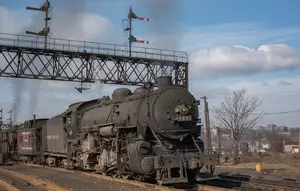
Its flagship run in later years was certainly the Powhatan Arrow, a train that served Norfolk/Newport News and Cincinnati, Ohio. This train was pulled by perhaps the most beautiful and powerful 4-8-4 steam locomotives ever to enter service.
History
Dubbed by the N&W as its J Class, these handsome streamlined machines were adorned in a striking livery of Tuscan red and black with gold trim. The train operated until the spring of 1969 when the Interstate Commerce Commission (ICC) allowed the railroad to discontinue the Arrow.
Its cancellation left just one long-distance N&W train in service, the Pocahontas, which survived (via Interstate Commerce Commission mandate) until the start of Amtrak a few years later.
Today, some of the railroad's historic fleet of crimson cars can be found preserved by museums and private collectors.
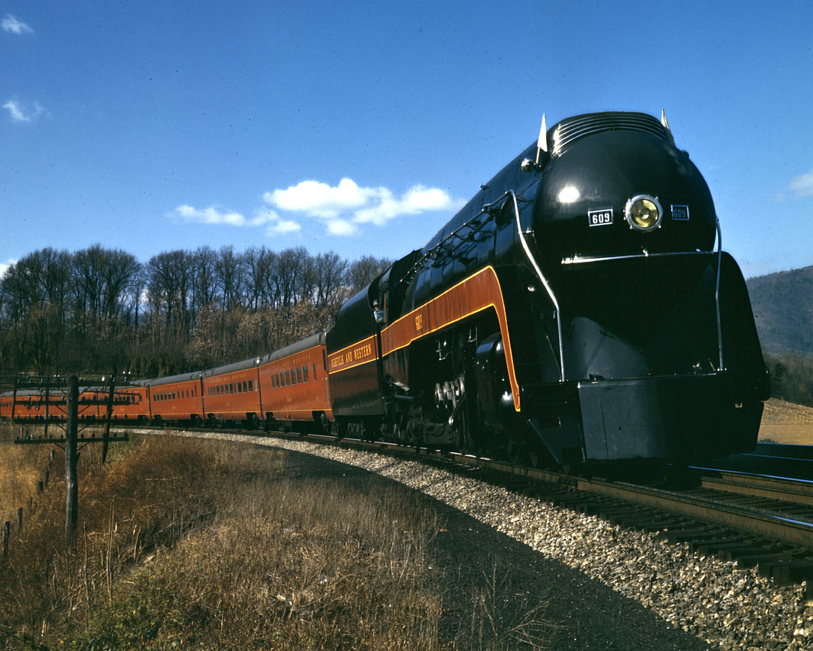 A publicity photo of Norfolk & Western's newly reequipped "Powhatan Arrow" (Norfolk - Cincinnati) led by 4-8-4 #609 (J), taken at Singer, Virginia (a few miles west of Roanoke) on December 8, 1949.
The Norfolk & Western's merger with the Southern Railway in 1982 was quite fitting due to both railroad’s similar style of operation; extremely efficient and well managed.
The N&W is remembered as one of the most highly respected railroad companies in history and for good reason. Aside from well-managed operations the railroad’s property was meticulous and its equipment was always in excellent working order.
Of course, from a railfan and historical standpoint it is remembered for many other things such as being the last Class I railroad to operate steam locomotives (until 1960), its symbolism with coal, and legendary photographer O. Winston Link.
His black and white photos of N&W's final years of steam are now considered all but priceless works of art (not only for the photography itself but also the historical images captured).
 Norfolk & Western 4-8-4 #606 departs Roanoke, Virginia with train #25, the westbound "Powhatan Arrow," circa 1955. A.C. Kalmbach photo. American-Rails.com collection.
The Powhatan Arrow was interestingly one of the very first post war streamliners put into service.
Although it originally included heavyweight cars it was entirely re-equipped in 1949 with lightweight, streamlined equipment from Pullman-Standard.
Also unique to the train was its motive power. In classic N&W fashion the train was powered by steam, not diesels.
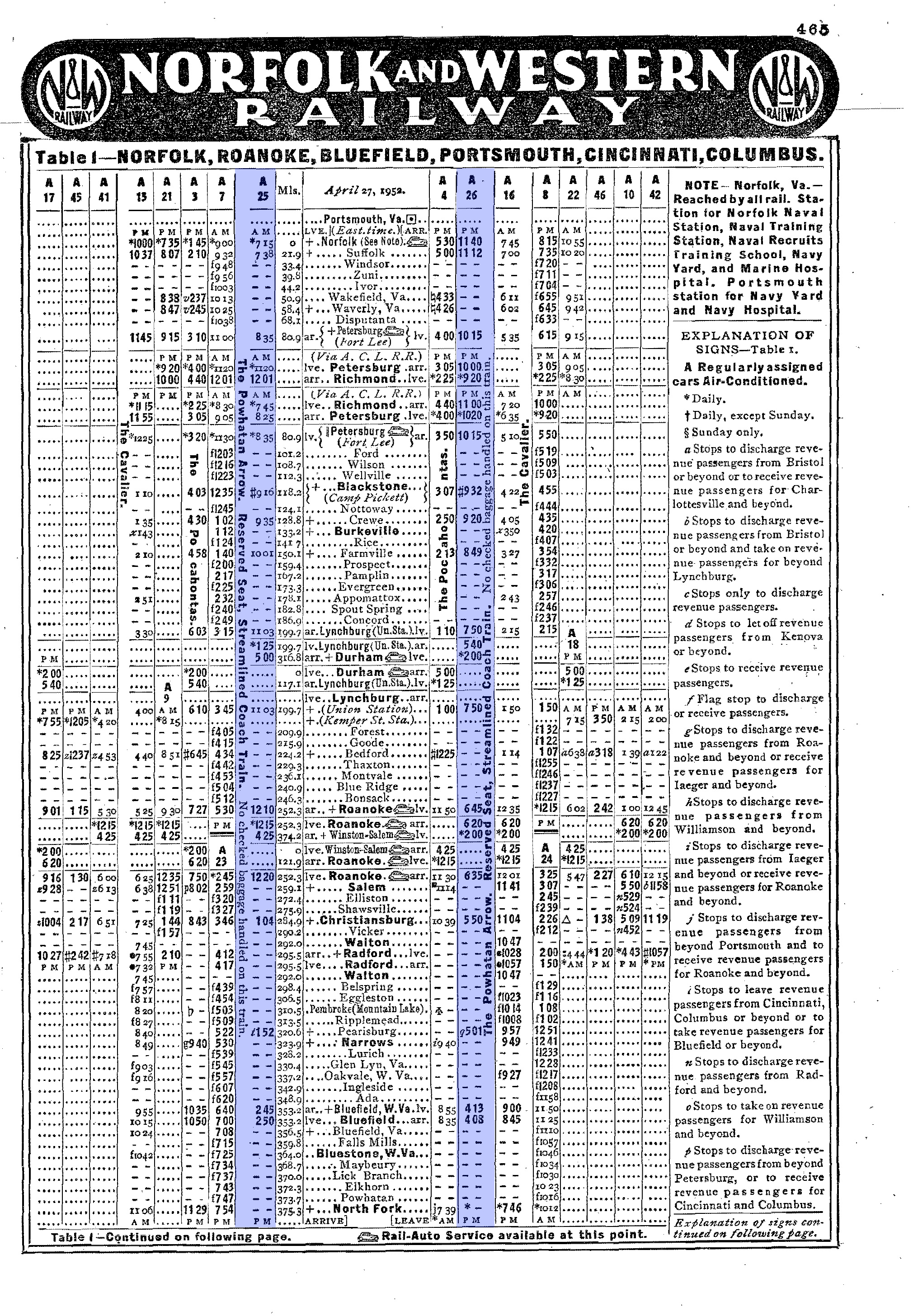
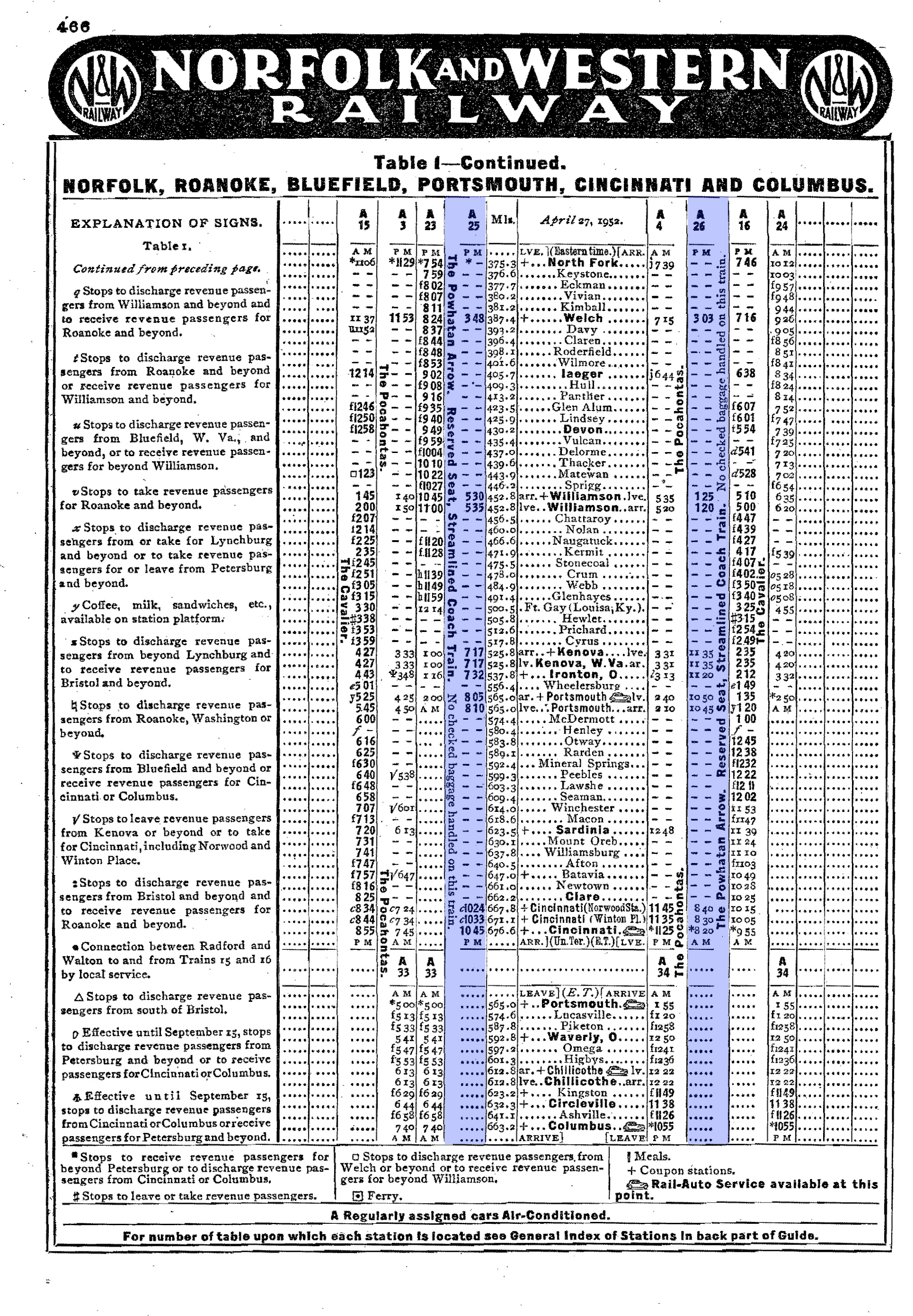
Timetable (1952)
These J Class 4-8-4s were home built at the railroad's legendary shops in Roanoke, Virginia and it owned a fleet of fourteen built between 1941 and 1950.
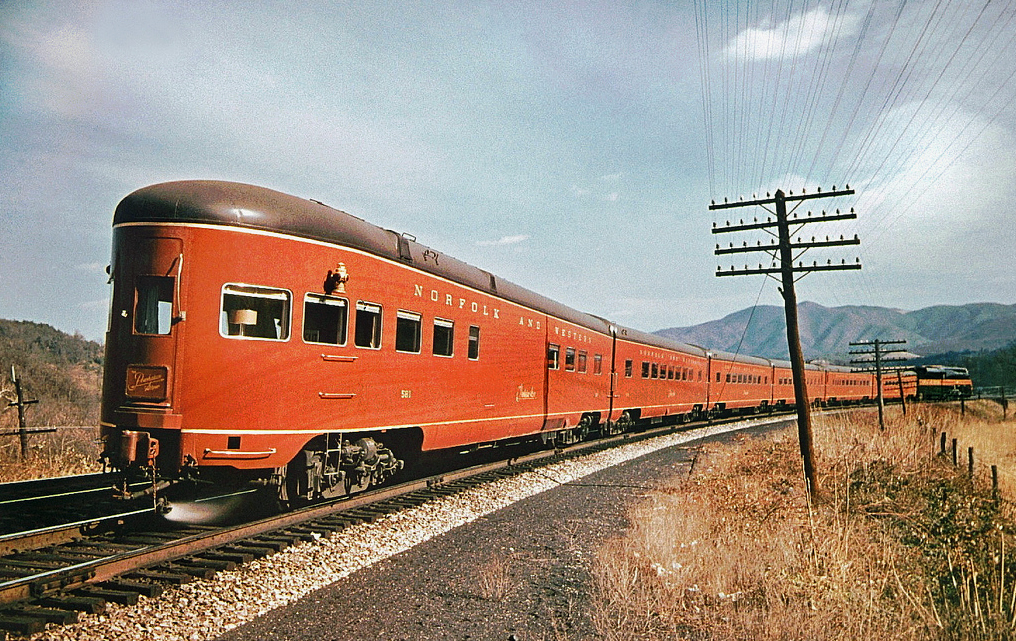
The train itself was adorned in a beautiful livery of Tuscan red and black with gold trim and carried a local Native American theme.
Aside from the N&W's high profit margin thanks to the abundance of coal it transported, the railroad was also successful because of its sound management practices.
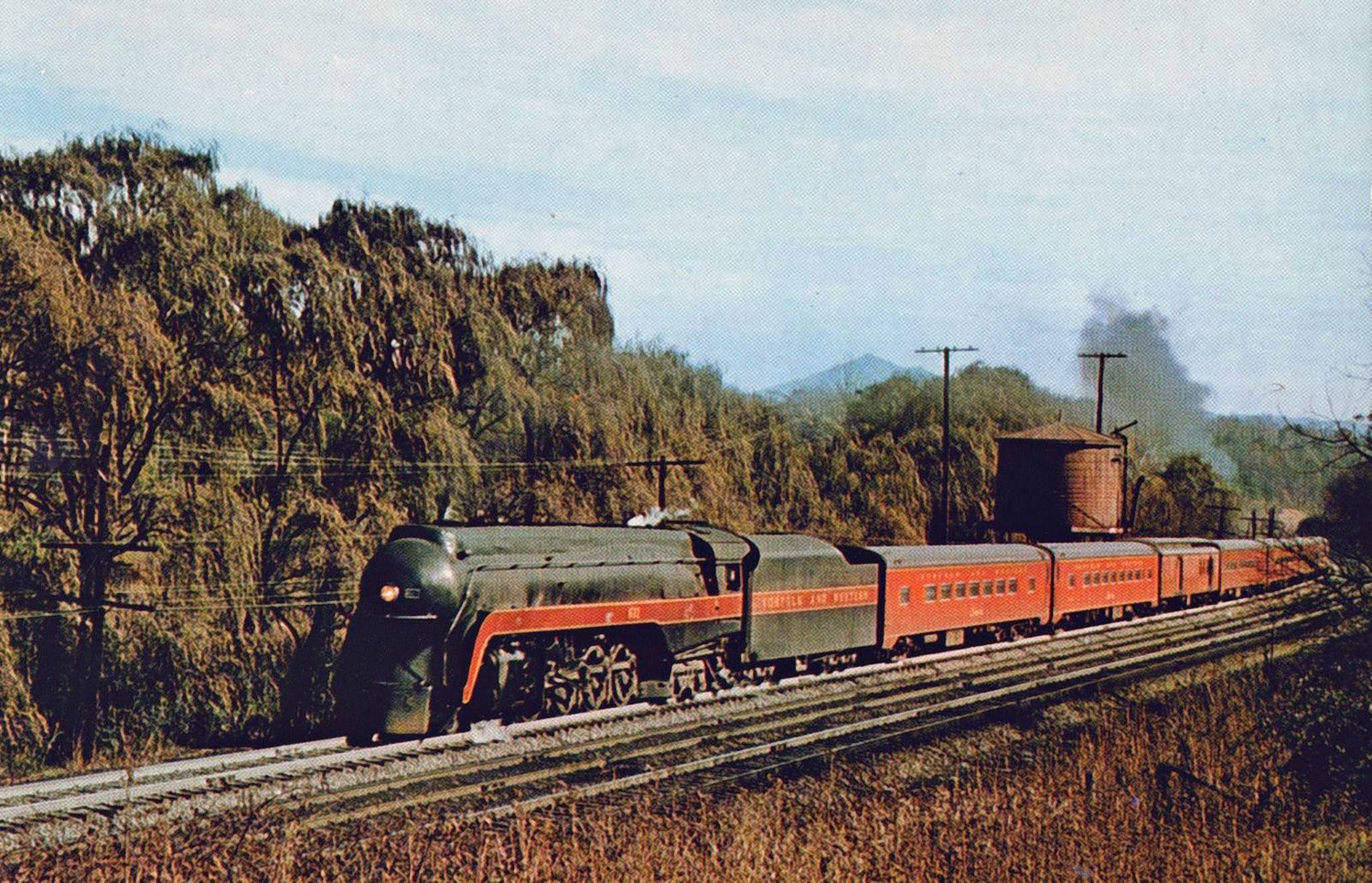 Norfolk & Western 4-8-4 #611 (J) leads train #25, the westbound "Powhatan Arrow" (Norfolk - Cincinnati), through Villamont, Virginia in the fall of 1957. Bob Collins photo.
First and foremost it always kept its physical plant in top-notch condition, pouring millions annually into maintenance programs. Likewise, it was meticulous about keeping its locomotive fleet and equipment in good running order.
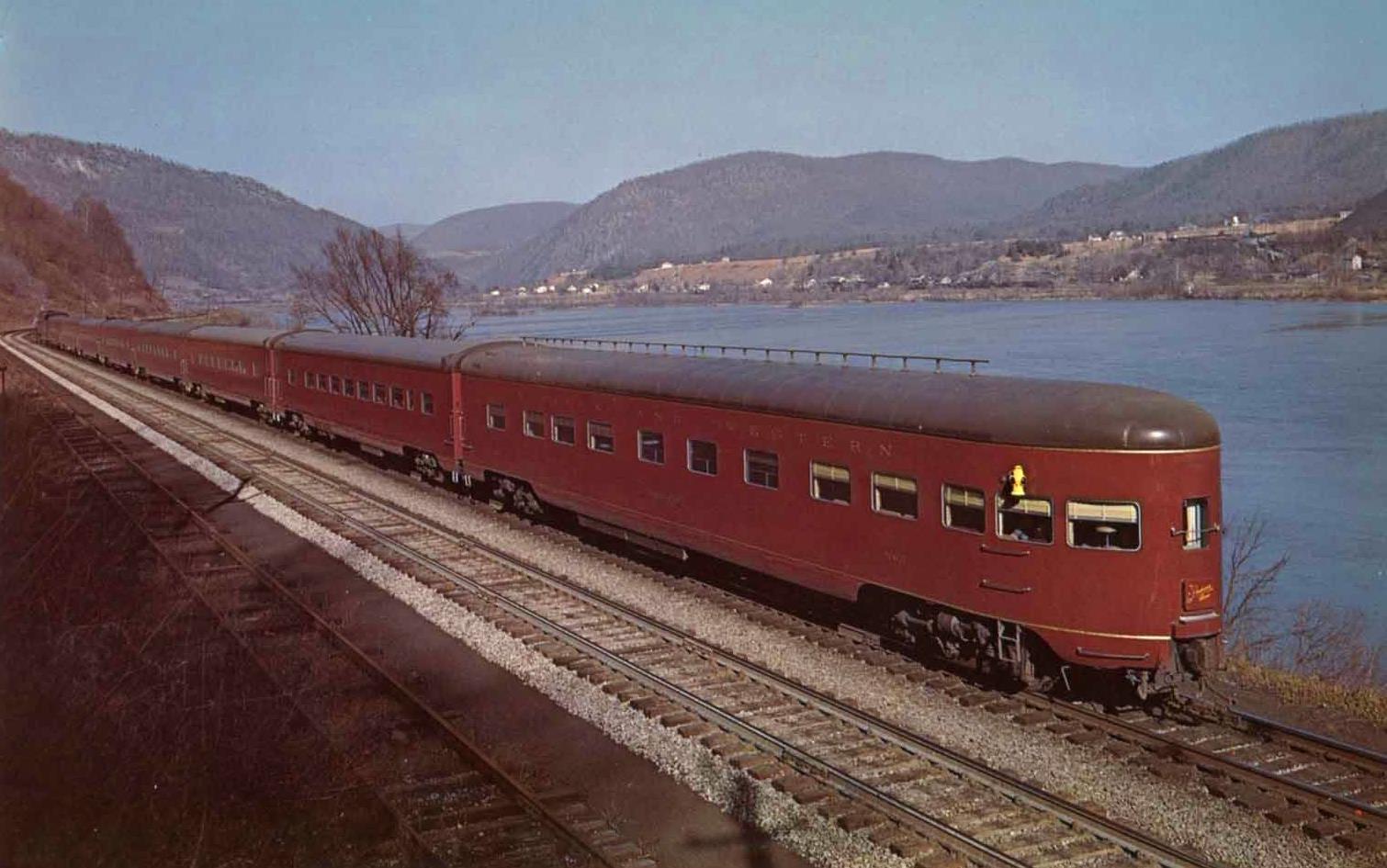 In this Norfolk & Western publicity photo the westbound dayliner "Powhatan Arrow" (Norfolk - Cincinnati) skirts the south bank of the New River outside of Christiansburg, Virginia during the 1950's. Pictured is the tavern-lounge-observation while other accommodations included coaches (reserved), a diner, and coach-dormitory for the crew. On the head-end is almost certainly a streamlined J (4-8-4). Not visible is the Virginian's electrified main line across the river.
According to the N&W's 1950 timetable the westbound Powhatan Arrow (train #25), left Norfolk at 7:25 a.m. and arrived in Cincinnati, Ohio later that night just after 11 pm.
Overall it took the train between 15 1/2 and 16 hours to complete the trip across the southern Appalachians carrying an average train speed of nearly 44 mph (quite fast, especially considering the terrain the Arrow was traveling).
Timetable (April, 1950)
| Read Down Time/Leave (Train #25) | Milepost | Location | Read Up Time/Arrive (Train #26) |
|---|---|---|---|
| 7:25 AM (Dp) | 0.0 | 11:50 PM (Ar) | |
| 7:48 AM | 21.9 | 11:22 PM | |
| 8:45 AM | 80.9 | 10:25 PM | |
| 9:26 AM | 118.2 | 9:42 PM | |
| 9:45 AM | 128.8 | 9:30 PM | |
| 10:11 AM | 150.1 | 8:59 PM | |
| 11:15 AM | 199.7 | 8:00 PM | |
| 12:25 PM (Ar) | 252.3 | 6:55 PM (Dp) | |
| 12:35 PM (Dp) | 252.3 | 6:45 PM (Ar) | |
| 1:19 PM | 284.9 | 5:59 PM | |
| 2:07 PM | 320.6 | 5:08 PM | |
| 3:00 PM (Ar) | 353.2 | 4:20 PM (Dp) | |
| 3:05 PM (Dp) | 353.2 | 4:15 PM (Ar) | |
| 4:10 PM | 387.4 | 3:03 PM | |
| 5:50 PM (Ar) | 452.8 | 1:25 PM (Dp) | |
| 5:55 PM (Dp) | 452.8 | 1:20 PM (Ar) | |
| 7:37 PM | 525.8 | 11:25 AM | |
| 7:52 PM | 537.8 | 11:20 AM | |
| 8:25 PM (Ar) | 568.3 | 10:50 AM (Dp) | |
| 8:30 PM (Dp) | 568.3 | 10:45 AM (Ar) | |
| 10:44 PM | 667.8 | 8:40 AM | |
| 10:53 PM | 671.1 | 8:30 AM | |
| 11:05 PM (Ar) | 676.6 | 8:20 AM (Dp) |
Additionally, it offered connecting service to Richmond (at Petersburg) and Durham, North Carolina (via Lynchburg) over the Atlantic Coast Line.
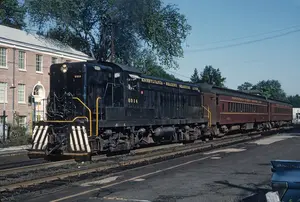
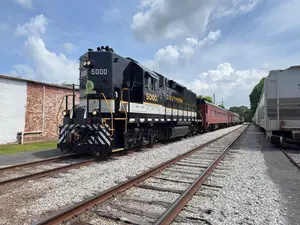
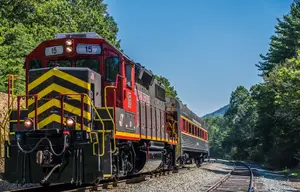
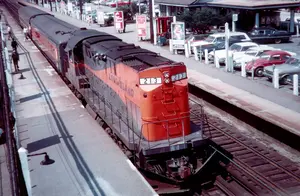
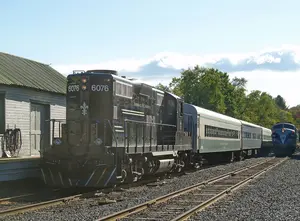
The Arrow continued to run the J Class steam locomotives until the late 1950s when Electro-Motive GP9 diesel locomotives, equipped with steam generators, replaced the Js. The switch to diesels is perhaps most surprising in the fact that the Geeps were non-streamlined locomotives.
Consist (1952)

While utilitarian they were certainly not nearly as beautiful on the
head-end as those gorgeous Northerns and provided virtually no semblance of streamlining. Despite this lack of visual appeal the N&W continued to provide quality service for the Arrow.
Final Years
The train followed a routing somewhat similar to the C&O’s George Washington (Newport News, Virginia to Cincinnati, Ohio) except that it ran through far fewer populated areas than the George, traversing central Virginia, the southern fringes of West Virginia, and southern Ohio.
Because of this, by the late 1960s both it and its sister, the Pocahontas were becoming increasingly less profitable.
When the U.S. Postal Service pulled its mail contracts around the same time the N&W knew it was time to pull the plug. In an interesting twist, the ICC allowed the railroad to discontinue its flagship Arrow only if it upgraded and continued to operate the Pocahontas.
This it did and in the spring of 1969 the Arrow made its final run with the Pocahontas following a few short years later when the N&W turned over all remaining passenger operations to Amtrak on May 1, 1971.
Recent Articles


-
Pennsylvania-Reading Seashore Lines: Map, Roster, History
Sep 23, 26 12:32 AM
 Pennsylvania-Reading Seashore Lines—Atlantic City Railroad renamed July 15, 1933. Pennsylvania two-thirds, Reading one-third. Camden to Atlantic City, Cape May, and Millville. Conrail April 1, 1976.
 -
Wisconsin Dinner Train Rides (2026): A Complete Guide
Sep 23, 26 12:28 AM
 2026 Wisconsin Great Northern dinner train in Trego—$105, Namekagon River, January 8–31 and May 5–December 17. Mid-Continent’s remaining 2026 calendar is snack and scenic. Confirm on the railroad.
 -
New Hampshire Dinner Train Rides (2026): A Complete Guide
Sep 23, 26 12:21 AM
2026 Cafe Lafayette Dinner Train in North Woodstock—five courses, 2 hours, from $125. Children under 6 not allowed. Confirm on nhdinnertrain.com. -
PRR "GG-1" Locomotives: Roster, Photos, Specs
Sep 23, 26 12:13 AM
 PRR GG1 electric: 139 locomotives, 4800–4938, built 1934–1943. Specs, Loewy shell, Amtrak numbers, and the last revenue trip on October 28, 1983.
 -
Montana Dinner Train Rides (2026): A Complete Guide
Sep 23, 26 12:04 AM
 2026 Charlie Russell Chew Choo from Hanover, near Lewistown—4.5 hours, prime rib, adult $151. Remaining listed dates sold out. Confirm on montanadinnertrain.com.
 -
Kentucky Dinner Train Rides (2026): A Complete Guide
Sep 22, 26 11:52 PM
 2026 My Old Kentucky Dinner Train in Bardstown—four courses, 2.5 hours, adult $116. Confirm on kydinnertrain.com.
 -
Tennessee Dinner Train Rides (2026): A Complete Guide
Sep 22, 26 11:45 PM
2026 TVRM Chattanooga Dinner Train—Grand Junction, select Fri/Sat March 6–October 24, 6 p.m., from $110. Confirm on tvrail.com. -
The Trainphone: PRR's Wireless Radio System
Sep 22, 26 11:17 PM
 Pennsylvania Trainphone—Union Switch & Signal inductive telephone. Bel-Del trial 1941, Frenchtown November 29, 1943. Carriers at 88 kHz and 144 kHz. Out of service April 30, 1967.
 -
Pennsylvania (PRR) Steam Roster: Post 1906
Sep 22, 26 11:13 PM
 ennsylvania steam after 1906—H8, H9, and H10 Consolidations, 574 L1s Mikados, 598 I1s Decapods, 425 K4s Pacifics, 301 M1 Mountains. Drury’s grid. Last steam November 30, 1957.
 -
Pennsylvania Railroad (PRR) Diesel Roster: All-Time List
Sep 22, 26 10:59 PM
 Pennsylvania diesel roster—SW 3908 in June 1937, then Alco, Baldwin, EMD, Fairbanks-Morse, GE, and Lima. Serials and Alco order numbers. Penn Central February 1, 1968.
 -
Pennsylvania Railroad: Map, Logo, History, Rosters
Sep 22, 26 10:02 PM
 Pennsylvania Railroad—chartered April 13, 1846, Harrisburg–Pittsburgh, Horseshoe Curve 1854, Penn Station 1910. Standard Railroad of the World. Penn Central February 1, 1968.
 -
Pennsylvania Dinner Train Rides (2026): A Complete Guide
Sep 22, 26 04:48 PM
 2026 Pennsylvania dinner trains—Colebrookdale Dining Class in Boyertown and Strasburg Dinner on the Rails. Confirm on each railroad.
 -
New York, Ontario & Western Steam Locomotives: History & Roster
Sep 22, 26 04:40 PM
 NYO&W steam—camelback 2-8-0s and 2-6-0s, Class X Bull Moose 2-10-2s, Class Y and Y-2 Mountains. All-time class roster. Steam finished in the summer of 1948. None saved.
 -
New York, Ontario & Western Diesel Roster: All-Time
Sep 22, 26 04:36 PM
 NYO&W diesel—five GE 44-tonners 101-105, eighteen FTs, seven F3s, twenty-one NW2s. Serials and the NW2 order E824. Railroad liquidated March 29 1957.
 -
New York, Ontario & Western Railway: Map, Roster, History
Sep 22, 26 04:26 PM
 New York, Ontario & Western—New York & Oswego Midland chartered January 11 1866, O&W January 21 1880. Scranton coal, West Shore rights. Last train March 29 1957.
 -
Massachusetts Dinner Train Rides (2026): A Complete Guide
Sep 22, 26 04:16 PM
 2026 Cape Cod Dinner Train—Hyannis, Buzzards Bay, and North Falmouth. Four-course, 3–3½ hours, from $99.99. Confirm on capetrain.com.
 -
Colorado Dinner Train Rides (2026): A Complete Guide
Sep 22, 26 03:51 PM
 2026 Royal Gorge Route First Class Dinner and Lunch from Cañon City. About 2 hours, 12+, from $199+. Confirm on royalgorgeroute.com.
 -
New York and Long Branch Railroad: A PRR & CNJ Subsidiary
Sep 22, 26 03:11 PM
 New York & Long Branch—chartered April 8 1868, Perth Amboy–Long Branch July 1 1875, Bay Head Junction 1881. Jersey Central and Pennsylvania trains. Conrail April 1 1976. NJ Transit North Jersey Co…
 -
Monongahela Railway Steam Locomotives: History & Roster
Sep 22, 26 01:34 PM
 Monongahela steam—H-5 Consolidations, USRA light Mikados 170–179, Baldwin L-2s, ex-P&LE L-3s. All-time roster. Last steam May 26, 1954.
 -
Monongahela Railway Diesel Roster: All-Time
Sep 22, 26 01:16 PM
 Monongahela diesel—27 Baldwin S-12s, NYC RF-16 sharks, P&LE GP7s, GP38s 2000–2004, Super 7s 2300–2310. Serials and orders. Last steam May 26, 1954.
 -
Monongahela Railway: Map, Rosters, History
Sep 22, 26 01:14 PM
 Monongahela Railway—incorporated December 31 1900, Railway July 1 1915. Brownsville–Fairmont coal road. Last steam May 26 1954. Conrail May 1 1993.
 -
Virginia Scenic Railway Dining (2026)
Sep 22, 26 01:09 PM
 2026 Virginia Scenic Railway—Blue Ridge Flyer Dining Class from Staunton, about 3 hours, plated meal. Sunday Brunch from Louisa, about $132. Confirm on virginiascenicrailway.com.
 -
Virginia Dinner Train Rides (2026): A Complete Guide
Sep 22, 26 01:03 PM
 2026 Virginia Scenic Railway—Blue Ridge Flyer Dining Class from Staunton, Alleghany Special Dining Class, Sunday Brunch from Louisa. Confirm on virginiascenicrailway.com.
 -
Oregon Dinner Train Rides (2026): A Complete Guide
Sep 22, 26 12:51 PM
 2026 Oregon has no plated dinner train on the calendar. Mount Hood is scenic with snacks. Oregon Coast Scenic’s evening ride is the 21+ Moonlight with sandwiches.
 -
Maine Central Steam Locomotives: History & Roster
Sep 22, 26 12:33 PM
Maine Central steam—Ten-Wheelers, W-class Consolidations, S-class Mikados, C-class Pacifics, Hudsons 701 and 702. Post-1900 roster after Drury. Last steam June 13, 1954. -
Maine Central Diesel Roster: All-Time
Sep 22, 26 12:04 PM
 Maine Central diesel—railcar 901, HH660s, GP7s, E7s, F3s, GP38s, U18Bs, ex-Rock Island U25Bs. All-time roster with serials and orders. Last steam June 13, 1954.
 -
Maine Central Railroad: Map, Logo, Rosters, History
Sep 22, 26 11:36 AM
 Maine Central—Androscoggin & Kennebec and Penobscot & Kennebec, October 28 1862. Pine Tree Route. Mountain Division, Portland–Bangor–Vanceboro. Last steam June 13 1954. Guilford June 1981.
 -
Maryland and Pennsylvania Railroad: Map, Roster, Logo
Sep 22, 26 12:14 AM
 Ma & Pa—Peach Bottom 1868, Maryland & Pennsylvania February 12 1901, Baltimore to York. Last steam November 29 1956. York Railway December 1 1999.
 -
New York Dinner Train Rides (2026): A Complete Guide
Sep 21, 26 11:59 PM
2026 New York dinner train—Adirondack Dinner Train from Utica, 6 p.m., about 3 hours, First Class from $139. Arcade & Attica mystery dinner is served at Curriers. Confirm on the railroad. -
California Dinner Train Rides (2026): A Complete Guide
Sep 21, 26 11:49 PM
 2026 California dinner trains—Napa Valley Wine Train plated meals, River Fox brunch and mystery dinner, Roaring Camp barbecue at camp. Confirm on each railroad.
 -
Roaring Camp Starlight Dinner Party (2026)
Sep 21, 26 11:33 PM
 2026 Roaring Camp Starlight Dinner Party—Beach Train from the Santa Cruz Boardwalk, barbecue at Felton, ride back after dark. Confirm on roaringcamp.com.
 -
Long Island Rail Road Steam Locomotives: History, Roster & Photos
Sep 21, 26 11:29 PM
 Long Island steam—G5s 20–50, H10s 101–119, last steam at Hicksville October 8, 1955. Post-1898 class roster.
 -
Long Island Rail Road Diesel Roster: All-Time
Sep 21, 26 11:24 PM
 Long Island diesel—boxcab 401 in 1925, FM C-Liners, RS-3s, C-420s, GP38-2s, DE30AC and DM30AC. All-time roster with serials and orders.
 -
Long Island Rail Road: Map, History, Pictures, Logo
Sep 21, 26 08:27 PM
 Long Island Rail Road—Brooklyn & Jamaica 1836, Greenport 1844, Pennsylvania control 1900, Penn Station 1910. MTA since 1968. Steam and diesel rosters.
 -
Oregon Coast Scenic Railroad (2026): Sunset Dinner and Moonlight
Sep 21, 26 02:40 PM
 2026 Oregon Coast Scenic does not post the old four-course Sunset Dinner. The evening ride is the 21+ Moonlight Excursion from Garibaldi, with pre-ordered sandwiches. Confirm on oregoncoastscenic.org.
 -
Adirondack Dinner Train (2026): Dates, Tickets & What to Expect
Sep 21, 26 01:38 PM
 2026 Adirondack Dinner Train—Utica Union Station, 6 p.m., about 3 hours to Remsen. First Class from $139. Chef Patrick O’Connor. Confirm on adirondackrr.com.
 -
Lehigh Valley Steam Locomotives: History, Roster & Photos
Sep 21, 26 01:31 PM
 Lehigh Valley steam—Camelback Consolidations, 2-10-2s, K-class Pacifics, six Mountains, Wyoming 4-8-4s. Post-1900 roster after Drury. Last steam September 14, 1951.
 -
Lehigh Valley Diesel Roster: All-Time
Sep 21, 26 01:23 PM
 Lehigh Valley diesel—boxcabs 1926, FTs 1945, F3/F7, FA/PA, C628 Snowbirds, GP38-2s, U23Bs. All-time roster with serials and orders. Last steam September 14, 1951.
 -
Lehigh Valley Railroad: Map, Roster, Logo, History
Sep 21, 26 01:09 PM
 Lehigh Valley—DLS&S 1847, named January 7 1853, Mauch Chunk–Easton September 12 1855. Route of the Black Diamond. Jersey City–Buffalo. Conrail April 1 1976.
 -
Wisconsin Great Northern Dinner Train (2026)
Sep 21, 26 12:47 PM
2026 Wisconsin Great Northern dinner train—Trego, $105, Namekagon River. January 8–31 and May 5–December 17. Confirm on spoonertrainride.com. -
Lehigh and New England Railroad: Map, Rosters, History
Sep 21, 26 12:33 AM
 Lehigh & New England—South Mountain & Boston 1873, named April 2 1895. Anthracite, cement, Maybrook. Last Camelbacks, Alco FAs. Voluntary shutdown October 31 1961.
 -
TVRM Chattanooga Dinner Train (2026): Dates, Tickets & What to Expect
Sep 21, 26 12:20 AM
 2026 TVRM Chattanooga Dinner Train Experience—Grand Junction, select Fri/Sat March 6–October 24, three-course, 2–3 hours, from $110. Confirm on tvrail.com.
 -
Lehigh and Hudson River Railroad: Map, Rosters, History
Sep 20, 26 11:55 PM
 Lehigh & Hudson River—Warwick Valley 1860, Railway April 1 1882. Easton–Maybrook bridge road, Alphabet Route, Alco RS-3s and C420s. Conrail April 1 1976.
 -
Royal Gorge First Class Dinner Train (2026)
Sep 20, 26 11:47 PM
 2026 Royal Gorge Route First Class Lunch & Dinner—Cañon City, about 2 hours, from $199+, 12+. Confirm on royalgorgeroute.com.
 -
GE "44-Tonner" Locomotives: Roster, Specs, History
Sep 20, 26 11:09 PM
 GE 44-ton switcher—90,000-pound rule, Caterpillar D17000 center-cab, Sept 4 1940 CB&Q 9103 through Oct 1956 Dansville & Mount Morris 1. Phases, serial roster, PRR 46.
 -
Strasburg Rail Road Dining (2026): Dinner on the Rails & Elegant Expre
Sep 20, 26 11:00 PM
2026 Strasburg Rail Road seated meals—Dinner on the Rails, Elegant Express, Valentine dinner. Lee E. Brenner diner. Confirm on strasburgrailroad.com. -
International-Great Northern Railroad: Map, History, Timetables
Sep 20, 26 10:43 PM
 International–Great Northern—Houston & Great Northern 1866, International Railroad 1870, merged Sept 30 1873. Palestine, Longview–Laredo, Gould, Missouri Pacific March 1 1956.
 -
Nevada Northern Taste of Italy Dinner Train (2026)
Sep 20, 26 03:25 PM
2026 Nevada Northern Taste of Italy—adults-only multi-course Italian dinner, steam when healthy, East Ely. Sep. 19 gala listed. Confirm on nnry.com. -
Cape Cod Dinner Train (2026): Dates, Tickets & What to Expect
Sep 20, 26 02:53 PM
 Cape Cod Central Dinner Train—Hyannis, Buzzards Bay, and Falmouth. Four-course, 3–3½ hours, from $99.99. Confirm on capetrain.com.
 -
Erie Steam Locomotives: History, Roster & Photos
Sep 20, 26 11:55 AM
 Erie Railroad steam—Camelback 2-8-0s, 155 N-1 Mikados, 105 Berkshires, K-class Pacifics, Triplexes. Post-1900 roster after Drury. Last steam March 17, 1954.
%20led%20by%204-8-4%20%23609%20(J)%2C%20taken%20at%20Singer%2C%20Virginia%20(a%20few%20miles%20west%20of%20Roanoke)%20on%20December%208%2C%201949.)


%20leads%20train%20%2325%2C%20the%20westbound%20%22Powhatan%20Arrow%22%20(Norfolk%20-%20Cincinnati)%2C%20through%20Villamont%2C%20Virginia%20in%20the%20fall%20of%201957.%20Bob%20Collins%20photo.)
%20skirts%20the%20south%20bank%20of%20the%20New%20River%20outside%20of%20Christiansburg%2C%20Virginia%20during%20the%201950's.%20Pictured%20is%20the%20tavern-lounge-observation%20while%20other%20accommodations%20included%20coaches%20(reserved)%2C%20a%20diner%2C%20and%20coach-dormitory%20for%20the%20crew.%20On%20the%20head-end%20is%20almost%20certainly%20a%20streamlined%20J%20(4-8-4).%20Not%20visible%20is%20the%20Virginian's%20electrified%20main%20line%20across%20the%20river.)

