
Seaboard Air Line Railroad: Map, Rosters, History
Last revised: October 12, 2024
By: Adam Burns
The Seaboard Air Line was another of the South's notable railroads, competing fiercely against Atlantic Coast Line and Southern Railway. The SAL was somewhat smaller than the ACL and never as wealthy as the Southern.
The company struggled in its early days and later experienced a bankruptcy after the Great Depression. It eventually got back onto its feet, pulled through these troubled times, and spent its final three decades as a profitable railroad.
When the streamliner craze hit the nation Seaboard beat its rival in launching the Silver Meteor, which began a highly successful passenger business to the Sunshine State until Amtrak in 1971.
After more than 100 years of continued competition, the ACL and SAL agreed to a union in the 1960s forming Seaboard Coast Line.
As many of the South's largest railroads came together the Seaboard System was formed in the early 1980's. This large conglomerate went on to join CSX Transportation a few years later. Today, parts of the Seaboard network are still owned by CSX while others are operated by short lines.
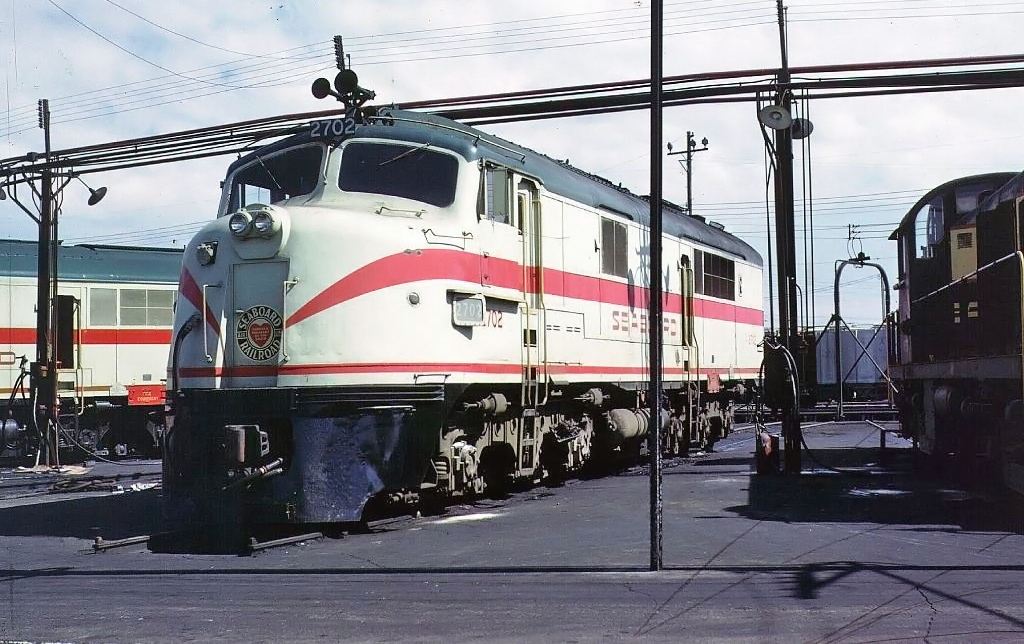 One of the Seaboard Air Line's rare, Baldwin-built DR-6-4-1500s, #2702, at Tampa, Florida on February 21, 1962. Warren Calloway collection.
History
The Seaboard Air Line carries an interesting name. It did not operate airplanes, had no connection with the airline industry, and the name "Air Line" was part of its corporate heritage more than thirty years before the Wright Brothers' First Flight!
The term was largely a marketing gimmick used by early promoters to describe a high-speed, arrow-straight railroad that was built with high fills, deep cuts, and towering bridges to achieve a low-grade route which passed high above the surrounding landscape.
The term became popular during the 19th century and was a particular favorite of early interurban builders. However, as everyone soon realized, such a well-engineered line proved far too expensive to be built at a reasonable cost. The history of the Seaboard Air Line began long before acquiring its unique name.
Portsmouth & Roanoke Rail Road
It started humbly, as did most railroads in those days, to serve the Norfolk region. On March 8, 1832 the Portsmouth & Roanoke Rail Road (P&R) was granted a charter by the Virginia General Assembly to connect Portsmouth, Virginia with Weldon, North Carolina running in a southwesterly direction. The initial 17 miles opened to Suffolk on September 4, 1834.
However, three more years would pass before the entire 78.6 miles was completed, opening for business in June of 1837.
Here, the road made a connection with its future rival, Atlantic Coast Line predecessor Wilmington & Raleigh. Beset with financial struggles the P&R entered receivership and was reorganized as the Seaboard & Roanoke in 1846.
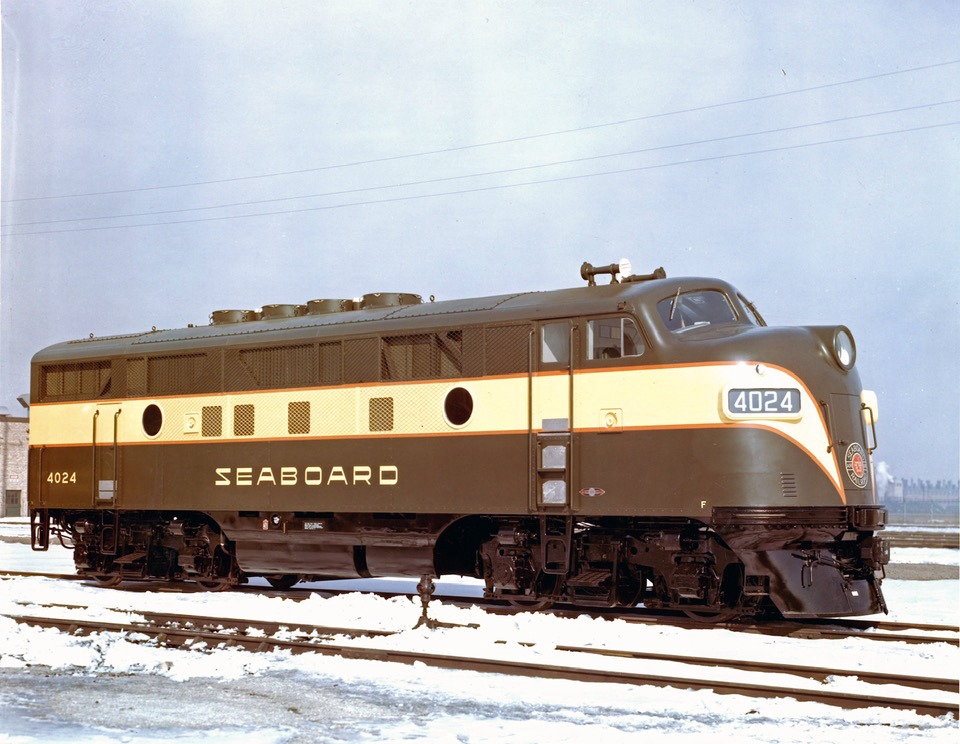 An EMD builder's photo from March, 1948 featuring new Seaboard Air Line F3A #4024. Warren Calloway collection.
Expansion
There was little further growth for more than 20 years until after the Civil War. In 1871 the P&R gained control of the Raleigh & Gaston, a system that had been incorporated in 1835 to connect Raleigh with Gaston, North Carolina (not far from Weldon). Its construction began in 1836 but monetary issues caused delays and it was not finished until March 21, 1840.
According to Mike Schafer's book, "More Classic American Railroads," despite its completion the road continued to founder, which led to the state of North Carolina becoming involved in 1845
It oversaw things for several years including the 1853 opening of an interchange with the P&R at Weldon. This link provided a continuous, all-rail route from Raleigh to the Norfolk area.
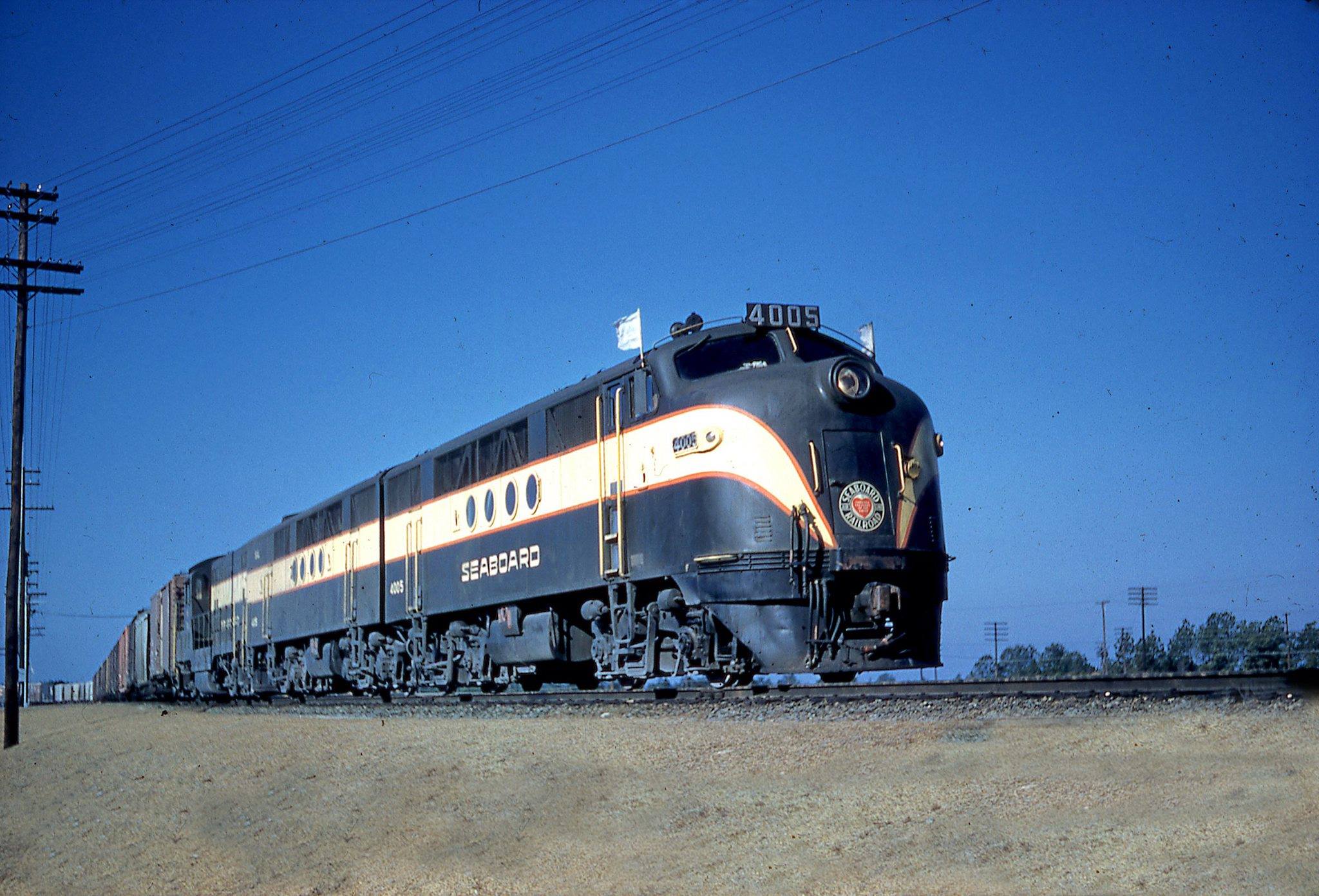 Seaboard Air Line FT's lead a freight extra through Hamlet, North Carolina in the summer of 1960. Wiley Bryan photo/Warren Calloway collection.
The R&G takeover also gave the P&R control of the Raleigh & Augusta Air-Line Railroad which the former road controlled. This was the first time "Air Line" appeared as part of a Seaboard predecessor.
The R&AA-L began as the Chatham Railroad, chartered by the state in February 14, 1855 (from the 1877 booklet, "History Of The Raleigh & August Air-Line Railroad" compiled by Walter Clark, Attorney At Law) to build a rail line, "...between Deep River, at or near the Coalfields, in the county of Chatham, and the City of Raleigh or some point on the North Carolina Railroad."
The project was riddled with delays and finally reorganized as the Raleigh & Augusta Air-Line in 1871. It eventually reached Hamlet in 1877 which in later years was a major SAL terminal point.
With a route that now extended through North Carolina the three roads offered a competitive network serving several important cities. The South was also blossoming into an industrial giant in the area of cotton, agriculture/farming, textiles, and manufacturing.
Logo
Together the R&G, P&R, and R&AA-L formed the backbone of the future Seaboard Air Line. It was all tied together by businessman John M. Robinson who had acquired financial control of the trio in 1875.
As a marketing tactic they were collectively known as the "Seaboard Air-Line System." The name initially had no legal authority although as Robinson continued to extend southward that would change. The first known official use of "Seaboard Air Line" appeared when it was pushing towards Atlanta.
It had already acquired the Georgia, Carolina & Northern Railway which intended to reach that city from Monroe, North Carolina. Construction began in 1887 and was completed as far as Inman Park, east of Atlanta, by 1892.
However, an ordinance prevented it from reaching the city directly. To circumvent this issue the Seaboard Air Line Belt Railroad (SALB) was chartered in 1892 to build an 8-mile branch and a connection with the Nashville, Chattanooga & St. Louis at Howells. From there the SALB utilized trackage rights over the Dixie Line to reach the downtown area.
Just prior to this event Robinson would link Rutherfordton and Wilmington, North Carolina via Charlotte and Hamlet by acquiring the Carolina Central Railroad in 1883. Rail service between these cities opened in 1887.
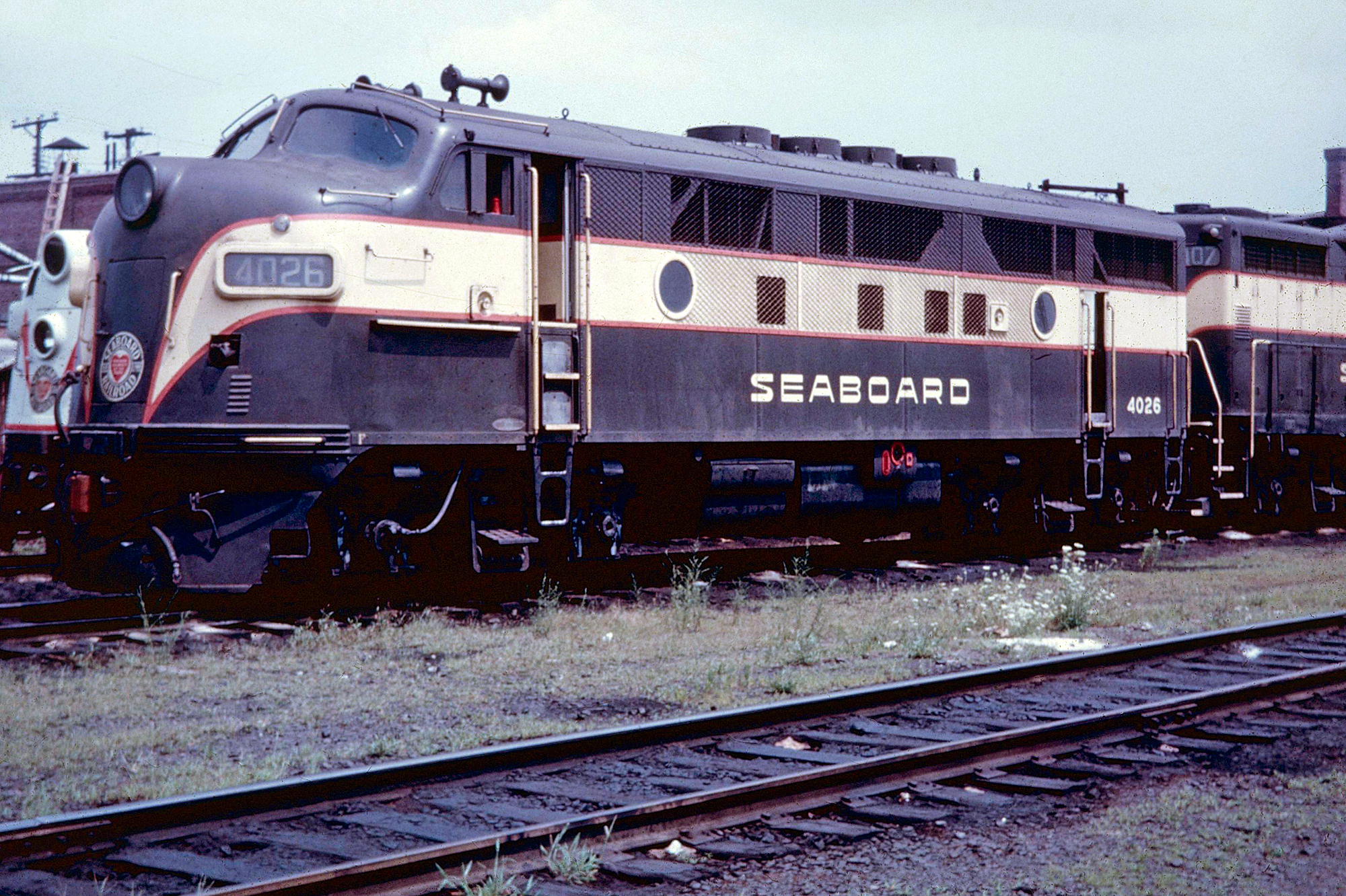 Seaboard Air Line F3A #4026, and other power, lays over in Alexandria, Virginia; July 21, 1963. American-Rails.com collection.
His railroad empire had now grown into a major regional system. With an eye towards further expansion into the Deep South a subsidiary known as the Palmetto Railroad was formed. It was chartered in 1882 in South Carolina and a year later in North Carolina.
It had constructed 18 miles from Hamlet to Cheraw, South Carolina by 1887 before Robinson lost control of his empire in 1899. In February that year Richmond bankers John L. Williams & Sons acquired a majority interest and looked to continue expansion.
On July 1, 1900 they formed the Seaboard Air Line Railway to acquire all assets of the Robinson holdings and extend service both north and south (in 1901 the predecessors were officially merged into the new company). One goal was already well underway, a direct link to the important city of Richmond.
Robinson had already been pushing towards that city through the Richmond, Petersburg & Carolina. It ran from a connection with the Raleigh & Gaston at Norlina, North Carolina and was ready for service by May of 1900.
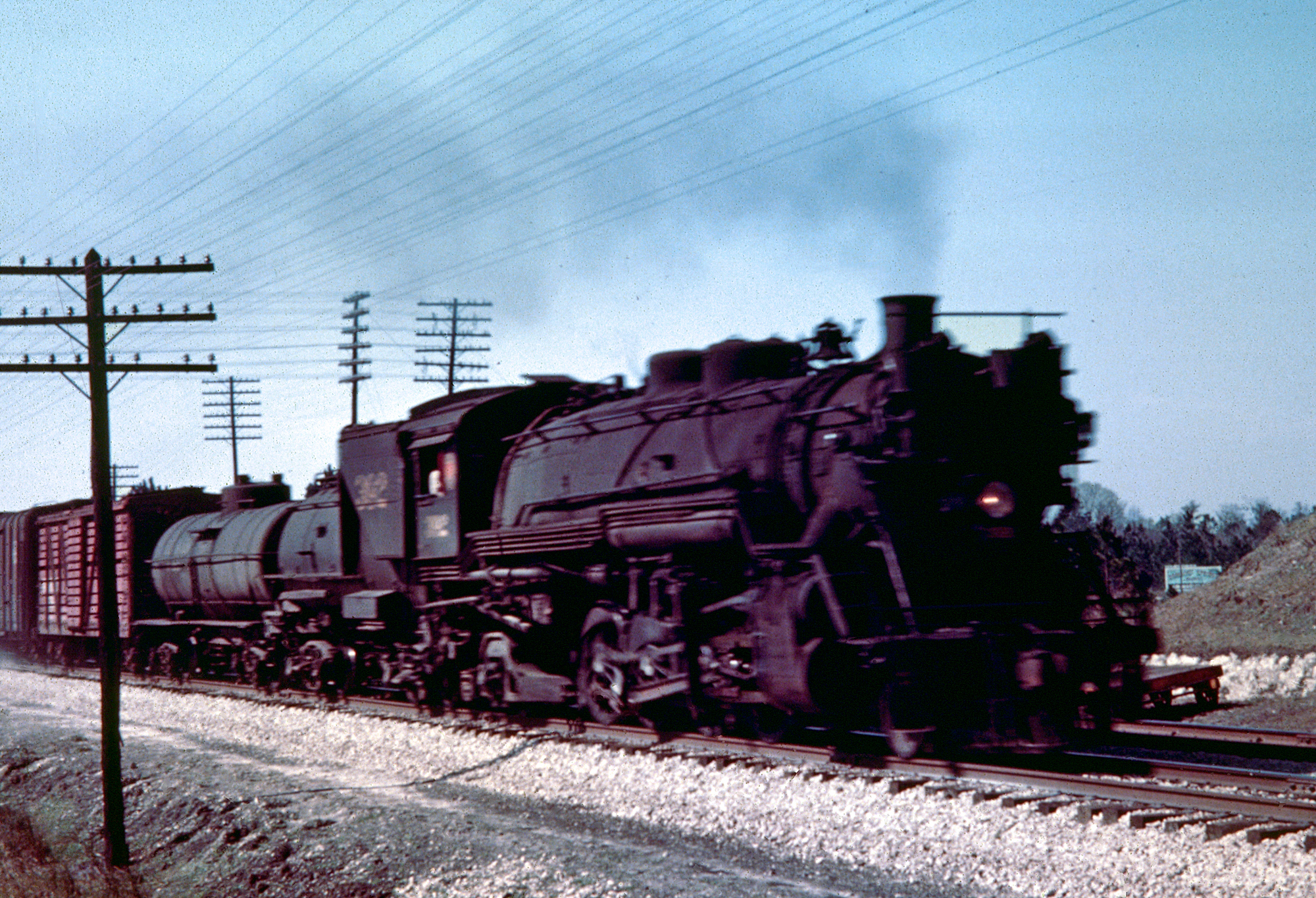 Seaboard Air Line 2-8-2 #392 is seen here in service during the 1950s. Location not recorded. Ed Olsen photo. American-Rails.com collection.
Now under new ownership the William interests pushed southward and were well positioned to transform the Seaboard into a major southern system. They already held stakes in two prominent railroads connecting parts of South Carolina, Georgia, and Florida.
The Georgia & Alabama, incorporated in 1853, linked Montgomery with Savannah running via Vidalia, Americus, and Richland. The much larger Florida Central & Peninsular joined Jacksonville with Tallahassee and then pushed south to Tampa, St. Petersburg, Fort Myers, and Sarasota.
It also ran north into Georgia and South Carolina at Savannah and Columbia. The only thing the Williams' had left to do in opening a through route from Richmond to Florida was build a new stretch from the FC&P's end of track at Columbia to the Palmetto Railroad at Cheraw .
According to Richard Prince's book, "Seaboard Air Line Railway: Steam Boats, Locomotives, And History," this 91-mile link began construction in 1899 and was completed from Cheraw to the FC&P at Cayce (on the west side of the Congaree River in Columbia) in 1900.
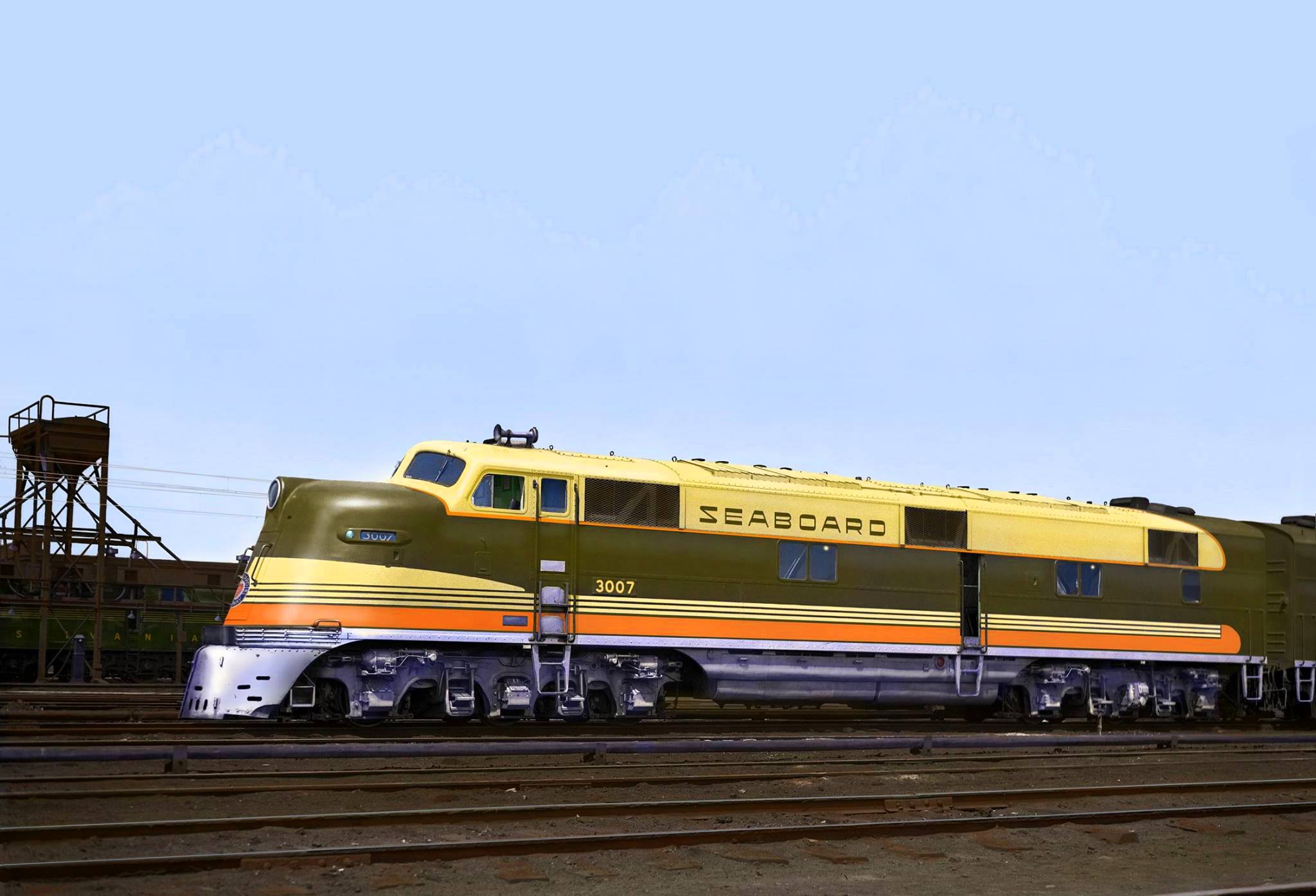 Seaboard Air Line E4A #3007 at Washington, D.C.'s Ivy City terminal circa 1939. Photo by Wiley Bryan from the Warren Calloway Collection; colorized by Tom Alderman.
Modern Network
The Seaboard's next major expansion occurred directly after this gap was closed. It created the Atlanta & Birmingham Air Line Railway to acquire the bankrupt assets of the East & West Railroad of Alabama (E&W) in April of 1902.
The E&W had already completed a segment from Cartersville, north of Atlanta, to Pell City, Alabama, east of Birmingham.
The latter goal was the Seaboard's target. By 1904 the link was established when a new route was built from Coal City, Alabama to Birmingham (37 miles) as well as a 43-mile direct connection to Atlanta via Rockmart. With this line now in service the company focused its attention back east.
The Georgetown & Western Railroad, serving northeastern segments of South Carolina, had been in receivership since 1902. Realizing an opportunity to open new markets here the SAL purchased its assets in 1912, renaming it the Carolina, Atlantic & Western.
The Seaboard went on to acquire other small, nearby properties which by 1915 gave it a connection to Charleston, Georgetown, Hartsville and Sumter from its end-of-track at Gibson, North Carolina and main line at McBee, South Carolina.
It then built new trackage from Charleston to Savannah (90 miles). The entire Hamlet - Charleston - Savannah line became SAL's primary freight route since it offered much easier grades than the line through Columbia.
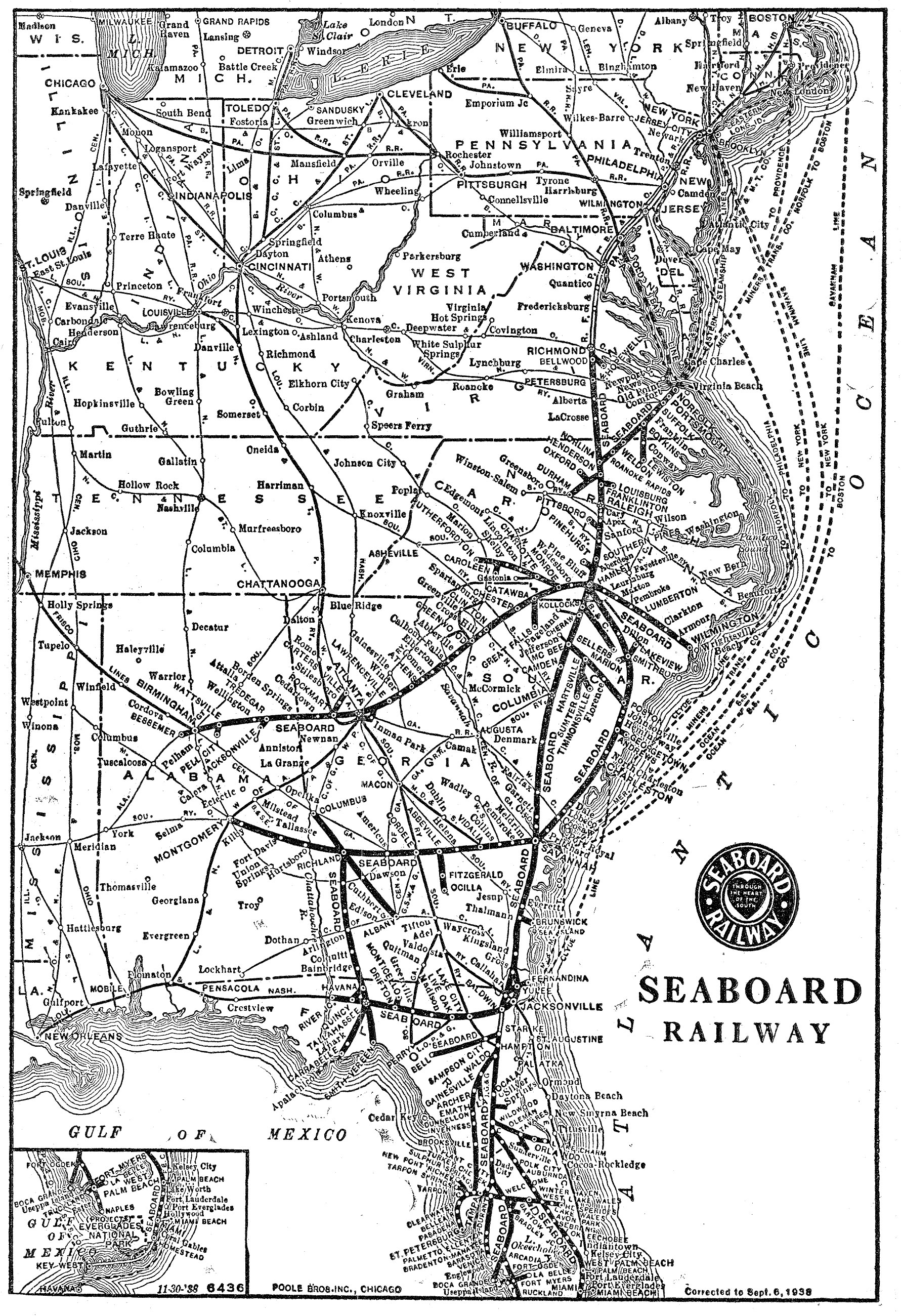
System Map (1940)
Its very last expansion came just prior to the Great Depression when it opened a line to Miami in 1927 through subsidiaries Florida Western & Northern and the Seaboard-All Florida Railroad.
With this link the Florida East Coast Railway, a system which had largely established the city, no longer had a monopoly down the state's Atlantic coast line.
At this time the Seaboard reached its largest size with a network of nearly 4,500 route miles. Unfortunately, trouble lay just over the horizon. The depression proved extremely detrimental and it fell into bankruptcy, remaining there for more than a decade.
However, it persevered through the 1930's by replacing some steam locomotives with diesels and launching the new streamliner, Silver Meteor, in 1939. Its transition into a prominent southeastern railroad began at this time as it continued to improve.
The company showed strong recovery through the World War II years by handling around 33 million tons of freight in single year during the conflict (1943). It also began implementing Centralized Traffic Control for more efficient and safe operations on a largely single-tracked main line.
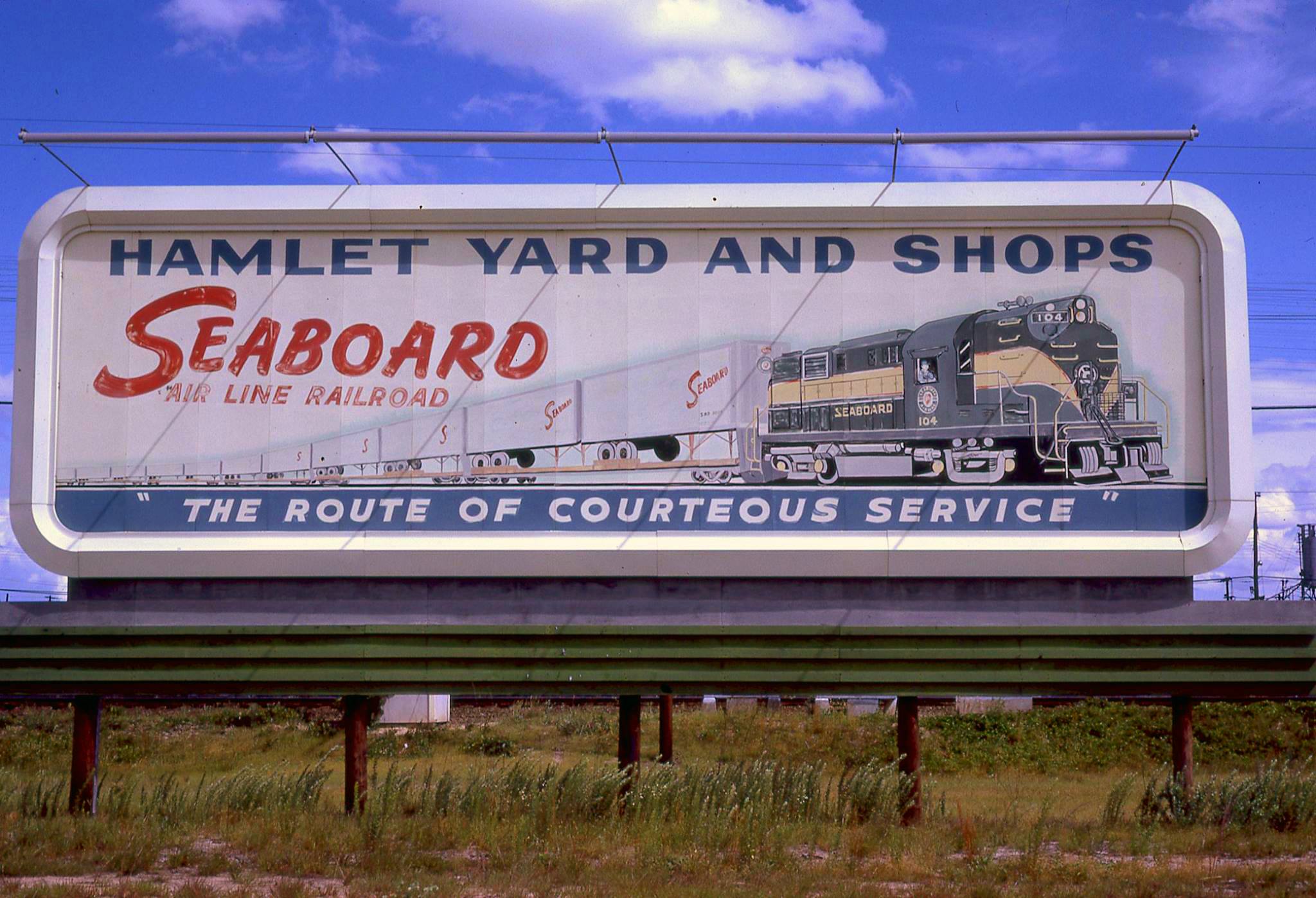 Seaboard Air Line's colorful sign announcing the entrance to its shops and division point at Hamlet, North Carolina in 1967. Warren Calloway photo.
At A Glance
Richmond, Virginia - Jacksonville - Homestead, Florida Coleman - St. Petersburg, Florida Hamlet, North Carolina - Charleston, South Carolina - Savannah, Georgia Norlina, North Carolina - Norfolk, Virginia Hamlet - Birmingham Savannah - Montgomery Baldwin - Chattahoochee, Florida Baldwin - Gross, Florida Waldo - Sulphur Springs, Florida Plant City - Fort Myers, Florida Durant - Venice, Florida Hull - Port Boca Grande, Florida Valrico - West Lake Wales, Florida Coleman - West Lake Wales - Miami |
|
Freight Cars: 27,560 Passenger Cars: 446 | |
In Sam Appleby, Jr.'s article, "Throughout The Heart Of The South" from the February, 1949 issue of Trains Magazine, the first segment to feature CTC was the Richmond Division completed in 1941.
Prior to decade's end CTC had been installed as far south as Raleigh and by 1965 was covering close to 1,700 miles of the SAL's network.
The railroad continued its modernization program by retiring its steam fleet completely in 1952. It was never as wealthy as the Coast Line and as such did not maintain a similar high-speed, double-tracked main line to Florida. Nevertheless, by the 1960's it was one of the South's premier Class I systems. B
y its latter years the Seaboard had quite a diverse freight traffic base which included agriculture, aggregates, cement, perishables, and iron ore. It likewise was one of the first to champion the trailer-on-flat-car (TOFC) concept in 1950.
The Seaboard also had an extensive and popular passenger train fleet. In addition to the aforementioned Meteor other famous trains included the Orange Blossom Special (also known as the OBS), Palmland, Suwanee River Special, and Silver Star.
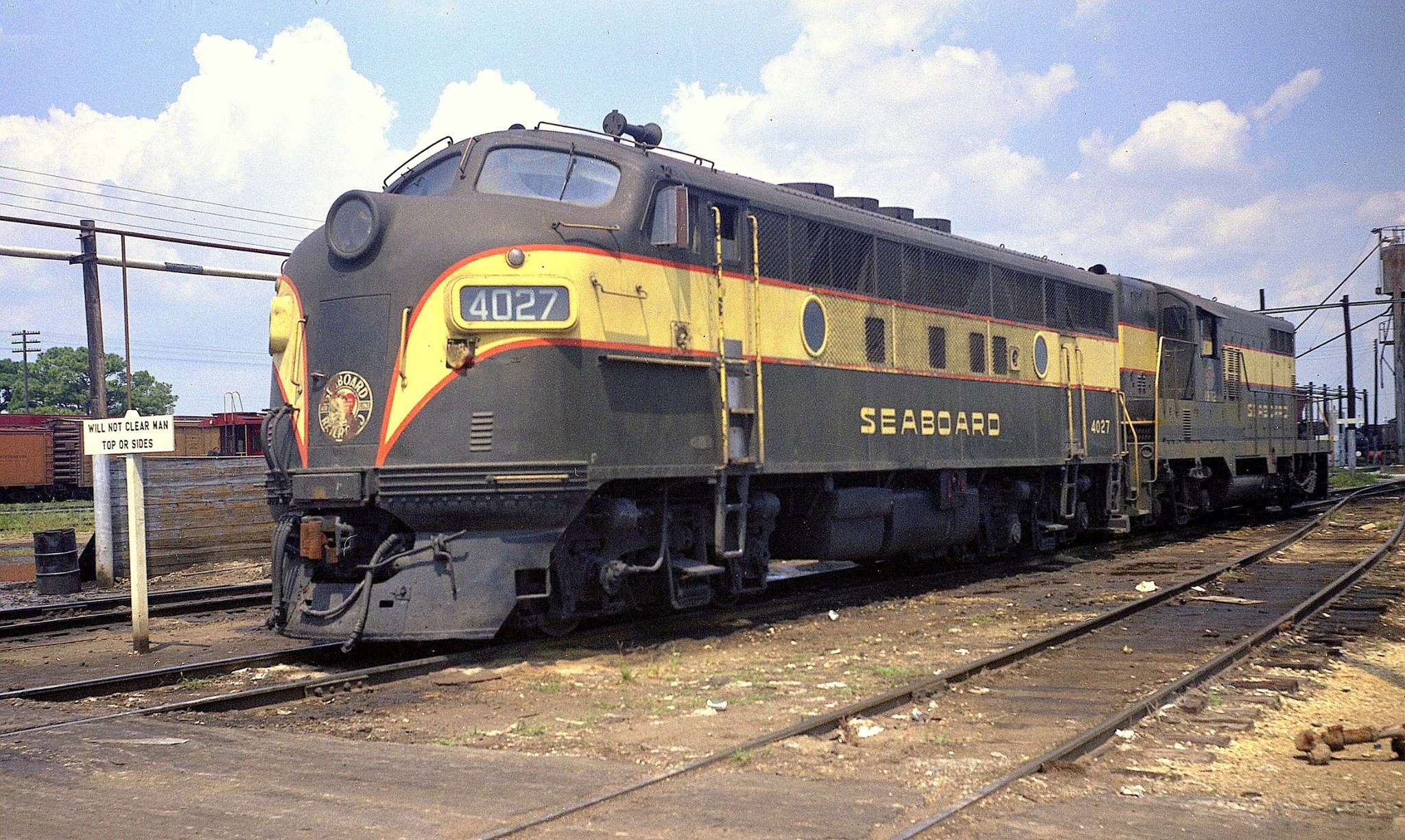 Seaboard Air Line F3A #4027 and GP9 #1972 at Hialeah, Florida during September of 1963. Warren Calloway photo.
Passenger Trains
Cotton Blossom: (Washington - Atlanta)
Gulf Wind: (Jacksonville - New Orleans)
New York-Florida Limited: (New York - Miami/St. Petersburg)
Orange Blossom Special: (New York - Miami)
Palmland: (New York - Tampa/Miami/Boca Grande)
Silver Comet: (New York/Portsmouth - Birmingham)
Silver Meteor: (New York - Miami/St. Petersburg/Venice/Fort Meyers)
Silver Star: (New York - Miami/St. Petersburg/Venice/Boca Grande)
Sunland: (Washington/Portsmouth - Miami/Venice)
Suwanee River Special: (Cincinnati - Florida)
Tidewater: (Raleigh/Norlina, North Carolina - Portsmouth, Virginia)
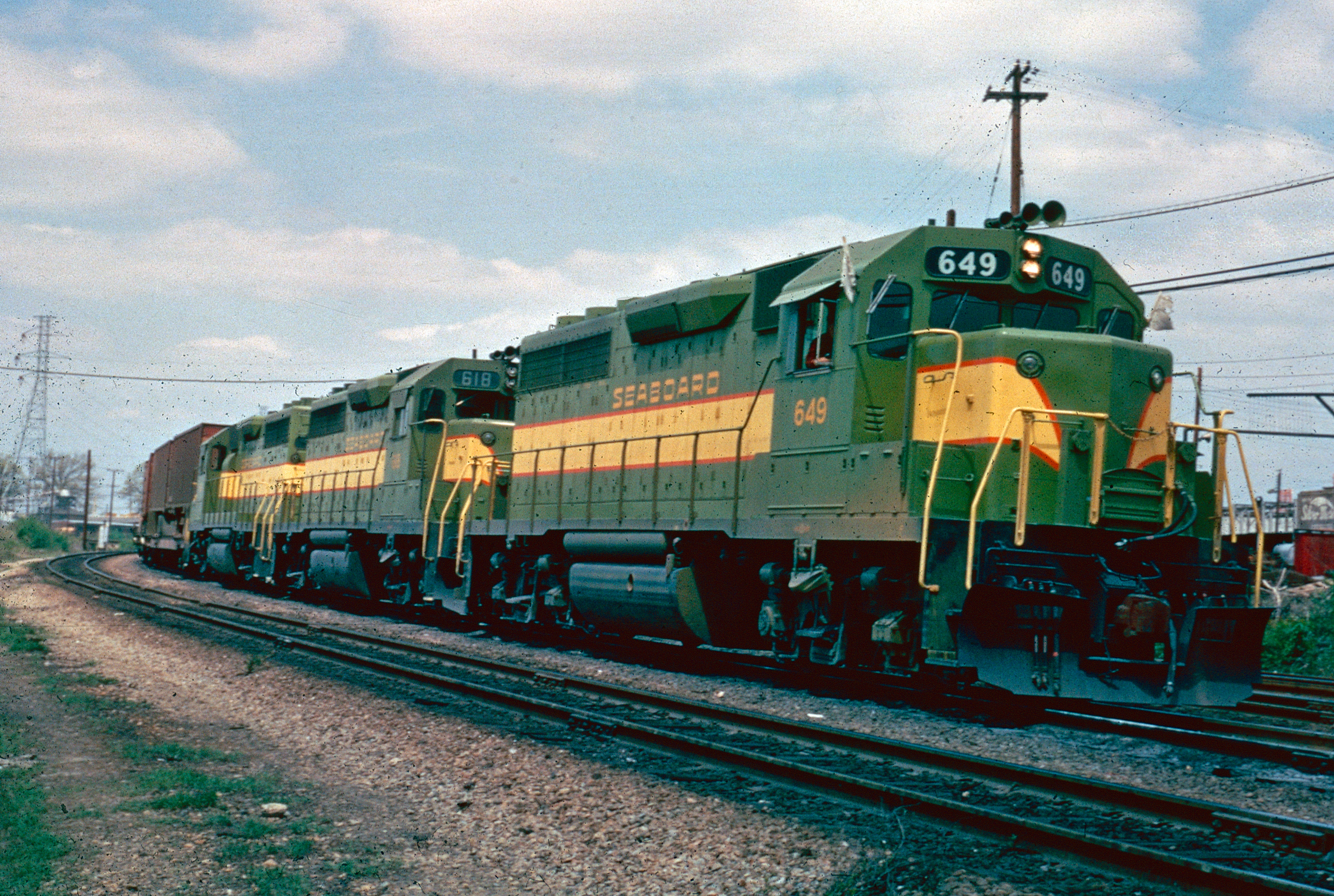 A trio of new GP40s lead a string of trailers southbound out of Hermitage Yard in Richmond, Virginia as the train approaches Hermitage Road during the spring of 1967. American-Rails.com collection.
Because the Floridian market remained strong through the 1960's the Seaboard, like the Coast Line, posted strong ridership during an era when most other carriers were significantly reducing services.
These numbers remained strong through the Seaboard Coast Line years until Amtrak took over on May 1, 1971. Because of this and the markets served some of SAL's trains survived under the new carrier (Silver Meteor and Silver Star).
In 1958 the Seaboard and Atlantic Coast Line began studying the possibility of merger, realizing a marriage could reduce expenses by combining lines and terminals since the railroads served many of the same places.
Diesel Roster
American Locomotive Company
| Model Type | Road Number | Date Built | Quantity |
|---|---|---|---|
| RS11 | 100-109 | 1960 | 10 |
| C420 | 110-136 | 1965-1966 | 27 |
| S1 | 1201 | 1941 | 1 |
| S2 | 1403-1405, 1425-1434 | 1942-1946 | 13 |
| S4 | 1482-1491 | 1953 | 10 |
| RSC2 | 1500-1531 | 1947-1949 | 32 |
| RSC3 | 1532-1543 | 1950-1951 | 12 |
| RS2 | 1600-1628 | 1949-1950 | 29 |
| RS3 | 1629-1684 | 1950-1952 | 56 |
Baldwin Locomotive Works
| Model Type | Road Number | Date Built | Quantity |
|---|---|---|---|
| VO-660 | 1202 | 1941 | 1 |
| VO-1000 | 1400-1416 | 1941-1945 | 17 |
| DS-4-4-1000 | 1417-1424, 1435-1461 | 1946-1951 | 35 |
| S12 | 1462-1465, 1476-1481 | 1952-1953 | 10 |
| DR-6-4-1500 (Babyface) | 2700-2702 | 1947-1948 | 3 |
| DR-12-8-3000 (Centipede) | 4500-4513 | 1947-1948 | 14 |
Electro-Motive Division
| Model Type | Road Number | Date Built | Quantity |
|---|---|---|---|
| GP18 | 400-409 | 1960 | 10 |
| GP30 | 500-534 | 1962-1963 | 35 |
| GP35 | 535-544 | 1965 | 10 |
| GP40 | 600-650 | 1966-1967 | 51 |
| SDP35 | 1100-1119 | 1964 | 20 |
| SW1 | 1200 | 1939 | 1 |
| NW2 | 1406-1412 | 1942 | 7 |
| GP7 | 1700-1711, 1730-1822 | 1950-1952 | 105 |
| GP9 | 1900-1929, 1954-1979 | 1955-1959 | 56 |
| E4A | 3000-3013 | 1938-1939 | 14 |
| E4B | 3100-3104 | 1938-1939 | 5 |
| E6A | 3014-3016 | 1940-1941 | 3 |
| E7A | 3017-3048 | 1945-1949 | 32 |
| E7B | 3105-3107 | 1948 | 3 |
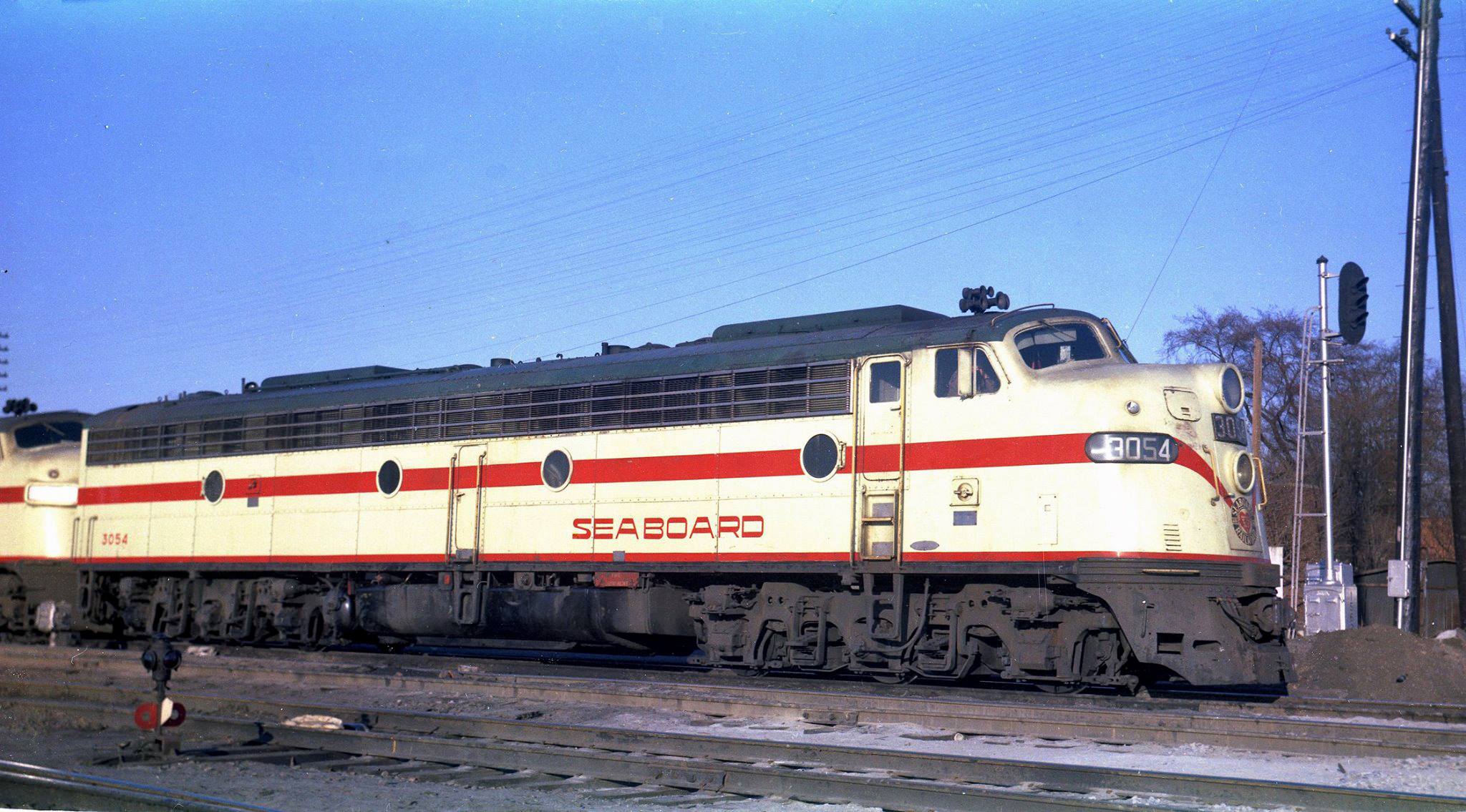
| E8A | 3049-3059 | 1950-1952 | 11 |
| E9A | 3060 | 1963 | 1 |
| FTA | 4000-4021 | 1942-1944 | 22 |
| FTB | 4100-4121 | 1942-1944 | 22 |
| F3A | 4022-4032 | 1948 | 11 |
General Electric
| Model Type | Road Number | Date Built | Quantity |
|---|---|---|---|
| U30B | 800-814 | 1967 | 15 |
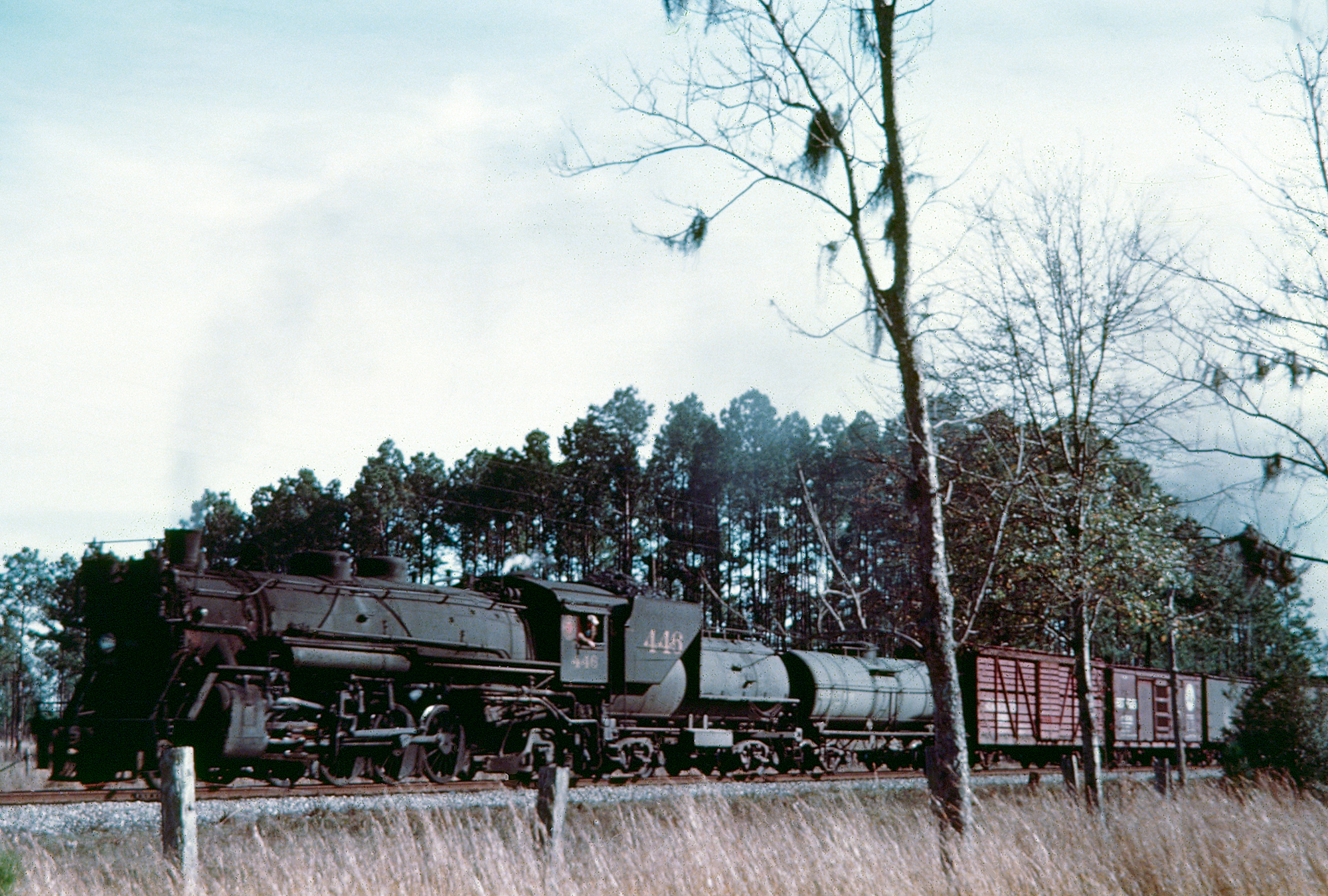 Seaboard Air Line 2-8-2 #446 is seen here in service, possibly in the Carolinas, during the 1940s. Ed Olsen photo. American-Rails.com collection.
Steam Roster
The Seaboard Air Line's slogan "Through The Heart Of The South" was not just a catchy advertisement. As one of the big three Class 1 systems in the region it truly did serve most of the southeast.
Despite its eastern seaboard location, the SAL's main line ran through the rolling hills of the Carolina Piedmont as well as the southern tip of the Appalachian Mountains to reach Atlanta as well Montgomery and Birmingham, Alabama.
As a result, the railroad did operate small fleets of larger wheel arrangements like the 2-8-8-2 and 2-6-6-4 for fast freight service between Hamlet and Richmond, as well as 2-10-0s (another fast freight engine operating between Montgomery-Savannah and Montgomery-Bainbridge), and 2-10-2s (Hamlet-Charlotte-Rutherfordton).
Generally speaking, the SAL utilized 2-8-0s and 2-8-2s for freight service and 4-6-0s, 4-6-2s, and 4-8-2s for passenger service. The railroad officially recognized 1953 as the year steam ended in main line service although George Drury notes in his book, "Guide To North American Steam Locomotives," that a lone 0-4-0T continued to handle switching work along the street trackage in Columbus, Georgia until 1959.
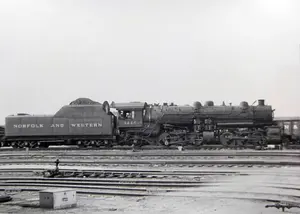
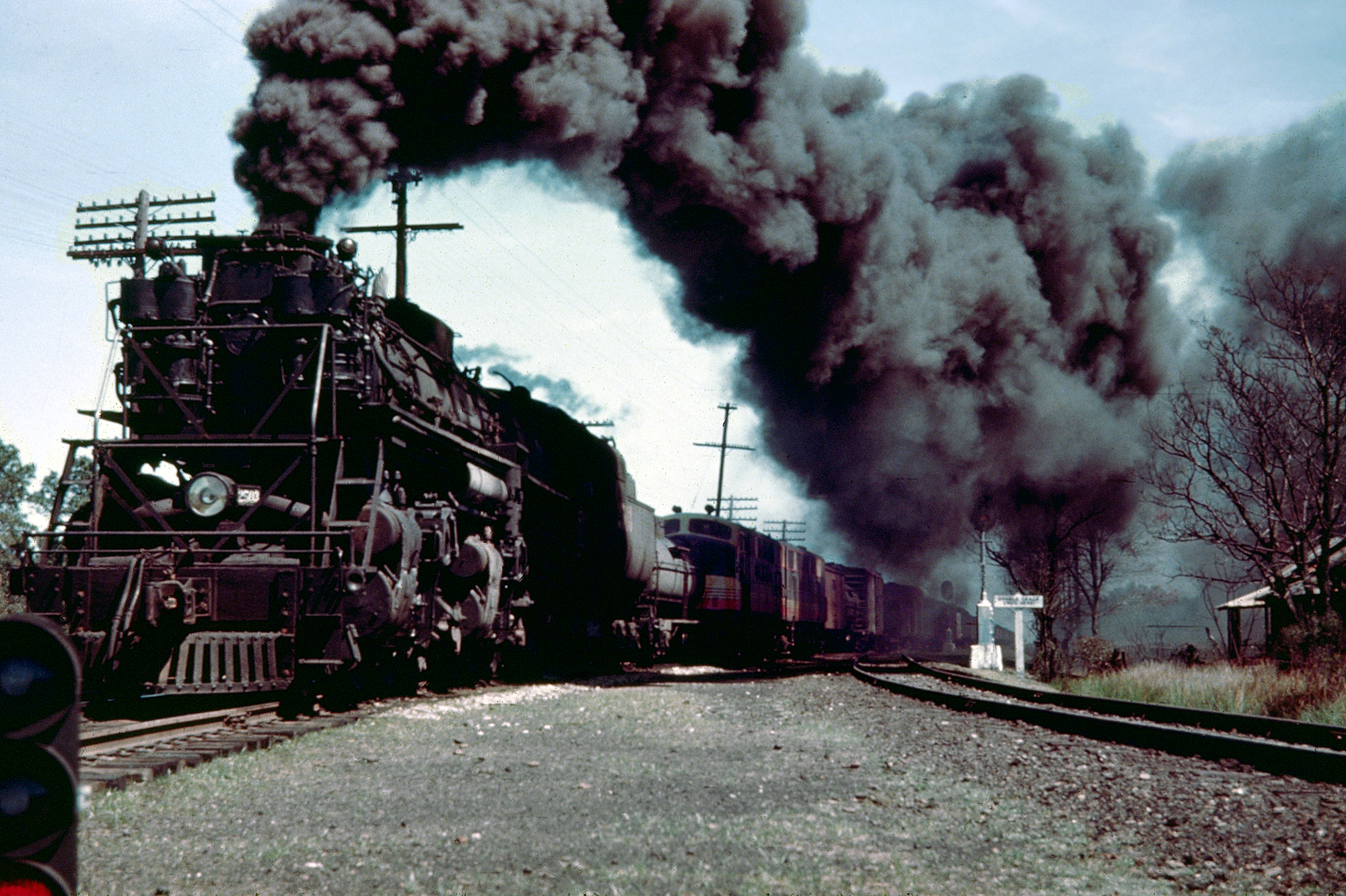 Seaboard Air Line 2-6-6-4 #2503 (R-1) assists a pair of FT's in freight service, circa 1945. No location provided. These steamers were later sold to the B&O in 1947. Ed Olsen photo. American-Rails.com collection.
Switchers
| Wheel Arrangement | Class | Road Numbers | Quantity | Builder | Completion Date | Retirement Date | Notes |
|---|---|---|---|---|---|---|---|
| 0-6-0 | No Class | 123 | 1 | Richmond (Alco) | 1900 | Sold in 1917. | ex-Georgetown & Western |
| 0-6-0 | No Class | 125 | 1 | PRR | 1903 | 1930 | ex-Jefferson Construction Co. |
| 0-4-0 | No Class | 468 | 1 | Baldwin | 1901 | 1917 | ex-Georgetown & Western |
| 0-4-0T | No Class | 1002 | 1 | Baldwin | 1912 | 1936 | - |
| 0-4-0T | No Class | 1003 | 1 | Baldwin | 1913 | 1936 | - |
| 0-4-2T | No Class | 1000 | 1 | Porter | 1900 | 1914 | ex-Columbia Belt Line |
| 0-4-0T | No Class | 1001 | 1 | Baldwin | 1936 | 1959 | - |
| 0-6-0 | No Class | 1000, 1001 | 2 | Baldwin | 1907 | 1930 | ex-Georgia, Florida & Alabama and ex-Tampa Northern Railroad |
| 0-6-0 | No Class | 1026 | 1 | Baldwin | 1915 | 1937 | ex-Carolina, Atlantic & Western |
| 0-6-0 | F-2 | 1016-1020 | 5 | Rhode Island (Alco) | 1900 | 1935 | - |
| 0-6-0 | F-3 | 1006-1009 | 4 | Pittsburgh (Alco) | 1900 | 1930 | - |
| 0-6-0 | F-4 | 1010-1015 | 6 | Pittsburgh | 1901 | 1930 | - |
| 0-6-0 | F-5 | 1090-1099 | 10 | Cooke (Alco) | 1918 | 1952 | - |
| 0-6-0 | F-7 | 1101-1150 | 50 | Baldwin | 1927-1928 | 1953 | - |
| 0-6-0 | L-5 | 1030-1059 | 30 | Baldwin | 1907-1913 | -1952 | - |
| 0-8-0 | F-9 | 1175-1179 | 5 | Pittsburgh | 1904-1905 | -1949 | ex-Elgin, Joliet & Eastern, former 2-8-0s |
Freight Locomotives
| Wheel Arrangement | Class | Road Numbers | Quantity | Builder | Completion Date | Retirement Date | Notes |
|---|---|---|---|---|---|---|---|
| 2-8-2 | Q | 300-318 | 19 | Richmond | 1914 | -1952 | |
| 2-8-2 | Q-2 | 319-333 | 15 | Schenectady | 1922 | -1952 | |
| 2-8-2 | Q-3 | 334-451 | 118 | Schen, BLW, Richmond | 1923-1931 | -1955 | |
| 2-8-2 | Q-4 | 480-487 | 8 | Rich, BLW | 1912 | 1946-1950 | Ex-Wabash |
| 2-8-2 | Q-1 | 490-499 | 10 | Schenectady | 1918 | 1950 | USRA |
| 2-10-0 (Russian Decapod) | D | 500-520 | 21 | Richmond (Alco) | 1918 | 1951 | - |
| 2-10-0 (Russian Decapod) | D-1 | 521, 522 | 2 | Baldwin | 1918 | 1949, 1950 | - |
| 2-10-0 | D-2 | 523-528 | 6 | Baldwin | 1924, 1926 | 1951-1953 | ex-GF&A |
| 2-10-0 | D-3 | 529-536 | 8 | Baldwin | 1930 | 1952-1953 | - |
| 2-10-0 (Russian Decapod) | D-4 | 540-546 | 7 | Brook (Alco)s | 1918 | 1949-1950 | -n |
| 2-10-0 (Russian Decapod) | D-5 | 547-550 | 4 | Baldwin, Richmond (Alco), Brooks (Alco) | 1918 | 1949-1951 | - |
| 2-8-0 | H-1 | 900-919 | 20 | Baldwin | 1911 | -1950 | |
| 2-8-0 | 920-924 | 5 | Baldwin | 1906-1913 | 1946, 1949 | Ex-GF&A 200-204 | |
| 2-8-0 | 925, 926 | 2 | Baldwin | 1910, 1911 | 1933, 1936 | Ex-CH&N 17, 18 | |
| 2-8-0 | 927, 928 | 2 | Richmond | 1913 | 1949, 1941 | Ex-CH&N 50, 51 | |
| 2-8-0 | 929-932 | 4 | Baldwin | 1920 | 1950-1951 | Ex-CH&N 71-74 | |
| 2-8-0 | H-2 | 933-937 | 5 | Schenectady | 1910-1912 | 1948-1949 | Ex-Chicago & North Western |
| 2-8-0 | 954, 955 | 2 | Baldwin | 1900 | 1916 | Ex-Georgetown & Western | |
| 2-8-0 | L-3 | 970-989 | 20 | Richmond | 1902-1903 | -1935 | |
| 2-8-0 | H | 990-999 | 10 | Baldwin | 1904 | -1938 | |
| 2-10-2 | B | 2400-2409 | 10 | Baldwin | 1918 | 1948-1950 | - |
| 2-10-2 | B-1 | 2485-2499 | 15 | Baldwin | 1919 | 1950-1953 | - |
Passenger Locomotives
| Wheel Arrangement | Class | Road Numbers | Quantity | Builder | Completion Date | Retirement Date | Notes |
|---|---|---|---|---|---|---|---|
| 4-4-0 | 101 | 101 | 1 | Baldwin | 1905 | 1936 | ex-GF&A |
| 4-4-0 | 103 | 103 | 1 | Baldwin | 1913 | 1933 | ex-Charlotte Harbor & Northern |
| 4-4-0 | 122 | 122 | 1 | Baldwin | 1901 | 1924 | ex-Georgetown & Western |
| 4-4-0 | 166 | 166 | 1 | Baldwin | 1914 | 1936 | ex-CA&W |
| 4-4-0 | G-1 | 180-184 | 5 | Rhode Island (Alco) | 1900 | 1903 | - |
| 4-4-0 | G-2 | 185-199 | 15 | Baldwin | 1900 | 1933 | - |
| 4-8-2 | M | 200-214 | 15 | Richmond (Alco), Schenectady (Alco) | 1914, 1917 | 1950 | - |
| 4-8-2 | M-1 | 215-224 | 10 | Schenectady (Alco) | 1922 | 1952 | - |
| 4-8-2 | M-2 | 235-270 | 36 | Baldwin | 1924-1926 | 1954 | - |
| 4-6-0 | I-5 | 581 | 1 | Richmond (Alco) | 1900 | 1916 | - |
| 4-6-0 | L-2 | 600-649 | 49 | Richmond (Alco), Baldwin | 1902-1907 | 1936-1950 | - |
| 4-6-0 | L-4-S | 650, 651, 655-657, 660-664 | 10 | Baldwin | 1910 | 1952 | Rebuilt in 1933 from Class K 4-6-0s. |
| 4-6-0 | L-2-S | 652-654, 659 | 4 | Baldwin | 1910 | 1950 | Rebuilt in 1933 from Class K 4-6-0s. |
| 4-6-0 | K | 658 | 1 | Baldwin | 1910 | 1940 | - |
| 4-6-0 | I-12 | 671-680 | 10 | Baldwin | 1909-1913 | 1936-1948 | ex-CA&W |
| 4-6-0 | I-13 | 681-683 | 3 | Baldwin | 1915 | 1946 | ex-CA&W |
| 4-6-0 | 684-688 | 5 | Baldwin | 1901-1906 | 1930, 1936 | ex-GF&A | |
| 4-6-0 | 689 | 1 | Baldwin | 1910 | 1934 | ex-CH&N | |
| 4-6-0 | L-4 | 690, 692 | 2 | Baldwin | 1907 | 1930 | ex-Tampa Northern Railroad |
| 4-6-0 | 17 | 693-695 | 3 | Baldwin | 1914 | 1936, 1933 | ex-Tampa & Gulf Coast |
| 4-6-2 | P-1 | 800-849 | 50 | Baldwin, Richmond (Alco) | 1912-1913 | 1952 | - |
| 4-6-2 | P | 851-870 | 20 | Richmond (Alco), Baldwin | 1911-1913 | 1951 | - |
| 4-6-2 | P-4 | 871-880 | 10 | Baldwin | 1909, 1911 | 1952 | - |
| 4-6-0 | I-5 | 1575-1599 | 24 | Richmond (Alco) | 1900-1901 | 1928-1933 | - |
Articulated Designs
| Wheel Arrangement | Class | Road Numbers | Quantity | Builder | Completion Date | Retirement Date | Notes |
|---|---|---|---|---|---|---|---|
| 2-8-8-2 | A | 500-515 | 16 | Richmond | 1917-1918 | Sold to the B&O in 1920. | - |
| 2-6-6-4 | R-1 | 2500-2504 | 5 | Baldwin | 1935 | Sold to the B&O in 1947. | - |
| 2-6-6-4 | R-2 | 2505-2509 | 5 | Baldwin | 1937 | Sold to the B&O in 1947. | - |
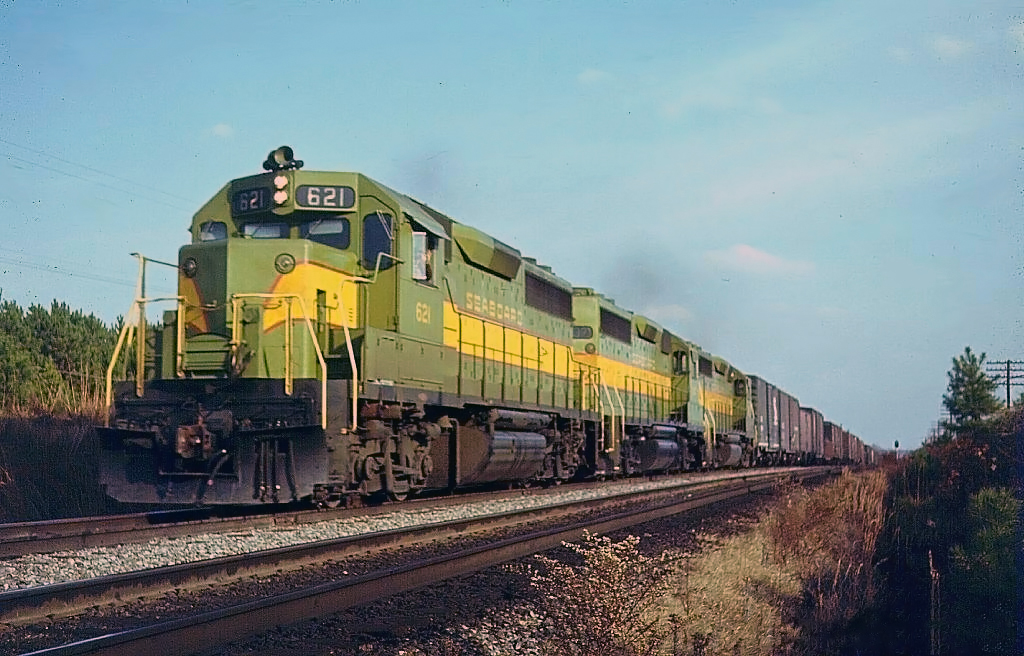 A trio of Seaboard's new GP40s, nicknamed "Jolly Green Giants" (thanks to their light green livery), lead a manifest through Cary, North Carolina in 1966. Warren Calloway photo.
Seaboard Coast Line
While the SAL and ACL were competitors, similar to the Pennsylvania and New York Central that merged during the same period, their planning would pay off through the new Seaboard Coast Line formed on July 1, 1967.
Thanks to the ACL's many holdings SCL controlled several other profitable systems including the Clinchfield, Louisville & Nashville, and West Point Route. The group went on to form the new marketing name known as "The Family Lines."
The moniker held no corporate power until December 29, 1982 when they were formally merged into the Seaboard System. The holding company, CSX Corporation, had been created on November 1, 1980 to eventually join the Seaboard roads and Chessie System lines into one giant conglomerate.
That railroad was formed on July 1, 1986 when CSX Transportation (CSXT) was born. It immediately absorbed the Seaboard System predecessors while the Chessie's subsidiaries, B&O and Chesapeake & Ohio, disappeared a year later in 1987 (the Western Maryland had vanished in 1983).
Photos
 A handsome set of Seaboard Air Line E7As, led by #3026, have train #3 stopped at Raleigh, North Carolina in the summer of 1965. Warren Calloway photo.
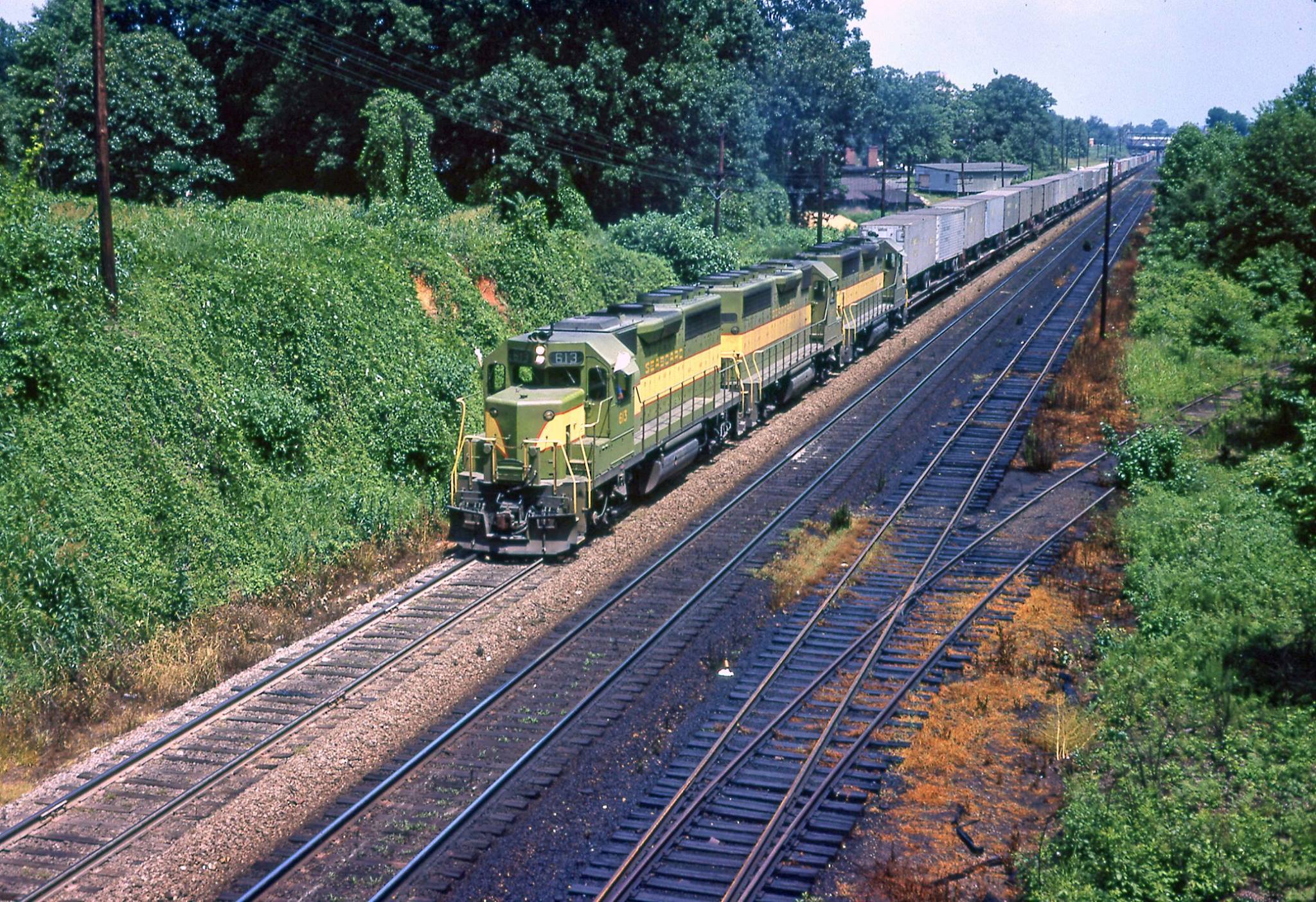 About a week prior to the Seaboard Coast Line merger, a trio of new Seaboard Air Line GP40s, led by #613, hustle trailers through Raleigh, North Carolina on June 24, 1967. Warren Calloway photo.
Recent Articles


-
Mobile & Ohio Steam Roster (Post 1900)
Oct 09, 26 12:26 PM
 Mobile & Ohio steam since 1900. Drury's class grid: 48 six-wheel switchers, 107 Ten-Wheelers, 15 Consolidations, 58 Mikados, and 14 Pacifics. Last revenue steam October 7, 1949.
 -
Mobile & Ohio Railroad: History, Map, Timetable
Oct 09, 26 11:31 AM
 Mobile & Ohio Railroad, chartered in 1848. Columbus on April 22, 1861, the Cairo & St. Louis, the March 1940 Official Guide, and the September 13, 1940 merger into the Gulf, Mobile & Ohio.
 -
Gulf, Mobile & Northern Steam Roster (Post 1900)
Oct 09, 26 10:42 AM
 Gulf, Mobile & Northern steam since 1900. Drury's class grid: Ten-Wheelers, Mikados, Russian Decapods, Pacifics 425 and 426, and three light 4-8-2s. Last revenue steam October 7, 1949.
 -
Gulf, Mobile & Ohio Diesel Roster (All-Time)
Oct 09, 26 10:41 AM
 Gulf, Mobile & Ohio diesel roster, all-time. The 1935 boxcab, DL-107s, 55 FA-1s, F3s and F7s, the Ingalls 4-S, GP30s through GP38-2s, and 21 SD40s. Serials and order numbers.
 -
Gulf, Mobile & Northern Railroad: History, Rebel Route
Oct 09, 26 10:36 AM
 Gulf, Mobile & Northern, from the 1890 Mobile, Jackson & Kansas City to the Rebel and the September 13, 1940 merger into the Gulf, Mobile & Ohio. Steam roster is the companion page.
 -
Gulf, Mobile & Ohio Railroad: Map, Photos, Trains, History
Oct 08, 26 11:48 PM
 Gulf, Mobile & Ohio, chartered in 1938 and merged September 13, 1940. The Mobile & Ohio, the Alton on May 31, 1947, the Rebel Route, and Illinois Central Gulf on August 10, 1972.
 -
New Jersey Railroad Museums (2026): A Complete Guide
Oct 08, 26 11:37 PM
 New Jersey railroad museums—Whippany, Maywood, Pine Creek, Mahwah’s Erie depot, Phillipsburg, and Boonton. Confirm hours on each site.
 -
New Hampshire Railroad Museums (2026): A Complete Guide
Oct 08, 26 11:34 PM
 New Hampshire railroad museums—North Conway, the Flying Yankee, Ashland, Gorham, Raymond, and Sandown. Confirm hours on each site.
 -
Missouri Railroad Museums (2026): A Complete Guide
Oct 08, 26 11:00 PM
 Missouri railroad museums—the National Museum of Transportation, Patee House, Frisco 4524, the Chicago & Alton depot, and Marceline. Confirm hours on each site.
 -
Milwaukee Road X3800: Deer Lodge’s Shop Goat
Oct 08, 26 04:28 PM
 Milwaukee Road X3800, the a home-built shop goat that served the Deer Lodge, MT yard. It was a 220-volt DC switcher, powered through an extension cord that moved electrics into a roundhouse where the…
 -
Key West Extension (Overseas Railroad): History, Construction, Decline
Oct 08, 26 03:59 PM
 Henry Flagler's Overseas Railroad, Miami to Key West, 1905–1935. The Seven Mile Bridge, the 1935 Labor Day Hurricane, and the road that became U.S. 1.
 -
Florida East Coast Steam Roster (Post 1900)
Oct 08, 26 02:34 PM
 Florida East Coast steam since 1897. Seventeen Ten-Wheelers, twenty Atlantics, eighty-seven Pacifics, ninety Mountains, fifteen Mikados, and the switchers.
 -
Florida East Coast Diesel Roster (All-Time)
Oct 08, 26 02:12 PM
 Florida East Coast diesel roster, all-time. E units from 1939, F3s, BL2s, GP7s and GP9s, the GP40-2 orders, 22 SD40-2s, and 24 ES44C4s. Serials and EMD order numbers.
 -
Florida East Coast Railway: Map, History, Rosters
Oct 08, 26 01:46 PM
 Florida East Coast Railway, Henry Flagler's line from Jacksonville to Miami and Key West. Receivership in 1931, the 1963 strike, Grupo México in 2017, and Brightline on the same track.
 -
Minnesota Railroad Museums (2026): A Complete Guide
Oct 08, 26 10:32 AM
Minnesota railroad museums—the Lake Superior Railroad Museum, Two Harbors, Jackson Street, Willmar’s Great Northern 2523, and Currie. Confirm hours on each site. -
Maine Railroad Museums (2026): A Complete Guide
Oct 08, 26 09:24 AM
 Maine railroad museums—Seashore Trolley, the two-foot lines at Portland, Alna, and Phillips, Boothbay, and the Bangor & Aroostook depots. Confirm hours on each site.
 -
Massachusetts Railroad Museums (2026): A Complete Guide
Oct 08, 26 12:08 AM
 Massachusetts railroad museums—Berkshire Scenic at Lenox, Shelburne Falls trolley No. 10, Edaville, Chatham’s 1887 depot, and Lowell. Confirm hours on each site.
 -
Clinchfield Steam Roster (Post 1900)
Oct 07, 26 12:09 PM
 Clinchfield steam since 1900. Fifteen H-4 Consolidations, K-1 Mikados, M-2 and M-3 Mallets, L-class 2-8-8-2s, eighteen Challengers. Class grid after Drury. Last steam April 16, 1954.
 -
Clinchfield Diesel Roster (All-Time)
Oct 07, 26 12:05 PM
 Clinchfield diesel roster, all-time. F3A 800, FP7 200, the F7s, GP7s, 25 SD40s, 18 SD45-2s, seven U36Cs, and the Family Lines hoods. Serials and EMD order numbers.
 -
Clinchfield Railroad: Map, Steam Locomotives, Roster, Logo
Oct 07, 26 12:02 PM
 Clinchfield Railroad, Elkhorn City to Spartanburg. George L. Carter, the Carolina, Clinchfield & Ohio, the 1924 lease, coal, the loops, and CSX. Steam and diesel rosters are companion pages.
 -
Kentucky Railroad Museums (2026): A Complete Guide
Oct 07, 26 11:39 AM
 Kentucky railroad museums—the Kentucky Railway Museum, Bowling Green’s L&N depot, Paducah, Versailles, and Covington. Confirm hours on each site.
 -
Kansas Railroad Museums (2026): A Complete Guide
Oct 07, 26 11:26 AM
 Kansas railroad museums—Santa Fe 3768 at Wichita, Santa Fe 132 in Topeka, the Great Overland Station, and Abilene. Confirm hours on each site.
 -
Cincinnati, New Orleans and Texas Pacific Diesel Roster (All-Time)
Oct 07, 26 10:38 AM
 All-time diesel roster of Southern locomotives lettered for the Cincinnati, New Orleans and Texas Pacific. Serials, order numbers, and builder dates.
 -
Cincinnati, New Orleans and Texas Pacific Railway
Oct 07, 26 10:31 AM
 Cincinnati, New Orleans and Texas Pacific Railway, incorporated September 8, 1881, to lease Cincinnati’s railroad to Chattanooga. Queen and Crescent route, Rathole, and the 2024 sale to Norfolk Southe…
 -
Indiana Railroad Museums (2026): A Complete Guide
Oct 07, 26 12:26 AM
 Indiana railroad museums—Nickel Plate 765, Elkhart’s New York Central collection, French Lick, Linden’s junction depot, and Haley Tower. Confirm hours on each site.
 -
"Triplex" Steam Locomotive: Specs, History, Photos
Oct 06, 26 11:52 PM
 Erie class P-1 Triplex 2-8-8-8-2s. Three Baldwin compounds, 2603–2605, later 5014–5016, built 1914 and 1916. Matt H. Shay, the 1930 class card, and Virginian XA 700.
 -
Illinois Railroad Museums (2026): A Complete Guide
Oct 06, 26 11:47 PM
 Illinois railroad museums—the Illinois Railway Museum, Monticello, the Pioneer Zephyr, Galesburg’s Burlington 3006, and the depots. Confirm hours on each site.
 -
Iowa Railroad Museums (2026): A Complete Guide
Oct 06, 26 11:41 PM
 Iowa railroad museums—the Union Pacific Railroad Museum, RailsWest, Sioux City, Boone, and the National Hobo Museum in Britt. Confirm hours on each site.
 -
Charleston and Western Carolina Diesel Roster (All-Time)
Oct 06, 26 11:29 PM
Charleston and Western Carolina diesel roster. Twenty-one GP7s, two SW7s, two SW9s, and six F7As, all built 1950–1952. Serials, order numbers, and ACL and SCL numbers. -
Charleston and Western Carolina Railway: Map, History, Timetables
Oct 06, 26 11:18 PM
 Charleston and Western Carolina Railway, incorporated September 16, 1896. Port Royal to Spartanburg, with branches to Anderson and Greenville. Merged into the Atlantic Coast Line on December 31, 1959.
 -
Central of Georgia Steam Roster (Post 1900)
Oct 06, 26 04:00 PM
 Central of Georgia steam since 1900. Cooke Consolidations, Harriman Mikados, 32 Mountains, and eight Lima 4-8-4s. Class grid after Drury. Last steam May 1953.
 -
Central of Georgia Diesel Roster (All-Time)
Oct 06, 26 03:44 PM
 Central of Georgia diesel roster. SW1 No. 1 in 1939, E7s and E8s, nine F3As, 39 RS3s, GP7s through SD35s. Serials and order numbers.
 -
Central of Georgia Railway: Map, Logo, History, Rosters
Oct 06, 26 03:42 PM
 Central of Georgia Railway, from the 1833 Savannah charter to Southern control on June 17, 1963. Map, logos, Nancy Hanks II, and links to the steam and diesel rosters.
 -
Georgia Railroad Museums (2026): A Complete Guide
Oct 06, 26 03:33 PM
Georgia railroad museums—Savannah’s Central shops, Duluth, the General at Kennesaw, the Texas in Atlanta, Tifton, Waycross, and Albany. Confirm hours on each site. -
Florida Railroad Museums (2026): A Complete Guide
Oct 06, 26 03:18 PM
 Florida railroad museums—Boca Raton, Winter Garden, Whitehall, the Gold Coast, Parrish, Fort Myers, Milton, and Plant City. Confirm hours on each site.
 -
Connecticut Railroad Museums (2026): A Complete Guide
Oct 06, 26 01:05 PM
 Connecticut railroad museums—the Shore Line Trolley, East Windsor, the Naugatuck Railroad, Danbury Union Station, Willimantic, and the SoNo tower. Confirm hours on each site.
 -
Colorado Railroad Museums (2026): A Complete Guide
Oct 06, 26 12:47 PM
 Colorado railroad museums—Golden, the Forney’s Big Boy 4005, Pueblo’s Santa Fe 2912, and the depots at Castle Rock, Limon, and Ridgway. Confirm hours on each site.
 -
Atlantic Coast Line Steam Roster (Post 1900)
Oct 06, 26 12:44 PM
 Atlantic Coast Line steam since 1900. Copper Head Ten-Wheelers, 235 P-5 Pacifics, Q-1 Santa Fes, twelve R-1 4-8-4s. Class grid after Drury. Last steam June 30, 1955.
 -
Atlantic Coast Line Diesel Roster (All-Time)
Oct 06, 26 11:57 AM
 Atlantic Coast Line diesel roster. HH660 1900 in 1939, E3s for the Champion, FTs and F2s, GP7s 100–279, GP30s, U25Cs, and the 1967 SCL numbers. Serials and orders.
 -
Atlantic Coast Line Railroad: "Standard Railroad of the South"
Oct 06, 26 11:53 AM
 Atlantic Coast Line, the Standard Railroad of the South. April 21, 1900 to July 1, 1967. Plant System, L&N, Clinchfield, the Champion, and the Seaboard Coast Line merger.
 -
California Railroad Museums (2026): A Complete Guide
Oct 06, 26 09:50 AM
California railroad museums—the California State Railroad Museum, Perris, Portola, Railtown 1897, and the depots that still stand. Confirm hours on each site. -
Arizona Railroad Museums (2026): A Complete Guide
Oct 06, 26 09:46 AM
Arizona railroad museums—the Arizona Railway Museum in Chandler, Southern Pacific 1673 at Tucson, and the McCormick-Stillman park in Scottsdale. -
Arkansas Railroad Museums (2026): A Complete Guide
Oct 06, 26 09:07 AM
 Arkansas railroad museums—Cotton Belt 819 at Pine Bluff, the Fort Smith trolley, the Mammoth Spring depot, and the Eureka Springs railway.
 -
Alabama Railroad Museums (2026): A Complete Guide
Oct 06, 26 09:03 AM
Alabama railroad museums—Heart of Dixie at Calera, the North Alabama museum at Chase, Huntsville’s 1860 depot, and Fort Payne. Confirm hours on each site. -
Pennsylvania Railroad Museums (2026): A Complete Guide
Oct 06, 26 12:09 AM
 Pennsylvania railroad museums—Strasburg, Steamtown, the Horseshoe Curve, the East Broad Top, and the depots and towers in between. Confirm hours on each site.
 -
Maryland Railroad Museums (2026): A Complete Guide
Oct 05, 26 11:53 PM
 Maryland railroad museums—the Baltimore roundhouse, Ellicott City station, Bowie, Gaithersburg’s Buffalo Creek & Gauley 14, and the Western Maryland collections.
 -
Ohio Railroad Museums (2026): A Complete Guide
Oct 05, 26 05:51 PM
 Ohio railroad museums—the Age of Steam Roundhouse, Bellevue, Worthington, Conneaut’s Nickel Plate 755, and the Dennison depot. Confirm hours on each site.
 -
Delaware Railroad Museums (2026): A Complete Guide
Oct 05, 26 02:43 PM
 Delaware railroad museums—Wilmington & Western at Greenbank, the Harrington tower and N5 caboose, Felton's 1868 depot, and the Selbyville station museum.
 -
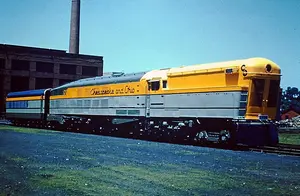
C&O's M-1 Steam Turbine Locomotives: Specs, Roster, History
Oct 05, 26 12:13 PM
 Chesapeake & Ohio Class M-1 steam-turbine-electrics. Three Baldwin-Westinghouse locomotives, 500–502, built 1947–48 for The Chessie. Specs, the 2-C1+2-C1-B arrangement, and a roster. All scrapped…
 -
N&W 2-6-6-2 Locomotives (Class Z): Specs, Roster, History
Oct 05, 26 11:44 AM
 Norfolk & Western Class Z 2-6-6-2s. One hundred ninety compound Mallets, 1300–1489, from Richmond, Baldwin, and Schenectady, 1912–1918. Diagram specs, the Z-1b rebuilds, Z-2 1399, and a roster. No…



%20assists%20a%20pair%20of%20FT's%20in%20freight%20service%2C%20circa%201945.%20No%20location%20provided.%20These%20steamers%20were%20later%20sold%20to%20the%20B%26O%20in%201947.%20Ed%20Olsen%20photo.%20American-Rails.com%20collection.)