Alco "C-424" Locomotives: Data Sheet, Roster, History
Last revised: December 26, 2024
By: Adam Burns
When the American Locomotive Company rolled out its Century Series in the early 1960s, the goal was straightforward: modernize Alco’s diesel catalog, correct the shortcomings of earlier models, and compete head-to-head with EMD and the rapidly rising General Electric. Among the first and most important of these new locomotives was the C424—a B-B (four-axle), 2,400-horsepower road-switcher intended to provide railroads with a versatile, modern freight locomotive at a time when power demands and expectations were climbing quickly.
Today, the ruggedness and reliability of these locomotives continues to show through as numerous examples of the C424 not only remained preserved but also are still used in freight service. Some locations where they can still be found hauling freight include the Western New York & Pennsylvania, Morristown & Erie, Buffalo Southern, and the Bath & Hammondsport Railroad.
Photos
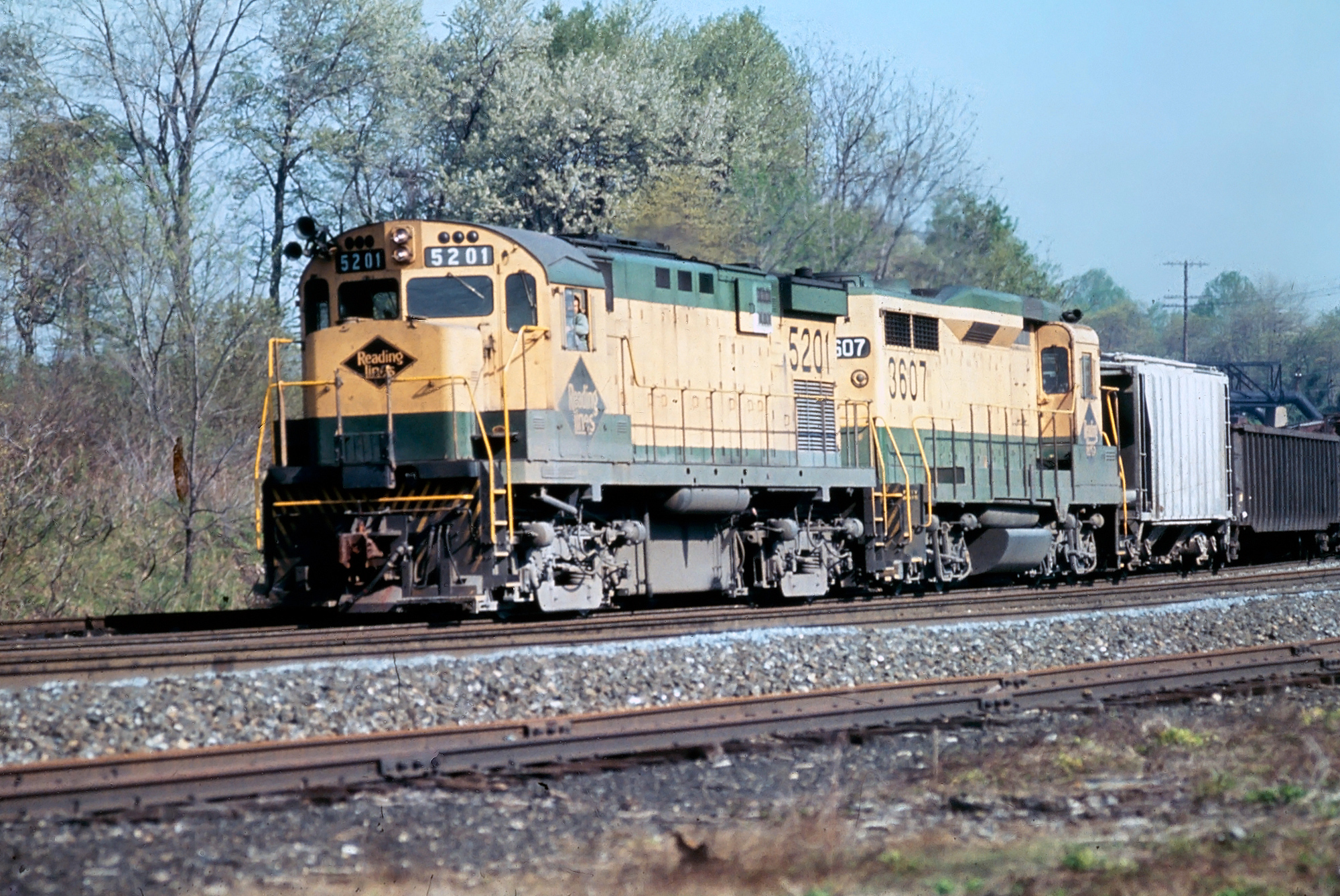 Reading C424 #5201 and GP30 #3607 in freight service; May 6, 1972. Location not recorded. American-Rails.com collection.
Overview
The C424 (listed by the builder as its DL640A) emerged as part of Alco’s effort to replace and improve upon earlier road-switcher concepts—particularly the RS-27, a model that sold in limited numbers and never gained broad traction. The Century line was meant to be more standardized, more maintainable, and more competitive in performance and price. In practice, the C424 was positioned as a lower-priced alternative to Alco’s own C425, while still offering strong horsepower for a four-axle unit in the mid-1960s market.
From a historian’s perspective, the C424 is especially interesting because it represents Alco’s “second wind” in road-switcher design—arriving at a moment when railroads were increasingly standardizing on EMD’s GP series and GE’s Universal line. In that competitive environment, even a technically capable locomotive faced an uphill battle if it couldn’t match the support networks, parts availability, and fleet commonality offered by the market leaders.
On the Belt Railway of Chicago the locomotives became a railfan favorite. The terminal road used its small fleet of six (#600-605) from the time they were purchased new from Alco in 1965-1966 until the early 2000's.
 Toledo, Peoria & Western C424 #800 leads eastbound freight AST-2 at Logansport, Indiana, circa 1970. The TP&W acquired two examples of this model new in 1964; #800-801. Karl Miller photo.
Fortunately the C424 sold better than its predecessor as a number of Class I railroads around the country picked up the model.
Additionally, smaller lines also purchased the design including Alco loyalists Green Bay & Western and Erie Mining while the Toledo, Peoria & Western also picked up a few units.
Unfortunately, while Alco sold nearly 200 C424s, 99 were built by the Montreal Locomotive Works for the Canadian Pacific, Canadian National, and Mexican line National de Mexico purchased another 45.
In general, most of the roads that bought the Alco C424 were returning customers, as the company could simply no longer attract new buyers and interest (which was mostly due to the fact that Alco still had a reputation for reliability issues despite having mostly corrected this problem years before).
Production ended on the model in early 1967 and despite the slow sales numbers (in comparison to models being produced by EMD who was selling thousands of GP35s and GP38s) the lines that purchased the C424 were generally quite happy with the models.
Core Specifications and Design
Alco did away with the notched corners on the C424s carbody, instead giving the nose a simple rounded look and the trailing long hood a raised edge for the number boards. At the heart of this model was Alco’s proven 251B diesel engine, delivering a rating of 2,400 horsepower. The locomotive rode on two-axle trucks (B-B), carried four GE 752 traction motors (despite GE being a major competitor by this time), and was offered with features railroads increasingly expected in mainline-capable road-switchers—such as multiple-unit capability and dynamic braking (where specified).
Perception and Longevity
The C424 sold better than its predecessor as a number of Class Is picked up the model. Additionally, smaller lines also purchased the design including Alco loyalists Green Bay & Western and Erie Mining while the Toledo, Peoria & Western also picked up a few units. In general, most of the roads that bought the model were returning customers, as the company could simply no longer attract new buyers and interest by this time.
Despite their modest sales, several customers used theirs for many years. The Green Bay & Western and Belt Railway of Chicago both employed theirs for more than 20 years; the former's surviving until it was acquired by Wisconsin Central in 1993 and the latter's until later that decade (these examlples continue to find use on short line's today). Additionally, the Canadian Pacific was still employing their M424s in service through the early 1990s.
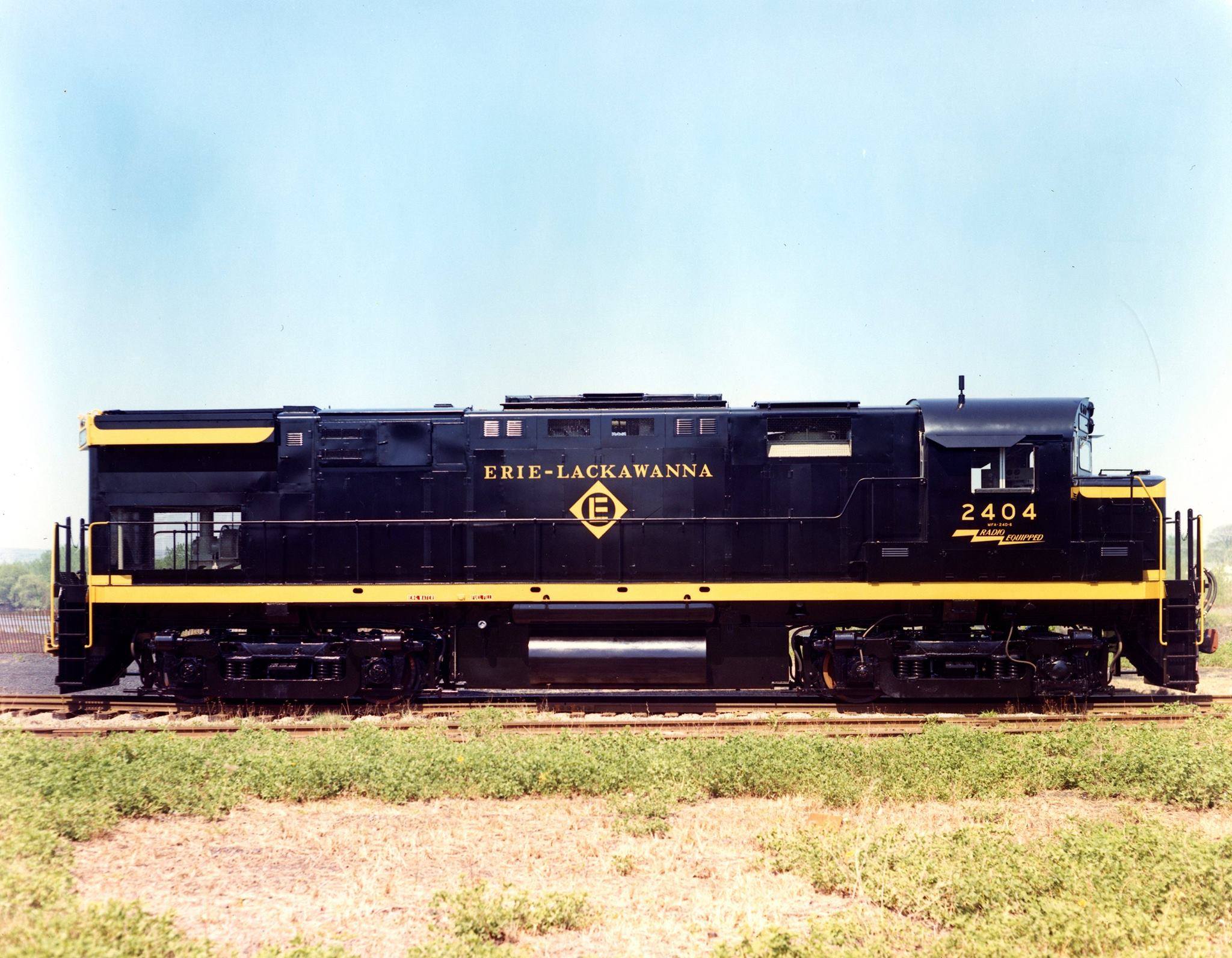 An American Locomotive builder's photo featuring new Erie-Lackawanna Railway C424 #2404 in June, 1963. Warren Calloway collection.
Data Sheet and Specifications
The C424 was built from April 1963 through May 1967, with a total production of 190 units. Importantly, it wasn’t solely a Schenectady product: C424s were constructed by Alco in the United States and by its Canadian affiliate, Montreal Locomotive Works (MLW).
| Entered Production | 5/1963 (Erie Lackawanna #2401) |
| Years Produced | 4/1963-5/1967 |
| Model Specification | DL640A |
| Engine | 251B, V-16 |
| Horsepower | 2,400 |
| RPM | 1,025 |
| Carbody Styling | Alco |
| Length (Between Coupler Pulling Faces) | 59' 4" (Originally 58' 10") |
| Weight | 260,000 Lbs. |
| Dynamic Brakes | Optional |
| Trucks | B-B |
| Truck Type | Swing Bolster, Drop-Side Equalizer (AAR Type-B) |
| Truck Wheelbase | 9' 4" |
| Wheel Size | 40" |
| Traction Motors | GE 752 (4) |
| Traction Generator | GT581 |
| Steam Generator | - |
| Gear Ratio | 65:18 |
| Tractive Effort Rating | 64,200 Lbs. |
| Top Speed | 75 MPH |
Production Roster
Alco
Total Built = 98
| Owner | Road Number(s) | Serial Number(s) | Date Built |
|---|---|---|---|
| Belt Railway of Chicago | 600 - 602 | 3382-05 to 07 | 4/1965 |
| Belt Railway of Chicago | 603 - 605 | 3450-01 to -03 | 4/1966 |
| Erie Lackawanna | 2401 - 2403 | 84543-84545 | 5/1963 |
| Erie Lackawanna | 2404 - 2415 | 84546-84557 | 6/1963 |
| Erie Mining Company | 500 | 3382-03 | 10/1964 |
| Green Bay & Western | 311 | 84559 | 9/1963 |
| Green Bay & Western | 312 | 3375-01 | 6/1964 |
| Green Bay & Western | 313, 314 | 3382-04, -08 | 1/1965, 9/1965 |
| Pennsylvania | 2415 | 84558 | 9/1963 |
| Reading | 5201 - 5203 | 84560-84562 | 10/1963 |
| Reading | 5204 - 5210 | 84733-84739 | 10/1963 - 11/1963 |
| Spokane, Portland & Seattle | 300 - 306 | 6/1964 | |
| Toledo, Peoria & Western | 800 - 801 | 9/1964 | |
| Wabash Railroad | B900 - B902* | 3372-01 to -03 | 3/1964 |
| Wabash Railroad | B903 - B906* | 3372-04 to -07 | 3/1964 |
* The Wabash Railroad's seven C424's, #B900-B906, were originally ordered for the Ferrocarril Nacional de México (NdeM) and expected to become #8000-8006 (construction numbers 3372-1 thru 3372-7).
However, through a lease-purchase contract they were sent to the Wabash and eventually became Norfolk & Western #3900-3906. Afterwards, NdeM acquired seven additional C424's, construction numbers S-3380-1 thru S-3380-7 (#8100-8106).
By this time Alco's construction numbering system had changed from a five-digit number (in sequential order of completion) to a Sales Number along with however many locomotives a customer ordered.
 A freshly repainted CP Rail C424, #4203, is seen here at St. Luc Yard in Montreal in September, 1979. Roger Puta photo.
Montreal Locomotive Works
Total Built = 92
| Owner | Road Number(s) | Construction Number(s) | Completion Date |
|---|---|---|---|
| Canadian Pacific | 8300 | 84413 | 4/1963 |
| Canadian National | 3200-3201 | 84837-84838 | 12/1964 |
| Canadian Pacific | 4200-4232 | 84839-84870 | 3/1965-8/1965 |
| Canadian Pacific | 4233-4250 | 3436-01 thru 3436-18 | 12/1965-3/1966 |
| Canadian National | 3202-3205 | 3443-01 thru 3443-04 | 3/1966-5/1966 |
| Canadian National | 3206-3221 | 3444-01 thru 3443-16 | 5/1966-8/1966 |
| Canadian National | 3222-3228 | 3477-01 thru 3477-07 | 1/1967-2/1967 |
| Canadian National | 3229-3240 | 3478-01 thru 3478-12 | 2/1967-5/1967 |
Sources
- Foster, Gerald. A Field Guide To Trains. New York: Houghton Mifflin, 1996.
- Kirkland, John F. Diesel Builders, The: Volume Two, American Locomotive Company And Montreal Locomotive Works. Glendale: Interurban Press, 1989.
- Pinkepank, Jerry A. Diesel Spotter's Guide. Milwaukee: Kalmbach Publishing Company, 1967.
- Solomon, Brian. Alco Locomotives. Minneapolis: Voyageur Press, 2009.
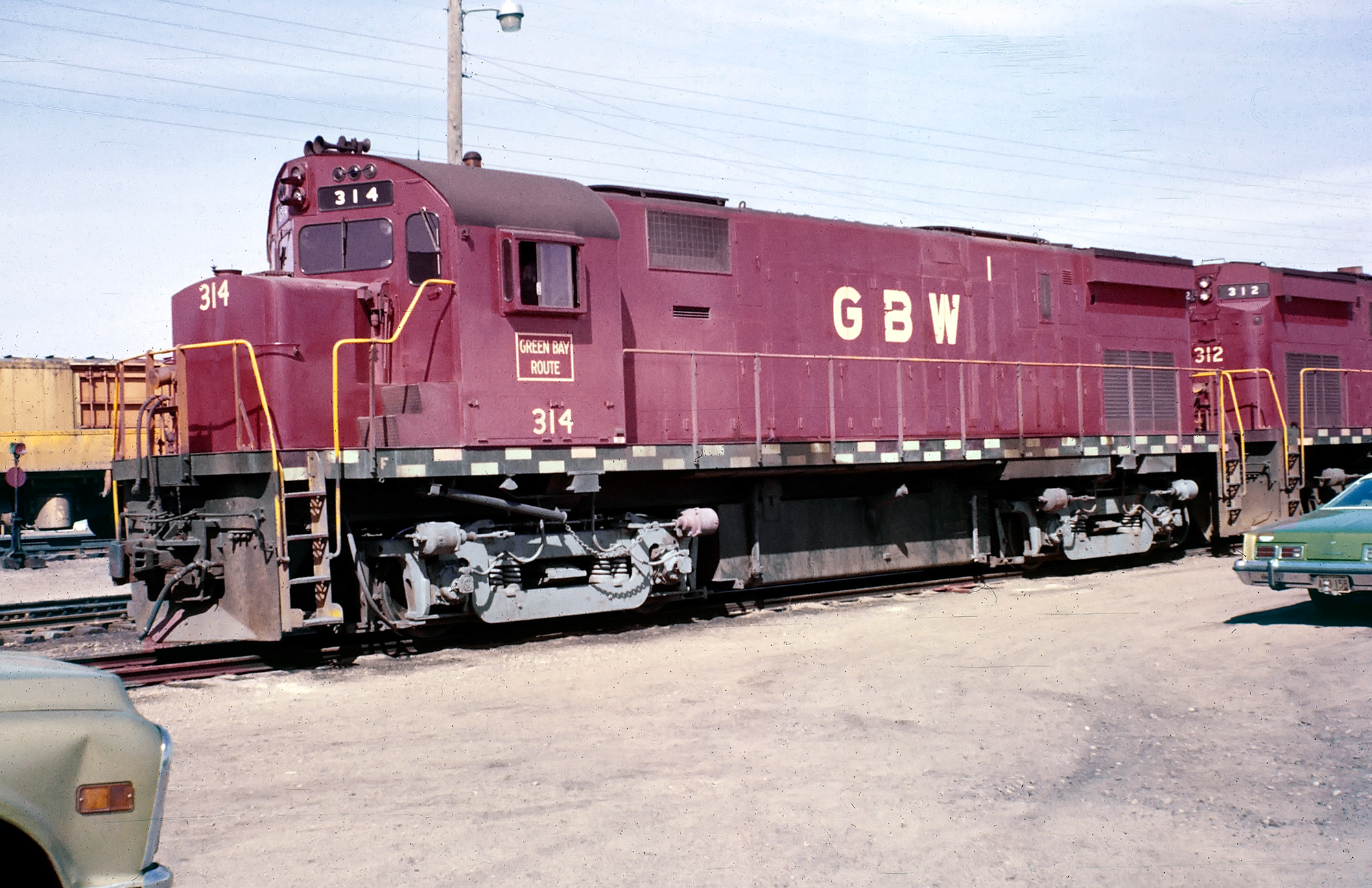 Green Bay & Western C424's #312 and #314 layover in Wisconsin Rapids, Wisconsin on April 24, 1974. American-Rails.com collection.
The C424 vs. the C425
From a research standpoint, one of the most important interpretive points is the relationship between the C424 and the C425. The C425 (2,500 hp) is often described as an upgraded evolution of the C424 concept, reflecting Alco’s attempts to refine the product for specific railroad preferences. In practice, railroads that were comparing orders during the mid-1960s were not just choosing horsepower—they were choosing long-term standardization, support, and perceived reliability. That broader purchasing logic is one reason Alco struggled, even when its locomotives could perform.
Legacy
Like many Alcos, the C424’s later years were shaped by the economic realities of parts supply, shop familiarity, and corporate change. As Class I rosters consolidated and standardized, Alco products were often traded, retired, or sold off earlier than equivalent EMD power—not always because they were “bad locomotives,” but because fleet commonality and corporate procurement dynamics strongly favored EMD and GE.
Yet the C424 has enjoyed a meaningful afterlife on short lines, regionals, and industrial operators, where purchase price and rugged tractive performance could outweigh concerns about standardization. Some examples remained active long after their original owners retired them, and a small number are preserved.
Recent Articles


-
Pennsylvania Railroad Museums (2026): A Complete Guide
Oct 06, 26 12:09 AM
 Pennsylvania railroad museums—Strasburg, Steamtown, the Horseshoe Curve, the East Broad Top, and the depots and towers in between. Confirm hours on each site.
 -
Maryland Railroad Museums (2026): A Complete Guide
Oct 05, 26 11:53 PM
 Maryland railroad museums—the Baltimore roundhouse, Ellicott City station, Bowie, Gaithersburg’s Buffalo Creek & Gauley 14, and the Western Maryland collections.
 -
Ohio Railroad Museums (2026): A Complete Guide
Oct 05, 26 05:51 PM
 Ohio railroad museums—the Age of Steam Roundhouse, Bellevue, Worthington, Conneaut’s Nickel Plate 755, and the Dennison depot. Confirm hours on each site.
 -
Delaware Railroad Museums (2026): A Complete Guide
Oct 05, 26 02:43 PM
 Delaware railroad museums—Wilmington & Western at Greenbank, the Harrington tower and N5 caboose, Felton's 1868 depot, and the Selbyville station museum.
 -
C&O's M-1 Steam Turbine Locomotives: Specs, Roster, History
Oct 05, 26 12:13 PM
 Chesapeake & Ohio Class M-1 steam-turbine-electrics. Three Baldwin-Westinghouse locomotives, 500–502, built 1947–48 for The Chessie. Specs, the 2-C1+2-C1-B arrangement, and a roster. All scrapped…
 -
N&W 2-6-6-2 Locomotives (Class Z): Specs, Roster, History
Oct 05, 26 11:44 AM
 Norfolk & Western Class Z 2-6-6-2s. One hundred ninety compound Mallets, 1300–1489, from Richmond, Baldwin, and Schenectady, 1912–1918. Diagram specs, the Z-1b rebuilds, Z-2 1399, and a roster. No…
 -
Scenic Train Rides (USA 2026): State Guide to Tourist Railroads
Oct 04, 26 12:17 AM
 Scenic and tourist train rides in all 50 states for 2026. Colorado narrow gauge, Pennsylvania steam, Alaska’s White Pass, and the states with no full-size ride this month. Confirm on the railroad.
 -
Wyoming Scenic Train Rides (2026): A Complete Guide
Oct 03, 26 12:07 AM
 Wyoming has no full-size tourist railroad on the calendar in October 2026. Cheyenne Depot Museum and Douglas Railroad Museum are static. Union Pacific 4014’s posted public trip is a November run to De…
 -
Washington Scenic Train Rides (2026): A Complete Guide
Oct 02, 26 11:53 PM
 Washington tourist trains in 2026—Mount Rainier Scenic at Elbe, the Northwest Railway Museum, and Chehalis-Centralia. Lake Whatcom has no 2026 date on its ticket page.
 -
Wisconsin Scenic Train Rides (2026): A Complete Guide
Oct 02, 26 11:48 PM
 Wisconsin tourist trains in 2026—Wisconsin Great Northern, Osceola & St. Croix Valley, Mid-Continent, East Troy, and the National Railroad Museum.
 -
Pennsylvania Railroad Class Q2 4-4-6-4: Specs, Roster, History
Oct 02, 26 11:28 PM
 Pennsylvania Railroad Class Q2 4-4-6-4 duplexes. Twenty-six engines, 6131 and 6175–6199, Altoona 1944–45. Form 109-J specs, the 7,987 hp test of 6175, and a roster. All scrapped.
 -
Utah Scenic Train Rides (2026): A Complete Guide
Oct 02, 26 11:18 PM
 Utah tourist trains in 2026—Heber Valley Railroad from Heber City. Golden Spike at Promontory is a locomotive demonstration, not a line-haul ride.
 -
South Dakota Scenic Train Rides (2026): A Complete Guide
Oct 02, 26 11:06 PM
 South Dakota’s 2026 scenic train is the Black Hills Central 1880 Train, Hill City to Keystone. Steam is the summer assignment. Confirm the engine.
 -
Oregon Scenic Train Rides (2026): A Complete Guide
Oct 02, 26 11:04 PM
 Oregon tourist trains in 2026—Oregon Coast Scenic from Rockaway Beach, Mount Hood at Hood River, Eagle Cap from Elgin, and the Oregon Rail Heritage Center in Portland.
 -
Oklahoma Scenic Train Rides (2026): A Complete Guide
Oct 02, 26 10:36 PM
 Oklahoma has no full-size scenic railroad on an October 2026 calendar. Oklahoma Railway Museum Halloween and Polar trains, the El Reno trolley, and the Heartland Flyer.
 -
North Dakota Scenic Train Rides (2026): A Complete Guide
Oct 02, 26 01:14 PM
North Dakota has no tourist railroad on a 2026 calendar. Ride Amtrak’s daily Empire Builder. The Fort Lincoln Trolley in Mandan is not a current ticket. -
Nebraska Scenic Train Rides (2026): A Complete Guide
Oct 02, 26 10:11 AM
 Nebraska has no full-size scenic railroad in 2026. The Omaha Zoo Railroad runs weekends through October 4. Ride Amtrak’s California Zephyr across the state.
 -
Missouri Scenic Train Rides (2026): A Complete Guide
Oct 02, 26 09:56 AM
 Missouri tourist trains in 2026—Branson Scenic Railway and the St. Louis, Iron Mountain & Southern at Jackson. Belton has no 2026 schedule posted.
 -
Minnesota Scenic Train Rides (2026): A Complete Guide
Oct 02, 26 09:52 AM
 Minnesota tourist trains in 2026—North Shore Scenic Railroad in Duluth, the Duluth River Train, and the Como-Harriet streetcar.
 -
Kansas Scenic Train Rides (2026): A Complete Guide
Oct 02, 26 09:32 AM
 Kansas tourist trains in 2026—the Abilene & Smoky Valley Railroad. Santa Fe 3415 is in overhaul. Midland Railway at Baldwin City is closed.
 -
Iowa Scenic Train Rides (2026): A Complete Guide
Oct 02, 26 08:41 AM
 Iowa tourist trains in 2026—Boone & Scenic Valley across the Bass Point Creek High Bridge, and Midwest Central’s December North Pole trains
 -
Indiana Scenic Train Rides (2026): A Complete Guide
Oct 02, 26 08:35 AM
 Indiana tourist trains in 2026—French Lick Scenic Railway, Nickel Plate Express, Hoosier Valley, and Hesston. Whitewater Valley is suspended.
 -
Illinois Scenic Train Rides (2026): A Complete Guide
Oct 02, 26 12:28 AM
 Illinois tourist trains in 2026—Illinois Railway Museum, Monticello Railway Museum, Fox River Trolley, and Silver Creek & Stephenson.
 -
Texas Scenic Train Rides (2026): A Complete Guide
Oct 02, 26 12:14 AM
 Texas tourist trains in 2026—Texas State Railroad, Grapevine Vintage Railroad, Austin Steam Train's Hill Country Flyer, and the Galveston Railroad Museum.
 -
Tennessee Scenic Train Rides (2026): A Complete Guide
Oct 02, 26 12:03 AM
Tennessee tourist trains in 2026—Tennessee Valley Railroad Museum, Dollywood Express, Three Rivers Rambler Christmas trains, and the Tennessee Central Railway Museum. -
South Carolina Scenic Train Rides (2026): A Complete Guide
Oct 01, 26 11:52 PM
 South Carolina's tourist train is the South Carolina Railroad Museum in Winnsboro—Blue Granite Express, pumpkin trains, and Santa trains on the old Rockton & Rion.
 -
Mississippi Scenic Train Rides (2026): A Complete Guide
Oct 01, 26 11:38 PM
 Mississippi has no regular tourist railroad in 2026. Ride Amtrak through the state, or book the excursion lines in Alabama, Tennessee, Louisiana, or Arkansas.
 -
Louisiana Scenic Train Rides (2026): A Complete Guide
Oct 01, 26 02:52 PM
 Louisiana has no regular full-size tourist railroad in 2026. New Orleans Polar Express returns December 11–31. Museums at Long Leaf, DeQuincy, and Jackson.
 -
Kentucky Scenic Train Rides (2026): A Complete Guide
Oct 01, 26 02:45 PM
 Kentucky tourist trains in 2026—Big South Fork Scenic Railway, Bluegrass Scenic Railroad, Kentucky Railway Museum, and My Old Kentucky Dinner Train.
 -
Georgia Scenic Train Rides (2026): A Complete Guide
Oct 01, 26 02:27 PM
 Georgia tourist trains in 2026—Blue Ridge Scenic Railway, SAM Shortline, Azalea Sprinter, Savannah shop rides, and what to confirm at Stone Mountain.
 -
Arkansas Scenic Train Rides (2026): A Complete Guide
Oct 01, 26 01:02 PM
 Arkansas tourist trains in 2026—Arkansas & Missouri through the Boston Mountains, and the Eureka Springs & North Arkansas dinner and excursion trains.
 -
Alabama Scenic Train Rides (2026): A Complete Guide
Oct 01, 26 12:59 PM
Alabama tourist trains in 2026—Heart of Dixie Railroad Museum at Calera, North Alabama Railroad Museum at Chase, and the Wales West Light Railway at Silverhill. -
The Circus Train: How Such Attractions Reached Distant Cities
Oct 01, 26 12:22 PM
 How circuses moved by rail: Coup's 1872 flats, the Ringling train's sections and car counts, the 1918 Hammond wreck, and the last show on May 21, 2017.
 -
West Virginia Halloween Train Rides (2026)
Oct 01, 26 12:19 PM
 2026 West Virginia Halloween train. Cass Scenic Halloween Train, October 30 and 31, steam, 5:00 p.m. from Cass Depot. Adult $75. About two hours to Whittaker. Family ride.
 -
Wisconsin Halloween Train Rides (2026)
Oct 01, 26 12:11 PM
2026 Wisconsin Halloween trains. Mid-Continent Pumpkin Special October 24–25, adult $24, pumpkins extra. Halloween Flyer October 24 at 4:30 p.m., adult $30. Osceola Pumpkin Express boards in Osceola… -
Utah Halloween Train Rides (2026)
Oct 01, 26 12:00 PM
 2026 Utah Halloween trains at Heber Valley Railroad. Pumpkin Train, about 40 minutes, with a cookie and a pumpkin. Halloween Express, about 90 minutes to Grim Hollow, Monday, Thursday, and Friday even…
 -
Texas Halloween Train Rides (2026)
Oct 01, 26 11:28 AM
 2026 Texas Halloween train. Texas State Railroad Spooky Special, adult-only, October 24. Boards Palestine at 5:00 p.m. About five hours to Rusk and back. Dinner on the grounds. Not steam. No fare on t…
 -
Tennessee Halloween Train Rides (2026)
Oct 01, 26 12:15 AM
 2026 Tennessee Halloween trains. Tennessee Valley Railroad Museum Rails, Wizards & Spells, selected days September 18 through October 25, from $35, about 2.5 hours. Spells & Potions tea from $60. The…
 -
Frisco's "Firefly" (Train): Consist, Route, Timetable
Sep 30, 26 11:37 PM
 Frisco Firefly—daylight streamliner, Kansas City to Tulsa and Oklahoma City. Trains 117 and 118. Pacifics 1018, 1026, and 1031. Last run May 22, 1960.
 -
South Carolina Halloween Train Rides (2026)
Sep 30, 26 11:29 PM
 2026 South Carolina Halloween train. South Carolina Railroad Museum Pumpkin Patch Express, the two Saturdays before Halloween. About three miles to the Greenbriar pavilion. Pumpkin for children 12 and…
 -
Oregon Halloween Train Rides (2026)
Sep 30, 26 08:10 PM
2026 Oregon Halloween train. Sumpter Valley Railroad Halloween Express at the Sumpter Depot, calendar window October 31 at 11:00 a.m. through November 1 at 12:30 p.m. Fare and the individual clocks ar… -
Oklahoma Halloween Train Rides (2026)
Sep 30, 26 03:45 PM
2026 Oklahoma Halloween train. Oklahoma Railway Museum, October 30 and 31, from Oakwood Station in Oklahoma City. Adults $15, children 3–12 $8. A candy bag with the ride. -
McCloud River Railroad: Serving The Timber Industry (1897-2009)
Sep 30, 26 03:37 PM
 McCloud River Railroad—Mount Shasta City to McCloud, Hambone, and Burney. Opened August 1, 1897. Alco No. 25 and EMD SD38s. Dinner train through January 2010. Railbikes in 2026; a dinner train is stil…
 -
Nevada Halloween Train Rides (2026)
Sep 30, 26 03:30 PM
2026 Nevada Halloween trains in Ely. Nevada Northern Pumpkin Patch Caper and Haunted Ghost Train. Adult tickets start at $45. Dates are on the railroad’s ticket calendar. Boulder City stays off until… -
Missouri Halloween Train Rides (2026)
Sep 30, 26 11:12 AM
 2026 Missouri Halloween trains. St. Louis Iron Mountain & Southern Pumpkin Patch Train on October 3, 4, 10, and 11, and Halloween Express on October 31 at 1:00 p.m. Jackson depot. No fare on the sched…
 -
Minnesota Halloween Train Rides (2026)
Sep 30, 26 11:06 AM
 2026 Minnesota Halloween trains. North Shore Scenic Great Pumpkin Train in Duluth, October 15–18. Everyone gets a pumpkin. Terror Train is October 30, an adult costume party, about three hours. Fares…
 -
Maryland Halloween Train Rides (2026)
Sep 30, 26 10:42 AM
 2026 Maryland Halloween trains. Western Maryland Scenic Pumpkin Patch Limited, October 17, 18, 24, and 25, $14. Colesville Trolleyween October 24, 25, and 31.
 -
West Side Lumber Company Railroad: Roster, History, Lines
Sep 30, 26 09:45 AM
 West Side Lumber at Tuolumne, California. Three-foot Shay and Heisler logging railroad. Lima shop numbers, builder specs, and where the engines are in 2026.
 -
Kansas Halloween Train Rides (2026)
Sep 30, 26 09:41 AM
 2026 Kansas Halloween train. Abilene & Smoky Valley Pumpkin Harvest Express, October 17 through 31. About one hour. Shop prices $35.56 to $41.02. Everyone picks a pumpkin.
 -
Iowa Halloween Train Rides (2026)
Sep 29, 26 11:58 PM
2026 Iowa Halloween train. Boone & Scenic Valley Pumpkin Express, October 10, 10:00 a.m. from 225 10th Street. About 1 hour 15 minutes. Children pick a pumpkin.