
Baldwin "DT-6-6-2000" Locomotives: Specs, Roster, Data Sheet
Last revised: December 28, 2024
By: Adam Burns
The DT-6-6-2000 was one of the most interesting models released by a major manufacturer.
This design was a specialized type of locomotive intended for use in heavy drag service over short distances, such as on terminal railroads or moving cuts of cars between local yards.
Believing that there was a market for such, Baldwin released the DT-6-6-2000 directly after World War II, one of first models to employ the company's own prime mover.
For a switcher, it was massive and, ironically longer than virtually every road switcher or cab unit on the market at that time.
As John Kirkland explains in "The Diesel Builders: Volume Three," the locomotive featured dual control stands for maximum flexibility, thus allowing operation in either direction without turning the locomotive.
Ironically, for a design geared towards switching, the DT-6-6-2000 retained a high-hood on both ends, thus restricting a crew's 360-degree view from either the ground (seeing the engineer) or the cab.
Unfortunately, the design had mechanical issues and railroads were never really interested in such a specialized locomotive resulting in fewer than 50 constructed when production had ended.
Photos
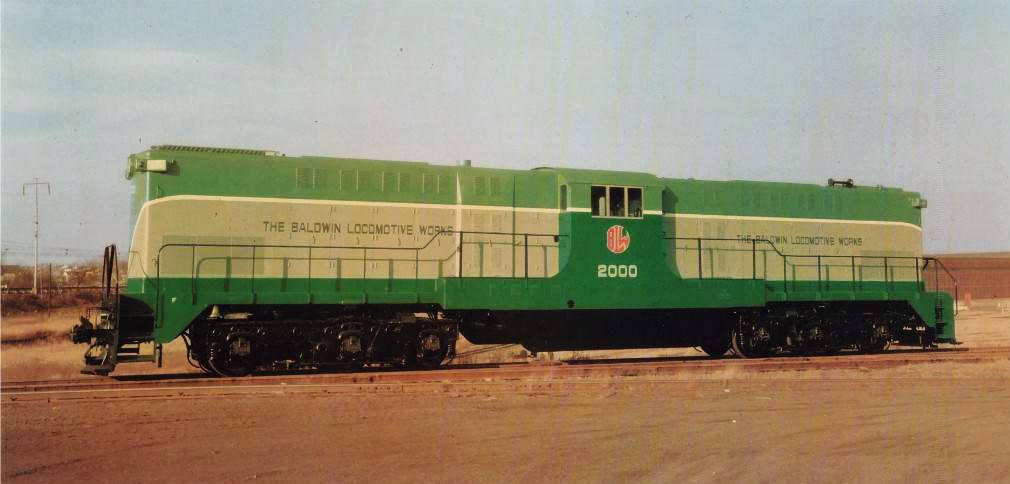 A Baldwin Locomotive Works builder's photo featuring one of its massive DT-6-6-2000 transfer switchers, demonstrator #2000, in December, 1948. This unit became Santa Fe #2606. Unfortunately, the transfer market never really took off and coupled with Baldwin's chronic reliability issues few of these sold. Despite their problems, Baldwin's diesels could certainly pull thanks to their powerful Westinghouse traction motors. For this reason, short line SMS Rail Lines in New Jersey still employs a rather sizable fleet of Baldwins in freight service.
Overview
The DT-6-6-2000 was an incredibly large switcher, originally cataloged in May of 1946. At over 70 feet in length, and weighing a hefty 360,000 pounds (180 tons), the switcher was certainly one of the largest, longest, and heaviest of its kind ever built.
It utilized two of Baldwin's 608NA prime movers equipped with C-C trucks and producing 2,000 horsepower. Even into the 1940s, Baldwin still shrugged off the notion of diesels as main line freight locomotive.
The company also held the philosophy that any such model it did produce should be customized to whatever task a railroad desired or requested.
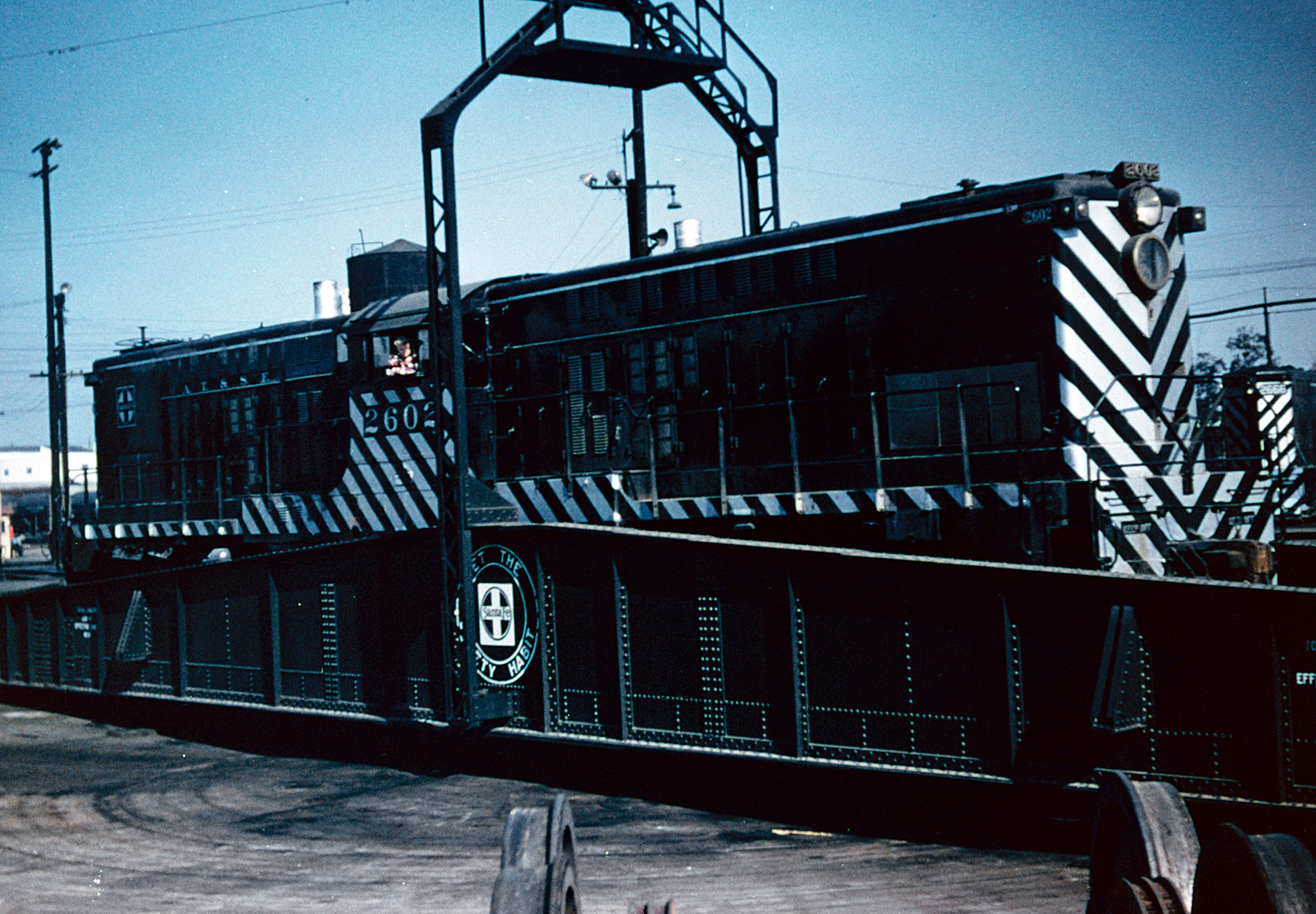 Santa Fe DT-6-6-2000 #2602 goes for a spin on the turntable at Redondo Junction (Los Angeles); July, 1956. American-Rails.com collection.
This notion harkened back to the days of steam, which were always manufactured and tailored to a railroad's specific needs.
This specialization led to the DT-6-6-2000's development. The switcher's classification was similarly based from the steam era and is why it includes many letters, dashes, and numbers.
The "DT" referred to Diesel Transfer while the first "6" referred to six overall axles; the second "6" referred to six powered traction motors; and "2000" stood for the horsepower rating.
The original DT-6-6-2000 variant was Elgin, Joliet & Eastern #100 completed on May 13, 1946. As a test-bed unit it was slightly different from the production DT-6-6-2000's with normally aspirated (NA), 8-cylinder engines and no crosswalks.
The latter was a feature requested on production DT-6-6-2000's, increasing their overall length by nearly 4 feet.
EJ&E #100
| Delivery Date | 5/13/1946 |
| Baldwin Class | 0-6-6-0-1000/2 NA5 |
| Engine | 608NA, 8-Cylinder In-Line (2) |
| Engine Builder | De La Vergne |
| Horsepower | 2000 |
| Carbody Styling | Baldwin |
| Length (Between Coupler Pulling Faces) | 70' 6" |
| Weight | 365,000 Lbs |
| Height (Top Of Rail To Top Of Cab) | 14' |
| Width | 10' |
| Trucks | C-C |
| Truck Type | GSC Rigid Bolster |
| Truck Wheelbase | 13' |
| Wheel Size | 42" |
| Traction Motors | 370F (6), Westinghouse |
| Traction Generator | 480C, Westinghouse |
| Auxiliary Generator | YG40D, Westinghouse |
| Gear Ratio | 15:63 |
| Tractive Effort Rating | 64,200 Lbs at 9.4 MPH. |
| Top Speed | 60 MPH |
Data Sheet and Specifications
| Entered Production | 3/3/1948 (Elgin, Joliet & Eastern #101) |
| Years Produced | 3/3/1948 - 8/23/1950 |
| Baldwin Class | DT-6-6-1000/2 SC |
| Engine | 606SC, 6-Cylinder In-Line, Supercharged |
| Engine Builder | De La Vergne |
| Turbocharger | Model H-503 (Elliott Company) |
| Horsepower | 2000 |
| RPM | 625 |
| Carbody Styling | Baldwin |
| Length (Between Coupler Pulling Faces) | 74' |
| Weight | 354,000 Lbs (Optional ballasting up to 375,000 Lbs.) |
| Height (Top Of Rail To Top Of Cab) | 14' |
| Width | 10' |
| Trucks | C-C |
| Truck Type | GSC Rigid Bolster |
| Truck Wheelbase | 13' |
| Wheel Size | 42" |
| Traction Motors | 370G (6), Westinghouse |
| Traction Generator | 480F, Westinghouse |
| Auxiliary Generator | YG40D, Westinghouse |
| Gear Ratio | 15:63 |
| Tractive Effort Rating | 64,200 Lbs at 9.4 MPH. |
| Top Speed | 60 MPH |
Production Roster
Total Built = 45
| Owner | Road Number | Baldwin Serial Number | Construction Number | Completion Date |
|---|---|---|---|---|
| Elgin, Joliet & Eastern | 101 | 1 | 73709 | 3/3/1948 |
| Elgin, Joliet & Eastern | 102 | 2 | 73710 | 3/7/1948 |
| Elgin, Joliet & Eastern | 103 | 3 | 73711 | 3/13/1948 |
| Elgin, Joliet & Eastern | 104 | 4 | 73712 | 3/19/1948 |
| Elgin, Joliet & Eastern | 105 | 5 | 73713 | 4/1/1948 |
| Elgin, Joliet & Eastern | 106 | 6 | 73714 | 3/31/1948 |
| Elgin, Joliet & Eastern | 107 | 7 | 73715 | 4/8/1948 |
| Elgin, Joliet & Eastern | 108 | 8 | 73716 | 4/21/1948 |
| Elgin, Joliet & Eastern | 109 | 9 | 73717 | 4/23/1948 |
| Elgin, Joliet & Eastern | 110 | 10 | 73718 | 4/29/1948 |
| Atchison, Topeka & Santa Fe | 2600 | 11 | 73748 | 6/3/1948 |
| Elgin, Joliet & Eastern | 111 | 12 | 73719 | 5/6/1948 |
| Elgin, Joliet & Eastern | 112 | 13 | 73720 | 5/7/1948 |
| Elgin, Joliet & Eastern | 113 | 14 | 73721 | 5/24/1948 |
| Elgin, Joliet & Eastern | 114 | 15 | 73722 | 6/5/1948 |
| Elgin, Joliet & Eastern | 115 | 16 | 73723 | 6/7/1948 |
| Elgin, Joliet & Eastern | 116 | 17 | 73724 | 6/25/1948 |
| Elgin, Joliet & Eastern | 117 | 18 | 73725 | 7/1/1948 |
| Elgin, Joliet & Eastern | 118 | 19 | 73726 | 7/6/1948 |
| Elgin, Joliet & Eastern | 119 | 20 | 73727 | 7/12/1948 |
| Elgin, Joliet & Eastern | 120 | 21 | 73728 | 8/2/1948 |
| Elgin, Joliet & Eastern | 121 | 22 | 73729 | 9/9/1948 |
| Elgin, Joliet & Eastern | 122 | 23 | 73730 | 8/13/1948 |
| Elgin, Joliet & Eastern | 123 | 24 | 73731 | 9/13/1948 |
| Elgin, Joliet & Eastern | 124 | 25 | 73732 | 9/13/1948 |
| Elgin, Joliet & Eastern | 125 | 26 | 73733 | 9/13/1948 |
| Trona Railway | 50 | 27 | 74123 | 4/22/1949 |
| Trona Railway | 51 | 28 | 74124 | 4/22/1949 |
| St. Louis Southwestern Railway (Cotton Belt) | 260 | 29 | 73532 | 5/28/1948 |
| Minneapolis, Northfield & Southern | 20 | 30 | 74137 | 12/17/1948 |
| Minneapolis, Northfield & Southern | 21 | 31 | 74138 | 12/30/1948 |
| Minneapolis, Northfield & Southern | 22 | 32 | 74139 | 1/12/1949 |
| Minneapolis, Northfield & Southern | 23 | 33 | 74140 | 1/14/1949 |
| Minneapolis, Northfield & Southern | 24 | 34 | 74141 | 1/18/1949 |
| Baldwin Locomotive Works | 2000 (2nd): Became Santa Fe #2606 | 35 | 73980 | 12/1/1948 |
| Atchison, Topeka & Santa Fe | 2601 | 36 | 74434 | 8/10/1949 |
| Atchison, Topeka & Santa Fe | 2602 | 37 | 74435 | 7/26/1949 |
| Atchison, Topeka & Santa Fe | 2603 | 38 | 74436 | 11/23/1949 |
| Atchison, Topeka & Santa Fe | 2604 | 39 | 74437 | 12/8/1949 |
| Atchison, Topeka & Santa Fe | 2605 | 40 | 74438 | 11/29/1949 |
| Duluth, South Shore & Atlantic | 300 | 41 | 74668 | 10/25/1949 |
| Duluth, South Shore & Atlantic | 301 | 42 | 74669 | 10/23/1949 |
| Duluth, South Shore & Atlantic | 302 | 43 | 74670 | 10/24/1949 |
| Baldwin Locomotive Works | 2001 (2nd): Became Elgin, Joliet & Eastern #126 | 44 | 74671 | 2/1/1950 |
| Duluth, South Shore & Atlantic | 303 | 45 | 74672 | 8/23/1950 |
Reception
As it turned out there was not much of a market for the transfer switcher; Baldwin ultimately only sold 46 units by the time production had ended in February of 1950.
The Elgin, Joliet & Eastern purchased the most, 27 (including one of the demonstrators), and actually became quite famous for its fleet although they would later be re-powered with Electro-Motive's reliable model 567 prime movers.
With EMD power plants the locomotives remained in service into the 1970's. Today, one Baldwin DT-6-6-2000 remains preserved; former Minneapolis, Northfield & Southern Railway #21 at the Illinois Railway Museum.
Sources
- Foster, Gerald. A Field Guide To Trains. New York: Houghton Mifflin, 1996.
- Kirkland, John F. Diesel Builders, The: Volume Three, Baldwin Locomotive Works. Pasadena: Interurban Press, 1994.
- Pinkepank, Jerry A. Diesel Spotter's Guide. Milwaukee: Kalmbach Publishing Company, 1967.
- Solomon, Brian. Baldwin Locomotives. Minneapolis: Voyageur Press, 2009.
Recent Articles


-
Lehigh and New England Railroad: Map, Rosters, History
Sep 21, 26 12:33 AM
 Lehigh & New England—South Mountain & Boston 1873, named April 2 1895. Anthracite, cement, Maybrook. Last Camelbacks, Alco FAs. Voluntary shutdown October 31 1961.
 -
TVRM Chattanooga Dinner Train (2026): Dates, Tickets & What to Expect
Sep 21, 26 12:20 AM
 2026 TVRM Chattanooga Dinner Train Experience—Grand Junction, select Fri/Sat March 6–October 24, three-course, 2–3 hours, from $110. Confirm on tvrail.com.
 -
Lehigh and Hudson River Railroad: Map, Rosters, History
Sep 20, 26 11:55 PM
 Lehigh & Hudson River—Warwick Valley 1860, Railway April 1 1882. Easton–Maybrook bridge road, Alphabet Route, Alco RS-3s and C420s. Conrail April 1 1976.
 -
Royal Gorge First Class Dinner Train (2026)
Sep 20, 26 11:47 PM
 2026 Royal Gorge Route First Class Lunch & Dinner—Cañon City, about 2 hours, from $199+, 12+. Confirm on royalgorgeroute.com.
 -
GE "44-Tonner" Locomotives: Roster, Specs, History
Sep 20, 26 11:09 PM
 GE 44-ton switcher—90,000-pound rule, Caterpillar D17000 center-cab, Sept 4 1940 CB&Q 9103 through Oct 1956 Dansville & Mount Morris 1. Phases, serial roster, PRR 46.
 -
Strasburg Rail Road Dining (2026): Dinner on the Rails & Elegant Expre
Sep 20, 26 11:00 PM
 2026 Strasburg Rail Road seated meals—Dinner on the Rails, Elegant Express, Valentine dinner. Lee E. Brenner diner. Confirm on strasburgrailroad.com.
 -
International-Great Northern Railroad: Map, History, Timetables
Sep 20, 26 10:43 PM
 International–Great Northern—Houston & Great Northern 1866, International Railroad 1870, merged Sept 30 1873. Palestine, Longview–Laredo, Gould, Missouri Pacific March 1 1956.
 -
Nevada Northern Taste of Italy Dinner Train (2026)
Sep 20, 26 03:25 PM
 2026 Nevada Northern Taste of Italy—adults-only multi-course Italian dinner, steam when healthy, East Ely. Sep. 19 gala listed. Confirm on nnry.com.
 -
Cape Cod Dinner Train (2026): Dates, Tickets & What to Expect
Sep 20, 26 02:53 PM
 Cape Cod Central Dinner Train—Hyannis, Buzzards Bay, and Falmouth. Four-course, 3–3½ hours, from $99.99. Confirm on capetrain.com.
 -
Erie Steam Locomotives: History, Roster & Photos
Sep 20, 26 11:55 AM
 Erie Railroad steam—Camelback 2-8-0s, 155 N-1 Mikados, 105 Berkshires, K-class Pacifics, Triplexes. Post-1900 roster after Drury. Last steam March 17, 1954.
 -
Erie Railroad Diesel Roster: All-Time
Sep 20, 26 11:47 AM
 Erie Railroad diesel—boxcabs 1926, FTs 1944, F3/F7, FA/PA, GP7/GP9, Baldwins, Limas. All-time roster with serials, orders, classes. Last steam March 17 1954. EL October 17 1960.
 -
Erie Railroad: Map, Passenger Trains, Logo, History
Sep 20, 26 11:44 AM
 Erie Railroad—New York & Erie 1832, Piermont–Dunkirk May 14 1851, six-foot then standard June 1880, Chicago 1883. High-and-wide fourth way. Erie Lackawanna October 17 1960.
 -
Colebrookdale Railroad Dining (2026): Secret Valley Dinner Train
Sep 20, 26 11:36 AM
 2026 Colebrookdale Railroad dinner in Boyertown—Secret Valley Dining Class, about 2 hours. Saturday evenings. Confirm on colebrookdalerailroad.com.
 -
Boone & Scenic Valley Wolf Dinner Train (2026)
Sep 19, 26 08:15 PM
 2026 Boone & Scenic Valley Wolf Dinner Train—Des Moines River valley, Bass Point Creek High Bridge, Union Pacific dining cars. Confirm on bsvrr.com.
 -
C&NW 4-6-2s 1617 & 1620: Minnesota 400 Yellow Jackets
Sep 19, 26 11:28 AM
 C&NW Class E Pacifics 1617 and 1620—Alco Schenectady 1917, yellow-and-green E-4-style shrouds 1941 for the Minnesota 400. Crews called them Yellow Jackets. Renumbered 617/620. Scrapped 1956.
 -
Erie Lackawanna Diesel Roster: All-Time
Sep 19, 26 10:13 AM
 Erie Lackawanna diesel—Erie and DL&W inheritance, GP35s, U25Bs, SD45/SDP45/SD45-2, U34CH. All-time roster with serials and orders. Conrail April 1 1976.
 -
Erie Lackawanna Railway: Map, History, Logo
Sep 19, 26 10:06 AM
 Erie Lackawanna Railway—Erie and DL&W, October 17 1960–March 31 1976. Von Willer, White revival, Dereco, Agnes, Conrail. High-and-wide Chicago main. Map, logo, what remains.
 -
"Empire State Express" (1941 Train): Timetables, Route, Consist
Sep 18, 26 10:59 PM
 NYC Empire State Express—George Daniels 1891 day train, 999’s 112.5 mph claim, Budd stainless streamliner December 7 1941, Cleveland and Detroit sections, diesels, 1967 name drop. Timetables, consist…
 -
New York Central 4-6-4s 5426 & 5429: Empire State Express Hudsons
Sep 18, 26 10:32 PM
 NYC J-3a Hudsons 5426 and 5429—Alco 1937, Budd stainless shrouds 1941 for the Empire State Express. Pearl Harbor inaugural. Shrouds off by 1950. Neither preserved.
 -
"Stourbridge Lion" Locomotive: Facts, History, Photos
Sep 18, 26 10:27 PM
 Stourbridge Lion—Foster, Rastrick 0-4-0, first steam locomotive in the United States. Horatio Allen, Honesdale, August 8, 1829. Too heavy for D&H gravity track. Boiler in Baltimore; Colonie replic…
 -
Delaware & Hudson Steam Roster (Post 1900)
Sep 18, 26 10:01 PM
 Delaware & Hudson steam—Camelback 2-8-0s, Loree high-pressure compounds, Class K 4-8-4s, forty Challengers. Post-1900 class roster after Drury. Last steam July 21, 1953.
 -
Boston & Maine Steam Roster (Post 1900)
Sep 18, 26 02:57 PM
 Boston & Maine steam—B-15 Moguls, K-8 Consolidations, P-4 Lima Pacifics, T-1 Limas, R-1 Mountains. Post-1900 class roster after Drury. Last steam July 23, 1956.
 -
Boston & Maine Diesel Roster (All-Time)
Sep 18, 26 01:25 PM
 Boston & Maine diesel—boxcab 1100 1935, Flying Yankee 6000, FTs, E7s, BL2s, GP7/GP9, GP38-2s and GP40-2s. All-time roster. Last steam July 23, 1956.
 -
Mid-Continent Railway Museum Dining (2026)
Sep 18, 26 01:21 PM
 2026 Mid-Continent dining in North Freedom—select-date seated meals in luxury cars, reservations required. Pizza Limited June 28. Confirm on midcontinent.org.
 -
Bessemer & Lake Erie Steam Roster (Post 1900)
Sep 18, 26 12:11 PM
Bessemer & Lake Erie steam—C3A 150–151, D1A/D2A Santa Fes, 47 H1 Texas types after Burlington. Post-1900 class roster after Drury. Last steam 2-8-0 156, May 14, 1953. -
Bessemer & Lake Erie Diesel Roster (All Time)
Sep 18, 26 12:09 PM
 Bessemer & Lake Erie diesel—Westinghouse 281 1936, Baldwin DRS-6-6-1500s, F7s 1950–53, SD7/SD9/SD18/SD38 family, RSD-15s. All-time roster. Last steam 2-8-0 156, May 14, 1953.
 -
Bangor & Aroostook Steam Roster (Post 1900)
Sep 18, 26 11:21 AM
 Bangor & Aroostook steam—Manchester Ten-Wheelers, Alco Mountains 100–109, G-2 Consolidations, Pacifics 250–254. Post-1900 class roster after Drury. Last steam Pacific 251, July 22, 1951.
 -
Bangor & Aroostook Diesel Roster (All Time)
Sep 18, 26 11:09 AM
 Bangor & Aroostook diesel—F3s 1947, eight BL2s, E7s, GP7s leased to the PRR, GP9s, GP38s. All-time roster. Last regular steam July 22, 1951.
 -
B&O Steam Locomotive Roster (Post 1900)
Sep 18, 26 10:33 AM
 Baltimore & Ohio steam—Old Maude, E-27 Consolidations, Q Mikados, Big Sixes, EM-1 Yellowstones, President Pacifics. Post-1900 class roster after Drury. Last public steam May 17, 1958.
 -
Baltimore & Ohio (B&O): Diesel Roster (All-Time)
Sep 18, 26 10:28 AM
 Baltimore & Ohio diesel—boxcab 1925, EMC 50 1935, EA 1937, FTs, F3s, F7s, FA-2s, sharks, GP7/GP9, GP30s after C&O 1963, SD50s 8576–8595 1984. All-time roster. Last steam 1958.
 -
Detroit & Toledo Shore Line Railroad: Map, Roster, History
Sep 18, 26 12:32 AM
 Detroit & Toledo Shore Line—Pleasant Bay 1898, named 1899, Detroit–Toledo freight bridge, GTW and Clover Leaf/NKP/N&W. Merged into Grand Trunk Western June 26, 1981.
 -
Lackawanna Steam Locomotives: History, Roster & Photos
Sep 18, 26 12:17 AM
 Delaware, Lackawanna & Western steam—Camelback 2-8-0s, Mikados, freight Pacifics, Poconos 4-8-4s, Hudsons. Post-1900 roster after Drury. Last steam July 13, 1953.
 -
Lackawanna (DL&W) Diesel Roster: All Time
Sep 18, 26 12:11 AM
Delaware, Lackawanna & Western diesel—boxcabs 1926, EMC SC 425–426 1935, FTs 1945, F3/F7/E8, GP7s, RS-3s, FM Train Masters. All-time roster. Last steam 1953. -
Lackawanna Railroad: Map, History, Viaducts, Rosters
Sep 18, 26 12:04 AM
 TDelaware, Lackawanna & Western—Liggett’s Gap 1832, named March 11 1853, Hoboken–Buffalo, anthracite, Phoebe Snow, Cutoff and Tunkhannock. It merged with the Erie to form Erie Lackawanna on Octobe…
 -
Rail News, The Latest
Sep 17, 26 11:56 PM
This page provides a portal to the latest in rail news, from preservation and restortation subjects to other notable topics. -
Union Pacific Big Boy 4014 Sets First Holiday Tour for Make-A-Wish
Sep 17, 26 11:54 PM
Union Pacific Big Boy 4014’s first holiday tour: Cheyenne–Denver tickets, Nov. 21 Denver-area display, Make-A-Wish. Museum patrons Oct. 16; public Oct. 19. -
Conrail Diesel Roster (All Time)
Sep 17, 26 10:27 PM
Conrail diesel—~5,000 inherited 1976, Big Blue, GP15-1s, SD40-2s, SD50s, Dash-8s, SD60/60M/60I, SD80MACs. All-time CR-number roster. -
Chessie System (Railroad): The C&O, B&O, And WM
Sep 17, 26 09:38 PM
 Chessie System, Inc.—C&O, B&O, and Western Maryland. Kitten-C paint 1972, holding company February 26 1973, CSX November 1 1980, C&O into CSXT August 31 1987.
 -
Chesapeake & Ohio (C&O) Diesel Roster: All-Time
Sep 17, 26 06:01 PM
Chesapeake & Ohio diesel—late steam, no Fairbanks-Morse, E7s 1946, GP7/GP9 flood, F7s, GP40-2s, B30-7s, SD50s 1984–85. All-time roster. Steam ended 1956. -
Chesapeake & Ohio (C&O) Steam Roster: Post-1900
Sep 17, 26 03:18 PM
 Chesapeake & Ohio steam—H-8 Alleghenies, K-4 Kanawhas, T-1 Texas, Greenbriers, H-6 1949 Mallets. Post-1900 class roster including Pere Marquette and Hocking Valley. Last steam 1956.
 -
Chesapeake and Ohio Railway: Map, Logo, History
Sep 17, 26 02:36 PM
 Chesapeake & Ohio Railway—Louisa Railroad 1836, named August 31 1868, Ohio River 1873. Coal, Chessie the kitten, Pere Marquette 1947, B&O control 1963, into CSX August 31 1987. Complete corporate…
 -
TVRM Valentine Train Ride (2026)
Sep 17, 26 02:31 PM
 2026 TVRM Valentine Train Ride in Chattanooga—Feb. 6–15, plated dinner, Grand Junction Depot. Confirm on tvrail.com.
 -
River Fox Train Dining (2026)
Sep 17, 26 02:29 PM
2026 River Fox Train in West Sacramento—Brunch Train and Murder Mystery dinner. 18095 County Road 117. Confirm on riverfoxtrain.com. -
Weehawken Terminal, Serving The West Shore Railroad
Sep 17, 26 01:38 PM
 Weehawken Terminal—West Shore / New York Central Hudson waterfront station, opened 1884. Five ferry slips, sixteen tracks, Weehawken Tunnel 4,014 feet. Last ferry March 25, 1959. Port Imperial and HBL…
 -
West Shore Railroad: Map, History, Timetables
Sep 17, 26 01:32 PM
 West Shore Railroad—New York, West Shore & Buffalo 1880–83, Weehawken to Buffalo. PRR-backed rival to the Central. Morgan settlement, 475-year NYC lease January 1 1886. CSX River Sub today.
 -
Jersey Central Diesel Locomotives: History, Roster & Photos
Sep 17, 26 01:20 PM
 Central Railroad of New Jersey diesel—boxcab 1000, Baldwin double-enders, F3s, Train Masters, SD35s, GP40Ps. All-time roster. Steam ended July 1, 1954.
 -
Jersey Central Steam Locomotives: History, Roster & Photos
Sep 17, 26 01:17 PM
 Central Railroad of New Jersey steam—Camelback Ten-Wheelers, USRA Mikados, G-class Pacifics, suburban tanks. Post-1900 class roster after Drury. Dieselized July 1, 1954.
 -
Jersey Central Railroad (CNJ): Map, Rosters, History
Sep 17, 26 01:14 PM
 Central Railroad of New Jersey—Elizabethtown & Somerville 1831, named April 23 1849. Communipaw, anthracite, Blue Comet, Reading/B&O control. Conrail April 1 1976. Complete corporate history.
 -
Central Vermont Diesel Locomotives: History, Roster & Photos
Sep 17, 26 11:35 AM
 Central Vermont diesel—Alco S-2s 1942, RS-3s, RS-11s from DW&P, EMD GP9s 1956–57, GP38ACs 1971. All-time roster. Last steam April 4, 1957.
 -
Central Vermont Steam Locomotives: History, Roster & Photos
Sep 17, 26 11:19 AM
 Central Vermont steam—ten Alco 2-10-4s of 1928, four U-1-a Mountains, Consolidations. Post-1900 class roster after Drury. Last steam April 4, 1957.


%3B%20July%2C%201956.%20American-Rails.com%20collection.)