The "Mainstreeter": NP's Secondary Train To Seattle
Last revised: August 25, 2024
By: Adam Burns
The Mainstreeter is sometimes forgotten as one of the Pacific
Northwest's important transcontinental streamliners: the Northern Pacific simply did not offer that many transcontinental services and the train was not launched until the 1950's.
Despite the Mainstreeter's lack of publicity it proved a very important run for the railroad. While the North Coast Limited always made headlines its second-tier sibling worked quietly earning the NP steady profits through the movement of mail and seasonal vacationers to the popular Yellowstone National Park.
In addition, the Mainstreeter was an all-stops service, meaning it paid a visit to every notable station along Northern Pacific's transcontinental corridor.
The train operated for nearly 20 years, surviving through the Burlington Northern era. It was finally discontinued with the start of Amtrak on May 1, 1971.
Photos
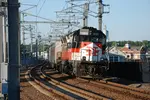
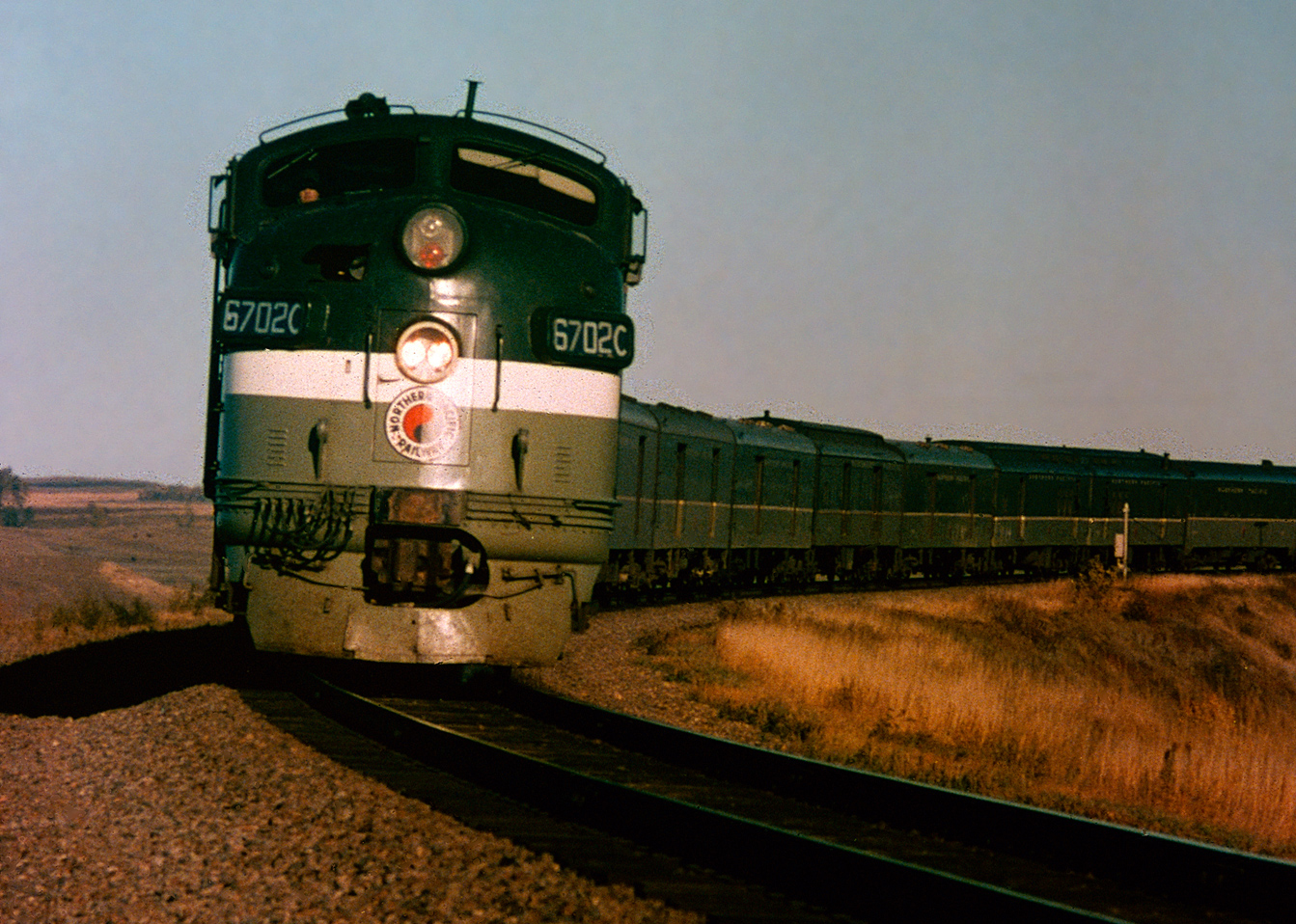 Northern Pacific F9A #6702-C with the westbound "Mainstreeter" near Valley City, North Dakota on the evening of September 27, 1964. Joe Stark photo. American-Rails.com collection.
History
Before the Northern Pacific launched the Mainstreeter there was another train serving its territory, known as the Alaskan. This run had a history that closely paralleled the NP's crack North Coast Limited, which was launched in late April of 1900.
As a secondary consist the Alaskan's primary responsibility was to provide local and intermediate service between Chicago and Seattle whereas the flagship was a fast express, limited stop train.
Reaching the two cities required help from allying roads; the Burlington between Minneapolis and Chicago as well as the Seattle, Portland & Spokane for the connecting section to Portland (via Spokane).
For a half-century little changed with either train except improved transit times, faster and more powerful steam locomotives, and all-steel heavyweight cars.
However, all of this changed with the streamliner age that dawned in 1934 when the Union Pacific and Burlington both successfully demonstrated the effectiveness of the gleaming, colorful, and fast trains.
Consist (1958)
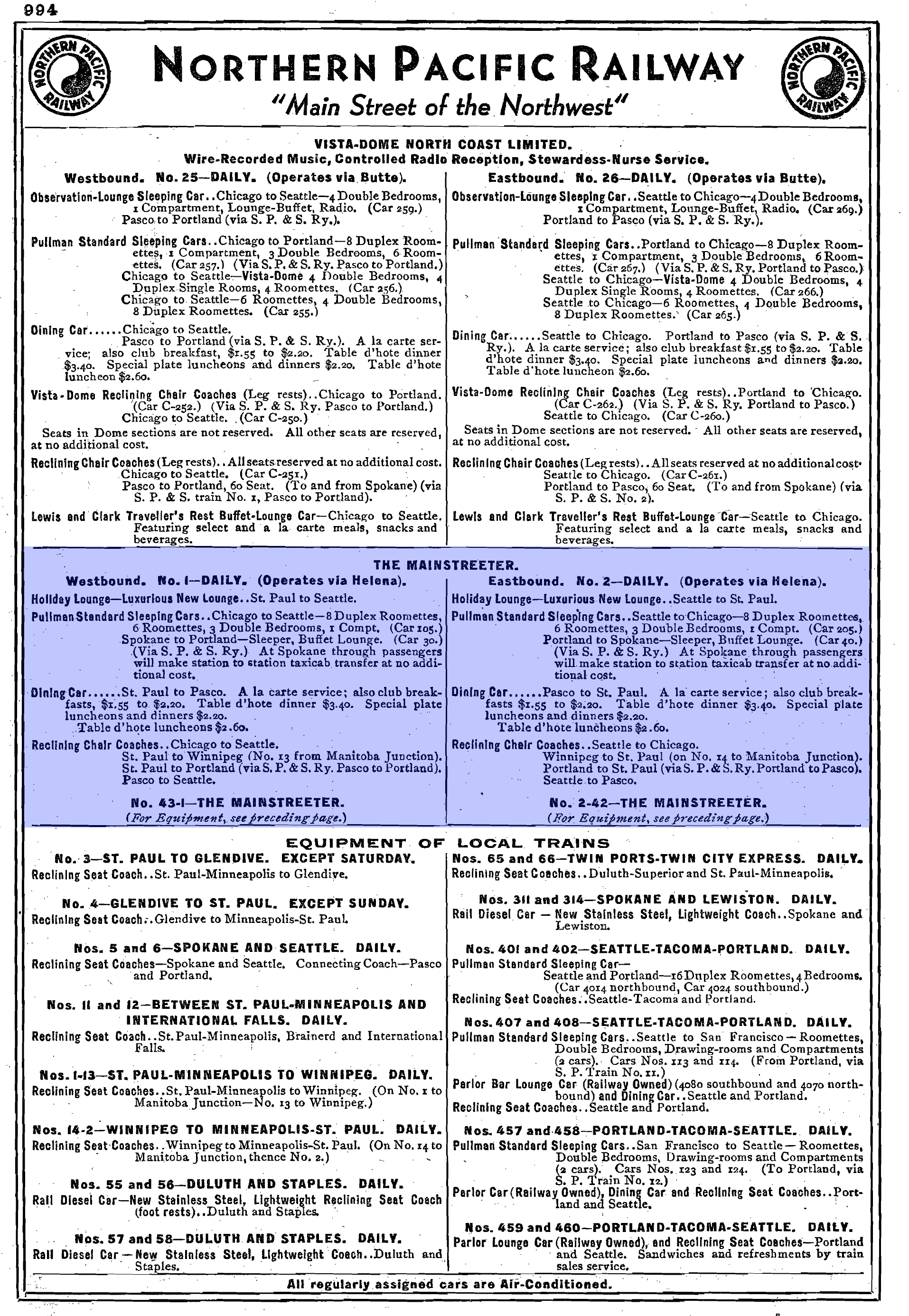
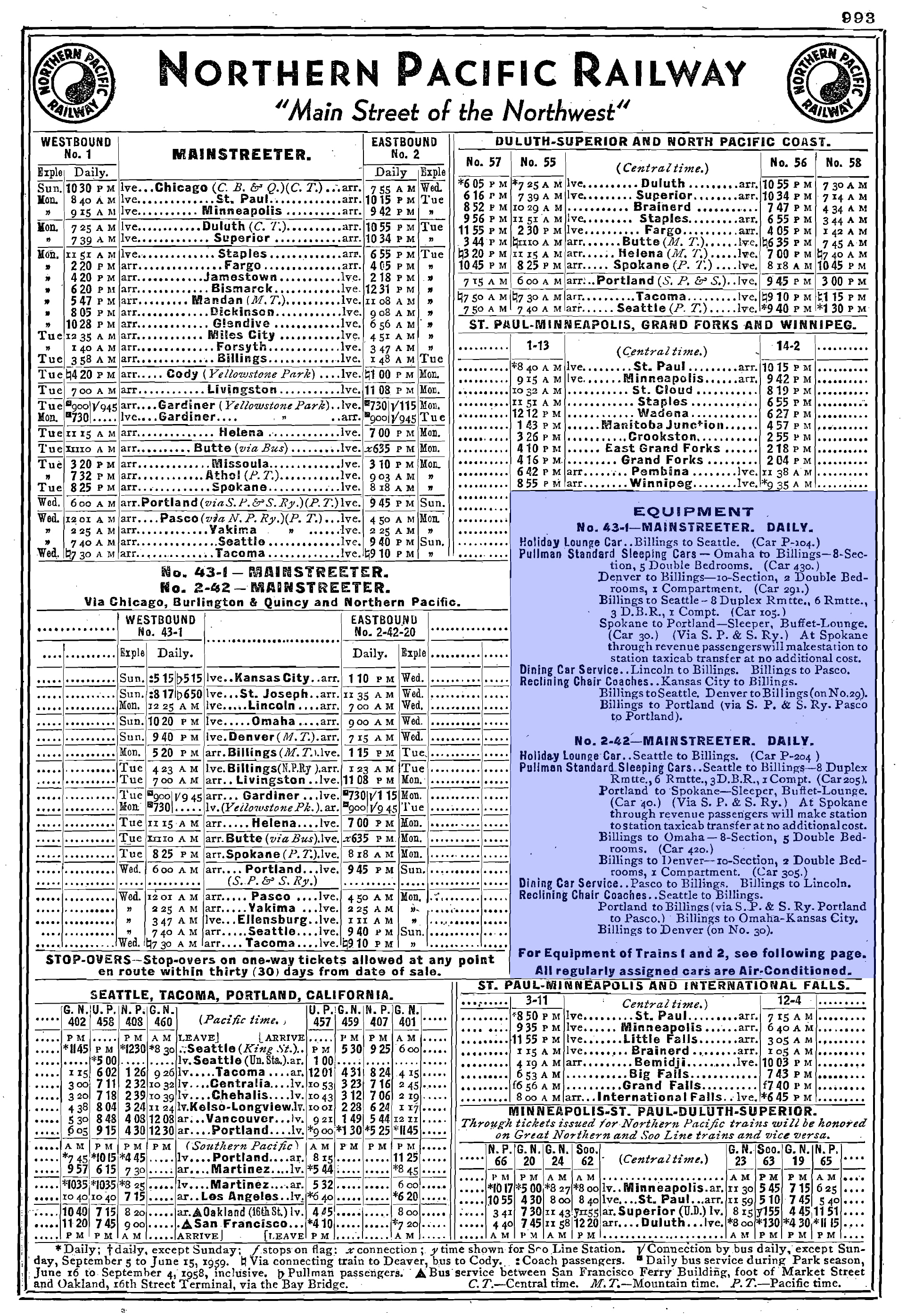
In 1946 the North Coast Limited was entirely reequipped with new, lightweight equipment from Pullman-Standard, which had been ordered two years earlier in 1944. The train was bedecked in a stunning two-tone green livery with white trim.
Despite the NCL's new look it still did not offer comparable running times with either the Great Northern's Empire Builder or the Milwaukee Road's Olympian Hiawatha.
This changed in November of 1952 when the Northern Pacific cut the NCL's schedule to just over 37 hours but doing so reduced many stops along the way.
To continue providing local service the NP inaugurated the Mainstreeter, named after the railroad's slogan as "Main Street of the Northwest." Using a mix of rebuilt heavyweight cars and newer lightweight equipment the train ran a schedule nearly 10 hours longer than its big sister (46.5 hours).
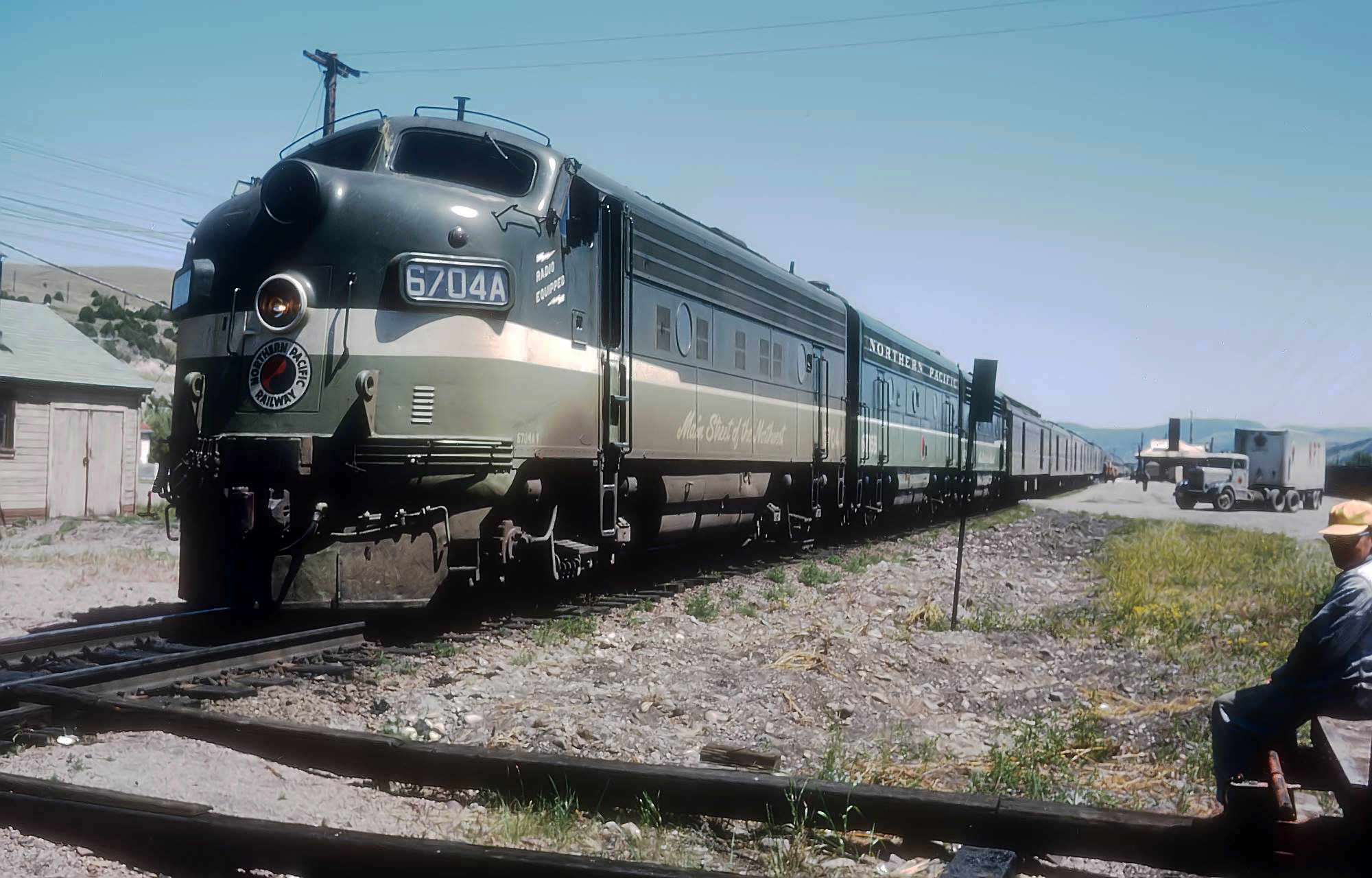 Northern Pacific F9A #6704A (became Burlington Northern #782) has train 1, the "Mainstreeter," at Garrison, Montana in July, 1965. Unknown photographer, Rick Burn collection.
From the outset the train was always listed as #1 (westbound) and #2 (eastbound) on NP's official timetable, replacing the NCL's numbers which gained the slots of #25 (westbound) and #24 (eastbound).
Despite the fact that the train ran a slow schedule, even in comparison to the GN's Western Star (the secondary run to the Builder), and was only semi-streamlined it was nevertheless adorned in NP's classic two-tone green passenger scheme as well.
Timetable (1969)
| Read Down Time/Leave (Train #51/Chicago, Burlington & Quincy) | Milepost | Location | Read Up Time/Arrive (Train #10/Chicago, Burlington & Quincy) |
|---|---|---|---|
| 10:45 PM (Dp) | 0.0 | 11:15 PM (Ar) | |
| 11:22 PM | 38 | 10:30 PM | |
| 12:02 AM | 83 | 9:50 PM | |
| 12:18 AM | 98 | 9:34 PM | |
| 1:30 AM | 145 | 8:50 PM | |
| 2:33 AM | 186 | 8:11 PM | |
| 3:31 AM | 239 | 7:18 PM | |
| 4:30 AM | 297 | 6:26 PM | |
| 5:15 AM | 328 | 5:52 PM | |
| 7:15 AM (Ar) | 427 | 4:30 PM (Dp) | |
| Time/Leave (Train #1/Northern Pacific) | Milepost | Location | Time/Arrive (Train #2/Northern Pacific) |
| 7:45 AM (Dp) | 0.0 | 2:55 PM (Ar) | |
| 8:10 AM (Ar) | 11 | 2:30 PM (Dp) | |
| 8:20 AM (Dp) | 11 | 2:20 PM (Ar) | |
| F 8:54 AM | 40 | F 1:40 PM | |
| 9:29 AM | 76 | 1:02 PM | |
| 10:04 AM | 107 | 12:23 PM | |
| 10:39 AM (Ar) | 141 | 11:45 AM (Dp) | |
| 10:43 AM (Dp) | 141 | 11:40 AM (Ar) | |
| 11:04 AM | 159 | 11:17 AM | |
| 11:27 AM | 182 | 10:50 AM | |
| 11:47 AM | 203 | 10:28 AM | |
| 12:11 PM (Ar) | 228 | 9:57 AM (Dp) | |
| 12:11 PM (Dp) | 228 | 9:57 AM (Ar) | |
| 12:42 PM | 251 | 9:25 AM | |
| 12:50 PM (Ar) | 252 | 9:23 AM (Dp) | |
| 1:05 PM (Dp) | 252 | 9:13 AM (Ar) | |
| 1:23 PM | 272 | 8:46 AM | |
| 1:56 PM | 310 | 8:13 AM | |
| 2:38 PM (Ar) | 344 | 7:38 AM (Dp) | |
| 2:44 PM (Dp) | 344 | 7:33 AM (Ar) | |
| F 3:36 PM | 402 | 6:32 AM | |
| 4:19 PM (Ar) | 446 | 5:53 AM (Dp) | |
| 4:19 PM (Dp) | 446 | 5:53 AM (Ar) | |
| 4:34 PM (Ar) | 451 | 5:40 AM (Dp) | |
| 4:49 PM (Dp) | 451 | 5:25 AM (Ar) | |
| 3:49 PM (Dp) | 451 | 4:25 AM (Ar) | |
| 4:14 PM | 473 | F 3:45 AM | |
| 4:20 PM | 479 | F 3:37 AM | |
| F 4:29 PM | 484 | F 3:31 AM | |
| 4:42 PM | 500 | F 3:17 AM | |
| 5:02 PM | 512 | 3:00 AM | |
| 5:21 PM | 527 | F 2:46 AM | |
| 5:30 PM | 532 | F 2:40 AM | |
| 5:42 PM | 540 | F 2:32 AM | |
| 6:03 PM (Ar) | 552 | 2:20 AM (Dp) | |
| 6:18 PM (Dp) | 552 | 2:05 AM (Ar) | |
| 6:32 PM | 562 | F 1:47 AM | |
| 6:49 PM | 572 | 1:37 AM | |
| 7:20 PM | 591 | F 1:14 AM | |
| 7:41 PM | 608 | F 12:57 AM | |
| 7:56 PM | 616 | 12:47 AM | |
| 8:06 PM | 627 | F 12:33 AM | |
| 8:55 PM (Ar) | 657 | 12:02 AM (Dp) | |
| 9:15 PM (Dp) | 657 | 11:42 PM (Ar) | |
| 687 | F 11:05 PM | ||
| F 9:53 PM | 697 | F 10:56 PM | |
| 10:49 PM | 736 | 9:55 PM | |
| 11:44 PM (Ar) | 781 | 9:11 PM (Dp) | |
| 11:47 PM (Dp) | 781 | 9:08 PM (Ar) | |
| F 12:14 AM | 809 | F 8:38 PM | |
| F 12:36 AM | 830 | F 8:13 PM | |
| 1:32 AM (Ar) | 883 | 7:22 PM (Dp) | |
| 1:47 AM (Dp) | 883 | 7:07 PM (Ar) | |
| 2:07 AM | 898 | 6:43 PM | |
| 2:31 AM | 923 | F 6:18 PM | |
| 3:15 AM | 964 | 5:36 PM | |
| 3:57 AM (Ar) | 999 | 5:05 PM (Dp) | |
| 4:05 AM (Dp) | 999 | 4:55 PM (Ar) | |
| 4:50 AM (Ar) | 1023 | 4:16 PM (Dp) | |
| Time/Leave (Train #1/Via Helena) | Milepost | Location | Time/Arrive (Train #2/Via Helena) |
| 4:50 AM (Dp) | 1023 | 4:16 PM (Dp) | |
| 5:00 AM | 1032 | ||
| 5:10 AM | 1041 | ||
| 5:19 AM | 1047 | 3:45 PM | |
| F 5:29 AM | 1053 | ||
| F 6:00 AM | 1077 | F 2:54 PM | |
| 6:16 AM | 1088 | 2:40 PM | |
| 7:00 AM (Ar) | 1121 | 1:56 PM (Dp) | |
| 7:05 AM (Dp) | 1121 | 1:51 PM (Ar) | |
| F 7:29 AM | 1134 | ||
| 7:51 AM | 1150 | F 1:04 PM | |
| 8:07 AM | 1159 | F 12:55 PM | |
| 8:29 AM (Ar) | 1172 | 12:38 PM (Dp) | |
| Time/Leave (Train #1) | Milepost | Location | Time/Arrive (Train #2) |
| 8:34 AM (Dp) | 1170 | 12:30 PM (Ar) | |
| 8:58 AM | 1190 | 12:04 PM | |
| 9:48 AM (Ar) | 1238 | 11:17 AM (Dp) | |
| 10:01 AM (Dp) | 1238 | 11:02 AM (Ar) | |
| 11:02 AM | 1276 | 9:57 AM | |
| F 11:24 AM | 1297 | F 9:36 AM | |
| 11:41 AM (Ar) | 1309 | 9:20 AM (Dp) | |
| 10:44 AM (Dp) | 1309 | 8:15 AM (Ar) | |
| 11:24 AM | 1341 | 7:25 AM | |
| 12:04 PM | 1379 | 6:40 AM | |
| 12:54 PM | 1428 | 5:45 AM | |
| F 1:24 PM | 1456 | F 5:15 AM | |
| 2:09 PM (Ar) | 1496 | 4:35 AM (Dp) | |
| 2:19 PM (Dp) | 1496 | 4:25 AM (Ar) | |
| 2:44 PM | 1512 | 3:52 AM | |
| F 3:29 PM | 1561 | F 2:58 AM | |
| F 4:26 PM | 1606 | F 1:56 AM | |
| 5:08 PM (Ar) | 1642 | 1:15 AM (Dp) | |
| 5:23 PM (Dp) | 1642 | 1:05 AM (Ar) | |
| 5:33 PM | 1644 | 12:55 AM | |
| 6:18 PM | 1681 | F 12:15 AM | |
| 6:49 PM | 1712 | 11:46 PM | |
| 7:23 PM (Ar) | 1731 | 11:24 PM (Dp) | |
| 7:28 PM (Dp) | 1731 | 11:19 PM (Ar) | |
| 8:23 PM | 1768 | 10:21 PM | |
| F 8:55 PM | 1792 | 9:53 PM | |
| F 9:59 PM | 1827 | F 8:53 PM | |
| F 10:08 PM | 1835 | F 8:40 PM | |
| 10:33 PM | 1850 | 8:16 PM | |
| 11:05 PM (Ar) | 1869 | 7:50 PM (Dp) | |
| 11:10 PM (Dp) | 1869 | 7:45 PM (Ar) | |
| 11:45 PM (Ar) | 1892 | 7:15 PM (Dp) |
The Mainstreeter's consist comprised a wide range of equipment depending on needs and demand. However, typically, one could find its makeup including a half-dozen heavyweight baggage cars (especially in the later years), a standard Railway Post Office (RPO), a handful of reclining seat coaches, one sleeper, and a diner (between St. Paul and Pasco, Washington).
Timetable (1958)
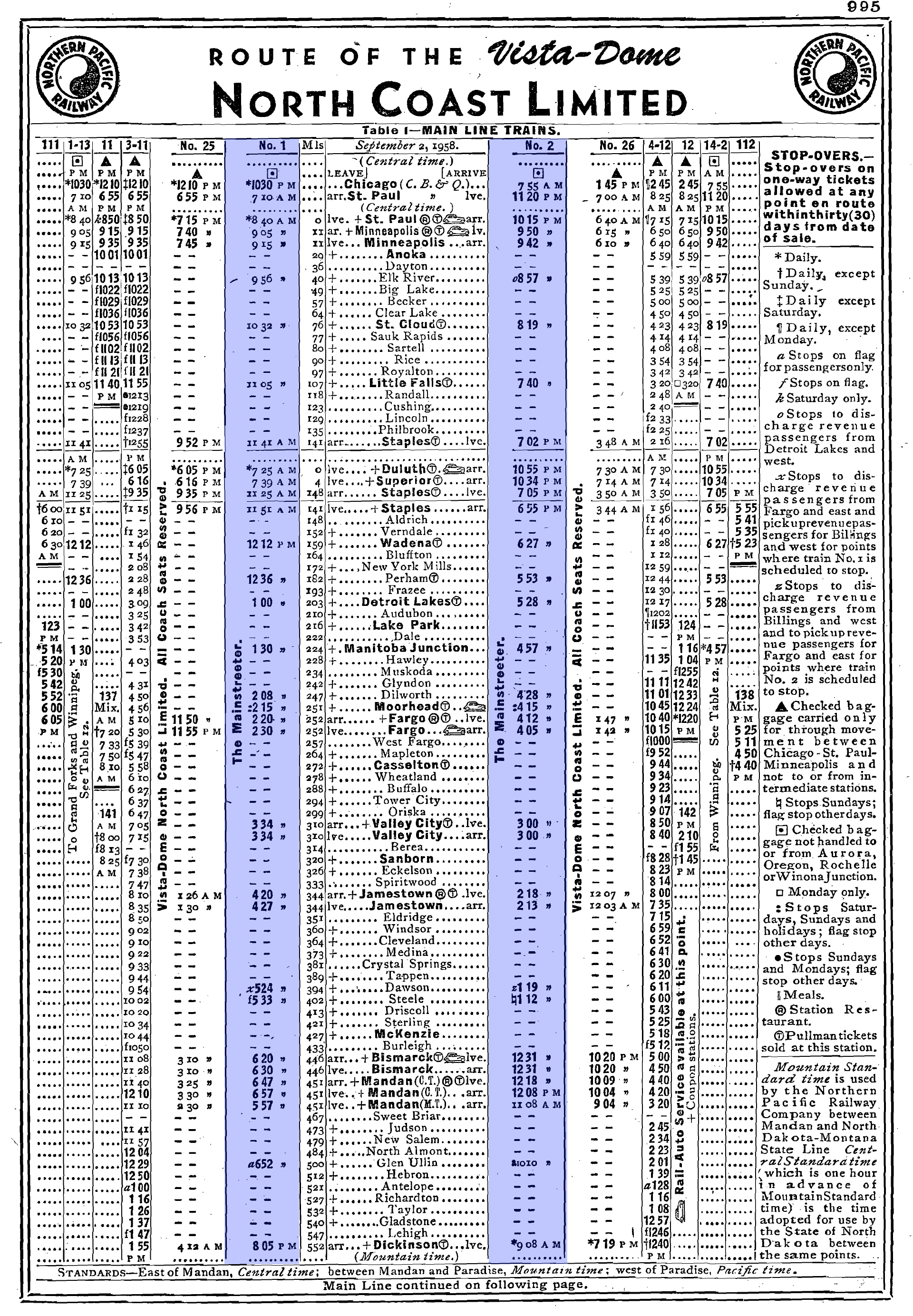
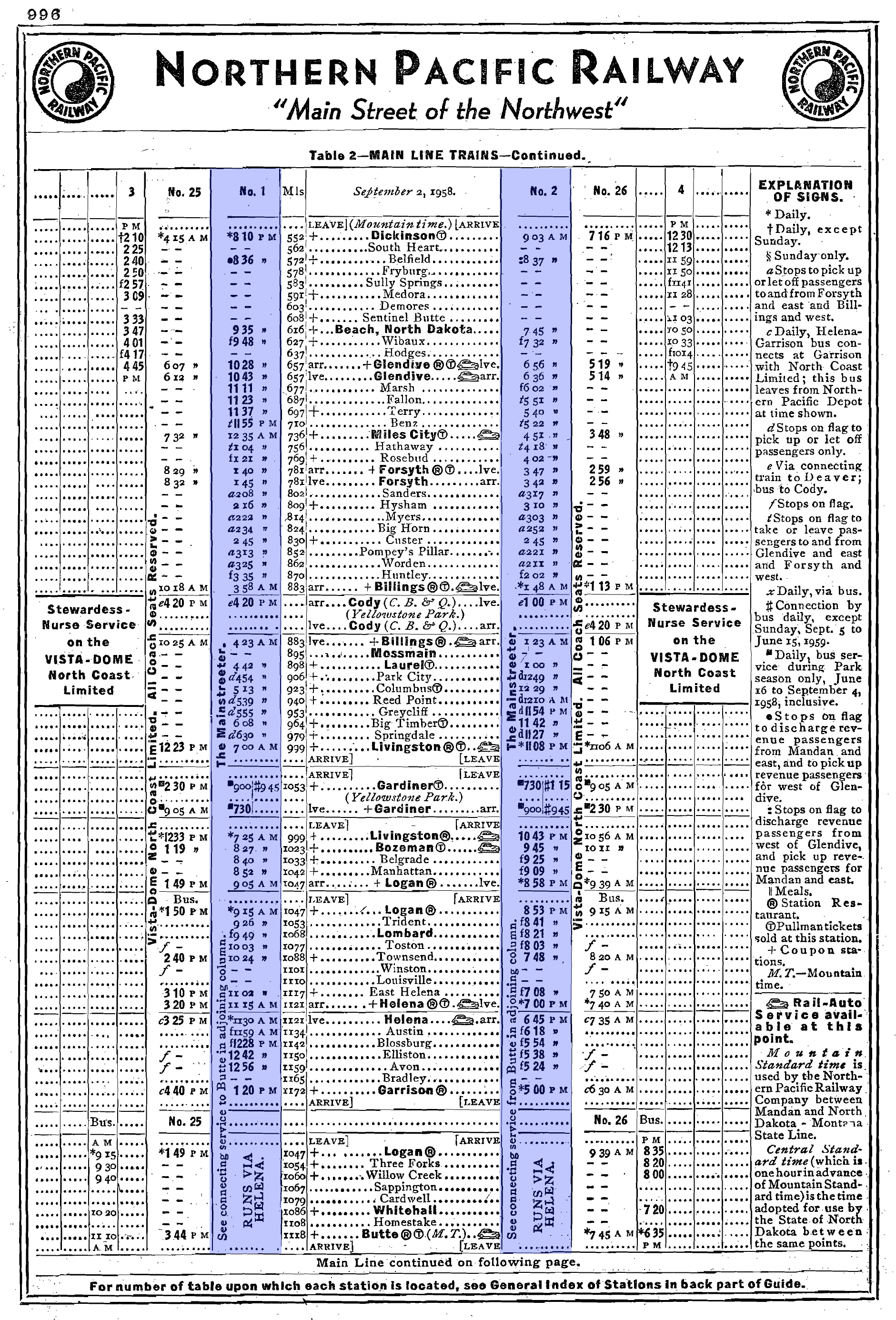
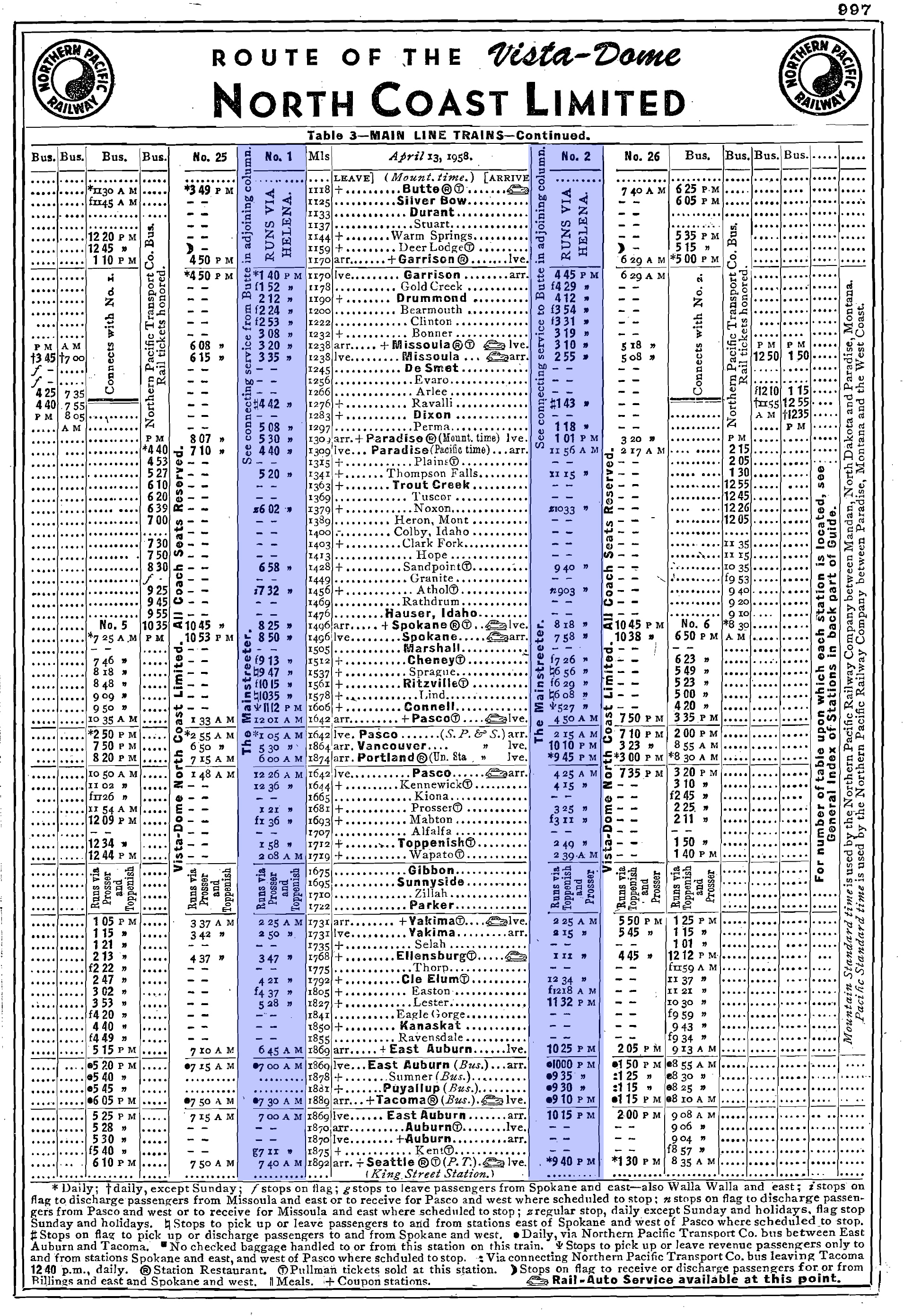
Power for the train during the diesel era could be one of a number of early Electro-Motive Division F models from F3s and F7s to FP7s and F9s. Interestingly, the NP, aside from the two FP7s it owned, never fleeted any passenger-specific diesels such as Electro-Motive's E models or American Locomotive Company PAs.
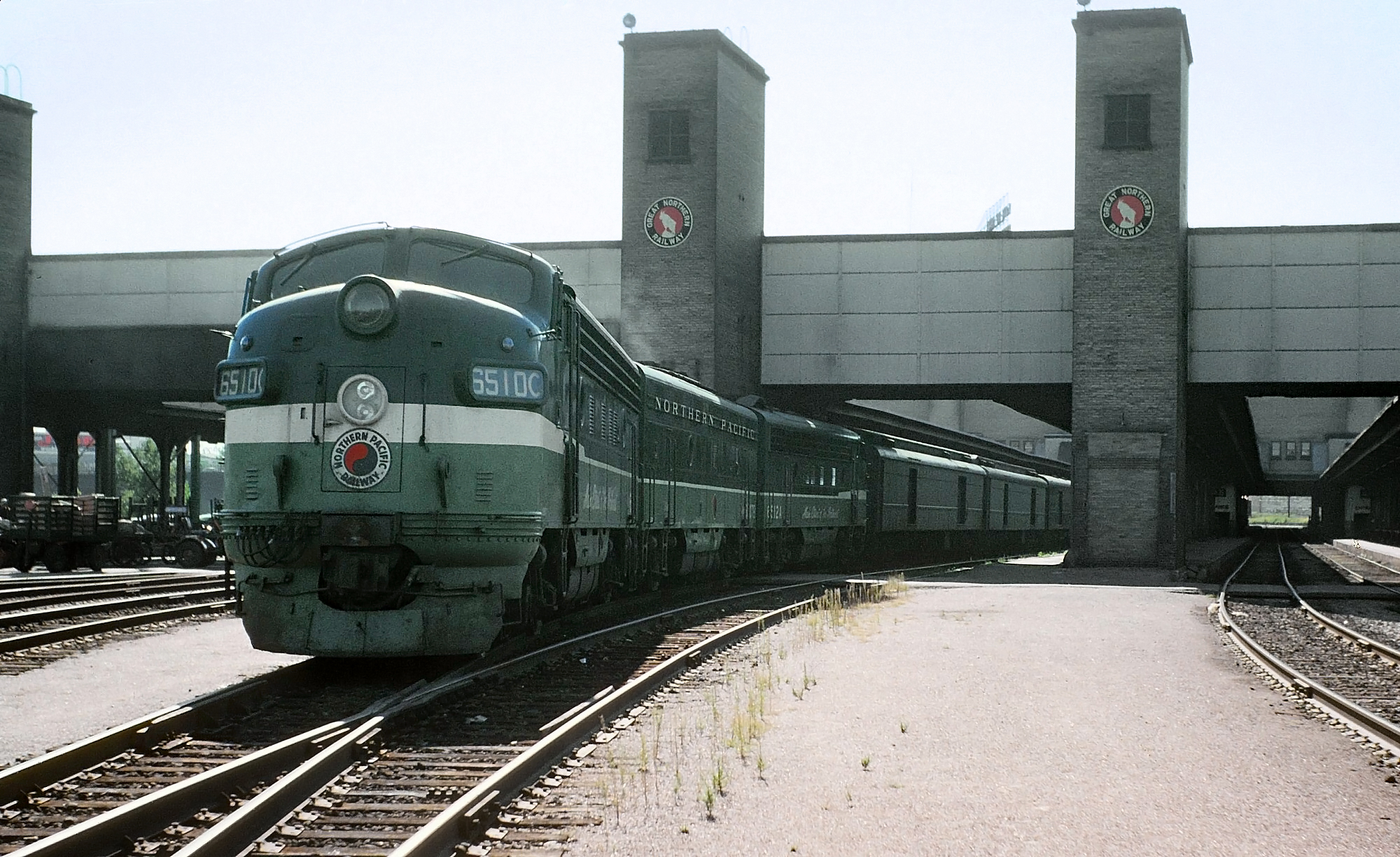 Northern Pacific F7A #6510C, F3B #6507B, and F7A #6512A have train #1, the "Mainstreeter," at Great Northern Depot in Minneapolis in September, 1962. Rick Burn photo.
Instead, the road stuck with four-axle road-power, such as F3s and F7s (the Santa Fe was also noted for using Fs in passenger service). In later years the sleeper was dropped for a Slumbercoach and dining service was discontinued for an economy buffet car.
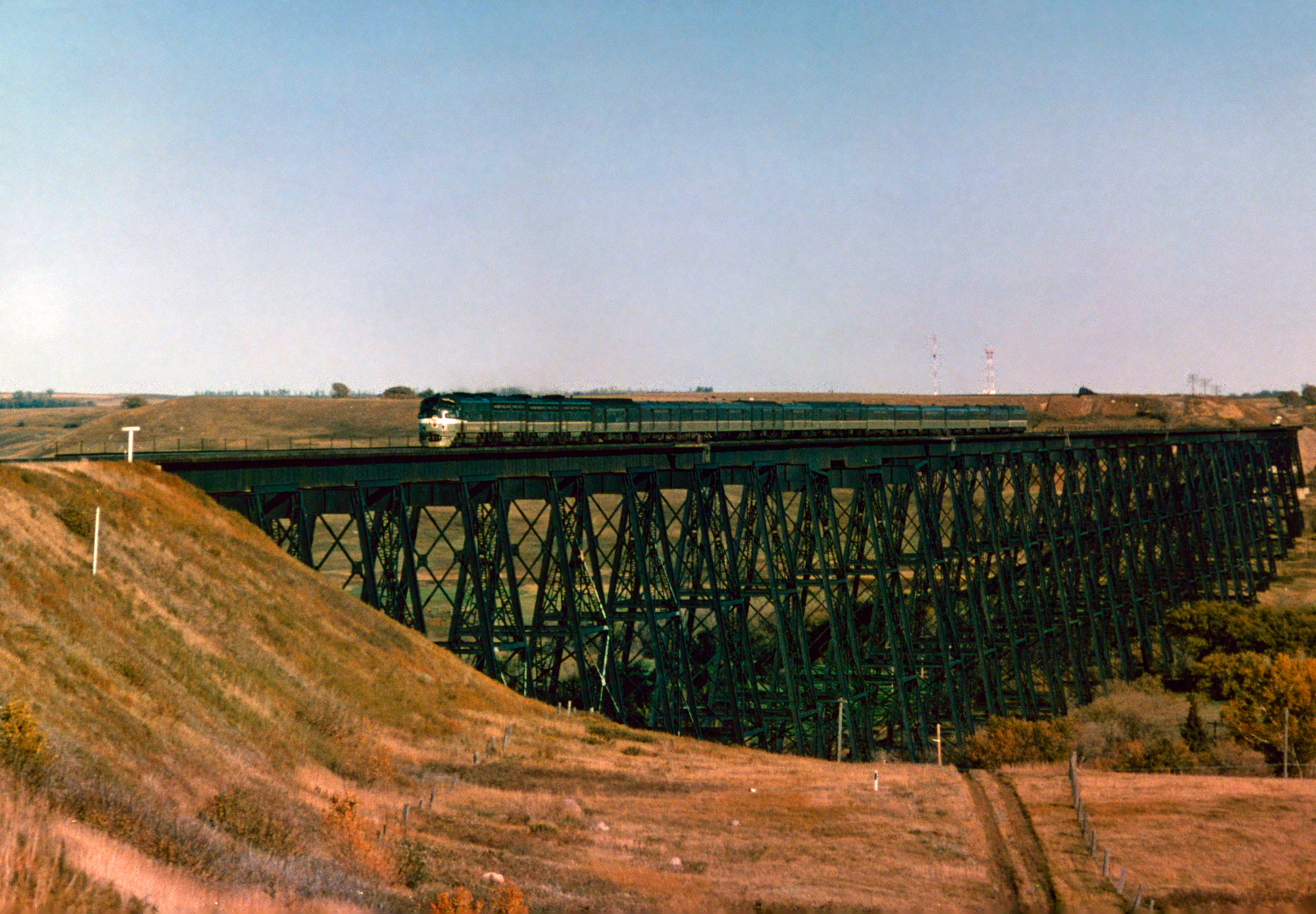 Northern Pacific F9A #6702-C leads the "Maintstreeter" across the High Line Bridge near Valley City, North Dakota on September 27, 1964. Joe Stark photo. American-Rails.com collection.
Final Years
In spite of declining traffic through the 1950s and 1960s the train remained a somewhat profitable operation, at least until the United States Postal Service cancelled mail contracts after 1967. Even then the Mainstreeter remained on the timetable through the 1970 Burlington Northern merger.
By this point its scheduling had declined to the point that it required 48 hours to complete the journey between Chicago and Seattle.
Further cutbacks took place just prior to Amtrak Day when the train was truncated no further east than St. Paul. It continued running this schedule until privately operated passenger services ceased after April 30, 1971.
Sources
- Schafer, Mike. More Classic American Railroads. Osceola: MBI Publishing, 2000.
- Schafer, Mike and Welsh, Joe. Streamliners, History of a Railroad Icon. St. Paul: MBI Publishing, 2003.
- Wood, Charles R. The Northern Pacific, Main Street Of The Northwest: A Pictorial History. Seattle: Superior Publishing Company, 1968.
Recent Articles


-
Colorado "Valentine's" Train Rides
Jan 30, 26 11:02 AM
 The Royal Gorge Route Railroad is the kind of trip that feels tailor-made for railfans and casual travelers alike, including during Valentine's weekend.
 -
Massachusetts "Valentine's" Train Rides
Jan 30, 26 10:37 AM
 The Cape Cod Central Railroad (CCCR) blends classic New England scenery with heritage equipment, narrated sightseeing, and some of the region’s best-known “rails-and-meals” experiences.
 -
California "Valentine's" Train Rides
Jan 30, 26 10:34 AM
 Operating out of West Sacramento, this excursion railroad has built a calendar that blends scenery with experiences—wine pours, themed parties, dinner-and-entertainment outings, and seasonal specials…
 -
Kansas Dinner Train Rides In Abilene
Jan 30, 26 10:27 AM
 If you’re looking for a heritage railroad that feels authentically Kansas—equal parts prairie scenery, small-town history, and hands-on railroading—the Abilene & Smoky Valley Railroad delivers.
 -
Georgia's Dinner Train Rides In Nashville!
Jan 30, 26 10:23 AM
 If you’ve ever wished you could slow down, trade traffic for jointed rail, and let a small-town landscape roll by your window while a hot meal is served at your table, the Azalea Sprinter delivers tha…
 -
Georgia "Wine Tasting" Train Rides In Cordele
Jan 30, 26 10:20 AM
 While the railroad offers a range of themed trips throughout the year, one of its most crowd-pleasing special events is the Wine & Cheese Train—a short, scenic round trip designed to feel like…
 -
Arizona ~ Wine Tasting ~ Train Rides
Jan 30, 26 10:18 AM
 For those who want to experience the charm of Arizona's wine scene while embracing the romance of rail travel, wine tasting train rides offer a memorable journey through the state's picturesque landsc…
 -
Arkansas ~ Wine Tasting ~ Train Rides
Jan 30, 26 10:17 AM
 This article takes you through the experience of wine tasting train rides in Arkansas, highlighting their offerings, routes, and the delightful blend of history, scenery, and flavor that makes them so…
 -
Wisconsin ~ Wine Tasting ~ Train Rides
Jan 29, 26 11:26 PM
 Wisconsin might not be the first state that comes to mind when one thinks of wine, but this scenic region is increasingly gaining recognition for its unique offerings in viticulture.
 -
Illinois Dinner Train Rides At Monticello
Jan 29, 26 02:21 PM
 The Monticello Railway Museum (MRM) is one of those places that quietly does a lot: it preserves a sizable collection, maintains its own operating railroad, and—most importantly for visitors—puts hist…
 -
Vermont "Dinner Train" Rides In Burlington!
Jan 29, 26 01:00 PM
 There is one location in Vermont hosting a dedicated dinner train experience at the Green Mountain Railroad.
 -
California ~ Wine Tasting ~ Train Rides
Jan 29, 26 12:50 PM
 This article explores the charm, routes, and offerings of these unique wine tasting trains that traverse California’s picturesque landscapes.
 -
Alabama ~ Wine Tasting ~ Train Rides
Jan 29, 26 12:46 PM
 While the state might not be the first to come to mind when one thinks of wine or train travel, the unique concept of wine tasting trains adds a refreshing twist to the Alabama tourism scene.
 -
Washington's "Wine Tasting" Train Rides
Jan 29, 26 12:39 PM
 Here’s a detailed look at where and how to ride, what to expect, and practical tips to make the most of wine tasting by rail in Washington.
 -
Kentucky ~ Wine Tasting ~ Train Rides
Jan 29, 26 11:12 AM
 Kentucky, often celebrated for its rolling pastures, thoroughbred horses, and bourbon legacy, has been cultivating another gem in its storied landscapes; enjoying wine by rail.
 -
Duffy's Cut: A Forgotten Railroad Tragedy
Jan 29, 26 11:05 AM
Duffy's Cut is an unfortunate incident which occurred during the early railroad industry when 57 Irish immigrants died of cholera during the second cholera pandemic. -
Wisconsin Passenger Rail
Jan 28, 26 11:47 PM
This article delves deep into the passenger and commuter train services available throughout Wisconsin, exploring their history, current state, and future potential. -
Connecticut Passenger Rail
Jan 28, 26 11:30 PM
 Connecticut's passenger and commuter train network offers an array of options for both local residents and visitors alike. Learn more about these services here.
 -
South Dakota ~ Murder Mystery ~ Dinner Train Rides
Jan 28, 26 12:29 PM
 While the state currently does not offer any murder mystery dinner train rides, the popular 1880 Train at the Black Hills Central recently hosted these popular trips!
 -
Wisconsin ~ Murder Mystery ~ Dinner Train Rides
Jan 28, 26 12:23 PM
 Whether you're a fan of mystery novels or simply relish a night of theatrical entertainment, Wisconsin's murder mystery dinner trains promise an unforgettable adventure.
 -
Florida ~ Wine Tasting ~ Train Rides
Jan 28, 26 11:18 AM
 Wine by train not only showcases the beauty of Florida's lesser-known regions but also celebrate the growing importance of local wineries and vineyards.
 -
Texas ~ Wine Tasting ~ Train Rides
Jan 28, 26 11:08 AM
 This article invites you on a metaphorical journey through some of these unique wine tasting train experiences in Texas.
 -
New York ~ Wine Tasting ~ Train Rides
Jan 28, 26 11:05 AM
 This article will delve into the history, offerings, and appeal of wine tasting trains in New York, guiding you through a unique experience that combines the romance of the rails with the sophisticati…
 -
Michigan ~ Wine Tasting ~ Train Rides
Jan 28, 26 11:04 AM
 In this article, we’ll delve into the world of Michigan’s wine tasting train experiences that cater to both wine connoisseurs and railway aficionados.
 -
Indiana ~ Wine Tasting ~ Train Rides
Jan 28, 26 10:59 AM
In this article, we'll delve into the experience of wine tasting trains in Indiana, exploring their routes, services, and the rising popularity of this unique adventure. -
South Dakota ~ Wine Tasting ~ Train Rides
Jan 28, 26 10:57 AM
For wine enthusiasts and adventurers alike, South Dakota introduces a novel way to experience its local viticulture: wine tasting aboard the Black Hills Central Railroad. -
Minnesota Valentine's Train Rides
Jan 28, 26 10:51 AM
 One of the most charming examples of MTM’s family-friendly programming is “The Love Train,” a Valentine’s-themed day that blends short train rides with crafts, treats, and playful activities inside th…
 -
Georgia Passenger Rail
Jan 27, 26 10:03 PM
 Georgia offers a variety of train services, from historic scenic routes to modern commuter trains serving the Atlanta metropolitan area.
 -
Illinois Passenger Rail
Jan 27, 26 02:49 PM
 Learn more about Illinois's current passenger rail options, ranging from Amtrak to the Twin Cities' light rail service.
 -
Pennsylvania Passenger Rail
Jan 27, 26 02:40 PM
 Here is a detailed, statewide look at the passenger rail services you can use today—focusing on intercity (long-distance and regional) options, primarily operated by Amtrak—plus the major commuter and…
 -
New Mexico ~ Wine Tasting ~ Train Rides
Jan 27, 26 01:19 PM
 For oenophiles and adventure seekers alike, wine tasting train rides in New Mexico provide a unique opportunity to explore the region's vineyards in comfort and style.
 -
Ohio ~ Wine Tasting ~ Train Rides
Jan 27, 26 01:10 PM
 Among the intriguing ways to experience Ohio's splendor is aboard the wine tasting trains that journey through some of Ohio's most picturesque vineyards and wineries.
 -
Pennsylvania ~ Wine Tasting ~ Train Rides
Jan 27, 26 12:05 PM
Wine tasting trains are a unique and enchanting way to explore the state’s burgeoning wine scene while enjoying a leisurely ride through picturesque landscapes. -
West Virginia's - Wine Tasting - Train Rides
Jan 27, 26 11:57 AM
 West Virginia, often celebrated for its breathtaking landscapes and rich history, offers visitors a unique way to explore its rolling hills and picturesque vineyards: wine tasting trains.
 -
Iowa Valentine's Train Rides
Jan 27, 26 10:22 AM
 While the Boone & Scenic Valley's calendar is packed with seasonal events, few are as popular—or as tailor-made for couples—as the Valentine Dinner Train.
 -
Texas Valentine's Train Rides
Jan 27, 26 09:44 AM
 On Valentine's Day, the Grapevine Vintage Railroad has become one of the Dallas–Fort Worth area’s most charming "micro-adventures" - and, on Valentine’s Day, one of the region’s most memorable date ni…
 -
Missouri ~ Murder Mystery ~ Dinner Train Rides
Jan 26, 26 01:21 PM
 Missouri, with its rich history and scenic landscapes, is home to one location hosting these unique excursion experiences.
 -
Washington's ~ Murder Mystery ~ Dinner Train Rides
Jan 26, 26 01:15 PM
 This article delves into what makes murder mystery dinner train rides in Washington State such a captivating experience.
 -
Utah's - Wine Tasting - Train Rides
Jan 26, 26 12:48 PM
Utah, a state widely celebrated for its breathtaking natural beauty and dramatic landscapes, is also gaining recognition for an unexpected yet delightful experience: wine tasting trains. -
Vermont's - Wine Tasting - Train Rides
Jan 26, 26 12:40 PM
 Known for its stunning green mountains, charming small towns, and burgeoning wine industry, Vermont offers a unique experience that seamlessly blends all these elements: wine tasting train rides.
 -
Rhode Island's - Wine Tasting - Train Rides
Jan 26, 26 12:36 PM
 It may the smallest state but Rhode Island is home to a unique and upscale train excursion offering wide aboard their trips, the Newport & Narragansett Bay Railroad.
 -
Oregon's - Wine Tasting - Train Rides
Jan 26, 26 12:25 PM
 For those looking to explore this wine paradise in style and comfort, Oregon's wine tasting trains offer a unique and enjoyable way to experience the region's offerings.
 -
Virginia's - Wine Tasting - Train Rides
Jan 26, 26 12:07 PM
 Wine tasting trains in Virginia provide just that—a unique experience that marries the romance of rail travel with the sensory delights of wine exploration.
 -
Tennessee's - Wine Tasting - Train Rides
Jan 26, 26 12:44 AM
 One of the most unique and enjoyable ways to savor the flavors of Tennessee’s vineyards is by train aboard the Tennessee Central Railway Museum.
 -
Texas's Thomas The Train Rides
Jan 25, 26 01:41 PM
 In the heart of Texas, where everything is said to be bigger and bolder, lies an event that captures the imagination of children and families alike - A Day Out With Thomas.
 -
New York's Thomas The Train Rides
Jan 25, 26 01:37 PM
These events, part of a national tour, are crafted for young Thomas fans and their families to enjoy an immersive experience filled with adventure, nostalgia, and sheer joy. -
Connecticut's Dinner Train Rides In Essex!
Jan 25, 26 01:34 PM
 Connecticut's rail heritage can be traced back to the industry's earliest days and a few organizations preserve this rich history by offering train rides. The Essex Steam Train also hosts dinner-theme…
 -
Minnesota's Dinner Train Rides In Duluth!
Jan 25, 26 01:25 PM
 One of the best ways to feel the region's history in motion today is aboard the North Shore Scenic Railroad (NSSR), which operates out of Duluth’s historic depot.
 -
North Carolina's - Wine Tasting - Train Rides
Jan 25, 26 01:18 PM
 A noteworthy way to explore North Carolina's beauty is by hopping aboard the Great Smoky Mountains Railroad and sipping fine wine!
 -
Nevada's - Wine Tasting - Train Rides
Jan 25, 26 01:13 PM
 While it may not be the first place that comes to mind when you think of wine, you can sip this delight by train in Nevada at the Nevada Northern Railway.