"Broadway Limited" (Train): Schedule, Route, Consist
Last revised: March 1, 2025
By: Adam Burns
The New York-Chicago market was the premier intercity passenger service in the eastern market and Pennsylvania Railroad’s Broadway Limited competed with rival New York Central's 20th Century Limited
for top honors.
While the argument will forever endure which was the more successful and prestigious what cannot is their distinctive different styles.
The 20th Century Limited catered to business travelers and “new money” with its modernistic cool, sleek designs and colors while the Broadway featured light, airy, and cheery accents and accommodated more to the older crowd.
For decades, starting in the early 20th century Pennsy offered a crack train serving Chicago and New York but as other modes of transportation began taking their toll after World War II the railroad cutback the amenities it provided.
Despite reduced services the Broadway was one of the last trains offering an all-Pullman status and it even outlived its parent until being canceled by Amtrak in 1995.
The Broadway Limited had its beginnings dating to 1912 when it took the place of the Pennsylvania Special. This train had been serving the New York to Chicago corridor for about a decade, launched in 1902.
Photos
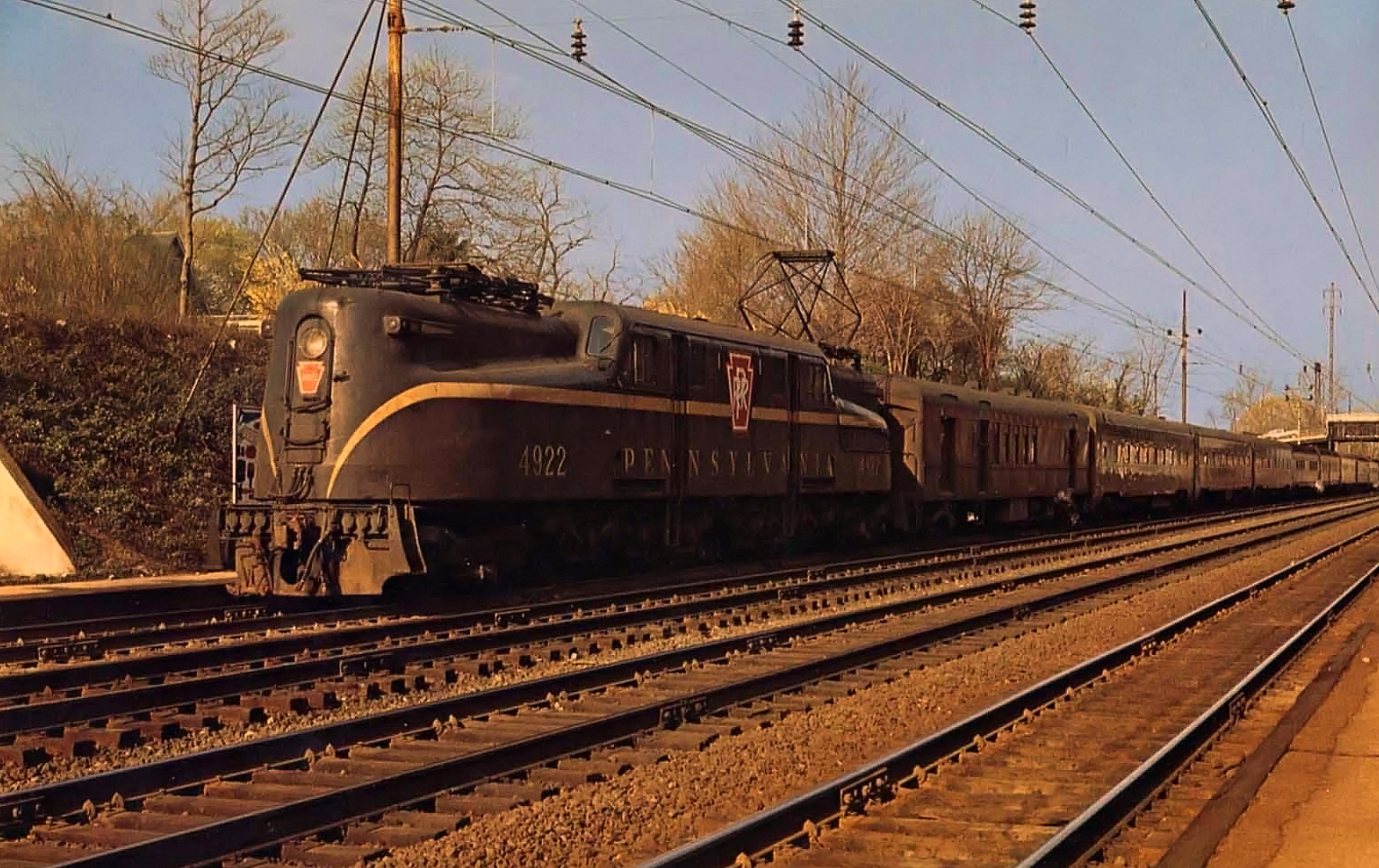 In this postcard scene, Pennsylvania GG-1 #4922 is ahead of the eastbound "Broadway Limited" at Paoli, Pennsylvania during the 1960's.
History
For the first thirty years both the Broadway and 20th Century were somewhat conservative in the nature of their accommodations and changed little aesthetically using standard heavyweight passenger equipment and traditional steam locomotives.
However, when the streamliner craze took root in the 1930s that all changed. The PRR and NYC were constantly watching each other to make sure neither upstaged the other. In the case of streamlining it was the Central which got things started.
In 1936 the NYC experimented and custom streamlined its Mercury running between Detroit and Cleveland. That same year, rather pleased with the results of this experiment the Central began serious discussions to streamline its flagship.
At A Glance
November 24, 1912* - January 31, 1968 (Pennsylvania) February 1, 1968 - April 30, 1971 (Penn Central) May 1, 1971 - September 10, 1995 (Amtrak) |
|
29 (Westbound) 28 (Eastbound) | |
Pennsylvania Station (New York) Union Station (Chicago) |
* Pennsylvania's first class service between Chicago - New York began as the "New York and Chicago Limited," inaugurated on October 31, 1881. It was renamed as the "Pennsylvania Limited" between May, 1887 (Lines West) and July, 1891 (Lines East). It then became the "Pennsylvania Special" on June 15, 1902 before being renamed as the "Broadway Limited" on November 24, 1912.
With no streamlined train yet of it’s own, after hearing of Central's intentions the PRR approached its rival wondering if the it would be interested in a joint effort of streamlining their flagships to which the NYC agreed.
The builder of their trains was the industry standard of the day, the Pullman Company (the Pullman-Standard division actually manufactured the equipment; at one time Pullman was a massive operation with several subsidiaries).
What’s interesting is that both trains, from a blueprint standpoint, were virtually identical since Pullman was very good at standardization as a cost savings tool (today, the practice is widespread, of course).
Consist (1952)
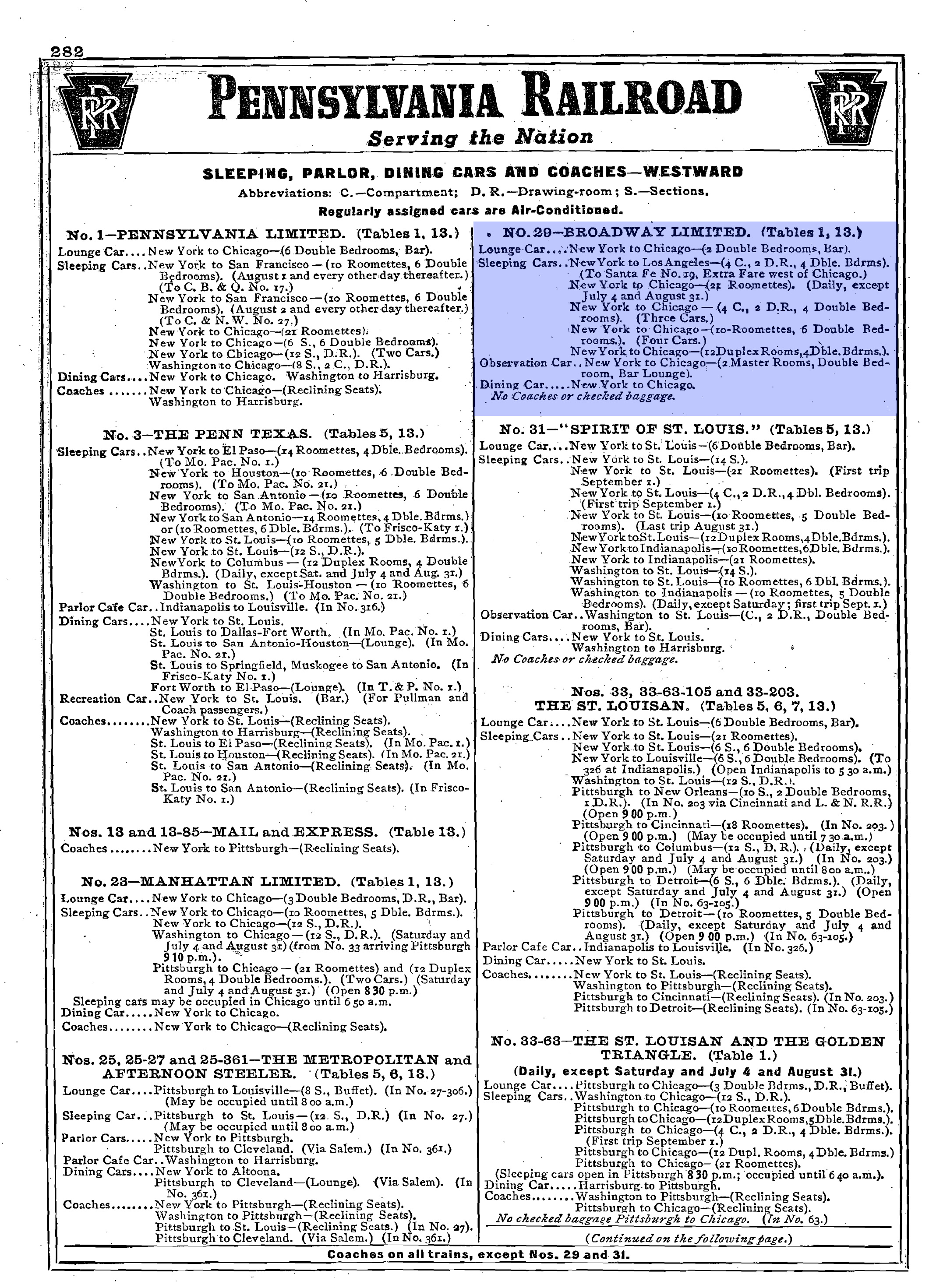
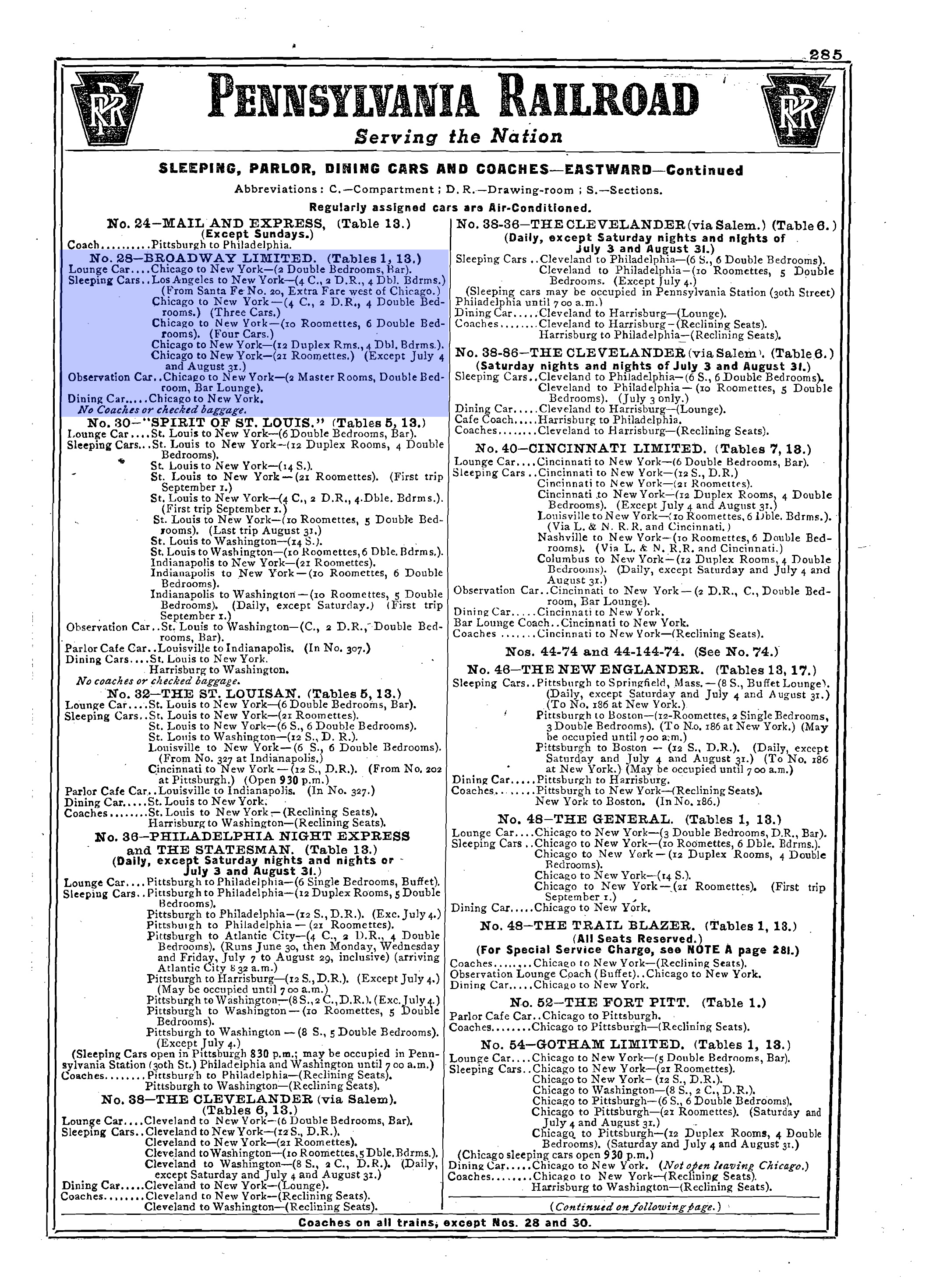
However, from an aesthetics standpoint the two could not have been more different inside and out after designers were finished with their touches.
Following delivery of its 52-car order (which became known, and advertised, by the Pennsy as its “Fleet of Modernism”) from Pullman the railroad quickly set to designing a new streamlined version of its Broadway Limited.
Drumhead
Notable equipment the train carried included a bar-lounge sleeper, dining car, buffet-lounge sleeper-observation, and four sleepers all serviced through Pullman; such was the trademark of a first-class train. To do this is the railroad hired the man who made its GG1 electric locomotive legendary, Raymond Loewy.
Timetable (July, 1938)
| Read Down Time/Leave (Train #29) | Milepost | Location | Read Up Time/Arrive (Train #28) |
|---|---|---|---|
| 5:00 PM (Dp) | 0.0 | 8:30 AM (Ar) | |
| 5:14 PM | 10.0 | 8:15 AM | |
| 6:20 PM | 85.9 | 7:09 AM | |
| F 6:44 PM | 111.4 | F 6:44 AM | |
| 8:04 PM | 194.6 | 5:20 AM | |
| 10:29 PM | 325.4 | 2:56 AM | |
| 12:58 AM | 439.3 | 12:26 AM | |
| 4:31 AM | 628.1 | 8:54 PM | |
| 759.7 | 5:49 PM (Dp) | ||
| 5:36 AM (Dp) | 759.7 | 5:45 PM (Dp) | |
| 7:43 AM | 900.7 | 3:43 PM | |
| 8:00 AM (Ar) | 907.7 | 3:30 PM (Dp) |
For the Broadway’s exterior (and interior, to some degree) Loewy stuck with the color that Pennsy was by then quite famous for, Tuscan red. In addition he added gold pinstriping, similar to his design on the GG1 (except without the cat whiskers).
Route Maps
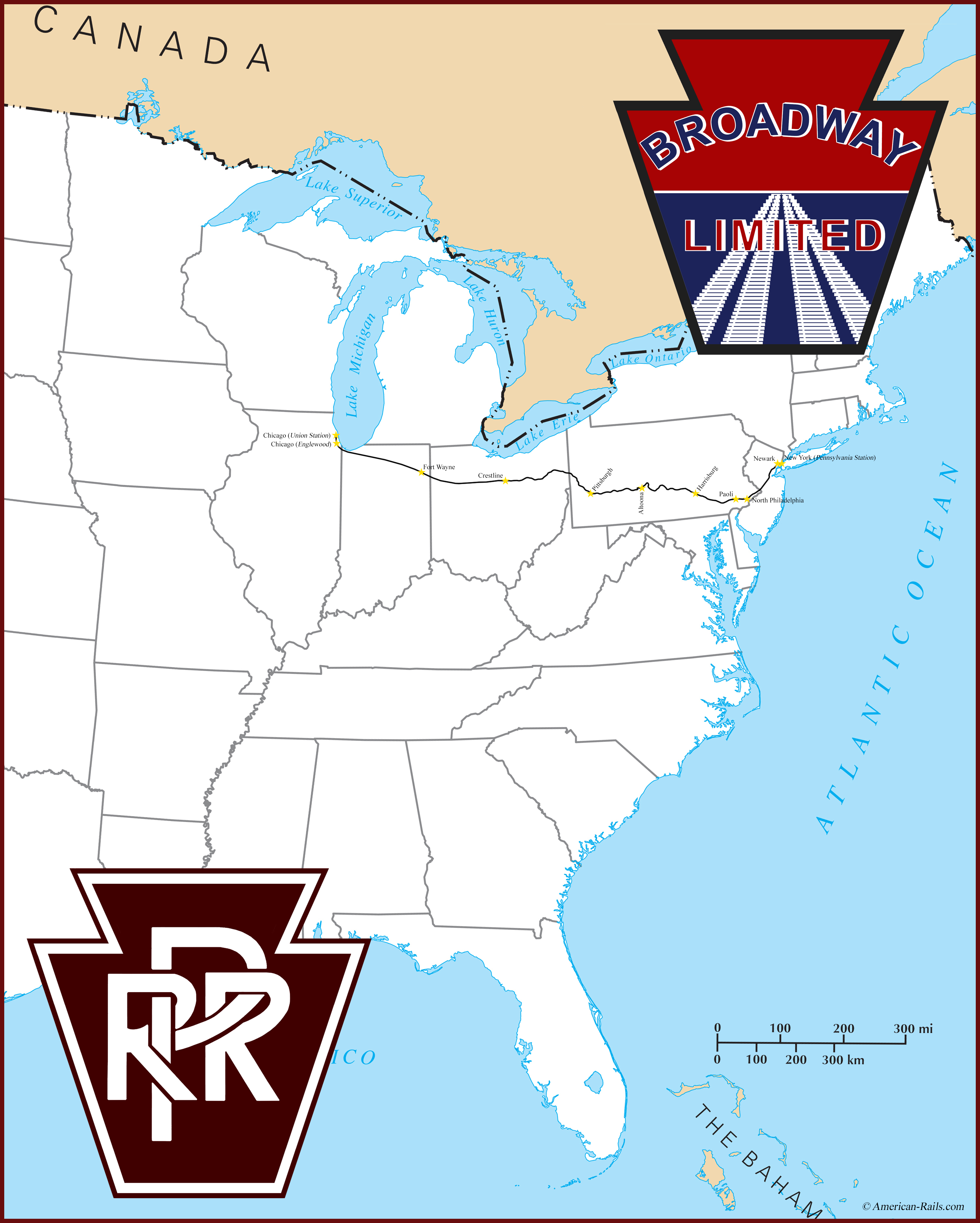
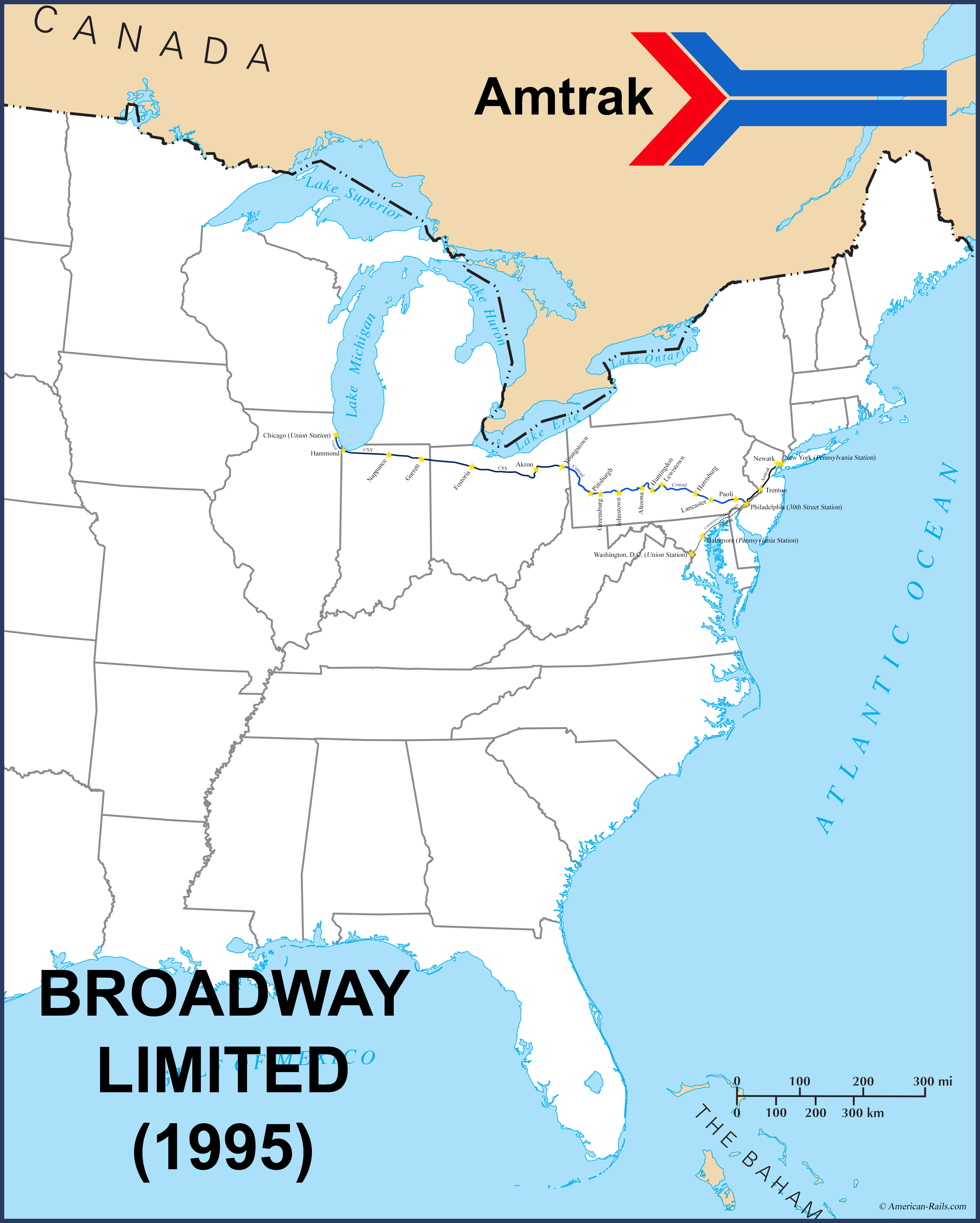
For the train’s interior Loewy used airy and cheery colors with blends of red, yellow, orange, black, blue, and white throughout, at times also including wood veneering. As with the 20th Century Limited the hallmark car in the train was the sleeper-observation.
Here Loewy used blue for the
seating and copper, rose, and tan for the walls and ceiling adding
indirect lighting to give the car a soft glow.
In addition, near the back he partitioned the car using protruding, rounded sectioning whereby the extreme end featured seating facing towards the windows so passengers could watch the landscape retreating away from them; for the time this was an evocative design.
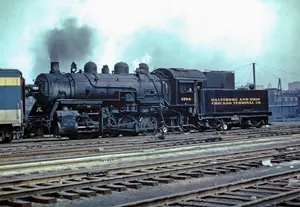
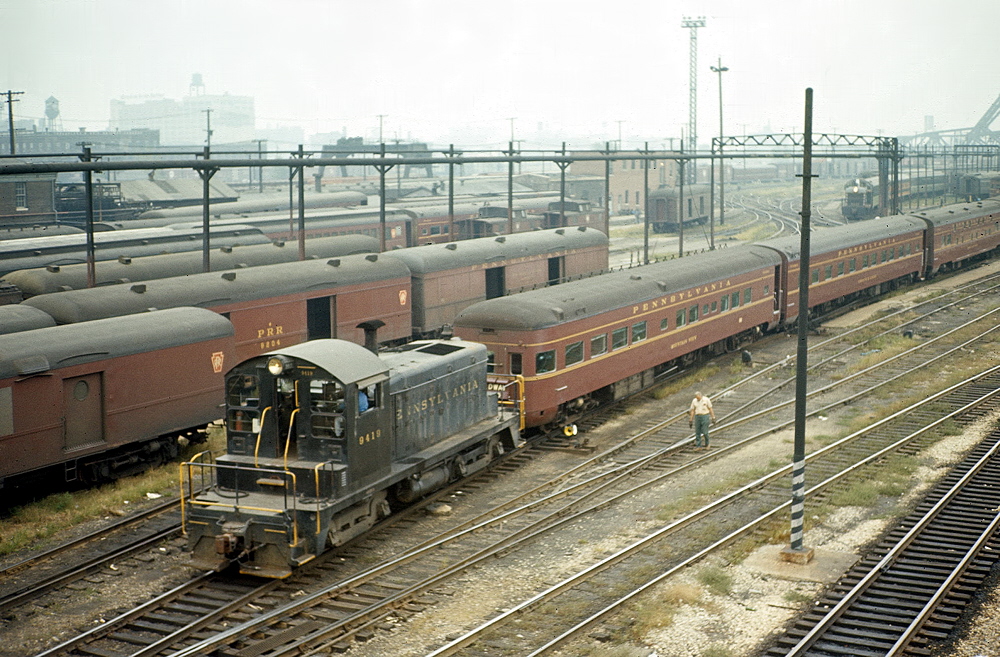 Pennsylvania SW1 #9418 switches the "Broadway Limited" in Chicago on September 14, 1965. Directly ahead of the switcher is sleeper-lounge-observation 'Mountain View'. Marty Bernard photo.
It is often believed the Broadway gained its name from the famous part of New York City. However, the train actually derived its name from the Pennsy’s “broad” four-track main line that ran much of the way between New York and Chicago.
Because the PRR had such extensive electrified operations the train was operated by GG1s from the Big Apple, south to Philadelphia, and west to Harrisburg (the western extent of the Pennsy's energized system).
 One of the Pennsylvania Railroad's streamlined 4-6-2's (K-4s), lead power for the "Broadway Limited," poses next to a pair of Studebaker's, circa 1939. Patty Allison colorization.
From here to Chicago one of the railroad famed Class K4s Pacifics carried the train with an average speed of more than 57 mph.
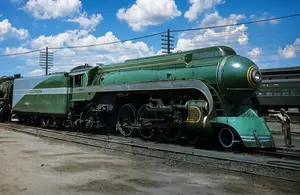
To match the rest of the train's streamlined appearance in 1936 Loewy provided similar touches to some of the K4s. The first to receive this treatment was #3768, which sported somewhat of a torpedo look.
There were four other K4s to carry streamlining including #1120, #2665, #3768, and #5338 although none received the same level of shrouding as #3768.
Timetable (1969)
(The below Broadway Limited timetable is dated effective November of 1969. Note the train still holds a schedule close to its 1938 counterpart with a few additional stops added. It has also changed train numbers in the Penn Central era.)
| Read Down Time/Leave (Train #49) | Milepost | Location | Read Up Time/Arrive (Train #48) |
|---|---|---|---|
| 4:55 PM (Dp) | 0.0 | 9:50 AM (Ar) | |
| 5:11 PM | 10 | 9:35 AM | |
| 5:55 PM | 58 | 8:48 AM | |
| 6:21 PM | 85 | 8:21 AM | |
| 6:53 PM | 111 | 7:48 AM | |
| 7:40 PM | 159 | 7:01 AM | |
| 8:11 PM (Ar) | 194 | 6:19 AM (Dp) | |
| 8:21 PM (Dp) | 194 | 6:19 AM (Ar) | |
| 10:53 PM | 325 | 3:50 AM | |
| 12:01 AM | 362 | ||
| 1:35 AM | 439 | 1:11 AM | |
| 5:06 AM | 628 | 9:49 PM | |
| 6:11 AM | 700 | 8:38 PM | |
| 7:06 AM | 759 | 7:45 PM | |
| 7:37 AM | 882 | 5:06 PM | |
| 8:20 AM | 900 | 4:43 PM | |
| 8:35 AM (Ar) | 907 | 4:30 PM (Dp) |
Interestingly, for all of the Broadway's grandeur the Pennsy never bothered having its locomotives match the rest of the train. Streamliners were typically linear in nature with the locomotive and cars matching one another uniformly and featuring type of round-ended design for the observation car (a classic design of the era).
However, the GG1 featured a curved nose on each end (and “cat whisker” pinstriping that sloped downward at each end), "breaking" its linear appearance and the #3768 was painted in Brunswick green while the equipment carried classic Tuscan red (by comparison the New York Central designed and painted its 20th Century Limited to match perfectly).
Timetable (1952)
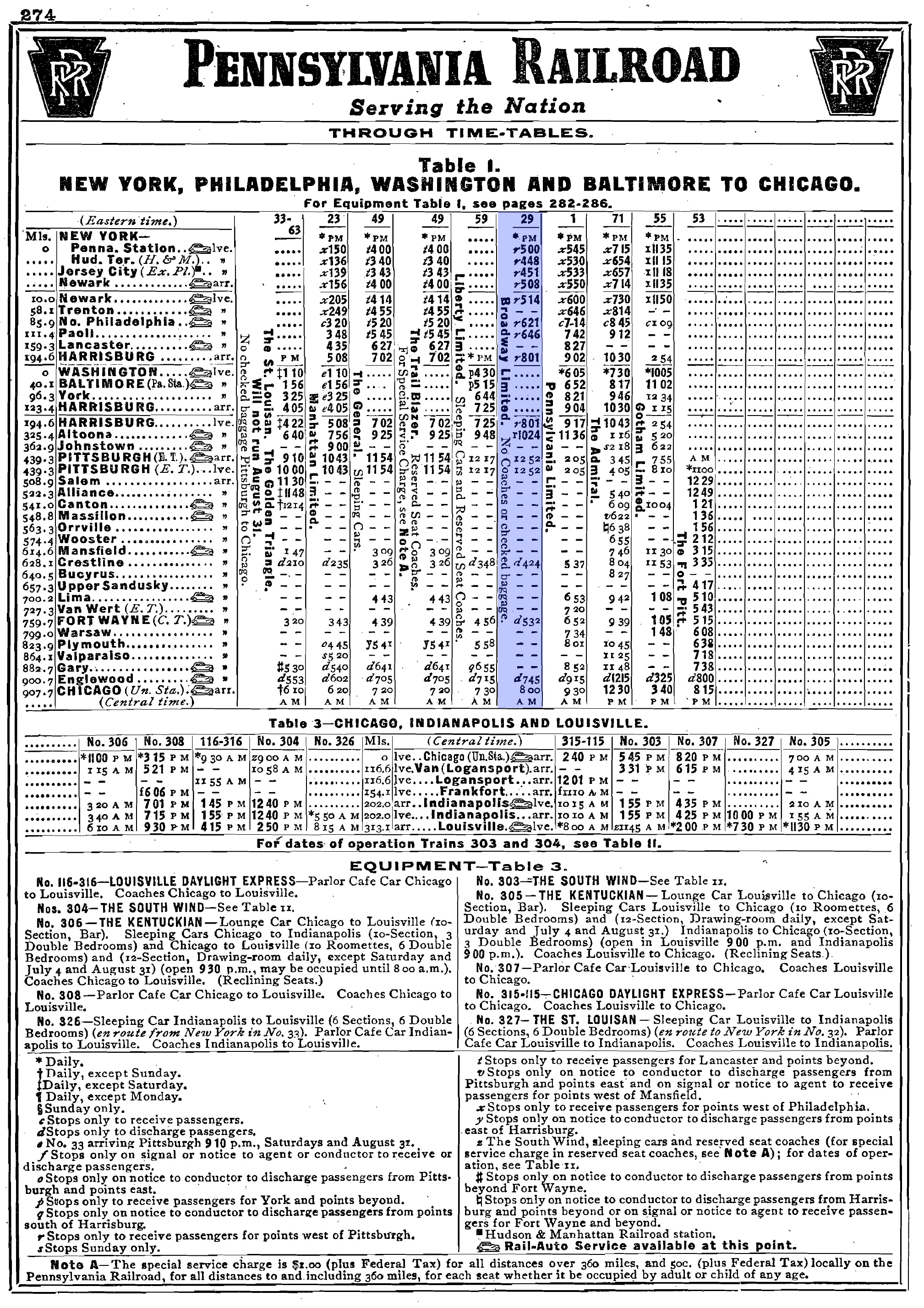
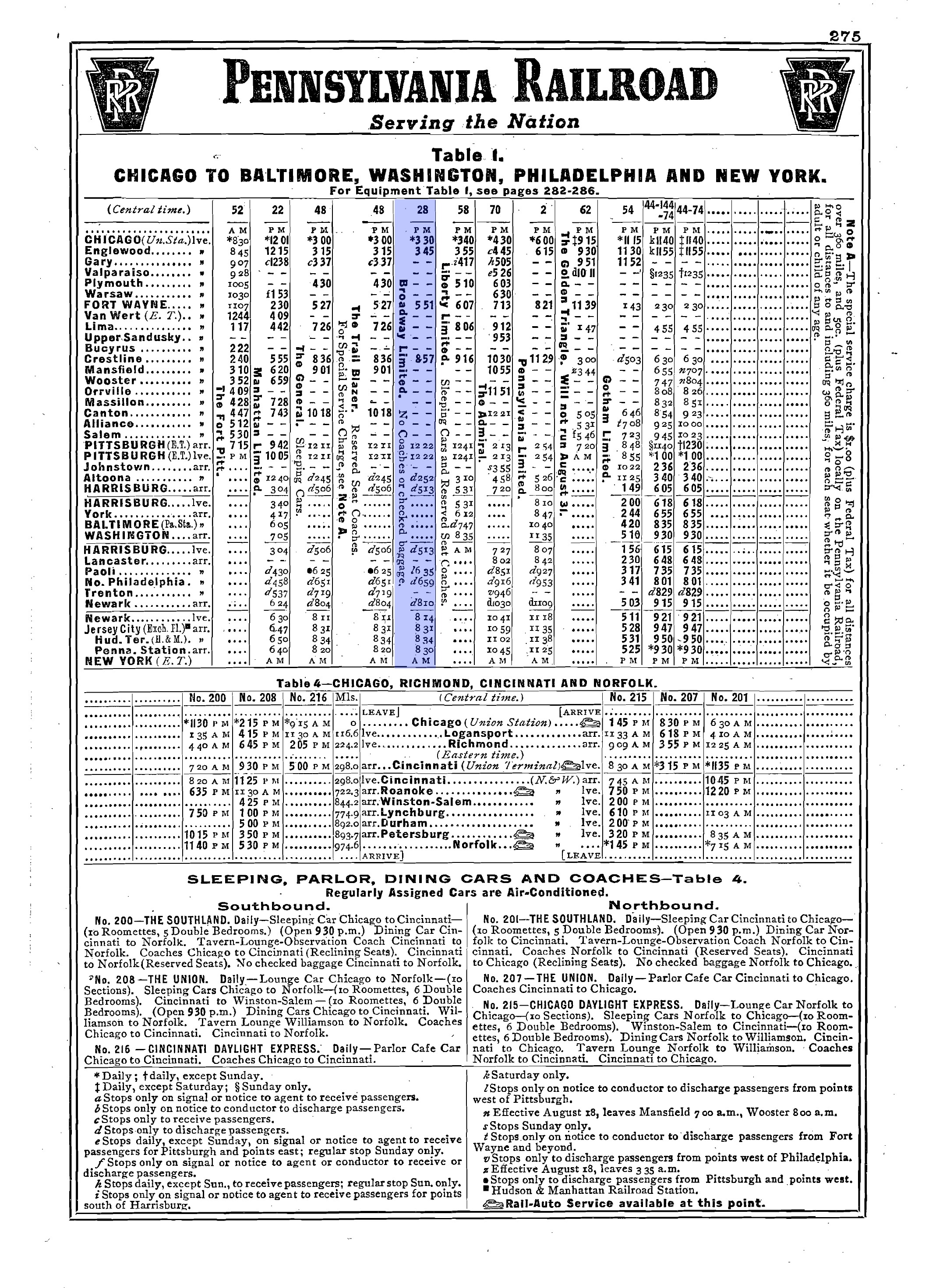
Newly arriving diesels during the 1940s, notably Electro-Motive's E7 and E8 models, largely took care of this minor blemish.
Despite rail travel waning during the 1950s the Pennsy wasted precious resources in upgrading its passenger fleet. For more reading about the train, such as brochures, ads, and menus please click here.
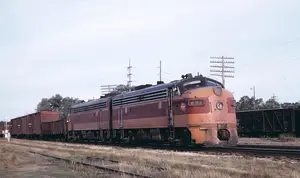
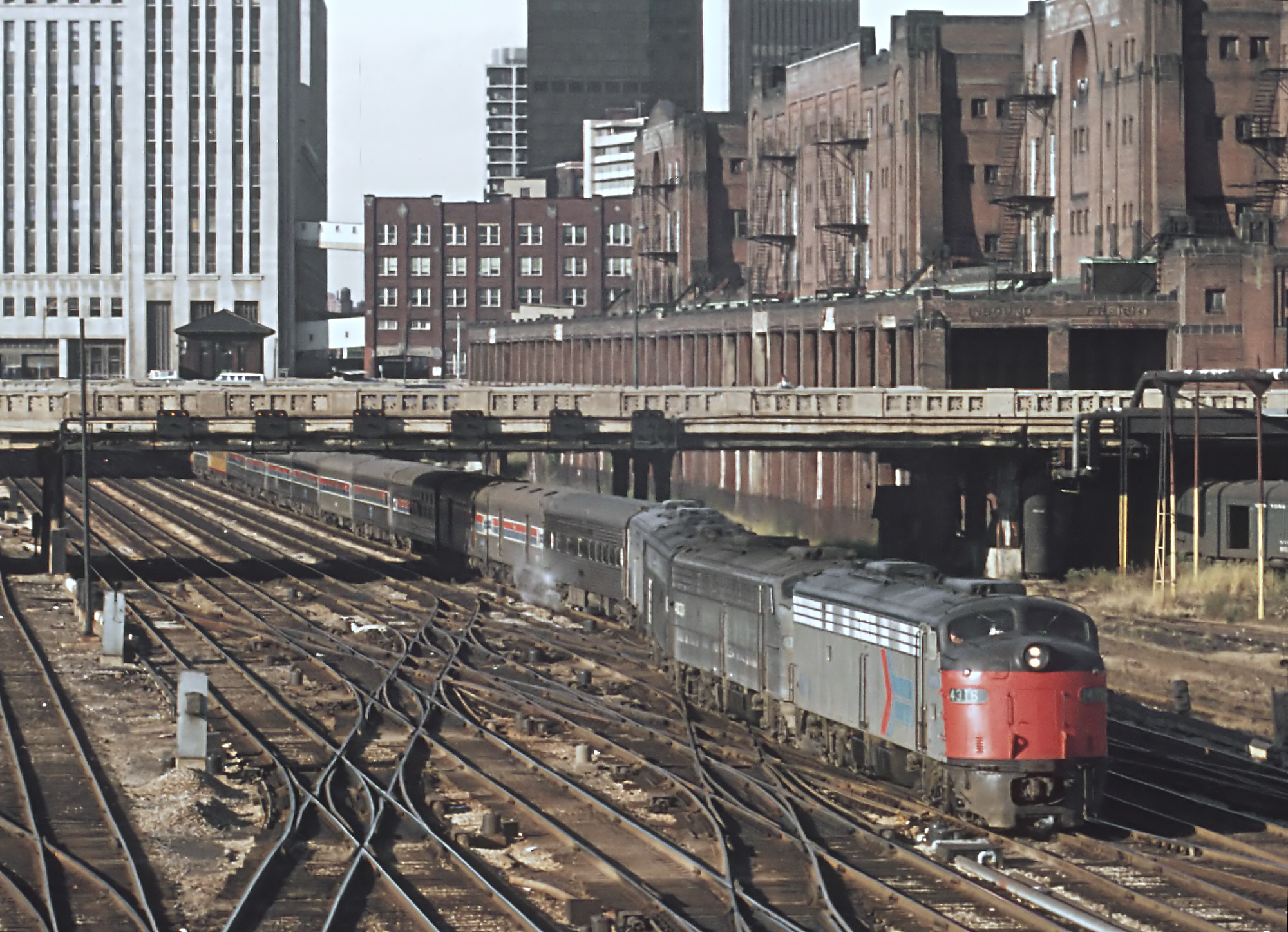 Amtrak E8A #4316 (ex-Penn Central #4616, built as PRR #5716) leads the Broadway Limited at 12th Street in Chicago near Union Station on October 14, 1972. Marty Bernard photo.
Final Years and Amtrak
While the railroad was likely hoping new equipment would bring travelers back to the rails, focusing efforts on freight operations would probably have wrought more fruitful results. The results and effort did little to curtail ridership losses.
By the 1960s the train and Penny's entire commuter/passenger operations were becoming a serious drain on the company's finances.
Finally, in 1967 the PRR discontinued the Broadway’s “All Pullman” status, one of the last train's boasting such regal accommodations. Sadly, within a few years the once powerful and profitable Pullman, synonymous with rail travel for more than a century, had exited the business.
While a
version of the Broadway continued operating under the Penn Central banner, and
later Amtrak, it carried none of the allure as it had during the Pennsylvania era. After more than 20 years of service under Amtrak the train made its final run on September 10, 1995.
Sources
- Schafer, Mike and Solomon, Brian. Pennsylvania Railroad. Osceola: MBI Publishing, 1997.
- Schafer, Mike and Welsh, Joe. Streamliners, History of a Railroad Icon. St. Paul: MBI Publishing, 2003.
- Stegmaier Jr., Harry. Pennsylvania Railroad: Passenger Trains, Consists And Cars - 1952 (Volume 1, East-West Trains). Lynchburg: TLC Publishing, Inc., 2003.
- Welsh, Joe. Pennsylvania Railroad's Broadway Limited. St. Paul: MBI Publishing, LLC, 2006.
Recent Articles


-
Canadian Pacific Railway: Map, History, Logo, Photos
Sep 17, 26 12:06 AM
 Canadian Pacific Railway—incorporated February 16, 1881. Last spike Craigellachie November 7, 1885. Soo, Milwaukee, D&H, DM&E. CPKC April 14, 2023. Complete corporate history.
 -
Canadian Pacific Diesel Locomotives: History, Roster & Photos
Sep 17, 26 12:03 AM
 Canadian Pacific diesel—E8A 1800 in 1949, FP7/FP9, FA-2, C424, SD40-2, SD40-2F Red Barns, AC4400CW, ES44AC, SD30C-ECO, SD70ACu heritage. All-time roster. Last steam November 6, 1960.
 -
Canadian Pacific Steam Locomotives: History, Roster & Photos
Sep 16, 26 11:35 PM
 Canadian Pacific steam—3,257 engines 1881–1949. D10 Ten-Wheelers, G3 Pacifics, Royal Hudsons, Selkirk 2-10-4s. Post-1900 class roster after Drury. Last steam November 6, 1960.
 -
Woodstown Central Dining in Motion (2026)
Sep 16, 26 11:31 PM
 2026 Woodstown Central Dining in Motion—Salem County table car, 50–60 minutes, private table of four from $190. Confirm on woodstowncentral.com.
 -
NCTM Wine & Dine on the Rails (2026)
Sep 16, 26 11:28 PM
 2026 NCTM Wine & Dine on the Rails in Spencer—Feb. 13–15, three-course dinner, 21+, $145/$140. Sold out. Confirm next season on nctransportationmuseum.org.
 -
Southern Railway 4-6-2 1380: The Streamlined Ps-4
Sep 16, 26 10:34 PM
 Southern Railway Ps-4 4-6-2 1380—Alco 1923, serial 64857. Otto Kuhler streamlining at Spencer 1940–41 for the Tennessean. Only streamlined steam locomotive on the Southern. Scrapped Baltimore 1953.
 -
Texas Mexican Railway: Serving The Border Since The 1880s
Sep 16, 26 09:58 PM
 Texas Mexican Railway—Corpus Christi, San Diego & Rio Grande March 1875, 3-foot. Tex-Mex June 1881, Laredo Sept 1881, Rio Grande bridge 1883. Standard gauge July 17 1902. Mexican government 1900–1…
 -
Mount Hood Railroad Dining (2026): No Plated Dinner Train This Season
Sep 16, 26 09:53 PM
 2026 Mount Hood Railroad in Hood River is scenic Fruit Loop trains with snacks and sandwiches—not a plated dinner train. Confirm on mthoodrr.com.
 -
Peoria and Eastern Railway: Map, Timetables, History
Sep 16, 26 09:39 PM
 Peoria & Eastern—Danville, Urbana, Bloomington & Pekin 1866, IB&W 1869, OI&W 1887. Incorporated Feb 21 1890, Big Four next day. NYC 1930, Conrail 1976. GP7s 5612–5625. Complete corporate history.
 -
Boston and Maine Railroad: "Route Of The Minute Man"
Sep 16, 26 11:30 AM
 Boston & Maine—Andover & Wilmington 1833, NH charter June 27 1835. Eastern, Boston & Lowell, Fitchburg/Hoosac, Concord & Montreal. Section 77 March 12 1970. Guilford June 30 1983. CSX June 1 2…
 -
Smoky Valley Limited Dinner Train (2026)
Sep 16, 26 11:24 AM
 2026 Abilene & Smoky Valley Smoky Valley Limited—two-hour dinner from the 1887 Rock Island Depot. Kansas catering, ~$72–$110. Confirm on asvrr.org.
 -
Canadian National Diesel Locomotives: History, Roster & Photos
Sep 16, 26 11:14 AM
 Canadian National diesel—CLC boxcabs 1929, GMD FP9 and GP9, MLW FPA-4 and RS-18, GMD1, wide-cab SD40-2W, Dash-9s, ES44AC and ET44AC. All-time roster.
 -
Canadian National Steam Locomotives: History, Roster & Photos
Sep 16, 26 10:07 AM
 Canadian National steam—CGR, Canadian Northern, Grand Trunk, GTP. 4-8-4 Confederations, U-1 Mountains, J and K Pacifics. Post-1900 class roster. Last scheduled steam April 25, 1960.
 -
Canadian National Railway: Map, Logo, History, Photos
Sep 16, 26 08:55 AM
 Canadian National—name Dec 20 1918, incorporated June 6 1919, Grand Trunk Jan 20 1923. Crown corporation, IPO Nov 17 1995. IC, Wisconsin Central, BC Rail, EJ&E. Class I, mark CN.
 -
Buffalo, Rochester and Pittsburgh Railway: "Safety and Service"
Sep 16, 26 12:12 AM
 Buffalo, Rochester & Pittsburgh—Rochester & State Line 1869, BR&P March 12 1887. Pennsylvania coal to Buffalo and Rochester. B&O January 1 1932. All-time steam roster, LL 2-6-6-2s, XX…
 -
Buffalo Creek & Gauley Railroad: Map, Roster, Logo, Photos
Sep 15, 26 11:55 PM
 Buffalo Creek & Gauley—Elk River Coal & Lumber, April 1 1904, Dundon–Widen. Last all-steam WV coal road, February 27 1965. All-time steam roster, #4 Baldwin 59472, Majestic and Elk River diesels…
 -
Buffalo and Susquehanna Railroad: Map & History
Sep 15, 26 11:42 PM
 Buffalo & Susquehanna—Goodyear hemlock railroad, Sinnemahoning Valley December 14 1885, 1893 merger, coal to Sagamore, Buffalo extension, bankruptcy May 6 1910, B&O 1932, WAG 1956.
 -
WMSR Allegheny Mountain Dinner Train (2026): Dates & Tickets
Sep 15, 26 11:36 PM
 2026 Western Maryland Scenic Allegheny Mountain Dinner Train—Cumberland, 3 hours, 21+, Saturday 7 p.m. Confirm on wmsr.com.
 -
Boston and Albany Railroad: Map & History
Sep 15, 26 11:28 PM
 Boston & Albany Railroad—Boston & Worcester June 23 1831, Western Railroad across the Berkshires, merger 1867–70. NYC 99-year lease July 1 1900. Berkshires, New England States, CSX and MBTA today.
 -
Grand Bellevue Dinner Train (2026): Portsmouth, Rhode Island
Sep 15, 26 11:14 PM
 2026 Grand Bellevue Rail Dining in Portsmouth, RI—2.5-hour seated dinner on Narragansett Bay. Fall/winter TBA after Aug. 29. Confirm on thegrandbell.com.
 -
The "John Bull": The C&A's First Locomotive (1831)
Sep 15, 26 11:01 PM
 John Bull locomotive—Stephenson Planet-type 0-4-0, 1831. Dripps assembly, 4-2-0 rebuild, cowcatcher. Specs, Camden & Amboy career, Smithsonian 1884, 1981 steam-up, 1939 replica.
 -
Napa Valley Wine Train Dining (2026): Lunch, Dinner & Vista Dome
Sep 15, 26 10:56 PM
 2026 Napa Valley Wine Train dining—downtown Napa, 36-mile round trip, gourmet lunch and dinner, Vista Dome. Confirm packages on winetrain.com.
 -
My Old Kentucky Dinner Train (2026): Dates, Tickets & What to Expect
Sep 15, 26 10:50 PM
 2026 My Old Kentucky Dinner Train in Bardstown—2.5 hours, 35-mile round trip, four-course dinner from $116. Confirm on kydinnertrain.com.
 -
LaSalle Street Station: One Of Chicago's Great Terminals
Sep 15, 26 10:42 PM
 LaSalle Street Station—Rock Island October 10, 1852. Frost & Granger July 1, 1903. 20th Century Limited, Rockets, Golden State. Headhouse razed 1981. Metra Rock Island District today.
 -
Charlie Russell Chew Choo (2026): Montana Dinner Train from Lewistown
Sep 15, 26 10:39 PM
 2026 Charlie Russell Chew Choo dinner train—Hanover/Lewistown, 4.5 hours, 56-mile round trip, prime rib. Adult $151. Remaining listed dates sold out. Confirm on montanadinnertrain.com.
 -
Central Pacific Railroad: Map, History, Facts, Logo
Sep 15, 26 10:30 PM
 Central Pacific—Judah, Big Four, June 28 1861. Sierra, Chinese labor, Donner Summit Tunnel. Ten-mile day April 28 1869. Promontory May 10. Southern Pacific lease April 1 1885. Dissolved June 30 1959…
 -
Bessemer & Lake Erie Railroad: "The Bessemer Road"
Sep 15, 26 05:20 PM
 Bessemer & Lake Erie—Bear Creek 1865, Carnegie 1897, U.S. Steel 1901. Ore south from Conneaut, coal north. 2-10-4s, Missabe sister road. CN May 10, 2004. Complete corporate history.
 -
Bangor and Aroostook Railroad: "Serving Northern Maine"
Sep 15, 26 05:05 PM
 Bangor & Aroostook—chartered February 13, 1891, first trains January 1, 1894. Potatoes, paper, Searsport, State of Maine reefers. MM&A 2003, Lac-Mégantic 2013, CP 2020, CPKC today. Complete co…
 -
Baltimore & Ohio Chicago Terminal Railroad: Map and History
Sep 15, 26 03:11 PM
 B&OCT—formed January 6, 1910 to buy Chicago Terminal Transfer. Grand Central, Barr Yard, 78 route-miles. Assigned B&O steam. Complete diesel roster. CSX paper subsidiary, mark BOCT.
 -
The "Alphabet Route" (Railroad): Photos and History
Sep 15, 26 02:53 PM
 Alphabet Route—eight railroads, not one company. P&WV to Connellsville February 11, 1931. Alpha Jets Chicago/St. Louis–New York/Boston. NKP, W&LE, P&WV, WM, Reading, CNJ, L&HR, New Hav…
 -
Milwaukee Road Livestock Operations: Cattle, Dakotas & Montana
Sep 15, 26 02:36 PM
 Milwaukee Road livestock traffic—Dakota and Montana cattle, Iowa hogs, Chicago markets, 28-hour law, head-end stock cars. By 1974 mostly Montana. Rick Burn’s Helena speech. Operations history, not the…
 -
Spirit of Jasper Ride & Dine (2026): Season Pause
Sep 15, 26 02:29 PM
 Spirit of Jasper Ride & Dine in Jasper, Indiana—seated meal on board. Operator: not running public trains for 2026. Depot remains open as a rental. Confirm on spiritofjaspertrain.com.
 -
South Carolina Canal & Rail Road Company: Map and History
Sep 15, 26 01:59 PM
 South Carolina Canal & Rail Road—chartered December 19, 1827. Best Friend of Charleston, 136 miles Charleston–Hamburg October 1833, Aiken inclined plane. South Carolina Railroad 1844, Southern 189…
 -
The Practice of Double-Heading: The Steam Era
Sep 15, 26 01:43 PM
 Doubleheading—two locomotives on the point, each with its own steam crew. Not a rear helper, not diesel MU. How it worked, PRR 1877, mountain grades, and what MU ended.
 -
Mohawk and Hudson Railroad: Map, Pictures, Locomotives
Sep 15, 26 01:20 PM
 Mohawk & Hudson Railroad—New York’s first railroad, chartered April 17, 1826. DeWitt Clinton, inclined planes, Albany & Schenectady 1847, first New York Central May 17, 1853. Complete corporat…
 -
Essex Clipper Dinner Train (2026): Dates, Tickets & What to Expect
Sep 15, 26 01:09 PM
 2026 Essex Clipper Dinner Train in Essex, CT—2.5 hours, four-course meal $129.99, 18+. Fall dates through Oct. 25. Confirm on essexsteamtrain.com.
 -
Camden & Amboy Railroad: Map, History, Photos
Sep 15, 26 12:53 PM
 Camden & Amboy Railroad—chartered February 4, 1830. Joint Companies monopoly with the Delaware & Raritan Canal, John Bull, T-rail. United New Jersey 1872, PRR 999-year lease 1871. Complete corpora…
 -
Cafe Lafayette Dinner Train (2026): Dates, Tickets & What to Expect
Sep 15, 26 12:47 PM
2026 Cafe Lafayette Dinner Train in North Woodstock, NH—2 hours, 20 miles, five-course meal from $125. May–October. Confirm on nhdinnertrain.com. -
Christmas Train Ride Locations (2026): A Complete Guide
Sep 15, 26 10:47 AM
 2026 Christmas train rides by state—Santa, North Pole Express, and holiday trains. Not Polar Express. State guides and product pages. Confirm dates on each railroad.
 -
Baltimore & Ohio Railroad: Linking 13 Great States With The Nation
Sep 15, 26 10:22 AM
 Baltimore & Ohio Railroad—first U.S. common carrier, chartered February 28, 1827. Wheeling 1853, Chicago 1874, C&O control 1963, Chessie 1973, into CSX April 30, 1987. Complete corporate history.
 -
Delaware & Hudson Railway: The Bridge Line
Sep 15, 26 09:59 AM
 Delaware & Hudson Railway—Wurts brothers canal 1823, gravity railroad 1829, Stourbridge Lion, Bridge Line to Montreal. Guilford 1984, CP 1991, NS south line 2015, CPKC north.
 -
Delaware & Hudson Diesel Roster (All-Time)
Sep 15, 26 12:17 AM
 All-time Delaware & Hudson diesel roster—Alco S-2s through C-628s and PA-4s, GE U-boats, Baldwin RF-16s, EMD SD45s and GP38-2/GP39-2s. Serials, dates, dispositions.
 -
Granite Railway, Our Country's First Railroad
Sep 14, 26 11:28 PM
 Granite Railway of Quincy, Massachusetts—chartered March 4, 1826, opened October 7, 1826. Gridley Bryant, 5-foot gauge, horses, Bunker Hill Monument stone. First commercial U.S. railroad.
 -
Milwaukee Road Skytop Lounges: History, Specs & Floor Plans
Sep 14, 26 11:09 PM
 Milwaukee Road Skytop observation cars—Brooks Stevens, 1948. Four Rapids parlor-lounges from Milwaukee Shops, six Creek sleeper-lounges from Pullman-Standard. Floor plans, roster, preservation.
 -
West Virginia Christmas Train Rides (2026): A Complete Guide
Sep 14, 26 11:02 PM
2026 West Virginia Christmas trains—Potomac Eagle North Pole Express in Romney and Christmas at Cass. Not Polar Express. Elkins Polar is not listed for 2026. -
Railroads Of Today: Class I Map, PSR & the 2026 Industry
Sep 14, 26 10:30 PM
U.S. freight rail in 2026—six Class I railroads on a nearly 140,000-mile network. PSR as everyday practice, how the STB works, traffic mix, short lines and regionals. -
Railroad History (USA): Timeline, Facts & How the Network Was Built
Sep 14, 26 10:03 PM
 Full U.S. railroad history hub—origins and inventors, Golden Age peak mileage, Civil War and transcontinental, streamliners, ICC regulation, Penn Central and Conrail, Staggers Act, PSR, and today’s Cl…
 -
Railroads In The 2020s: CPKC, East Palestine & the UP–NS Case
Sep 14, 26 09:51 PM
 U.S. railroads 2020–2026—Class I mileage 91,773 in 2020. COVID traffic drop, CPKC April 14 2023, East Palestine Feb. 3 2023, UP–NS $85 billion case still before the STB.
 -
Railroads In The 2010s: PSR, Coal’s Decline & Positive Train Control
Sep 14, 26 03:51 PM
 U.S. railroads 2010–2020—Class I mileage 95,573 to 91,773. Buffett closed BNSF Feb. 12 2010, Harrison at CP June 29 2012 and CSX 2017, PTC deadline Dec. 31 2018.
 -
Virginia Christmas Train Rides (2026): A Complete Guide
Sep 14, 26 03:46 PM
 2026 Virginia Christmas trains—Virginia Scenic Railway Santa Express from Staunton, about 60 minutes. Confirm dates. Not Polar Express.