Pennsylvania (PRR) Steam Roster: Post 1906
Last revised: September 22, 2026
By: Adam Burns
Between 1910 and the early 1920s the Pennsylvania Railroad settled on five steam locomotives and then built them by the hundred. The E6s Atlantic and the K4s Pacific handled the passenger trains. The L1s Mikado, the I1s Decapod, and the M1 Mountain handled the freight. Around those five sat an enormous Consolidation fleet, a few experimental articulateds, two famous duplex classes, and one steam turbine. George H. Drury’s chapter in the revised Guide to North American Steam Locomotives is the class grid below.
Juniata, at Altoona, built more locomotives for its owner than any other American railroad built for itself. A Belpaire firebox, a keystone number plate, and an “s” for superheat were the marks of the system. The Belpaire has a flat crown and flat sides, so the staybolts between the crown sheet and the wrapper are straight and visible. It was easier to maintain, and Juniata could turn the boilers out in quantity. The firebox still depends on those stays. What the design gave the railroad was a staybolt a shopman could see, and a heating surface the company trusted enough to put under nearly everything it rostered after 1906.
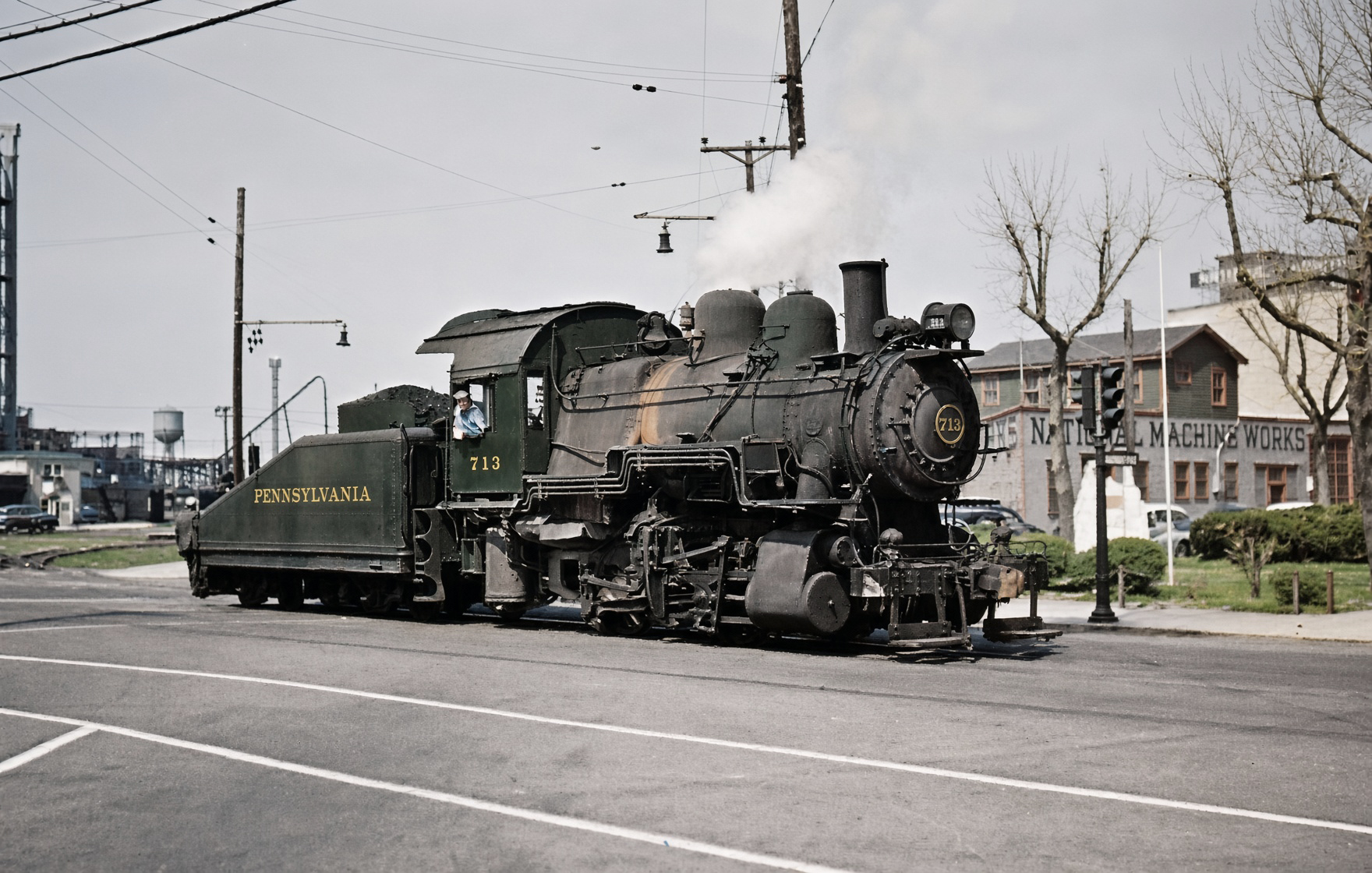
A5s #713, an 0-4-0, running light through Atlantic City, New Jersey, April 25, 1954. Doug Wornom photo. The A5s was the heavy street switcher, piston valves and power reverse, 131,750 pounds, built at Juniata from 1916 to 1924.
On this page: At a glance · Consolidations, Mikados, Decapods · Mountains, the J1, and the duplexes · Atlantics and the K4s · Switchers and articulateds · November 30, 1957 · Class roster
At a glance
| Item | Detail |
|---|---|
| Railroad | Pennsylvania Railroad. Mark PRR. Company Pennsylvania Railroad |
| This roster | Locomotives built since 1906, after Drury, pages 267–271. Earlier power is outside the grid |
| Shops | Juniata, at Altoona, with a stationary test plant. Outside orders usually went to Baldwin at Eddystone |
| Freight, in quantity | 1,233 class H8, H9, and H10 Consolidations. 574 L1s Mikados, 1914–1919. 598 I1s Decapods. 301 M1 and M1a Mountains. 125 J1 2-10-4s, 1942–1944 |
| Passenger, in quantity | 82 E6s Atlantics, plus one experimental E6. 425 K4s Pacifics, 1914–1928. Two K5s, 1929, not repeated. 90 G5s Ten-Wheelers, and 31 more for the Long Island |
| Duplex and turbine | S1 6-4-4-6, one engine, 6100. T1 4-4-4-4, 52 engines. Q1 4-6-4-4, one engine. Q2 4-4-6-4, 26 engines. S2 6-8-6 turbine, engine 6200 |
| Lines West | Operated by the Pennsylvania Company until the 1920s, with its own number blocks and several of its own classes (K3s, N1s, the USRA engines) |
| Last steam | Declared finished November 30, 1957. The year-end report still listed 319 steam locomotives. 21 remained at the end of 1958 |
| Preserved | K4s 1361 at Altoona, under restoration. K4s 3750 and L1s 520 at the Railroad Museum of Pennsylvania |
Class table follows Drury, Guide to North American Steam Locomotives (revised edition), pages 270–271. Information compiled September 22, 2026.
The Consolidation, then the Mike, then the Decapod
The modern Pennsylvania Consolidation starts with the H6 of 1906, Baldwin, and then the H6b. The H8 of 1907 was the step up: 24-by-28-inch cylinders, 62-inch drivers, and more than 42,000 pounds of extra weight over the engines it replaced. Juniata and the commercial builders kept at them through 1913. As superheaters went on, many early H8s were reclassed H9 or H10. Cylinder diameter was the real difference. H9s on Lines East had 25-by-28-inch cylinders and the same 62-inch drivers. H10s on Lines West were Mikado-sized, 27-by-28-inch cylinders, about 320,700 pounds, in the range of a later USRA heavy Mikado, and they carried the same boiler as the K4s. Counted together, H8, H9, and H10 came to 1,233 locomotives. Coal and ore trains were still doubleheading 2-8-0s after the Mikado had arrived.
The L1s was the next standard freight engine. Between 1914 and 1919 the company acquired 574 of them: 344 from Juniata, 205 from Baldwin, and 25 from Lima. They shared a boiler, and a great many parts, with the K4s. Drury puts them first on the Central Region, then bumped east, to everything east of Altoona and Renovo, once the Decapods arrived. A long-distance tender on the later engines rode on sixteen wheels.
The I1s was the Decapod, and it was the Pennsylvania’s answer to those doubleheaded Consolidations. One test engine, 790, came out of Juniata in 1916. Juniata built 122 more in 1918 and 1919. Baldwin built 475, numbered 4225–4699, in 1922 and 1923. That is 598. The Baldwin engines carried Worthington BL feedwater heaters, unusual on a railroad that was slow to adopt feedwater heaters at all. Cylinders were 30½ by 32 inches, drivers 62 inches, tractive effort 90,000 pounds, about twice an H8, and the engine weight was 386,100 pounds. They were enormous for the rail they ran on. They also did the job. The class letter in the railroad’s own usage is I1s, the superheated Decapod. The three rows below are that class, including the 1916 test engine.
Lines West wanted a 2-10-2 and got the N1s: 35 from Brooks in 1918 and 25 from Baldwin in 1919, sixty engines. The grate was 79.9 square feet, which is why the firebox sat on a trailing truck. Drivers matched the I1s, the cylinders were half an inch smaller, and the weight went to 435,000 pounds. They were assigned to the Central Region and displaced L1s Mikados. The United States Railroad Administration also handed Lines West 130 heavy 2-10-2s, class N2s, same cylinder size as the N1s, drivers an inch larger, and about 55,000 pounds lighter. After four years the Pennsylvania replaced their radial-stay fireboxes with Belpaires. The same administration assigned 38 light 2-8-2s in 1919. All but five moved on to the Missouri Pacific and the St. Louis–San Francisco. The five that stayed were class L2s, numbered 9627–9631, and went to work on the Grand Rapids & Indiana.
The M1, a war 2-10-4, and the duplexes
The M1 of 1923 was an I1 boiler on a Mountain, with interchangeable parts, 27-by-30-inch cylinders, 72-inch drivers, and a weight of 385,000 pounds. Juniata built one, 4700, later renumbered 6699, and tested it. Baldwin and Lima delivered 200 M1s in 1926, engines 6800–6999. Lima, Baldwin, and Juniata built 100 M1as in 1930, engines 6700–6799. Some were dual-service, with a larger tender and a mechanical stoker. The first tender tried on the type was a low-sided tank more appropriate to an E6. A few M1s were stripped and painted for passenger trains. New York–Washington electrification then released Pacifics, and the Mountains were not needed in that service. They remained the fast freight engine.
World War II arrived with a traffic surge and almost no modern freight power. In May 1942 Juniata turned out a single duplex, class Q1, engine 6130, a 4-6-4-4 with one set of drivers set the other way under the firebox. It was not a success, and the idea went back to the drawing board. The War Production Board had frozen new designs, so the Pennsylvania borrowed a Chesapeake & Ohio 2-10-4, changed the drivers from 69 inches to 70, fitted a solid drop-coupler pilot and a keystone number plate, and built 125 class J1s at Altoona in 1942, 1943, and 1944: 100 engines numbered 6401–6500, and 25 numbered 6150–6174.
A second duplex, the Q2 4-4-6-4, was ready in 1944. Both sets of drivers faced forward. The prototype was 6131. The railroad canceled an order to Lima for 25 more 2-10-4s and built 25 Q2s at Altoona in 1945, engines 6175–6199. They were the most powerful two-unit duplexes anyone built, about 40,000 pounds heavier than a J1 and about 5,000 pounds stronger in tractive effort. They were also more complicated. Every Q2 was retired before any of the J1s.
The passenger duplexes were a separate disappointment. Baldwin built two T1 prototypes, 6110 and 6111, in 1942. Juniata and Baldwin built 50 more, 5500–5549, in 1945 and 1946. The S1, engine 6100, was a one-of-a-kind 6-4-4-6 of 1939. The S2, engine 6200, is the turbine: a Baldwin 6-8-6 of 1944, direct drive, retired in 1952. It is not a second S1.
From the Atlantic back to the Pacific
The Pennsylvania stayed with Atlantics until 1910, and it got more out of a 4-4-2 than most railroads got out of a light Pacific. In 1907 Alco’s Pittsburgh works delivered an experimental Pacific, class K28, engine 7067: 24-by-26-inch cylinders, 80-inch drivers, 273,600 pounds. That engine was the sketch for a Lines West K1 that was never built, and for the Lines West K2 that was. Between 1910 and 1913 the railroad acquired 227 K2 Pacifics. Most were built superheated, and the others were superheated later and reclassed. In 1913 Baldwin delivered 30 K3s Pacifics to Lines West, larger, and equipped with mechanical stokers, which the Pennsylvania adopted only reluctantly and years afterward.
The K2 was still not quite right. In 1910 the company returned to the Atlantic and produced the E6: 22-by-26-inch cylinders, 80-inch drivers, 231,500 pounds, in effect a middleweight Pacific with two pairs of drivers. The boiler was close to the H8’s. Superheating allowed the cylinders to go to 23½ inches and the tractive effort to 31,275 pounds. Juniata built two in 1912 and 80 in 1914, most of them for the New York–Philadelphia–Washington trains. One experimental E6, 5075, later 1067, dates from 1910.
In 1911 Alco delivered another experimental Pacific, class K29, engine 3395: 27-by-28-inch cylinders, 80-inch drivers, 317,000 pounds. The K4s combined that size with the E6’s manners and the L1s boiler. It was tested for three years. Between 1917 and 1927 Altoona built 324. Passenger trains kept growing, and doubleheaded K4s became ordinary practice, while other railroads were buying 4-8-2s, 4-6-4s, and 4-8-4s. In 1927 and 1928 the Pennsylvania ordered 100 more K4s, 25 from Juniata and 75 from Baldwin, still hand-fired. With the 1914 prototype the class is 425 locomotives, numbered in the 8–8378 series, built from 1914 through 1928. Engine 5495, Altoona, 1928, was among the last. For builder photographs the railroad painted the window frames and the lamp lenses white.
Suburban service needed something smaller. The G5s put an E6 boiler on 68-inch drivers. The Pennsylvania built 90 of its own, in two groups, and 31 for the Long Island Rail Road. Those 31 are on the Long Island steam roster.
In 1929 Juniata and Baldwin each built a heavy Pacific with M1-size cylinders, class K5, engines 5698 and 5699. The Baldwin engine had Caprotti poppet valves, removed in 1937. Both had Worthington feedwater heaters, and both were handed a Pennsylvania coal shovel. They offered about 10,000 pounds more tractive effort than a K4s and put about 6,000 pounds more weight on the drivers. They were slippery. They were not enough better to duplicate, and the Depression made a new passenger engine unnecessary.
Over the years the K4s received disk drivers, smoke lifters, solid pilots, and a little streamlining. Late in the steam era the headlight and the turbogenerator traded places, the generator moving onto the smokebox front just ahead of the stack. The change was small. The face of the locomotive was not. The early 1940s brought the S1 and the T1 for passenger work, and the S2 turbine. None of them replaced the K4s on the trains that still needed steam.
Switchers, and a few articulateds
Two classes dominated the six-wheel switchers. The B6 weighed about 170,000 to 180,000 pounds. The B8 weighed about 140,000. The Lines West B29 was lighter still, about 135,000 pounds. The United States Railroad Administration allotted 30 six-wheel switchers, class B28s, built in 1918 and 1919. Street track and the sharp curves of the eastern cities were an 0-4-0 job. The A4, 64 engines, was built from 1906 to 1913. The A5s, 47 engines, was built from 1916 to 1924, with piston valves and power reverse, at 131,750 pounds the heaviest 0-4-0s the railroad owned.
In the mid-1920s Juniata built 90 class C1 0-8-0s, engines in the 6550–6639 series, with 27-by-30-inch cylinders, 56-inch drivers, a weight of 278,000 pounds, and 78,107 pounds of tractive effort. A USRA 0-8-0, for comparison, had 25-by-28-inch cylinders, 51-inch drivers, a weight of 214,000 pounds, and about 51,000 pounds of tractive effort. The C1 was large, and the people who ran it did not like it.
Articulateds were experiments, with one exception. In 1911 Schenectady built a single 2-8-8-2, class HH1, engine 3396, which pushed near Pittsburgh. In 1912 Baldwin built a single 0-8-8-0, class CC1, engine 3397, meant to replace a pair of Consolidations in pusher service. It was not successful enough to repeat. In 1919 Juniata built a single-expansion 2-8-8-0, class HC1s, engine 3700. It was too big, it stayed a pusher, and it was not duplicated. The articulateds that worked were ten 0-8-8-0s, class CC2s, Baldwin, 1919, for Lines West pushers and humps. All ten eventually sat at Columbus, Ohio.
In 1943 the Pennsylvania bought six USRA 2-8-8-2s from the Norfolk & Western for Hagerstown and Harrisburg. Norfolk & Western classed them Y3. The Pennsylvania classed them HH1, reusing the classification of its 1911 articulated. After the war they went to Columbus to join the CC2s. Their road numbers are not in Drury’s post-1906 grid, which lists the original HH1 as the single engine 3396, so they are not given a row below.
November 30, 1957
By the late 1920s the mechanical department had turned from new steam to electrification. The wires reached Washington in 1935 and Harrisburg in 1938, and a surplus of steam locomotives followed. The intention to electrify on over the Alleghenies to Pittsburgh kept new steam on the shelf through the Depression. The war then had to be moved with Decapods, Mikados, and a crash program of 2-10-4s. After the war the company did buy duplex freight engines, which were good, and duplex passenger engines, which were not.
Steam was declared finished on November 30, 1957. Some of the last passenger assignments were on the New York & Long Branch, where a K4s still fit the railroad. The report to the Interstate Commerce Commission at the end of that year still included 319 steam locomotives, and 21 were left at the end of 1958. K4s 1361, built at Juniata in 1918, is under restoration at the Railroaders Memorial Museum in Altoona. K4s 3750 and L1s 520 are at the Railroad Museum of Pennsylvania.
Pennsylvania Railroad steam locomotives built since 1906
Numbers on the big classes were assigned in blocks, and the blocks were not consecutive. A quantity is the number of locomotives, not the span of the number series. An “s” in the class is superheat. Lines West engines carry the higher numbers. Retirement years are the span Drury prints for the class, not a single scrap date.
| Type | Class | Numbers | Qty | Builder | Built | Retired | Notes |
|---|---|---|---|---|---|---|---|
| 0-4-0 | A4 | 50–6601 | 64 | PRR | 1906–1913 | 1927–1936 | Not sequential |
| 0-4-0 | A5s | 76–4039 | 47 | PRR | 1916–1924 | 1930–1956 | Not sequential. Piston valves, power reverse, 131,750 lb |
| 0-6-0 | — | 3687–3688 | 2 | Baldwin | 1907, 1913 | 1925–1926 | Ex-Cornwall & Lebanon |
| 0-6-0 | — | 5411 | 1 | Baldwin | 1912 | 1928 | Ex-Baltimore & Sparrows Point |
| 0-6-0 | B6 | 7045–9354 | 49 | PRR, Baldwin, Lima | 1910–1913 | 1948–1952 | Not sequential. About 170,000–180,000 lb |
| 0-6-0 | B6sa | 3–6227 | 55 | PRR | 1913–1914 | 1949–1953 | Not sequential |
| 0-6-0 | B6sb | 31–6400 | 238 | PRR | 1916–1926 | 1949–1959 | Not sequential |
| 0-6-0 | B8 | 15–9569 | 247 | PRR, Lima | 1913 | 1929–1956 | Not sequential. About 140,000 lb |
| 0-6-0 | B23 | 8777–8782 | 6 | Alco (Schenectady) | 1907 | 1926–1934 | — |
| 0-6-0 | B28s | 7007–9405 | 30 | Alco (Pittsburgh, Cooke, Schenectady) | 1918–1919 | 1948–1953 | Not sequential. USRA |
| 0-6-0 | B29 | 7028–9786 | 135 | Alco (Pittsburgh, Richmond), Lima | 1913 | 1926–1930 | Not sequential. Lines West. About 135,000 lb |
| 0-8-0 | C1 | 6550–6639 | 90 | PRR | 1925–1927 | 1948–1953 | Not sequential. 27×30 in, 56 in drivers, 78,107 lb tractive effort |
| 0-8-8-0 | CC1s | 3397 | 1 | Baldwin | 1912 | 1931 | Pusher. Not repeated |
| 0-8-8-0 | CC2s | 7250–9359 | 10 | Baldwin | 1919 | 1947–1949 | Not sequential. Lines West pushers and humps. Later all at Columbus, Ohio |
| 2-6-0 | F27s | 8833–8843 | 11 | Alco (Schenectady) | 1907 | 1926–1928 | — |
| 2-8-0 | H6b | 1–9988 | 148 | Baldwin, PRR, Alco (Pittsburgh) | 1907–1913 | 1925–1953 | Not sequential. First modern Consolidation family after the 1906 H6 |
| 2-8-0 | H8 | 3193–3217 | 25 | PRR | 1907 | 1933–1956 | 24×28 in cylinders, 62 in drivers |
| 2-8-0 | H8a | 7193–9886 | 117 | PRR, Baldwin, Alco (Pittsburgh) | 1907–1911 | 1937–1956 | Not sequential |
| 2-8-0 | H8b | 21–3577 | 352 | PRR, Baldwin | 1908–1913 | 1934–1957 | Not sequential |
| 2-8-0 | H8c | 7021–9989 | 192 | Alco (Brooks, Pittsburgh), PRR | 1908–1913 | 1934–1957 | Not sequential |
| 2-8-0 | H9s | 7–9999 | 312 | — | — | — | Not sequential. Converted from H8 |
| 2-8-0 | H9s | 24–5174 | 274 | Baldwin, PRR | 1913–1914 | 1947–1958 | Not sequential. Lines East. 25×28 in, 62 in drivers |
| 2-8-0 | H10s | 6073–9999 | 200 | — | — | — | Not sequential. Converted from H8 |
| 2-8-0 | H10s | 7001–9895 | 273 | Alco (Pittsburgh, Brooks), Baldwin, Lima | 1913–1916 | By 1960 | Not sequential. Converted from H8. Lines West, 27×28 in, about 320,700 lb. Same boiler as the K4s |
| 2-8-0 | H34a | 9602–9605 | 4 | Alco (Pittsburgh) | 1908 | 1925–1926 | — |
| 2-8-0 | H34b | 9616–9619 | 4 | Alco (Pittsburgh) | 1910 | 1925–1926 | — |
| 2-8-2 | L1s | 2–9866 | 574 | Juniata, Baldwin, Lima | 1914–1919 | 1941–1959 | Not sequential. Juniata 344, Baldwin 205, Lima 25. Same boiler as the K4s. 520 preserved |
| 2-8-2 | L2s | 9627–9631 | 5 | Alco (Schenectady) | 1919 | 1948 | USRA light. Five kept from an allotment of 38. Grand Rapids & Indiana |
| 2-10-0 | I1s | 790 | 1 | PRR | 1916 | 1956 | Test engine |
| 2-10-0 | I1s | 30–6340 | 122 | PRR | 1918–1919 | 1949–1959 | Not sequential. Juniata |
| 2-10-0 | I1s | 4225–4699 | 475 | Baldwin | 1922–1923 | 1949–1960 | Worthington BL feedwater heaters. 30½×32 in, 62 in drivers, 90,000 lb tractive effort, 386,100 lb. Class total 598 |
| 2-10-2 | N1s | 7008–9866 | 60 | Alco (Brooks), Baldwin | 1918–1919 | 1947–1950 | 35 Brooks, 1918; 25 Baldwin, 1919. Lines West. Grate 79.9 sq ft. 435,000 lb |
| 2-10-2 | N2s | 7036–9859 | 130 | Alco (Brooks), Baldwin | 1919 | 1948–1953 | USRA heavy. Belpaire fireboxes fitted after about four years |
| 2-10-4 | J1 | 6150–6174 | 25 | PRR | 1943–1944 | 1957–1959 | C&O design. 70 in drivers, drop-coupler pilot, keystone number plate. Class total 125 |
| 2-10-4 | J1, J1a | 6401–6500 | 100 | PRR | 1942–1943 | 1957–1959 | Altoona |
| 2-8-8-0 | HC1s | 3700 | 1 | PRR | 1919 | 1929 | Single-expansion. Pusher. Not repeated |
| 2-8-8-2 | HH1s | 3396 | 1 | Alco (Schenectady) | 1911 | 1928 | Pusher near Pittsburgh. Six ex-N&W Y3s were also classed HH1 in 1943; their numbers are not in this grid |
| 4-4-0 | D16 | 340–6460 | 40 | PRR | 1907–1908 | 1928–1935 | Not sequential |
| 4-4-0 | D16d | 9821–9825 | 5 | PRR | 1907–1910 | 1925–1931 | — |
| 4-4-2 | E2b | 7496–8634 | 70 | PRR | 1909 | 1924–1927 | Not sequential |
| 4-4-2 | E2d | 6001–6083 | 32 | PRR | 1908 | 1931–1938 | Not sequential |
| 4-4-2 | E3d | 10–6441 | 43 | PRR | 1908 | 1932–1946 | Not sequential |
| 4-4-2 | E5 | 1002–9832 | 12 | PRR | 1910–1913 | 1937–1949 | Not sequential |
| 4-4-2 | E6 | 5075, later 1067 | 1 | PRR | 1910 | 1950 | Experimental |
| 4-4-2 | E6s | 13–6085 | 82 | PRR | 1912–1914 | 1948–1953 | Not sequential. 23½ in cylinders after superheat, 31,275 lb tractive effort. Two in 1912, eighty in 1914 |
| 4-4-2 | E23s | 8735–8738 | 4 | Alco (Schenectady) | 1907–1910 | 1928–1929 | — |
| 4-4-2 | — | 6504, 6532 | 2 | Baldwin | 1907 | — | Class letter blank on the grid |
| 4-6-0 | G34b | 9530–9539 | 8 | Alco (Pittsburgh) | 1907–1909 | 1927–1928 | Not sequential |
| 4-6-0 | G5s | 459–3832 | 40 | PRR | 1923 | 1948–1953 | Not sequential. E6 boiler, 68 in drivers |
| 4-6-0 | G5s | 5700–5749 | 50 | PRR | 1924–1925 | 1949–1955 | Pennsylvania total 90. Another 31 were built for the Long Island |
| 4-6-2 | K2 | 23–9999 | 153 | PRR | 1910–1911 | 1931–1949 | Not sequential |
| 4-6-2 | K2a | 86–8543 | 72 | PRR, Alco (Schenectady) | 1911–1913 | 1931–1949 | Not sequential. With K2 and K2sb, 227 Pacifics of the K2 family |
| 4-6-2 | K2sb | 3371, 3375 | 2 | PRR | 1911 | 1934, 1931 | — |
| 4-6-2 | K3s | 7004–8663 | 30 | Baldwin | 1913 | 1947–1949 | Lines West. Mechanical stokers |
| 4-6-2 | K4s | 8–8378 | 425 | PRR, Baldwin | 1914–1928 | 1947–1959 | Not sequential. 1914 prototype, 324 at Altoona 1917–1927, then 100 more (25 Juniata, 75 Baldwin) in 1927–1928. 1361 and 3750 preserved |
| 4-6-2 | K5 | 5698–5699 | 2 | PRR, Baldwin | 1929 | 1952–1953 | One each. Baldwin engine had Caprotti valves, removed 1937. Both hand-fired. Not repeated |
| 4-6-2 | K21s | 8701–8712 | 12 | Alco (Schenectady) | 1910–1913 | 1929–1930 | — |
| 4-6-2 | K28 | 7067 | 1 | Alco (Pittsburgh) | 1907 | 1933 | Experimental. 24×26 in, 80 in drivers, 273,600 lb |
| 4-6-2 | K29 | 3395 | 1 | Alco (Schenectady) | 1911 | 1929 | Experimental. 27×28 in, 80 in drivers, 317,000 lb. The size the K4s started from |
| 4-8-2 | M1 | 4700, later 6699 | 1 | PRR | 1923 | 1950 | Prototype. I1 boiler, 27×30 in, 72 in drivers, 385,000 lb |
| 4-8-2 | M1 | 6800–6999 | 200 | Baldwin, Lima | 1926 | 1949–1959 | — |
| 4-8-2 | M1a | 6700–6799 | 100 | Baldwin, PRR, Lima | 1930 | 1951–1959 | Class total, with the prototype, 301 |
| 4-4-4-4 | T1 | 6110–6111 | 2 | Baldwin | 1942 | 1953 | Duplex prototypes |
| 4-4-4-4 | T1 | 5500–5549 | 50 | PRR, Baldwin | 1945–1946 | 1952–1956 | Duplex |
| 4-6-4-4 | Q1 | 6130 | 1 | PRR | 1942 | 1952 | Duplex. One driver-set reversed under the firebox. Not repeated |
| 4-4-6-4 | Q2 | 6131 | 1 | PRR | 1944 | 1952 | Duplex prototype. Both driver-sets faced forward |
| 4-4-6-4 | Q2 | 6175–6199 | 25 | PRR | 1945 | 1953–1956 | Duplex. Built at Altoona in place of 25 further J1s. All retired before any J1 |
| 6-4-4-6 | S1 | 6100 | 1 | PRR | 1939 | 1949 | Duplex |
| 6-8-6 | S2 | 6200 | 1 | Baldwin | 1944 | 1952 | Direct-drive steam turbine |
| 2-6-0 | — | 9663 | 1 | Griffith & Wedge | 1909 | 1928 | Narrow gauge. Ex-Ohio River & Western |
| 2-6-0 | — | 9684 | 1 | Alco (Cooke) | 1916 | 1934 | Narrow gauge. Ex-Waynesburg & Washington |
| 2-6-0 | — | 9687 | 1 | Alco (Cooke) | 1920 | 1934 | Narrow gauge. Ex-Waynesburg & Washington |
| 4-6-0 | — | 9661 | 1 | Baldwin | 1910 | 1929 | Narrow gauge. Ex-Ohio River & Western |
Sources
- Drury, George H. Guide to North American Steam Locomotives. Revised edition. Waukesha: Kalmbach Books, 2015. Pages 267–271. The class grid and the fleet history.
- Staufer, Alvin F. Pennsy Power: Steam and Electric Locomotives of the Pennsylvania Railroad, 1900–1957. Reprint, Brattleboro: Echo Point Books & Media, 2019.
- Westing, Frederick. Apex of the Atlantics. Milwaukee: Kalmbach, 1963.
- Edson, William D. Keystone Steam & Electric. Wayner Publications, 1974.
- Morrison, Tom. The American Steam Locomotive in the Twentieth Century. Jefferson: McFarland, 2019.
- Schafer, Mike, and Brian Solomon. Pennsylvania Railroad. Osceola: MBI Publishing, 1997.
- Railroad magazine, published rosters: July 1941, p. 50; August 1941, p. 50; September 1941, p. 89; October 1941, p. 60; November 1941, p. 77; December 1954, p. 22; August 1957, p. 36.
- Pennsylvania Railroad Technical & Historical Society. prrths.com.
Related pages: Pennsylvania Railroad · PRR diesel roster · Long Island steam · GG1 · Horseshoe Curve · 4-6-2 type
Recent Articles


-
New Jersey Halloween Train Rides (2026)
Sep 28, 26 06:45 PM
 2026 New Jersey Halloween trains—Black River & Western to Everitt Farms through October 25, Delaware River Great Pumpkin through November 1, Whippany October 4, 10, and 11, Pine Creek night trains.
 -
New Hampshire Halloween Train Rides (2026)
Sep 28, 26 05:17 PM
 2026 New Hampshire Halloween train—Conway Scenic Halloween Express, October 24 and 25, about 1 hour from North Conway. Coach adult $30. Confirm on conwayscenic.com.
 -
Conway Scenic Pumpkin Patch Express (2026): Dates, Tickets & Tips
Sep 28, 26 05:09 PM
 Conway Scenic Halloween Express—October 24 and 25, 2026, about 1 hour from North Conway. Coach adult $30. A pumpkin after the ride while supplies last. Confirm on conwayscenic.com.
 -
Black River & Western Pumpkin Trains (2026): Dates, Tickets & Tips
Sep 28, 26 02:20 PM
 Suggested meta description: Black River & Western Pumpkin Train—Flemington to Everitt Farms, weekends September 26–October 25, 2026. Pumpkin patch, maze, and wagon rides. Confirm on blackriverrail…
 -
Scenic Dinner Train Rides (2026): A Complete Guide
Sep 28, 26 01:30 PM
 2026 scenic dinner trains by state—a seated meal on the train. Branson through October 30, Cincinnati Saturdays, Potomac Eagle, and the full state list. Confirm on the railroad.
 -
West Virginia Dinner Train Rides (2026): A Complete Guide
Sep 28, 26 11:58 AM
 2026 Potomac Eagle dining from Romney—about 3 hours in the Trough. Premium three courses $124. Superior four courses $159, ages 17 and older. Confirm on potomaceagle.com.
 -
Washington Dinner Train Rides (2026): A Complete Guide
Sep 28, 26 11:51 AM
 2026 Chehalis-Centralia dinner trains have run. The July 18 Roaring 20s dinner was $89. The planning calendar lists no later dinner. Confirm on steamtrainride.com.
 -
Texas Dinner Train Rides (2026): A Complete Guide
Sep 28, 26 11:27 AM
 2026 Texas has no plated dinner aboard the train. Grapevine sells snacks. The Texas State Railroad Dogwood lunch was served at the Rusk depot. Confirm on the railroad.
 -
Ohio Dinner Train Rides (2026): A Complete Guide
Sep 28, 26 10:15 AM
2026 Ohio dinner trains—Cincinnati Saturdays, $140, about 3 hours, ages 12 and up. Hocking Valley Elegant Dinner Train October 17 and November 7, from $95. -
Missouri Dinner Train Rides (2026): A Complete Guide
Sep 28, 26 10:09 AM
 2026 Branson Scenic Railway dinner train—three courses, about 2 hours, Fridays and Saturdays through October 30. Dome $123.50 plus tax. Confirm on bransontrain.com.
 -
Minnesota Dinner Train Rides (2026): A Complete Guide
Sep 28, 26 09:40 AM
 2026 North Shore Scenic Northwoods Dinner Train in Duluth—four courses in the SkyView dome, 2½ hours, $90, through September 26. Confirm on duluthtrains.com.
 -
Maine Dinner Train Rides (2026): A Complete Guide
Sep 28, 26 09:29 AM
 2026 Maine has no dining-car dinner. WW&F Pig Roast at SeaLyon Farm was June 13 and has run, $54.95. Sunset Express was a drink and ended September 5.
 -
Greenbrier, Cheat & Elk Railroad: Western Maryland's Logging Line
Sep 26, 26 11:59 PM
 Greenbrier, Cheat and Elk—the logging railroad the Western Maryland bought in 1927. Cass to Spruce, Summit Cut at 4,066.6 feet, Elk River Branch, Laurel Bank.
 -
Elkins (Western Maryland): Yard, History, Operations
Sep 26, 26 11:56 PM
 Western Maryland at Elkins—the Elkins Division yard, roundhouse, and wash rack. Belington, Durbin, Black Fork, and the Elk River branches met here.
 -
B&O's "Cincinnatian" (Train): Route, Consist, Timetable
Sep 26, 26 11:51 PM
 B&O Cincinnatian—Mount Clare five-car streamliner, January 19, 1947, trains 75 and 76. P-7d Pacifics 5301–5304. Detroit–Cincinnati from June 25, 1950, trains 53 and 54. Last run April 30, 1971.
 -
The Semaphore: Railroading's Classic Signal
Sep 26, 26 11:51 AM
 Railroad semaphore signals: blade and spectacle, lower quadrant and upper quadrant, US&S Style B and GRS Model 2A, Robinson’s track circuit, and the last blades on the Raton Subdivision.
 -
Black Fork Grade (Western Maryland): History and Operations
Sep 26, 26 11:47 AM
 Black Fork Grade—the Western Maryland climb through Blackwater Canyon. Thomas to Hendricks, past 3 percent, an H-9 and ten loads, helpers off at Fairfax.
 -
Western Maryland Steam Locomotives: History & Roster
Sep 26, 26 11:39 AM
 Western Maryland steam—H-9 Consolidations, I-2 Decapods, Lima 2-8-8-2s, Baldwin Challengers, and twelve Baldwin Potomac 4-8-4s. Post-1900 roster.
 -
Western Maryland Diesel Roster: All-Time
Sep 26, 26 11:32 AM
 Western Maryland diesels—S1 102 in 1941, fourteen F7 boosters, BL2s, hammerhead RS3s, Circus SD40s, and Chessie GP40-2s. Serials and order numbers.
 -
The Dutch Line (Western Maryland): History, Map, Operations
Sep 25, 26 09:38 PM
 Western Maryland Dutch Line—the Hanover Subdivision. Emory Grove to Highfield via Hanover and Gettysburg, York branch 1893, stone trains, and the route CSX still runs.
 -
The Durbin Branch (Western Maryland): History, Map, Operations
Sep 25, 26 09:13 PM
 Western Maryland Durbin Branch—the Coal & Iron Railway, 46.9 miles Elkins to Durbin, opened July 27, 1903. Mixed train until April 10, 1959. H-7B Consolidations.
 -
Western Maryland Railway: Map, Rosters, Logo, History
Sep 25, 26 10:24 AM
 Western Maryland Railway—the Fast Freight Line. Baltimore, Carroll & Frederick, May 27, 1852. Connellsville Extension 1912. Chessie, then into the B&O May 1, 1983.
 -
Illinois Dinner Train Rides (2026): A Complete Guide
Sep 25, 26 09:52 AM
 2026 Monticello Railway Museum Murder Mystery Dinner Train—June 13, July 11, August 1, and September 5 have run. Three courses, about 2 hours, $112. Confirm on mrym.org.
 -
Georgia Dinner Train Rides (2026): A Complete Guide
Sep 25, 26 12:29 AM
 2026 Azalea Sprinter dinner train from Nashville and Willacoochee, Georgia—2½ hours. Club Car adult $147, Executive adult $177. Confirm on azaleasprinter.com.
 -
Baldwin "Centipede" Locomotives: Specs, Roster, Photos
Sep 25, 26 12:02 AM
 Baldwin DR-12-8-1500/2 Centipede—2-D+D-2, two 608SC engines, 3,000 hp. SAL 4500 from the 1943 test bed. 54 on the serial list, 52 sold. PRR BP60 then BH50. None preserved.
 -
Florida Dinner Train Rides (2026): A Complete Guide
Sep 24, 26 11:56 PM
 2026 Seminole Gulf Murder Mystery Dinner Train in Fort Myers—five courses cooked onboard, 3½ hours, $129 or $135 Saturday, plus tax and gratuity. Confirm on semgulf.com.
 -
West Virginia Northern Railroad: Map, Photos, History
Sep 24, 26 11:27 PM
 West Virginia Northern—Kingwood to Tunnelton, 11 miles of Preston County coal. Narrow gauge 1888, standard gauge 1895. Last freight February 19, 1991. Consolidations 8 and 9 survive.
 -
Rutland Railroad: Map, Rosters, History, Logo
Sep 24, 26 01:18 PM
 Rutland Railroad—Follett’s Champlain & Connecticut River, November 1, 1843. Bellows Falls–Burlington December 18, 1849. Green Mountain Gateway. Last train September 25, 1961. Vermont Railway Janua…
 -
Arkansas Dinner Train Rides (2026): A Complete Guide
Sep 24, 26 01:12 PM
 2026 Eureka Springs & North Arkansas Dinner Train—Eurekan dining car, about 2 hours, $53.62 tax included, opens May 9, Tuesday, Wednesday, Friday, and Saturday. Confirm on esnarailway.com.
 -
Arizona Dinner Train Rides (2026): A Complete Guide
Sep 24, 26 01:01 PM
 2026 Arizona has no plated dinner train. Grand Canyon Railway sells snacks in the cars and meals in Williams or at the rim. Verde Canyon includes a charcuterie tray.
 -
Rail News, The Latest
Sep 24, 26 12:36 PM
This page provides a portal to the latest in rail news, from preservation and restortation subjects to other notable topics. -
Cotton Belt 819 Moved Outside at Pine Bluff for Evaluation
Sep 24, 26 12:35 PM
Cotton Belt 819 left the Pine Bluff shop on September 22, 2026, first time outside in about 30 years. RDG Steam Services is evaluating the engine. No donation link posted. -
Reading Steam Locomotives: History, Roster & Photos
Sep 24, 26 12:14 PM
 Reading steam—Wootten fireboxes, Camelback Consolidations, Mallets, K-1 Santa Fes, G-3 Pacifics, T-1 4-8-4s. Post-1900 roster after Drury. Rambles ended October 17, 1964.
 -
Reading Diesel Roster: All-Time
Sep 24, 26 12:10 PM
 Reading diesel roster—AGEIR boxcabs, FTs, FA-1s, RS-3s, Train Masters, GP30s through GP39-2s. Serials and order numbers. Conrail April 1, 1976.
 -
Reading Railroad: Map, Logo, History, Rosters
Sep 24, 26 12:08 PM
 Reading Company—Philadelphia & Reading, 1833. Anthracite, Port Richmond, Reading Terminal. Operating company January 1, 1924. Conrail April 1, 1976.
 -
Nevada Dinner Train Rides (2026): A Complete Guide
Sep 24, 26 12:02 PM
 2026 Nevada Northern Taste of Italy—adults-only gala from East Ely. The September 19 date has run. Confirm any later night on nnry.com.
 -
North Carolina Dinner Train Rides (2026): A Complete Guide
Sep 24, 26 11:24 AM
 2026 North Carolina dinner trains—NCTM Wine & Dine in Spencer sold out February 13–15. GSMR First Class is the plated meal on the Nantahala Gorge excursion. Confirm on the railroad.
 -
Railway Express Agency (REA): Signs, Trucks, Logo & History
Sep 24, 26 09:40 AM
 Railway Express Agency—railroad-owned express company. Incorporated December 7, 1928. Operations March 1, 1929. Red diamond, green trucks. Last regular express November 7, 1975.
 -
Michigan Dinner Train Rides (2026): A Complete Guide
Sep 24, 26 09:28 AM
 2026 Steam Railroading Institute dining in Owosso—select evenings, no public dinner dates posted. Confirm on michigansteamtrain.com.
 -
Pittsburgh and West Virginia Railway: Map, Rosters, History
Sep 24, 26 12:24 AM
 Pittsburgh & West Virginia—the Hi-Line. Wabash-Pittsburgh Terminal 1904. Railway January 29, 1917. Connellsville February 11, 1931. N&W lease October 16, 1964. Wheeling & Lake Erie from May 17, 1990.
 -
Indiana Dinner Train Rides (2026): A Complete Guide
Sep 24, 26 12:13 AM
2026 Spirit of Jasper Ride & Dine is paused. No public trains. Depot at 201 Mill Street stays open as a rental. Confirm on spiritofjaspertrain.com. -
New Jersey Dinner Train Rides (2026): A Complete Guide
Sep 24, 26 12:01 AM
2026 Woodstown Central Dining in Motion—private table of four from $190, about an hour, Salem County. Confirm on woodstowncentral.com. -
Maryland Dinner Train Rides (2026): A Complete Guide
Sep 23, 26 05:19 PM
 2026 Western Maryland Scenic Allegheny Mountain Dinner Train—Cumberland, 3 hours, 21+, Saturday 7 p.m. Confirm on wmsr.com.
 -
Pittsburgh and Lake Erie Railroad: Map, Rosters, Photos
Sep 23, 26 03:28 PM
 Pittsburgh & Lake Erie—the Little Giant. Chartered 1875, Pittsburgh to Youngstown February 10, 1879. New York Central from 1883. Independent May 15, 1979. Last day September 11, 1992.
 -
Kansas Dinner Train Rides (2026): A Complete Guide
Sep 23, 26 01:11 PM
 2026 Abilene & Smoky Valley Smoky Valley Limited—two hours from the Rock Island Depot, about $72–$110, dates into December 31. Confirm on asvrr.org.
 -
The Belpaire Firebox: Simplicity and Greater Power
Sep 23, 26 01:03 PM
 Belpaire firebox—Alfred Belpaire, 1864. Square crown, straight staybolts at right angles. Pennsylvania standard after the 1880s. Great Northern was the other big user.
 -
Pennsylvania Railroad (PRR) Electric Roster: All Classes
Sep 23, 26 12:57 PM
Pennsylvania Railroad electrics—DD1s into Penn Station, P5s, 139 GG1s, B1 switchers, and 66 E44s. Class roster, 1905–1963. No unit-by-unit GG1 list. -
Penn Central Diesel Roster: All-Time
Sep 23, 26 12:46 PM
 Penn Central diesel roster—PRR classes on NYC, PRR, and New Haven power. New orders carry serials. GP38-2s are 7940-8162. Conrail April 1, 1976.
 -
Penn Central Railroad: Map, History, Logo
Sep 23, 26 12:32 PM
 Penn Central—Pennsylvania and New York Central merged February 1, 1968. New Haven January 1, 1969. Section 77 bankruptcy June 21, 1970. Conrail April 1, 1976.
 -
Iowa Dinner Train Rides (2026): A Complete Guide
Sep 23, 26 11:42 AM
2026 Boone & Scenic Valley Wolf Dinner Train—Saturdays May–October, Union Pacific dining cars, Bass Point Creek High Bridge. Confirm on bsvrr.com.