Union Pacific Steam Roster
Last revised: November 11, 2026
By: Adam Burns
Union Pacific steam after 1900 was a system roster spread across four letterings. The main line ran from Council Bluffs west to Ogden, and from Kansas City west to Denver and then north to Cheyenne. West of Cheyenne the railroad climbed Sherman Hill and descended to Laramie, then followed the North Platte and the Green River through Weber Canyon to Ogden. The Oregon Short Line, the Los Angeles & Salt Lake, and the Oregon-Washington Railroad & Navigation Company each kept their own numbers, and an engine moved among them usually took a new one. Freight power ran from the Harriman Consolidation and the Mikado to the 2-10-2, the 4-12-2, and the simple articulateds, the 4-6-6-4 Challenger and the 4-8-8-4 Big Boy. Passenger power ran from the Atlantic and the Pacific to the 4-8-2 and the FEF 4-8-4.
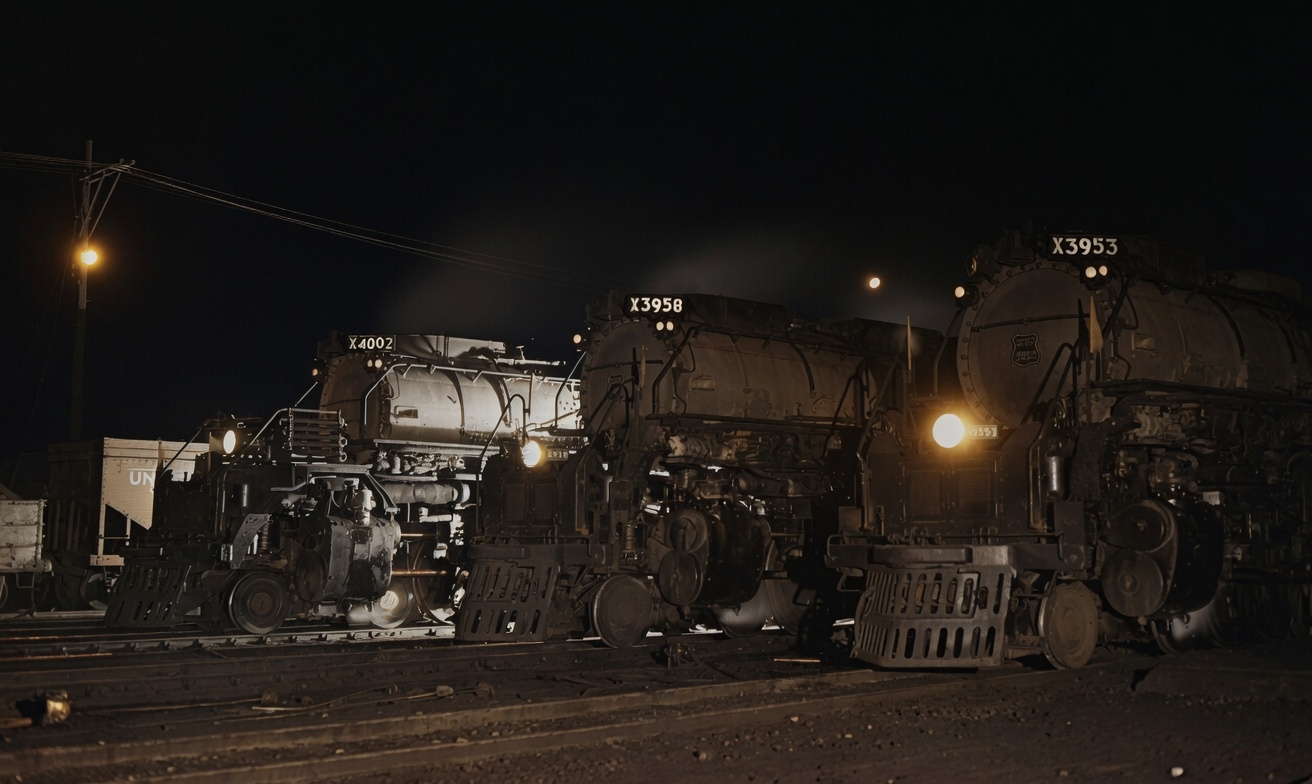
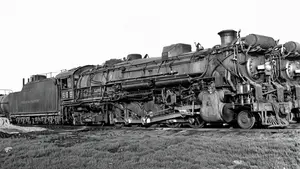
Union Pacific 4-8-8-4 Big Boy 4002, with 4-6-6-4s 3958 and 3953, at the roundhouse in Ogden, Utah, in the late 1940s. A Union Pacific publicity photograph.
On this page: At a glance · The system · Consolidations · Mikados · 2-10-2s · 4-10-2 and 4-12-2 · Articulateds · Passenger locomotives · Switchers · After revenue steam · Roster
At a glance
| Item | Detail |
|---|---|
| Railroad | Union Pacific Railroad. Company history. Diesel roster |
| This table | Post-1900 class grid. Union Pacific, Oregon Short Line, Los Angeles & Salt Lake, and Oregon-Washington Railroad & Navigation Company |
| Numbering | A different set of digits for each type. A transfer, and sometimes a change from coal to oil or the reverse, meant a new number. The 4-6-6-4 series is the tangled one |
| Where the grades were | Sherman Hill west of Cheyenne. The Blue Mountains between the Snake River and the Columbia. Meadow Valley Wash and Cajon Pass on the Los Angeles & Salt Lake |
| Standard freight engine | Harriman 2-8-0. The chapter counts 472 between 1900 and 1909, nearly all with 57-inch drivers and Stephenson valve gear |
| Mikado | The chapter counts 427. Early classes had 57-inch drivers. Later classes had 63-inch drivers, 26-by-28-inch cylinders, and 53,628 pounds of tractive effort |
| 2-10-2 | Class TTT. The chapter counts 174 between 1917 and 1924, all with 63-inch drivers and 29½-by-30-inch cylinders |
| 4-12-2 | The Union Pacific type. Separate 4-12-2 page. The chapter says 89 more were bought after No. 9000 |
| Challenger | 4-6-6-4. First fifteen, 3900–3914, delivered in 1936. Later classes share parts with the Big Boy and the last 4-8-4s |
| Big Boy | 4-8-8-4, classes 4884-1 and 4884-2, numbers 4000–4024. In service in 1941. The chronological history calls the type the largest steam locomotive ever built |
| 4-8-4 | Forty-five Northerns, classes FEF-1, FEF-2, and FEF-3, delivered from 1937 to 1944. No. 844, built in 1944, is the last steam engine built for the railroad |
| Quantity column | 2,178. The rows as printed, not a count of frames |
The system
About three decades after the Council Bluffs line reached Promontory, the railroad was in difficulty. Edward H. Harriman gained control in 1897 and began the rebuilding. The Oregon Short Line, a subsidiary, ran from Granger, west of Green River, northwest to Huntington on the Snake River, with other lines toward Silver Bow, near Butte, and from McCammon through Ogden and Salt Lake City to Uvada. The Oregon Railroad & Navigation Company ran from Huntington to Portland and from Umatilla northeast to Spokane. In 1910 that company became the Oregon-Washington Railroad & Navigation Company. In 1907 the Los Angeles & Salt Lake was completed between its namesake cities, and the southern portion of the Oregon Short Line was transferred to it.
East of Cheyenne the profile was the gentle climb of the Platte and Lodgepole Creek onto the high plains. West of Laramie the line crossed the Great Divide Basin and the Green River. Northwest of Granger, the Snake River line across southern Idaho and the Columbia along the top of Oregon were water-level railroads, with the Blue Mountains between them. The Los Angeles & Salt Lake crossed long desert in Utah, then followed Meadow Valley Wash for more than 100 miles down to Las Vegas, and then met steep grades in the mountains southwest of Las Vegas and over Cajon Pass into the Los Angeles basin. The operating rule was to keep trains together. Helpers were still unavoidable.
The number system was not a block of 5000s for one subsidiary and 6000s for another. Each type had its own digits, and an engine was sometimes renumbered because it changed from coal to oil, or from oil back to coal. The 4-6-6-4s are the series that shows it. The railroad was an early buyer of diesels for the streamliners. The steam chapter dates the start of freight-train dieselization to 1947. The chronological history dates the first diesel freight power to 1941, the year the Big Boy went into service.
Consolidations
Between 1900 and 1909 the system bought 472 Consolidations. Nearly all of them were standard Harriman 2-8-0s, with 57-inch drivers and cylinders of 21 by 30 inches or 22 by 30 inches, and all of them had Stephenson valve gear. A few were later rebuilt with Walschaerts gear. The early class codes on the grid, C-57 and C-55 among them, are the driver-diameter codes from those years. Vauclain compounds and cross-compounds sit in their own rows, and a small group of Union Pacific Consolidations is noted as former Southern Pacific.
One Consolidation became the railroad’s only eight-wheel switcher. No. 4500, class S-57, was rebuilt from a 2-8-0 in the company shops in 1924. Unaltered Consolidations did much of the heavy yard work for the rest of the steam era. The same Harriman program, drawn while the two railroads were under one control, is the Common Standard fleet on the Southern Pacific steam roster.
Mikados
The 2-8-2 fleet numbered 427 in the chapter’s count. Classes MK-1 and MK-2 had 57-inch drivers, 23½-by-30-inch cylinders, and 47,945 pounds of tractive effort. Later classes had 63-inch drivers, 26-by-28-inch cylinders, and 53,628 pounds of tractive effort, a little smaller and a little less powerful than the United States Railroad Administration light Mikado. The railroad did take twenty of those light engines. They arrived in 1918, were classed MK-Special because they stood outside the Associated Lines Common Standard, and were numbered 2295–2314. In 1920 they were renumbered 2480–2499 so the Harriman 2-8-2 sequence could continue. The grid keeps a Brooks row at 2295–2310, class MK-9, quantity 16, and the USRA row at 2480–2499, quantity 20.
Mikados moved constantly among the Union Pacific, the Oregon Short Line, and the Los Angeles & Salt Lake. The Oregon Short Line 2515s are the plain case. One row sends 2515–2524 to the Los Angeles & Salt Lake. The next rows put other engines back into 2515–2518, 2519–2524, and 2525–2534, some of them former Union Pacific numbers, and one of those rows is noted back to Union Pacific 2311–2320. The quantities are printed again for each listing. Class MK-3 is printed 2200–2290, quantity 10, and the following MK-4 through MK-9 rows occupy numbers inside that span. Both the span and the quantity stay as printed.
2-10-2s
After the Mikado, freight power divided. One line was the articulated. The other was the 2-10-2, which the railroad classed TTT, for two-ten-two. Between 1917 and 1924 the system added 174 of them. All had 63-inch drivers and 29½-by-30-inch cylinders, and the subsidiaries traded them as freely as they traded Mikados. Los Angeles & Salt Lake 3800–3805 became Oregon Short Line 5300–5305. Union Pacific 5007 and 5010–5013 became Los Angeles & Salt Lake 5525–5529. The two leased blocks, 5500–5514 and 5515–5524, are printed with quantity 25 each. The number spans are shorter than those quantities, and the cells are left as they stand.

Union Pacific 2-10-2 5525 and a Big Boy head west through western Nebraska in the 1950s. Ed Olsen photo. American-Rails.com collection.
4-10-2 and 4-12-2
A year after the last 2-10-2, the railroad assigned one experimental three-cylinder 4-10-2, No. 8000, class FTT-1. It was tested thoroughly. Nine more were built for the Los Angeles & Salt Lake. The type was not what the railroad wanted. The 4-10-2s had the same 63-inch drivers as the 2-10-2s. In 1942 they were rebuilt as two-cylinder locomotives and renumbered 5090–5099, and they were scrapped several years before the 4-12-2s. The grid lists 8000 with a note to Los Angeles & Salt Lake 8809, and lists 8809 again with the note that it was renumbered 5090. Both retirement cells are blank.
The railroad designed, and Brooks built, a single 4-12-2, No. 9000, class UP-1, with 67-inch drivers. The long rigid wheelbase and the three-cylinder machinery did not keep it from being a success. Between 1926 and 1930 the railroad bought 89 more, and most of them stayed on the Union Pacific proper, with long lives as three-cylinder engines. The engines that were to have been 9063–9077 were built for the Oregon Short Line as 9500–9514. Eight built for the Oregon-Washington Railroad & Navigation Company were soon transferred to the Union Pacific. The grid’s note on 9700–9707 sends them to 9055–9062. No. 9708, lettered for that subsidiary, carries the note Ex-/to UP 9004, and its retirement cell is blank.
The type is so closely tied to this railroad that it carries the Union Pacific name. The 4-12-2 page is the longer account. It says only this railroad used the wheel arrangement in freight service, counts 88 engines in classes UP-1 through UP-5, and places No. 9000 on display at the Los Angeles County Fairplex in Pomona. The 88, the chapter’s 89 more, and the repeat listings in the grid below are three different counts. The table follows the grid.
Articulateds
In 1909 the Union Pacific and the Oregon-Washington Railroad & Navigation Company each received three 2-8-8-2s from Baldwin, Union Pacific 2000–2002 and the other road 700–702. In 1915 they were renumbered 3600–3602 and 3800–3802. In 1917 the Union Pacific engines went to the Oregon Short Line as 3700–3702. All six were scrapped in 1928. The grid keeps both the Union Pacific numbers and the Oregon Short Line numbers, and the Oregon-Washington engines as 3800–3802.
In 1918 Schenectady delivered fifteen 2-8-8-0s, 3600–3614. The war interrupted the flow, and it resumed in 1920. By 1924 the Union Pacific had 64 of them, and the Oregon Short Line and the Oregon-Washington company had three each. They were powerful and slow, and they became the standard road freight power across Wyoming until the 4-12-2s arrived. Later classes were converted from compound to simple in the late 1930s and early 1940s. Between 1937 and 1944 the railroad converted all 70 and numbered them 3500–3569. The numbers 3500–3514 had been Atlantics until 1933, which is why the Oregon-Washington 4-4-2s on this grid occupy 3500–3514 and retire by 1933. The 2-8-8-0 rows below add to that 70, and the notes send each group into the 3500s. Number 3644 is not in the MC-6 span. The Oregon Short Line note sends No. 3703 to Union Pacific 3644, and then to 3544.
In the mid-1930s the railroad turned from sheer pulling power to horsepower. It wanted one locomotive to replace the combination of a 2-8-8-0 and a 2-10-2 on eastbound freights from Ogden. A 4-12-2 with still larger drivers was not available. Arthur H. Fetters, general mechanical engineer, proposed a simple articulated, with a much shorter rigid wheelbase and lighter rods. He and the American Locomotive Company designers started from the 4-12-2, split the six driving axles into two groups of three, added two inches to the driver diameter, replaced the outside 27-inch and middle 31-inch cylinders with four cylinders of 22 by 32 inches, and raised the boiler pressure from 220 to 255 pounds. The firebox then grew enough to need a four-wheel trailing truck. The wheel arrangement was a 4-6-6-4.
Shortly after 3900–3914 were delivered in 1936, the type was named Challenger. One account says the name was chosen because the proposed run, Ogden to Green River, would be a challenge to any locomotive. In 1935 the railroad had also put on a low-fare Chicago–Los Angeles coach train of the same name, and within a year or two the name was on fast merchandise trains and on a railroad-owned hotel at Sun Valley, Idaho. The second group, 3915–3939, arrived in 1937 with small changes, and the last six of that group were fitted for passenger service. The grid later sends the first two groups to 3800–3814 and 3815–3839.
Within five years the railroad wanted more. Under Otto Jabelmann the Challenger was expanded into a 4-8-8-4 with 68-inch drivers, cylinders of 23¾ by 32 inches, and a total weight, in the chapter, of 772,000 pounds. Someone at the American Locomotive Company chalked “Big Boy” on the smokebox of one under construction, and the type took that name. The chapter says there is no record of another name the railroad and the builder may have considered. The first twenty were delivered in 1941. The chronological history calls the Big Boy the largest steam locomotive ever built and dates it to that year. Five more, 4020–4024, followed in 1944. The railroad’s own page on No. 4014 says the twenty-five normally worked between Ogden and Cheyenne.

A head-end view of Union Pacific Big Boy 4016 at Rawlins, Wyoming, on September 3, 1956. John Shaw photo. American-Rails.com collection.
Shortly after the first twenty Big Boys arrived, the railroad went back for more Challengers. Jabelmann revised the design with cylinders an inch smaller and a firebox 26 inches shorter, at 280 pounds boiler pressure. Many of the internal parts were common to the Big Boys and to the last 4-8-4s. On the new Challengers the front engine was free to move sideways and was held against vertical motion, which improved the weight distribution and the stability. Those engines are the 1942, 1943, and 1944 rows, classes 4664-3, 4664-4, and 4664-5. The note on 3975–3999 sends 3975–3984 to 3708–3717. During the Second World War the railroad also bought thirty simple 2-8-8-2s from the Chesapeake & Ohio and five United States Railroad Administration compound 2-8-8-2s from the Norfolk & Western. Both groups were scrapped in 1947. They are the SA-57 and MC-57 rows.
Passenger locomotives
Most of the 4-4-2s were standard Harriman Atlantics with 81-inch drivers. One class, the A-3s, were Vauclain compounds built in 1906 and retired as compounds in 1921 and 1923. The four non-Harriman Atlantics were 70-inch A-1s built in 1903 for the San Pedro, Los Angeles & Salt Lake, and they were scrapped in 1921. A few groups of 4-6-0s had passenger-size drivers, 68, 69, 73, and 79 inches. The railroad was not a Ten-Wheeler road on the scale of the Southern Pacific. It went to the Pacific early, and in quantity.
There was little difference among the first six Pacific classes, P-1 through P-6. All had 77-inch drivers, 22-by-28-inch cylinders, and Stephenson valve gear. Later classes kept the 77-inch drivers and used 25-by-28-inch cylinders. The largest, the P-13s, Union Pacific 2900–2909, Baldwin, 1920, approached the United States Railroad Administration heavy Pacific in weight on drivers and in tractive effort. They were the last Pacifics. The grid gathers P-1 through P-6 as one row, 2800–2859, quantity 60.
In 1922 the railroad turned to the 4-8-2 for heavy passenger trains. The chapter counts 70 Mountains, with 73-inch drivers, 29-by-28-inch cylinders, and 54,838 pounds of tractive effort. In the 1930s they were upgraded with one-piece cast frames, integral cylinders, and Walschaerts valve gear. The grid has three Mountain rows. Brooks built forty MT-1 engines for the Union Pacific in 1922, numbers 7000–7039, and fifteen MT-1 engines for the Los Angeles & Salt Lake in 1923, numbers 7850–7864. Five MT-2 engines, 7865–7869, were leased to the Los Angeles & Salt Lake. Those three quantities add to 60. The chapter’s 70 stands beside them.
The last step was the 4-8-4: twenty in 1937, fifteen in 1939, and ten in 1944. The first group, 800–819, had 77-inch drivers, 24½-by-32-inch cylinders, and twelve-wheel semi-Vanderbilt tenders. The second and third groups, 820–834 and 835–844, had 80-inch drivers, 25-by-32-inch cylinders, and pedestal tenders. All of them were converted to oil in 1946. The railroad’s page on No. 844 counts 45 Northerns in three classes, delivered between 1937 and 1944, which is the same 20, 15, and 10. That page places No. 814 on display in Council Bluffs, No. 833 on display in Ogden, and No. 838 in Cheyenne as a parts source for No. 844.
Switchers
Most of the switchers were 0-6-0s with 51-inch or 57-inch drivers and Stephenson valve gear. Classes S-5 and S-6 were built with Walschaerts gear, and a few early switchers received it later. Fifteen United States Railroad Administration 0-6-0s, Union Pacific 4600–4609 and Oregon Short Line 4753–4757, were the exceptions to the Harriman standard switcher. The single 0-8-0 is the rebuilt Consolidation already noted. Three Shays worked on the Los Angeles & Salt Lake, all of them former New East Tintic engines. No. 60 was built in 1896, before the table’s own date, and the row is printed with the others.
After revenue steam
The chapter says No. 844 was never stricken from the roster. It stayed in use for excursion trains and company specials. In 1962 it was renumbered 8444. The chapter says the new number made room for GP30s, and that the engine took 844 again in 1981. The railroad’s page on the locomotive says the extra digit distinguished the steamer from a diesel numbered in the 800 series, and that the number returned in June 1989, after that diesel was retired. The same page says No. 844 worked freight in Nebraska from 1957 to 1959, was saved from scrapping in 1960, and was held for special service. The chapter says 4-6-6-4 No. 3985 was restored to operation in 1981.
The chapter’s horizon is 2015, and at that date Big Boy 4014 was being restored. The chronological history is later than the book. In 2012, the 150th anniversary of the Pacific Railway Act, No. 844 made a goodwill tour of more than 13,000 miles. In 2013 the railroad reacquired No. 4014. For the 150th anniversary of Promontory, in 2019, 4014 and 844 ran together on the Great Race to Ogden. The railroad’s page on No. 4014 dates the retirement of that engine to December 1961, after 1,031,205 miles, dates the return to service to May 2019, and calls 4014 the only one of eight remaining Big Boys still operating. It places the other seven on display in St. Louis, Dallas, Omaha, Denver, Scranton, Green Bay, and Cheyenne. In 2021 the same chronology sent No. 4014 on a ten-state tour of 4,000 miles in 34 days. In 2005 Kenefick Park, in Omaha, was dedicated with Big Boy 4023 and Centennial 6900. The excursion fleet is the commemorative page.
Roster
The rows follow the chapter’s order and its quantities. Where a number series does not close, the span is printed with the quantity in the cell. Class MK-3 is 2200–2290 and the quantity is 10. Los Angeles & Salt Lake TTT-6, numbers 5500–5514, is quantity 25, and TTT-7, numbers 5515–5524, is quantity 25. Several Oregon Short Line Mikado series occupy the same numbers as the row above them. The 2-8-8-0 notes and the Challenger notes send engines into numbers that other rows already use. The quantity column adds every cell. Builder abbreviations in the chapter are spelled out here as Schenectady and Brooks. UP in the builder column is the company shops. The road abbreviations in the notes match the road column.
| Type | Class | Numbers | Road | Qty | Builder | Built | Retired | Notes |
|---|---|---|---|---|---|---|---|---|
| 0–6–0 | S-56 | 4226 | LA&SL | 1 | Lima | 1913 | 1945 | |
| 0–6–0 | S-55 | 4227, 4228 | LA&SL | 2 | Schenectady | 1902 | 1925 | |
| 0–6–0 | S-1 | 4229–4234 | LA&SL | 6 | Baldwin | 1904 | 1929–1947 | |
| 0–6–0 | S-2 | 4235–4239 | LA&SL | 5 | Baldwin | 1907 | 1929–1947 | |
| 0–6–0 | S-3 | 4240–4242 | LA&SL | 3 | Baldwin | 1913 | 1946–1947 | |
| 0–6–0 | S-6 | 4243–4246 | LA&SL | 4 | Baldwin | 1921 | 1946–1956 | |
| 0–6–0 | S-51 | 4338–4347 | UP | 10 | Baldwin | 1901 | 1925–1928 | |
| 0–6–0 | S-1 | 4350–4359 | UP | 10 | Baldwin | 1905 | 1929–1936 | |
| 0–6–0 | S-2 | 4360–4379 | UP | 20 | Baldwin | 1906–1907 | 1927–1936 | |
| 0–6–0 | S-2 | 4380 | UP | 1 | Brooks | 1908 | 1929 | |
| 0–6–0 | S-2 | 4381–4400 | UP | 20 | Baldwin | 1909, 1911 | 1927–1936 | |
| 0–6–0 | S-4 | 4401–4415 | UP | 15 | Baldwin | 1913 | 1933–1956 | |
| 0–6–0 | S-4 | 4416–4420 | UP | 5 | Lima | 1914 | 1934–1958 | |
| 0–6–0 | S-5 | 4421–4450 | UP | 30 | Baldwin | 1916 | 1947–1960 | |
| 0–6–0 | S-6 | 4451–4480 | UP | 30 | Lima | 1920 | 1947–1956 | |
| 0–6–0 | S-Spl | 4600–4609 | UP | 10 | Baldwin | 1918 | 1947–1956 | USRA |
| 0–6–0 | S-51 | 4701, 4702 | OSL | 2 | Baldwin | 1901 | 1926 | |
| 0–6–0 | S-2 | 4703–4709 | OSL | 7 | Brooks | 1908 | 1928–1947 | |
| 0–6–0 | S-2 | 4710–4721 | OSL | 12 | Baldwin | 1906 | 1928–1933 | |
| 0–6–0 | S-51 | 4722–4724 | OSL | 3 | Baldwin | 1901 | 1928, 1930 | |
| 0–6–0 | S-51 | 4725–4729 | OSL | 5 | Cooke | 1901 | 1927–1930 | |
| 0–6–0 | S-1 | 4730–4734 | OSL | 5 | Baldwin | 1904 | 1929–1946 | |
| 0–6–0 | S-3 | 4735–4739 | OSL | 5 | Baldwin | 1912 | 1933–1947 | |
| 0–6–0 | S-4 | 4740–4744 | OSL | 5 | Lima | 1914 | 1946–1947 | |
| 0–6–0 | S-5 | 4748–4752 | OSL | 5 | Baldwin | 1918 | 1946–1954 | |
| 0–6–0 | S-Spl | 4753–4757 | OSL | 5 | Pittsburgh | 1919 | 1937–1955 | USRA |
| 0–6–0 | S-1, -2 | 4758–4764 | OSL | 7 | Baldwin | 1905–1907 | 1929 | Ex-UP |
| 0–6–0 | S-51 | 4901 | OWR&N | 1 | Pittsburgh | 1902 | 1927 | Ex-Pittsburgh & Lake Erie |
| 0–6–0 | S-2 | 4902–4922 | OWR&N | 21 | Baldwin | 1907–1913 | 1933–1955 | |
| 0–6–0 | S-4 | 4923–4926 | OWR&N | 4 | Lima | 1914 | 1953, 1955 | |
| 0–6–0 | S-1 | 4927–4930 | OWR&N | 4 | Baldwin | 1905 | 1931–1955 | |
| 0–6–0 | S-51 | 4931–4933 | OWR&N | 3 | Baldwin | 1901–1903 | 1930, 1940 | |
| 0–8–0 | S-57 | 4500 | UP | 1 | UP | 1924 | 1946 | Rebuilt from 2–8–0 |
| 2–6–0 | M-62 | 4100–4107 | OSL | 8 | Baldwin | 1901 | 1925–1928 | |
| 2–8–0 | C-57 | 150–158 | UP | 9 | Baldwin | 1902 | 1928–1946 | |
| 2–8–0 | C-2 | 201–310 | UP | 110 | Baldwin | 1902 | 1933–1953 | Compound |
| 2–8–0 | C-2 | 311–331 | UP | 21 | Brooks | 1908 | 1930–1957 | |
| 2–8–0 | C-2 | 332, 333 | UP | 2 | Baldwin | 1905 | 1957, 1937 | |
| 2–8–0 | C-2 | 350–358 | UP | 9 | Baldwin | 1904 | 1933–1957 | Ex-SP |
| 2–8–0 | C-57 | 400–479 | UP | 80 | Baldwin | 1900–1901 | 1929–1958 | Vauclain compound |
| 2–8–0 | C-57 | 480–499 | UP | 20 | Baldwin | 1903 | 1929–1958 | |
| 2–8–0 | C-55 | 510–524 | OSL | 15 | Baldwin | 1901 | 1930–1956 | Vauclain compound |
| 2–8–0 | C-57 | 525–539 | OSL | 15 | Baldwin | 1901–1903 | 1946–1958 | |
| 2–8–0 | C-2 | 560–618 | OSL | 59 | Baldwin | 1904–1907 | 1933–1958 | |
| 2–8–0 | C-2 | 619–622 | OSL | 4 | Brooks | 1908 | 1947–1956 | |
| 2–8–0 | C-51 | 705, 706 | OWR&N | 2 | Schenectady | 1909 | 1947, 1940 | Ex-North Coast 1, 2 |
| 2–8–0 | C-57 | 710–724 | OWR&N | 15 | Baldwin | 1901, 1903 | 1927–1947 | |
| 2–8–0 | C-57 | 725–729 | OWR&N | 5 | Baldwin | 1902 | 1930–1940 | Compound |
| 2–8–0 | C-2 | 730–768 | OWR&N | 39 | Baldwin | 1906–1908 | 1930–1957 | |
| 2–8–0 | C-1 | 6000–6008 | LA&SL | 9 | Baldwin | 1904 | 1933–1955 | |
| 2–8–0 | C-2 | 6009–6060 | LA&SL | 52 | Baldwin | 1905, 1907 | 1928–1957 | |
| 2–8–0 | C-2 | 6061–6086 | LA&SL | 16 | Schenectady, Brooks | 1907 | 1928–1957 | |
| 2–8–2 | MK-1 | 1900–1929 | UP | 30 | Baldwin | 1911 | 1947–1955 | |
| 2–8–2 | MK-2 | 1930–1949 | UP | 20 | Baldwin | 1912 | 1947–1956 | |
| 2–8–2 | MK-1 | 2000–2014 | OSL | 15 | Baldwin | 1911 | 1947–1955 | |
| 2–8–2 | MK-2 | 2015–2034 | OSL | 20 | Baldwin | 1912 | 1947–1954 | |
| 2–8–2 | MK-1 | 2100 | OWR&N | 1 | Baldwin | 1910 | 1955 | Original Harriman 2–8–2 |
| 2–8–2 | MK-1 | 2101–2140 | OWR&N | 40 | Baldwin | 1911 | 1946–1957 | |
| 2–8–2 | MK-2 | 2141–2165 | OWR&N | 25 | Baldwin | 1912–1913 | 1947–1957 | |
| 2–8–2 | MK-8 | 2166–2171 | OWR&N | 6 | Baldwin | 1918 | 1947–1957 | |
| 2–8–2 | MK-3 | 2200–2290 | UP | 10 | Baldwin | 1911 | 1947–1956 | |
| 2–8–2 | MK-4 | 2210–2219 | UP | 10 | Baldwin | 1912 | 1948–1955 | |
| 2–8–2 | MK-5 | 2220–2244 | UP | 25 | Baldwin | 1913 | 1947–1958 | |
| 2–8–2 | MK-6 | 2245–2259 | UP | 15 | Lima | 1914 | 1947–1957 | |
| 2–8–2 | MK-7 | 2260–2279 | UP | 20 | Baldwin | 1917 | 1947–1958 | |
| 2–8–2 | MK-8 | 2280–2294 | UP | 15 | Baldwin | 1918 | 1947–1956 | |
| 2–8–2 | MK-9 | 2295–2310 | UP | 16 | Brooks | 1918 | 1947–1959 | |
| 2–8–2 | MK-8 | 2311–2320 | UP | 10 | Baldwin | 1918 | 1947–1956 | Ex-OSL 2525–2534 |
| 2–8–2 | MK-Spl | 2480–2499 | UP | 20 | Schenectady | 1918 | 1953–1958 | USRA |
| 2–8–2 | MK-5 | 2500–2514 | OSL | 15 | Baldwin | 1913 | 1947–1956 | |
| 2–8–2 | MK-7 | 2515–2524 | OSL | 10 | Lima | 1917 | 1947–1956 | To LA&SL |
| 2–8–2 | MK-4 | 2515–2518 | OSL | 4 | Brooks | 1912 | 1946–1956 | Ex-UP 2214…2218 |
| 2–8–2 | MK-5 | 2519–2524 | OSL | 6 | Baldwin | 1913 | 1947–1958 | Ex-UP 2220…2241 |
| 2–8–2 | MK-8 | 2525–2527 | OSL | 3 | Lima | 1914 | 1949–1954 | Ex-UP 2246, 2254, 2258 |
| 2–8–2 | MK-7 | 2528–2532 | OSL | 5 | Baldwin | 1917 | 1948–1956 | Ex-UP 2266…2278 |
| 2–8–2 | MK-8 | 2525–2534 | OSL | 10 | Baldwin | 1918 | 1947–1956 | To UP 2311–2320 |
| 2–8–2 | MK-10 | 2555–2564 | OSL | 10 | Brooks | 1921 | 1947–1959 | Ex-LA&SL 2716–2725 |
| 2–8–2 | MK-6 | 2700–2707 | LA&SL | 8 | Schenectady | 1914 | 1947–1956 | |
| 2–8–2 | MK-6 | 2708 | LA&SL | 1 | Baldwin | 1914 | 1947 | |
| 2–8–2 | MK-7 | 2709–2715 | LA&SL | 7 | Lima | 1917 | 1947–1957 | Ex-OSL 2515…2524 |
| 2–8–2 | MK-10 | 2716–2725 | LA&SL | 10 | Brooks | 1921 | 1947–1959 | To OSL 2555–2564 |
| 2–8–2 | MK-5 | 2726–2732 | LA&SL | 7 | Baldwin | 1913 | 1947–1957 | Ex-OSL 2500…2521 |
| 2–8–2 | MK-7 | 2733–2735 | LA&SL | 3 | Lima | 1917 | 1948–1956 | Ex-OSL 2500…2521 |
| 2–10–2 | TTT-2 | 3800–3805 | LA&SL | 6 | Baldwin | 1918 | 1952–1958 | To OSL 5300–5305 |
| 2–10–2 | TTT-1 | 5000–5009 | UP | 10 | Baldwin | 1917 | 1948–1955 | 5007 to LA&SL |
| 2–10–2 | TTT-3 | 5010–5014 | UP | 5 | Baldwin | 1919 | 1958 | 5010–5013 to LA&SL |
| 2–10–2 | TTT-4 | 5015–5039 | UP | 25 | Baldwin | 1920 | 1952–1957 | |
| 2–10–2 | TTT-6 | 5040–5049 | UP | 10 | Brooks | 1923 | 1952–1958 | |
| 2–10–2 | TTT-6 | 5050–5052 | UP | 3 | Baldwin | 1923 | 1955 | |
| 2–10–2 | TTT-6 | 5053–5089 | UP | 37 | Lima | 1923 | 1950–1958 | |
| 2–10–2 | TTT-2 | 5300–5305 | OSL | 6 | Baldwin | 1918 | 1952–1958 | Ex-LA&SL 3800–3805 |
| 2–10–2 | TTT-6 | 5306–5313 | OSL | 8 | Brooks | 1923 | 1950–1958 | |
| 2–10–2 | TTT-5 | 5314–5318 | OSL | 5 | Baldwin | 1923 | 1952–1958 | Ex-OWR&N 5408, 5409, 5411–5413 |
| 2–10–2 | TTT-5 | 5400–5414 | OWR&N | 15 | Baldwin | 1922–1923 | 1954–1956 | 5408, 5409, 5411–5413 to OSL |
| 2–10–2 | TTT-6 | 5500–5514 | LA&SL | 25 | Baldwin | 1923 | 1949–1956 | Leased from UP |
| 2–10–2 | TTT-7 | 5515–5524 | LA&SL | 25 | Baldwin | 1924 | 1949–1956 | Leased from UP |
| 2–10–2 | TTT-1 | 5525–5529 | LA&SL | 5 | Baldwin | 1917, 1919 | 1954–1956 | Ex-UP 5007, 5010–5013 |
| 2–8–8–0 | MC-2 | 3600–3614 | UP | 15 | Schenectady | 1918 | 1954–1956 | To 3500–3514 |
| 2–8–8–0 | MC-3 | 3615–3633 | UP | 19 | Brooks | 1920 | 1947–1954 | To 3515–3533 |
| 2–8–8–0 | MC-4 | 3634–3638 | UP | 5 | Brooks | 1923 | 1949–1954 | To 3534–3538 |
| 2–8–8–0 | MC-5 | 3639–3643 | UP | 5 | Brooks | 1923 | 1952, 1954 | To 3539–3543 |
| 2–8–8–0 | MC-6 | 3645–3664 | UP | 20 | Brooks | 1924 | 1947–1954 | To 3545–3564 |
| 2–8–8–0 | MC-2 | 3703 | OSL | 1 | Schenectady | 1918 | 1942 | To UP 3644, then 3544 |
| 2–8–8–0 | MC-4 | 3704, 3705 | OSL | 2 | Brooks | 1923 | 1944 | To UP 3565, 3566 |
| 2–8–8–0 | MC-4 | 3803–3805 | OWR&N | 3 | Brooks | 1923 | 1944 | To 3567–3569 |
| 2–8–8–2 | SA-57 | 3570–3599 | UP | 30 | Schenectady, Baldwin | 1924, 1926 | 1947 | Ex-Chesapeake & Ohio |
| 2–8–8–2 | MC-1 | 3600–3602 | UP | 3 | Baldwin | 1909 | 1928 | To OSL 3700–3702 |
| 2–8–8–2 | MC-57 | 3670–3674 | UP | 5 | Schenectady | 1919 | 1947 | Ex-Norfolk & Western |
| 2–8–8–2 | MC-1 | 3700–3702 | OSL | 3 | Baldwin | 1909 | 1928 | Ex-UP 2000–2002 |
| 2–8–8–2 | MC-1 | 3800–3802 | OWR&N | 3 | Baldwin | 1910 | 1928 | |
| 4–4–0 | E-62 | 1008 | OSL | 1 | Baldwin | 1909 | 1923 | Ex-Idaho Northern 200 |
| 4–4–0 | E-70 | 1050 | LA&SL | 1 | Schenectady | 1901 | 1925 | Ex-Los Angeles Terminal 8 |
| 4–4–2 | A-2 | 3300–3319 | UP | 20 | Baldwin | 1904, 1906 | 1923, 1925 | |
| 4–4–2 | A-3 | 3320–3334 | UP | 15 | Baldwin | 1906 | 1921, 1923 | Compound |
| 4–4–2 | A-1 | 3376–3379 | LA&SL | 4 | Schenectady | 1903 | 1921 | Ex-3100–3103 |
| 4–4–2 | A-2 | 3400–3407 | OSL | 8 | Baldwin | 1904 | 1925–1930 | |
| 4–4–2 | A-2 | 3408–3411 | OSL | 4 | Brooks | 1908 | 1928–1929 | |
| 4–4–2 | A-4 | 3500–3514 | OWR&N | 15 | Baldwin | 1911 | 1928–1933 | |
| 4–6–0 | T-69 | 1320–1329 | UP | 10 | Baldwin | 1900 | 1921–1936 | |
| 4–6–0 | T-73 | 1330–1347 | UP | 18 | Baldwin | 1900–1901 | 1921–1932 | |
| 4–6–0 | T-79 | 1348–1359 | UP | 12 | Baldwin | 1901 | 1921–1924 | |
| 4–6–0 | T-63 | 1360–1369 | UP | 10 | Baldwin | 1902–1903 | 1927–1934 | |
| 4–6–0 | T-54 | 1502 | OSL | 1 | Baldwin | 1907 | 1925 | Ex-Idaho Northern 101 |
| 4–6–0 | T-73 | 1562–1571 | OSL | 10 | Baldwin | 1902 | 1926, 1928 | |
| 4–6–0 | T-2, -3 | 1572–1583 | OSL | 12 | Baldwin | 1909, 1911 | 1933–1951 | |
| 4–6–0 | T-57, 61 | 1584–1587 | OSL | 4 | Baldwin | 1907, 1910 | 1946–1947 | Ex-Pacific & Idaho Northern |
| 4–6–0 | T-68 | 1591–1596 | LA&SL | 6 | Brooks, Schenectady | 1901 | 1925 | |
| 4–6–0 | T-64 | 1727–1732 | OWR&N | 6 | Baldwin | 1901 | 1927–1948 | |
| 4–6–0 | T-2, -3 | 1742–1754 | OWR&N | 13 | Baldwin | 1909, 1911 | 1933–1949 | |
| 4–6–0 | T-1 | 1755–1760 | OWR&N | 6 | Brooks | 1909 | 1940–1947 | |
| 4–6–2 | P-1-P-6 | 2800–2859 | UP | 60 | Baldwin | 1904–1911 | 1927–1947 | |
| 4–6–2 | P-8, -9 | 2860–2879 | UP | 20 | Brooks | 1912–1913 | 1947–1954 | |
| 4–6–2 | P-10 | 2880–2899 | UP | 20 | Lima | 1914 | 1947–1955 | |
| 4–6–2 | P-13 | 2900–2909 | UP | 10 | Baldwin | 1920 | 1947–1954 | |
| 4–6–2 | P-9, -10 | 2910, 2911 | UP | 2 | Brooks, Lima | 1913, 1914 | 1953 | Ex-OSL 3124, 3130 |
| 4–6–2 | P-3 | 3100–3113 | OSL | 14 | Baldwin | 1906, 1911 | 1933–1947 | |
| 4–6–2 | P-8 | 3114–3123 | OSL | 10 | Schenectady | 1912 | 1947–1953 | |
| 4–6–2 | P-9 | 3124–3128 | OSL | 5 | Brooks | 1913 | 1947 | |
| 4–6–2 | P-10 | 3129–3133 | OSL | 5 | Lima | 1914 | 1947, 1952 | |
| 4–6–2 | P-11 | 3134–3138 | OSL | 5 | Baldwin | 1919 | 1954–1955 | |
| 4–6–2 | P-1 | 3150–3170 | LA&SL | 21 | Baldwin | 1904 | 1926–1954 | |
| 4–6–2 | P-4 | 3171–3175 | LA&SL | 5 | Baldwin | 1907 | 1928–1933 | |
| 4–6–2 | P-8 | 3176–3181 | LA&SL | 6 | Schenectady | 1912 | 1947–1949 | |
| 4–6–2 | P-2 | 3200–3203 | OWR&N | 4 | Baldwin | 1905 | 1936–1958 | |
| 4–6–2 | P-1 | 3204–3207 | OWR&N | 4 | Schenectady | 1904 | 1933–1955 | |
| 4–6–2 | P-3 | 3208–3210 | OWR&N | 3 | Baldwin | 1906 | 1936–1948 | |
| 4–6–2 | P-6 | 3211–3217 | OWR&N | 7 | Baldwin | 1911 | 1933–1954 | |
| 4–6–2 | P-7 | 3218, 3219 | OWR&N | 2 | Baldwin | 1911 | 1947, 1955 | |
| 4–6–2 | P-9 | 3220–3225 | OWR&N | 6 | Brooks | 1913 | 1947–1955 | |
| 4–6–2 | P-12 | 3226, 3227 | OWR&N | 2 | Baldwin | 1919 | 1954 | |
| 4–8–2 | MT-1 | 7000–7039 | UP | 40 | Brooks | 1922 | 1949–1956 | |
| 4–8–2 | MT-1 | 7850–7864 | LA&SL | 15 | Brooks | 1923 | 1950–1956 | |
| 4–8–2 | MT-2 | 7865–7869 | UP | 5 | Brooks | 1924 | 1953–1956 | Leased to LA&SL |
| 4–8–4 | FEF-1 | 800–819 | UP | 20 | Alco | 1937 | 1954–1961 | |
| 4–8–4 | FEF-2 | 820–834 | UP | 15 | Alco | 1939 | 1956–1962 | |
| 4–8–4 | FEF-3 | 835–844 | UP | 10 | Alco | 1944 | 1957–1962 | |
| 4–10–2 | FTT-1 | 8000 | UP | 1 | Brooks | 1925 | To LA&SL 8809 | |
| 4–10–2 | FTT-2 | 8800–8808 | LA&SL | 9 | Brooks | 1926 | 1948–1954 | To 5091–5099 |
| 4–10–2 | FTT-1 | 8809 | LA&SL | 1 | Brooks | 1925 | Renumbered 5090 | |
| 4–12–2 | UP-1 | 9000 | UP | 1 | Brooks | 1926 | 1956 | |
| 4–12–2 | UP-2 | 9001–9014 | UP | 14 | Brooks | 1926 | 1953–1956 | |
| 4–12–2 | UP-3 | 9015–9029 | UP | 15 | Brooks | 1928 | 1954–1956 | |
| 4–12–2 | UP-4 | 9030–9054 | UP | 25 | Schenectady | 1929 | 1953–1956 | |
| 4–12–2 | UP-5 | 9078–9087 | UP | 10 | Schenectady | 1930 | 1953–1955 | |
| 4–12–2 | UP-5 | 9500–9514 | OSL | 15 | Schenectady | 1930 | 1954–1956 | Ex-UP 9063–9077 |
| 4–12–2 | UP-3 | 9700–9707 | UP | 8 | Brooks | 1928 | 1953–1956 | To UP 9055–9062 |
| 4–12–2 | UP-2 | 9708 | OWR&N | 1 | Brooks | 1928 | Ex-/to UP 9004 | |
| 4–6–6–4 | CSA-1 | 3900–3914 | UP | 15 | Schenectady | 1936 | 1956–1962 | To 3800–3814 |
| 4–6–6–4 | CSA-2 | 3915–3939 | UP | 25 | Schenectady | 1937 | 1956–1961 | To 3815–3839 |
| 4–6–6–4 | 4664–5 | 3930–3949 | UP | 20 | Schenectady | 1944 | 1952–1960 | |
| 4–6–6–4 | 4664–3 | 3950–3969 | UP | 20 | Schenectady | 1942 | 1958–1961 | |
| 4–6–6–4 | 4664–4 | 3975–3999 | UP | 25 | Schenectady | 1943 | 1959–1961 | 3975–3984 to 3708–3717 |
| 4–8–8–4 | 4884–1 | 4000–4019 | UP | 20 | Schenectady | 1941 | 1951–1962 | |
| 4–8–8–4 | 4884–2 | 4020–4024 | UP | 5 | Schenectady | 1944 | 1962 | |
| Shay | 65–3 | 59 | LA&SL | 1 | Lima | 1902 | 1949 | Ex-New East Tintic 11 |
| Shay | 32–2 | 60 | LA&SL | 1 | Lima | 1896 | 1918 | Ex-New East Tintic 10 |
| Shay | 80–3 | 61 | LA&SL | 1 | Lima | 1907 | 1948 |
Related reading
- Union Pacific Railroad: Map, History, Logo
- Union Pacific Diesel Roster (All-Time)
- Union Pacific 4-12-2 locomotives
- Commemorative and heritage fleet
- Southern Pacific Steam Roster: Post 1900
Sources
- George H. Drury, Guide to North American Steam Locomotives, revised edition, Union Pacific chapter, pp. 314–319. The classes, the quantities, the builders, the retirement spans, and the account of how the engines were used. The quantity column is 2,178. The chapter dates No. 844’s return to that number to 1981, and its horizon for Big Boy 4014 is a restoration still underway in 2015.
- Union Pacific, “Chronological History.” Big Boy in service in 1941, called the largest steam locomotive ever built, and diesel freight power the same year. No. 844 built in 1944, the last steam engine built for the railroad. The 2012 tour of more than 13,000 miles. No. 4014 reacquired in 2013. The Great Race to Ogden in 2019. The 2021 tour, 4,000 miles in 34 days. Kenefick Park in 2005, with Big Boy 4023 and Centennial 6900.
- Union Pacific, “Living Legend” Northern No. 844. Forty-five Northerns in three classes, 1937–1944. Freight service in Nebraska, 1957–1959. Held for special service from 1960. The extra digit applied in 1962, and the number restored in June 1989. No. 814 at Council Bluffs, No. 833 at Ogden, and No. 838 at Cheyenne as a parts source.
- Union Pacific, “Big Boy No. 4014.” Twenty-five engines, normally between Ogden and Cheyenne. No. 4014 retired in December 1961 after 1,031,205 miles, reacquired from the RailGiants Train Museum in Pomona in 2013, and returned to service in May 2019. Eight Big Boys remain, and 4014 is the one still operating. The other seven are displayed in St. Louis, Dallas, Omaha, Denver, Scranton, Green Bay, and Cheyenne.
- American-Rails.com, 4-12-2 “Union Pacific” locomotives. The wheel arrangement in freight service on this railroad alone. The page counts 88 engines in classes UP-1 through UP-5 and places No. 9000 at the Los Angeles County Fairplex in Pomona.
Recent Articles


-
Union Pacific 2-10-2 5511 Passes Its First Steam Test
Nov 12, 26 12:12 AM
 Union Pacific 2-10-2 5511 passed a steam test at Silvis, Illinois. Railfan and Railroad reports a summer 2027 target. A November 6 Trains report had no immediate operating plan.
-
Union Pacific Steam Roster
Nov 12, 26 12:03 AM
 Union Pacific steam locomotives built since 1900. Oregon Short Line, Los Angeles and Salt Lake, and Oregon-Washington Railroad and Navigation Company numbers, with the 4-12-2s, Challengers, Big Boys…
-
Union Pacific Railroad: Map, History, Logo
Nov 11, 26 11:56 PM
 The Union Pacific, from the Pacific Railway Act of July 1, 1862, and Promontory Summit on May 10, 1869, through E. H. Harriman and the mergers that built the modern railroad. Steam and diesel rosters…
-
Texas and Pacific Railway: Map, History, Timetables
Nov 10, 26 10:33 PM
 The Texas & Pacific Railway, the federally chartered southern transcontinental that stopped at Sierra Blanca and became the Missouri Pacific's Texas and Louisiana main line. Merged October 15, 1976.
-
Texas and Pacific Steam Locomotives: Texas Types and Mountains
Nov 10, 26 10:30 PM
 Texas & Pacific steam: 70 Lima 2-10-4 Texas types, 600-669, classes I-1 through I-1d, and 10 Mountains, 900-909. No. 610 is at Palestine.
-
Texas and Pacific Diesel Roster (All-Time)
Nov 10, 26 10:29 PM
 All-time diesel roster of locomotives built for the Texas & Pacific. 246 units: E7s, E8s, 83 F7A and 35 F7B, NW2s, SW7s, SW8s, SW9s, GP7s, GP9s, GP18s, and GP35s. Serials and order numbers.
-
Santa Fe-Southern Pacific Railroad: Merger, History, Paint Scheme
Nov 10, 26 10:07 PM
 The proposed Santa Fe-Southern Pacific merger, from the 1980 attempt and the 1983 holding company through the ICC denial, the Kodachrome paint, and the sale of the Southern Pacific.
-
CSX Santa Train Will Feature Locomotives 250 and 2026
Nov 10, 26 01:51 PM
 The CSX Santa Train will feature locomotives 250 and 2026 on November 21, 2026. The 84th running covers 110 miles from Shelbiana, Kentucky, to Kingsport, Tennessee.
-
Denton County Asks to Extend Stadler Car Relief
Nov 10, 26 01:05 PM
Denton County Transit Authority has asked the FRA to extend a waiver for its Stadler diesel multiple-unit cars. Comments run to January 11, 2027. -
FreightCar America Reports Third-Quarter Results
Nov 10, 26 01:02 PM
 FreightCar America reported third-quarter revenue of $76.5 million and 662 railcar deliveries. Backlog stood at 2,660 cars valued at $284.5 million.
-
Amtrak Has Filed a Train Control Amendment
Nov 10, 26 12:53 PM
 Amtrak asked the FRA on October 26, 2026, to amend the safety plan for its Interoperable Electronic Train Management System. Comments are due November 30, 2026.
-
SunRail Signal Waiver Is Open for Comment
Nov 10, 26 12:25 PM
 FRA has asked for comment on a petition to extend signal-testing relief on the Central Florida Rail Corridor. The notice names both the corridor and CSXT. Comments run to January 11, 2027.
-
Cars and Units Rose With BNSF Third-Quarter Earnings
Nov 10, 26 12:18 PM
Berkshire Hathaway reports that after-tax BNSF earnings increased 19.3 percent in the third quarter of 2026, with car and unit volumes up 3.9 percent. -
Amtrak Chicago Platforms Are Moving Toward Level Boarding
Nov 10, 26 12:13 PM
 Amtrak says construction is underway soon on the first level boarding platforms at Chicago Union Station, a 112 million dollar, 30-month project.
-
Maryland Has New Penn Line Times on November 16
Nov 10, 26 12:07 PM
MARC Penn Line schedules change on November 16, 2026, after Amtrak trains return to regular schedules. Weekend southbound trains are unchanged. -
Building Contract for Metrolink Sidings Goes to Granite
Nov 10, 26 12:00 PM
Granite says Metrolink awarded a 51.5 million dollar SCORE contract for sidings near downtown Los Angeles and in Rancho Cucamonga. -
EMD "F2" Locomotives: Specs, Roster, History
Nov 10, 26 12:22 AM
 EMD F2, the 1,350-horsepower bridge between the FT and the F3. 104 locomotives, July through November 1946. Spotting features, specifications, and the production roster.
-
Southern Pacific Diesel Roster (All-Time)
Nov 10, 26 12:08 AM
 Southern Pacific diesel roster with builder serials, order numbers, Texas and New Orleans numbers, and the 1965 renumbering. Alco, Baldwin, Fairbanks-Morse, Electro-Motive, General Electric, Krauss-Ma…
-
Southern Pacific Steam Roster: Post 1900
Nov 09, 26 11:56 PM
 Southern Pacific steam locomotives built since 1900. Pacific Lines, Texas and Louisiana Lines, cab-forwards, the GS 4-8-4s, and five narrow-gauge Ten-Wheelers. The quantity column counts the rows as p…
-
Canal Street Yard Assessment Stays Open Through December 7
Nov 09, 26 01:07 PM
The FRA signed the Canal Street Yard environmental assessment on November 6, 2026. Public inspection runs through December 7, and meeting dates are not confirmed. -
NS Legacy Cab-Signal Comments Are Due November 9
Nov 09, 26 01:05 PM
The FRA must receive comments by November 9, 2026, on a Norfolk Southern plan to drop legacy cab signals on 14 line segments and rely on positive train control. -
Elimination Grant of $27.8 Million Reaches Scott Road in Allen County
Nov 09, 26 12:53 PM
Allen County received $27,878,116, also stated as $27.8 million, to design and build a grade separation where Scott Road crosses Norfolk Southern. -
Vermont Receives $60.3 Million for the Western Corridor
Nov 09, 26 12:45 PM
Vermont will receive $60.3 million to rehabilitate about 60 miles of the Western Corridor. The delegation quote also calls the sum $60 million. -
Burlingame Grade Separation Wins a Federal Grant
Nov 09, 26 10:42 AM
 Rep. Kevin Mullin said on November 5, 2026 that the FRA awarded $90.4 million for the Caltrain Broadway grade separation in Burlingame. Early work is expected in May 2027.
-
Orange County Rail Line Gets a Coastal Permit
Nov 09, 26 10:18 AM
The California Coastal Commission on November 5, 2026 approved a 10-year permit for the San Clemente rail line, including about 690,000 cubic yards of sand. -
Railroad Quiet Zones Are Reinstated in St. Louis
Nov 09, 26 10:14 AM
 St. Louis said on November 6, 2026 that the FRA reinstated the city quiet zones. Horns are to stop after railroad systems are updated.
-
Southern Pacific Railroad: Map, History, Logo
Nov 08, 26 01:58 PM
 The Southern Pacific, from the December 2, 1865 charter and the Big Four to Sprint, the Rio Grande Industries purchase of 1988, and the Union Pacific merger of February 1, 1997.
-
California Awards Flexible Rail Aid to Nine Projects
Nov 08, 26 01:15 PM
CalSTA on November 5, 2026 awarded $66.58 million in flexible State Rail Assistance to nine California projects. Each amount in the summary is a cap, printed as up to. -
CSX Leaves Three Days Out of the Weekly Reports
Nov 08, 26 12:02 PM
CSX told the Surface Transportation Board it cannot recover October 27-29 data for the EP 724 and EP 787 reports covering the week ending October 30, 2026. -
NJ Transit Advances Three Station Housing Projects
Nov 08, 26 11:56 AM
NJ Transit on November 5, 2026 advanced station projects in Jersey City, Bound Brook, and Morristown. The three are projected to add more than 1,000 homes. -
River Fox Train Wraps a Locomotive for America 250
Nov 08, 26 11:06 AM
 The River Fox Train in West Sacramento wrapped a locomotive with America 250 markings, the American flag, and the Sacramento skyline. The wrap is expected to stay through 2027.
-
California Keeps Metrolink Service in the 2027 Budget
Nov 07, 26 11:35 PM
 Metrolink says a California State Transportation Agency grant lets the proposed fiscal year 2027 budget keep service at current levels. The board hearing is November 13, 2026.
-
WM's 4-6-6-4 Locomotives (M-2): Specs, Roster, History
Nov 07, 26 04:37 PM
 Western Maryland class M-2, twelve Baldwin 4-6-6-4s numbered 1201-1212, built in 1940 and 1941 for Hagerstown-Connellsville fast freight. Roster, specifications, and retirement in 1952-1953.
-
Missouri Pacific Diesel Roster (All-Time)
Nov 07, 26 04:26 PM
 Missouri Pacific diesel roster with builder serials, order numbers, subsidiary lettering, and renumberings. Alco, Baldwin, Electro-Motive, and General Electric. Texas and Pacific locomotives are on th…
-
Missouri Pacific Steam Roster (Built Since 1900)
Nov 07, 26 04:21 PM
 Missouri Pacific steam locomotives built since 1900. Drury quantity column 1,439. Sedalia rebuilds counted once, 1,407 frames. Last steam was 0-6-0 9301 in November 1955.
-
Missouri Pacific Railroad: Map, Locomotives, Logo, History
Nov 07, 26 04:19 PM
 The Missouri Pacific was a large Midwestern that carried a long history of financial difficulty until later years.
-
LIRR Service Changes Start on November 9
Nov 07, 26 03:15 PM
New Long Island Rail Road schedules start on every branch on Monday, November 9, 2026. Midday and weekend times change. Rush hour does not. Babylon service returns in stages. -
Draft EA Reviews Norfolk Southern Track in London, Ohio
Nov 07, 26 11:35 AM
The Surface Transportation Board environmental office issued a draft assessment on November 6, 2026, for about 0.96 miles of Norfolk Southern track in London, Ohio. Comments are due November 20. -
Metrolink Lines Will Not Run on Three Routes November 7
Nov 07, 26 10:53 AM
Metrolink will not run the Ventura County, Orange County, or Inland Empire-Orange County lines on November 7 and 8, 2026. The advisory says no substitute transportation will be provided. -
Hartford Line Adds a Weekday Round Trip on November 16
Nov 07, 26 10:48 AM
 Connecticut said the Hartford Line adds a weekday New Haven-Hartford round trip on November 16, starts a morning train in Springfield, and extends weekend stops to Windsor and Windsor Locks.
-
Board Issues a Policy Statement on Rail Preemption
Nov 07, 26 10:44 AM
The Surface Transportation Board placed a policy statement on public inspection for the November 9 Federal Register. It reviews existing preemption precedent and says it makes no binding determination… -
NJ Transit Restores Lines After the Newark Drawbridge Stop
Nov 07, 26 10:37 AM
 NJ Transit said Morris and Essex service between Hackettstown and Dover, and Montclair-Boonton service between Hackettstown and Montclair State University, resumed after the Newark Drawbridge stop.
-
EMD "SD35" Locomotives: Data Sheet, Specs, Roster
Nov 06, 26 10:35 PM
 EMD SD35, 2,500 horsepower, 16-cylinder 567D3A, built June 1964 through January 1966. 360 locomotives. Specifications and the production roster by owner, serial, and order.
-
EMD "SDP35" Locomotives: Data Sheet, Specs, Roster
Nov 06, 26 10:32 PM
 EMD SDP35, the steam-generator SD35. 35 locomotives, July 1964 through September 1965. Seaboard Air Line 1100-1119, Atlantic Coast Line 550, Louisville and Nashville 1700-1703, Union Pacific 1400-1409…
-
RJ Corman Will Be Replaced on Part of the Luzerne Lines
Nov 06, 26 01:34 PM
A November 6, 2026 notice says Wilkes-Barre Terminal Railway would acquire about 59.65 miles in Luzerne County and replace R.J. Corman as operator on part of the line. The earliest date is November 22… -
NS Names a Student Hub at the University of Georgia
Nov 06, 26 12:03 PM
Norfolk Southern said a 100,000 dollar gift named a student-organization hub in Driftmier Engineering Center. The University of Georgia marked the naming on October 26. The space is for 23 clubs. -
Union Pacific Filed Its Vena Recording Certification
Nov 06, 26 11:56 AM
 Union Pacific filed a November 5, 2026 verified statement that the confidential label is off the March 17 Vena recording and that parties of record received a copy at 3:30 p.m. Eastern.
-
OmniTRAX Adds Tenants at Its Blue Island Hub
Nov 06, 26 10:26 AM
 OmniTRAX has signed new construction-company leases at its 90-acre Blue Island, Illinois, hub and is planning a second phase.
-
Veterans and Active-Duty Members Exceed 16 Percent of Norfolk Southern
Nov 06, 26 10:14 AM
Norfolk Southern said on November 5, 2026, that more than 3,000 veterans and active-duty service members are more than 16 percent of its workforce. This year grants are $100,000 and $50,000. -
BNSF: Merger Would Put Half of U.S. Rail Shipments Under One Railroad
Nov 06, 26 10:00 AM
BNSF chief marketing officer Tom G. Williams told customers on November 3, 2026, that a Union Pacific-Norfolk Southern merger would put about half of U.S. rail shipments under one railroad. Nothing is…