WM's 4-6-6-4 Locomotives (M-2): Specs, Roster, History
Published: March 23, 2025
By: Adam Burns
Western Maryland's big 4-6-6-4s were a radical departure from anything the railroad had rostered up until that time. Like all Challengers, the big brutes were designed for fast freight service.
The railroad had long been known for redundancy within its locomotive fleet. Management continually sought a versatile engine capable of navigating both the challenging mountain terrains and the Potomac Valley's more forgiving profile between Hagerstown and Cumberland.
However, the Challengers were not heavy drag service engines although the railroad occasionally employed them in helper assignments. As a result, the WM's feelings on the 4-6-6-4s are historically mixed.
Despite this, they were reliable machines and lived up to the railroad's slogan, "Fast Freight Service." Unfortunately, all were scrapped in the mid-1950s. From a corporate standpoint, and railfan perspective, the fast Challengers are also noteworthy for introducing the WM's now-famous "Fireball" herald when the first examples rolled out of Baldwin's Eddsytone plant in 1940.
 Western Maryland 4-6-6-4 #1202 (M-2) hustles a freight train through Frostburg, Maryland on October 1, 1952. These powerful 'Challengers' were designed for fast freight service between Hagerstown, MD-Connellsville, PA although a number of issues resulted in their banishment east of Cumberland. All were scrapped in 1953.
The mid-20th century was a transformative period for American railroads, with increasing demands for freight transportation and the need for more powerful locomotives to handle mountainous terrains and longer, heavier trains.
The Western Maryland, facing these operational challenges, sought out a solution that would both meet capacity demands and improve efficiency on its steep gradients and winding routes.
In response to these needs, the WM acquired twelve 4-6-6-4s from the Baldwin Locomotive Works between 1940-1941. These were designated as Class M-2, numbered 1201-1212. The Challengers were based on an articulated design originally developed by the Union Pacific but adapted to suit the specific requirements of the WM.
A handful of other Class 1s also operated examples of this type including the Clinchfield; Delaware & Hudson; Denver & Rio Grande Western; Great Northern; Northern Pacific; Spokane, Portland & Seattle; and Western Pacific.
WM's Challengers were a late era design, incorporating many of the advanced "Super Power" concepts which had been established during the 1920s. Despite their relatively short operational period, the 4-6-6-4s left a lasting mark on WM’s operations, embodying the zenith of steam locomotive development.
Specifications
| Class | M-2 |
| Railroad | Western Maryland (WM) |
| Whyte | 4-6-6-4 |
| Number in Class | 12 |
| Road Numbers | 1201-1212 |
| Gauge | Std |
| Number Built | 12 |
| Builder | Baldwin |
| Year | 1940 |
| Valve Gear | Walschaert |
| Locomotive Length and Weight | |
| Driver Wheelbase | 24 Feet |
| Engine Wheelbase | 60 Feet, 3 24/25 Inches |
| Overall Wheelbase | 106 Feet |
| Axle Loading (Maximum Weight per Axle) | 67,562 Lbs |
| Weight on Drivers | 402,266 Lbs |
| Engine Weight | 601,000 Lbs |
| Tender Loaded Weight | 418,950 Lbs |
| Total Engine and Tender Weight | 1,019,950 Lbs |
| Tender Water Capacity | 22,000 Gallons |
| Tender Fuel Capacity | 27 Tons |
| Minimum weight of rail (Lbs/Yard) | 112 |
| Driver Diameter (Inches) | 69 |
| Boiler Pressure (psi) | 250 |
| High Pressure Cylinders (Diameter x Sstroke) | 22" x 32" |
| Tractive Effort | 95,397 Lbs |
| Factor of Adhesion (Weight on Drivers/Tractive Effort) | 4.22 |
| Firebox Area (Square Feet) | 796 |
| Grate Area (Square Feet) | 118.80 |
Production Roster
| Class | Road Numbers | Completion Dates | Notes |
|---|---|---|---|
| M-2 | 1201-1206 | 1940 | Scrapped in 1953. |
| M-2 | 1207-1212 | 1941 | Scrapped in 1953. |
WM's Challengers are a subject that often invites a range of strong opinions among rail enthusiasts and historians. A common misconception is that these locomotives were solely used as helpers and not as mainline fast freight engines. However, this overlooks their pivotal role from their delivery until the arrival of the 4-8-4s in January 1947.
Initially, the 1200-series were indeed deployed as mainline freight engines, fulfilling their intended purpose of running through trains from Hagerstown to Connellsville. Freight trains on this route operated at a maximum speed of 50 mph between Hagerstown and Cumberland, and 45 mph between Cumberland and Connellsville.
Occasionally, the Challengers extended their reach by working trains east of Hagerstown towards Baltimore. However, the hilly and curving mainline, with speed limits restricted to 40 mph, made this territory less suited to their strengths.
With the introduction of the 4-8-4s, the operational landscape changed, and the Challengers were primarily confined west of Cumberland.
Most trips east of Cumberland, likely for maintenance at the Hagerstown shops, became infrequent. Predominantly, the 1200-series worked the "New Line" (Connellsville Extension), often serving as helpers. This role was not unique to the Challengers, as nearly every type of motive power on the WM offered assistance on critical grades like Sand Patch.
On the WM, there were no divisions without a helper district, showcasing the railroad's proficiency in utilizing power as helpers. For trains navigating Sand Patch, mid-train and rear-end helpers were common. Some helpers on westbound trains would either stay with the train to Connellsville or decouple and follow the train independently.
Notably, there were instances where a rear-end helper, shoving on a caboose, had another engine trailing behind the tender. This setup indicated that the crew would continue to Connellsville and return with another train eastbound.
Such operations often saw the pairing of older Decapods as head-end locomotives with Challengers providing rear-end assistance, highlighting the interchangeable use of these powerful engines in such assignments.
It seems WM's train crews had mixed opinions of these big articulateds. Some found these locomotives to be rough-riding, although such comparisons were often made against the Pacifics and Potomacs, the latter being WM's moniker for their 4-8-4s.
Others criticized the 4-6-6-4s for being slippery, while a skilled few argued that they simply required a knowledgeable touch to operate effectively.
The 4-6-6-4s had potential avenues for improvement, predominantely the inclusion of roller bearings on all axles. The railroad's initial foray into this technology was with the lead truck only on #1200, a somewhat unusual investment in 1940 when such bearings were primarily reserved for passenger locomotives.
Many smaller Challengers at the time also used solid bearings. Incorporating Type E superheaters, as later seen in the 4-8-4s, could have markedly boosted the efficiency of the 1200-series. However, no clear application of Type Es is evident in WM's 4-6-6-4s. Their superheater heating area was comparable to other engines but smaller than that of the later 1400-series.
Higher steam pressure could have resulted in greater power and reduced fuel consumption. Additionally, trailing truck boosters would have enhanced their low-speed capabilities.
Had Baldwin inncorporated certain design elements from Alco, such as the new weight-supporting hinge, these engines might have had better weight distribution and improved ride quality. Nevertheless, these advancements, excluding the roller bearings, would have increased maintenance costs.
The WM seemed perpetually unsatisfied with their Challengers. It's unclear if they fully grasped the design intentions of these powerful machines. If their goal was to accelerate fast freight operations, the Challengers did indeed provide that capability.
It has been argued the railroad would have been better served by 2-8-8-4s, which were later acquired by the Baltimore & Ohio. The B&O's EM-1s, which offered roughly 20,000 pounds more starting tractive effort, were fine machines and arguably the best large articulateds the railroad ever owned.
In fact, despite wanting diesels at the time, the B&O became quite fond of its Yellowstones and they remained in service until the latter 1950s.
For the WM's part, the subsequent arrival of the 4-8-4s demonstrated that the same trains could be managed more efficiently over flatter terrain with smaller engines. Train speeds, however, were impacted by frequent stops required to couple on mid-train and rear-end helpers for tackling the Sand Patch.
Ultimately, management concluded that in mountainous territory, tractive effort outweighed horsepower in importance—a decision that proved accurate for their operational needs.
While the M-2s had a relatively short operational life, their legacy endures in the annals of American railroading history. These locomotives represented the peak of steam technology and the determination of the Western Maryland to overcome challenging operational conditions.
Sadly, none of the 4-6-6-4s were preserved. However, their memory is kept alive through photographs, documentation, and the stories of those who witnessed their might along the mountainous routes of the Western Maryland.
Railway enthusiasts and historians continue to celebrate the legacy of the Western Maryland Railway and its iconic Challengers. Models, literature, and historical accounts serve to preserve the rich heritage of these locomotives, reminding us of the pivotal role they played in the railroad’s operational history.
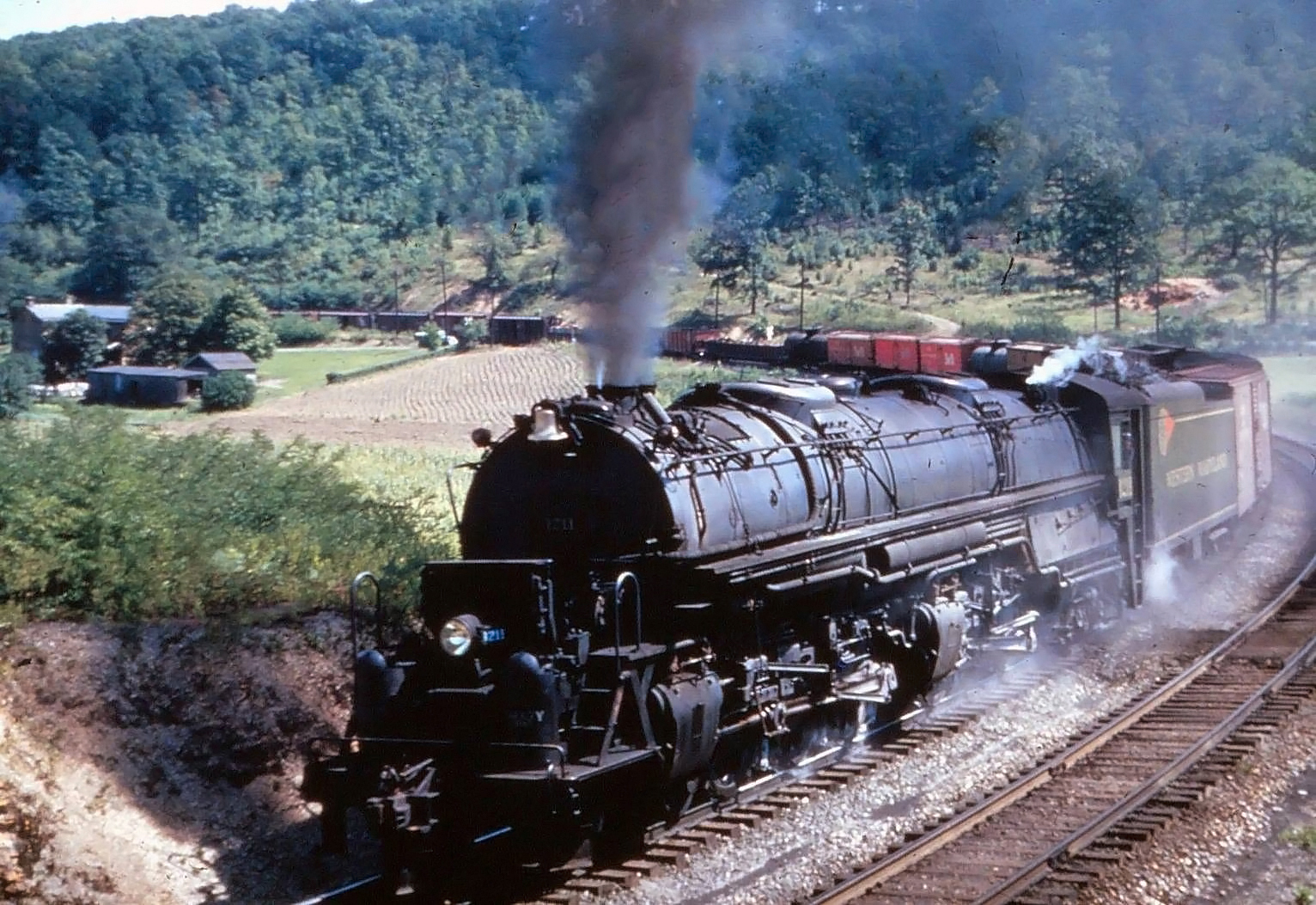 Western Maryland 4-6-6-4 #1211 (M-2) charges westbound around Helmstetter's Curve on its way to Frostburg, Maryland during the 1950s. Bill Price photo.
The M-2s were more than just machines; they were embodiments of the technological advancements and operational challenges of mid-20th century American railroading.
These powerful locomotives exemplified the peak of steam locomotive design, capable of navigating the steep grades and heavy loads characteristic of the WM's rugged routes.
Despite their brief period of operation, the Challengers left a lasting impression on the Western Maryland and its surrounding communities. Their presence marked a significant era in the history of rail transport, reflecting the broader transitions and innovations within the industry.
The story of the WM's Challengers is a testament to the ingenuity and resilience of the railway and its workforce, forever etched in the legacy of American railroads.
Recent Articles


-
Court Clears $257.7 Million in Notes for Brightline Florida
Oct 31, 26 12:18 AM
 A New Jersey bankruptcy court on October 29, 2026 authorized $257.7 million in notes for Brightline Trains Florida. The operating company is not one of the 17 debtor holding companies.
-
Brightline West Still Waiting on a $6 Billion Federal Loan
Oct 31, 26 12:11 AM
 Brightline West said October 27, 2026 that it is still working through a $6 billion federal loan and still talks about opening in 2029. The Florida restructuring is a separate company.
-
BNSF Reopens the Gallup Subdivision After New Mexico Flooding
Oct 31, 26 12:06 AM
 BNSF said October 28, 2026 that both Gallup Subdivision main tracks are back after flooding near Laguna, New Mexico. The El Paso Subdivision was still out of service.
-
CSX Says Interchange Is Moving Again After a Technology Outage
Oct 31, 26 12:01 AM
 CSX said October 29, 2026 that interchange with other Class I railroads is moving again after a technology outage that began October 27. Dispatching and positive train control stayed up.
-
Baldwin "Baby Face" Locomotives: Specs, Photos, Roster
Oct 30, 26 11:01 PM
 Baldwin's Babyface cab on the early road diesels: 50 short-cab units, 1946-1948, plus the related Centipede. Construction numbers, specs, and the sharknose that followed.
-
California High-Speed Rail Chief Resigns
Oct 30, 26 08:36 PM
 Ian Choudri resigned October 28, 2026 as chief executive of the California High-Speed Rail Authority. The board named Joe Stephenshaw interim chief executive.
-
The 1910 Portal Bridge Is Handed Over for Demolition
Oct 30, 26 04:03 PM
 Amtrak handed the 1910 Portal Bridge over for demolition on October 29, 2026, during the final cutover to Portal North. Regular NJ Transit and Amtrak schedules are expected November 15.
-
Union Pacific-Norfolk Southern Merger Review Runs to 2027
Oct 30, 26 03:59 PM
 Union Pacific says the Surface Transportation Board's review of the Norfolk Southern merger gathers information through May 28, 2027. A closing still depends on board approval.
-
Amtrak Board Will Hear Restructuring Comments on November 10
Oct 30, 26 03:41 PM
 Amtrak's board will hear public comments on its restructuring on November 10, 2026, from 2 to 3 p.m. Eastern. Written comments were due October 30. A proposal goes to the board in December.
-
Canadian Pacific Selkirk 5931 Restored in Calgary
Oct 30, 26 01:36 PM
 Heritage Park in Calgary unveiled a cosmetic restoration of Canadian Pacific 2-10-4 No. 5931 on October 27, 2026. One of two surviving Selkirks. It stays on display.
-
Gettysburg Railway to Host Steam for Lincoln
Oct 30, 26 01:18 PM
 Northern Central Railway of York No. 17 will recreate Lincoln's arrival at Gettysburg on November 18, 2026, with public steam trips November 19-21.
-
NC&StL No. 576 to Steam for the Public in Nashville
Oct 30, 26 01:00 PM
 Nashville Steam will fire NC&StL 4-8-4 No. 576 for the public on November 7, 2026, 9 a.m. to 3 p.m., at 220 Willow Street. Admission is free.
-
Pennsylvania Railroad E8s Join the T1 Trust
Oct 30, 26 12:38 PM
 The T1 Trust has acquired former Pennsylvania Railroad E8A diesels 5702A and 5761A from the Fort Wayne Railroad Historical Society. They are bound for Cumberland.
-
Ligonier Valley Railroad: History, Roster, Timetable
Oct 30, 26 12:03 PM
 The Ligonier Valley Railroad ran 10.5 miles from Latrobe to Ligonier, Pennsylvania. Opened December 1, 1877. Last day August 31, 1952.
-
Toledo, Peoria & Western Diesel Roster (All-Time)
Oct 30, 26 10:25 AM
 Toledo, Peoria & Western diesel locomotives, each frame once. Thirteen Alcos, three Lima-Hamilton switchers, and 26 Electro-Motive units.
-
Toledo, Peoria & Western Steam Roster
Oct 30, 26 09:14 AM
 Toledo, Peoria & Western steam locomotives from the Rogers Consolidations of 1895 through the 4-8-4s of 1937
-
Toledo, Peoria & Western Railway: Map, Roster, History
Oct 29, 26 11:12 PM
 History of the Toledo, Peoria & Western. The Peoria & Oquawka, George P. McNear, the Santa Fe and Pennsylvania years, and the railroad that came back in 1989.
-
Cotton Belt Diesel Roster (All-Time)
Oct 29, 26 07:58 PM
 St. Louis Southwestern diesel locomotives, each frame once. Baldwin switchers, F units, and new Cotton Belt-lettered power through the GP60s of May 1990.
-
Cotton Belt Steam Roster (Built Since 1900)
Oct 29, 26 06:52 PM
 St. Louis Southwestern steam locomotives built since 1900. Consolidations, Ten-Wheelers, and twenty class L-1 4-8-4s. The quantity column is 297.
-
Cotton Belt Railroad: Map, Logo, History, Rosters
Oct 29, 26 10:56 AM
 History of the St. Louis Southwestern, the Cotton Belt Route. The Tyler Tap, Paramore's silver spike, the Thebes Bridge, the Blue Streak, and Southern Pacific control. Steam and diesel rosters are sep…
-
Pere Marquette Steam Roster (Built Since 1900)
Oct 28, 26 11:54 PM
 Pere Marquette steam locomotives built since 1900. Consolidations, Mikados, Pacifics, and 39 Berkshires. The quantity column is 503.
-
Pere Marquette Diesel Roster (All-Time)
Oct 28, 26 11:48 PM
 Pere Marquette diesel locomotives, each frame once. Two SW1s, 14 NW2s, three GE 70-tonners, eight E7As, and six BL2s delivered lettered Chesapeake and Ohio. The quantity column is 33.
-
Pere Marquette Railway: Map, Logo, Rosters, History
Oct 28, 26 11:44 PM
 History of the Pere Marquette Railway. Timber roads, the Prince years, the Van Sweringens, the Ludington car ferries, and the Chesapeake and Ohio merger of June 6, 1947.
-
Nickel Plate Road (Railroad): Map, History, Rosters
Oct 28, 26 10:51 PM
 History of the Nickel Plate Road, the New York, Chicago and St. Louis. The Seney syndicate, the Van Sweringens, the Berkshires, and the Norfolk and Western absorption at 12:01 a.m. on October 16, 1964…
-
Nickel Plate Diesel Roster (All-Time)
Oct 28, 26 10:48 PM
 Nickel Plate diesel locomotives, each frame once. Alco switchers and PAs, GP7s and GP9s, and the GP30s. The quantity column is 440. The 1950 fleet was 117.
-
Nickel Plate Steam Roster (Built Since 1900)
Oct 28, 26 10:43 PM
 Nickel Plate steam locomotives built since 1900, including the Lake Erie and Western, the Clover Leaf, and the Wheeling engines that took Nickel Plate numbers. The quantity column is 786.
-
EMD "E9" Locomotives: Specs, Roster, History
Oct 28, 26 10:37 PM
 EMD E9 cab units and boosters, 2,400 horsepower, built April 1954 through January 1964. Gear ratios, specifications, and the production roster by owner, serial, and order.
-
NYC 4-6-4 #5344, "Commodore Vanderbilt"
Oct 28, 26 04:31 PM
 NYC J-1e Hudson 5344, the Commodore Vanderbilt. Alco, November 1931. Carl Kantola’s shroud, December 1934, then a Dreyfuss bullet nose in 1939. Scrapped at Collinwood in 1954.
-
New Jersey, Indiana & Illinois Railroad: A South Bend Shortline
Oct 28, 26 11:05 AM
 The New Jersey, Indiana & Illinois, the Jersey Line, ran from South Bend to Pine. Singer built it in 1905. Wabash stock control came in 1926. Two diesels, and the steam the record names.
-
Monon Diesel Roster (All-Time)
Oct 28, 26 10:13 AM
 Monon diesel locomotives, each frame once. F3s, nine BL2s, the C420s, and eight U23Bs. The quantity column is 96. The 1951 fleet was 57.
-
Monon Steam Roster (Built Since 1900)
Oct 28, 26 10:09 AM
 Monon steam locomotives built since 1900. Twelve-Wheelers, Mikados, light Pacifics, and thirteen six-wheel switchers. The quantity column is 148.
-
Monon Railroad: Map, Photos, History, Logo
Oct 28, 26 09:55 AM
 History of the Monon, the Hoosier Line. The New Albany & Salem, the X at Monon, Barriger's streamliners, and the Louisville & Nashville merger of July 31, 1971.
-
Missouri-Kansas-Texas Diesel Roster (All-Time)
Oct 28, 26 09:48 AM
 All-time diesel roster of the Missouri-Kansas-Texas. 406 locomotives, each frame once. Baldwin switchers, Alco cab units, F units, Geeps, and the SD40-2s.
-
Missouri-Kansas-Texas Steam Roster (Built Since 1900)
Oct 28, 26 09:43 AM
 Missouri-Kansas-Texas steam locomotives built since 1900. Moguls, Mikados, Pacifics, and the narrow-gauge shop tanks. The quantity column is 715.
-
Missouri-Kansas-Texas Railroad (Katy): Map, History, Rosters
Oct 27, 26 11:02 PM
 History of the Missouri-Kansas-Texas, the Katy. The race into Indian Territory, Gould, the 1923 railroad, the Texas Special, and the 1988 sale. Steam and diesel rosters are linked.
-
Soo Line Diesel Roster (All-Time)
Oct 27, 26 10:55 PM
 All-time diesel roster of the Soo Line and the Wisconsin Central. 786 locomotives, each frame once. Cab units, Geeps, the Milwaukee Road engines, and the SD60s. The South Shore's 24 stay on that page.
-
Soo Line Steam Roster (Built Since 1900)
Oct 27, 26 10:49 PM
 Soo Line and Wisconsin Central steam locomotives built since 1900. Consolidations, Mikados, Pacifics, 21 Mountains, and four Lima 4-8-4s.
-
Soo Line Railroad: Map, Logo, History, Rosters
Oct 27, 26 10:24 PM
 The Soo Line, from the flour millers' railroad around Chicago to the Sault, the Wisconsin Central, and the Milwaukee Road. Steam quantity 422. Diesels 786. Canadian Pacific took full control in 1990.
-
Minneapolis, Northfield and Southern Railway: Map, History, Rosters
Oct 27, 26 10:32 AM
 The Minneapolis, Northfield & Southern, the Dan Patch Line that became a Twin Cities belt. Steam, gas-electric mules, motor cars, and the 22 diesels, through the Soo Line.
-
Minneapolis & St. Louis Diesel Roster (All-Time)
Oct 27, 26 10:27 AM
 All-time diesel roster of the Minneapolis & St. Louis. 97 locomotives, each frame once. Switchers from 1938, 35 RS-1s, the FT and F-unit cabs, two SD7s, and 23 GP9s. Builder numbers included.
-
Minneapolis & St. Louis Steam Roster (Post 1900)
Oct 27, 26 10:25 AM
Minneapolis & St. Louis steam locomotives built since 1900. Moguls, Consolidations, 35 Mikados, and five Pacifics. -
Minneapolis and St Louis Railway: "The Peoria Gateway"
Oct 27, 26 09:52 AM
 The Minneapolis & St. Louis, the Tootin' Louie, from the 1870 charter to the Peoria Gateway and the Chicago & North Western sale on November 1, 1960.
-
Alco "PA" Locomotives: Restoration, Specs, Engine, Rosters
Oct 27, 26 12:12 AM
 Alco's PA passenger cab, 297 locomotives built from 1946 to 1953. The 244 engine, the production roster, the Delaware & Hudson PA-4s, and Nickel Plate Road 190.
-
Milwaukee Road Diesel Roster: (All Time)
Oct 26, 26 01:44 PM
 All-time diesel roster of the Milwaukee Road. 1,208 locomotives, each frame once. Alco, Baldwin, Davenport, EMD, Fairbanks-Morse, General Electric, and Whitcomb, with builder numbers.
-
Milwaukee Road Steam Roster (All-Time): Post-1900
Oct 26, 26 01:38 PM
 Milwaukee Road steam locomotives built since 1900. Prairies, Mikados, the N-class articulateds, the S-class 4-8-4s, and the Hiawatha Atlantics and Hudsons. Quantity column 1,974. Unique frames 1,951.
-
Milwaukee Road: Map, Electrification, Logo, History
Oct 26, 26 01:20 PM
 The Milwaukee Road, from the Milwaukee & Mississippi of 1850 to the Pacific Coast Extension, the Hiawathas, and the Soo Line sale. Why Lines West should have stayed.
-
Lake Superior & Ishpeming Railroad: Map, Roster, History
Oct 25, 26 11:38 PM
 Lake Superior & Ishpeming Railroad, reporting mark LSI, from the Marquette Range to the Presque Isle ore dock. The 1954 steam list and the diesels the railroad owned.
-
Kansas City Southern Steam Roster (Built Since 1900)
Oct 25, 26 09:09 PM
 Steam locomotives of the Kansas City Southern built since 1900, with the Louisiana & Arkansas and the Texas company.
-
Kansas City Southern Diesel Roster (Built New)
Oct 25, 26 11:46 AM
All-time diesel roster of the Kansas City Southern. E units, F units, Geeps, SD40s through SD70ACes, Fairbanks-Morse, Baldwin, Alco, and General Electric, with serials and order numbers. -
Kansas City Southern Railway: Map, Photos, History
Oct 25, 26 12:24 AM
The Kansas City Southern, from Arthur Stilwell's Gulf line to Canadian Pacific Kansas City on April 14, 2023. Steam and diesel rosters, the Southern Belle, and the Louisiana & Arkansas.