Bessemer & Lake Erie Steam Roster (Post 1900)
Last revised: September 18, 2026
By: Adam Burns
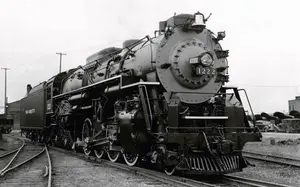
The Bessemer & Lake Erie was a conveyor: iron ore south from Conneaut, Ohio, coal north to the lake. Ore is heavy and it moves in trainload lots. The 144-mile line from the harbor to North Bessemer crosses five summits. A 12-mile climb off Lake Erie starts at about 1 percent. That is not a mountain railroad. It is enough, with jennies, to want the heaviest two-cylinder engines in the country. George H. Drury, in Guide to North American Steam Locomotives, is a good start for steam rosters.
By 1900 the road already connected Conneaut with Carnegie’s mills. United States Steel took both in 1901. B&LE chose the 2-10-2, then the 2-10-4, over the Mallet, and made the track heavy enough to carry them: 100-pound rail by 1900, 130-pound in 1917, 152-pound in 1939, 155-pound—the heaviest rolled—in 1948. Forty-seven Texas types, copies of Burlington’s 2-10-4s, did the ore. Dieselization was complete in early 1953. Last steam was 2-8-0 156, tied up at Butler on May 14, 1953. Two engines survive: H1g 643 at Age of Steam, and C3B 154 at the Henry Ford Museum.

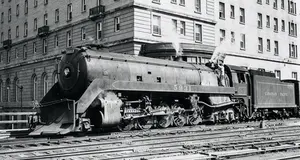
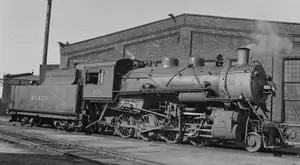
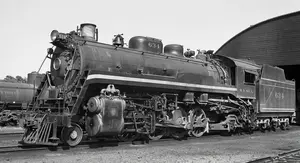
Bessemer & Lake Erie 4-6-2 #904 has southbound train #1 backing into the depot at Greenville, Pennsylvania, during the early 1950s. The train, which carried an RPO/express and a standard coach, will soon make the return trip northbound to North Bessemer. Fred Houser photo. Class P1A, Schenectady, 1913—one of four light Pacifics.
On this page: At a glance · Consolidations, Santa Fes, Texans · Americans and Pacifics · Switchers · May 14, 1953 · All-time roster (built since 1900)
At a glance
| Item | Detail |
|---|---|
| Railroad | Bessemer & Lake Erie. Mark BLE. Company Bessemer & Lake Erie |
| This roster | Classes built since 1900, after Drury, pages 82–83. Photo: P1A #904 Greenville |
| Map | Conneaut, Ohio, to North Bessemer, Pa., 144 miles, five summits. Ore to the Union Railroad. Sister ore road DM&IR |
| Consolidations | C1 through C4, 54-inch drivers. C3A 150 and 151, 1900, the heaviest locomotives in the world when built |
| Santa Fes | D1A 501–520, Baldwin 1916, 404,000 lb. D2A 521–525, USRA heavies, 1919, scrapped first |
| Texas types | Forty-seven 2-10-4s, H1A–H1G 601–647, 1929–44. Burlington copies. 64-inch drivers, 31 × 32, about 524,000 lb. Ten Alco, the rest Baldwin. Eighteen sold to DM&IR, 1951 |
| Pacifics | Four P1A, 901–904, Schenectady 1913 |
| Last steam | 2-8-0 156, Butler, May 14, 1953. Dieselization complete early 1953. 2-10-4s off by the end of 1952 |
| Survivors | H1g 643, Baldwin 1944, Age of Steam Roundhouse, Sugarcreek, Ohio. C3B 154, Henry Ford Museum, Dearborn |
| Shops | Greenville, Pennsylvania |
Class table follows Drury, Guide to North American Steam Locomotives (revised edition), pages 82–83. Last-run date follows Classic Trains, Winter 2017. Information compiled September 18, 2026.
C3As that were the heaviest in the world, then Santa Fes, then Burlington Texans
Drury’s freight chapter opens on the Consolidations. The Bessemer had a large fleet of 2-8-0s with 54-inch drivers. The classes differed mainly in weight and cylinders: C1s about 173,000 to 182,000 pounds, 22 × 28; C2s 202,000 to 213,000, 22 × 30; C3s 251,000 to 261,000, 24 × 32; C4s 268,000, 26 × 30. When C3A 150 and 151 came out of Pittsburgh in 1900 they were the heaviest, most powerful locomotives in the world. C3B 154, Baldwin 1909, is the one that survived. C2B–C2D 325–362, thirty-eight Pittsburgh engines of 1911–13, were the last big Consolidation order and the last of the type on the roster, into 1954.
By the mid-teens the 2-6-6-2 and the 2-10-2 had matured into roughly equal pulling power. The Mallet spread the work across two engines, easier on the rail, more to maintain, and a rough rider. B&LE took the simple 2-10-2 and later the 2-10-4 and built the track to match. In 1916 Baldwin delivered twenty D1A Santa Fes, 501–520: 60-inch drivers, 30 × 32 cylinders, 404,000 pounds. They looked like Erie 2-10-2s, even to the Vanderbilt tenders, but Erie’s had 63-inch drivers and 31 × 32 cylinders. In 1919 the USRA allotted five heavy 2-10-2s, D2A 521–525. Fifty-seven-inch drivers, about 25,000 pounds lighter than the home-design Santa Fes, about 12,000 pounds less tractive effort. The USRA engines were scrapped first, in 1947, before Bessemer's own D1As.
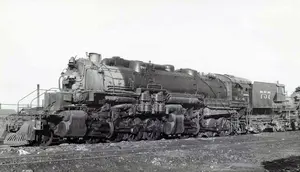
Baldwin built its first 2-10-4s in 1927 for Burlington coal. Sixty-four-inch drivers, 31 × 32, about 524,000 pounds engine weight, 353,000 on the drivers. The Bessemer bought one copy in 1929 and nine more in 1930. By 1944 it had 47, class H1A through H1G, 601–647, all but ten of them Baldwin. They were put to the same use as Burlington’s: heavy mineral trains. Pennypacker called them the tough Texans. The type encyclopedia is the 2-10-4 page. The surviving engine, 643, is its own.
By 1951 many of the 2-10-4s were out of work. B&LE sold eighteen to the Duluth, Missabe & Iron Range: 621–631, 635, 637–638, 641, and 645–647. The rest were retired in 1952–54. Fires on the H1s were out by the end of 1952.
Four light Pacifics
The Bessemer was never a passenger railroad. At its maximum the timetable was two or three locals the length of the main plus connecting branch trains. Ten-Wheelers and Americans handled that until 1913, when Schenectady delivered four light Pacifics, P1A 901–904. Number 904 at Greenville, backing train 1 in with an RPO and a coach, is that class near the end. Steam-generator SD7s took the varnish in 1952. The last passenger train came off in 1955.
Four-coupled passenger power in the table is three E5 classes: Cooke 15 of 1900; Pittsburgh 16–19 of 1905 and 1908, of which 16 and 19 went to the Union Railroad; and Pittsburgh 10–11 of 1909. They were off by 1944.
Six-wheel, then a dozen heavy 0-8-0s
Seven 0-6-0s of 1909 and 1911 lasted into dieselization. The four S3A engines of 1909, 234–237, weighed 184,400 pounds. The three S2Ds of 1911, 227–229, were nearly 60,000 pounds lighter. Two Brooks S2Bs, 232–233, 1900, were gone by 1936.
The last new steam type on the railroad was the eight-wheel switcher. Alco built twelve heavy 0-8-0s, S4A–S4E 251–262, between 1936 and 1943: 57-inch drivers, 25 × 30 cylinders, about 280,000 pounds. A USRA 0-8-0 was 51-inch drivers, 25 × 28, 214,000 pounds. The B&LE engines switched and took way freights. They came off in 1953–54 with the last Consolidations.
2-8-0 156, Butler, May 14, 1953
B&LE bought a Westinghouse diesel switcher in 1936. A few Baldwin switchers arrived in 1949, then a wave of Electro-Motive F7s in 1950 and 1951. Road trains were dieselized by the end of 1952. Drury puts dieselization complete in early 1953. Classic Trains names the last steam: Consolidation 156, class C3B/C3D, tied up at Butler on May 14, 1953. 154 had already been set aside. 643 was stored at Greenville. The diesels that replaced this fleet—F7s, SD7s, later every non-turbocharged six-axle EMD in the catalog—are the diesel roster.
All-time roster (built since 1900)
Drury’s grid is classes built from 1900 on. Quantities are his. Retirement years are the span he prints. Builder “Pittsburgh,” “Brooks,” “Cooke,” and “Schenectady” are Alco works. H1 notes list the eighteen 2-10-4s sold to DM&IR in 1951.
| Type | Class | Numbers | Qty | Builder | Built | Retired | Notes |
|---|---|---|---|---|---|---|---|
| 0-6-0 | S2B | 232, 233 | 2 | Brooks | 1900 | 1936 | |
| 0-6-0 | S2D | 227–229 | 3 | Baldwin | 1911 | 1950–1952 | About 60,000 lb lighter than S3A |
| 0-6-0 | S3A | 234–237 | 4 | Baldwin | 1909 | 1948–1950 | 184,400 lb |
| 0-8-0 | S4A–S4E | 251–262 | 12 | Alco | 1936–1943 | 1953–1954 | 57-inch drivers, 25 × 30, about 280,000 lb. Last new steam type. Way freight as well as switching |
| 2-8-0 | C1B | 85–90 | 6 | Pittsburgh | 1900–1901 | 1927–1936 | 54-inch drivers. 22 × 28 |
| 2-8-0 | C1B | 95–114 | 20 | Pittsburgh | 1902–1903 | 1927–1936 | |
| 2-8-0 | C1C | 93, 94 | 2 | Brooks | 1901 | 1936 | |
| 2-8-0 | C1D | 84 | 1 | Baldwin | 1900 | 1926 | |
| 2-8-0 | C1D | 91, 92 | 2 | Baldwin | 1901 | 1926 | |
| 2-8-0 | C1E, C1F | 125–145 | 21 | Pittsburgh | 1907, 1909 | 1929–1930 | |
| 2-8-0 | C2A | 115–124 | 10 | Pittsburgh | 1905 | 1936 | 22 × 30 |
| 2-8-0 | C2B–C2D | 325–362 | 38 | Pittsburgh | 1911–1913 | 1936–1954 | Last Consolidation order |
| 2-8-0 | C3A | 150–153 | 4 | Pittsburgh | 1900–1902 | 1936–1943 | 150 and 151, 1900, heaviest locomotives in the world when built. 24 × 32 |
| 2-8-0 | C3B, C3D | 154–157 | 4 | Baldwin | 1909, 1911 | 1951–1954 | 154 preserved, Henry Ford Museum. 156 last steam, May 14, 1953, Butler |
| 2-8-0 | C4A | 158, 159 | 2 | Baldwin | 1913 | 1953, 1951 | 26 × 30, 268,000 lb |
| 2-10-2 | D1A | 501–520 | 20 | Baldwin | 1916 | 1948–1951 | 60-inch drivers, 30 × 32, 404,000 lb |
| 2-10-2 | D2A | 521–525 | 5 | Baldwin | 1919 | 1947 | USRA heavy. 57-inch drivers. Scrapped before the D1As |
| 2-10-4 | H1A–H1G | 601–647 | 47 | Baldwin, Alco | 1929–1944 | 1952–1954 | Burlington copies. 64-inch, 31 × 32, about 524,000 lb. Ten Alco. 621–631, 635, 637–638, 641, 645–647 to DM&IR, 1951. 643 preserved, Age of Steam |
| 4-4-0 | E5A | 15 | 1 | Cooke | 1900 | 1936 | |
| 4-4-0 | E5B, E5C | 16–19 | 4 | Pittsburgh | 1905, 1908 | 1936–1944 | 16 and 19 to Union Railroad |
| 4-4-0 | E5D | 10, 11 | 2 | Pittsburgh | 1909 | 1944 | |
| 4-6-2 | P1A | 901–904 | 4 | Schenectady | 1913 | 1953 | Photo: #904 Greenville |
Related reading on American-Rails.com
- Bessemer & Lake Erie · B&LE diesel roster · 2-10-4 Texas type
- B&LE 2-10-4 #643 at Age of Steam
- Duluth, Missabe & Iron Range · Union Railroad
- Canadian National · Pennsylvania railroads · Ohio railroads
Sources
- Drury, George H. Guide to North American Steam Locomotives, revised edition, pp. 82–83. Post-1900 class table; C3A 150–151 heaviest in 1900; D1A vs Erie and USRA D2A; 47 Texas types after Burlington; 18 to DM&IR; dieselization early 1953; published rosters in Railroad magazine, May 1938 / July 1938 / October 1951
- Pennypacker, Bert. “Tough Texans of the Bessemer.” Classic Trains, Winter 2000. 2-10-4 fleet
- Classic Trains, Winter 2017. Last steam 2-8-0 156, May 14, 1953, Butler; road trains dieselized by the end of 1952; 18 Texas types among the last active steam in America on the Missabe into 1959
- American-Rails.com, Bessemer & Lake Erie. Last passenger 1955; 643 and 154 as the survivors
- American-Rails.com, B&LE 2-10-4 #643. Baldwin 1944; Age of Steam, Sugarcreek
- American-Rails.com, B&LE diesel roster. Westinghouse 1936; F7s 1950–53; SD7s
Recent Articles


-
California High-Speed Rail Chief Resigns
Oct 30, 26 08:36 PM
 Ian Choudri resigned October 28, 2026 as chief executive of the California High-Speed Rail Authority. The board named Joe Stephenshaw interim chief executive.
-
The 1910 Portal Bridge Is Handed Over for Demolition
Oct 30, 26 04:03 PM
 Amtrak handed the 1910 Portal Bridge over for demolition on October 29, 2026, during the final cutover to Portal North. Regular NJ Transit and Amtrak schedules are expected November 15.
-
Union Pacific-Norfolk Southern Merger Review Runs to 2027
Oct 30, 26 03:59 PM
 Union Pacific says the Surface Transportation Board's review of the Norfolk Southern merger gathers information through May 28, 2027. A closing still depends on board approval.
-
Amtrak Board Will Hear Restructuring Comments on November 10
Oct 30, 26 03:41 PM
 Amtrak's board will hear public comments on its restructuring on November 10, 2026, from 2 to 3 p.m. Eastern. Written comments were due October 30. A proposal goes to the board in December.
-
Canadian Pacific Selkirk 5931 Restored in Calgary
Oct 30, 26 01:36 PM
 Heritage Park in Calgary unveiled a cosmetic restoration of Canadian Pacific 2-10-4 No. 5931 on October 27, 2026. One of two surviving Selkirks. It stays on display.
-
Gettysburg Railway to Host Steam for Lincoln
Oct 30, 26 01:18 PM
 Northern Central Railway of York No. 17 will recreate Lincoln's arrival at Gettysburg on November 18, 2026, with public steam trips November 19-21.
-
NC&StL No. 576 to Steam for the Public in Nashville
Oct 30, 26 01:00 PM
 Nashville Steam will fire NC&StL 4-8-4 No. 576 for the public on November 7, 2026, 9 a.m. to 3 p.m., at 220 Willow Street. Admission is free.
-
Pennsylvania Railroad E8s Join the T1 Trust
Oct 30, 26 12:38 PM
 The T1 Trust has acquired former Pennsylvania Railroad E8A diesels 5702A and 5761A from the Fort Wayne Railroad Historical Society. They are bound for Cumberland.
-
Ligonier Valley Railroad: History, Roster, Timetable
Oct 30, 26 12:03 PM
 The Ligonier Valley Railroad ran 10.5 miles from Latrobe to Ligonier, Pennsylvania. Opened December 1, 1877. Last day August 31, 1952.
-
Toledo, Peoria & Western Diesel Roster (All-Time)
Oct 30, 26 10:25 AM
 Toledo, Peoria & Western diesel locomotives, each frame once. Thirteen Alcos, three Lima-Hamilton switchers, and 26 Electro-Motive units.
-
Toledo, Peoria & Western Steam Roster
Oct 30, 26 09:14 AM
 Toledo, Peoria & Western steam locomotives from the Rogers Consolidations of 1895 through the 4-8-4s of 1937
-
Toledo, Peoria & Western Railway: Map, Roster, History
Oct 29, 26 11:12 PM
 History of the Toledo, Peoria & Western. The Peoria & Oquawka, George P. McNear, the Santa Fe and Pennsylvania years, and the railroad that came back in 1989.
-
Cotton Belt Diesel Roster (All-Time)
Oct 29, 26 07:58 PM
 St. Louis Southwestern diesel locomotives, each frame once. Baldwin switchers, F units, and new Cotton Belt-lettered power through the GP60s of May 1990.
-
Cotton Belt Steam Roster (Built Since 1900)
Oct 29, 26 06:52 PM
 St. Louis Southwestern steam locomotives built since 1900. Consolidations, Ten-Wheelers, and twenty class L-1 4-8-4s. The quantity column is 297.
-
Cotton Belt Railroad: Map, Logo, History, Rosters
Oct 29, 26 10:56 AM
 History of the St. Louis Southwestern, the Cotton Belt Route. The Tyler Tap, Paramore's silver spike, the Thebes Bridge, the Blue Streak, and Southern Pacific control. Steam and diesel rosters are sep…
-
Pere Marquette Steam Roster (Built Since 1900)
Oct 28, 26 11:54 PM
 Pere Marquette steam locomotives built since 1900. Consolidations, Mikados, Pacifics, and 39 Berkshires. The quantity column is 503.
-
Pere Marquette Diesel Roster (All-Time)
Oct 28, 26 11:48 PM
 Pere Marquette diesel locomotives, each frame once. Two SW1s, 14 NW2s, three GE 70-tonners, eight E7As, and six BL2s delivered lettered Chesapeake and Ohio. The quantity column is 33.
-
Pere Marquette Railway: Map, Logo, Rosters, History
Oct 28, 26 11:44 PM
 History of the Pere Marquette Railway. Timber roads, the Prince years, the Van Sweringens, the Ludington car ferries, and the Chesapeake and Ohio merger of June 6, 1947.
-
Nickel Plate Road (Railroad): Map, History, Rosters
Oct 28, 26 10:51 PM
 History of the Nickel Plate Road, the New York, Chicago and St. Louis. The Seney syndicate, the Van Sweringens, the Berkshires, and the Norfolk and Western absorption at 12:01 a.m. on October 16, 1964…
-
Nickel Plate Diesel Roster (All-Time)
Oct 28, 26 10:48 PM
 Nickel Plate diesel locomotives, each frame once. Alco switchers and PAs, GP7s and GP9s, and the GP30s. The quantity column is 440. The 1950 fleet was 117.
-
Nickel Plate Steam Roster (Built Since 1900)
Oct 28, 26 10:43 PM
 Nickel Plate steam locomotives built since 1900, including the Lake Erie and Western, the Clover Leaf, and the Wheeling engines that took Nickel Plate numbers. The quantity column is 786.
-
EMD "E9" Locomotives: Specs, Roster, History
Oct 28, 26 10:37 PM
 EMD E9 cab units and boosters, 2,400 horsepower, built April 1954 through January 1964. Gear ratios, specifications, and the production roster by owner, serial, and order.
-
NYC 4-6-4 #5344, "Commodore Vanderbilt"
Oct 28, 26 04:31 PM
 NYC J-1e Hudson 5344, the Commodore Vanderbilt. Alco, November 1931. Carl Kantola’s shroud, December 1934, then a Dreyfuss bullet nose in 1939. Scrapped at Collinwood in 1954.
-
New Jersey, Indiana & Illinois Railroad: A South Bend Shortline
Oct 28, 26 11:05 AM
 The New Jersey, Indiana & Illinois, the Jersey Line, ran from South Bend to Pine. Singer built it in 1905. Wabash stock control came in 1926. Two diesels, and the steam the record names.
-
Monon Diesel Roster (All-Time)
Oct 28, 26 10:13 AM
 Monon diesel locomotives, each frame once. F3s, nine BL2s, the C420s, and eight U23Bs. The quantity column is 96. The 1951 fleet was 57.
-
Monon Steam Roster (Built Since 1900)
Oct 28, 26 10:09 AM
 Monon steam locomotives built since 1900. Twelve-Wheelers, Mikados, light Pacifics, and thirteen six-wheel switchers. The quantity column is 148.
-
Monon Railroad: Map, Photos, History, Logo
Oct 28, 26 09:55 AM
 History of the Monon, the Hoosier Line. The New Albany & Salem, the X at Monon, Barriger's streamliners, and the Louisville & Nashville merger of July 31, 1971.
-
Missouri-Kansas-Texas Diesel Roster (All-Time)
Oct 28, 26 09:48 AM
 All-time diesel roster of the Missouri-Kansas-Texas. 406 locomotives, each frame once. Baldwin switchers, Alco cab units, F units, Geeps, and the SD40-2s.
-
Missouri-Kansas-Texas Steam Roster (Built Since 1900)
Oct 28, 26 09:43 AM
 Missouri-Kansas-Texas steam locomotives built since 1900. Moguls, Mikados, Pacifics, and the narrow-gauge shop tanks. The quantity column is 715.
-
Missouri-Kansas-Texas Railroad (Katy): Map, History, Rosters
Oct 27, 26 11:02 PM
 History of the Missouri-Kansas-Texas, the Katy. The race into Indian Territory, Gould, the 1923 railroad, the Texas Special, and the 1988 sale. Steam and diesel rosters are linked.
-
Soo Line Diesel Roster (All-Time)
Oct 27, 26 10:55 PM
 All-time diesel roster of the Soo Line and the Wisconsin Central. 786 locomotives, each frame once. Cab units, Geeps, the Milwaukee Road engines, and the SD60s. The South Shore's 24 stay on that page.
-
Soo Line Steam Roster (Built Since 1900)
Oct 27, 26 10:49 PM
 Soo Line and Wisconsin Central steam locomotives built since 1900. Consolidations, Mikados, Pacifics, 21 Mountains, and four Lima 4-8-4s.
-
Soo Line Railroad: Map, Logo, History, Rosters
Oct 27, 26 10:24 PM
 The Soo Line, from the flour millers' railroad around Chicago to the Sault, the Wisconsin Central, and the Milwaukee Road. Steam quantity 422. Diesels 786. Canadian Pacific took full control in 1990.
-
Minneapolis, Northfield and Southern Railway: Map, History, Rosters
Oct 27, 26 10:32 AM
 The Minneapolis, Northfield & Southern, the Dan Patch Line that became a Twin Cities belt. Steam, gas-electric mules, motor cars, and the 22 diesels, through the Soo Line.
-
Minneapolis & St. Louis Diesel Roster (All-Time)
Oct 27, 26 10:27 AM
 All-time diesel roster of the Minneapolis & St. Louis. 97 locomotives, each frame once. Switchers from 1938, 35 RS-1s, the FT and F-unit cabs, two SD7s, and 23 GP9s. Builder numbers included.
-
Minneapolis & St. Louis Steam Roster (Post 1900)
Oct 27, 26 10:25 AM
Minneapolis & St. Louis steam locomotives built since 1900. Moguls, Consolidations, 35 Mikados, and five Pacifics. -
Minneapolis and St Louis Railway: "The Peoria Gateway"
Oct 27, 26 09:52 AM
 The Minneapolis & St. Louis, the Tootin' Louie, from the 1870 charter to the Peoria Gateway and the Chicago & North Western sale on November 1, 1960.
-
Alco "PA" Locomotives: Restoration, Specs, Engine, Rosters
Oct 27, 26 12:12 AM
 Alco's PA passenger cab, 297 locomotives built from 1946 to 1953. The 244 engine, the production roster, the Delaware & Hudson PA-4s, and Nickel Plate Road 190.
-
Milwaukee Road Diesel Roster: (All Time)
Oct 26, 26 01:44 PM
 All-time diesel roster of the Milwaukee Road. 1,208 locomotives, each frame once. Alco, Baldwin, Davenport, EMD, Fairbanks-Morse, General Electric, and Whitcomb, with builder numbers.
-
Milwaukee Road Steam Roster (All-Time): Post-1900
Oct 26, 26 01:38 PM
 Milwaukee Road steam locomotives built since 1900. Prairies, Mikados, the N-class articulateds, the S-class 4-8-4s, and the Hiawatha Atlantics and Hudsons. Quantity column 1,974. Unique frames 1,951.
-
Milwaukee Road: Map, Electrification, Logo, History
Oct 26, 26 01:20 PM
 The Milwaukee Road, from the Milwaukee & Mississippi of 1850 to the Pacific Coast Extension, the Hiawathas, and the Soo Line sale. Why Lines West should have stayed.
-
Lake Superior & Ishpeming Railroad: Map, Roster, History
Oct 25, 26 11:38 PM
 Lake Superior & Ishpeming Railroad, reporting mark LSI, from the Marquette Range to the Presque Isle ore dock. The 1954 steam list and the diesels the railroad owned.
-
Kansas City Southern Steam Roster (Built Since 1900)
Oct 25, 26 09:09 PM
 Steam locomotives of the Kansas City Southern built since 1900, with the Louisiana & Arkansas and the Texas company.
-
Kansas City Southern Diesel Roster (Built New)
Oct 25, 26 11:46 AM
All-time diesel roster of the Kansas City Southern. E units, F units, Geeps, SD40s through SD70ACes, Fairbanks-Morse, Baldwin, Alco, and General Electric, with serials and order numbers. -
Kansas City Southern Railway: Map, Photos, History
Oct 25, 26 12:24 AM
The Kansas City Southern, from Arthur Stilwell's Gulf line to Canadian Pacific Kansas City on April 14, 2023. Steam and diesel rosters, the Southern Belle, and the Louisiana & Arkansas. -
Indiana Harbor Belt Diesel Roster (All-Time)
Oct 25, 26 12:17 AM
 All-time diesel roster of the Indiana Harbor Belt. 202 locomotive frames, each counted once. NW2s, SW7s, SW1500s, road switchers, and gensets. Slugs and boosters are outside the count.
-
Indiana Harbor Belt Steam Roster (Built Since 1900)
Oct 25, 26 12:13 AM
 Steam locomotives of the Indiana Harbor Belt built since 1900. 182 engines, each counted once. 0-6-0s, 2-6-0s, 0-8-0s, and 2-8-2s. The three U-4a switchers are three-cylinder Brooks engines of 1927.
-
Indiana Harbor Belt Railroad: Map, Rosters, History
Oct 25, 26 12:00 AM
 Indiana Harbor Belt, the inner belt across the Calumet, from the East Chicago Belt of May 16, 1896. Renamed June 29, 1907. Still operating, headquarters Hammond. Steam roster is the companion, 182 loc…
-
NYC's "P Motor" Electric Locomotives
Oct 24, 26 11:43 PM
 New York Central P motors: 22 Alco-GE 2-C+C-2 electrics, Cleveland Union Terminal 1050–1071, class P-1a. 3,030 hp one-hour on 3,000-volt DC catenary, then 660-volt third rail as P-2a and P-2b.
-
Illinois Terminal Car Roster
Oct 24, 26 11:40 PM
 Illinois Terminal cars. Mainline motors, the 1948 streamliners, sleepers, Alton and Valley Division cars, express motors, and the line cars rebuilt from pull cars.