Atlantic Coast Line Steam Roster (Post 1900)
Last revised: October 6, 2026
By: Adam Burns
The Atlantic Coast Line’s main line from Richmond to Jacksonville was nearly a water-level railroad, and the company chose the Pacific where other roads would have bought a Consolidation. When the 4-4-0s were outgrown, the next freight engine was a 4-6-0. The Pacific that followed hauled Florida passengers south and citrus north. Drury calls the Coast Line the only railroad in the United States that used the Pacific extensively for freight. The two P-5 classes alone were 235 engines. Twelve Baldwin 4-8-4s of 1938 were the largest steam the road ever bought, and they were in freight service after the war.
The class grid below is the post-1900 roster in George H. Drury’s Guide to North American Steam Locomotives, revised edition, pages 69–72, read against the chapter’s own text and against Richard E. Prince. The company history is the Atlantic Coast Line. Diesels are the diesel roster.

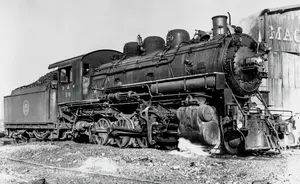
Baldwin builder photograph of new Atlantic Coast Line 4-8-4 No. 1805, class R-1, in 1938. The class was 1800–1811.
On this page: At a glance · Copper Heads · Pacifics · Consolidations, Mikados, Santa Fes · The twelve 4-8-4s · Switchers · June 30, 1955 · Roster built since 1900
At a glance
| Item | Detail |
|---|---|
| Railroad | Atlantic Coast Line. Mark ACL. Company page: Atlantic Coast Line |
| This roster | Engines built since 1900, after Drury, pages 69–72 |
| Ten-Wheelers | Copper Heads. Classes K through K-15. One K-16, No. 1045, Baldwin, 1922 |
| Pacifics | ACL’s own P through P-4, then 70 USRA light P-5-As (1500–1569) and 165 P-5-Bs (1600–1764). Thirteen more came from the AB&C |
| Freight | 2-8-0s for the Montgomery line, then Mikados, then twenty Q-1 2-10-2s in 1925. No 2-10-0 on this roster |
| 4-8-4 | Twelve R-1s, 1800–1811, Baldwin, 1938. Eighty-inch disc drivers. Assigned to freight after the war |
| 4-8-2 | Five ex-DL&W J-1s, bought 1943. Two ex-FEC AM-1s, from the AB&C in 1946 |
| Last steam | June 30, 1955. Six locomotives were left at the end of 1954 |
| Preserved | P-5-A No. 1504, Alco-Richmond, 1919, at the Prime F. Osborn III Convention Center, Jacksonville |
Roster follows Drury, Guide to North American Steam Locomotives (revised edition), pages 69–72, with the built years of the early Pacifics taken from Drury’s text and from Prince where the grid column is a year early. Information compiled October 6, 2026.
Copper Heads
In the early 1890s the Coast Line wanted a passenger engine with more boiler than a 4-4-0. Baldwin had just shown a 2-4-2 at the World’s Columbian Exposition, and the wide firebox on a trailing axle was the idea the railroad took home. Baldwin designed a 4-4-2 for the Coast Line and named the type for the railroad. The company bought ten Atlantics between 1894 and 1900, plus a pair of 2-4-2s to try the wheel arrangement. They were too light for the main, went to local trains, and were scrapped in 1934. The name stayed on the type. The Coast Line went back to Ten-Wheelers.
Baldwin delivered five Ten-Wheelers in 1898 for freight, and they worked. More followed, some with 64-inch drivers for freight and some with 69-inch drivers for passenger trains. The type picked up the nickname Copper Head from a decorative copper flange on the stack. The basic engine was steady for years: 185 pounds of boiler pressure, equally spaced drivers, and a weight of 140,000 to 160,000 pounds, with 19-by-26-inch cylinders and later 20-by-26. Drury’s Copper Head classes are K, K-4, K-5, K-6, K-14, and K-15. The last batches had piston valves and Walschaerts valve gear. Many of the earlier engines were superheated and given piston-valve chests.
In 1922 the railroad and Baldwin designed one more Ten-Wheeler, class K-16, No. 1045, 34,000 pounds heavier than the newest Copper Heads. It was meant for lines that could not yet carry a Pacific. By the time it arrived, the track work had moved ahead of it, and one engine was enough. Five K-9s, 206–210, came with the Plant System. Rhode Island built them in 1893 as cross-compounds for the Milwaukee Road, which sent them back. Rhode Island rebuilt them as simple engines for the Plant System, and in 1912 the Coast Line rebuilt them as 4-6-0s. The grid carries 1900 in the built column for that group. No. 211 is a separate Baldwin K-9 of 1902, also ex-Savannah, Florida & Western.
Pacifics, including 235 of the P-5
The Coast Line’s own Pacifics began with fifteen class P engines from Baldwin in 1911, numbers 260–274, with 73-inch drivers and slide valves. They were later superheated and fitted with piston-valve chests. Drury says they were then reclassified P-S. The summary grid keeps the letter P on 260–274. Class P-1, 275–286, followed in 1912 at essentially the same size, superheated and equipped with piston valves from the start.
Class P-2, 400–410, was the freight version, delivered in 1913 with 64-inch drivers. No. 403, a P-2, is the engine in Drury’s photograph of an early Pacific, the odd-shaped cab included. Those engines stayed on the roster until dieselization. Class P-3, of 1914, was the dual-service engine with 69-inch drivers, forty-five locomotives, 411–455. Class P-4, twenty-seven engines delivered in 1916–1918, numbers 456–482, had cylinders an inch larger than the P-3 and set the pattern for what came next.
In 1919 and 1920 the railroad took seventy United States Railroad Administration light Pacifics from Alco’s Brooks and Richmond plants, unusual for a company that bought Baldwin whenever it could. Class P-5-A, numbers 1500–1569, was larger and more powerful than any Pacific the Coast Line had designed for itself, and it became the standard passenger engine. No. 1504 was built at Richmond in 1919, carried number 497 before it was renumbered, and is the one that was saved. After the war, Baldwin and the railroad modified the USRA engine into a slightly heavier dual-service Pacific with 69-inch drivers. The Coast Line bought 165 of them between 1922 and 1926, class P-5-B, numbers 1600–1764. The two classes together are the 235 Pacifics.
Merger of the Atlanta, Birmingham & Coast added thirteen more. Eleven ex-Florida East Coast Pacifics, class AJ-1, were lighter than any of the Coast Line’s own. Two ex-Great Northern engines, class AJ-2, Nos. 7153 and 7175, Lima, 1914, were somewhat heavier than a P-4.
Montgomery’s freight engines
The former Alabama Midland, from Bainbridge northwest to Montgomery, crossed the tail of the Appalachians and ran crosswise to the rivers. It needed heavier freight power than the coastal plain. With the Plant System the Coast Line inherited four Baldwin 2-8-0s built for the Alabama Midland in 1901. It then bought ten more Consolidations from Baldwin in 1903, three in 1905, and four in 1911, all for the Montgomery route until Mikados replaced them and the 2-8-0s were scattered as switchers. On the grid those engines are classes L (700–713), L-1 (714–716), and L-2 (717–720). L-2 is a 2-8-0.
Twenty Mikados, class M, 800–819, came from Baldwin in 1911. Drury describes them as light engines, 233,450 pounds, with 56½-inch drivers and slide valves. In 1919 the railroad bought much larger 2-8-2s for the coal trains on the Montgomery line, on the order of a USRA light Mikado. They are class M-2, 820–836, seventeen engines, Baldwin, 1918–1923.
The AB&C brought seventeen Mikados in three classes. Four small Baldwins of 1912–1915, class AK-1, were already down to the four that reached the Coast Line, two of them scrapped almost at once. Eleven ex-New York Central engines, class AK-2, included ten that had been rebuilt from 2-8-0s between 1912 and 1915. Two Baldwin products of 1910, class AK-3, Nos. 7301 and 7302, were scrapped soon after the Coast Line acquired them. AK-3 is a 2-8-2.
In 1925 the railroad bought twenty Santa Fe type locomotives for the Montgomery route, class Q-1, 2000–2019. Drury describes them as twelve tons heavier than a USRA 2-10-2. They introduced the automatic stoker and the Vanderbilt tender on the Coast Line. A smaller 2-10-2 group, class O, 8000–8009, Baldwin and Richmond, 1917–1918, includes the three light engines of 1917 whose 57-inch drivers were taken out to 63 inches with oversize tires.
Twelve 4-8-4s, then five Mountains
In 1938 Baldwin delivered a dozen class R-1 4-8-4s, 1800–1811, for the mainline passenger trains. They had cast-steel engine beds, 80-inch disc drivers, roller bearings on the lead trucks and the drivers, tenders on eight-wheel trucks, and a two-tone gray-and-black paint scheme. In service the reciprocating machinery proved to have been over-counterbalanced. At speed the engines pounded the rail and threw the track out of line. The condition was never completely corrected. After the war, as the E-units took the passenger trains, the 4-8-4s went to freight.
A wartime rise in traffic to Florida’s west coast sent the railroad out to buy 4-8-2s. Five came from the Delaware, Lackawanna & Western in 1943, class J-1, 1401–1405, Brooks, 1924. They worked chiefly between Tampa and Albany, Georgia. Two more, former Florida East Coast engines, class AM-1, Nos. 7351 and 7372, Schenectady, 1924, came off the AB&C in 1946.
Switchers
The standard switcher was class E-4, a low-slung slide-valve 0-6-0, numbers 126–190, sixty-five engines, Baldwin, 1904–1910, that looked older than it was. Class E-10, 1100–1125, raised the boiler and put the firebox above the frames, and still used slide valves, Stephenson gear, and main rods connected to the second axle. There were two E-11s, 1126 and 1127: superheated, piston valves, Southern valve gear. The next eight, 1128–1135, are class E-12, with the main rods on the rear axle and Walschaerts valve gear. The United States Railroad Administration assigned ten 0-6-0s, which the railroad classed E-9-S, 1136–1145. Class E-13, five ex-AB&C engines, 1146–1150, looked like a USRA switcher and lacked the superheater. The road went back to slide valves.
The 0-8-0s of class E-14, 1200–1234, are thirty-five Baldwin copies of the USRA design, built in 1923–1926. The three 0-8-0s rebuilt from 4-6-0s are the AB&C’s own class AS-2, 7033–7035, rebuilt in the AB&C shops in 1939–1942.
June 30, 1955
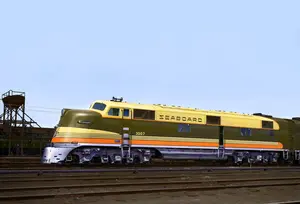
In 1938 the Coast Line bought 4-8-4s and the Seaboard bought diesels. In 1939 the Coast Line bought a pair of Electro-Motive passenger units and then turned to freight cabs. By 1952 diesels were handling 99 percent of the trains. A few steam locomotives remained for seasonal peaks and for lines that could not carry a diesel’s axle load. At the end of 1954 six steam locomotives were on the roster, five of them built before 1920. The railroad retired its last steam locomotive on June 30, 1955.
The grid prints a 1964 retirement for the ninety-six K-5 Ten-Wheelers numbered 910–1005. That year falls after the railroad had finished with steam. No. 1504, retired in 1952, is the Pacific on display at the Prime F. Osborn III Convention Center in Jacksonville.
Atlantic Coast Line steam locomotives built since 1900
| Type | Class | Numbers | Qty | Builder | Built | Retired | Notes |
|---|---|---|---|---|---|---|---|
| 0-6-0 | E | 117 | 1 | Baldwin | 1900 | 1929 | |
| 0-6-0 | E-3 | 118–120 | 3 | Baldwin | 1901 | 1934 | |
| 0-6-0 | E-3 | 124–125 | 2 | Baldwin | 1903 | 1936 | |
| 0-6-0 | E-4 | 126–190 | 65 | Baldwin | 1904–1910 | 1935–1952 | |
| 0-6-0 | E-5 | 121–123 | 3 | Richmond | 1901 | 1950–1952 | Ex-SF&W |
| 0-6-0 | E-7 | 1151–1158 | 8 | Cooke | 1918–1919 | 1951–1952 | |
| 0-6-0 | E-9-S | 1136–1145 | 10 | Baldwin | 1918–1919 | 1948–1952 | USRA assignment |
| 0-6-0 | E-10 | 1100–1125 | 26 | Baldwin | 1916 | 1951–1952 | |
| 0-6-0 | E-11 | 1126, 1127 | 2 | Baldwin | 1917 | 1952 | |
| 0-6-0 | E-12 | 1128–1135 | 8 | Baldwin | 1917 | 1952 | |
| 0-6-0 | E-13 | 1146–1150 | 5 | Baldwin | 1907 | 1950–1952 | Ex-AB&C |
| 0-6-0 | AS-1 | 7023–7028 | 3 | Baldwin | 1923–1926 | 1946–1952 | |
| 0-8-0 | E-14 | 1200–1234 | 35 | Baldwin | 1923–1926 | 1952 | |
| 0-8-0 | AS-2 | 7033–7035 | 3 | AB&C | 1939–1942 | 1952 | Ex-AB&C, rebuilt from 4-6-0 |
| 2-8-0 | L | 700–713 | 14 | Baldwin | 1901, 1903 | 1939–1942 | |
| 2-8-0 | L-1 | 714–716 | 3 | Baldwin | 1905 | 1951–1955 | |
| 2-8-0 | L-2 | 717–720 | 4 | Baldwin | 1911 | 1951–1955 | |
| 2-8-2 | M | 800–819 | 20 | Baldwin | 1911 | 1950–1952 | |
| 2-8-2 | M-2 | 820–836 | 17 | Baldwin | 1918–1923 | 1952 | |
| 2-8-2 | AK-1 | 7205–7213 | 4 | Baldwin | 1912–1915 | 1946–1951 | Ex-AB&C |
| 2-8-2 | AK-2 | 7225–7235 | 11 | Alco | 1912–1915 | 1947–1952 | Ex-AB&C, ex-NYC |
| 2-8-2 | AK-3 | 7301, 7302 | 2 | Baldwin | 1910 | 1946, 1947 | Ex-AB&C |
| 2-10-2 | O | 8000–8009 | 10 | Baldwin, Richmond | 1917–1918 | 1949–1952 | |
| 2-10-2 | Q-1 | 2000–2019 | 20 | Baldwin | 1925 | 1951–1952 | |
| 4-4-2 | AF-1 | 7401–7403 | 3 | Baldwin | 1917 | 1951–1952 | Ex-AB&C |
| 4-6-0 | I-3 | 98, 99 | 2 | Baldwin | 1900 | 1934 | |
| 4-6-0 | K | 322–327 | 6 | Richmond | 1900 | 1934 | |
| 4-6-0 | K | 328–351 | 24 | Baldwin | 1901–1903 | 1934–1935 | |
| 4-6-0 | K-4 | 212–222 | 11 | Baldwin | 1903 | 1934 | |
| 4-6-0 | K-5 | 233–211 | 12 | Baldwin | 1907 | 1936–1939 | Number cell as Drury prints it |
| 4-6-0 | K-5 | 910–1005 | 96 | Baldwin | 1906–1907 | 1935–1964 | See the note on June 30, 1955 |
| 4-6-0 | K-6 | 223–232 | 10 | Baldwin | 1905 | 1934–1942 | |
| 4-6-0 | K-6 | 351–399 | 49 | Baldwin | 1904–1906 | 1935–1950 | |
| 4-6-0 | K-6 | 900–909 | 10 | Baldwin | 1906 | 1935–1950 | |
| 4-6-0 | K-9 | 206–210 | 5 | Rhode Island | 1900 | 1935–1947 | Ex-SF&W |
| 4-6-0 | K-9 | 211 | 1 | Baldwin | 1902 | 1934–1942 | Ex-SF&W |
| 4-6-0 | K-14 | 245–254 | 10 | Baldwin | 1910 | 1934 | |
| 4-6-0 | K-14 | 1006–1011 | 6 | Baldwin | 1910 | 1947–1950 | |
| 4-6-0 | K-15 | 1012–1044 | 34 | Baldwin | 1912–1913 | 1947–1951 | |
| 4-6-0 | K-16 | 1045 | 1 | Baldwin | 1922 | 1952 | |
| 4-6-0 | AW-1 | 7060 | 1 | Baldwin | 1922 | 1952 | |
| 4-6-0 | AW-2 | 7064 | 1 | Baldwin | 1907 | 1949 | Ex-AB&C |
| 4-6-0 | AW-3 | 7101–7113 | 6 | Baldwin | 1907 | 1949 | Ex-AB&C |
| 4-6-0 | AW-4 | 7115–7124 | 9 | Baldwin | 1906–1907 | 1950–1952 | Ex-AB&C |
| 4-6-2 | P | 260–274 | 15 | Baldwin | 1911 | 1950–1952 | 73-inch drivers |
| 4-6-2 | P-1 | 275–286 | 12 | Baldwin | 1912 | 1950–1952 | |
| 4-6-2 | P-2 | 400–410 | 11 | Baldwin | 1913 | 1950–1952 | 64-inch drivers. On the roster until dieselization |
| 4-6-2 | P-3 | 411–455 | 45 | Baldwin | 1914 | 1950–1952 | 69-inch drivers |
| 4-6-2 | P-4 | 456–482 | 27 | Baldwin | 1916–1918 | 1947–1952 | |
| 4-6-2 | P-5-A | 1500–1569 | 70 | Brooks, Richmond | 1919–1920 | 1950–1952 | USRA light. 1504 preserved |
| 4-6-2 | P-5-B | 1600–1764 | 165 | Baldwin | 1922–1926 | 1950–1953 | 69-inch drivers |
| 4-6-2 | AJ-1 | 7071–7086 | 11 | Schenectady | 1911–1913 | 1946–1955 | Ex-AB&C, ex-FEC. Not every number in the span |
| 4-6-2 | AJ-2 | 7153, 7175 | 2 | Lima | 1914 | 1949, 1950 | Ex-AB&C, ex-GN |
| 4-8-0 | AS-3 | 7034 | 1 | Baldwin | 1906 | 1949 | Ex-AB&C, ex-N&W |
| 4-8-2 | J-1 | 1401–1405 | 5 | Brooks | 1924 | 1951–1952 | Ex-DL&W. Purchased 1943 |
| 4-8-2 | AM-1 | 7351, 7372 | 2 | Schenectady | 1924 | 1951 | Ex-AB&C, ex-FEC. To ACL in 1946 |
| 4-8-4 | R-1 | 1800–1811 | 12 | Baldwin | 1938 | 1951–1952 |
AB&C Atlanta, Birmingham & Coast. DL&W Delaware, Lackawanna & Western. FEC Florida East Coast. GN Great Northern. N&W Norfolk & Western. NYC New York Central. SF&W Savannah, Florida & Western. A number span with a smaller quantity, such as AJ-1 and AW-3, means the class did not occupy every number in the span. Drury prints the smaller K-5 group as 233–211.
Related reading on American-Rails.com
Sources
- George H. Drury, Guide to North American Steam Locomotives, revised edition, Atlantic Coast Line, pp. 69–72. User photographs in
Downloads\ACL_Steam, October 2026. Class grid, the Copper Head description, the P-2 with 64-inch drivers, the 70 USRA light Pacifics, the 165 dual-service engines of 1922–1926, the twelve R-1s, the five DL&W 4-8-2s of 1943, and the two FEC 4-8-2s of 1946 - Richard E. Prince, Atlantic Coast Line Railroad: Steam Locomotives, Ships and History (1966), as summarized for the Pacific classes at steamlocomotive.com: P 1911, P-1 1912, P-2 1913, P-3 1914, P-4 1916–18, P-5-A 1500–1569, P-5-B 1600–1764
- Mike Schafer, Classic American Railroads, Volume III: last steam locomotive retired June 30, 1955
- No. 1504: Alco-Richmond, 1919, USRA light Pacific, earlier number 497, retired 1952, displayed at the Prime F. Osborn III Convention Center, Jacksonville, the former terminal
- Drury’s retired cell for K-5 910–1005 prints 1935–1964. The railroad’s last steam date is June 30, 1955, so that 1964 is the book’s figure and not a year the class was still running
Recent Articles


-
Rock Island Diesel Roser: All-Time
Oct 19, 26 11:05 AM
 Chicago, Rock Island and Pacific diesel locomotives, 1,029 frames counted once. Switchers, cab units, road-switchers, two acquired slugs, five RDCs, and bi-power 10000. Serial and order are separate c…
-
Rock Island Steam Roster: Post 1900
Oct 19, 26 11:01 AM
 Chicago, Rock Island and Pacific steam locomotives built or rebuilt since 1900. Drury's class grid, 1,482 frames counted once, including 85 4-8-4s. Last revenue steam was July 1953.
-
Rock Island Railroad: Map, Pictures, Logo, History
Oct 19, 26 10:51 AM
 The Chicago, Rock Island and Pacific ran from Chicago to the Twin Cities, Denver, Tucumcari, and the Gulf. First train October 10, 1852. Directed service ended March 23, 1980. Steam and diesel rosters…
-
EMD "F7" Locomotives: Cab, Top Speed, Specs, Rosters
Oct 19, 26 12:27 AM
 EMD F7 cab units and boosters, 1,500 horsepower, built February 1949 through December 1953. Gear ratios, specifications, and the production roster by owner, serial, and order.
-
Harlem Transfer Company: An NYC Terminal System
Oct 19, 26 12:01 AM
 Harlem Transfer Company, the Lackawanna's offline freight terminal on the Bronx side of the Harlem River at East 135th Street. Carfloats to Hoboken, boxcab No. 2, and GE 44-tonner 53.
-
Belpre Industrial Parkersburg Railroad: Roster, History, Photos
Oct 18, 26 11:44 PM
 Belpre Industrial Parkersburg Railroad, a Class III short line leasing about 46.9 miles of CSX track at Parkersburg since 2020. The Ohio River bridge, the Marietta Subdivision, and five GP38-3s.
-
Chicago, Peoria & St. Louis Railroad: Map, Timetables, History
Oct 18, 26 10:57 PM
 Chicago, Peoria & St. Louis Railroad, an Illinois line from Pekin and Peoria through Springfield to Madison. Chartered in 1853. Sold in parcels on November 20, 1924. The Pekin line is today the Illino…
-
Chicago, Burlington & Quincy Diesel Roster (All-Time)
Oct 18, 26 10:54 PM
 All-time diesel roster of the Chicago, Burlington & Quincy. 951 parent frames, 72 Colorado & Southern, and 36 Fort Worth & Denver, each counted once. Serials included.
-
Burlington Railroad (CB&Q): Map, History, Rosters, Photos
Oct 18, 26 10:49 PM
 The Chicago, Burlington & Quincy, the Burlington Route, ran from Chicago to Denver, the Twin Cities, and the Gulf. Steam built since 1900 and the diesel fleets are companion rosters. Burlington Northe…
-
Chicago, Burlington & Quincy Steam Roster (Post 1900)
Oct 18, 26 10:33 PM
 Chicago, Burlington & Quincy steam locomotives built or rebuilt since 1900. 429 Prairies, 383 Mikados, the Hudsons, and the O-5 4-8-4s. Drury's class grid.
-
Virginian Railway's 2-6-6-6 Locomotives (Class AG)
Oct 18, 26 01:38 PM
 Virginian Railway class AG. Eight Lima 2-6-6-6s, Nos. 900-907, built in 1945 for the east end. Billed at 753,000 pounds. Scrapped in 1960.
-
Pennsylvania (PRR) Steam Roster: Post 1906
Oct 18, 26 01:05 PM
 ennsylvania steam after 1906—H8, H9, and H10 Consolidations, 574 L1s Mikados, 598 I1s Decapods, 425 K4s Pacifics, 301 M1 Mountains. Drury’s grid. Last steam November 30, 1957.
-
Chicago, Aurora and Elgin Railroad: The "Roarin' Elgin"
Oct 18, 26 10:54 AM
 The Chicago, Aurora & Elgin, the Roarin' Elgin, ran 600-volt third-rail trains from Chicago to Aurora, Batavia, and Elgin. Passenger service ended at noon on July 3, 1957. Freight ended June 11, 1959.
-
Algoma Central Railway: Map, Logo, Rosters
Oct 17, 26 10:49 PM
 Algoma Central Railway, Sault Ste. Marie to Hearst. Wisconsin Central on February 1, 1995. Fifty-nine steam locomotives and forty-two diesels.
-
Akron, Canton and Youngstown Railroad: Map, History, Rosters
Oct 17, 26 05:49 PM
 Akron, Canton and Youngstown Railroad, Mogadore to Delphos. The rails never reached Canton or Youngstown. Norfolk & Western control on October 16, 1964. Twenty-six diesels and the historical society's…
-
Georgia Railroad: Map, History, Logo, Rosters
Oct 17, 26 12:59 PM
 Georgia Railroad, the Georgia Railroad and Banking Company, Augusta to Atlanta, with the Athens branch and the Macon Road. Mark GA. The railroad properties were sold on November 4, 1982.
-
West Point Route (Railroad): Map, History, Logo
Oct 16, 26 11:26 PM
 The West Point Route was a trademarked name comprising the Atlanta & West Point and Western Railway of Alabama, which were controlled by the Georgia Railroad.
-
Virginian Railway Diesel Roster (All-Time)
Oct 16, 26 11:11 PM
 All-time diesel roster of the Virginian Railway. 40 Fairbanks-Morse H16-44s, 25 H24-66 Train Masters, and one GE 44-tonner. Serials included.
-
Virginian Railway Steam Roster (Post 1900)
Oct 16, 26 10:55 PM
 Virginian Railway steam locomotives built since 1900. Mikados, 2-8-8-2s, the Triplex, class AE 2-10-10-2s, and the 1945 2-6-6-6s.
-
Virginian Railway: Map, Rosters, History, Electrification
Oct 16, 26 10:51 PM
 Virginian Railway, Deepwater to Norfolk. Combined in 1907 and completed in 1909. Electrified from Roanoke to Elmore. Absorbed by the Norfolk & Western on December 1, 1959.
-
Baldwin "Centipede" Locomotives: Specs, Roster, Photos
Oct 16, 26 03:58 PM
 Baldwin DR-12-8-1500/2 Centipede—2-D+D-2, two 608SC engines, 3,000 hp. SAL 4500 from the 1943 test bed. 54 on the serial list, 52 sold. PRR BP60 then BH50. None preserved.
-
Louisville & Nashville Class M-1 2-8-4s: The Big Emmas
Oct 16, 26 03:52 PM
Louisville & Nashville class M-1, 42 Big Emma 2-8-4s. Baldwin in 1942 and 1944, Lima in 1949. Coal trains from Neon to DeCoursey. No locomotive survives. -
Tennessee, Alabama and Georgia Railway: Map, History, Rosters
Oct 16, 26 03:21 PM
 Tennessee, Alabama and Georgia Railway, Chattanooga to Gadsden. The May 1929 card is 91.7 miles. Southern stock control closed on a January 1, 1971 schedule. Five diesels and Prince's steam list.
-
Railroad Museums In The USA (2026): State Guides & Collections
Oct 16, 26 02:29 PM
 U.S. railroad museums—what they are vs tourist railroads, preservation history (R&LHS, NRHS, IRM, Steamtown), state guides, and destination collections. Confirm hours on each museum’s site.
-
Wyoming Railroad Museums (2026): A Complete Guide
Oct 16, 26 02:26 PM
 Wyoming railroad museums—the Cheyenne Depot, Burlington 5633 at Douglas, Big Boy 4004, and the Laramie depot. Confirm hours and which locomotive is on the property.
-
West Virginia Railroad Museums (2026): A Complete Guide
Oct 16, 26 12:52 PM
 West Virginia railroad museums—Cass Scenic’s geared steam, the Hinton C&O collection, and the Martinsburg B&O roundhouse. Confirm hours and which locomotive is assigned.
-
Washington Railroad Museums (2026): A Complete Guide
Oct 16, 26 12:46 PM
 Washington railroad museums—Snoqualmie, Elbe, Chehalis, Reardan, and the Northern Pacific depot at Toppenish. Confirm hours and which locomotive is assigned.
-
Vermont Railroad Museums (2026): A Complete Guide
Oct 16, 26 12:42 PM
 Vermont railroad museums—the Shelburne Museum’s 1890 station, Central Vermont No. 220, and the private car Grand Isle. Confirm hours on the site.
-
Tennessee Central Railway: Map, Logo, Rosters, History
Oct 16, 26 11:32 AM
 Tennessee Central Railway, Harriman to Hopkinsville. Reorganized January 26, 1922. Last day August 31, 1968. Thirty-one diesels and the railroad's steam roster.
-
Southern Railway Steam Roster (Post 1900)
Oct 16, 26 09:40 AM
Southern Railway steam locomotives built since 1900. Ps-4 Pacifics, Ts Mountains, USRA Santa Fes, and the subsidiary grids for the CNO&TP, Alabama Great Southern, and New Orleans and Northeastern. -
Southern Railway (USA): Map, Locomotives, Logo, History
Oct 16, 26 09:28 AM
 The Southern Railway, formed July 1, 1894 from the Richmond and Danville and the East Tennessee, Virginia and Georgia. Washington. Norfolk Southern Railway on December 31, 1990.
-
Seaboard Coast Line Diesel Roster (All-Time)
Oct 15, 26 04:21 PM
 All-time diesel roster of the Seaboard Coast Line. Inherited Coast Line and Seaboard locomotives, then 623 new locomotives in the printed orders, plus 28 acquired from other railroads.
-
Seaboard Coast Line Railroad: Map, History, Photos
Oct 15, 26 04:17 PM
 The Seaboard Coast Line, formed July 1, 1967 from the Atlantic Coast Line and the Seaboard Air Line. Jacksonville. Family Lines, then the Seaboard System on December 29, 1982.
-
South Carolina Railroad Museums (2026): A Complete Guide
Oct 15, 26 02:54 PM
 South Carolina railroad museums—Winnsboro’s Rockton & Rion line, Spartanburg’s Hub City depot, Greenwood’s Baldwin No. 19, and the Best Friend replica. Confirm hours on each site.
-
South Dakota Railroad Museums (2026): A Complete Guide
Oct 15, 26 10:55 AM
 South Dakota railroad museums—the Hill City museum beside the 1880 Train, and Prairie Village at Madison. Confirm hours, and confirm whether Hill City is still open.
-
Seaboard Air Line Diesel Roster (All-Time)
Oct 15, 26 10:46 AM
 All-time diesel roster of the Seaboard Air Line. 734 locomotives: E4s in 1938, Centipedes, Alco road switchers, and GP40s through February 1967. Serials included.
-
Seaboard Air Line Steam Roster (Post 1900)
Oct 15, 26 10:39 AM
 Seaboard Air Line steam locomotives built since 1900. Mikados, Russian Decapods, 2-10-2s, and the 2-6-6-4s sold to the Baltimore and Ohio in 1947. Drury's class grid.
-
Seaboard Air Line Railroad: Map, Rosters, History
Oct 15, 26 10:34 AM
 The Seaboard Air Line, chartered in the Portsmouth and Roanoke of 1832 and formed July 1, 1900. Inland route to Florida. Merged into the Seaboard Coast Line on July 1, 1967.
-
Utah Railroad Museums (2026): A Complete Guide
Oct 15, 26 12:04 AM
 Utah railroad museums—Ogden Union Station, Golden Spike at Promontory, the Helper mining museum, and the Heber Valley Railroad. Confirm hours on each site.
-
Escanaba & Lake Superior Diesel Roster (All-Time)
Oct 14, 26 10:44 PM
All-time diesel roster of the Escanaba & Lake Superior. 30 locomotives: Baldwin switchers and RS-12s, two RF16s, three GP38s, three SD40-2s, and the Reserve Mining units. Serials and order numbers. -
Escanaba & Lake Superior Railroad: In Service Since 1898
Oct 14, 26 09:04 PM
 Escanaba & Lake Superior Railroad, chartered November 17, 1898, and still operating from Wells, Michigan. Logging line to Channing, the Milwaukee Road lines, and the diesel roster.
-
Richmond, Fredericksburg & Potomac Diesel Roster (All-Time)
Oct 14, 26 08:49 PM
All-time diesel roster of the Richmond, Fredericksburg and Potomac. 107 locomotives: 22 Alco S2s, one SW1, and an Electro-Motive road fleet from E8s to GP40-2s. Serials and order numbers. -
Richmond, Fredericksburg & Potomac Steam Roster (Since 1900)
Oct 14, 26 08:46 PM
 Richmond, Fredericksburg and Potomac steam locomotives built since 1900. Pacifics, Mountains, Berkshire-type 2-8-4s, and the named 4-8-4s. Last revenue run December 17, 1954.
-
Richmond, Fredericksburg and Potomac Railroad: Map, Rosters, Logo
Oct 14, 26 08:36 PM
 The Richmond, Fredericksburg and Potomac, chartered February 25, 1834. A 113-mile Richmond–Washington bridge line. Named 4-8-4s, Potomac Yard, and the CSX sale of October 10, 1991.
-
North Dakota Railroad Museums (2026): A Complete Guide
Oct 14, 26 08:29 PM
North Dakota railroad museums—Mandan’s state museum, the Railroad Museum of Minot, and Bonanzaville’s Northern Pacific 684. Confirm hours on each site. -
Oklahoma Railroad Museums (2026): A Complete Guide
Oct 14, 26 08:02 PM
Oklahoma railroad museums—the Oklahoma Railway Museum, Enid’s Frisco 1519, Waynoka’s Harvey House, and El Reno’s Rock Island depot. Confirm hours on each site. -
Oneida & Western Railroad: Map, History, Timetable
Oct 14, 26 06:47 PM
Oneida & Western Railroad, a Tennessee short line from Oneida to Jamestown. Chartered in 1912, opened to East Jamestown in 1921, and to Jamestown on December 10, 1930. Last revenue train March 4, 1954… -
Oneida and Western Railroad (Shamrock Coal Company)
Oct 14, 26 03:20 PM
 Shamrock Coal's mint-green coal trains, 1979–1987. Eight EMD SD40-2s, OWTX 9950–9957, order 786246. Two 72-car gondola sets. Louisville & Nashville, then CSX. Sold to BC Rail.
-
Rhode Island Railroad Museums (2026): A Complete Guide
Oct 14, 26 03:03 PM
 Rhode Island railroad museums—the Friends’ museum in the 1875 Kingston depot, on the old New York, Providence and Boston. Confirm what is on view.
-
Original Norfolk Southern Diesel Roster (All-Time)
Oct 14, 26 12:40 PM
 All-time diesel roster of the original Norfolk Southern Railway. 59 locomotives: Baldwin switchers and AS-416s, three GE 70-tonners, 17 GP18s, and seven GP38s. Serials and order numbers.