4-8-4 “Northern” Steam Locomotives: History, Survivors & Operating Examples
Last revised: September 4, 2026
By: Adam Burns
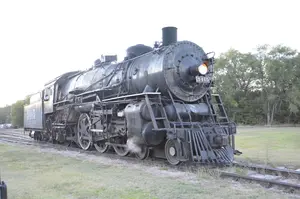
On looks alone the 4-8-4 was one of the handsomest steam locomotives ever built: long boiler, four-wheel lead truck, eight drivers, four-wheel trailing truck, and a tender that often looked as if it had been drawn to match. Streamlining on a few famous classes (Southern Pacific’s Daylight GS-4s, Norfolk & Western’s Js) only underlined a shape that already worked. The type took its popular name from the Northern Pacific, which put the first production 4-8-4s in service in December 1926. After that, more railroads renamed it than almost any other Whyte arrangement—Greenbrier, Western, Niagara, Golden State, Pocono, Wyoming, Dixie, Confederation—because a locomotive born on the NP did not have to wear a northern name on the C&O or the Southern Pacific.
This page cover why the 4-8-4 appeared, how it developed from Super Power practice, which U.S. classes mattered, which complete engines survive, and which still steam in 2026. How a steam locomotive works, Whyte notation, and Lima’s 1925 Super Power Berkshire live on the steam hub. Individual classes and celebrity engines—the N&W J, NYC Niagara, C&O Greenbrier, SP 4449, UP 844, Reading T-1s—can all be found here.
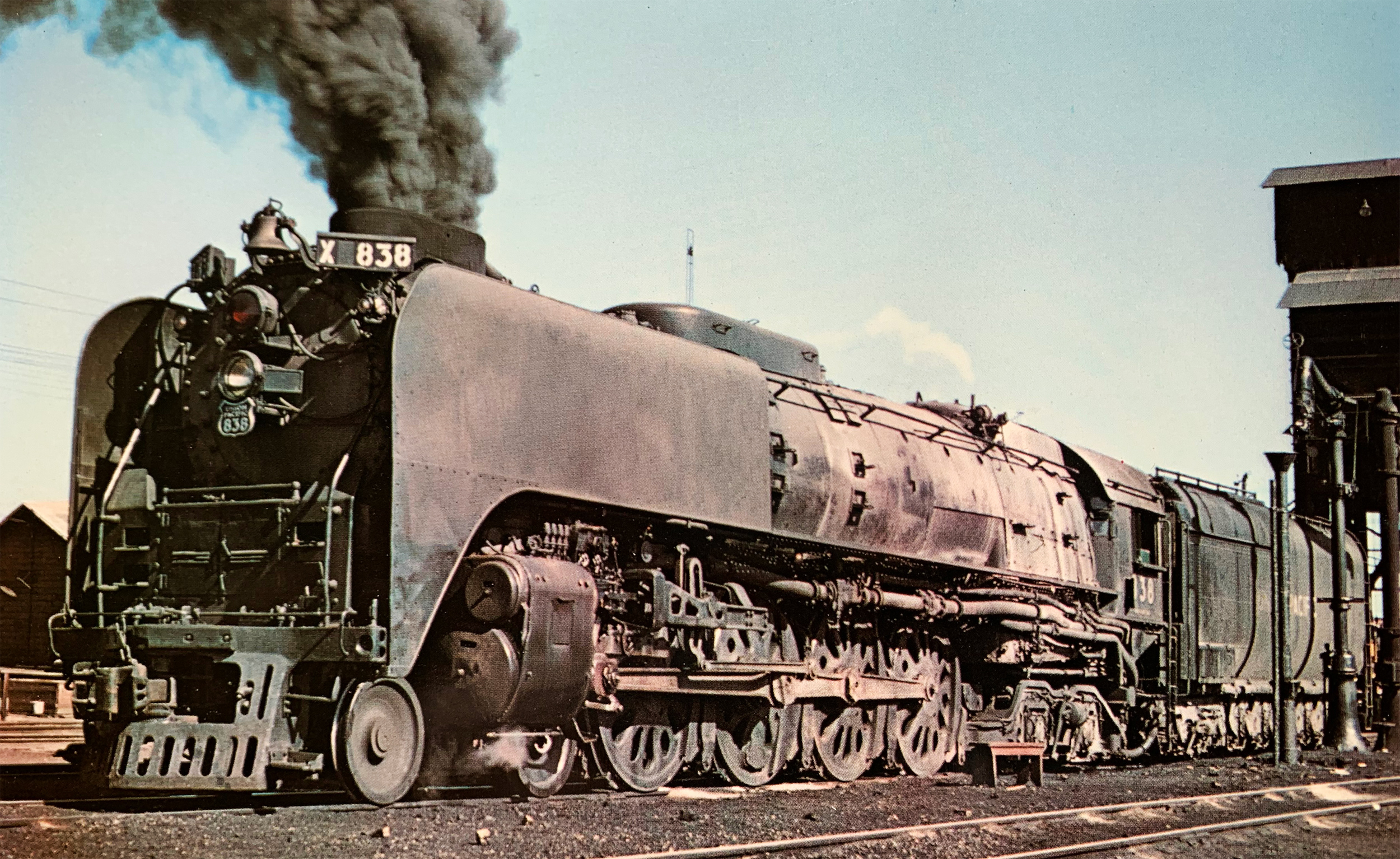
Union Pacific 4-8-4 #838, with elephant-ear smoke deflectors, backing toward the water plug at Council Bluffs, Iowa, September 21, 1958—late freight service before retirement. Sister #844 still lives on Union Pacific’s roster. Bernard Corbin photo. American-Rails.com collection.
On this page: At a glance · Historical development · Nicknames · Notable U.S. classes · Surviving examples · Operating examples · Related reading
At a glance
| Item | Detail |
|---|---|
| Whyte | 4-8-4: four-wheel leading truck, eight coupled drivers, four-wheel trailing truck. Popular name: Northern |
| First production | Northern Pacific Class A, Alco, December 1926, road numbers 2600–2611 (12 engines; all later scrapped) |
| Why four trailing wheels | A grate on the order of 100–120+ sq ft needed a four-wheel trailing truck. NP’s first engines used about 115 sq ft to burn low-grade Rosebud lignite |
| Role | Dual-service: passenger trains at 70+ mph and heavy freight. Driver diameters commonly 70–80 in |
| North American production | More than 1,000 (Neil Carlson, in a 2026 Classic Trains profile, cites 1,125). About three dozen U.S. railroads rostered them |
| Oldest survivor | Santa Fe #3751 (Baldwin, 1927)—first Santa Fe 4-8-4 and the oldest surviving example. See #3751 |
| Last new U.S. 4-8-4s | Norfolk & Western Class J #611–613, Roanoke Shops, 1950. Lima’s last passenger 4-8-4 was C&O Greenbrier #614, June 1948 |
| U.S. survivors | About three dozen complete standard-gauge 4-8-4s. Wes Barris’s steamlocomotive.com search is the living inventory |
| Still steaming (2026) | A handful make public trips in a given season. Status changes with flue time, PTC, and shop work—see Operating examples. Do not treat any list as evergreen |
Historical development
Frederick Methvan Whyte’s notation reads a locomotive from front to back. A 4-8-4 has a four-wheel leading truck to steer a long rigid wheelbase, eight driving wheels for adhesion, and a four-wheel trailing truck under a wide, deep firebox. That last pair of axles is the mechanical point of the type. A 4-8-2 Mountain already had eight drivers and a four-wheel engine truck; what it did not have was enough grate and firebox volume to keep a large boiler steaming at speed with a long train. The 4-8-4 is the Mountain idea with Super Power’s firebox hung on four trailing wheels.
The 1920s made that firebox necessary. All-steel heavyweight passenger cars were replacing wood. Trains got longer and heavier just as the public still expected timetable speed. The everyday 4-6-2 Pacific was out of its depth on many mountain and transcontinental runs. The 4-8-2 helped, but grate area still limited sustained horsepower. Lima Locomotive Works, under William E. Woodard, had already shown the answer on freight power: the 1925 2-8-4 Berkshire, Super Power, a much larger firebox on a four-wheel trailing truck so the engine could make steam at speed instead of only starting a train. The steam hub covers that turning point. The 4-8-4 is the same idea applied to a two-cylinder passenger and dual-service engine with a four-wheel lead truck.
Northern Pacific did not invent the 4-8-4 as a faster passenger engine and nothing else. NP burned Rosebud lignite from lineside mines—fuel with roughly two-thirds the heat content of the bituminous coal other roads used. A larger grate was not a luxury; it was how you kept a big boiler hot on cheap coal. Alco studied the problem and recommended what was essentially a modified Mountain with a firebox of about 115 square feet. Two trailing axles carried that box. In December 1926 NP took delivery of twelve Class A engines, 2600–2611. NP owned no Mountains; compared with its Class Q Pacifics the new 4-8-4s were on the order of 50 tons heavier, carried boiler pressure nearly 50 psi higher, and produced roughly 40 percent more tractive effort while running faster with heavier trains. Because the type first ran on the Northern Pacific it was called the Northern Pacific type, then simply Northern.
Santa Fe did not wait. Baldwin delivered #3751 in 1927, the first of fourteen 3751-class engines and the first Baldwin 4-8-4. Santa Fe already had 4-8-2s for the Kansas City–Los Angeles run; the Northerns took that work and held what was then the longest scheduled steam assignment without a locomotive change—on the order of 1,760 miles via Raton, or farther via Amarillo. Later Santa Fe 4-8-4s (3765, 3776, and the wartime 2900s) grew heavier and faster. #3751 is still with us, which is why that first Baldwin engine is more than a footnote.
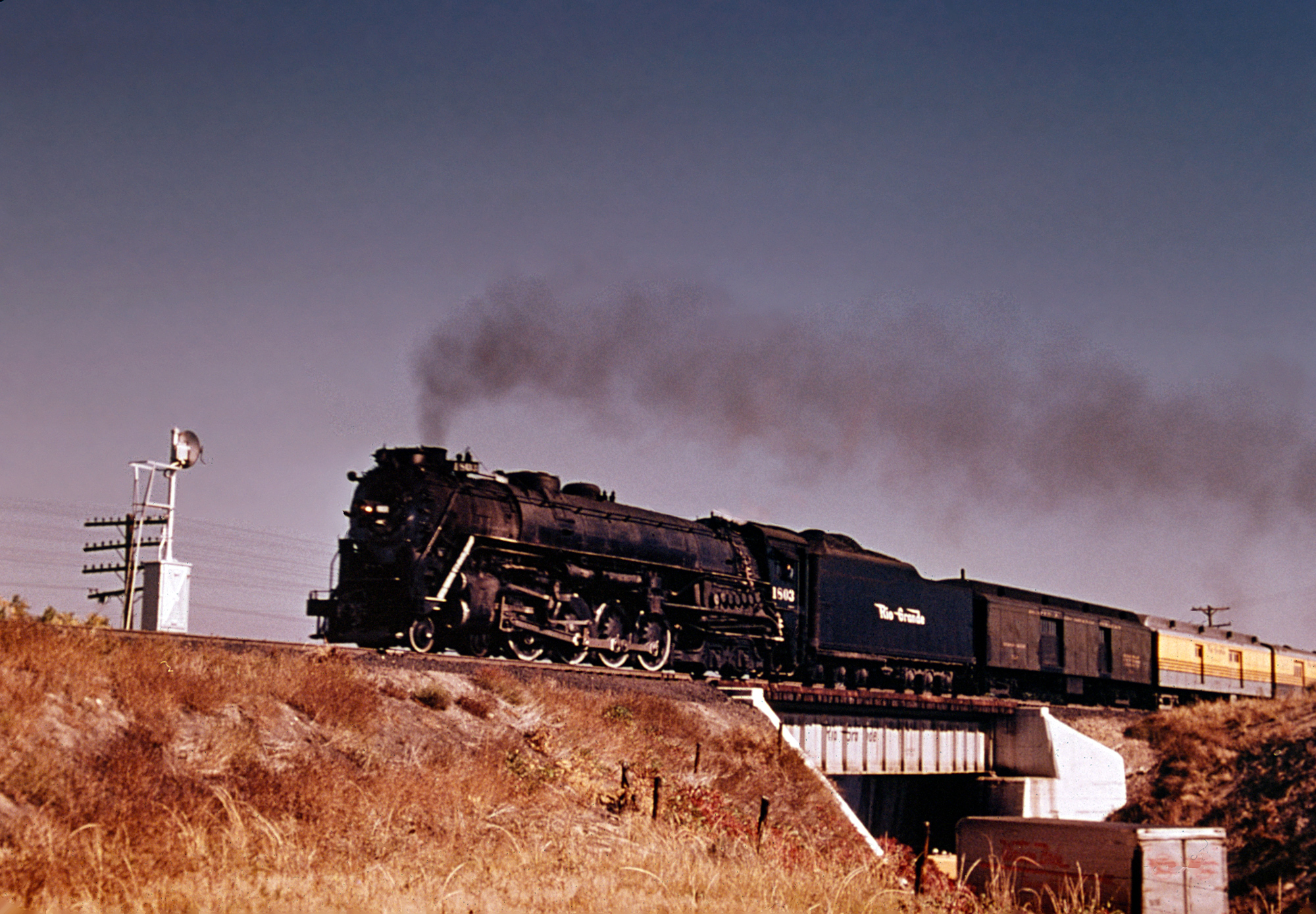
Rio Grande 4-8-4 #1803 with the Scenic Limited at Wolhurst, Colorado, 1950. D&RGW called its 4-8-4s Westerns. Robert LeMassena photo. American-Rails.com collection.
What made the arrangement stick was versatility. A 4-8-4 with 70- to 80-inch drivers could take a time freight or a name passenger train. Superheaters, mechanical stokers, feedwater heaters, outside valve gear, and (after 1930, on more and more new engines) roller bearings were not unique to the Northern, but the type was large enough and late enough that most examples received the full late-steam kit. There is no single horsepower or top-speed figure for “the 4-8-4.” A wartime freight Northern and a New York Central Niagara were different machines. What they shared was a balanced boiler, grate, and cylinder combination that, as Carlson put it, produced no poor 4-8-4s.
Timken 1111 and roller bearings
In 1930 the Timken Roller Bearing Company and Alco built demonstrator 4-8-4 #1111 with roller bearings on every engine and tender axle. After on the order of 100,000 miles on several railroads, Timken had made its sales case: less journal friction, less hotbox trouble, less maintenance. NP bought the engine in 1933, classed it A-1, and numbered it 2626 (later scrapped). Roller bearings spread quickly on new high-status power—N&W Js had them almost everywhere that turned—but they were not universal on every switcher and drag engine still being built in the 1930s and 1940s.
Who built them, who renamed them, who ran them last
Alco, Baldwin, and Lima all built 4-8-4s. So did railroad shops: Burlington’s West Burlington plant turned out O-5a engines after Baldwin’s first O-5s; Reading rebuilt thirty I-10sa 2-8-0s into T-1 4-8-4s in 1945–47 when wartime rules made a clean-sheet design harder; N&W built every J at Roanoke. Cotton Belt built later L-1s in its own shops. Shop-built Northerns are part of the type’s American story, not a footnote.
About three dozen U.S. railroads bought or built them. Canadian National and Grand Trunk Western called theirs Confederations; GTW’s U-3-b engines worked Michigan and Indiana and two survive in the United States. The wheel arrangement also went overseas—South Africa, New Zealand, Australia, and others—but this site’s job is the North American engine. On most U.S. roads that owned them, 4-8-4s ran until the end of steam. Dieselization after 1945 was fast; N&W held out into 1958–59, which is why the last Js had such a short first life and such a long second one.
The last new American 4-8-4s were N&W 611, 612, and 613 in 1950. C&O 614, outshopped by Lima in June 1948, is often cited as the last commercially built passenger steam locomotive in the United States. After that the story is preservation, fan trips, and—uniquely—Union Pacific keeping one 4-8-4 on the active roster instead of donating it to a park.
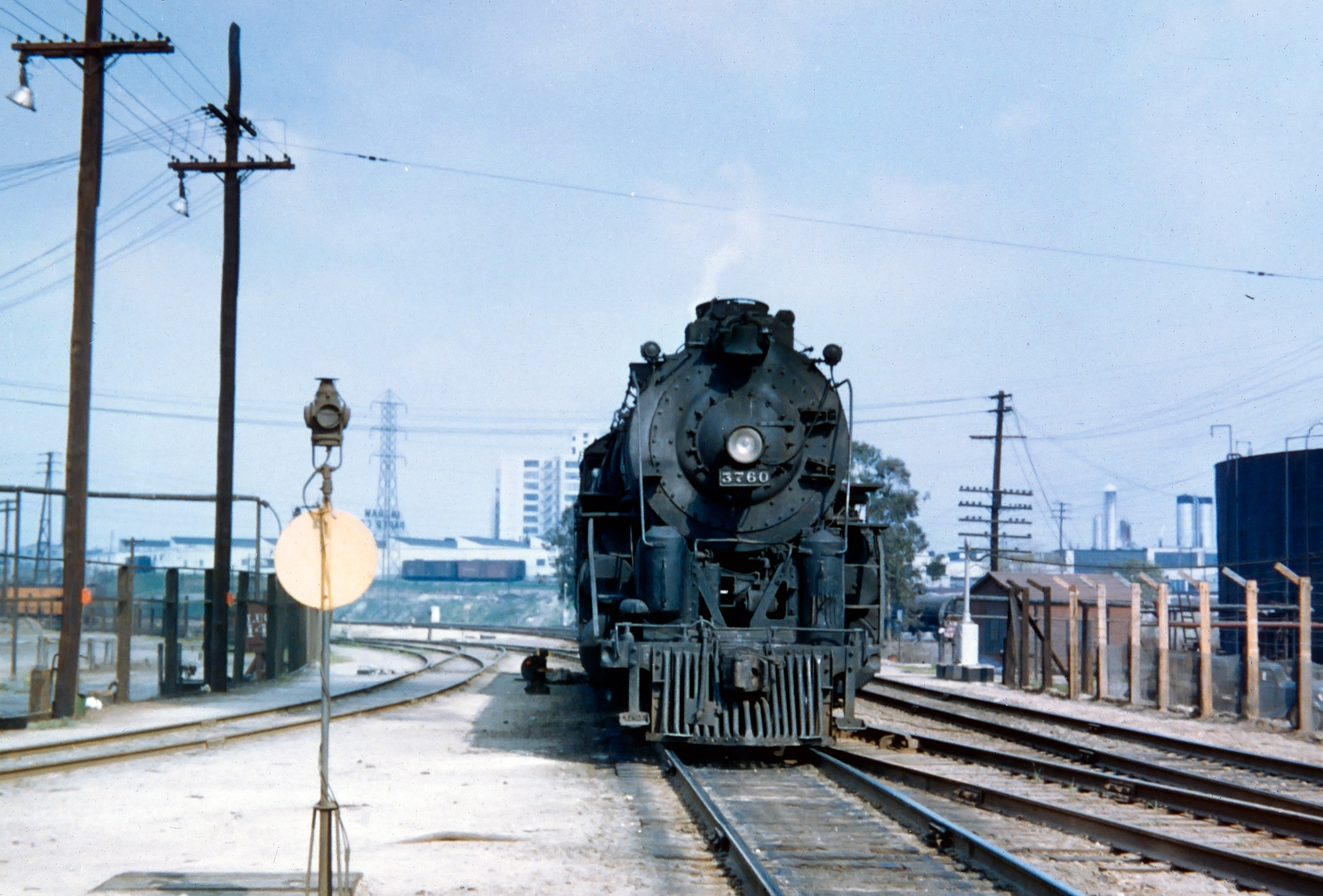
Santa Fe 4-8-4 #3760 at Los Angeles, November 1952. Santa Fe rostered 65 Northerns in four classes, more than any other U.S. road. American-Rails.com collection.
Nicknames by railroad
Northern is the Whyte name. Individual railroads used class letters, geographic names, or both. N&W never used a type name at all—the engines were simply Class J. Union Pacific called them Four-Eight-Fours and classed them FEF. Southern Pacific’s GS is Golden State, not a nickname piled on Northern.
| Railroad | Name used |
|---|---|
| Atlantic Coast Line | 1800s (road-number series) |
| Canadian National / Grand Trunk Western | Confederations |
| Central of Georgia | Big Apples |
| Chesapeake & Ohio | Greenbriers |
| Denver & Rio Grande Western | Westerns |
| Delaware, Lackawanna & Western | Poconos |
| Lehigh Valley | Wyomings |
| Nashville, Chattanooga & St. Louis | Dixies |
| Norfolk & Western | Class J (letter class, not a type name) |
| New York Central | Niagaras |
| Northern Pacific | Northerns (the source of the popular name) |
| Richmond, Fredericksburg & Potomac | Generals, Governors, Statesmen |
| Southern Pacific | Golden State (GS) |
| Union Pacific | FEF (Four-Eight-Four) |
| Western Maryland | Potomacs |
Notable U.S. classes
Full specifications and rosters can be found on the class and engine pages linked here. This table is a map, not a builder’s list of every 4-8-4 in North America.
| Railroad | Class / numbers (typical) | Builder / years | Notes |
|---|---|---|---|
| Northern Pacific | A, 2600–2611 | Alco, 1926 | First production 4-8-4s. All scrapped. Later NP A-2/A-3/A-4/A-5 classes followed; Timken 1111 became A-1 2626 |
| Santa Fe | 3751, 3765, 3776, 2900 | Baldwin, 1927–1944 | 65 engines. #3751 operational; #2926 operational in Albuquerque. Nine Santa Fe 4-8-4s survive |
| Union Pacific | FEF-1/2/3, 800–844 | Alco, 1937–1944 | 45 engines. #844 never retired. #814, #833 on display; #838 parts source at Cheyenne |
| Southern Pacific | GS-1 through GS-6 | Baldwin and Lima, 1930–1943 | Daylight-painted GS-4s are the public face. #4449 (GS-4) operational; GS-6 #4460 displayed at St. Louis (last SP steam passenger run) |
| Norfolk & Western | J, 600–613 | Roanoke, 1941–1950 | 14 home-built streamliners. Only #611 survives. Class history: J Class |
| New York Central | S-1/S-2 Niagara, 5500, 6000–6025 | Alco, 1945–1946 | Among the finest 4-8-4s built. None preserved. Niagara page |
| Chesapeake & Ohio | J-3 / J-3a Greenbrier, 600–614 | Lima, 1935–1948 | 12 engines. Only #614 survives; restoration, not currently operating. Class: Greenbriers |
| Reading | T-1, 2100–2129 | Reading Shops rebuilds, 1945–1947 | From I-10sa 2-8-0s. Four survive; #2102 operating on Reading & Northern. History: Iron Horse Rambles |
| Milwaukee Road | S-1, S-2, S-3 | Baldwin and Alco, 1930s–1944 | #261 (S-3) operational; #265 displayed at IRM |
| Spokane, Portland & Seattle | E-1, 700–702 | Baldwin, 1938 | Oil-burning NP A-3 cousins. #700 returned to service May 6, 2025 |
| Chicago, Burlington & Quincy | O-5 / O-5a / O-5b, 5600–5635 | Baldwin 1930; CB&Q shops 1936–1940 | Four displayed. #5632 was a famous 1960s fan-trip engine (scrapped; not a survivor) |
| St. Louis–San Francisco (Frisco) | 4500, 4500–4524 | Baldwin, 1942–1943 | Four survive on display (Tulsa, Frisco, Sedalia, Springfield) |
| Grand Trunk Western | U-3-b, 6312–6336 | Alco, 1942–1943 | CN Confederation family in U.S. service. #6323 (IRM) was GTW’s last steam; #6325 at Age of Steam Roundhouse |
| Nashville, Chattanooga & St. Louis | J3-57 Dixie, including 576 | Alco, 1942 | #576 under restoration at Nashville (Tennessee Central Railroad Museum / Nashville Steam) |
| St. Louis Southwestern (Cotton Belt) | L-1, 800–819 | Baldwin and SSW shops, 1930–1943 | #819 at Arkansas Railroad Museum, Pine Bluff; cosmetic work complete, operating restoration still a museum decision |
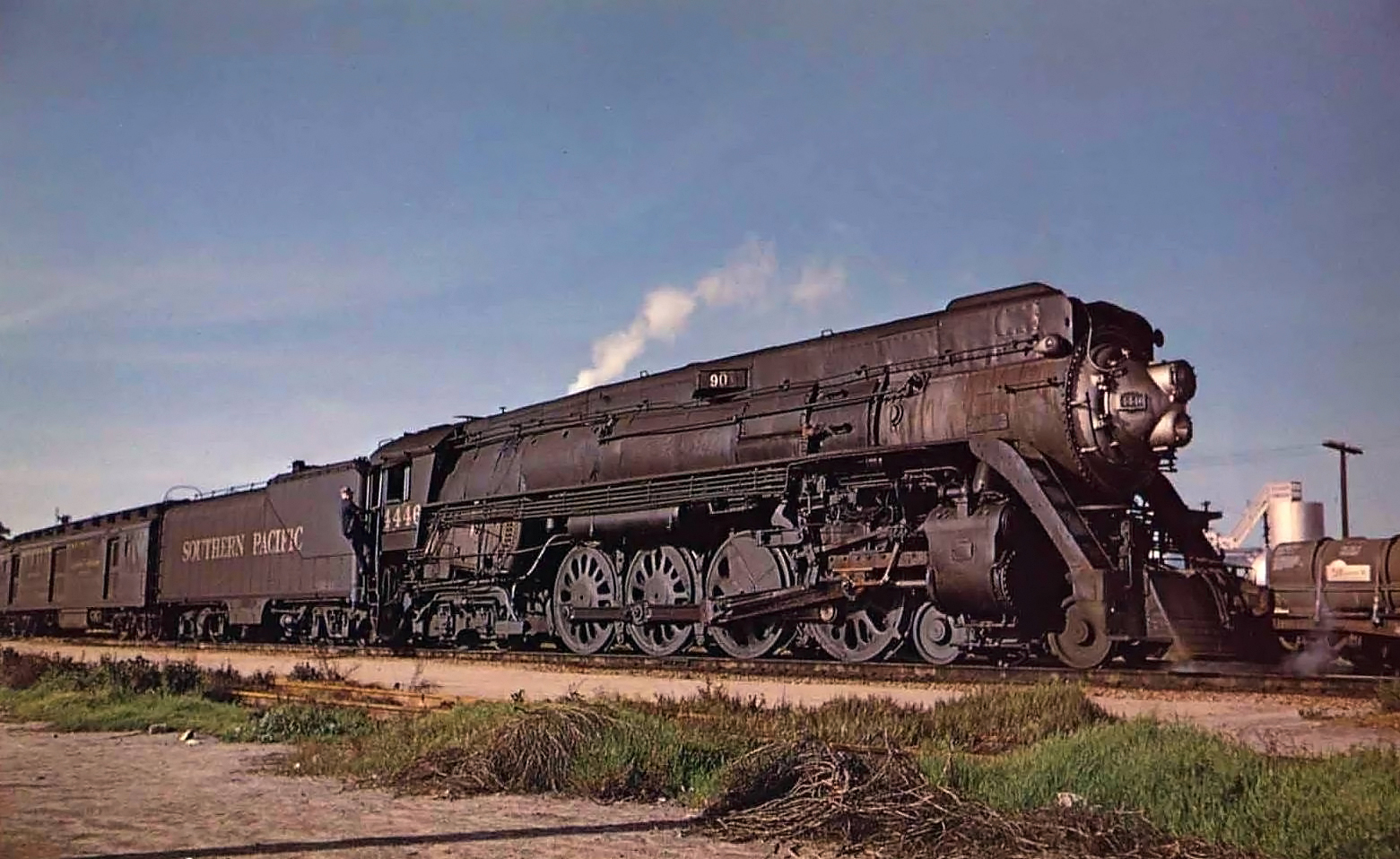
A crewman climbs aboard Southern Pacific GS-4 #4446 on train 90, the Coast Mail, at Oxnard, California, December 1956. Retirement is close. Sister #4449 would become the American Freedom Train engine. William Fahey, Jr. photo.
Surviving examples
About three dozen complete standard-gauge 4-8-4s survive in the United States. That count is locomotives, not leftover tenders (Great Northern 2575’s tender at Portland, a Milwaukee auxiliary tank in Montana, and similar pieces). It includes one Mexican National (NdeM) QR-1, #3028, stored at New Hope, Pennsylvania. It does not include park-ride miniatures. Wes Barris’s steamlocomotive.com database is the search tool to use before a road trip; locations and status move.
Santa Fe left the largest preserved fleet: nine engines, from #3751 of 1927 through wartime 2900s. Reading left four T-1s, every one a Ramble veteran. Union Pacific left four FEFs, one of them still on the company roster. Burlington, Frisco, Milwaukee, Grand Trunk Western, and Southern Pacific each left more than one. Northern Pacific, which named the type, left none. New York Central left none. Those two absences still sting.
Display engines are not a second-class story. SP GS-6 #4460 at the Museum of Transportation in St. Louis made the railroad’s last steam passenger run. GTW #6323 at the Illinois Railway Museum was that road’s last steam locomotive in service. GN #2584 at the Havre, Montana, depot is one of the most photographed park engines in the West. Reading #2124 at Steamtown and #2101 (American Freedom Train #1) at the B&O Railroad Museum in Baltimore carry the Ramble and Bicentennial stories even when they are not under steam. #2101 received a cosmetic restoration to Freedom Train appearance, completed in December 2025.
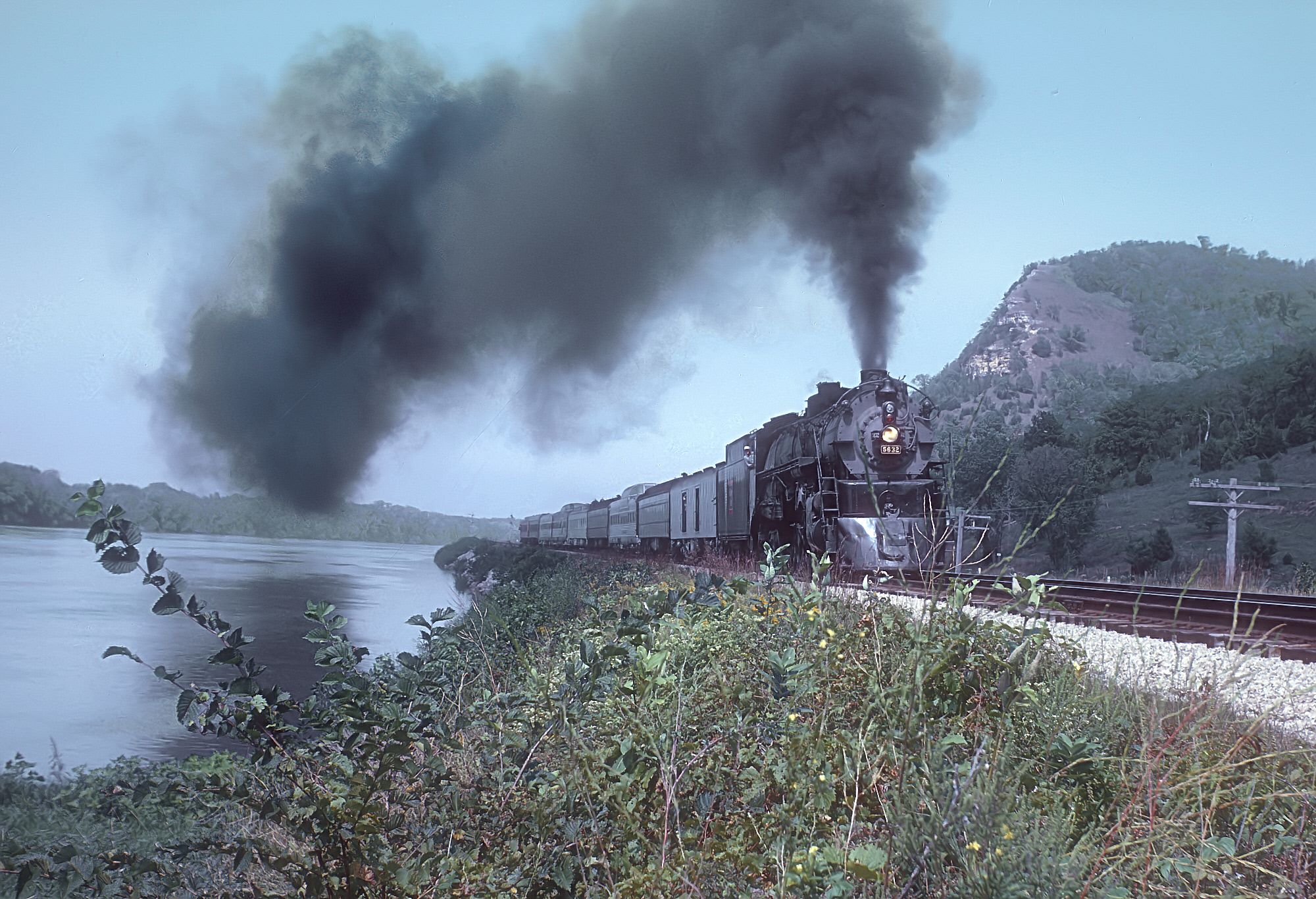
Burlington O-5 #5632 on a fan trip along the Mississippi at Victory, Wisconsin, September 1962. 5632 was the celebrity CB&Q Northern of the excursion era; it does not survive. Four other Burlington 4-8-4s do. Rick Burn photo.
The table below lists complete U.S.-located standard-gauge 4-8-4s as commonly published in 2026. Status words mean what they say: operational is capable of running (not a promise of a public trip this month); restoration is active work toward steam; display is static; stored is out of public service, including parts engines.
| Road no. | Railroad / class | Location | Status (2026) |
|---|---|---|---|
| 3751 | ATSF 3751 | San Bernardino Railroad Historical Society, Redondo Junction, Vernon, CA | Operational. Article |
| 3759 | ATSF 3751 class | Locomotive Park, Kingman, AZ | Display |
| 3768 | ATSF 3765 class | Great Plains Transportation Museum, Wichita, KS | Display |
| 2903 | ATSF 2900 | Illinois Railway Museum, Union, IL | Display |
| 2912 | ATSF 2900 | Pueblo Union Depot, Pueblo, CO | Display |
| 2913 | ATSF 2900 | Riverview Park, Fort Madison, IA | Display |
| 2921 | ATSF 2900 | Amtrak station, Modesto, CA | Display |
| 2925 | ATSF 2900 | Old Sacramento / CSRM area, Sacramento, CA | Display |
| 2926 | ATSF 2900 | New Mexico Heritage Rail, Albuquerque, NM | Operational (excursions from 2023; PTC equipped) |
| 5614 | CB&Q O-5a | Patee Park, St. Joseph, MO | Display |
| 5629 | CB&Q O-5b | Colorado Railroad Museum, Golden, CO | Display |
| 5631 | CB&Q O-5a | Sheridan, WY | Display |
| 5633 | CB&Q O-5a | Douglas Railroad Interpretive Center, Douglas, WY | Display |
| 614 | C&O J-3a Greenbrier | Strasburg Railroad, Strasburg, PA (Iron Horse Enterprises) | Restoration. Article |
| 6323 | GTW U-3-b | Illinois Railway Museum, Union, IL | Display (last GTW steam) |
| 6325 | GTW U-3-b | Age of Steam Roundhouse, Sugarcreek, OH | Display (operated 2001–2005) |
| 2584 | GN S-2 | Havre depot, Havre, MT | Display |
| 261 | MILW S-3 | Friends of the 261, Minneapolis, MN | Operational. Article |
| 265 | MILW S-3 | Illinois Railway Museum, Union, IL | Display |
| 576 | NC&StL J3-57 Dixie | Tennessee Central Railroad Museum / Nashville Steam, Nashville, TN | Restoration (boiler fired 2026) |
| 611 | N&W J | Virginia Museum of Transportation, Roanoke, VA | Operational. #611 · class |
| 3028 | NdeM QR-1 | New Hope Railroad / ALCO Historical & Technical Society, New Hope, PA | Stored (Mexican 4-8-4 on U.S. soil) |
| 2100 | Reading T-1 | American Steam Railroad, Cleveland, OH | Listed operational; Freedom Train #250 project. Article |
| 2101 | Reading T-1 (AFT #1) | B&O Railroad Museum, Baltimore, MD | Display (AFT cosmetic restoration, 2025). Freedom Train |
| 2102 | Reading T-1 | Reading & Northern, Port Clinton, PA | Operational. Article |
| 2124 | Reading T-1 | Steamtown NHS, Scranton, PA | Display |
| 4500 | SLSF 4500 | Route 66 Historical Village, Tulsa, OK | Display |
| 4501 | SLSF 4500 | Museum of the American Railroad, Frisco, TX | Display |
| 4516 | SLSF 4500 | Missouri State Fairgrounds, Sedalia, MO | Display |
| 4524 | SLSF 4500 | Grant Beach Park, Springfield, MO | Display |
| 4449 | SP GS-4 | Oregon Rail Heritage Center, Portland, OR | Operational. Article |
| 4460 | SP GS-6 | Museum of Transportation, St. Louis, MO | Display (last SP steam passenger locomotive) |
| 700 | SP&S E-1 | Oregon Rail Heritage Center, Portland, OR | Operational (returned May 6, 2025). Article |
| 819 | SSW L-1 | Arkansas Railroad Museum, Pine Bluff, AR | Restoration / display (cosmetic; operating restoration not committed) |
| 814 | UP FEF-1 | RailsWest / Rock Island depot, Council Bluffs, IA | Display |
| 833 | UP FEF-2 | Utah State Railroad Museum, Ogden, UT | Display |
| 838 | UP FEF-3 | UP steam shop, Cheyenne, WY | Stored (parts for 844) |
| 844 | UP FEF-3 | UP steam shop, Cheyenne, WY | Operational on UP’s roster; public running recently scarce. Article |
Canadian 4-8-4s survive north of the border (CN Confederations among them) and are not tabled here.
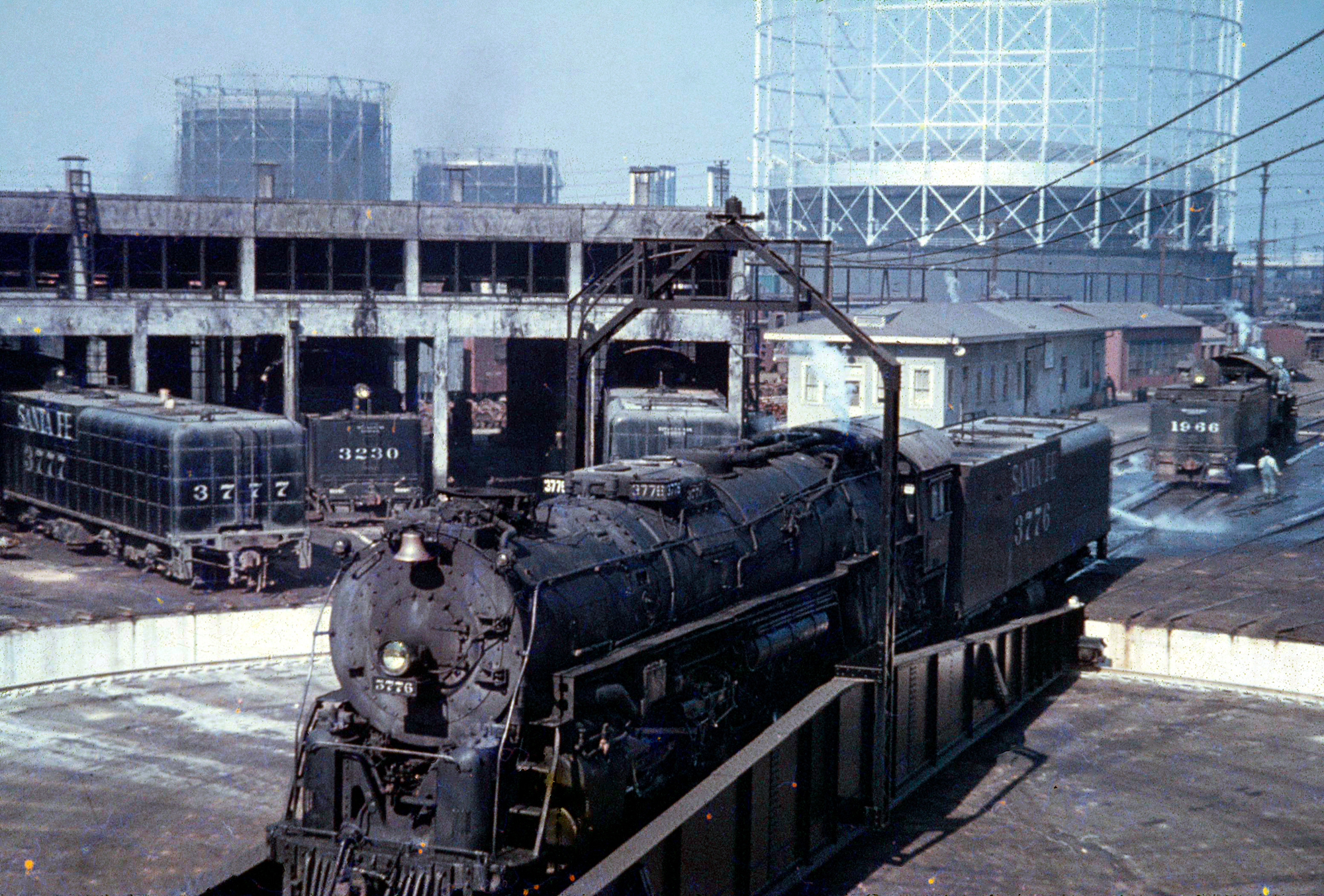
Santa Fe 4-8-4 #3776 on the turntable at Redondo Junction, Los Angeles, 1950s. Redondo is still home to operating 4-8-4 #3751. Edwin Olsen photo. American-Rails.com collection.
Operating examples (2026)
Flue time, 1,472-day inspections, Positive Train Control, host-railroad access, and shop space decide whether a 4-8-4 actually turns a wheel in public in a given year. Union Pacific #844 is the extreme case: never retired, maintained at Cheyenne, and for several recent seasons not the Heritage Fleet engine you were likely to catch on the main line while Big Boy #4014 did the traveling. An engine can be operational and still not have a ticketed trip next month.
As of 2026 the U.S. 4-8-4s that have a realistic chance of being seen under steam by the public, with the usual caveats, are these:
| Engine | Home / operator | 2026 notes |
|---|---|---|
| N&W 611 | Virginia Museum of Transportation, Roanoke; Virginia Scenic Railway excursions | The surviving J. Limited public trips in Virginia in recent seasons, including a 2026 Virginia Scenic program. Confirm dates on VMT / Virginia Scenic, not on a steam-type page |
| SP 4449 | Oregon Rail Heritage Center, Portland | GS-4; American Freedom Train engine, restored 1975. Operational; ORHC also houses SP&S 700. Limited main-line and local appearances |
| SP&S 700 | Oregon Rail Heritage Center, Portland | Baldwin 1938 E-1. 1,472-day overhaul from 2015; returned to operation May 6, 2025 |
| ATSF 3751 | San Bernardino Railroad Historical Society, Redondo Junction | Oldest surviving 4-8-4. Restored 1991; out of service 2017; back September 21, 2022. PTC equipped. Excursions are occasional, not a tourist-railroad daily |
| ATSF 2926 | New Mexico Heritage Rail, Albuquerque | Baldwin 1944 2900-class. First move under steam July 24, 2021; excursion debut September 30, 2023. Second U.S. steam locomotive with PTC. No dedicated American-Rails engine page yet |
| MILW 261 | Friends of the 261, Minneapolis | Alco S-3, 1944. Restored 1993; returned 2012 after a later shopping. Regular excursion and seasonal specials when hosted |
| Reading 2102 | Reading & Northern, Port Clinton, PA | T-1 Ramble veteran. Restored to operation April 6, 2022. Modern Iron Horse Rambles on RBMN. See Rambles |
| UP 844 | Union Pacific, Cheyenne, WY | FEF-3, December 1944. Never retired; numbered 8444 from 1962 to 1989. Operational in the shop sense. Public trips have been rare in recent seasons. Check Union Pacific’s steam/Heritage Fleet notices before planning a chase. Sister 838 remains the parts engine at Cheyenne |
| Reading 2100 | American Steam Railroad, Cleveland, OH | Listed operational in survivor databases; restoration aimed at American Freedom Train identity as No. 250. Not a scheduled tourist operation. Confirm with the operator |
Not currently operating, but in the shop queue: C&O #614 at Strasburg (restoration; published hopes have pointed at later 2020s, not a 2026 public season). NC&StL #576 at Nashville (boiler fired in 2026; not yet a ticketed engine). Cotton Belt #819 at Pine Bluff (cosmetic work done; an operating restoration is still a museum decision). GTW #6325 at Sugarcreek has been displayed since its 2001–2005 excursion spell ended.
If you are traveling to see a Northern under steam, use the operator’s current calendar. This page will date-stamp the operating table when it is revised; it will not invent fares, consist, or a 2026 trip that has not been announced.
Related reading
- Steam locomotives (How steam works, Whyte, Super Power, builders, dieselization)
- Class and engine leaves: N&W J Class · #611 · NYC Niagara · C&O Greenbriers · #614 · SP 4449 · UP 844 · ATSF 3751 · MILW 261 · SP&S 700
- Reading T-1s: Iron Horse Rambles · #2100 · #2102 · American Freedom Train
- Burlington #5632 (famous O-5, not a survivor) · Elephant ears / smoke deflectors
- Other Super Power and late types on this site: Berkshires (2-8-4) · Mountains (4-8-2) · Hudsons (4-6-4) · Texas (2-10-4)
Sources for this rewrite include the previous American-Rails 4-8-4 page (November 6, 2024); Neil Carlson, “Steam locomotive profile: 4-8-4 Northern,” Classic Trains / Trains.com, January 21, 2026 (NP lignite/grate origin, ~1,125 built); Wes Barris, steamlocomotive.com survivor search (U.S. 4-8-4 locations and status); Union Pacific, “Living Legend No. 844”; and the American-Rails class and engine leaves linked above for J, Niagara, Greenbrier, GS-4 4449, FEF 844, T-1 Rambles, 3751, 261, and 700. Photographs are from the American-Rails.com collection except as credited (Corbin; LeMassena; Burn; Fahey; Olsen).
Recent Articles


-
Wyoming Scenic Train Rides (2026): A Complete Guide
Oct 03, 26 12:07 AM
 Wyoming has no full-size tourist railroad on the calendar in October 2026. Cheyenne Depot Museum and Douglas Railroad Museum are static. Union Pacific 4014’s posted public trip is a November run to De…
 -
Washington Scenic Train Rides (2026): A Complete Guide
Oct 02, 26 11:53 PM
 Washington tourist trains in 2026—Mount Rainier Scenic at Elbe, the Northwest Railway Museum, and Chehalis-Centralia. Lake Whatcom has no 2026 date on its ticket page.
 -
Wisconsin Scenic Train Rides (2026): A Complete Guide
Oct 02, 26 11:48 PM
 Wisconsin tourist trains in 2026—Wisconsin Great Northern, Osceola & St. Croix Valley, Mid-Continent, East Troy, and the National Railroad Museum.
 -
Pennsylvania Railroad Class Q2 4-4-6-4: Specs, Roster, History
Oct 02, 26 11:28 PM
 Pennsylvania Railroad Class Q2 4-4-6-4 duplexes. Twenty-six engines, 6131 and 6175–6199, Altoona 1944–45. Form 109-J specs, the 7,987 hp test of 6175, and a roster. All scrapped.
 -
Utah Scenic Train Rides (2026): A Complete Guide
Oct 02, 26 11:18 PM
 Utah tourist trains in 2026—Heber Valley Railroad from Heber City. Golden Spike at Promontory is a locomotive demonstration, not a line-haul ride.
 -
South Dakota Scenic Train Rides (2026): A Complete Guide
Oct 02, 26 11:06 PM
 South Dakota’s 2026 scenic train is the Black Hills Central 1880 Train, Hill City to Keystone. Steam is the summer assignment. Confirm the engine.
 -
Oregon Scenic Train Rides (2026): A Complete Guide
Oct 02, 26 11:04 PM
 Oregon tourist trains in 2026—Oregon Coast Scenic from Rockaway Beach, Mount Hood at Hood River, Eagle Cap from Elgin, and the Oregon Rail Heritage Center in Portland.
 -
Oklahoma Scenic Train Rides (2026): A Complete Guide
Oct 02, 26 10:36 PM
 Oklahoma has no full-size scenic railroad on an October 2026 calendar. Oklahoma Railway Museum Halloween and Polar trains, the El Reno trolley, and the Heartland Flyer.
 -
North Dakota Scenic Train Rides (2026): A Complete Guide
Oct 02, 26 01:14 PM
North Dakota has no tourist railroad on a 2026 calendar. Ride Amtrak’s daily Empire Builder. The Fort Lincoln Trolley in Mandan is not a current ticket. -
Nebraska Scenic Train Rides (2026): A Complete Guide
Oct 02, 26 10:11 AM
 Nebraska has no full-size scenic railroad in 2026. The Omaha Zoo Railroad runs weekends through October 4. Ride Amtrak’s California Zephyr across the state.
 -
Missouri Scenic Train Rides (2026): A Complete Guide
Oct 02, 26 09:56 AM
 Missouri tourist trains in 2026—Branson Scenic Railway and the St. Louis, Iron Mountain & Southern at Jackson. Belton has no 2026 schedule posted.
 -
Minnesota Scenic Train Rides (2026): A Complete Guide
Oct 02, 26 09:52 AM
 Minnesota tourist trains in 2026—North Shore Scenic Railroad in Duluth, the Duluth River Train, and the Como-Harriet streetcar.
 -
Kansas Scenic Train Rides (2026): A Complete Guide
Oct 02, 26 09:32 AM
 Kansas tourist trains in 2026—the Abilene & Smoky Valley Railroad. Santa Fe 3415 is in overhaul. Midland Railway at Baldwin City is closed.
 -
Iowa Scenic Train Rides (2026): A Complete Guide
Oct 02, 26 08:41 AM
 Iowa tourist trains in 2026—Boone & Scenic Valley across the Bass Point Creek High Bridge, and Midwest Central’s December North Pole trains
 -
Indiana Scenic Train Rides (2026): A Complete Guide
Oct 02, 26 08:35 AM
 Indiana tourist trains in 2026—French Lick Scenic Railway, Nickel Plate Express, Hoosier Valley, and Hesston. Whitewater Valley is suspended.
 -
Illinois Scenic Train Rides (2026): A Complete Guide
Oct 02, 26 12:28 AM
 Illinois tourist trains in 2026—Illinois Railway Museum, Monticello Railway Museum, Fox River Trolley, and Silver Creek & Stephenson.
 -
Texas Scenic Train Rides (2026): A Complete Guide
Oct 02, 26 12:14 AM
 Texas tourist trains in 2026—Texas State Railroad, Grapevine Vintage Railroad, Austin Steam Train's Hill Country Flyer, and the Galveston Railroad Museum.
 -
Tennessee Scenic Train Rides (2026): A Complete Guide
Oct 02, 26 12:03 AM
Tennessee tourist trains in 2026—Tennessee Valley Railroad Museum, Dollywood Express, Three Rivers Rambler Christmas trains, and the Tennessee Central Railway Museum. -
South Carolina Scenic Train Rides (2026): A Complete Guide
Oct 01, 26 11:52 PM
 South Carolina's tourist train is the South Carolina Railroad Museum in Winnsboro—Blue Granite Express, pumpkin trains, and Santa trains on the old Rockton & Rion.
 -
Mississippi Scenic Train Rides (2026): A Complete Guide
Oct 01, 26 11:38 PM
 Mississippi has no regular tourist railroad in 2026. Ride Amtrak through the state, or book the excursion lines in Alabama, Tennessee, Louisiana, or Arkansas.
 -
Louisiana Scenic Train Rides (2026): A Complete Guide
Oct 01, 26 02:52 PM
 Louisiana has no regular full-size tourist railroad in 2026. New Orleans Polar Express returns December 11–31. Museums at Long Leaf, DeQuincy, and Jackson.
 -
Kentucky Scenic Train Rides (2026): A Complete Guide
Oct 01, 26 02:45 PM
 Kentucky tourist trains in 2026—Big South Fork Scenic Railway, Bluegrass Scenic Railroad, Kentucky Railway Museum, and My Old Kentucky Dinner Train.
 -
Georgia Scenic Train Rides (2026): A Complete Guide
Oct 01, 26 02:27 PM
 Georgia tourist trains in 2026—Blue Ridge Scenic Railway, SAM Shortline, Azalea Sprinter, Savannah shop rides, and what to confirm at Stone Mountain.
 -
Arkansas Scenic Train Rides (2026): A Complete Guide
Oct 01, 26 01:02 PM
 Arkansas tourist trains in 2026—Arkansas & Missouri through the Boston Mountains, and the Eureka Springs & North Arkansas dinner and excursion trains.
 -
Alabama Scenic Train Rides (2026): A Complete Guide
Oct 01, 26 12:59 PM
Alabama tourist trains in 2026—Heart of Dixie Railroad Museum at Calera, North Alabama Railroad Museum at Chase, and the Wales West Light Railway at Silverhill. -
The Circus Train: How Such Attractions Reached Distant Cities
Oct 01, 26 12:22 PM
 How circuses moved by rail: Coup's 1872 flats, the Ringling train's sections and car counts, the 1918 Hammond wreck, and the last show on May 21, 2017.
 -
West Virginia Halloween Train Rides (2026)
Oct 01, 26 12:19 PM
 2026 West Virginia Halloween train. Cass Scenic Halloween Train, October 30 and 31, steam, 5:00 p.m. from Cass Depot. Adult $75. About two hours to Whittaker. Family ride.
 -
Wisconsin Halloween Train Rides (2026)
Oct 01, 26 12:11 PM
2026 Wisconsin Halloween trains. Mid-Continent Pumpkin Special October 24–25, adult $24, pumpkins extra. Halloween Flyer October 24 at 4:30 p.m., adult $30. Osceola Pumpkin Express boards in Osceola… -
Utah Halloween Train Rides (2026)
Oct 01, 26 12:00 PM
 2026 Utah Halloween trains at Heber Valley Railroad. Pumpkin Train, about 40 minutes, with a cookie and a pumpkin. Halloween Express, about 90 minutes to Grim Hollow, Monday, Thursday, and Friday even…
 -
Texas Halloween Train Rides (2026)
Oct 01, 26 11:28 AM
 2026 Texas Halloween train. Texas State Railroad Spooky Special, adult-only, October 24. Boards Palestine at 5:00 p.m. About five hours to Rusk and back. Dinner on the grounds. Not steam. No fare on t…
 -
Tennessee Halloween Train Rides (2026)
Oct 01, 26 12:15 AM
 2026 Tennessee Halloween trains. Tennessee Valley Railroad Museum Rails, Wizards & Spells, selected days September 18 through October 25, from $35, about 2.5 hours. Spells & Potions tea from $60. The…
 -
Frisco's "Firefly" (Train): Consist, Route, Timetable
Sep 30, 26 11:37 PM
 Frisco Firefly—daylight streamliner, Kansas City to Tulsa and Oklahoma City. Trains 117 and 118. Pacifics 1018, 1026, and 1031. Last run May 22, 1960.
 -
South Carolina Halloween Train Rides (2026)
Sep 30, 26 11:29 PM
 2026 South Carolina Halloween train. South Carolina Railroad Museum Pumpkin Patch Express, the two Saturdays before Halloween. About three miles to the Greenbriar pavilion. Pumpkin for children 12 and…
 -
Oregon Halloween Train Rides (2026)
Sep 30, 26 08:10 PM
2026 Oregon Halloween train. Sumpter Valley Railroad Halloween Express at the Sumpter Depot, calendar window October 31 at 11:00 a.m. through November 1 at 12:30 p.m. Fare and the individual clocks ar… -
Oklahoma Halloween Train Rides (2026)
Sep 30, 26 03:45 PM
2026 Oklahoma Halloween train. Oklahoma Railway Museum, October 30 and 31, from Oakwood Station in Oklahoma City. Adults $15, children 3–12 $8. A candy bag with the ride. -
McCloud River Railroad: Serving The Timber Industry (1897-2009)
Sep 30, 26 03:37 PM
 McCloud River Railroad—Mount Shasta City to McCloud, Hambone, and Burney. Opened August 1, 1897. Alco No. 25 and EMD SD38s. Dinner train through January 2010. Railbikes in 2026; a dinner train is stil…
 -
Nevada Halloween Train Rides (2026)
Sep 30, 26 03:30 PM
2026 Nevada Halloween trains in Ely. Nevada Northern Pumpkin Patch Caper and Haunted Ghost Train. Adult tickets start at $45. Dates are on the railroad’s ticket calendar. Boulder City stays off until… -
Missouri Halloween Train Rides (2026)
Sep 30, 26 11:12 AM
 2026 Missouri Halloween trains. St. Louis Iron Mountain & Southern Pumpkin Patch Train on October 3, 4, 10, and 11, and Halloween Express on October 31 at 1:00 p.m. Jackson depot. No fare on the sched…
 -
Minnesota Halloween Train Rides (2026)
Sep 30, 26 11:06 AM
 2026 Minnesota Halloween trains. North Shore Scenic Great Pumpkin Train in Duluth, October 15–18. Everyone gets a pumpkin. Terror Train is October 30, an adult costume party, about three hours. Fares…
 -
Maryland Halloween Train Rides (2026)
Sep 30, 26 10:42 AM
 2026 Maryland Halloween trains. Western Maryland Scenic Pumpkin Patch Limited, October 17, 18, 24, and 25, $14. Colesville Trolleyween October 24, 25, and 31.
 -
West Side Lumber Company Railroad: Roster, History, Lines
Sep 30, 26 09:45 AM
 West Side Lumber at Tuolumne, California. Three-foot Shay and Heisler logging railroad. Lima shop numbers, builder specs, and where the engines are in 2026.
 -
Kansas Halloween Train Rides (2026)
Sep 30, 26 09:41 AM
 2026 Kansas Halloween train. Abilene & Smoky Valley Pumpkin Harvest Express, October 17 through 31. About one hour. Shop prices $35.56 to $41.02. Everyone picks a pumpkin.
 -
Iowa Halloween Train Rides (2026)
Sep 29, 26 11:58 PM
2026 Iowa Halloween train. Boone & Scenic Valley Pumpkin Express, October 10, 10:00 a.m. from 225 10th Street. About 1 hour 15 minutes. Children pick a pumpkin. -
Arizona Halloween Train Rides (2026)
Sep 29, 26 11:43 PM
 2026 Arizona Halloween train. Grand Canyon Railway Pumpkin Patch Train from Williams, $39 with a pumpkin included. Select October dates on the ticket calendar. Haunted train cars are optional.
 -
Nevada Northern Halloween Trains (2026)
Sep 29, 26 06:18 PM
Nevada Northern 2026 Halloween trains in Ely. Pumpkin Patch Caper to Keystone Gulch and the Haunted Ghost Train. Adult tickets start at $45. Dates are on the railroad’s calendar. Confirm on nnry.com. -
Grand Canyon Railway Pumpkin Patch Train (2026)
Sep 29, 26 02:42 PM
Grand Canyon Railway Pumpkin Patch Train—select October 2026 dates from Williams, $39 with a pumpkin included. Haunted train cars are optional. Days are on the ticket calendar. Confirm on thetrain.com… -
Cass Scenic Railroad Halloween Trains (2026)
Sep 29, 26 02:37 PM
 Cass Scenic Halloween Trains—October 30 and 31, 2026, steam, 5:00 p.m. from Cass Depot. About two hours to Whittaker. Adult $75. Candy for every child. Confirm on mountainrailwv.com.
 -
Halloween Train Rides (2026): Pumpkin Patch, Haunted & Spooky Trips
Sep 29, 26 11:26 AM
 2026 Halloween train rides in nine checked states. Conway Scenic Halloween Express October 24–25. Strasburg’s three fall tickets. Great Smoky Mountains Railroad’s October trains are the gorge and rive…
 -
Maine Halloween Train Rides (2026)
Sep 29, 26 11:08 AM
 2026 Maine Halloween trains. Seashore Pumpkin Patch Trolley through October 18, adult $17. Happy Trolleyween October 23–25 at $15. WW&F Pumpkin Pickin’ October 3, 12, 17, and 24. Downeast’s booking it…
 -
Kentucky Halloween Train Rides (2026)
Sep 29, 26 10:58 AM
 2026 Kentucky Halloween trains. Kentucky Railway Museum Trick and Track Express, October 24 and 31, from $17. Bluegrass Scenic pumpkin trains in Versailles. Confirm on the ticket shop.