Southern Pacific Steam Roster: Post 1900
Last revised: November 10, 2026
By: Adam Burns
Southern Pacific steam was two rosters and five three-foot Ten-Wheelers. West of El Paso the Pacific Lines ran under four-digit numbers. East of El Paso the Texas & Louisiana Lines used three-digit numbers and were, in practice, another railroad. Baldwin built the cab-forward articulateds for the Sierra snowsheds. Lima built the later 4-8-4s, the Daylight engines among them, and twelve coal-burning 2-8-8-4s for the desert east of El Paso. Sacramento, Los Angeles, and Houston assembled locomotives of their own, and the Harriman Common Standard engines of the 1900s were still in service at the end of steam. The table is George H. Drury’s class grid for locomotives built since 1900. The quantity column is 2,605. It adds the cells as printed, including the five narrow-gauge engines, eleven leased Cotton Belt 4-8-4s, and numbers that were used more than once. It is not a count of frames.

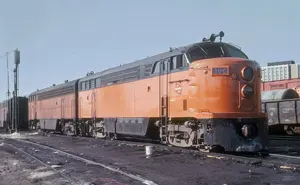
4-8-8-2 No. 4294, class AC-12, at Colton, California, in July 1951. The locomotive is preserved at the California State Railroad Museum. American-Rails.com collection.
On this page: At a glance · The two lines · Harriman standard · Consolidations and Moguls · Mikados and Decks · Cab-forwards · Passenger locomotives · Switchers · Narrow gauge · The end of steam · What survives · Roster
At a glance
| Item | Detail |
|---|---|
| Railroad | Southern Pacific Lines. Company history. Diesel roster |
| This table | Drury’s post-1900 class grid. Pacific Lines, then the narrow gauge, then the Texas & Louisiana Lines |
| Numbering | Four digits west of El Paso. Three digits on the Texas & Louisiana Lines. Both rosters were renumbered in 1925. A transfer did not keep its old number |
| Standard freight engine | Harriman Common Standard 2-8-0. 57-inch drivers, 22-by-30-inch cylinders. More than 350 between 1901 and 1911, and 19 more from the shops in 1917–1919 |
| Later road freight | 2-10-2s, called Decks. Mikados were an interim type: 83 in four Pacific Lines classes, and 57 class Mk-5 on the Texas lines |
| Cab-forwards | 195 Baldwin 4-8-8-2s, classes AC-4 through AC-12 except AC-9. The earlier 2-8-8-2s were rebuilt simple and reclassed AC. Separate cab-forward page |
| AC-9 | 12 Lima 2-8-8-4s, 1939, coal-burning, El Paso–Tucumcari, converted to oil in 1950. Separate AC-9 page |
| 4-8-4 | GS-1 through GS-6 for the Southern Pacific, four more GS-1s on the Texas lines, and eleven leased Cotton Belt engines classed GS-7 and GS-8 |
| 4-10-2 | 49 three-cylinder engines, Schenectady, 1925–1927. Southern Pacific type. The Union Pacific called its own the Overland type |
| 0-8-0 | 39 on the whole system, in three groups. The rest of the switchers were 0-6-0s |
| Shops | Sacramento, Los Angeles, and Houston built and rebuilt steam. The table marks those rows SP or T&NO |
| Narrow gauge | Five Baldwin 4-6-0s, former Nevada-California-Oregon, Laws to Keeler |
| Last steam freight | November 30, 1956 |
| Last steam passenger | Peninsula commute, January 22, 1957 |
| Last excursion in the chapter | 4-8-4 No. 4460, Oakland to Reno, October 19, 1958 |
| Quantity column | 2,605. The rows as printed, not a count of frames |
The two lines
In 1900 the railroad was a set of long routes out of Oakland. East over the Sierra Nevada and across the desert to Ogden, that line was the original Central Pacific. North through the Sacramento Valley and over the Cascades and the Siskiyous toward Portland. Southeast through the San Joaquin Valley and over the Tehachapis to Los Angeles, then east through Tucson, El Paso, San Antonio, and Houston to New Orleans. Houston was the hub for a group of lines covering much of Texas east of San Antonio. The Coast Line from San Francisco to Los Angeles was nearly complete in 1900 and opened in 1901. Drury dates Edward H. Harriman’s purchase of control to 1900, from the estate of Collis P. Huntington.
Fruit and vegetables moved east from California. Lumber moved south and east from Oregon. General merchandise moved west. The Southern Pacific was the principal passenger carrier on the West Coast, with suburban trains from San Francisco to San Jose and around Oakland, Berkeley, and Alameda. Every route out of California climbed. The worst combination of grade and weather, in Drury’s judgment, was the line to Ogden, though he allows that crews on the Siskiyous or the Tehachapis might argue. From Sacramento the railroad climbed 7,000 feet in 105 miles to the summit of Donner Pass. Much of that climb sat under snowsheds, and the crews fought smoke as well as snow. Beyond the Sierra, and beyond the mountains east of Los Angeles, lay hundreds of miles of desert.
Texas required a railroad doing business in the state to keep its principal offices there, so the lines east of El Paso were a long list of subsidiaries. In 1934 they were consolidated as the Texas & New Orleans. From at least the 1901 renumbering, Pacific Lines engines had four-digit numbers and Texas & Louisiana engines had three. An engine sent across El Paso was renumbered, and it was not promised its old number back. The Pacific Lines had room in the four-digit series, so that roster was fairly stable. The Texas roster was cramped by three digits and was renumbered several times. In 1925 both rosters were renumbered again.
Two purchases added engines that did not match either roster. The El Paso & Southwestern came in 1924, with a line from Tucson to El Paso parallel to the Southern Pacific and then northeast to a Rock Island connection at Tucumcari. The San Antonio & Aransas Pass came in 1925. Many of those non-standard locomotives later went to the Southern Pacific Lines in Mexico. That Mexican line was completed from Nogales to a connection with the National Railways of Mexico a few miles north of Guadalajara. The Natron Cutoff, from Black Butte to Eugene, was finished in 1926 and bypassed the curves of the route through Grants Pass. About the same time the company opened a line from Klamath Falls to the Oakland–Ogden route at Fernley.
The motive-power policy was conservative. The railroad was still acquiring Ten-Wheelers in 1920 and Moguls in 1930, both of them products of its own shops, and both the heaviest of their type, at 242,500 and 215,230 pounds. Of the two large ideas of the 1920s, Drury says the company took the less successful one and bought three-cylinder power. A firebox carried on a four-wheel trailing truck appeared on only two types, the 4-8-2 and the 4-8-4. The Depression stopped new design for several years. In the late 1930s and early 1940s the railroad bought 4-8-4s and 4-8-2s in quantity.
Harriman standard
Harriman’s control of the Southern Pacific and the Union Pacific was, in Drury’s words, an all-but-merger, and one result was a single family of locomotives. The Union Pacific mechanical department was in poor shape after the Gould years, so the Southern Pacific department drew the Common Standard. Ten wheel arrangements. Parts interchangeable among many classes. The specification ran to the builder’s plate and to the placement of the gauges in the cab. Purchasing for the Associated Lines sat with the Union Pacific Equipment Association. For five months at the end of 1907 and the beginning of 1908, the entire output of Alco’s Brooks Works was one order: 125 engines of five types, for the Southern Pacific, the Union Pacific, and subsidiaries from the Oregon & Washington to the Cananea, Rio Yaqui y Pacifico. New engines went where they were needed, which was not always the railroad lettered on the cab. A group of the Common Standard 2-8-0s went to the Erie, where Harriman was a director. Harriman died in 1909. Drury dates the end of Union Pacific control to 1913. The Common Standard engines themselves stayed to the end of steam, and the policy shaped design for several years after the control ended.
In 1904 the same program produced a class code that was more precise than anyone wanted to use. A letter for the wheel arrangement was followed by fractions for driver size, cylinder bore and stroke, and weight on drivers. About 1912 the railroad dropped it for the simpler letter classes in the table below. Suffix letters were added later for a superheater or a feedwater heater.
The shops did the work the builders were not asked to do. During the First World War the Southern Pacific was one of the few large roads that took almost no United States Railroad Administration engines. Those designs would have had to be converted to oil, and the company had its own ideas. It was short of power anyway, so Sacramento and Los Angeles built 2-6-0s, 2-8-0s, 4-6-0s, and 4-6-2s out of spare parts, condemned engines, and new pieces, and got what were in effect new locomotives of older designs. The Second World War was the other way around. The traffic was heavy enough that the railroad bought whatever could be restored, including ten Boston & Maine 2-8-4s, class B-1, numbers 3500–3509, Lima engines of 1928.
Consolidations and Moguls
In the 1890s the standard freight engine had been a 4-8-0. At the turn of the century the railroad went back to the 2-8-0 for heavy trains and the 2-6-0 for lighter ones, and it adopted piston valves, oil fuel, and compounding at the same time. The M-4 Moguls had 63-inch drivers, 20-by-28-inch cylinders, and a weight of 146,000 pounds. Many were built as Vauclain compounds. By the middle 1910s they had been converted to simple engines with 21-by-28-inch cylinders. The later classes of Mogul changed only a little. Three class M-6 engines built at Sacramento in 1917 and 1918, from spare parts, weighed about 179,000 pounds and still had Stephenson valve gear. The table marks that row, 1823–1825, as SP.

2-6-0 No. 1760 at Fresno in the 1950s. The engine is one of class M-6, numbers 1725–1769. Herb Cearley photograph. Author’s collection.
The heaviest Mogul was a Texas engine. Class M-21, numbers 520–529, came from the Houston shops in 1928 and 1930. The basic design was the same as the older Moguls, with 63-inch drivers and 22-by-28-inch cylinders, but the boiler pressure was 250 pounds and the weight was 215,230 pounds. Drury gives them 45,710 pounds of tractive effort. The table lists the builder as T&NO and the note as ex-Houston & Texas Central.
Between 1901 and 1911 the company gathered more than 350 Harriman Common Standard 2-8-0s, 57-inch drivers and 22-by-30-inch cylinders, and those were the standard freight engine. Sacramento and Los Angeles assembled 19 more in 1917–1919 from spare parts and new material. That shop group is class C-10, numbers 2839–2857. The earlier Consolidations include cross-compounds, classes C-3 and C-4, and Vauclain compounds, the first C-5 block. A Vanderbilt boiler shows up on several Mogul and switcher rows, and again on the A-2 Atlantics.
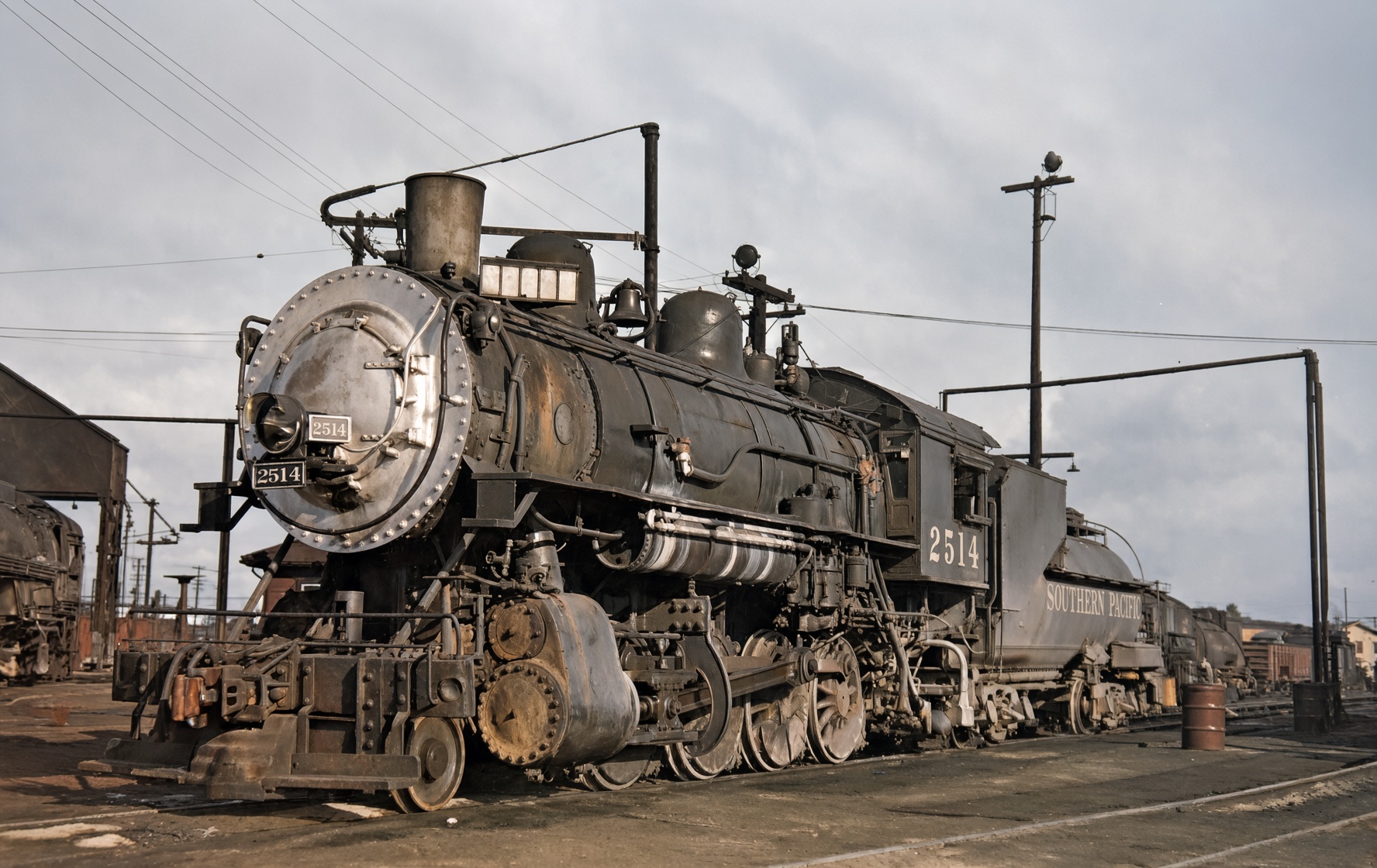
2-8-0 No. 2514, class C-9, at Taylor Yard in Los Angeles in the 1950s. Mac Owen collection.
The El Paso & Southwestern Consolidations stayed a separate series, classes C-15 through C-23, and several of those rows were sold in 1951. Two small Prairie classes, Pr-1 and Pr-2, also came from that road and were gone in the early 1930s. They are the only 2-6-2s on the grid.
Mikados and Decks
The Mikado was an interim type on the Pacific Lines. The first, class Mk-2, numbers 3200–3215, arrived in 1911 with 57-inch drivers, 23¼-by-30-inch cylinders, and a weight of 264,800 pounds. Classes Mk-4, Mk-5, and Mk-6 followed in 1913 and 1914, slightly heavier, superheated, with 63-inch drivers and 26-by-28-inch cylinders. A class Mk-5 weighed 280,300 pounds. The Mk-6s, the same size, were delivered in the middle of the Mk-5 deliveries. Those four classes are 83 engines. The Texas & Louisiana Lines had a single group of 57 class Mk-5s, numbers 738–794, built by the T&NO, Baldwin, and Brooks from 1913 to 1921. Later Mikados on the Pacific Lines were secondhand: El Paso & Southwestern engines, two from the Minarets & Western, and two from the Chicago & Illinois Midland.
The 2-10-2 was the engine that actually replaced the Consolidation on the main line. The class letter was F, for freight, and the crews called them Decks. Brooks delivered ten 63-inch-drivered F-1s, numbers 3601–3610, in 1917. Three months later a single 57-inch F-2, No. 3600, followed, and it was rebuilt to F-1 specifications in 1920. The table sends that engine to the T&NO in 1946. Class F-3, numbers 3653–3667, Baldwin, 1921, set the pattern for the rest: 63-inch drivers, 29½-by-32-inch cylinders, and 385,000 pounds. Class F-4, numbers 3668–3687, left Baldwin in one train, called the Prosperity Special, to mark the end of the slump after the First World War. The whole F-4 row in the table is 3668–3717, fifty engines. A number of the 2-10-2s were converted to coal in the 1920s for service out of El Paso, and later put back on oil. Many were leased or sold to the T&NO in the 1940s and 1950s. The Texas grid carries them as one row, classes F-1, F-4, and F-5, numbers 900…999, quantity 83, ex-Pacific Lines. The note on Pacific Lines F-5, numbers 3718–3768, says most of them went to the T&NO.
No. 3769 was the experiment. Baldwin built it in 1924 with Uniflow valves and Walschaerts gear. In 1929 it was fitted with Caprotti poppet valves, which proved too delicate. In 1937 it was rebuilt to F-5 specifications. The table leaves it in a row of its own, class F-6, and the note says Uniflow valves. Retirement is 1955.
After the last 2-10-2s, the railroad tried Alco’s three-cylinder idea in a 4-10-2. Schenectady delivered 16 in 1925, 23 in 1926, and 10 in 1927, classes SP-1, SP-2, and SP-3, numbers 5000–5048. On the Southern Pacific they were called the Southern Pacific type. The Union Pacific’s three-cylinder 4-10-2s were the Overland type. They went to work over the Sierra. They were not a replacement for the 2-8-8-2s, and most of them eventually worked out of Los Angeles.
Cab-forwards
In 1909 Baldwin delivered two conventional 2-8-8-2s with 57-inch drivers, the first of that wheel arrangement, meant to replace double-headed Consolidations on the Sierra. They pulled well. Their length and their exhaust did not work in the snowsheds. The crews could not see, and they could not breathe. One trip was tried with the tender ahead of the engine. It ran better and it produced the remedy. The cab went ahead of the smokebox, the engineer kept a forward view, oil was piped back to the firebox, and the cab was enclosed. Later in 1909 Baldwin delivered 15 of them, class MC-2, numbers 4002–4016. MC stood for Mallet Consolidation. Between 1911 and 1913 Baldwin shipped 32 more, numbers 4017–4048. From 1928 to 1931 the 2-8-8-2s were rebuilt as simple articulateds and reclassed AC. The table keeps them on the MC rows and notes the new classes: MC-1 and MC-2 to AC-1, MC-4 to AC-2, MC-6 to AC-3. There are no separate rows for those rebuilt classes. They stayed in service into the late 1940s. The longer account of the type is the cab-forward page.
The same idea was tried on a passenger engine in 1911. Class MM-2 was a dozen cab-forward 2-6-6-2s, numbers 3900–3911, and the note says they were built as 2-6-6-2s. They were unstable. By 1914 all of them had four-wheel lead trucks. They were simplified in the late 1920s and the 1930s, and the class ended in freight service in Oregon. The MM-1 class was a different machine, a dozen light Texas & New Orleans 2-6-6-2s of 1910, numbers 900–911, formerly 950–961. The 2-10-2s displaced them in the early 1920s, and the table retires them in 1929 and 1930. Two more 2-6-6-2s, class MM-3, numbers 3930 and 3931, came from the Verde Tunnel & Smelter.
The second generation was a 4-8-8-2 with 63-inch drivers and four 24-by-32-inch cylinders. The first ten, class AC-4, numbers 4100–4109, came from Baldwin in 1928, the same year the railroad introduced its first 2-8-8-4. Drury’s comparison with the Northern Pacific Yellowstone is direct. The AC-4 had the same size drivers, cylinders two inches smaller, a smaller firebox, a weight about 50 tons less, and a tractive force of about 116,900 pounds against about 140,000. The Northern Pacific bought 12 Yellowstones. Baldwin built 195 Southern Pacific 4-8-8-2s, classes AC-4 through AC-12 except AC-9. The last of them, class AC-12, numbers 4275–4294, were Baldwin engines of 1943 and 1944. No. 4294 is the engine in the photograph at the top of this page.

2-8-8-4 No. 3800, class AC-9, westbound with a 70-car manifest outside Tucumcari, New Mexico, on May 11, 1940. Richard Kindig photograph.
The AC-9s were the other articulated. In 1939 Lima delivered twelve coal-burning 2-8-8-4s, numbers 3800–3811, for the run between El Paso and Tucumcari. They were the only modern articulateds of conventional layout, and the only coal-burning articulateds. Driver and cylinder dimensions matched the cab-forward 4-8-8-2s. They carried skyline casing over the domes. They were converted to oil in 1950. The class has its own AC-9 page. The table retires them between 1953 and 1956.
Passenger locomotives
By 1900 the railroad had settled on the 4-6-0 for passenger trains, and it still bought two groups of Americans for lighter work. Class E-23, numbers 1445–1458, came from Cooke in 1900, and class E-27, numbers 1526–1540, from Baldwin in 1911. Both had 73-inch drivers. Most were scrapped in the middle 1930s. No. 1455 went to the Texas & Louisiana Lines and lasted until 1948. No. 1445 was scrapped in 1951 after years as a stationary boiler at Indio. On the Texas lines, Americans inherited from the San Antonio & Aransas Pass and the Dayton & Goose Creek lasted on light branches because nothing larger could replace them. Those are classes E-39, E-40, and E-41.
The Atlantic belonged on the level country from Oakland east to Sacramento, north to Redding, and south to Bakersfield. Sixteen class A-1 compounds, numbers 3000–3015, Baldwin, 1902, had 84-inch drivers. Nine class A-2s, numbers 3016–3024, Baldwin, 1903, had 79-inch drivers, Vanderbilt boilers, and cylindrical fireboxes set into the rear of the boiler. The Texas A-2s, numbers 285–288, had conventional boilers. Of the A-1s and A-2s, only No. 288 was converted to a simple engine, and it was scrapped with the rest of the class. The large group was the A-3, numbers 3025–3071 on the Pacific Lines and 289–292 on the Texas lines, built by Baldwin, Schenectady, and Brooks from 1904 to 1908 as simple engines with 81-inch drivers. They were superheated by the middle 1920s. Many received feedwater heaters or booster trailing trucks. The ones delivered with inside-journal trailing trucks kept Stephenson gear.
Class A-5, numbers 3072–3074, was built for the Mexican lines, worked the Arizona Eastern, and came to the Pacific Lines in 1924 with the same dimensions as the A-3. In 1927 and 1928 Sacramento and Los Angeles each rebuilt two A-3s with new cylinders, outside valve gear, and booster trailing trucks. Those four are class A-6, numbers 3000–3003, which repeats numbers from the old A-1 series. At least one was later painted red and orange and assigned to the Sacramento Daylight, the Sacramento–Lathrop section of the San Joaquin Daylight.
The Ten-Wheeler carried the passenger train until the Pacific was big enough. Classes T-25 and T-26, numbers 2274–2281 and 2283–2300, Cooke and Baldwin, 1901, had 69-inch drivers, and the Baldwins were Vauclain compounds. Ten class T-23 engines, numbers 2301–2310, Baldwin, 1903, had 63-inch drivers and 21-by-28-inch cylinders. Classes T-28 and T-31 followed the same design with cylinders an inch larger. Drury’s weights for the T-23 are 176,330 pounds as built and 196,200 superheated. The T-28 was 203,300 as built and 208,000 superheated. The T-31, built superheated, was 208,000. Twelve T-28s went to the Texas lines in 1908 and 1911, numbers 700–711. Brooks built the Pacific Lines T-32s, numbers 2363–2370, in 1913: 69-inch drivers, 23-by-28-inch cylinders, 218,500 pounds, and a wide firebox in place of the narrow firebox the older Ten-Wheelers carried between the rear drivers. Sacramento and Los Angeles copied that design for 14 more in 1917–1920, numbers 2371–2384. In 1927 No. 2371 was reclassed T-40 when a feedwater heater took the weight to 242,500 pounds, the heaviest 4-6-0 the railroad owned. The table leaves 2371 inside the T-32 row.
One Ten-Wheeler was a camelback. No. 2282, class T-27, was built by Baldwin in 1900 for the Sonora Railway, to burn anthracite from northern Mexico. After a few months it was transferred to the Pacific Lines and rebuilt with a conventional cab. The table retires it in 1928.
Baldwin delivered 28 Pacifics, numbers 2400–2427, from 1904 to 1907. They had 77-inch drivers, 22-by-28-inch cylinders, outside piston valves, Stephenson gear, inside-journal trailing trucks, and a weight of 222,000 pounds. They were superheated in the late 1910s. Between 1927 and 1929 eight of the class, and one P-2, were modernized with Walschaerts gear, booster trailing trucks, and feedwater heaters and reclassed P-4, keeping their original numbers. The table note on the P-1 row says nine were rebuilt to P-4. The two statements sit side by side in the chapter. Class P-3, numbers 2428–2437, Baldwin, 1911, had Walschaerts gear from the start. In 1917 and 1918 Sacramento built two more, numbers 2459 and 2460, from spare parts, rather than take United States Railroad Administration engines. Classes P-5 and P-6 were the 1912 and 1913 Pacifics. The P-6, Brooks, was the first real development of the Harriman Common Standard Pacific: 277,300 pounds, 77-inch drivers, 25-by-28-inch cylinders, and a large tapered boiler. The Texas lines had their own P-5s and P-6s, numbers 600–609 and 610–621, formerly 900–909 and 920–931.
Classes P-8 and P-10, numbers 2461–2475 and 2478–2491, were the heavy Pacifics, 73-inch drivers and 25-by-30-inch cylinders. The Texas P-9s, numbers 622–630, and the P-13s, numbers 631–633, were near-duplicates of the P-10. The P-10s were built with feedwater heaters. The P-8s had them added. The last eight P-10s had boosters. Class P-14, numbers 650–652, was three former Pacific Lines P-6s, 2455–2457, rebuilt and streamlined in 1937 for the Sunbeam and the Hustler.
The 4-8-2s arrived with the heavy Pacifics. Schenectady delivered 28 in 1923 and 1924, class Mt-1, numbers 4300–4327. Sacramento built 49 more between 1925 and 1930, classes Mt-3, Mt-4, and Mt-5. They had 73-inch drivers, 28-by-30-inch cylinders, trailing-truck boosters, and Worthington BL feedwater heaters. Six class Mt-2 engines, numbers 4385–4390, had been ordered by the El Paso & Southwestern and were delivered to the Southern Pacific instead, then renumbered almost at once. Their cylinders were an inch larger and they had Baker valve gear. In the early 1940s they were rebuilt with 28-inch cylinders and Walschaerts gear. The 4-8-2 was bought for heavy passenger trains and was later bumped to secondary trains, commute trains, and freight. No. 4334, a Sacramento engine, carried a skyline casing.
The 4-8-4 was straightforward except for the renumbering every time a GS-1 crossed El Paso. Baldwin delivered 14 in 1930: numbers 4400–4409 for the Pacific Lines and 700–703 for the Texas lines. The class was GS-1. Some read the letters as General Service, and some as Golden State. They weighed 442,300 pounds, with 73-inch drivers and 27-by-30-inch cylinders. At 250 pounds pressure they had about 5,000 pounds more tractive effort than the Mountains, on cylinders an inch smaller. In the early 1940s seven Pacific Lines GS-1s moved to the Texas lines and became 704–710. In the 1950s, numbers 700–703 and 705–709 came west into the 4400s, some of them through a temporary 4470-series number.
After a seven-year gap, Lima delivered six more in 1936, class GS-2, numbers 4410–4415. The dimensions matched the GS-1. The appearance did not. They had a broad running-board skirt, skyline casing, a conical smokebox front, and red, orange, and black paint to match the San Francisco–Los Angeles Daylight. In 1937 Lima built 14 more, class GS-3, numbers 4416–4429, with 80-inch drivers, 26-by-32-inch cylinders, and 280 pounds pressure. Then came 28 class GS-4 engines and two class GS-5 engines in 1941 and 1942. The GS-5s, numbers 4458 and 4459, had a cylinder diameter half an inch smaller and a pressure 20 pounds higher, and they had roller bearings, Timken on 4458 and SKF on 4459. The 4-8-4s took the principal passenger trains and the San Francisco–Los Angeles Overnight.
Class GS-6 was a wartime engine and a dual-service engine, so it went back to the 73-inch GS-2 dimensions, without the skirt, and it was painted black. Numbers 4460–4469 came from Lima in 1943. The Western Pacific received six engines of the same design. The Central of Georgia used it for the Big Apple 4-8-4s. No. 4449, a GS-4, was on display in Portland in 1958. Drury dates the restoration for the American Freedom Train to 1975, and says the engine has since operated over much of the system.
In 1952 the Southern Pacific leased eleven Cotton Belt 4-8-4s that diesels had displaced, classed them GS-7 and GS-8, and got another three to five years out of them. They worked first on the Rio Grande Division out of El Paso, then in San Francisco commute service. The grid lists GS-7 as 4475–4481, seven Baldwin engines of 1930, and GS-8 as 4485–4488, four engines built by the Cotton Belt in 1937 and 1942. Which eleven of the Cotton Belt’s own 4-8-4s they were is a question for the Cotton Belt steam roster. This table does not answer it.
Switchers
The whole system had 39 eight-wheel switchers, and they came in three groups. Sacramento built class SE-4, numbers 1307–1314 and 4501–4508, sixteen engines, in 1930–1937, using boilers from retired A-3 Atlantics. Houston and the T&NO built class SE-3, twelve on the Texas lines as 175–186 and four on the Pacific Lines as 4509–4512, starting from boilers of 2-6-6-2s. The other seven, class SE-2, were El Paso & Southwestern engines that had been built as 0-8-0s. The Depression cut off the program of rebuilding 0-6-0s into 0-8-0s about the time diesel switchers became available. Everything else that switched was a six-wheel engine. Most of those had 51-inch drivers and 19-by-26-inch cylinders. The ones built after the First World War had 57-inch drivers and 20-by-26-inch cylinders. The largest single block was class S-51, and the shops’ own contribution was class S-12, thirty-eight engines, numbers 1247–1284, built in 1919–1923.
Narrow gauge
In 1900 the company bought the Carson & Colorado, a three-foot railroad that ran from a connection with the Virginia & Truckee at Mound House, Nevada, about 300 miles south across desert and mountains into the Owens Valley. For a decade it connected with nothing else. What remained in the steam era was the piece from Laws to Keeler, and five Baldwin 4-6-0s that had come from the Nevada-California-Oregon. The table gives them no class letter. Numbers 8, 9, and 18 were built in 1907–1911. Numbers 6 and 7 were built in 1903 and retired in 1934 and 1935.
Drury gives two accounts of the end. In the oddities paragraph the Owens Valley line stayed in steam until 1954, when a custom-built diesel took over. In the chronology at the close of the chapter, the last steam locomotive in regular service anywhere on the railroad was narrow-gauge 4-6-0 No. 9, from Laws to Keeler, on August 25, 1959. The retirement cell for 8, 9, and 18 reads 1954, 1960, 1955, in that order. Those years stay in the cell, unpaired. October 19, 1958, was the Oakland–Reno excursion with 4-8-4 No. 4460.
The end of steam
Diesel switchers arrived in the late 1930s. Road diesels did not arrive until 1947. The railroad dieselized from the ends toward the middle. As the outer districts were turned over, steam moved to California. By 1956 steam was held for traffic surges. Deliveries of diesels in 1956, and a recession in 1957, covered the peak as well. The last steam freight ran on November 30, 1956. The last steam in regular passenger service was a Peninsula commute train on January 22, 1957. The last excursion Drury records is the October 19, 1958 trip with No. 4460. The chapter’s last regular-service date is the narrow-gauge run of August 25, 1959. The 1954 sentence above stays beside it. A few ex-El Paso & Southwestern Consolidations, classes C-18 and C-19, carry retirement dates into 1959 on the grid. Those cells are printed as they stand.
What survives
Two locomotives from this roster are still public engines. AC-12 No. 4294, the cab-forward in the photograph, is a Baldwin engine that the American Society of Mechanical Engineers records in service from 1944 through 1956. In May 1981 the society designated it Historic Mechanical Engineering Landmark No. 62. It is displayed at the California State Railroad Museum, 111 I Street, Sacramento. GS-4 No. 4449 belongs to the City of Portland. The Oregon Rail Heritage Center keeps it, dates the Freedom Train restoration to 1974, and lists it as operational. Of the 28 GS-4s Lima built in 1941 and 1942, it is the one that remains.
Roster
The rows follow Drury’s order and his quantities. Where a number series is not continuous, the span is printed with the quantity he gives. Class M-4 on the Pacific Lines is 1615–1719 and the quantity is 103. Class S-57, numbers 1112–1121, is quantity 12. The Texas 2-10-2s are 900…999 and the quantity is 83. Some series overlap as printed. Mk-4 and Mk-5 share numbers. The rebuilt A-6s reuse 3000–3003 from the old A-1s. On the Texas lines the 2-6-6-2s and the 2-10-2s both use the 900s, and the T-28s and the GS-1s both use the 700s. The quantity column adds every cell. Builder SP is the company shops, Sacramento or Los Angeles, and the chapter does not always say which. T&NO is the Texas shops, Houston among them. AE, CRYyP, and SSFB are left as Drury printed them. The other former-owner notes are spelled out from his own list: El Paso & Southwestern, Houston & Texas Central, San Antonio & Aransas Pass, and Salem, Falls City & Western. NCO is the Nevada-California-Oregon, which the chapter names.
| Type | Class | Numbers | Qty | Builder | Built | Retired | Notes |
|---|---|---|---|---|---|---|---|
| Pacific Lines | |||||||
| 0–6–0 | S-8 | 1295–1297 | 3 | Brooks, Baldwin | 1908–1909 | 1940–1950 | Ex-AE |
| 0–6–0 | S-10 | 1210–1221 | 12 | Baldwin | 1913 | 1954–1958 | |
| 0–6–0 | S-10 | 1232–1246 | 15 | Baldwin | 1918 | 1953–1957 | |
| 0–6–0 | S-10 | 1298, 1299 | 2 | Baldwin | 1917, 1918 | 1957, 1958 | Ex-AE |
| 0–6–0 | S-11 | 1222–1231 | 10 | Lima | 1914 | 1953–1958 | |
| 0–6–0 | S-12 | 1247–1284 | 38 | SP | 1919–1923 | 1949–1958 | |
| 0–6–0 | S-14 | 1285–1294 | 10 | Lima | 1924 | 1953–1958 | |
| 0–6–0 | S-16 | 1002 | 1 | Baldwin | 1903 | 1935 | Ex-El Paso & Southwestern |
| 0–6–0 | S-17 | 1003–1014 | 12 | Schenectady | 1907 | 1932–1936 | Ex-El Paso & Southwestern |
| 0–6–0 | S-22 | 1100 | 1 | Brooks | 1922 | 1951 | Ex-SSFB |
| 0–6–0 | S-51 | 1122–1194 | 73 | Baldwin, Brooks | 1906–1911 | 1939–1951 | |
| 0–6–0 | S-51 | 1195–1209 | 15 | Baldwin | 1912 | 1946–1951 | |
| 0–6–0 | S-57 | 1077–1101 | 25 | Baldwin | 1901–1902 | 1932–1940 | |
| 0–6–0 | S-57 | 1102–1106 | 5 | Baldwin | 1903 | 1934–1938 | Vanderbilt boilers |
| 0–6–0 | S-57 | 1107–1111 | 5 | Baldwin | 1903 | 1932–1945 | |
| 0–6–0 | S-57 | 1112–1121 | 12 | Schenectady | 1904 | 1935–1952 | |
| 0–8–0 | SE-2 | 1301–1306 | 6 | Baldwin | 1901, 1903 | 1935–1950 | Ex-El Paso & Southwestern |
| 0–8–0 | SE-2 | 4500 | 1 | Baldwin | 1901 | 1950 | Ex-El Paso & Southwestern |
| 0–8–0 | SE-3 | 4509–4512 | 4 | T&NO | 1930, 1936 | 1956–1958 | |
| 0–8–0 | SE-4 | 1307–1314 | 8 | SP | 1930–1937 | 1956–1958 | |
| 0–8–0 | SE-4 | 4501–4508 | 8 | SP | 1930–1937 | 1956–1958 | |
| 2–6–0 | M-4 | 1615–1719 | 103 | Schenectady, Cooke | 1899–1901 | 1932–1957 | 2–6–0 |
| 2–6–0 | M-6 | 1725–1769 | 45 | Baldwin | 1901 | 1934–1958 | Vauclain compound |
| 2–6–0 | M-6 | 1780–1802 | 23 | Baldwin | 1902–1903 | 1939–1958 | Vauclain compound |
| 2–6–0 | M-6 | 1803 | 1 | Baldwin | 1902 | 1953 | Ex-CRYyP |
| 2–6–0 | M-6 | 1823–1825 | 3 | SP | 1917, 1918 | 1946–1957 | |
| 2–6–0 | M-7 | 1720–1724 | 5 | Baldwin | 1901 | 1934–1954 | Vanderbilt boiler, Vauclain compound |
| 2–6–0 | M-7 | 1770–1779 | 10 | Baldwin | 1902 | 1954–1958 | Vanderbilt boiler, Vauclain compound |
| 2–6–0 | M-9 | 1804–1818 | 15 | Brooks | 1908 | 1934–1958 | |
| 2–6–0 | M-9 | 1819–1822 | 4 | Baldwin | 1909 | 1950–1953 | |
| 2–6–0 | M-9 | 1826, 1827 | 2 | SP | 1918 | 1952, 1953 | |
| 2–6–0 | M-9 | 1828–1830 | 3 | Brooks | 1908 | 1950–1954 | Ex-AE |
| 2–6–0 | M-11 | 1831–1836 | 6 | Baldwin | 1909 | 1949–1956 | Ex-AE |
| 2–6–2 | Pr-1 | 1900–1903 | 4 | Baldwin | 1902 | 1932–1935 | Ex-El Paso & Southwestern |
| 2–6–2 | Pr-2 | 1904, 1905 | 2 | Baldwin | 1904 | 1935, 1932 | |
| 2–8–0 | C-3 | 2606–2611 | 6 | Schenectady | 1900 | 1935–1951 | Cross-compound |
| 2–8–0 | C-4 | 2612–2623 | 12 | Schenectady | 1901 | 1935–1957 | Cross-compound |
| 2–8–0 | C-5 | 2624–2677 | 54 | Baldwin | 1901–1903 | 1934–1953 | Vauclain compound |
| 2–8–0 | C-5 | 2678–2693 | 16 | Baldwin | 1903–1904 | 1935–1952 | |
| 2–8–0 | C-8 | 2694–2751 | 58 | Baldwin | 1904 | 1952–1958 | |
| 2–8–0 | C-9 | 2513–2599 | 87 | Baldwin | 1906–1907 | 1949–1958 | |
| 2–8–0 | C-9 | 2752–2830 | 79 | Baldwin | 1905–1908 | 1951–1958 | |
| 2–8–0 | C-9 | 2858–2860 | 3 | Brooks | 1908 | 1953–1954 | Ex-AE |
| 2–8–0 | C-10 | 2831–2838 | 8 | Baldwin | 1911 | 1952–1958 | |
| 2–8–0 | C-10 | 2839–2857 | 19 | SP | 1917–1919 | 1949–1958 | |
| 2–8–0 | C-11 | 2502 | 1 | Schenectady | 1904 | 1934 | Ex-Butte County |
| 2–8–0 | C-11 | 2861–2864 | 4 | Baldwin | 1920–1921 | 1958 | Ex-St. Louis Southwestern |
| 2–8–0 | C-12 | 2503 | 1 | Baldwin | 1902 | 1936 | Ex-Butte County |
| 2–8–0 | C-12 | 2865–2868 | 4 | Baldwin | 1923 | 1958 | Ex-St. Louis Southwestern |
| 2–8–0 | C-13 | 2501 | 1 | Lima | 1905 | 1925 | Ex-Salem, Falls City & Western |
| 2–8–0 | C-15 | 2505–2508 | 4 | Baldwin | 1900 | 1939–1950 | Ex-El Paso & Southwestern |
| 2–8–0 | C-16 | 2509 | 1 | Baldwin | 1901 | 1923 | Ex-El Paso & Southwestern |
| 2–8–0 | C-17 | 2510, 2511 | 2 | Baldwin | 1902, 1905 | 1949 | Ex-El Paso & Southwestern |
| 2–8–0 | C-18 | 3400–3409 | 10 | Baldwin | 1902, 1903 | 1932–1959 | Ex-El Paso & Southwestern |
| 2–8–0 | C-19 | 3410–3426 | 17 | Baldwin | 1904 | 1934–1959 | Ex-El Paso & Southwestern |
| 2–8–0 | C-20 | 3440–3444 | 5 | Baldwin | 1906 | Sold 1951 | Ex-El Paso & Southwestern |
| 2–8–0 | C-21 | 3445–3449 | 5 | Baldwin | 1906–1907 | Sold 1951 | Ex-El Paso & Southwestern |
| 2–8–0 | C-22 | 3452–3469 | 18 | Schenectady | 1907 | Sold 1951 | Ex-El Paso & Southwestern |
| 2–8–0 | C-23 | 3450, 3451 | 2 | Schenectady | 1907 | Sold 1951 | Ex-El Paso & Southwestern |
| 2–8–0 | C-32 | 2500 | 1 | Baldwin | 1906 | 1948 | Ex-Nacozari |
| 2–8–2 | Mk-2 | 3200–3215 | 16 | Baldwin | 1911 | 1934–1956 | |
| 2–8–2 | Mk-4 | 3216–3240 | 25 | Baldwin | 1913 | 1934–1956 | |
| 2–8–2 | Mk-5 | 3236–3249 | 14 | Baldwin | 1913 | 1951–1956 | |
| 2–8–2 | Mk-5 | 3270–3277 | 8 | Baldwin, Lima | 1913–1917 | 1952–1956 | |
| 2–8–2 | Mk-6 | 3250–3269 | 20 | Lima | 1914 | 1951–1957 | |
| 2–8–2 | Mk-7 | 3300–3309 | 10 | Schenectady | 1913, 1916 | 1950–1954 | Ex-El Paso & Southwestern |
| 2–8–2 | Mk-8 | 3310–3314 | 5 | Schenectady | 1918 | 1951–1954 | Ex-El Paso & Southwestern |
| 2–8–2 | Mk-9 | 3315–3324 | 10 | Schenectady | 1920 | 1950–1955 | Ex-El Paso & Southwestern |
| 2–8–2 | Mk-10 | 3295, 3296 | 2 | Brooks | 1923 | 1953 | Ex-Minarets & Western |
| 2–8–2 | Mk-11 | 3297, 3298 | 2 | Brooks | 1914 | 1953, 1954 | Ex-Chicago & Illinois Midland |
| 2–8–4 | B-1 | 3500–3509 | 10 | Lima | 1928 | 1950–1951 | Ex-Boston & Maine |
| 2–10–2 | F-1 | 3601–3652 | 52 | Brooks, Baldwin | 1917, 1919 | 1952–1958 | |
| 2–10–2 | F-2 | 3600 | 1 | Brooks | 1918 | To T&NO 1946 | |
| 2–10–2 | F-3 | 3653–3667 | 15 | Baldwin | 1921 | 1952–1958 | |
| 2–10–2 | F-4 | 3668–3717 | 50 | Baldwin | 1922 | 1951–1958 | |
| 2–10–2 | F-5 | 3718–3768 | 51 | Baldwin | 1923–1924 | 1949–1956 | Most to T&NO |
| 2–10–2 | F-6 | 3769 | 1 | Baldwin | 1924 | 1955 | Uniflow valves |
| 2–6–6–2 | MM-3 | 3930, 3931 | 2 | Schenectady | 1920 | 1954, 1951 | Ex-Verde Tunnel & Smelter |
| 2–8–8–2 | MC-1 | 4000, 4001 | 2 | Baldwin | 1909 | 1948, 1949 | Rebuilt to AC-1 |
| 2–8–8–2 | MC-2 | 4002–4016 | 15 | Baldwin | 1909 | 1935–1949 | Rebuilt to AC-1 |
| 2–8–8–2 | MC-4 | 4017–4028 | 12 | Baldwin | 1911 | 1935–1948 | Rebuilt to AC-2 |
| 2–8–8–2 | MC-6 | 4029–4048 | 20 | Baldwin | 1912–1913 | 1936–1949 | Rebuilt to AC-3 |
| 2–8–8–4 | AC-9 | 3800–3811 | 12 | Lima | 1939 | 1953–1956 | |
| 4–4–0 | E-23 | 1445–1458 | 14 | Cooke | 1900 | 1932–1945 | |
| 4–4–0 | E-27 | 1526–1540 | 15 | Baldwin | 1911 | 1934 | |
| 4–4–2 | A-1 | 3000–3015 | 16 | Baldwin | 1902 | 1922–1925 | Vauclain compound |
| 4–4–2 | A-2 | 3016–3024 | 9 | Baldwin | 1903 | 1915–1918 | Vanderbilt boiler, Vauclain compound |
| 4–4–2 | A-3 | 3025–3071 | 47 | Schenectady, Baldwin, Brooks | 1904–1908 | 1932–1952 | |
| 4–4–2 | A-5 | 3072–3074 | 3 | Baldwin | 1911 | 1935 | |
| 4–4–2 | A-6 | 3000–3003 | 4 | SP | 1927–1928 | 1948–1952 | Rebuilt from A-3 |
| 4–6–0 | T-23 | 2301–2310 | 10 | Baldwin | 1903 | 1949–1954 | |
| 4–6–0 | T-25 | 2274–2281 | 8 | Cooke | 1901 | 1926–1934 | |
| 4–6–0 | T-26 | 2283–2300 | 18 | Baldwin | 1901 | 1934–1951 | Vauclain compound |
| 4–6–0 | T-27 | 2282 | 1 | Baldwin | 1900 | 1928 | Camelback |
| 4–6–0 | T-28 | 2311–2352 | 42 | Baldwin | 1907–1911 | 1949–1957 | |
| 4–6–0 | T-31 | 2353–2362 | 10 | Baldwin | 1912 | 1953–1957 | |
| 4–6–0 | T-32 | 2363–2370 | 8 | Brooks | 1913 | 1953–1956 | |
| 4–6–0 | T-32 | 2371–2384 | 14 | SP | 1917–1920 | 1952–1957 | |
| 4–6–0 | T-35 | 2101 | 1 | Schenectady | 1900 | 1926 | Ex-El Paso & Southwestern |
| 4–6–0 | T-36 | 2102–2104 | 3 | Manchester | 1902 | 1934–1947 | Ex-El Paso & Southwestern |
| 4–6–0 | T-37 | 2105, 2106 | 2 | Rhode Island | 1903 | 1952, 1951 | Ex-El Paso & Southwestern |
| 4–6–0 | T-57 | 2385 | 1 | Baldwin | 1906 | Ex-Bullfrog-Goldfield | |
| 4–6–0 | T-58 | 2386 | 1 | Baldwin | 1907 | Ex-Las Vegas & Tonopah | |
| 4–6–2 | P-1 | 2400–2427 | 28 | Baldwin | 1904–1907 | 1934–1954 | 9 rebuilt to P-4 |
| 4–6–2 | P-3 | 2428–2437 | 10 | Baldwin | 1911 | 1947–1954 | |
| 4–6–2 | P-3 | 2459, 2460 | 2 | SP | 1917, 1918 | 1952, 1948 | |
| 4–6–2 | P-5 | 2438–2452 | 15 | Baldwin | 1912 | 1947–1953 | |
| 4–6–2 | P-6 | 2453–2458 | 6 | Brooks | 1913 | 1955–1957 | |
| 4–6–2 | P-7 | 2476, 2477 | 2 | Lima | 1917 | 1958 | Ex-AE |
| 4–6–2 | P-8 | 2461–2475 | 15 | Baldwin | 1921 | 1953–1958 | |
| 4–6–2 | P-10 | 2478–2491 | 14 | Baldwin | 1923–1924 | 1954–1958 | |
| 4–6–2 | P-11 | 3100–3109 | 10 | Baldwin | 1907 | 1939–1950 | Ex-El Paso & Southwestern |
| 4–6–2 | P-12 | 3120–3129 | 10 | Brooks | 1917 | 1947–1953 | |
| 4–8–2 | Mt-1 | 4300–4327 | 28 | Schenectady | 1923–1924 | 1952–1957 | |
| 4–8–2 | Mt-2 | 4385–4390 | 6 | Brooks | 1924 | 1951, 1953 | |
| 4–8–2 | Mt-3 | 4328–4345 | 18 | SP | 1925–1926 | 1953–1958 | |
| 4–8–2 | Mt-4 | 4346–4366 | 21 | SP | 1926–1929 | 1953–1958 | |
| 4–8–2 | Mt-5 | 4367–4376 | 10 | SP | 1929–1930 | 1953–1958 | |
| 4–8–4 | GS-1 | 4400–4409 | 10 | Baldwin | 1930 | 1954–1957 | |
| 4–8–4 | GS-2 | 4410–4415 | 6 | Lima | 1936 | 1954–1958 | |
| 4–8–4 | GS-3 | 4416–4429 | 14 | Lima | 1937 | 1954–1958 | |
| 4–8–4 | GS-4 | 4430–4457 | 28 | Lima | 1941–1942 | 1956–1958 | |
| 4–8–4 | GS-5 | 4458, 4459 | 2 | Lima | 1942 | 1958, 1956 | Roller bearings |
| 4–8–4 | GS-6 | 4460–4469 | 10 | Lima | 1943 | 1954–1958 | |
| 4–8–4 | GS-7 | 4475–4481 | 7 | Baldwin | 1930 | 1955–1957 | Ex-St. Louis Southwestern |
| 4–8–4 | GS-8 | 4485–4488 | 4 | SSW | 1937, 1942 | 1956, 1958 | Ex-St. Louis Southwestern |
| 4–10–2 | SP-1 | 5000–5015 | 16 | Schenectady | 1925 | 1951–1954 | |
| 4–10–2 | SP-2 | 5016–5038 | 23 | Schenectady | 1926 | 1953–1955 | |
| 4–10–2 | SP-3 | 5039–5048 | 10 | Schenectady | 1927 | 1953–1954 | |
| 4–6–6–2 | MM-2 | 3900–3911 | 12 | Baldwin | 1911 | 1946–1948 | Built as 2–6–6–2 |
| 4–8–8–2 | AC-4 | 4100–4109 | 10 | Baldwin | 1928 | 1953–1955 | |
| 4–8–8–2 | AC-5 | 4110–4125 | 16 | Baldwin | 1929 | 1952–1955 | |
| 4–8–8–2 | AC-6 | 4126–4150 | 25 | Baldwin | 1930 | 1953–1955 | |
| 4–8–8–2 | AC-7 | 4151–4176 | 26 | Baldwin | 1937 | 1954–1958 | |
| 4–8–8–2 | AC-8 | 4177–4204 | 28 | Baldwin | 1939 | 1954–1958 | |
| 4–8–8–2 | AC-10 | 4205–4244 | 40 | Baldwin | 1942 | 1955–1958 | |
| 4–8–8–2 | AC-11 | 4245–4274 | 30 | Baldwin | 1942–1943 | 1954–1958 | |
| 4–8–8–2 | AC-12 | 4275–4294 | 20 | Baldwin | 1943–1944 | 1955–1958 | |
| Narrow gauge | |||||||
| 4–6–0 | 8, 9, 18 | 3 | Baldwin | 1907–1911 | 1954, 1960, 1955 | Ex-Nevada-California-Oregon | |
| 4–6–0 | 6, 7 | 2 | Baldwin | 1903 | 1934, 1935 | Ex-Nevada-California-Oregon | |
| Texas & Louisiana Lines | |||||||
| 0–6–0 | S-3 | 45–52 | 8 | Schenectady | 1899–1900 | 1930–1947 | |
| 0–6–0 | S-5 | 53–77 | 25 | Baldwin | 1902–1903 | 1939–1941 | |
| 0–6–0 | S-7 | 78–81 | 4 | Schenectady | 1904 | 1947–1950 | |
| 0–6–0 | S-8 | 82–102 | 21 | Baldwin | 1906–1911 | 1941–1949 | |
| 0–6–0 | S-8 | 111–116 | 6 | Baldwin | 1906–1907 | 1946–1949 | Ex-Houston & Texas Central |
| 0–6–0 | S-9 | 103–110 | 8 | Baldwin | 1912 | 1947–1950 | |
| 0–6–0 | S-9 | 117–128 | 12 | Baldwin | 1913 | 1947–1954 | |
| 0–6–0 | S-10 | 129–136 | 8 | Baldwin | 1917–1918 | 1950–1953 | |
| 0–6–0 | S-13 | 137–146 | 10 | Baldwin | 1920–1921 | 1952–1956 | |
| 0–6–0 | S-14 | 147–166 | 20 | Lima, T&NO | 1924–1926 | 1952–1957 | |
| 0–6–0 | S-19 | 26–29 | 4 | Schenectady | 1901, 1903 | 1936–1937 | Ex-San Antonio & Aransas Pass, El Paso & Southwestern |
| 0–8–0 | SE-3 | 175–186 | 12 | T&NO | 1930–1936 | 1952–1957 | |
| 2–6–0 | M-4 | 410–459 | 50 | Schenectady, Cooke | 1899–1901 | 1934–1955 | |
| 2–6–0 | M-6 | 482–485 | 4 | Baldwin | 1903 | 1947–1953 | |
| 2–6–0 | M-6 | 515–517 | 3 | Baldwin | 1903 | 1947–1953 | |
| 2–6–0 | M-7 | 460–469 | 10 | Baldwin | 1902 | 1928–1929 | Vanderbilt boiler, Vauclain compound |
| 2–6–0 | M-9 | 550–556 | 7 | Brooks | 1908 | 1948–1955 | Ex-Houston & Texas Central |
| 2–6–0 | M-10 | 560–565 | 6 | Baldwin | 1909 | 1947–1953 | Ex-Houston & Texas Central |
| 2–6–0 | M-11 | 500–514 | 15 | Baldwin | 1912 | 1952–1957 | |
| 2–6–0 | M-17 | 495 | 1 | Baldwin | 1905 | 1946 | Ex-San Antonio & Aransas Pass |
| 2–6–0 | M-18 | 496 | 1 | Lima | 1911 | 1932 | Ex-San Antonio & Aransas Pass |
| 2–6–0 | M-19 | 497–499 | 3 | Baldwin | 1911 | 1932, 1946 | |
| 2–6–0 | M-20 | 481 | 1 | Baldwin | 1919 | 1953 | Ex-Dayton & Goose Creek |
| 2–6–0 | M-21 | 520–529 | 10 | T&NO | 1928–1930 | 1950–1954 | Ex-Houston & Texas Central |
| 2–8–0 | C-8 | 800–807 | 8 | Baldwin | 1904 | 1950–1955 | |
| 2–8–0 | C-9 | 808–857 | 50 | Baldwin, Brooks | 1905–1908 | 1946–1958 | |
| 2–8–0 | C-20 | 867–869 | 3 | Cooke | 1921 | 1953–1955 | Ex-San Antonio & Aransas Pass |
| 2–8–0 | C-21 | 870 | 1 | Lima | 1909 | 1950 | Ex-San Antonio & Aransas Pass |
| 2–8–0 | C-22 | 871–876 | 6 | Pittsburgh | 1900 | 1936–1947 | Ex-San Antonio & Aransas Pass |
| 2–8–0 | C-23 | 877–884 | 8 | Baldwin | 1913 | 1939–1954 | Ex-San Antonio & Aransas Pass |
| 2–8–0 | C-24 | 885–894 | 10 | Lima | 1913 | 1935–1955 | Ex-San Antonio & Aransas Pass |
| 2–8–0 | C-25 | 895, 896 | 2 | Schenectady | 1913 | 1957, 1956 | Ex-Texas Midland |
| 2–8–2 | Mk-5 | 738–794 | 57 | T&NO, Baldwin, Brooks | 1913–1921 | 1953–1957 | |
| 2–10–0 | D-1 | 897–899 | 3 | Baldwin | 1903 | 1934, 1937 | Ex-San Antonio & Aransas Pass |
| 2–10–2 | F-1, F-4, F-5 | 900…999 | 83 | Baldwin, Brooks | 1917–1924 | 1953–1957 | Ex-Pacific Lines |
| 2–6–6–2 | MM-1 | 900–911 | 12 | Baldwin | 1910 | 1929–1930 | Ex-950–961 |
| 4–4–0 | E-23 | 261–265 | 5 | Cooke | 1900 | 1941–1951 | |
| 4–4–0 | E-39 | 205–209 | 5 | Baldwin | 1924 | 1946 | Ex-San Antonio & Aransas Pass |
| 4–4–0 | E-40 | 220–223 | 4 | Baldwin | 1922 | 1947, 1954 | Ex-San Antonio & Aransas Pass |
| 4–4–0 | E-41 | 224 | 1 | Baldwin | 1921 | 1946 | Ex-Dayton & Goose Creek |
| 4–4–2 | A-2 | 285–288 | 4 | Baldwin | 1903 | 1921 | |
| 4–4–2 | A-3 | 289–292 | 4 | Schenectady, Baldwin | 1904 | 1932 | Vauclain compound |
| 4–6–0 | T-28 | 700–711 | 12 | Brooks, Baldwin | 1908, 1911 | 1954–1955 | |
| 4–6–0 | T-38 | 369–376 | 8 | Baldwin | 1907–1908 | 1930–1937 | Ex-San Antonio & Aransas Pass |
| 4–6–2 | P-5 | 600–609 | 10 | Baldwin | 1912 | 1952–1957 | Ex-900–909 |
| 4–6–2 | P-6 | 610–621 | 12 | Brooks | 1913 | 1952–1954 | Ex-920–931 |
| 4–6–2 | P-9 | 622–630 | 9 | Baldwin | 1923 | 1953–1955 | |
| 4–6–2 | P-13 | 631–633 | 3 | Baldwin | 1928 | 1954–1955 | |
| 4–6–2 | P-14 | 650–652 | 3 | Brooks | 1913 | 1953–1954 | Ex-2455–2457 |
| 4–8–4 | GS-1 | 700–703 | 4 | Baldwin | 1930 | 1954–1956 | |
Related reading
- Southern Pacific Railroad: Map, History, Logo
- Southern Pacific Diesel Roster (All-Time)
- Cab-Forward steam locomotives
- Southern Pacific Class AC-9 2-8-8-4s
- Southern Pacific Daylights
- Cotton Belt steam roster
- California State Railroad Museum
- Union Pacific Railroad
- El Paso & Southwestern Railroad
Sources
- George H. Drury, Guide to North American Steam Locomotives, revised edition, Southern Pacific Lines chapter, pp. 300–308. The classes, the quantities, the builders, the retirement spans, and the account of how the engines were used. The quantity column is 2,605. No. 4449’s Freedom Train restoration is dated 1975 in that chapter.
- American Society of Mechanical Engineers, Historic Mechanical Engineering Landmark No. 62, “Southern Pacific #4294 Cab-in-Front Steam Locomotive.” Baldwin. In service 1944 through 1956. Designated May 1981. Displayed at the California State Railroad Museum, 111 I Street, Sacramento.
- Oregon Rail Heritage Center, “Southern Pacific 4449,” locomotives page. City of Portland. Donated for display in 1958. Freedom Train restoration dated 1974. The remaining GS-4 of the 28 built in 1941 and 1942. Listed as operational.
Recent Articles


-
EMD "F2" Locomotives: Specs, Roster, History
Nov 10, 26 12:22 AM
 EMD F2, the 1,350-horsepower bridge between the FT and the F3. 104 locomotives, July through November 1946. Spotting features, specifications, and the production roster.
-
Southern Pacific Diesel Roster (All-Time)
Nov 10, 26 12:08 AM
 Southern Pacific diesel roster with builder serials, order numbers, Texas and New Orleans numbers, and the 1965 renumbering. Alco, Baldwin, Fairbanks-Morse, Electro-Motive, General Electric, Krauss-Ma…
-
Southern Pacific Steam Roster: Post 1900
Nov 09, 26 11:56 PM
 Southern Pacific steam locomotives built since 1900. Pacific Lines, Texas and Louisiana Lines, cab-forwards, the GS 4-8-4s, and five narrow-gauge Ten-Wheelers. The quantity column counts the rows as p…
-
Canal Street Yard Assessment Stays Open Through December 7
Nov 09, 26 01:07 PM
The FRA signed the Canal Street Yard environmental assessment on November 6, 2026. Public inspection runs through December 7, and meeting dates are not confirmed. -
NS Legacy Cab-Signal Comments Are Due November 9
Nov 09, 26 01:05 PM
 The FRA must receive comments by November 9, 2026, on a Norfolk Southern plan to drop legacy cab signals on 14 line segments and rely on positive train control.
-
Elimination Grant of $27.8 Million Reaches Scott Road in Allen County
Nov 09, 26 12:53 PM
Allen County received $27,878,116, also stated as $27.8 million, to design and build a grade separation where Scott Road crosses Norfolk Southern. -
Vermont Receives $60.3 Million for the Western Corridor
Nov 09, 26 12:45 PM
Vermont will receive $60.3 million to rehabilitate about 60 miles of the Western Corridor. The delegation quote also calls the sum $60 million. -
Burlingame Grade Separation Wins a Federal Grant
Nov 09, 26 10:42 AM
 Rep. Kevin Mullin said on November 5, 2026 that the FRA awarded $90.4 million for the Caltrain Broadway grade separation in Burlingame. Early work is expected in May 2027.
-
Orange County Rail Line Gets a Coastal Permit
Nov 09, 26 10:18 AM
The California Coastal Commission on November 5, 2026 approved a 10-year permit for the San Clemente rail line, including about 690,000 cubic yards of sand. -
Railroad Quiet Zones Are Reinstated in St. Louis
Nov 09, 26 10:14 AM
 St. Louis said on November 6, 2026 that the FRA reinstated the city quiet zones. Horns are to stop after railroad systems are updated.
-
Southern Pacific Railroad: Map, History, Logo
Nov 08, 26 01:58 PM
 The Southern Pacific, from the December 2, 1865 charter and the Big Four to Sprint, the Rio Grande Industries purchase of 1988, and the Union Pacific merger of February 1, 1997.
-
California Awards Flexible Rail Aid to Nine Projects
Nov 08, 26 01:15 PM
CalSTA on November 5, 2026 awarded $66.58 million in flexible State Rail Assistance to nine California projects. Each amount in the summary is a cap, printed as up to. -
CSX Leaves Three Days Out of the Weekly Reports
Nov 08, 26 12:02 PM
CSX told the Surface Transportation Board it cannot recover October 27-29 data for the EP 724 and EP 787 reports covering the week ending October 30, 2026. -
NJ Transit Advances Three Station Housing Projects
Nov 08, 26 11:56 AM
 NJ Transit on November 5, 2026 advanced station projects in Jersey City, Bound Brook, and Morristown. The three are projected to add more than 1,000 homes.
-
River Fox Train Wraps a Locomotive for America 250
Nov 08, 26 11:06 AM
 The River Fox Train in West Sacramento wrapped a locomotive with America 250 markings, the American flag, and the Sacramento skyline. The wrap is expected to stay through 2027.
-
California Keeps Metrolink Service in the 2027 Budget
Nov 07, 26 11:35 PM
 Metrolink says a California State Transportation Agency grant lets the proposed fiscal year 2027 budget keep service at current levels. The board hearing is November 13, 2026.
-
WM's 4-6-6-4 Locomotives (M-2): Specs, Roster, History
Nov 07, 26 04:37 PM
 Western Maryland class M-2, twelve Baldwin 4-6-6-4s numbered 1201-1212, built in 1940 and 1941 for Hagerstown-Connellsville fast freight. Roster, specifications, and retirement in 1952-1953.
-
Missouri Pacific Diesel Roster (All-Time)
Nov 07, 26 04:26 PM
 Missouri Pacific diesel roster with builder serials, order numbers, subsidiary lettering, and renumberings. Alco, Baldwin, Electro-Motive, and General Electric. Texas and Pacific locomotives are on th…
-
Missouri Pacific Steam Roster (Built Since 1900)
Nov 07, 26 04:21 PM
 Missouri Pacific steam locomotives built since 1900. Drury quantity column 1,439. Sedalia rebuilds counted once, 1,407 frames. Last steam was 0-6-0 9301 in November 1955.
-
Missouri Pacific Railroad: Map, Locomotives, Logo, History
Nov 07, 26 04:19 PM
 The Missouri Pacific was a large Midwestern that carried a long history of financial difficulty until later years.
-
LIRR Service Changes Start on November 9
Nov 07, 26 03:15 PM
New Long Island Rail Road schedules start on every branch on Monday, November 9, 2026. Midday and weekend times change. Rush hour does not. Babylon service returns in stages. -
Draft EA Reviews Norfolk Southern Track in London, Ohio
Nov 07, 26 11:35 AM
The Surface Transportation Board environmental office issued a draft assessment on November 6, 2026, for about 0.96 miles of Norfolk Southern track in London, Ohio. Comments are due November 20. -
Metrolink Lines Will Not Run on Three Routes November 7
Nov 07, 26 10:53 AM
Metrolink will not run the Ventura County, Orange County, or Inland Empire-Orange County lines on November 7 and 8, 2026. The advisory says no substitute transportation will be provided. -
Hartford Line Adds a Weekday Round Trip on November 16
Nov 07, 26 10:48 AM
 Connecticut said the Hartford Line adds a weekday New Haven-Hartford round trip on November 16, starts a morning train in Springfield, and extends weekend stops to Windsor and Windsor Locks.
-
Board Issues a Policy Statement on Rail Preemption
Nov 07, 26 10:44 AM
The Surface Transportation Board placed a policy statement on public inspection for the November 9 Federal Register. It reviews existing preemption precedent and says it makes no binding determination… -
NJ Transit Restores Lines After the Newark Drawbridge Stop
Nov 07, 26 10:37 AM
 NJ Transit said Morris and Essex service between Hackettstown and Dover, and Montclair-Boonton service between Hackettstown and Montclair State University, resumed after the Newark Drawbridge stop.
-
EMD "SD35" Locomotives: Data Sheet, Specs, Roster
Nov 06, 26 10:35 PM
 EMD SD35, 2,500 horsepower, 16-cylinder 567D3A, built June 1964 through January 1966. 360 locomotives. Specifications and the production roster by owner, serial, and order.
-
EMD "SDP35" Locomotives: Data Sheet, Specs, Roster
Nov 06, 26 10:32 PM
 EMD SDP35, the steam-generator SD35. 35 locomotives, July 1964 through September 1965. Seaboard Air Line 1100-1119, Atlantic Coast Line 550, Louisville and Nashville 1700-1703, Union Pacific 1400-1409…
-
RJ Corman Will Be Replaced on Part of the Luzerne Lines
Nov 06, 26 01:34 PM
A November 6, 2026 notice says Wilkes-Barre Terminal Railway would acquire about 59.65 miles in Luzerne County and replace R.J. Corman as operator on part of the line. The earliest date is November 22… -
NS Names a Student Hub at the University of Georgia
Nov 06, 26 12:03 PM
 Norfolk Southern said a 100,000 dollar gift named a student-organization hub in Driftmier Engineering Center. The University of Georgia marked the naming on October 26. The space is for 23 clubs.
-
Union Pacific Filed Its Vena Recording Certification
Nov 06, 26 11:56 AM
 Union Pacific filed a November 5, 2026 verified statement that the confidential label is off the March 17 Vena recording and that parties of record received a copy at 3:30 p.m. Eastern.
-
OmniTRAX Adds Tenants at Its Blue Island Hub
Nov 06, 26 10:26 AM
 OmniTRAX has signed new construction-company leases at its 90-acre Blue Island, Illinois, hub and is planning a second phase.
-
Veterans and Active-Duty Members Exceed 16 Percent of Norfolk Southern
Nov 06, 26 10:14 AM
Norfolk Southern said on November 5, 2026, that more than 3,000 veterans and active-duty service members are more than 16 percent of its workforce. This year grants are $100,000 and $50,000. -
BNSF: Merger Would Put Half of U.S. Rail Shipments Under One Railroad
Nov 06, 26 10:00 AM
BNSF chief marketing officer Tom G. Williams told customers on November 3, 2026, that a Union Pacific-Norfolk Southern merger would put about half of U.S. rail shipments under one railroad. Nothing is… -
Amtrak Opens a Winter Fare Sale
Nov 06, 26 09:28 AM
Amtrak opened a Winter Wanderlust sale on November 5, 2026. Book by November 12 for travel from December 1, 2026, through March 14, 2027. Blackout dates apply. Coach and Acela Business only. -
CN and CPKC Report October Grain Records
Nov 06, 26 08:50 AM
 CPKC reported October 2026 grain records in Canada and the United States. CN reported 3.54 million metric tonnes across Canada. The releases do not print a combined total.
-
New Brunswick Transload Gets CN Rail Service
Nov 06, 26 08:49 AM
 CN said on November 4, 2026, that it has started serving AD Gagnon Transload Services near Grand Falls, New Brunswick. The site is three kilometres from the Trans-Canada Highway and lists room for 106…
-
Together, Freight and Passenger Rail Can Grow, Union Pacific Says
Nov 06, 26 08:47 AM
 Union Pacific said on November 5, 2026, that passenger obligations would remain if it combines with Norfolk Southern. The capacity claim is a Union Pacific analysis, not a Surface Transportation Board…
-
FM "C-Liner" Locomotives: Specs, Roster, Photos
Nov 05, 26 11:19 PM
 Fairbanks-Morse Consolidation Line cab units, the C-Liners. 165 locomotives, Beloit and Kingston, March 1950 through February 1955. Models, specs, and production rosters.
-
Atlanta, Birmingham & Coast Railroad: Map, History, Roster
Nov 05, 26 12:03 PM
 Atlanta, Birmingham & Coast, from Brunswick and Waycross to Atlanta and Birmingham. Atlantic Coast Line control at the close of 1926. Merged in January 1946 as the Western Division. Steam roster of th…
-
El Paso & Southwestern Railroad: Map, History, Logo
Nov 05, 26 12:00 PM
 The El Paso & Southwestern, the Phelps Dodge copper railroad from Tucson to the Rock Island at Tucumcari. Southern Pacific control on October 31, 1924.
-
Brightline Says Orlando Service Has Resumed
Nov 05, 26 11:55 AM
 Brightline said on November 5, 2026, that trains to and from Orlando have resumed after weather suspensions in Brevard County. Later that morning the departures page still showed the Orlando segment s…
-
Metra Customers Must Sign Up Again
Nov 05, 26 11:43 AM
Metra says customers who want service alerts must sign up again at metratracker.com. The November 2 story says the new system has launched and the old email list is shut down. A notice on the same pag… -
Norfolk Southern Packs Six Projects Into One Window
Nov 05, 26 11:38 AM
 Norfolk Southern used one 26-hour window on the W Line for six projects in Indiana and Kentucky, including three bridge replacements. The October 27 account does not give the calendar day of the work.
-
CSX: More Time to Comment on an Inspection Waiver
Nov 05, 26 11:29 AM
The Federal Railroad Administration extended comments on a CSX petition for relief from some qualified mechanical inspector rules until December 2, 2026. The November 2 notice does not grant the waive… -
Brightline Expects Orlando Service on Thursday
Nov 05, 26 09:21 AM
Brightline said on November 4, 2026, that it expects trains to and from Orlando to resume on Thursday, November 5. South Florida stations kept running. The departures page still showed the Orlando seg… -
Union Pacific: More Time to Comment on an Inspection Waiver
Nov 05, 26 09:15 AM
The Federal Railroad Administration extended comments on a Union Pacific petition for relief from some qualified mechanical inspector rules until December 2, 2026. The November 2 notice does not grant… -
Wisconsin Opens Comments on the 2027 Freight Plan
Nov 05, 26 09:03 AM
 WisDOT opened the draft 2027 State Freight Plan for comment through December 1, 2026. The plan covers freight rail with highways, harbors, aviation, and intermodal links. Completion is expected in sum…
-
U.S. Rail Traffic Rose 3.5 Percent in the Week Ending October 31
Nov 05, 26 08:52 AM
U.S. railroads moved 514,080 carloads and intermodal units in the week ending October 31, 2026, up 3.5 percent from a year earlier, the Association of American Railroads said on November 4. -
Muni and Bay Area Transit Measures Pass
Nov 05, 26 08:49 AM
 San Francisco Municipal Transportation Agency said on November 4, 2026 that Proposition H and a regional transit measure passed. Proposition H is about 160 million dollars a year for Muni. The regiona…