Atlanta, Birmingham & Coast Railroad: Map, History, Roster
Published: November 5, 2026
By: Adam Burns
The Atlanta, Birmingham & Coast was the railroad the Atlantic Coast Line used to reach Atlanta and Birmingham. The diamond herald read AB&C. The main line ran from the port of Brunswick through Waycross and Fitzgerald to Manchester, Georgia, where one arm went up to Atlanta and the other ran on to Birmingham. In the March 1940 Official Guide the company reported 640 miles. General offices were at 26 Cain Street, N.W., in Atlanta. The Coast Line held all of the common stock from the close of 1926 and merged the company in January 1946, after operating it separately through the end of 1945. The line became the Coast Line’s Western Division.
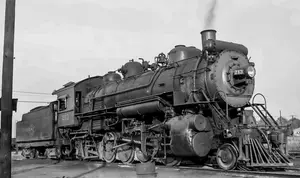
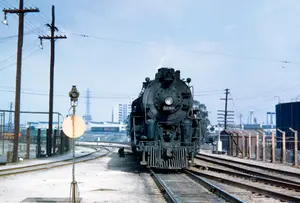
The road had been built, under earlier names, to put Atlanta and Birmingham on a line of steamships out of Brunswick. It was in receivership before the last of its own track was open. The locomotives it handed to the Coast Line were a secondhand fleet. Mikado No. 213, at Birmingham on May 17, 1930, was one of the four of its class still on the property at the merger.
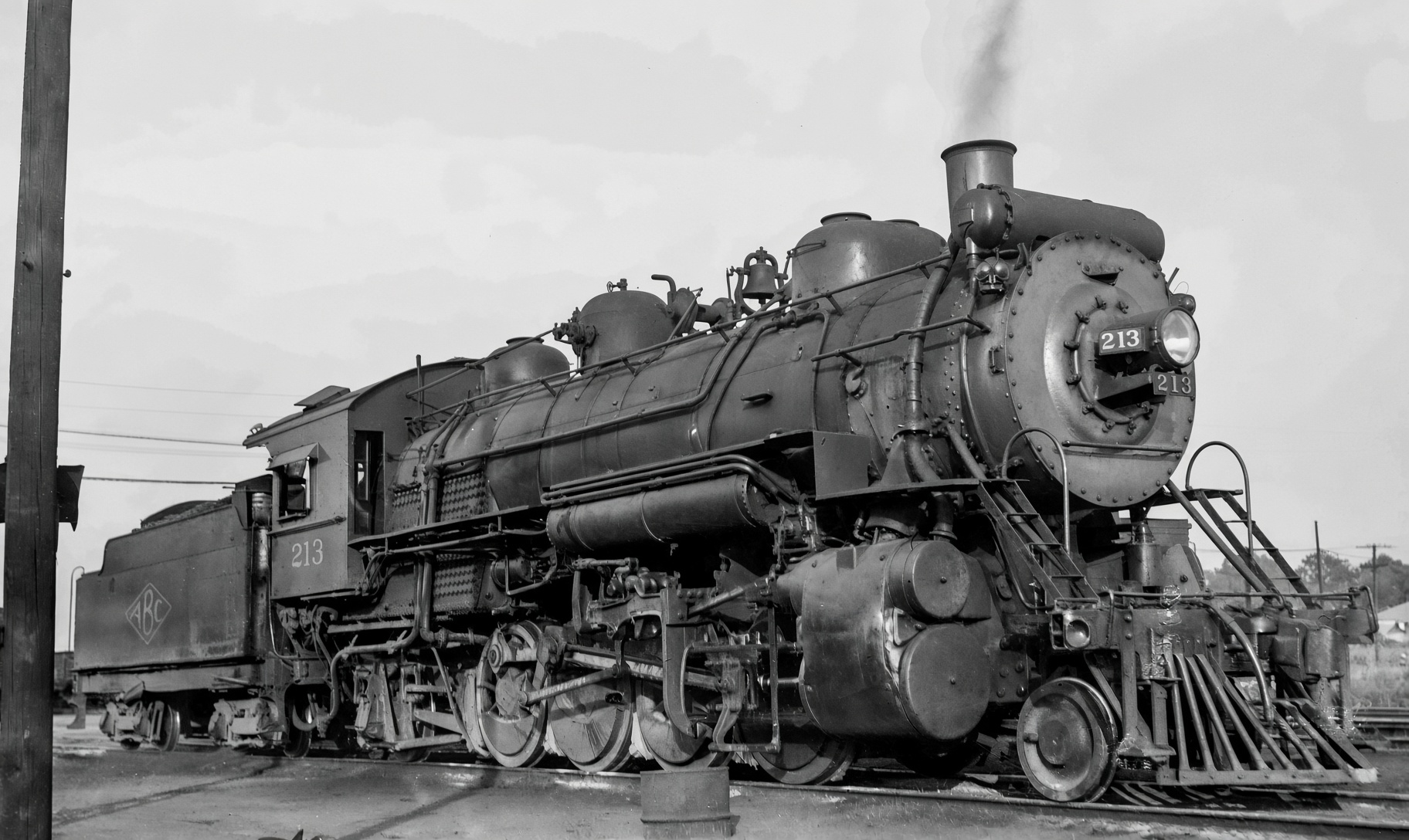
Atlanta, Birmingham & Coast 2-8-2 No. 213 at Birmingham, Alabama, on May 17, 1930. Baldwin built the engine in the early 1910s. It became Atlantic Coast Line 7213.
On this page: Logging roads · Atlanta and Birmingham · Two receiverships · Coast Line control · The railroad in 1940 · At a glance · Steam · Western Division
Logging roads
The oldest piece was a logging railroad. The Waycross Air Line was chartered on October 24, 1887, by the Waycross Lumber Company. In 1890 it opened 25 miles from Waycross to Sessoms for the movement of logs. The first sign that it was acting as a common carrier is a rate circular of the Railroad Commission of Georgia, No. 228, issued July 7, 1893.
The line then crept northwest through the pine woods. Sessoms to Nicholls, 4 miles, came in 1897. Nicholls to Douglas, 13.6 miles, came in 1898. Douglas to Fitzgerald, 28.4 miles, came in 1901. On November 27, 1901, the charter was amended, the name became the Atlantic & Birmingham Railroad, and the company was pointed at Birmingham. Fitzgerald to Cordele, 37 miles, opened in 1902. Cordele to Montezuma, 31.3 miles, opened in 1903. Montezuma, on the Flint River, was as far as this railroad got under its own name.
Two lumber roads filled in the country south and west of Fitzgerald. H. H. Tift, a Tifton lumberman, built the Tifton & Northeastern. It was incorporated on October 15, 1891, ran 24.5 miles from Tifton to Fitzgerald, and opened in 1896. The Tifton, Thomasville & Gulf was incorporated on June 26, 1897. The Union Lumber Company built it, about 55.8 miles from Tifton to Thomasville, and opened it in September 1899. On December 3, 1903, those two companies and the Atlantic & Birmingham Railroad were consolidated as the Atlantic & Birmingham Railway.
The port was a separate railroad. The Brunswick & Birmingham was incorporated on December 11, 1900, to build from Brunswick toward Montgomery and Birmingham. In 1902 it finished 48.70 miles from Brunswick to Offerman, and it bought the Offerman & Western, a logging road of about 35.5 miles from Offerman to Nicholls that had been incorporated on June 22, 1899. The Brunswick company was in receivership on April 30, 1904, sold at foreclosure on August 9, 1904, and conveyed to the Atlantic & Birmingham Railway on September 6, 1904. With that purchase the railway had its own line from the docks at Brunswick to Montezuma, plus the branches to Waycross and Thomasville. The Interstate Commerce Commission later put that railway at about 313.5 miles.
Atlanta and Birmingham
Atlanta men wanted the rest of the map. The principal promoters were H. M. Atkinson, P. S. Arkwright, and G. D. Wadley, with Boston capital beside them. The Atlanta, Birmingham & Atlantic Railroad was chartered on April 19, 1905, to build from Montezuma to Birmingham and from Atlanta to a connection with that line. The paper company’s first president and secretary were W. B. Stovall and S. J. Bradley, employees of Atkinson. The real vehicle was the Atlantic & Birmingham Construction Company. Atkinson was its president. Arkwright was vice president and general manager. The construction contract of May 19, 1905, was signed by Atkinson and Stovall as presidents of the two companies.
The plan was larger than a railroad. The construction company was to build terminals in Atlanta and Birmingham, and it took the stock of the Brunswick Steamship Company and the Birmingham Coal & Iron Company. Steamships were to run from Brunswick to New York and Boston. Coal and iron at Birmingham, and the ships at Brunswick, were supposed to fill the new line with through freight. An agreement of merger with the Atlantic & Birmingham Railway, dated April 12, 1906, took effect on May 1, 1906. From that day the old railway was the Atlanta, Birmingham & Atlantic.
Construction moved fast, and then it did not. The Commission’s valuation records the sections as they were turned over for operation:
| Section | Opened | Miles |
|---|---|---|
| Montezuma to Talbotton | February 18, 1906 | 43.90 |
| Talbotton to LaGrange | March 3, 1907 | 48.70 |
| LaGrange to Roanoke, Alabama | August 4, 1907 | 24.30 |
| Roanoke to Wadley | September 8, 1907 | 14.10 |
| Wadley to Talladega | December 22, 1907 | 53.00 |
| Talladega to Pelham | September 6, 1908 | 49.40 |
| Pelham to Reader’s Gap | July 1, 1910 | 13.00 |
| Manchester to Atlanta, freight | April 14, 1908 | 75.70 |
| Manchester to Atlanta, passengers | June 21, 1908 |
The contract had called for the Atlanta line to leave the Birmingham line at Warm Springs. It left at Manchester instead, and Manchester became the junction on which the railroad turned. The Birmingham main reached that neighborhood in 1907, on the way from Talbotton to LaGrange. Reader’s Gap, the end of the owned main stem, is a short distance southeast of Bessemer. The company entered Birmingham over the Alabama Terminal Railroad, which it leased. Into Atlanta it leased the Georgia Terminal Company. One older railroad was rebuilt into the new main line. The Eastern Railway of Alabama, incorporated May 1, 1901, ran 19.8 miles from the pyrites mines at Pyriton to a Louisville & Nashville connection at Stockdale. It opened on September 8, 1903. The construction company took control on November 10, 1905, and the deed to the Atlanta, Birmingham & Atlantic is dated July 3, 1906.
The shops in the construction contracts were at Fitzgerald. The valuation of June 30, 1914, found the owned main track at 623.813 miles: Brunswick to Reader’s Gap, about 444 miles; Manchester to Atlanta, about 75 miles; Fitzgerald to Thomasville, 80.373 miles; and Sessoms to Waycross, about 25 miles. With the leased terminals and a little trackage, the receiver was operating about 642 miles.
The through traffic never arrived. The construction company lost the steamship stock and the coal-company stock. The Commission’s conclusion was direct. The railroad had been built for a combination it did not keep, and it lived on local freight.
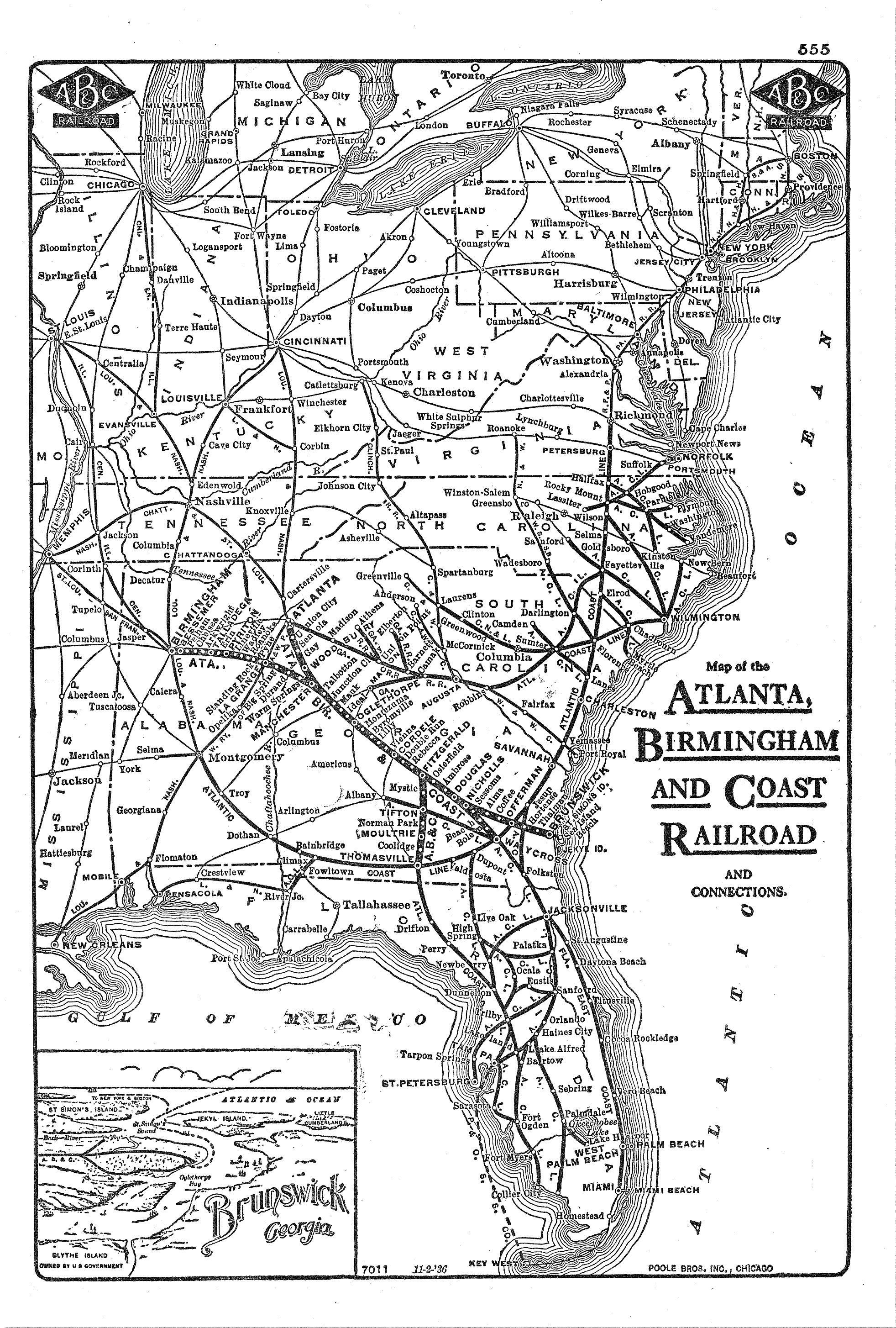
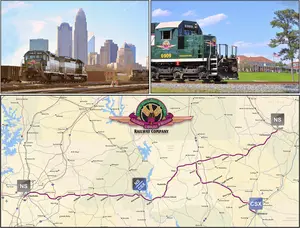
System map of the Atlanta, Birmingham & Coast and its connections, 1936, from the March 1940 Official Guide. Brunswick, Waycross, Fitzgerald, Manchester, Atlanta, Birmingham, and Thomasville are the railroad’s own cities. The through lines to Chicago and Florida are connections.
Two receiverships
Interest due on January 1, 1909, was not paid. That night Judge Don A. Pardee of the United States circuit court placed the railroad in receivership and named the two promoters, H. M. Atkinson and P. S. Arkwright, as the receivers. Their authority was extended the next month to the Alabama terminal company and the Georgia terminal company. The owned track was still short of Reader’s Gap. That last 13 miles opened on July 1, 1910, with the railroad already in court.
A foreclosure sale on June 5, 1914, failed because the bidders could not complete the purchase, and the receivership went on. A plan adopted in 1914 was redone at the close of 1915. The new company, the Atlanta, Birmingham & Atlantic Railway, was incorporated in January 1916 and took possession on January 1, 1916. The United States Supreme Court later described that reorganization as a wipeout of $35,000,000 in stock and $14,500,000 in bonds. The railroad had been under the United States Railroad Administration with the rest of the country’s railroads during the war. In 1921 it went through a bitter strike. The 1916 company failed as well.
Coast Line control
On June 22, 1926, the property was sold at foreclosure in Atlanta. The court confirmed the sale the next day. The Interstate Commerce Commission’s order of December 21, 1926, authorized a new company, the Atlanta, Birmingham & Coast Railroad, to take the property, and authorized the Atlantic Coast Line to acquire the arrangement. The new company opened its books on January 1, 1927. From the close of 1926 the Coast Line owned all of the common stock.
The Court’s account of the bargain is the one to keep. Another $30,000,000 of stock was wiped out. Holders of the $8,600,000 in bonds then outstanding received 60 percent of face value in 5 percent preferred stock of the new company. The new stock was $5,180,344.07 of redeemable preferred and 150,000 shares of no-par common. The Coast Line took the common, extinguished prior liens aggregating $4,080,699.80, and guaranteed the preferred. George H. Drury records the same moment as Coast Line control in 1926. The line was the Coast Line’s way into Atlanta and Birmingham. It crossed the same kind of country the old Alabama Midland crossed between Bainbridge and Montgomery, ridge after ridge, nothing like the water-level railroad from Richmond to Jacksonville.
The AB&C kept its own officers, its own trains, and its own locomotives. An emergency-board history of the company, written while it was still separate, put the interchange in proportion. About 18 percent of the AB&C’s tonnage was delivered to the Coast Line, and about 18 percent was received from it. The rest was the railroad’s own business and its other connections. In the Commission’s 1929 consolidation plan the AB&C was assigned to the Atlantic Coast Line system.
The railroad in 1940
The March 1940 Official Guide is a picture of the railroad in Coast Line hands and still under its own name. B. L. Bugg was president, in Atlanta. O. E. Brower was general superintendent. W. A. Spell was chief engineer. C. S. Perry was superintendent of motive power. H. Huddleston was superintendent at Manchester. The Wilmington names at the head of the page were Coast Line officers: Lyman Delano, chairman of the executive committee; George B. Elliott, advisory counsel; and C. McD. Davis, a vice-president. The traffic department at 26 Cain Street still included an industrial geologist, Poole Maynard, and agricultural agents at Fitzgerald and LaGrange. The railroad was still out looking for freight on its own line.
The public tables match the map. On the sheet dated January 2, 1940, Atlanta Union Station is mile 0, in Central time. Manchester is 78.2 miles. Montezuma, where the table changes to Eastern time, is 140.1. Fitzgerald is 208.2. Waycross Union Station is 279.3. The continuation down the old Brunswick & Birmingham puts Brunswick at 331.0 miles from Atlanta. On the Birmingham sheet, dated November 26, 1939, Birmingham is mile 0 in Central time, Bessemer is 9.9, Talladega is 73.7, Pyriton is 96.5, LaGrange is 165.1, and Manchester is 195.9. A third table covered Atlanta, Tifton, and Thomasville, so the branch still had passenger trains. The Commission’s 1914 figure for Fitzgerald to Thomasville is 80.373 miles.
Trains 1 and 3 left Atlanta Union Station in the morning, at 7:15 and 9:00, for Cordele, Fitzgerald, and Waycross. Trains 2 and 4 were the returns. Trains 22 and 23 were the Birmingham–Manchester trains, and the same table carried them on toward Fitzgerald, Thomasville, Waycross, and Brunswick. Many of the small stations were flag stops.
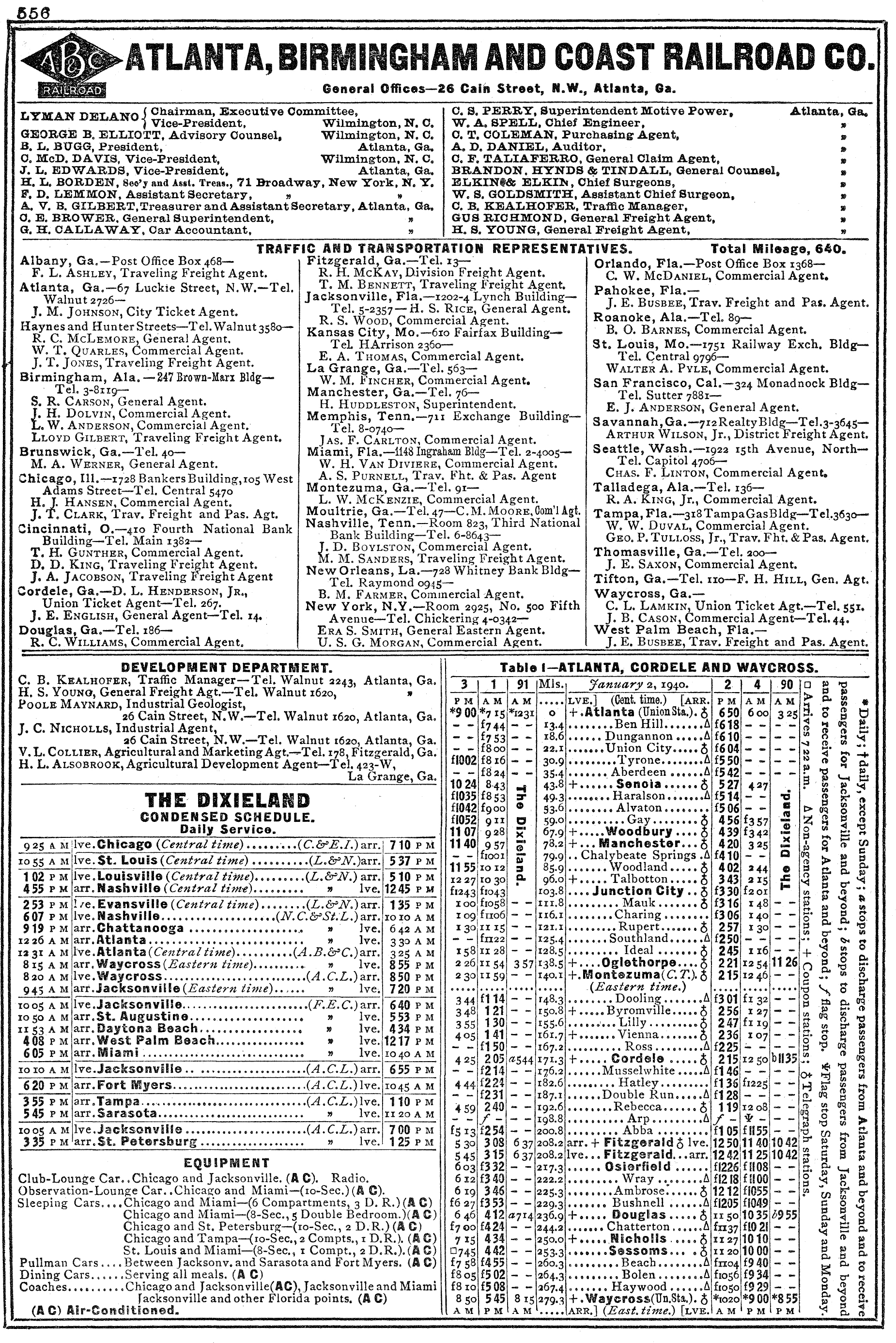
Atlanta, Cordele, and Waycross, dated January 2, 1940, and the condensed schedule of the Dixieland, from the March 1940 Official Guide. General offices are at 26 Cain Street, N.W., Atlanta. The page’s own mileage is 640.
The train the railroad advertised was the Dixieland. The Guide called it the fastest train by the shortest route between Chicago and St. Louis and the Florida resorts, completely air-conditioned, and the only train with only one night out between Chicago and St. Louis and the Florida peninsula. The cars were marked air-conditioned: a club-lounge between Chicago and Jacksonville, an observation-lounge between Chicago and Miami, sleepers for Miami, St. Petersburg, and Tampa, a St. Louis–Miami sleeper, dining cars, and coaches.
The route, as the Guide printed it, used five other railroads around the AB&C leg. Chicago to Evansville was the Chicago & Eastern Illinois. St. Louis to Evansville and Evansville to Nashville was the Louisville & Nashville. Nashville to Atlanta was the Nashville, Chattanooga & St. Louis. Atlanta to Waycross was the AB&C. Waycross to Jacksonville, and Jacksonville to St. Petersburg, was the Atlantic Coast Line. Jacksonville to Tampa and Jacksonville to Miami was the Florida East Coast. Southbound train 91, the Dixieland, left Atlanta Union Station at 12:31 a.m. Central Time and reached Waycross Union Station at 8:15 a.m. Eastern Time. The northbound train, No. 90, reached Atlanta at 3:25 a.m.
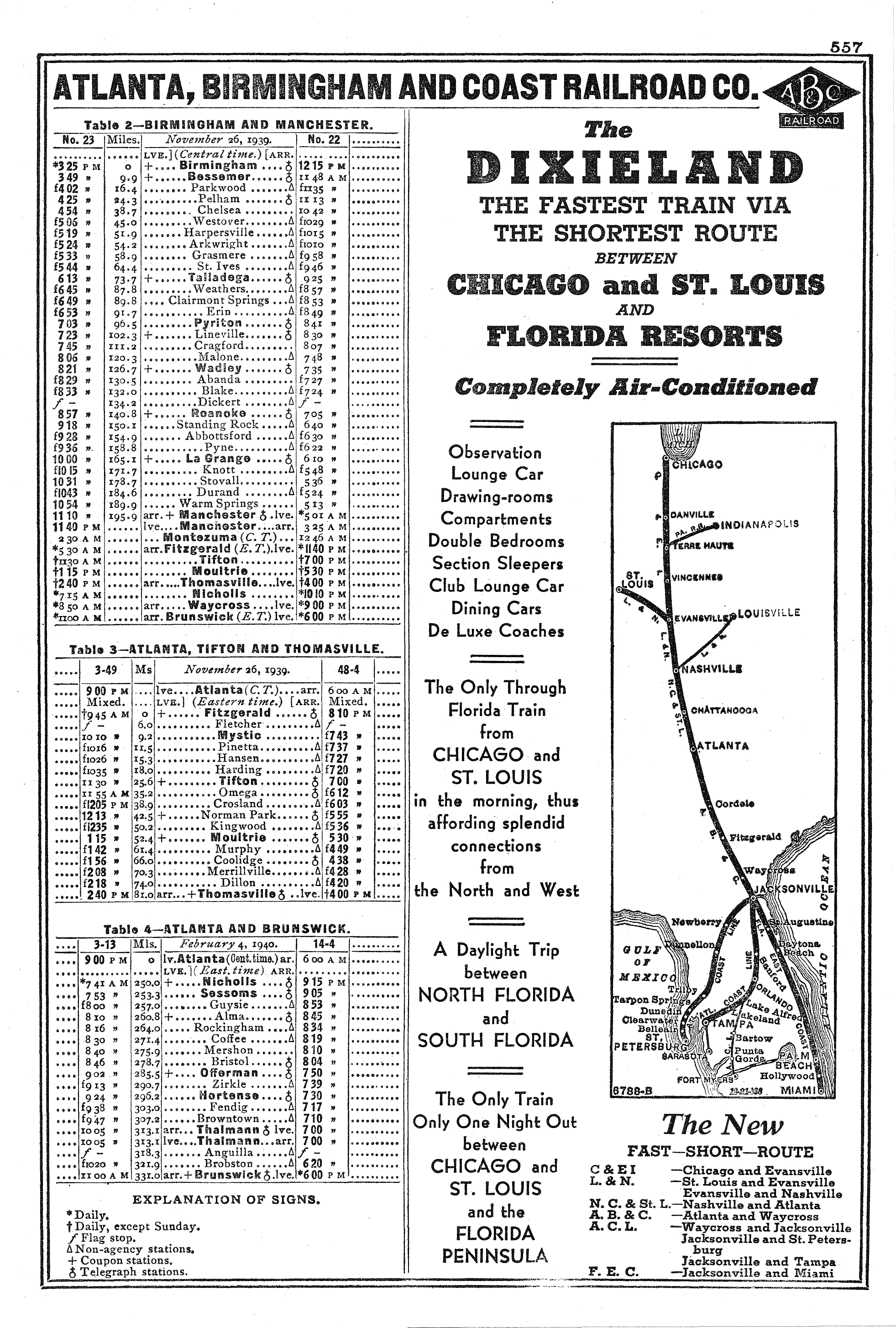
Birmingham and Manchester, dated November 26, 1939, from the March 1940 Official Guide, with the Dixieland advertisement and the route from Chicago and St. Louis to Florida. Brunswick, on the continuation of the Atlanta table, is 331 miles from Atlanta.
Later the same year the AB&C picked up a streamliner. The Dixie Flagler was inaugurated on December 17, 1940. The Coast Line’s subsidiary carried it from Atlanta to Waycross, and Pacific No. 79, a former Florida East Coast engine, was streamlined that December with a skyline casing and a bullet nose to lead it. The March Guide is the Dixieland. The Flagler came after that issue.
At a glance
| Item | Detail |
|---|---|
| Railroad | Atlanta, Birmingham & Coast Railroad, from January 1, 1927. Preceded by the Atlanta, Birmingham & Atlantic Railway, from January 1, 1916, and the Atlanta, Birmingham & Atlantic Railroad, chartered April 19, 1905 |
| Herald | AB&C, in a diamond |
| Headquarters | 26 Cain Street, N.W., Atlanta, in the March 1940 Official Guide. Principal offices were already in Atlanta at the 1914 valuation |
| States | Georgia and Alabama |
| Gauge | 4 feet, 8½ inches |
| Mileage | 640 miles in the March 1940 Official Guide. Owned main track 623.813 miles at the valuation of June 30, 1914. The receiver then operated about 642 miles, including leased terminals |
| Main line | Brunswick–Waycross–Fitzgerald–Manchester, then Manchester–Atlanta and Manchester–Birmingham. Thomasville branch from Fitzgerald through Tifton and Moultrie |
| Junction | Manchester. Atlanta Union Station was 78.2 miles north of it on the January 2, 1940 table. Birmingham was 195.9 miles west of it on the November 26, 1939 table |
| Shops | Fitzgerald, in the construction contracts. Superintendent at Manchester in 1940 |
| Control | Atlantic Coast Line, all of the common stock, from the close of 1926. ICC order December 21, 1926 |
| Passenger train | Dixieland, trains 90 and 91, Atlanta to Waycross, in the March 1940 Guide. Dixie Flagler from December 17, 1940 |
| Steam conveyed | 64 locomotives in the table below, the engines Drury places on the Coast Line after the merger |
| Merged | January 1946, after separate operation through the end of 1945. Atlantic Coast Line Western Division |
| Line today | CSX Transportation still uses the line through Fitzgerald and Manchester, between Waycross, Atlanta, and Birmingham |
Steam
Drury’s word for the fleet that came with the merger was a ragtag assortment of secondhand locomotives. The Coast Line gave them class letters that begin with A. The table is those engines, in the numbers the Coast Line assigned, plus five former AB&C six-wheel switchers that took ordinary Coast Line numbers in class E-13. The quantity column totals 64. It is the fleet conveyed at the merger. It is not a list of every locomotive the Atlanta, Birmingham & Atlantic ever owned. A span with a smaller quantity means the class did not use every number in the span.
The freight engines were Mikados. Seventeen of them reached the Coast Line, in three classes. Four small Baldwins, built in 1912–1915, were AB&C 205, 208, 209, and 213. No. 213 is the engine in the photograph. They became Coast Line class AK-1, Nos. 7205, 7208, 7209, and 7213. They were what remained of a larger Baldwin group the AB&C had numbered 201–215. The others had been sold or scrapped before the merger. Eleven more Mikados, AB&C 225–235, were secondhand New York Central engines, Alco, built 1912–1915, ten of them rebuilt from Consolidations. They became class AK-2, 7225–7235. Two Baldwin Mikados of 1910, AB&C 301 and 302, became class AK-3, Nos. 7301 and 7302, and were scrapped soon after the Coast Line acquired them.
The passenger engines were mostly Pacifics bought used. Eleven former Florida East Coast Pacifics, Schenectady, 1911–1913, were lighter than any Pacific the Coast Line had designed for itself. They became class AJ-1, numbered in the span 7071–7086. Two former Great Northern Pacifics, Lima, 1914, became class AJ-2, Nos. 7153 and 7175, and were somewhat heavier than a Coast Line P-4. No. 79, one of the Florida East Coast Pacifics, carried the skyline casing for the Dixie Flagler. Two former Florida East Coast Mountains, Schenectady, 1924, were AB&C 351 and 372 and became Coast Line 7351 and 7372, class AM-1, in 1946.
The Ten-wheelers were the railroad’s own Baldwins of 1906 and 1907, later superheated, with Baker valve gear in place of the old Stephenson motion. Seventeen of them reached the Coast Line as classes AW-1 through AW-4. Three Atlantics, Baldwin, 1917, became class AF-1. Three 0-8-0s, class AS-2, were rebuilt from Ten-wheelers in the AB&C shops in 1939–1942. One former Norfolk & Western 4-8-0, Baldwin, 1906, became Coast Line 7034. That number sits inside the AS-2 span 7033–7035, and Drury prints it there. The switchers were five Baldwin 0-6-0s of 1907, class E-13, which looked like a United States Railroad Administration switcher and had no superheater, and three more 0-6-0s, class AS-1, Baldwin, 1923–1926.
The Coast Line retired its last steam locomotive on June 30, 1955. Most of the AB&C engines were already gone by then. The AJ-1 Pacifics are the class whose retirement range runs out to that year. The Mikados were finished by 1952.
| Type | ACL class | ACL numbers | Qty | Builder | Built | Retired | Notes |
|---|---|---|---|---|---|---|---|
| 0-6-0 | E-13 | 1146–1150 | 5 | Baldwin | 1907 | 1950–1952 | Ex-AB&C. No superheater |
| 0-6-0 | AS-1 | 7023–7028 | 3 | Baldwin | 1923–1926 | 1946–1952 | Not every number in the span |
| 0-8-0 | AS-2 | 7033–7035 | 3 | AB&C | 1939–1942 | 1952 | Rebuilt from 4-6-0s in the AB&C shops |
| 2-8-2 | AK-1 | 7205, 7208, 7209, 7213 | 4 | Baldwin | 1912–1915 | 1946–1951 | AB&C 205, 208, 209, and 213. No. 213 is the Birmingham photograph |
| 2-8-2 | AK-2 | 7225–7235 | 11 | Alco | 1912–1915 | 1947–1952 | AB&C 225–235. Ex-New York Central. Ten had been rebuilt from 2-8-0s |
| 2-8-2 | AK-3 | 7301, 7302 | 2 | Baldwin | 1910 | 1946, 1947 | AB&C 301 and 302 |
| 4-4-2 | AF-1 | 7401–7403 | 3 | Baldwin | 1917 | 1951–1952 | Ex-AB&C |
| 4-6-0 | AW-1 | 7060 | 1 | Baldwin | 1922 | 1952 | |
| 4-6-0 | AW-2 | 7064 | 1 | Baldwin | 1907 | 1949 | Ex-AB&C |
| 4-6-0 | AW-3 | 7101–7113 | 6 | Baldwin | 1907 | 1949 | Ex-AB&C. Not every number in the span |
| 4-6-0 | AW-4 | 7115–7124 | 9 | Baldwin | 1906–1907 | 1950–1952 | Ex-AB&C. Not every number in the span |
| 4-6-2 | AJ-1 | 7071–7086 | 11 | Schenectady | 1911–1913 | 1946–1955 | Ex-AB&C, ex-Florida East Coast. Not every number in the span |
| 4-6-2 | AJ-2 | 7153, 7175 | 2 | Lima | 1914 | 1949, 1950 | Ex-AB&C, ex-Great Northern |
| 4-8-0 | AS-3 | 7034 | 1 | Baldwin | 1906 | 1949 | Ex-AB&C, ex-Norfolk & Western. The number sits inside the AS-2 span |
| 4-8-2 | AM-1 | 7351, 7372 | 2 | Schenectady | 1924 | 1951 | AB&C 351 and 372. Ex-Florida East Coast. To the Coast Line in 1946 |
The rows total 64 locomotives. The class-by-class Coast Line roster, and the rest of the A-prefix story as Drury tells it, is the Atlantic Coast Line steam roster.
Western Division
The AB&C kept its own name through the Second World War. At the end of 1945 it was still a separate railroad. In January 1946 the Atlantic Coast Line merged it and made the property the Western Division. Larry Goolsby, who has written the book-length history of the line, put the next step in a Manchester newspaper column: the Coast Line rebuilt the railroad to a modern standard. The secondhand steam went to work in Coast Line numbers, and then it went to scrap.
The corporate chain from there is the Coast Line’s. The Seaboard Coast Line began on July 1, 1967. From 1972 through 1982 the family of railroads was marketed as the Family Lines. The Seaboard Coast Line and the Louisville & Nashville merged into the Seaboard System on December 29, 1982. CSX Corporation dates from November 1, 1980. CSX Transportation dates from July 1, 1986. The line through Fitzgerald and Manchester is still a CSX route between Waycross, Atlanta, and Birmingham, which is the assignment the builders of 1905 were chasing and the traffic the receivers never saw.
Related reading on American-Rails.com
- Atlantic Coast Line · Atlantic Coast Line steam roster · Seaboard Coast Line · Family Lines · CSX Transportation
- Dixie Flagler · Florida East Coast · Louisville & Nashville · Nashville, Chattanooga & St. Louis · Chicago & Eastern Illinois
- 2-8-2 Mikado locomotives · 4-6-2 locomotives · 4-8-2 locomotives
Sources
- Interstate Commerce Commission, Valuation Reports, Volume 75, Atlanta, Birmingham & Atlantic Railroad, valuation date June 30, 1914. Charter of April 19, 1905, the May 1, 1906 merger, receivers on January 1, 1909, the construction dates and miles, owned main track of 623.813 miles, about 642 miles operated by the receiver, the predecessor logging roads, the Eastern Railway of Alabama, Fitzgerald shops, and the Commission’s conclusion that the railroad lived on local traffic. Promoters H. M. Atkinson, P. S. Arkwright, and G. D. Wadley
- Moody’s Manual of Investments, American and Foreign: Steam Railroads, on the January 1916 incorporation of the Atlanta, Birmingham & Atlantic Railway and possession on January 1, 1916
- Commercial & Financial Chronicle, November 27, 1926. Foreclosure sale of June 22, 1926, confirmed June 23, 1926
- Atlanta, Birmingham & Coast Railroad Co. v. United States, 282 U.S. 522 (1931). The ICC order of December 21, 1926, books opened January 1, 1927, the 1915 wipeout of $35,000,000 in stock and $14,500,000 in bonds, the 1926 wipeout of $30,000,000 more of stock, the $8,600,000 of bonds exchanged at 60 percent into 5 percent preferred, preferred of $5,180,344.07, 150,000 no-par common shares, and prior liens of $4,080,699.80 extinguished by the Atlantic Coast Line. The opinion states the property as 640 miles of line in Alabama and Georgia
- National Mediation Board emergency-board history of the Atlanta, Birmingham & Coast, printed with the board’s report. Atlantic Coast Line sole owner of the common stock since the reorganization at the close of 1926. About 18 percent of tonnage delivered to the Coast Line and about 18 percent received from it
- Official Guide of the Railways, March 1940, the company’s pages. System map of 1936. Total mileage 640. General offices at 26 Cain Street, N.W., Atlanta. Officers, including B. L. Bugg, O. E. Brower, W. A. Spell, C. S. Perry, H. Huddleston, Lyman Delano, George B. Elliott, and C. McD. Davis. Atlanta–Waycross table dated January 2, 1940, with Manchester 78.2, Montezuma 140.1, Fitzgerald 208.2, Waycross 279.3, and Brunswick 331.0. Birmingham–Manchester table dated November 26, 1939, with Manchester 195.9. Trains 1, 2, 3, 4, 22, 23, 90, and 91. The Dixieland condensed schedule, equipment, and route
- George H. Drury, Guide to North American Steam Locomotives, revised edition, Atlantic Coast Line chapter. Control in 1926. The A-prefix classes and class E-13. Quantities, builders, built years, retirements, and the June 30, 1955 last steam date of the Coast Line. The class grid on this page is that chapter’s AB&C rows
- Wes Barris, steamlocomotive.com, Atlanta, Birmingham & Atlantic Mikado and Pacific pages, drawing on AB&C diagram books of 1928, 1930, and 1942 supplied by Allen Stanley. AB&C Mikado numbers 201–215, of which 205, 208, 209, and 213 reached the Coast Line; 225–235; and 301–302. Pacific 79 streamlined in December 1940 for the Dixie Flagler
- Larry Goolsby, “The True History of the Old Caboose,” Harris County Journal (Hamilton, Ga.), October 18, 2012. The railroad reached Manchester in 1907, the 1921 strike, separate operation until 1945, absorption in 1946, and the rebuilding of the line. His Atlanta, Birmingham & Coast (Atlantic Coast Line and Seaboard Air Line Historical Society, 2000) is the book-length history
- Dixie Flagler on this site. Inaugurated December 17, 1940. The AB&C carried the train from Atlanta to Waycross
Recent Articles


-
Atlanta, Birmingham & Coast Railroad: Map, History, Roster
Nov 05, 26 12:03 PM
 Atlanta, Birmingham & Coast, from Brunswick and Waycross to Atlanta and Birmingham. Atlantic Coast Line control at the close of 1926. Merged in January 1946 as the Western Division. Steam roster of th…
-
El Paso & Southwestern Railroad: Map, History, Logo
Nov 05, 26 12:00 PM
 The El Paso & Southwestern, the Phelps Dodge copper railroad from Tucson to the Rock Island at Tucumcari. Southern Pacific control on October 31, 1924.
-
Brightline Says Orlando Service Has Resumed
Nov 05, 26 11:55 AM
 Brightline said on November 5, 2026, that trains to and from Orlando have resumed after weather suspensions in Brevard County. Later that morning the departures page still showed the Orlando segment s…
-
Metra Customers Must Sign Up Again
Nov 05, 26 11:43 AM
 Metra says customers who want service alerts must sign up again at metratracker.com. The November 2 story says the new system has launched and the old email list is shut down. A notice on the same pag…
-
Norfolk Southern Packs Six Projects Into One Window
Nov 05, 26 11:38 AM
 Norfolk Southern used one 26-hour window on the W Line for six projects in Indiana and Kentucky, including three bridge replacements. The October 27 account does not give the calendar day of the work.
-
CSX: More Time to Comment on an Inspection Waiver
Nov 05, 26 11:29 AM
 The Federal Railroad Administration extended comments on a CSX petition for relief from some qualified mechanical inspector rules until December 2, 2026. The November 2 notice does not grant the waive…
-
Brightline Expects Orlando Service on Thursday
Nov 05, 26 09:21 AM
 Brightline said on November 4, 2026, that it expects trains to and from Orlando to resume on Thursday, November 5. South Florida stations kept running. The departures page still showed the Orlando seg…
-
Union Pacific: More Time to Comment on an Inspection Waiver
Nov 05, 26 09:15 AM
The Federal Railroad Administration extended comments on a Union Pacific petition for relief from some qualified mechanical inspector rules until December 2, 2026. The November 2 notice does not grant… -
Wisconsin Opens Comments on the 2027 Freight Plan
Nov 05, 26 09:03 AM
 WisDOT opened the draft 2027 State Freight Plan for comment through December 1, 2026. The plan covers freight rail with highways, harbors, aviation, and intermodal links. Completion is expected in sum…
-
U.S. Rail Traffic Rose 3.5 Percent in the Week Ending October 31
Nov 05, 26 08:52 AM
U.S. railroads moved 514,080 carloads and intermodal units in the week ending October 31, 2026, up 3.5 percent from a year earlier, the Association of American Railroads said on November 4. -
Muni and Bay Area Transit Measures Pass
Nov 05, 26 08:49 AM
 San Francisco Municipal Transportation Agency said on November 4, 2026 that Proposition H and a regional transit measure passed. Proposition H is about 160 million dollars a year for Muni. The regiona…
-
Ground Rules Set for Responsive Applications
Nov 05, 26 08:47 AM
Decision No. 46, served November 4, 2026, denies a request to add Walsenburg to the Union Pacific interchange list and sets what CPKC and CN must include in responsive applications. Four CPKC proposal… -
Video of the Vena Address Must Be Released
Nov 05, 26 08:42 AM
The Surface Transportation Board on November 4, 2026 denied the Union Pacific appeal and ordered the March 17 shipper-conference recording released to the parties by 5:00 p.m. Eastern on November 5. C… -
Chicago & North Western Iron Ore C628s
Nov 04, 26 11:47 PM
 Chicago and North Western C628s 6701-6730, the ex-Norfolk and Western high-hoods, in Upper Peninsula iron-ore service from the mid-1970s until December 21, 1986, and what happened to each unit.
-
Warrenton Railroad: Serving Warrenton, NC (1884-1985)
Nov 04, 26 10:33 PM
 The three-mile Warrenton Railroad, from Warren Plains to the North Carolina county seat. Chartered January 28, 1871. First train November 8, 1884. Closed in 1985.
-
Rio Grande Steam Locomotives (Since 1900)
Nov 04, 26 11:40 AM
 Denver & Rio Grande Western steam locomotives built since 1900. Standard gauge quantity 435 and narrow gauge 48. Challengers, 2-8-8-2s, Mountains, Northerns, and the K-27, K-28, K-36, and K-37.
-
Rio Grande Diesel Locomotives (All-Time)
Nov 04, 26 11:39 AM
 Denver & Rio Grande Western diesel locomotives, each frame once. 554 units, from the 1941 NW2 through the 1990 GP60s. FT, F3, F7, and F9 sets are not counted again under their 1950 numbers.
-
Rio Grande Railroad: Map, Logo, History, Rosters
Nov 04, 26 11:34 AM
 Denver & Rio Grande Western history, from William Jackson Palmer and the October 27, 1870 charter through the Royal Gorge, the Moffat route, the California Zephyr, and Union Pacific common control…
-
Lindblom Gift Expands the Fort Wayne Restoration Shop
Nov 04, 26 11:14 AM
 Art Lindblom gave the Fort Wayne Railroad Historical Society more than $1.4 million, its largest single gift, to expand the New Haven shop. The addition is planned for late 2026 and early 2027. A sepa…
-
Design Contract Awarded for the Forest Park Branch
Nov 04, 26 11:09 AM
The Chicago Transit Board approved a design contract for about 13 miles of Blue Line track from the Illinois Medical District to the I-290 Bridge. The release summary calls it a $17 million contract… -
Kanawha River Railroad: The Norfolk Southern Lease Is Renewed
Nov 04, 26 10:51 AM
 Kanawha River Railroad filed to keep leasing 309.45 miles from Norfolk Southern in West Virginia and Ohio. The second amendment is dated August 17, 2026. The Board has not set the date the exemption t…
-
Short Line Center Awarded a $5.625 Million Grant
Nov 04, 26 10:35 AM
The American Short Line and Regional Railroad Association received a $5.625 million CRISI grant on October 20, 2026, for the Short Line Training Center. A 25 percent match brings the project to $7.5 m… -
Palestine and Rusk Track Rebuild Finishes Its First Phase
Nov 04, 26 09:13 AM
 The Texas & Eastern Railroad has finished the first phase of a roughly $30 million track project between Palestine and Rusk. Phase I used a $13.4 million CRISI grant. Phase II, at $8.54 million, adds…
-
Manhattan, Brooklyn, Queens, and the Bronx Get Subway Power Design
Nov 04, 26 09:12 AM
STV said on November 2, 2026, that MTA Construction and Development selected the firm to manage design of 10 subway substations and 12 circuit breaker houses in four New York boroughs. No contract pri… -
Chicago's Regional Transit Budget Goes Out for Comment
Nov 04, 26 09:07 AM
The Northern Illinois Transit Authority opened its first regional budget for comment through December 4, 2026. The proposal is $5.04 billion for 2027 operations and $9.73 billion in capital work throu… -
VIA Rail Finishes the Toronto Maintenance Centre
Nov 04, 26 09:05 AM
VIA Rail completed a four-year modernization of its Toronto Maintenance Centre on November 2, 2026. The Government of Canada invested $310 million. The shop supports 32 Corridor trainsets and will sus… -
Brightline Suspends Orlando Service for High Water
Nov 04, 26 09:02 AM
Brightline suspended trains between Orlando and West Palm Beach on November 2, 2026, because of high water in Brevard County. A later post the same day kept the suspension until 2:00 p.m. on November… -
Hiawatha West Draws Federal Funding Toward Madison
Nov 04, 26 08:58 AM
 Amtrak welcomed a CRISI selection for Hiawatha West, extending Chicago-Milwaukee service toward Madison, Watertown, and Pewaukee. Wisconsin said on October 16 that the award is over $218 million.
-
Seattle's Train Maintenance Facility Opens for Airo Trains
Nov 04, 26 08:56 AM
 Amtrak cut the ribbon October 23, 2026, on a $250 million Seattle shop for Airo trains on the Cascades route. The building came in on time and $50 million under budget and opens in phases through the…
-
Aberdeen Carolina and Western Wins a $19.9 Million Grant
Nov 04, 26 08:46 AM
 The Aberdeen Carolina and Western Railway won a $19.9 million CRISI grant for about 30 miles of welded rail in Montgomery and Stanly counties. The railroad and NCDOT are putting up a 52 percent match…
-
Alco "C628" Locomotives: Roster, Data Sheet, Specs
Nov 03, 26 07:57 PM
 Alco Century C628: 2,750 hp C-C road switcher, 186 built from December 1963 to December 1968. Production roster, specs, and where the high-hood Norfolk and Western units went.
-
Santa Fe Railroad (AT&SF): Diesel Roster (All-Time)
Nov 03, 26 12:54 PM
 Santa Fe diesel locomotives, each new frame once, with construction numbers and order numbers. The counted total is 3,964, from the 1935 boxcabs through the SD75Ms.
-
Metra Holiday Trains Return on Six Lines
Nov 03, 26 11:40 AM
 Metra holiday trains will run on six lines in December, with tickets on sale at noon November 16 for $10. The Chicago Transit Authority and Pace are fielding holiday buses in the same regional announc…
-
Amtrak Encourages Early Booking for Thanksgiving
Nov 03, 26 11:39 AM
 Amtrak is asking travelers to book Thanksgiving trips early. The railroad carried more than 1.2 million customer trips over the 2025 holiday and expects another record, with extra Northeast Regional s…
-
Channel Pacific Keeps Its West Sacramento Exemption
Nov 03, 26 11:26 AM
The Surface Transportation Board denied a West Sacramento challenge to Channel Pacific Railroad’s exemption to operate about 2,132 feet of terminal track. The exemption took effect in June 2026. -
DART Marks One Year of the Silver Line
Nov 03, 26 11:22 AM
 DART marked one year of Silver Line service linking seven North Texas cities and DFW Airport. The 26-mile regional rail line opened October 25, 2025, as the agency’s first rail expansion in a decade.
-
Massachusetts Breaks Ground for the Berkshire Flyer
Nov 03, 26 10:07 AM
Massachusetts broke ground October 29 in Pittsfield on track work meant to support permanent seasonal Berkshire Flyer service. MassDOT has $31 million for the project in its 2027-2031 capital plan. -
Cheraw Scrapyard Closed After a Search for CSX Rail
Nov 03, 26 10:02 AM
Chesterfield County deputies, CSX police, and state agents searched Cheraw Iron and Metal on October 27 and closed the yard after finding CSX rail and telephone wire. -
Union Pacific Urges the Board to Keep a Speech Video Confidential
Nov 03, 26 09:53 AM
Union Pacific on October 30 asked the Surface Transportation Board to keep a recording of Jim Vena’s shipper speech confidential while it appeals. BNSF on November 2 asked the board to deny that… -
Enfield Station Construction Begins on the Hartford Line
Nov 03, 26 09:39 AM
 Connecticut has started a $125.3 million Enfield station on the Hartford Line, restoring passenger service for the first time since 1986. The state expects construction to finish in fall 2030.
-
Santa Fe Steam Roster (Built Since 1900)
Nov 03, 26 09:30 AM
 Featured here is the Santa Fe's all-time steam roster after 1900. The railroad operated a wide and varied collection of wheel arrangements.
-
Santa Fe Railroad: Map, Logo, History, Rosters
Nov 03, 26 09:16 AM
 History of the Atchison, Topeka and Santa Fe, from Cyrus Holliday’s 1859 charter to the Burlington Northern merger on December 31, 1996. The Warbonnet, the Super Chief, and the Chicago to Los An…
-
Asheville Rail Corridor Gets $35.8 Million
Nov 03, 26 12:18 AM
The U.S. Department of Transportation awarded North Carolina $35.8 million for development, design, and construction on the Salisbury to Asheville corridor, including more than 40 crossing-signal syst… -
Le Mars Transload Center Expands on Canadian National
Nov 03, 26 12:06 AM
Burlington Junction Railway has expanded the Le Mars Transload Center beside Canadian National and U.S. Highway 75. A zero-interest Iowa DOT loan paid for part of the work. The center and industrial p… -
Lehigh Gorge Trains Move to Nesquehoning
Nov 02, 26 11:48 PM
Reading and Northern has moved Lehigh Gorge Scenic Railway trips to Nesquehoning after the October 31 rockslide west of Jim Thorpe. Trains leave at 11 a.m., 1 p.m., and 3 p.m. through Sunday, November… -
Texas Transit Agency Breaks Ground on TEXRail
Nov 02, 26 11:40 PM
 Trinity Metro broke ground October 29, 2026, on a $270 million, 2.1-mile TEXRail extension from Fort Worth T&P Station to a new Near Southside station on land donated by Baylor Scott and White Hea…
-
Lake Front Depot: The C&NW's Milwaukee Terminal
Nov 02, 26 09:40 PM
 The Chicago and North Western Lake Front Depot at 915 East Wisconsin Avenue, Milwaukee. Charles Sumner Frost, 1889. Last train May 15, 1966. Clock tower down May 7, 1968.
-
Canal Street Maintenance Plan Will Get an FRA Review
Nov 02, 26 01:48 PM
The Federal Railroad Administration will prepare an environmental assessment of Amtrak Canal Street maintenance plans in Chicago after adding 17 viaduct repairs to a project that had a categorical exc… -
Durango & Silverton Repairs Track After Continued Flooding
Nov 02, 26 01:40 PM
 Durango & Silverton crews are repairing flood damage after the Animas hit 11,200 cfs on October 23. The Highline Express ran October 27 through November 1. Polar Express trains remain listed from…
-
Middle Georgia Megasite Will Host the First Audi Plant in the U.S.
Nov 02, 26 01:35 PM
 Audi will build its first U.S. plant at the Norfolk Southern-served Middle Georgia Megasite in Peach County, about $4 billion and about 4,500 jobs. Audi and Norfolk Southern publish different construc…