Chicago & North Western Iron Ore C628s
Published: November 3, 2026
By: Adam Burns
For a little more than a decade the heaviest Alco road switchers in the Midwest had one job that suited them. Thirty Century 628s, all of them ex-Norfolk & Western and the only high-short-hood C628s Alco ever built, hauled iron ore between the Empire Mine and the dock at Escanaba. Three units, 8,250 horsepower, a string of about 110 cars, and a grade that asked for both pulling and holding. They were still at it in the mid-1980s, when a big Alco in everyday heavy service was already a rare sight. The last one ran on December 21, 1986.
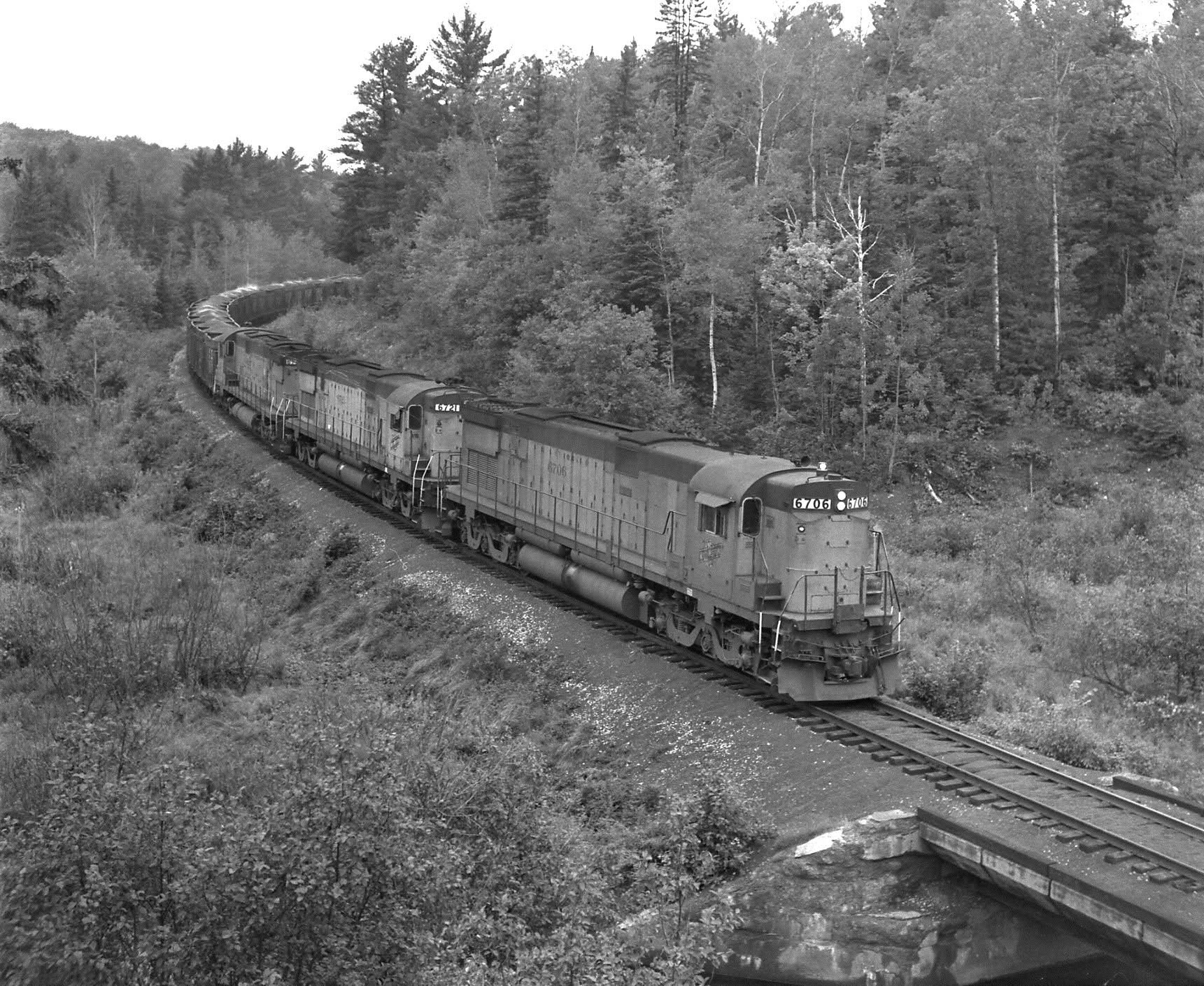
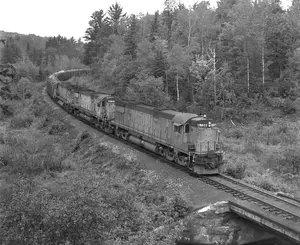
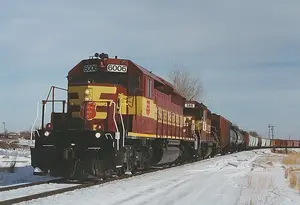
Chicago & North Western's C628s #6706, #6721, and #6702 move ore through the North Country as the trio is seen here ahead of loaded jennies within Michigan's U.P. near Goose Lake on September 12, 1986. Charlie Hill photo.
The model, the other buyers, and the three C628s that still exist are on the C628 page. This page is the North Western’s thirty, #6701–6730. A May 20, 1979, photograph of #6709 and #6729 at Escanaba is on that model page.
On this page: From the Norfolk & Western · The ore job · On the road and in the shop · The last winter · What became of the thirty
From the Norfolk & Western
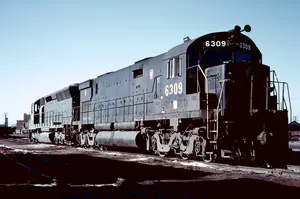
Alco built them as Norfolk & Western #1100–1129. The first ten, order 3429, were finished in October and November 1965. The other twenty, order 3455, were finished in April and May 1966. High short hoods, dynamic brakes, a 16-251C rated at 2,750 horsepower, 74:18 gearing, and an operating weight of 408,000 pounds. That is 204 tons. They were coal-road locomotives on a railroad that was already filling out the rest of the fleet with EMD and General Electric power. Alco left the domestic market in 1969. By the early 1970s the thirty were an orphan class.
The Chicago & North Western leased the whole group on February 1, 1973, and bought it on June 29, 1973. The new numbers followed the old ones in order: #6701 was #1100, and #6730 was #1129. A 1986 film about the fleet, Centuries of the North Woods, sets that purchase against a shortage of road power. They were not sent straight to the ore docks. They went into the general pool, including the Twin Cities Division. The ore assignment came when the Fairbanks-Morse H-16-66s that had been doing the job were retired. By the mid-1970s the high-hoods were the power out of Escanaba, and the 1979 photographs show them settled into it.
The ore job
Escanaba was the center of it. The city keeps Eastern time. The railroad’s day, like the rest of the North Western, ran on Central. A three-unit set came off the servicing track, coupled to about 110 empty ore cars, and the crew made an air test. The empty train was about 2,400 tons. The 61 miles from the ore dock to the Empire Mine are mostly upgrade, a moderate pull for 8,250 horsepower, and the empties were held to 40 miles an hour.
From Partridge the trains were on Lake Superior & Ishpeming trackage rights, under the operator at Eagle Mills, through Empire Junction and into the mine. Little Lake was the usual meet. The northbound empties, timetable west, took the siding. The southbound loads, timetable east, held the main. At the mine the crew set out the empties and picked up about 110 loads, on the order of 9,900 tons. Most of the trip home was in dynamic brake, holding the train to the 30 mile an hour limit for loaded ore cars.
Three was the set. The film’s account of the job is that this was work the C628 had the tools for: lugging ability, a strong dynamic brake, and a machine that would stand an Upper Peninsula winter. Early in the 1980s Escanaba dispatched five or six turns a day to the mine. By 1986 that was down to two or three. Five of the thirty were already off the roster by the summer of 1986, and the twenty-five that remained could not all stay hot on that thinner schedule. A locomotive left sitting too long went downhill in a hurry. The railroad put the 6700s into rotating storage, so the line of stored units was always changing and the ones that had sat went back to work.
They were serviced for years at the Escanaba roundhouse. That house closed in 1984. Two years later the tracks around it were gone, and the film shows the replacement as a servicing spot inside a crane factory on the west side of town. Heavy repairs were another matter. Those were done at Green Bay. The C628s were not confined to the ore turns. They also covered the manifest between Escanaba and Green Bay, the train the railroad called ESGBA. The job that connected with those trains at Powers usually rated two of the North Western’s four C425s. After the C425s were retired in 1986, the film’s usual power there was a GP7 and a C628. In November and December 1985 the big Alcos also got loose on the main line and ran between Green Bay and Proviso, the railroad’s Chicago yard.
On the road and in the shop
The men who ran them and the men who maintained them were not describing the same machine, which is how a lot of good Alcos were remembered.
On the road, the 1986 film presents a locomotive that had found its job. The narration’s point is that the North Western considered the C628s well suited to the ore trains, well enough that they lasted longer than most people looking at an Alco in 1973 would have bet, and that in the middle of the 1980s they were still out every day. The loaded trip home was a dynamic-brake trip. That brake, more than the horsepower number, is what made three units the right size for 9,900 tons on a 30 mile an hour railroad.
At Green Bay the same film follows a lube-oil and filter change on #6725, with roundhouse foreman Al Kawalek and shop superintendent Ron Nickel. The shop view is the practical one. A 251 was more work to keep than a contemporary EMD, and the electrical side, the transition gear and the dynamic-brake contactors, was a standing maintenance item. Weight and length had already kept the model off a lot of railroads. On this one piece of railroad, the ore line, those same traits were the reason the North Western had bought them. Nickel, in the film, already had the next power in view: the SD50s were on the property, and the SD60s were close behind.
The railroad also bought parts to keep the electrical gear alive. In 1982 it picked up five former Conrail U30Cs, #6840–6844, because that model used similar GE equipment. None of the five was numbered or painted Chicago & North Western. All five went back to General Electric as trade-in material in June 1989, after the C628s were done.

C628s 6728 and 6725 at the ore dumper yard in Escanaba, Michigan, in April 1985. The C628s were secondhand from the Norfolk & Western and spent their North Western years in Upper Peninsula ore service. Rob Kitchen photo.
The last winter
Thirty-five SD50s, #7000–7034, had been on the property since November and December 1985. They were 3,500-horsepower units. In September 1986 the first of fifty-five SD60s arrived, #8001–8055, with the 16-710 engine at 3,800 horsepower. The SD60s freed SD50s for the ore job, and the change was sudden.
The first SD50s entered ore service on November 18, 1986. The last C628 ore train ran two days later. Two SD50s replaced three C628s on each ore train, 7,000 horsepower in place of 8,250, and SD40-2s took the Green Bay manifests. By November 29 only #6703 and #6709 were still working, on the dumper at Escanaba. The film dates the closing of the Green Bay backshop to that same November, and notes that the Ishpeming office had closed, with the layover job beginning to tie up at Eagle Mills.
#6703 was the last Alco running on the North Western. On December 21, 1986, she went past the stored sisters, with one more trip on ESGBA still ahead of her. Five days later she was in the deadline with them. The day after Christmas the railroad was an EMD-only road for the first time. #6715 was the exception in the storage line. She had been partly cannibalized at Green Bay. The others sat in the yard at Escanaba. The film’s reading of that deadline is that their future rode with the ore operation: if a buyer took the lines north of Green Bay and took the 6700s with them, the Alcos might run again, and if not, they would not.
Nobody bought the ore lines that way. The units stayed stored. The roster dates below are the mechanical department’s retirements, which run from 1980 to 1990. The last day any of them worked is the December day in 1986.
What became of the thirty
One unit was already gone before the ore job ended. #6705 was retired on December 8, 1980, used for parts, and sold to a Wisconsin scrap dealer. #6713 and #6722 were retired on May 3, 1984, and were still on the property for the 1990 scrap sale. #6714 and #6719 were retired on July 15, 1986, traded to Electro-Motive that August, and scrapped by St. Louis Auto Shredding at Madison, Illinois. #6715, #6716, and #6724 were retired on April 12, 1990, and sold that month to National Railway Equipment at Dixmoor, Illinois. The other twenty-two were retired on October 2, 1990. Those twenty-two, together with #6713 and #6722, were sold for scrap to Pielet Brothers at McCook, Illinois, in September 1990.
That is all thirty. None was preserved.
| C&NW | N&W | Order | Built | Retired | Disposition |
|---|---|---|---|---|---|
| 6701 | 1100 | 3429-01 | October 1965 | October 2, 1990 | Pielet Brothers, McCook, September 1990 |
| 6702 | 1101 | 3429-02 | October 1965 | October 2, 1990 | Pielet Brothers, McCook, September 1990 |
| 6703 | 1102 | 3429-03 | October 1965 | October 2, 1990 | Pielet Brothers, McCook, September 1990. Last to run, December 21, 1986. |
| 6704 | 1103 | 3429-04 | October 1965 | October 2, 1990 | Pielet Brothers, McCook, September 1990 |
| 6705 | 1104 | 3429-05 | October 1965 | December 8, 1980 | Used for parts. Sold to a Wisconsin scrap dealer. |
| 6706 | 1105 | 3429-06 | October 1965 | October 2, 1990 | Pielet Brothers, McCook, September 1990 |
| 6707 | 1106 | 3429-07 | October 1965 | October 2, 1990 | Pielet Brothers, McCook, September 1990 |
| 6708 | 1107 | 3429-08 | November 1965 | October 2, 1990 | Pielet Brothers, McCook, September 1990 |
| 6709 | 1108 | 3429-09 | November 1965 | October 2, 1990 | Pielet Brothers, McCook, September 1990. Still on the Escanaba dumper with #6703 on November 29, 1986. |
| 6710 | 1109 | 3429-10 | November 1965 | October 2, 1990 | Pielet Brothers, McCook, September 1990 |
| 6711 | 1110 | 3455-01 | April 1966 | October 2, 1990 | Pielet Brothers, McCook, September 1990 |
| 6712 | 1111 | 3455-02 | April 1966 | October 2, 1990 | Pielet Brothers, McCook, September 1990 |
| 6713 | 1112 | 3455-03 | April 1966 | May 3, 1984 | Pielet Brothers, McCook, September 1990 |
| 6714 | 1113 | 3455-04 | April 1966 | July 15, 1986 | Traded to EMD, August 1986. Scrapped at Madison, Illinois. |
| 6715 | 1114 | 3455-05 | April 1966 | April 12, 1990 | National Railway Equipment, Dixmoor, April 1990. Partly stripped at Green Bay. |
| 6716 | 1115 | 3455-06 | April 1966 | April 12, 1990 | National Railway Equipment, Dixmoor, April 1990 |
| 6717 | 1116 | 3455-07 | April 1966 | October 2, 1990 | Pielet Brothers, McCook, September 1990 |
| 6718 | 1117 | 3455-08 | April 1966 | October 2, 1990 | Pielet Brothers, McCook, September 1990 |
| 6719 | 1118 | 3455-09 | April 1966 | July 15, 1986 | Traded to EMD, August 1986. Scrapped at Madison, Illinois. |
| 6720 | 1119 | 3455-10 | April 1966 | October 2, 1990 | Pielet Brothers, McCook, September 1990 |
| 6721 | 1120 | 3455-11 | April 1966 | October 2, 1990 | Pielet Brothers, McCook, September 1990 |
| 6722 | 1121 | 3455-12 | April 1966 | May 3, 1984 | Pielet Brothers, McCook, September 1990 |
| 6723 | 1122 | 3455-13 | April 1966 | October 2, 1990 | Pielet Brothers, McCook, September 1990 |
| 6724 | 1123 | 3455-14 | April 1966 | April 12, 1990 | National Railway Equipment, Dixmoor, April 1990 |
| 6725 | 1124 | 3455-15 | April 1966 | October 2, 1990 | Pielet Brothers, McCook, September 1990 |
| 6726 | 1125 | 3455-16 | May 1966 | October 2, 1990 | Pielet Brothers, McCook, September 1990 |
| 6727 | 1126 | 3455-17 | May 1966 | October 2, 1990 | Pielet Brothers, McCook, September 1990 |
| 6728 | 1127 | 3455-18 | May 1966 | October 2, 1990 | Pielet Brothers, McCook, September 1990 |
| 6729 | 1128 | 3455-19 | May 1966 | October 2, 1990 | Pielet Brothers, McCook, September 1990 |
| 6730 | 1129 | 3455-20 | May 1966 | October 2, 1990 | Pielet Brothers, McCook, September 1990 |
Related Reading
- Alco C628
- Chicago & North Western
- Chicago & North Western diesel roster
- Norfolk & Western
- Lake Superior & Ishpeming
- Fairbanks-Morse
- EMD SD40 and SD40-2
Sources
- Strack, Don. Chicago & North Western diesel roster, part 10, Utah Rails, roster of #6701–6730: builder dates, order numbers, retirement dates, and the four disposition notes. The underlying roster is the one prepared for Paul K. Withers, Diesels of the Chicago & North Western.
- Strack, Don. Chicago & North Western roster notes, Utah Rails. Five ex-Conrail U30Cs, #6840–6844, bought in 1982 as electrical parts and traded to GE in June 1989.
- Christopher, Bill. Centuries of the North Woods. East End Productions, filmed in 1986 and released on the East End Productions Archive channel in 2023. Ore-job figures, the Escanaba and Green Bay account, the November 18 and December 21, 1986, dates, and the shop names.
- Sarberenyi, Robert. Alco C628 Original Owners. Confirms the thirty as the only high-short-hood C628s, and the number match to Norfolk & Western #1100–1129.
Recent Articles


-
Chicago & North Western Iron Ore C628s
Nov 03, 26 10:50 PM
 Chicago and North Western C628s 6701-6730, the ex-Norfolk and Western high-hoods, in Upper Peninsula iron-ore service from the mid-1970s until December 21, 1986, and what happened to each unit.
-
Alco "C628" Locomotives: Roster, Data Sheet, Specs
Nov 03, 26 07:57 PM
 Alco Century C628: 2,750 hp C-C road switcher, 186 built from December 1963 to December 1968. Production roster, specs, and where the high-hood Norfolk and Western units went.
-
Santa Fe Railroad (AT&SF): Diesel Roster (All-Time)
Nov 03, 26 12:54 PM
 Santa Fe diesel locomotives, each new frame once, with construction numbers and order numbers. The counted total is 3,964, from the 1935 boxcabs through the SD75Ms.
-
Metra Holiday Trains Return on Six Lines
Nov 03, 26 11:40 AM
 Metra holiday trains will run on six lines in December, with tickets on sale at noon November 16 for $10. The Chicago Transit Authority and Pace are fielding holiday buses in the same regional announc…
-
Amtrak Encourages Early Booking for Thanksgiving
Nov 03, 26 11:39 AM
 Amtrak is asking travelers to book Thanksgiving trips early. The railroad carried more than 1.2 million customer trips over the 2025 holiday and expects another record, with extra Northeast Regional s…
-
Channel Pacific Keeps Its West Sacramento Exemption
Nov 03, 26 11:26 AM
The Surface Transportation Board denied a West Sacramento challenge to Channel Pacific Railroad’s exemption to operate about 2,132 feet of terminal track. The exemption took effect in June 2026. -
DART Marks One Year of the Silver Line
Nov 03, 26 11:22 AM
 DART marked one year of Silver Line service linking seven North Texas cities and DFW Airport. The 26-mile regional rail line opened October 25, 2025, as the agency’s first rail expansion in a decade.
-
Massachusetts Breaks Ground for the Berkshire Flyer
Nov 03, 26 10:07 AM
Massachusetts broke ground October 29 in Pittsfield on track work meant to support permanent seasonal Berkshire Flyer service. MassDOT has $31 million for the project in its 2027-2031 capital plan. -
Cheraw Scrapyard Closed After a Search for CSX Rail
Nov 03, 26 10:02 AM
 Chesterfield County deputies, CSX police, and state agents searched Cheraw Iron and Metal on October 27 and closed the yard after finding CSX rail and telephone wire.
-
Union Pacific Urges the Board to Keep a Speech Video Confidential
Nov 03, 26 09:53 AM
 Union Pacific on October 30 asked the Surface Transportation Board to keep a recording of Jim Vena’s shipper speech confidential while it appeals. BNSF on November 2 asked the board to deny that…
-
Enfield Station Construction Begins on the Hartford Line
Nov 03, 26 09:39 AM
 Connecticut has started a $125.3 million Enfield station on the Hartford Line, restoring passenger service for the first time since 1986. The state expects construction to finish in fall 2030.
-
Santa Fe Steam Roster (Built Since 1900)
Nov 03, 26 09:30 AM
 Featured here is the Santa Fe's all-time steam roster after 1900. The railroad operated a wide and varied collection of wheel arrangements.
-
Santa Fe Railroad: Map, Logo, History, Rosters
Nov 03, 26 09:16 AM
 History of the Atchison, Topeka and Santa Fe, from Cyrus Holliday’s 1859 charter to the Burlington Northern merger on December 31, 1996. The Warbonnet, the Super Chief, and the Chicago to Los An…
-
Asheville Rail Corridor Gets $35.8 Million
Nov 03, 26 12:18 AM
 The U.S. Department of Transportation awarded North Carolina $35.8 million for development, design, and construction on the Salisbury to Asheville corridor, including more than 40 crossing-signal syst…
-
Le Mars Transload Center Expands on Canadian National
Nov 03, 26 12:06 AM
Burlington Junction Railway has expanded the Le Mars Transload Center beside Canadian National and U.S. Highway 75. A zero-interest Iowa DOT loan paid for part of the work. The center and industrial p… -
Lehigh Gorge Trains Move to Nesquehoning
Nov 02, 26 11:48 PM
Reading and Northern has moved Lehigh Gorge Scenic Railway trips to Nesquehoning after the October 31 rockslide west of Jim Thorpe. Trains leave at 11 a.m., 1 p.m., and 3 p.m. through Sunday, November… -
Texas Transit Agency Breaks Ground on TEXRail
Nov 02, 26 11:40 PM
 Trinity Metro broke ground October 29, 2026, on a $270 million, 2.1-mile TEXRail extension from Fort Worth T&P Station to a new Near Southside station on land donated by Baylor Scott and White Hea…
-
Lake Front Depot: The C&NW's Milwaukee Terminal
Nov 02, 26 09:40 PM
 The Chicago and North Western Lake Front Depot at 915 East Wisconsin Avenue, Milwaukee. Charles Sumner Frost, 1889. Last train May 15, 1966. Clock tower down May 7, 1968.
-
Canal Street Maintenance Plan Will Get an FRA Review
Nov 02, 26 01:48 PM
The Federal Railroad Administration will prepare an environmental assessment of Amtrak Canal Street maintenance plans in Chicago after adding 17 viaduct repairs to a project that had a categorical exc… -
Durango & Silverton Repairs Track After Continued Flooding
Nov 02, 26 01:40 PM
 Durango & Silverton crews are repairing flood damage after the Animas hit 11,200 cfs on October 23. The Highline Express ran October 27 through November 1. Polar Express trains remain listed from…
-
Middle Georgia Megasite Will Host the First Audi Plant in the U.S.
Nov 02, 26 01:35 PM
 Audi will build its first U.S. plant at the Norfolk Southern-served Middle Georgia Megasite in Peach County, about $4 billion and about 4,500 jobs. Audi and Norfolk Southern publish different construc…
-
Union Pacific No. 844 Returns Beside Big Boy on November 21
Nov 02, 26 01:30 PM
 Union Pacific 4-8-4 No. 844 is back under steam and will trail Big Boy 4014 from Greeley to Denver on November 21. The pair will then stand on free display at Denver Union Station.
-
Norfolk Southern Abandonment in the Shenandoah Valley Is Stayed
Nov 02, 26 01:19 PM
 The Surface Transportation Board on October 22, 2026, postponed a Norfolk Southern exemption to abandon 48.5 miles from Front Royal to Broadway, Virginia. A response is due November 3.
-
Reading & Northern Sets a November 23 Start in Luzerne
Nov 02, 26 01:13 PM
Reading and Northern expects to begin operating about 59.65 miles of Luzerne County rail line on November 23, 2026. The package is $7 million in cash plus $3 million in track work. -
Second Daily Pennsylvanian Begins November 18
Nov 02, 26 12:19 PM
A second daily Pennsylvanian round trip between New York and Pittsburgh begins November 18, 2026, after 46 years with one round trip. Each city gets a morning departure and an afternoon departure. -
MBTA Sets November Meetings on Regional Rail
Nov 02, 26 12:10 PM
 The MBTA will hold virtual meetings on November 4 and November 17, 2026, from 6:00 to 7:30 p.m., on a plan to turn Commuter Rail into Regional Rail with more frequent servic
-
Wisconsin Central Diesel Roster (Soo Line Years)
Nov 01, 26 11:31 PM
 Diesels built new for the Wisconsin Central in the Soo Line years. 97 locomotives, Alco 24 and Electro-Motive 73. These 97 are already inside the Soo Line roster of 786.
-
Wisconsin Central Ltd. Diesel Roster
Nov 01, 26 11:22 PM
 Wisconsin Central Ltd. diesels, 1987 to 2001. Thirty locomotives with a number fixed by another roster on this site or by a photograph. The fleet stood at 244 units. More than 100 were SD45s.
-
Wisconsin Central Steam Roster (Built Since 1900)
Nov 01, 26 11:20 PM
Wisconsin Central steam locomotives built since 1900. The quantity column is 156. Consolidations, Mikados, Atlantics, Ten-Wheelers, Pacifics, and Mountains. The Soo 4-8-4s stay on the Soo roster. -
Wisconsin Central Railway: Map, History, Logo, Roster
Nov 01, 26 11:15 PM
 Two railroads kept the Wisconsin Central name. The 1871 line was leased to the Soo on April 1, 1909 and merged January 1, 1961. Wisconsin Central Ltd. ran from October 11, 1987 until Canadian National…
-
Watchmen Talks Extended at Los Angeles and Long Beach
Nov 01, 26 10:41 PM
Suggested meta description: The Pacific Maritime Association and ILWU Local 26 extended their contract through 5 p.m. Pacific Time on November 4, 2026, moving a November 1 deadline at the ports of Los… -
LIRR September Ridership Tops the 2019 Mark
Nov 01, 26 10:39 PM
The Long Island Rail Road carried 102 percent of its September 2019 ridership in September 2026, Governor Kathy Hochul said on October 28. Metro-North carried 323,423 riders on October 24 and 25. -
North Carolina Awards the Rogers Road Bridge in Wake Forest
Nov 01, 26 10:22 PM
 NCDOT on October 28, 2026 awarded a contract to Blythe Construction for a bridge over the CSX S-Line on Rogers Road in Wake Forest. Work can start as early as November 30, with opening aimed at fall 2…
-
Trinity Books 2,190 Railcar Orders in the Third Quarter
Nov 01, 26 10:17 PM
 Trinity Industries on October 29, 2026 reported 2,190 new railcar orders and 2,030 deliveries in the third quarter. The company expects industry deliveries below 25,000 railcars in 2026.
-
New York Central's Jade Green E Units
Nov 01, 26 09:25 PM
 In 1961 the New York Central tried Century Green, called Jade Green, on E8As 4053 and 4083 and E7B 4107. Dark gray became the passenger scheme. The green stayed on freight cars.
-
FRA Awards $1.24 Billion for Grade-Crossing Work in 37 States
Nov 01, 26 12:48 PM
The Federal Railroad Administration on October 30, 2026, awarded $1.24 billion for 91 grade-crossing projects in 37 states under the Railroad Crossing Elimination program. -
PATH Director Clarelle DeGraffe Will Retire at the End of 2026
Nov 01, 26 12:43 PM
Clarelle DeGraffe will retire at the end of 2026 after 37 years with the Port Authority of New York and New Jersey. James Sincaglia will succeed her as PATH director. -
Lehigh Gorge Scenic Railway Suspends Trains After a Rockslide
Nov 01, 26 12:30 PM
The Lehigh Gorge Scenic Railway has suspended all trains indefinitely after a rockslide near Jim Thorpe, Pennsylvania, on October 31, 2026. Tickets through November 15 will be refunded. -
Georgia Marks the Opening of the Gainesville Inland Port
Nov 01, 26 12:06 PM
 Norfolk Southern and Georgia Ports marked the Gainesville Inland Port on October 29, 2026. The terminal opened May 4 and can handle 200,000 containers a year at full build-out.
-
BLET Members Ratify Five-Year Deal on the Dakota, Minnesota & Eastern
Nov 01, 26 11:48 AM
 Brotherhood of Locomotive Engineers and Trainmen members have ratified a five-year agreement with CPKC covering Dakota, Minnesota and Eastern lines. Engineers' hourly pay rises 41.42 percent over the…
-
Canada Lists Roberts Bank Terminal 2 as a Project of National Interest
Nov 01, 26 11:03 AM
On October 30, 2026, Canada listed the Roberts Bank Terminal 2 container project at the Port of Vancouver as a project of national interest. The listing includes a widened causeway for rail. -
Amtrak Finishes the First Street Tunnel Work South of Union Station
Nov 01, 26 09:59 AM
 Amtrak on October 26, 2026 finished nine days of work at A Interlocking in the First Street Tunnel south of Washington Union Station. Trains south of the station are back.
-
CPKC Asks the STB to End the Union Pacific-Norfolk Southern Review
Nov 01, 26 12:23 AM
CPKC on October 30, 2026 asked the Surface Transportation Board to end its review of the Union Pacific-Norfolk Southern merger, citing remarks by the Union Pacific chief executive. -
U.S. Rail Traffic Rose 7.8 Percent in the Week Ending October 24
Nov 01, 26 12:13 AM
U.S. railroads moved 538,503 carloads and intermodal units in the week ending October 24, 2026, up 7.8 percent from a year earlier, the Association of American Railroads said. -
Schneider Will Shift Its Eastern Intermodal Freight to NS
Nov 01, 26 12:06 AM
 Schneider said October 29, 2026 that Norfolk Southern will be its primary eastern railroad. The move from CSX begins next month, with official implementation on January 1.
-
Union Pacific Dispatchers Will Vote on ATDA Representation
Nov 01, 26 12:00 AM
 The National Mediation Board has authorized a representation election for Union Pacific train dispatchers. The American Train Dispatchers Association announced the decision on October 29, 2026.
-
Wabash Diesel Roster (All-Time)
Oct 31, 26 12:35 AM
 Wabash diesel locomotives, each frame once, through the lease at 12:01 a.m. on October 16, 1964.
-
Wabash Steam Roster (Built Since 1900)
Oct 31, 26 12:30 AM
 Wabash steam locomotives built since 1900. Moguls, Mikados, Mountains, and the O-1 Northerns.
-
Wabash Railroad: Map, Rosters, History, Logo
Oct 31, 26 12:28 AM
 History of the Wabash Railroad, from the Northern Cross of 1838 to the Norfolk & Western lease at 12:01 a.m. on October 16, 1964. Follow the Flag. Steam and diesel rosters are separate pages.
-
Court Clears $257.7 Million in Notes for Brightline Florida
Oct 31, 26 12:18 AM
A New Jersey bankruptcy court on October 29, 2026 authorized $257.7 million in notes for Brightline Trains Florida. The operating company is not one of the 17 debtor holding companies.