Rio Grande Steam Locomotives (Since 1900)
Published: November 4, 2026
By: Adam Burns
Coal, helpers, and a main line that climbed instead of going around the mountains shaped the engines. George H. Drury’s table of Denver & Rio Grande Western steam locomotives built since 1900 prints a quantity column of 435 on the standard gauge, Shay included, and 48 on the narrow gauge. Engines built before 1900 are not covered here.
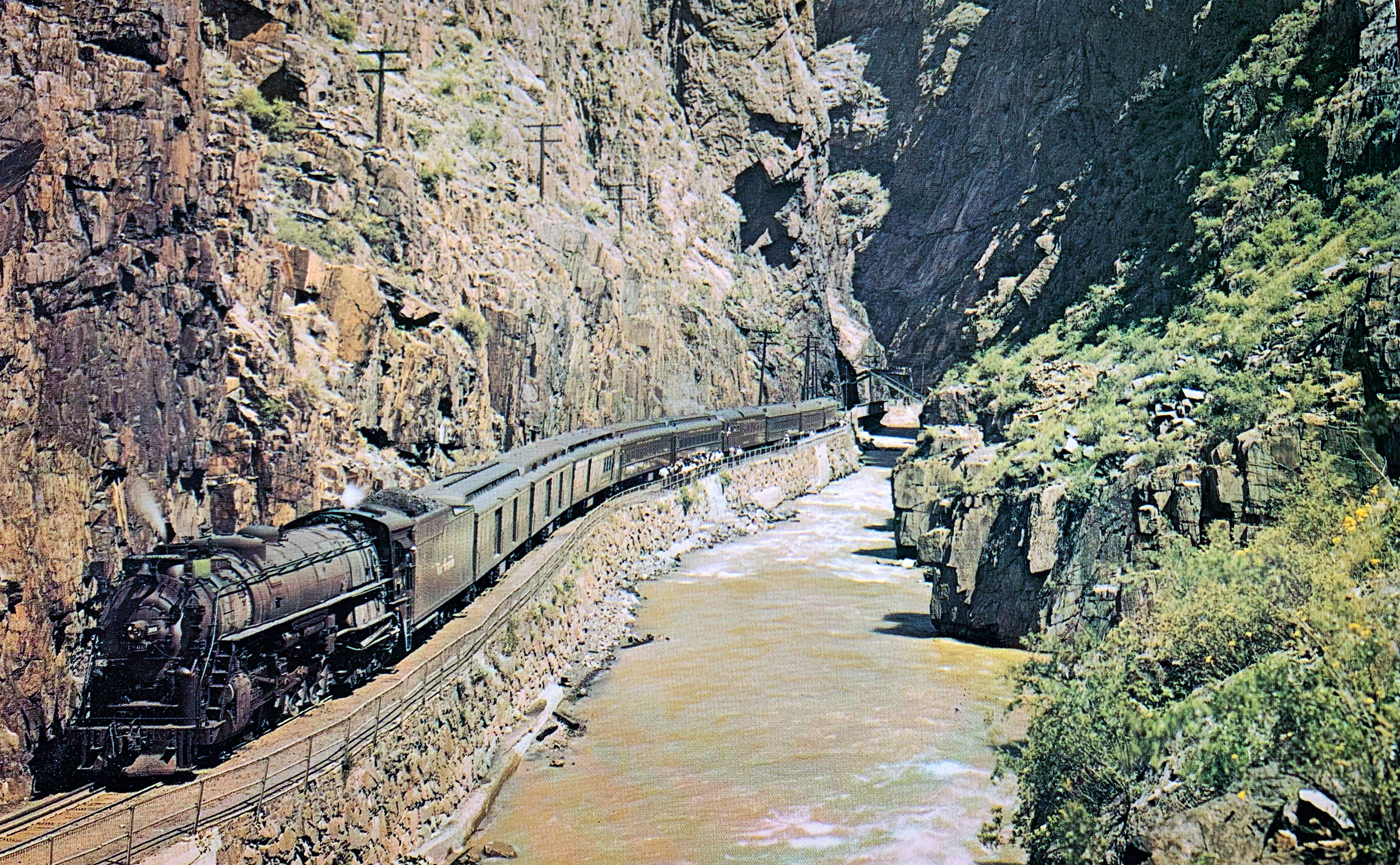
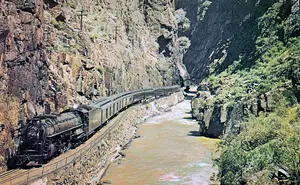
Rio Grande 4-8-4 1800 (M-68) with the Scenic Limited at the Hanging Bridge in the Royal Gorge, summer 1945. Otto Roach photo. American-Rails.com collection.
On this page: At a glance · How the classes were numbered · Freight · Passenger · Narrow gauge · Where the chapter disagrees · Roster
At a glance
| Item | Detail |
|---|---|
| Railroad | Denver & Rio Grande Western. Company page |
| Scope | George H. Drury, locomotives built since 1900. Pre-1900 engines are not added |
| Standard gauge | 435, including Shay 4 and 5 |
| Narrow gauge | 48. The K-27, K-28, K-36, and K-37 are 45 of them |
| Frames | 483, each once |
| Last new steam | 4-6-6-4s 3710–3714, Baldwin, 1942 |
| Last standard-gauge steam | 2-8-0 1151, Alamosa to South Fork and return, December 26, 1956 |
| Diesels | 554 owned frames. Roster |
How the classes were numbered
The Denver & Rio Grande was incorporated on October 27, 1870, as a narrow-gauge railroad aimed at El Paso. The first spike went down in Denver on July 28, 1871. In 1878 the road and the Santa Fe fought over Raton Pass and the Royal Gorge. Rails of the Denver & Rio Grande and its Utah affiliate joined in the Utah desert in 1883, three-foot gauge from Denver through Pueblo and Marshall Pass to Salt Lake City and Ogden. The Denver & Rio Grande Western was independent in 1886. Denver & Rio Grande control returned in 1901, and the Rio Grande Western was merged in 1908 into the Denver & Rio Grande Western Railroad.
The 1908 merger brought a general renumbering. A second renumbering came in 1923. Classes used the wheel arrangement and the tractive effort. A third rail went down in 1881, Denver to Ogden was standard gauge by 1890, and by 1906 the narrow gauge was marked off at Alamosa, Salida, and Montrose.
Denver sits at 5,198 feet. Palmer Lake, 7,237 feet, is 52 miles away. Pueblo is 4,672. Tennessee Pass is 10,240, Grand Junction 4,583, Green River 4,076, Soldier Summit 7,440, Salt Lake City 4,233, and Ogden 4,293. Much of the main line is 0.6 to 0.7 percent. The west slope of Tennessee Pass is 3 percent. The west slope of Soldier Summit was 4 percent, and a relocation in 1912 and 1913 brought it to 2 percent. Coal was the principal commodity.
No United States Railroad Administration locomotives were allocated in the First World War. The 2-8-8-2s of 1923, class L-107, are copies of that design, and they are in the table as Rio Grande engines. A 2-8-8-8-2 was drawn up and not built: 34-by-32-inch cylinders, an 80-square-foot grate divided by a Gaines wall, and Walschaert valve gear. It is not a row.
Freight
The road bought no new switchers after the three Alcos of class S-33, numbers 60–62. The table dates them 1908. Twelve engines of a fifteen-engine 0-6-0 order went to the Western Pacific instead. In 1937 the Salt Lake shops took the lead truck off 2-8-0 1013 and made an 0-8-0. The experiment was not repeated, and 1013 stays inside the Consolidation row.
Consolidations are the long freight list, 151 engines in the quantity column. Class C-48, numbers 1131–1178 and 1180–1199, were the last 2-8-0s built for the Denver & Rio Grande: 57-inch drivers, piston valves, and Stephenson gear. Class C-41, numbers 1000–1029, had been Vauclain compounds, originally 1101–1130, and were simplified in 1909. The Mikados are classes K-59 and K-63, 24 engines. The Santa Fe type is one Brooks order, class F-81, numbers 1400–1409. The chapter prose gives them as 1250–1259, Brooks 1916, 428,500 pounds, with Vanderbilt tenders later replaced. The table prints 1400–1409, 1917, and this roster follows the table.
The first Mallets were compound 2-6-6-0s. Class L-62, numbers 3300–3307, had been 1050–1057. The table dates them 1909. Class L-77, numbers 3360–3375, is the Denver & Salt Lake group, quantity 16, former 200–209 and 211–216. Engine 210 has no Rio Grande number. On the Denver & Salt Lake, 200–209 were 0-6-6-0s and 211–216 were 2-6-6-0s. Lead trucks had been applied from 1912, and the Rio Grande row types the whole group as 2-6-6-0. The merger date is April 11, 1947. The same addition brought Mikados 1220–1229, former 400–409, and Consolidations 1031–1039. Ten-Wheeler 302 became Rio Grande 795. Number 303 was assigned 796. Both were scrapped in July 1948. The since-1900 table prints 795 only.
The 2-8-8-2s begin with class L-96, numbers 3400–3415, originally 1060–1075. The table names the builder Alco. The chapter prose says Schenectady, which was an Alco works. Class L-107, numbers 3500–3509, Richmond 1923, are the government copies. Class L-109, numbers 3550–3564, fifteen engines, are former Norfolk & Western Y-2s, built 1918–1924. The chapter places the purchases in 1943 and 1948. The built years in the table stay the construction years.
Numbers 3350 and 3351 are a different Norfolk & Western pair: 2-6-6-2s, class L-76, Schenectady 1916. The chapter also says the road bought two Norfolk & Western 2-6-6-4s, in 1943 and 1948. Those 2-6-6-4s are not the L-76 row, and they are not given their own line in the table.
Brooks delivered class L-131, numbers 3600–3609, in 1927, and they were the world’s largest locomotives when they arrived. The chapter prose calls that class L-125. Schenectady delivered class L-132, numbers 3610–3619, in 1930. The prose calls that class L-127. The table classes are the ones in the grid. The last of them, 3609, 3612, and 3619, ran until November 1956 and then went to Pueblo for scrap.
The Challengers are three rows. Class L-105, numbers 3700–3709, Baldwin, simple, 70-inch drivers, were the Grand Junction to Salt Lake City engines. The table and the caption on 3703 date them 1938. The chapter prose says 1937. Numbers 3710–3714, Baldwin 1942, used a Worthington heater instead of an Elesco, and they were the last new steam the road bought. Class L-97, numbers 3800–3805, Alco 1943, were leased from the Defense Plant Corporation. They were painted and lettered Rio Grande and they were not purchased. The retirement cell is blank. The note sends them to the Clinchfield in 1947.
Two Shays, numbers 4 and 5, class Y-33, came from the Copper Belt. They sit with the standard-gauge list, just above the narrow-gauge header.
Passenger
Ten-Wheelers and Pacifics are 55 engines in the quantity column, counting 795. Class T-31, numbers 750–759, had been 1001–1010, were renumbered in 1908, and were simplified in 1909. They had 67-inch drivers and weighed 214,080 pounds. The Brooks Ten-Wheelers 760–793 are class T-29, and the table notes that 763 and 777 were class T-31. Pacifics 800–805, class P-44, had been 1001–1006, also with 67-inch drivers.
The Mountains are five rows. Class M-67, numbers 1501–1510, Brooks 1922, had 63-inch drivers, 28-by-30-inch cylinders, and weighed 377,000 pounds. Class M-78, numbers 1511–1520, was the same engine with a booster, for Grand Junction to Salt Lake City. A second M-67 group, 1521–1530, worked Salida to Grand Junction. Four Mountains, class M-69, numbers 1550–1553, were Norfolk & Western 206–209, Roanoke 1926, and were sold in 1948. The chapter sends them on to the Wheeling & Lake Erie. The three-cylinder Baldwins, class M-75, numbers 1600–1609, had 67-inch drivers, three 25-by-30-inch cylinders, and weighed 419,310 pounds. Drury calls them the heaviest 4-8-2s until the Illinois Central engines of 1942.
Northerns close the passenger list. Class M-64, numbers 1700–1713, Baldwin 1929, had 70-inch drivers and worked passenger trains between Denver and Salt Lake City. Class M-68, numbers 1800–1804, Baldwin 1937, had 73-inch drivers, roller bearings, and vestibule cabs. Number 1800 is the engine at the Hanging Bridge.
Narrow gauge
Three outside-frame Consolidations came from the Crystal River, a 1916 purchase of engines built in 1900 and 1903: class C-21, numbers 360 and 361, and class C-25, number 375. The Copper Belt note belongs to the Shays, not to these three.
The Mudhens are class K-27, numbers 450–464, Baldwin 1903, built as Vauclain compounds. Later they were simple, with 17-by-22-inch cylinders, superheat, piston valves, and Walschaerts gear. Drury gives their tractive effort as 27,000 pounds. They are the K-27 page.
Class K-28, numbers 470–479, Alco 1923, had 44-inch drivers, 18-by-22-inch cylinders, and 27,540 pounds of tractive effort. The railroad called them the Sports Model. They are the K-28 page. Class K-36, numbers 480–489, Baldwin 1925, had 44-inch drivers, 20-by-24-inch cylinders, 36,200 pounds of tractive effort, and weighed 187,100 pounds. The retirement cell names 1955 and number 485. They are the K-36 page.
Class K-37, numbers 490–499, used boilers from the standard-gauge C-41 Consolidations of the 1000–1029 series. The table names the builder as the Denver & Rio Grande Western and the years as 1928 and 1930. The chapter prose says Burnham Shops. The retirement cell names 1955 for 496 and 1963 for 490, and the note says many K-36s and K-37s were still in service when the table was printed. That note is the table’s. The engines are the K-37 page. What remained of the narrow gauge went to the Durango & Silverton and the Cumbres & Toltec.
By 1956 only a few standard-gauge steam engines were left, mainly switchers and helpers on the Moffat route. The last standard-gauge steam run was 2-8-0 1151, Alamosa to South Fork and back, on December 26, 1956.
Where the chapter disagrees
The grid follows the table. The chapter prose uses other years or other class numbers for some of the same engines, and those differences are the ones named above: 60–62, 950–964, the K-59s, the F-81s, the L-62s, L-96, L-131, L-132, and the first L-105s. A blank note or a blank retirement is an em dash. Retirement years are the span the table prints, including a cell that names one year and then another.
Roster
The standard-gauge quantity column sums to 435. The narrow-gauge column sums to 48.
Standard gauge
| Type | Class | Numbers | Qty | Builder | Built | Retired | Notes |
|---|---|---|---|---|---|---|---|
| 0-6-0 | S-23 | 20–22 | 3 | Schenectady | 1900 | 1928–1936 | — |
| 0-6-0 | S-33 | 50–54 | 5 | Baldwin | 1906 | Sold 1942–1943 | — |
| 0-6-0 | S-33 | 55–59 | 5 | Baldwin | 1907 | 3 sold 1943; 2 scrapped 1952 | — |
| 0-6-0 | S-33 | 60–62 | 3 | Alco | 1908 | 1944–1952 | — |
| 2-6-0 | G-28 | 592–597 | 6 | Schenectady | 1901 | 1926–1937 | — |
| 2-8-0 | C-38 | 900–903 | 4 | Richmond | 1900 | 1936 | — |
| 2-8-0 | C-39 | 915 | 1 | Baldwin | 1912 | 1937 | — |
| 2-8-0 | C-39 | 916–925 | 10 | Baldwin | 1905 | 1936–1941 | — |
| 2-8-0 | C-40 | 930–934 | 5 | Baldwin | 1901 | 1945–1946 | — |
| 2-8-0 | C-40 | 940–944 | 5 | Richmond | 1901 | 1936 | — |
| 2-8-0 | C-41 | 950–964 | 15 | Baldwin | 1900 | 1936–1946 | — |
| 2-8-0 | C-41 | 1000–1029 | 30 | Baldwin | 1902 | 1937–1952 | Simplified 1909 |
| 2-8-0 | C-42 | 970–973 | 4 | Richmond | 1900 | 1929–1936 | — |
| 2-8-0 | C-43 | 1031–1039 | 9 | Schenectady | 1906–1910 | 1937–1955 | Ex-D&SL 111–113, 118–123 |
| 2-8-0 | C-48 | 1131–1178 | 48 | Schenectady | 1906, 1908 | 1946–1956 | 57-inch drivers. Last 2-8-0s built for the D&RG |
| 2-8-0 | C-48 | 1180–1199 | 20 | Schenectady | 1906 | 1949–1956 | — |
| 2-8-2 | K-59 | 1200–1213 | 14 | Baldwin | 1913 | 1938–1955 | — |
| 2-8-2 | K-63 | 1220–1227 | 8 | Lima | 1915 | 1948–1956 | Ex-D&SL 400–407 |
| 2-8-2 | K-63 | 1228, 1229 | 2 | Schenectady | 1916 | 1952, 1956 | Ex-D&SL 408, 409 |
| 2-10-2 | F-81 | 1400–1409 | 10 | Brooks | 1917 | 1952–1955 | — |
| 2-6-6-0 | L-62 | 3300–3307 | 8 | Schenectady | 1909 | 1947–1952 | Originally 1050–1057 |
| 2-6-6-2 | L-76 | 3350, 3351 | 2 | Schenectady | 1916 | 1952, 1950 | Ex-N&W |
| 2-6-6-0 | L-77 | 3360–3375 | 16 | Schenectady | 1908–1916 | 1947–1952 | Ex-D&SL 200–209, 211–216. 210 omitted |
| 2-8-8-2 | L-96 | 3400–3415 | 16 | Alco | 1913 | 1944–1951 | Originally 1060–1075 |
| 2-8-8-2 | L-107 | 3500–3509 | 10 | Richmond | 1923 | 1947–1951 | USRA copies |
| 2-8-8-2 | L-109 | 3550–3564 | 15 | Baldwin, N&W | 1918–1924 | 1947–1951 | Ex-N&W. The fifteen Y-2s |
| 2-8-8-2 | L-131 | 3600–3609 | 10 | Brooks | 1927 | 1955–1956 | — |
| 2-8-8-2 | L-132 | 3610–3619 | 10 | Schenectady | 1930 | 1955–1956 | — |
| 4-6-6-4 | L-97 | 3800–3805 | 6 | Alco | 1943 | — | To Clinchfield 1947. Leased, not bought |
| 4-6-6-4 | L-105 | 3700–3709 | 10 | Baldwin | 1938 | 1951–1956 | 70-inch drivers |
| 4-6-6-4 | L-105 | 3710–3714 | 5 | Baldwin | 1942 | 1951–1956 | Worthington heater. Last new steam |
| 4-6-0 | 33 | 795 | 1 | Schenectady | 1905, 1907 | 1942, 1948 | Ex-D&SL 302 |
| 4-6-0 | T-24 | 530–533 | 4 | Schenectady | 1901 | 1927–1928 | — |
| 4-6-0 | T-29 | 760–793 | 34 | Brooks | 1908–1909 | 1926–1951 | 763 and 777 were class T-31 |
| 4-6-0 | T-31 | 750–759 | 10 | Baldwin | 1902 | 1926–1939 | Built as 1001–1010. Renumbered 1908. Simplified 1909 |
| 4-6-2 | P-44 | 800–805 | 6 | Baldwin | 1913 | 1949–1953 | Originally 1001–1006 |
| 4-8-2 | M-67 | 1501–1510 | 10 | Brooks | 1922 | 1950–1955 | 63-inch drivers |
| 4-8-2 | M-78 | 1511–1520 | 10 | Brooks | 1923 | 1952–1955 | Booster. Grand Junction–Salt Lake City |
| 4-8-2 | M-67 | 1521–1530 | 10 | Brooks | 1923 | 1949–1955 | Salida–Grand Junction |
| 4-8-2 | M-69 | 1550–1553 | 4 | N&W | 1926 | Sold 1948 | Ex-N&W 206–209 |
| 4-8-2 | M-75 | 1600–1609 | 10 | Baldwin | 1926 | 1941–1949 | Three cylinders |
| 4-8-4 | M-64 | 1700–1713 | 14 | Baldwin | 1929 | 1950–1956 | 70-inch drivers. Denver–Salt Lake City passenger |
| 4-8-4 | M-68 | 1800–1804 | 5 | Baldwin | 1937 | 1952–1954 | 73-inch drivers, roller bearings, vestibule cabs |
| Shay | Y-33 | 4, 5 | 2 | Lima | 1905, 1906 | 1926, 1936 | Ex-Copper Belt |
Narrow gauge
| Type | Class | Numbers | Qty | Builder | Built | Retired | Notes |
|---|---|---|---|---|---|---|---|
| 2-8-0 | C-21 | 360, 361 | 2 | Baldwin | 1900 | 1950, 1951 | Ex-Crystal River |
| 2-8-0 | C-25 | 375 | 1 | Baldwin | 1903 | 1949 | Ex-Crystal River |
| 2-8-2 | K-27 | 450–464 | 15 | Baldwin | 1903 | 1939–1953 | Vauclain compound. K-27 |
| 2-8-2 | K-28 | 470–479 | 10 | Alco | 1923 | 1946 | K-28 |
| 2-8-2 | K-36 | 480–489 | 10 | Baldwin | 1925 | 1955 (No. 485) | K-36 |
| 2-8-2 | K-37 | 490–499 | 10 | D&RGW | 1928, 1930 | 1955 (496), 1963 (490) | Many K-36s and K-37s are still in service. K-37 |
Related Reading
Sources
- George H. Drury, Guide to North American Steam Locomotives, revised edition, Denver & Rio Grande Western chapter. The table is locomotives built since 1900. The chapter names the Rio Grande Modeling and Historical Society and Locomotives of the Rio Grande (Colorado Railroad Museum, 1980).
- Don Strack, Utah Rails, for Denver & Salt Lake 302 and 303 becoming 795 and 796, and for the July 1948 scrap date. The Drury table prints 795 only.
- Robert G. Athearn, and United States Tax Court dockets 43783–43786, for the Denver & Salt Lake merger of April 11, 1947.
- Don Strack, Utah Rails, “Rio Grande in Colorado, 1870–1880,” for the incorporation of October 27, 1870, and the first spike of July 28, 1871, citing Robert A. LeMassena, Robert G. Athearn, and O. Meredith Wilson.
- Locobase 6823, for the 2-8-8-8-2 that was drawn and not built. It is not a row in the table.
Recent Articles


-
Rio Grande Steam Locomotives (Since 1900)
Nov 04, 26 11:40 AM
 Denver & Rio Grande Western steam locomotives built since 1900. Standard gauge quantity 435 and narrow gauge 48. Challengers, 2-8-8-2s, Mountains, Northerns, and the K-27, K-28, K-36, and K-37.
-
Rio Grande Diesel Locomotives (All-Time)
Nov 04, 26 11:39 AM
 Denver & Rio Grande Western diesel locomotives, each frame once. 554 units, from the 1941 NW2 through the 1990 GP60s. FT, F3, F7, and F9 sets are not counted again under their 1950 numbers.
-
Rio Grande Railroad: Map, Logo, History, Rosters
Nov 04, 26 11:34 AM
 Denver & Rio Grande Western history, from William Jackson Palmer and the October 27, 1870 charter through the Royal Gorge, the Moffat route, the California Zephyr, and Union Pacific common control…
-
Lindblom Gift Expands the Fort Wayne Restoration Shop
Nov 04, 26 11:14 AM
 Art Lindblom gave the Fort Wayne Railroad Historical Society more than $1.4 million, its largest single gift, to expand the New Haven shop. The addition is planned for late 2026 and early 2027. A sepa…
-
Design Contract Awarded for the Forest Park Branch
Nov 04, 26 11:09 AM
The Chicago Transit Board approved a design contract for about 13 miles of Blue Line track from the Illinois Medical District to the I-290 Bridge. The release summary calls it a $17 million contract… -
Kanawha River Railroad: The Norfolk Southern Lease Is Renewed
Nov 04, 26 10:51 AM
 Kanawha River Railroad filed to keep leasing 309.45 miles from Norfolk Southern in West Virginia and Ohio. The second amendment is dated August 17, 2026. The Board has not set the date the exemption t…
-
Short Line Center Awarded a $5.625 Million Grant
Nov 04, 26 10:35 AM
 The American Short Line and Regional Railroad Association received a $5.625 million CRISI grant on October 20, 2026, for the Short Line Training Center. A 25 percent match brings the project to $7.5 m…
-
Palestine and Rusk Track Rebuild Finishes Its First Phase
Nov 04, 26 09:13 AM
 The Texas & Eastern Railroad has finished the first phase of a roughly $30 million track project between Palestine and Rusk. Phase I used a $13.4 million CRISI grant. Phase II, at $8.54 million, adds…
-
Manhattan, Brooklyn, Queens, and the Bronx Get Subway Power Design
Nov 04, 26 09:12 AM
STV said on November 2, 2026, that MTA Construction and Development selected the firm to manage design of 10 subway substations and 12 circuit breaker houses in four New York boroughs. No contract pri… -
Chicago's Regional Transit Budget Goes Out for Comment
Nov 04, 26 09:07 AM
 The Northern Illinois Transit Authority opened its first regional budget for comment through December 4, 2026. The proposal is $5.04 billion for 2027 operations and $9.73 billion in capital work throu…
-
VIA Rail Finishes the Toronto Maintenance Centre
Nov 04, 26 09:05 AM
VIA Rail completed a four-year modernization of its Toronto Maintenance Centre on November 2, 2026. The Government of Canada invested $310 million. The shop supports 32 Corridor trainsets and will sus… -
Brightline Suspends Orlando Service for High Water
Nov 04, 26 09:02 AM
Brightline suspended trains between Orlando and West Palm Beach on November 2, 2026, because of high water in Brevard County. A later post the same day kept the suspension until 2:00 p.m. on November… -
Hiawatha West Draws Federal Funding Toward Madison
Nov 04, 26 08:58 AM
 Amtrak welcomed a CRISI selection for Hiawatha West, extending Chicago-Milwaukee service toward Madison, Watertown, and Pewaukee. Wisconsin said on October 16 that the award is over $218 million.
-
Seattle's Train Maintenance Facility Opens for Airo Trains
Nov 04, 26 08:56 AM
 Amtrak cut the ribbon October 23, 2026, on a $250 million Seattle shop for Airo trains on the Cascades route. The building came in on time and $50 million under budget and opens in phases through the…
-
Aberdeen Carolina and Western Wins a $19.9 Million Grant
Nov 04, 26 08:46 AM
 The Aberdeen Carolina and Western Railway won a $19.9 million CRISI grant for about 30 miles of welded rail in Montgomery and Stanly counties. The railroad and NCDOT are putting up a 52 percent match…
-
Chicago & North Western Iron Ore C628s
Nov 03, 26 10:50 PM
 Chicago and North Western C628s 6701-6730, the ex-Norfolk and Western high-hoods, in Upper Peninsula iron-ore service from the mid-1970s until December 21, 1986, and what happened to each unit.
-
Alco "C628" Locomotives: Roster, Data Sheet, Specs
Nov 03, 26 07:57 PM
 Alco Century C628: 2,750 hp C-C road switcher, 186 built from December 1963 to December 1968. Production roster, specs, and where the high-hood Norfolk and Western units went.
-
Santa Fe Railroad (AT&SF): Diesel Roster (All-Time)
Nov 03, 26 12:54 PM
 Santa Fe diesel locomotives, each new frame once, with construction numbers and order numbers. The counted total is 3,964, from the 1935 boxcabs through the SD75Ms.
-
Metra Holiday Trains Return on Six Lines
Nov 03, 26 11:40 AM
 Metra holiday trains will run on six lines in December, with tickets on sale at noon November 16 for $10. The Chicago Transit Authority and Pace are fielding holiday buses in the same regional announc…
-
Amtrak Encourages Early Booking for Thanksgiving
Nov 03, 26 11:39 AM
 Amtrak is asking travelers to book Thanksgiving trips early. The railroad carried more than 1.2 million customer trips over the 2025 holiday and expects another record, with extra Northeast Regional s…
-
Channel Pacific Keeps Its West Sacramento Exemption
Nov 03, 26 11:26 AM
The Surface Transportation Board denied a West Sacramento challenge to Channel Pacific Railroad’s exemption to operate about 2,132 feet of terminal track. The exemption took effect in June 2026. -
DART Marks One Year of the Silver Line
Nov 03, 26 11:22 AM
 DART marked one year of Silver Line service linking seven North Texas cities and DFW Airport. The 26-mile regional rail line opened October 25, 2025, as the agency’s first rail expansion in a decade.
-
Massachusetts Breaks Ground for the Berkshire Flyer
Nov 03, 26 10:07 AM
Massachusetts broke ground October 29 in Pittsfield on track work meant to support permanent seasonal Berkshire Flyer service. MassDOT has $31 million for the project in its 2027-2031 capital plan. -
Cheraw Scrapyard Closed After a Search for CSX Rail
Nov 03, 26 10:02 AM
Chesterfield County deputies, CSX police, and state agents searched Cheraw Iron and Metal on October 27 and closed the yard after finding CSX rail and telephone wire. -
Union Pacific Urges the Board to Keep a Speech Video Confidential
Nov 03, 26 09:53 AM
Union Pacific on October 30 asked the Surface Transportation Board to keep a recording of Jim Vena’s shipper speech confidential while it appeals. BNSF on November 2 asked the board to deny that… -
Enfield Station Construction Begins on the Hartford Line
Nov 03, 26 09:39 AM
 Connecticut has started a $125.3 million Enfield station on the Hartford Line, restoring passenger service for the first time since 1986. The state expects construction to finish in fall 2030.
-
Santa Fe Steam Roster (Built Since 1900)
Nov 03, 26 09:30 AM
 Featured here is the Santa Fe's all-time steam roster after 1900. The railroad operated a wide and varied collection of wheel arrangements.
-
Santa Fe Railroad: Map, Logo, History, Rosters
Nov 03, 26 09:16 AM
 History of the Atchison, Topeka and Santa Fe, from Cyrus Holliday’s 1859 charter to the Burlington Northern merger on December 31, 1996. The Warbonnet, the Super Chief, and the Chicago to Los An…
-
Asheville Rail Corridor Gets $35.8 Million
Nov 03, 26 12:18 AM
The U.S. Department of Transportation awarded North Carolina $35.8 million for development, design, and construction on the Salisbury to Asheville corridor, including more than 40 crossing-signal syst… -
Le Mars Transload Center Expands on Canadian National
Nov 03, 26 12:06 AM
Burlington Junction Railway has expanded the Le Mars Transload Center beside Canadian National and U.S. Highway 75. A zero-interest Iowa DOT loan paid for part of the work. The center and industrial p… -
Lehigh Gorge Trains Move to Nesquehoning
Nov 02, 26 11:48 PM
Reading and Northern has moved Lehigh Gorge Scenic Railway trips to Nesquehoning after the October 31 rockslide west of Jim Thorpe. Trains leave at 11 a.m., 1 p.m., and 3 p.m. through Sunday, November… -
Texas Transit Agency Breaks Ground on TEXRail
Nov 02, 26 11:40 PM
 Trinity Metro broke ground October 29, 2026, on a $270 million, 2.1-mile TEXRail extension from Fort Worth T&P Station to a new Near Southside station on land donated by Baylor Scott and White Hea…
-
Lake Front Depot: The C&NW's Milwaukee Terminal
Nov 02, 26 09:40 PM
 The Chicago and North Western Lake Front Depot at 915 East Wisconsin Avenue, Milwaukee. Charles Sumner Frost, 1889. Last train May 15, 1966. Clock tower down May 7, 1968.
-
Canal Street Maintenance Plan Will Get an FRA Review
Nov 02, 26 01:48 PM
The Federal Railroad Administration will prepare an environmental assessment of Amtrak Canal Street maintenance plans in Chicago after adding 17 viaduct repairs to a project that had a categorical exc… -
Durango & Silverton Repairs Track After Continued Flooding
Nov 02, 26 01:40 PM
 Durango & Silverton crews are repairing flood damage after the Animas hit 11,200 cfs on October 23. The Highline Express ran October 27 through November 1. Polar Express trains remain listed from…
-
Middle Georgia Megasite Will Host the First Audi Plant in the U.S.
Nov 02, 26 01:35 PM
 Audi will build its first U.S. plant at the Norfolk Southern-served Middle Georgia Megasite in Peach County, about $4 billion and about 4,500 jobs. Audi and Norfolk Southern publish different construc…
-
Union Pacific No. 844 Returns Beside Big Boy on November 21
Nov 02, 26 01:30 PM
 Union Pacific 4-8-4 No. 844 is back under steam and will trail Big Boy 4014 from Greeley to Denver on November 21. The pair will then stand on free display at Denver Union Station.
-
Norfolk Southern Abandonment in the Shenandoah Valley Is Stayed
Nov 02, 26 01:19 PM
 The Surface Transportation Board on October 22, 2026, postponed a Norfolk Southern exemption to abandon 48.5 miles from Front Royal to Broadway, Virginia. A response is due November 3.
-
Reading & Northern Sets a November 23 Start in Luzerne
Nov 02, 26 01:13 PM
Reading and Northern expects to begin operating about 59.65 miles of Luzerne County rail line on November 23, 2026. The package is $7 million in cash plus $3 million in track work. -
Second Daily Pennsylvanian Begins November 18
Nov 02, 26 12:19 PM
A second daily Pennsylvanian round trip between New York and Pittsburgh begins November 18, 2026, after 46 years with one round trip. Each city gets a morning departure and an afternoon departure. -
MBTA Sets November Meetings on Regional Rail
Nov 02, 26 12:10 PM
 The MBTA will hold virtual meetings on November 4 and November 17, 2026, from 6:00 to 7:30 p.m., on a plan to turn Commuter Rail into Regional Rail with more frequent servic
-
Wisconsin Central Diesel Roster (Soo Line Years)
Nov 01, 26 11:31 PM
 Diesels built new for the Wisconsin Central in the Soo Line years. 97 locomotives, Alco 24 and Electro-Motive 73. These 97 are already inside the Soo Line roster of 786.
-
Wisconsin Central Ltd. Diesel Roster
Nov 01, 26 11:22 PM
 Wisconsin Central Ltd. diesels, 1987 to 2001. Thirty locomotives with a number fixed by another roster on this site or by a photograph. The fleet stood at 244 units. More than 100 were SD45s.
-
Wisconsin Central Steam Roster (Built Since 1900)
Nov 01, 26 11:20 PM
Wisconsin Central steam locomotives built since 1900. The quantity column is 156. Consolidations, Mikados, Atlantics, Ten-Wheelers, Pacifics, and Mountains. The Soo 4-8-4s stay on the Soo roster. -
Wisconsin Central Railway: Map, History, Logo, Roster
Nov 01, 26 11:15 PM
 Two railroads kept the Wisconsin Central name. The 1871 line was leased to the Soo on April 1, 1909 and merged January 1, 1961. Wisconsin Central Ltd. ran from October 11, 1987 until Canadian National…
-
Watchmen Talks Extended at Los Angeles and Long Beach
Nov 01, 26 10:41 PM
Suggested meta description: The Pacific Maritime Association and ILWU Local 26 extended their contract through 5 p.m. Pacific Time on November 4, 2026, moving a November 1 deadline at the ports of Los… -
LIRR September Ridership Tops the 2019 Mark
Nov 01, 26 10:39 PM
The Long Island Rail Road carried 102 percent of its September 2019 ridership in September 2026, Governor Kathy Hochul said on October 28. Metro-North carried 323,423 riders on October 24 and 25. -
North Carolina Awards the Rogers Road Bridge in Wake Forest
Nov 01, 26 10:22 PM
 NCDOT on October 28, 2026 awarded a contract to Blythe Construction for a bridge over the CSX S-Line on Rogers Road in Wake Forest. Work can start as early as November 30, with opening aimed at fall 2…
-
Trinity Books 2,190 Railcar Orders in the Third Quarter
Nov 01, 26 10:17 PM
 Trinity Industries on October 29, 2026 reported 2,190 new railcar orders and 2,030 deliveries in the third quarter. The company expects industry deliveries below 25,000 railcars in 2026.
-
New York Central's Jade Green E Units
Nov 01, 26 09:25 PM
 In 1961 the New York Central tried Century Green, called Jade Green, on E8As 4053 and 4083 and E7B 4107. Dark gray became the passenger scheme. The green stayed on freight cars.