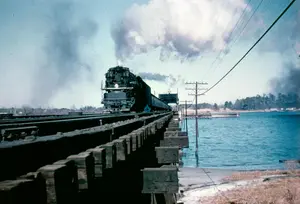
Denver and Salt Lake Railway: History, Roster, Timetable
Published: October 22, 2026
By: Adam Burns
The Denver & Salt Lake was the Moffat Road, David H. Moffat’s standard-gauge railroad west from Colorado’s capital into the Rockies. He incorporated it in 1902 as the Denver, Northwestern & Pacific, aimed at Salt Lake City. The track reached Craig in 1913, and Craig remained the end of the line. The Moffat Tunnel opened on February 26, 1928, in place of the temporary railroad over Rollins Pass. The Dotsero Cutoff, dedicated on June 16, 1934, joined the railroad to the Denver & Rio Grande Western. The two companies merged on April 11, 1947.
On the December 1929 public table, trains 1 and 2 covered Denver to Craig, 232 miles, with cafe-parlor cars. W. R. Freeman was president, and the offices were in Denver. George H. Drury’s steam list is on this page. The quantity column prints 59.
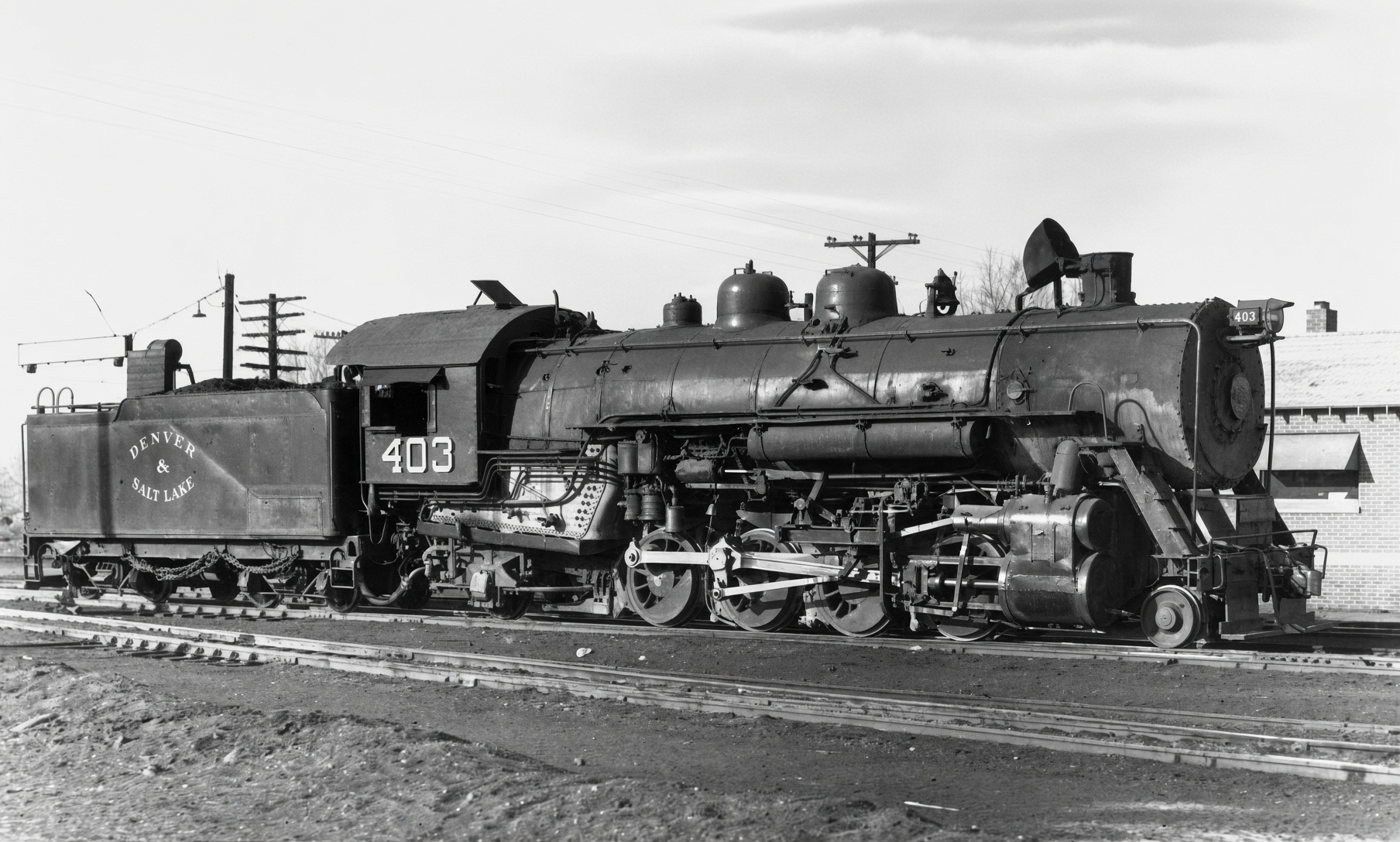
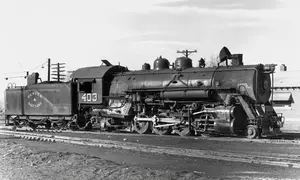
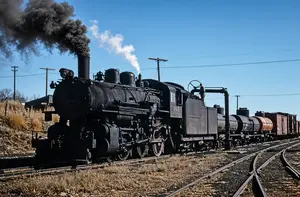
Denver & Salt Lake 2-8-2 No. 403 at Denver, Colorado. American-Rails.com collection. Lima, 1915, one of the 400–407 group.
On this page: The Moffat Road · Craig · At a glance · Moffat Tunnel · December 1929 · Dotsero · Steam · The Rio Grande
The Moffat Road
In 1902 David Moffat incorporated the Denver, Northwestern & Pacific to build west from Denver toward Salt Lake City. Construction began almost at once. By 1904 the rails stood on the summit of Rollins Pass, 65 miles from Denver and 6,400 feet higher. That is an average grade of 1.86 percent.
The westbound climb began at the South Platte River bridge in Denver. After a few miles the grade settled at 2 percent and held 2 percent to Ladora, north of Tolland and northeast of the later east portal. At Ladora it rose to 4 percent and stayed there for 13 miles, to the summit at Corona. Eastbound trains faced 16 miles of 4 percent from Vasquez, northwest of present-day Winter Park, up to the same summit. The pass was a temporary crossing, meant to stand until a 3-mile tunnel at 9,900 feet could be built. Winter closed it for weeks or months at a time. More than two miles above sea level, the 4 percent grades were the manageable part of the work. Keeping the line open was the hard part.
Coal from northwestern Colorado kept trains on the railroad, and a bore under the Continental Divide was the other thing the property still needed. Both would matter to the Rio Grande after the merger.
Craig
Moffat died in New York on March 18, 1911, with the tunnel still unbuilt and his fortune in the railroad. After his death the property went into foreclosure. In 1913 it was reorganized as the Denver & Salt Lake Railroad.
The line itself had been moving west through those years. History Colorado’s note on the company collection dates Sulphur Springs to 1905 and Steamboat Springs to 1908, and calls that railroad 214 miles from Denver. The extension to Craig, 40.5 miles, was finished in 1913. The same year the company finished a belt line to the Denver stockyards, 4.87 miles. Craig, in Moffat County, was as far as the track went. The 214 miles are the distance to Steamboat Springs on that earlier railroad. The stockyards belt is 4.87 miles in Denver, apart from the miles out to Craig.
Denver’s passenger station for the railroad was Moffat Station, the 1906 depot at 2101 15th Street. It was the city end of the line over Rollins Pass. Denver Union Station served the other roads into the city.
At a glance
| Item | Figure |
|---|---|
| Headquarters | Denver |
| Name on the 1929 table | The Denver & Salt Lake Railway Company, “The Moffat Road” |
| Gauge | 4 feet, 8½ inches |
| Incorporated | 1902, as the Denver, Northwestern & Pacific |
| Denver & Salt Lake Railroad | Reorganized 1913, after foreclosure |
| Rollins Pass | Summit reached by 1904. 6,400 feet of climb in 65 miles. 4 percent on the summit grades |
| Steamboat Springs | 1908. 214 miles from Denver on the pre-tunnel line |
| Craig | 1913, a 40.5-mile extension. Mile 232 on the December 1929 table |
| Moffat Tunnel | Turned over to the railroad on February 26, 1928. More than 6 miles, at about 9,200 feet |
| Dotsero Cutoff | Dedicated June 16, 1934. About 38 miles, Orestod to Dotsero |
| Trackage rights | Rio Grande, Denver to Orestod, 128 miles |
| Merger | April 11, 1947, into the Denver & Rio Grande Western |
| Steam locomotives | 59 |
| President, December 1929 | W. R. Freeman, Denver |
Moffat Tunnel
The pass line stayed in use until the state built the tunnel Moffat had wanted. A special session of the Colorado legislature passed the Moffat Tunnel bill on April 29, 1922. The Moffat Tunnel Commission built the bore. The railroad bore was holed through on July 7, 1927. On February 26, 1928, the finished tunnel was turned over to the railroad, which took it as lessee. By then the company had been reorganized as the Denver & Salt Lake Railway, the name on the December 1929 table.
The tunnel that opened was more than 6 miles long, at about 9,200 feet, and it shortened the railroad by about 23 miles. Moffat’s plan for the crossing had been a 3-mile tunnel at 9,900 feet. The Moffat Tunnel page carries the bore. On the railroad’s own December 1929 table, East Portal is mile 50, elevation 9,198, and West Portal is mile 56, elevation 9,085. When the pass line was abandoned, the older locomotives went into storage, and many of them were scrapped in the late 1930s.
December 1929
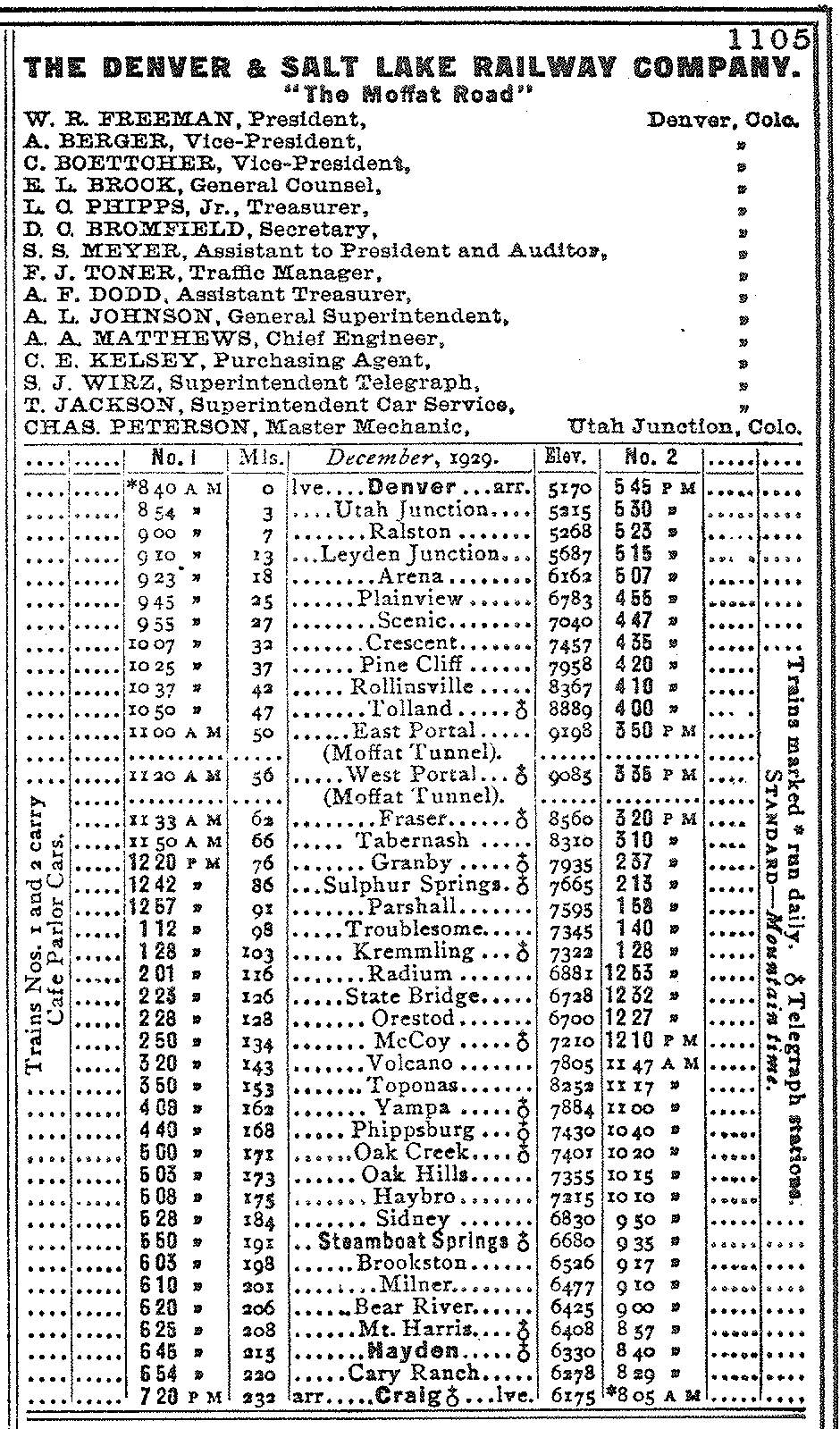
The Denver & Salt Lake Railway Company in the January 1930 Official Guide. The table is dated December 1929. Trains 1 and 2, Denver to Craig.
The sheet is headed the Denver & Salt Lake Railway Company, “The Moffat Road,” with W. R. Freeman as president at Denver. Trains 1 and 2 carried cafe-parlor cars. Train 1 left Denver at 8:40 a.m. The sheet marks that departure as a daily train. It arrived at Craig at 7:20 p.m. Train 2 left Craig at 8:05 a.m. and arrived at Denver at 5:45 p.m.
Craig is mile 232. Steamboat Springs is mile 191. That is the post-tunnel distance. The 214 miles to Steamboat Springs belong to the 1908 line, before the bore took about 23 miles out of the trip. Orestod, on the Colorado River, is mile 128. The name is Dotsero spelled backward. In 1929 it was a station on the way to Craig. Five years later it was the junction where the Rio Grande came in from the west.
Dotsero
The Rio Grande built the Dotsero Cutoff, about 38 miles from Orestod down the Colorado River to Dotsero, and dedicated it on June 16, 1934. The New York Times reported the opening that day. The cutoff placed Denver on a direct line west. The Times put the saving at 175 miles between Denver and Salt Lake City, and the cost at $3,850,000, most of it borrowed from the Reconstruction Finance Corporation. A Burlington Zephyr ran through for the dedication.
Drury records what the Rio Grande took from the Denver & Salt Lake once that junction was open: trackage rights over more than half the railroad, Denver to Orestod, 128 miles, and a start on buying the stock. In 1934 Wilson McCarthy became president of the Denver & Salt Lake. He went on as an operating trustee of the Rio Grande.
Steam
The railroad’s switchers were Nos. 20 and 21, Schenectady engines of 1903, used while the line was being built. They were scrapped in 1939, after several years in storage.
The first Consolidations came from Schenectady in 1904, and a third followed in 1905. Those three, 100 through 102, had 57-inch drivers, 22-by-28-inch cylinders, piston valves, and Stephenson valve gear. The rest of the 2-8-0s, 103 through 123, had 55-inch drivers and the same cylinder size, with slide valves. Walschaerts valve gear replaced Stephenson on the last ten, built in 1910.
In 1908 the Moffat Road became the fourth railroad in the United States to buy a Mallet. No. 200 looked much like Baltimore & Ohio 2400, with slightly higher domes and stack, high-pressure cylinders an inch larger in diameter, low-pressure cylinders an inch and a half larger, 55-inch drivers, an inch smaller, and a total weight 28,000 pounds greater. Two more 0-6-6-0s came in 1909 and seven in 1910, the group 200 through 209. In 1912 the railroad began fitting the Mallets with lead trucks and mechanical stokers. The next seven, 210 through 216, are the 2-6-6-0s, two delivered in 1913 and five in 1916.
The Mikados waited until the eve of that last Mallet delivery. Eight came from Lima in 1915, Nos. 400 through 407, and two from Schenectady in 1916, Nos. 408 and 409. The Lima engines followed the Harriman 2-8-2 pattern that builder had used for the Southern Pacific, the Illinois Central, and the Central of Georgia. The two Alco engines used the same main dimensions, 26-by-30-inch cylinders and 55-inch drivers. They were a heavy engine for the curves over Rollins Pass, and for their weight, until the tunnel opened. They were later fitted with Coffin feedwater heaters. Their tenders gained brakemen’s cabs taller than the locomotive cab, and side boards that raised the coal capacity. No. 407 was one of the last Lima engines to carry that builder’s old rectangular plate. No. 403, in the photograph above, is one of the 1915 Lima engines.
Passenger power started with a pair of Americans bought in 1904 from the Chesapeake Beach Railway, a 28-mile line from Seat Pleasant, Maryland, to the resort at Chesapeake Beach. Moffat and Otto Mears were among that road’s backers. Pittsburgh had built Nos. 390 and 391 in 1899, with 68-inch drivers. One of them was put on a construction train, reached the foot of the 4 percent, and stalled. Both were rebuilt with 60-inch drivers and then handled light trains, usually the local passenger runs between Denver and Tolland. They were scrapped in 1937.
The Ten-Wheelers were four engines. No. 300 arrived from Schenectady in 1904, with 63-inch drivers, inboard piston valves, and a weight of 186,000 pounds. No. 301, in 1905, also had inboard piston valves, with 57-inch drivers, and weighed about 4,000 pounds less. No. 302, in 1907, had 57-inch drivers, slide valves, and Stephenson gear, and weighed 189,000 pounds. No. 303, in 1910, weighed 215,000 pounds, with 63-inch drivers, slide valves, and Walschaerts gear. Nos. 302 and 303 had extended smokeboxes and a single-stage air pump on the right side.
| Type | Class | Numbers | Qty | Builder | Built | Retired | Notes |
|---|---|---|---|---|---|---|---|
| 0-6-0 | 51 | 20, 21 | 2 | Schenectady | 1903 | 1939 | — |
| 2-8-0 | 42 | 100–102 | 3 | Schenectady | 1904–1905 | 1937–1955 | — |
| 2-8-0 | 44 | 103–123 | 21 | Schenectady | 1906–1910 | 1948–1956 | 111–113, 118–123 to D&RGW 1031–1039 |
| 2-8-2 | 63 | 400–407 | 8 | Lima | 1915 | 1952, 1956 | To D&RGW 1220–1227 |
| 2-8-2 | 63 | 408, 409 | 2 | Schenectady | 1916 | 1947–1952 | To D&RGW 1228, 1229 |
| 0-6-6-0 | 76 | 200–209 | 10 | Schenectady | 1908–1910 | 1949–1951 | To D&RGW 3360–3369 |
| 2-6-6-0 | 76 | 210–216 | 7 | Schenectady | 1913, 1916 | 1947–1951 | 211–216 to D&RGW 3370–3375 |
| 4-4-0 | 19 | 390, 391 | 2 | Pittsburgh | 1899 | 1937 | Ex-Chesapeake Beach. Bought 1904 |
| 4-6-0 | 30 | 300 | 1 | Schenectady | 1904 | 1942, 1948 | — |
| 4-6-0 | 33 | 301, 302 | 2 | Schenectady | 1905, 1907 | 1942, 1948 | 302 to D&RGW 795 |
| 4-6-0 | 34 | 303 | 1 | Schenectady | 1910 | 1948 | To D&RGW 796 |
The quantity column totals 59 locomotives. The two Americans were built in 1899. Drury’s chapter includes them with the engines built after 1900 because the Moffat Road bought them in 1904.
The Rio Grande
On April 11, 1947, the Denver & Salt Lake merged into the Denver & Rio Grande Western and lost its separate existence. The Rio Grande owned about 95 percent of the stock. That was the day the reorganized Rio Grande took up its own affairs after twelve years in trusteeship. The Rio Grande added the Mikados, the Mallets, and nine Consolidations. Nine of the class 44 engines, 111 through 113 and 118 through 123, became Rio Grande 1031 through 1039. Mikados 400 through 409 became 1220 through 1229. Mallets 200 through 209 became 3360 through 3369, and 211 through 216 became 3370 through 3375. Ten-Wheelers 302 and 303 were assigned Rio Grande 795 and 796 and were scrapped in July 1948.
The rails stayed in service. Denver to the junction, and the branch on to Craig, became part of the Rio Grande. The railroad’s own Craig passenger train had been trains 1 and 2. The Rio Grande’s later train on the Craig line is the Yampa Valley. Union Pacific operates the line through the Moffat Tunnel.
Related reading
- Denver & Rio Grande Western
- Moffat Tunnel
- Yampa Valley
- Denver Union Station
- Colorado railroads
- Union Pacific
- Fallen Flags
Sources
- George H. Drury, Guide to North American Steam Locomotives, revised edition, the Denver & Salt Lake chapter, pp. 165–166. Incorporation in 1902. The summit of Rollins Pass by 1904, 65 miles from Denver and 6,400 feet higher, an average of 1.86 percent. The 2 percent to Ladora and the 4 percent grades, 13 miles westbound and 16 miles eastbound from Vasquez. Coal traffic. The tunnel of 1928, more than 6 miles at about 9,200 feet, shortening the line by about 23 miles, and the reorganization as the Denver & Salt Lake Railway. Storage and scrapping of older power after the pass was abandoned. The Dotsero Cutoff in 1934, trackage rights from Denver to Orestod, 128 miles, and the merger in April 1947. The locomotive specifications in the steam section, and the sentence that Ten-Wheelers 302 and 303 received Rio Grande numbers and were scrapped in July 1948. The roster table is that chapter’s grid. The Notes column is aligned to the Rio Grande numbers Drury prints and to the 1947 additions below.
- History Colorado, Denver, Northwestern and Pacific Railway Collection, MSS.830, the collection’s historical note. Organized in 1902 to build from Denver toward Salt Lake City. Sulphur Springs in 1905. Steamboat Springs in 1908, that line 214 miles from Denver. Craig extension of 40.5 miles finished in 1913, and a 4.87-mile belt to the Denver stockyards the same year. Moffat’s death in March 1911, foreclosure, and reorganization in 1913 as the Denver and Salt Lake Railroad Company.
- Colorado Encyclopedia, “David H. Moffat.” Death on March 18, 1911, in New York City, with the tunnel unfinished. The line reached Craig in 1913.
- History Colorado, National and State Register, Moffat Station, 2101 15th Street, Denver, listed October 22, 1976. The 1906 depot was the Denver terminus of the railroad over Rollins Pass.
- Colorado state archives, Moffat Tunnel fact sheet, as preserved on the state site. The Moffat Tunnel bill passed a special session on April 29, 1922. The railroad bore was holed through on July 7, 1927. The finished tunnel was turned over to the lessee on February 26, 1928.
- The New York Times, June 17, 1934, “New Line to Coast Opened to Trains,” dateline Denver, June 16. Dedication of the Dotsero Cutoff that afternoon. About 38 miles, connecting the Denver & Salt Lake and the Denver & Rio Grande Western. A saving of 175 miles between Denver and Salt Lake City. Cost $3,850,000, most of it borrowed from the Reconstruction Finance Corporation. A Burlington Zephyr ran through the opening.
- Robert G. Athearn, “The Independence of the Denver and Rio Grande,” Utah Historical Quarterly, Vol. 26, No. 1. Wilson McCarthy became president of the Denver & Salt Lake in 1934 and then an operating trustee of the Rio Grande. April 11, 1947, was the day the reorganized Rio Grande’s board first sat, after the Supreme Court upheld the plan in February 1947 and ended twelve years of trusteeship.
- Denver & Salt Lake Railway Co. v. Commissioner, Tax Court dockets 43783, 43784, 43785, and 43786. Principal office at Denver. The Rio Grande owned about 95 percent of the stock. The company merged into the Denver & Rio Grande Western on April 11, 1947, and lost its separate existence that day.
- Don Strack, Rio Grande motive-power timeline, the 1947 steam additions: nine 2-8-0s numbered 1031–1039, ten 2-8-2s numbered 1220–1229, sixteen 2-6-6-0s numbered 3360–3375, and two 4-6-0s numbered 795 and 796. Those counts are the check on which Denver & Salt Lake numbers received Rio Grande numbers.
- The Denver & Salt Lake table in the January 1930 Official Guide, p. 1105, dated December 1929 and reproduced here. The Moffat Road. W. R. Freeman, president, Denver. Trains 1 and 2, cafe-parlor cars. Denver 8:40 a.m., Craig 7:20 p.m., Craig 8:05 a.m., Denver 5:45 p.m. East Portal mile 50, elevation 9,198. West Portal mile 56, elevation 9,085. Orestod mile 128. Steamboat Springs mile 191. Craig mile 232.
Recent Articles


-
Denver and Salt Lake Railway: History, Roster, Timetable
Oct 22, 26 09:47 AM
 Denver & Salt Lake, the Moffat Road, from Denver to Craig. Tunnel opened February 26, 1928. Dotsero Cutoff dedicated June 16, 1934. Merged April 11, 1947. Steam locomotives 59.
-
Duluth, Missabe and Iron Range Diesel Roster (All-Time)
Oct 22, 26 09:43 AM
 All-time diesel roster of the Duluth, Missabe and Iron Range. 148 owned frames, each counted once. SW9s, SD9s, SD18s, SD38s, RSD-15s, and C630s. Serials and builder order numbers included. Helm SD40-3…
-
Duluth, Missabe and Iron Range Steam Locomotives (Since 1900)
Oct 22, 26 09:22 AM
 Duluth, Missabe & Iron Range steam locomotives built since 1900. Duluth & Iron Range, Duluth, Missabe & Northern, and later DM&IR acquisitions. Quantity column 252. Yellowstones 220-23…
-
Duluth, Missabe and Iron Range Railway: Roster, Map, Logo
Oct 22, 26 09:17 AM
 Duluth, Missabe & Iron Range, reporting mark DMIR, from the Mesabi and the Vermilion to the Lake Superior docks. Formed July 1, 1937. Steam quantity 252. Owned diesels 148. On paper through Decemb…
-
Duluth, South Shore, and Atlantic Railway: Map, Roster, Timetables
Oct 21, 26 11:21 PM
 Duluth, South Shore & Atlantic Railway, the South Shore. Marquette to the Sault, St. Ignace, Houghton, and Duluth-Superior. Soo Line on January 1, 1961. Twenty-four diesels.
-
Detroit, Toledo and Ironton Diesel Roster (All-Time)
Oct 21, 26 02:55 PM
 All-time diesel roster of the Detroit, Toledo and Ironton. 119 frames, each counted once. Serials and builder order numbers included. Last steam was December 24, 1955.
-
Detroit, Toledo and Ironton Steam Roster (Post 1900)
Oct 21, 26 02:49 PM
 Detroit, Toledo and Ironton steam locomotives built after 1900. Drury's class grid. The quantity column prints 141. Counted once, the frames are 137. Last steam was Mikado 805 on December 24, 1955.
-
Detroit, Toledo and Ironton Railroad: Map, Roster, History
Oct 21, 26 02:40 PM
 Detroit, Toledo & Ironton, reporting mark DTI, from Detroit to Ironton, Ohio. Railway organized May 2, 1905. Railroad articles filed February 21, 1914. Henry Ford, 1920 to 1929. Steam and diesel r…
-
Iowa, Chicago and Eastern Railroad: Roster, Map, History
Oct 21, 26 01:04 PM
 Iowa, Chicago & Eastern Railroad Corporation, reporting mark ICE. About 1,125 miles and about 275 miles of trackage rights from the I&M Rail Link. Operations at 12:01 a.m. July 30, 2002. Canad…
-
Rapid City, Pierre & Eastern Railroad: Route, Roster, Overview
Oct 21, 26 10:16 AM
 Rapid City, Pierre & Eastern Railroad, reporting mark RCPE. Genesee & Wyoming Class II. Agreement of January 2, 2014, Finance Docket 35799. Freight service from June 1, 2014, on the Dakota, Mi…
-
Dakota, Minnesota & Eastern Railroad: Roster, Map, History
Oct 21, 26 12:26 AM
 Dakota, Minnesota & Eastern Railroad, reporting mark DME. The July 2, 1986 Chicago & North Western sale, 826 miles and 139 miles of trackage rights. Canadian Pacific control October 30, 2008…
-
Detroit and Mackinac Railway: Map, Roster, History
Oct 20, 26 11:58 PM
 Detroit & Mackinac Railway, the Turtle Line. Bay City to Cheboygan along Lake Huron. Incorporated December 29, 1894. Lake State Railway leased the operation in 1992 and bought the lines in 1997. E…
-
Davenport, Rock Island and Northwestern Railroad
Oct 20, 26 11:22 PM
 Davenport, Rock Island and North Western Railway, the DRI Line. Clinton to East Moline across the Crescent Bridge. Burlington and Milwaukee. Merged into the Soo Line on June 29, 1995. Eighteen diesels…
-
Chicago Great Western Steam Roster (Post 1900)
Oct 20, 26 11:17 PM
 Chicago Great Western steam locomotives built or rebuilt since 1900. Drury's class grid. 320 frames, each once. The quantity column prints 376 because a rebuild is listed again. Last steam in the reti…
-
Chicago Great Western Diesel Roster (All-Time)
Oct 20, 26 10:47 PM
 All-time diesel roster of the Chicago Great Western. 157 frames, each counted once. Serials and builder order numbers included. Steam was gone by 1950. The 1963 glance figure of 141 is one year's flee…
-
Chicago Great Western Railway: Map, Photos, History, Rosters
Oct 20, 26 10:43 PM
 The Chicago Great Western, the Corn Belt Route, linked Chicago, the Twin Cities, Omaha, and Kansas City from September 27, 1885, until the Chicago & North Western merger at 12:01 a.m. on July 1, 1968…
-
Chicago, South Shore & South Bend Railroad: "The South Shore Line"
Oct 20, 26 05:48 PM
 Chicago South Shore & South Bend, the South Shore Line, from the 1901 Air Line through Samuel Insull's 1925 rebuild, the orange cars, the 800s, and the railroad NICTD and Anacostia still run.
-
Northwestern Virginia Railroad: Map, History, Timetable
Oct 20, 26 04:18 PM
 Northwestern Virginia Railroad, chartered February 14, 1851, Grafton to Parkersburg, 104 miles. Opened May 1, 1857. Foreclosure sale February 15, 1865, as the Parkersburg Branch. Twenty-three tunnels…
-
"Exposition Flyer" (Train): Consist, Timetable, History
Oct 20, 26 03:29 PM
 Exposition Flyer, Chicago to Oakland, June 10, 1939 to March 20, 1949. Burlington, Rio Grande, and Western Pacific. Heavyweight cars, then diesels and a vista-dome. Replaced by the California Zephyr.
-
Chicago, St. Paul, Minneapolis & Omaha Railway, "The Omaha Road"
Oct 20, 26 02:13 PM
 The Omaha Road, reporting mark CMO. Formed May 26, 1880. North Western management on December 16, 1882. Leased January 1, 1957. Class K-1 No. 183 and the sublettered diesels.
-
Chicago and Western Indiana Railroad: Map, Rosters, History
Oct 20, 26 01:17 PM
 Chicago and Western Indiana, chartered June 5, 1879. Five equal owners, Dearborn Station, and two main lines. Dolton suburban mile 16.6. Fifteen diesels. Railroad service ended in 1994. The Illinois c…
-
Railroad Tell-Tales: Protecting The Brakeman
Oct 20, 26 12:58 PM
 Railroad tell-tales: hanging ropes that warned a man on a freight-car roof of a low bridge or tunnel. The 1897 bridge-warning report, the 1905 Wisconsin statute, retainers, and why the roof walk outla…
-
Chicago & North Western Steam Roster (Post 1900)
Oct 20, 26 12:54 PM
 Chicago & North Western steam locomotives built since 1900, and the Omaha Road list beside it. Drury's parent quantity column sums to 1,445, with four rows left blank. The Omaha Road column sums to 24…
-
Chicago & North Western Diesel Roster (All-Time)
Oct 20, 26 12:49 PM
 All-time diesel roster of the Chicago & North Western. 2,494 frames, each counted once, including Chicago Great Western, Minneapolis & St. Louis, and Omaha Road units that received North Western numbe…
-
Chicago and North Western Railroad: Map, History, Logo
Oct 20, 26 12:37 PM
 The Chicago & North Western, chartered as the Galena & Chicago Union in 1836 and formed in June 1859. Granger railroad of the 400s, the Cowboy Line, and Powder River coal. Union Pacific common control…
-
Chicago & Illinois Midland Steam Roster (Post 1900)
Oct 20, 26 12:30 AM
 Chicago & Illinois Midland steam locomotives built since 1900. Drury's class grid, 57 engines. Twenty-six 2-10-2s, including nine from the Wabash and nine from the Atlantic Coast Line. Last road steam…
-
Chicago & Illinois Midland Diesel Roster (All-Time)
Oct 20, 26 12:20 AM
 All-time diesel roster of the Chicago & Illinois Midland. 28 frames, each counted once. Six SW1200s, five SD9s, the only two RS1325s, two SD18s, six SD38-2s, and four SD20s. Serials included.
-
Chicago and Illinois Midland Railroad: Map, Rosters, History
Oct 20, 26 12:17 AM
 The Chicago & Illinois Midland moved Illinois coal for Commonwealth Edison, Taylorville and Springfield to Pekin, with Peoria over the Peoria & Pekin Union. The 1906 railway began operating February 1…
-
Chicago & Eastern Illinois Diesel Roster (All-Time)
Oct 19, 26 04:23 PM
 All-time diesel roster of the Chicago & Eastern Illinois. 143 frames, each counted once. Switchers, F3s, FP7s, E7s, the BL1, and the GP7s through GP35s. Serials included.
-
Chicago & Eastern Illinois Steam Roster (Post 1900)
Oct 19, 26 04:19 PM
Chicago & Eastern Illinois steam locomotives built or rebuilt since 1900. 146 Consolidations, 60 Mikados, and 24 Pacifics. Drury's class grid. Last steam was Mikado 1944 at Vincennes on May 5, 1950. -
Chicago and Eastern Illinois Railroad: Map, Rosters, History
Oct 19, 26 03:57 PM
 The Chicago & Eastern Illinois ran from Chicago to Evansville, St. Louis, and Thebes. First company of the name, August 28, 1877. The remainder merged into the Missouri Pacific on October 15, 1976. St…
-
Rock Island Diesel Roser: All-Time
Oct 19, 26 11:05 AM
 Chicago, Rock Island and Pacific diesel locomotives, 1,029 frames counted once. Switchers, cab units, road-switchers, two acquired slugs, five RDCs, and bi-power 10000. Serial and order are separate c…
-
Rock Island Steam Roster: Post 1900
Oct 19, 26 11:01 AM
Chicago, Rock Island and Pacific steam locomotives built or rebuilt since 1900. Drury's class grid, 1,482 frames counted once, including 85 4-8-4s. Last revenue steam was July 1953. -
Rock Island Railroad: Map, Pictures, Logo, History
Oct 19, 26 10:51 AM
 The Chicago, Rock Island and Pacific ran from Chicago to the Twin Cities, Denver, Tucumcari, and the Gulf. First train October 10, 1852. Directed service ended March 23, 1980. Steam and diesel rosters…
-
EMD "F7" Locomotives: Cab, Top Speed, Specs, Rosters
Oct 19, 26 12:27 AM
 EMD F7 cab units and boosters, 1,500 horsepower, built February 1949 through December 1953. Gear ratios, specifications, and the production roster by owner, serial, and order.
-
Harlem Transfer Company: An NYC Terminal System
Oct 19, 26 12:01 AM
 Harlem Transfer Company, the Lackawanna's offline freight terminal on the Bronx side of the Harlem River at East 135th Street. Carfloats to Hoboken, boxcab No. 2, and GE 44-tonner 53.
-
Belpre Industrial Parkersburg Railroad: Roster, History, Photos
Oct 18, 26 11:44 PM
 Belpre Industrial Parkersburg Railroad, a Class III short line leasing about 46.9 miles of CSX track at Parkersburg since 2020. The Ohio River bridge, the Marietta Subdivision, and five GP38-3s.
-
Chicago, Peoria & St. Louis Railroad: Map, Timetables, History
Oct 18, 26 10:57 PM
 Chicago, Peoria & St. Louis Railroad, an Illinois line from Pekin and Peoria through Springfield to Madison. Chartered in 1853. Sold in parcels on November 20, 1924. The Pekin line is today the Illino…
-
Chicago, Burlington & Quincy Diesel Roster (All-Time)
Oct 18, 26 10:54 PM
 All-time diesel roster of the Chicago, Burlington & Quincy. 951 parent frames, 72 Colorado & Southern, and 36 Fort Worth & Denver, each counted once. Serials included.
-
Burlington Railroad (CB&Q): Map, History, Rosters, Photos
Oct 18, 26 10:49 PM
 The Chicago, Burlington & Quincy, the Burlington Route, ran from Chicago to Denver, the Twin Cities, and the Gulf. Steam built since 1900 and the diesel fleets are companion rosters. Burlington Northe…
-
Chicago, Burlington & Quincy Steam Roster (Post 1900)
Oct 18, 26 10:33 PM
Chicago, Burlington & Quincy steam locomotives built or rebuilt since 1900. 429 Prairies, 383 Mikados, the Hudsons, and the O-5 4-8-4s. Drury's class grid. -
Virginian Railway's 2-6-6-6 Locomotives (Class AG)
Oct 18, 26 01:38 PM
 Virginian Railway class AG. Eight Lima 2-6-6-6s, Nos. 900-907, built in 1945 for the east end. Billed at 753,000 pounds. Scrapped in 1960.
-
Pennsylvania (PRR) Steam Roster: Post 1906
Oct 18, 26 01:05 PM
ennsylvania steam after 1906—H8, H9, and H10 Consolidations, 574 L1s Mikados, 598 I1s Decapods, 425 K4s Pacifics, 301 M1 Mountains. Drury’s grid. Last steam November 30, 1957. -
Chicago, Aurora and Elgin Railroad: The "Roarin' Elgin"
Oct 18, 26 10:54 AM
The Chicago, Aurora & Elgin, the Roarin' Elgin, ran 600-volt third-rail trains from Chicago to Aurora, Batavia, and Elgin. Passenger service ended at noon on July 3, 1957. Freight ended June 11, 1959. -
Algoma Central Railway: Map, Logo, Rosters
Oct 17, 26 10:49 PM
 Algoma Central Railway, Sault Ste. Marie to Hearst. Wisconsin Central on February 1, 1995. Fifty-nine steam locomotives and forty-two diesels.
-
Akron, Canton and Youngstown Railroad: Map, History, Rosters
Oct 17, 26 05:49 PM
 Akron, Canton and Youngstown Railroad, Mogadore to Delphos. The rails never reached Canton or Youngstown. Norfolk & Western control on October 16, 1964. Twenty-six diesels and the historical society's…
-
Georgia Railroad: Map, History, Logo, Rosters
Oct 17, 26 12:59 PM
 Georgia Railroad, the Georgia Railroad and Banking Company, Augusta to Atlanta, with the Athens branch and the Macon Road. Mark GA. The railroad properties were sold on November 4, 1982.
-
West Point Route (Railroad): Map, History, Logo
Oct 16, 26 11:26 PM
 The West Point Route was a trademarked name comprising the Atlanta & West Point and Western Railway of Alabama, which were controlled by the Georgia Railroad.
-
Virginian Railway Diesel Roster (All-Time)
Oct 16, 26 11:11 PM
 All-time diesel roster of the Virginian Railway. 40 Fairbanks-Morse H16-44s, 25 H24-66 Train Masters, and one GE 44-tonner. Serials included.
-
Virginian Railway Steam Roster (Post 1900)
Oct 16, 26 10:55 PM
 Virginian Railway steam locomotives built since 1900. Mikados, 2-8-8-2s, the Triplex, class AE 2-10-10-2s, and the 1945 2-6-6-6s.