
Harlem Transfer Company: An NYC Terminal System
Published: July 15, 2024
By: Adam Burns
The Harlem Transfer Company stands as a notable chapter in the historical tapestry of American rail and freight transportation, playing a pivotal role in the interchange of goods between railroads and customers in New York City.
Established in the late 19th century, the company facilitated the seamless transfer of freight between Harlem River's waterfront, the burgeoning network of railroads, and the dense urbanfabric of Manhattan and its surrounding boroughs.
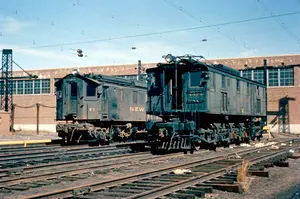
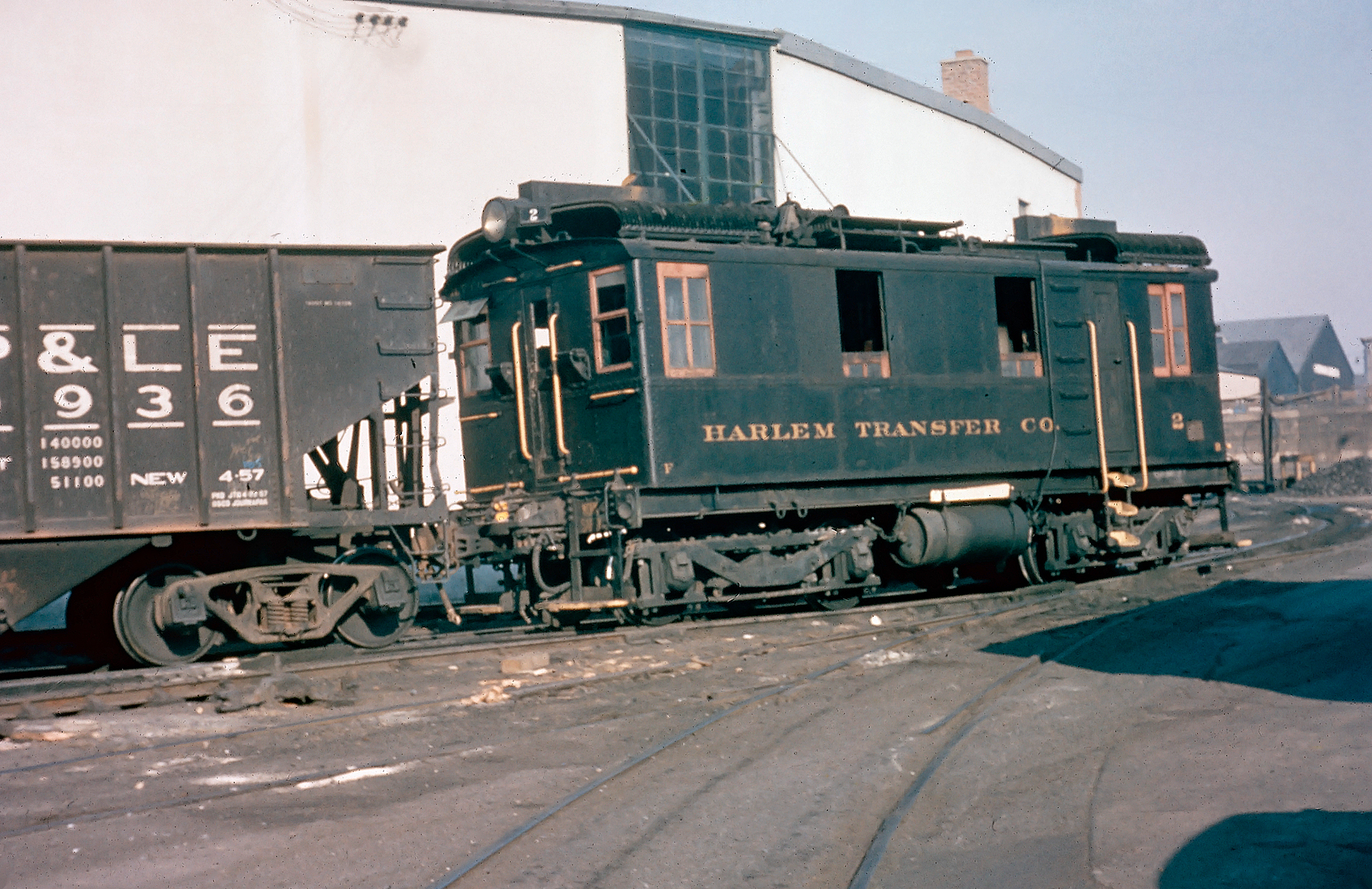 Harlem Transfer Company 60-ton boxcab #2 is seen here at its facility in the Bronx (New York), circa 1960. This 300 horsepower switcher was manufactured by Alco/GE/Ingersoll-Rand in June, 1926, ordered as Lackawanna #3002. However, the locomotive was transferred to DL&W-subsidiary Harlem Transfer, remaining in service until February, 1962. It was scrapped later that year in November. Meyer Pearlman photo. American-Rails.com collection.
Origins and Foundation
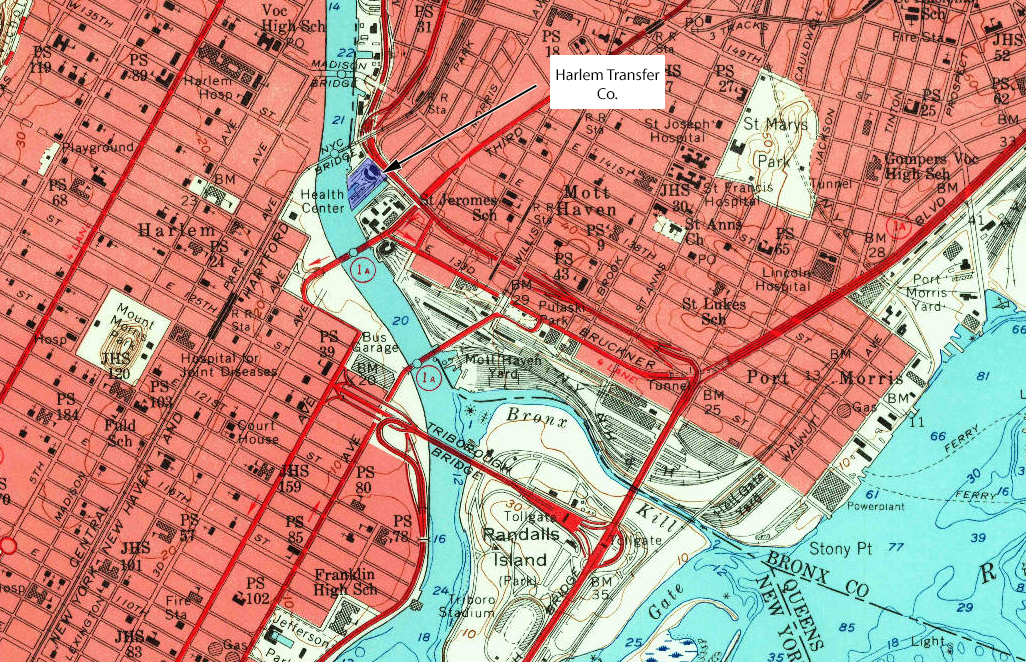
Established in 1898, the Harlem Transfer Company was a pioneer among the so-called "pocket terminals" strategically located in the Bronx along the Harlem River.
Positioned at the intersection of Park Avenue (formerly Railroad Avenue) and East 135th Street, the facility was originally built, owned, and operated by the Erie Railroad.
Between 1898 and 1906, the terminal evolved into a joint operation, accommodating several other railroads.
When the Harlem Transfer facility first commenced operations, it primarily facilitated interchange with the Erie Railroad, Central Railroad of New Jersey, and the Delaware, Lackawanna & Western Railroads.
By 1902, the Baltimore & Ohio would also join, leveraging this crucial hub for their interchange needs.
In 1906, the Delaware, Lackawanna & Western Railroad acquired the Harlem Transfer property outright, assuming exclusive control over its operations while maintaining company as a subsidiary under its original name.
This strategic move necessitated that other railroads construct their own carfloat terminals along the Harlem River. However, the Erie Railroad maintained its presence at the facility into the 1930s.
The Harlem Transfer boasted its own tugboats and locomotives, distinct from those in the DL&W roster. Notably, the facility's freighthouse was an unusual architectural feat.
Infrastructure and Operations
The core infrastructure comprised several key components:
1. **Rail Yards:** Extensive rail yards allowed for the sorting, storage, and transfer of freight cars. These yards were equipped with numerous tracks to accommodate the high volume of rail traffic and facilitate smooth operations.
2. **Docks and Piers:** Given the strategic location by the Harlem River, docks and piers were integral to the company's operations. These facilities enabled the offloading of goods transported via barges and ships, seamlessly integrating waterborne transport with rail and road.
3. **Warehouses:** Massive warehouses provided secure storage for goods awaiting transfer. These structures were engineered to handle a variety of cargo types, ranging from bulk commodities to manufactured products.
4. **Transfer Platforms:** Specialized platforms and cranes were utilized to transfer goods between rail cars and trucks. This included state-of-the-art equipment for the era, ensuring that even heavy or bulky items could be handled efficiently.
DL&W Directory
The Lackawanna's directory of industries from the 1950s noted the following about the operation:
HARLEM TRANSFER COMPANY'S TERMINAL - NEW YORK CITY, N.Y.
Located on Bronx side of Harlem River between Park Avenue and Mott Haven Canal, extending from 135th Street to Harlem River.
Cars are handled by carfloat daily to and from New York Lighterage Station (Hoboken, N.J.). Handles carload and less carload eastbound and westbound freight. This is a land terminal yard - capacity 75 cars. A Diesel locomotive is located at the terminal assuring prompt service. An electric crane - capacity 25 tons. Modern coal pockets operated by Cramer Oil & Coal Company. The following have private sidings:
Anderson Brick & Supply Co. - Building Materials
Cramer Oil & Coal Co. - Coal
Grossmac Flour Trucking Co. - Flour
Key Contributions
1. **Intermodal Integration:** By effectively integrating rail, road, and water transport, the Harlem Transfer Company helped optimize the entire freight transport network. This intermodal approach was ahead of its time and crucial for the high-density urban environment of New York City.
2. **Economic Boost:** The company's operations supported a wide array of industries, including manufacturing, retail, and agriculture. By ensuring that raw materials and finished products moved efficiently, it contributed significantly to the economic growth of the region.
System Map
Challenges and Evolution
Despite its success, the Harlem Transfer Company faced numerous challenges over the years. The relentless pace of urbanization, technological advancements, and shifts in transportation logistics continuously reshaped the industry.
Most notably, increased competition from other transport companies and emerging trucking firms posed a persistent threat. As an increasing number of major highways were built throughout New York after World War II, trucks quickly pulled away most short haul freight - not only at the Harlem Transfer operation but also industry-wide.
Decline and Legacy
As the 20th century progressed, the landscape of freight transportation evolved dramatically. The rise of containerization, advancements in logistics technology, and the growth of the interstate highway system fundamentally reshaped the industry.
The once-critical intermodal hubs like the Harlem Transfer Company found it increasingly challenging to compete in this new context.
By the mid-20th century, the rise in containerized shipping—which allowed goods to be packed in large, standardized containers that could be easily transferred between ships, trucks, and trains—reduced the need for specialized transfer facilities like those operated by the Harlem Transfer Company. As trucking became faster and more cost-effective, the reliance on rail for short hauls diminished.
The shift to containerized shipping and the consolidation of railroad companies led to a gradual decline in the need for dedicated freight transfer terminals.
Additionally, urban redevelopment initiatives in New York City during the latter half of the 20th century led to the repurposing of waterfront and industrial areas for residential and commercial use, further displacing traditional freight operations.
After decades of service, the Harlem Transfer Company facility permanently closed in July 1968. The tracks were dismantled, and the float bridge was removed. The property was subsequently sold in 1978.
1. **Historical Significance:** The company remains a case study in efficient intermodal transport and urban freight logistics, offering valuable lessons for modern transportation planning.
2. **Infrastructure Influence:** The infrastructure and methods developed by the Harlem Transfer Company influenced subsequent developments in freight handling and logistics, paving the way for more advanced and integrated systems.
3. **Economic Foundation:** The economic impact of the Harlem Transfer Company during its heyday provided a solid foundation for the growth and development of New York City's commerce and industry, effects still felt in the city's vibrant economy.
Conclusion
The Harlem Transfer Company's history is a testament to the dynamic nature of the transportation and logistics industry.
From its strategic inception and operation in the 19th century to its adaptation to technological advancements and economic pressures, the company played a crucial role in shaping the freight landscape of New York City.
While it ultimately succumbed to the changing tides of the industry, the Harlem Transfer Company's contributions to intermodal transportation, urban planning, and economic growth leave an indelible mark on the annals of American transportation history.
Its story underscores the importance of adaptability, innovation, and strategic vision in an ever-evolving industry.
Recent Articles


-
Norfolk & Western Diesel Roster (All-Time)
Oct 12, 26 11:59 PM
 Norfolk & Western diesel roster, all-time. 1,464 locomotives built new for the railroad, from the 1955 GP9s and RS-3s through the C36-7s, plus the merger fleets.
 -
Norfolk & Western Steam Roster (Post 1900)
Oct 12, 26 11:52 PM
 Norfolk & Western steam since 1898. The Roanoke grid: 1,266 locomotives, the J, the A, and the Y, and the last road steam on May 7, 1960.
 -
Norfolk & Western Railway: Map, Logo, Rosters, History
Oct 12, 26 11:45 PM
 The Norfolk & Western, from the City Point Railroad of 1838 to Norfolk Southern. Pocahontas coal, Roanoke steam, and the 1964 expansion.
 -
Louisiana Railroad Museums (2026): A Complete Guide
Oct 12, 26 11:24 PM
 Louisiana railroad museums—the DeQuincy depot, the Long Leaf sawmill, Jackson’s model railroad, and Southern Pacific 745. Confirm hours on each site.
 -
Michigan Railroad Museums (2026): A Complete Guide
Oct 12, 26 11:14 PM
 Michigan railroad museums—Pere Marquette 1225 at Owosso, Durand Union Station, The Henry Ford, and the Mount Clemens depot. Confirm hours on each site.
 -
Mississippi Railroad Museums (2026): A Complete Guide
Oct 12, 26 10:52 PM
 Mississippi railroad museums—McComb’s rebuilt Illinois Central depot and Illinois Central 2542, and the Casey Jones museum at Water Valley. Confirm hours on each site.
 -
The "E2b": PRR's Experimental Freight Electrics
Oct 12, 26 10:33 PM
 PRR class E2b: six GE B-B freight electrics, 4939–4944, 2,500 hp, 11 kV AC. Specifications, roster, and the 1964 scrap.
 -
Alaska Railroad Museums (2026): A Complete Guide
Oct 12, 26 10:10 PM
 Alaska railroad museums—the Museum of Alaska in Wasilla, Tanana Valley No. 1 at Pioneer Park, and the Engine 557 shop. Confirm hours on each site.
 -
Western and Atlantic Railroad: Map, History, Timetables
Oct 12, 26 09:55 PM
 The Western & Atlantic Railroad of the State of Georgia, authorized December 21, 1836, from Atlanta to Chattanooga. The state still owns the 137.33-mile line. CSX leases it. The through railroad opene…
 -
Nashville, Chattanooga & St. Louis Steam Roster (Post 1900)
Oct 12, 26 09:52 PM
 Nashville, Chattanooga & St. Louis steam since 1900. Drury's class grid: Consolidations, 51 Mikados, three 2-8-8-2s, Pacifics, and 25 4-8-4s. Last steam was January 4, 1953.
 -
Nashville, Chattanooga & St. Louis Diesel Roster (All-Time)
Oct 12, 26 09:27 PM
 Nashville, Chattanooga & St. Louis diesel roster, all-time. Switchers from 1941, 37 GP7s, and the F3s and F7s. The quantity column totals 132 locomotives.
 -
Nashville, Chattanooga and St. Louis Railway: Map, History, Logo
Oct 12, 26 08:41 PM
 The Nashville, Chattanooga & St. Louis, the Dixie Line. Charter of December 11, 1845, the Cumberland tunnel, and the Louisville & Nashville merger of August 30, 1957.
 -
Idaho Railroad Museums (2026): A Complete Guide
Oct 12, 26 02:44 PM
 Idaho railroad museums—Nampa’s 1903 depot, Wallace’s Northern Pacific depot, and Boise’s 1925 Union Pacific depot. Confirm hours on each site.
 -
Hawaii Railroad Museums (2026): A Complete Guide
Oct 12, 26 12:50 PM
Hawaii railroad museums—the Hawaiian Railway Society at Ewa Beach and the Laupahoehoe Train Museum on the Big Island. Confirm hours on each site. -
Marietta and Cincinnati Railroad: Map, History, Timetable
Oct 12, 26 11:44 AM
 Marietta and Cincinnati Railroad, chartered March 8, 1845 as the Belpre & Cincinnati. Opened in April 1857, sold under foreclosure December 9, 1882, and succeeded by the Baltimore & Ohio Southwestern…
 -
Tennessee Railroad Museums (2026): A Complete Guide
Oct 12, 26 11:39 AM
 Tennessee railroad museums—TVRM and Southern 4501 in Chattanooga, the Tennessee Central museum in Nashville, Casey Jones in Jackson, and the depots at Cookeville, Cowan, and Townsend.
 -
Virginia Railroad Museums (2026): A Complete Guide
Oct 12, 26 09:40 AM
 Virginia railroad museums—Roanoke’s Virginia Museum of Transportation and the O. Winston Link Museum, the C&O center at Clifton Forge, and the depots in Richmond, Fairfax Station, Suffolk, Parksley, a…
 -
Louisville & Nashville Diesel Roster (All-Time)
Oct 12, 26 12:15 AM
 Louisville & Nashville diesel roster, all-time. Switchers from 1939, the cab units, and EMD, Alco, and GE hoods through the SD50s. The quantity column totals 1948 locomotives, plus 29 yard slugs.
 -
Louisville & Nashville Steam Roster (Post 1900)
Oct 11, 26 05:44 PM
Louisville & Nashville steam since 1900. Drury's class grid: Consolidations, 165 heavy Mikados, 42 Big Emma 2-8-4s, Pacifics, and 22 Mountains. Last steam January 1957. -
Louisville and Nashville Railroad: Map, Rosters, History
Oct 11, 26 05:39 PM
 Louisville & Nashville, the Old Reliable. Charter of March 5, 1850, Milton H. Smith, the 921-mile main line, Big Emma, and the December 29, 1982 merger. Steam and diesel rosters are companion pages.
 -
Oregon Railroad Museums (2026): A Complete Guide
Oct 11, 26 05:19 PM
 Oregon railroad museums—the Oregon Rail Heritage Center, Brooks trolleys, Canby’s 1891 depot, Medford’s Willamette, and Train Mountain. Confirm hours on each site.
 -
Texas Railroad Museums (2026): A Complete Guide
Oct 11, 26 05:15 PM
 Texas railroad museums—Frisco’s Big Boy 4018, Galveston’s Santa Fe depot, Temple’s 1911 station, Plano’s interurban, and Fort Worth & Denver 304. Confirm hours on each site.
 -
Wisconsin Railroad Museums (2026): A Complete Guide
Oct 10, 26 11:51 PM
Wisconsin railroad museums—Green Bay’s Big Boy 4017 and Eisenhower’s A4, Mid-Continent at North Freedom, East Troy’s interurban, and the Riverside & Great Northern. Confirm hours on each site. -
Interstate Railroad (Virginia): Map, Roster, Logo, History
Oct 10, 26 11:22 PM
 Interstate Railroad, a Virginia coal road chartered February 18, 1896. Andover shops. Ten Alco RS3s, 30–39. Southern control in 1961. The company ended October 31, 1985.
 -
North Carolina Railroad Museums (2026): A Complete Guide
Oct 10, 26 11:16 PM
North Carolina railroad museums—Spencer Shops, Wilmington’s Atlantic Coast Line 250, Hamlet’s Seaboard depot, and the New Hope Valley Railway. Confirm hours on each site. -
New Mexico Railroad Museums (2026): A Complete Guide
Oct 10, 26 10:54 PM
 New Mexico railroad museums—Santa Fe 2926 in Albuquerque, the Clovis depot, Alamogordo’s Toy Train Depot, and Belen. Confirm hours on each site.
 -
New York Railroad Museums (2026): A Complete Guide
Oct 10, 26 09:33 PM
 New York railroad museums—Phoenicia, Medina’s New York Central freight house, the Transit Museum, Long Island 35 and 39, and GG1 4933. Confirm hours on each site.
 -
Columbia, Newberry & Laurens Railroad: History, Timetable, Roster
Oct 10, 26 09:08 PM
 Columbia, Newberry & Laurens Railroad, Columbia to Laurens, 75 miles. Chartered in 1885. Five Atlantic Coast Line GP7s, 100–104. Merged into the Seaboard System on April 30, 1984.
 -
New Haven Diesel Roster (All-Time)
Oct 10, 26 06:35 PM
 New Haven diesel roster, all-time. 558 road numbers: 60 DL-109s, 30 FA-1s, 27 PA-1s, 60 FL9s, and the switchers from HH600 0900. Serials and order numbers.
 -
New Haven Steam Roster (Post 1900)
Oct 10, 26 06:31 PM
 New Haven steam since 1900. Drury's class grid: 226 Moguls, 33 Mikados, 50 Santa Fes, 70 Mountains, 141 Pacifics, and 10 Hudsons. Last fan trip July 19, 1953.
 -
New Haven Railroad: Rosters, Map, Logo, History, Trains
Oct 10, 26 06:26 PM
 New York, New Haven and Hartford. The Shore Line, Hell Gate, the 1952 map at 1,838.89 miles, and the railroad Penn Central took at 11:59:59 p.m. on December 31, 1968.
 -
C&O's 4-6-4 "Hudson" Locomotives (Class L): Specs, Roster, History
Oct 10, 26 05:36 PM
 Chesapeake & Ohio Class L 4-6-4 Hudsons. Eight L-2s, five L-1 rebuilds, five L-2-As. Specs, Baldwin works numbers, and the roster. No. 490 survives.
 -
Alton Railroad: Map, History, Timetables
Oct 09, 26 10:31 PM
 Alton Railroad, chartered February 27, 1847 as the Alton & Sangamon. Chicago, St. Louis, and Kansas City, the 1937 Official Guide, and the May 31, 1947 merger into the Gulf, Mobile & Ohio.
 -
Mobile & Ohio Steam Roster (Post 1900)
Oct 09, 26 12:26 PM
 Mobile & Ohio steam since 1900. Drury's class grid: 48 six-wheel switchers, 107 Ten-Wheelers, 15 Consolidations, 58 Mikados, and 14 Pacifics. Last revenue steam October 7, 1949.
 -
Mobile & Ohio Railroad: History, Map, Timetable
Oct 09, 26 11:31 AM
 Mobile & Ohio Railroad, chartered in 1848. Columbus on April 22, 1861, the Cairo & St. Louis, the March 1940 Official Guide, and the September 13, 1940 merger into the Gulf, Mobile & Ohio.
 -
Gulf, Mobile & Northern Steam Roster (Post 1900)
Oct 09, 26 10:42 AM
 Gulf, Mobile & Northern steam since 1900. Drury's class grid: Ten-Wheelers, Mikados, Russian Decapods, Pacifics 425 and 426, and three light 4-8-2s. Last revenue steam October 7, 1949.
 -
Gulf, Mobile & Ohio Diesel Roster (All-Time)
Oct 09, 26 10:41 AM
 Gulf, Mobile & Ohio diesel roster, all-time. The 1935 boxcab, DL-107s, 55 FA-1s, F3s and F7s, the Ingalls 4-S, GP30s through GP38-2s, and 21 SD40s. Serials and order numbers.
 -
Gulf, Mobile & Northern Railroad: History, Rebel Route
Oct 09, 26 10:36 AM
 Gulf, Mobile & Northern, from the 1890 Mobile, Jackson & Kansas City to the Rebel and the September 13, 1940 merger into the Gulf, Mobile & Ohio. Steam roster is the companion page.
 -
Gulf, Mobile & Ohio Railroad: Map, Photos, Trains, History
Oct 08, 26 11:48 PM
 Gulf, Mobile & Ohio, chartered in 1938 and merged September 13, 1940. The Mobile & Ohio, the Alton on May 31, 1947, the Rebel Route, and Illinois Central Gulf on August 10, 1972.
 -
New Jersey Railroad Museums (2026): A Complete Guide
Oct 08, 26 11:37 PM
 New Jersey railroad museums—Whippany, Maywood, Pine Creek, Mahwah’s Erie depot, Phillipsburg, and Boonton. Confirm hours on each site.
 -
New Hampshire Railroad Museums (2026): A Complete Guide
Oct 08, 26 11:34 PM
 New Hampshire railroad museums—North Conway, the Flying Yankee, Ashland, Gorham, Raymond, and Sandown. Confirm hours on each site.
 -
Missouri Railroad Museums (2026): A Complete Guide
Oct 08, 26 11:00 PM
 Missouri railroad museums—the National Museum of Transportation, Patee House, Frisco 4524, the Chicago & Alton depot, and Marceline. Confirm hours on each site.
 -
Milwaukee Road X3800: Deer Lodge’s Shop Goat
Oct 08, 26 04:28 PM
 Milwaukee Road X3800, the a home-built shop goat that served the Deer Lodge, MT yard. It was a 220-volt DC switcher, powered through an extension cord that moved electrics into a roundhouse where the…
 -
Key West Extension (Overseas Railroad): History, Construction, Decline
Oct 08, 26 03:59 PM
 Henry Flagler's Overseas Railroad, Miami to Key West, 1905–1935. The Seven Mile Bridge, the 1935 Labor Day Hurricane, and the road that became U.S. 1.
 -
Florida East Coast Steam Roster (Post 1900)
Oct 08, 26 02:34 PM
 Florida East Coast steam since 1897. Seventeen Ten-Wheelers, twenty Atlantics, eighty-seven Pacifics, ninety Mountains, fifteen Mikados, and the switchers.
 -
Florida East Coast Diesel Roster (All-Time)
Oct 08, 26 02:12 PM
 Florida East Coast diesel roster, all-time. E units from 1939, F3s, BL2s, GP7s and GP9s, the GP40-2 orders, 22 SD40-2s, and 24 ES44C4s. Serials and EMD order numbers.
 -
Florida East Coast Railway: Map, History, Rosters
Oct 08, 26 01:46 PM
 Florida East Coast Railway, Henry Flagler's line from Jacksonville to Miami and Key West. Receivership in 1931, the 1963 strike, Grupo México in 2017, and Brightline on the same track.
 -
Minnesota Railroad Museums (2026): A Complete Guide
Oct 08, 26 10:32 AM
Minnesota railroad museums—the Lake Superior Railroad Museum, Two Harbors, Jackson Street, Willmar’s Great Northern 2523, and Currie. Confirm hours on each site. -
Maine Railroad Museums (2026): A Complete Guide
Oct 08, 26 09:24 AM
 Maine railroad museums—Seashore Trolley, the two-foot lines at Portland, Alna, and Phillips, Boothbay, and the Bangor & Aroostook depots. Confirm hours on each site.
 -
Massachusetts Railroad Museums (2026): A Complete Guide
Oct 08, 26 12:08 AM
 Massachusetts railroad museums—Berkshire Scenic at Lenox, Shelburne Falls trolley No. 10, Edaville, Chatham’s 1887 depot, and Lowell. Confirm hours on each site.
%2C%20circa%201960.%20Meyer%20Pearlman%20photo.%20American-Rails.com%20collection.)
