Chicago, Burlington & Quincy Steam Roster (Post 1900)
Published: October 18, 2026
By: Adam Burns
The Chicago, Burlington & Quincy built a large share of its modern steam locomotives in its own shops. West Burlington, Aurora, and Havelock turned out Prairies, switchers, Hudsons, and 4-8-4s. Baldwin supplied the Mikados that did the freight, 383 of them, and the Pacifics that carried the passenger trains until the Hudsons. The table is George H. Drury’s list of locomotives built or rebuilt since 1900. A rebuild is the same frame. The railroad those engines belonged to, from the Aurora Branch charter of February 12, 1849, to Burlington Northern at 12:01 a.m. on March 2, 1970, is the Chicago, Burlington & Quincy page.
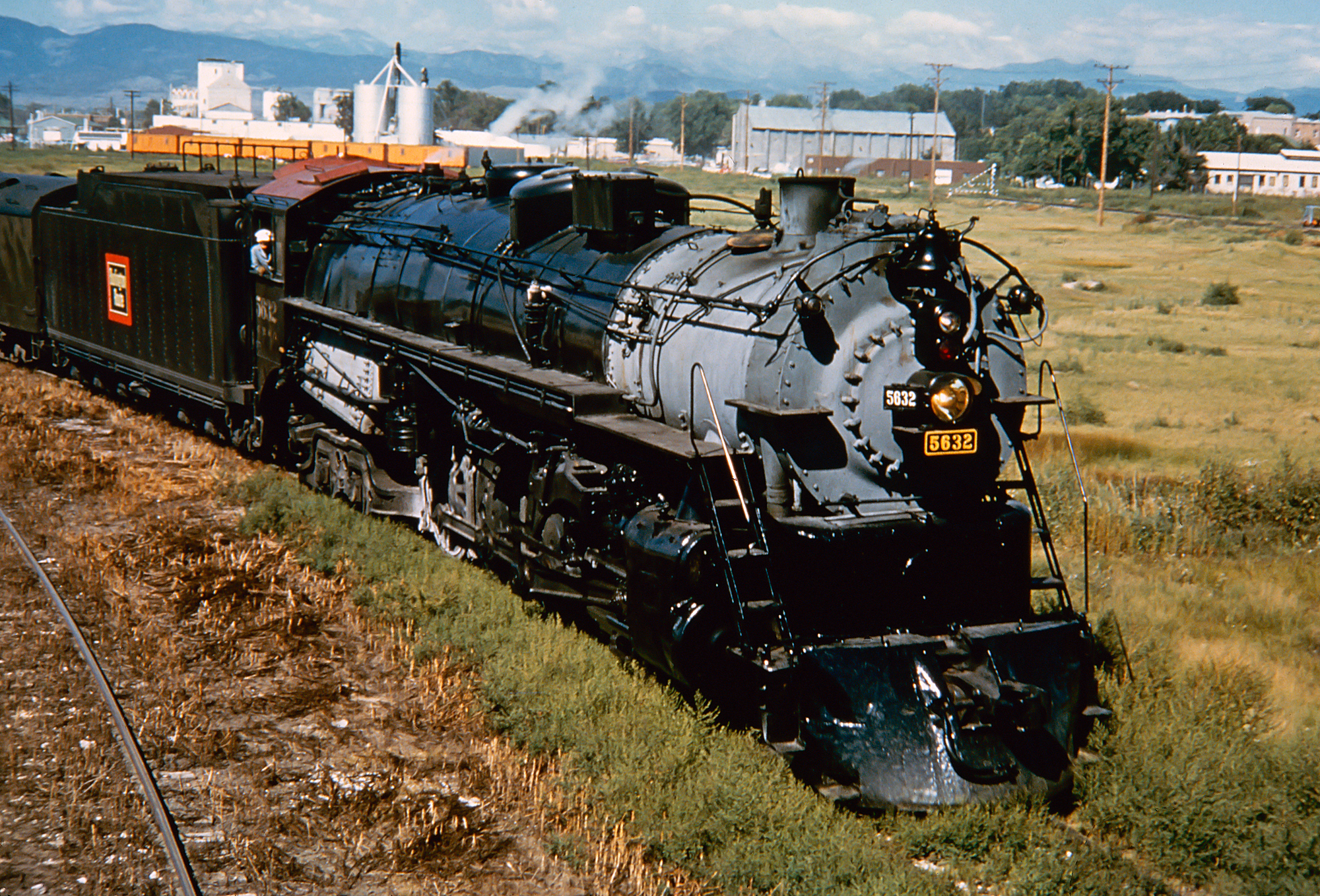
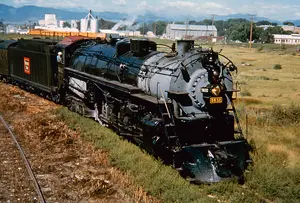
O-5B 5632 between excursions at Longmont, Colorado, in August 1963. American-Rails.com collection.
On this page: At a glance · Prairies · Mikados · Ten-coupled · Articulateds · Passenger engines · Switchers · Roster
At a glance
| Item | Detail |
|---|---|
| Railroad | Chicago, Burlington & Quincy. Mark CBQ. Company history |
| This table | Steam locomotives built or rebuilt since 1900, in Drury’s class order. A rebuild is the same frame |
| Prairies | R-1 through R-5, 429 engines. The R-5 of 1906–1907 is the large Prairie, 175 engines |
| Mikados | 383. O-1 60, O-1A 148, O-2 100, O-3 60, O-4 15 |
| Ten-coupled | 86 Santa Fe type 2-10-2s. 18 Texas type 2-10-4s, class M-4 |
| Articulateds | 19. T-1 and T-1A 2-6-6-2s, ten T-2s, and T-3 4200 |
| Passenger | 145 Pacifics, S-1, S-2, and S-3. 14 Hudson frames. 36 4-8-4s, eight O-5 and twenty-eight O-5A |
| Last steam | Commercial steam ended in January 1959. After 1960 the excursion engines were 4960 and 5632. 4960’s last Burlington trip was the Denrock Zephyr, July 17, 1966 |
Prairies
In 1900 the West Burlington shops built four 2-6-2s to a design by F. A. Delano, the superintendent of motive power. They joined the six-driver 2-6-0. Those first R-1s had 64-inch drivers, 19 by 24 cylinders, and weighed 151,220 pounds. The railroad then enlarged the design, to 20 by 24 cylinders, 170,000 pounds, and 25,500 pounds of tractive effort, and ordered fifty from Baldwin and ten from West Burlington. Drury classes fifty-four of them R-2 and six Baldwin Vauclain compounds R-2C. The grid keeps all sixty in one R-2 row. Two of them were later rebuilt as 0-6-0s.
The fifty R-3s of 1902 were larger: 69-inch drivers, 21 by 26 cylinders, 180,500 pounds, and 28,300 pounds of tractive effort. All of them were rebuilt as 0-6-0s. The R-4 rows are 140 engines, Baldwin in 1904 and 1906 and Brooks in 1905, with 22 by 28 cylinders, a weight of 208,530 pounds, and 35,000 pounds of tractive effort. They had a conventional firebox and inboard piston valves. The R-5 of 1906–1907, 175 engines from Baldwin and Brooks, kept the R-4’s 69-inch drivers and 22 by 28 cylinders and carried a larger boiler. Later R-5s were rebuilt with outboard piston valves and Walschaerts gear. The 25 by 28 cylinders belong to that later R-5A rebuild. The grid keeps those engines in the R-5 row.
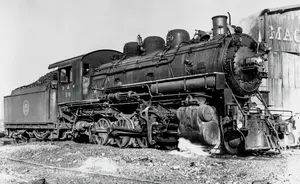
R-5 2121 still had the inboard piston valves and the squared counterweights of 1907 when it was at Congress Park, Illinois, in 1939. The low tender and the mantel-clock headlight were Burlington practice. Between 1917 and 1930 the R-3s, many of the R-4s, and a few of the R-5s became 0-6-0s. Those switcher rows are the same frames. The Prairie total is 429.
Mikados
Post-1900 Consolidations were one group, the 100 D-4A and D-4B engines of 1903, plus two D-7s from the Iowa & St. Louis. They were for slow freight west of the Mississippi. Most were scrapped during the Depression. The Mikado was the Prairie’s successor.
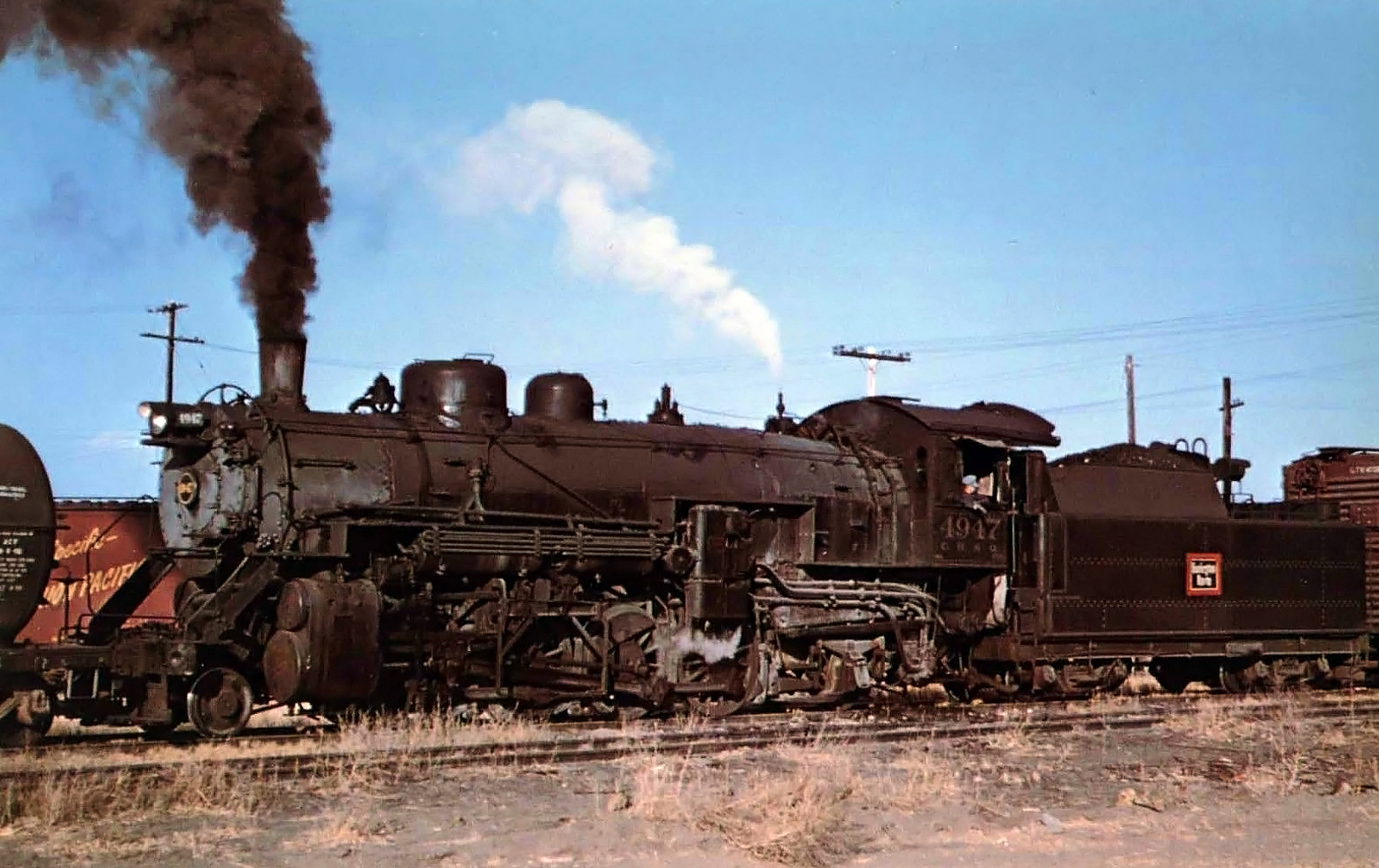
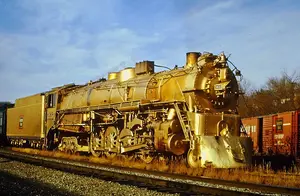
O-1A 2-8-2 4947 at Longmont, Colorado, on November 15, 1958. Bernard Corbin photo.
Baldwin’s first O-1s, in 1910 and 1911, kept the 64-inch drivers and weighed 288,000 pounds. Tractive effort was 49,500 pounds, about 40 percent more than the newest 2-6-2s. The O-2s of 1912–1913 were heavier, 310,000 pounds, and only a little more powerful. The O-1A boiler was tapered. The 148 O-1As are 5060–5147, built 1917–1922, and 4940–4999, built in 1923. Number 4960 is one of the 1923 engines. The O-2 and O-3 boilers were straight-top, with a larger grate. Feedwater heaters, Elesco, Worthington, and Coffin, were applied over the years. O-2A and O-2B are those rebuilds, and they are the same O-2 frames. The fifteen O-4s of 1919 were the United States Railroad Administration heavy Mikados, later oil burners and often assigned west. The Mikado total is 383.
Ten-coupled
The first 2-10-2s, class M-1, five Baldwin engines of 1912, weighed 378,700 pounds and for a short time were the heaviest non-articulated locomotives in the world. They had 60-inch drivers and a wide firebox behind the drivers. The road liked the 2-10-2 well enough to buy 26 more in 1914, and the class then ran on through 1921. Numbers 6108 and 6109, class M-2A, used lightweight alloy rods and did without the extra counterweights. At 40 miles an hour the rail blow from the unbalanced forces was nearly 40 percent less. Most of the 2-10-2s later received feedwater heaters, and the M-2As received disk main drivers. Ten United States Railroad Administration light 2-10-2s, class M-3, 6300–6309, spent much of their lives leased to the Colorado & Southern. The Santa Fe types in this table are 86.
Baldwin built the first twelve M-4 2-10-4s in 1927 and six more in 1929, numbers 6310–6327. They had 64-inch drivers, 31 by 32 cylinders, and weighed 524,000 pounds. Between 1934 and 1940 West Burlington rebuilt them for speed: disk main drivers, roller bearings, and cylinders reduced from 31 inches to 28. Tractive effort fell from 90,000 pounds to 83,300. Some went to the Colorado & Southern. The grid leaves their retirement cell open.
Articulateds
Articulateds were few. The mountainous pieces of the map were the line to Billings and the Deadwood branch in the Black Hills, plus the hump at Galesburg. Three compound 2-6-6-2s, 4000–4002, class T-1, arrived from Baldwin in 1908, with 55-inch drivers. Whether Baldwin had built them for the Great Northern is not settled. Five T-1A engines followed in 1909, with 56-inch drivers. They burned lignite, with the firebox ahead of the drivers and a feedwater heater in the front half, and they trailed an outside-journal truck. They were hard to fire and spent most of their lives in the Black Hills.
Seven of the eight T-1 and T-1A engines became F-2 0-8-0s in 1926 and 1927. Denver began with 4003, which became 0-8-0 550. That engine kept 56-inch drivers, and the boiler had to be shortened about six feet. The 24 by 32 cylinders of the first conversion were more than the boiler wanted, so the later conversions used 25-inch cylinders. Number 4001 was not converted. The ten T-2 Mallets of 1910 had a rigid boiler, 64-inch drivers, and Belpaire fireboxes over the rear drivers. They too stayed in the Hills and were gone by 1929. The single 2-8-8-2, T-3 4200 of 1911, worked the Galesburg hump, was converted to oil, and was sent to Alliance before retirement in 1934. The articulateds are 19 engines.
Passenger engines
Passenger power began the century as 4-4-0s, 4-6-0s, and 2-6-0s. The Atlantics carried a wide firebox, a Burlington idea tried once by the Atlantic Coast Line and not repeated. The P-1C compounds of 1899–1900 were rebuilt as simple engines with 78-inch drivers in 1913–1915. Drury says they were reclassed P-1. The grid still lists them as P-1C. Between 1915 and 1918 the shops rebuilt 105 older 4-4-0s, on the same frames, into class A-2 for branch and inspection work.
The Pacifics, S-1, S-2, and S-3, are 145 engines, and they did the long passenger trains until the Hudsons. The S-1 was developed from the R-5 Prairie, and a number of parts interchanged with the 2-6-2s. It had 74-inch drivers, 22 by 28 cylinders, and weighed 234,000 pounds. Some were built with inboard piston valves and Stephenson gear. Numbers 2800–2844 had Walschaerts gear. The S-2, built almost immediately afterward, had 69-inch drivers and 25 by 28 cylinders, a boiler pressure of 180 pounds against the S-1’s 160, and about 3,500 pounds more tractive effort. Most of both classes were rebuilt as S-1A and S-2A between 1923 and 1930, with piston valves, Walschaerts gear, and feedwater heaters. The S-3 had the S-1’s 74-inch drivers plus 27 by 28 cylinders, at 180 pounds. It was slightly lighter than a United States Railroad Administration light Pacific and a little more powerful. Baldwin delivered 15 in 1915 and 10 in 1918, numbers 2950–2974. Drury notes five more in 1922, two oil burners for the Fort Worth & Denver and three coal burners with 69-inch drivers for the Colorado & Southern. Those five sit outside this row.
The Mountains were for the western lines and for lignite. Lima built eight B-1 4-8-2s in 1922, numbers 7000–7007, with 74-inch drivers, 27 by 30 cylinders, a weight of 364,000 pounds, Rushton trailing trucks, and eight-wheel tenders. Baldwin built thirteen B-1A engines in 1925, with Worthington BL feedwater heaters. Six burned bituminous coal and seven burned lignite.
The Hudsons and the 4-8-4s were the modern passenger and dual-service engines, and they looked alike. Baldwin delivered S-4 3000–3011 in 1930, with 78-inch drivers, 25 by 28 cylinders, and 250 pounds of boiler pressure. West Burlington added 3012 in 1935, on a Baldwin boiler. In 1937 the shops rebuilt 3002 with a stainless shroud and roller-bearing side rods, renumbered it 4000, class S-4A, and named it Aeolus. Crews called it Big Alice the Goon. In 1938 the shops built a duplicate, 4001, also named Aeolus, with the same machinery and no shroud. 4000 is 3002. The Hudson frames are 14. Five survive: 3001 at Ottumwa, 3003 at Burlington, Iowa, 3006 at Galesburg, 3007 at Union, Illinois, and the shrouded engine that began as 3002.
Baldwin’s eight O-5 4-8-4s, 5600–5607, came in 1930 with 74-inch drivers and Elesco feedwater heaters. West Burlington built thirteen more in 1937, numbers 5608–5620, on Baldwin boilers, with the same drivers and Worthington SA heaters. The 1938 engines 5621–5625 and the 1940 engines 5626–5635 were class O-5A, and some of the earlier shop-built engines were later reclassed O-5A with them. The table follows Drury and lists 5608–5635 as O-5A, 28 engines, so the 4-8-4s are 36. In 1942 the shops fitted poppet valves to 5625. The valves did not match the power they were meant to pass, and 5625 was scrapped in 1954. Oil-burning conversions were class O-5B. 5632 was one of them.
Two locomotives came out of freight for the excursion program, 2-8-2 4960 and 4-8-4 5632. Commercial steam ended in January 1959. After 1960 those two were the excursion engines. Harry C. Murphy retired on July 1, 1965. Louis W. Menk ended the steam excursion program. 4960’s last Burlington trip was the Denrock Zephyr on July 17, 1966.
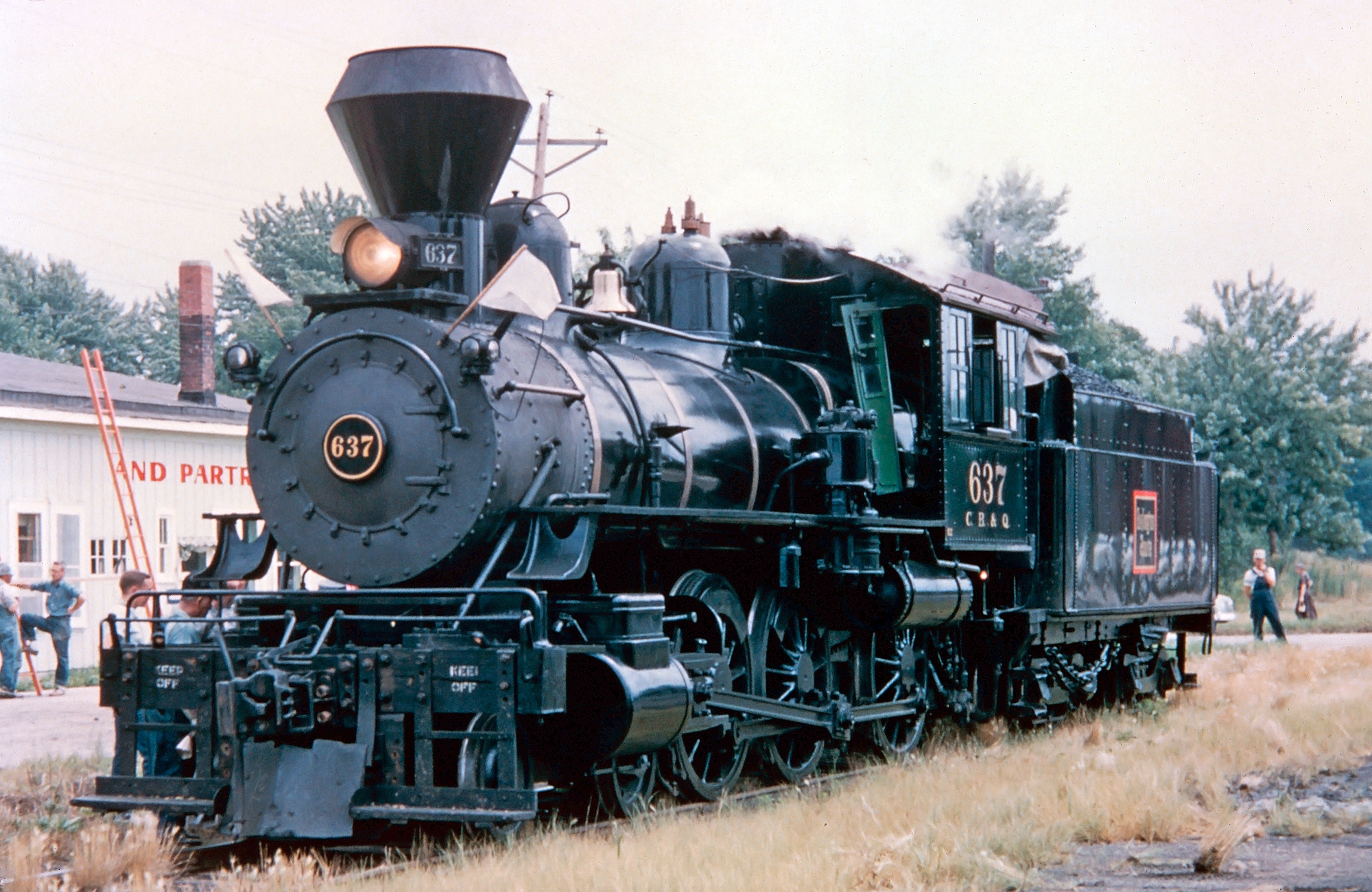
K-2 4-6-0 637 on the Illini Railroad Club’s Triangle fan trip, September 2, 1956, Chicago–Aurora–Streator–Zearing–Aurora. GP7 235 helped on the loop, and Hudson 4000 handled Aurora–Chicago. Rogers built 637 in November 1892, before the post-1900 roster. It is at the Illinois Railway Museum. American-Rails.com collection.
Switchers
Between 1900 and 1913 the railroad built 130 class G-3 0-6-0s at Aurora, Havelock, and West Burlington, and Baldwin added 50 in 1912 and 1913. The G-4 engines were 2-8-0s with the lead truck and the trailing truck removed. The G-6 engines of 1921 were home-built copies of a United States Railroad Administration switcher. Baldwin’s fifteen G-5A engines of the same year followed the same design and were not superheated. The G-7, G-8, G-9, and G-10 classes were rebuilt from 2-6-2s. The G-10s were given new numbers. The other three rebuilt classes kept theirs.
The first 0-8-0s were ten United States Railroad Administration F-1 engines, Brooks, 1919, numbers 540–549. The seven F-2 engines are the Mallet conversions, and 550 was 4003. F-3 5020 was an O-1 Mikado with its lead truck and trailing truck removed, done in the late 1920s or early 1930s, and retired in 1939. The switcher rows add to 457. Many of those rows are Prairies, Consolidations, and Mallets counted again after the rebuild.
Roster
Switchers
| Type | Class | Numbers | Qty | Builder | Built | Retired | Notes |
|---|---|---|---|---|---|---|---|
| 0-6-0 | G-3 | 1400–1579 | 180 | CB&Q, Baldwin | 1900–1913 | 1928–1947 | Built at Aurora, Havelock, and West Burlington, plus 50 from Baldwin in 1912–1913 |
| 0-6-0 | G-4A | 1600–1654 | 55 | CB&Q | 1900–1903 | 1909–1928 | Rebuilt from 2-8-0s |
| 0-6-0 | G-4B, G-4C | 1601–1603, 1647, 1651, 1655–1677 | 28 | CB&Q | 1904–1921 | 1926–1939 | Rebuilt from 2-8-0s |
| 0-6-0 | G-5 | 500–509 | 10 | Cooke | 1919 | 1954 | United States Railroad Administration |
| 0-6-0 | G-5A | 510–524 | 15 | Baldwin | 1921 | 1953–1955 | United States Railroad Administration design. Not superheated |
| 0-6-0 | G-6 | 1678–1699 | 22 | CB&Q | 1921 | 1953–1955 | Home-built copy of a United States Railroad Administration switcher |
| 0-6-0 | G-7 | 1702, 1720 | 2 | CB&Q | 1905–1910 | 1931–1955 | Rebuilt from 2-6-2s |
| 0-6-0 | G-8 | 1710–1769 | 70 | CB&Q | 1917–1929 | 1938–1951 | Rebuilt from 2-6-2s |
| 0-6-0 | G-9 | 1805–1848 | 22 | CB&Q | 1925–1928 | 1942–1951 | Rebuilt from 2-6-2s. Not every number in the span was used |
| 0-6-0 | G-10 | 560–594 | 35 | CB&Q | 1928–1930 | 1951–1955 | Rebuilt from 2-6-2s and given new numbers |
| 0-8-0 | F-1 | 540–549 | 10 | Brooks | 1919 | 1953–1956 | United States Railroad Administration |
| 0-8-0 | F-2 | 550–556 | 7 | CB&Q | 1926–1927 | 1946 | Rebuilt from T-1 and T-1A 2-6-6-2s. 550 was 4003 |
| 0-8-0 | F-3 | 5020 | 1 | CB&Q | — | 1939 | An O-1 Mikado with the lead truck and trailing truck removed, late 1920s or early 1930s |
Freight locomotives
| Type | Class | Numbers | Qty | Builder | Built | Retired | Notes |
|---|---|---|---|---|---|---|---|
| 2-6-2 | R-1 | 1700–1703 | 4 | CB&Q | 1900 | 1929–1930 | Delano’s first Prairies, West Burlington |
| 2-6-2 | R-2 | 1710–1769 | 60 | Baldwin, CB&Q | 1901 | — | Includes six Baldwin compounds classed R-2C. 2 rebuilt as 0-6-0s |
| 2-6-2 | R-3 | 1800–1849 | 50 | Baldwin | 1902 | 1928–1930 | All rebuilt as 0-6-0s |
| 2-6-2 | R-4 | 1900–1939 | 40 | Baldwin | 1904 | 1928–1953 | Many rebuilt as 0-6-0s |
| 2-6-2 | R-4 | 1940–1989 | 50 | Brooks | 1905 | 1928–1954 | A few rebuilt as 0-6-0s |
| 2-6-2 | R-4 | 2000–2049 | 50 | Baldwin | 1906 | 1928–1951 | A few rebuilt as 0-6-0s |
| 2-6-2 | R-5 | 2050–2224 | 175 | Baldwin, Brooks | 1906–1907 | 1928–1953 | A few rebuilt as 0-6-0s. 2121 is the 1939 Congress Park engine |
| 2-8-0 | D-4A | 3100–3174 | 75 | Schenectady | 1903 | 1928–1946 | Slow freight west of the Mississippi |
| 2-8-0 | D-4B | 3175–3199 | 25 | Baldwin | 1903 | 1928–1932 | Same service as the D-4A |
| 2-8-0 | D-7 | 3030–3031 | 2 | Baldwin | 1903 | 1928 | Ex-Iowa & St. Louis |
| 2-8-2 | O-1 | 5000–5059 | 60 | Baldwin | 1910–1911 | 1927–1951 | 64-inch drivers |
| 2-8-2 | O-1A | 5060–5147 | 88 | Baldwin | 1917–1922 | 1953–1957 | Tapered boiler |
| 2-8-2 | O-1A | 4940–4999 | 60 | Baldwin | 1923 | 1951–1957 | 4960 is one of these. Excursions through July 17, 1966 |
| 2-8-2 | O-2 | 5200–5299 | 100 | Baldwin | 1912–1913 | 1931–1954 | Straight-top boiler. O-2A and O-2B are rebuilds of these frames |
| 2-8-2 | O-3 | 5300–5359 | 60 | Baldwin | 1915–1919 | 1951–1956 | Close to the O-2 |
| 2-8-2 | O-4 | 5500–5514 | 15 | Baldwin | 1919 | 1954–1957 | United States Railroad Administration heavy Mikados. Later oil burners |
| 2-10-2 | M-1 | 6000–6004 | 5 | Baldwin | 1912 | 1933, 1950 | 378,700 pounds. Briefly the heaviest non-articulated locomotives |
| 2-10-2 | M-2 | 6100–6107 | 8 | Baldwin | 1914 | 1951–1953 | |
| 2-10-2 | M-2A | 6108–6109 | 2 | Baldwin | 1914 | 1952 | Lightweight rods. No supplemental counterweights |
| 2-10-2 | M-2 | 6110–6125 | 16 | Baldwin | 1914 | 1951–1954 | |
| 2-10-2 | M-2A | 6126–6170 | 45 | Baldwin | 1915–1921 | 1951–1954 | Most later received feedwater heaters and disk main drivers |
| 2-10-2 | M-3 | 6300–6309 | 10 | Brooks | 1919 | 1953–1954 | United States Railroad Administration. Leased to the Colorado & Southern |
| 2-10-4 | M-4 | 6310–6327 | 18 | Baldwin | 1927, 1929 | — | 64-inch drivers, 31 by 32 inches, 524,000 pounds. Rebuilt 1934–1940 with 28-inch cylinders |
| 4-8-2 | B-1 | 7000–7007 | 8 | Lima | 1922 | 1953–1955 | Western lines. Lignite. 74-inch drivers, 27 by 30 cylinders |
| 4-8-2 | B-1A | 7008–7020 | 13 | Baldwin | 1925 | 1955– | Six equipped for bituminous coal and seven for lignite |
Articulated locomotives
| Type | Class | Numbers | Qty | Builder | Built | Retired | Notes |
|---|---|---|---|---|---|---|---|
| 2-6-6-2 | T-1 | 4000–4002 | 3 | Baldwin | 1908 | — | Rebuilt as F-2 0-8-0s in 1926–1927, except 4001. Black Hills. Lignite |
| 2-6-6-2 | T-1A | 4003–4007 | 5 | Baldwin | 1909 | — | 4003 became 0-8-0 550 |
| 2-6-6-2 | T-2 | 4100–4109 | 10 | Baldwin | 1910 | 1929 | Rigid boiler. 64-inch drivers. Black Hills |
| 2-8-8-2 | T-3 | 4200 | 1 | Baldwin | 1911 | 1934 | Galesburg hump. Later oil, and sent to Alliance |
Passenger and dual-service locomotives
| Type | Class | Numbers | Qty | Builder | Built | Retired | Notes |
|---|---|---|---|---|---|---|---|
| 4-4-0 | A-2 | 374–478 | 105 | CB&Q | 1915–1918 | 1927–1935 | Rebuilt from 4-4-0s of 1868–1879. Same frames |
| 4-4-0 | A-6 | 479 | 1 | Baldwin | 1901 | 1923 | Ex-Davenport, Rock Island & North Western |
| 2-6-0 | H-4 | 1220–1262 | 43 | Baldwin, Rogers, CB&Q | 1899–1900 | — | 19 rebuilt as K-10 4-6-0s |
| 4-6-0 | K-4 | 700–723 | 24 | CB&Q | 1900–1904 | 1931–1953 | |
| 4-6-0 | K-5 | 800–807 | 8 | CB&Q | 1904–1905 | 1929–1930 | |
| 4-6-0 | K-10 | 950–968 | 19 | CB&Q | 1908–1914 | 1931–1954 | Rebuilt from 2-6-0s |
| 4-4-2 | P-1C | 2500–2504 | 5 | Baldwin | 1899–1900 | 1932–1933 | Formerly 1591–1595. Rebuilt simple, 1913–1915, with 78-inch drivers |
| 4-4-2 | P-2C | 2510–2515 | 6 | Baldwin | 1902 | — | Formerly 1584–1589 |
| 4-4-2 | P-2 | 2520–2527 | 8 | Rogers | 1903 | 1930 | Formerly 1576–1583 |
| 4-4-2 | P-2 | 2528–2544 | 17 | Rogers | 1902–1903 | 1930 | 2544 became P-6A 2592 in 1927 |
| 4-4-2 | P-3C | 2700–2719 | 20 | Baldwin | 1904–1905 | — | Rebuilt as P-5 and P-6 |
| 4-4-2 | P-4 | 2599 | 1 | CB&Q | 1905 | 1929 | Rebuilt from a 2-4-2 |
| 4-4-2 | P-5 | 2550–2555 | 6 | CB&Q | 1915–1917 | 1942–1947 | Formerly P-2 |
| 4-4-2 | P-5 | 2558–2574 | 14 | CB&Q | 1924–1927 | 1942–1954 | Formerly P-3 |
| 4-4-2 | P-6 | 2580–2585 | 6 | CB&Q | 1927–1928 | 1951–1953 | Formerly P-3 |
| 4-4-2 | P-6A | 2590–2597 | 8 | CB&Q | 1927–1928 | 1947–1954 | Rebuilt from P-2. 2592 was 2544, and the drivers went from 84¼ inches to 69 |
| 4-6-2 | S-1 | 2800–2869 | 70 | Baldwin, Schenectady | 1906–1909 | 1933–1955 | Most rebuilt as S-1A, 1923–1930 |
| 4-6-2 | S-2 | 2900–2949 | 50 | Baldwin | 1910 | 1933–1955 | Most rebuilt as S-2A |
| 4-6-2 | S-3 | 2950–2974 | 25 | Baldwin | 1915, 1918 | 1951–1958 | 15 in 1915 and 10 in 1918 |
| 4-6-4 | S-4 | 3000–3011 | 12 | Baldwin | 1930 | 1955 | 78-inch drivers, 25 by 28, 250 pounds. 3002 became shrouded 4000, Aeolus, in 1937 |
| 4-6-4 | S-4 | 3012 | 1 | CB&Q | 1935 | 1955 | West Burlington, on a Baldwin boiler |
| 4-6-4 | S-4A | 4001 | 1 | CB&Q | 1938 | 1955 | Duplicate of 4000, also named Aeolus, without the shroud |
| 4-8-4 | O-5 | 5600–5607 | 8 | Baldwin | 1930 | 1955 | 74-inch drivers. Elesco feedwater heater |
| 4-8-4 | O-5A | 5608–5635 | 28 | CB&Q | 1936–1940 | 1953– | West Burlington. Oil-burning engines were O-5B. 5632 ran excursions through 1966 |
Related reading on American-Rails.com
- Chicago, Burlington & Quincy · Diesel roster
- California Zephyr · Denver Zephyr · Exposition Flyer
- Fallen Flags
Sources
- George H. Drury, Guide to North American Steam Locomotives, revised edition, the Chicago, Burlington & Quincy chapter, pp. 123–127. Locomotives built or rebuilt since 1900. The class grid above, including builders, dates, quantities, and notes. Prose dimensions for the R-1, R-3, R-4, R-5, O-1, O-2, M-1, M-2A, M-4, T-1, T-1A, T-2, S-1, S-2, S-3, B-1, S-4, and the switcher rebuilds. Six R-2 engines classed R-2C. R-5A cylinders of 25 by 28 inches are the rebuild. 4000 is 3002. 5625 scrapped in 1954. Drury’s recommended roster is Bernard Corbin and William Kerka, Steam Locomotives of the Burlington Route (1960), and their Railway & Locomotive Historical Society list of 1936–1937, with the 1948 supplement. The Burlington Route Historical Society is www.burlingtonroute.com.
- Commercial steam ended in January 1959. After 1960 the excursion engines were 4960 and 5632. Harry C. Murphy retired on July 1, 1965. 4960’s last Burlington trip was the Denrock Zephyr on July 17, 1966. K-2 637 was built by Rogers in November 1892 and is at the Illinois Railway Museum. The company page holds the Aurora Branch charter of February 12, 1849, the merger at 12:01 a.m. on March 2, 1970, and the 1963 count of 10 steam locomotives.
Recent Articles


-
Chicago, Peoria & St. Louis Railroad: Map, Timetables, History
Oct 18, 26 10:57 PM
 Chicago, Peoria & St. Louis Railroad, an Illinois line from Pekin and Peoria through Springfield to Madison. Chartered in 1853. Sold in parcels on November 20, 1924. The Pekin line is today the Illino…
-
Chicago, Burlington & Quincy Diesel Roster (All-Time)
Oct 18, 26 10:54 PM
 All-time diesel roster of the Chicago, Burlington & Quincy. 951 parent frames, 72 Colorado & Southern, and 36 Fort Worth & Denver, each counted once. Serials included.
-
Burlington Railroad (CB&Q): Map, History, Rosters, Photos
Oct 18, 26 10:49 PM
 The Chicago, Burlington & Quincy, the Burlington Route, ran from Chicago to Denver, the Twin Cities, and the Gulf. Steam built since 1900 and the diesel fleets are companion rosters. Burlington Northe…
-
Chicago, Burlington & Quincy Steam Roster (Post 1900)
Oct 18, 26 10:33 PM
 Chicago, Burlington & Quincy steam locomotives built or rebuilt since 1900. 429 Prairies, 383 Mikados, the Hudsons, and the O-5 4-8-4s. Drury's class grid.
-
Virginian Railway's 2-6-6-6 Locomotives (Class AG)
Oct 18, 26 01:38 PM
 Virginian Railway class AG. Eight Lima 2-6-6-6s, Nos. 900-907, built in 1945 for the east end. Billed at 753,000 pounds. Scrapped in 1960.
-
Pennsylvania (PRR) Steam Roster: Post 1906
Oct 18, 26 01:05 PM
 ennsylvania steam after 1906—H8, H9, and H10 Consolidations, 574 L1s Mikados, 598 I1s Decapods, 425 K4s Pacifics, 301 M1 Mountains. Drury’s grid. Last steam November 30, 1957.
-
Chicago, Aurora and Elgin Railroad: The "Roarin' Elgin"
Oct 18, 26 10:54 AM
 The Chicago, Aurora & Elgin, the Roarin' Elgin, ran 600-volt third-rail trains from Chicago to Aurora, Batavia, and Elgin. Passenger service ended at noon on July 3, 1957. Freight ended June 11, 1959.
-
Algoma Central Railway: Map, Logo, Rosters
Oct 17, 26 10:49 PM
 Algoma Central Railway, Sault Ste. Marie to Hearst. Wisconsin Central on February 1, 1995. Fifty-nine steam locomotives and forty-two diesels.
-
Akron, Canton and Youngstown Railroad: Map, History, Rosters
Oct 17, 26 05:49 PM
 Akron, Canton and Youngstown Railroad, Mogadore to Delphos. The rails never reached Canton or Youngstown. Norfolk & Western control on October 16, 1964. Twenty-six diesels and the historical society's…
-
Georgia Railroad: Map, History, Logo, Rosters
Oct 17, 26 12:59 PM
 Georgia Railroad, the Georgia Railroad and Banking Company, Augusta to Atlanta, with the Athens branch and the Macon Road. Mark GA. The railroad properties were sold on November 4, 1982.
-
West Point Route (Railroad): Map, History, Logo
Oct 16, 26 11:26 PM
 The West Point Route was a trademarked name comprising the Atlanta & West Point and Western Railway of Alabama, which were controlled by the Georgia Railroad.
-
Virginian Railway Diesel Roster (All-Time)
Oct 16, 26 11:11 PM
 All-time diesel roster of the Virginian Railway. 40 Fairbanks-Morse H16-44s, 25 H24-66 Train Masters, and one GE 44-tonner. Serials included.
-
Virginian Railway Steam Roster (Post 1900)
Oct 16, 26 10:55 PM
 Virginian Railway steam locomotives built since 1900. Mikados, 2-8-8-2s, the Triplex, class AE 2-10-10-2s, and the 1945 2-6-6-6s.
-
Virginian Railway: Map, Rosters, History, Electrification
Oct 16, 26 10:51 PM
 Virginian Railway, Deepwater to Norfolk. Combined in 1907 and completed in 1909. Electrified from Roanoke to Elmore. Absorbed by the Norfolk & Western on December 1, 1959.
-
Baldwin "Centipede" Locomotives: Specs, Roster, Photos
Oct 16, 26 03:58 PM
 Baldwin DR-12-8-1500/2 Centipede—2-D+D-2, two 608SC engines, 3,000 hp. SAL 4500 from the 1943 test bed. 54 on the serial list, 52 sold. PRR BP60 then BH50. None preserved.
-
Louisville & Nashville Class M-1 2-8-4s: The Big Emmas
Oct 16, 26 03:52 PM
Louisville & Nashville class M-1, 42 Big Emma 2-8-4s. Baldwin in 1942 and 1944, Lima in 1949. Coal trains from Neon to DeCoursey. No locomotive survives. -
Tennessee, Alabama and Georgia Railway: Map, History, Rosters
Oct 16, 26 03:21 PM
 Tennessee, Alabama and Georgia Railway, Chattanooga to Gadsden. The May 1929 card is 91.7 miles. Southern stock control closed on a January 1, 1971 schedule. Five diesels and Prince's steam list.
-
Railroad Museums In The USA (2026): State Guides & Collections
Oct 16, 26 02:29 PM
 U.S. railroad museums—what they are vs tourist railroads, preservation history (R&LHS, NRHS, IRM, Steamtown), state guides, and destination collections. Confirm hours on each museum’s site.
-
Wyoming Railroad Museums (2026): A Complete Guide
Oct 16, 26 02:26 PM
 Wyoming railroad museums—the Cheyenne Depot, Burlington 5633 at Douglas, Big Boy 4004, and the Laramie depot. Confirm hours and which locomotive is on the property.
-
West Virginia Railroad Museums (2026): A Complete Guide
Oct 16, 26 12:52 PM
 West Virginia railroad museums—Cass Scenic’s geared steam, the Hinton C&O collection, and the Martinsburg B&O roundhouse. Confirm hours and which locomotive is assigned.
-
Washington Railroad Museums (2026): A Complete Guide
Oct 16, 26 12:46 PM
 Washington railroad museums—Snoqualmie, Elbe, Chehalis, Reardan, and the Northern Pacific depot at Toppenish. Confirm hours and which locomotive is assigned.
-
Vermont Railroad Museums (2026): A Complete Guide
Oct 16, 26 12:42 PM
 Vermont railroad museums—the Shelburne Museum’s 1890 station, Central Vermont No. 220, and the private car Grand Isle. Confirm hours on the site.
-
Tennessee Central Railway: Map, Logo, Rosters, History
Oct 16, 26 11:32 AM
 Tennessee Central Railway, Harriman to Hopkinsville. Reorganized January 26, 1922. Last day August 31, 1968. Thirty-one diesels and the railroad's steam roster.
-
Southern Railway Steam Roster (Post 1900)
Oct 16, 26 09:40 AM
Southern Railway steam locomotives built since 1900. Ps-4 Pacifics, Ts Mountains, USRA Santa Fes, and the subsidiary grids for the CNO&TP, Alabama Great Southern, and New Orleans and Northeastern. -
Southern Railway (USA): Map, Locomotives, Logo, History
Oct 16, 26 09:28 AM
 The Southern Railway, formed July 1, 1894 from the Richmond and Danville and the East Tennessee, Virginia and Georgia. Washington. Norfolk Southern Railway on December 31, 1990.
-
Seaboard Coast Line Diesel Roster (All-Time)
Oct 15, 26 04:21 PM
 All-time diesel roster of the Seaboard Coast Line. Inherited Coast Line and Seaboard locomotives, then 623 new locomotives in the printed orders, plus 28 acquired from other railroads.
-
Seaboard Coast Line Railroad: Map, History, Photos
Oct 15, 26 04:17 PM
 The Seaboard Coast Line, formed July 1, 1967 from the Atlantic Coast Line and the Seaboard Air Line. Jacksonville. Family Lines, then the Seaboard System on December 29, 1982.
-
South Carolina Railroad Museums (2026): A Complete Guide
Oct 15, 26 02:54 PM
 South Carolina railroad museums—Winnsboro’s Rockton & Rion line, Spartanburg’s Hub City depot, Greenwood’s Baldwin No. 19, and the Best Friend replica. Confirm hours on each site.
-
South Dakota Railroad Museums (2026): A Complete Guide
Oct 15, 26 10:55 AM
 South Dakota railroad museums—the Hill City museum beside the 1880 Train, and Prairie Village at Madison. Confirm hours, and confirm whether Hill City is still open.
-
Seaboard Air Line Diesel Roster (All-Time)
Oct 15, 26 10:46 AM
 All-time diesel roster of the Seaboard Air Line. 734 locomotives: E4s in 1938, Centipedes, Alco road switchers, and GP40s through February 1967. Serials included.
-
Seaboard Air Line Steam Roster (Post 1900)
Oct 15, 26 10:39 AM
 Seaboard Air Line steam locomotives built since 1900. Mikados, Russian Decapods, 2-10-2s, and the 2-6-6-4s sold to the Baltimore and Ohio in 1947. Drury's class grid.
-
Seaboard Air Line Railroad: Map, Rosters, History
Oct 15, 26 10:34 AM
 The Seaboard Air Line, chartered in the Portsmouth and Roanoke of 1832 and formed July 1, 1900. Inland route to Florida. Merged into the Seaboard Coast Line on July 1, 1967.
-
Utah Railroad Museums (2026): A Complete Guide
Oct 15, 26 12:04 AM
 Utah railroad museums—Ogden Union Station, Golden Spike at Promontory, the Helper mining museum, and the Heber Valley Railroad. Confirm hours on each site.
-
Escanaba & Lake Superior Diesel Roster (All-Time)
Oct 14, 26 10:44 PM
All-time diesel roster of the Escanaba & Lake Superior. 30 locomotives: Baldwin switchers and RS-12s, two RF16s, three GP38s, three SD40-2s, and the Reserve Mining units. Serials and order numbers. -
Escanaba & Lake Superior Railroad: In Service Since 1898
Oct 14, 26 09:04 PM
 Escanaba & Lake Superior Railroad, chartered November 17, 1898, and still operating from Wells, Michigan. Logging line to Channing, the Milwaukee Road lines, and the diesel roster.
-
Richmond, Fredericksburg & Potomac Diesel Roster (All-Time)
Oct 14, 26 08:49 PM
 All-time diesel roster of the Richmond, Fredericksburg and Potomac. 107 locomotives: 22 Alco S2s, one SW1, and an Electro-Motive road fleet from E8s to GP40-2s. Serials and order numbers.
-
Richmond, Fredericksburg & Potomac Steam Roster (Since 1900)
Oct 14, 26 08:46 PM
 Richmond, Fredericksburg and Potomac steam locomotives built since 1900. Pacifics, Mountains, Berkshire-type 2-8-4s, and the named 4-8-4s. Last revenue run December 17, 1954.
-
Richmond, Fredericksburg and Potomac Railroad: Map, Rosters, Logo
Oct 14, 26 08:36 PM
 The Richmond, Fredericksburg and Potomac, chartered February 25, 1834. A 113-mile Richmond–Washington bridge line. Named 4-8-4s, Potomac Yard, and the CSX sale of October 10, 1991.
-
North Dakota Railroad Museums (2026): A Complete Guide
Oct 14, 26 08:29 PM
North Dakota railroad museums—Mandan’s state museum, the Railroad Museum of Minot, and Bonanzaville’s Northern Pacific 684. Confirm hours on each site. -
Oklahoma Railroad Museums (2026): A Complete Guide
Oct 14, 26 08:02 PM
Oklahoma railroad museums—the Oklahoma Railway Museum, Enid’s Frisco 1519, Waynoka’s Harvey House, and El Reno’s Rock Island depot. Confirm hours on each site. -
Oneida & Western Railroad: Map, History, Timetable
Oct 14, 26 06:47 PM
Oneida & Western Railroad, a Tennessee short line from Oneida to Jamestown. Chartered in 1912, opened to East Jamestown in 1921, and to Jamestown on December 10, 1930. Last revenue train March 4, 1954… -
Oneida and Western Railroad (Shamrock Coal Company)
Oct 14, 26 03:20 PM
 Shamrock Coal's mint-green coal trains, 1979–1987. Eight EMD SD40-2s, OWTX 9950–9957, order 786246. Two 72-car gondola sets. Louisville & Nashville, then CSX. Sold to BC Rail.
-
Rhode Island Railroad Museums (2026): A Complete Guide
Oct 14, 26 03:03 PM
 Rhode Island railroad museums—the Friends’ museum in the 1875 Kingston depot, on the old New York, Providence and Boston. Confirm what is on view.
-
Original Norfolk Southern Diesel Roster (All-Time)
Oct 14, 26 12:40 PM
 All-time diesel roster of the original Norfolk Southern Railway. 59 locomotives: Baldwin switchers and AS-416s, three GE 70-tonners, 17 GP18s, and seven GP38s. Serials and order numbers.
-
Original Norfolk Southern Railway: Map, Rosters, History
Oct 14, 26 10:09 AM
 The original Norfolk Southern Railway, chartered in 1870 as the Elizabeth City & Norfolk. Norfolk to Charlotte. Merged into the Southern Railway on January 1, 1974. Baldwin diesels and the GP18s and G…
-
Nebraska Railroad Museums (2026): A Complete Guide
Oct 14, 26 10:00 AM
 Nebraska railroad museums—the Durham Museum, Kenefick Park, Cody Park, and the Golden Spike Tower over Bailey Yard. Confirm hours on each site.
-
Nevada Railroad Museums (2026): A Complete Guide
Oct 14, 26 09:51 AM
 Nevada railroad museums—Carson City, Boulder City, the Nevada Northern at East Ely, and the Virginia City depot. Confirm hours on each site.
-
Montana Railroad Museums (2026): A Complete Guide
Oct 14, 26 12:17 AM
 Montana railroad museums—the Livingston depot, Fort Missoula’s Willamette, the Harlowton Milwaukee depot, and the Whitefish station. Confirm hours on each site.
-
"Jawn Henry" Locomotive: Specs, Diagram, Photos
Oct 14, 26 12:03 AM
 Norfolk & Western No. 2300, class TE-1, the steam turbine-electric Jawn Henry. Baldwin-Lima-Hamilton, Westinghouse, and Babcock & Wilcox, May 1954. Specifications, the road tests, and the Dece…
-
Atlantic and Danville Railway: Serving Southern VA
Oct 13, 26 04:32 PM
 Atlantic and Danville Railway, chartered in 1882, incorporated September 1883. Three-foot line to Claremont, then Norfolk to Danville. Southern lease from September 1, 1899, to July 1, 1949. Alco RS2s…