
Rock Island Railroad: Map, Pictures, Logo, History
Last revised: December 6, 2024
By: Adam Burns
The fabled Chicago, Rock Island and Pacific Railroad was a legend in its own time. A Mighty Fine Line was immortalized in song when Clarence Wilson, a member of the Rock Island's Colored Booster Quartet (an employee choir group from the railroad's Biddle Shops in Little Rock, Arkansas) wrote "Rock Island Line" in 1929.
A few different versions sprang up in the succeeding years, the most famous of which was recorded by icon Johnny Cash in 1970.
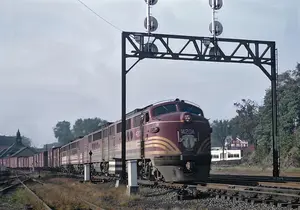
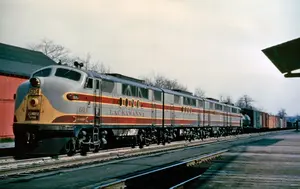
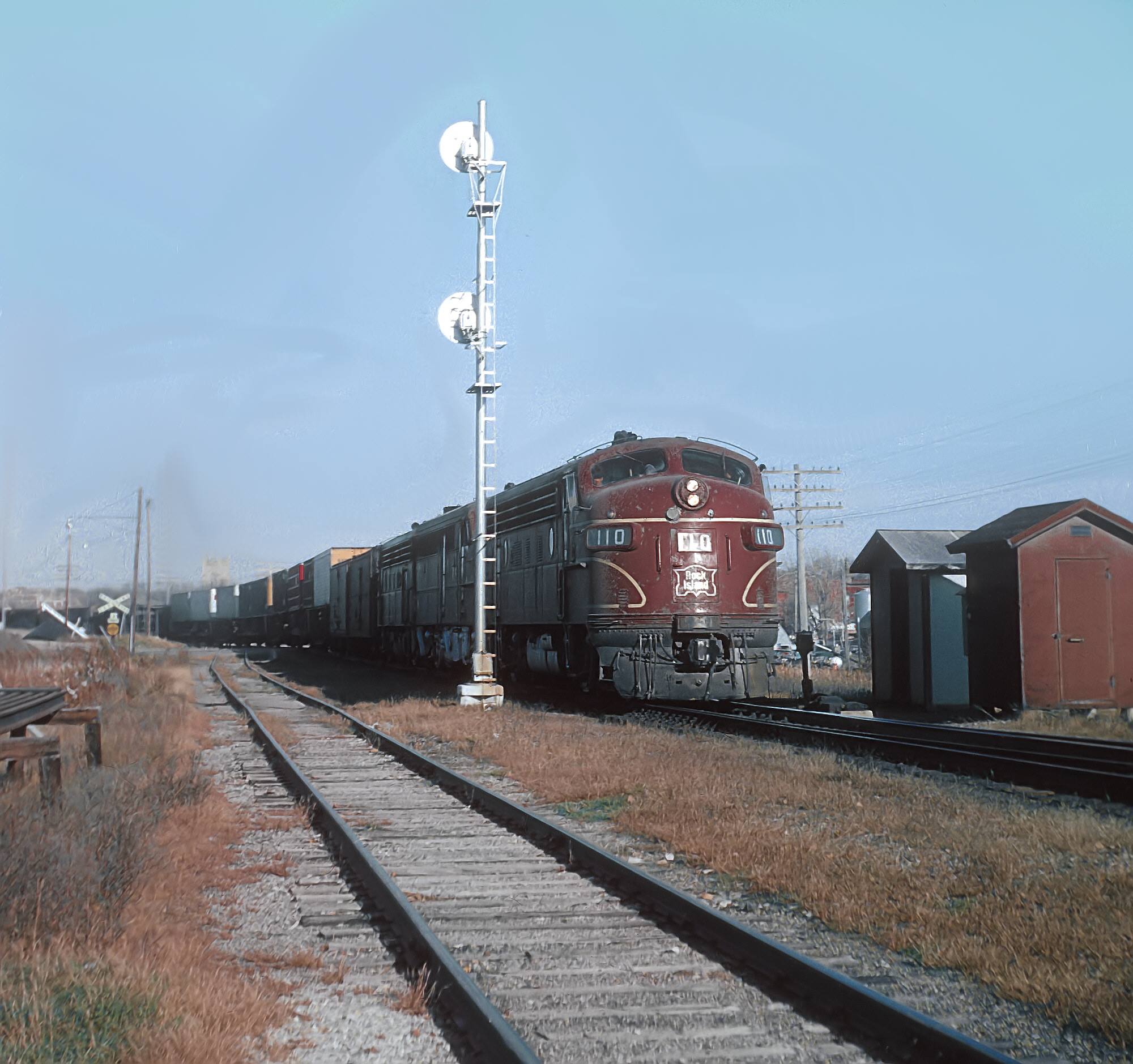 Rock Island F7A #110 in freight service at Northfield, Minnesota on October 29, 1964. After the Rock shutdown this trackage was taken over by the C&NW. Photographer unknown, Rick Burn collection.
Unfortunately, for all the Rock's fame it was not quite as glamorous in reality. It carried problems tracing back to its earliest years and served cities its competitors already reached.
The Rock never "ran down into New Orleans" as Mr. Cash sang and struggled after the company's greatest leader, John D. Farrington, retired. In 1964, a merger was agreed upon with Union Pacific to assure the Rock's survival.
Alas, there was much opposition to this union and as the Interstate Commerce Commission dragged its feet the railroad physically collapsed.
In late 1974, when the agency finally gave its blessing UP was no longer interested. With few options left the Rock Island entered bankruptcy and was liquidated in 1980. In one of the industry's great ironies, most of the railroad's principal routes survive today.
Photos
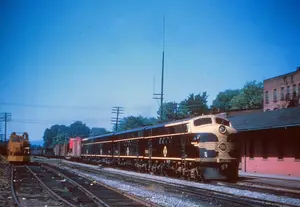
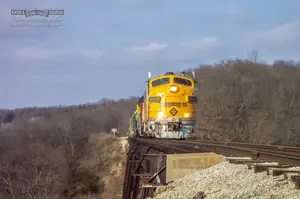
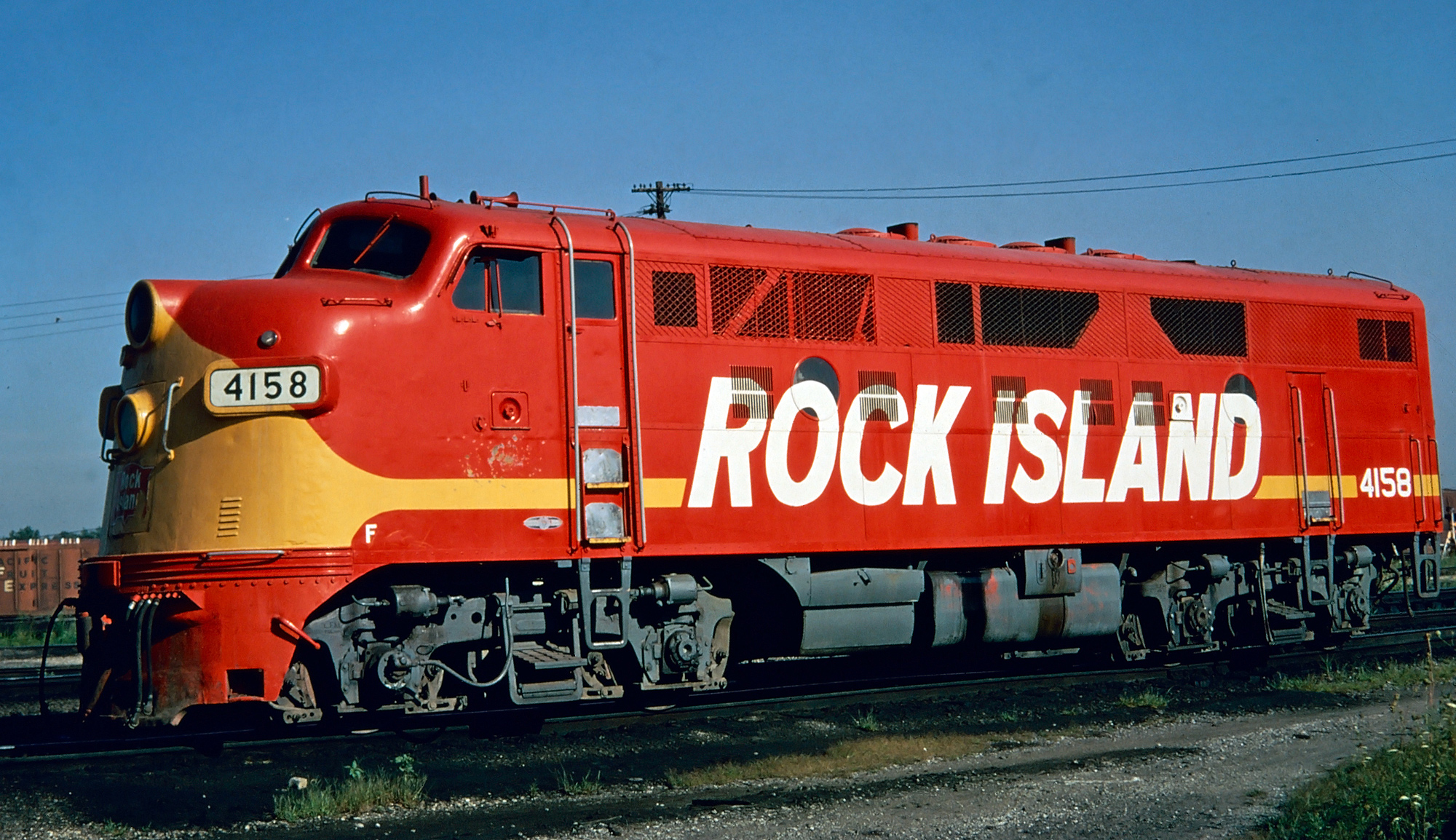 Rock Island F9Am #4158, circa 1975; another former Union Pacific F3A (#1416-A/#1522) the railroad had rebuilt to F9 specs (numbered 522) before being sold to the Rock in 1972. It's interesting that the lettering was painted right over the portholes. By the 1970s the Rock was in desperate need of motive power but could not afford new units so it acquired outdated, first-generation power at a bargain price from UP. American-Rails.com collection.
History
From a nostalgic standpoint many would argue the Rock Island was the greatest of all grangers and it's often hard to dispute that belief.
The railroad offered wonderful bucolic scenes in postwar years of tired covered wagons negotiating rickety and weed-covered trackage to serve a local customer along a rural Midwestern branch line.
While such scenes provided fascinating subjects for the camera they more vividly illustrated the railroad's plight. Agriculture was always the Rock's lifeblood and the two carried a symbiotic relationship.
This was never made clearer than during the 1970's when states like Iowa offered assistance to rebuild crumbling branch lines for continued rail service.
The company's history began like so many others in the Midwest, launched in the mid-19th century to help a small town reach its potential.
According to Bill Marvel's wonderful title, "Rock Island Line," a group of businessmen spent an evening in June of 1845 planning a railroad of 75 miles to link Rock Island, Illinois (across the Mississippi River from Davenport, Iowa) with LaSalle.
What was known as the Rock Island & La Salle Rail Road Company, officially incorporated on February 27, 1847, would work in conjunction with canal and riverboat operators to move freight and passengers into Chicago.
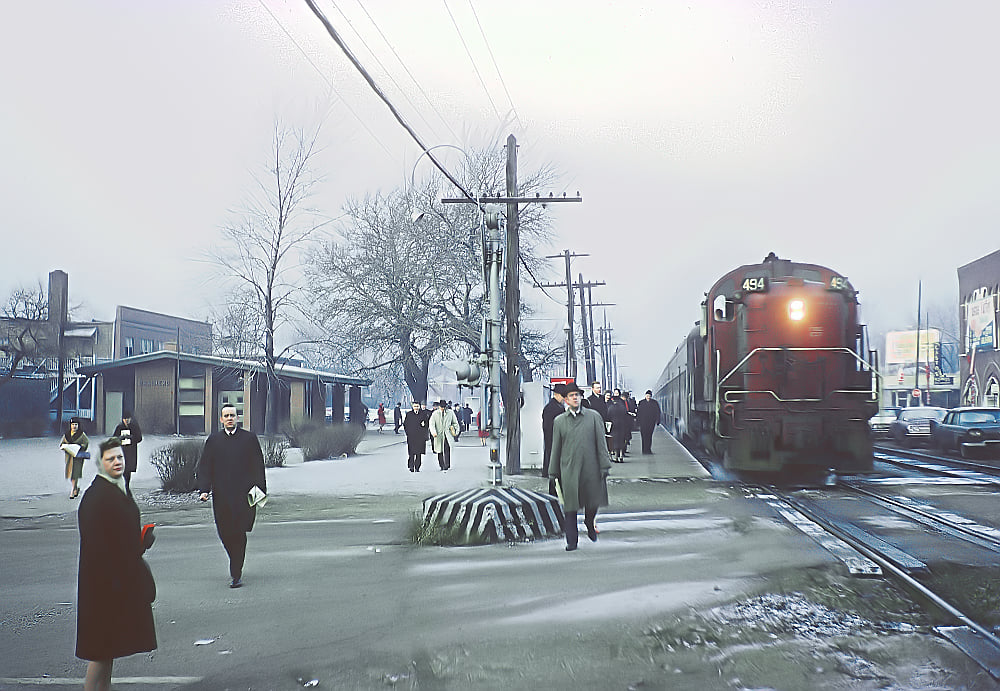 Rock Island RS3 #494 has a morning commuter run at the Brainerd Staton on the Beverly Branch on December 31, 1964. Rick Burn photo.
Rock Island & La Salle Rail Road
Unfortunately, this ambitious lot did not have the needed funding to begin construction right away, the bane of so many such projects. They were forced to go about it the old fashioned way, acting as salesmen going door to door selling stock across the countryside.
Raising money in this manner normally carried mixed results but enthusiasm for the railroad turned out to be quite high and by November of 1850 the needed $300,000 had been secured.
When the group sought an engineer for surveying a route they were told extending the line into Chicago offered the best chance of success.
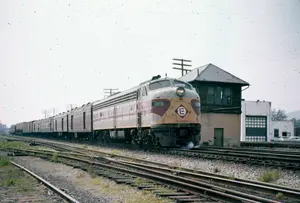
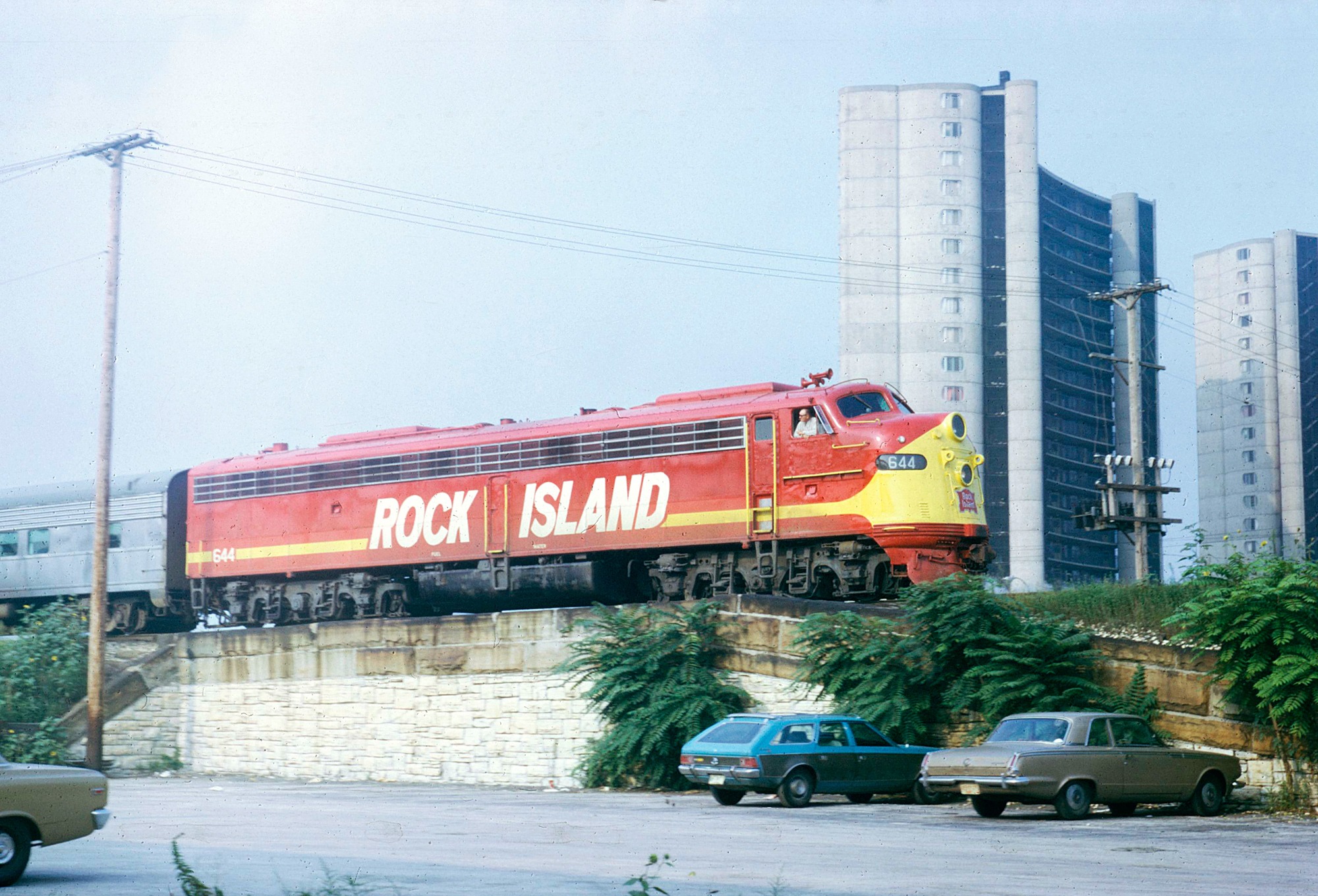 Rock Island E8A #644 leads one of the late era "Rocket" services through Chicago; August, 1973. Kevin Scanlon photo. American-Rails.com collection.
Chicago & Rock Island Railroad
The eager group quickly agreed to this new plan and renamed their company accordingly, as the Chicago & Rock Island Railroad (C&RI). The individual who had made the proposal was Henry Farnam, already well-known for his work on the Michigan Southern Railroad building towards Chicago.
This system went on to form part of the Lake Shore & Michigan Southern, a future component of the mighty New York Central. Farnam's help also provided the CR&I with strong financial backing. In seemingly no time at all a project with an uncertain future was now on solid ground.
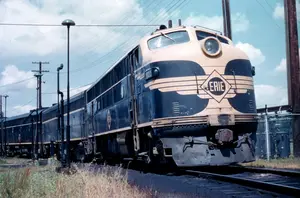
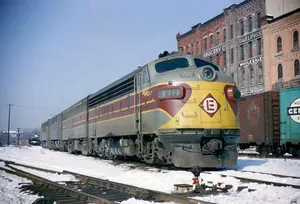
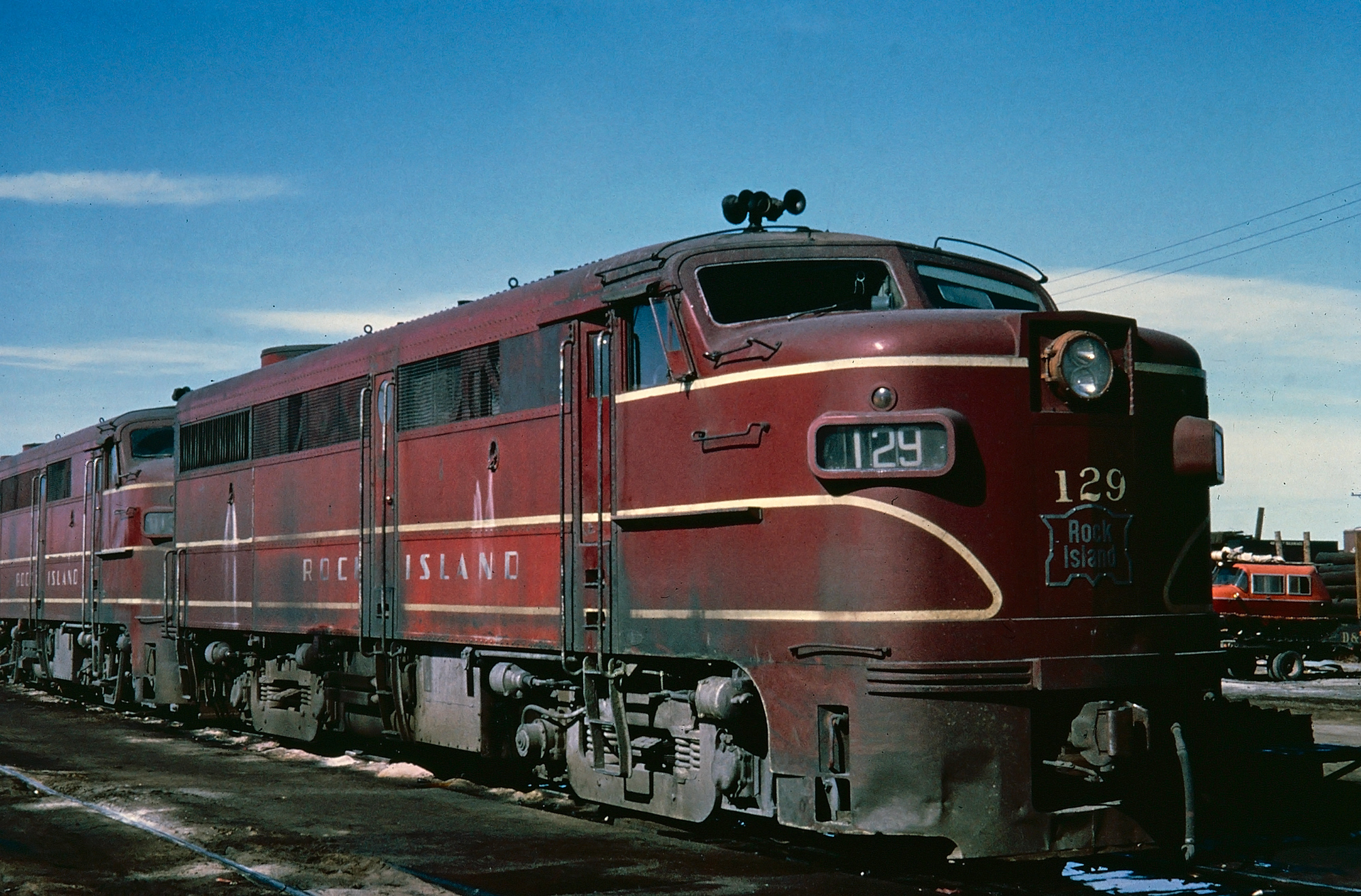 Rock Island FA-1's, with #129 closest to the photographer, layover in Denver, Colorado, circa 1965. The CRI&P would send its entire fleet of sixteen "A" units (145-160) to EMD in the mid-1950s whereupon they were upgraded with 567C's and renumbered. Some were additionally given Blomberg trucks (like the trailing unit) from trade-in FT's. American-Rails.com collection.
4-4-0 "Rocket"
Construction commenced in August of 1852 and rapidly progressed westward from Chicago. In his book, "Classic American Railroads," historian Mike Schafer notes when the initial segment was completed the 4-4-0 Rocket, amid much celebration, pulled the road's first train between Chicago and Joliet on October 10, 1852.
As work continued the line was completed more than a year ahead of the schedule when rail service opened to Rock Island on February 22, 1854. It proved an immediate success and promoters felt so good about their prospects expansion was underway before the C&RI's completion.
On February 5, 1853 the Mississippi & Missouri Rail Road had been chartered to build from Davenport to Council Bluffs. As the book "Iowa Railroads" (the essays of Frank Donovan, Jr., edited by H. Roger Grant) points out, the M&M also planned branches to Muscatine and the Minnesota border via Cedar Rapids; the former opened on November 20, 1855 but the latter was not reached until some years later.
Within two years of reaching Rock Island the Mississippi River was bridged and direct service into Davenport, Iowa opened on April 23, 1856.
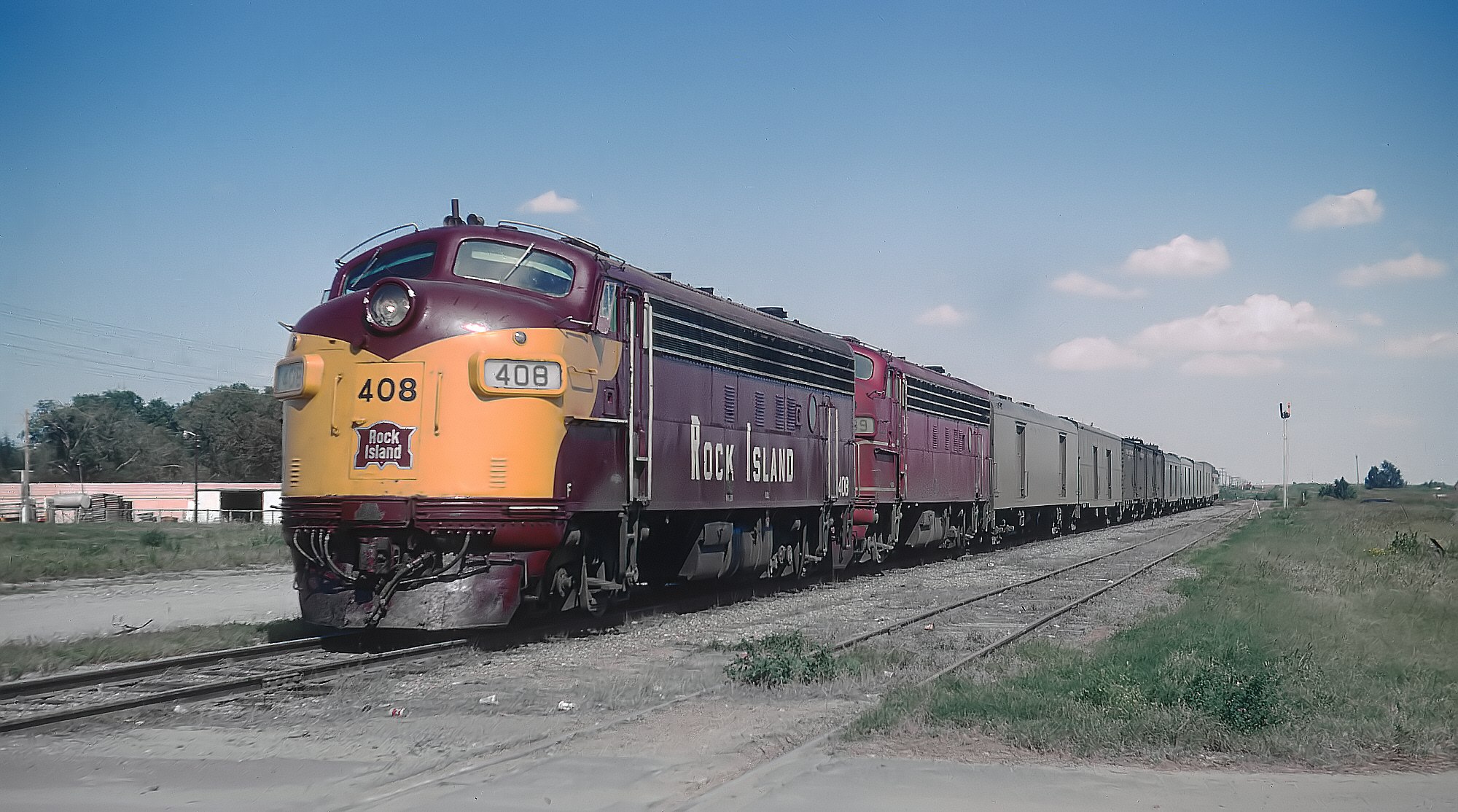 A beautiful Rock Island FP7, #408 (along with #409), has Train #21 at Shamrock, Texas on the now-abandoned "Choctaw Route" in August, 1967. Tom Hoffman photo, Rick Burn collection.
With the pace of construction it appeared the C&RI would soon establish itself as one of the Midwest's premier systems. However, just as quickly work slowed considerably due to financing and a national recession.
As the M&M languished its competitors, notably the Chicago, Burlington & Quincy and Chicago & North Western, eyed their own extension to Council Bluffs while expanding in other directions far beyond the Windy City.
With Congressional passage of the Pacific Railroad Act of 1862, subsequently signed into law by President Lincoln on July 1st, the Union Pacific Railroad was established as the eastern leg of the Transcontinental Railroad. Its goal was to build west from Omaha, a city located directly across the Missouri River from Council Bluffs.
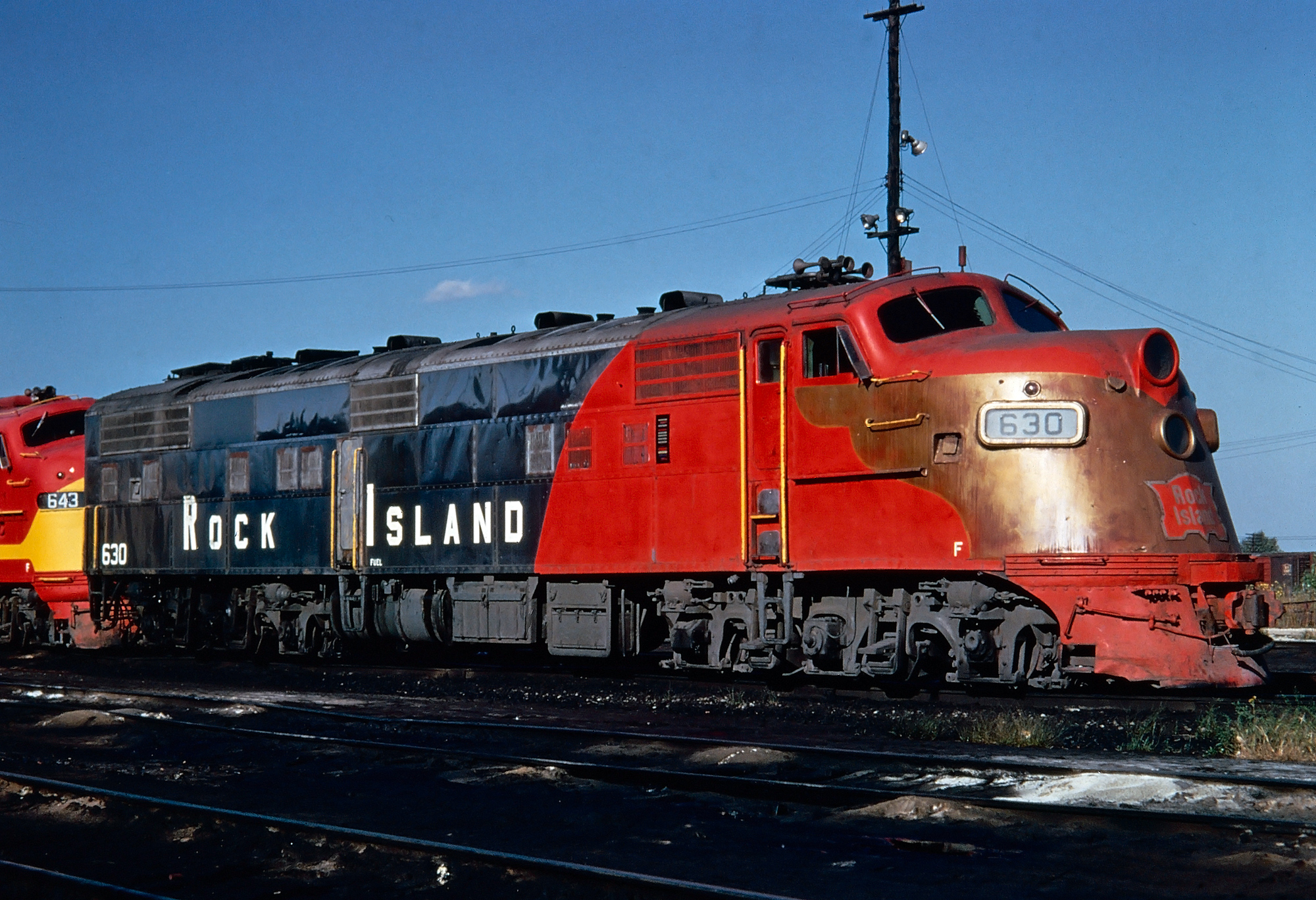 Rock Island E6A #630 is seen here at Silvis, Illinois, circa 1973, wearing a special "Gold Wing" livery to honor Electro-Motive's 50th anniversary manufacturing locomotives (1922-1972). She continued to handle commuter assignments until the end of operations in 1978 when she was subsequently stored at Silvis. Today, the E6 is preserved by the Iowa Northern Railway and cosmetically restored. American-Rails.com collection.
Chicago, Rock Island & Pacific Railroad
Despite the traffic potential a connection there offered the M&M advanced little in the succeeding years and was further delayed by the Civil War. The road then slipped into bankruptcy and was reorganized as the Chicago, Rock Island & Pacific Railroad in July of 1866.
Hope for prosperity returned, however, when new leadership under John Tracy sought the Rock's completion. A date of June 1, 1869 was set for this to occur and if it not met the road would lose its land grants across Iowa.
Logo
From its end-of-track at Iowa City rails extended westward, reaching Council Bluffs just in time on May 11, 1869 and a day after the Transcontinental Railroad held formal opening ceremonies at Promontory Summit, Utah. Despite the significance of this event the Rock was not the first to arrive.
A Chicago & North Western subsidiary had completed its own route in January of 1867, followed by a Chicago, Burlington & Quincy predecessor two years later.
Richard Overton points out in his authoritative book, "Burlington Route: A History Of The Burlington Lines," predecessors of the Kansas City, St. Joseph & Council Bluffs (1870) provided the Burlington its initial link to Council Bluffs, opening on November 25, 1869.
This was followed by a more direct link via Burlington, Iowa and the Burlington & Missouri River Rail Road completed on January 3, 1870.
At A Glance
Chicago - Omaha, Nebraska Omaha - Colorado Springs/Denver, Colorado Davenport, Iowa - Tucumcari, New Mexico Bureau Junction - Peoria, Illinois Minneapolis - Kansas City Manly-Burlington, Iowa Cedar Rapids (Vinton), Iowa - Sioux Falls, South Dakota Keokuk, Iowa - Bear Lake, South Dakota Tucumcari - Memphis Herington, Kansas - Houston Little Rock, Arkansas - Eunice, LouisianaKansas City - St. Louis |
|
Freight Cars: 26,690 Passenger Cars: 646 |
|
It is rather ironic that despite being the first to bridge the mighty Mississippi the Rock Island was one of the last to reach Council Bluffs.
Its late arrival carried severe repercussions throughout the years as its interchange business with Union Pacific was only ever a fraction of that enjoyed by C&NW, the Omaha road's primary Chicago freight connector. This singular issue also caused the drawn out fight over UP's planned merger with Rock Island nearly a century later.
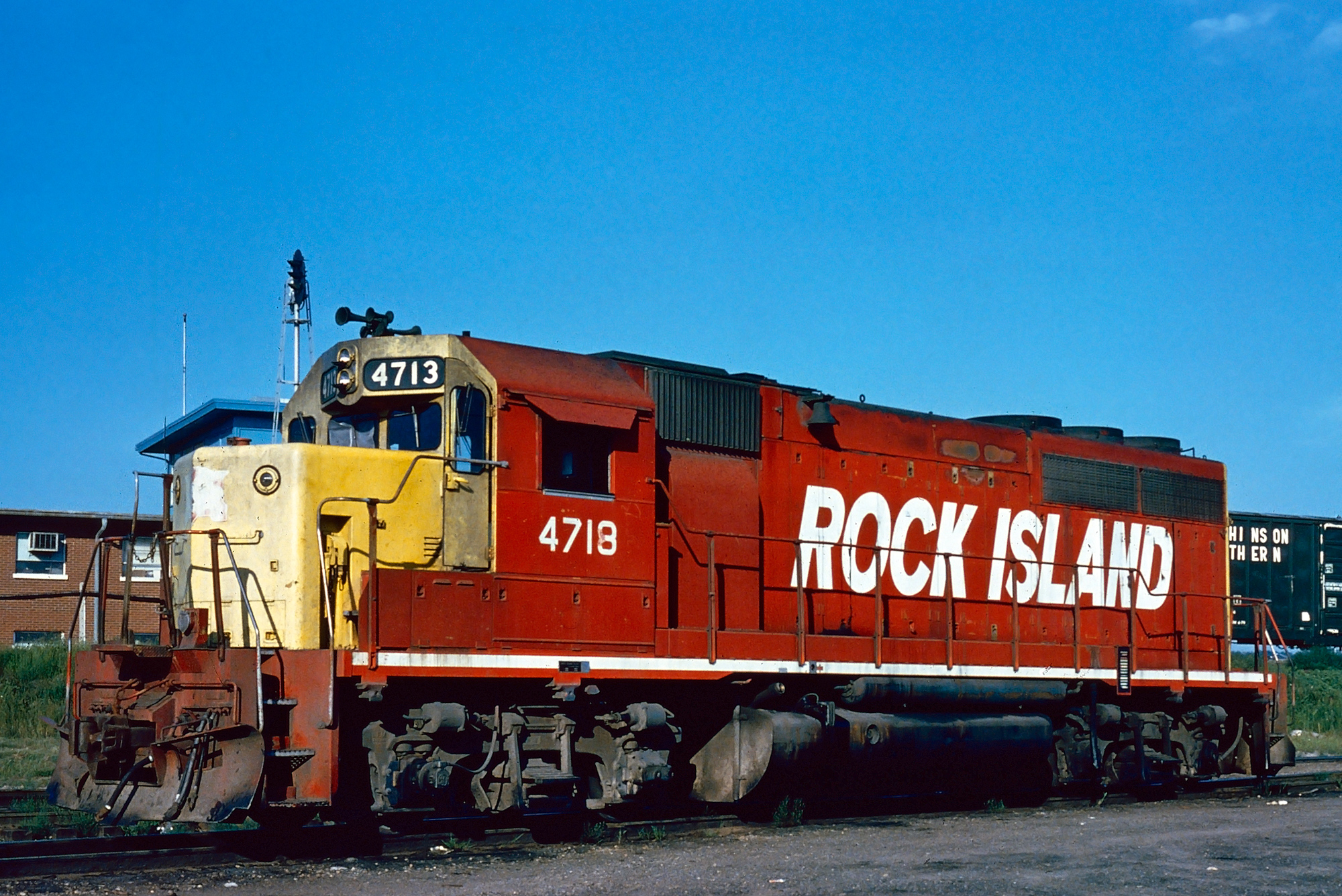 Rock Island GP40 #4713 at the railroad's Silvis, Illinois hump yard and terminal. Date not recorded. Mike Bledsoe photo. American-Rails.com collection.
Expansion
After Council Bluffs was reached, Rock Island embarked upon a great expansion although playing second-fiddle throughout the Midwest became a common theme.
It also arrived in other important cities after its competitors reaching Kansas City in 1879 over rails of the Hannibal & St. Joseph (Burlington) and did not achieve access into the Twin Cities until its 1885 acquisition of the 368-mile Burlington, Cedar Rapids & Northern (which also reached eastern South Dakota at Sioux Falls and Waterton).
The Rock's growth in the latter 19th century was started under John Tracy and continued through Hugh Riddle. A myriad of small systems were added at this time; names like the Keokuk & Des Moines; Des Moines, Indianola & Missouri; Newton & Monroe; and the Des Moines & Fort Dodge.
As Mr. Donovan's book notes, no railroad dominated the Hawkeye State like the Rock. It came to operate a network of 2,075 miles, nearly double that of Chicago & North Western (1,053 miles).
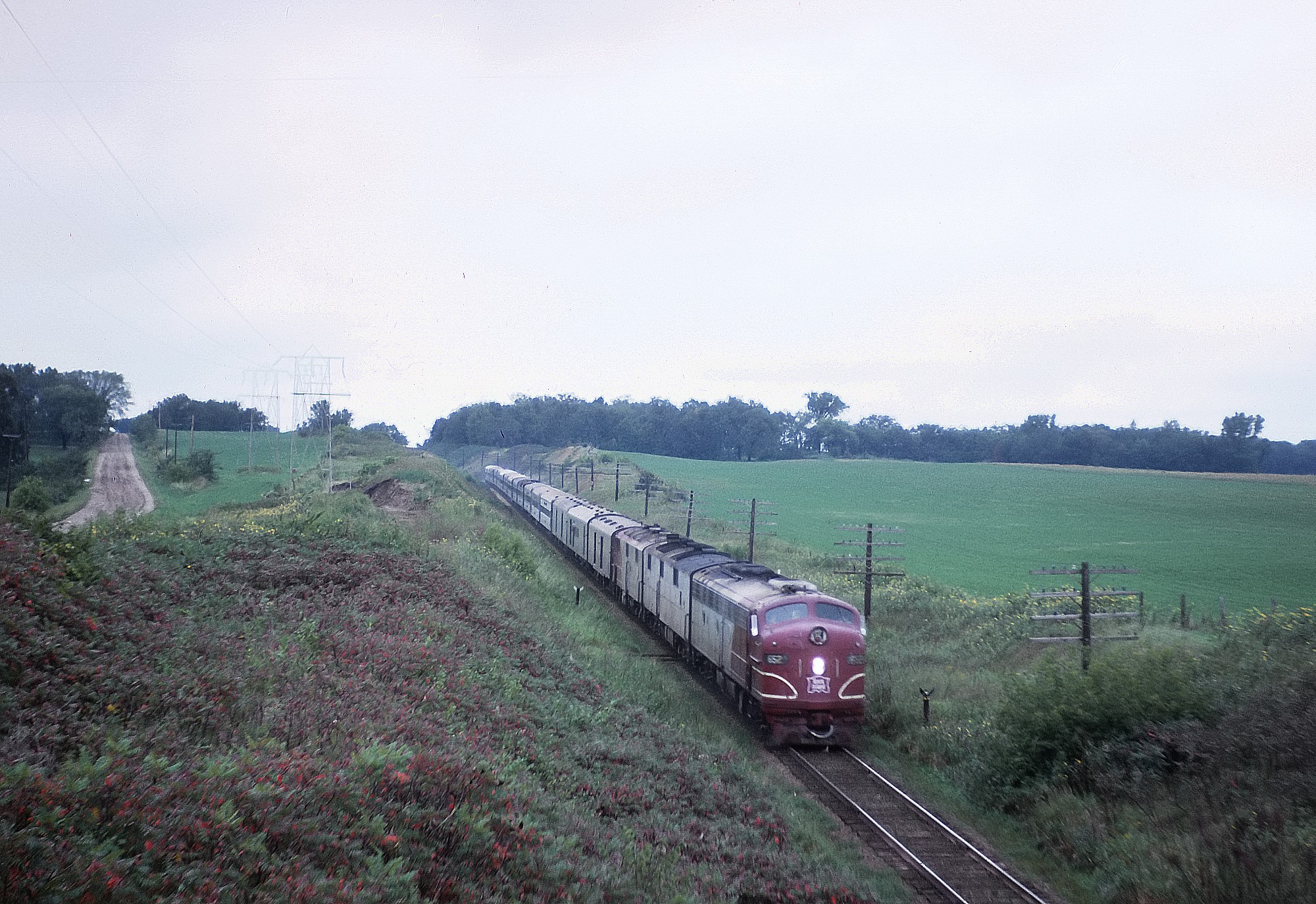 Rock Island E8A #652 is ahead of train #17, the "Twin Star Rocket," north of Northfield, Minnesota in September, 1962. Rick Burn photo.
Under Tracy, the Rock launched a secondary extension heading southwesterly from Davenport. Known as the Chicago & South Western Railway construction began in 1869 from the end-of-track at Washington, Iowa with intentions of reaching Fort Leavenworth, Kansas.
Chicago, Rock Island & Pacific Railway
By the spring of 1872 the line was complete after a bridge opened over the Missouri River. With expansion throughout Iowa occurring at a rapid pace the Chicago, Rock Island & Pacific Railroad and its many subsidiaries were merged into a new company known as the Chicago, Rock Island & Pacific Railway.
In 1883 a change in leadership occurred when Ransom Cable took the reigns; under his direction the Rock Island grew far beyond its regional status. He began by acquiring the aforementioned BCR&N and then set off for the Western Frontier via a new subsidiary known as the Chicago, Kansas & Nebraska.
It was chartered in December of 1886 to build from St. Joseph (a decision which forever left Leavenworth along a relatively inconsequential branch line), head towards Wichita, and reach Denver, Colorado along the Front Range.
With new sources of financing secured and business booming the project commenced quickly. Construction had only just begun when permission was granted to extend beyond Wichita to the Gulf Coast at Galveston, via East Texas and Indian Territory (Oklahoma).
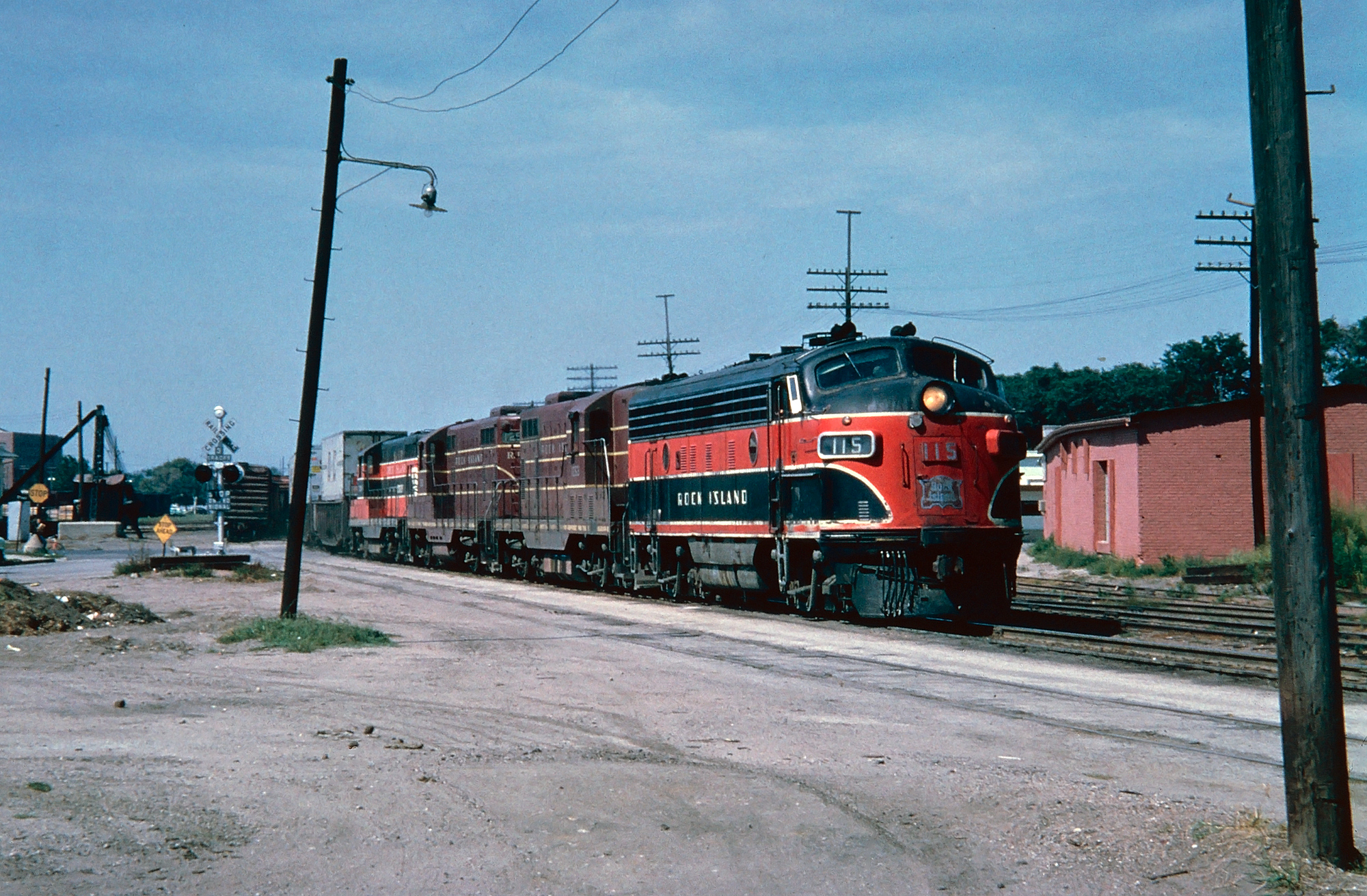 Rock Island F7A #115 leads a westbound through Lincoln, Nebraska, circa 1960. Note the trailers riding in converted gondolas. American-Rails.com collection.
Choctaw Route
The CK&N carried out some of the fastest construction ever witnessed. Following only two years of work there were more than 1,100 miles ready for service by 1889 reaching Denver, Topeka, and Wichita.
There was also an extension to El Reno, Oklahoma while a direct route from Denver to Omaha was established via Belleville, Kansas and Lincoln, Nebraska.
In 1891 Rock Island boasted a network of nearly 4,000 miles and had blossomed into a major Midwestern system. Further growth slowed for about a decade until new leadership through the Reid-Moore Syndicate in 1901 reignited the process.
Under their direction the fabled "Choctaw Route" was established as well as the "Golden State Route" completed from Liberal, Kansas to a connection with the El Paso & Northeastern Railroad at Santa Rosa, New Mexico in February of 1902.
The EP&N was acquired by the El Paso & Southwestern during the summer of 1905, which all became part of the Southern Pacific in 1924.
It is somewhat surprising that the Rock did not continue beyond New Mexico and establish its own transcontinental route given the company's strong financing at the time and the syndicate's desire to do so. There was some additional westward survey work performed but apparently officials were happy to carry the title of "Pacific" in name-only.
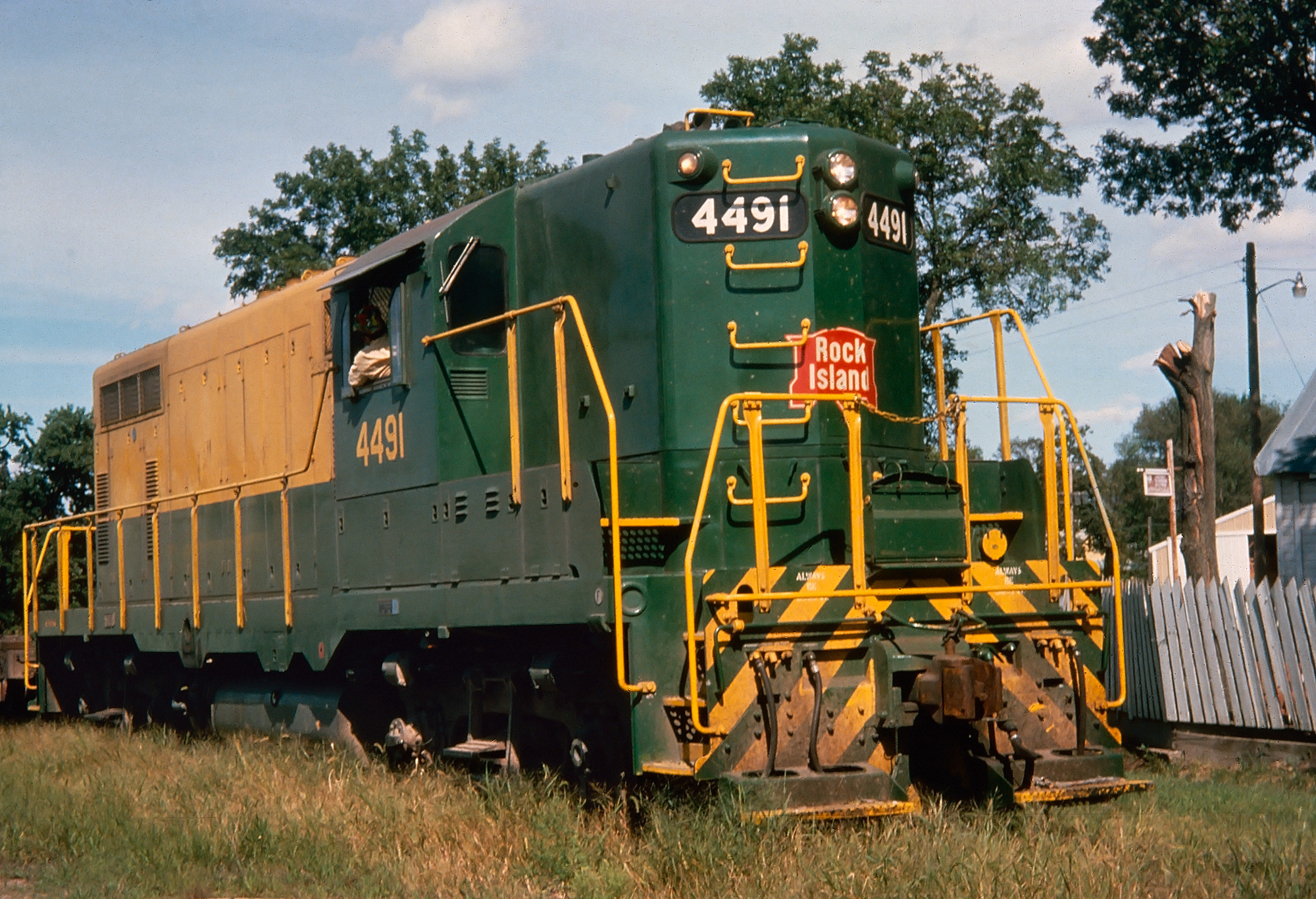 Rock Island GP7R #4491, a rebuild acquired from Precision National, appears to be carrying out switching chores in the summer of 1975. Location not listed. This unit was built as Wabash GP7 #471. American-Rails.com collection.
When the "Choctaw Route," built by the Choctaw, Oklahoma & Gulf, was completed to Tucumcari, New Mexico in 1910 the "Golden State Route" south of that point was leased to the EP&SW. The Choctaw was another important corridor, a southern gateway linking the Southwest and Southeast.
It curved eastward from Tucumcari, headed to Amarillo and cut across Oklahoma and Arkansas before terminating at Memphis, Tennessee. Back along the Rock Island's eastern fringes service opened to St. Louis via Kansas City and finally accessed Galveston when the Trinity & Brazos Valley Railway was leased from the Colorado & Southern in 1906 (later known as the Burlington-Rock Island Railroad).
South of Little Rock, Arkansas the syndicate tried to establish a through route to New Orleans but only made it as far as Eunice, Louisiana where it had to settle upon an interchange with Missouri Pacific. While Reid-Moore's efforts saw the railroad balloon into a network of 8,328 miles they also embarked upon a disastrous scheme of trying to leverage Rock Island's strong earnings power in financing a true transcontinental network.
The incredibly complex and expensive boondoggle failed, and along with it the railroad, which entered receivership in 1915. It was reorganized on June 24, 1917 as the Chicago, Rock Island & Pacific Railroad with the original system still intact.
 Outbound Rock Island commuter runs are seen here at Blue Island, Illinois in September, 1967. Note Illinois Central's electrified commuter trackage to the right.
Unfortunately, the company's newfound freedom was short-lived. After the United Stated entered World War I the Rock, and the entire industry, was placed under federal control on December 28, 1917 through the United States Railway Administration. There it remained until being returned to private management on February 28, 1920.
The road spent the "Roarin' 20's" enjoying the decade's strong traffic and carried out some infrastructure improvements but its perennial infrastructure issues (light rail, poor ballasting, insufficient bridges, and circuitous routes) were not resolved when the stock market crashed in the fall of 1929.
These problems, coupled with the country's economic condition, caused a second bankruptcy on June 7, 1933.
This time, recovery was not as fast but a bright spot appeared, new president John Dow Farrington. The receivers brought him in to fix the problems and return the railroad to profitability. Without question, Farrington was the Rock Island's greatest leader.
System Map
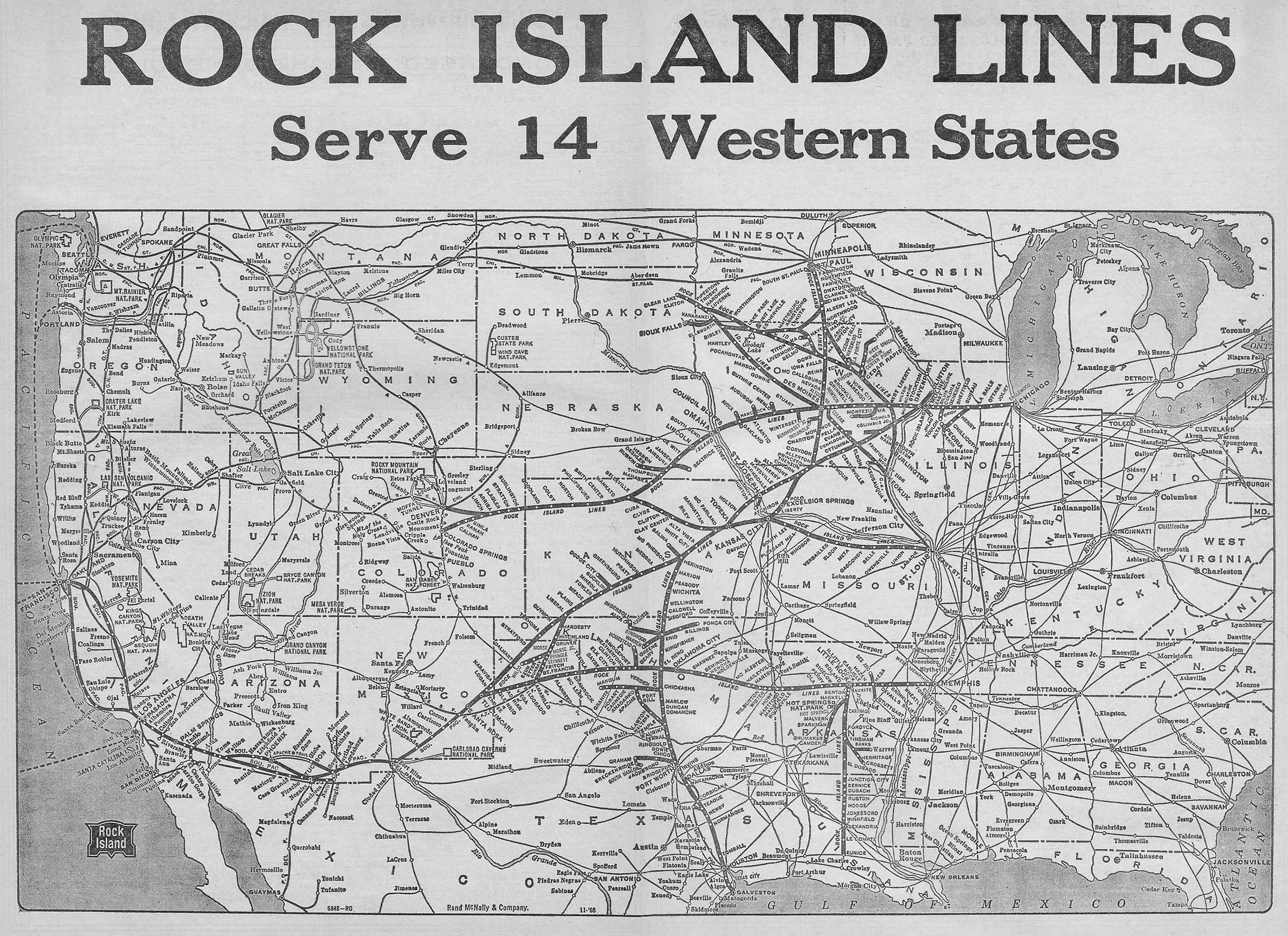
Modern Network
Farrington was a no-nonsense manager, always on the hunt for ways of increasing efficiency and cutting waste. He loathed ignorance and brought quick retribution upon anyone who could not thoroughly answer questions.
Farrington's high-rail equipped Ford sedan became a common, and dreaded, sight as it traveled around the Rock Island network hunting potential problems.
Under his direction the railroad set about a system-wide infrastructure improvement program by replacing ties, pouring tons of new ballast, rebuilding bridges, laying heavy, 112+ pound rail on main lines, straightening bottlenecks, purchasing diesels, and expanding centralized traffic control/automatic block signaling systems.
Within only a few years the results were being felt; annual revenues increased from $66 million in 1934 to $82 million in 1937.
This number further increased to $96 million by 1941 and just after World War II had reached $178 million by 1947. A now healthy Rock Island exited receivership on January 1, 1948 as the road's future appeared very bright.
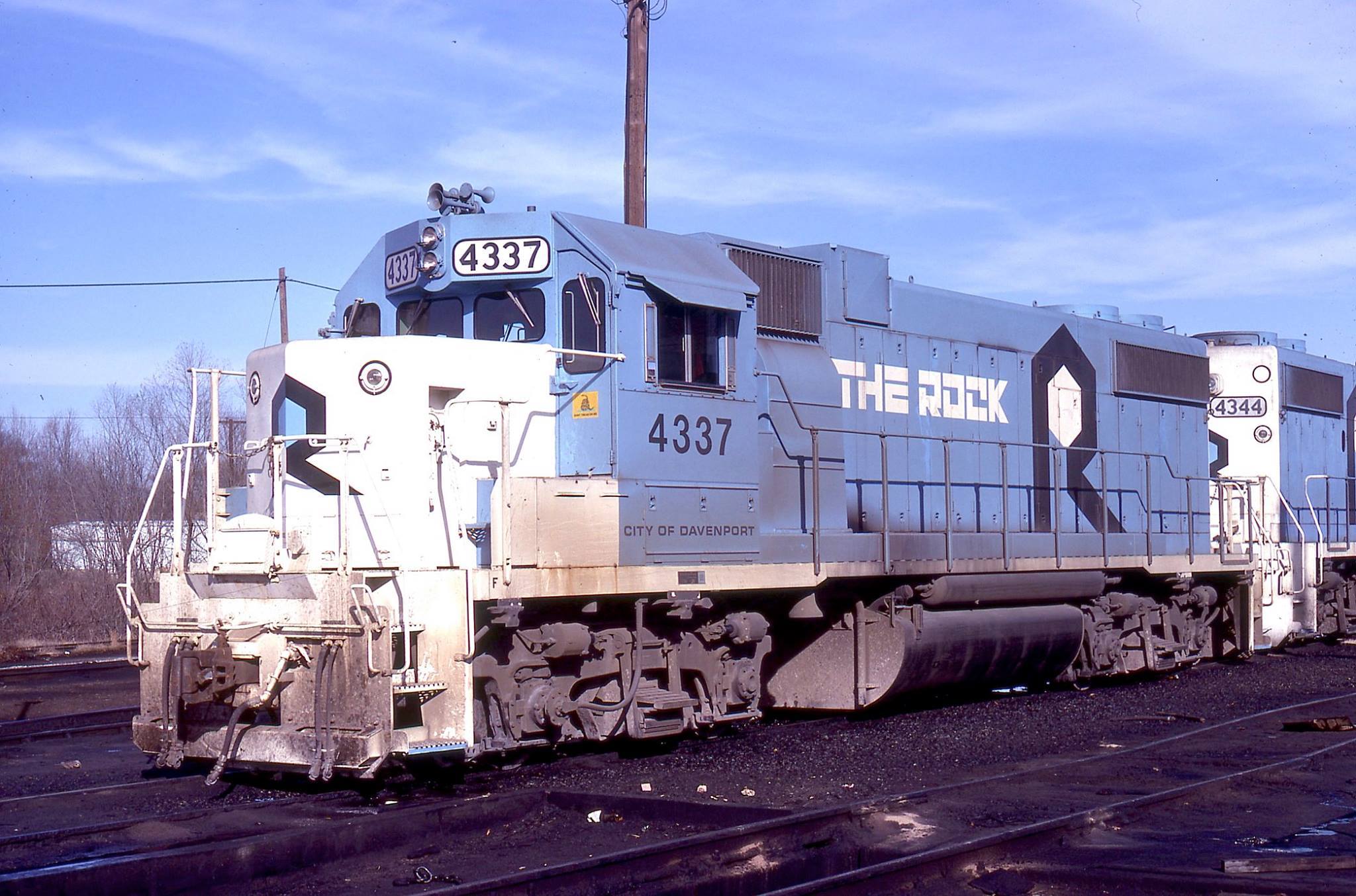 Rock Island GP38-2's, about a year old, at Little Rock, Arkansas on December 10, 1977. J. Harlan Wilson photo/Warren Calloway collection.
Farrington not only upgraded the property but was also a streamliner proponent. As John Kelly notes in his book, "Rock Island Railroad: Photo Archive," several new trains debuted from the late summer through early fall of 1937 including the Texas Rocket (August 29th), Peoria Rocket (September 19th), Des Moines Rocket (September 25th), Minneapolis-Kansas City Rocket (September 29th), and Kansas City-Denver Rocket (October 18th).
These trains were adorned in an attractive livery of two-tone maroon with silver/aluminum pulled by matching locomotives, a unique four-axle passenger model from Electro-Motive known as the TA (#601-606).
The Rocket fleet continued to grow in the succeeding years when the Twin Star Rocket debuted on January 15, 1945, followed by the Rocky Mountain Rocket on November 12, 1939, and finally the transcontinental Golden State.
The latter had been operated jointly with Southern Pacific for years but was re-inaugurated as a streamliner in January of 1948. The modernization continued through the 1950's as steam was retired by 1954 and modern classification yards were built, most notably at Silvis, Illinois.
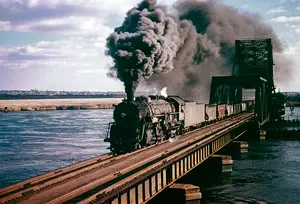
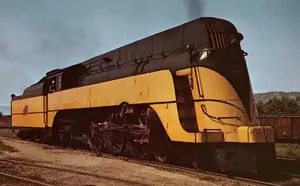
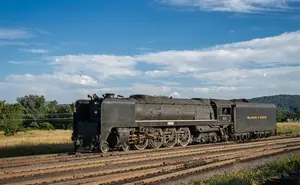
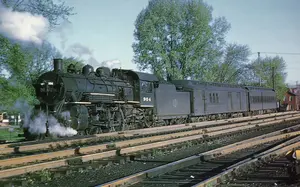
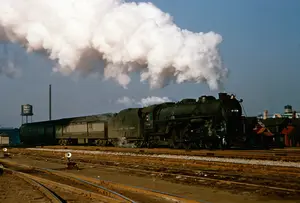
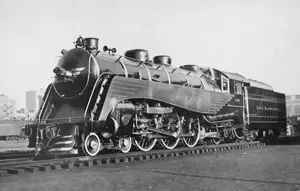
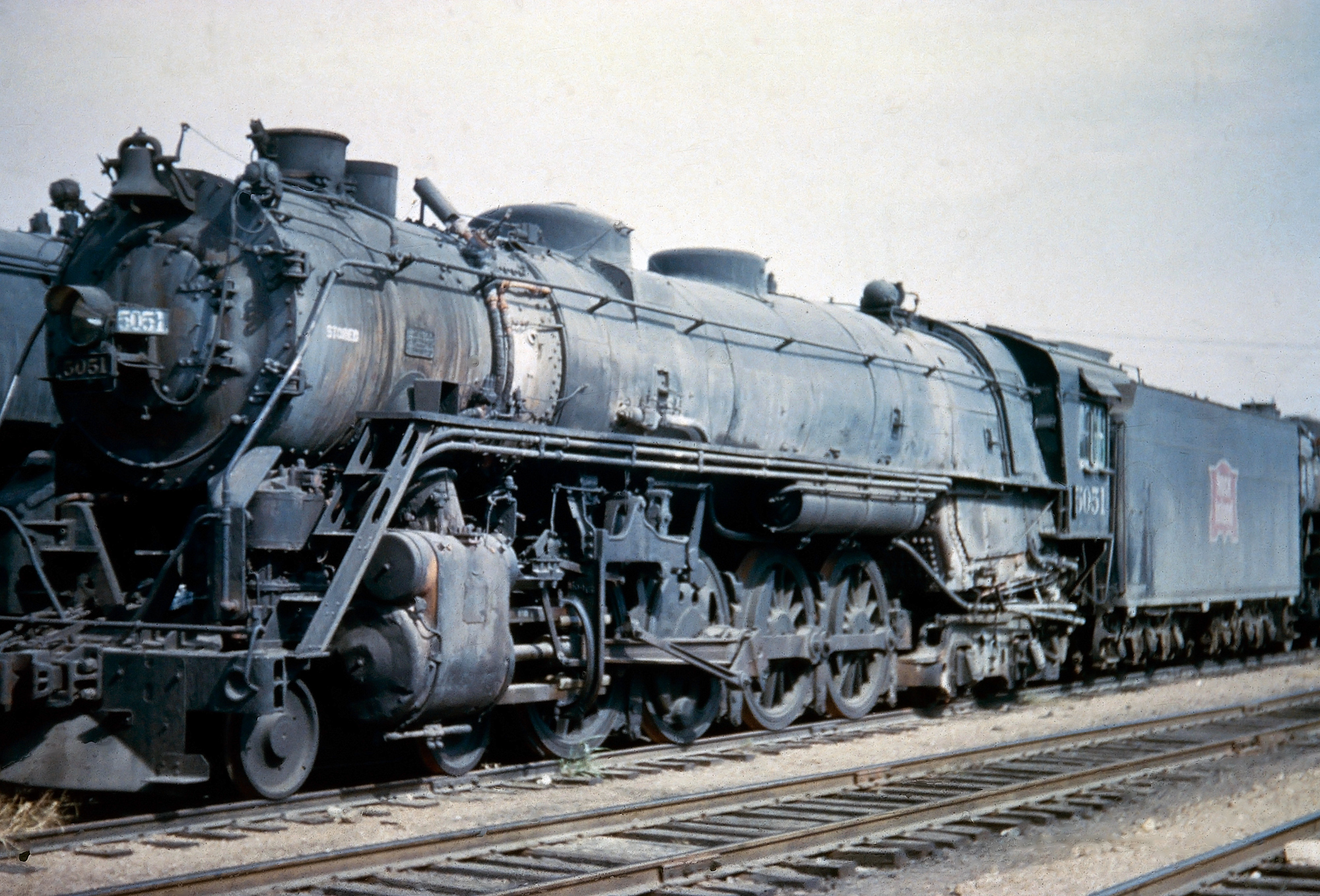 Rock Island 4-8-4 #5051 in storage at Silvis, Illinois, circa 1952. Note the "Stored" stencil near the smoke box. Despite the Rock owning the largest fleet of Northerns (85), sadly none were preserved. Photographer unknown.
Decline
Unfortunately, the 1950's were a tough decade for the entire industry which dealt with declining traffic brought about through increased competition (highways and airlines) and a 1958 national recession. The Rock's legendary leader retired in 1955 but was replaced by Downing Jenks, an equally accomplished railroader.
Unfortunately, his tenure was short-lived when he left for the Missouri Pacific. This brought Farrington back briefly before his death in 1961 at which time R. Ellis Johnson assumed the presidency. As the 1960's dawned the Rock was showing signs of trouble; in a region overbuilt with railroads it relied heavily on dwindling agricultural traffic.
To make matters worse it was not heavily diversified in other areas such as coal, manufacturing, or petrochemicals and did not enjoy the C&NW's healthy interchange business through the Council Bluffs/Omaha gateway.
At this time, talks with a merger between Milwaukee Road and Southern Pacific were briefly carried out before discussions with Union Pacific began.
In September of 1964 UP formally applied to acquire the Rock Island. Its relationship with the Chicago & North Western at the time was strained and the CRI&P would provide it a direct link into Chicago.
For a complete history of the Rock's final years, Greg Schneider's "Rock Island Requiem," is strongly recommended. The author superbly articulates how the company collapsed during its final decade and a half of operation.
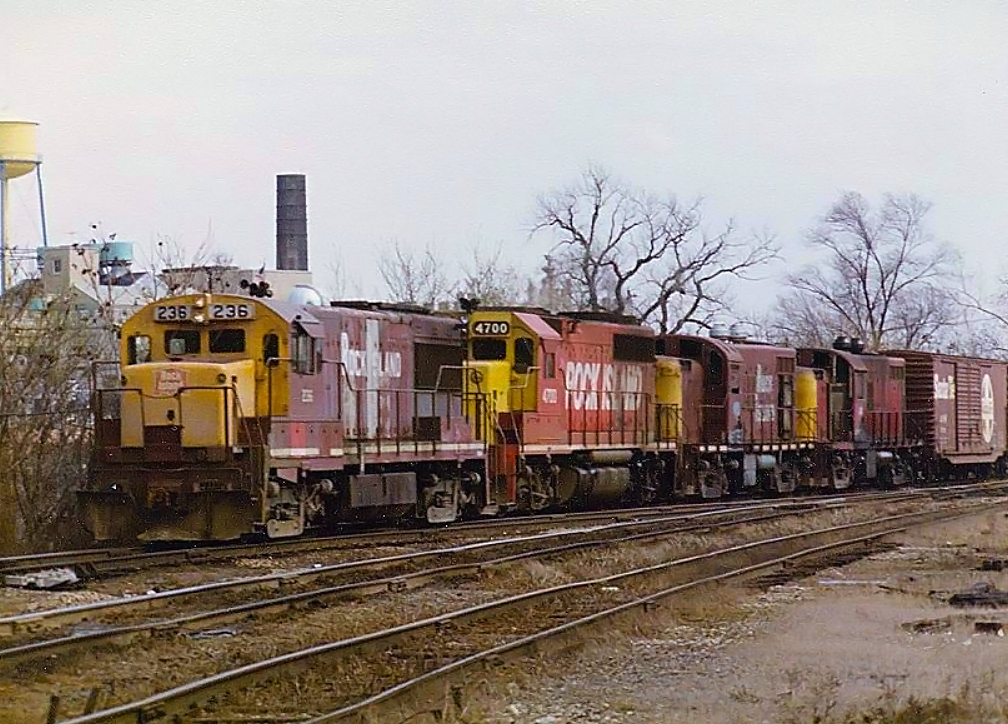 Rock Island power, which has seen better days, leads a westbound freight approaching the diamond at Joliet, Illinois on April 2, 1977. Only U25B #236 and GP40 #4700 were powering this train, the pair of RS-2u's (#452 and #453, re-engined with 567C's and sporting EMD hoods) were dead in-tow. Doug Kroll photo.
1970s Struggles
The Rock Island's final decade of operation could best be summed up as grim, both physically and internally. As Doug Kroll's photo at Joliet, Illinois illustrates, the motive power was in sorry condition.
The Rock was too poor to upgrade its roster except for some new Electro-Motive units, and cheaper General Electric "U-boats," picked up during the 1960's and 1970's.
In its final days it was still running dilapidated covered wagons dating back to just after World War II. In addition, E6A #630, continued working the commuter pool throughout the 1970s, a locomotive which had been outshopped in October of 1941! (Today, it is preserved.)
The physical plant was an equally sad situation with rotten ties, insufficient rail, slow orders, and derailments a common occurrence throughout the system.
If the railroad was an up-to-date, modern operation it quite likely would have been profitable. One of president John Ingram's initiatives in cutting costs and revamping the company's image was adoption of a cheaper light blue and white livery with "The Rock" emblazoned across locomotives and equipment.
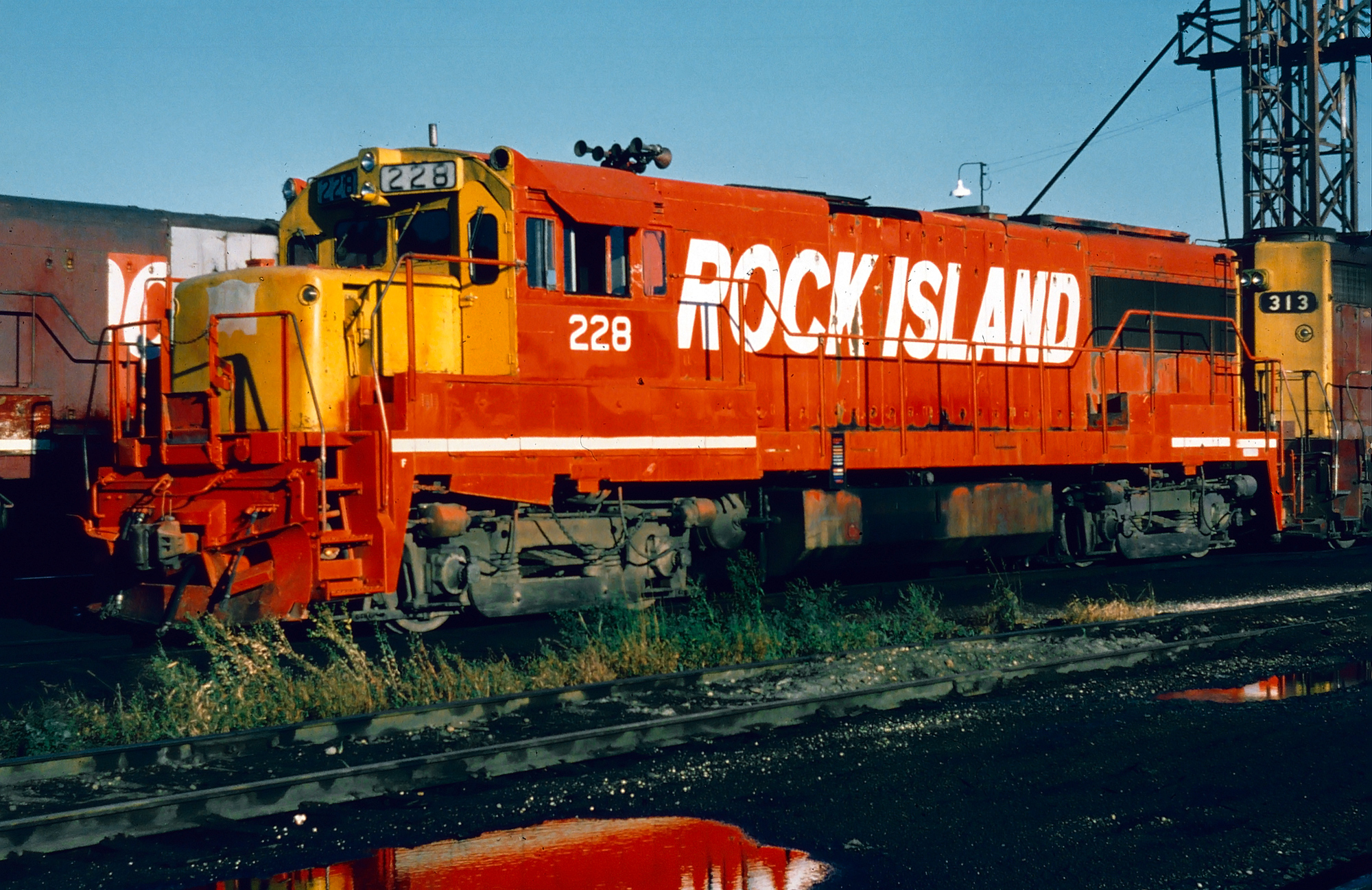 A tired Rock Island U25B, #228, lays over at the Inver Grove engine house in St. Paul, Minnesota during the summer of 1977. By this time, the railroad was struggling to maintain enough power to even meet remaining freight demand. American-Rails.com collection.
In the absence of new power the company carried out its so-called Capital Rebuild Program on venerable Geeps to extend their service lives.
During a power shortage in the early '70s it also picked up elderly F9's from Union Pacific while even first-generation Alco road units, re-engined with Electro-Motive model 567 prime movers, continued to see service throughout that decade. To say the least, it's fleet was eclectic. Perhaps more than any other state, Iowa was most proactive in saving the Rock's operations within its borders.
It formed the Iowa Energy Policy Council in 1973, whose duties included (among other things) saving branch lines for continued rail service.
While the state ultimately set aside several million dollars to carry out these improvements (which also included rehabbing lines of the Milwaukee Road and Burlington Northern), interestingly, it was the shippers themselves which sometimes ponied up funds for rebuilding the branches.
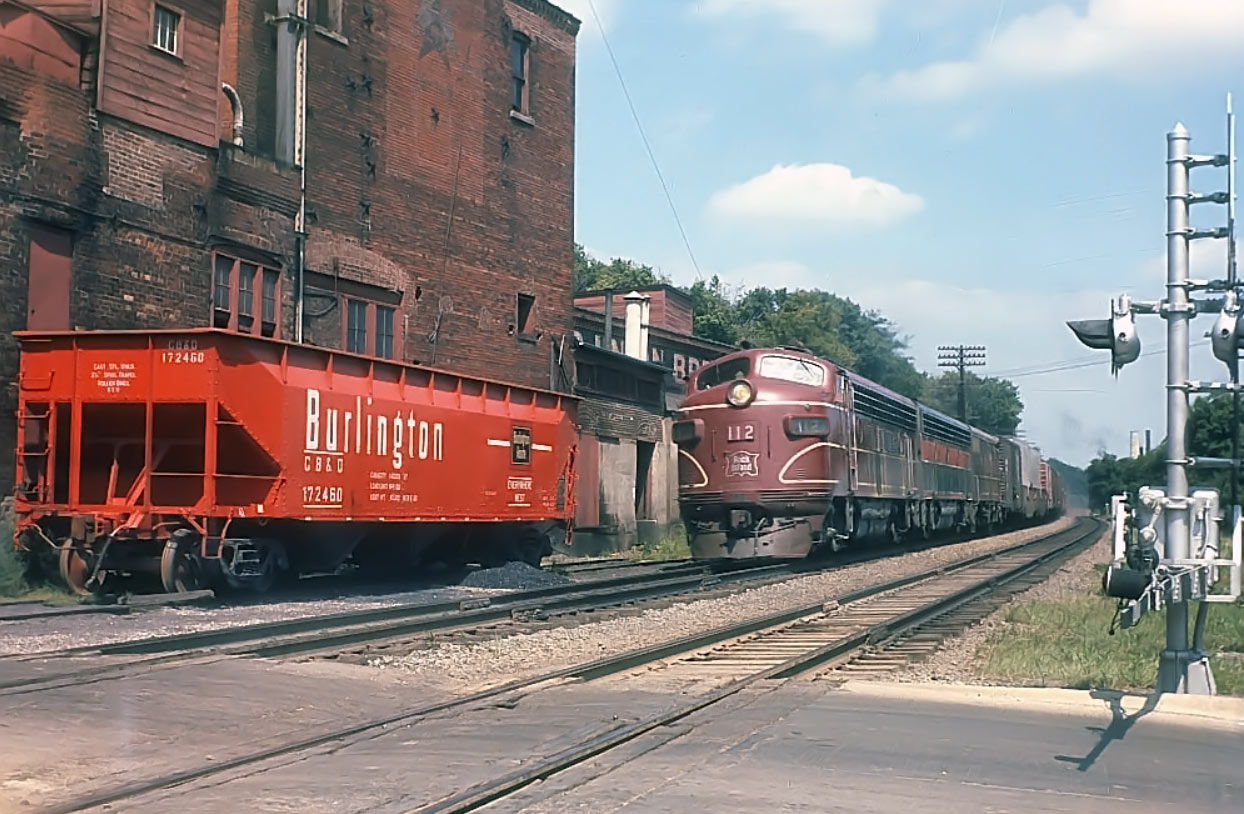 A Rock Island freight, led by F7A #112, rolls past Star Union Brewery at Pine Street in Peru, Illinois in August, 1960. Rick Burn photo.
There has been great blame laid on the Interstate Commerce Commission for dragging out the proceedings that eventually led to the company's collapse. In truth, the ICC was only part of the problem.
When the merger was announced, Chicago & North Western's Ben Heineman immediately challenged the UP-Rock Island marriage. Instead, he proposed his own takeover of the Rock or at least a three-way union with the Milwaukee Road.
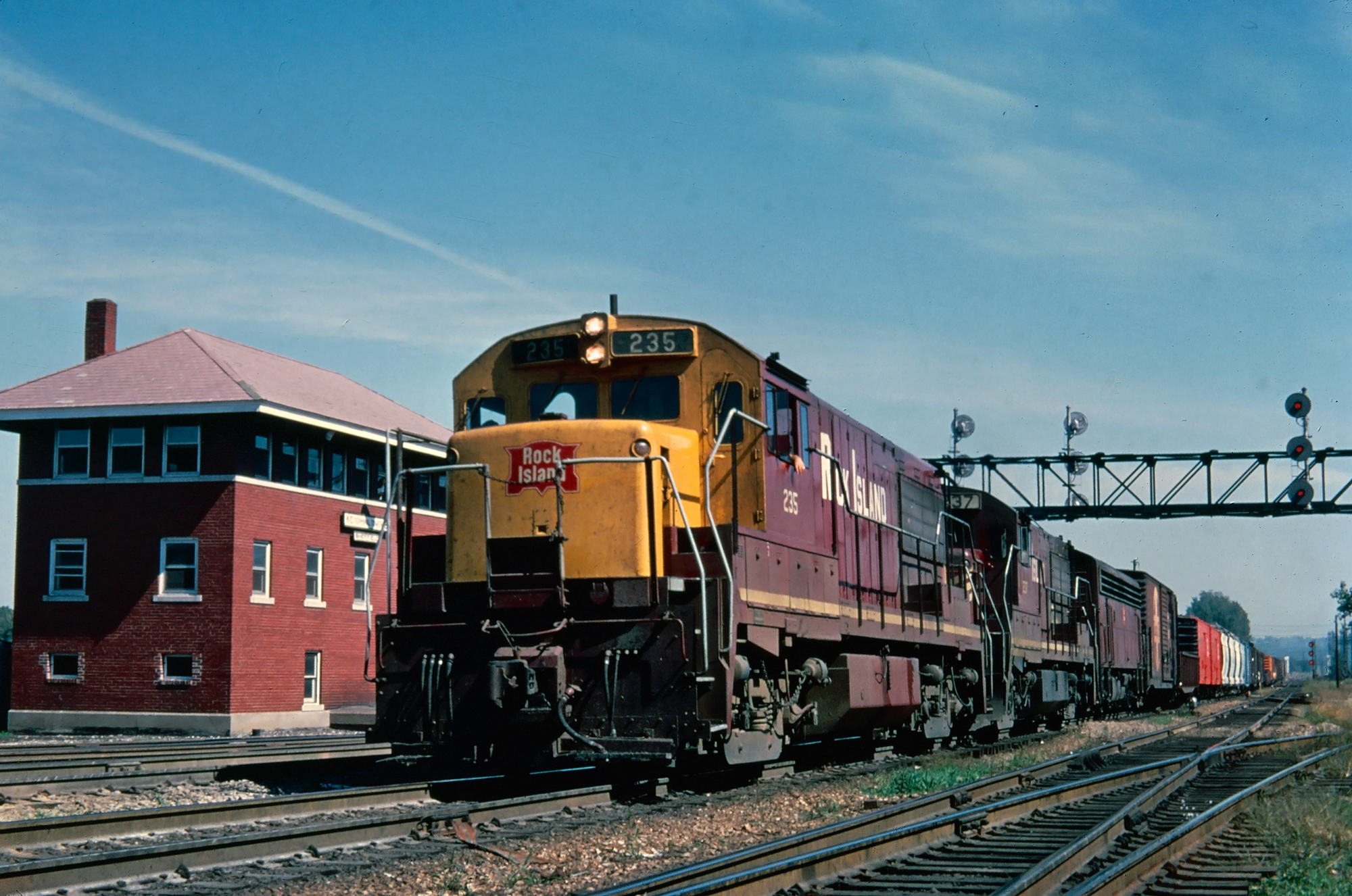 Rock Island U25Bs #235 and #237 lead a westbound on the Kansas City Terminal as the train rolls past the Sheffield Interlocking Tower, circa 1967. American-Rails.com collection.
If the UP-Rock merger was approved the C&NW would stand to lose considerable interchange business through the Omaha gateway so its opposition was justified. As the hearings wore on and the years passed the Rock Island simply fell apart.
As Mr. Schneider notes, in 1959 the railroad was still a well-respected corporation boasting gross annual revenues of $219.5 million with a ranking of 22nd in Fortune magazine's Top Fifty Transportation Companies. Barely two decades later the picture had changed dramatically as the road carried a stunning annual deficit of $400 million when it was liquidated in 1980.
 Along the western end of Rock Island's system, GP38-2 #4304 (named "The Loyal Shipper") has the weekday local from Limon, Colorado at Roswell Junction (Colorado Springs) during the 1970s. Bob Lenardson photo.
As the railroad came apart it is also truly perplexing why Union Pacific did not spend the capital for infrastructure improvements, or at least enough to maintain operations, considering the planned merger. The Rock's officials asked multiple times for such funds but were always denied.
Union Pacific was the wealthiest railroad in the country at the time (and still-so today); in 1966 its net income, before taxes, was an impressive $109.7 million. As part of the takeover plan UP had agreed to spend $200 million on such improvements but only after the marriage was finalized. Nearly a decade passed before the ICC officially granted approval on November 8, 1974.
As a condition of the merger, Rio Grande would acquire the Rock's Omaha-Denver main line and Santa Fe would pick up most of its Choctaw Route (Memphis - Amarillo) as well as be required to takeover the Missouri-Kansas-Texas Railroad.
In addition others would be given additional traffic rights and interchange gateways to help shield them from potential traffic losses. Unfortunately, by then the Rock's property was in pathetic condition and UP was no longer interested. With no where else to turn the railroad entered bankruptcy protection on March 17, 1975.
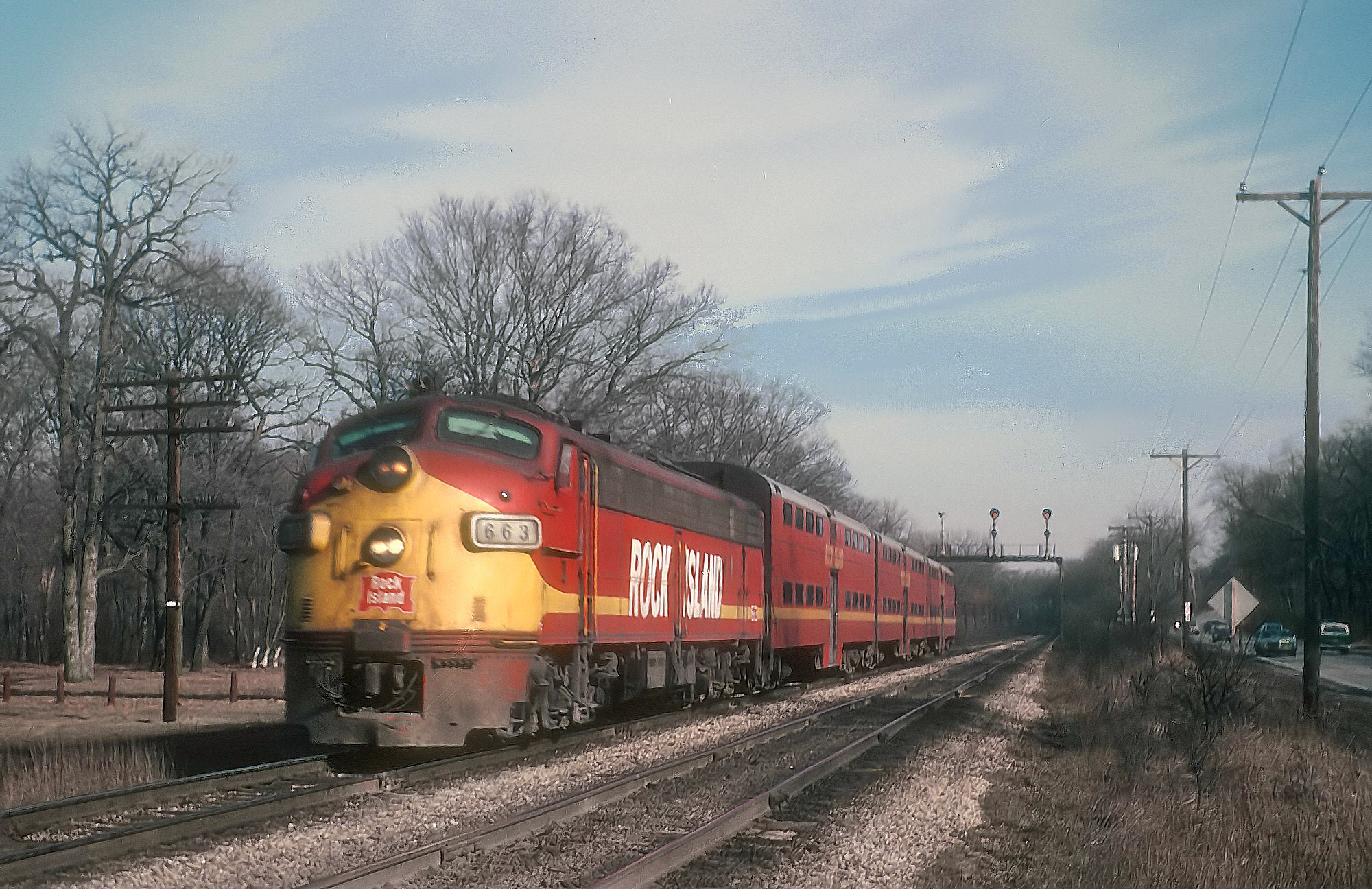 Rock Island E9A #663 (ex-UP #901) on a commuter run between Joliet and New Lenox, Illinois along US 30 in December, 1975. Rick Burn photo.
The Rock Island's final years were sad to witness as the road attempted in vain to produce a profitable railroad beneath decaying infrastructure and a mountain of debt.
It tried to apply for governmental assistance, notably through the Reconstruction Finance Corporation (RFC), but with Washington busy with the Penn Central mess the Rock's situation was largely ignored (as was that of the Milwaukee Road, which entered bankruptcy in 1977). Adding insult to injury the railroad was still running passenger trains.
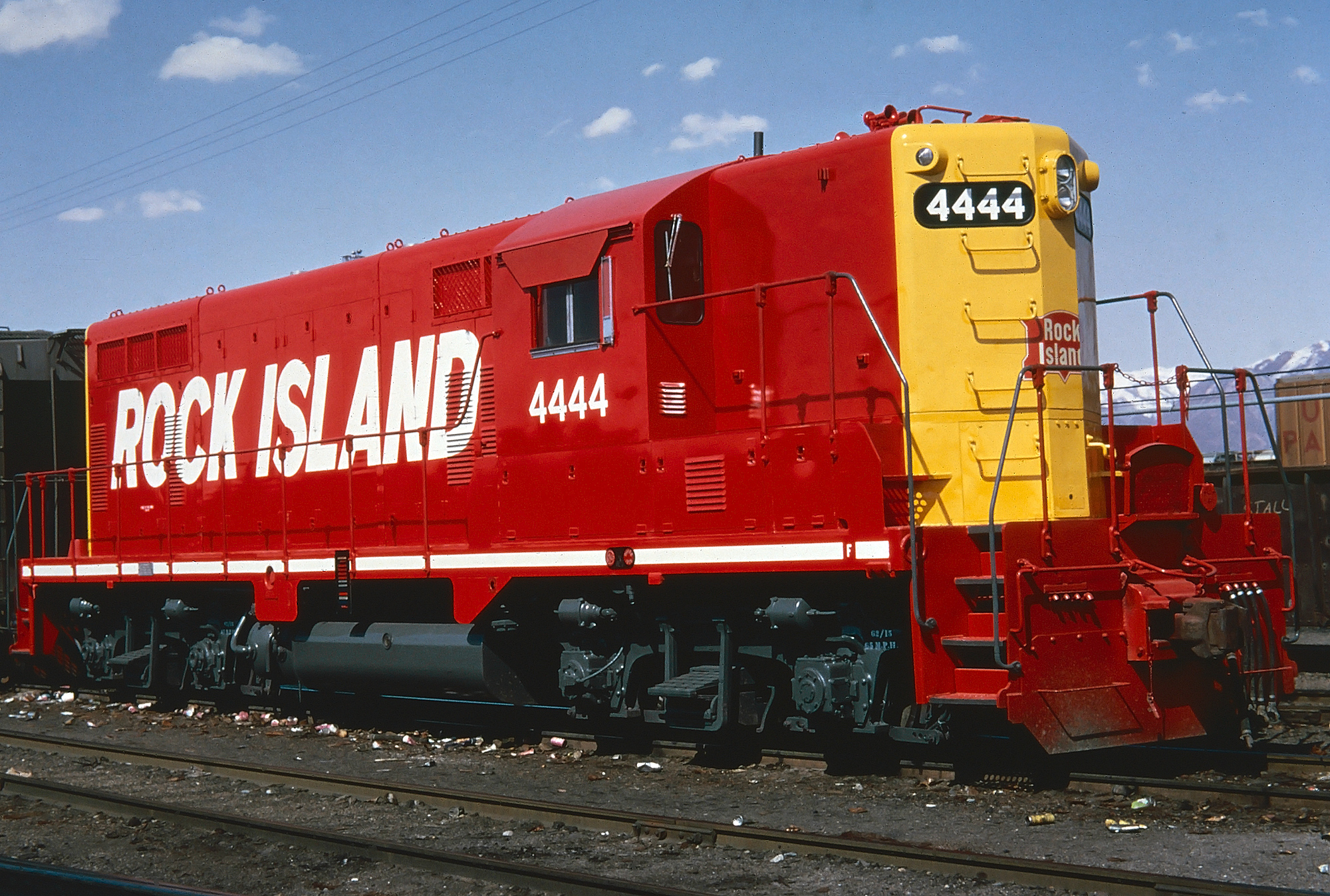 Rock Island GP7R #4444, following her rebuild by Morrison-Knudsen in Boise, Idaho, was on her way back to home rails when photographed here in Salt Lake City on April 24, 1975. Ken Ardinger photo. American-Rails.com collection.
It could not afford the entry feet to join what became the National Railroad Passenger Corporation (Amtrak) on May 1, 1971 and continued operating what was dubbed the Peoria Rocket and Quad Cities Rocket until service was finally suspended on December 31, 1978. The immediate elimination of these trains could have saved the railroad $1 million annually.
The state of Illinois also forced it to continue running its money-losing commuter trains throughout the Chicago area. In a dire financial situation it threatened to immediately discontinue these, which were costing the Rock nearly $2 million annually, if the state did not either take over the service or provide a subsidy. Illinois finally relented by at first providing a stipend but eventually took over the services entirely.
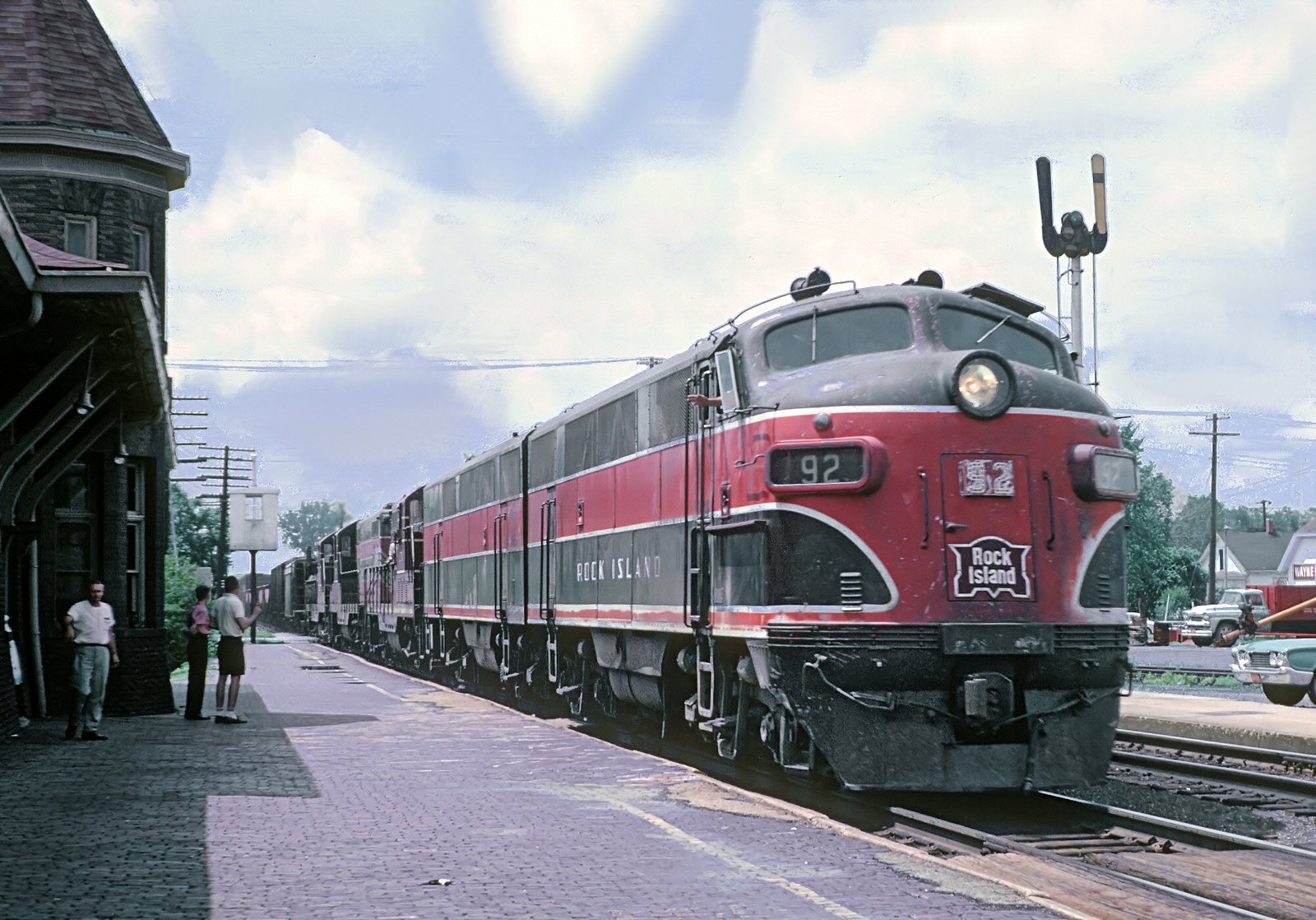 An aging set of Rock Island FT's lead a manifest freight train past the station at Ottawa, Illinois on June 10, 1962. At the time the railroad was still financially healthy but that would change within a decade. Roger Puta photo.
"Rock Island Line" (Song)
"Rock Island Line" was a term often used to describe the Chicago, Rock Island & Pacific. It almost certainly predated the song although the future ballad would earn the company widespread publicity. As mentioned at the start of this article, the original is credited to Clarence Wilson although its lyrics are not believed to exist.
Throughout the years several versions were released, which greatly deviated from Wilson's said to describe the daily activities of Rock Island's shops in Little Rock, Arkansas.
Rock Island Line gained recognition when musicologist John Lomax recorded the first audio version on September 29, 1934 at the prison farm in Tucker, Arkansas with assistance from Lead Belly (an African American folk/blues musician who's full name was Huddie William Ledbetter).
This version featured elements of the original as well as new lyrics now regarded as the song's "classic" rendition. Lead Belly would go on to sing Rock Island Line numerous times throughout his career. Over the decades many other artists have either sang or released versions including:
Billy Bragg/Joe Henry
Bobby Darin
Boxcar Willie
Chris Thomas King
Dan Zanes and Friends
Devil in a Woodpile
Don Cornell
Eleven Hundred Springs
Eric Church
Gateway Singers
George Harrison/Paul Simon
George Melly
Graham Bonnet
Harry Belafonte
John Lennon
Johnny Cash
Johnny Horton
Little Richard & Fishbone
Lonnie Donegan
Long John Baldry
Mano Negra
Merrill Moore, With Cliffie Stone's Orchestra
Milt Okun
Odetta
Ramblin Jack Elliot
Ringo Starr
Snooks Eaglin
Sonny Terry and Brownie McGhee
Stan Freberg
The Brothers Four
The Knitters
The Reverend Peyton's Big Damn Band
The Tarriers
The Washington Squares
The Weavers
Whiskey Howl
Woody Guthrie/Sonny Terry
Johnny Cash, of course, sang the most widely accepted and remembered version of a Rock Island Line. The lyrics are as follows:
Now this here's a story about the Rock Island Line
Well the Rock Island Line she runs down into New Orleans
There's a big tollgate down there
And you know, if you got certain things on board when you go through the tollgate
Well you don't have to pay the man no toll
Well a train driver he pulled up to the tollgate
And a man hollered and asked him what all he had on board and said:
------------------
I got livestock
I got livestock
I got cows
I got pigs
I got sheep
I got mules
I got all livestock
------------------
Well he said you're alright boy, you don't have to pay no toll
You can just go right on through so he went on through the tollgate
And as he went through he started pickin' up a little bit of speed
Pickin' up a little bit of steam
He got on through he turned and looked back at the man he said
------------------
Well I fooled you
I fooled you
I got pig iron
I got pig iron
I got old pig iron
------------------
~ Chorus ~
Down the Rock Island Line she's a mighty good road
Rock Island Line it's the road to ride
Rock Island Line it's a mighty good road
Well if you ride it you got to ride it like you find it
Get your ticket at the station for the Rock Island Line
~ Chorus ~
------------------
Looked cloudy in the west and it looked like rain
Round the curve came a passenger train
Northbound train on a southbound track
He's alright a leavin' but he won't be back
~ Chorus ~
Oh I may be right and I may be wrong
But you're gonna miss me when I'm gone
Well the engineer said before he died
There were two more drinks that he'd like to try
The conductor said what could they be
A hot cup of coffee and a cold glass of tea
~ Chorus ~
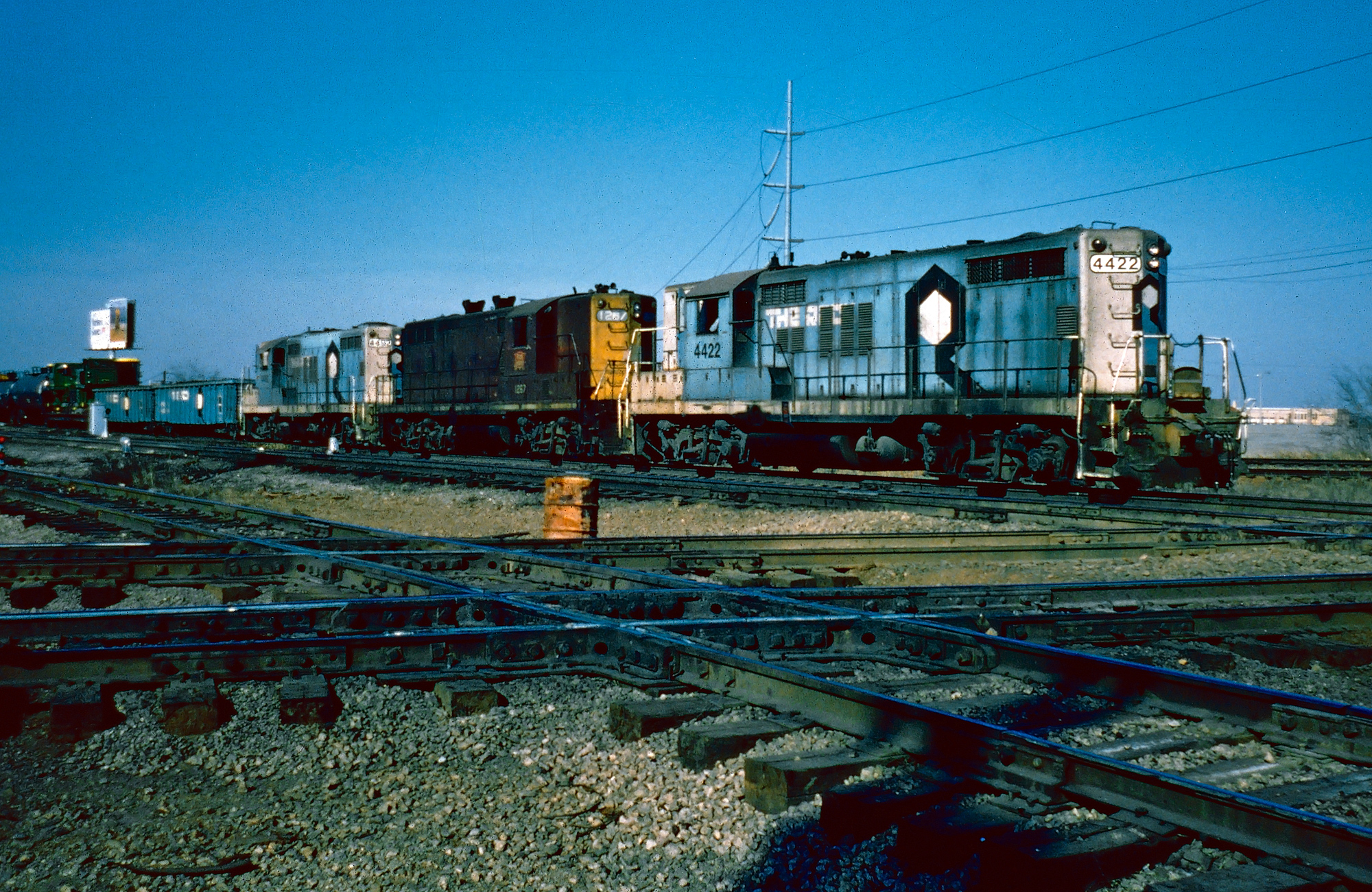 Rock Island GP7R #4422, GP7 #1257, and another GP7R lead a mixed freight through the interlocking at Tower 55 in Fort Worth, Texas, circa 1979. Mike Bledsoe photo. American-Rails.com collection.
Judge Frank McGarr, who headed the bankruptcy proceedings, had no experience with railroads. However, he was a good manager who understood the importance of the Rock Island's routes despite growing pressure from creditors to liquidate immediately.
McGarr continued delaying liquidation as his team attempted to put together a profitable operation. Alas, time simply ran out.
The railroad greatly needed to rebuild its failing infrastructure (which then totaled just over 7,300 route miles) but there was simply no money to do so. With its financial condition in tatters borrowing was impossible.
 Rock Island's rebuilt DL-109, #621, awaits depature from Memphis, Tennessee with train #21 on December 1, 1966. The locomotive had just been serviced at the Illinois Central shops. William White, Jr. photo.
Passenger Trains
Choctaw Rocket: (Amarillo - Memphis)
Corn Belt Rocket: (Chicago - Omaha)
Des Moines Rocket: (Chicago - Des Moines)
The Imperial (Consist, History, Photos, Timetable): Operated between Los Angeles and Chicago in conjunction with the Southern Pacific.
Jet Rocket: (Chicago - Peoria)
Kansas City Rocket: (Minneapolis - Kansas City)
Peoria Rockets: (Chicago - Peoria)
Texas Rocket: Originally served Fort Worth and Houston, although later connected Kansas City and Dallas.
Twin Star Rocket: (Minneapolis - Houston)
Quad Cities Rocket: (Chicago - Rock Island)
Zephyr Rocket: Connected Minneapolis and St. Louis in conjunction with the CB&Q.
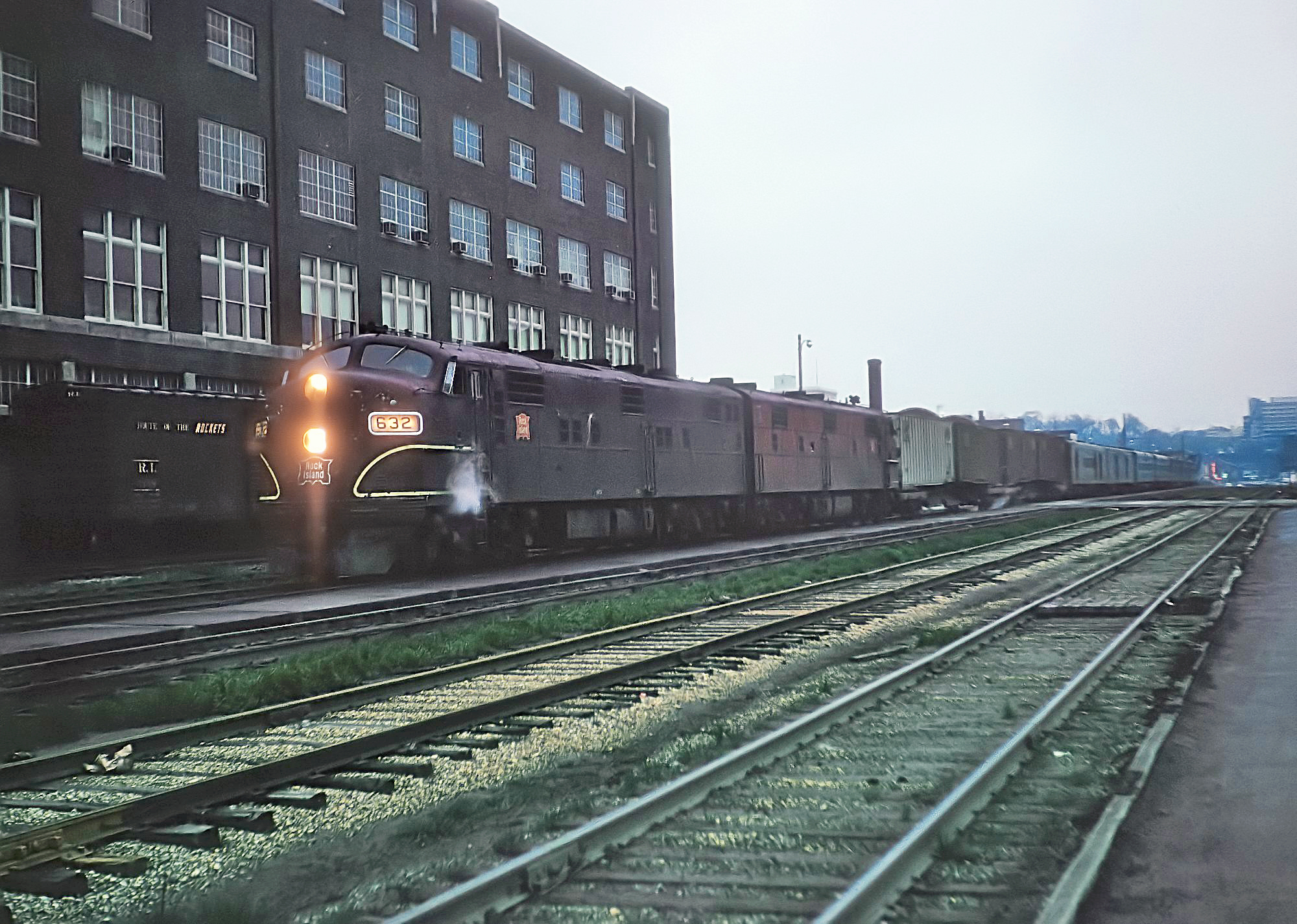 Rock Island E7A #632 has the "Corn Belt Rocket" at Moline, Illinois in May, 1967. This service linked Chicago and Omaha. Rick Burn photo.
The final blow came on August 28, 1979 when the Brotherhood of Railway & Airline Clerks, joined by the United Transportation Union, issued a strike and the railroad's fate was sealed.
Their issue dealt with a new national labor wage agreement which they refused to accept. The move essentially put them out of work when McGarr ordered liquidation on January 25, 1980. It was a somber conclusion to a beleaguered road that had fought hard until the end.
Diesel Roster
Steam Roster
 Rock Island SD40-2 #4798 with a westbound transfer run at the Hoffman Avenue interlocking in St. Paul, Minnesota, circa 1976. American-Rails.com collection.
Postscript
No single person was at fault for the Rock Island's liquidation; everyone in a leadership position in the last days tried their best to right the ship. As it turns out there was, indeed, a solvent road beneath the mess. Nearly all of the railroad's through routes were ultimately purchased and remain in operation today.
Only one is not, the Choctaw Route (Tucumcari - Memphis). There were negotiations with Arkansas and Oklahoma to purchase 866 miles of the corridor to be operated as the Arkansas-Oklahoma Railroad.
The Trustee set a price of $100 million although the states only wanted to pay $21 million, the salvage value. In the end, the parties were too far apart and the property was abandoned.
Various railroads picked up other segments, including the Iowa Interstate, a 1984 startup which spent a great deal of money and effort to resurrect the Chicago - Omaha main line. Today, it is an extremely successful Class II, regional.
On May 19, 1984 the Chicago, Rock Island & Pacific Railroad was reorganized as the Chicago Pacific Corporation, a non-operating railroad entity which branched out into the fields of investment and real estate. It began to grow by acquiring the Hoover Corporation in 1985 before being purchased itself by the Maytag Corporation in 1988.
Photos
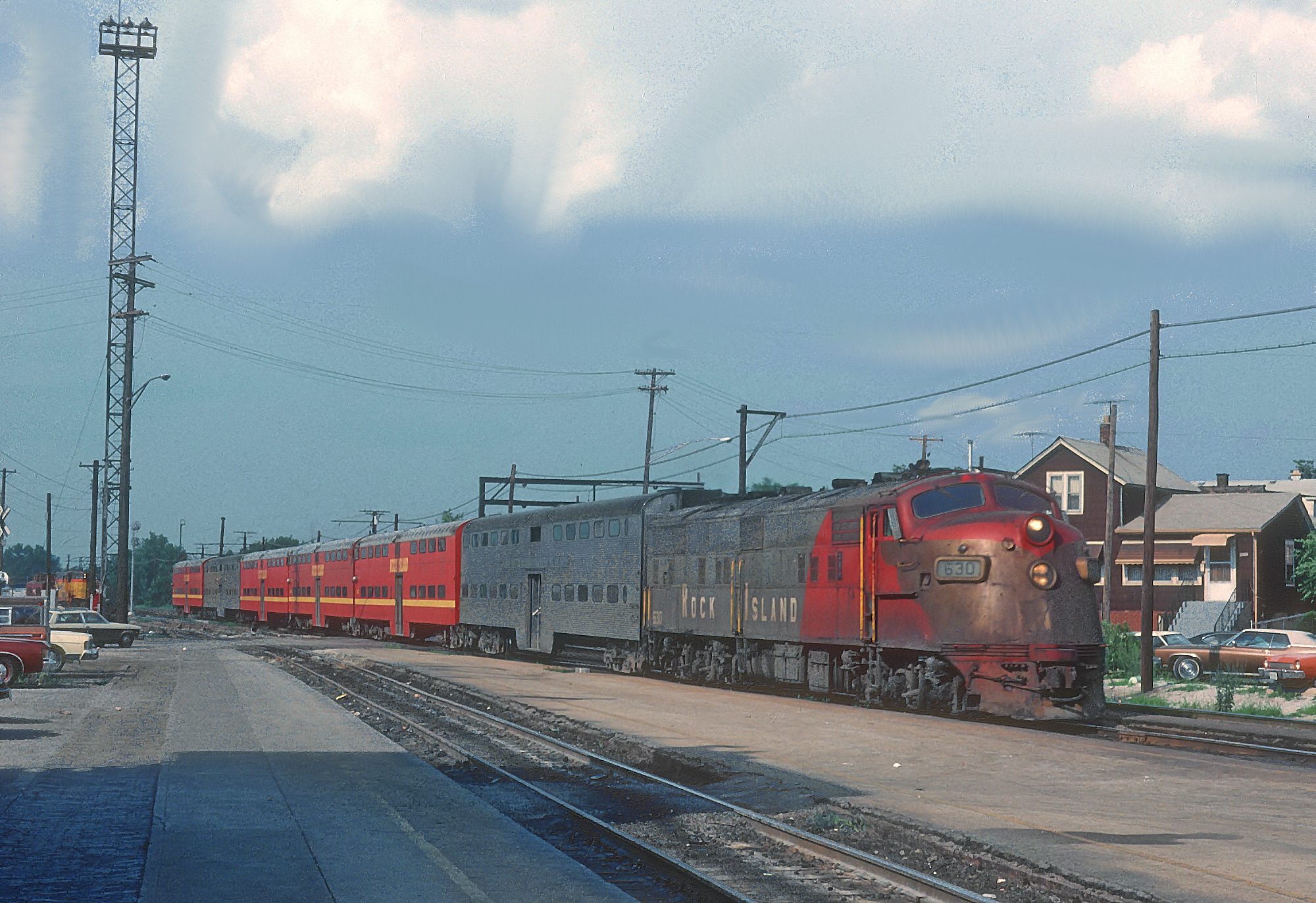 A very weathered Rock Island E6A, #630, has a commuter run at the Vermont Street Station in Blue Island, Illinois on June 24, 1977. Marty Bernard photo.
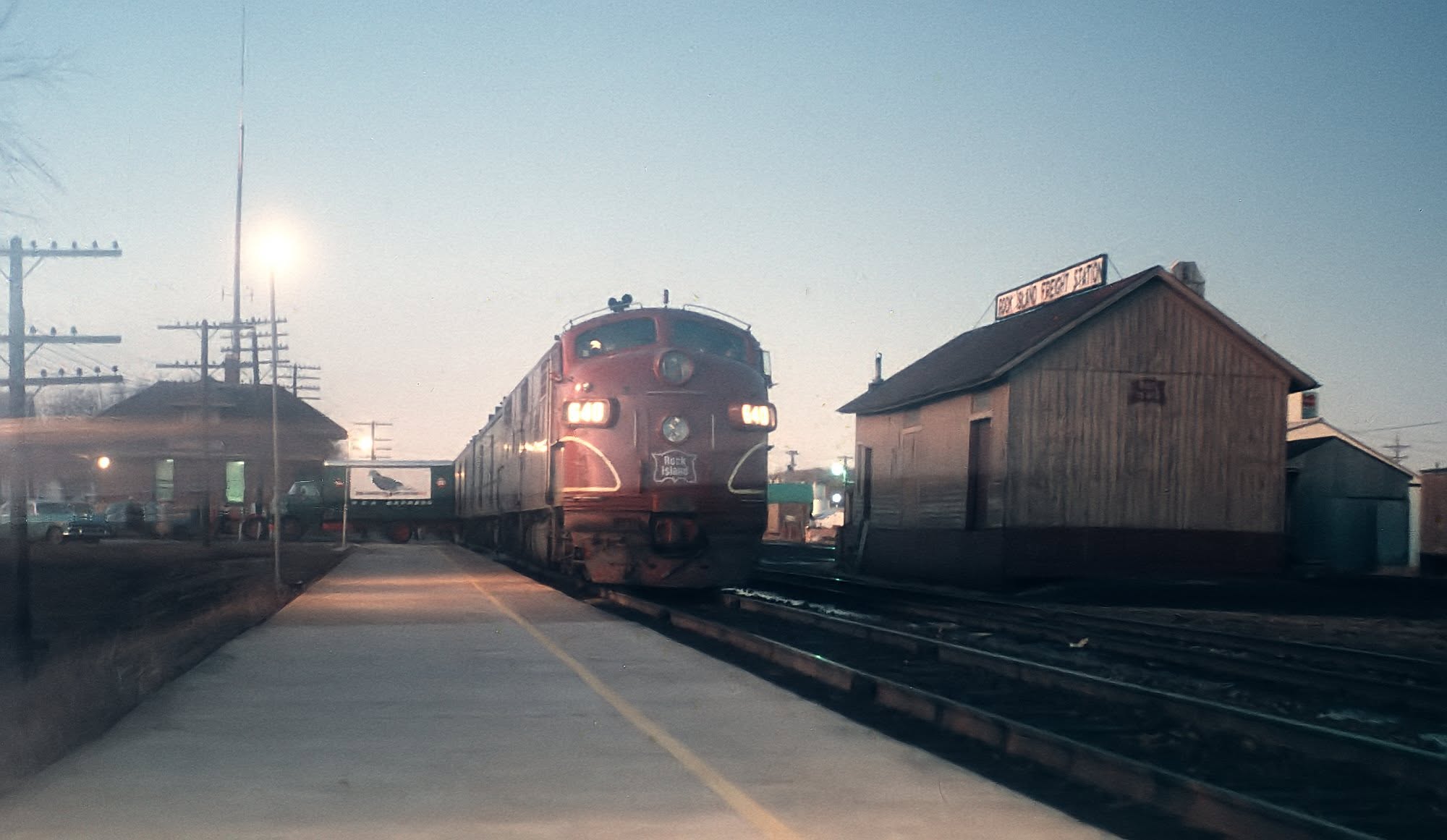 Rock Island E8A #649 has southbound train 19 stopped at Owatonna, Minnesota in February, 1964. This train connected Minneapolis with Manly, Iowa. Rick Burn photo.
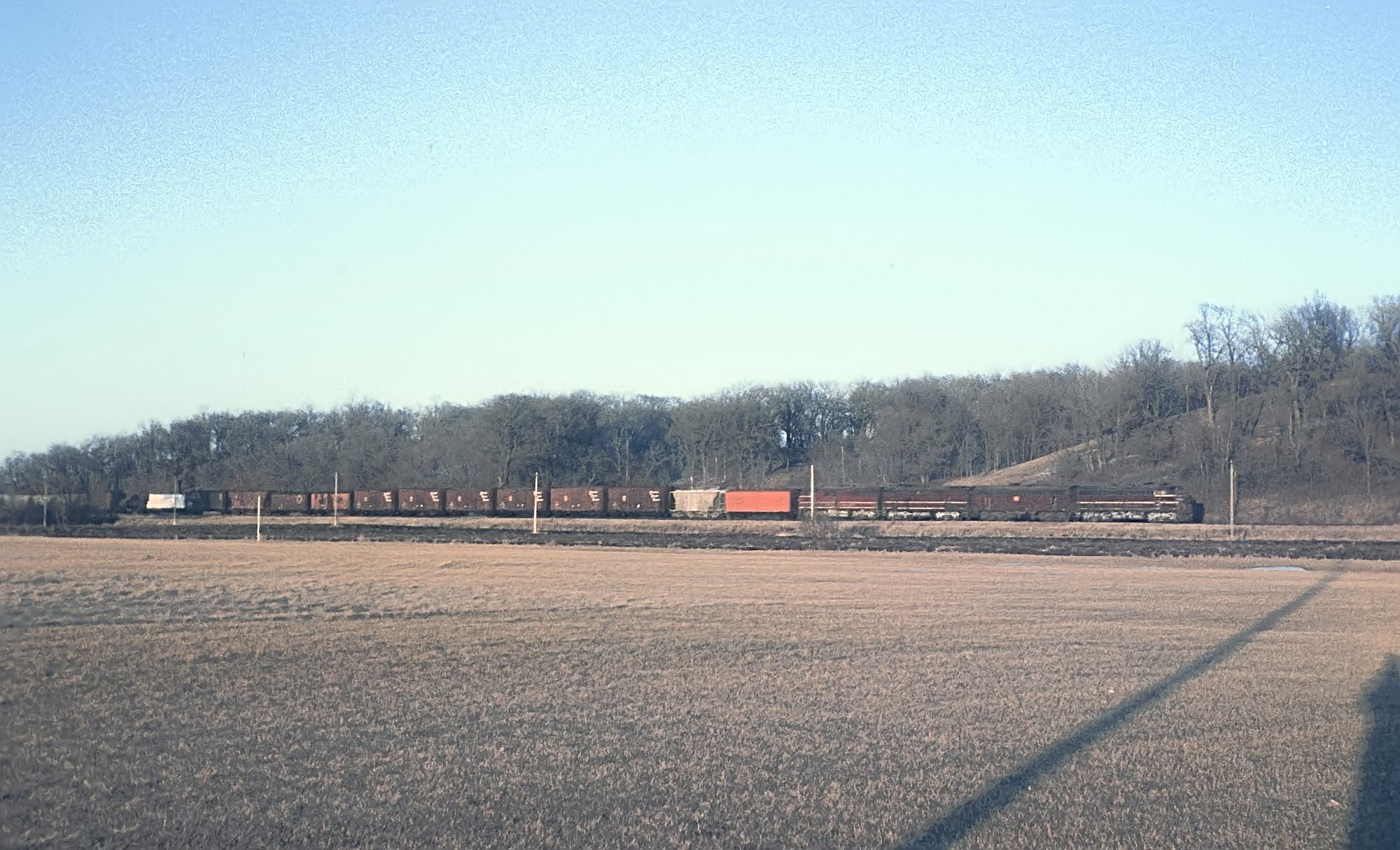 In this panoramic scene, what appears to be an FA-FB-FB-FA set lead a Rock Island freight near Medford, Minnesota in February, 1964. Rick Burn photo.
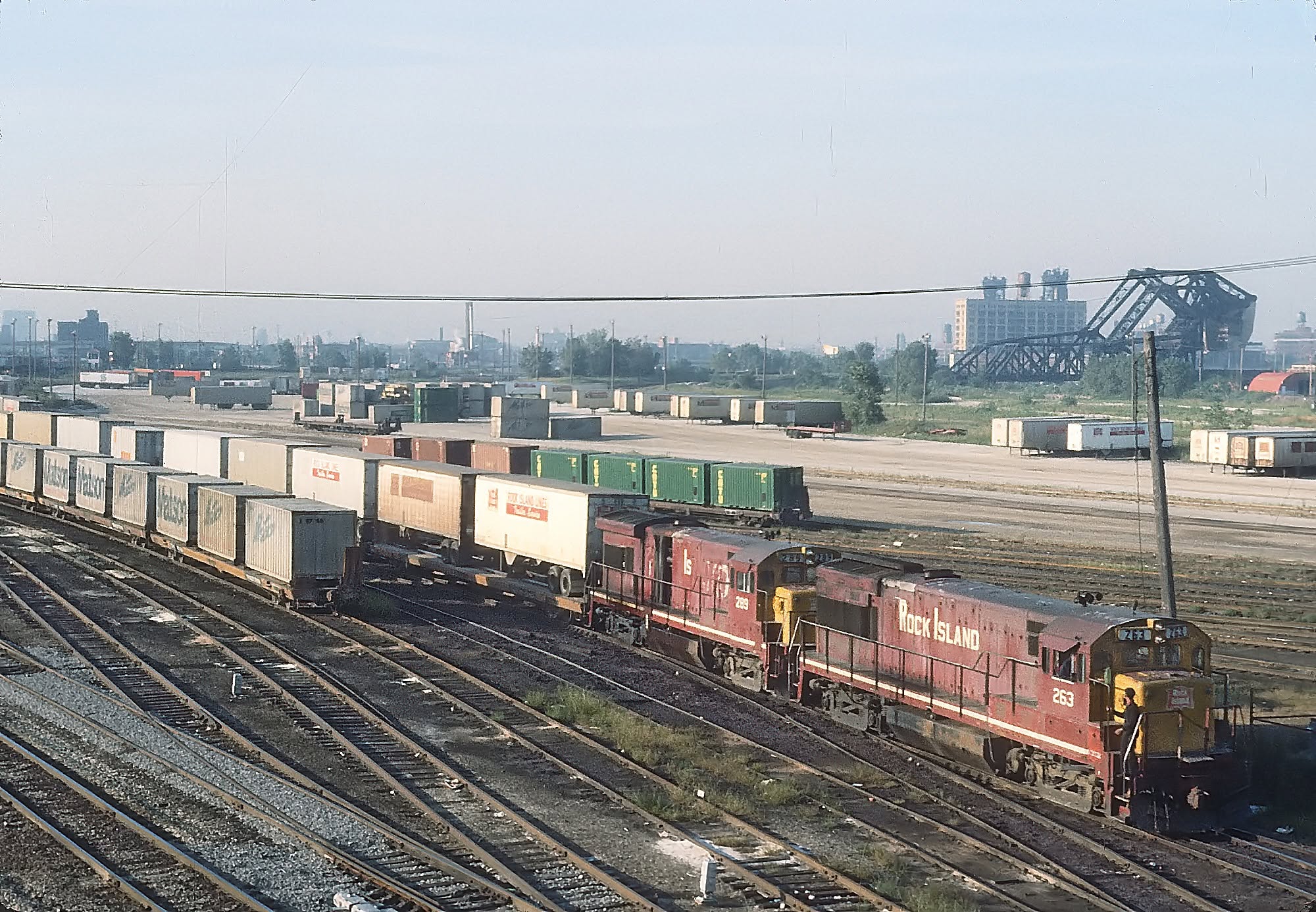 A pair of ragged Rock Island U-boats, U28B #263 and U33B #289, at the 12th Street (Roosevelt Road) Piggyback Yard in Chicago on April 25, 1977. This was the railroad’s primary downtown intermodal facility in the later years (especially the late 1960s–1970s). It was developed from the old 12th Street coach/freight house area between the Rock Island’s passenger tracks into LaSalle and the parallel B&OCT tracks. Circus-style loading/unloading of trailers on flatcars was the norm. This facility declined with the Rock’s bankruptcy and 1980 liquidation; little remains of the once-busy TOFC tracks today. Marty Bernard photo.
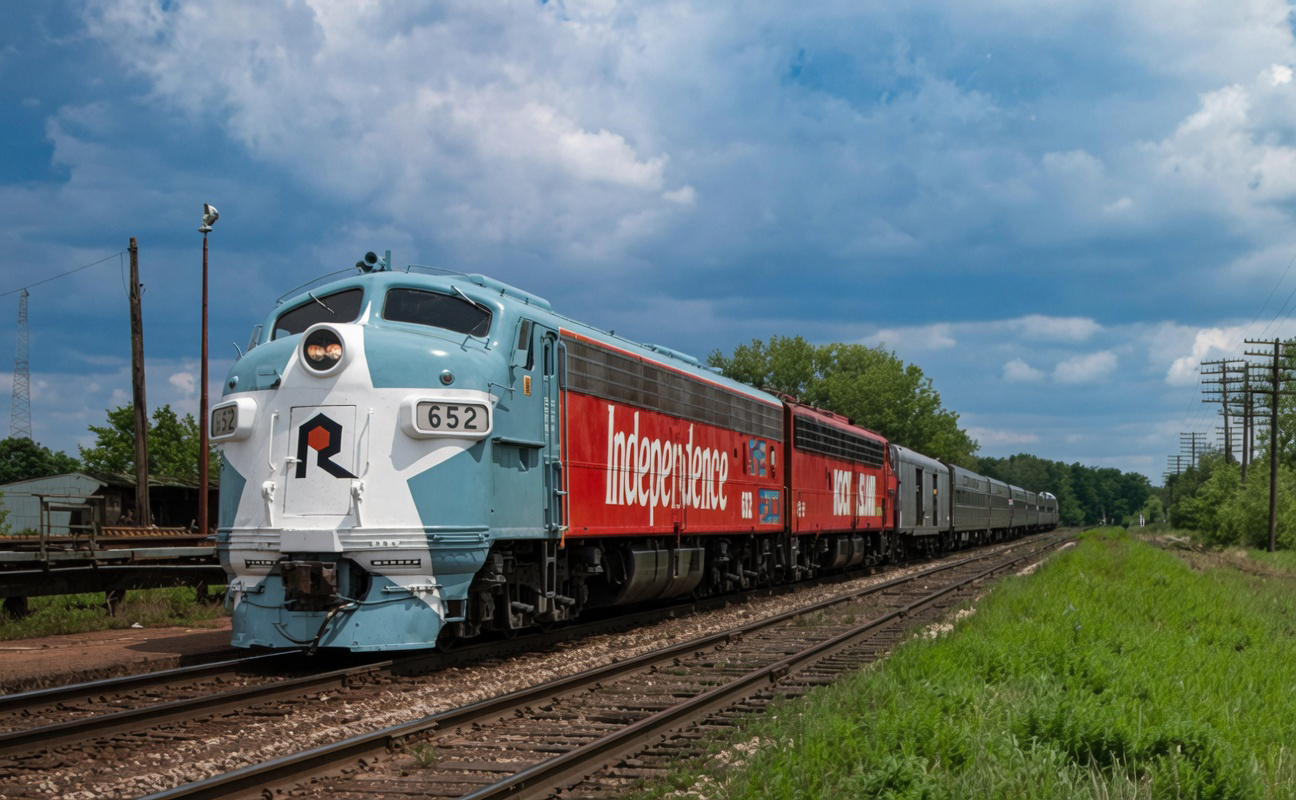 Rock Island's Bicentennial E8A, #652, which was designed by the 20th Century Railroad Club, leads the eight-car "Bicentennial Rocket" through Ottawa, Illinois on May 15, 1976. George Strombeck photo.
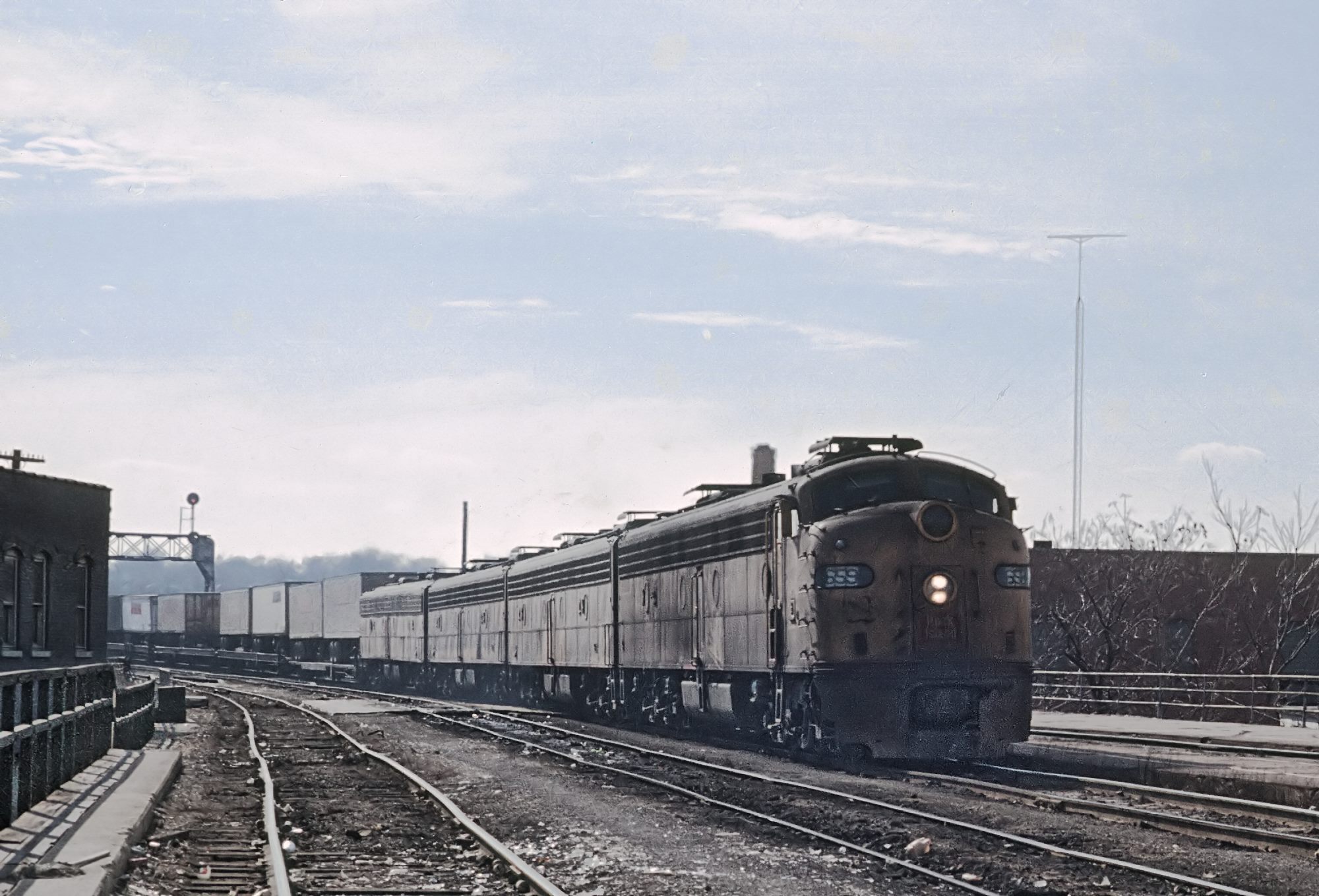 The Rock Island was another line which eloquently illustrated the industry's problems by the 1970's. Following a failed merger with Union Pacific the fabled carrier struggled for more than a decade before finally being liquidated in 1980. With little cash and power short, it acquired locomotives wherever and whenever possible such as these aging Union Pacific E8's which were pressed into freight service. The train is seen here passing through Joliet, Illinois in June, 1972. Roger Puta photo.
 Rock Island F7A #676 with C&NW gallery cars at the Vermont Street Station in Blue Island, Illinois on June 24, 1977. The C&NW gallery cars were on loan due to the Rock's aging commuter cars. Note the blue AMC Gremlin. Marty Bernard photo.
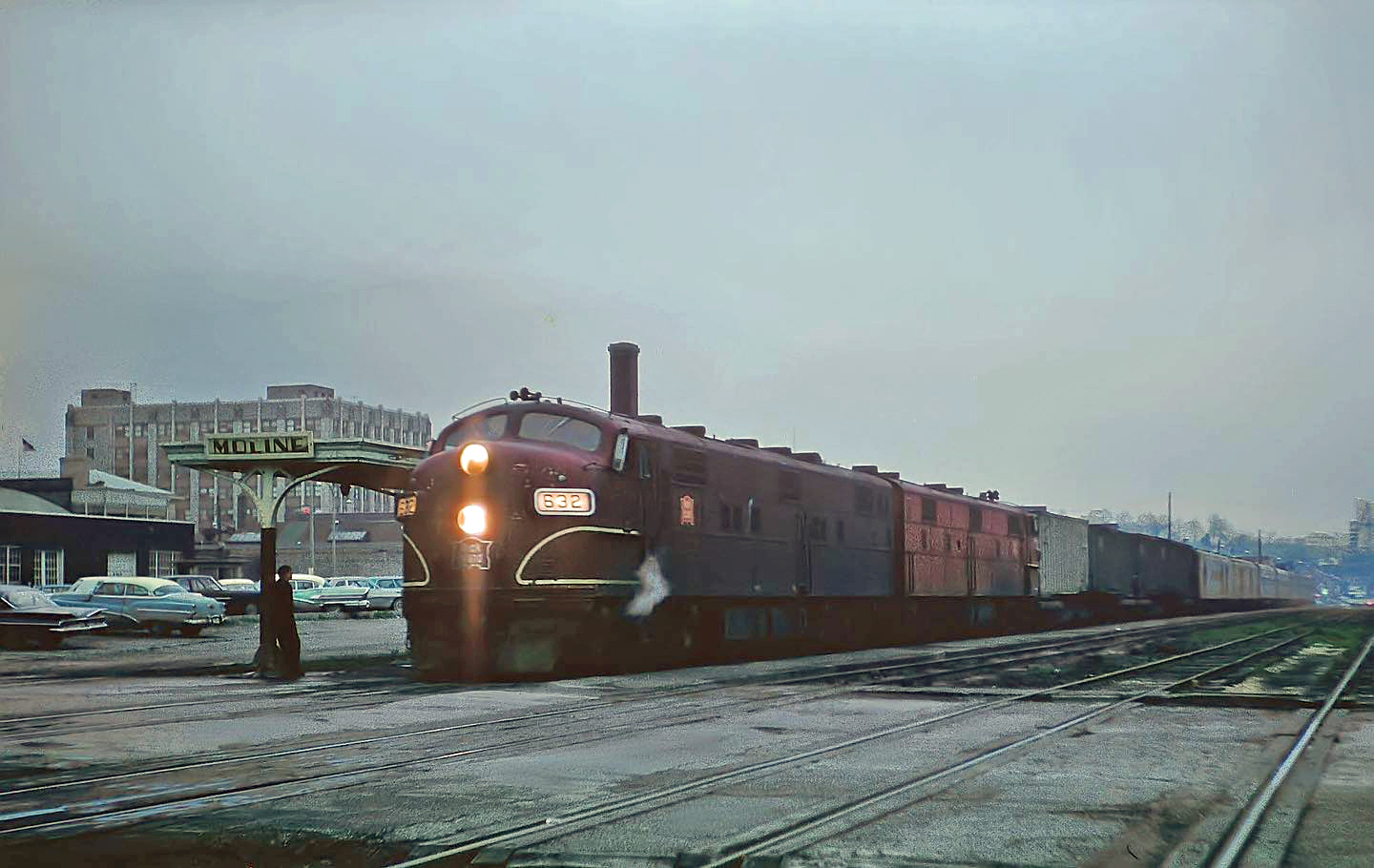 Rock Island E7A #632 with train 10, the "Corn Belt Rocket," at Moline, Illinois, May, 1967. Rick Burn photo.
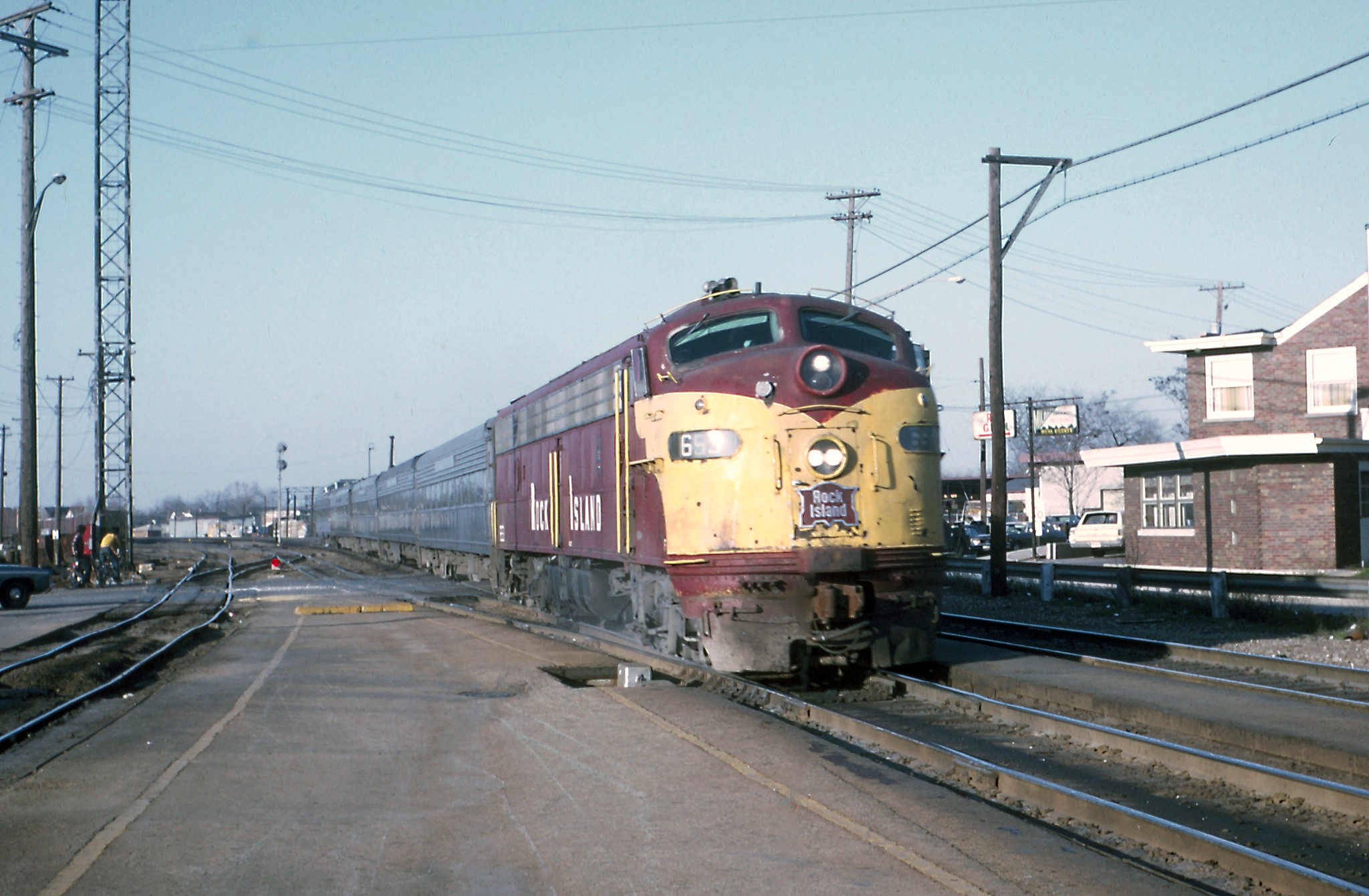 Rock Island E8A #653 is ahead of train #5, the "Quad Cities Rocket," at Blue Island, Illinois in May, 1974. Rick Burn photo.
Recent Articles


-
Lehigh and New England Railroad: Map, Rosters, History
Sep 21, 26 12:33 AM
 Lehigh & New England—South Mountain & Boston 1873, named April 2 1895. Anthracite, cement, Maybrook. Last Camelbacks, Alco FAs. Voluntary shutdown October 31 1961.
 -
TVRM Chattanooga Dinner Train (2026): Dates, Tickets & What to Expect
Sep 21, 26 12:20 AM
 2026 TVRM Chattanooga Dinner Train Experience—Grand Junction, select Fri/Sat March 6–October 24, three-course, 2–3 hours, from $110. Confirm on tvrail.com.
 -
Lehigh and Hudson River Railroad: Map, Rosters, History
Sep 20, 26 11:55 PM
 Lehigh & Hudson River—Warwick Valley 1860, Railway April 1 1882. Easton–Maybrook bridge road, Alphabet Route, Alco RS-3s and C420s. Conrail April 1 1976.
 -
Royal Gorge First Class Dinner Train (2026)
Sep 20, 26 11:47 PM
 2026 Royal Gorge Route First Class Lunch & Dinner—Cañon City, about 2 hours, from $199+, 12+. Confirm on royalgorgeroute.com.
 -
GE "44-Tonner" Locomotives: Roster, Specs, History
Sep 20, 26 11:09 PM
 GE 44-ton switcher—90,000-pound rule, Caterpillar D17000 center-cab, Sept 4 1940 CB&Q 9103 through Oct 1956 Dansville & Mount Morris 1. Phases, serial roster, PRR 46.
 -
Strasburg Rail Road Dining (2026): Dinner on the Rails & Elegant Expre
Sep 20, 26 11:00 PM
 2026 Strasburg Rail Road seated meals—Dinner on the Rails, Elegant Express, Valentine dinner. Lee E. Brenner diner. Confirm on strasburgrailroad.com.
 -
International-Great Northern Railroad: Map, History, Timetables
Sep 20, 26 10:43 PM
 International–Great Northern—Houston & Great Northern 1866, International Railroad 1870, merged Sept 30 1873. Palestine, Longview–Laredo, Gould, Missouri Pacific March 1 1956.
 -
Nevada Northern Taste of Italy Dinner Train (2026)
Sep 20, 26 03:25 PM
 2026 Nevada Northern Taste of Italy—adults-only multi-course Italian dinner, steam when healthy, East Ely. Sep. 19 gala listed. Confirm on nnry.com.
 -
Cape Cod Dinner Train (2026): Dates, Tickets & What to Expect
Sep 20, 26 02:53 PM
 Cape Cod Central Dinner Train—Hyannis, Buzzards Bay, and Falmouth. Four-course, 3–3½ hours, from $99.99. Confirm on capetrain.com.
 -
Erie Steam Locomotives: History, Roster & Photos
Sep 20, 26 11:55 AM
 Erie Railroad steam—Camelback 2-8-0s, 155 N-1 Mikados, 105 Berkshires, K-class Pacifics, Triplexes. Post-1900 roster after Drury. Last steam March 17, 1954.
 -
Erie Railroad Diesel Roster: All-Time
Sep 20, 26 11:47 AM
 Erie Railroad diesel—boxcabs 1926, FTs 1944, F3/F7, FA/PA, GP7/GP9, Baldwins, Limas. All-time roster with serials, orders, classes. Last steam March 17 1954. EL October 17 1960.
 -
Erie Railroad: Map, Passenger Trains, Logo, History
Sep 20, 26 11:44 AM
 Erie Railroad—New York & Erie 1832, Piermont–Dunkirk May 14 1851, six-foot then standard June 1880, Chicago 1883. High-and-wide fourth way. Erie Lackawanna October 17 1960.
 -
Colebrookdale Railroad Dining (2026): Secret Valley Dinner Train
Sep 20, 26 11:36 AM
 2026 Colebrookdale Railroad dinner in Boyertown—Secret Valley Dining Class, about 2 hours. Saturday evenings. Confirm on colebrookdalerailroad.com.
 -
Boone & Scenic Valley Wolf Dinner Train (2026)
Sep 19, 26 08:15 PM
 2026 Boone & Scenic Valley Wolf Dinner Train—Des Moines River valley, Bass Point Creek High Bridge, Union Pacific dining cars. Confirm on bsvrr.com.
 -
C&NW 4-6-2s 1617 & 1620: Minnesota 400 Yellow Jackets
Sep 19, 26 11:28 AM
 C&NW Class E Pacifics 1617 and 1620—Alco Schenectady 1917, yellow-and-green E-4-style shrouds 1941 for the Minnesota 400. Crews called them Yellow Jackets. Renumbered 617/620. Scrapped 1956.
 -
Erie Lackawanna Diesel Roster: All-Time
Sep 19, 26 10:13 AM
 Erie Lackawanna diesel—Erie and DL&W inheritance, GP35s, U25Bs, SD45/SDP45/SD45-2, U34CH. All-time roster with serials and orders. Conrail April 1 1976.
 -
Erie Lackawanna Railway: Map, History, Logo
Sep 19, 26 10:06 AM
 Erie Lackawanna Railway—Erie and DL&W, October 17 1960–March 31 1976. Von Willer, White revival, Dereco, Agnes, Conrail. High-and-wide Chicago main. Map, logo, what remains.
 -
"Empire State Express" (1941 Train): Timetables, Route, Consist
Sep 18, 26 10:59 PM
 NYC Empire State Express—George Daniels 1891 day train, 999’s 112.5 mph claim, Budd stainless streamliner December 7 1941, Cleveland and Detroit sections, diesels, 1967 name drop. Timetables, consist…
 -
New York Central 4-6-4s 5426 & 5429: Empire State Express Hudsons
Sep 18, 26 10:32 PM
 NYC J-3a Hudsons 5426 and 5429—Alco 1937, Budd stainless shrouds 1941 for the Empire State Express. Pearl Harbor inaugural. Shrouds off by 1950. Neither preserved.
 -
"Stourbridge Lion" Locomotive: Facts, History, Photos
Sep 18, 26 10:27 PM
 Stourbridge Lion—Foster, Rastrick 0-4-0, first steam locomotive in the United States. Horatio Allen, Honesdale, August 8, 1829. Too heavy for D&H gravity track. Boiler in Baltimore; Colonie replic…
 -
Delaware & Hudson Steam Roster (Post 1900)
Sep 18, 26 10:01 PM
 Delaware & Hudson steam—Camelback 2-8-0s, Loree high-pressure compounds, Class K 4-8-4s, forty Challengers. Post-1900 class roster after Drury. Last steam July 21, 1953.
 -
Boston & Maine Steam Roster (Post 1900)
Sep 18, 26 02:57 PM
 Boston & Maine steam—B-15 Moguls, K-8 Consolidations, P-4 Lima Pacifics, T-1 Limas, R-1 Mountains. Post-1900 class roster after Drury. Last steam July 23, 1956.
 -
Boston & Maine Diesel Roster (All-Time)
Sep 18, 26 01:25 PM
 Boston & Maine diesel—boxcab 1100 1935, Flying Yankee 6000, FTs, E7s, BL2s, GP7/GP9, GP38-2s and GP40-2s. All-time roster. Last steam July 23, 1956.
 -
Mid-Continent Railway Museum Dining (2026)
Sep 18, 26 01:21 PM
 2026 Mid-Continent dining in North Freedom—select-date seated meals in luxury cars, reservations required. Pizza Limited June 28. Confirm on midcontinent.org.
 -
Bessemer & Lake Erie Steam Roster (Post 1900)
Sep 18, 26 12:11 PM
Bessemer & Lake Erie steam—C3A 150–151, D1A/D2A Santa Fes, 47 H1 Texas types after Burlington. Post-1900 class roster after Drury. Last steam 2-8-0 156, May 14, 1953. -
Bessemer & Lake Erie Diesel Roster (All Time)
Sep 18, 26 12:09 PM
 Bessemer & Lake Erie diesel—Westinghouse 281 1936, Baldwin DRS-6-6-1500s, F7s 1950–53, SD7/SD9/SD18/SD38 family, RSD-15s. All-time roster. Last steam 2-8-0 156, May 14, 1953.
 -
Bangor & Aroostook Steam Roster (Post 1900)
Sep 18, 26 11:21 AM
 Bangor & Aroostook steam—Manchester Ten-Wheelers, Alco Mountains 100–109, G-2 Consolidations, Pacifics 250–254. Post-1900 class roster after Drury. Last steam Pacific 251, July 22, 1951.
 -
Bangor & Aroostook Diesel Roster (All Time)
Sep 18, 26 11:09 AM
 Bangor & Aroostook diesel—F3s 1947, eight BL2s, E7s, GP7s leased to the PRR, GP9s, GP38s. All-time roster. Last regular steam July 22, 1951.
 -
B&O Steam Locomotive Roster (Post 1900)
Sep 18, 26 10:33 AM
 Baltimore & Ohio steam—Old Maude, E-27 Consolidations, Q Mikados, Big Sixes, EM-1 Yellowstones, President Pacifics. Post-1900 class roster after Drury. Last public steam May 17, 1958.
 -
Baltimore & Ohio (B&O): Diesel Roster (All-Time)
Sep 18, 26 10:28 AM
 Baltimore & Ohio diesel—boxcab 1925, EMC 50 1935, EA 1937, FTs, F3s, F7s, FA-2s, sharks, GP7/GP9, GP30s after C&O 1963, SD50s 8576–8595 1984. All-time roster. Last steam 1958.
 -
Detroit & Toledo Shore Line Railroad: Map, Roster, History
Sep 18, 26 12:32 AM
 Detroit & Toledo Shore Line—Pleasant Bay 1898, named 1899, Detroit–Toledo freight bridge, GTW and Clover Leaf/NKP/N&W. Merged into Grand Trunk Western June 26, 1981.
 -
Lackawanna Steam Locomotives: History, Roster & Photos
Sep 18, 26 12:17 AM
 Delaware, Lackawanna & Western steam—Camelback 2-8-0s, Mikados, freight Pacifics, Poconos 4-8-4s, Hudsons. Post-1900 roster after Drury. Last steam July 13, 1953.
 -
Lackawanna (DL&W) Diesel Roster: All Time
Sep 18, 26 12:11 AM
Delaware, Lackawanna & Western diesel—boxcabs 1926, EMC SC 425–426 1935, FTs 1945, F3/F7/E8, GP7s, RS-3s, FM Train Masters. All-time roster. Last steam 1953. -
Lackawanna Railroad: Map, History, Viaducts, Rosters
Sep 18, 26 12:04 AM
 TDelaware, Lackawanna & Western—Liggett’s Gap 1832, named March 11 1853, Hoboken–Buffalo, anthracite, Phoebe Snow, Cutoff and Tunkhannock. It merged with the Erie to form Erie Lackawanna on Octobe…
 -
Rail News, The Latest
Sep 17, 26 11:56 PM
This page provides a portal to the latest in rail news, from preservation and restortation subjects to other notable topics. -
Union Pacific Big Boy 4014 Sets First Holiday Tour for Make-A-Wish
Sep 17, 26 11:54 PM
Union Pacific Big Boy 4014’s first holiday tour: Cheyenne–Denver tickets, Nov. 21 Denver-area display, Make-A-Wish. Museum patrons Oct. 16; public Oct. 19. -
Conrail Diesel Roster (All Time)
Sep 17, 26 10:27 PM
Conrail diesel—~5,000 inherited 1976, Big Blue, GP15-1s, SD40-2s, SD50s, Dash-8s, SD60/60M/60I, SD80MACs. All-time CR-number roster. -
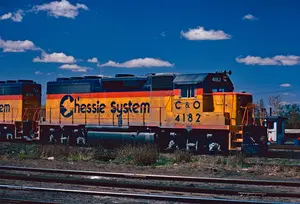
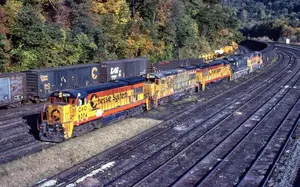
Chessie System (Railroad): The C&O, B&O, And WM
Sep 17, 26 09:38 PM
 Chessie System, Inc.—C&O, B&O, and Western Maryland. Kitten-C paint 1972, holding company February 26 1973, CSX November 1 1980, C&O into CSXT August 31 1987.
 -
Chesapeake & Ohio (C&O) Diesel Roster: All-Time
Sep 17, 26 06:01 PM
Chesapeake & Ohio diesel—late steam, no Fairbanks-Morse, E7s 1946, GP7/GP9 flood, F7s, GP40-2s, B30-7s, SD50s 1984–85. All-time roster. Steam ended 1956. -
Chesapeake & Ohio (C&O) Steam Roster: Post-1900
Sep 17, 26 03:18 PM
 Chesapeake & Ohio steam—H-8 Alleghenies, K-4 Kanawhas, T-1 Texas, Greenbriers, H-6 1949 Mallets. Post-1900 class roster including Pere Marquette and Hocking Valley. Last steam 1956.
 -
Chesapeake and Ohio Railway: Map, Logo, History
Sep 17, 26 02:36 PM
 Chesapeake & Ohio Railway—Louisa Railroad 1836, named August 31 1868, Ohio River 1873. Coal, Chessie the kitten, Pere Marquette 1947, B&O control 1963, into CSX August 31 1987. Complete corporate…
 -
TVRM Valentine Train Ride (2026)
Sep 17, 26 02:31 PM
 2026 TVRM Valentine Train Ride in Chattanooga—Feb. 6–15, plated dinner, Grand Junction Depot. Confirm on tvrail.com.
 -
River Fox Train Dining (2026)
Sep 17, 26 02:29 PM
2026 River Fox Train in West Sacramento—Brunch Train and Murder Mystery dinner. 18095 County Road 117. Confirm on riverfoxtrain.com. -
Weehawken Terminal, Serving The West Shore Railroad
Sep 17, 26 01:38 PM
 Weehawken Terminal—West Shore / New York Central Hudson waterfront station, opened 1884. Five ferry slips, sixteen tracks, Weehawken Tunnel 4,014 feet. Last ferry March 25, 1959. Port Imperial and HBL…
 -
West Shore Railroad: Map, History, Timetables
Sep 17, 26 01:32 PM
 West Shore Railroad—New York, West Shore & Buffalo 1880–83, Weehawken to Buffalo. PRR-backed rival to the Central. Morgan settlement, 475-year NYC lease January 1 1886. CSX River Sub today.
 -
Jersey Central Diesel Locomotives: History, Roster & Photos
Sep 17, 26 01:20 PM
 Central Railroad of New Jersey diesel—boxcab 1000, Baldwin double-enders, F3s, Train Masters, SD35s, GP40Ps. All-time roster. Steam ended July 1, 1954.
 -
Jersey Central Steam Locomotives: History, Roster & Photos
Sep 17, 26 01:17 PM
 Central Railroad of New Jersey steam—Camelback Ten-Wheelers, USRA Mikados, G-class Pacifics, suburban tanks. Post-1900 class roster after Drury. Dieselized July 1, 1954.
 -
Jersey Central Railroad (CNJ): Map, Rosters, History
Sep 17, 26 01:14 PM
 Central Railroad of New Jersey—Elizabethtown & Somerville 1831, named April 23 1849. Communipaw, anthracite, Blue Comet, Reading/B&O control. Conrail April 1 1976. Complete corporate history.
 -
Central Vermont Diesel Locomotives: History, Roster & Photos
Sep 17, 26 11:35 AM
 Central Vermont diesel—Alco S-2s 1942, RS-3s, RS-11s from DW&P, EMD GP9s 1956–57, GP38ACs 1971. All-time roster. Last steam April 4, 1957.
 -
Central Vermont Steam Locomotives: History, Roster & Photos
Sep 17, 26 11:19 AM
 Central Vermont steam—ten Alco 2-10-4s of 1928, four U-1-a Mountains, Consolidations. Post-1900 class roster after Drury. Last steam April 4, 1957.

%20the%20railroad%20had%20rebuilt%20to%20F9%20specs%20(numbered%20522)%20before%20being%20sold%20to%20the%20Rock%20in%201972.%20It's%20interesting%20that%20the%20lettering%20was%20painted%20right%20over%20the%20portholes.%20By%20the%201970s%20the%20Rock%20was%20in%20desperate%20need%20of%20motive%20power%20but%20could%20not%20afford%20new%20units%20so%20it%20acquired%20outdated%2C%20first-generation%20power%20at%20a%20bargain%20price%20from%20UP.%20American-Rails.com%20collection.)

%20to%20EMD%20in%20the%20mid-1950s%20whereupon%20they%20were%20upgraded%20with%20567C's%20and%20renumbered.%20%20Some%20were%20additionally%20given%20Blomberg%20trucks%20(like%20the%20trailing%20unit)%20from%20trade-in%20FT's.%20American-Rails.com%20collection.)
.%20She%20continued%20to%20handle%20commuter%20assignments%20until%20the%20end%20of%20operations%20in%201978%20when%20she%20was%20subsequently%20stored%20at%20Silvis.%20Today%2C%20the%20E6%20is%20preserved%20by%20the%20Iowa%20Northern%20Railway%20and%20cosmetically%20restored.%20American-Rails.com%20collection.)


%2C%20sadly%20none%20were%20preserved.%20Photographer%20unknown.)
%20were%20dead%20in-tow.%20Doug%20Kroll%20photo.)


