Georgia Railroad: Map, History, Logo, Rosters
Published: October 17, 2026
By: Adam Burns
The Georgia Railroad was the railroad of the Georgia Railroad & Banking Company. Reporting mark GA. The main line ran from Augusta to Atlanta, 171 miles, with a branch from Union Point to Athens and the Macon Road from Camak to Macon. Headquarters were in Augusta. The company chartered the railroad in 1833, added banking in 1836, and leased the line in 1881. The Seaboard Coast Line bought the railroad properties from the banking company on November 4, 1982.
The banking company held a large block of Atlanta & West Point stock and an interest in the Western Railway of Alabama. Those two railroads, operated together, were the West Point Route. The Georgia Railroad kept its own locomotives, its own shops at Augusta, and its own mark. The diesels below are the locomotives that carried Georgia numbers. GP7 No. 1026 is at the Southeastern Railway Museum in Duluth.
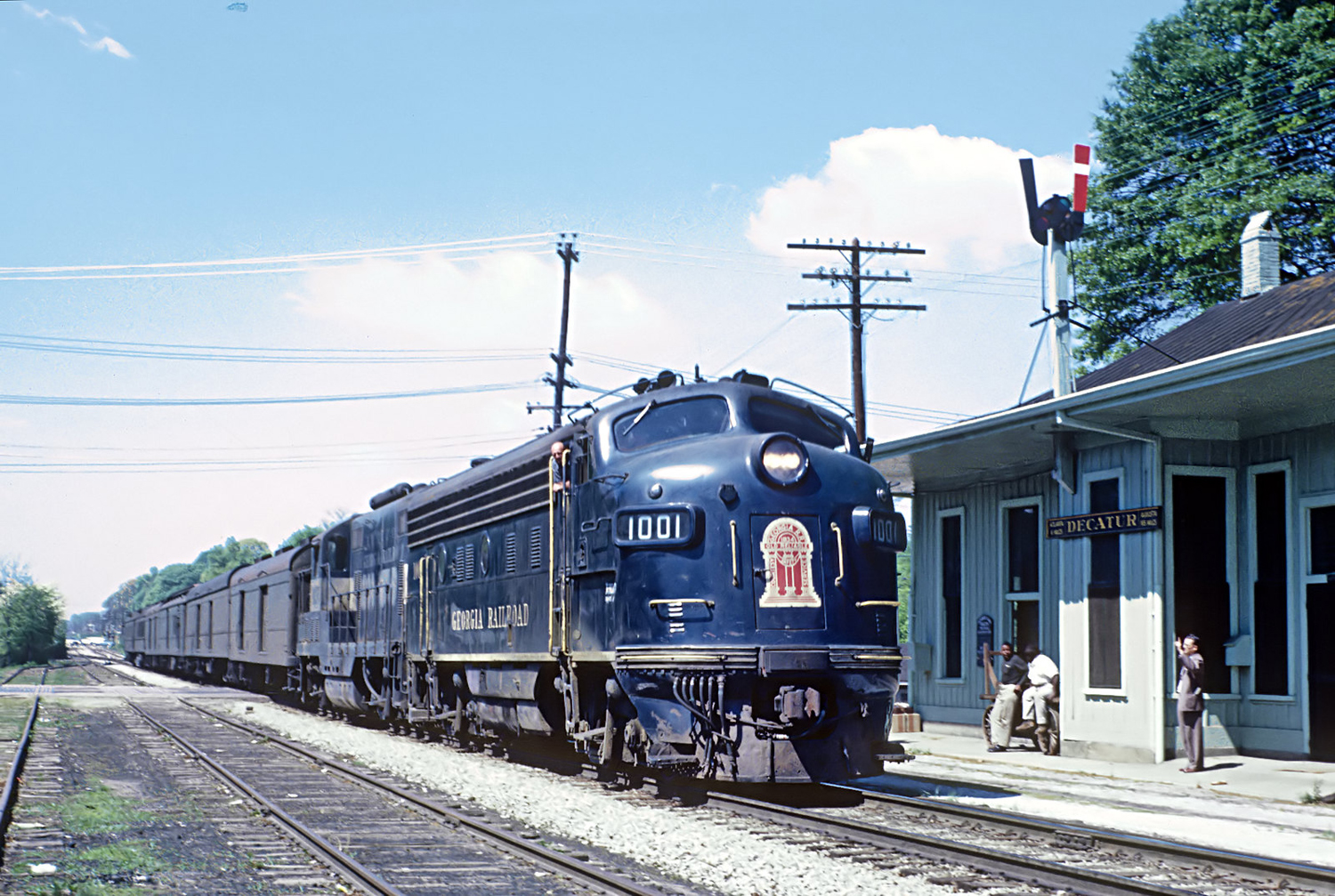
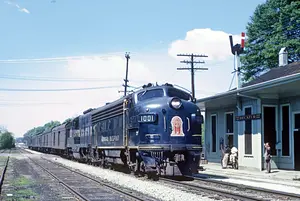
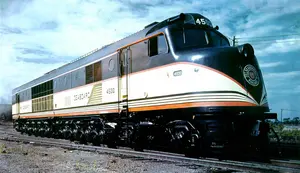
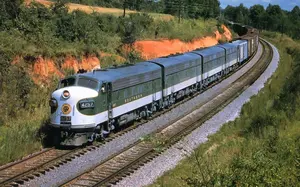
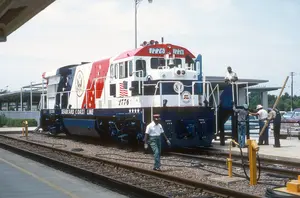
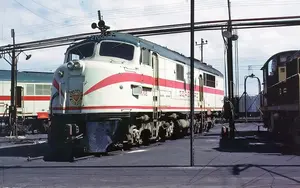
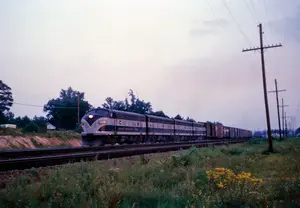
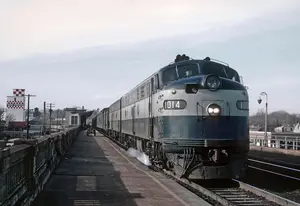
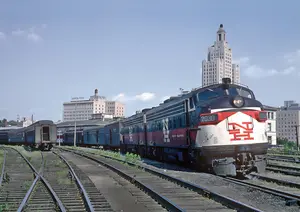
Georgia Railroad F3A No. 1001 arrives at Decatur, Georgia, with train 2 on April 13, 1963. Roger Puta photo.
On this page: Augusta to Atlanta · Branches · The 1881 lease · At a glance · Passenger trains and mixed trains · Steam · Diesels · Family Lines and CSX
Augusta to Atlanta
Athens citizens led by James Camak took a charter on December 21, 1833, for a railroad between Athens and Augusta. They met at Camak’s house in Athens on March 10, 1834, accepted the charter, and elected him president. Construction started at Augusta in 1835. In 1836 the charter was amended so the company could carry on a banking business, and the name became the Georgia Railroad & Banking Company. John Edgar Thomson, a young engineer from Philadelphia, became chief engineer in 1834. His assistant, Richard Peters, located most of the line and became superintendent in 1837. Augustan John Pendleton King was president from 1841 to 1878.
Thomson’s location ran west from Augusta. C. J. Marsh Jr. credits him with eighty miles, as far as the Oconee River west of Greensboro, laid out so the railroad needed no bridge. The town of Thomson, on that line, carries the engineer’s name. He left to become chief engineer of the Pennsylvania Railroad and, in 1852, its president. The act that renamed Marthasville as Atlanta, on December 26, 1845, used the name he had proposed.
The original Athens branch, 39 miles from Union Point, opened in December 1841 and ran with horse cars until 1847. The line toward Atlanta was finished in 1845. Marsh dates the arrival at the settlement then called Marthasville, later Atlanta, to 1844, and he puts the Augusta–Atlanta distance at 171 miles. That line became the main line. It was built to the South’s 5-foot gauge. On May 29–31, 1886, with the rest of the southern railroads, it was narrowed to 4 feet 8½ inches.
At Augusta the railroad met the South Carolina Railroad and a road to Charleston. At Atlanta it met the Western & Atlantic, the state railroad toward Chattanooga, and the roads coming up from Macon. The Central of Georgia, building out of Savannah, was the rival for the same cities. Cotton and the products of the plantations and the forests moved toward Augusta. Manufactured goods moved inland. In 1863 the line could move about 800 tons of freight a day and stood among the stronger railroads of the Confederacy. The Georgia Railroad & Banking Company had owned at least 162 enslaved people, used to build and maintain the railroad. After Atlanta fell in the late summer of 1864, Union troops destroyed the track from that city to the Oconee River and left the embankments.
The Georgia Railroad logo. The railroad’s mark was GA.
Branches
The longest branch was the Macon Road. The Macon & Augusta Railroad was building it when the Georgia Railroad leased the unfinished line in 1867. The branch was completed in 1873, 78 miles from Camak to Macon, and it was merged into the Georgia Railroad in 1878. A shorter line, the Union Point & White Plains, was built in 1889 and abandoned in 1927. The Washington branch ran 18 miles from Barnett to Washington. The Monroe branch ran 10 miles from Social Circle to Monroe. Marsh also names the Washington & Lincolnton, the Elberton & Eastern, the Lexington Terminal, the Milstead, and the Milledgeville Railway among the short lines the company nurtured. Those feeders lived on cotton, lumber, and farm freight, and they were abandoned as that traffic faded.
On the main line the through freights were Nos. 209, 210, and 211. They moved bridge traffic between Atlanta and Augusta and did their station work at Camak, where the Macon Road and the Savannah & Atlanta met the main line. Local freights covered the online customers and fed the branch mixed trains. In 1929 the railroad handled just over 100,000 carloads. Forest products, clay, gravel, cotton, and cottonseed were the online freight. Coal, flour, petroleum, sugar, textiles, and manufactured goods came from the connections. Georgia Power’s plant on Lake Sinclair, near Milledgeville, turned the outer Macon Road into a coal railroad in the early 1960s. A connecting track of about one mile at Camak let those trains run between Atlanta and Milledgeville without turning the power.
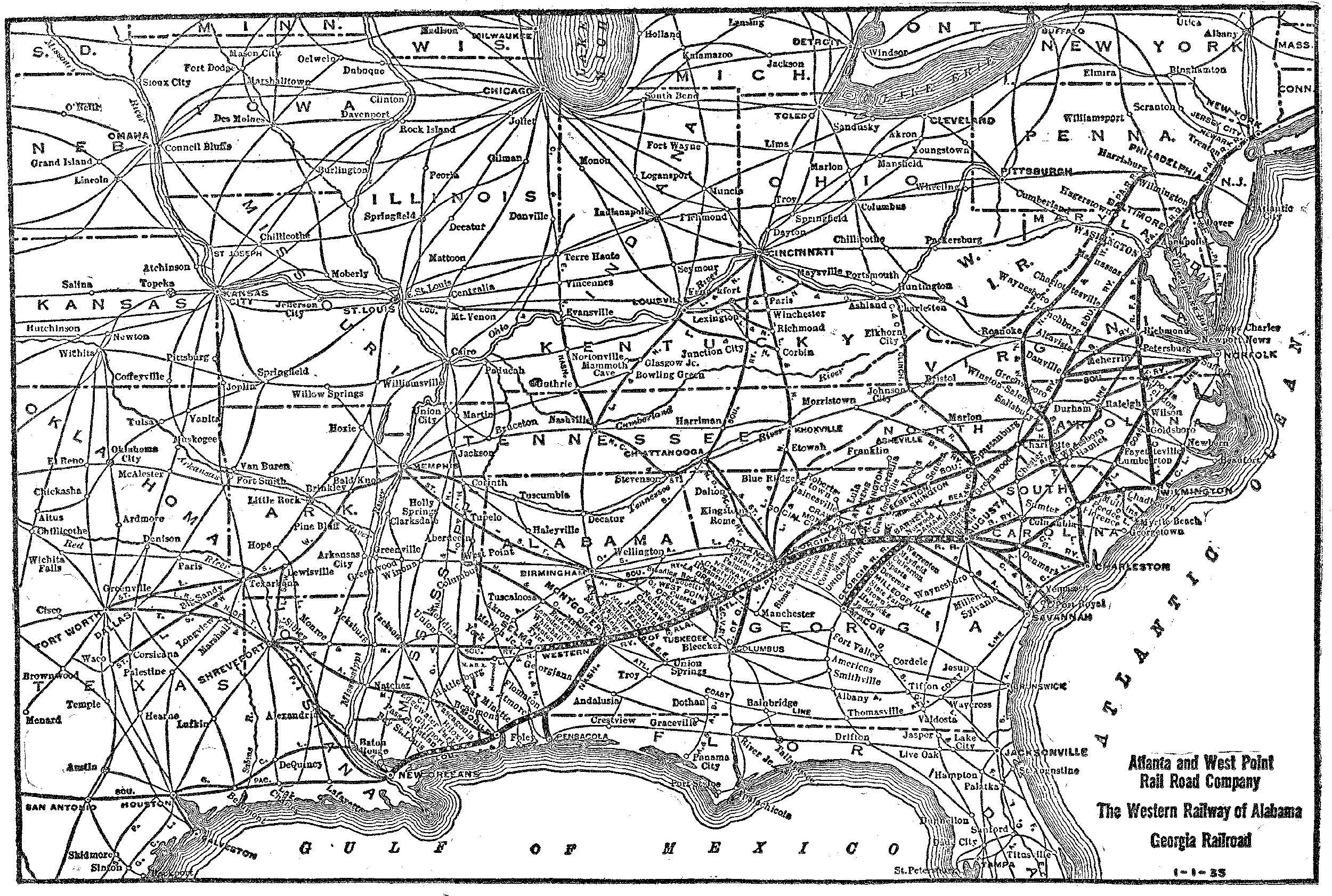
A March, 1940 Official Guide map of the Georgia Railroad, the Atlanta and West Point, and the Western Railway of Alabama. American-Rails.com collection
The 1881 lease
Banking had become the more profitable side of the company. On June 1, 1881, William M. Wadley, president of the Central of Georgia, leased the railroad properties for 99 years. The lease covered the Georgia Railroad and the banking company’s interests in the Atlanta & West Point and the Western Railway of Alabama. Wadley assigned it jointly to the Central of Georgia and the Louisville & Nashville. The Interstate Commerce Commission’s valuation of the Central records the Central’s half of that lease at $300,000 a year. The property then leased was 307 miles, the Augusta–Atlanta line and the branches to Athens and Macon. The Official Railway List still showed 307 miles in 1889, with 48 locomotives, and again in 1894, with 57 locomotives.
The Central entered receivership in 1892. In 1898 the reorganized Central sold its half of the Georgia lease to the Louisville & Nashville. In 1899 the L&N assigned that half to the Atlantic Coast Line. The Coast Line bought control of the L&N in November 1902 and left the L&N to run its own railroad. From then on the two lessees were the Atlantic Coast Line and the Louisville & Nashville. The Georgia Railroad & Banking Company remained the owner. The railroad kept Georgia letters on the locomotives and Georgia men in the Augusta shops.
The same valuation describes the Atlanta & West Point as it stood in those years. The Louisville & Nashville and the Atlantic Coast Line controlled it jointly, through 3,118 shares they owned and the voting power of 9,361 shares owned by the Georgia Rail Road & Banking Company. The Georgia company’s investment had built that route. Operation of the West Point Route is on its own page.
At a glance
| Item | Detail |
|---|---|
| Company | Georgia Railroad & Banking Company |
| Mark | GA |
| Headquarters | Augusta |
| Charter | December 21, 1833. Accepted March 10, 1834. Banking added in 1836 |
| Main line | Augusta to Atlanta, 171 miles. Completed in 1845 |
| Athens branch | Union Point to Athens, 39 miles, December 1841. Horse cars until 1847 |
| Macon Road | Camak to Macon, 78 miles, completed 1873, merged 1878 |
| Mileage in the lease | 307 miles in 1881, and the same figure in the lists for 1889 and 1894 |
| Gauge | 5 feet, then 4 feet 8½ inches from May 29–31, 1886 |
| Lease | June 1, 1881, 99 years, jointly to the Central of Georgia and the Louisville & Nashville |
| Diesels | 44 locomotives that carried Georgia numbers. GP16 4975 is GP9 1042 |
| Sale of the railroad | Seaboard Coast Line, November 4, 1982. Main-line mixed trains lasted until May 6, 1983 |
| Line today | CSX Transportation still uses the Augusta–Atlanta main line |
Passenger trains and mixed trains
After 1945 the main line still had four passenger trains. Nos. 1 and 2 ran by day. Nos. 3 and 4 ran by night. The night trains carried a Pullman between Augusta and Atlanta, and through cars for Charleston and Wilmington on the Atlantic Coast Line. All four trains handled a heavy express and mail business, with Railway Post Office cars for the towns along the line. That mail work on the night trains ended in the fall of 1967. Nos. 3 and 4 came off in March 1968. The day trains were the last regular heavyweight passenger runs on the railroad, in Georgia Railroad colors, behind the blue-and-silver F units.
In Atlanta the Georgia Railroad’s passenger trains used Union Station, with the Louisville & Nashville. The West Point Route used Terminal Station, with the Southern, the Seaboard Air Line, and the Central of Georgia. Train 4, in the April 1963 photograph below, was at Terminal Station. Locomotives were maintained at Augusta. West Point Route locomotives were maintained at Montgomery.
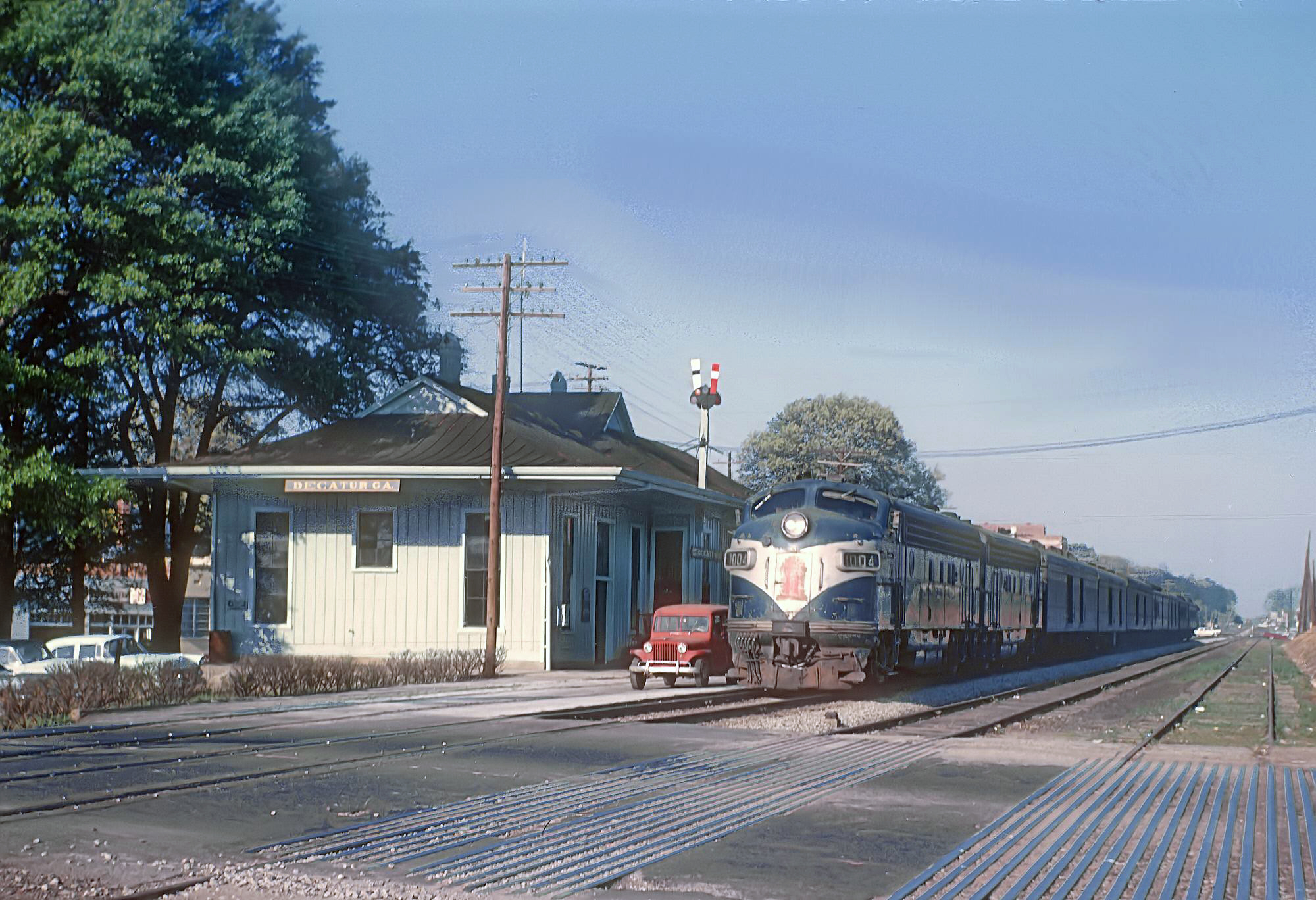
Georgia Railroad FP7 No. 1004 ahead of train 1, Augusta to Atlanta, at Decatur in April 1963. Rick Burn photo.
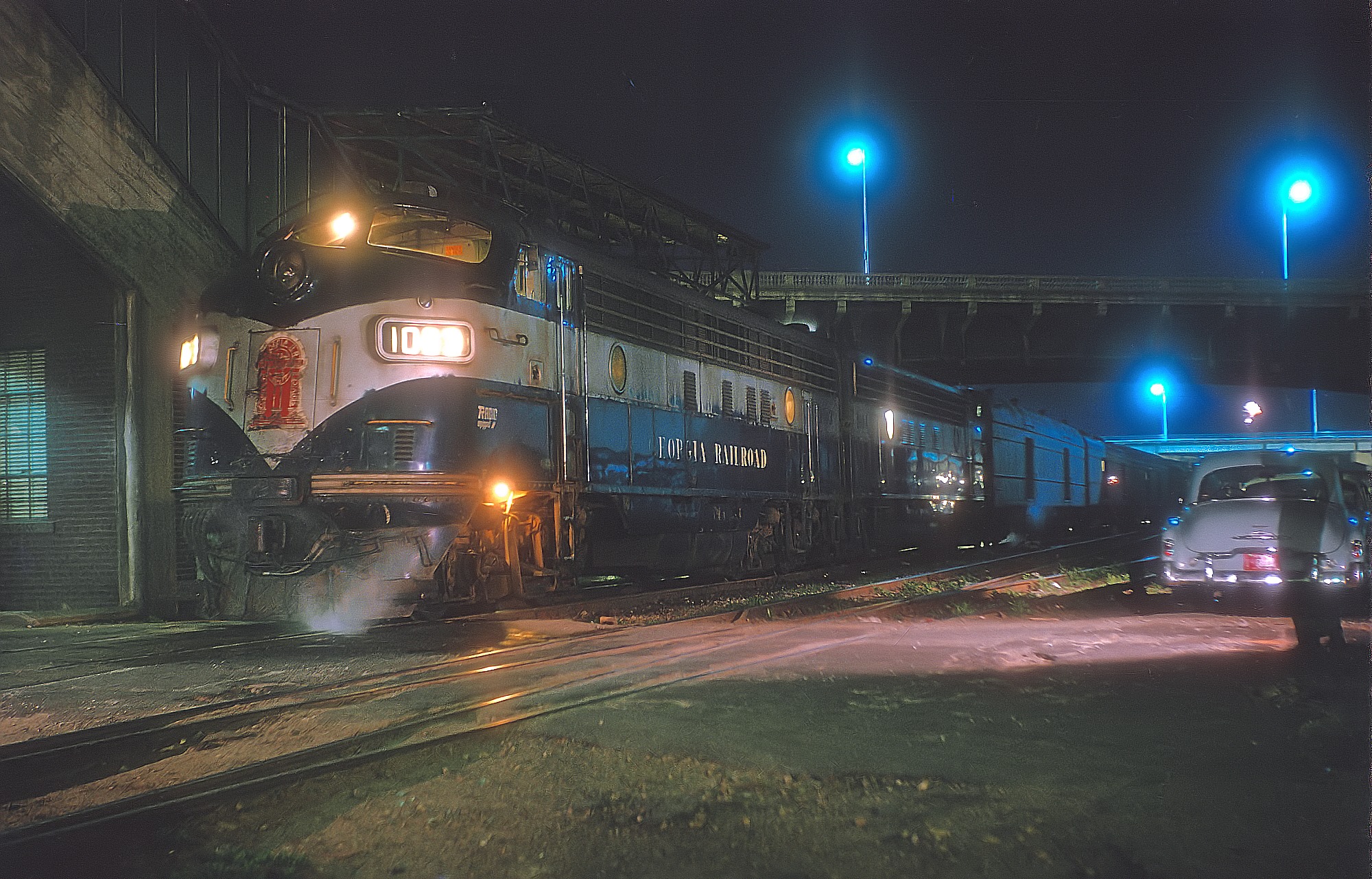
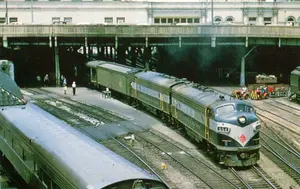
Georgia Railroad FP7 No. 1003 with train 4, Atlanta to Augusta, at Atlanta Terminal Station in April 1963. Rick Burn photo.
On July 1, 1969, trains 1 and 2 began to handle as many as 50 loaded through freight cars. Those trains were called the Super Mixeds. In 1969, Atlanta & West Point coach 120 and Western Railway of Alabama coach 106, relettered for the Georgia Railroad, replaced the heavyweight coaches on those trains. On March 29, 1972, trains 1 and 2 came off. Those coaches then rode freights 103 and 108, and the limit of 50 cars ended the same day. The branch lines had been running mixed trains, a Ten-Wheeler or a road-switcher and a combine, for years before the main line did. Augusta Union Station, which this railroad shared with the Atlantic Coast Line, closed in 1968 and was demolished in 1972.
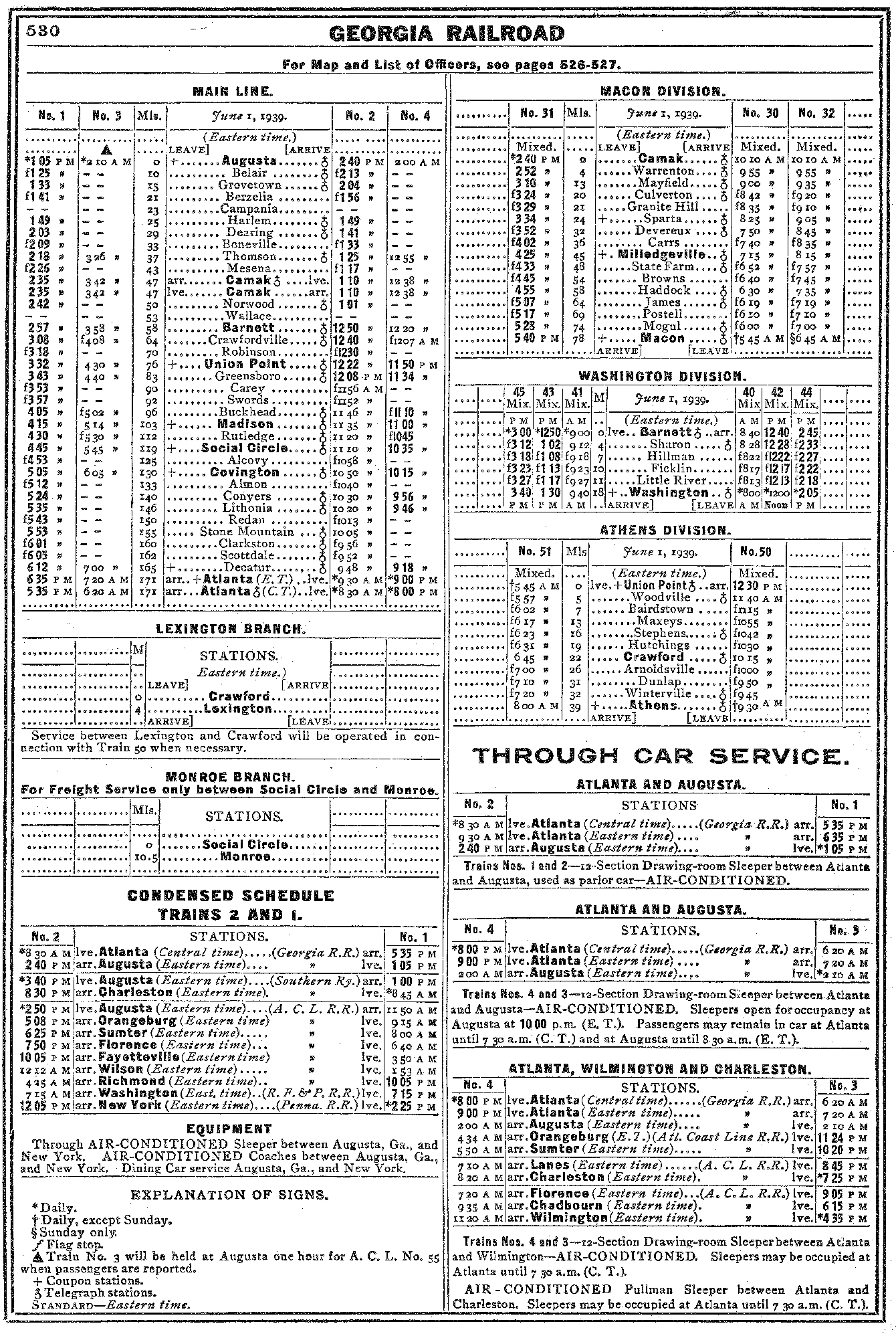
Georgia Railroad timetables from the March, 1940 Official Guide of the Railways. American-Rails.com collection.
Steam
The steam list is in Richard E. Prince’s Steam Locomotives and History: Georgia Railroad and West Point Route (1962). Ten-Wheelers were the most numerous type. No. 253 had been built by Rogers in 1907 as Western of Alabama 150, and later rebuildings changed the cylinders, the valve gear, the trailing truck, and the tender. No. 222 was photographed at Milledgeville on April 8, 1954, and is identified as the last steam locomotive in service. By 1914 the road also had American-type engines, six-wheel switchers, Moguls, four Lima Mikados, and a pair of light Pacifics. Lima Mikado 321 was one of seven built in the mid-1920s and was still on train 2 out of Atlanta in April 1950.
From the United States Railroad Administration years, 1918–1920, the railroad came away with a small group of standard Mikados and eight-wheel switchers. Larger Ten-Wheelers were rebuilt between 1920 and 1942 for the branches and the secondary trains. In 1943 four Clinchfield K-1 Mikados came to the Georgia Railroad: Nos. 402, 403, 406, and 407. One eight-wheel switcher came from the Detroit Terminal. After 1954 the four main-line passenger trains were an assignment for the F units.
Diesels
The first diesel was NW2 No. 901, Electro-Motive serial 6194, in April 1948. The first road diesel was F3A No. 1001, serial 7483, in October 1948, bought to cover the four daily trips on the Macon Road. The list below is every locomotive that carried a Georgia Railroad number. A rebuild keeps the row of the locomotive it was rebuilt from. GP16 4975 is GP9 1042. FP7 1005, GP7 1019, and GP7 1020 came from the Atlanta & West Point. Baldwin switcher 921 went to the Atlanta & West Point as No. 675. The early cabs were blue and silver, and a later passenger scheme was solid blue. The GP40s of 1967 and 1968 came in solid black. The GP38-2s came in Family Lines paint.
| Model | Numbers | Qty | Serial | Order | Built | Notes |
|---|---|---|---|---|---|---|
| NW2 | 901 | 1 | 6194 | April 1948 | To Seaboard System 24 | |
| NW2 | 902 | 1 | 8022 | March 1949 | To Seaboard System 25 | |
| NW2 | 903 | 1 | 8023 | April 1949 | ||
| NW2 | 904–905 | 2 | 8024–8025 | September 1949 | To Seaboard System 26 and 27 | |
| SW9 | 906–907 | 2 | 15604–15605 | October 1951 | 906 to Seaboard System 203 | |
| DS-4-4-1000 | 921 | 1 | 74205 | June 1949 | To Atlanta & West Point 675 | |
| F3A | 1001 | 1 | 7483 | October 1948 | Trade-in to Electro-Motive | |
| FP7 | 1002 | 1 | 7605 | November 1949 | Trade-in to Electro-Motive | |
| FP7 | 1003 | 1 | 8322 | November 1949 | Trade-in to Electro-Motive | |
| FP7 | 1004 | 1 | 8870 | February 1950 | Trade-in to Electro-Motive | |
| FP7 | 1005 | 1 | 8020 | August 1949 | Ex-Atlanta & West Point 551 | |
| GP7 | 1019 | 1 | 8868 | February 1950 | Ex-Atlanta & West Point 571. To Seaboard System 703 | |
| GP7 | 1020 | 1 | 11876 | August 1950 | Ex-Atlanta & West Point 572 | |
| GP7 | 1021 | 1 | 8871 | April 1950 | To Seaboard System 707 | |
| GP7 | 1022 | 1 | 9081 | August 1950 | To Seaboard System 709, then Valdosta Southern 184 | |
| GP7 | 1023–1024 | 2 | 9077–9078 | October 1950 | 1024 to Seaboard System 717 | |
| GP7 | 1025–1026 | 2 | 12000–12001 | October 1950 | 1025 to Seaboard System 719. 1026 is at the Southeastern Railway Museum, Duluth | |
| GP7 | 1027–1028 | 2 | 13024–13025 | January 1951 | 1027 stripped for parts. 1028 to Seaboard System 722 | |
| GP7 | 1029 | 1 | 14984 | September 1951 | To Seaboard System 723 | |
| GP7 | 1030 | 1 | 17064 | August 1952 | Trade-in to Electro-Motive | |
| GP7 | 1031–1032 | 2 | 17555–17556 | October 1952 | 1031 to Seaboard System 730. 1032 to Seaboard System 732, then the North Carolina Port Authority | |
| GP7 | 1033–1034 | 2 | 18280–18281 | April 1953 | Trade-in to General Electric | |
| GP7 | 1035 | 1 | 18722 | November 1953 | To Seaboard System 733 | |
| GP7 | 1036 | 1 | 18723 | November 1953 | Wrecked. Trade-in to Electro-Motive | |
| GP9 | 1040–1042 | 3 | 19515–19517 | May 1954 | 1041 trade-in to General Electric. 1042 rebuilt as GP16 4975, later Seaboard System 4975 | |
| GP40 | 751 | 1 | 33100 | May 1967 | To Seaboard System 6653 | |
| GP40 | 752 | 1 | 33097 | May 1967 | To Seaboard System 6654 | |
| GP40 | 753–754 | 2 | 33883–33884 | July 1968 | To Seaboard System 6655 and 6656 | |
| GP40-2 | 755–756 | 2 | 5814-1, 5814-2 | 5814 | December 1972 | To Seaboard System 6643 and 6644 |
| GP38-2 | 6009–6010 | 2 | April 1979 | Family Lines paint. To Seaboard System 6009 and 6010 | ||
| GP38-2 | 6051–6052 | 2 | March 1980 | Family Lines paint. To Seaboard System 6051 and 6052 |
The rows total 44 locomotives. Eight of them were switchers, the five NW2s, the two SW9s, and the Baldwin. After 1954 those eight covered Atlanta and Augusta, and the road-switchers covered the freight.
Family Lines and CSX
From 1972 through 1982 the Seaboard Coast Line Industries marketed the Georgia Railroad with the Seaboard Coast Line, the Louisville & Nashville, the Clinchfield, the Atlanta & West Point, and the Western Railway of Alabama under the name Family Lines. Each company kept its mark. GP38-2s 6009 and 6010 were delivered in that paint in April 1979. Nos. 6051 and 6052 followed in March 1980.
On November 4, 1982, the Seaboard Coast Line acquired the Georgia Railroad properties from the Georgia Railroad and Banking Company. On December 29, 1982, the Seaboard Coast Line and the Louisville & Nashville merged into the Seaboard System. The mixed trains outlasted that merger. The branch-line mixeds made their last runs on April 29, 1983. On May 6, 1983, the last main-line mixeds left both ends of the railroad. Seaboard System 6051, named Franklin M. Garrett, left Hulsey Yard in Atlanta for Harrisonville Yard in Augusta. CSX Transportation dates from July 1, 1986. The Augusta–Atlanta main line is still part of CSX.
Seaboard System abandoned the Union Point–Athens line in November 1984. A stub of 0.44 mile, from downtown Athens east to Old Winterville Road, lasted until 1997. The Macon–Milledgeville piece of the Macon Road was abandoned on December 15, 1984. Camak to Milledgeville stayed in service for coal to Plant Harllee Branch. The Washington branch is now the Georgia Woodlands Railroad. The Monroe branch is now the Great Walton Railroad.
Related reading on American-Rails.com
- West Point Route · Family Lines · Seaboard Coast Line · CSX Transportation
- Central of Georgia · Western & Atlantic · Louisville & Nashville · Atlantic Coast Line · Clinchfield
- 2-8-2 Mikado locomotives · 4-6-2 locomotives · USRA locomotives
Sources
- railga.com, Georgia Railroad, Steve Storey. Charter of December 21, 1833, the March 10, 1834 organization, Thomson from 1834, the Athens branch, the 1845 completion, the Macon Road, the 1881 lease and the 1898 and 1899 assignments, the 1889 and 1894 equipment lists, the abandonments, and the company’s ownership of at least 162 enslaved people
- Interstate Commerce Commission valuation of the Central of Georgia, for the June 1, 1881 lease, the Central’s half at $300,000 a year, and the 307 miles then leased. The Atlanta & West Point valuation, Volume 29, for the 3,118 shares and the 9,361 shares held by the Georgia Rail Road & Banking Company
- C. J. Marsh Jr., “Georgia Railroad: A good and unique ‘Family’ member,” Classic Trains, September 1, 2023. Thomson’s location, the traffic, trains 209–211, the passenger trains, the sale on November 4, 1982, and the mixed trains of April 29 and May 6, 1983
- C. J. Marsh Jr., “Georgia Railroad locomotives remembered,” Classic Trains, September 17, 2023. Ten-Wheeler 253, Ten-Wheeler 222 on April 8, 1954, Mikado 321, the 1914 types, the USRA engines, F3A 1001 on the Macon Road, and the paint
- Lyle Key, “The Last Years of the Georgia Railroad Mixed Trains,” Railway & Locomotive Historical Society, Southeast Chapter, Southeast Limited, Newsletter No. 34, April 1996. Night trains off in March 1968, the Super Mixeds from July 1, 1969, trains 1 and 2 off on March 29, 1972, the branch mixeds on April 29, 1983, and Seaboard System 6051, Franklin M. Garrett, Hulsey Yard to Harrisonville Yard on May 6, 1983
- Richard E. Prince, Steam Locomotives and History: Georgia Railroad and West Point Route (1962). Steam roster
- Robert H. Hanson, Safety-Courtesy-Service: History of the Georgia Railroad (Overmountain Press, 1996)
- W. Forrest Beckum Jr. and Albert M. Langley Jr., Georgia Railroad Album (Union Station Publishing, 1985)
- Georgia Railroad diesel roster, thedieselshop.us, John Komanesky, from Extra 2200 South, revised February 28, 2016. The diesel list. The Southeastern Railway Museum roster on the same site places GP7 1026 at Duluth
Recent Articles


-
Georgia Railroad: Map, History, Logo, Rosters
Oct 17, 26 12:59 PM
 Georgia Railroad, the Georgia Railroad and Banking Company, Augusta to Atlanta, with the Athens branch and the Macon Road. Mark GA. The railroad properties were sold on November 4, 1982.
 -
West Point Route (Railroad): Map, History, Logo
Oct 16, 26 11:26 PM
 The West Point Route was a trademarked name comprising the Atlanta & West Point and Western Railway of Alabama, which were controlled by the Georgia Railroad.
 -
Virginian Railway Diesel Roster (All-Time)
Oct 16, 26 11:11 PM
 All-time diesel roster of the Virginian Railway. 40 Fairbanks-Morse H16-44s, 25 H24-66 Train Masters, and one GE 44-tonner. Serials included.
 -
Virginian Railway Steam Roster (Post 1900)
Oct 16, 26 10:55 PM
 Virginian Railway steam locomotives built since 1900. Mikados, 2-8-8-2s, the Triplex, class AE 2-10-10-2s, and the 1945 2-6-6-6s.
 -
Virginian Railway: Map, Rosters, History, Electrification
Oct 16, 26 10:51 PM
 Virginian Railway, Deepwater to Norfolk. Combined in 1907 and completed in 1909. Electrified from Roanoke to Elmore. Absorbed by the Norfolk & Western on December 1, 1959.
 -
Baldwin "Centipede" Locomotives: Specs, Roster, Photos
Oct 16, 26 03:58 PM
 Baldwin DR-12-8-1500/2 Centipede—2-D+D-2, two 608SC engines, 3,000 hp. SAL 4500 from the 1943 test bed. 54 on the serial list, 52 sold. PRR BP60 then BH50. None preserved.
 -
Louisville & Nashville Class M-1 2-8-4s: The Big Emmas
Oct 16, 26 03:52 PM
 Louisville & Nashville class M-1, 42 Big Emma 2-8-4s. Baldwin in 1942 and 1944, Lima in 1949. Coal trains from Neon to DeCoursey. No locomotive survives.
 -
Tennessee, Alabama and Georgia Railway: Map, History, Rosters
Oct 16, 26 03:21 PM
 Tennessee, Alabama and Georgia Railway, Chattanooga to Gadsden. The May 1929 card is 91.7 miles. Southern stock control closed on a January 1, 1971 schedule. Five diesels and Prince's steam list.
 -
Railroad Museums In The USA (2026): State Guides & Collections
Oct 16, 26 02:29 PM
 U.S. railroad museums—what they are vs tourist railroads, preservation history (R&LHS, NRHS, IRM, Steamtown), state guides, and destination collections. Confirm hours on each museum’s site.
 -
Wyoming Railroad Museums (2026): A Complete Guide
Oct 16, 26 02:26 PM
 Wyoming railroad museums—the Cheyenne Depot, Burlington 5633 at Douglas, Big Boy 4004, and the Laramie depot. Confirm hours and which locomotive is on the property.
 -
West Virginia Railroad Museums (2026): A Complete Guide
Oct 16, 26 12:52 PM
 West Virginia railroad museums—Cass Scenic’s geared steam, the Hinton C&O collection, and the Martinsburg B&O roundhouse. Confirm hours and which locomotive is assigned.
 -
Washington Railroad Museums (2026): A Complete Guide
Oct 16, 26 12:46 PM
 Washington railroad museums—Snoqualmie, Elbe, Chehalis, Reardan, and the Northern Pacific depot at Toppenish. Confirm hours and which locomotive is assigned.
 -
Vermont Railroad Museums (2026): A Complete Guide
Oct 16, 26 12:42 PM
 Vermont railroad museums—the Shelburne Museum’s 1890 station, Central Vermont No. 220, and the private car Grand Isle. Confirm hours on the site.
 -
Tennessee Central Railway: Map, Logo, Rosters, History
Oct 16, 26 11:32 AM
 Tennessee Central Railway, Harriman to Hopkinsville. Reorganized January 26, 1922. Last day August 31, 1968. Thirty-one diesels and the railroad's steam roster.
 -
Southern Railway Steam Roster (Post 1900)
Oct 16, 26 09:40 AM
Southern Railway steam locomotives built since 1900. Ps-4 Pacifics, Ts Mountains, USRA Santa Fes, and the subsidiary grids for the CNO&TP, Alabama Great Southern, and New Orleans and Northeastern. -
Southern Railway (USA): Map, Locomotives, Logo, History
Oct 16, 26 09:28 AM
 The Southern Railway, formed July 1, 1894 from the Richmond and Danville and the East Tennessee, Virginia and Georgia. Washington. Norfolk Southern Railway on December 31, 1990.
 -
Seaboard Coast Line Diesel Roster (All-Time)
Oct 15, 26 04:21 PM
 All-time diesel roster of the Seaboard Coast Line. Inherited Coast Line and Seaboard locomotives, then 623 new locomotives in the printed orders, plus 28 acquired from other railroads.
 -
Seaboard Coast Line Railroad: Map, History, Photos
Oct 15, 26 04:17 PM
 The Seaboard Coast Line, formed July 1, 1967 from the Atlantic Coast Line and the Seaboard Air Line. Jacksonville. Family Lines, then the Seaboard System on December 29, 1982.
 -
South Carolina Railroad Museums (2026): A Complete Guide
Oct 15, 26 02:54 PM
 South Carolina railroad museums—Winnsboro’s Rockton & Rion line, Spartanburg’s Hub City depot, Greenwood’s Baldwin No. 19, and the Best Friend replica. Confirm hours on each site.
 -
South Dakota Railroad Museums (2026): A Complete Guide
Oct 15, 26 10:55 AM
 South Dakota railroad museums—the Hill City museum beside the 1880 Train, and Prairie Village at Madison. Confirm hours, and confirm whether Hill City is still open.
 -
Seaboard Air Line Diesel Roster (All-Time)
Oct 15, 26 10:46 AM
 All-time diesel roster of the Seaboard Air Line. 734 locomotives: E4s in 1938, Centipedes, Alco road switchers, and GP40s through February 1967. Serials included.
 -
Seaboard Air Line Steam Roster (Post 1900)
Oct 15, 26 10:39 AM
 Seaboard Air Line steam locomotives built since 1900. Mikados, Russian Decapods, 2-10-2s, and the 2-6-6-4s sold to the Baltimore and Ohio in 1947. Drury's class grid.
 -
Seaboard Air Line Railroad: Map, Rosters, History
Oct 15, 26 10:34 AM
 The Seaboard Air Line, chartered in the Portsmouth and Roanoke of 1832 and formed July 1, 1900. Inland route to Florida. Merged into the Seaboard Coast Line on July 1, 1967.
 -
Utah Railroad Museums (2026): A Complete Guide
Oct 15, 26 12:04 AM
 Utah railroad museums—Ogden Union Station, Golden Spike at Promontory, the Helper mining museum, and the Heber Valley Railroad. Confirm hours on each site.
 -
Escanaba & Lake Superior Diesel Roster (All-Time)
Oct 14, 26 10:44 PM
All-time diesel roster of the Escanaba & Lake Superior. 30 locomotives: Baldwin switchers and RS-12s, two RF16s, three GP38s, three SD40-2s, and the Reserve Mining units. Serials and order numbers. -
Escanaba & Lake Superior Railroad: In Service Since 1898
Oct 14, 26 09:04 PM
 Escanaba & Lake Superior Railroad, chartered November 17, 1898, and still operating from Wells, Michigan. Logging line to Channing, the Milwaukee Road lines, and the diesel roster.
 -
Richmond, Fredericksburg & Potomac Diesel Roster (All-Time)
Oct 14, 26 08:49 PM
 All-time diesel roster of the Richmond, Fredericksburg and Potomac. 107 locomotives: 22 Alco S2s, one SW1, and an Electro-Motive road fleet from E8s to GP40-2s. Serials and order numbers.
 -
Richmond, Fredericksburg & Potomac Steam Roster (Since 1900)
Oct 14, 26 08:46 PM
 Richmond, Fredericksburg and Potomac steam locomotives built since 1900. Pacifics, Mountains, Berkshire-type 2-8-4s, and the named 4-8-4s. Last revenue run December 17, 1954.
 -
Richmond, Fredericksburg and Potomac Railroad: Map, Rosters, Logo
Oct 14, 26 08:36 PM
 The Richmond, Fredericksburg and Potomac, chartered February 25, 1834. A 113-mile Richmond–Washington bridge line. Named 4-8-4s, Potomac Yard, and the CSX sale of October 10, 1991.
 -
North Dakota Railroad Museums (2026): A Complete Guide
Oct 14, 26 08:29 PM
North Dakota railroad museums—Mandan’s state museum, the Railroad Museum of Minot, and Bonanzaville’s Northern Pacific 684. Confirm hours on each site. -
Oklahoma Railroad Museums (2026): A Complete Guide
Oct 14, 26 08:02 PM
Oklahoma railroad museums—the Oklahoma Railway Museum, Enid’s Frisco 1519, Waynoka’s Harvey House, and El Reno’s Rock Island depot. Confirm hours on each site. -
Oneida & Western Railroad: Map, History, Timetable
Oct 14, 26 06:47 PM
Oneida & Western Railroad, a Tennessee short line from Oneida to Jamestown. Chartered in 1912, opened to East Jamestown in 1921, and to Jamestown on December 10, 1930. Last revenue train March 4, 1954… -
Oneida and Western Railroad (Shamrock Coal Company)
Oct 14, 26 03:20 PM
 Shamrock Coal's mint-green coal trains, 1979–1987. Eight EMD SD40-2s, OWTX 9950–9957, order 786246. Two 72-car gondola sets. Louisville & Nashville, then CSX. Sold to BC Rail.
 -
Rhode Island Railroad Museums (2026): A Complete Guide
Oct 14, 26 03:03 PM
 Rhode Island railroad museums—the Friends’ museum in the 1875 Kingston depot, on the old New York, Providence and Boston. Confirm what is on view.
 -
Original Norfolk Southern Diesel Roster (All-Time)
Oct 14, 26 12:40 PM
 All-time diesel roster of the original Norfolk Southern Railway. 59 locomotives: Baldwin switchers and AS-416s, three GE 70-tonners, 17 GP18s, and seven GP38s. Serials and order numbers.
 -
Original Norfolk Southern Railway: Map, Rosters, History
Oct 14, 26 10:09 AM
 The original Norfolk Southern Railway, chartered in 1870 as the Elizabeth City & Norfolk. Norfolk to Charlotte. Merged into the Southern Railway on January 1, 1974. Baldwin diesels and the GP18s and G…
 -
Nebraska Railroad Museums (2026): A Complete Guide
Oct 14, 26 10:00 AM
 Nebraska railroad museums—the Durham Museum, Kenefick Park, Cody Park, and the Golden Spike Tower over Bailey Yard. Confirm hours on each site.
 -
Nevada Railroad Museums (2026): A Complete Guide
Oct 14, 26 09:51 AM
 Nevada railroad museums—Carson City, Boulder City, the Nevada Northern at East Ely, and the Virginia City depot. Confirm hours on each site.
 -
Montana Railroad Museums (2026): A Complete Guide
Oct 14, 26 12:17 AM
 Montana railroad museums—the Livingston depot, Fort Missoula’s Willamette, the Harlowton Milwaukee depot, and the Whitefish station. Confirm hours on each site.
 -
"Jawn Henry" Locomotive: Specs, Diagram, Photos
Oct 14, 26 12:03 AM
 Norfolk & Western No. 2300, class TE-1, the steam turbine-electric Jawn Henry. Baldwin-Lima-Hamilton, Westinghouse, and Babcock & Wilcox, May 1954. Specifications, the road tests, and the Dece…
 -
Atlantic and Danville Railway: Serving Southern VA
Oct 13, 26 04:32 PM
 Atlantic and Danville Railway, chartered in 1882, incorporated September 1883. Three-foot line to Claremont, then Norfolk to Danville. Southern lease from September 1, 1899, to July 1, 1949. Alco RS2s…
 -
Norfolk, Franklin and Danville Railroad: Map, Roster, History
Oct 13, 26 04:26 PM
 Norfolk, Franklin and Danville Railway, chartered October 2, 1962, and operating from November 1, 1962. Norfolk to Danville, 210.8 miles. Two Alco RS36s and four RS11s. Merged into the N&W on December…
 -
Norfolk & Western Diesel Roster (All-Time)
Oct 12, 26 11:59 PM
 Norfolk & Western diesel roster, all-time. 1,464 locomotives built new for the railroad, from the 1955 GP9s and RS-3s through the C36-7s, plus the merger fleets.
 -
Norfolk & Western Steam Roster (Post 1900)
Oct 12, 26 11:52 PM
 Norfolk & Western steam since 1898. The Roanoke grid: 1,266 locomotives, the J, the A, and the Y, and the last road steam on May 7, 1960.
 -
Norfolk & Western Railway: Map, Logo, Rosters, History
Oct 12, 26 11:45 PM
 The Norfolk & Western, from the City Point Railroad of 1838 to Norfolk Southern. Pocahontas coal, Roanoke steam, and the 1964 expansion.
 -
Louisiana Railroad Museums (2026): A Complete Guide
Oct 12, 26 11:24 PM
 Louisiana railroad museums—the DeQuincy depot, the Long Leaf sawmill, Jackson’s model railroad, and Southern Pacific 745. Confirm hours on each site.
 -
Michigan Railroad Museums (2026): A Complete Guide
Oct 12, 26 11:14 PM
 Michigan railroad museums—Pere Marquette 1225 at Owosso, Durand Union Station, The Henry Ford, and the Mount Clemens depot. Confirm hours on each site.
 -
Mississippi Railroad Museums (2026): A Complete Guide
Oct 12, 26 10:52 PM
Mississippi railroad museums—McComb’s rebuilt Illinois Central depot and Illinois Central 2542, and the Casey Jones museum at Water Valley. Confirm hours on each site. -
The "E2b": PRR's Experimental Freight Electrics
Oct 12, 26 10:33 PM
 PRR class E2b: six GE B-B freight electrics, 4939–4944, 2,500 hp, 11 kV AC. Specifications, roster, and the 1964 scrap.
 -
Alaska Railroad Museums (2026): A Complete Guide
Oct 12, 26 10:10 PM
 Alaska railroad museums—the Museum of Alaska in Wasilla, Tanana Valley No. 1 at Pioneer Park, and the Engine 557 shop. Confirm hours on each site.