Norfolk & Western Steam Roster (Post 1900)
Published: October 12, 2026
By: Adam Burns
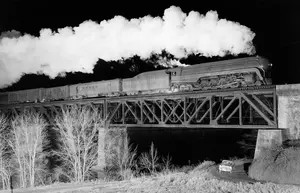
Roanoke built the last reciprocating steam locomotive an American common carrier put in service, and it built the last steam locomotive in the United States meant for road freight. The first of those is 0-8-0 No. 244, finished in December 1953. The second is class Y6b No. 2200, finished in April 1952. Between them, and behind them, is a coal railroad that designed its own power, roller-bearinged it, and then turned it in a lubritorium in 90 minutes or less. Regular road steam ended in the early hours of May 7, 1960, when class Y6b No. 2190 dropped its fire at Williamson, West Virginia.
The class grid is the roster of engines built since 1898 in George H. Drury’s Guide to North American Steam Locomotives, revised edition, pages 255–261. The quantity column totals 1,266.
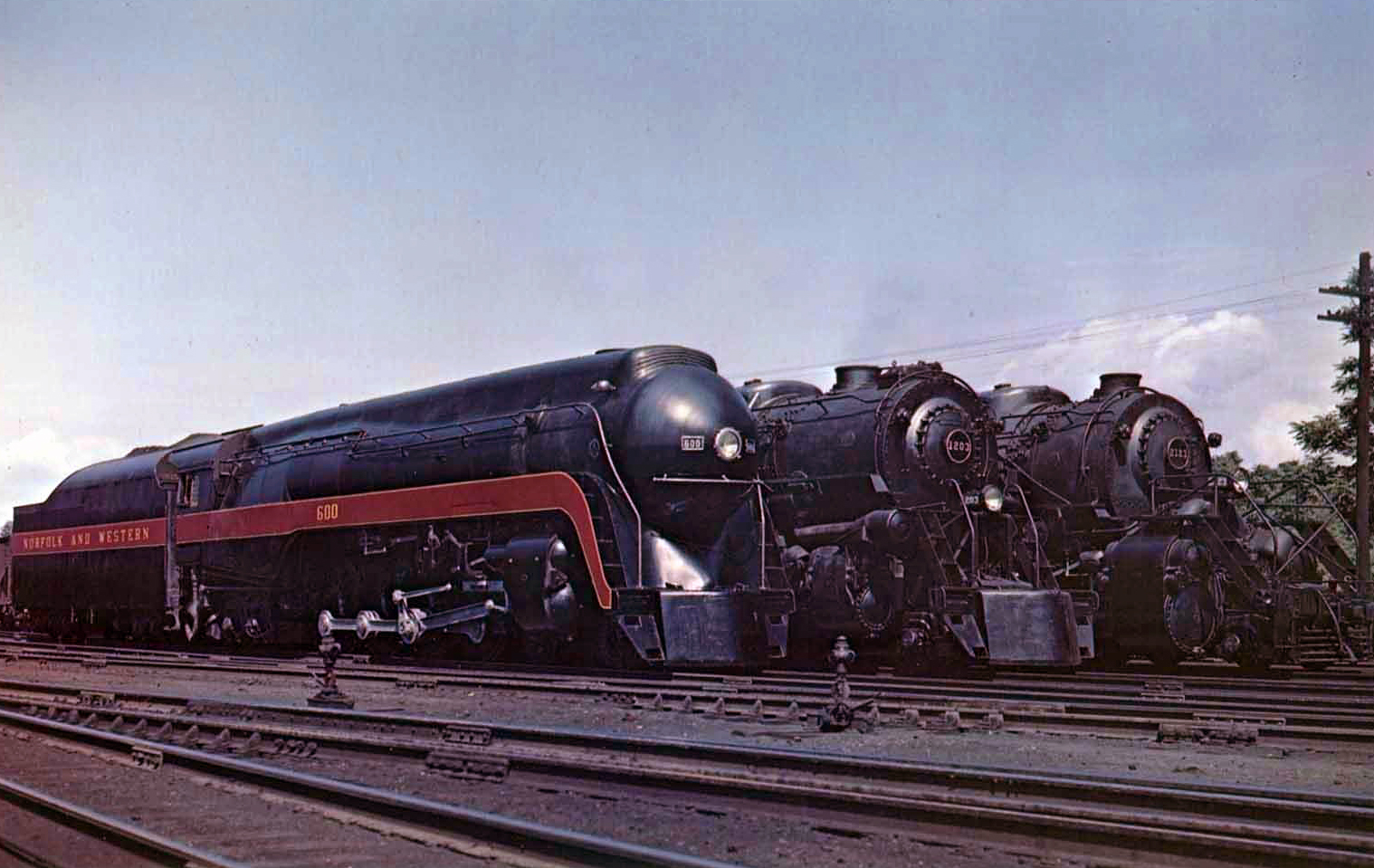
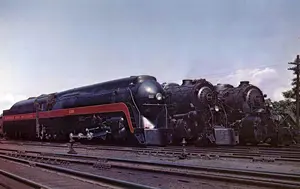
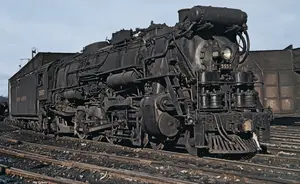
The pride of Roanoke. Norfolk & Western 4-8-4 No. 600 (J), 2-6-6-4 No. 1203 (A), and compound 2-8-8-2 No. 2133 (Y-6) at Shaffer’s Crossing, Roanoke, in 1945.
On this page: At a glance · Roanoke and the lubritorium · Switchers · Passenger power · Consolidations and Mastodons · Articulateds · A Shay and Jawn Henry · Roster built since 1898
At a glance
| Item | Detail |
|---|---|
| Railroad | Norfolk & Western. Mark NW. Company page: Norfolk & Western |
| This roster | Engines built since 1898, after Drury, pages 255–261. The quantity column totals 1,266 |
| Outside that total | One Lima Shay of 1907. Jawn Henry, No. 2300, class TE-1, May 1954. The Z-2, a 1928 rebuild of No. 1399, is listed with the Baldwin Z-1a it came from |
| Freight | 286 twelve-wheel Mastodons in class M. 287 Consolidations in classes W, W1, W2, and B. 190 compound Z 2-6-6-2s. 43 class A 2-6-6-4s. The Y 2-8-8-2s, from the five Y-1s of 1910 through 30 Y-6bs |
| Passenger | Fourteen class J 4-8-4s, five of them built streamlined in 1941–1942, six built in 1943 and streamlined later, three built in 1950. Forty-eight class K 4-8-2s. The E-class Pacifics |
| Last new road freight steam | Y6b No. 2200, Roanoke, April 1952 |
| Last reciprocating common-carrier steam | S1a No. 244, Roanoke, December 1953 |
| Last road steam | Y6b No. 2190, Williamson, West Virginia, May 7, 1960 |
| Preserved | J No. 611 and A No. 1218 at the Virginia Museum of Transportation. E2 No. 578 at the Ohio Railway Museum. Y3a No. 2050 at the Illinois Railway Museum. Y6a No. 2156 is preserved. No Z survives. No Y6b survives |
Roster follows Drury, Guide to North American Steam Locomotives (revised edition), pages 255–261, with the class Z counts aligned to the class page. Information compiled October 12, 2026.
A shop that started again in 1900
Roanoke built locomotives from 1883, stopped for about ten years, and started again in January 1900 with Consolidation No. 830. After 1930 the shop’s own designs, roller bearings, cast frames, and feedwater heaters, replaced what the commercial builders had been supplying. The last steam the railroad bought from a commercial builder was the Y3a of 1923, Richmond engines with Worthington BL heaters and slant-front cabs. Everything heavy after that, the Y-4 through the Y-6b, the class A, and the class J, was Roanoke’s.
The lubritoriums stood at Shaffer’s Crossing in Roanoke, at Bluefield, Williamson, and Portsmouth, with a modified one at Pulaski. A locomotive could be lubricated, inspected, and coaled for the next call in 90 minutes or less. Between May 1952 and April 1954 the shops also built 91 auxiliary water tenders, so a road engine could run past the plugs that had paced the older Mallets. The tenders stand outside the locomotive count.
Two families of 0-8-0, and one that was secondhand
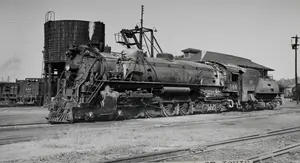
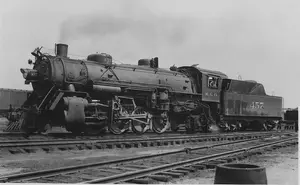
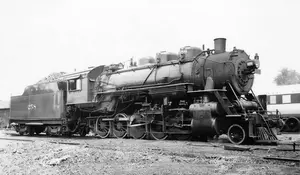
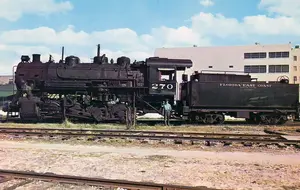
The big switcher of the last years was class S1a, Nos. 200–244, 45 engines built at Roanoke in 1951–1953. No. 244, outshopped in December 1953, was the last reciprocating steam locomotive built for common-carrier service on an American railroad. No. 218, in the photograph, is one of them. Class S1, Nos. 255–284, was a different group: 30 Chesapeake & Ohio 0-8-0s, built by Baldwin in 1948, bought in 1950, and left with their C&O numbers. Both classes were retired in 1958–1960. Five of the W1 Consolidations had earlier been rebuilt as 0-8-0 tank engines. They stay inside the W1 count.
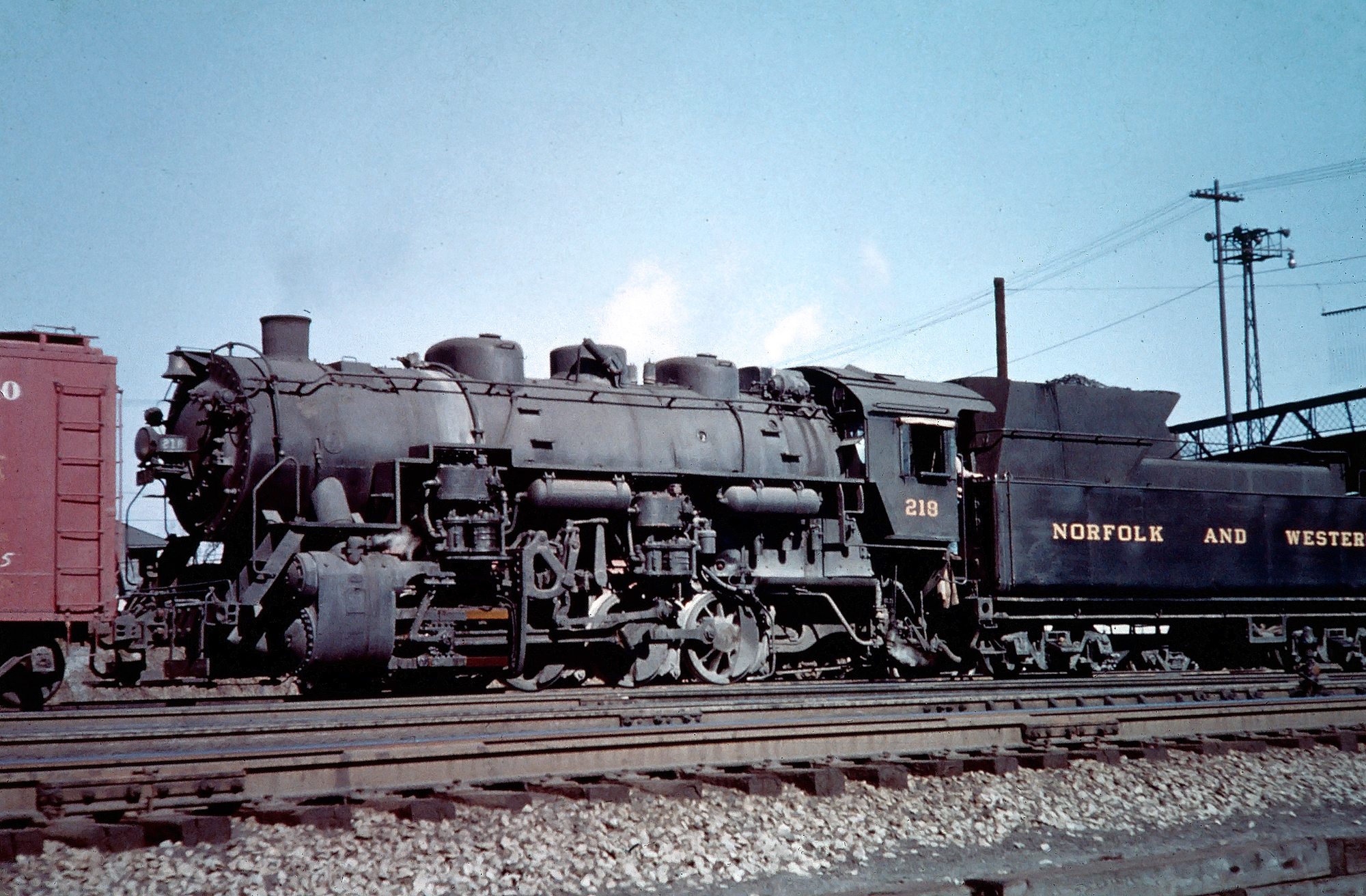
0-8-0 No. 218, class S1a, at work in Roanoke, Virginia, circa 1950. Fred Byerly photo. American-Rails.com collection.
From the E-class Pacific to the J
The modern passenger engine before the J was a Pacific. Class E, Nos. 595–599, five Richmond engines of 1905, came first. The E1, E2, E2a, and E2b followed, the last of them built at Roanoke in 1913–1914. E2 No. 578 is preserved at the Ohio Railway Museum. Class E2a, Nos. 553–563, is eleven engines, six from Baldwin and five from Roanoke, all in 1912. The E3s, Nos. 500–504, were Pennsylvania K3s, built by Baldwin in 1913 and bought in 1930. Their 80-inch drivers were the highest on the Norfolk & Western. After the Roanoke shop worked them over, the lead truck was arranged for right-hand running. They were retired in 1946–1947.
The Mountains are class K. K1, Nos. 100–115, sixteen engines, Roanoke, 1916–1917. K2, Nos. 116–125, ten Alco-Brooks copies of the USRA heavy 4-8-2, 1919. K2a, Nos. 126–137, twelve Baldwins of 1923. K3, Nos. 200–209, ten Roanoke engines of 1926, were sold in 1944–1945, six to the Richmond, Fredericksburg & Potomac and four to the Denver & Rio Grande Western. The specification card for the whole 4-8-2 family is the class K page.
The class J 4-8-4 is fourteen engines, and the numbers 600–613 had already been used by seven Baldwin 4-4-2s of 1903–1904, retired in 1931–1935. Roanoke built 600–604 in October 1941–January 1942, streamlined from the start. Nos. 605–610 were built in 1943 without shrouds, as class J1, and were streamlined in 1945–1947 and reclassed J. Nos. 611–613 followed in 1950. Drury’s figures for the streamlined engine are 70-inch drivers, safety valves set at 275 pounds (the boiler was designed for 300), a grate of 107.7 square feet, 73,300 pounds of tractive effort, and an engine weight of 494,000 pounds, on roller bearings. The unstreamlined 605–610 were built at 300 pounds and, once streamlined and reclassed, were rated at 80,000 pounds. The full card, and the later excursion life of No. 611, stay on the class J page and on No. 611. The City of Roanoke transferred 611, and class A No. 1218, to the Virginia Museum of Transportation on April 2, 2012. No. 1218 is not operational.
Consolidations first, then the twelve-wheelers
At the turn of the century the freight engine was a 2-8-0. Class W, Nos. 800–829, thirty Baldwins of 1898–1899, was retired in 1926–1934. Class W1 is Nos. 830–842 and 844–865, thirty-five engines, built by Roanoke, Baldwin, and Richmond in 1900–1901. No. 830 is the engine that reopened locomotive building at Roanoke in January 1900. Five of the W1s later became 0-8-0 tank engines. Class W2 is 212 engines, Nos. 673–799, No. 843, and Nos. 866–949, from Roanoke, Baldwin, Richmond, and Cooke, 1901–1905, retired across 1926–1952. Class B, Nos. 61–70, ten Baldwin cross-compounds of 1898–1904, were simpled in 1909–1912 and retired in 1933–1934.
The twelve-coupled freight engine, the N&W’s Mastodon, totals 286 locomotives, which is the figure Drury’s prose gives for the M classes together. Class M, Nos. 375–499, is 125, Richmond and Baldwin, 1906–1907. Class M1, Nos. 1000–1099, is 100, built in 1907. Class M2, Nos. 1100–1149, is 50 Baldwins of 1910. Roanoke then added M2a 1150–1152, M2b 1153–1154, and M2c 1155–1160, eleven engines in 1911–1912. The last of the M class was retired in 1958. M2 Nos. 1110 and 1112 were fitted as automatic switchers, in 1947 and 1948.
Z, A, and Y
The first articulateds were two experiments of 1910. Class X-1 was five Alco-Schenectady 0-8-8-0s, Nos. 990–994, Walschaerts engines finished as hump switchers and retired in 1934. Class Y-1 was five Baldwin 2-8-8-2s, Nos. 995–999, retired by 1924. The compound 2-6-6-2 that followed is class Z, 190 engines, Nos. 1300–1489. Z-1 is 1300–1314, fifteen Richmond engines with Walschaerts valve gear, in service in April and May 1912, retired in 1934. Z-1a is 1315–1489, 175 engines: Richmond 65 (1315–1379), Baldwin 40 (1380–1419, June–August 1914), and Schenectady 70 (1420–1489, 1915–1918). In the late 1920s and early 1930s, Roanoke converted 74 of them to class Z-1b, 17 Baldwin engines and 57 Alco engines, with piston valves in place of the low-pressure slide valves and a Worthington BL heater. The Z-2 is No. 1399 only, a Baldwin Z-1a rebuilt at Roanoke in 1928 with four simple cylinders, and retired about 1934. The last compound Z was retired in April 1958. None is preserved. The cylinders, weights, and works numbers are on the class Z page. Class A, the simple 2-6-6-4 that followed, was a new design.
Class A is 43 engines, Nos. 1200–1242, all Roanoke: 1200–1209 in 1936–1937, 1210–1224 in 1943, 1225–1234 in 1944, and 1235–1242 in 1949–1950. They took the time freights on the easier grades and, when assigned, a passenger train. No. 1218, built in 1943, is at the Virginia Museum of Transportation and is not operational. The card is the class A page. No. 1218 has its own page.
The compound 2-8-8-2 after the Y-1 is the Y the coal field knew. Y-2 Nos. 1700–1704, five Roanoke engines of 1918–1921, and Y-2 Nos. 1711–1730, twenty Baldwins of 1919, were later classed Y-2a. Y-2a Nos. 1705–1710, six Roanoke engines of 1924, were built with low-pressure cylinders a half-inch larger. That is 31 engines in the Y-2 line. The USRA Y-3 is fifty engines of 1919, forty-five from Schenectady (2000–2044) and five from Baldwin (2045–2049). In 1943 the Pennsylvania bought six of the Y-3s and reclassed them HH1. The Pennsylvania’s road numbers for those six stay on the Pennsylvania roster. Y-3 No. 2049 received a bridge-pipe front end in 1928, and 300 pounds became the boiler pressure the later classes were built to.
Y-3a Nos. 2050–2079, thirty Richmond engines of 1923, were the last steam locomotives the Norfolk & Western bought from a commercial builder. No. 2050 is at the Illinois Railway Museum. Y-3b Nos. 2080–2089, ten Richmond engines of 1927, were reclassed Y-4 and retired in 1958. Y-4 Nos. 2090–2109, twenty Roanoke engines of 1930–1932, were later classed Y-5. No. 2092 was wrecked in 1937. In 1940–1941 the nineteen survivors received roller bearings and one-piece cast frames, and engines from the 2090–2100 group were renumbered 2110–2119. The Y-6, Nos. 2120–2154, is thirty-five Roanoke engines of 1936–1940. The 1940–1941 rebuilding is what brought the earlier Y-4 and Y-5 frames up to the power. Y-6a Nos. 2155–2170, sixteen engines, followed in 1942. No. 2156 is preserved.
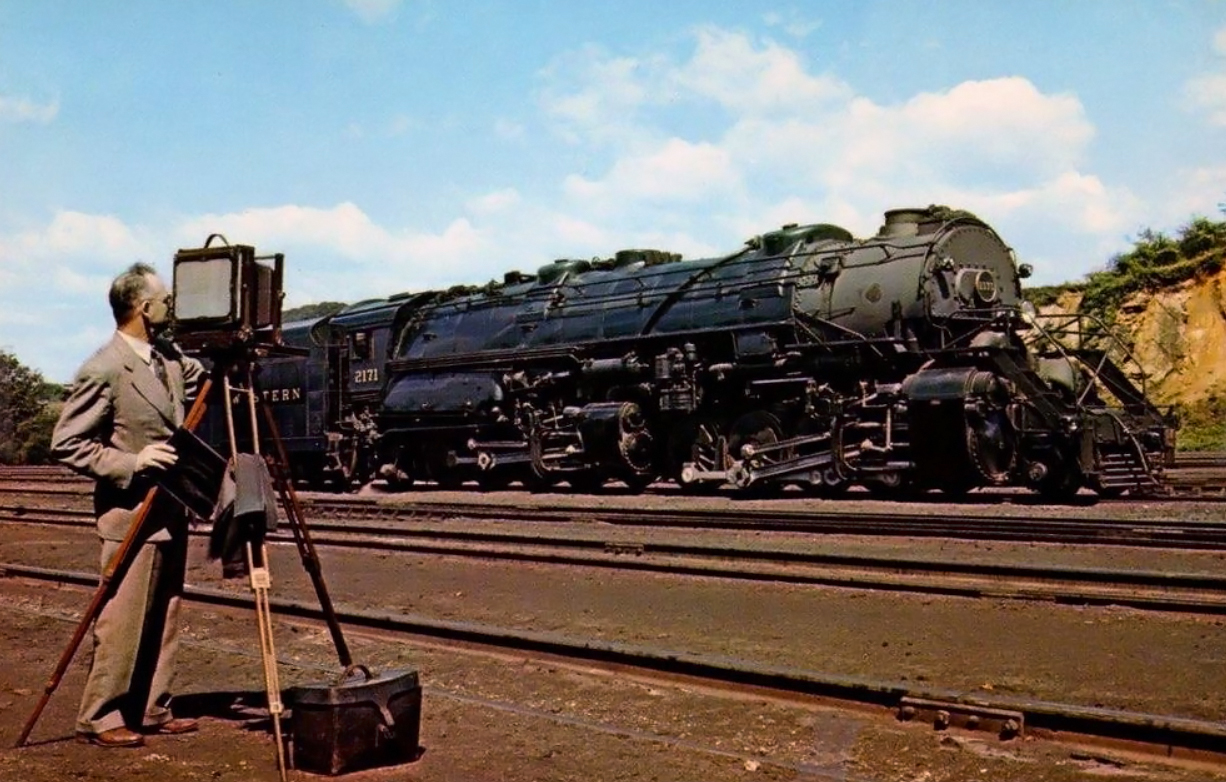
Photographing the photographer. Newly completed 2-8-8-2 No. 2171, class Y-6b, circa 1948. These were the last of the big compounds, built at the Roanoke Shops.
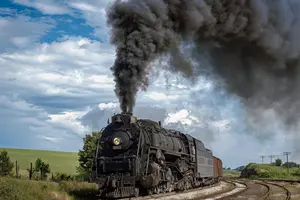
The Y-6b is thirty engines: 2171–2187 in 1948–1949, 2188–2194 in 1950–1951, and 2195–2200 in 1951–1952. They carried Worthington SA feedwater heaters, one-piece cast-steel frames, roller bearings, multiple front-end throttles, and a slanted smokebox door arranged for the superheater header. No. 2200, completed in April 1952, was the last steam locomotive built in the United States for road freight service. No. 2190, on a mine run out of Williamson, was the last road engine in regular service. The fire was dropped in the early hours of May 7, 1960. Link wrote that the boiler cooled that day. No Y-6b is preserved. The class narrative and the earlier specification cards are on the class Y page.
One geared engine, and a turbine scrapped in 1957
In August 1907 Lima delivered a 150-ton, four-truck Shay for the mine branches near Bluestone, West Virginia. It later went to the El Paso & Southwestern. The road number is unrecorded in this roster. The type is the Shay page. In May 1954 Baldwin-Westinghouse delivered No. 2300, class TE-1, the steam turbine-electric the railroad named Jawn Henry. A Babcock & Wilcox water-tube boiler worked at 600 pounds. The engine put 818,000 pounds on the drivers, was rated at 4,500 horsepower, and on test produced 199,000 pounds of tractive effort at one mile an hour. It was scrapped in December 1957. The full account is the Jawn Henry page. Both stand outside the 1,266.
Norfolk & Western steam locomotives built since 1898
| Type | Class | Numbers | Qty | Builder | Built | Retired | Notes |
|---|---|---|---|---|---|---|---|
| 0-8-0 | S1 | 255–284 | 30 | Baldwin | 1948 | 1958–1960 | Ex-Chesapeake & Ohio, acquired 1950, numbers kept |
| 0-8-0 | S1a | 200–244 | 45 | Roanoke | 1951–1953 | 1958–1960 | No. 244, December 1953, last reciprocating common-carrier steam built for an American railroad. No. 218 is one of these |
| 4-4-2 | J | 600–606 | 7 | Baldwin | 1903–1904 | 1931–1935 | Numbers later reused by the 4-8-4 |
| 4-6-0 | V | 950–961 | 12 | Baldwin | 1900 | 1929–1948 | |
| 4-6-0 | V1 | 962–966 | 5 | Richmond | 1902 | 1929–1933 | |
| 4-6-0 | A | 86–90 | 5 | Baldwin | 1902–1904 | 1928 | |
| 4-6-2 | E | 595–599 | 5 | Richmond | 1905 | 1934–1939 | |
| 4-6-2 | E1 | 580–594 | 15 | Baldwin | 1907 | 1931–1938 | |
| 4-6-2 | E2 | 564–579 | 16 | Richmond | 1910 | 1938–1958 | Superheated. No. 578 is at the Ohio Railway Museum |
| 4-6-2 | E2a | 553–563 | 11 | Baldwin, Roanoke | 1912 | 1940–1958 | Baldwin built six, Roanoke five |
| 4-6-2 | E2b | 543–552 | 10 | Roanoke | 1913–1914 | 1938–1955 | |
| 4-6-2 | E3 | 500–504 | 5 | Baldwin | 1913 | 1946–1947 | Built for the Pennsylvania as class K3s. Bought 1930. 80-inch drivers. Right-hand lead truck after shop work |
| 4-8-2 | K1 | 100–115 | 16 | Roanoke | 1916–1917 | 1957–1958 | |
| 4-8-2 | K2 | 116–125 | 10 | Alco-Brooks | 1919 | 1957–1959 | USRA heavy 4-8-2 |
| 4-8-2 | K2a | 126–137 | 12 | Baldwin | 1923 | 1958–1959 | |
| 4-8-2 | K3 | 200–209 | 10 | Roanoke | 1926 | 1944–1945 | Sold. Six to the RF&P, four to the Denver & Rio Grande Western |
| 4-8-4 | J | 600–604 | 5 | Roanoke | 1941–1942 | 1958–1959 | Streamlined as built. October 1941–January 1942 |
| 4-8-4 | J1 | 605–610 | 6 | Roanoke | 1943 | 1959 | Built without shrouds. Streamlined 1945–1947 and reclassed J |
| 4-8-4 | J | 611–613 | 3 | Roanoke | 1950 | 1959 | Streamlined. No. 611 is at the Virginia Museum of Transportation |
| 2-8-0 | W | 800–829 | 30 | Baldwin | 1898–1899 | 1926–1934 | |
| 2-8-0 | W1 | 830–842, 844–865 | 35 | Roanoke, Baldwin, Richmond | 1900–1901 | 1926–1934 | No. 830 reopened locomotive building at Roanoke, January 1900. Five later became 0-8-0Ts |
| 2-8-0 | W2 | 673–799, 843, 866–949 | 212 | Roanoke, Baldwin, Richmond, Cooke | 1901–1905 | 1926–1952 | |
| 2-8-0 | B | 61–70 | 10 | Baldwin | 1898–1904 | 1933–1934 | Cross-compounds, simpled 1909–1912 |
| 4-8-0 | M | 375–499 | 125 | Richmond, Baldwin | 1906–1907 | 1926–1958 | |
| 4-8-0 | M1 | 1000–1099 | 100 | Richmond, Baldwin | 1907 | 1926–1947 | |
| 4-8-0 | M2 | 1100–1149 | 50 | Baldwin | 1910 | 1950–1957 | Nos. 1110 and 1112 fitted as automatic switchers, 1947 and 1948 |
| 4-8-0 | M2a | 1150–1152 | 3 | Roanoke | 1911 | 1950–1956 | |
| 4-8-0 | M2b | 1153–1154 | 2 | Roanoke | 1911 | 1950–1956 | |
| 4-8-0 | M2c | 1155–1160 | 6 | Roanoke | 1911–1912 | 1952–1957 | |
| 0-8-8-0 | X1 | 990–994 | 5 | Schenectady | 1910 | 1934 | Walschaerts. Finished as hump switchers |
| 2-6-6-2 | Z1 | 1300–1314 | 15 | Richmond | 1912 | 1934 | Walschaerts. In service April–May 1912 |
| 2-6-6-2 | Z1a | 1315–1379 | 65 | Richmond | 1912–1913 | 1934–1958 | Baker valve gear. Part of the 175 Z-1a engines |
| 2-6-6-2 | Z1a | 1380–1419 | 40 | Baldwin | 1914 | 1934–1958 | June–August 1914. No. 1399 rebuilt at Roanoke in 1928 as the Z-2 |
| 2-6-6-2 | Z1a | 1420–1489 | 70 | Schenectady | 1915–1918 | 1934–1958 | |
| 2-6-6-2 | Z1b | 74 conversions | Roanoke | late 1920s–early 1930s | 17 Baldwin and 57 Alco engines, from the Z-1a. Piston valves and a Worthington BL heater. A conversion. Last Z retirement, April 1958. None preserved | ||
| 2-6-6-2 | Z2 | 1399 | Roanoke | 1928 | about 1934 | Rebuilt from Baldwin Z-1a 1399. Four simple cylinders. Already inside the Baldwin Z-1a count | |
| 2-6-6-4 | A | 1200–1209 | 10 | Roanoke | 1936–1937 | 1958–1959 | Simple cylinders |
| 2-6-6-4 | A | 1210–1224 | 15 | Roanoke | 1943 | 1959–1961 | No. 1218 is at the Virginia Museum of Transportation and is not operational |
| 2-6-6-4 | A | 1225–1234 | 10 | Roanoke | 1944 | 1958–1959 | |
| 2-6-6-4 | A | 1235–1242 | 8 | Roanoke | 1949–1950 | 1958–1959 | |
| 2-8-8-2 | Y1 | 995–999 | 5 | Baldwin | 1910 | 1924 | Retired by 1924 |
| 2-8-8-2 | Y2 | 1700–1704 | 5 | Roanoke | 1918–1921 | 1946–1951 | Later classed Y2a |
| 2-8-8-2 | Y2a | 1705–1710 | 6 | Roanoke | 1924 | 1948–1949 | Low-pressure cylinders a half-inch larger than the Y2 |
| 2-8-8-2 | Y2 | 1711–1730 | 20 | Baldwin | 1919 | 1948–1951 | Later classed Y2a |
| 2-8-8-2 | Y3 | 2000–2044 | 45 | Schenectady | 1919 | 1957–1958 | USRA. Six Y3s, from this class, went to the Pennsylvania in 1943 and were reclassed HH1 |
| 2-8-8-2 | Y3 | 2045–2049 | 5 | Baldwin | 1919 | 1957–1958 | USRA. No. 2049 received a bridge-pipe front end in 1928 |
| 2-8-8-2 | Y3a | 2050–2079 | 30 | Richmond | 1923 | 1958–1959 | Worthington BL heaters, slant-front cabs. Last steam bought from a commercial builder. No. 2050 is at the Illinois Railway Museum |
| 2-8-8-2 | Y3b | 2080–2089 | 10 | Richmond | 1927 | 1958 | Reclassed Y4 |
| 2-8-8-2 | Y4 | 2090–2109 | 20 | Roanoke | 1930–1932 | 1958–1960 | Later classed Y5. No. 2092 wrecked in 1937. In 1940–1941 the 19 survivors received roller bearings and one-piece cast frames. Engines from 2090–2100 were renumbered 2110–2119 |
| 2-8-8-2 | Y6 | 2120–2154 | 35 | Roanoke | 1936–1940 | 1958–1960 | |
| 2-8-8-2 | Y6a | 2155–2170 | 16 | Roanoke | 1942 | 1958–1960 | No. 2156 is preserved |
| 2-8-8-2 | Y6b | 2171–2187 | 17 | Roanoke | 1948–1949 | 1959–1960 | Worthington SA heater, cast-steel frame, roller bearings |
| 2-8-8-2 | Y6b | 2188–2194 | 7 | Roanoke | 1950–1951 | 1959–1960 | |
| 2-8-8-2 | Y6b | 2195–2200 | 6 | Roanoke | 1951–1952 | 1959–1960 | No. 2200, April 1952, last U.S. steam locomotive built for road freight. No. 2190 dropped its fire on May 7, 1960 |
Outside the 1,266
| Type | Class | Numbers | Qty | Builder | Built | Retired | Notes |
|---|---|---|---|---|---|---|---|
| Shay | 1 | Lima | August 1907 | 150-ton, four-truck. Mine branches near Bluestone, West Virginia. Later El Paso & Southwestern. Road number not recorded here | |||
| Steam turbine-electric | TE-1 | 2300 | 1 | Baldwin-Westinghouse | May 1954 | December 1957 | Jawn Henry. Babcock & Wilcox water-tube boiler at 600 psi. 818,000 lb on drivers. Rated 4,500 hp. Test tractive effort 199,000 lb at 1 mph. Scrapped |
Related reading
- Norfolk & Western · Norfolk & Western diesel roster
- Class J · Class A · Class Y · Class Z · Class K
- No. 611 · No. 1218 · Jawn Henry · Shay locomotives
- Virginia Museum of Transportation · United States Railroad Administration
Sources
- George H. Drury, Guide to North American Steam Locomotives, revised edition, pages 255–261. The class grid, the lubritorium in 90 minutes or less, the grades, the Y-6b appliances, the J figures used above, No. 2200 in April 1952, and No. 244 in December 1953
- Class Z page, for the 190 compounds, the builder split of the Z-1a (Richmond 65, Baldwin 40, Schenectady 70), the 74 Z-1b conversions, and Z-2 No. 1399, rebuilt at Roanoke in 1928 and retired about 1934. The works numbers stay on that page. Ron Rosenberg, Norfolk & Western Steam (The Last 25 Years), for the Y-2 line of 31 and for the Y-6 reading of Nos. 2120–2154
- Norfolk & Western Historical Society account of May 7, 1960, and O. Winston Link’s note that the boiler of Y6b 2190 cooled that day
- City of Roanoke, transfer of Nos. 611 and 1218 to the Virginia Museum of Transportation, April 2, 2012
Recent Articles


-
Norfolk & Western Diesel Roster (All-Time)
Oct 12, 26 11:59 PM
 Norfolk & Western diesel roster, all-time. 1,464 locomotives built new for the railroad, from the 1955 GP9s and RS-3s through the C36-7s, plus the merger fleets.
 -
Norfolk & Western Steam Roster (Post 1900)
Oct 12, 26 11:52 PM
 Norfolk & Western steam since 1898. The Roanoke grid: 1,266 locomotives, the J, the A, and the Y, and the last road steam on May 7, 1960.
 -
Norfolk & Western Railway: Map, Logo, Rosters, History
Oct 12, 26 11:45 PM
 The Norfolk & Western, from the City Point Railroad of 1838 to Norfolk Southern. Pocahontas coal, Roanoke steam, and the 1964 expansion.
 -
Louisiana Railroad Museums (2026): A Complete Guide
Oct 12, 26 11:24 PM
 Louisiana railroad museums—the DeQuincy depot, the Long Leaf sawmill, Jackson’s model railroad, and Southern Pacific 745. Confirm hours on each site.
 -
Michigan Railroad Museums (2026): A Complete Guide
Oct 12, 26 11:14 PM
 Michigan railroad museums—Pere Marquette 1225 at Owosso, Durand Union Station, The Henry Ford, and the Mount Clemens depot. Confirm hours on each site.
 -
Mississippi Railroad Museums (2026): A Complete Guide
Oct 12, 26 10:52 PM
 Mississippi railroad museums—McComb’s rebuilt Illinois Central depot and Illinois Central 2542, and the Casey Jones museum at Water Valley. Confirm hours on each site.
 -
The "E2b": PRR's Experimental Freight Electrics
Oct 12, 26 10:33 PM
 PRR class E2b: six GE B-B freight electrics, 4939–4944, 2,500 hp, 11 kV AC. Specifications, roster, and the 1964 scrap.
 -
Alaska Railroad Museums (2026): A Complete Guide
Oct 12, 26 10:10 PM
 Alaska railroad museums—the Museum of Alaska in Wasilla, Tanana Valley No. 1 at Pioneer Park, and the Engine 557 shop. Confirm hours on each site.
 -
Western and Atlantic Railroad: Map, History, Timetables
Oct 12, 26 09:55 PM
 The Western & Atlantic Railroad of the State of Georgia, authorized December 21, 1836, from Atlanta to Chattanooga. The state still owns the 137.33-mile line. CSX leases it. The through railroad opene…
 -
Nashville, Chattanooga & St. Louis Steam Roster (Post 1900)
Oct 12, 26 09:52 PM
 Nashville, Chattanooga & St. Louis steam since 1900. Drury's class grid: Consolidations, 51 Mikados, three 2-8-8-2s, Pacifics, and 25 4-8-4s. Last steam was January 4, 1953.
 -
Nashville, Chattanooga & St. Louis Diesel Roster (All-Time)
Oct 12, 26 09:27 PM
 Nashville, Chattanooga & St. Louis diesel roster, all-time. Switchers from 1941, 37 GP7s, and the F3s and F7s. The quantity column totals 132 locomotives.
 -
Nashville, Chattanooga and St. Louis Railway: Map, History, Logo
Oct 12, 26 08:41 PM
 The Nashville, Chattanooga & St. Louis, the Dixie Line. Charter of December 11, 1845, the Cumberland tunnel, and the Louisville & Nashville merger of August 30, 1957.
 -
Idaho Railroad Museums (2026): A Complete Guide
Oct 12, 26 02:44 PM
 Idaho railroad museums—Nampa’s 1903 depot, Wallace’s Northern Pacific depot, and Boise’s 1925 Union Pacific depot. Confirm hours on each site.
 -
Hawaii Railroad Museums (2026): A Complete Guide
Oct 12, 26 12:50 PM
Hawaii railroad museums—the Hawaiian Railway Society at Ewa Beach and the Laupahoehoe Train Museum on the Big Island. Confirm hours on each site. -
Marietta and Cincinnati Railroad: Map, History, Timetable
Oct 12, 26 11:44 AM
 Marietta and Cincinnati Railroad, chartered March 8, 1845 as the Belpre & Cincinnati. Opened in April 1857, sold under foreclosure December 9, 1882, and succeeded by the Baltimore & Ohio Southwestern…
 -
Tennessee Railroad Museums (2026): A Complete Guide
Oct 12, 26 11:39 AM
 Tennessee railroad museums—TVRM and Southern 4501 in Chattanooga, the Tennessee Central museum in Nashville, Casey Jones in Jackson, and the depots at Cookeville, Cowan, and Townsend.
 -
Virginia Railroad Museums (2026): A Complete Guide
Oct 12, 26 09:40 AM
 Virginia railroad museums—Roanoke’s Virginia Museum of Transportation and the O. Winston Link Museum, the C&O center at Clifton Forge, and the depots in Richmond, Fairfax Station, Suffolk, Parksley, a…
 -
Louisville & Nashville Diesel Roster (All-Time)
Oct 12, 26 12:15 AM
 Louisville & Nashville diesel roster, all-time. Switchers from 1939, the cab units, and EMD, Alco, and GE hoods through the SD50s. The quantity column totals 1948 locomotives, plus 29 yard slugs.
 -
Louisville & Nashville Steam Roster (Post 1900)
Oct 11, 26 05:44 PM
Louisville & Nashville steam since 1900. Drury's class grid: Consolidations, 165 heavy Mikados, 42 Big Emma 2-8-4s, Pacifics, and 22 Mountains. Last steam January 1957. -
Louisville and Nashville Railroad: Map, Rosters, History
Oct 11, 26 05:39 PM
 Louisville & Nashville, the Old Reliable. Charter of March 5, 1850, Milton H. Smith, the 921-mile main line, Big Emma, and the December 29, 1982 merger. Steam and diesel rosters are companion pages.
 -
Oregon Railroad Museums (2026): A Complete Guide
Oct 11, 26 05:19 PM
 Oregon railroad museums—the Oregon Rail Heritage Center, Brooks trolleys, Canby’s 1891 depot, Medford’s Willamette, and Train Mountain. Confirm hours on each site.
 -
Texas Railroad Museums (2026): A Complete Guide
Oct 11, 26 05:15 PM
 Texas railroad museums—Frisco’s Big Boy 4018, Galveston’s Santa Fe depot, Temple’s 1911 station, Plano’s interurban, and Fort Worth & Denver 304. Confirm hours on each site.
 -
Wisconsin Railroad Museums (2026): A Complete Guide
Oct 10, 26 11:51 PM
Wisconsin railroad museums—Green Bay’s Big Boy 4017 and Eisenhower’s A4, Mid-Continent at North Freedom, East Troy’s interurban, and the Riverside & Great Northern. Confirm hours on each site. -
Interstate Railroad (Virginia): Map, Roster, Logo, History
Oct 10, 26 11:22 PM
 Interstate Railroad, a Virginia coal road chartered February 18, 1896. Andover shops. Ten Alco RS3s, 30–39. Southern control in 1961. The company ended October 31, 1985.
 -
North Carolina Railroad Museums (2026): A Complete Guide
Oct 10, 26 11:16 PM
North Carolina railroad museums—Spencer Shops, Wilmington’s Atlantic Coast Line 250, Hamlet’s Seaboard depot, and the New Hope Valley Railway. Confirm hours on each site. -
New Mexico Railroad Museums (2026): A Complete Guide
Oct 10, 26 10:54 PM
 New Mexico railroad museums—Santa Fe 2926 in Albuquerque, the Clovis depot, Alamogordo’s Toy Train Depot, and Belen. Confirm hours on each site.
 -
New York Railroad Museums (2026): A Complete Guide
Oct 10, 26 09:33 PM
 New York railroad museums—Phoenicia, Medina’s New York Central freight house, the Transit Museum, Long Island 35 and 39, and GG1 4933. Confirm hours on each site.
 -
Columbia, Newberry & Laurens Railroad: History, Timetable, Roster
Oct 10, 26 09:08 PM
 Columbia, Newberry & Laurens Railroad, Columbia to Laurens, 75 miles. Chartered in 1885. Five Atlantic Coast Line GP7s, 100–104. Merged into the Seaboard System on April 30, 1984.
 -
New Haven Diesel Roster (All-Time)
Oct 10, 26 06:35 PM
 New Haven diesel roster, all-time. 558 road numbers: 60 DL-109s, 30 FA-1s, 27 PA-1s, 60 FL9s, and the switchers from HH600 0900. Serials and order numbers.
 -
New Haven Steam Roster (Post 1900)
Oct 10, 26 06:31 PM
 New Haven steam since 1900. Drury's class grid: 226 Moguls, 33 Mikados, 50 Santa Fes, 70 Mountains, 141 Pacifics, and 10 Hudsons. Last fan trip July 19, 1953.
 -
New Haven Railroad: Rosters, Map, Logo, History, Trains
Oct 10, 26 06:26 PM
 New York, New Haven and Hartford. The Shore Line, Hell Gate, the 1952 map at 1,838.89 miles, and the railroad Penn Central took at 11:59:59 p.m. on December 31, 1968.
 -
C&O's 4-6-4 "Hudson" Locomotives (Class L): Specs, Roster, History
Oct 10, 26 05:36 PM
 Chesapeake & Ohio Class L 4-6-4 Hudsons. Eight L-2s, five L-1 rebuilds, five L-2-As. Specs, Baldwin works numbers, and the roster. No. 490 survives.
 -
Alton Railroad: Map, History, Timetables
Oct 09, 26 10:31 PM
 Alton Railroad, chartered February 27, 1847 as the Alton & Sangamon. Chicago, St. Louis, and Kansas City, the 1937 Official Guide, and the May 31, 1947 merger into the Gulf, Mobile & Ohio.
 -
Mobile & Ohio Steam Roster (Post 1900)
Oct 09, 26 12:26 PM
 Mobile & Ohio steam since 1900. Drury's class grid: 48 six-wheel switchers, 107 Ten-Wheelers, 15 Consolidations, 58 Mikados, and 14 Pacifics. Last revenue steam October 7, 1949.
 -
Mobile & Ohio Railroad: History, Map, Timetable
Oct 09, 26 11:31 AM
 Mobile & Ohio Railroad, chartered in 1848. Columbus on April 22, 1861, the Cairo & St. Louis, the March 1940 Official Guide, and the September 13, 1940 merger into the Gulf, Mobile & Ohio.
 -
Gulf, Mobile & Northern Steam Roster (Post 1900)
Oct 09, 26 10:42 AM
 Gulf, Mobile & Northern steam since 1900. Drury's class grid: Ten-Wheelers, Mikados, Russian Decapods, Pacifics 425 and 426, and three light 4-8-2s. Last revenue steam October 7, 1949.
 -
Gulf, Mobile & Ohio Diesel Roster (All-Time)
Oct 09, 26 10:41 AM
 Gulf, Mobile & Ohio diesel roster, all-time. The 1935 boxcab, DL-107s, 55 FA-1s, F3s and F7s, the Ingalls 4-S, GP30s through GP38-2s, and 21 SD40s. Serials and order numbers.
 -
Gulf, Mobile & Northern Railroad: History, Rebel Route
Oct 09, 26 10:36 AM
 Gulf, Mobile & Northern, from the 1890 Mobile, Jackson & Kansas City to the Rebel and the September 13, 1940 merger into the Gulf, Mobile & Ohio. Steam roster is the companion page.
 -
Gulf, Mobile & Ohio Railroad: Map, Photos, Trains, History
Oct 08, 26 11:48 PM
 Gulf, Mobile & Ohio, chartered in 1938 and merged September 13, 1940. The Mobile & Ohio, the Alton on May 31, 1947, the Rebel Route, and Illinois Central Gulf on August 10, 1972.
 -
New Jersey Railroad Museums (2026): A Complete Guide
Oct 08, 26 11:37 PM
 New Jersey railroad museums—Whippany, Maywood, Pine Creek, Mahwah’s Erie depot, Phillipsburg, and Boonton. Confirm hours on each site.
 -
New Hampshire Railroad Museums (2026): A Complete Guide
Oct 08, 26 11:34 PM
 New Hampshire railroad museums—North Conway, the Flying Yankee, Ashland, Gorham, Raymond, and Sandown. Confirm hours on each site.
 -
Missouri Railroad Museums (2026): A Complete Guide
Oct 08, 26 11:00 PM
 Missouri railroad museums—the National Museum of Transportation, Patee House, Frisco 4524, the Chicago & Alton depot, and Marceline. Confirm hours on each site.
 -
Milwaukee Road X3800: Deer Lodge’s Shop Goat
Oct 08, 26 04:28 PM
 Milwaukee Road X3800, the a home-built shop goat that served the Deer Lodge, MT yard. It was a 220-volt DC switcher, powered through an extension cord that moved electrics into a roundhouse where the…
 -
Key West Extension (Overseas Railroad): History, Construction, Decline
Oct 08, 26 03:59 PM
 Henry Flagler's Overseas Railroad, Miami to Key West, 1905–1935. The Seven Mile Bridge, the 1935 Labor Day Hurricane, and the road that became U.S. 1.
 -
Florida East Coast Steam Roster (Post 1900)
Oct 08, 26 02:34 PM
 Florida East Coast steam since 1897. Seventeen Ten-Wheelers, twenty Atlantics, eighty-seven Pacifics, ninety Mountains, fifteen Mikados, and the switchers.
 -
Florida East Coast Diesel Roster (All-Time)
Oct 08, 26 02:12 PM
 Florida East Coast diesel roster, all-time. E units from 1939, F3s, BL2s, GP7s and GP9s, the GP40-2 orders, 22 SD40-2s, and 24 ES44C4s. Serials and EMD order numbers.
 -
Florida East Coast Railway: Map, History, Rosters
Oct 08, 26 01:46 PM
 Florida East Coast Railway, Henry Flagler's line from Jacksonville to Miami and Key West. Receivership in 1931, the 1963 strike, Grupo México in 2017, and Brightline on the same track.
 -
Minnesota Railroad Museums (2026): A Complete Guide
Oct 08, 26 10:32 AM
Minnesota railroad museums—the Lake Superior Railroad Museum, Two Harbors, Jackson Street, Willmar’s Great Northern 2523, and Currie. Confirm hours on each site. -
Maine Railroad Museums (2026): A Complete Guide
Oct 08, 26 09:24 AM
 Maine railroad museums—Seashore Trolley, the two-foot lines at Portland, Alna, and Phillips, Boothbay, and the Bangor & Aroostook depots. Confirm hours on each site.
 -
Massachusetts Railroad Museums (2026): A Complete Guide
Oct 08, 26 12:08 AM
 Massachusetts railroad museums—Berkshire Scenic at Lenox, Shelburne Falls trolley No. 10, Edaville, Chatham’s 1887 depot, and Lowell. Confirm hours on each site.