Marietta and Cincinnati Railroad: Map, History, Timetable
Last revised: October 12, 2026
By: Adam Burns
The Marietta and Cincinnati was the southern Ohio railroad that brought the Baltimore & Ohio from the Ohio River at Belpre and Marietta to Cincinnati. The legislature chartered it on March 8, 1845, as the Belpre & Cincinnati, to build from Harmar, or from a point on the Ohio opposite Parkersburg, by way of Athens and Chillicothe, to the Little Miami Railroad near Cincinnati. An act of March 20, 1851, changed the name. A train from Athens reached Marietta on April 9, 1857. Through service, using the Little Miami from Loveland into Cincinnati, was in operation on April 20.
At the receivership of 1858 the company had built 157 miles from Loveland to Marietta. It was reorganized on July 31, 1860, added the Hillsboro and Portsmouth branches, and on June 30, 1875, operated 311.86 miles. John King, Jr., of Baltimore, was president that year, and Robert Garrett sat on the board. The road was sold under foreclosure on December 9, 1882. The buyers adopted the name Cincinnati, Washington & Baltimore on February 7, 1883. The Baltimore & Ohio Southwestern Railroad Company was incorporated on December 20, 1889. The map below is the Official Guide sheet from the October, 1881 edition featuring the Marietta and Cincinnati Railway and its connections.
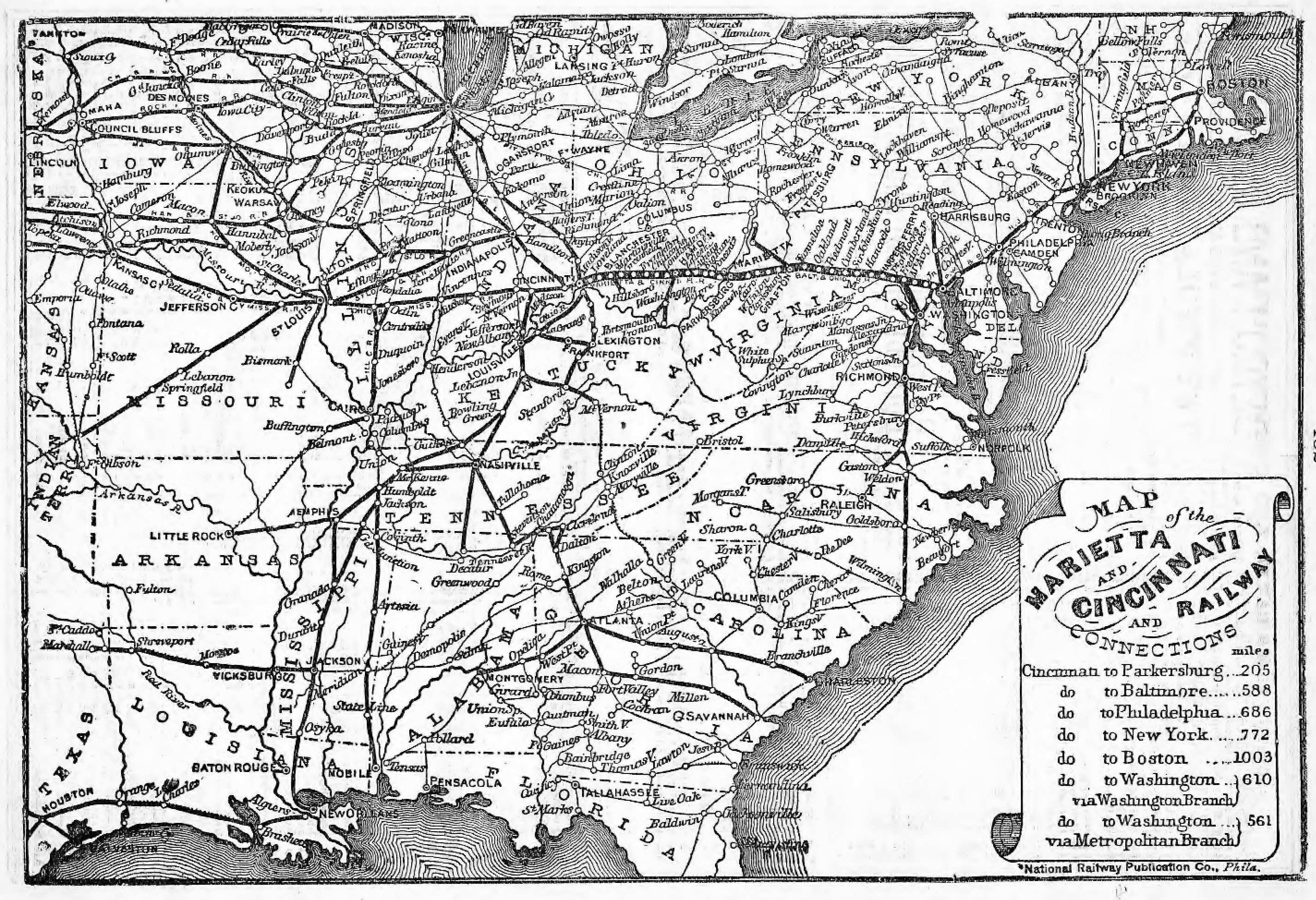
Map of the Marietta and Cincinnati Railway and Connections, National Railway Publication Company, Philadelphia, the companion sheet to the Official Guide card dated to June 12, 1881. The heavy line runs from the seaboard through Baltimore and Parkersburg to Cincinnati and on toward St. Louis. The cartouche advertises Cincinnati to Parkersburg 205 miles, Baltimore 588, Philadelphia 686, New York 772, Boston 1,003, Washington 610 by the Washington Branch and 561 by the Metropolitan Branch.
On this page: At a glance · Belpre & Cincinnati · Opening the line · The reorganization of 1860 · Hillsboro and Portsmouth · Union Branch and the bridge · Cincinnati · The Short Line · The railroad in 1875 · Timetable of June 12, 1881 · Sale and the Southwestern · What is left
At a glance
| Item | Detail |
|---|---|
| Railroad | Belpre & Cincinnati, 1845. Marietta and Cincinnati from 1851. Reorganized July 31, 1860 |
| Charter | March 8, 1845. Harmar, or opposite Parkersburg, via Athens and Chillicothe, to the Little Miami near Cincinnati |
| Name | March 20, 1851, once the subscriptions named in the act had been taken |
| Opened | April 9, 1857, Athens to Marietta. April 20, 1857, through service by the Little Miami from Loveland |
| Built by 1858 | 157 miles, Loveland to Marietta |
| Eastern connection | Northwestern Virginia, the Baltimore & Ohio's Parkersburg Branch, May 1, 1857. Parkersburg Bridge, January 7, 1871, 7,140 feet |
| Operated, June 30, 1875 | 311.86 miles. Cincinnati to Belpre 192.55. Gauge 4 feet 8½ inches. 74 locomotives |
| Branches | Hillsboro, 21 miles, from Blanchester. Portsmouth to Hamden, 56 miles |
| Cincinnati entrance | Cincinnati & Baltimore, 5.60 miles, double track, leased June 1, 1872 |
| Officers | 1875: John King, Jr., of Baltimore, president. Robert Garrett, a director. June 12, 1881: King, receiver. John Waddle, president |
| Sale | December 9, 1882. Cincinnati, Washington & Baltimore, February 7, 1883 |
| Southwestern | Incorporated December 20, 1889. Operation from January 1, 1890 |
| Today | Belpre Industrial Parkersburg Railroad on the CSX Marietta Subdivision, including the Parkersburg Bridge. Moonville Rail-Trail on the old grade from Zaleski to Mineral |
Belpre & Cincinnati
On March 8, 1845, the Ohio legislature chartered the Belpre and Cincinnati Railroad Company, 43 Ohio Laws 280. The charter authorized a double-track railroad from a point on the Ohio opposite Parkersburg, then still in Virginia, or from Harmar, up the Hocking valley by way of Athens and Chillicothe, to a connection with the Little Miami Railroad between Plainville, in Hamilton County, and the mouth of O'Bannon Creek, in Clermont County.
The company organized at Chillicothe on August 18, 1847. William P. Cutler of Washington County sat on the first board. He was a grandson of Manasseh Cutler and had been speaker of the Ohio House, and he was president through most of the years before the foreclosure of 1858. William Prescott Smith, writing up the railroad celebrations of 1857, is the source for that August meeting. John E. Pixton, Jr., using the Cutler papers at Marietta College, gives the charter capital as $1,000,000 and is the source for the presidency.
The name changed under section 14 of an act of March 20, 1851, 49 Ohio Laws 480, an amendment to the charter of the Franklin and Ohio River Railroad. If specified subscriptions to the Belpre & Cincinnati were made and accepted, the name would become the Marietta and Cincinnati Railroad Company. The subscriptions were made, and the name changed. Legislation of that same year authorized a line up the Ohio toward Wheeling, to meet a proposed connection out of western Virginia. Grade, stone culverts, and abutments were standing unfinished when the suit of 1858 was filed. That river line remained a grade.
Opening the line
Three dates belong to the opening, and they are different days. On April 9, 1857, a train from Athens reached Marietta: a locomotive, a baggage car, and one passenger car. Poor's Manual dates the main line in operation at April 20, 1857, with the Little Miami used from Loveland into Cincinnati. Smith records the public celebration at Chillicothe for Tuesday, June 2. At the receivership the next year, Pixton counts 157 miles built, from the Little Miami junction at Loveland to Marietta. Smith's projected "Ohio belt" of what he called the American Central Railway was a longer line, about 200 miles, from Loveland to Belpre or Harmar.
The eastern neighbor opened the same spring. The Northwestern Virginia Railroad, the Baltimore & Ohio's Parkersburg Branch, opened on May 1, 1857. Until a bridge existed, freight and passengers crossed the Ohio by ferry. Smith, describing the 1857 excursion, puts the ferry point at Scott's Landing, four miles from the Marietta station. The three roads celebrated together that year, the Marietta and Cincinnati, the Northwestern Virginia, and the Ohio & Mississippi, were the American Central of Smith's book. West of Cincinnati the Ohio & Mississippi was a six-foot railroad, opened in 1857. A car from Baltimore changed gauge at Cincinnati until that road was narrowed in 1871.
The reorganization of 1860
On November 27, 1858, mortgage creditors filed in the Court of Common Pleas of Ross County. The court appointed a receiver and, on January 7, 1860, ordered the road sold, finished and unfinished, with the right of way. The General Assembly passed a relief act on February 24, 1860, 57 Ohio Laws 128, so that a reorganized company could hold the charter after the sale. The sale was confirmed on May 2, 1860. The deed to the purchasers is June 5. On July 31, 1860, the buyers reorganized as The Marietta and Cincinnati Railroad Company as reorganized, converted the old stock and debts into first-preferred, second-preferred, and common shares, and took a deed from the purchasing trustees.
The Ohio Supreme Court reopened the question. In Atkinson v. The Marietta and Cincinnati Railroad Company as reorganized, December term 1864, 15 Ohio Reports 36, the court held that a mortgage sale carried the franchise to maintain and operate the road, and left the franchise to be a corporation with the old company. The relief act of 1860 was a special act, and the state constitution forbade conferring corporate powers that way. The reorganized company closed the gap under an act of April 4, 1863. On February 23, 1865, the directors of the original company deeded it the corporate franchise.
Hillsboro and Portsmouth
Two foreclosed neighbors became the branches. The Hillsboro and Cincinnati Railroad Company was chartered on March 2, 1846, 44 Ohio Laws 276, to build from Hillsboro to Cincinnati or to the Little Miami. Thirty-seven miles passed to the reorganized Marietta and Cincinnati in 1860, under the general corporation act of May 1, 1852. The company's own report of February 1, 1862, put the price at about $40,000 a mile, paid in the three classes of Marietta and Cincinnati stock at par. Sixteen miles of that railroad became main line. The other 21 miles are the Hillsboro Branch, from Blanchester to Hillsboro.
The Scioto and Hocking Valley Railroad Company was chartered on February 20, 1849, to build from Portsmouth, on the east side of the Scioto, through Piketon, Chillicothe, Circleville, Lancaster, and Amanda, to Newark. A foreclosure bill was filed in Perry County on December 4, 1857. The road sold on May 19, 1863, for $411,100, subject to a first mortgage of $300,000. The deed is January 26, 1864. The same day the purchasers agreed to sell the Marietta and Cincinnati the portion from the Cincinnati, Wilmington & Zanesville, later the Cincinnati & Muskingum Valley, in Perry County, through to Portsmouth. The price was $500,000 in first-preferred stock, and the $300,000 mortgage stayed on the property. That piece is the Portsmouth Branch. On June 30, 1875, the branch in operation ran from Portsmouth to Hamden, 56 miles, where it met the main line. The northern remainder, from the Cincinnati, Wilmington & Zanesville to Newark, was sold on September 2, 1869, to the Newark, Somerset and Straitsville Railroad.
Union Branch and the bridge
The Union Railroad Company filed its certificate on September 13, 1858, Ohio Record of Incorporations No. 1, page 474. The line ran nine miles, from half a mile west of Scott's Landing to the west bank of the Ohio in Belpre Township, opposite Parkersburg. The Cutler family account has it organized by John Mills, Douglas Putnam, and William P. Cutler, finished in the fall of 1859, and helped along by a $20,000 loan from the city of Baltimore. The reorganized Marietta and Cincinnati took the deed on August 6, 1863: about $40,000 in cash, $25,000 in stock, and a mortgage of $60,000, which the buyer assumed. The state commissioner's history calls it the Union Branch. With that branch in service, the ferry ran the short distance from Belpre to Parkersburg.
The bridge was a Baltimore & Ohio work. Construction ran from May 18, 1869, to January 7, 1871, and the bridge opened on that January day. Jacob Linville designed it. The Keystone Bridge Company, Andrew Carnegie's firm, fabricated and erected the iron. W. E. Porter is the name on the National Register entry. The Historic American Engineering Record, HAER WV-12, gives the length as 7,140 feet: 4,397 feet of open ironwork, plus the approaches, including 2,676 feet of embankment on the Ohio side. There were 46 spans. The two channel spans, about 348 feet, were wrought-iron Linville-Piper trusses, and HAER calls them second in length only to Albert Fink's Louisville bridge of 1870. The other spans were largely Bollman trusses. The approaches were replaced in 1898–1900 and the river spans in 1904–1905, on the original piers. The National Register lists it as the Sixth Street Railroad Bridge, added December 10, 1982, reference 82001785. From that January day in 1871, the Parkersburg Branch and the Marietta and Cincinnati met on dry land at Belpre.
Cincinnati
The western entrance was someone else's railroad for the first fifteen years. Trains of April 1857 reached Cincinnati on the Little Miami from Loveland. In 1869 the Pennsylvania took control of the Little Miami, which is the reason an entrance of the company's own mattered. By June 30, 1875, the Marietta and Cincinnati owned its main line from the Mill Creek Bridge to Short Line Junction, 156.95 miles.
The last miles into the city were a lease. On June 1, 1872, the Cincinnati & Baltimore Railway opened from Cincinnati to Ludlow Grove, 5.60 miles of double track, and transferred possession the same day under a perpetual lease. The Marietta and Cincinnati assumed maintenance, the principal and interest of the funded debt, and an annual dividend of 8 percent on the Cincinnati & Baltimore stock. Those 5.60 miles, and the 30 miles of the Baltimore Short Line at the other end, sit inside the 192.55 miles the company operated from Cincinnati to Belpre. At Cincinnati the trains crossed the Cincinnati, Hamilton & Dayton at grade. A flagman stood there, and every train stopped.
The Short Line
On November 15, 1874, Marietta and Cincinnati trains began regular service over the Baltimore Short Line Railway, from Warren's, in Athens County, to the west end of the Parkersburg bridge at Belpre, 30 miles. The state commissioner describes it as a road built in the company's interest, with easier grades and a shorter line toward Baltimore. The rental was 8 percent on the stock, 7 percent on the bonds, and $3,000 a year to keep the Short Line company alive. That alignment became the main line to the river.
The original line was still in the operated account on June 30, 1875: Scott's Landing to Main Line Junction, 31.20 miles. Service from Warren's over that old line to the Union Railroad at Scott's Landing ended in December 1876. The Athens Messenger of December 7 and December 14 carried the notice. The old alignment turned inland south of the river road. West of Vincent it crossed the West Branch of the Little Hocking on dry-laid sandstone piers, the stones cut on the site and set without mortar by German and Irish stonecutters, with a wooden trestle on top. The Marietta Times gives the piers at about 84 feet. Three piers and the abutments still stand. A later Marietta Mineral Railway put trains back on part of the grade. The commissioner's report for 1885 records service from Fleming Station to Marietta in October 1884, and on to Big Run in June 1885. Local accounts date the last train across the Dunbar trestle to 1916.
The railroad in 1875
The return for the year ending June 30, 1875, is the full portrait of the company while it was still the Marietta and Cincinnati. Operated miles were:
| Line | Miles |
|---|---|
| Cincinnati to Belpre | 192.55 |
| Belpre to Marietta | 11.11 |
| Scott's Landing to Main Line Junction | 31.20 |
| Blanchester to Hillsboro | 21 |
| Portsmouth to Hamden | 56 |
| Operated | 311.86 |
Inside the 192.55 miles from Cincinnati to Belpre were the two leases, the Cincinnati & Baltimore at 5.60 miles and the Baltimore Short Line at 30 miles, and the company-owned main from the Mill Creek Bridge to Short Line Junction at 156.95. Owned single main track of every kind came to 276.26 miles. Double main track in operation was 9.06 miles, of which the Cincinnati & Baltimore supplied 5.60. Sidings and other tracks came to 61.10 miles, and track of all kinds to 382.02. The gauge was 56½ inches, which is 4 feet 8½ inches. Rail on the main track weighed 56, 60, and 64 pounds to the yard. Ballast, of rock, gravel, and cinder, covered 276 miles. The operated railroad lay in Hamilton, Clermont, Warren, Clinton, Highland, Ross, Jackson, Vinton, Lawrence, Scioto, Athens, and Washington counties.
Eight tunnels totaled 4,914½ feet, six of them stone. Bridges were 51 of wood, 10 of iron, and 22 of stone, with 264 trestles. In that year the company put an iron bridge of three spans, 367½ feet, across the Little Miami at Loveland, where the Little Miami itself was still a grade crossing, flagged, with every train required to stop. The company owned its telegraph, 294 miles, and counted 28 stations that handled both passengers and freight. It employed 1,811 people.
Rolling stock on that date was 74 locomotives, average weight in working order 64,000 pounds; 10 express and baggage cars; 34 passenger cars; 8 drawing-room and sleeping cars; and 1,506 freight cars. Four of the eight drawing-room and sleeping cars belonged to the Pullman Palace Car Company, and four coaches belonged to the Baltimore & Ohio. Passenger cars rode on Loughridge brakes, with wooden bridges between them, Baker heaters and wood stoves, and candles for light. E. M. Bosley was master mechanic at Chillicothe, where he still was on the 1881 card. W. W. Peabody was general superintendent. Charles F. Low was auditor and secretary. R. M. Fraser was general freight agent. John Waddle, at Cincinnati, was chief engineer.
John King, Jr., of Baltimore, was president, and he swore the return in Hamilton County. Robert Garrett of Baltimore was a director, with J. N. Camden of Parkersburg and directors from Cincinnati, Chillicothe, and Marietta. The stock authorized and issued was $14,000,000, par $50. Preferred accounted for $12,591,087.67 of it, and common for $1,408,912.33. Funded debt was $11,307,876.56. Road and equipment stood at $23,589,790.42. Three hundred ninety stockholders living in Ohio held $1,261,150 of the stock. The transfer office outside the state was the Farmers' Loan and Trust Company in New York. In the year ending that June 30 the road earned $1,953,109.53 and spent $1,542,854.96, which was 77.99 percent of earnings. Freight was $1,210,909.20 of the total. Grain was the largest class, 138,011 tons out of 744,678.
Timetable of June 12, 1881
Pixton dates a second receivership to 1878. It was still in force on the public card of June 12, 1881, page 153 of the Official Guide. John King, Jr., is printed as receiver, at Cincinnati. John Waddle, the chief engineer of 1875, is president, also at Cincinnati. James H. Stewart was superintendent. J. E. Rose was master of transportation. S. W. Stone was master of road. Charles F. Low was still auditor. R. M. Fraser was still general freight agent. T. P. Barry was general passenger and ticket agent. E. M. Bosley was still master mechanic at Chillicothe.
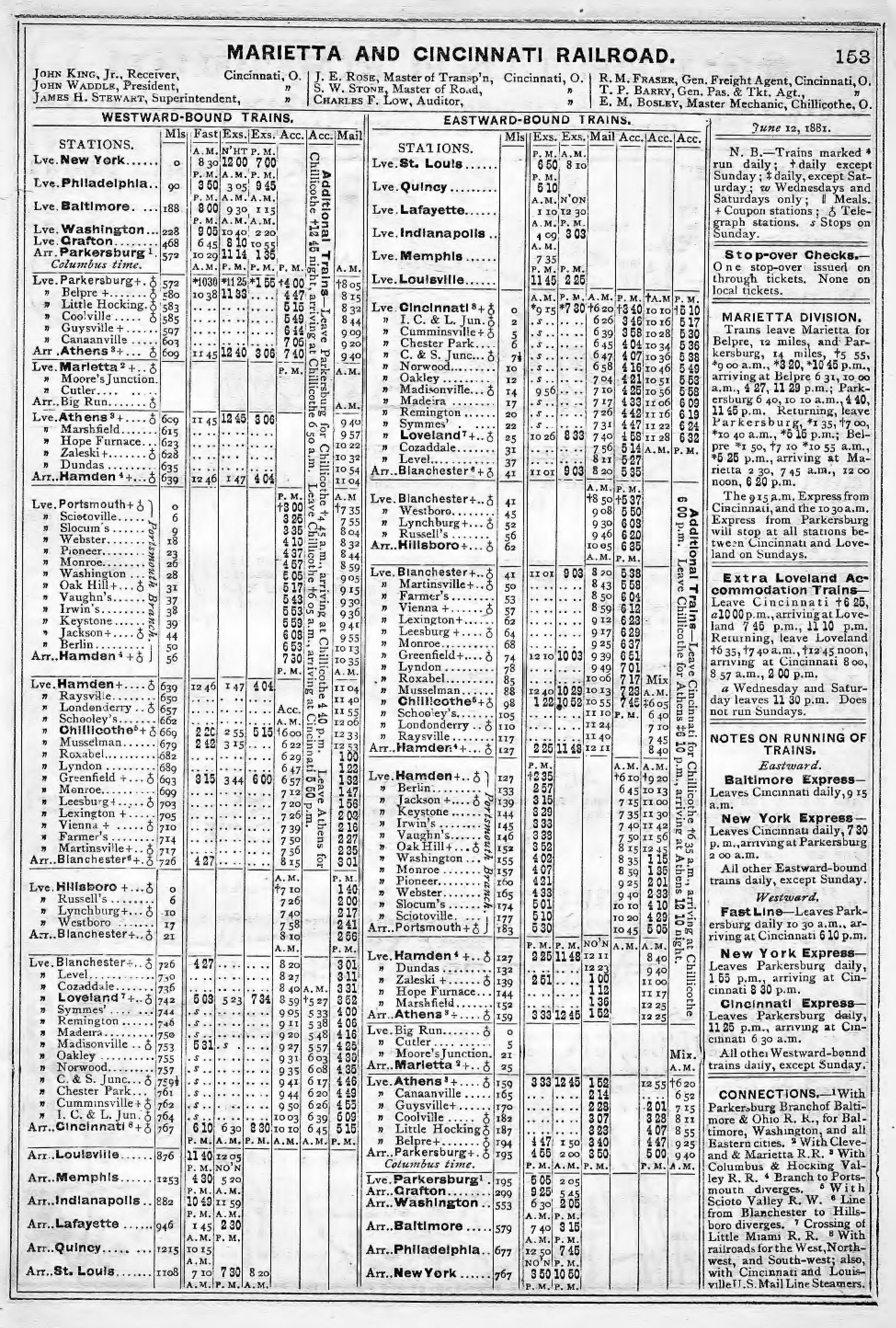
Official Guide, June 12, 1881, page 153. John King, Jr., receiver, Cincinnati. John Waddle, president. The named trains are the Baltimore Express, the New York Express, the Fast Line, and the Cincinnati Express. A note at the right sends Marietta trains to Belpre, 12 miles, and Parkersburg, 14 miles.
Eastward, the Baltimore Express left Cincinnati daily at 9:15 a.m. The New York Express left Cincinnati daily at 7:30 p.m. and reached Parkersburg at 2:00 a.m. The other eastward trains ran daily except Sunday. Westward, the Fast Line left Parkersburg daily at 10:30 a.m. and reached Cincinnati at 6:10 p.m. The New York Express left Parkersburg daily at 1:55 p.m. and reached Cincinnati at 8:30 p.m. The Cincinnati Express left Parkersburg daily at 11:25 p.m. and reached Cincinnati at 6:30 a.m. The other westward trains ran daily except Sunday. On Sundays the 9:15 a.m. express from Cincinnati and the 10:30 a.m. express from Parkersburg stopped at every station between Cincinnati and Loveland. Extra accommodation trains ran between Cincinnati and Loveland on days other than Sunday.
The card's own note puts Belpre 12 miles from Marietta and Parkersburg 14. The connections, numbered in the margin, are the Parkersburg Branch of the Baltimore & Ohio, for Baltimore, Washington, and the eastern cities; the Cleveland & Marietta; the Columbus & Hocking Valley; the Portsmouth branch; the Scioto Valley; the line from Blanchester to Hillsboro; the crossing of the Little Miami; the railroads for the West, the Northwest, and the Southwest; and the Cincinnati and Louisville U.S. Mail Line steamers.
Sale and the Southwestern
Poor's Manual gives the end of the company under its own name. The road was sold under foreclosure on December 9, 1882, to a committee of purchasing trustees. The court confirmed the sale on December 20. The deed is December 30. The trustees took possession on December 31 and operated the property until April 1, 1883. At a meeting on February 7, 1883, they adopted the name Cincinnati, Washington & Baltimore and set the capital at $21,000,000, of which $13,750,000 was preferred and $7,250,000 was common. Common was limited to 6 percent until the preferred had received 6 percent, and after that the two classes shared alike.
At the end of 1884 that successor counted 280.80 miles: Cincinnati to Belpre 192.90, the Marietta branch 11.10, Portsmouth to Hamden 55.40, and the Hillsboro branch 21.40. The gauge was 4 feet 8½ inches. Steel of 60 pounds to the yard covered the 192.9 miles of the Cincinnati–Belpre main. The old line through Vincent was off that account.
The Cincinnati, Washington & Baltimore defaulted in November 1888. Receivers were appointed on December 31, 1888. The property was sold in foreclosure on October 7, 1889. The Baltimore and Ohio Southwestern Railroad Company was incorporated in Ohio on December 20, 1889, and its own organization operated the line from January 1, 1890. The Interstate Commerce Commission's valuation counts 286.75 miles acquired from the purchasing trustees and 2.15 miles built, 288.90 miles at the consolidation date of November 1, 1893: the Cincinnati–Belpre main, and the branches from Belpre to Marietta, Hamden to Portsmouth, and Blanchester to Hillsboro. The Baltimore & Ohio controlled the company through the capital stock. On November 1, 1893, the Southwestern consolidated with the Ohio & Mississippi, whose road west of Cincinnati is the Ohio & Mississippi page. The Southwestern itself passed into the Baltimore & Ohio in 1900. The later company history is the Baltimore & Ohio.
What is left
The line across southern Ohio became the Baltimore & Ohio's road to St. Louis by way of Parkersburg. In 1985 CSX moved to take up the Parkersburg Branch, from Clarksburg to Parkersburg, and much of the Ohio Division. The grade through Vinton and Athens counties is the Moonville Rail-Trail, from Zaleski to Mineral, through Zaleski State Forest and the Moonville Tunnel. The rails on that section came up in the late 1980s. East of Mineral the old main toward Athens and Belpre is gone as a through railroad.
The railroad still in service is the bridge, the stub through Belpre and Marietta, and the later line north from Harmar to Relief, near Beverly. CSX owns it. The Belpre Industrial Parkersburg Railroad, a Cathcart Rail company, has operated it under lease since May 2, 2020. A Surface Transportation Board notice of April 24, 2026, filed to amend that lease, describes about 38 miles from Belpre, milepost BUS 0.0, to Relief, milepost BUS 38.0, and about 5.29 miles of the Parkersburg Running Track from Parkersburg, milepost BB 194.59, to Belpre, milepost BB 189.3, the piece that includes the bridge. High Yard in Parkersburg is in the same lease. West of Vincent, the Marietta and Cincinnati main line is the grade, the trail, and the sandstone piers.
Related reading on American-Rails.com
Sources
- Ninth Annual Report of the Commissioner of Railroads and Telegraphs of Ohio, for the year ending June 30, 1875 (Columbus: Nevins & Myers, 1876). The corporate history: Belpre & Cincinnati charter, March 8, 1845, 43 Ohio Laws 280; the name, March 20, 1851, 49 Ohio Laws 480; the Ross County suit of November 27, 1858; the sale order of January 7, 1860; the relief act of February 24, 1860, 57 Ohio Laws 128; confirmation May 2 and deed June 5, 1860; reorganization July 31, 1860; Atkinson, 15 Ohio Reports 36; the act of April 4, 1863, and the franchise deed of February 23, 1865. Hillsboro & Cincinnati, March 2, 1846, 44 Ohio Laws 276, transferred in 1860 at about $40,000 a mile. Scioto & Hocking Valley, February 20, 1849; sale May 19, 1863, for $411,100; deed January 26, 1864; the Portsmouth piece at $500,000 in first-preferred stock; the northern remainder sold September 2, 1869. Union Railroad, certificate September 13, 1858, deed August 6, 1863. Cincinnati & Baltimore lease, June 1, 1872, 5.60 miles. Baltimore Short Line, regular service November 15, 1874. The company return of the same date: the mileage table, stock, funded debt, cost, gauge, rail, tunnels, bridges, the Loveland spans, telegraph, rolling stock, officers, and earnings
- Poor's Manual of the Railroads. Main line in operation April 20, 1857, by the Little Miami from Loveland. Foreclosure sale December 9, 1882; confirmation December 20; deed December 30; trustees in possession December 31, 1882, through April 1, 1883. Name Cincinnati, Washington & Baltimore adopted February 7, 1883, capital $21,000,000. Mileage at the end of 1884, 280.80 miles, with 60-pound steel on the 192.9-mile Cincinnati–Belpre main
- The Official Guide of the Railways, June 12, 1881, page 153, reproduced above, and the companion map of the Marietta and Cincinnati Railway and connections, National Railway Publication Company, Philadelphia. The map face carries the cartouche miles and no year. The card prints King as receiver and Waddle as president, the named trains, the Marietta distances of 12 and 14 miles, and the connections
- Interstate Commerce Commission valuation narrative of the Baltimore and Ohio Southwestern Railroad. Foreclosure sale October 7, 1889. Incorporated in Ohio December 20, 1889. Operation by its own organization from January 1, 1890. Miles acquired 286.75, plus 2.15 built, 288.90 at November 1, 1893. Baltimore & Ohio control through the capital stock. Consolidation with the Ohio & Mississippi, November 1, 1893
- William Prescott Smith, The Book of the Great Railway Celebrations of 1857 (New York: D. Appleton & Co., 1858). Organization at Chillicothe, August 18, 1847. Scott's Landing, four miles from the Marietta station. The Chillicothe celebration, June 2, 1857. The American Central Railway, and the projected line of about 200 miles
- John E. Pixton, Jr., "Faith vs. Economics: The Marietta and Cincinnati Railroad, 1845–1883," Ohio Historical Quarterly 66, no. 1 (January 1957): 1–10, from the Cutler papers at Marietta College. Charter capital of $1,000,000. William P. Cutler. The 157 miles at the 1858 receivership. The 1851 river line toward Wheeling. Pennsylvania control of the Little Miami in 1869. The second receivership in 1878
- Life and Times of Ephraim Cutler, for the April 9, 1857 train from Athens to Marietta, and for the Union Railroad finished in the fall of 1859 with a $20,000 loan from the city of Baltimore. John Mills, Douglas Putnam, and William P. Cutler
- Historic American Engineering Record WV-12, "Baltimore & Ohio Railroad, Parkersburg Bridge." Total length 7,140 feet. Jacob Linville. Keystone Bridge Company. Channel spans about 348 feet, second in length only to Albert Fink's Louisville bridge of 1870. Approaches replaced 1898–1900. River spans replaced 1904–1905, on the original piers. National Register of Historic Places, Sixth Street Railroad Bridge, built May 18, 1869, to January 7, 1871, added December 10, 1982, reference 82001785. W. E. Porter is the Register's architect
- Manual of Statistics, for the default of November 1888 and the receivers appointed December 31, 1888. The 1890 annual report of the Baltimore & Ohio, as noticed in the Commercial & Financial Chronicle, for the consummation of the Southwestern reorganization. The Southwestern's passage into the Baltimore & Ohio is 1900
- Athens Messenger, December 7 and December 14, 1876, as cited in the secondary account of the Short Line, for the end of service on the old line from Warren's to Scott's Landing
- Annual report of the Commissioner of Railroads and Telegraphs of Ohio for 1885, for Marietta Mineral trains from Fleming Station to Marietta in October 1884 and on to Big Run in June 1885
- Eldon Young, Marietta Times, November 12, 2022, for the Dunbar piers west of Vincent, dry-laid sandstone, about 84 feet, over the West Branch of the Little Hocking. The 1916 date for the last train on the trestle is the local account
- Federal Register, April 24, 2026, Belpre Industrial Parkersburg Railroad, LLC, amendment to a lease and operation exemption, Docket No. FD 36388 (Sub-No. 1). The 2020 lease from CSX, the Marietta Subdivision from Belpre to Relief, and the Parkersburg Running Track across the bridge. Trains, "Belpre Industrial Parkersburg Railroad profile," January 20, 2023, for the start of operation on May 2, 2020, under Cathcart Rail
- Moonville Rail-Trail, for the grade from Zaleski to Mineral through Zaleski State Forest and the Moonville Tunnel. Ohio Department of Transportation, project 120373, describes the trail between Zaleski and Mineral. The rails on that section came up in the late 1980s. The 1985 withdrawal from the Parkersburg Branch and much of the Ohio Division is the Baltimore & Ohio page
Recent Articles


-
Toledo, Peoria & Western Steam Roster
Oct 30, 26 09:14 AM
 Toledo, Peoria & Western steam locomotives from the Rogers Consolidations of 1895 through the 4-8-4s of 1937
-
Toledo, Peoria & Western Railway: Map, Roster, History
Oct 29, 26 11:12 PM
 History of the Toledo, Peoria & Western. The Peoria & Oquawka, George P. McNear, the Santa Fe and Pennsylvania years, and the railroad that came back in 1989.
-
Cotton Belt Diesel Roster (All-Time)
Oct 29, 26 07:58 PM
 St. Louis Southwestern diesel locomotives, each frame once. Baldwin switchers, F units, and new Cotton Belt-lettered power through the GP60s of May 1990.
-
Cotton Belt Steam Roster (Built Since 1900)
Oct 29, 26 06:52 PM
 St. Louis Southwestern steam locomotives built since 1900. Consolidations, Ten-Wheelers, and twenty class L-1 4-8-4s. The quantity column is 297.
-
Cotton Belt Railroad: Map, Logo, History, Rosters
Oct 29, 26 10:56 AM
 History of the St. Louis Southwestern, the Cotton Belt Route. The Tyler Tap, Paramore's silver spike, the Thebes Bridge, the Blue Streak, and Southern Pacific control. Steam and diesel rosters are sep…
-
Pere Marquette Steam Roster (Built Since 1900)
Oct 28, 26 11:54 PM
 Pere Marquette steam locomotives built since 1900. Consolidations, Mikados, Pacifics, and 39 Berkshires. The quantity column is 503.
-
Pere Marquette Diesel Roster (All-Time)
Oct 28, 26 11:48 PM
 Pere Marquette diesel locomotives, each frame once. Two SW1s, 14 NW2s, three GE 70-tonners, eight E7As, and six BL2s delivered lettered Chesapeake and Ohio. The quantity column is 33.
-
Pere Marquette Railway: Map, Logo, Rosters, History
Oct 28, 26 11:44 PM
 History of the Pere Marquette Railway. Timber roads, the Prince years, the Van Sweringens, the Ludington car ferries, and the Chesapeake and Ohio merger of June 6, 1947.
-
Nickel Plate Road (Railroad): Map, History, Rosters
Oct 28, 26 10:51 PM
 History of the Nickel Plate Road, the New York, Chicago and St. Louis. The Seney syndicate, the Van Sweringens, the Berkshires, and the Norfolk and Western absorption at 12:01 a.m. on October 16, 1964…
-
Nickel Plate Diesel Roster (All-Time)
Oct 28, 26 10:48 PM
 Nickel Plate diesel locomotives, each frame once. Alco switchers and PAs, GP7s and GP9s, and the GP30s. The quantity column is 440. The 1950 fleet was 117.
-
Nickel Plate Steam Roster (Built Since 1900)
Oct 28, 26 10:43 PM
 Nickel Plate steam locomotives built since 1900, including the Lake Erie and Western, the Clover Leaf, and the Wheeling engines that took Nickel Plate numbers. The quantity column is 786.
-
EMD "E9" Locomotives: Specs, Roster, History
Oct 28, 26 10:37 PM
 EMD E9 cab units and boosters, 2,400 horsepower, built April 1954 through January 1964. Gear ratios, specifications, and the production roster by owner, serial, and order.
-
NYC 4-6-4 #5344, "Commodore Vanderbilt"
Oct 28, 26 04:31 PM
 NYC J-1e Hudson 5344, the Commodore Vanderbilt. Alco, November 1931. Carl Kantola’s shroud, December 1934, then a Dreyfuss bullet nose in 1939. Scrapped at Collinwood in 1954.
-
New Jersey, Indiana & Illinois Railroad: A South Bend Shortline
Oct 28, 26 11:05 AM
 The New Jersey, Indiana & Illinois, the Jersey Line, ran from South Bend to Pine. Singer built it in 1905. Wabash stock control came in 1926. Two diesels, and the steam the record names.
-
Monon Diesel Roster (All-Time)
Oct 28, 26 10:13 AM
 Monon diesel locomotives, each frame once. F3s, nine BL2s, the C420s, and eight U23Bs. The quantity column is 96. The 1951 fleet was 57.
-
Monon Steam Roster (Built Since 1900)
Oct 28, 26 10:09 AM
 Monon steam locomotives built since 1900. Twelve-Wheelers, Mikados, light Pacifics, and thirteen six-wheel switchers. The quantity column is 148.
-
Monon Railroad: Map, Photos, History, Logo
Oct 28, 26 09:55 AM
 History of the Monon, the Hoosier Line. The New Albany & Salem, the X at Monon, Barriger's streamliners, and the Louisville & Nashville merger of July 31, 1971.
-
Missouri-Kansas-Texas Diesel Roster (All-Time)
Oct 28, 26 09:48 AM
 All-time diesel roster of the Missouri-Kansas-Texas. 406 locomotives, each frame once. Baldwin switchers, Alco cab units, F units, Geeps, and the SD40-2s.
-
Missouri-Kansas-Texas Steam Roster (Built Since 1900)
Oct 28, 26 09:43 AM
 Missouri-Kansas-Texas steam locomotives built since 1900. Moguls, Mikados, Pacifics, and the narrow-gauge shop tanks. The quantity column is 715.
-
Missouri-Kansas-Texas Railroad (Katy): Map, History, Rosters
Oct 27, 26 11:02 PM
 History of the Missouri-Kansas-Texas, the Katy. The race into Indian Territory, Gould, the 1923 railroad, the Texas Special, and the 1988 sale. Steam and diesel rosters are linked.
-
Soo Line Diesel Roster (All-Time)
Oct 27, 26 10:55 PM
 All-time diesel roster of the Soo Line and the Wisconsin Central. 786 locomotives, each frame once. Cab units, Geeps, the Milwaukee Road engines, and the SD60s. The South Shore's 24 stay on that page.
-
Soo Line Steam Roster (Built Since 1900)
Oct 27, 26 10:49 PM
 Soo Line and Wisconsin Central steam locomotives built since 1900. Consolidations, Mikados, Pacifics, 21 Mountains, and four Lima 4-8-4s.
-
Soo Line Railroad: Map, Logo, History, Rosters
Oct 27, 26 10:24 PM
 The Soo Line, from the flour millers' railroad around Chicago to the Sault, the Wisconsin Central, and the Milwaukee Road. Steam quantity 422. Diesels 786. Canadian Pacific took full control in 1990.
-
Minneapolis, Northfield and Southern Railway: Map, History, Rosters
Oct 27, 26 10:32 AM
 The Minneapolis, Northfield & Southern, the Dan Patch Line that became a Twin Cities belt. Steam, gas-electric mules, motor cars, and the 22 diesels, through the Soo Line.
-
Minneapolis & St. Louis Diesel Roster (All-Time)
Oct 27, 26 10:27 AM
 All-time diesel roster of the Minneapolis & St. Louis. 97 locomotives, each frame once. Switchers from 1938, 35 RS-1s, the FT and F-unit cabs, two SD7s, and 23 GP9s. Builder numbers included.
-
Minneapolis & St. Louis Steam Roster (Post 1900)
Oct 27, 26 10:25 AM
Minneapolis & St. Louis steam locomotives built since 1900. Moguls, Consolidations, 35 Mikados, and five Pacifics. -
Minneapolis and St Louis Railway: "The Peoria Gateway"
Oct 27, 26 09:52 AM
 The Minneapolis & St. Louis, the Tootin' Louie, from the 1870 charter to the Peoria Gateway and the Chicago & North Western sale on November 1, 1960.
-
Alco "PA" Locomotives: Restoration, Specs, Engine, Rosters
Oct 27, 26 12:12 AM
 Alco's PA passenger cab, 297 locomotives built from 1946 to 1953. The 244 engine, the production roster, the Delaware & Hudson PA-4s, and Nickel Plate Road 190.
-
Milwaukee Road Diesel Roster: (All Time)
Oct 26, 26 01:44 PM
 All-time diesel roster of the Milwaukee Road. 1,208 locomotives, each frame once. Alco, Baldwin, Davenport, EMD, Fairbanks-Morse, General Electric, and Whitcomb, with builder numbers.
-
Milwaukee Road Steam Roster (All-Time): Post-1900
Oct 26, 26 01:38 PM
 Milwaukee Road steam locomotives built since 1900. Prairies, Mikados, the N-class articulateds, the S-class 4-8-4s, and the Hiawatha Atlantics and Hudsons. Quantity column 1,974. Unique frames 1,951.
-
Milwaukee Road: Map, Electrification, Logo, History
Oct 26, 26 01:20 PM
 The Milwaukee Road, from the Milwaukee & Mississippi of 1850 to the Pacific Coast Extension, the Hiawathas, and the Soo Line sale. Why Lines West should have stayed.
-
Lake Superior & Ishpeming Railroad: Map, Roster, History
Oct 25, 26 11:38 PM
 Lake Superior & Ishpeming Railroad, reporting mark LSI, from the Marquette Range to the Presque Isle ore dock. The 1954 steam list and the diesels the railroad owned.
-
Kansas City Southern Steam Roster (Built Since 1900)
Oct 25, 26 09:09 PM
 Steam locomotives of the Kansas City Southern built since 1900, with the Louisiana & Arkansas and the Texas company.
-
Kansas City Southern Diesel Roster (Built New)
Oct 25, 26 11:46 AM
All-time diesel roster of the Kansas City Southern. E units, F units, Geeps, SD40s through SD70ACes, Fairbanks-Morse, Baldwin, Alco, and General Electric, with serials and order numbers. -
Kansas City Southern Railway: Map, Photos, History
Oct 25, 26 12:24 AM
The Kansas City Southern, from Arthur Stilwell's Gulf line to Canadian Pacific Kansas City on April 14, 2023. Steam and diesel rosters, the Southern Belle, and the Louisiana & Arkansas. -
Indiana Harbor Belt Diesel Roster (All-Time)
Oct 25, 26 12:17 AM
 All-time diesel roster of the Indiana Harbor Belt. 202 locomotive frames, each counted once. NW2s, SW7s, SW1500s, road switchers, and gensets. Slugs and boosters are outside the count.
-
Indiana Harbor Belt Steam Roster (Built Since 1900)
Oct 25, 26 12:13 AM
 Steam locomotives of the Indiana Harbor Belt built since 1900. 182 engines, each counted once. 0-6-0s, 2-6-0s, 0-8-0s, and 2-8-2s. The three U-4a switchers are three-cylinder Brooks engines of 1927.
-
Indiana Harbor Belt Railroad: Map, Rosters, History
Oct 25, 26 12:00 AM
 Indiana Harbor Belt, the inner belt across the Calumet, from the East Chicago Belt of May 16, 1896. Renamed June 29, 1907. Still operating, headquarters Hammond. Steam roster is the companion, 182 loc…
-
NYC's "P Motor" Electric Locomotives
Oct 24, 26 11:43 PM
 New York Central P motors: 22 Alco-GE 2-C+C-2 electrics, Cleveland Union Terminal 1050–1071, class P-1a. 3,030 hp one-hour on 3,000-volt DC catenary, then 660-volt third rail as P-2a and P-2b.
-
Illinois Terminal Car Roster
Oct 24, 26 11:40 PM
 Illinois Terminal cars. Mainline motors, the 1948 streamliners, sleepers, Alton and Valley Division cars, express motors, and the line cars rebuilt from pull cars.
-
Illinois Terminal Diesel Roster
Oct 24, 26 09:31 PM
 All-time Illinois Terminal diesels, 62 frames. Alco S-2s and RS-1s, EMD switchers, GP7s, SD39s, GP38-2s, and the two GP20s. Serial numbers from the 1989 roster.
-
Illinois Terminal Electric Locomotives
Oct 24, 26 08:22 PM
 Illinois Terminal electric locomotives, 57 frames. Class A through Class D, the Decatur-built motors, and the battery locomotives. Class D is the same five Class C frames, rebuilt.
-
Illinois Terminal Steam Roster
Oct 24, 26 07:37 PM
 Illinois Terminal steam locomotives, 36 frames. Baldwin Moguls, three Class 30 Mikados, Florida East Coast 0-8-0s, and 2-6-0 No. 21, the last fire on June 30, 1950.
-
Illinois Terminal Railroad: Map, Roster, Photos, History
Oct 24, 26 07:32 PM
Illinois Terminal, McKinley's Illinois Traction System, from the Danville coal towns to St. Louis. The McKinley Bridge, the sleeping cars, the 1937 break with the power company, the 1948 streamliners… -
Southern Railway Diesel Roster (All-Time)
Oct 23, 26 11:00 PM
 All-time diesel roster of the Southern Railway. 2,505 locomotives in the system number series, from the 1939 demonstrator FT to GP50s and B30-7A1s. Serials included.
-
Illinois Central Diesel Roster (All-Time)
Oct 23, 26 04:06 PM
Illinois Central and Illinois Central Gulf diesel locomotives, each frame once. The quantity column is 886. Serials and order numbers from Electro-Motive's builder lists. Paducah rebuilds and Gulf, Mo… -
Illinois Central Gulf Diesel Roster
Oct 23, 26 04:02 PM
 Illinois Central Gulf operating numbers from August 10, 1972, to February 29, 1988. New frames stay on the Illinois Central diesel roster. Gulf, Mobile and Ohio frames stay on that roster. No Gulf fle…
-
Illinois Central Railroad: Map, Logo, History
Oct 23, 26 03:50 PM
Illinois Central, the Main Line of Mid-America, from the 1850 land grant to Canadian National control on July 1, 1999. Charter lines, Cairo bridge, Paducah, and the Illinois Central Gulf. Steam quanti… -
Grand Trunk Western Diesel Roster (All-Time)
Oct 23, 26 12:53 PM
 Grand Trunk Western diesel locomotives, each frame once. The quantity column is 377. Serials are filled for the Detroit, Toledo and Ironton and Detroit and Toledo Shore Line engines the railroad kept…
-
Grand Trunk Western Steam Roster
Oct 23, 26 12:14 PM
 Grand Trunk Western steam locomotives in service about 1937 to 1942, from Richard Leonard's class list. Drury has no chapter. The quantity column is the counted Grand Trunk Western rows. Two mixed Gra…