Mobile & Ohio Steam Roster (Post 1900)
Published: October 9, 2026
By: Adam Burns
The Mobile & Ohio stayed with the Ten-Wheeler until the main line outgrew it. Freight then moved to the Mikado, first a Baldwin engine of 1911 and later a copy of the United States Railroad Administration light 2-8-2. Passenger power closed with ten copies of the USRA light Pacific. The successor railroad made its last revenue steam run on October 7, 1949.
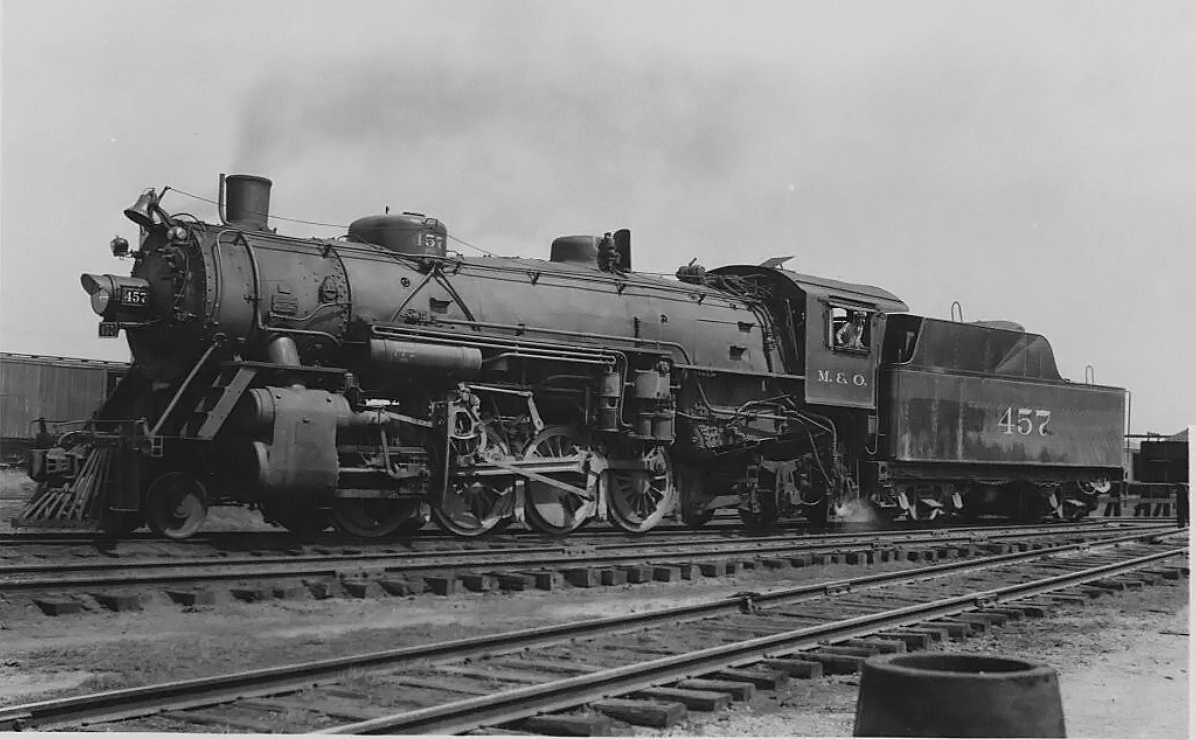
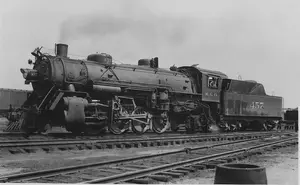
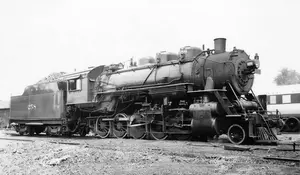
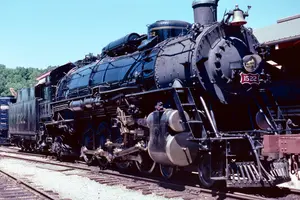
Mobile & Ohio 2-8-2 #457, one of several Mikados acquired throughout the 1920s from Alco-Richmond, Lima, Baldwin, and Alco-Schenectady.
The class grid below is the post-1900 roster in George H. Drury's Guide to North American Steam Locomotives, revised edition, pages 224 and 225. The company history is the Mobile & Ohio. The merged railroad is the Gulf, Mobile & Ohio. Gulf, Mobile & Northern steam is the sister roster, and the diesels are the diesel roster.
On this page: At a glance · The 1910 numbers · Ten-Wheelers and Consolidations · Mikados · Pacifics · Switchers · Roster built since 1900
At a glance
| Item | Detail |
|---|---|
| Railroad | Mobile & Ohio. Company page: Mobile & Ohio |
| This roster | Engines built since 1900, after Drury, pages 224–225. The quantity column sums to 242 |
| Numbers | The 1910 renumbering. The table uses those numbers. Three notes give the earlier series: 6–9, 10–14, and 72–76 |
| Switchers | 48 six-wheel engines. Ten were USRA 0-6-0s, Cooke, 1918. Thirteen were copies, Richmond and Schenectady, 1927 and 1928 |
| Freight | 107 Ten-Wheelers. Fifteen Consolidations, 1914. Fifty-eight Mikados, 21 of them Baldwin, 1911–1916, and 37 copies of the USRA light 2-8-2 |
| Passenger | Four Pacifics of 1912, built with a Southern Ps-2 group. Ten USRA light Pacific copies, Baldwin, 1923–1926. Ten-Wheelers 230–239 had 69-inch drivers |
| Control | Southern Railway, 1901 to 1938. Gulf, Mobile & Ohio from September 13, 1940. The Alton came in on May 31, 1947 |
| Last revenue steam | October 7, 1949, on the Gulf, Mobile & Ohio |
Roster follows Drury, Guide to North American Steam Locomotives (revised edition), pages 224–225. Information compiled October 9, 2026.
The 1910 numbers
The Mobile & Ohio ran from Mobile, Alabama, north to St. Louis, with a branch from Artesia, Mississippi, to Montgomery, and with trackage rights on the Southern and the Illinois Central between Memphis, Corinth, and Birmingham. That geography, the Cairo & St. Louis, and the March 1940 timetable are the company history. Drury's chapter opens on the engines. The Southern controlled the railroad from 1901 to 1938. In 1940 the new Gulf, Mobile & Ohio bought it and consolidated it with the Gulf, Mobile & Northern. The merger date on the company pages is September 13, 1940. Steam purchases had already ended. In 1947 the Alton came in, and the combined railroad dieselized. The last revenue steam run was October 7, 1949.
The locomotives were renumbered in 1910. Drury calls it a convoluted scheme, aimed at engine crews and at anyone trying to sort the roster afterward. One group of 0-6-0s handed its numbers to another group, and other 0-6-0s kept the numbers they already wore. His picture of the result is a crew that greeted No. 12 as an old friend, the engineer and the fireman agreeing she was a good steamer, and then discovered that this No. 12 was a different engine. The table uses the 1910 numbers. Where he prints the earlier series, it is in the notes: 11–14 were built as 6–9, 18–22 as 10–14, and 23–27 as 72–76.
Ten-Wheelers, then fifteen Consolidations
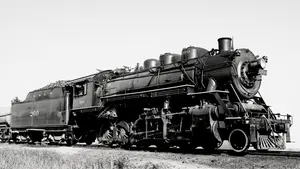
Freight stayed on 57-inch and 63-inch Ten-Wheelers until eight-coupled power arrived. Drury's weight for the type runs from 129,000 pounds on Rogers engines 178–187, built in 1900, to 167,495 pounds on Baldwin's 310–321 and 325–384. Later in life those heavier Ten-Wheelers weighed 179,500 pounds. The largest group was sixty Baldwin engines of 1905–1907, numbers 325–384, with 63-inch drivers, 21-by-28-inch cylinders, and 33,320 pounds of tractive effort. No. 377, one of the sixty, leads a mixed train at Starkville, Mississippi, in February 1942 in C. W. Witbeck's photograph.
One Ten-Wheeler group was a passenger engine. Nos. 230–239, Baldwin, 1906, had 69-inch drivers. Three of them were later given 63-inch drivers.
In 1914 the railroad bought fifteen Consolidations, eight from Alco and seven from Baldwin, numbered 540–554. The builder cell reads Baldwin, Richmond. Like the early Mikados they had 63-inch drivers, and the cylinders were three inches smaller. They were meant to replace older and smaller power. Crews disliked them. The firebox was about the size of a 2-8-2 firebox, so the boiler sat higher to clear the rear drivers, and that rear pair tended to derail. The railroad went back to the Mikado for the orders that followed. Ten of the 2-8-0s were scrapped before 1940. The retirement cell for the class runs 1935–1948.
Two generations of Mikados
Between 1911 and 1916 Baldwin delivered twenty-one Mikados, 400–420. The last three, 418–420, had Southern valve gear. The others had Walschaerts. All of them carried outboard-bearing trailing trucks. The Pacifics of 1912, described below, carried inboard-bearing trailing trucks. Drury gives the 400s 63-inch drivers, 27-by-30-inch cylinders, and a weight of 273,000 pounds.
The second Mikado was a copy of the USRA light 2-8-2. Alco's Richmond Works built ten in 1922. Lima built seventeen in 1923 and 1924. Baldwin built five in 1926. Alco's Schenectady Works delivered the final five in 1928. That is thirty-seven engines, numbers 450–486. The builder cell on the grid is clipped at the column edge after "Schen." The paragraph spells the works out. No. 459, built by Richmond in 1922, is the engine in R. J. Foster's photograph, a mainline freight Mikado with the Mobile & Ohio on the tender. The class lasted to 1946–1950.
Four light Pacifics, then ten USRA copies
The first Pacifics were 250–253, Baldwin, 1912. They were identical to a group of Southern Ps-2s and were built along with them. Drury calls them light machines, 232,000 pounds, with 72-inch drivers and inboard-bearing trailing trucks. They left the roster in 1939 and 1940.
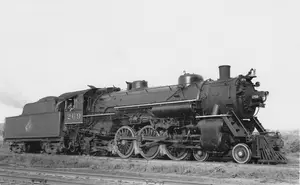
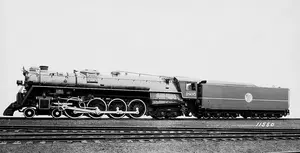
In the 1920s the railroad bought ten more 4-6-2s, copies of the USRA light Pacific. Baldwin delivered them from 1923 through 1926 and they took 260–269. What set the copy off from the USRA engine was the cab roof. The USRA roof had a deeper curve. John B. Allen's photograph on the chapter's first page is No. 268, the cab number plain, two men in the gangway. These ten were still on the roster into 1946–1949. Alton Pacific 5296, the former Chicago & Alton 656, photographed at Brighton in March 1947, is a different roster. That picture is on the company page.
Forty-eight six-wheel switchers
The road was well supplied with switchers, and every one of them on this grid is an 0-6-0. The numerous group was the USRA switcher. Ten were allocated, numbers 40–49, built by Cooke in 1918. Thirteen copies followed from Richmond and Schenectady in 1927 and 1928, numbers 50–62. The notes on those two rows read "USRA" and "USRA copies."
Older six-wheel engines fill the rows above them. Rogers built 11–14 in 1900, originally 6–9. Baldwin built 15–17 in 1905, 18–22 in 1904–1905 (originally 10–14), and 23–27 in 1906–1907 (originally 72–76). Eight Lima engines of 1911, numbers 30–37, survived long enough to receive Gulf, Mobile & Ohio numbers. Their retirement cell is 1940–1948. The USRA engines and the copies lasted to 1948–1950.
Roster built since 1900
| Type | Numbers | Qty | Builder | Built | Retired | Notes |
|---|---|---|---|---|---|---|
| 0-6-0 | 11–14 | 4 | Rogers | 1900 | 1931–1934 | Built as 6–9 |
| 0-6-0 | 15–17 | 3 | Baldwin | 1905 | 1934–1940 | |
| 0-6-0 | 18–22 | 5 | Baldwin | 1904–1905 | 1934–1943 | Built as 10–14 |
| 0-6-0 | 23–27 | 5 | Baldwin | 1906–1907 | 1934–1945 | Built as 72–76 |
| 0-6-0 | 30–37 | 8 | Lima | 1911 | 1940–1948 | |
| 0-6-0 | 40–49 | 10 | Cooke | 1918 | 1948–1950 | USRA |
| 0-6-0 | 50–62 | 13 | Richmond, Schenectady | 1927, 1928 | 1948–1950 | USRA copies |
| 2-8-0 | 540–554 | 15 | Baldwin, Richmond | 1914 | 1935–1948 | |
| 2-8-2 | 400–420 | 21 | Baldwin | 1911–1916 | 1946–1949 | |
| 2-8-2 | 450–486 | 37 | Richmond, Lima, Baldwin, Schenectady | 1922–1928 | 1946–1950 | |
| 4-6-0 | 178–187 | 10 | Rogers | 1900 | 1918–1934 | |
| 4-6-0 | 220–227 | 8 | Baldwin | 1903 | 1918–1940 | |
| 4-6-0 | 230–239 | 10 | Baldwin | 1906 | 1931–1949 | |
| 4-6-0 | 300–306 | 7 | Baldwin | 1904 | 1918–1940 | |
| 4-6-0 | 310–321 | 12 | Baldwin | 1904 | 1930–1940 | |
| 4-6-0 | 325–384 | 60 | Baldwin | 1905–1907 | 1918–1949 | |
| 4-6-2 | 250–253 | 4 | Baldwin | 1912 | 1939–1940 | |
| 4-6-2 | 260–269 | 10 | Baldwin | 1923–1926 | 1946–1949 |
The quantity column sums to 242. Cooke, Richmond, and Schenectady are Alco works. The 450–486 builder cell is cut off on the printed page after "Schen," and the chapter's own paragraph names Schenectady for the last five. USRA United States Railroad Administration.
Related reading on American-Rails.com
- Mobile & Ohio · Gulf, Mobile & Ohio · Gulf, Mobile & Northern · GM&N steam roster · GM&O diesel roster
- Southern Railway · Illinois Central · Alton Railroad
- Mikado · Pacific
Sources
- George H. Drury, Guide to North American Steam Locomotives, revised edition, Mobile & Ohio, pp. 224–225. Class grid, the 1910 renumbering, Southern control from 1901 to 1938, the Ten-Wheeler weights and the 33,320-pound tractive effort, the fifteen Consolidations, the two Mikado generations, Pacifics 250–253 and 260–269, and October 7, 1949
- Drury's own citations on that page: Gulf, Mobile & Ohio Historical Society, gmohs.org. Railroad magazine, September 1934, p. 88. Railroad History No. 157, p. 85
- Photograph credits on those pages: John B. Allen, Pacific 268. C. W. Witbeck, Ten-Wheeler 377 at Starkville, February 1942. R. J. Foster, Mikado 459, Richmond, 1922
Recent Articles


-
Mobile & Ohio Steam Roster (Post 1900)
Oct 09, 26 12:26 PM
 Mobile & Ohio steam since 1900. Drury's class grid: 48 six-wheel switchers, 107 Ten-Wheelers, 15 Consolidations, 58 Mikados, and 14 Pacifics. Last revenue steam October 7, 1949.
 -
Mobile & Ohio Railroad: History, Map, Timetable
Oct 09, 26 11:31 AM
 Mobile & Ohio Railroad, chartered in 1848. Columbus on April 22, 1861, the Cairo & St. Louis, the March 1940 Official Guide, and the September 13, 1940 merger into the Gulf, Mobile & Ohio.
 -
Gulf, Mobile & Northern Steam Roster (Post 1900)
Oct 09, 26 10:42 AM
 Gulf, Mobile & Northern steam since 1900. Drury's class grid: Ten-Wheelers, Mikados, Russian Decapods, Pacifics 425 and 426, and three light 4-8-2s. Last revenue steam October 7, 1949.
 -
Gulf, Mobile & Ohio Diesel Roster (All-Time)
Oct 09, 26 10:41 AM
 Gulf, Mobile & Ohio diesel roster, all-time. The 1935 boxcab, DL-107s, 55 FA-1s, F3s and F7s, the Ingalls 4-S, GP30s through GP38-2s, and 21 SD40s. Serials and order numbers.
 -
Gulf, Mobile & Northern Railroad: History, Rebel Route
Oct 09, 26 10:36 AM
 Gulf, Mobile & Northern, from the 1890 Mobile, Jackson & Kansas City to the Rebel and the September 13, 1940 merger into the Gulf, Mobile & Ohio. Steam roster is the companion page.
 -
Gulf, Mobile & Ohio Railroad: Map, Photos, Trains, History
Oct 08, 26 11:48 PM
 Gulf, Mobile & Ohio, chartered in 1938 and merged September 13, 1940. The Mobile & Ohio, the Alton on May 31, 1947, the Rebel Route, and Illinois Central Gulf on August 10, 1972.
 -
New Jersey Railroad Museums (2026): A Complete Guide
Oct 08, 26 11:37 PM
 New Jersey railroad museums—Whippany, Maywood, Pine Creek, Mahwah’s Erie depot, Phillipsburg, and Boonton. Confirm hours on each site.
 -
New Hampshire Railroad Museums (2026): A Complete Guide
Oct 08, 26 11:34 PM
 New Hampshire railroad museums—North Conway, the Flying Yankee, Ashland, Gorham, Raymond, and Sandown. Confirm hours on each site.
 -
Missouri Railroad Museums (2026): A Complete Guide
Oct 08, 26 11:00 PM
 Missouri railroad museums—the National Museum of Transportation, Patee House, Frisco 4524, the Chicago & Alton depot, and Marceline. Confirm hours on each site.
 -
Milwaukee Road X3800: Deer Lodge’s Shop Goat
Oct 08, 26 04:28 PM
 Milwaukee Road X3800, the a home-built shop goat that served the Deer Lodge, MT yard. It was a 220-volt DC switcher, powered through an extension cord that moved electrics into a roundhouse where the…
 -
Key West Extension (Overseas Railroad): History, Construction, Decline
Oct 08, 26 03:59 PM
 Henry Flagler's Overseas Railroad, Miami to Key West, 1905–1935. The Seven Mile Bridge, the 1935 Labor Day Hurricane, and the road that became U.S. 1.
 -
Florida East Coast Steam Roster (Post 1900)
Oct 08, 26 02:34 PM
 Florida East Coast steam since 1897. Seventeen Ten-Wheelers, twenty Atlantics, eighty-seven Pacifics, ninety Mountains, fifteen Mikados, and the switchers.
 -
Florida East Coast Diesel Roster (All-Time)
Oct 08, 26 02:12 PM
 Florida East Coast diesel roster, all-time. E units from 1939, F3s, BL2s, GP7s and GP9s, the GP40-2 orders, 22 SD40-2s, and 24 ES44C4s. Serials and EMD order numbers.
 -
Florida East Coast Railway: Map, History, Rosters
Oct 08, 26 01:46 PM
 Florida East Coast Railway, Henry Flagler's line from Jacksonville to Miami and Key West. Receivership in 1931, the 1963 strike, Grupo México in 2017, and Brightline on the same track.
 -
Minnesota Railroad Museums (2026): A Complete Guide
Oct 08, 26 10:32 AM
Minnesota railroad museums—the Lake Superior Railroad Museum, Two Harbors, Jackson Street, Willmar’s Great Northern 2523, and Currie. Confirm hours on each site. -
Maine Railroad Museums (2026): A Complete Guide
Oct 08, 26 09:24 AM
 Maine railroad museums—Seashore Trolley, the two-foot lines at Portland, Alna, and Phillips, Boothbay, and the Bangor & Aroostook depots. Confirm hours on each site.
 -
Massachusetts Railroad Museums (2026): A Complete Guide
Oct 08, 26 12:08 AM
 Massachusetts railroad museums—Berkshire Scenic at Lenox, Shelburne Falls trolley No. 10, Edaville, Chatham’s 1887 depot, and Lowell. Confirm hours on each site.
 -
Clinchfield Steam Roster (Post 1900)
Oct 07, 26 12:09 PM
 Clinchfield steam since 1900. Fifteen H-4 Consolidations, K-1 Mikados, M-2 and M-3 Mallets, L-class 2-8-8-2s, eighteen Challengers. Class grid after Drury. Last steam April 16, 1954.
 -
Clinchfield Diesel Roster (All-Time)
Oct 07, 26 12:05 PM
 Clinchfield diesel roster, all-time. F3A 800, FP7 200, the F7s, GP7s, 25 SD40s, 18 SD45-2s, seven U36Cs, and the Family Lines hoods. Serials and EMD order numbers.
 -
Clinchfield Railroad: Map, Steam Locomotives, Roster, Logo
Oct 07, 26 12:02 PM
 Clinchfield Railroad, Elkhorn City to Spartanburg. George L. Carter, the Carolina, Clinchfield & Ohio, the 1924 lease, coal, the loops, and CSX. Steam and diesel rosters are companion pages.
 -
Kentucky Railroad Museums (2026): A Complete Guide
Oct 07, 26 11:39 AM
 Kentucky railroad museums—the Kentucky Railway Museum, Bowling Green’s L&N depot, Paducah, Versailles, and Covington. Confirm hours on each site.
 -
Kansas Railroad Museums (2026): A Complete Guide
Oct 07, 26 11:26 AM
 Kansas railroad museums—Santa Fe 3768 at Wichita, Santa Fe 132 in Topeka, the Great Overland Station, and Abilene. Confirm hours on each site.
 -
Cincinnati, New Orleans and Texas Pacific Diesel Roster (All-Time)
Oct 07, 26 10:38 AM
 All-time diesel roster of Southern locomotives lettered for the Cincinnati, New Orleans and Texas Pacific. Serials, order numbers, and builder dates.
 -
Cincinnati, New Orleans and Texas Pacific Railway
Oct 07, 26 10:31 AM
 Cincinnati, New Orleans and Texas Pacific Railway, incorporated September 8, 1881, to lease Cincinnati’s railroad to Chattanooga. Queen and Crescent route, Rathole, and the 2024 sale to Norfolk Southe…
 -
Indiana Railroad Museums (2026): A Complete Guide
Oct 07, 26 12:26 AM
 Indiana railroad museums—Nickel Plate 765, Elkhart’s New York Central collection, French Lick, Linden’s junction depot, and Haley Tower. Confirm hours on each site.
 -
"Triplex" Steam Locomotive: Specs, History, Photos
Oct 06, 26 11:52 PM
 Erie class P-1 Triplex 2-8-8-8-2s. Three Baldwin compounds, 2603–2605, later 5014–5016, built 1914 and 1916. Matt H. Shay, the 1930 class card, and Virginian XA 700.
 -
Illinois Railroad Museums (2026): A Complete Guide
Oct 06, 26 11:47 PM
 Illinois railroad museums—the Illinois Railway Museum, Monticello, the Pioneer Zephyr, Galesburg’s Burlington 3006, and the depots. Confirm hours on each site.
 -
Iowa Railroad Museums (2026): A Complete Guide
Oct 06, 26 11:41 PM
 Iowa railroad museums—the Union Pacific Railroad Museum, RailsWest, Sioux City, Boone, and the National Hobo Museum in Britt. Confirm hours on each site.
 -
Charleston and Western Carolina Diesel Roster (All-Time)
Oct 06, 26 11:29 PM
Charleston and Western Carolina diesel roster. Twenty-one GP7s, two SW7s, two SW9s, and six F7As, all built 1950–1952. Serials, order numbers, and ACL and SCL numbers. -
Charleston and Western Carolina Railway: Map, History, Timetables
Oct 06, 26 11:18 PM
 Charleston and Western Carolina Railway, incorporated September 16, 1896. Port Royal to Spartanburg, with branches to Anderson and Greenville. Merged into the Atlantic Coast Line on December 31, 1959.
 -
Central of Georgia Steam Roster (Post 1900)
Oct 06, 26 04:00 PM
 Central of Georgia steam since 1900. Cooke Consolidations, Harriman Mikados, 32 Mountains, and eight Lima 4-8-4s. Class grid after Drury. Last steam May 1953.
 -
Central of Georgia Diesel Roster (All-Time)
Oct 06, 26 03:44 PM
 Central of Georgia diesel roster. SW1 No. 1 in 1939, E7s and E8s, nine F3As, 39 RS3s, GP7s through SD35s. Serials and order numbers.
 -
Central of Georgia Railway: Map, Logo, History, Rosters
Oct 06, 26 03:42 PM
 Central of Georgia Railway, from the 1833 Savannah charter to Southern control on June 17, 1963. Map, logos, Nancy Hanks II, and links to the steam and diesel rosters.
 -
Georgia Railroad Museums (2026): A Complete Guide
Oct 06, 26 03:33 PM
Georgia railroad museums—Savannah’s Central shops, Duluth, the General at Kennesaw, the Texas in Atlanta, Tifton, Waycross, and Albany. Confirm hours on each site. -
Florida Railroad Museums (2026): A Complete Guide
Oct 06, 26 03:18 PM
 Florida railroad museums—Boca Raton, Winter Garden, Whitehall, the Gold Coast, Parrish, Fort Myers, Milton, and Plant City. Confirm hours on each site.
 -
Connecticut Railroad Museums (2026): A Complete Guide
Oct 06, 26 01:05 PM
 Connecticut railroad museums—the Shore Line Trolley, East Windsor, the Naugatuck Railroad, Danbury Union Station, Willimantic, and the SoNo tower. Confirm hours on each site.
 -
Colorado Railroad Museums (2026): A Complete Guide
Oct 06, 26 12:47 PM
 Colorado railroad museums—Golden, the Forney’s Big Boy 4005, Pueblo’s Santa Fe 2912, and the depots at Castle Rock, Limon, and Ridgway. Confirm hours on each site.
 -
Atlantic Coast Line Steam Roster (Post 1900)
Oct 06, 26 12:44 PM
 Atlantic Coast Line steam since 1900. Copper Head Ten-Wheelers, 235 P-5 Pacifics, Q-1 Santa Fes, twelve R-1 4-8-4s. Class grid after Drury. Last steam June 30, 1955.
 -
Atlantic Coast Line Diesel Roster (All-Time)
Oct 06, 26 11:57 AM
 Atlantic Coast Line diesel roster. HH660 1900 in 1939, E3s for the Champion, FTs and F2s, GP7s 100–279, GP30s, U25Cs, and the 1967 SCL numbers. Serials and orders.
 -
Atlantic Coast Line Railroad: "Standard Railroad of the South"
Oct 06, 26 11:53 AM
 Atlantic Coast Line, the Standard Railroad of the South. April 21, 1900 to July 1, 1967. Plant System, L&N, Clinchfield, the Champion, and the Seaboard Coast Line merger.
 -
California Railroad Museums (2026): A Complete Guide
Oct 06, 26 09:50 AM
California railroad museums—the California State Railroad Museum, Perris, Portola, Railtown 1897, and the depots that still stand. Confirm hours on each site. -
Arizona Railroad Museums (2026): A Complete Guide
Oct 06, 26 09:46 AM
Arizona railroad museums—the Arizona Railway Museum in Chandler, Southern Pacific 1673 at Tucson, and the McCormick-Stillman park in Scottsdale. -
Arkansas Railroad Museums (2026): A Complete Guide
Oct 06, 26 09:07 AM
 Arkansas railroad museums—Cotton Belt 819 at Pine Bluff, the Fort Smith trolley, the Mammoth Spring depot, and the Eureka Springs railway.
 -
Alabama Railroad Museums (2026): A Complete Guide
Oct 06, 26 09:03 AM
Alabama railroad museums—Heart of Dixie at Calera, the North Alabama museum at Chase, Huntsville’s 1860 depot, and Fort Payne. Confirm hours on each site. -
Pennsylvania Railroad Museums (2026): A Complete Guide
Oct 06, 26 12:09 AM
 Pennsylvania railroad museums—Strasburg, Steamtown, the Horseshoe Curve, the East Broad Top, and the depots and towers in between. Confirm hours on each site.
 -
Maryland Railroad Museums (2026): A Complete Guide
Oct 05, 26 11:53 PM
 Maryland railroad museums—the Baltimore roundhouse, Ellicott City station, Bowie, Gaithersburg’s Buffalo Creek & Gauley 14, and the Western Maryland collections.
 -
Ohio Railroad Museums (2026): A Complete Guide
Oct 05, 26 05:51 PM
 Ohio railroad museums—the Age of Steam Roundhouse, Bellevue, Worthington, Conneaut’s Nickel Plate 755, and the Dennison depot. Confirm hours on each site.
 -
Delaware Railroad Museums (2026): A Complete Guide
Oct 05, 26 02:43 PM
 Delaware railroad museums—Wilmington & Western at Greenbank, the Harrington tower and N5 caboose, Felton's 1868 depot, and the Selbyville station museum.
 -
C&O's M-1 Steam Turbine Locomotives: Specs, Roster, History
Oct 05, 26 12:13 PM
 Chesapeake & Ohio Class M-1 steam-turbine-electrics. Three Baldwin-Westinghouse locomotives, 500–502, built 1947–48 for The Chessie. Specs, the 2-C1+2-C1-B arrangement, and a roster. All scrapped…
 -
N&W 2-6-6-2 Locomotives (Class Z): Specs, Roster, History
Oct 05, 26 11:44 AM
 Norfolk & Western Class Z 2-6-6-2s. One hundred ninety compound Mallets, 1300–1489, from Richmond, Baldwin, and Schenectady, 1912–1918. Diagram specs, the Z-1b rebuilds, Z-2 1399, and a roster. No…