- Home ›
- Fallen Flags ›
- Frisco ›
- Steam Roster
Frisco Steam Roster (Built Since 1900)
Published: November 21, 2026
By: Adam Burns
The Frisco approached 1900 with a new name and a main line from St. Louis to Oklahoma City. What the twentieth century added was a freight engine the railroad kept rebuilding until the boiler was doing a different job. Consolidations became Mikados. Santa Fe type boilers became Mountains. Ten Pacifics became 4-6-4s and stayed on the Pacific line of the list.
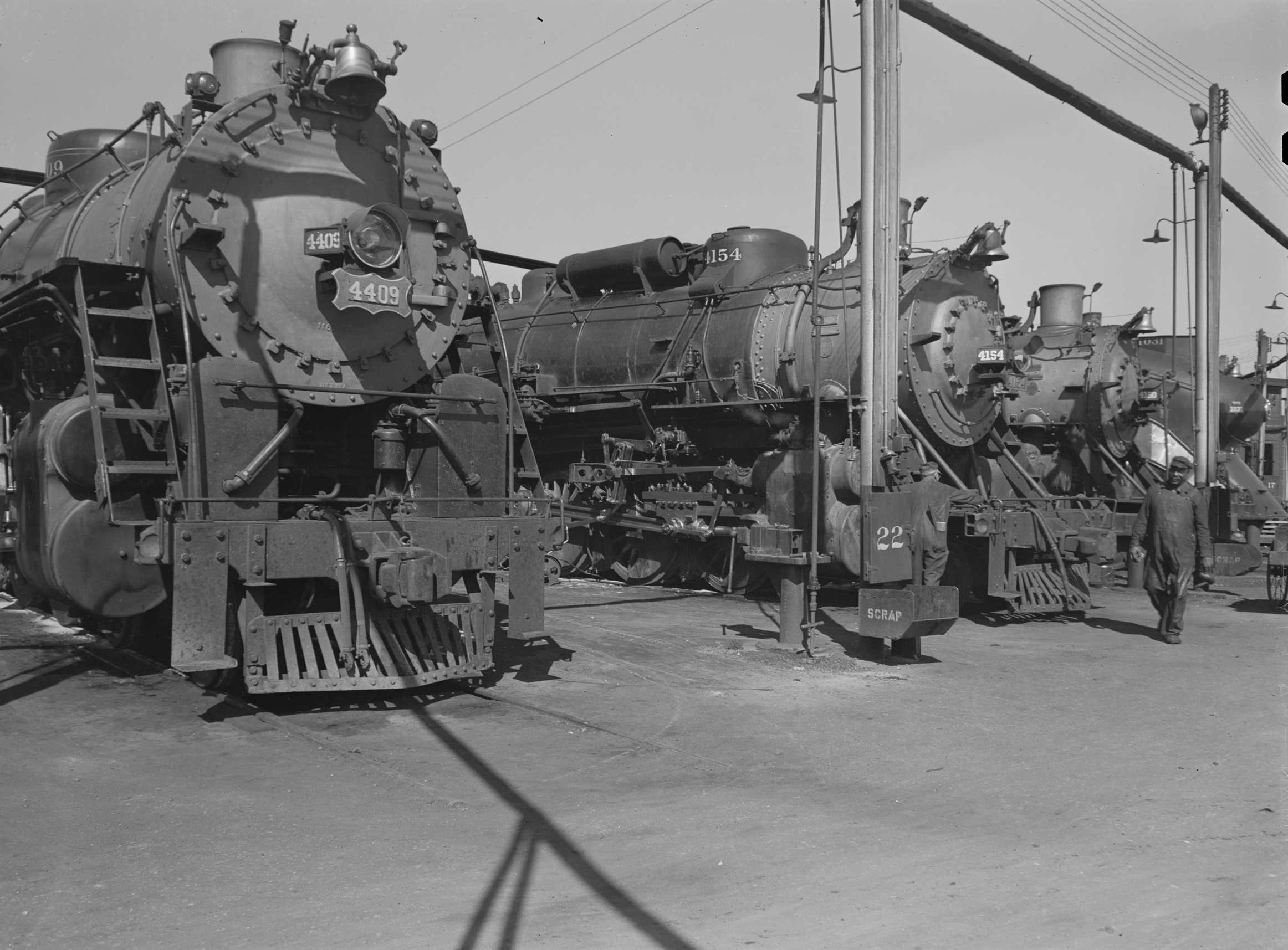
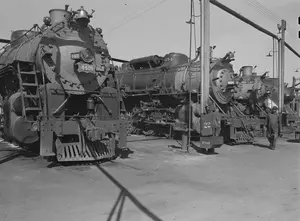
Frisco steam power lays over outside the roundhouse at Tulsa, Oklahoma in October, 1942. From left to right is 4-8-2 #4409, 2-8-2 #4154, 2-8-2 #4160, and streamlined 4-6-2 #1031 (one of three Pacifics shrouded for the "Firefly"). John Vachon photo.
On this page: At a glance · Consolidations · Mikados · Decapods, Santa Fe types, and Mallets · Mountains · Passenger locomotives · The 4-8-4s · Roster
At a glance
| Item | Detail |
|---|---|
| Railroad | St. Louis-San Francisco. Company history |
| This table | Steam locomotives on the post-1900 grid. Seven rebuilt Mikados are listed again |
| Six-wheel switchers | 106 |
| Moguls | 6. All of them inherited |
| Consolidations | 264 |
| Mikados | 125. Seven of them rebuilt from Consolidations at Springfield |
| Decapods | 21. Twenty Russian Decapods, and a replacement for No. 1621 |
| Santa Fe type | 60. Baldwin, 1916–1918 |
| Mallets | 7. 2-8-8-2s, Schenectady, 1910 |
| Americans | 32 |
| Ten-Wheelers | 268 |
| Atlantics | 12. Schenectady, 1907 |
| Pacifics | 70. Numbers 1060–1069 were later rebuilt as 4-6-4s and stay on this line |
| Mountains | 64. Thirty Baldwins, and thirty-four built at Springfield |
| 4-8-4 | 25. Baldwin, 1942–1943 |
| Quantity column | 1060 |
| Last steam in revenue | February 1952. Local freight, Birmingham–Bessemer, behind USRA 2-8-2 No. 4018 |
| Still around | 4-8-2 No. 1522, 2-10-0 No. 1630, and 4-8-4 No. 4501 |
Consolidations
The road freight engine of the new century was a 2-8-0, and the Frisco bought them in every size the builders were offering. The early ones were modest. Numbers 801–833, Dickson, Pittsburgh, and Richmond, 1900 and 1902, had 21-by-28-inch cylinders and 57-inch drivers. The 801s had been built as 501–518. Numbers 970–989, Baldwin, 1906, were about twelve tons heavier, with the firebox set above the rear drivers. Ten of that class went to the New Orleans, Texas & Mexico in 1911.
The 1200s were the engine that filled the roster. Baldwin built sixty-six, 1200–1265, in 1907 and 1909: 22-by-30-inch cylinders, 57-inch drivers, 198,000 pounds, and 43,300 pounds of tractive effort. A parallel group, 1251–1295, came from Schenectady in 1907 and was sold to the Rock Island in 1908. Those numbers were used again. The later occupants, Baldwin and Brooks engines of 1909 and 1910 in the 1266–1305 series, are different locomotives, and both rows are on the list.
The modern Consolidation was a much larger engine. Numbers 1266–1305 and 1306–1345 had 26-by-30-inch cylinders, 63-inch drivers, and a weight of 241,900 pounds. Schenectady built the forty engines of 1912. West Springfield later took seven of them and made Mikados. The railroad kept its older power polished and, more often than not, rebuilt. A clean rod was a Frisco habit. So was a new wheel arrangement under an old boiler.
Mikados
The first 2-8-2s on the list are those seven rebuilds, 1350–1356, turned out at Springfield from 1943 through 1946. The engines that defined the type had arrived a generation earlier. Thirty-three United States Railroad Administration light Mikados, 4000–4032, came in 1919 from Lima and Schenectady. They were secondhand through the Administration. The Pennsylvania had rejected the design, and the Indiana Harbor Belt had been in the same story. The Frisco took them and used them.
Baldwin’s heavy Mikados followed. Numbers 4100–4164, sixty-five engines built from 1923 through 1926, had 64-inch drivers, 210 pounds of pressure, and a booster worth 8,750 pounds. Then, in 1930, came an order of twenty that were heavier still. Numbers 4200–4219 kept the drivers and the cylinders, gained ten square feet of grate, and carried 235 pounds. Tractive effort was 68,500 pounds, plus 9,600 from the booster. They had outside-journal lead trucks, two air pumps set behind shields, concealed Coffin feedwater heaters, Baker valve gear, and welded tenders. They were the last new Mikados, and they looked it.
Decapods, Santa Fe types, and Mallets
The seven 2-8-8-2s, 2001–2007, were Schenectady engines of 1910. By the middle of the 1920s they had been sent to the coal branches in Alabama. The road freight engine the railroad actually wanted was a 2-10-2.
Baldwin built sixty of them, numbered 1–60, from 1916 through 1918. They had 29-by-30-inch cylinders, 60-inch drivers, and weighed 380,000 pounds. They were delivered without drawbars, and the Jacobs-Shupert fireboxes were replaced at once. Above about 35 miles an hour they kinked the rail. What they had, and what Springfield wanted, was the boiler. Engines 19 and 40 were kept into 1941 for the branch to Fort Leonard Wood. The rest of the class gave up its boilers to the Mountains.
The Decapods were a wartime inheritance. Twenty Russian 2-10-0s, 1613–1632, came from Richmond, Baldwin, Brooks, and Schenectady in 1918. The first 1621 was destroyed in a dynamite explosion in the 1920s. Its replacement was another Baldwin Russian of 1918, off the Fort Smith, Subiaco & Rock Island, and it took the same number. Both are on the list. In 1951 five of the Decapods went to Eagle-Picher Mining. One of those five, No. 1630, is at the Illinois Railway Museum in Union, Illinois.
Mountains
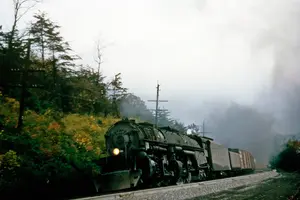
Baldwin had already built thirty 4-8-2s, 1500–1529, in 1923–1926. Springfield then built its own, and built them out of the 2-10-2s. No. 4300 came out of the shops on July 15, 1936, with 27-by-30-inch cylinders, 70-inch Scullin disk drivers, a weight of 431,110 pounds, and 66,400 pounds of tractive effort plus an 8,450-pound booster. Numbers 4301–4310 were the fast-freight engines for St. Louis–Monett. The second group used the entire 2-10-2 boiler: 70-inch drivers and 29-by-32-inch cylinders. Numbers 4400–4412 burned oil and worked in either service. Numbers 4413–4422 burned coal and worked in freight. The 4400s were the heaviest Mountains on the railroad, at 449,760 pounds. The 2-10-2 row counts thirty-three of those boilers rebuilt as 4-8-2s. The Mountain rows are thirty-four new locomotives. Both figures are on the list. Six of the Baldwin 1500s were put on display. No. 1522 was taken from the National Museum of Transportation in 1988 and ran excursions through 2002.
Passenger locomotives
The passenger engine of 1902 was still a 4-4-0 or a 4-6-0, and the Frisco owned a great many of both. Thirty-two Americans and 268 Ten-Wheelers are on this list, a mix of new Baldwins, Dicksons, and Brooks engines with whatever came along when a short line was bought. The Jonesboro, Lake City & Eastern, the Gulf, Texas & Western, the St. Louis, Brownsville & Mexico, the Kansas City, Fort Scott & Memphis, and the Blackwell, Enid & Southwestern are all in the notes. Twelve Atlantics, 1100–1111, came from Schenectady in 1907 and were the last of the four-drivered passenger engines.
The Pacific replaced them. Brooks and Baldwin built the first fifteen, 1000–1014, in 1904. Baldwin’s 1015–1039 of 1910 and Schenectady’s 1040–1059 of 1912 filled out the modern class. Three of the 1910 engines, 1018, 1026, and 1031, were shrouded at Springfield for the Firefly. The bell and the whistle stayed out in front of the shroud. The shrouds came off 1026 on May 31, 1949, off 1031 on October 4, 1949, and off 1018 on May 22, 1950. None of the three was saved. The last new Pacifics, 1060–1069, were Baldwin engines of 1917. In 1937 Springfield rebuilt them as 4-6-4s. They are still one row.
The 4-8-4s
The last new steam on the Frisco was a Northern, and it was borrowed from the Burlington. Baldwin built twenty-five 4-8-4s, 4500–4524, in 1942 and 1943, on the general lines of the Burlington’s O-5A: 74-inch drivers, 28-inch cylinders, a 31-inch stroke, and pressure that ran from 250 pounds to 255. Tractive effort was 71,200 pounds. The first twelve, 4503–4514, were coal-burning freight engines, delivered in 1942. In November 1942 three oil-burning passenger engines, 4500–4502, arrived painted blue and white for the Meteor. Ten more, 4515–4524, came in 1943 with boosters, and Springfield applied boosters to the earlier engines of the class. The freight tenders carried “Frisco Faster Freight” until 1946. No. 4501 is at the Museum of the American Railroad in Frisco, Texas, where it arrived on May 27, 2013.
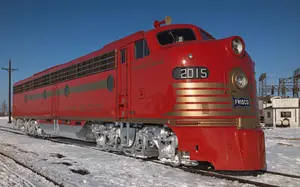
The first diesels were switchers in St. Louis during the war. The first road diesels were E7s for the Texas Special and the Meteor. A change of management in 1947 put dieselization in earnest into 1948. The last steam-powered revenue train was a local freight from Birmingham to Bessemer in February 1952, behind USRA Mikado No. 4018. Everything the railroad bought after 1900, and everything it rebuilt and counted again, is in the table.
Roster
| Type | Numbers | Qty | Builder | Built | Notes |
|---|---|---|---|---|---|
| 0-6-0 | 3539–3548 | 10 | Baldwin | 1923 | |
| 0-6-0 | 3648–3657 | 10 | Baldwin | 1906 | |
| 0-6-0 | 3670 | 1 | Pittsburgh | 1902 | Ex-St. Louis, Memphis & Southeastern 12 |
| 0-6-0 | 3671–3695 | 25 | Baldwin | 1904–1906 | |
| 0-6-0 | 3700–3712 | 13 | Dickson | 1906 | |
| 0-6-0 | 3713–3752 | 40 | Baldwin | 1907–1911 | |
| 0-6-0 | 3800–3806 | 7 | Schenectady | 1919 | USRA |
| 2-6-0 | 72, 73 | 2 | Baldwin | 1913 | Ex-Jonesboro, Lake City & Eastern |
| 2-6-0 | 365, 366 | 2 | Schenectady | 1909 | Ex-Gulf, Texas & Western 3, 4 |
| 2-6-0 | 367, 368 | 2 | Brooks | 1910 | Ex-Gulf, Texas & Western 5, 6 |
| 2-8-0 | 76, 77 | 2 | Baldwin | 1920 | Ex-Jonesboro, Lake City & Eastern |
| 2-8-0 | 801–818 | 18 | Dickson | 1900 | Built as 501–518. 21-by-28-inch cylinders, 57-inch drivers |
| 2-8-0 | 819–828 | 10 | Pittsburgh | 1902 | |
| 2-8-0 | 829–833 | 5 | Richmond | 1902 | |
| 2-8-0 | 834, 835 | 2 | Brooks | 1903 | |
| 2-8-0 | 850, 851 | 2 | Brooks | 1905 | Ex-New Iberia & Northern 1, 2 |
| 2-8-0 | 860, 861 | 2 | Brooks | 1900 | Ex-Muscle Shoals, Birmingham & Pensacola |
| 2-8-0 | 870, 871 | 2 | Pittsburgh | 1900 | Ex-Muscle Shoals, Birmingham & Pensacola |
| 2-8-0 | 956–965 | 10 | Dickson | 1902 | Ex-St. Louis, Memphis & Southeastern 270–279 |
| 2-8-0 | 970–989 | 20 | Baldwin | 1906 | Firebox above the rear drivers. Ten to the New Orleans, Texas & Mexico in 1911 |
| 2-8-0 | 1200–1265 | 66 | Baldwin | 1907, 1909 | 22-by-30-inch cylinders, 57-inch drivers, 198,000 pounds |
| 2-8-0 | 1251–1295 | 45 | Schenectady | 1907 | Sold to the Rock Island in 1908. Different engines from the later 2-8-0s in these numbers |
| 2-8-0 | 1266–1280 | 15 | Baldwin | 1909–1910 | 26-by-30-inch cylinders, 63-inch drivers |
| 2-8-0 | 1281–1292 | 12 | Brooks | 1910 | |
| 2-8-0 | 1293–1305 | 13 | Baldwin | 1910 | |
| 2-8-0 | 1306–1345 | 40 | Schenectady | 1912 | Seven rebuilt as 2-8-2s 1350–1356 |
| 2-8-2 | 1350–1356 | 7 | Springfield | 1943–1946 | Rebuilt from 2-8-0s in the 1306–1345 series. Same frames, counted again |
| 2-8-2 | 4000–4032 | 33 | Lima, Schenectady | 1919 | USRA light Mikados, acquired secondhand. 4018 drew the last steam revenue train, Birmingham–Bessemer, February 1952 |
| 2-8-2 | 4100–4164 | 65 | Baldwin | 1923–1926 | 64-inch drivers, 210 pounds, booster of 8,750 pounds |
| 2-8-2 | 4200–4219 | 20 | Baldwin | 1930 | 235 pounds. Coffin feedwater heater, Baker valve gear, welded tenders |
| 2-10-0 | 1613–1632 | 20 | Richmond, Baldwin, Brooks, Schenectady | 1918 | Russian Decapods. Five sold to Eagle-Picher Mining in 1951. No. 1630 is at the Illinois Railway Museum in Union, Illinois |
| 2-10-0 | 1621 | 1 | Baldwin | 1918 | Replacement for the first 1621, destroyed in a dynamite explosion in the 1920s. Ex-Fort Smith, Subiaco & Rock Island |
| 2-10-2 | 1–60 | 60 | Baldwin | 1916–1918 | 29-by-30-inch cylinders, 60-inch drivers, 380,000 pounds. 33 of the class rebuilt as 4-8-2s, 1936–1942. Engines 19 and 40 kept for the Fort Leonard Wood branch |
| 2-8-8-2 | 2001–2007 | 7 | Schenectady | 1910 | Sent to the Alabama coal branches in the mid-1920s |
| 4-4-0 | 182, 183 | 2 | Pittsburgh | 1902 | Ex-St. Louis, Memphis & Southeastern 23, 24 |
| 4-4-0 | 200–204 | 5 | Pittsburgh | 1902 | |
| 4-4-0 | 205–219 | 15 | Dickson | 1903 | |
| 4-4-0 | 220–229 | 10 | Rhode Island | 1903 | |
| 4-6-0 | 74, 75 | 2 | Baldwin | 1916 | Ex-Jonesboro, Lake City & Eastern |
| 4-6-0 | 467 | 1 | Baldwin | 1913 | Ex-Gulf, Texas & Western 8 |
| 4-6-0 | 479–484 | 6 | Baldwin | 1910 | Ex-St. Louis, Brownsville & Mexico 38–43 |
| 4-6-0 | 516–530 | 15 | Baldwin | 1902 | |
| 4-6-0 | 558–567 | 10 | Cooke | 1903 | |
| 4-6-0 | 573, 574 | 2 | Pittsburgh | 1902 | Ex-St. Louis, Memphis & Southeastern 21, 22 |
| 4-6-0 | 575–584 | 10 | Pittsburgh | 1902 | Ex-Kansas City, Fort Scott & Memphis 575–584 |
| 4-6-0 | 585–599 | 15 | Dickson | 1903 | |
| 4-6-0 | 600–609 | 10 | Richmond | 1902 | |
| 4-6-0 | 610–616 | 7 | Baldwin | 1903 | |
| 4-6-0 | 617–623 | 7 | Baldwin | 1903 | |
| 4-6-0 | 624–628 | 5 | Baldwin | 1903 | |
| 4-6-0 | 629–633 | 5 | Schenectady | 1905 | |
| 4-6-0 | 634–668 | 35 | Baldwin | 1904 | |
| 4-6-0 | 669–693 | 25 | Dickson | 1903 | |
| 4-6-0 | 695–699 | 5 | Brooks | 1906 | |
| 4-6-0 | 700–704 | 5 | Dickson | 1903 | Cross-compound |
| 4-6-0 | 705–724 | 20 | Brooks | 1906 | |
| 4-6-0 | 727–741 | 15 | Schenectady | 1905 | |
| 4-6-0 | 742–759 | 18 | Baldwin | 1902 | Vauclain compound |
| 4-6-0 | 760–774 | 15 | Baldwin | 1903 | |
| 4-6-0 | 775–778 | 4 | Baldwin | 1903 | Ex-St. Louis, Memphis & Southeastern 620–623 |
| 4-6-0 | 779–784 | 6 | Baldwin | 1903 | Ex-Blackwell, Enid & Southwestern 624–629 |
| 4-6-0 | 785–799 | 15 | Baldwin | 1903 | |
| 4-6-0 | 1400–1409 | 10 | Baldwin | 1907 | |
| 4-4-2 | 1100–1111 | 12 | Schenectady | 1907 | |
| 4-6-2 | 1000–1009 | 10 | Brooks | 1904 | |
| 4-6-2 | 1010–1014 | 5 | Baldwin | 1904 | |
| 4-6-2 | 1015–1039 | 25 | Baldwin | 1910 | 1018, 1026, and 1031 shrouded for the Firefly |
| 4-6-2 | 1040–1059 | 20 | Schenectady | 1912 | |
| 4-6-2 | 1060–1069 | 10 | Baldwin | 1917 | Rebuilt as 4-6-4s in 1937. Same frames |
| 4-8-2 | 1500–1529 | 30 | Baldwin | 1923–1926 | Six put on display. 1522 ran excursions from 1988 through 2002 |
| 4-8-2 | 4300–4310 | 11 | Springfield | 1936–1937 | 4300 outshopped July 15, 1936. 70-inch drivers. New engines, using 2-10-2 boilers |
| 4-8-2 | 4400–4422 | 23 | Springfield | 1939–1942 | 4400–4412 oil, dual service. 4413–4422 coal, freight. Heaviest Mountains, 449,760 pounds |
| 4-8-4 | 4500–4524 | 25 | Baldwin | 1942–1943 | 4500–4502 oil, for the Meteor, November 1942. 4503–4514 coal freight, 1942. 4515–4524 in 1943, with boosters. 4501 is at the Museum of the American Railroad in Frisco, Texas |
Related Reading
Sources
- George H. Drury, Guide to North American Steam Locomotives, revised edition, St. Louis-San Francisco chapter, pp. 286–287. The wheel arrangements, the quantities, the builders, and the years. The quantity column is 1060.
- Joe G. Collias, Frisco Power: Locomotives and Trains of the St. Louis-San Francisco Railway, 1903–1953 (M M Books, 1984). The railroad’s own practice with what it had bought.
- Railroad magazine locomotive rosters, November 1934, p. 41, and July 1948, p. 98.
Recent Articles


-
NYC's "Xplorer" (Train): Concept, Consist, Photos
Nov 21, 26 10:47 PM
 New York Central Xplorer, the Ohio Xplorer, Cleveland to Cincinnati in 1956. Pullman-Standard Train X cars, Baldwin-Lima-Hamilton locomotive 20, trains 423 and 424, timetable, consist, and photographs…
-
Frisco Diesel Roster (All-Time)
Nov 21, 26 10:27 PM
 St. Louis-San Francisco diesel locomotives, each frame once. From VO-1000 No. 200 in 1941 through the GP40-2s and SD38-2s of 1979.
-
Frisco Steam Roster (Built Since 1900)
Nov 21, 26 10:18 PM
 St. Louis-San Francisco steam locomotives built since 1900. Mikados, Mountains, and twenty-five 4-8-4s.
-
Robert R. Young: Net Worth, Railroads, Biography
Nov 21, 26 09:47 PM
 Robert Ralph Young, born February 14, 1897, in Canadian, Texas, chaired the Chesapeake and Ohio and, in 1954, the New York Central. He died on January 25, 1958, in Palm Beach.
-
St. Louis-San Francisco Railway (Frisco): Map, Rosters, History
Nov 21, 26 06:37 PM
 History of the St. Louis-San Francisco Railway, the Frisco. The Pacific Railroad, the coonskin, Yoakum, Pensacola, and the Burlington Northern merger of November 21, 1980. Steam and diesel rosters are…
-
Kuhn, Loeb and Company: Net Worth, Railroads, History
Nov 21, 26 01:34 PM
 Kuhn, Loeb and Company was the New York banking house in E. H. Harriman's circle. Abraham Kuhn and Solomon Loeb opened the banking partnership in 1867. Jacob H. Schiff joined on January 1, 1875.
-
Otto Kahn: Net Worth, Railroads, Biography
Nov 21, 26 01:22 PM
 Otto Hermann Kahn was born in Mannheim on February 21, 1867. He died in New York on March 29, 1934. He was the Kuhn, Loeb partner in E. H. Harriman's railroad work.
-
George Pullman: Net Worth, Palace Cars, Biography
Nov 21, 26 11:01 AM
 George M. Pullman was born at Brocton on March 3, 1831. He died in Chicago on October 19, 1897. He built the palace-car company that owned the sleeping cars.
-
Arthur E. Stilwell: Net Worth, Railroads, Biography
Nov 21, 26 12:33 AM
 Arthur E. Stilwell was born in Rochester on October 21, 1859. He died in New York on September 26, 1928. He built the road to Port Arthur and the Kansas City, Mexico and Orient.
-
Frederick Weyerhaeuser: Net Worth, Railroads, Biography
Nov 21, 26 12:22 AM
 Frederick Weyerhaeuser was born at Niedersaulheim on November 21, 1834. He died at Pasadena on April 4, 1914. He was a lumberman and a railroad director.
-
John Murray Forbes: Net Worth, CB&Q, Biography
Nov 21, 26 12:13 AM
 John Murray Forbes was born at Bordeaux on February 23, 1813. He died at Milton on October 12, 1898. He was chairman of the Chicago, Burlington and Quincy.
-
Henry B. Plant: Net Worth, Plant System, Biography
Nov 20, 26 10:27 PM
 Henry Bradley Plant was born at Branford, Connecticut, on October 27, 1819. He died at his home on Fifth Avenue on June 23, 1899. He was president of the Plant system and of the Southern Express Compa…
-
Henry Flagler: Net Worth, Florida East Coast, Biography
Nov 20, 26 10:00 PM
Henry Flagler was born at Canandaigua, New York. He died at Whitehall on May 20, 1913, at 83, and was buried at Memorial Presbyterian Church in St. Augustine. -
William Rockefeller: Net Worth, Railroads, Biography
Nov 20, 26 11:50 AM
 William Rockefeller was born in Richford, New York, on May 31, 1841. The Associated Press dates his death June 24, 1922, at Rockwood Hall. Redmond dates it June 23, at Pocantico Hills.
-
William H. Vanderbilt: Net Worth, Railroads, Biography
Nov 20, 26 10:08 AM
 William H. Vanderbilt was born in New Brunswick, New Jersey, on May 8, 1821. He died in New York City on December 8, 1885. His will names two blocks of $40,000,000 and states no total.
-
J. Edgar Thomson: Net Worth, Pennsylvania Railroad, Biography
Nov 20, 26 12:25 AM
 J. Edgar Thomson was born in Springfield, Delaware County, Pennsylvania, on February 10, 1808. He died in Philadelphia on May 27, 1874. No opened inventory states a total.
-
Thomas A. Scott: Net Worth, Railroads, Biography
Nov 20, 26 12:06 AM
Thomas A. Scott was born at Loudon, Pennsylvania, on December 28. The year is 1823 in one biography and 1824 on the funeral plate. He died near Darby on May 21, 1881. No opened inventory states a tota… -
Henry Villard: Net Worth, Railroads, Biography
Nov 19, 26 11:41 PM
 Henry Villard was born Ferdinand Heinrich Gustav Hilgard at Speyer on April 10, 1835, and died early on November 12, 1900, at Thorwood Park, near Dobbs Ferry. He was 65. A court recital put the person…
-
J.P. Morgan: Net Worth, Railroads, Biography
Nov 19, 26 07:03 PM
 John Pierpont Morgan was born in Hartford on April 17, 1837, and died in Rome on March 31, 1913, at 12:05 p.m. Rome time. He was 75. A 1916 New York appraisal put the gross estate at $78,149,024, excl…
-
Daniel Willard: Net Worth, Baltimore and Ohio, Biography
Nov 19, 26 06:51 PM
 Daniel Willard was born on January 28, 1861, and died on July 6, 1942. He was 81. He was president of the Baltimore and Ohio from January 15, 1910 until 1941. No opened record states a fortune. Time p…
-
Cyrus K. Holliday: Net Worth, Santa Fe, Biography
Nov 19, 26 06:03 PM
 Cyrus Kurtz Holliday was born April 3, 1826, and died in Topeka on March 29, 1900. He was 73. He founded Topeka, wrote the Atchison and Topeka charter, and was the railroad's first president. He l…
-
N&W 2-6-6-4 Locomotives (Class A): Specs, Roster, History
Nov 19, 26 05:39 PM
 Norfolk & Western Class A. Forty-three simple 2-6-6-4s, 1200 to 1242, built at Roanoke from 1936 to 1950 for time freight and used on passenger trains when assigned. Diagram specs, the 114,000-pou…
-
Jay Cooke: Net Worth, Civil War, Biography
Nov 19, 26 05:05 PM
 Jay Cooke was born at Sandusky on August 10, 1821, and died the night of February 16, 1905, at Ogontz. He was 83. Jay Cooke and Company opened January 1, 1861, and suspended September 18, 1873. He sol…
-
Daniel Drew: Net Worth, Erie Railroad, Biography
Nov 19, 26 04:44 PM
 Daniel Drew was born at Carmel on July 29, 1797, and died the night of September 18, 1879, age 82. He was Erie treasurer, not president. The settlement of July 2, 1868, put him out of that office.
-
James Fisk Jr.: Net Worth, Robber Baron, Biography
Nov 19, 26 02:47 PM
 James Fisk Jr. was born on April 1, 1835, and died the morning of January 7, 1872, at the Grand Central Hotel. He was 36. Edward S. Stokes shot him the afternoon before. He was an Erie director from O…
-
Chehalis-Centralia Polar Express Seats Are Sold Out
Nov 19, 26 02:43 PM
Chehalis-Centralia marks its Polar Express departures sold out. Diesel No. 6 is pulling while steam No. 15 is repaired. The business-car page still prints $260, $390, and $520. -
Cumbres & Toltec Lists Santa's Holiday Express
Nov 19, 26 02:38 PM
 Cumbres & Toltec lists Santa's Holiday Express for December 5-6 in Chama and December 12-13 in Antonito. Coach is $25. The Chama trip will not run to Dalton.
-
Florida Railroad Museum Lists the North Pole Express
Nov 19, 26 02:28 PM
 The Florida Railroad Museum lists the North Pole Express from November 27 through December 22, 2026. The trip is 3.75 hours. The museum will be closed November 21 and 22.
-
George Jay Gould: Net Worth, Railroads, Biography
Nov 19, 26 02:18 PM
 George Jay Gould was born in New York on February 6, 1864, and died on May 16, 1923, at his villa in France. The company pages date his father's portfolio to 1896. The Panic of 1907 broke the tran…
-
Jay Gould: Net Worth, Railroads, Biography
Nov 19, 26 01:43 PM
 Jason Gould, called Jay, was born at Roxbury on May 27, 1836, and died the morning of December 2, 1892. Erie president from October 1868 until 1872. From 1879 the Missouri Pacific was the center of th…
-
Mark Hopkins Jr.: Net Worth, Railroads, Biography
Nov 19, 26 11:53 AM
 Mark Hopkins Jr., born at Henderson on September 1, 1813, died at Fort Yuma on the night of March 29, 1878. Treasurer of the Central Pacific from June 28, 1861, until he died in that office. The 1881…
-
Leland Stanford: Net Worth, Railroads, Biography
Nov 19, 26 12:36 AM
 Amasa Leland Stanford, Watervliet 1824 to the Palo Alto house in June 1893, president of the Central Pacific and, until February 28, 1890, of the Southern Pacific. The 1893 inventory was about 17 mill…
-
Charles Crocker (Railroads): Robber Baron, Net Worth, Biography
Nov 19, 26 12:23 AM
 Charles Crocker, Troy 1822 to August 14, 1888, built the Central Pacific and drove the Siskiyou spike. He did not die president of the Southern Pacific. The opened biographies state no estate total.
-
Edward H. Harriman (Railroad): Facts, Robber Baron, Biography
Nov 19, 26 12:18 AM
 Edward Henry Harriman, February 25, 1848, to September 9, 1909, president of the Union Pacific from 1904 until he died in that office. The Courier-Journal put the known estate on the public record at…
-
Collis P. Huntington: Net Worth, Railroads, Biography
Nov 18, 26 11:26 PM
 Collis Potter Huntington, 1821 to 1900, vice president of the Central Pacific and president of the Southern Pacific from February 28, 1890, until he died in that office. The will stated no total. The…
-
Detroit Terminal Railroad: History, Roster
Nov 18, 26 10:47 PM
 The Detroit Terminal Railroad was a Detroit and Highland Park belt line, incorporated December 8, 1905. The November 1944 Guide listing gives 17.994 miles of first main track.
-
James J. Hill: Net Worth, Railroads, Robber Baron, Facts
Nov 18, 26 09:19 PM
 James J. Hill, 1838 to 1916, built the Great Northern from the St. Paul and Pacific to Puget Sound and left the chair in 1912. The fortune was estimated at $63 million. He left no will.
-
Cornelius Vanderbilt: Biography, Facts, Net Worth
Nov 18, 26 05:21 PM
 Cornelius Vanderbilt, 1794 to 1877, assembled the New York Central and Hudson River from the Harlem, the Hudson River Railroad, and the original New York Central, and died in office. The estate was ab…
-
Pacific Great Eastern Railway: All-Time Diesel Roster
Nov 18, 26 12:24 PM
 All-time diesel roster of the Pacific Great Eastern, the British Columbia Railway, and BC Rail. Classes, road numbers, and builder data from Paul Crozier Smith, Canadian Rail no. 547 (2012).
-
Pacific Great Eastern Railway: Map, History, Roster
Nov 18, 26 10:22 AM
 The Pacific Great Eastern, incorporated February 27, 1912, became the British Columbia Railway Company on March 30, 1972. On the October 26, 1969 Official Guide, 861.9 miles were under operation. Cana…
-
Northern Alberta Railways: Map, History, Timetables
Nov 17, 26 11:52 PM
 Northern Alberta Railways, reporting mark NAR, was incorporated June 14, 1929, and owned jointly by Canadian National and Canadian Pacific. On the October 27, 1968 freight timetable, Dawson Creek is 4…
-
Yakima Valley Transportation: History, Timetable, Photos
Nov 17, 26 10:51 PM
 Yakima Valley Transportation opened Christmas Day, 1907. Union Pacific bought it June 9, 1909. Last city car February 1, 1947. Last freight November 18, 1985. Line car A and steeplecab 298 stayed in Y…
-
"20th Century Limited" (Train): Map, Consist, Schedule, Interior
Nov 17, 26 05:03 PM
 The 20th Century Limited was the flagship passenger train of the NYC, operating until 1967 (just prior to the Penn Central merger).
-
Western Pacific Diesel Roster (All-Time)
Nov 17, 26 04:52 PM
 Western Pacific all-time diesel roster. Why the switchers, covered wagons, road switchers, and General Electric units were bought, where they worked, and what Union Pacific inherited on December 22, 1…
-
Western Pacific Steam Roster (Built Since 1900)
Nov 17, 26 04:49 PM
 Western Pacific steam locomotives built since 1900. Drury quantity column 201. Thirteen rows. Mikado 329 made the last regular steam run in June 1953.
-
Western Maryland Scenic Lists Polar Express Fares
Nov 17, 26 03:30 PM
 Western Maryland Scenic lists Polar Express tickets from November 21 through December 24, 2026. Coach is $40, plus a $5 heritage fee. Excursions are diesel while No. 1309 is inspected.
-
Western Pacific Railroad: Map, History, Logo, Rosters
Nov 17, 26 11:12 AM
 The Western Pacific, organized in San Francisco on March 3, 1903, the Feather River Route to Salt Lake City, and the Union Pacific acquisition completed on December 22, 1982.
-
Spokane, Portland & Seattle Diesel Roster (All-Time)
Nov 17, 26 10:53 AM
Spokane, Portland and Seattle all-time diesel roster. Why the Alcos, Baldwins, and Electro-Motive units were bought, where they worked, and which numbers Burlington Northern inherited. -
Spokane, Portland & Seattle Steam Roster (Built Since 1900)
Nov 17, 26 10:46 AM
 Spokane, Portland and Seattle steam locomotives built since 1900. Drury quantity column 121. Rebuilds counted once, 115 frames. Last steam run was June 23, 1956.
-
Spokane, Portland & Seattle Railway: Map, History, Photos
Nov 17, 26 10:10 AM
 The Spokane, Portland and Seattle, organized August 22, 1905 as the Portland and Seattle, the north-bank line to Portland, and the Burlington Northern merger at 12:01 a.m. on March 2, 1970.