Western Pacific Diesel Roster (All-Time)
Published: November 17, 2026
By: Adam Burns
The first diesel on the Western Pacific was a switcher, not a road set. On September 26, 1939, Electro-Motive demonstrator 906 began a thirty-hour test at Elko, Nevada. The railroad bought that engine and two more. They became SW1s 501–503. The 1973 brochure dates the start of freight diesel operation to 1939. George H. Drury, in the steam chapter, dates the first FTs to 1941. Both dates stay. The SW1s are the first diesels. The FTs are the first road diesels.
The Feather River Rail Society's motive-power index divides the all-time diesel roster into 214 Electro-Motive units, five Baldwins, twenty-four Alcos, and thirty-six General Electric units. The tables here are the locomotives the society's class pages name, one frame to a row. A renumber is the same locomotive. What the quantity column adds to is in the glance. Don Strack's December 1982 list is the fleet still on the property when Union Pacific took over, and he prints 145. Units already gone are not in that 145. The company story is the Western Pacific page. The steam classes are the steam roster.
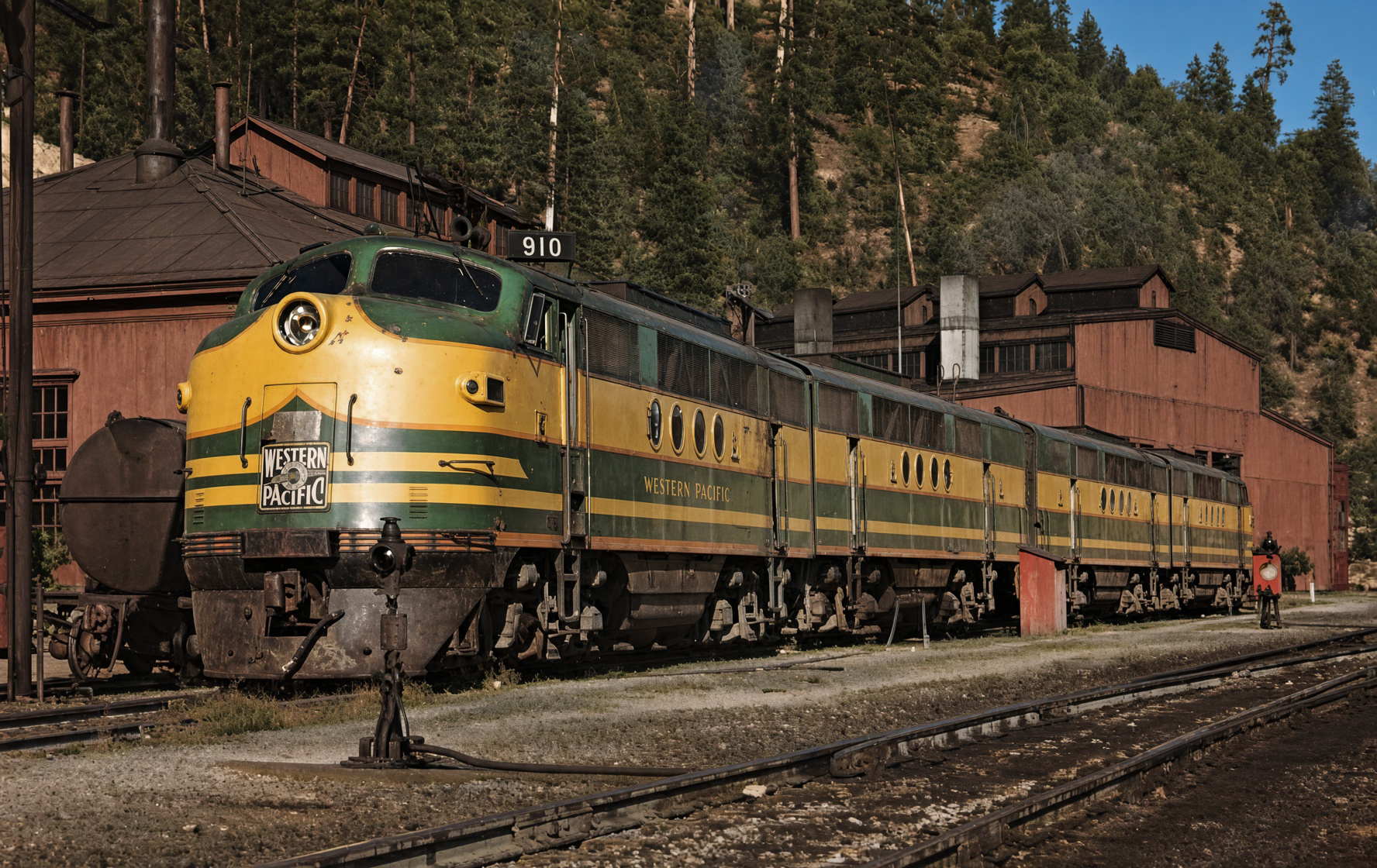
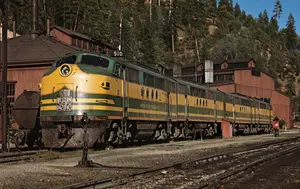
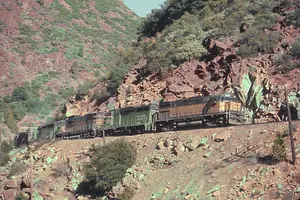
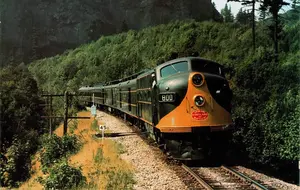
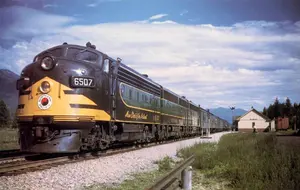
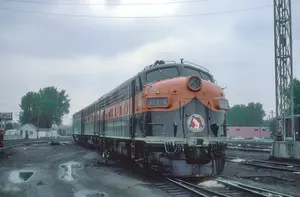
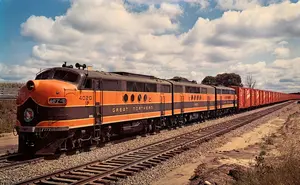
Western Pacific FTs, in the original livery, between assignments at Keddie, California, in August 1949. Guy Dunscomb photo.
On this page: At a glance · Numbers · Switchers · Covered wagons · Road switchers · General Electric · After December 22, 1982 · Sources
At a glance
| Item | Detail |
|---|---|
| Railroad | Western Pacific. Company Western Pacific. Union Pacific completed the acquisition on December 22, 1982 |
| Builders | Electro-Motive, Alco, Baldwin, and General Electric, plus two Budd RDC-2 railcars. No Fairbanks-Morse unit was bought |
| Quantity column | 303. Each frame once. Sacramento Northern numbers on former Western Pacific switchers and GP7s are the same locomotives |
| Society shares | 214 Electro-Motive, five Baldwin, twenty-four Alco, thirty-six General Electric. The 214 matches this list when the forty-eight FT frames are counted as twenty-four A-B sets. The switcher pages name twenty-two Alcos. The five Baldwins are VO-1000s 581–585. The thirty-six General Electric units are the U30Bs and the U23Bs |
| 1939 | SW1s 501–503. Demonstrator 906 became 501. The brochure's first freight diesels are this year. Drury's first FTs are 1941 |
| 1950 | The index says forty-six new units, four of them Alco S2s. The class pages place S2s 559–562, F7 sets 913–921, and the 804–805 passenger locomotives in that year. The two Budd cars are not in the forty-six |
| Merger day | Strack prints 145, as of December 1982. His GP20 row reads 2001–2010 and quantity 9. His U23B row reads 2251–2265 and quantity 13 |
| Steam | Western Pacific steam roster. The dieselization account dates full dieselization to GP7s 710–713 on April 14, 1953. The steam roster's last regular run is Mikado 329 in June 1953 |
Numbers
Each row is one group of frames. The quantity is the count of locomotives on that row. A second number in the notes is a renumber of the same frame. SW1s 501–503 later carried Sacramento Northern numbers. F3s 801A, 802A, and 801D became 925A, 925D, and 926A in 1968. U30Bs 751–769 became 3051–3069 in 1972, except 765, which was not renumbered. FP7 cabs delivered with a C suffix became D on April 11, 1951. GP40s 3540 and 3541 were briefly 1776 and 1976. F7 920A later became 913. None of those is a second locomotive.
The index counts twenty-four FT A-B sets. The dieselization page counts a dozen four-unit sets, 901 through 912. This list counts forty-eight frames. This site's FT page letters the cabs 901 and 901C, and the boosters 901A and 901B. The society's own pages letter a four-unit set A-B-C-D, with A and D the cabs. Both letter systems stay. The covered-wagon page dates two further FT orders to April 30, 1941, and September 1943, and calls each an order for six A-B-B-A sets. The dieselization page counts three sets in 1943 and six sets in 1944. The rows follow the twelve sets, which is what the FT page lists.
This site's Ontario & Western diesel roster sends cabs 501 and 502 on to Western Pacific 301 and 302, and cab 503 on to Sacramento Northern 303, then Western Pacific 801D, later 926A. The covered-wagon page names only that one extra cab, as 801-D. Nos. 301 and 302 are not in this quantity column. Pooled Burlington Northern and Union Pacific locomotives are not on it either. The three water cars made from Mountain tenders are not locomotives.
Switchers
The SW1s were ordered with a welded frame, which is the SW in the model name, and they were rated at 600 horsepower. The railroad had first planned to number them 167–169, after the 0-6-0s. Demonstrator 906 was renumbered 501 before 502 and 503 were delivered. The other two were shipped on December 6, 1939. They were black, with aluminum striping. Stockton was too busy, and the other yards were too hilly, so they settled in Sacramento and the Bay Area. The switcher page says all three moved to the Sacramento Northern in 1965 as 401–403. An earlier page in the same series says two of them became 401 and 402. Strack's merger list has one SW1 left, Sacramento Northern 402, and no Union Pacific number.
The S1s were the next yard engines because Electro-Motive and Baldwin could not promise a delivery. Alco could. The order for eight, 504–511, was placed on October 17, 1941, for March 1942. They arrived in April, May, and June 1942. The dieselization series dates the same eight to 1941. The table uses the switcher page. They released road steam from the yards and spent their lives at Portola, Oroville, Sacramento, Stockton, and Oakland, with short turns on the Sacramento Northern and the Tidewater Southern. Nos. 509 and 511 went to General Electric against U30Bs in December 1967. No. 504 became Sacramento Northern 405 at the same time. Nos. 505 and 506 were the engines traded to the Stockton Terminal & Eastern for the two NW2s. The switcher page dates that trade to October 1968. Strack dates it to 1969.
The S1s were light for the heavier cuts. Eight S2s, 551–558, were ordered on November 10, 1942, and delivered in 1943 under War Production Board schedules, at about $80,000 each. Four more, 559–562, were ordered on November 21, 1949, arrived in February 1950, and cost nearly $103,000. Those four had multiple-unit connections. They are the four Alco S2s in the index's count of forty-six new units for 1950. The last of them, 557, 560, and 561, went to the Stockton Terminal & Eastern in 1976. The page does not name every earlier sale. Two S4s, 563 and 564, were ordered when the Korean War raised the chance of new controls. They were the last new Alcos, and the last switchers delivered in black. No. 563 is at the Western Pacific Railroad Museum in Portola. No. 564 went to the Stockton Terminal & Eastern.
Five VO-1000s, 581–585, were the Baldwin diesel switchers. The railroad had wanted NW2s. Electro-Motive could not deliver, the order was canceled in June 1945, and Baldwin had five slots. They arrived late in 1945, black, with four stacks and an eight-cylinder De La Vergne engine. No. 584 became Sacramento Northern 407 on July 17, 1970. Nos. 581 and 583 were the last two. They were sold on September 10, 1973, and ended up on the Auto-Train at Sanford, Florida. The switcher page says those two were later scrapped, and that no Western Pacific VO-1000 survives.
Six SW9s were ordered in 1952, built at Cleveland, and delivered in June and July as the first switchers in orange and aluminum. The switcher-page heading reads 601–605. The same page says the order was for six, and the dieselization page numbers them 601–606. The row is six. They were meant for branches and locals. The AAR switcher trucks rode too hard, so the branches went to the GP7s and the SW9s stayed in the yards. All six were still in service at the merger. Four of them were rebuilt into Union Pacific SW10s 1271–1274. No. 602 went to Western Cooperative Fertilizer at Calgary. No. 604 was sold to Pielet Brothers at McCook, Illinois, in May 1984.
The two NW2s were not new. No. 607 had been Electro-Motive demonstrator 889, bought by the Union Pacific in March 1940 as D.S. 1000. No. 608 was D.S. 1001. The Stockton Terminal & Eastern bought the pair in 1966, then traded them back for S1s 505 and 506. Western Pacific rebuilt them from 1,000 to 1,200 horsepower and numbered them 607 and 608. No. 607 moved to the Sacramento Northern in May 1973 and kept its number. Strack's 1987 list retires 607 to the Heber Creeper and 608 to the Feather River Rail Society. The switcher page says 1002 is at Portola as 608, and that Union Pacific 1000 is preserved at Boulder City. The two sentences are left as printed.
The SW1500s were the last new switchers, and they were leased, not purchased. An order for eight, which the dieselization page numbers 611–618, was canceled in 1970 and replaced by ten GP40s, 3517–3526. Three SW1500s, 1501–1503, were ordered in 1972 and delivered in May 1973, green, on Flexicoil trucks, with 1,100-gallon tanks. They started at Stockton and moved to Oakland and San Francisco. When the ferry stopped at the end of 1978, all three worked in Oakland. They kept their numbers into the Union Pacific, were renumbered 1315–1317 in 1987 and 1988, and were bought by the Union Pacific on January 3, 1989, when the lease ended. In 2001 they became UPY 1040–1042. No. 1503 came back to Portola in October 2011.
| Model | Road numbers | Qty | Built | Notes |
|---|---|---|---|---|
| SW1 | 501–503 | 3 | 1939 | 501 was Electro-Motive demonstrator 906. The other two shipped on December 6, 1939. Switcher page: Sacramento Northern 401–403 in 1965. An earlier page says two, as 401–402 |
| S1 | 504–511 | 8 | April–June 1942 | Ordered October 17, 1941. The dieselization series dates them 1941. 509 and 511 traded to GE in December 1967. 504 to Sacramento Northern 405 |
| S2 | 551–558 | 8 | 1943 | Ordered November 10, 1942. About $80,000 each. 557, with 560 and 561, to the Stockton Terminal & Eastern in 1976 |
| S2 | 559–562 | 4 | February 1950 | Ordered November 21, 1949. Multiple-unit connections. Nearly $103,000 each. The index's four Alco deliveries of 1950 |
| S4 | 563–564 | 2 | 1950 | Last new Alcos. Last black switchers. 563 is at Portola. 564 sold to the Stockton Terminal & Eastern |
| VO-1000 | 581–585 | 5 | Late 1945 | NW2 order canceled in June 1945. 581 and 583 sold on September 10, 1973, and went to the Auto-Train |
| SW9 | 601–606 | 6 | June–July 1952 | Built at Cleveland. The switcher-page heading reads 601–605. Four became Union Pacific SW10s 1271–1274 |
| NW2 | 607–608 | 2 | 1940 | Not new. 607 was demonstrator 889, Union Pacific D.S. 1000. 608 was D.S. 1001. Trade dated October 1968 on the switcher page and 1969 by Strack |
| SW1500 | 1501–1503 | 3 | May 1973 | Leased. Union Pacific 1315–1317, then UPY 1040–1042. 1503 donated to Portola, arrived October 2011 |
Covered wagons
The road-diesel trial was not a purchase. On May 6, 1940, the Rio Grande delivered Electro-Motive FT demonstrator 103 to Roper Yard in Salt Lake City. The four-unit set was rated at 5,400 horsepower and worked 2,077 miles on the Western Pacific. The railroad liked the fuel bill, the lack of water stops, and the lighter maintenance. It became Electro-Motive's fifth FT customer. Orders E411 and E412, for six cabs and six boosters, are dated March 25, 1941, on the covered-wagon page. The dieselization page says the first three sets were purchased in 1940. Delivery of set 901 began on November 29, 1941, and set 903 was finished on January 10, 1942. The paint was green and yellow with red stripes. It was not repeated.
Three more sets, 904 through 906, came in 1943. Six more, through 912, came in 1944. Booster 912-C carried a steam generator for emergency passenger work. The sets could be split into A-B pairs. The noses had no multiple-unit connectors, so the railroad never made that change, and the FTs did not run with the later F7s. By the middle of the 1960s the survivors were on work trains and locals. In 1967 the last of them, 905C and 905D, 908A and 908B, and 909C and 909D, took a train east to Salt Lake City and went on to Electro-Motive as trade-in material. Sets 903 and 907 were the only ones retired complete. The first set, 901, had already gone in on the GP20s.
The California Zephyr needed its own locomotives. After a test of demonstrator 754, the railroad ordered three F3 A-B-B sets on August 20, 1945, with a steam generator in every unit. The covered-wagon page says they were not delivered until July 1947. The dieselization page says June and July 1947. They were silver and orange, with black roofs, and they broke in on freight and on the Exposition Flyer. The steam generators failed on every run in the first thirty days. Oakland got them reliable enough to heat a twelve-car train. One more cab arrived in 1957. It had been New York, Ontario & Western 503, then Sacramento Northern 303, and it was leased as 801-D. It had no stainless-steel panels and no steam generator. In 1968 it became 926A. By the end of 1971 the F3s were gone, traded on newer power.
Two FP7 A-B-A sets, 804 and 805, arrived in 1950 to supplement the F3s. The cabs were delivered as 804A, 804C, 805A, and 805C. The C suffixes became D on April 11, 1951, so the passenger cabs matched the freight lettering. The boosters were F7Bs 804B and 805B. The covered-wagon page says there was no such thing as an FP7B. The extra four feet in the FP7, 54 feet 8 inches against 50 feet 8 inches, was water capacity. Two F3 cabs then left the Zephyr and dieselized the Royal Gorge. Three tenders from Mountains 174, 175, and 177 became water cars 853, 851, and 852. They are not in the table. The company-page captions of August 26, 1967, call one locomotive an F7A, No. 805D, and an FP7, No. 805-D. The covered-wagon page calls the cab an FP7. Only 805A remains, at Portola. Its later years on the Wellsville, Addison & Galeton, and the parts-donor career of F7B 921C, are on that page.
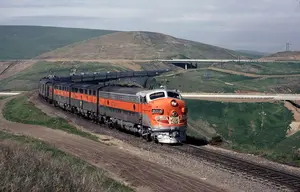
Freight F7s came as A-B-B-A sets that were not coupled for life. Sets 913 through 921 were delivered from January 31 to February 7, 1950, at $653,408 a set. Sets 922 through 924 were ordered in November 1950 and delivered in June 1951, at $675,533 a set. Only the B-suffix units had steam generators. The railroad rated them at 1,375 tons each in the canyon and 2,275 tons on the First Subdivision. They wore silver and orange, with a black roof and an orange pilot. The first off the roster were 916A and 924D, wrecked at Beowawe, Nevada, on September 21, 1963, the same day GP20 2003 was wrecked there. They are not the same locomotive. No. 916A was traded against GP35 3021, and 924D was credited against 3022. In September 1967, cabs 917A and 923A were sold to Mt. Newman Mining in Australia through Bechtel.
By late 1972 every B unit was gone. The last were 914C and 918C, traded to General Electric on September 13. Six cabs were left: 913A, in its second use of that number, plus 914A, 915D, 917D, 918D, and 921D. The second 913 was the former 920A. On July 1, 1975, the letter suffixes came off, except on 914A, which had burned on August 9, 1972, and was sold for scrap on October 15, 1975. No. 915 was scrapped in April 1979. What remained were the four the railroad called the Fabulous Four, 913, 917, 918, and 921. Their job was the San Jose Turn, Stockton to San Jose over Altamont, about 300 miles a day. Strack's merger list still shows F7As 917 and 921, with no Union Pacific numbers. The covered-wagon page says 917D and 921D are both at Portola. Strack sends 917 to the Western Railway Museum at Rio Vista Junction, delivered on October 15, 1983, and 921 to Portola.
| Model | Road numbers | Qty | Built | Notes |
|---|---|---|---|---|
| FT | 901–903 | 12 | November 1941–January 1942 | Three A-B-B-A sets. Orders E411 and E412 on the FT page: cabs 1410–1415, boosters 1416–1421. Set 901 traded on the GP20s |
| FT | 904–906 | 12 | June–September 1943 | Orders E559 and E560. Cabs 2096–2101. Boosters 2102–2107 |
| FT | 907–911 | 20 | July–September 1944 | Order E633. Cab serials 2783–2792. Booster serials 2795–2804. Not one continuous span |
| FT | 912 | 4 | November 1944 | Same order. Cabs 2793–2794. Boosters 2805–2806. Booster 912-C had a steam generator |
| F3 | 801–803 | 9 | 1947 | Three A-B-B sets. Ordered August 20, 1945. July 1947 on the covered-wagon page. June and July 1947 on the dieselization page |
| F3 | 801-D | 1 | 1948 | Ex-Ontario & Western 503, then Sacramento Northern 303. Leased in 1957. Later 926A. The sister cabs that became 301 and 302 are not in this column |
| FP7 | 804A, 804C, 805A, 805C | 4 | 1950 | Two A-B-A sets. The C suffixes became D on April 11, 1951. 805A is at Portola |
| F7B | 804B, 805B | 2 | January 1950 | Boosters in the FP7 sets. This site's F7 page: serials 9006–9007, order 6043. There was no FP7B |
| F7 | 913–921 | 36 | January 31–February 7, 1950 | Nine A-B-B-A sets. $653,408 a set. F7 page: cabs 8962–8979 and boosters 8980–8997, order 3006 |
| F7 | 922–924 | 12 | June 1951 | Ordered November 1950. $675,533 a set. F7 page: cabs 10803–10808 and boosters 10809–10814, order 3040 |
| RDC-2 | 375–376 | 2 | May and July 1950 | $130,000 each. Trains 1 and 2. The dieselization page says they were sold to the Northern Pacific and later became Amtrak 31 and 32. The Northern Pacific diesel roster on this site does not list them |
The two Budd cars replaced conventional equipment on the Royal Gorge, which the dieselization page says had been the Feather River Express and which ended on September 14, 1950. The railroad called the railcars the Zephyrettes. They ran tri-weekly between Oakland and Salt Lake City, on a schedule that complemented the California Zephyr. They are outside the society's builder shares. The index's forty-six new units of 1950 are the locomotives, not these two cars.
Road switchers
After the June 1951 F7s, the railroad wanted a cab and a set of controls on every unit. The GP7 was the same machinery as an F7, in a hood. Nine of them, 701–709, arrived in silver and orange with dual controls and a barrel headlight. The page does not date that delivery. Four more, 710–713, arrived on April 14, 1953, and the dieselization account calls that the completion of dieselization. It also says nine steam locomotives were still on the roster at the end of 1953. The steam roster's last regular run is a different sentence, Mikado 329 in June 1953. GP7 702 was retired in March 1981, before the merger, and sold to Levin Metals in Sacramento. That is why Strack's inherited list skips 702 and counts twelve. Nos. 711 and 712 are Sacramento Northern on that list. No. 713 went to the Pacific Locomotive Association. Nos. 707 and 708 went to the Feather River Rail Society.
Eight GP9s, 725–732, were ordered in April 1955 at $184,700 each, again with dual controls and barrel headlights. A follow-on order for thirty-two more GP9s was canceled in 1959, when the GP20 was ready. The GP20 was Electro-Motive's first turbocharged locomotive, and the Western Pacific was the first railroad to take one. No. 2001 arrived in December 1959. The series is 2001–2010, the last short high-hood road switchers the railroad bought. The dieselization page says the only other high-nose GP20s were thirty-six that went to the Great Northern. Those thirty-six are not added here. The 901 set was the trade-in. No. 2003 was wrecked at Beowawe on September 21, 1963. Strack's merger row still reads 2001–2010, and the quantity cell is 9. No. 2001 was donated to Portola in 1985. It is the first production GP20.
The FT trade continued with GP35s 3001–3022, ordered across 1963 and 1964, with delivery finished in 1965. All but two were traded against FTs. The page does not name the two. The GP35s were hard on the shops. The trouble was electrical, and especially the D67 traction motor. The railroad thought about General Electric 752 motors and stayed with Electro-Motive's D77, the motor used in the GP40. Twenty-two were built. Morrison-Knudsen rebuilt eighteen. Seventeen reached the Union Pacific. The ones that did not were 3007, wrecked by the Burlington Northern at Seattle on October 8, 1977; 3011 and 3016, wrecked at Floka, Nevada, on March 28, 1970; 3021, wrecked by the Burlington Northern at Bend, Oregon, on July 16, 1971; and 3018, wrecked at Deeth, Nevada, with U23B 2259. The survivor page dates Deeth to September 12, 1980. Strack's unit note dates it September 12, 1981. Union Pacific left number 796 empty for 3018.
The GP40 was the four-axle choice after a 1967 test. A set of SD45s was stronger on the High Line, Keddie to Bieber. Four U30Bs, at 12,000 horsepower, were argued against three SD45s at 10,800. The railroad kept the four-axle locomotive for ordinary work. GP40s 3501–3510 came in 1966, and 3511–3516 in 1967, without the dual controls of the earlier hoods. The 1967 delivery was also the end of the FTs. Nos. 3517–3526 came in August 1970 with snowplow pilots and sealed-beam lights. They were the ten units taken instead of the eight canceled SW1500s. Nos. 3527–3544 came in 1971. The trade-ins were F3s, F7s, FP7s, and four hoods: 726, 3505, 3516, and 3011.
Nos. 3540 and 3541 were the bicentennial engines, painted red, white, and blue and renumbered 1776 and 1976. The page does not say which number was which. Both went back to green and orange in 1979. The survivor page says 3540 was the former 1976, and that 3527 and 3540 were wrecked at Hayward, California, on April 9, 1980. No. 3505, a 1966 GP40, was wrecked at Floka on March 28, 1970, the same day as GP35s 3011 and 3016. Those are three locomotives. The forty-four GP40s and fifteen GP40-2s are fifty-nine. Three retirements left fifty-six on merger day. Morrison-Knudsen rebuilt 3501–3516 in 1980, and every one of that group except 3505 stayed in Union Pacific service.
The last new locomotives were GP40-2s. Nos. 3545–3549 arrived in 1979 with factory air conditioning and the New Image paint, an orange nose and orange pilots, and no low-nose signal lights. Nos. 3550–3559 followed, the last of them into service on May 6, 1980, with a new roof profile and with the signal lights restored. All fifteen were renumbered into Union Pacific and Missouri Pacific 900–914. The twenty-six unrebuilt GP40s took a different road. Strack says they were leased to the Chicago, Missouri & Western in April 1987, and that they apparently moved to the Gateway Western in January 1990. Seventeen of those later left for the Wisconsin Central. That roster does not pair them back to Western Pacific numbers.
| Model | Road numbers | Qty | Built | Notes |
|---|---|---|---|---|
| GP7 | 701–709 | 9 | — | After the June 1951 F7s. The page gives no month. Dual controls. 702 retired in March 1981, before the merger |
| GP7 | 710–713 | 4 | April 14, 1953 | The dieselization page calls this the completion. 711 and 712 are Sacramento Northern on the merger list. 713 to the Pacific Locomotive Association |
| GP9 | 725–732 | 8 | April 1955 | Ordered at $184,700 each. A later order for thirty-two was canceled for the GP20. Six were still on the property in December 1982. 726 was a GP40 trade-in |
| GP20 | 2001–2010 | 10 | 1959–1960 | 2001 arrived in December 1959. High short hood. 2003 wrecked at Beowawe on September 21, 1963. The merger row prints these numbers and quantity 9. 2001 is at Portola |
| GP35 | 3001–3022 | 22 | 1963–1965 | FT trade-ins, all but two. Seventeen reached the Union Pacific. 3018 left number 796 empty |
| GP40 | 3501–3510 | 10 | 1966 | No dual controls. 3505 wrecked at Floka on March 28, 1970, and was also a trade-in on the 1971 order |
| GP40 | 3511–3516 | 6 | 1967 | The delivery that took the last FTs east. 3516 was a trade-in on the 1971 GP40s |
| GP40 | 3517–3526 | 10 | August 1970 | Taken instead of eight canceled SW1500s. Snowplow pilots. Rebuilt by Morrison-Knudsen in 1980 with 3501–3516 |
| GP40 | 3527–3544 | 18 | 1971 | 3540 and 3541 were bicentennial 1776 and 1976. The survivor page says 3540 was former 1976. 3527 and 3540 wrecked at Hayward on April 9, 1980 |
| GP40-2 | 3545–3549 | 5 | 1979 | Factory air conditioning. New Image paint. No low-nose signal lights |
| GP40-2 | 3550–3559 | 10 | 1980 | Last new locomotives. The last entered service on May 6, 1980. Low-nose signal lights were back |
General Electric
General Electric broke the Electro-Motive run with four U30B demonstrators, 301–304, which the dieselization page says ran more than 10,000 miles on the railroad in 1966 and 1967. On the High Line they moved more tonnage than the GP40s. The railroad then bought its own. Five, 751–755, came in September 1967 with the early radiator, silver and orange, signal lights on the low nose, and the first factory snowplows. They rode on rebuilt Electro-Motive trucks. Four more, 756–759, came in September 1968 with the wide radiator. Ten more, 760–769, came in April and May 1969. Two former U36B demonstrators, 303 and 304, were rebuilt back to U30B specification and numbered 770 and 771. Strack's builder table covers 751–769 and does not list 770 and 771. The disposition list, which is not a full roster, retires 3070 and 3071 in October 1980 and does not give their old numbers. They are not written here as 770 and 771.
During the U23B delivery the U30Bs were renumbered for horsepower. Strack's table sends 751–764 and 766–769 to 3051–3064 and 3066–3069. No. 765 was wrecked at Woodland, Washington, on July 22, 1971, while on the Burlington Northern, retired on June 15, 1972, and was not renumbered to 3065. It was sold to Schnitzer Steel in Oakland on June 20, 1972. The eighteen that remained were stored in February 1983 and stripped at Omaha that September. The dieselization page's new series runs through 3071. Strack's series stops at 3069.
The U23Bs were a diverted order. In 1971 the railroad was considering fifteen GP38-2s and bought fifteen 2,250-horsepower U23Bs instead, 2251–2265. They came west from Erie in May and June 1972, on Blomberg trucks taken from the trade-ins, with dual controls and without nose lights or plows. They were bought for the High Line and also worked locals. Strack's serials run 38397–38411. Nos. 2251–2253 are May. The rest are June. No. 2256 was wrecked at Devil's Slide, Utah, on November 17, 1979, and retired on May 6, 1980. No. 2259 was the other half of the Deeth wreck. The merger row still reads 2251–2265, and the quantity is 13. The assigned Union Pacific block, 520–533, includes 527 for 2259 even though that engine had been retired. The thirteen that remained were traded to General Electric in February 1988 and rebuilt as Super 7s. Nos. 2263, 2251, and 2257 became GECX 2000–2002. No. 2254 became Monongahela 2300, the first of the set finished at Montreal.
| Model | Road numbers | Qty | Built | Notes |
|---|---|---|---|---|
| U30B | 751–755 | 5 | September 1967 | Strack serials 36451–36455. Later 3051–3055. Early radiator. First factory snowplows. Electro-Motive trucks |
| U30B | 756–759 | 4 | September 1968 | Serials 36833–36836. Later 3056–3059. Wide radiator |
| U30B | 760–769 | 10 | April–May 1969 | Serials 36998–37007. 765 wrecked at Woodland on July 22, 1971, retired June 15, 1972, and was not renumbered to 3065. The others became 3060–3064 and 3066–3069 |
| U30B | 770–771 | 2 | 1967–1971 | Ex-demonstrators 303 and 304, rebuilt from U36B back to U30B. Not on Strack's builder table. Not equated here with 3070 and 3071 |
| U23B | 2251–2265 | 15 | May–June 1972 | Serials 38397–38411. Bought instead of fifteen GP38-2s. Merger quantity 13. 2254 became Monongahela 2300 |
After December 22, 1982
Union Pacific completed the acquisition on December 22, 1982. The society's locomotive account calls that day the end of the Western Pacific as a separate operating railroad, and the day Union Pacific rules took hold. Strack's roster notes date the approval to that same day, and they say ordinary operations ran on until January 13, 1983, when the mechanical departments were consolidated. The two sentences are left as written. The Missouri Pacific company continued. This one did not. On June 17, 1987, the Western Pacific, the Tidewater Southern, and the Sacramento Northern were merged into the Union Pacific as corporations. That is a later paper date. It is not the end of the railroad.
What Union Pacific inherited is Strack's 145, not the quantity column above. The summary counts one Sacramento Northern SW1, six SW9s, two NW2s, twelve GP7s, six GP9s, two F7As, three SW1500s, nine GP20s, thirteen U23Bs, seventeen GP35s, eighteen U30Bs, forty-one GP40s, and fifteen GP40-2s. Several of those rows print a full number series and a smaller quantity. The GP20 cell is the plain case: numbers 2001–2010, quantity 9, because 2003 had been gone since 1963. The F7As are 917 and 921. They were repainted orange and silver at North Platte in July 1983 and given away. They did not get Union Pacific numbers.
Most of the unrebuilt hoods went into storage in March 1983, first at Stockton, then Oroville, then Portola, then Salt Lake City. The rebuilt GP35s and GP40s stayed out. The first former Western Pacific unit painted yellow and gray was GP40 3532, in March 1983, still lettered Western Pacific. The renumbering plan was approved on November 16, 1983. Repainting ran from December 1983 into early 1986. At the date of Strack's note, fifty former Western Pacific locomotives were still on the Union Pacific: seventeen GP35s, fifteen GP40s, fifteen GP40-2s, and three SW1500s. The U30Bs had already been stripped. The U23Bs were waiting at North Little Rock. The switchers were gone or rebuilt. The Feather River freight was Union Pacific's.
Related reading
- Western Pacific
- Western Pacific steam roster
- Keddie Wye
- California Zephyr
- Exposition Flyer
- EMD FT
- EMD F7
- Western Pacific Railroad Museum
- Union Pacific
- Gateway Western
Sources
- Feather River Rail Society, “Western Pacific Motive Power.” The builder shares, 214, 5, 24, and 36, and the forty-six new units of 1950, four of them Alco S2s. The twenty-four FT A-B sets. Pooled power is described and is not rostered. https://www.wplives.com/about-wp/motivepower/index.php
- Feather River Rail Society, dieselization pages 1 through 4. Demonstrator 906 at Elko on September 26, 1939. The FT demonstrator at Roper Yard on May 6, 1940. S1s, S2s, the VO-1000 order, the SW9s, the NW2 trade, and the SW1500s. F3s, FP7s, F7s, and RDC-2s 375 and 376. GP7s 710–713 on April 14, 1953. The canceled GP9 order, GP20 2001 in December 1959, the GP35s, the GP40s, the bicentennial pair, and GP40-2s 3550–3559, the last of them on May 6, 1980. U30Bs 751–771 and U23Bs 2251–2265. Alfred E. Perlman in August 1970, and the statement that he did not start the new colors. dieselization1.php, dieselization2.php, dieselization3.php, dieselization4.php
- Feather River Rail Society, “Switchers,” and “Covered Wagons.” The class narratives, the SW9 heading that reads 601–605, the S2 order dates, the FT delivery dates, the F7 prices, and the statement that only FP7 805A remains. switchers.php. covered_wagons.php
- Feather River Rail Society, locomotive survivors after the merger. GP35 wrecks, the three GP40 retirements that reduced 59 to 56, and GP20 2001 at Portola. post_merger.php
- Don Strack, “Western Pacific Locomotives,” Utah Rails, as of December 1982, page updated July 26, 2026. The printed total of 145, the summary quantities, the U30B and U23B builder numbers, and the notes on 765, 917, 921, and the Deeth wreck. https://utahrails.net/up-diesel-roster/up-x-wp.html
- Don Strack, “Western Pacific Diesel Locomotive Roster Notes,” Utah Rails, updated June 6, 2026. Storage in 1983, GP40 3532 in March 1983, the renumbering plan of November 16, 1983, the fifty locomotives still on the Union Pacific, the corporate merger of June 17, 1987, and the twenty-six unrebuilt GP40s. https://utahrails.net/wp/wp-roster-notes.html
- Don Strack, Western Pacific locomotive disposition as of September 6, 1987. The page says it is not a full all-time list. SW9, NW2, GP7, GP20, and the October 1980 retirement of 3070 and 3071 are taken from the cells that were read. https://utahrails.net/wp/western-pacific-power_9-87.html
- This site's FT page and F7 page. FT serials and orders E411, E412, E559, E560, and E633. F7 orders 3006, 3040, and 6043. The FT page's cab letters are 901 and 901C. The society's set letters are A-B-C-D.
- This site's Ontario & Western diesel roster. Cab 503 became Western Pacific 801D and later 926A. Cabs 501 and 502 are given as Western Pacific 301 and 302, and those two numbers are not rows here.
- This site's Western Pacific page. The brochure's 1939 start of freight diesel operation. Union Pacific completed the acquisition on December 22, 1982. Alfred E. Perlman, president from December 1, 1970, in that brochure.
- This site's Western Pacific steam roster. Drury's first FTs are 1941. The last regular steam run is Mikado 329 in June 1953.
- This site's Wellsville, Addison & Galeton page. FP7 805A, and F7B 921C as a parts donor.
- This site's Northern Pacific diesel roster. It does not list RDC-2s 375 and 376. The Western Pacific dieselization page says those cars were sold to the Northern Pacific and later became Amtrak 31 and 32.
Recent Articles


-
Western Pacific Diesel Roster (All-Time)
Nov 17, 26 04:52 PM
 Western Pacific all-time diesel roster. Why the switchers, covered wagons, road switchers, and General Electric units were bought, where they worked, and what Union Pacific inherited on December 22, 1…
-
Western Pacific Steam Roster (Built Since 1900)
Nov 17, 26 04:49 PM
 Western Pacific steam locomotives built since 1900. Drury quantity column 201. Thirteen rows. Mikado 329 made the last regular steam run in June 1953.
-
Western Maryland Scenic Lists Polar Express Fares
Nov 17, 26 03:30 PM
 Western Maryland Scenic lists Polar Express tickets from November 21 through December 24, 2026. Coach is $40, plus a $5 heritage fee. Excursions are diesel while No. 1309 is inspected.
-
Western Pacific Railroad: Map, History, Logo, Rosters
Nov 17, 26 11:12 AM
 The Western Pacific, organized in San Francisco on March 3, 1903, the Feather River Route to Salt Lake City, and the Union Pacific acquisition completed on December 22, 1982.
-
Spokane, Portland & Seattle Diesel Roster (All-Time)
Nov 17, 26 10:53 AM
 Spokane, Portland and Seattle all-time diesel roster. Why the Alcos, Baldwins, and Electro-Motive units were bought, where they worked, and which numbers Burlington Northern inherited.
-
Spokane, Portland & Seattle Steam Roster (Built Since 1900)
Nov 17, 26 10:46 AM
 Spokane, Portland and Seattle steam locomotives built since 1900. Drury quantity column 121. Rebuilds counted once, 115 frames. Last steam run was June 23, 1956.
-
Spokane, Portland & Seattle Railway: Map, History, Photos
Nov 17, 26 10:10 AM
 The Spokane, Portland and Seattle, organized August 22, 1905 as the Portland and Seattle, the north-bank line to Portland, and the Burlington Northern merger at 12:01 a.m. on March 2, 1970.
-
Pacific Electric Railway: Car Roster
Nov 16, 26 12:15 AM
 Pacific Electric cars by order: the St. Louis 800s and 950s, Jewett Tens, Standard Steel 1100s, Pressed Steel and Pullman 1200s, and the city-car number catalog.
-
Pacific Electric Railway: Locomotive Roster
Nov 16, 26 12:02 AM
 Pacific Electric box motors, Baldwin-Westinghouse electrics, company-built locomotives, and the General Electric diesels numbered 1650-1654 in 1947.
-
Pacific Electric Railway: Map, Logo, History, Photos
Nov 15, 26 11:38 PM
 The Pacific Electric Red Cars of Los Angeles, Henry Huntington, the Great Merger of September 1, 1911, and the last Long Beach train on the morning of April 9, 1961.
-
Spokane International Railroad: Map, History, Photos
Nov 15, 26 06:54 AM
 The Spokane International, chartered January 1, 1905, from Spokane to Eastport, Idaho, its steam locomotives and Alco RS-1s, and Union Pacific control on October 6, 1958.
-
Northwestern Pacific Railroad: History, Map, Timetable
Nov 15, 26 12:38 AM
 The Northwestern Pacific, incorporated January 8, 1907, by the Southern Pacific and the Santa Fe, the Willits to Shively line, general traffic on July 1, 1915, and the later operators north of San Fra…
-
Northern Pacific Diesel Roster (All-Time)
Nov 14, 26 09:17 PM
 Northern Pacific all-time diesel roster. Alco, Baldwin, Electro-Motive, and General Electric serials, orders, and build dates.
-
Northern Pacific Steam Roster (Built Since 1900)
Nov 14, 26 07:44 PM
 Northern Pacific steam locomotives built since 1900. Last steam run was January 17, 1958.
-
Northern Pacific Railway: Map, Logo, History, Rosters
Nov 14, 26 12:15 AM
 The Northern Pacific, chartered July 2, 1864, from Jay Cooke and the panic of 1873 to the last spike at Gold Creek in 1883, Stampede Tunnel in 1888, and Burlington Northern at 12:01 a.m. on March 2, 1…
-
The Pacific Extension (Milwaukee Road): Map, Abandonment, History
Nov 13, 26 11:52 PM
 The Milwaukee Road Pacific Extension, from Mobridge to Tacoma. A shorter northern transcontinental, the mountain electrification, and the decision to take the line up.
-
Colorado Railroad Museum Lists Polar Express Fares
Nov 13, 26 11:44 PM
The Colorado Railroad Museum lists 2026 Polar Express train tickets through December 23. Standard seats are $80 and $100. First Class is sold by the table. Shows are at 5, 6:30, and 8 p.m. -
Essex Steam Train Lists the North Pole Express
Nov 13, 26 11:24 PM
 The Essex Steam Train lists North Pole Express dates from November 20 through December 23, 2026. Coach is $60 or $70. The railroad says questions about this train are not taken by phone.
-
Tennessee Valley Lists the North Pole Limited
Nov 13, 26 11:17 PM
The Tennessee Valley Railroad Museum lists the North Pole Limited on select dates from November 13 through December 23, 2026. Traditional tickets are $38 and $45. The page does not print a clock grid. -
Great Northern Diesel Roster (All-Time)
Nov 13, 26 10:59 PM
 Great Northern all-time diesel roster. Alco, Baldwin, Electro-Motive, and General Electric serials, orders, and build dates. Cascade electrics stay on the company page.
-
Alco "DH-643" Locomotives: Specs, Roster, Data Sheet
Nov 13, 26 10:39 PM
 Alco DH-643: 4,300 hp diesel-hydraulic C-C road switcher. Three built for the Southern Pacific in September 1964. Specs, drive, and the production roster.
-
Virginia Scenic Lists the 2026 Santa Express
Nov 13, 26 10:26 PM
 Virginia Scenic Railway lists the Santa Express from November 28 through December 23, 2026. The ride is about 60 minutes. The page says it is not a scenic excursion. Coach is $50.
-
Goleta Depot Stays Open Behind Storm Fencing
Nov 13, 26 07:20 PM
The City of Goleta says fencing and sandbags protect the historic depot. The museum building is closed for the season. Rides continue, and the Candy Cane Train runs November 28 through December 27, 20… -
Brandywine Museum Opens Its Holiday Railroad
Nov 13, 26 07:02 PM
The Brandywine Museum of Art opens the holiday model railroad on November 14, 2026. It runs through January 10, 2027, with holiday admission. -
Great Northern Steam Roster (Built Since 1900)
Nov 13, 26 04:14 PM
 Great Northern steam locomotives built since 1900. Drury quantity column 1,376. Rebuilds counted once, 1,178 frames. Last steam run was in August 1957.
-
Illinois Railway Museum Adds Three Burlington Gallery Cars
Nov 13, 26 01:54 PM
 The Illinois Railway Museum says Burlington gallery coaches 702 and 709 and cab car 791 arrived on November 11, 2026.
-
Great Northern Railway: Map, Logo, Rosters, History
Nov 13, 26 01:41 PM
 James J. Hill and the Great Northern, from the St. Paul and Pacific to the last spike near Scenic on January 6, 1893, and into Burlington Northern at 12:01 a.m. on March 2, 1970. Steam and diesel rost…
-
West Chester Lists Its 2026 Holiday Trains
Nov 13, 26 01:25 PM
The West Chester Railroad lists a 2026 Christmas Tree Train at 8 a.m. and a separate Santa Express of 75 minutes. The event pages do not print a calendar. -
Burlington Northern Diesel Roster (All-Time)
Nov 13, 26 12:49 PM
 Burlington Northern diesel roster of locomotives bought new from 1970 through December 30, 1996. Electro-Motive and General Electric, with builder serials and order numbers. Predecessor fleets stay on…
-
Atherton Train Station Museum Opens in the Old Depot
Nov 13, 26 12:21 PM
The Almanac reports that the Atherton Train Station Museum opened October 18 with six dioramas in the old depot beside Town Center. -
Manheim and Lititz Study a Strasburg Excursion
Nov 13, 26 12:15 PM
 LancasterOnline reports that a working group and the Strasburg Rail Road are studying passenger trips between Manheim and Lititz if a line purchase goes through.