Great Northern Steam Roster (Built Since 1900)
Published: November 13, 2026
By: Adam Burns
Presented here is the Great Northern's steam fleet in the post-1900 era, featuring all of the railroad's modern designs it operated including 2-8-2s, 4-8-4s, 4-6-6-4s, and other large articulateds.
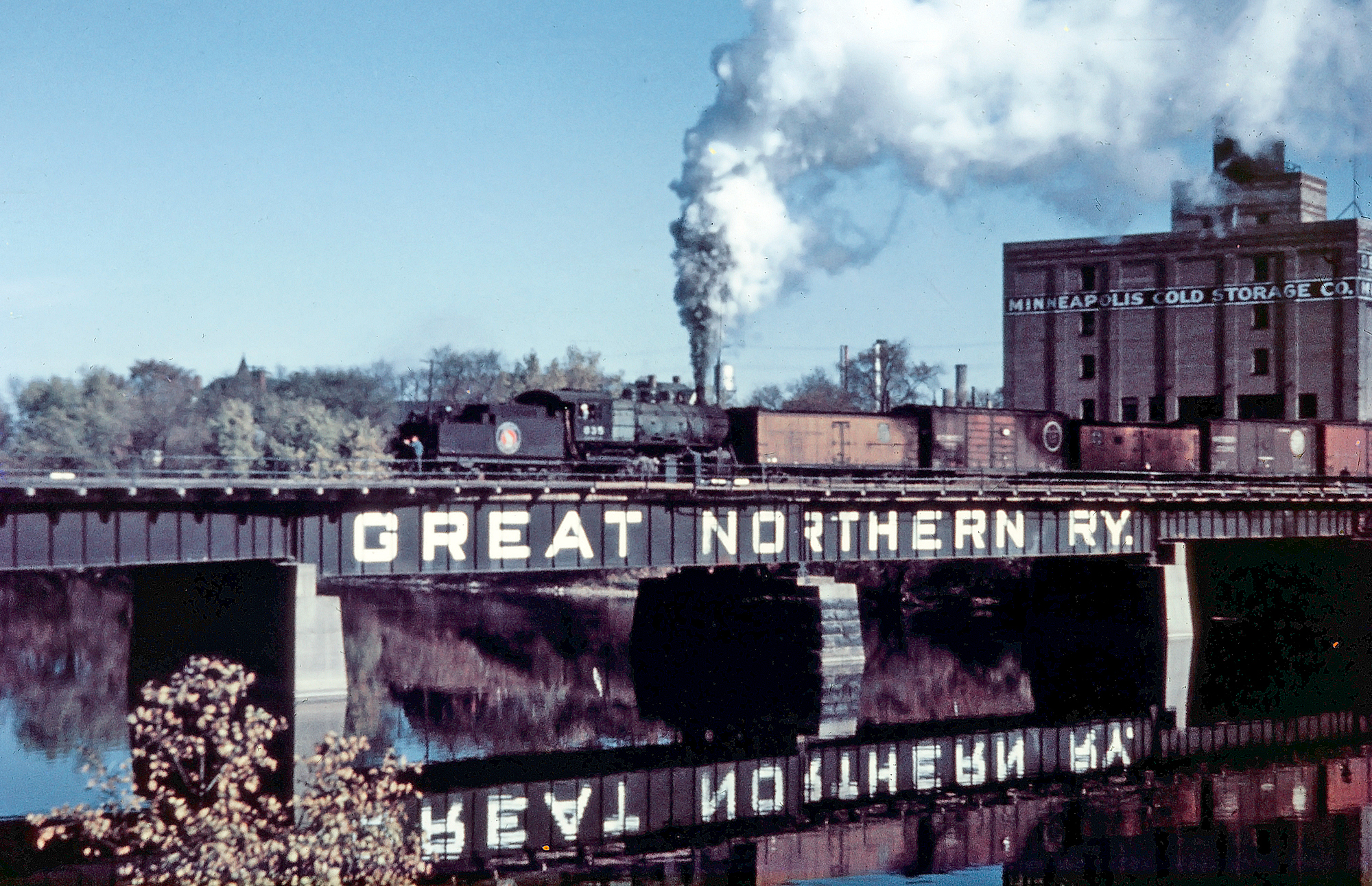
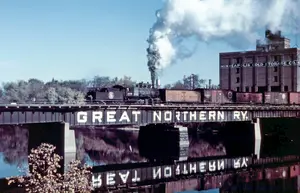
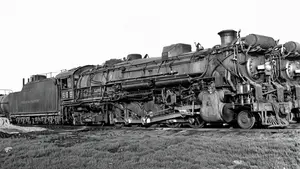
0-8-0 No. 835 switching in the Twin Cities during the fall of 1955. It is one of the Baldwin C-1s, 810–849, built in 1918. Ed Olsen photo. American-Rails.com collection.
On this page: At a glance · Switchers · Prairies and Consolidations · Mikados and Santa Fes · Articulateds · Passenger power · Roster
At a glance
| Item | Detail |
|---|---|
| Railroad | Great Northern. Company Great Northern. Successor Burlington Northern, operations at 12:01 a.m. on March 2, 1970 |
| Scope | Built since 1900. Drury’s table, 56 rows. The A-10 and G-3 rows begin in the 1890s |
| Quantity column | 1,376 |
| Frames, counted once | 1,178. Taken out: the 20 F-6s, the 24 F-9s, the 45 L-2s, 22 of the L-1s, 22 of the M-1s, the 15 P-1s, 35 of the E-14s, and 15 Prairies. Eleven 0-8-0s whose notes do not name the 2-8-0, and the overlap of E-8 and E-14 at 1053 and 1054, stay in both counts |
| Last steam | August 1957, without ceremony. Drury names no engine |
| Steam, as 1951 began | 568, in the railroad’s own count of 844 locomotives. Not this list |
| Diesels | Diesel roster |
Switchers
The railroad worked its yards with six-wheel switchers from about 1880 into 1917. The five 0-6-0 rows in the table are the A-8s of 1900, two groups of A-9s, the A-10s of Brooks in 1898–1900, and two Limas of 1917, Nos. 30 and 31. The second A-9 row prints the numbers as 1...94 and the quantity as 56. That is not a solid block from 1 to 94. The missing numbers are not in the table.
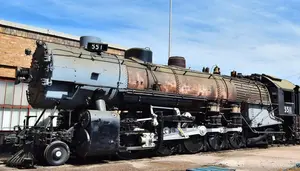
In 1918 Baldwin delivered 40 eight-wheel switchers, larger than the United States Railroad Administration 0-8-0. They are the C-1 class, 810–849. Drury calls them the top-rank switchers, and they outlasted the 0-8-0s created by taking the lead trucks off Consolidations. No. 835, in the Twin Cities in the fall of 1955, is one of them.
The other four 0-8-0 rows are those rebuilds. C-2, 850–869, is the F-6 class after the conversion, and the F-6 row leaves the original numbers blank. C-3, 875–899, is the F-9 conversion plus one number. The F-9 note says the 24 engines went to 0-8-0s 875–898, and that row also leaves the original numbers blank. No. 899 is only on the C-3 line. C-4, 780–786, and C-5, 870–873, say rebuilt from a 2-8-0 and do not name the engines. They stay in the quantity column and they are not taken out of the frame count.
Prairies and Consolidations
The freight the chapter names is lumber, wheat, and iron ore off the Mesabi. The company page has the railroad that moved it. The Twelve-Wheelers in the table are the G-3s, Rogers, 1899–1900, and the G-4s, Brooks, 1900. Drury describes the 1890s 4-8-0s as mountain engines on 55-inch drivers, one of them briefly the world’s largest, some of them later superheated and given piston valves. The table does not show a 4-8-0 rebuilt into a switcher. The 0-8-0 notes name 2-8-0s.
The Consolidations are six rows. F-5, 1095–1109, is Rogers, 1901. F-7, 1134–1139, is Cooke, 1901. F-8, 1140–1253, is the large class, Rogers and Baldwin, 1901–1905, quantity 114. F-12 is two Alcos of 1907, Nos. 1326 and 1327. F-6 and F-9 are the blank-number rows already tied to the 0-8-0s.
Two of the F-8s are still around. No. 1147 is at Wenatchee, Washington. No. 1246 is at the Northwest Railway Museum in Snoqualmie. The museum says 1246 was retired in 1953, given to the City of Seattle for display at the Woodland Park Zoo, and later came to Snoqualmie. The museum dates that engine to 1907. The F-8 cell in the table is 1901–1905. The cell is copied as printed.
Baldwin built 150 Prairies in 1906 and 1907, the J-1s, 1500–1549, and the J-2s, 1550–1649. They had 69-inch drivers. Drury says they were unstable at speed, useful on branch lines, and that 15 of them were rebuilt into low-drivered Pacifics for dual service. Those 15 are the H-6 class. The chapter says the rest of the Prairies were scrapped in the late 1930s and early 1940s.
Mikados and Santa Fes
The O-1 Mikados replaced the early articulateds in ordinary freight. Baldwin delivered 145 of them, 3000–3144, from 1911 through 1918. Drury gives them 63-inch drivers, 28-by-32-inch cylinders, a weight of 280,000 pounds, and a tractive effort of 60,930 pounds, heavier and simpler than the L-2 2-6-6-2s. No. 3059, one of them, is displayed at Williston, North Dakota. The O-2 is a single Alco of 1915, No. 3149, which the chapter says came with a merger. The table does not name the railroad it came from.
The O-3s are nine United States Railroad Administration Mikados, 3200–3208, Alco, 1919–1920, one row in the table with the note USRA. The chapter splits that nine into four engines diverted from the Spokane, Portland & Seattle and five received in 1920 from the El Paso & Southwestern. The table is copied as the one row. Baldwin’s 45 O-4s of 1920, 3210–3254, kept the O-1 cylinder and driver dimensions, were a little more powerful, and were the first Great Northern engines with Vanderbilt tenders.
The later Mikados were shop work. The 45 L-2 Mallets became O-5s 3300–3344 in 1922–1925, with 63-inch drivers and 25-by-30-inch cylinders, about the weight of an O-1 and less powerful. Twenty-two of the L-1s became O-6s 3350–3371 in 1925 and 1926, also on 63-inch drivers. The L-1 rows total 25, so three of those articulateds are not in the O-6 line. Between 1929 and 1931 the shops rebuilt 22 of the 2-6-8-0s into O-7s 3375–3396, with 69-inch drivers. In 1932 the shops built three O-8s, 3397–3399, from scratch, on 69-inch drivers and an axle loading of more than 80,000 pounds. In the 1940s the O-7s were rebuilt to O-8 specifications. That rebuilding is not a new row. Drury gives the O-8 class the honors for the heaviest, fastest, and most powerful Mikados in North America.
The chapter says development of new locomotives ended in 1930, with the S-2 Northerns and the R-2 articulateds. The three O-8s of 1932 are still in the table, built new. Both statements are the chapter’s.
Heavy freight after the 2-8-8-0s used the Santa Fe type. Adding a fifth driving axle to the O-4 produced the Q-1, thirty Baldwins of 1923, 2100–2129. The Q-2s, 2175–2189, are the fifteen P-1 Mountains rebuilt by the shops in 1928. Drury calls them a little heavier than the Administration light 2-10-2 and considerably more powerful. They are the only Great Northern 4-8-2s rebuilt to another wheel arrangement.
Articulateds
The early articulateds were Cascade helpers. The chapter dates the first Cascade Tunnel to 1901 and a reduction of the grade between Wenatchee and Seattle from 4 percent to 2.2 percent. The railroad’s own 1951 history, followed on the company page, dates that bore to 1900, 2.63 miles, with the summit reduced from 4,059 feet to 3,383. The locomotives below do not depend on the year.
Baldwin delivered five L-1 2-6-6-2s in 1906, 1800–1804. Drury gives them a weight of 355,000 pounds, about 20,000 more than Baltimore & Ohio No. 2400, and about 1,500 pounds more tractive effort. The table notes that they were renumbered 1900–1904, which freed 1800–1804 for the next class. Twenty more L-1s came in 1908, numbered 1905–1924. The L-2s are 1800–1844, Baldwin, 1907–1908, quantity 45. The chapter’s sentence numbers them 1810–1854. The table is the roster. Drury gives the L-2s the running gear and the boiler of the H-2 Pacific, a weight of 250,000 pounds, and a tractive effort of 54,520 pounds. All 45 became the O-5 Mikados.
The M-1s are 35 Baldwin 2-6-8-0s of 1910, 1950–1984. The chapter says the railroad simpled them in the early 1920s and classed them M-2, then rebuilt 22 of them into the O-7 Mikados. M-2 is not a row. The N-1s followed in 1912, twenty-five 2-8-8-0s, 2000–2024, the first of the road’s Mallets on 63-inch drivers. Drury calls them the tallest locomotives on the railroad. In the mid-1920s they were simpled and classed N-2. In the early 1940s they received new frames and roller bearings and were classed N-3. The chapter’s tractive-effort figures are 93,250 pounds as built, 100,000 pounds simpled, and 104,236 pounds after the modernization. N-2 and N-3 are not rows. The 25 frames are the N-1 line.
Simple 2-8-8-2s replaced the Mikados and Santa Fes on the mountain freight between 1925 and 1930. Baldwin built the first four R-1s, 2030–2033, in 1925, and the Great Northern shops built ten more, 2034–2043, in 1927 and 1928. The table carries all 14 as one row, builder Baldwin and the railroad, 1925–1928. The R-2s, 2044–2059, came out of the Hillyard shops in Spokane in 1929 and 1930. Both classes had 63-inch drivers. The R-1s had inboard-bearing trailing trucks. The R-2s had cast Delta trailing trucks. Drury gives the R-2 a tractive effort of 153,000 pounds and calls the class the most powerful simple articulateds in the world.
The last articulateds were not a Great Northern design. In October 1937 the Spokane, Portland & Seattle took six Northern Pacific-design 4-6-6-4s, 900–905. In November 1937, engines 903 and 904 were sold to the Great Northern and numbered 4000 and 4001, class Z-6, so the mileage would match on the Spokane, Wishram, Bend, and Bieber run. No. 4000 went back to the Spokane road in 1946. No. 4001 went back in 1950. The table note is the former numbers.
Passenger power
The Great Northern owned ten Atlantics, and only ten. The K-1s, 1700–1709, Baldwin, 1906, were balanced compounds, with the high-pressure cylinders inside on the first pair of drivers and the low-pressure cylinders outside on the second pair. Drury gives them 73-inch drivers and 23,000 pounds of tractive effort, and says they were not especially fast. In the mid-1920s the shops rebuilt them as superheated single-expansion engines with booster-equipped cast trailing trucks. With the booster cut in, the figure is 36,800 pounds. A thousand miles of prairie between St. Paul and the Rockies was the country an Atlantic could use. The chapter says the type was a flatland engine.
The Ten-Wheelers in the table are the ones Drury kept for the years after 1900. E-6, 925–939, and E-8, 1053–1072, are Rogers. E-14, 1010–1054, is Baldwin, 1909, quantity 45. E-15, 1078–1090, is Baldwin, 1910. E-2 is two Alcos of 1915, Nos. 910 and 911. E-8 and E-14 both claim 1053 and 1054. Nothing in the notes says those two numbers are the same frames, so both rows stay in the count.
The first Pacifics were six Rogers H-1s of 1905, 1400–1405, with 21-by-28-inch cylinders and 73-inch drivers. In 1906 and 1907 Baldwin delivered the H-2s, built for pull rather than speed: 69-inch drivers, 22-by-30-inch cylinders, slide valves, Walschaerts gear, and inside-journal trailing trucks. The chapter says there were 34, and that all but one were later given piston valves, 23.5-inch cylinders, and outside-frame trailing trucks and reclassed H-3. The table prints H-3s 1406–1439 as quantity 34, note “Former H-2 class,” and keeps H-2 No. 1440 as quantity 1. Both lines are copied. The 34 is not rewritten as 33.
The H-4s were the last Pacifics bought from a commercial builder, twenty from Baldwin in 1909 and twenty-five from Lima. The chapter says the Lima engines came in 1914 and 1915. The table year is 1914. They had 73-inch drivers, less tractive effort than the H-2s, and more speed. After that the new Pacific classes were shop rebuilds. H-5, 1350–1374, and H-7, 1375–1384, came from E-14 Ten-Wheelers, 25 and 10, so 35 of the 45 E-14s. H-6, 1710–1724, is the 15 Prairies. No. 1355, displayed at Sioux City, Iowa, is one of the H-5s. The preserved-locomotive list cited below says it was rebuilt from E-14 No. 1020 in May 1924, which sits inside both rows.
The P-1 Mountains, 1750–1764, Lima, 1914, were ordered with the later H-4s and followed the O-1 Mikado closely enough to carry 63-inch drivers. They were too slow for the passenger trains and went to freight. In 1928 they became the Q-2 Santa Fes. The P-2s were the opposite case. Baldwin delivered 28 in 1923, 2500–2527, with 73-inch drivers, 29-by-28-inch cylinders, and a radial-stay firebox, where most Great Northern steam used a Belpaire. Drury gives the tractive effort as 54,823 pounds, later 57,580, and 69,780 with the booster. Nos. 2507, at Wishram, Washington, and 2523, at Willmar, Minnesota, are two of them.
The first Northerns were six conservative Baldwins of 1929, class S-1, 2550–2555, Belpaire fireboxes, 73-inch drivers, a weight of 472,000 pounds, and a tractive effort of 68,500 pounds. They were bought for passenger trains and soon went to freight. The S-2s of 1930, 2575–2588, fourteen Baldwins, were the passenger 4-8-4s. Drury says they were 50,000 pounds lighter and 10,000 pounds less in tractive effort, the first 4-8-4s with 80-inch drivers, and, like the P-2s, they had radial-stay fireboxes. No. 2584 is at the depot in Havre, Montana.
By the mid-1950s the railroad was dieselized except in the wheat harvest. Drury says the last run of a steam locomotive came without ceremony in August 1957. He does not name the engine. As 1951 began, the railroad’s own history counted 568 steam locomotives in a fleet of 844. That is a census for the start of that year. It is not this list. The same history is where the company page takes the Cascade Tunnel dates used above.
Roster
The quantity column is Drury’s, and it adds to 1,376. Where the shops rebuilt a locomotive and the table lists both numbers, both lines stay. Counted once, the frames are 1,178. The pairs taken out are named in the glance. Builder names are spelled out from the table’s abbreviations. GN in a builder cell is the railroad’s own shops. BLW is Baldwin. A blank number cell is blank in the book. The F-6 and F-9 rows are blank, and the new numbers are in the note.
| Type | Class | Numbers | Qty | Builder | Built | Notes |
|---|---|---|---|---|---|---|
| 0-6-0 | A-8 | 70–72 | 3 | Rogers | 1900 | |
| 0-6-0 | A-9 | 380–399 | 20 | Baldwin | 1912 | |
| 0-6-0 | A-9 | 1...94 | 56 | Great Northern, Baldwin, Rogers | 1903–1912 | |
| 0-6-0 | A-10 | 95–99 | 5 | Brooks | 1898–1900 | |
| 0-6-0 | A-11 | 30, 31 | 2 | Lima | 1917 | |
| 0-8-0 | C-1 | 810–849 | 40 | Baldwin | 1918 | |
| 0-8-0 | C-2 | 850–869 | 20 | Brooks | 1901 | Rebuilt from 2-8-0 |
| 0-8-0 | C-3 | 875–899 | 25 | Brooks | 1903 | Rebuilt from 2-8-0 |
| 0-8-0 | C-4 | 780–786 | 7 | Baldwin, Rogers | 1902–1907 | Rebuilt from 2-8-0 |
| 0-8-0 | C-5 | 870–873 | 4 | Rogers | 1901 | Rebuilt from 2-8-0 |
| 2-6-2 | J-1 | 1500–1549 | 50 | Baldwin | 1906 | |
| 2-6-2 | J-2 | 1550–1649 | 100 | Baldwin | 1907 | |
| 2-8-0 | F-5 | 1095–1109 | 15 | Rogers | 1901 | |
| 2-8-0 | F-6 | 20 | Brooks | 1901 | To 0-8-0 850–869 | |
| 2-8-0 | F-7 | 1134–1139 | 6 | Cooke | 1901 | |
| 2-8-0 | F-8 | 1140–1253 | 114 | Rogers, Baldwin | 1901–1905 | |
| 2-8-0 | F-9 | 24 | Brooks | 1903 | To 0-8-0 875–898 | |
| 2-8-0 | F-12 | 1326, 1327 | 2 | Alco | 1907 | |
| 2-8-2 | O-1 | 3000–3144 | 145 | Baldwin | 1911–1918 | |
| 2-8-2 | O-2 | 3149 | 1 | Alco | 1915 | |
| 2-8-2 | O-3 | 3200–3208 | 9 | Alco | 1919–1920 | USRA |
| 2-8-2 | O-4 | 3210–3254 | 45 | Baldwin | 1920 | |
| 2-8-2 | O-5 | 3300–3344 | 45 | Great Northern | 1922–1925 | Rebuilt from 2-6-6-2 |
| 2-8-2 | O-6 | 3350–3371 | 22 | Great Northern | 1925–1926 | Rebuilt from 2-6-6-2 |
| 2-8-2 | O-7 | 3375–3396 | 22 | Great Northern | 1929–1931 | Rebuilt from 2-6-8-0 |
| 2-8-2 | O-8 | 3397–3399 | 3 | Great Northern | 1932 | |
| 2-10-2 | Q-1 | 2100–2129 | 30 | Baldwin | 1923 | |
| 2-10-2 | Q-2 | 2175–2189 | 15 | Great Northern | 1928 | Rebuilt from 4-8-2 |
| 2-6-6-2 | L-1 | 1800–1804 | 5 | Baldwin | 1906 | Renumbered 1900–1904 |
| 2-6-6-2 | L-1 | 1905–1924 | 20 | Baldwin | 1908 | |
| 2-6-6-2 | L-2 | 1800–1844 | 45 | Baldwin | 1907–1908 | |
| 2-6-8-0 | M-1 | 1950–1984 | 35 | Baldwin | 1910 | |
| 2-8-8-0 | N-1 | 2000–2024 | 25 | Baldwin | 1912 | |
| 2-8-8-2 | R-1 | 2030–2043 | 14 | Baldwin, Great Northern | 1925–1928 | |
| 2-8-8-2 | R-2 | 2044–2059 | 16 | Great Northern | 1929–1930 | |
| 4-6-6-4 | Z-6 | 4000, 4001 | 2 | Alco | 1937 | Spokane, Portland & Seattle 903, 904 |
| 4-4-2 | K-1 | 1700–1709 | 10 | Baldwin | 1906 | |
| 4-6-0 | E-2 | 910, 911 | 2 | Alco | 1915 | |
| 4-6-0 | E-6 | 925–939 | 15 | Rogers | 1902 | |
| 4-6-0 | E-8 | 1053–1072 | 20 | Rogers | 1901–1903 | |
| 4-6-0 | E-14 | 1010–1054 | 45 | Baldwin | 1909 | |
| 4-6-0 | E-15 | 1078–1090 | 13 | Baldwin | 1910 | |
| 4-6-2 | H-1 | 1400–1405 | 6 | Rogers | 1905 | |
| 4-6-2 | H-2 | 1440 | 1 | Baldwin | 1907 | |
| 4-6-2 | H-3 | 1406–1439 | 34 | Baldwin | 1906–1907 | Former H-2 class |
| 4-6-2 | H-4 | 1441–1460 | 20 | Baldwin | 1909 | |
| 4-6-2 | H-4 | 1461–1485 | 25 | Lima | 1914 | |
| 4-6-2 | H-5 | 1350–1374 | 25 | Great Northern | 1921–1927 | Rebuilt from 4-6-0 |
| 4-6-2 | H-6 | 1710–1724 | 15 | Great Northern | 1923 | Rebuilt from 2-6-2 |
| 4-6-2 | H-7 | 1375–1384 | 10 | Great Northern | 1926–1927 | Rebuilt from 4-6-0 |
| 4-8-0 | G-3 | 720–769 | 50 | Rogers | 1899–1900 | |
| 4-8-0 | G-4 | 770–779 | 10 | Brooks | 1900 | |
| 4-8-2 | P-1 | 1750–1764 | 15 | Lima | 1914 | Rebuilt to 2-10-2 |
| 4-8-2 | P-2 | 2500–2527 | 28 | Baldwin | 1923 | |
| 4-8-4 | S-1 | 2550–2555 | 6 | Baldwin | 1929 | |
| 4-8-4 | S-2 | 2575–2588 | 14 | Baldwin | 1930 |
Sources
- George H. Drury, Guide to North American Steam Locomotives, revised edition, Great Northern chapter, pages 180–183. The table, the class narrative, the August 1957 last run, and the conflicts labeled above.
- Public Relations Department, Great Northern Railway, “A Condensed History of the Great Northern Railway” (1951), as reproduced by the Great Northern Railway Historical Society. The count of 568 steam locomotives as 1951 began, and the first Cascade Tunnel completed in 1900.
- Ben Ringnalda, “Preserved GN Steam,” Great Northern Empire. The displayed engines that fall inside this table, and the note that H-5 No. 1355 was rebuilt from E-14 No. 1020 in May 1924. The 1861 William Crooks is on that list and is outside this table.
- Northwest Railway Museum, Snoqualmie, Washington, collection note on Great Northern 1246. Retirement in 1953, the Woodland Park Zoo years, the move to Snoqualmie, and the 1907 date that does not match the F-8 cell.
- Great Northern Railway Historical Society, “GN Locomotive Rosters.” The society points readers to two out-of-print books for an all-time roster. Those books were not used for a figure on this page.
Recent Articles


-
Brandywine Museum Opens Its Holiday Railroad
Nov 13, 26 04:19 PM
The Brandywine Museum of Art opens the holiday model railroad on November 14, 2026. It runs through January 10, 2027, with holiday admission. -
Great Northern Steam Roster (Built Since 1900)
Nov 13, 26 04:14 PM
 Great Northern steam locomotives built since 1900. Drury quantity column 1,376. Rebuilds counted once, 1,178 frames. Last steam run was in August 1957.
-
Illinois Railway Museum Adds Three Burlington Gallery Cars
Nov 13, 26 01:54 PM
 The Illinois Railway Museum says Burlington gallery coaches 702 and 709 and cab car 791 arrived on November 11, 2026.
-
Great Northern Railway: Map, Logo, Rosters, History
Nov 13, 26 01:41 PM
 James J. Hill and the Great Northern, from the St. Paul and Pacific to the last spike near Scenic on January 6, 1893, and into Burlington Northern at 12:01 a.m. on March 2, 1970. Steam and diesel rost…
-
West Chester Lists Its 2026 Holiday Trains
Nov 13, 26 01:25 PM
 The West Chester Railroad lists a 2026 Christmas Tree Train at 8 a.m. and a separate Santa Express of 75 minutes. The event pages do not print a calendar.
-
Burlington Northern Diesel Roster (All-Time)
Nov 13, 26 12:49 PM
 Burlington Northern diesel roster of locomotives bought new from 1970 through December 30, 1996. Electro-Motive and General Electric, with builder serials and order numbers. Predecessor fleets stay on…
-
Atherton Train Station Museum Opens in the Old Depot
Nov 13, 26 12:21 PM
The Almanac reports that the Atherton Train Station Museum opened October 18 with six dioramas in the old depot beside Town Center. -
Manheim and Lititz Study a Strasburg Excursion
Nov 13, 26 12:15 PM
 LancasterOnline reports that a working group and the Strasburg Rail Road are studying passenger trips between Manheim and Lititz if a line purchase goes through.
-
Berkshire Scenic Railway Works to Replace Burned RDC
Nov 13, 26 09:53 AM
A fire on October 24, 2026 damaged New Haven 41 at the Berkshire Scenic Railway Museum. Volunteers are trying to finish Boston and Maine 6126 for the Tinseliner. -
Conway Scenic Lists the Winter Mountaineer
Nov 13, 26 12:37 AM
 Conway Scenic Railroad lists Winter Mountaineer trips from North Conway on select dates from November 28, 2026, through March 2027.
-
Burlington Northern Railroad: Map, Logo, History
Nov 12, 26 05:29 PM
 Burlington Northern, formed at 12:01 a.m. on March 2, 1970 from the Hill Lines. Powder River coal, the Frisco merger of November 21, 1980, and the Santa Fe combination of 1995–96. The diesel ros…
-
Age of Steam Roundhouse Receives Chesapeake & Ohio 1308
Nov 12, 26 04:05 PM
Chesapeake & Ohio 2-6-6-2 No. 1308 has arrived at the Age of Steam Roundhouse Museum in Sugarcreek, Ohio, from Huntington, West Virginia. -
Hoosier Valley Santa Trains Begin November 21
Nov 12, 26 03:59 PM
 The Hoosier Valley Railroad Museum lists Santa trains on five Saturdays from November 21 through December 19, 2026, leaving North Judson, Indiana.
-
Strasburg Rail Road Closes for Track Replacement
Nov 12, 26 12:44 PM
 The Strasburg Rail Road homepage says the railroad is closed for track replacement until November 21, 2026.
-
Union Pacific Diesel Roster (All-Time)
Nov 12, 26 12:22 PM
 Union Pacific diesel roster with builder serials and order numbers. Alco, Baldwin, Fairbanks-Morse, Electro-Motive, and General Electric. Merger partners keep their own roster pages.
-
Escanaba & Lake Superior Weighs a Trail on the Wells Grade
Nov 12, 26 12:15 PM
 Michigan and the Escanaba & Lake Superior Railroad are discussing a sale of 60 miles of inactive grade between Wells and Channing for a trail, with the grade kept for possible rail use.
-
Oklahoma Railway Museum Repaints Santa Fe FP45 90
Nov 12, 26 11:58 AM
The Oklahoma Railway Museum is repainting Santa Fe FP45 90 in the blue-and-yellow Freight Bonnet it wore as 5990. The museum does not plan to operate the locomotive. -
Pullmans Move Toward a Chicago Home With a Norfolk Southern Switch
Nov 12, 26 11:49 AM
 Friends of the Pullman National Historical Park held a spike-setting on November 9, 2026. Norfolk Southern has installed a switch and committed $250,000 toward a future rail connection.
-
Sloss Furnaces Entrance Gets a Norfolk Southern Grant
Nov 12, 26 11:44 AM
 Norfolk Southern awarded a $146,460 Thriving Communities grant to the Sloss Furnaces Foundation for the 32nd Street entrance in Birmingham.
-
Union Pacific 2-10-2 5511 Passes Its First Steam Test
Nov 12, 26 12:12 AM
 Union Pacific 2-10-2 5511 passed a steam test at Silvis, Illinois. Railfan and Railroad reports a summer 2027 target. A November 6 Trains report had no immediate operating plan.
-
Union Pacific Steam Roster
Nov 12, 26 12:03 AM
 Union Pacific steam locomotives built since 1900. Oregon Short Line, Los Angeles and Salt Lake, and Oregon-Washington Railroad and Navigation Company numbers, with the 4-12-2s, Challengers, Big Boys…
-
Union Pacific Railroad: Map, History, Logo
Nov 11, 26 11:56 PM
 The Union Pacific, from the Pacific Railway Act of July 1, 1862, and Promontory Summit on May 10, 1869, through E. H. Harriman and the mergers that built the modern railroad. Steam and diesel rosters…
-
Texas and Pacific Railway: Map, History, Timetables
Nov 10, 26 10:33 PM
 The Texas & Pacific Railway, the federally chartered southern transcontinental that stopped at Sierra Blanca and became the Missouri Pacific's Texas and Louisiana main line. Merged October 15, 1976.
-
Texas and Pacific Steam Locomotives: Texas Types and Mountains
Nov 10, 26 10:30 PM
 Texas & Pacific steam: 70 Lima 2-10-4 Texas types, 600-669, classes I-1 through I-1d, and 10 Mountains, 900-909. No. 610 is at Palestine.
-
Texas and Pacific Diesel Roster (All-Time)
Nov 10, 26 10:29 PM
 All-time diesel roster of locomotives built for the Texas & Pacific. 246 units: E7s, E8s, 83 F7A and 35 F7B, NW2s, SW7s, SW8s, SW9s, GP7s, GP9s, GP18s, and GP35s. Serials and order numbers.
-
Santa Fe-Southern Pacific Railroad: Merger, History, Paint Scheme
Nov 10, 26 10:07 PM
 The proposed Santa Fe-Southern Pacific merger, from the 1980 attempt and the 1983 holding company through the ICC denial, the Kodachrome paint, and the sale of the Southern Pacific.
-
CSX Santa Train Will Feature Locomotives 250 and 2026
Nov 10, 26 01:51 PM
 The CSX Santa Train will feature locomotives 250 and 2026 on November 21, 2026. The 84th running covers 110 miles from Shelbiana, Kentucky, to Kingsport, Tennessee.
-
Denton County Asks to Extend Stadler Car Relief
Nov 10, 26 01:05 PM
Denton County Transit Authority has asked the FRA to extend a waiver for its Stadler diesel multiple-unit cars. Comments run to January 11, 2027. -
FreightCar America Reports Third-Quarter Results
Nov 10, 26 01:02 PM
 FreightCar America reported third-quarter revenue of $76.5 million and 662 railcar deliveries. Backlog stood at 2,660 cars valued at $284.5 million.
-
Amtrak Has Filed a Train Control Amendment
Nov 10, 26 12:53 PM
 Amtrak asked the FRA on October 26, 2026, to amend the safety plan for its Interoperable Electronic Train Management System. Comments are due November 30, 2026.
-
SunRail Signal Waiver Is Open for Comment
Nov 10, 26 12:25 PM
FRA has asked for comment on a petition to extend signal-testing relief on the Central Florida Rail Corridor. The notice names both the corridor and CSXT. Comments run to January 11, 2027. -
Cars and Units Rose With BNSF Third-Quarter Earnings
Nov 10, 26 12:18 PM
Berkshire Hathaway reports that after-tax BNSF earnings increased 19.3 percent in the third quarter of 2026, with car and unit volumes up 3.9 percent. -
Amtrak Chicago Platforms Are Moving Toward Level Boarding
Nov 10, 26 12:13 PM
 Amtrak says construction is underway soon on the first level boarding platforms at Chicago Union Station, a 112 million dollar, 30-month project.
-
Maryland Has New Penn Line Times on November 16
Nov 10, 26 12:07 PM
MARC Penn Line schedules change on November 16, 2026, after Amtrak trains return to regular schedules. Weekend southbound trains are unchanged. -
Building Contract for Metrolink Sidings Goes to Granite
Nov 10, 26 12:00 PM
Granite says Metrolink awarded a 51.5 million dollar SCORE contract for sidings near downtown Los Angeles and in Rancho Cucamonga. -
EMD "F2" Locomotives: Specs, Roster, History
Nov 10, 26 12:22 AM
 EMD F2, the 1,350-horsepower bridge between the FT and the F3. 104 locomotives, July through November 1946. Spotting features, specifications, and the production roster.
-
Southern Pacific Diesel Roster (All-Time)
Nov 10, 26 12:08 AM
 Southern Pacific diesel roster with builder serials, order numbers, Texas and New Orleans numbers, and the 1965 renumbering. Alco, Baldwin, Fairbanks-Morse, Electro-Motive, General Electric, Krauss-Ma…
-
Southern Pacific Steam Roster: Post 1900
Nov 09, 26 11:56 PM
 Southern Pacific steam locomotives built since 1900. Pacific Lines, Texas and Louisiana Lines, cab-forwards, the GS 4-8-4s, and five narrow-gauge Ten-Wheelers. The quantity column counts the rows as p…
-
Canal Street Yard Assessment Stays Open Through December 7
Nov 09, 26 01:07 PM
The FRA signed the Canal Street Yard environmental assessment on November 6, 2026. Public inspection runs through December 7, and meeting dates are not confirmed. -
NS Legacy Cab-Signal Comments Are Due November 9
Nov 09, 26 01:05 PM
The FRA must receive comments by November 9, 2026, on a Norfolk Southern plan to drop legacy cab signals on 14 line segments and rely on positive train control. -
Elimination Grant of $27.8 Million Reaches Scott Road in Allen County
Nov 09, 26 12:53 PM
Allen County received $27,878,116, also stated as $27.8 million, to design and build a grade separation where Scott Road crosses Norfolk Southern. -
Vermont Receives $60.3 Million for the Western Corridor
Nov 09, 26 12:45 PM
Vermont will receive $60.3 million to rehabilitate about 60 miles of the Western Corridor. The delegation quote also calls the sum $60 million. -
Burlingame Grade Separation Wins a Federal Grant
Nov 09, 26 10:42 AM
 Rep. Kevin Mullin said on November 5, 2026 that the FRA awarded $90.4 million for the Caltrain Broadway grade separation in Burlingame. Early work is expected in May 2027.
-
Orange County Rail Line Gets a Coastal Permit
Nov 09, 26 10:18 AM
The California Coastal Commission on November 5, 2026 approved a 10-year permit for the San Clemente rail line, including about 690,000 cubic yards of sand. -
Railroad Quiet Zones Are Reinstated in St. Louis
Nov 09, 26 10:14 AM
 St. Louis said on November 6, 2026 that the FRA reinstated the city quiet zones. Horns are to stop after railroad systems are updated.
-
Southern Pacific Railroad: Map, History, Logo
Nov 08, 26 01:58 PM
 The Southern Pacific, from the December 2, 1865 charter and the Big Four to Sprint, the Rio Grande Industries purchase of 1988, and the Union Pacific merger of February 1, 1997.
-
California Awards Flexible Rail Aid to Nine Projects
Nov 08, 26 01:15 PM
CalSTA on November 5, 2026 awarded $66.58 million in flexible State Rail Assistance to nine California projects. Each amount in the summary is a cap, printed as up to. -
CSX Leaves Three Days Out of the Weekly Reports
Nov 08, 26 12:02 PM
CSX told the Surface Transportation Board it cannot recover October 27-29 data for the EP 724 and EP 787 reports covering the week ending October 30, 2026. -
NJ Transit Advances Three Station Housing Projects
Nov 08, 26 11:56 AM
NJ Transit on November 5, 2026 advanced station projects in Jersey City, Bound Brook, and Morristown. The three are projected to add more than 1,000 homes. -
River Fox Train Wraps a Locomotive for America 250
Nov 08, 26 11:06 AM
 The River Fox Train in West Sacramento wrapped a locomotive with America 250 markings, the American flag, and the Sacramento skyline. The wrap is expected to stay through 2027.