Santa Fe-Southern Pacific Railroad: Merger, History, Paint Scheme
Last revised: September 23, 2024
By: Adam Burns
The failed merger between the Atchison, Topeka and Santa Fe Railway (often referred to simply as the Santa Fe) and the Southern Pacific Transportation Company (Southern Pacific) represents a significant chapter in the history of American railroads.
This narrative includes not just two storied railroads, but also the regulatory environment, market conditions, and strategic ambitions that shaped their story.
In a stunning move, the Interstate Commerce Commission denied the merger in 1986, mandating that the companies disentangle their operations within two years.
Consequently, in October 1988, Southern Pacific was sold to Rio Grande Industries for $1.02 billion. Meanwhile, the merger’s resulting real estate assets in California were spun off into Catellus Development Corporation, which soon rose to prominence as the state’s largest private landowner.
The original holding company rebranded itself as Santa Fe Pacific Corporation, retaining ownership of the Santa Fe Railway and the diverse non-rail assets of both predecessor companies.
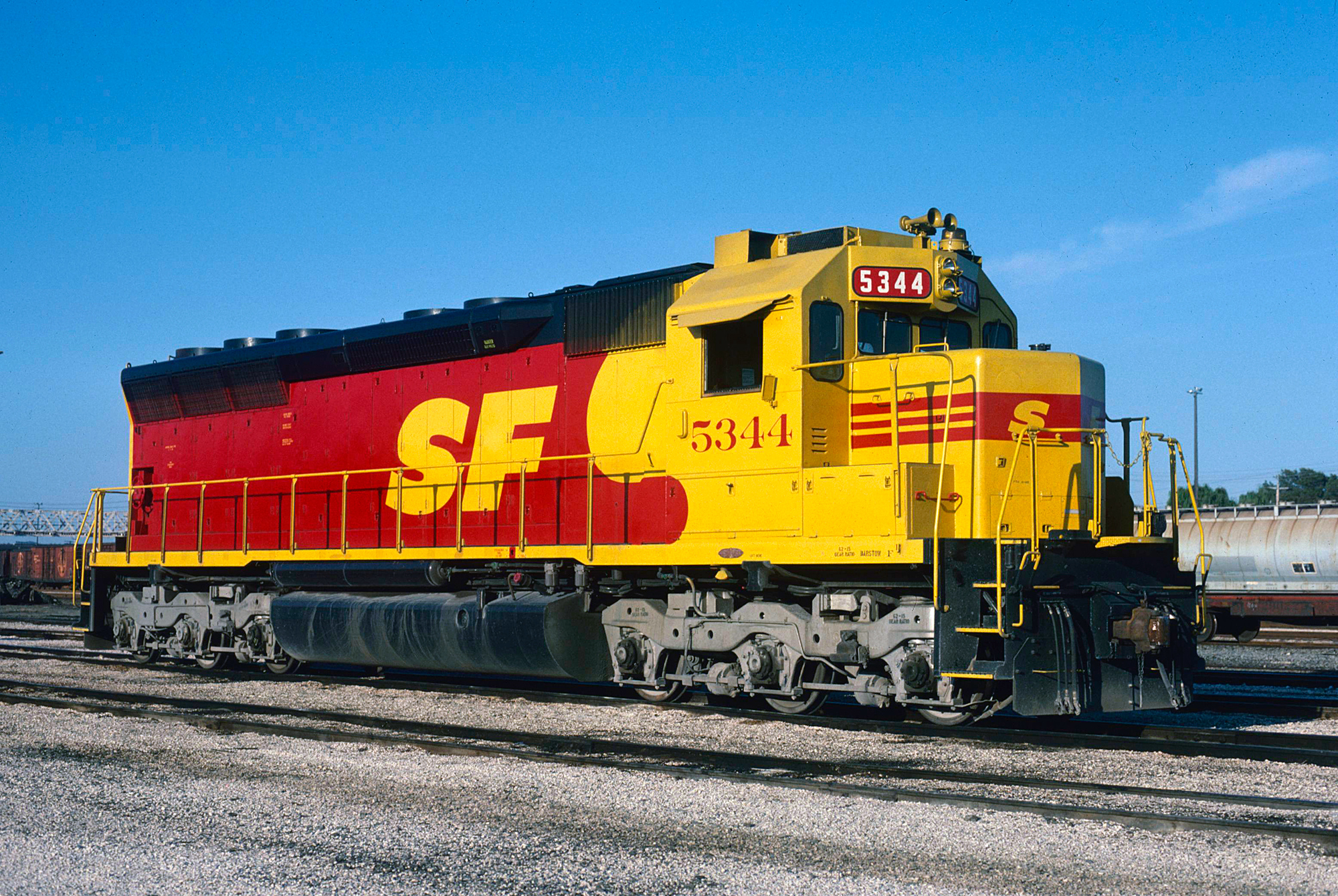 Santa Fe SD45u #5344; June, 1986. The locomotive is wearing the so-called "Kodachrome" paint scheme for the intended merger with Southern Pacific which was denied by the ICC that year. American-Rails.com collection.
Historical Background
Both the Santa Fe and Southern Pacific railroads were giants in the American railway industry, each with a rich history dating back to the 19th century.
- **Santa Fe Railway**: Founded in 1859, the Santa Fe Railway was instrumental in the development of the western United States. Renowned for its passenger services and extensive freight operations, its iconic red and silver locomotives became a symbol of railroading excellence.
- **Southern Pacific**: Established in 1865, Southern Pacific covered vast stretches of the western U.S. and was crucial in the development of California. Its diverse operations included not just rail transport but also trucking and telecommunications.
As the 20th century progressed, both railroads sought to maintain profitability amidst rising competition from other modes of transportation, particularly trucks and ships.
Combining resources through a merger was seen as a strategic move to solidify market positions, reduce operational redundancies, and better compete against emerging transportation challenges.
The Merger Proposal
In a dramatic tale of corporate ambition and regulatory reality, the proposed merger of two major railroads in the Western United States—the Atchison, Topeka and Santa Fe Railway, and the Southern Pacific Railroad—unfolded in the mid-1980s.
Announced in September 1983, this $5 billion venture aimed to consolidate the rail networks under a new holding company, the Santa Fe Southern Pacific Corporation.
By December of that year, the companies had already merged their extensive non-rail assets, although the Southern Pacific Railroad continued to operate independently within a voting trust during the ongoing regulatory review.
Confident of regulatory approval, the two companies jointly petitioned the Interstate Commerce Commission (ICC) for clearance in March 1984. Anticipating a positive outcome, they even began repainting their locomotives into a unified livery for a new "SPSF" railroad.
The merger aimed to create a powerful, integrated transportation network across the western United States, boosting efficiency and service quality.
This union was anticipated to save a staggering $760 million annually by eliminating duplicated operations, enhancing route rationalization, and leveraging combined capital investments.
Regulatory Environment and Challenges
Regulatory oversight fell squarely on the shoulders of the Interstate Commerce Commission (ICC), the federal agency responsible for railroad mergers.
The ICC evaluated such mergers based on several criteria, including the potential for reducing competition, possible service improvements, overall public interest, and financial viability.
From the onset, the merger faced significant regulatory scrutiny. There were substantial concerns about the potential monopolistic effects of the merger, particularly in regions where Santa Fe and Southern Pacific’s operations overlapped.
The combination of these two major players could stifle competition significantly in the western U.S., leading to higher rates for shippers and diminished service options.
Numerous stakeholders voiced their opposition, including shippers, competing railroads, and state regulators. Shippers feared that reduced competition would lead to increased freight rates. Competing railroads worried about the looming giant’s market power and its ability to push them out of business.
ICC Decision and Implications
The ICC's decision process was rigorous and lengthy, lasting several years. The central question was whether the proposed merger would harm the public by reducing competition and restricting service options. On July 24, 1986, the ICC delivered its final decision: the merger was denied.
Key points in the ICC’s decision included:
- **Anticompetitive Concerns**: The merger would have created a virtual monopoly in several regions, significantly reducing competition. The ICC was particularly concerned about reduced options for shippers in key markets where Santa Fe and Southern Pacific routes overlapped.
- **Service Quality**: Although the merger promised improved service quality through operational efficiencies, the ICC believed that these potential benefits were outweighed by the negative impact of reduced competition. The merger could result in higher costs and fewer service choices for businesses relying on freight rail.
- **Public Interest**: The ICC concluded that the merger was not in the public interest. The potential for increased freight rates and diminished service quality was deemed too great a risk.
Aftermath and Strategic Reorientation
Following the ICC’s denial, both Santa Fe and Southern Pacific had to revisit their strategic roadmaps. The decision was a significant blow to their aspirations of creating a dominant western U.S. railroad network. However, both companies were resilient and sought alternative paths to competitiveness.
**Santa Fe**:
- The Santa Fe continued to operate independently but faced mounting financial pressures. In 1995, the Santa Fe found a new merger partner in the Burlington Northern Railroad.
The merger was successful, creating the Burlington Northern Santa Fe Railroad (now BNSF Railway), which emerged as one of the largest and most efficient railroads in North America.
The ICC approved this merger, noting it would enhance competition by creating a robust competitor to the Union Pacific Railroad.
**Southern Pacific**:
- After the failed merger, Southern Pacific struggled to maintain its market position. It faced significant financial challenges, exacerbated by competition and operational inefficiencies.
In 1996, Southern Pacific was acquired by Union Pacific Railroad, creating the largest railroad network in the UnitedStates. The ICC approved this acquisition, considering it a necessary move to stabilize Southern Pacific’s operations and enhance service in the western U.S.
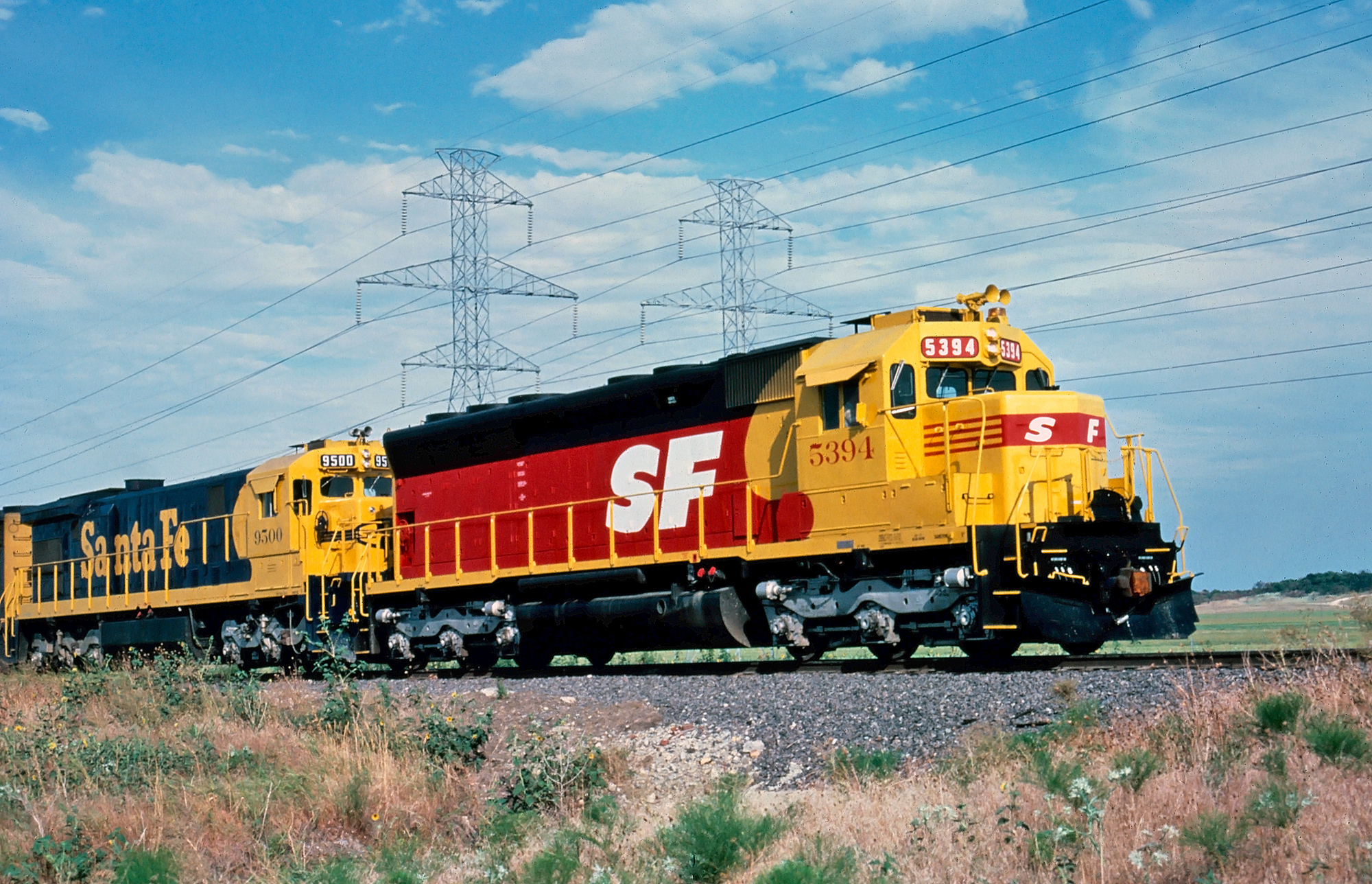 Santa Fe SD45u #5394 in the Santa Fe–Southern Pacific's railfan-coined "Kodachrome" livery near Venus, Texas; August, 1985. Mike Bledsoe photo. American-Rails.com collection.
"Shouldn't Paint So Fast"
During the proposed merger the new Santa Fe Southern Pacific Corporation felt so strongly the merger would be approved that it began repainting locomotives.
This new unified paint scheme was designed to represent the impending SPSF Railway. Legally mandated to operate independently until the merger received full approval, the locomotives bore the initials SP or SF, with space reserved to add the remaining letters post-merger.
The redesigned livery merged elements from both railroads. It drew inspiration from the Santa Fe's "Yellowbonnet" design, featuring a distinguished red stripe on the locomotive's nose.
The rest of the body sported SP's signature scarlet red, reminiscent of their "Bloody Nose" scheme, accented with a black roof extending to the lower sections of the radiator grills.
The number boards were distinctly red with white numerals, and large block letters "SP" or "SF" prominently adorned the sides.
Interestingly, this color scheme bore a striking resemblance to the packaging of Kodak's Kodachrome film, widely used by rail enthusiasts at the time.
Consequently, the paint scheme earned the nickname "Kodachrome." Following the ICC's unexpected denial of the merger, industry insiders and railfans humorously remarked that SPSF stood for "Shouldn't Paint So Fast."
To showcase the envisioned unified appearance, two Santa Fe SD45-2s locomotives (#7219 and #7221) were fully painted with the SPSF lettering. Similarly, one Santa Fe caboose was adorned with "SPSF" in anticipation of the merger.
By the time the merger was denied, a significant portion of the fleet had been repainted that included:
- 306 Santa Fe locomotives
- 4 Santa Fe cabooses
- 10 Santa Fe slugs
- 96 Southern Pacific locomotives
- 1 Southern Pacific caboose
Following the regulatory decision, both railroads undertook efforts to revert their locomotives to their standard paint schemes.
Santa Fe managed to repaint all its Kodachrome locomotives by 1990. In contrast, Southern Pacific's repaints progressed more slowly, with some of the Kodachrome units remaining operational within the Union Pacific roster post-SP acquisition.
Notably, a GP9 in the Kodachrome livery (ex-SP 2873) has been preserved at the Western Pacific Railroad Museum in Portola, California, serving as a colorful relic of this ambitious but unrealized merger.
Broader Impact on the Railroad Industry
The failed Santa Fe–Southern Pacific merger had broader implications for the railroad industry, influencing future merger activities and regulatory policies.
**Regulatory Environment**:
- The ICC’s stringent review process highlighted regulatory concerns about industry consolidation's anticompetitive effects. It set a precedent that future rail mergers would need to demonstrate clear benefits outweighing any potential reduction in competition. This decision became a reference point for subsequent railroad mergers and acquisitions.
**Industry Landscape**:
- The denial reshaped the competitive landscape. While the mega-merger was halted, the subsequent successful mergers involving Burlington Northern, Santa Fe, Union Pacific, and Southern Pacific ultimately led to a more consolidated industry, with fewer but larger and financially stable railroads.
This consolidation helped streamline operations, improve service efficiencies, and enhance competitive capacities against other transport modes.
**Strategic Realignments**:
- Railroads recognized the need for strategic realignments to stay competitive. This included investments in technology, infrastructure improvements, and service quality enhancements. The focus shifted from expanding networks through mergers to optimizing existing operations and enhancing customer service.
**Customer and Market Focus**:
- Shippers and other stakeholders in the freight transportation ecosystem benefited from heightened awareness about the impacts of consolidation. The need for competitive pricing and reliable service became more pronounced, driving railroads to focus on customer-centric approaches and innovative logistics solutions.
Legacy and Lessons
Despite its failure, the attempted merger between Santa Fe and Southern Pacific left a lasting legacy on the rail industry. Several key lessons emerged from this episode:
**Regulatory Oversight**:
- The ICC’s decision underscored the importance of regulatory oversight in maintaining competitive balance. Future merger proposals would need to address competition concerns comprehensively and demonstrate substantial public benefits.
**Strategic Adaptability**:
- Railroads learned the importance of strategic adaptability. When immediate merger opportunities are not feasible, railroads can still pursue competitiveness through operational efficiencies, technological advancements, and improved customer relations.
**Market Dynamics**:
- The attempted merger highlighted the dynamic nature of market forces in transportation. Railroads needed to respond to shifting market conditions, evolving customer needs, and competitive pressures from other transport modes to remain viable and profitable.
Conclusion
The story of the Santa Fe–Southern Pacific merger is a testament to the complexities of railroad consolidation, regulatory scrutiny, and strategic adaptability. While the merger itself was unsuccessful, the paths taken by Santa Fe and Southern Pacific post-merger denial significantly reshaped the railroad industry.
Their efforts demonstrated resilience and strategic foresight, ultimately leading to the formation of major railroad entities that dominate the American landscape today.
In reflection, the failed merger serves as a pivotal case study in understanding the balance between consolidation and competition in a critical industry that continues to drive economic growth and connectivity across vast regions.
The legacy of the Santa Fe–Southern Pacific merger underscores the enduring importance of regulatory oversight, market adaptability, and strategic vision in navigating the complex terrain of railroad operations.
Recent Articles


-
Grand Canyon Railway Pumpkin Patch Train (2026)
Sep 29, 26 02:42 PM
 Grand Canyon Railway Pumpkin Patch Train—select October 2026 dates from Williams, $39 with a pumpkin included. Haunted train cars are optional. Days are on the ticket calendar. Confirm on thetrain.com…
 -
Cass Scenic Railroad Halloween Trains (2026)
Sep 29, 26 02:37 PM
 Cass Scenic Halloween Trains—October 30 and 31, 2026, steam, 5:00 p.m. from Cass Depot. About two hours to Whittaker. Adult $75. Candy for every child. Confirm on mountainrailwv.com.
 -
Halloween Train Rides (2026): Pumpkin Patch, Haunted & Spooky Trips
Sep 29, 26 11:26 AM
 2026 Halloween train rides in nine checked states. Conway Scenic Halloween Express October 24–25. Strasburg’s three fall tickets. Great Smoky Mountains Railroad’s October trains are the gorge and rive…
 -
Maine Halloween Train Rides (2026)
Sep 29, 26 11:08 AM
 2026 Maine Halloween trains. Seashore Pumpkin Patch Trolley through October 18, adult $17. Happy Trolleyween October 23–25 at $15. WW&F Pumpkin Pickin’ October 3, 12, 17, and 24. Downeast’s booking it…
 -
Kentucky Halloween Train Rides (2026)
Sep 29, 26 10:58 AM
 2026 Kentucky Halloween trains. Kentucky Railway Museum Trick and Track Express, October 24 and 31, from $17. Bluegrass Scenic pumpkin trains in Versailles. Confirm on the ticket shop.
 -
Connecticut Halloween Train Rides (2026)
Sep 29, 26 10:26 AM
 2026 Connecticut Halloween trains. East Windsor Pumpkin Patch Fridays through Sundays, October 2–31. Naugatuck coach $20. Shore Line Pumpkin Patch on nine October days. Confirm on each site.
 -
Pennsylvania Halloween Train Rides (2026)
Sep 29, 26 09:45 AM
 2026 Pennsylvania Halloween trains—Everett October 3, 4, 10, and 17, Strasburg’s three fall shows, Oil Creek on October 24, plus Kutztown, Kempton, Honesdale, Middletown, and West Chester.
 -
New York Halloween Train Rides (2026)
Sep 29, 26 12:08 AM
 2026 New York Halloween trains—Catskill Pumpkin Express October 17–18 and 24–25, Adirondack pumpkin and family trains, Arcade & Attica haunt, Cooperstown patch and trick-or-treat, Tupper Lake triv…
 -
North Carolina Halloween Train Rides (2026)
Sep 28, 26 11:56 PM
 2026 North Carolina Halloween trains—New Hope Valley Track or Treat on October 10, 17, 23, and 24, and Tweetsie Ghost Train Friday and Saturday nights through October 31. GSMR’s October menu is the go…
 -
Tweetsie Railroad Ghost Train Halloween Festival (2026)
Sep 28, 26 11:44 PM
 Tweetsie Ghost Train—Friday and Saturday nights September 25–October 31, 2026, in Blowing Rock. Adult $65, child $45. One reserved steam ride plus the park. Ages 8 and up for the haunt.
 -
Milwaukee Road Class A 4-4-2: Specs, Roster, History
Sep 28, 26 11:20 PM
 Milwaukee Road Class A Atlantics 1–4, Alco 1935–1937, for the Hiawatha. Order S-1740, 84-inch drivers, 19x28, 300 psi, 30,685 lb. Full builder specs, roster, and the May 15, 1935 run at 112.5 mph. All…
 -
Strasburg Rail Road Halloween Trains (2026)
Sep 28, 26 11:00 PM
 Strasburg’s 2026 Halloween tickets—Pumpkins in Paradise on October 3, The Haunting of Pumpkin Junction, and The Brakeman’s Curse through October 25. Three fares. Legacy of Sleepy Hollow is an earlier…
 -
GSMR Peanuts Pumpkin Train (2026): Not on This Year’s Ticket Menu
Sep 28, 26 10:50 PM
Great Smoky Mountains Railroad’s September 28, 2026 ticket menu lists Nantahala and Tuckasegee excursions. A Peanuts Great Pumpkin train is not on that menu. Polar Express is on the November calendar. -
New Jersey Halloween Train Rides (2026)
Sep 28, 26 06:45 PM
2026 New Jersey Halloween trains—Black River & Western to Everitt Farms through October 25, Delaware River Great Pumpkin through November 1, Whippany October 4, 10, and 11, Pine Creek night trains. -
New Hampshire Halloween Train Rides (2026)
Sep 28, 26 05:17 PM
 2026 New Hampshire Halloween train—Conway Scenic Halloween Express, October 24 and 25, about 1 hour from North Conway. Coach adult $30. Confirm on conwayscenic.com.
 -
Conway Scenic Pumpkin Patch Express (2026): Dates, Tickets & Tips
Sep 28, 26 05:09 PM
 Conway Scenic Halloween Express—October 24 and 25, 2026, about 1 hour from North Conway. Coach adult $30. A pumpkin after the ride while supplies last. Confirm on conwayscenic.com.
 -
Black River & Western Pumpkin Trains (2026): Dates, Tickets & Tips
Sep 28, 26 02:20 PM
 Suggested meta description: Black River & Western Pumpkin Train—Flemington to Everitt Farms, weekends September 26–October 25, 2026. Pumpkin patch, maze, and wagon rides. Confirm on blackriverrail…
 -
Scenic Dinner Train Rides (2026): A Complete Guide
Sep 28, 26 01:30 PM
 2026 scenic dinner trains by state—a seated meal on the train. Branson through October 30, Cincinnati Saturdays, Potomac Eagle, and the full state list. Confirm on the railroad.
 -
West Virginia Dinner Train Rides (2026): A Complete Guide
Sep 28, 26 11:58 AM
 2026 Potomac Eagle dining from Romney—about 3 hours in the Trough. Premium three courses $124. Superior four courses $159, ages 17 and older. Confirm on potomaceagle.com.
 -
Washington Dinner Train Rides (2026): A Complete Guide
Sep 28, 26 11:51 AM
 2026 Chehalis-Centralia dinner trains have run. The July 18 Roaring 20s dinner was $89. The planning calendar lists no later dinner. Confirm on steamtrainride.com.
 -
Texas Dinner Train Rides (2026): A Complete Guide
Sep 28, 26 11:27 AM
 2026 Texas has no plated dinner aboard the train. Grapevine sells snacks. The Texas State Railroad Dogwood lunch was served at the Rusk depot. Confirm on the railroad.
 -
Ohio Dinner Train Rides (2026): A Complete Guide
Sep 28, 26 10:15 AM
2026 Ohio dinner trains—Cincinnati Saturdays, $140, about 3 hours, ages 12 and up. Hocking Valley Elegant Dinner Train October 17 and November 7, from $95. -
Missouri Dinner Train Rides (2026): A Complete Guide
Sep 28, 26 10:09 AM
 2026 Branson Scenic Railway dinner train—three courses, about 2 hours, Fridays and Saturdays through October 30. Dome $123.50 plus tax. Confirm on bransontrain.com.
 -
Minnesota Dinner Train Rides (2026): A Complete Guide
Sep 28, 26 09:40 AM
 2026 North Shore Scenic Northwoods Dinner Train in Duluth—four courses in the SkyView dome, 2½ hours, $90, through September 26. Confirm on duluthtrains.com.
 -
Maine Dinner Train Rides (2026): A Complete Guide
Sep 28, 26 09:29 AM
 2026 Maine has no dining-car dinner. WW&F Pig Roast at SeaLyon Farm was June 13 and has run, $54.95. Sunset Express was a drink and ended September 5.
 -
Greenbrier, Cheat & Elk Railroad: Western Maryland's Logging Line
Sep 26, 26 11:59 PM
 Greenbrier, Cheat and Elk—the logging railroad the Western Maryland bought in 1927. Cass to Spruce, Summit Cut at 4,066.6 feet, Elk River Branch, Laurel Bank.
 -
Elkins (Western Maryland): Yard, History, Operations
Sep 26, 26 11:56 PM
 Western Maryland at Elkins—the Elkins Division yard, roundhouse, and wash rack. Belington, Durbin, Black Fork, and the Elk River branches met here.
 -
B&O's "Cincinnatian" (Train): Route, Consist, Timetable
Sep 26, 26 11:51 PM
 B&O Cincinnatian—Mount Clare five-car streamliner, January 19, 1947, trains 75 and 76. P-7d Pacifics 5301–5304. Detroit–Cincinnati from June 25, 1950, trains 53 and 54. Last run April 30, 1971.
 -
The Semaphore: Railroading's Classic Signal
Sep 26, 26 11:51 AM
 Railroad semaphore signals: blade and spectacle, lower quadrant and upper quadrant, US&S Style B and GRS Model 2A, Robinson’s track circuit, and the last blades on the Raton Subdivision.
 -
Black Fork Grade (Western Maryland): History and Operations
Sep 26, 26 11:47 AM
 Black Fork Grade—the Western Maryland climb through Blackwater Canyon. Thomas to Hendricks, past 3 percent, an H-9 and ten loads, helpers off at Fairfax.
 -
Western Maryland Steam Locomotives: History & Roster
Sep 26, 26 11:39 AM
 Western Maryland steam—H-9 Consolidations, I-2 Decapods, Lima 2-8-8-2s, Baldwin Challengers, and twelve Baldwin Potomac 4-8-4s. Post-1900 roster.
 -
Western Maryland Diesel Roster: All-Time
Sep 26, 26 11:32 AM
 Western Maryland diesels—S1 102 in 1941, fourteen F7 boosters, BL2s, hammerhead RS3s, Circus SD40s, and Chessie GP40-2s. Serials and order numbers.
 -
The Dutch Line (Western Maryland): History, Map, Operations
Sep 25, 26 09:38 PM
 Western Maryland Dutch Line—the Hanover Subdivision. Emory Grove to Highfield via Hanover and Gettysburg, York branch 1893, stone trains, and the route CSX still runs.
 -
The Durbin Branch (Western Maryland): History, Map, Operations
Sep 25, 26 09:13 PM
 Western Maryland Durbin Branch—the Coal & Iron Railway, 46.9 miles Elkins to Durbin, opened July 27, 1903. Mixed train until April 10, 1959. H-7B Consolidations.
 -
Western Maryland Railway: Map, Rosters, Logo, History
Sep 25, 26 10:24 AM
 Western Maryland Railway—the Fast Freight Line. Baltimore, Carroll & Frederick, May 27, 1852. Connellsville Extension 1912. Chessie, then into the B&O May 1, 1983.
 -
Illinois Dinner Train Rides (2026): A Complete Guide
Sep 25, 26 09:52 AM
2026 Monticello Railway Museum Murder Mystery Dinner Train—June 13, July 11, August 1, and September 5 have run. Three courses, about 2 hours, $112. Confirm on mrym.org. -
Georgia Dinner Train Rides (2026): A Complete Guide
Sep 25, 26 12:29 AM
 2026 Azalea Sprinter dinner train from Nashville and Willacoochee, Georgia—2½ hours. Club Car adult $147, Executive adult $177. Confirm on azaleasprinter.com.
 -
Baldwin "Centipede" Locomotives: Specs, Roster, Photos
Sep 25, 26 12:02 AM
 Baldwin DR-12-8-1500/2 Centipede—2-D+D-2, two 608SC engines, 3,000 hp. SAL 4500 from the 1943 test bed. 54 on the serial list, 52 sold. PRR BP60 then BH50. None preserved.
 -
Florida Dinner Train Rides (2026): A Complete Guide
Sep 24, 26 11:56 PM
 2026 Seminole Gulf Murder Mystery Dinner Train in Fort Myers—five courses cooked onboard, 3½ hours, $129 or $135 Saturday, plus tax and gratuity. Confirm on semgulf.com.
 -
West Virginia Northern Railroad: Map, Photos, History
Sep 24, 26 11:27 PM
 West Virginia Northern—Kingwood to Tunnelton, 11 miles of Preston County coal. Narrow gauge 1888, standard gauge 1895. Last freight February 19, 1991. Consolidations 8 and 9 survive.
 -
Rutland Railroad: Map, Rosters, History, Logo
Sep 24, 26 01:18 PM
 Rutland Railroad—Follett’s Champlain & Connecticut River, November 1, 1843. Bellows Falls–Burlington December 18, 1849. Green Mountain Gateway. Last train September 25, 1961. Vermont Railway Janua…
 -
Arkansas Dinner Train Rides (2026): A Complete Guide
Sep 24, 26 01:12 PM
 2026 Eureka Springs & North Arkansas Dinner Train—Eurekan dining car, about 2 hours, $53.62 tax included, opens May 9, Tuesday, Wednesday, Friday, and Saturday. Confirm on esnarailway.com.
 -
Arizona Dinner Train Rides (2026): A Complete Guide
Sep 24, 26 01:01 PM
2026 Arizona has no plated dinner train. Grand Canyon Railway sells snacks in the cars and meals in Williams or at the rim. Verde Canyon includes a charcuterie tray. -
Rail News, The Latest
Sep 24, 26 12:36 PM
This page provides a portal to the latest in rail news, from preservation and restortation subjects to other notable topics. -
Cotton Belt 819 Moved Outside at Pine Bluff for Evaluation
Sep 24, 26 12:35 PM
Cotton Belt 819 left the Pine Bluff shop on September 22, 2026, first time outside in about 30 years. RDG Steam Services is evaluating the engine. No donation link posted. -
Reading Steam Locomotives: History, Roster & Photos
Sep 24, 26 12:14 PM
 Reading steam—Wootten fireboxes, Camelback Consolidations, Mallets, K-1 Santa Fes, G-3 Pacifics, T-1 4-8-4s. Post-1900 roster after Drury. Rambles ended October 17, 1964.
 -
Reading Diesel Roster: All-Time
Sep 24, 26 12:10 PM
 Reading diesel roster—AGEIR boxcabs, FTs, FA-1s, RS-3s, Train Masters, GP30s through GP39-2s. Serials and order numbers. Conrail April 1, 1976.
 -
Reading Railroad: Map, Logo, History, Rosters
Sep 24, 26 12:08 PM
 Reading Company—Philadelphia & Reading, 1833. Anthracite, Port Richmond, Reading Terminal. Operating company January 1, 1924. Conrail April 1, 1976.
 -
Nevada Dinner Train Rides (2026): A Complete Guide
Sep 24, 26 12:02 PM
 2026 Nevada Northern Taste of Italy—adults-only gala from East Ely. The September 19 date has run. Confirm any later night on nnry.com.
 -
North Carolina Dinner Train Rides (2026): A Complete Guide
Sep 24, 26 11:24 AM
 2026 North Carolina dinner trains—NCTM Wine & Dine in Spencer sold out February 13–15. GSMR First Class is the plated meal on the Nantahala Gorge excursion. Confirm on the railroad.