Pacific Electric Car Roster
Published: November 16, 2026
By: Adam Burns
The Pacific Electric kept city cars, suburban cars, and interurban cars under a numbering plan the shops set out at the Great Merger. The orders below are the classes with a builder history: the St. Louis 800s and the Los Angeles Pacific 950s, the Jewett Tens, the Standard Steel 1100s, and the steel 1200s from Pressed Steel and from Pullman. Cars that arrived later from the Northwestern Pacific and from the group the numbering page assigns to the United States Maritime Commission are on the same list, once. A later number on the same car is a note, not another row. Locomotives, box motors, and tower cars are on the locomotive roster.
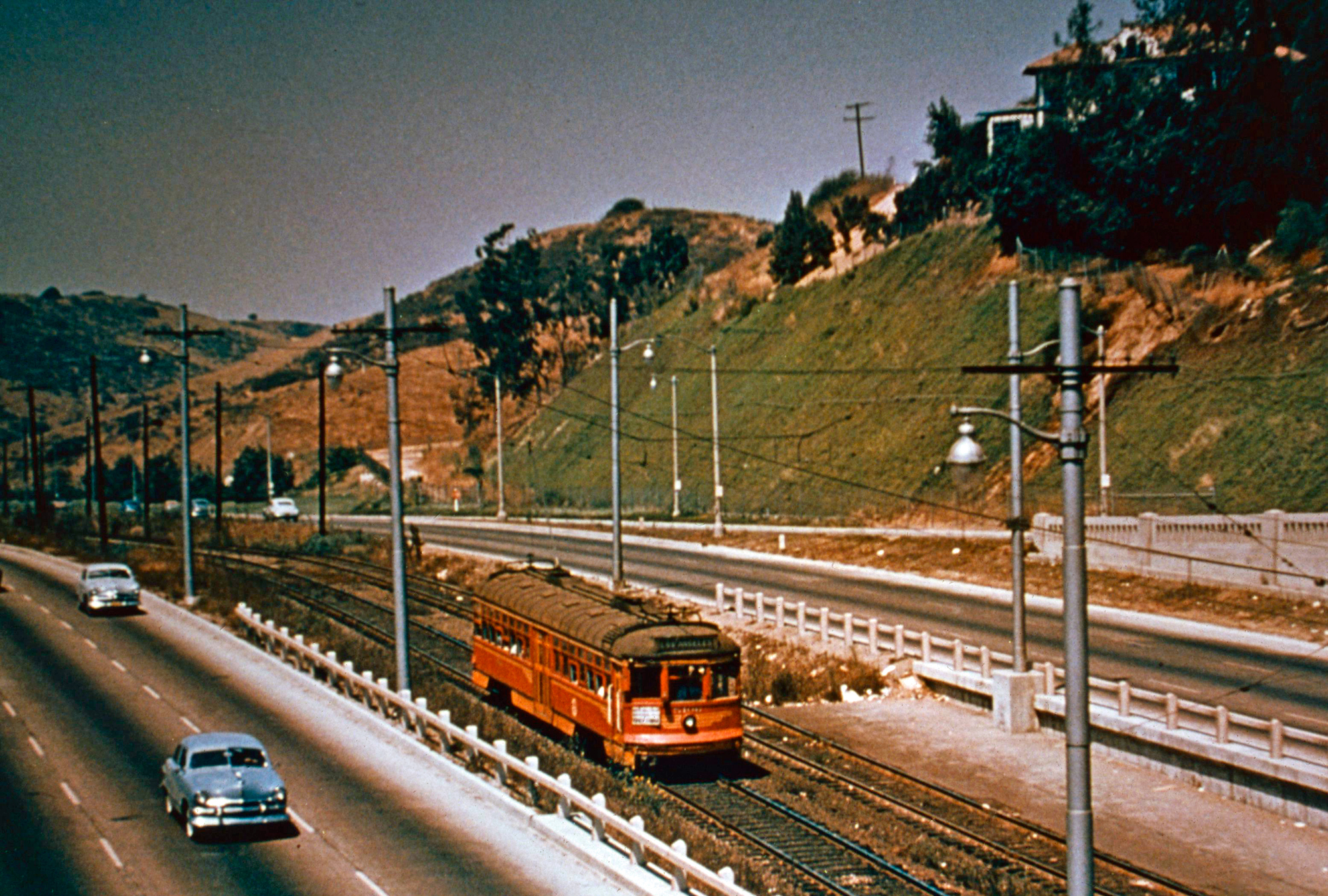
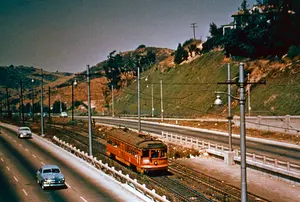
From atop Barham Boulevard along Cahuenga Pass, Pacific Electric car 5166 heads east toward downtown Los Angeles on September 21, 1952. Author’s collection.
On this page: The 1911 numbers · Interurban orders · Cars that arrived later · City cars · Combines
The 1911 numbers
After the merger the shops sorted hundreds of unlike cars into blocks. The Electric Railway Historical Association prints that scheme. Deluxe cars were 01-025, business and excursion cars. City cars were 1-399, including the Mount Lowe cars. Suburban cars were 400-699. Interurban cars were 700-1299. Combines were 1300-1399. Box motors were 1400-1499. Light locomotives were 1500-1599, and heavy locomotives were 1600-1699. Line cars were 1700-1799, and miscellaneous cars were 1800-1899. Wreckers were 001-0010. The numbering page dates the scheme to the Great Merger of 1910. The Western District history dates the consolidation itself to September 1, 1911. The company history is on the Pacific Electric page.
The blocks did not stay put. When the last sixty Hollywood cars arrived, the suburban class took the 700s, and interurban cars 700-749 were renumbered 950-999 in 1924. Those 700s were the Los Angeles Pacific cars below, not a second fleet. In 1931 the 1700 and 1800 classes ended, and the cars became 00150-00199. In 1940 new PCC cars for suburban service were numbered 5000-5029. In 1949 the 600 class was one-manned and renumbered into the 5050 class. The numbering page does not give the original span of the 600 class. Cars photographed in 1952 on the company page, in the 5050 series, are 5111, 5134, 5136, 5152, 5162, 5166, 5168, and 5175. The Southern California Railway Museum collection includes Hollywood cars of the 1920s.
Interurban orders
The quantity is the number of cars in the order, as the class history prints it. The 800 class history says the original series ran from 250 through 386, which it calls 137 cars, and that six numbers, 330-335, are missing from the order table. The same page says 131 cars of the type were on the property after 1911. The interurban catalog lists the class as 800-929 and marks 930-949 as never built. Cars 800-889 were ordered and paid for by the Los Angeles Inter-Urban Railway and were lettered Pacific Electric. The order rows use the St. Louis table.
| Nos. | Qty | Builder | Year | Notes |
|---|---|---|---|---|
| 250-269 | 20 | St. Louis | December 1902 | First 800s. Ordered for the new standard-gauge interurban service. Later renumbered into the 800 class |
| 270-276 | 7 | St. Louis | June 1903 | 800 class |
| 277-319 | 43 | St. Louis | July 1904 | 800 class |
| 320-329 | 10 | St. Louis | February 1906 | 800 class |
| 336-386 | 51 | St. Louis | July 1906 | 800 class. The order table marks 330-335 as six missing numbers and does not give them a count |
| 700-749 | 50 | St. Louis | 1907 | Built for the Los Angeles Pacific, the first cars that company received on standard-gauge trucks. Top speed 47 miles an hour. Renumbered into the 950 class in 1924. Struck off November 9, 1950, except 981, 982, 985, and 987. Cars 744-746 were control trailers and were motorized in September 1914. Car 999 had been the deluxe El Vicento, then Pacific Electric 01, and returned to 999 on December 17, 1925 |
| 1000-1044 | 45 | Jewett bodies, Brill trucks | Summer 1913 | The Tens. Delivered from Newark, Ohio. Paul Shoup described 45 cars of this type. The class history heads the passenger motors as 1001-1044 because 1000 was rebuilt as a business car soon after it was equipped. Four Westinghouse 333-A-2 motors, 100 horsepower, able to run on 600 or 1,200 volts. In 1919 cars 1001-1012 traded motors with 871-882 and received Westinghouse 557-A-5 motors of 140 horsepower. Those twelve then weighed 85,200 pounds. Opened the San Bernardino line on July 11, 1914 |
| 1050-1057 | 8 | Jewett bodies, Brill trucks | 1913 | Same design as the Tens, ordered by the Southern Pacific for the Peninsula Railway out of San Jose, equipped in Los Angeles, and later numbered Pacific Electric 1050-1057. Not part of the 45 |
| 1100-1149 | 50 | Standard Steel Car Co., Hammond, Indiana | 1924 | Last new interurban order. Cost $1,850,000. First fifteen arrived at Torrance in June 1924 and entered service on the Pasadena lines in August. The class was in service by the end of October 1924. Wheels 34 inches. Top speed 47 miles an hour. Could couple with the 1200s and could not run in multiple with them |
| 1200-1221 | 22 | Pressed Steel Car Co. | 1915 | San Bernardino Twelves. Redesigned as steel after the Vineyard wreck of July 11, 1913, in which sixteen people were killed. The class history says the company ordered no more wooden passenger cars after that day. General Electric motors and controls were installed in Los Angeles. In Northern District service in 1915, with combines 1370 and 1371. The same history gives them a balancing speed of 60 miles an hour, and the Long Beach Twelves 56 |
| 1222-1241 | 20 | Pullman | 1921 | Long Beach Twelves. $41,080 each. Westinghouse 557-D-7 motors, 140 horsepower, 36-inch wheels, gear ratio 19:58 |
| 1242-1251 | 10 | Pullman | 1921 | Trailers on the same order. $22,434 each. Built to run between two of the 1222-class motors |
| 1252-1263, 1299, 1372-1376 | 18 | Pullman | Built 1912 | Bought from the Southern Pacific in July 1928, work order 28210 of July 1, 1928, for $214,659. Built for the Portland, Eugene and Eastern, later the Oregon and California cars of the Southern Pacific Red Electrics. Eighteen cars: motors 210-212, 219, and 220; trailers 470-477; railway post office 501; combines 511-514. Rebuilt at Torrance as the numbers in this row |
Five 800s, cars 823, 826, 844, 859, and 881, were rebuilt as box motors 1495-1499. During the war they ran again as passenger cars on the Torrance shop train, and in 1944 they went back to box motors. Four other 800s became combines 1356-1359. Tens 1028, 1029, 1038, and 1039 became combines 1360-1363. None of those conversions is a second order. The box motors are on the locomotive roster.
The 950s were sold, thirty-one of them, to National Steel and Metals for about $1,700 each after the Venice Short Line closed on September 17, 1950, and they were scrapped at Terminal Island. The class history says the company struck the class off the roster on November 9, 1950, with the four exceptions named in the table. The Tens went the same way, except 1001, rebuilt as rail grinder 00199 in 1948.
Cars that arrived later
The PCC cars were the break in the 1911 scheme. The numbering page says they were acquired in 1940 for suburban service and numbered 5000-5029. It does not name a builder. In 1949 the company looked at buying 101 more PCC cars for the Northern District and did not buy them. That proposal is on the company page.
| Nos. | Qty | From | Year | Notes |
|---|---|---|---|---|
| 5000-5029 | 30 | New PCC cars | 1940 | Suburban service. The numbering page does not name the builder |
| 4500-4518 | 19 | Northwestern Pacific | 1942 | The plan had been to number them 1275-1293. The catalog calls 4500-4511 motors and 4512-4518 trailers. Modernized as 300-318. Same nineteen cars. The museum calls the modernized cars Blimps |
| 4600-4647 | 48 | See the note | 1945 | The numbering page says United States Maritime Commission cars, renumbered 4600-4647. The interurban catalog calls them Interurban Electric Railway motors. Modernized cars are listed as 400-437 and 450-459. Same cars, not a second fleet |
| 4700-4703 | 4 | See the note | 1945 | The numbering page says four combines from the same 1945 acquisition |
Under the Los Angeles Metropolitan Transit Authority the surviving suburban cars were renumbered into the 1800s, and surviving interurbans into the 1500s and 1700s. The interurban catalog prints 1500-1547 and 1700-1708 for that renumbering. Those numbers are the same cars.
City cars
The city catalog is a number list. Some numbers are on the list twice, for an earlier type and a later one, and those rows have no quantity. Adding the two lines would count the same numbers as two fleets. The catalog marks other numbers as never built, and those gaps are left out. The list runs through the Birneys. The suburban block 400-699 is absent from it. The Eastern District history says Birney cars were put into Pomona, Riverside, Redlands, and San Bernardino in 1918, and it does not assign every car in 320-388 to that delivery.
| Nos. | Type | Notes |
|---|---|---|
| 1-3 | Incline cars | Number 3 is also listed as a trailer |
| A1-A2 | Horse cars | |
| 3-4 | Single-truck trailers | Same number 3 as the incline pair |
| 5-6 | Steam open cars | |
| 10-18 | Single-truck open | The catalog splits 10-17 and 18 |
| 20-28 | Single-truck closed | The catalog splits 20-24, 25-26, 27, and 28 |
| 30-33 | Mount Lowe cars | |
| 38-39 | Double-truck open | |
| 40-41 | Control trailers | |
| 42-47 | Closed trailers | |
| 50-57 | Closed trailers | Same numbers later appear in the steel-stepless block |
| 50-80 | Steel stepless | The catalog points 300-319 at this block. Those numbers are not a second group |
| 80-83 | Single-truck California | Number 80 is also the last steel-stepless car in the row above |
| 84 | Single-truck open | |
| 90-94 | Double-truck combination | The catalog splits 90-93 and 94 |
| 100-112, 116 | California | The catalog also lists 100-114 as steel closed cars. Number 102, 115, and 117-119 are marked never built and are omitted |
| 100-114 | Steel closed | Same numbers as the California rows around them |
| 120-151, 152-157, 160-169 | California | The catalog splits these into shorter runs. It also lists 150-152 as steel closed, so 150-152 are on both types |
| 170-179 | Steel closed, center entrance | Shoup, writing for equipment due in 1913, described twenty center-entrance stepless cars of a 50-69 class, and a further thirty that were not ordered |
| 200-299 | California | The 800 class history describes an earlier 200 class that was enlarged into the 800 design. This row is the catalog line for California cars in the same numbers |
| 320-388 | Birneys | 389-399 are marked never built |
The deluxe block in the 1911 scheme was 01-025. The 950 class history identifies one of them. Los Angeles Pacific 749, later discussed as 999, ran as the deluxe car El Vicento until the merger, became Pacific Electric 01, and on December 17, 1925, went back to 999. In 1929 it was rebuilt into an ordinary 950 class motor.
Combines
The association lists combines, railway post office cars, and box motors on one page. The post office cars and the box motors used the 1400s and are with the locomotives. The combines below are the 1300s, plus the running mates of the 1200s. A roman numeral on that list is a later use of the same number and is not a row. Rebuilds that already appear in an order above are named and are not given a quantity.
| Nos. | Qty | Type | Notes |
|---|---|---|---|
| 1300-1305 | 6 | Standard wooden | 1301 and 1310 are also listed as United States mail cars. 1306-1309 never built |
| 1310-1318 | 9 | Standard wooden | 1319-1349 never built |
| 1350-1351 | 2 | Standard wooden | 1352-1355 never built |
| 1356-1359 | Standard wooden | Rebuilt from 800 class cars. Already in that order | |
| 1360-1363 | Standard wooden | Rebuilt from Tens 1028, 1029, 1038, and 1039. The catalog also enters a second use of 1360-1363 | |
| 1364 | 1 | Steel combine | 1365-1369 never built |
| 1370-1371 | 2 | Steel combines | Running mates of 1200-1221, in service with them in 1915. The 1200 class history does not give them a separate builder line |
| 1372-1376 | Steel combines | Part of the eighteen Portland cars bought in 1928. Already in that row. The catalog also repeats 1372-1374 and 1375-1376 | |
| 1380-1381 | 2 | Wooden combines | 1382-1399 never built |
| 496-499, 1546-1547 | Steel combines | On the catalog only. The page does not say these were new cars |
Related reading
Sources
- Electric Railway Historical Association of Southern California, Pacific Electric 1911 car numbering. The blocks from 01-025 through the wreckers, and the exceptions: 700-749 to 950-999 in 1924, the 5050s in 1949, PCC cars 5000-5029 in 1940, Northwestern Pacific cars 4500-4518 in 1942, Maritime Commission cars 4600-4647 and combines 4700-4703 in 1945, the 300 and 400 classes as the postwar renumbering of the 4500s, 4600s, and 4700s, and the later Los Angeles Metropolitan Transit Authority numbers.
- Electric Railway Historical Association, Pacific Electric city and suburban cars. The city number-and-type catalog through the Birneys, including the lines marked never built and the lines that reuse a number.
- Electric Railway Historical Association, Pacific Electric interurban and deluxe cars. The class spans 800-929, 950-999, 1000-1057, 1100-1149, and 1200-1263, the Northwestern Pacific and Interurban Electric blocks, and the Authority renumbers.
- Electric Railway Historical Association, 800 class history. St. Louis orders and dates, the missing numbers 330-335, the count of 131 cars after 1911, Los Angeles Inter-Urban ownership of 800-889, the five box-motor conversions, and the four combines.
- Electric Railway Historical Association, 950 class history. Fifty cars, St. Louis, 1907, Los Angeles Pacific 700-749, the 47-mile-an-hour gearing, the November 9, 1950, retirement, cars 744-746, and car 999.
- Electric Railway Historical Association, 1000 class history. Jewett bodies, Brill trucks, Newark, the summer of 1913, Shoup and the 45 cars, car 1000, the Peninsula Railway eight, the San Bernardino opening on July 11, 1914, the motor trade of 1919, combines 1360-1363, and the end of the wooden cars with the Venice Short Line on September 17, 1950.
- Electric Railway Historical Association, 1100 class history. Fifty cars, Standard Steel Car Company of Hammond, 1924, the price, the delivery, and the performance.
- Electric Railway Historical Association, 1200 class history. Pressed Steel 1200-1221, Pullman 1222-1251 with the two prices, combines 1370 and 1371, the Vineyard wreck, and the eighteen Portland cars of work order 28210.
- Electric Railway Historical Association, combines, railway post office cars, box motors, work motors, locomotives, tower cars, and service cars. The 1300 class combine list used in the last table. Box motors from the same page are on the locomotive roster.
- Southern California Railway Museum, Pacific Electric collection. Hollywood cars of the 1920s, and the Blimps that finished Long Beach service in 1961.
- Electric Railway Historical Association, Eastern District. Birney cars in Pomona, Riverside, Redlands, and San Bernardino in 1918.
Recent Articles


-
Pacific Electric Railway: Car Roster
Nov 16, 26 12:15 AM
 Pacific Electric cars by order: the St. Louis 800s and 950s, Jewett Tens, Standard Steel 1100s, Pressed Steel and Pullman 1200s, and the city-car number catalog.
-
Pacific Electric Railway: Locomotive Roster
Nov 16, 26 12:02 AM
 Pacific Electric box motors, Baldwin-Westinghouse electrics, company-built locomotives, and the General Electric diesels numbered 1650-1654 in 1947.
-
Pacific Electric Railway: Map, Logo, History, Photos
Nov 15, 26 11:38 PM
 The Pacific Electric Red Cars of Los Angeles, Henry Huntington, the Great Merger of September 1, 1911, and the last Long Beach train on the morning of April 9, 1961.
-
Spokane International Railroad: Map, History, Photos
Nov 15, 26 06:54 AM
 The Spokane International, chartered January 1, 1905, from Spokane to Eastport, Idaho, its steam locomotives and Alco RS-1s, and Union Pacific control on October 6, 1958.
-
Northwestern Pacific Railroad: History, Map, Timetable
Nov 15, 26 12:38 AM
 The Northwestern Pacific, incorporated January 8, 1907, by the Southern Pacific and the Santa Fe, the Willits to Shively line, general traffic on July 1, 1915, and the later operators north of San Fra…
-
Northern Pacific Diesel Roster (All-Time)
Nov 14, 26 09:17 PM
 Northern Pacific all-time diesel roster. Alco, Baldwin, Electro-Motive, and General Electric serials, orders, and build dates.
-
Northern Pacific Steam Roster (Built Since 1900)
Nov 14, 26 07:44 PM
 Northern Pacific steam locomotives built since 1900. Last steam run was January 17, 1958.
-
Northern Pacific Railway: Map, Logo, History, Rosters
Nov 14, 26 12:15 AM
 The Northern Pacific, chartered July 2, 1864, from Jay Cooke and the panic of 1873 to the last spike at Gold Creek in 1883, Stampede Tunnel in 1888, and Burlington Northern at 12:01 a.m. on March 2, 1…
-
The Pacific Extension (Milwaukee Road): Map, Abandonment, History
Nov 13, 26 11:52 PM
 The Milwaukee Road Pacific Extension, from Mobridge to Tacoma. A shorter northern transcontinental, the mountain electrification, and the decision to take the line up.
-
Colorado Railroad Museum Lists Polar Express Fares
Nov 13, 26 11:44 PM
 The Colorado Railroad Museum lists 2026 Polar Express train tickets through December 23. Standard seats are $80 and $100. First Class is sold by the table. Shows are at 5, 6:30, and 8 p.m.
-
Essex Steam Train Lists the North Pole Express
Nov 13, 26 11:24 PM
 The Essex Steam Train lists North Pole Express dates from November 20 through December 23, 2026. Coach is $60 or $70. The railroad says questions about this train are not taken by phone.
-
Tennessee Valley Lists the North Pole Limited
Nov 13, 26 11:17 PM
 The Tennessee Valley Railroad Museum lists the North Pole Limited on select dates from November 13 through December 23, 2026. Traditional tickets are $38 and $45. The page does not print a clock grid.
-
Great Northern Diesel Roster (All-Time)
Nov 13, 26 10:59 PM
 Great Northern all-time diesel roster. Alco, Baldwin, Electro-Motive, and General Electric serials, orders, and build dates. Cascade electrics stay on the company page.
-
Alco "DH-643" Locomotives: Specs, Roster, Data Sheet
Nov 13, 26 10:39 PM
 Alco DH-643: 4,300 hp diesel-hydraulic C-C road switcher. Three built for the Southern Pacific in September 1964. Specs, drive, and the production roster.
-
Virginia Scenic Lists the 2026 Santa Express
Nov 13, 26 10:26 PM
 Virginia Scenic Railway lists the Santa Express from November 28 through December 23, 2026. The ride is about 60 minutes. The page says it is not a scenic excursion. Coach is $50.
-
Goleta Depot Stays Open Behind Storm Fencing
Nov 13, 26 07:20 PM
The City of Goleta says fencing and sandbags protect the historic depot. The museum building is closed for the season. Rides continue, and the Candy Cane Train runs November 28 through December 27, 20… -
Brandywine Museum Opens Its Holiday Railroad
Nov 13, 26 07:02 PM
The Brandywine Museum of Art opens the holiday model railroad on November 14, 2026. It runs through January 10, 2027, with holiday admission. -
Great Northern Steam Roster (Built Since 1900)
Nov 13, 26 04:14 PM
 Great Northern steam locomotives built since 1900. Drury quantity column 1,376. Rebuilds counted once, 1,178 frames. Last steam run was in August 1957.
-
Illinois Railway Museum Adds Three Burlington Gallery Cars
Nov 13, 26 01:54 PM
 The Illinois Railway Museum says Burlington gallery coaches 702 and 709 and cab car 791 arrived on November 11, 2026.
-
Great Northern Railway: Map, Logo, Rosters, History
Nov 13, 26 01:41 PM
 James J. Hill and the Great Northern, from the St. Paul and Pacific to the last spike near Scenic on January 6, 1893, and into Burlington Northern at 12:01 a.m. on March 2, 1970. Steam and diesel rost…
-
West Chester Lists Its 2026 Holiday Trains
Nov 13, 26 01:25 PM
The West Chester Railroad lists a 2026 Christmas Tree Train at 8 a.m. and a separate Santa Express of 75 minutes. The event pages do not print a calendar. -
Burlington Northern Diesel Roster (All-Time)
Nov 13, 26 12:49 PM
 Burlington Northern diesel roster of locomotives bought new from 1970 through December 30, 1996. Electro-Motive and General Electric, with builder serials and order numbers. Predecessor fleets stay on…
-
Atherton Train Station Museum Opens in the Old Depot
Nov 13, 26 12:21 PM
The Almanac reports that the Atherton Train Station Museum opened October 18 with six dioramas in the old depot beside Town Center. -
Manheim and Lititz Study a Strasburg Excursion
Nov 13, 26 12:15 PM
 LancasterOnline reports that a working group and the Strasburg Rail Road are studying passenger trips between Manheim and Lititz if a line purchase goes through.
-
Berkshire Scenic Railway Works to Replace Burned RDC
Nov 13, 26 09:53 AM
A fire on October 24, 2026 damaged New Haven 41 at the Berkshire Scenic Railway Museum. Volunteers are trying to finish Boston and Maine 6126 for the Tinseliner. -
Conway Scenic Lists the Winter Mountaineer
Nov 13, 26 12:37 AM
 Conway Scenic Railroad lists Winter Mountaineer trips from North Conway on select dates from November 28, 2026, through March 2027.
-
Burlington Northern Railroad: Map, Logo, History
Nov 12, 26 05:29 PM
 Burlington Northern, formed at 12:01 a.m. on March 2, 1970 from the Hill Lines. Powder River coal, the Frisco merger of November 21, 1980, and the Santa Fe combination of 1995–96. The diesel ros…
-
Age of Steam Roundhouse Receives Chesapeake & Ohio 1308
Nov 12, 26 04:05 PM
Chesapeake & Ohio 2-6-6-2 No. 1308 has arrived at the Age of Steam Roundhouse Museum in Sugarcreek, Ohio, from Huntington, West Virginia. -
Hoosier Valley Santa Trains Begin November 21
Nov 12, 26 03:59 PM
 The Hoosier Valley Railroad Museum lists Santa trains on five Saturdays from November 21 through December 19, 2026, leaving North Judson, Indiana.
-
Strasburg Rail Road Closes for Track Replacement
Nov 12, 26 12:44 PM
 The Strasburg Rail Road homepage says the railroad is closed for track replacement until November 21, 2026.
-
Union Pacific Diesel Roster (All-Time)
Nov 12, 26 12:22 PM
 Union Pacific diesel roster with builder serials and order numbers. Alco, Baldwin, Fairbanks-Morse, Electro-Motive, and General Electric. Merger partners keep their own roster pages.
-
Escanaba & Lake Superior Weighs a Trail on the Wells Grade
Nov 12, 26 12:15 PM
 Michigan and the Escanaba & Lake Superior Railroad are discussing a sale of 60 miles of inactive grade between Wells and Channing for a trail, with the grade kept for possible rail use.
-
Oklahoma Railway Museum Repaints Santa Fe FP45 90
Nov 12, 26 11:58 AM
The Oklahoma Railway Museum is repainting Santa Fe FP45 90 in the blue-and-yellow Freight Bonnet it wore as 5990. The museum does not plan to operate the locomotive. -
Pullmans Move Toward a Chicago Home With a Norfolk Southern Switch
Nov 12, 26 11:49 AM
 Friends of the Pullman National Historical Park held a spike-setting on November 9, 2026. Norfolk Southern has installed a switch and committed $250,000 toward a future rail connection.
-
Sloss Furnaces Entrance Gets a Norfolk Southern Grant
Nov 12, 26 11:44 AM
 Norfolk Southern awarded a $146,460 Thriving Communities grant to the Sloss Furnaces Foundation for the 32nd Street entrance in Birmingham.
-
Union Pacific 2-10-2 5511 Passes Its First Steam Test
Nov 12, 26 12:12 AM
 Union Pacific 2-10-2 5511 passed a steam test at Silvis, Illinois. Railfan and Railroad reports a summer 2027 target. A November 6 Trains report had no immediate operating plan.
-
Union Pacific Steam Roster
Nov 12, 26 12:03 AM
 Union Pacific steam locomotives built since 1900. Oregon Short Line, Los Angeles and Salt Lake, and Oregon-Washington Railroad and Navigation Company numbers, with the 4-12-2s, Challengers, Big Boys…
-
Union Pacific Railroad: Map, History, Logo
Nov 11, 26 11:56 PM
 The Union Pacific, from the Pacific Railway Act of July 1, 1862, and Promontory Summit on May 10, 1869, through E. H. Harriman and the mergers that built the modern railroad. Steam and diesel rosters…
-
Texas and Pacific Railway: Map, History, Timetables
Nov 10, 26 10:33 PM
The Texas & Pacific Railway, the federally chartered southern transcontinental that stopped at Sierra Blanca and became the Missouri Pacific's Texas and Louisiana main line. Merged October 15, 1976. -
Texas and Pacific Steam Locomotives: Texas Types and Mountains
Nov 10, 26 10:30 PM
 Texas & Pacific steam: 70 Lima 2-10-4 Texas types, 600-669, classes I-1 through I-1d, and 10 Mountains, 900-909. No. 610 is at Palestine.
-
Texas and Pacific Diesel Roster (All-Time)
Nov 10, 26 10:29 PM
 All-time diesel roster of locomotives built for the Texas & Pacific. 246 units: E7s, E8s, 83 F7A and 35 F7B, NW2s, SW7s, SW8s, SW9s, GP7s, GP9s, GP18s, and GP35s. Serials and order numbers.
-
Santa Fe-Southern Pacific Railroad: Merger, History, Paint Scheme
Nov 10, 26 10:07 PM
 The proposed Santa Fe-Southern Pacific merger, from the 1980 attempt and the 1983 holding company through the ICC denial, the Kodachrome paint, and the sale of the Southern Pacific.
-
CSX Santa Train Will Feature Locomotives 250 and 2026
Nov 10, 26 01:51 PM
The CSX Santa Train will feature locomotives 250 and 2026 on November 21, 2026. The 84th running covers 110 miles from Shelbiana, Kentucky, to Kingsport, Tennessee. -
Denton County Asks to Extend Stadler Car Relief
Nov 10, 26 01:05 PM
Denton County Transit Authority has asked the FRA to extend a waiver for its Stadler diesel multiple-unit cars. Comments run to January 11, 2027. -
FreightCar America Reports Third-Quarter Results
Nov 10, 26 01:02 PM
 FreightCar America reported third-quarter revenue of $76.5 million and 662 railcar deliveries. Backlog stood at 2,660 cars valued at $284.5 million.
-
Amtrak Has Filed a Train Control Amendment
Nov 10, 26 12:53 PM
 Amtrak asked the FRA on October 26, 2026, to amend the safety plan for its Interoperable Electronic Train Management System. Comments are due November 30, 2026.
-
SunRail Signal Waiver Is Open for Comment
Nov 10, 26 12:25 PM
FRA has asked for comment on a petition to extend signal-testing relief on the Central Florida Rail Corridor. The notice names both the corridor and CSXT. Comments run to January 11, 2027. -
Cars and Units Rose With BNSF Third-Quarter Earnings
Nov 10, 26 12:18 PM
Berkshire Hathaway reports that after-tax BNSF earnings increased 19.3 percent in the third quarter of 2026, with car and unit volumes up 3.9 percent. -
Amtrak Chicago Platforms Are Moving Toward Level Boarding
Nov 10, 26 12:13 PM
 Amtrak says construction is underway soon on the first level boarding platforms at Chicago Union Station, a 112 million dollar, 30-month project.
-
Maryland Has New Penn Line Times on November 16
Nov 10, 26 12:07 PM
MARC Penn Line schedules change on November 16, 2026, after Amtrak trains return to regular schedules. Weekend southbound trains are unchanged.