Western Pacific Steam Roster (Built Since 1900)
Published: November 17, 2026
By: Adam Burns
The Western Pacific operated a condensed fleet of steam power; in the modern era it largely consisted of 2-8-0s, 2-8-2s, and 4-6-0s. In addition, it also operated an impressive fleet of large articulateds including 2-6-6-2s, 2-8-8-2s, and even 4-6-6-4s. In addition, it fielded a small fleet of six 4-8-4s along with ten ex-FEC 4-8-2s it utilized in passenger service.
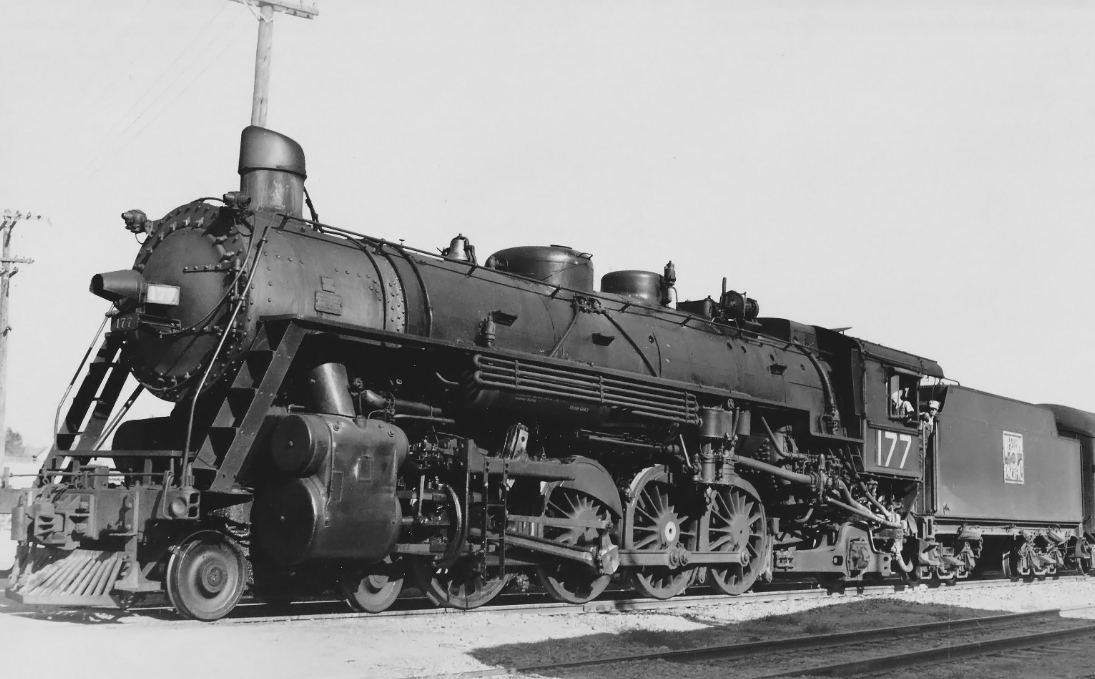
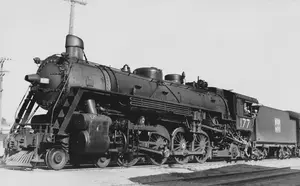
Western Pacific 4-8-2 #177 (Class MTP-44) at Oakland, California in April, 1945. These engines were all ex-Florida East Coast and operated in passenger service. American-Rails.com collection.
On this page: At a glance · How the classes were named · Consolidations · Mikados · Mallets and simple articulateds · Challengers · Passenger locomotives · The last engines bought · Switchers · Roster
At a glance
| Item | Detail |
|---|---|
| Railroad | Western Pacific. Company Western Pacific. Union Pacific completed the acquisition on December 22, 1982 |
| Scope | Built since 1900. Drury's table, 13 rows |
| Quantity column | 201 |
| Frames | 201. Nos. 321–325 are on two rows. Five Baldwin engines carried those numbers, and they were sold in 1920. Later Mikados received the numbers. Both groups stay in the column |
| Switchers | 16, all of them 0-6-0s |
| Last regular steam | June 1953. Mikado 329, between Oroville and Stockton. Most steam was gone by the end of 1951. The 4-8-4 retired cell still reads 1953–1957 |
| Preserved | Drury says five survive, and two of the five are from Nos. 163–166. He does not name them. The museum page names No. 165 |
How the classes were named
Drury's opening judgment is that the steam roster was brutally straightforward. He says the railroad never renumbered, and that it had no pre-1900 locomotive development to account for. The repeated block in the table, Nos. 321–325, is a number used again after those engines were sold. The Mikado section has that sale. The first locomotives were Consolidations and Ten-Wheelers. For freight power it picked a basic design and stayed with the specifications, buying larger examples as the years went on. The Mikados are his example of that habit. It never had a passenger locomotive built to its own specifications.
The lowest road number in a group was the class designation. Mikados 301–305 were class 301. The railroad also assigned a symbol, an abbreviation of the wheel arrangement plus the tractive effort in thousands of pounds. Some symbols carry a second figure, the tractive effort with the booster cut in. The P in the symbols for the 4-6-0s and the 4-8-2s means passenger. A few low-drivered 4-6-0s from the nineteenth century, inherited or bought secondhand, were freight Ten-Wheelers, and the symbol for those used TF. They are not rows in this table.
The canyon those engines had to climb is the company page. The finished road was held to a 1 percent grade. The first locomotives larger than a Consolidation were articulateds for the Feather River.
Consolidations
The first locomotives were twenty Baldwin Consolidations of 1906, Nos. 1–20, symbol C-43. They had 57-inch drivers, slide valves, and Stephenson valve gear. All but one were eventually rebuilt with piston valves. The chapter does not say which engine kept the slide valves. The retired cell is 1937–1950.
Schenectady built forty-five more in 1909, Nos. 21–65, the same symbol. They were almost the same engine, except that they came with Walschaerts valve gear. Most were later superheated and equipped with piston valves. The retired cell is 1939–1954. A number of the Consolidations were fitted with footboards and used for switching. The railroad had little work for a switcher, which is why the switcher fleet, in the last section, is sixteen engines.
Mikados
Drury counts 41 Mikados. Thirty-one of them were the same basic engine, built over a period of eleven years. The other ten were five light engines that went to the Wabash, and five heavy engines from the Elgin, Joliet & Eastern.
The first five were Nos. 301–305, Brooks, 1918. They were coal burners, assigned to the east end of the railroad. Two were converted to oil and moved west in 1950. The chapter does not say which two. Their class designation was 301. They sit inside the table's row for Nos. 301–321.
In 1919 the United States Railroad Administration assigned the railroad five coal-burning light Mikados. The railroad numbered them 321–325, above the Mikados it already had, because it expected to buy heavier engines and wanted those numbers clear. The table gives them their own row: symbol MK-55, Baldwin, 1918, quantity 5. The retired cell is blank. The note reads Acquired 1919, sold 1920. In 1920 they were sold to the Wabash. The Wabash steam roster lists the five as Nos. 2213, 2214, 2215, 2218, and 2219.
The heavier engines were five United States Railroad Administration heavy Mikados from the Elgin, Joliet & Eastern, bought for $55,261 apiece and numbered 306–310. They were coal burners. In 1938, when the 4-6-6-4s arrived, they were converted to oil. They also sit inside Nos. 301–321. The builder cell on that row reads Schen, Brooks. The chapter does not name a builder for these five.
Brooks then built five more oil burners, Nos. 311–315, in 1921, and delivered six oil burners, Nos. 316–321, in 1923. They were duplicates of Nos. 301–305, but heavier. Those batches, with Nos. 301–305 and Nos. 306–310, are the 21 engines on the MK-60 row. The built cell is 1918–1923. The retired cell is 1950–1953.
Another five oil burners, Nos. 322–326, came from Brooks in 1924. The principal difference was a booster-equipped Delta trailing truck. Schenectady built the last two batches, Nos. 327–331 in 1926 and Nos. 332–336 in 1929. They were the same engine as the previous Mikados. They looked bigger because of their 12-wheel tenders and Elesco feedwater heaters. The table puts Nos. 322–336 on one row, symbol MK-60-71, builder Brooks, Schen, built 1924–1929, quantity 15, retired 1939–1953. The second figure in the symbol is the booster.
Drury's caption of No. 326 says the Mikados all had Elesco feedwater heaters. Later classes were built with them. Earlier classes received them during visits to the shops. The same caption puts No. 326 at the head of train 39, the westbound Exposition Flyer, at Portola on July 4, 1940. The train's own story is the Exposition Flyer page.
No. 329 was the last steam engine to operate in regular service. It worked between Oroville and Stockton in June 1953. By the end of 1948 the management was committed to dieselization, and most steam power was gone by the end of 1951. No. 329 is one of the 1926 Schenectady engines, inside the 322–336 row. The retired cell on that row still begins in 1939.
Mallets and simple articulateds
The first locomotives larger than a Consolidation were five 2-6-6-2s built by Brooks in 1917. They were oil burners, for the Feather River Canyon between Oroville and Portola. Five more, substantially identical, came from Alco's Richmond Works in 1924. The table is one row, Nos. 201–210, symbol M-80, builder Brooks, Rich, built 1917, 1924, quantity 10, retired 1949–1953. The comma in the built cell is the book's. Drury says they were somewhat lighter than the United States Railroad Administration 2-6-6-2, with larger cylinders and the same tractive effort. He does not give the pounds.
Upon completion of the line in 1931, the ten moved to the Northern California Extension, between Keddie and Bieber. Drury gives that line long grades of 2.2 percent north from Keddie and 1.8 percent south from Bieber. A snowplow pilot was a necessity there in the winter. The Keddie Wye page has the High Line.
Those compound Mallets were replaced in the canyon by six simple 2-8-8-2s from Baldwin in 1931, and by four more in 1938. Drury calls the 1931 engines the railroad's first Baldwins since the Consolidations of 1906. The five light Mikados are also Baldwin in the table. They were not an order from this railroad. The 2-8-8-2s were unusual in having trailing-truck boosters. During the Second World War they were equipped with steam heat and air signal lines for passenger service, probably on troop trains.
No. 251 was the first of the 1931 batch. The second group, built in 1938, had disc drivers and welded tenders. The table is Nos. 251–260, symbol M-137-151, Baldwin, built 1931, 1938, quantity 10, retired 1952. The two figures in the symbol follow the same booster pattern as the Mikados.
Challengers
The seven Challengers were built in 1938 for freight across the desert between Elko, Nevada, and Salt Lake City. They were coal burners. The table is Nos. 401–407, symbol M-100, Alco, 1938, quantity 7, retired 1952. Diesels replaced them in 1950. In October of that year six were leased briefly to the Union Pacific. The chapter does not name the six. The railroad later offered to lease them to the Rio Grande, the Burlington, the Great Northern, and the Milwaukee Road, and found no takers. The seven have their own Challenger page.
No. 402 went to the Chicago Railroad Fair in 1949. On July 21, 1949, it began working its way home. Drury's photograph shows it on a Burlington freight at Downers Grove, Illinois.
Before the war the railroad had looked at buying 4-8-4s, to take the helpers off the long grade west from Wendover, Utah. Moving the 4-6-6-4s farther west would have required longer turntables at several places. The road tested an Electro-Motive FT and decided a four-unit freight diesel would not need those turntables. Drury dates the first FTs to 1941. The company page has the brochure's date for the first freight diesel operations, 1939.
Passenger locomotives
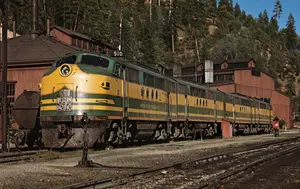
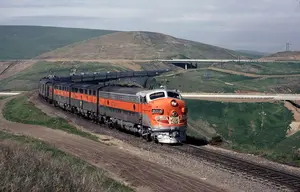
Western Pacific was not a major passenger carrier. The Oakland–Salt Lake City main line carried a daily first-class train, successively the Scenic Limited, the Exposition Flyer, and the California Zephyr, and a secondary train that at times went only as far east as Gerlach, or Reno, or Portola. Between the Great Salt Lake and San Francisco Bay, the running time was five to ten hours longer than the Southern Pacific. Passengers rode the Western Pacific to reach places the Southern Pacific did not serve, or to see different scenery. The California Zephyr has its own page.
The first passenger locomotives, and the only ones until 1936, were 36 Ten-Wheelers built by Brooks in 1908 and 1909. The table is one row, Nos. 71–106, symbol TP-29, retired 1934–1950. Drury calls them the 71 class and the 86 class, and he says the only difference is the delivery date. The 71 class was built for the Denver & Rio Grande and assigned to the Western Pacific before delivery. The engines came with piston valves and Walschaerts valve gear. They were not the newest passenger power. The Southern Pacific and the Santa Fe already had Pacifics. They were adequate here for three decades. Very few photographs show them doubleheaded on a passenger train.
In 1936 the railroad bought ten Florida East Coast 4-8-2s, built in 1924, at $12,500 each. They replaced the Ten-Wheelers on the Oakland–Salt Lake City passenger trains. Three were rebuilt at the Rio Grande's shop in Salt Lake City. Jeffery Shops in Sacramento rebuilt the rest. The rebuilding cost about $33,000 each. Drury's comparison, for that same year, is that the Southern Pacific paid $133,547 apiece for six 4-8-4s for the new Daylight trains, and that the Detroit & Toledo Shore Line bought three Mikados for $84,196 each.
The table row is Nos. 171–180, symbol MTP-44, Schenectady, 1924, quantity 10, retired 1950–1952. The note reads Ex-Florida East Coast. The Florida East Coast steam roster lists the former numbers. Nos. 403–408 became 171–176. Nos. 410 and 412 became 177 and 178. Nos. 414 and 415 became 179 and 180. The dimensions of the Florida East Coast class stay on that page.
The last engines bought
The last steam locomotives the railroad acquired were six 4-8-4s, Lima, 1943. They were part of a Southern Pacific order for unstreamlined 4-8-4s with 73-inch drivers, and the War Production Board allocated them to the Western Pacific. They were identical to the Southern Pacific GS-6. The railroad had also wanted 4-8-4s about the size of the Chesapeake & Ohio's 1942 Greenbriers. Their axle loading exceeded the limits the Southern Pacific imposed on the paired track across Nevada, so the six that arrived were the medium engines from the Southern Pacific order.
Before delivery, some of the Southern Pacific's patented devices were removed, such as the oil burner. Between 1946 and 1948 the Western Pacific added smoke deflectors. Drury's caption says the smoke deflectors, the enameled number plate on the cab, and the herald on the tender are the only features that are not Southern Pacific. After the dieselized California Zephyr replaced the Exposition Flyer, the six worked in freight. Three of them, Nos. 481, 484, and 485, were sold to the Southern Pacific for parts in 1953.
The table is Nos. 481–486, symbol GS-64-77, Lima, 1943, quantity 6, retired 1953–1957. The retired cell is the span for the class. The last engine in regular service remained Mikado 329, in June 1953.
Switchers
The railroad had only sixteen switchers, all of them 0-6-0s, mainly because it had little work for them. The first dozen came from Alco's Pittsburgh Works in 1909. They had 51-inch drivers, slide valves, and slope-back tenders. Nos. 151–158 were oil burners. Nos. 159–162 were built as coal burners and converted to oil in the 1920s. The table row is Nos. 151–162, symbol S-31, Pittsburgh, 1909, quantity 12, retired 1947–1953.
Nos. 163–166 came from the United Verde Copper Company in 1927. Alco built them at Schenectady in 1915 and 1919. The built cell reads 1915, 1919, a comma and not a span. They were a little heavier than the earlier batches, with piston valves and Walschaerts valve gear. The row is symbol S-34, quantity 4, retired 1953. The note reads Ex-United Verde Copper. Drury says two of the five surviving Western Pacific steam locomotives are from this group. He does not name the five. This site's Western Pacific Railroad Museum page names No. 165, an 0-6-0 built in 1919 for the United Verde Copper Company, and says the museum is restoring it.
Roster
The quantity column is Drury's, and it adds to 201. Thirteen rows. Nos. 321–325 are printed twice because the 1919 engines were sold and the numbers were used again. Both lines stay. The retired cell on the MK-55 row is blank in the book. A built cell printed with a comma is copied with a comma. The builder cells Schen, Brooks and Brooks, Schen and Brooks, Rich are copied as printed.
| Type | Symbol | Numbers | Qty | Builder | Built | Retired | Notes |
|---|---|---|---|---|---|---|---|
| 0-6-0 | S-31 | 151–162 | 12 | Pittsburgh | 1909 | 1947–1953 | |
| 0-6-0 | S-34 | 163–166 | 4 | Schenectady | 1915, 1919 | 1953 | Ex-United Verde Copper |
| 2-8-0 | C-43 | 1–20 | 20 | Baldwin | 1906 | 1937–1950 | |
| 2-8-0 | C-43 | 21–65 | 45 | Schenectady | 1909 | 1939–1954 | |
| 2-8-2 | MK-60 | 301–321 | 21 | Schen, Brooks | 1918–1923 | 1950–1953 | |
| 2-8-2 | MK-55 | 321–325 | 5 | Baldwin | 1918 | Acquired 1919, sold 1920 | |
| 2-8-2 | MK-60-71 | 322–336 | 15 | Brooks, Schen | 1924–1929 | 1939–1953 | |
| 2-6-6-2 | M-80 | 201–210 | 10 | Brooks, Rich | 1917, 1924 | 1949–1953 | |
| 2-8-8-2 | M-137-151 | 251–260 | 10 | Baldwin | 1931, 1938 | 1952 | |
| 4-6-0 | TP-29 | 71–106 | 36 | Brooks | 1908–1909 | 1934–1950 | |
| 4-8-2 | MTP-44 | 171–180 | 10 | Schenectady | 1924 | 1950–1952 | Ex-Florida East Coast |
| 4-8-4 | GS-64-77 | 481–486 | 6 | Lima | 1943 | 1953–1957 | |
| 4-6-6-4 | M-100 | 401–407 | 7 | Alco | 1938 | 1952 |
Schen Schenectady. Rich Richmond. The MK-55 retired cell is blank. The built cells 1915, 1919 and 1917, 1924 and 1931, 1938 keep the comma.
Related reading on American-Rails.com
- Western Pacific
- Keddie Wye
- Western Pacific 4-6-6-4s
- Florida East Coast steam roster
- Wabash steam roster
- Exposition Flyer · California Zephyr
- Western Pacific Railroad Museum
Sources
- George H. Drury, Guide to North American Steam Locomotives, revised edition, Western Pacific chapter, pages 329–331. The table, the class symbols, the Consolidations, the Mikado batches and the 1920 sale, the 2-6-6-2s and the 1931 move to Keddie and Bieber, the simple 2-8-8-2s, the Challengers and the October 1950 lease, the Ten-Wheelers, the 1936 Mountain purchase, the 1943 4-8-4s, the sixteen switchers, and Mikado 329 in June 1953. The odd cells are copied: a blank retired cell on Nos. 321–325, and built cells printed with a comma. The reading box on page 331 was not opened. No figure on this page comes from it. The photographs in the chapter stay in the book.
- This site's Florida East Coast steam roster. The 1936 sales rows give former Nos. 403–408 as Western Pacific 171–176, Nos. 410 and 412 as 177 and 178, and Nos. 414 and 415 as 179 and 180. The class dimensions on that page describe the Florida East Coast engines.
- This site's Wabash steam roster. Five Baldwin engines of 1918, former Western Pacific 321–325, are Nos. 2213, 2214, 2215, 2218, and 2219.
- This site's Western Pacific page. The 1 percent grade. First freight diesel operations in 1939, in the 1973 brochure. Union Pacific completed the acquisition on December 22, 1982.
- This site's Keddie Wye page. The High Line is the 1931 line from Keddie to Bieber. Drury's 2.2 percent and 1.8 percent are his figures for the grades on that line.
- This site's Western Pacific Railroad Museum page. It names 0-6-0 No. 165, built in 1919 for the United Verde Copper Company, and says the museum is restoring it. Drury's count of five survivors, two of them from Nos. 163–166, does not name the engines.
Recent Articles


-
Western Pacific Diesel Roster (All-Time)
Nov 17, 26 04:52 PM
 Western Pacific all-time diesel roster. Why the switchers, covered wagons, road switchers, and General Electric units were bought, where they worked, and what Union Pacific inherited on December 22, 1…
-
Western Pacific Steam Roster (Built Since 1900)
Nov 17, 26 04:49 PM
 Western Pacific steam locomotives built since 1900. Drury quantity column 201. Thirteen rows. Mikado 329 made the last regular steam run in June 1953.
-
Western Maryland Scenic Lists Polar Express Fares
Nov 17, 26 03:30 PM
 Western Maryland Scenic lists Polar Express tickets from November 21 through December 24, 2026. Coach is $40, plus a $5 heritage fee. Excursions are diesel while No. 1309 is inspected.
-
Western Pacific Railroad: Map, History, Logo, Rosters
Nov 17, 26 11:12 AM
 The Western Pacific, organized in San Francisco on March 3, 1903, the Feather River Route to Salt Lake City, and the Union Pacific acquisition completed on December 22, 1982.
-
Spokane, Portland & Seattle Diesel Roster (All-Time)
Nov 17, 26 10:53 AM
 Spokane, Portland and Seattle all-time diesel roster. Why the Alcos, Baldwins, and Electro-Motive units were bought, where they worked, and which numbers Burlington Northern inherited.
-
Spokane, Portland & Seattle Steam Roster (Built Since 1900)
Nov 17, 26 10:46 AM
 Spokane, Portland and Seattle steam locomotives built since 1900. Drury quantity column 121. Rebuilds counted once, 115 frames. Last steam run was June 23, 1956.
-
Spokane, Portland & Seattle Railway: Map, History, Photos
Nov 17, 26 10:10 AM
 The Spokane, Portland and Seattle, organized August 22, 1905 as the Portland and Seattle, the north-bank line to Portland, and the Burlington Northern merger at 12:01 a.m. on March 2, 1970.
-
Pacific Electric Railway: Car Roster
Nov 16, 26 12:15 AM
 Pacific Electric cars by order: the St. Louis 800s and 950s, Jewett Tens, Standard Steel 1100s, Pressed Steel and Pullman 1200s, and the city-car number catalog.
-
Pacific Electric Railway: Locomotive Roster
Nov 16, 26 12:02 AM
 Pacific Electric box motors, Baldwin-Westinghouse electrics, company-built locomotives, and the General Electric diesels numbered 1650-1654 in 1947.
-
Pacific Electric Railway: Map, Logo, History, Photos
Nov 15, 26 11:38 PM
 The Pacific Electric Red Cars of Los Angeles, Henry Huntington, the Great Merger of September 1, 1911, and the last Long Beach train on the morning of April 9, 1961.
-
Spokane International Railroad: Map, History, Photos
Nov 15, 26 06:54 AM
 The Spokane International, chartered January 1, 1905, from Spokane to Eastport, Idaho, its steam locomotives and Alco RS-1s, and Union Pacific control on October 6, 1958.
-
Northwestern Pacific Railroad: History, Map, Timetable
Nov 15, 26 12:38 AM
 The Northwestern Pacific, incorporated January 8, 1907, by the Southern Pacific and the Santa Fe, the Willits to Shively line, general traffic on July 1, 1915, and the later operators north of San Fra…
-
Northern Pacific Diesel Roster (All-Time)
Nov 14, 26 09:17 PM
 Northern Pacific all-time diesel roster. Alco, Baldwin, Electro-Motive, and General Electric serials, orders, and build dates.
-
Northern Pacific Steam Roster (Built Since 1900)
Nov 14, 26 07:44 PM
 Northern Pacific steam locomotives built since 1900. Last steam run was January 17, 1958.
-
Northern Pacific Railway: Map, Logo, History, Rosters
Nov 14, 26 12:15 AM
 The Northern Pacific, chartered July 2, 1864, from Jay Cooke and the panic of 1873 to the last spike at Gold Creek in 1883, Stampede Tunnel in 1888, and Burlington Northern at 12:01 a.m. on March 2, 1…
-
The Pacific Extension (Milwaukee Road): Map, Abandonment, History
Nov 13, 26 11:52 PM
 The Milwaukee Road Pacific Extension, from Mobridge to Tacoma. A shorter northern transcontinental, the mountain electrification, and the decision to take the line up.
-
Colorado Railroad Museum Lists Polar Express Fares
Nov 13, 26 11:44 PM
The Colorado Railroad Museum lists 2026 Polar Express train tickets through December 23. Standard seats are $80 and $100. First Class is sold by the table. Shows are at 5, 6:30, and 8 p.m. -
Essex Steam Train Lists the North Pole Express
Nov 13, 26 11:24 PM
 The Essex Steam Train lists North Pole Express dates from November 20 through December 23, 2026. Coach is $60 or $70. The railroad says questions about this train are not taken by phone.
-
Tennessee Valley Lists the North Pole Limited
Nov 13, 26 11:17 PM
The Tennessee Valley Railroad Museum lists the North Pole Limited on select dates from November 13 through December 23, 2026. Traditional tickets are $38 and $45. The page does not print a clock grid. -
Great Northern Diesel Roster (All-Time)
Nov 13, 26 10:59 PM
 Great Northern all-time diesel roster. Alco, Baldwin, Electro-Motive, and General Electric serials, orders, and build dates. Cascade electrics stay on the company page.
-
Alco "DH-643" Locomotives: Specs, Roster, Data Sheet
Nov 13, 26 10:39 PM
 Alco DH-643: 4,300 hp diesel-hydraulic C-C road switcher. Three built for the Southern Pacific in September 1964. Specs, drive, and the production roster.
-
Virginia Scenic Lists the 2026 Santa Express
Nov 13, 26 10:26 PM
 Virginia Scenic Railway lists the Santa Express from November 28 through December 23, 2026. The ride is about 60 minutes. The page says it is not a scenic excursion. Coach is $50.
-
Goleta Depot Stays Open Behind Storm Fencing
Nov 13, 26 07:20 PM
The City of Goleta says fencing and sandbags protect the historic depot. The museum building is closed for the season. Rides continue, and the Candy Cane Train runs November 28 through December 27, 20… -
Brandywine Museum Opens Its Holiday Railroad
Nov 13, 26 07:02 PM
The Brandywine Museum of Art opens the holiday model railroad on November 14, 2026. It runs through January 10, 2027, with holiday admission. -
Great Northern Steam Roster (Built Since 1900)
Nov 13, 26 04:14 PM
 Great Northern steam locomotives built since 1900. Drury quantity column 1,376. Rebuilds counted once, 1,178 frames. Last steam run was in August 1957.
-
Illinois Railway Museum Adds Three Burlington Gallery Cars
Nov 13, 26 01:54 PM
 The Illinois Railway Museum says Burlington gallery coaches 702 and 709 and cab car 791 arrived on November 11, 2026.
-
Great Northern Railway: Map, Logo, Rosters, History
Nov 13, 26 01:41 PM
 James J. Hill and the Great Northern, from the St. Paul and Pacific to the last spike near Scenic on January 6, 1893, and into Burlington Northern at 12:01 a.m. on March 2, 1970. Steam and diesel rost…
-
West Chester Lists Its 2026 Holiday Trains
Nov 13, 26 01:25 PM
The West Chester Railroad lists a 2026 Christmas Tree Train at 8 a.m. and a separate Santa Express of 75 minutes. The event pages do not print a calendar. -
Burlington Northern Diesel Roster (All-Time)
Nov 13, 26 12:49 PM
 Burlington Northern diesel roster of locomotives bought new from 1970 through December 30, 1996. Electro-Motive and General Electric, with builder serials and order numbers. Predecessor fleets stay on…
-
Atherton Train Station Museum Opens in the Old Depot
Nov 13, 26 12:21 PM
The Almanac reports that the Atherton Train Station Museum opened October 18 with six dioramas in the old depot beside Town Center. -
Manheim and Lititz Study a Strasburg Excursion
Nov 13, 26 12:15 PM
 LancasterOnline reports that a working group and the Strasburg Rail Road are studying passenger trips between Manheim and Lititz if a line purchase goes through.