Florida East Coast Steam Roster (Post 1900)
Published: October 8, 2026
By: Adam Burns
The Florida East Coast bought steam for a railroad that stayed within a few miles of the Atlantic, on a profile that barely left sea level. Drury's post-1900 grid is 272 locomotives, Ten-Wheelers of 1897 through the last Mountains of 1926. Eighty-seven of them were Pacifics and ninety were 4-8-2s. The boom of 1924–1926 alone put 125 new engines on the property. Six steam locomotives were still on the roster through 1958. The railroad was all-diesel in 1959.
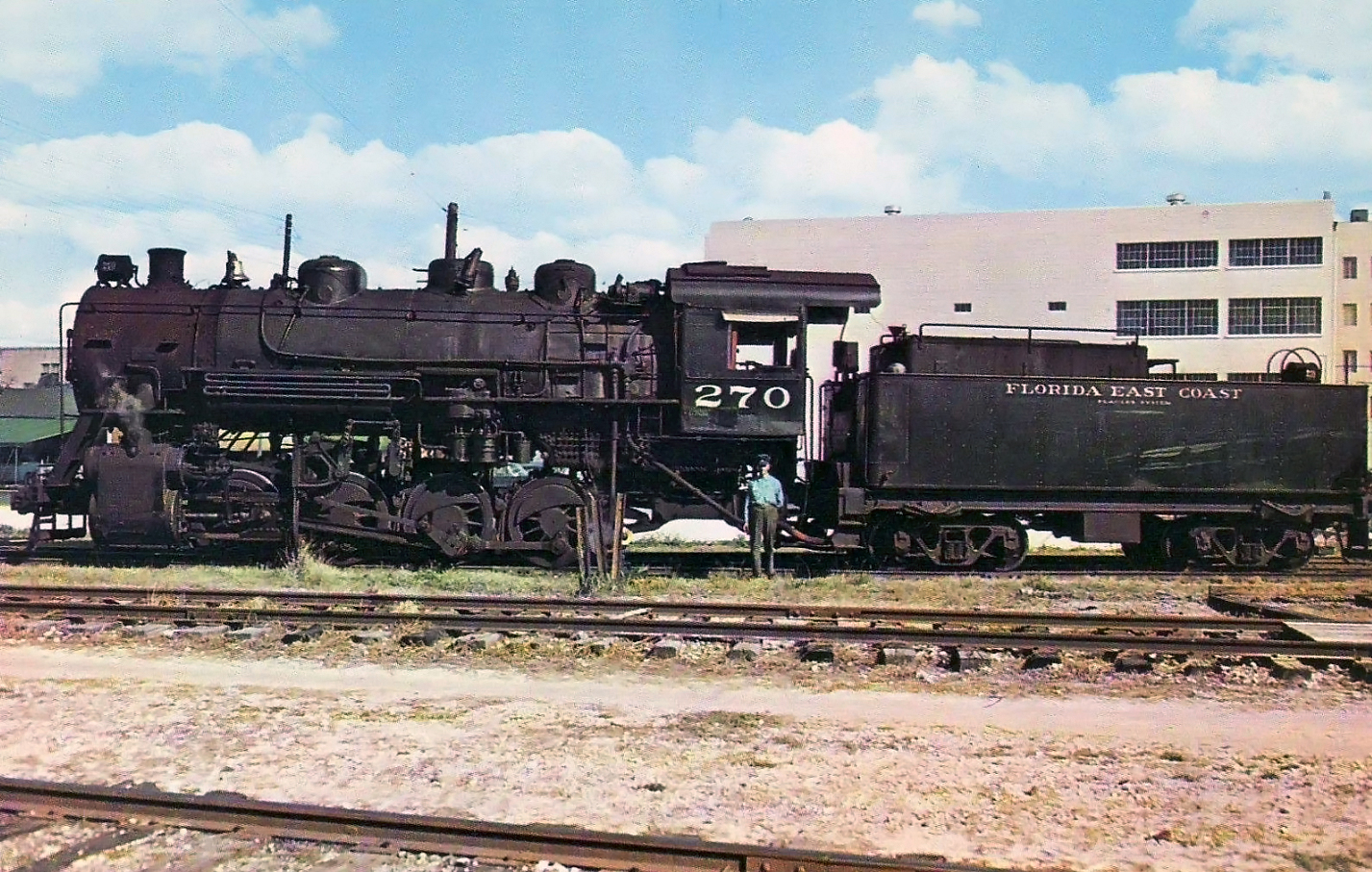
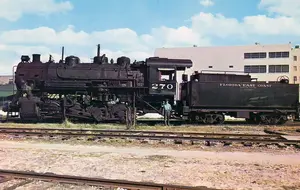
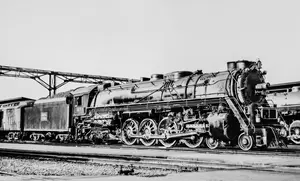
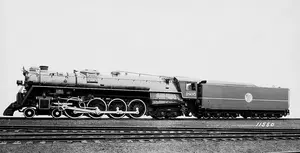
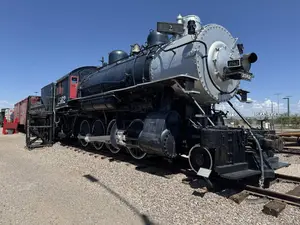
Florida East Coast 0-8-0 #270, built by Alco in 1926, on the ready track at West Palm Beach on December 15, 1953. John Krave photo.
On this page: At a glance · Ten-Wheelers, Atlantics, Pacifics · Mountains and Mikados · Switchers · Sold to other railroads · Roster built since 1900
At a glance
| Item | Detail |
|---|---|
| Railroad | Florida East Coast Railway. Mark FEC. Still operating. Company page: Florida East Coast |
| This roster | Engines in Drury's post-1900 grid, pages 177–179. 272 locomotives. Ten-Wheelers 28–32 of 1897 are included because Drury printed them |
| Passenger and dual service | 4-6-0: 17. 4-4-2: 20. 4-6-2: 87 |
| Freight | 4-8-2: 90. 2-8-2: 15, copies of the USRA heavy Mikado |
| Switchers | 0-6-0: 14. 0-8-0: 29, Richmond, 1924–1926. No. 270 is one of them |
| Last new steam | 4-8-2s 801–823, Schenectady, 1926. Based on the USRA heavy Mountain |
| End of steam | Between 1952 and 1954 the steam count fell from 66 to 9. Six remained through 1958. All-diesel in 1959 |
| Still running | Pacific 148, Richmond, 1920, on the Sugar Express at Clewiston |
Roster follows Drury, Guide to North American Steam Locomotives (revised edition), pages 177–179. Information compiled October 8, 2026.
Ten-Wheelers, twenty Atlantics, eighty-seven Pacifics
Drury's first road engines, printed with the later roster for completeness, are five 4-6-0s numbered 28–32, Schenectady, 1897, with 63-inch drivers. Seven more, 33–39, followed in 1900 with the same dimensions. Baldwin delivered 40–44 in 1902, and those five were the last Baldwin locomotives the Florida East Coast bought. Four of the earlier Ten-Wheelers and three of the Baldwins went to industrial owners between 1925 and 1934. The other Ten-Wheelers were scrapped between 1925 and 1930. Baldwin Americans 1–27, from the years before this grid, sit outside the table.
In 1904 and 1905 Schenectady built twenty Atlantics, 45–64. The drivers were no more than 70 inches. Atlantic 64, photographed for Drury by C. W. Witbeck, is the 1905 engine of the group, with Stephenson gear and inside piston valves. One Atlantic went to a construction company. One blew up in 1923. The rest were dismantled or sold for scrap in 1925 and 1930. Drury's scrap span for the class is 1923–1930.
Between 1907 and 1922 the railroad bought 87 Pacifics. Details changed across those fifteen years, and the common dimensions held: 69-inch drivers, 22-by-26-inch cylinders, and about 204,000 pounds, light as Pacifics go. The number series skips 137–140 and 158–160, which are 0-6-0s built on the same orders. The four groups are 65–74 (Schenectady, 1907), 77–136 (Schenectady, 1910–1917), 141–150 (Richmond, 1920), and 151–157 (Schenectady, 1922). Drury's portrait of the 1920 engines is No. 147, high headlight, paired compressors, and a wood pilot. Pacific 148, from that same Richmond order, runs on the Sugar Express at Clewiston. The sales table has no row for 147 or 148.
Light track, then ninety Mountains
The peninsula main line starts at 8 feet above sea level at Jacksonville, reaches 9 feet at South Jacksonville, drops to 7 at St. Augustine, climbs to a summit of 16 feet at West Palm Beach, drops to 7 at Fort Lauderdale, and finishes at 15 feet in Miami. A branch west from New Smyrna Beach reaches 70 feet at Lake Helen. The railroad was lightly built, and the first Mountains were built to match it.
In 1923 the FEC turned to the 4-8-2. Vacationers and perishable fruit needed a stronger engine, and the track needed the weight spread out. Numbers 301–315, Richmond, 1923, were among the lightest Mountains built: about 287,000 pounds, 68-inch drivers, and 43,100 pounds of tractive effort, about 10,000 pounds more than a USRA light Pacific.
Schenectady then built 52 larger Mountains, 401–452, in 1924, 1925, and 1926. Cylinders were 26 by 28 inches, an inch larger than the 301 series, with 73-inch drivers. Weight ran from 313,000 to 321,500 pounds, a little under a USRA light 4-8-2, and tractive effort was 44,100 pounds. The USRA light 4-8-2 was rated at 53,900 pounds. In 1936 the railroad defaulted on equipment-trust payments, and most of 401–420 left for other companies. The sales table is that record. Later groups, including 441–452 in 1945 and several of the 420s in 1948, went to the National Railways of Mexico.
The last new steam was a third Mountain, 801–823, Schenectady, 1926, based on the USRA heavy 4-8-2. They were bought for freight and for the long heavyweight Pullman trains that came south each winter. Drivers were 69 inches, cylinders 28 by 30 inches, weight about 4,000 pounds over the USRA heavy Mountain, and tractive effort 60,800 pounds. Drury's scrap span is 1951–1955. The whole class stayed off the sales list. The same years produced the only Mikados: 701–715, Schenectady, 1925, fifteen copies of the USRA heavy 2-8-2, bought as freight power and scrapped in 1954 and 1955. They too stayed off the sales list.
Switchers added to road orders
Most of the switchers were add-ons to orders for road engines. The 0-6-0s of 1907 and of 1917 and 1920 carried construction numbers immediately above the Pacifics of those years, and they were later renumbered 201–206. The three of 1922 became 207–209. The five of 1924, numbers 210–214, carried construction numbers immediately above Mountains 301–315. The grid lists that last five as Schenectady, 1924, scrapped in 1941 and 1952.
The 0-8-0s were about the size of a USRA switcher. Richmond built all 29, numbers 251–279, in 1924, 1925, and 1926. Numbers 251–255 followed Mountains 401–420, 256–261 followed 421–432, and 262–267 followed the Mikados. No. 270, in the photograph above, is one of the 1926 engines. Drury's scrap span for the class is 1930–1955. A few of them, and a few of the renumbered 0-6-0s, appear on the sales list under their later numbers.
Sold to other railroads
Drury's point about this roster is that it became a parts bin for other companies. The 1930 Pacifics went in numbers to the Atlanta, Birmingham & Coast, and many of those later carried Atlantic Coast Line 7000-series numbers. Others went to the Georgia Northern, the Georgia & Florida, the Savannah & Atlanta, the Atlanta & St. Andrews Bay, the Apalachicola Northern, the Louisiana & Arkansas, and the Columbia, Newberry & Laurens. The 1936 Mountains went to the Western Pacific, the St. Louis Southwestern, the Western Railway of Alabama, and the Atlanta, Birmingham & Coast. In 1941 the surviving 301-series Mountains, and in 1945 and 1948 a further group of the 401s, went to the National Railways of Mexico. The 0-6-0s on this list are the renumbered engines, 203 and up.
| Type | Numbers | Year sold | Subsequent owner and number |
|---|---|---|---|
| 4-6-2 | 69 | 1930 | Georgia Northern 106 |
| 4-6-2 | 80 | 1935 | Savannah & Atlanta 750 |
| 4-6-2 | 88 | 1930 | Sold for scrap; Georgia Northern 107 |
| 4-6-2 | 96 | 1941 | Georgia & Florida 500 |
| 4-6-2 | 101, 103, 105, 108 | 1930 | Atlanta, Birmingham & Coast 71–74; Atlantic Coast Line 7071–7074 |
| 4-6-2 | 109 | 1930 | Louisiana & Arkansas 309 |
| 4-6-2 | 110 | 1930 | Atlanta, Birmingham & Coast 75; Atlantic Coast Line 7075 |
| 4-6-2 | 111 | 1930 | Atlanta, Birmingham & Coast 76; Apalachicola Northern 301 |
| 4-6-2 | 112 | 1930 | Atlanta, Birmingham & Coast 77; Atlantic Coast Line 7077 |
| 4-6-2 | 115 | 1930 | Atlanta, Birmingham & Coast 78; Apalachicola Northern 300 |
| 4-6-2 | 117 | 1930 | Atlanta, Birmingham & Coast 79 |
| 4-6-2 | 118–122 | 1930 | Atlanta, Birmingham & Coast 80–84; Atlantic Coast Line 7080–7084 |
| 4-6-2 | 123 | 1930 | Atlanta, Birmingham & Coast 85; Apalachicola Northern 302 |
| 4-6-2 | 125 | 1930 | Atlanta, Birmingham & Coast 86; Atlantic Coast Line 7086 |
| 4-6-2 | 127–129 | 1934 | Georgia & Florida 501–503 |
| 4-6-2 | 130 | 1936 | Georgia Northern 130 |
| 4-6-2 | 131 | 1935 | Atlanta & St. Andrews Bay 131 |
| 4-6-2 | 132–135 | 1934–37 | Georgia Northern 504–507 |
| 4-6-2 | 136, 141 | 1936, 35 | Savannah & Atlanta 752, 751 |
| 4-6-2 | 142, 143 | 1934 | Atlanta & St. Andrews Bay 142, 143 |
| 4-6-2 | 144 | 1934 | Georgia & Florida 508 |
| 4-6-2 | 145, 146 | 1935, 34 | Atlanta & St. Andrews Bay 145, 146 |
| 4-6-2 | 149 | 1941 | Georgia & Florida 509 |
| 4-6-2 | 150 | 1942 | Apalachicola Northern 510; Kansas City, Mexico & Orient 152 |
| 4-6-2 | 151, 152 | 1941 | Georgia & Florida 510, 511 |
| 4-6-2 | 154 | 1935 | Atlanta & St. Andrews Bay 154; Columbia, Newberry & Laurens 154 |
| 4-6-2 | 155 | 1942 | Apalachicola Northern 515; Kansas City, Mexico & Orient 153 |
| 4-6-2 | 156 | 1941 | Georgia & Florida 512 |
| 4-6-2 | 157 | 1941 | Columbia, Newberry & Laurens 157 |
| 0-6-0 | 203 | 1923 | Georgia & Florida 27 |
| 0-6-0 | 206 | 1934 | Atlanta & St. Andrews Bay 206 |
| 0-6-0 | 207 | 1934 | Georgia & Florida 28 |
| 0-6-0 | 208 | 1934 | Atlanta & St. Andrews Bay 208 |
| 0-6-0 | 211, 212 | 1941 | Georgia & Florida 29, 30 |
| 0-8-0 | 251–253 | 1936 | Louisiana & Arkansas 251–253 |
| 0-8-0 | 254, 255 | 1936 | Illinois Terminal 36, 37 |
| 0-8-0 | 264, 265, 267 | 1930 | Illinois Terminal 34, 33, 35 |
| 4-8-2 | 304, 305 | 1941 | National Railways of Mexico 3200, 3201 |
| 4-8-2 | 307–309 | 1941 | National Railways of Mexico 3206, 3202, 3207 |
| 4-8-2 | 311–315 | 1941 | National Railways of Mexico 3208, 3203, 3204, 3209, 3205 |
| 4-8-2 | 401 | 1936 | St. Louis Southwestern 675 |
| 4-8-2 | 402 | 1936 | Western Railway of Alabama 185 |
| 4-8-2 | 403–408 | 1936 | Western Pacific 171–176 |
| 4-8-2 | 409, 411 | 1936 | St. Louis Southwestern 676, 677 |
| 4-8-2 | 410, 412 | 1936 | Western Pacific 177, 178 |
| 4-8-2 | 413, 416 | 1936 | St. Louis Southwestern 678, 679 |
| 4-8-2 | 414, 415 | 1936 | Western Pacific 179, 180 |
| 4-8-2 | 417, 420 | 1936 | Atlanta, Birmingham & Coast 351, 372; Atlantic Coast Line 7351, 7372 |
| 4-8-2 | 418, 419 | 1936 | Western Railway of Alabama 187, 186 |
| 4-8-2 | 421, 422 | 1948 | National Railways of Mexico 3314, 3315 |
| 4-8-2 | 425–427 | 1948 | National Railways of Mexico 3316–3318 |
| 4-8-2 | 429 | 1948 | National Railways of Mexico 3319 |
| 4-8-2 | 433, 434 | 1945 | National Railways of Mexico 3300, 3301 |
| 4-8-2 | 441–452 | 1945 | National Railways of Mexico 3302–3313 |
Years and second numbers are Drury's, including pairs listed out of Florida East Coast order. Mikados 701–715 and Mountains 801–823 stay off this list. Their scrap spans are on the class grid.
Florida East Coast steam locomotives built since 1900
| Type | Numbers | Qty | Builder | Built | Scrapped | Notes |
|---|---|---|---|---|---|---|
| 0-6-0 | 75, 76 | 2 | Schenectady | 1907 | 1916 | Renumbered 201, 202 |
| 0-6-0 | 137–140 | 4 | Schenectady | 1917, 1920 | 1923, 1934 | Renumbered 203–206 |
| 0-6-0 | 158–160 | 3 | Schenectady | 1922 | 1934 | Renumbered 207–209 |
| 0-6-0 | 210–214 | 5 | Schenectady | 1924 | 1941, 1952 | Construction numbers immediately above 4-8-2s 301–315 |
| 0-8-0 | 251–279 | 29 | Richmond | 1924–1926 | 1930–1955 | 270 is the West Palm Beach photograph. About USRA switcher size |
| 2-8-2 | 701–715 | 15 | Schenectady | 1925 | 1954–1955 | Copies of the USRA heavy 2-8-2 |
| 4-4-2 | 45–64 | 20 | Schenectady | 1904, 1905 | 1923–1930 | Drivers no more than 70 inches. 64 is the Witbeck photograph |
| 4-6-0 | 28–39 | 12 | Schenectady | 1897, 1900 | 1925–1934 | 28–32 in 1897, 63-inch drivers. 33–39 in 1900. Included for completeness |
| 4-6-0 | 40–44 | 5 | Baldwin | 1902 | 1930 | Last Baldwins bought new |
| 4-6-2 | 65–74 | 10 | Schenectady | 1907 | 1929–1930 | 69-inch drivers, 22 by 26 inches, about 204,000 pounds |
| 4-6-2 | 77–136 | 60 | Schenectady | 1910–1917 | 1930–1937 | Same common dimensions |
| 4-6-2 | 141–150 | 10 | Richmond | 1920 | 1935–1942 | 147 is Drury's portrait. 148 runs at Clewiston |
| 4-6-2 | 151–157 | 7 | Schenectady | 1922 | 1934–1952 | |
| 4-8-2 | 301–315 | 15 | Richmond | 1923 | 1941–1954 | About 287,000 pounds. 68-inch drivers. 43,100 pounds tractive effort |
| 4-8-2 | 401–452 | 52 | Schenectady | 1924–1926 | 1936–1955 | 73-inch drivers. 26 by 28 inches. 44,100 pounds tractive effort |
| 4-8-2 | 801–823 | 23 | Schenectady | 1926 | 1951–1955 | Last new steam. USRA heavy Mountain, 69-inch drivers, 28 by 30 inches, 60,800 pounds tractive effort |
The quantity column totals 272. The scrapped column is Drury's span for the class. An engine sold to another railroad can fall inside that span, and the sale is in the table above. Americans 1–27 are outside this grid.
Related reading on American-Rails.com
- Florida East Coast Railway · Diesel roster · Key West Extension
- Atlantic · Pacific · Mountain
- Atlantic Coast Line · Seaboard Air Line · Regional railroads
Sources
- George H. Drury, Guide to North American Steam Locomotives, revised edition, Florida East Coast, pp. 177–179. User photographs in
Downloads\FEC_Steam, October 2026. Class grid, dimensions, the profile, the 125 locomotives of 1924–1926, dieselization from 66 engines to 9 and then to six through 1958, and the sales list on page 179 - Seth H. Bramson, Speedway to Sunshine (Boston Mills Press, 1984, ISBN 0-919783-12-0). Drury's recommended reading for the company
- Railroad magazine, January 1948, page 90. The published roster Drury cites
- John Krave photograph of 0-8-0 270, West Palm Beach, December 15, 1953, for the hero. The live caption dates the engine to Alco, 1926, inside Richmond's 251–279
Recent Articles


-
Milwaukee Road X3800: Deer Lodge’s Shop Goat
Oct 08, 26 04:28 PM
 Milwaukee Road X3800, the one Deer Lodge shop goat. Home-built, 220-volt DC through an extension cord, moving electrics into a roundhouse the trolley never reached. Displayed at Harlowton.
 -
Key West Extension (Overseas Railroad): History, Construction, Decline
Oct 08, 26 03:59 PM
 Henry Flagler's Overseas Railroad, Miami to Key West, 1905–1935. The Seven Mile Bridge, the 1935 Labor Day Hurricane, and the road that became U.S. 1.
 -
Florida East Coast Steam Roster (Post 1900)
Oct 08, 26 02:34 PM
 Florida East Coast steam since 1897. Seventeen Ten-Wheelers, twenty Atlantics, eighty-seven Pacifics, ninety Mountains, fifteen Mikados, and the switchers.
 -
Florida East Coast Diesel Roster (All-Time)
Oct 08, 26 02:12 PM
 Florida East Coast diesel roster, all-time. E units from 1939, F3s, BL2s, GP7s and GP9s, the GP40-2 orders, 22 SD40-2s, and 24 ES44C4s. Serials and EMD order numbers.
 -
Florida East Coast Railway: Map, History, Rosters
Oct 08, 26 01:46 PM
 Florida East Coast Railway, Henry Flagler's line from Jacksonville to Miami and Key West. Receivership in 1931, the 1963 strike, Grupo México in 2017, and Brightline on the same track.
 -
Minnesota Railroad Museums (2026): A Complete Guide
Oct 08, 26 10:32 AM
 Minnesota railroad museums—the Lake Superior Railroad Museum, Two Harbors, Jackson Street, Willmar’s Great Northern 2523, and Currie. Confirm hours on each site.
 -
Maine Railroad Museums (2026): A Complete Guide
Oct 08, 26 09:24 AM
 Maine railroad museums—Seashore Trolley, the two-foot lines at Portland, Alna, and Phillips, Boothbay, and the Bangor & Aroostook depots. Confirm hours on each site.
 -
Massachusetts Railroad Museums (2026): A Complete Guide
Oct 08, 26 12:08 AM
 Massachusetts railroad museums—Berkshire Scenic at Lenox, Shelburne Falls trolley No. 10, Edaville, Chatham’s 1887 depot, and Lowell. Confirm hours on each site.
 -
Clinchfield Steam Roster (Post 1900)
Oct 07, 26 12:09 PM
 Clinchfield steam since 1900. Fifteen H-4 Consolidations, K-1 Mikados, M-2 and M-3 Mallets, L-class 2-8-8-2s, eighteen Challengers. Class grid after Drury. Last steam April 16, 1954.
 -
Clinchfield Diesel Roster (All-Time)
Oct 07, 26 12:05 PM
 Clinchfield diesel roster, all-time. F3A 800, FP7 200, the F7s, GP7s, 25 SD40s, 18 SD45-2s, seven U36Cs, and the Family Lines hoods. Serials and EMD order numbers.
 -
Clinchfield Railroad: Map, Steam Locomotives, Roster, Logo
Oct 07, 26 12:02 PM
 Clinchfield Railroad, Elkhorn City to Spartanburg. George L. Carter, the Carolina, Clinchfield & Ohio, the 1924 lease, coal, the loops, and CSX. Steam and diesel rosters are companion pages.
 -
Kentucky Railroad Museums (2026): A Complete Guide
Oct 07, 26 11:39 AM
 Kentucky railroad museums—the Kentucky Railway Museum, Bowling Green’s L&N depot, Paducah, Versailles, and Covington. Confirm hours on each site.
 -
Kansas Railroad Museums (2026): A Complete Guide
Oct 07, 26 11:26 AM
 Kansas railroad museums—Santa Fe 3768 at Wichita, Santa Fe 132 in Topeka, the Great Overland Station, and Abilene. Confirm hours on each site.
 -
Cincinnati, New Orleans and Texas Pacific Diesel Roster (All-Time)
Oct 07, 26 10:38 AM
 All-time diesel roster of Southern locomotives lettered for the Cincinnati, New Orleans and Texas Pacific. Serials, order numbers, and builder dates.
 -
Cincinnati, New Orleans and Texas Pacific Railway
Oct 07, 26 10:31 AM
 Cincinnati, New Orleans and Texas Pacific Railway, incorporated September 8, 1881, to lease Cincinnati’s railroad to Chattanooga. Queen and Crescent route, Rathole, and the 2024 sale to Norfolk Southe…
 -
Indiana Railroad Museums (2026): A Complete Guide
Oct 07, 26 12:26 AM
 Indiana railroad museums—Nickel Plate 765, Elkhart’s New York Central collection, French Lick, Linden’s junction depot, and Haley Tower. Confirm hours on each site.
 -
"Triplex" Steam Locomotive: Specs, History, Photos
Oct 06, 26 11:52 PM
 Erie class P-1 Triplex 2-8-8-8-2s. Three Baldwin compounds, 2603–2605, later 5014–5016, built 1914 and 1916. Matt H. Shay, the 1930 class card, and Virginian XA 700.
 -
Illinois Railroad Museums (2026): A Complete Guide
Oct 06, 26 11:47 PM
 Illinois railroad museums—the Illinois Railway Museum, Monticello, the Pioneer Zephyr, Galesburg’s Burlington 3006, and the depots. Confirm hours on each site.
 -
Iowa Railroad Museums (2026): A Complete Guide
Oct 06, 26 11:41 PM
 Iowa railroad museums—the Union Pacific Railroad Museum, RailsWest, Sioux City, Boone, and the National Hobo Museum in Britt. Confirm hours on each site.
 -
Charleston and Western Carolina Diesel Roster (All-Time)
Oct 06, 26 11:29 PM
 Charleston and Western Carolina diesel roster. Twenty-one GP7s, two SW7s, two SW9s, and six F7As, all built 1950–1952. Serials, order numbers, and ACL and SCL numbers.
 -
Charleston and Western Carolina Railway: Map, History, Timetables
Oct 06, 26 11:18 PM
 Charleston and Western Carolina Railway, incorporated September 16, 1896. Port Royal to Spartanburg, with branches to Anderson and Greenville. Merged into the Atlantic Coast Line on December 31, 1959.
 -
Central of Georgia Steam Roster (Post 1900)
Oct 06, 26 04:00 PM
 Central of Georgia steam since 1900. Cooke Consolidations, Harriman Mikados, 32 Mountains, and eight Lima 4-8-4s. Class grid after Drury. Last steam May 1953.
 -
Central of Georgia Diesel Roster (All-Time)
Oct 06, 26 03:44 PM
 Central of Georgia diesel roster. SW1 No. 1 in 1939, E7s and E8s, nine F3As, 39 RS3s, GP7s through SD35s. Serials and order numbers.
 -
Central of Georgia Railway: Map, Logo, History, Rosters
Oct 06, 26 03:42 PM
 Central of Georgia Railway, from the 1833 Savannah charter to Southern control on June 17, 1963. Map, logos, Nancy Hanks II, and links to the steam and diesel rosters.
 -
Georgia Railroad Museums (2026): A Complete Guide
Oct 06, 26 03:33 PM
Georgia railroad museums—Savannah’s Central shops, Duluth, the General at Kennesaw, the Texas in Atlanta, Tifton, Waycross, and Albany. Confirm hours on each site. -
Florida Railroad Museums (2026): A Complete Guide
Oct 06, 26 03:18 PM
 Florida railroad museums—Boca Raton, Winter Garden, Whitehall, the Gold Coast, Parrish, Fort Myers, Milton, and Plant City. Confirm hours on each site.
 -
Connecticut Railroad Museums (2026): A Complete Guide
Oct 06, 26 01:05 PM
 Connecticut railroad museums—the Shore Line Trolley, East Windsor, the Naugatuck Railroad, Danbury Union Station, Willimantic, and the SoNo tower. Confirm hours on each site.
 -
Colorado Railroad Museums (2026): A Complete Guide
Oct 06, 26 12:47 PM
 Colorado railroad museums—Golden, the Forney’s Big Boy 4005, Pueblo’s Santa Fe 2912, and the depots at Castle Rock, Limon, and Ridgway. Confirm hours on each site.
 -
Atlantic Coast Line Steam Roster (Post 1900)
Oct 06, 26 12:44 PM
 Atlantic Coast Line steam since 1900. Copper Head Ten-Wheelers, 235 P-5 Pacifics, Q-1 Santa Fes, twelve R-1 4-8-4s. Class grid after Drury. Last steam June 30, 1955.
 -
Atlantic Coast Line Diesel Roster (All-Time)
Oct 06, 26 11:57 AM
 Atlantic Coast Line diesel roster. HH660 1900 in 1939, E3s for the Champion, FTs and F2s, GP7s 100–279, GP30s, U25Cs, and the 1967 SCL numbers. Serials and orders.
 -
Atlantic Coast Line Railroad: "Standard Railroad of the South"
Oct 06, 26 11:53 AM
 Atlantic Coast Line, the Standard Railroad of the South. April 21, 1900 to July 1, 1967. Plant System, L&N, Clinchfield, the Champion, and the Seaboard Coast Line merger.
 -
California Railroad Museums (2026): A Complete Guide
Oct 06, 26 09:50 AM
California railroad museums—the California State Railroad Museum, Perris, Portola, Railtown 1897, and the depots that still stand. Confirm hours on each site. -
Arizona Railroad Museums (2026): A Complete Guide
Oct 06, 26 09:46 AM
Arizona railroad museums—the Arizona Railway Museum in Chandler, Southern Pacific 1673 at Tucson, and the McCormick-Stillman park in Scottsdale. -
Arkansas Railroad Museums (2026): A Complete Guide
Oct 06, 26 09:07 AM
 Arkansas railroad museums—Cotton Belt 819 at Pine Bluff, the Fort Smith trolley, the Mammoth Spring depot, and the Eureka Springs railway.
 -
Alabama Railroad Museums (2026): A Complete Guide
Oct 06, 26 09:03 AM
Alabama railroad museums—Heart of Dixie at Calera, the North Alabama museum at Chase, Huntsville’s 1860 depot, and Fort Payne. Confirm hours on each site. -
Pennsylvania Railroad Museums (2026): A Complete Guide
Oct 06, 26 12:09 AM
 Pennsylvania railroad museums—Strasburg, Steamtown, the Horseshoe Curve, the East Broad Top, and the depots and towers in between. Confirm hours on each site.
 -
Maryland Railroad Museums (2026): A Complete Guide
Oct 05, 26 11:53 PM
 Maryland railroad museums—the Baltimore roundhouse, Ellicott City station, Bowie, Gaithersburg’s Buffalo Creek & Gauley 14, and the Western Maryland collections.
 -
Ohio Railroad Museums (2026): A Complete Guide
Oct 05, 26 05:51 PM
 Ohio railroad museums—the Age of Steam Roundhouse, Bellevue, Worthington, Conneaut’s Nickel Plate 755, and the Dennison depot. Confirm hours on each site.
 -
Delaware Railroad Museums (2026): A Complete Guide
Oct 05, 26 02:43 PM
 Delaware railroad museums—Wilmington & Western at Greenbank, the Harrington tower and N5 caboose, Felton's 1868 depot, and the Selbyville station museum.
 -
C&O's M-1 Steam Turbine Locomotives: Specs, Roster, History
Oct 05, 26 12:13 PM
 Chesapeake & Ohio Class M-1 steam-turbine-electrics. Three Baldwin-Westinghouse locomotives, 500–502, built 1947–48 for The Chessie. Specs, the 2-C1+2-C1-B arrangement, and a roster. All scrapped…
 -
N&W 2-6-6-2 Locomotives (Class Z): Specs, Roster, History
Oct 05, 26 11:44 AM
 Norfolk & Western Class Z 2-6-6-2s. One hundred ninety compound Mallets, 1300–1489, from Richmond, Baldwin, and Schenectady, 1912–1918. Diagram specs, the Z-1b rebuilds, Z-2 1399, and a roster. No…
 -
Scenic Train Rides (USA 2026): State Guide to Tourist Railroads
Oct 04, 26 12:17 AM
 Scenic and tourist train rides in all 50 states for 2026. Colorado narrow gauge, Pennsylvania steam, Alaska’s White Pass, and the states with no full-size ride this month. Confirm on the railroad.
 -
Wyoming Scenic Train Rides (2026): A Complete Guide
Oct 03, 26 12:07 AM
Wyoming has no full-size tourist railroad on the calendar in October 2026. Cheyenne Depot Museum and Douglas Railroad Museum are static. Union Pacific 4014’s posted public trip is a November run to De… -
Washington Scenic Train Rides (2026): A Complete Guide
Oct 02, 26 11:53 PM
 Washington tourist trains in 2026—Mount Rainier Scenic at Elbe, the Northwest Railway Museum, and Chehalis-Centralia. Lake Whatcom has no 2026 date on its ticket page.
 -
Wisconsin Scenic Train Rides (2026): A Complete Guide
Oct 02, 26 11:48 PM
 Wisconsin tourist trains in 2026—Wisconsin Great Northern, Osceola & St. Croix Valley, Mid-Continent, East Troy, and the National Railroad Museum.
 -
Pennsylvania Railroad Class Q2 4-4-6-4: Specs, Roster, History
Oct 02, 26 11:28 PM
Pennsylvania Railroad Class Q2 4-4-6-4 duplexes. Twenty-six engines, 6131 and 6175–6199, Altoona 1944–45. Form 109-J specs, the 7,987 hp test of 6175, and a roster. All scrapped. -
Utah Scenic Train Rides (2026): A Complete Guide
Oct 02, 26 11:18 PM
 Utah tourist trains in 2026—Heber Valley Railroad from Heber City. Golden Spike at Promontory is a locomotive demonstration, not a line-haul ride.
 -
South Dakota Scenic Train Rides (2026): A Complete Guide
Oct 02, 26 11:06 PM
 South Dakota’s 2026 scenic train is the Black Hills Central 1880 Train, Hill City to Keystone. Steam is the summer assignment. Confirm the engine.
 -
Oregon Scenic Train Rides (2026): A Complete Guide
Oct 02, 26 11:04 PM
 Oregon tourist trains in 2026—Oregon Coast Scenic from Rockaway Beach, Mount Hood at Hood River, Eagle Cap from Elgin, and the Oregon Rail Heritage Center in Portland.
 -
Oklahoma Scenic Train Rides (2026): A Complete Guide
Oct 02, 26 10:36 PM
Oklahoma has no full-size scenic railroad on an October 2026 calendar. Oklahoma Railway Museum Halloween and Polar trains, the El Reno trolley, and the Heartland Flyer.