Spokane, Portland & Seattle Steam Roster (Built Since 1900)
Published: November 17, 2026
By: Adam Burns
For such a small road the Spokane, Portland & Seattle operated some rather large wheel arrangements in later years including 4-8-4s and even massive 4-6-6-4s, which were nearly identical to Northern Pacific's examples. In general service the railroad typically operated 2-8-2s, 2-8-0s, 4-6-0s, and 4-6-2s.
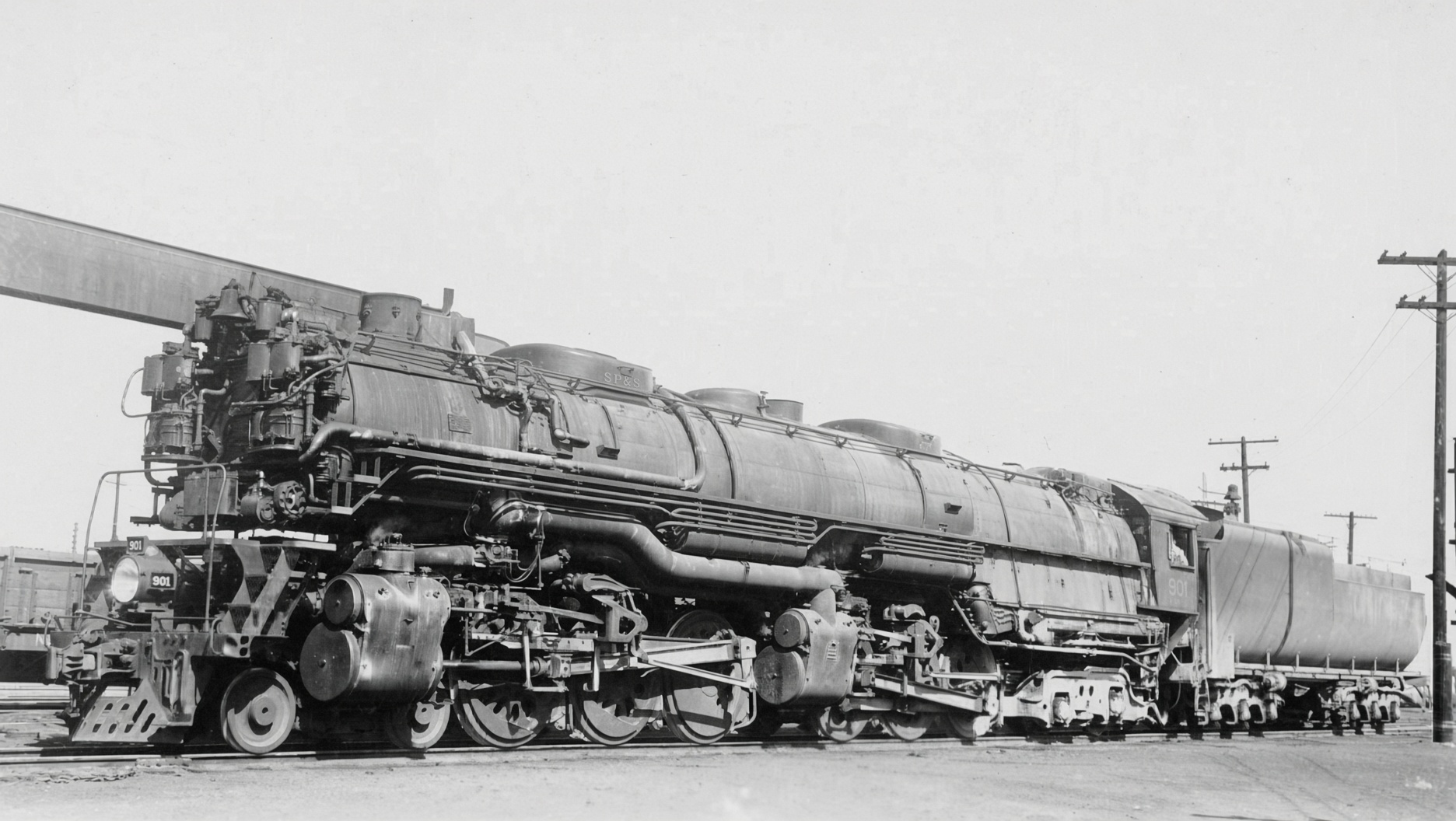
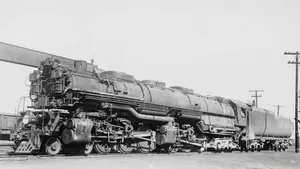
One of the Spokane, Portland & Seattle's huge Z-6 4-6-6-4s, #901, lays over in Pasco, Washington on May 9, 1938. At the time of this photo the engine was about a year old. Photographer unknown.
On this page: At a glance · Switchers · Prairies, Consolidations, and Ten-Wheelers · Mikados · Atlantics and Pacifics · Northerns and Challengers · Roster
At a glance
| Item | Detail |
|---|---|
| Railroad | Spokane, Portland & Seattle. Company Spokane, Portland & Seattle. Successor Burlington Northern, operations at 12:01 a.m. on March 2, 1970 |
| Scope | Built since 1900. Drury's table, 26 rows |
| Quantity column | 121 |
| Frames, counted once | 115. Taken out: H-1s 620–625, rebuilt from D-1s 102, 103, 104, 105, 107, and 109. No. 626 stays in both counts. Secondhand engines stay in both counts |
| Built new | 30, in Drury's split: seven 0-6-0s, ten Atlantics, two Ten-Wheelers, three Northerns, and eight Challengers. All of them were Great Northern or Northern Pacific designs |
| Last steam | June 23, 1956. Challenger 910. A last-of-steam excursion ran behind Northern 700 on May 20, 1956. The retired cells for the E-1s, the Z-6s, and the Z-8s still read 1960 |
| Preserved | No. 700. Drury says it was put on display, restored to operating condition in 1990, and is at the Oregon Rail Heritage Center in Portland |
Switchers
Drury's opening judgment is that the railroad never had a steam locomotive of its own design, and that for much of its life it made do with castoffs from its owners. The Great Northern and the Northern Pacific supplied the engines. He writes that the parent roads tended to wrangle over their child, and that they vied to see which could be stingier. Most of the steam locomotives were acquired secondhand from one parent or the other. The thirty built new were still Great Northern or Northern Pacific designs: seven 0-6-0s, ten Atlantics, two Ten-Wheelers, three Northerns, and eight Challengers.
The six-wheel switchers are the seven new engines at the top of the table. Class A-1 is Nos. 1–5, Manchester, 1907. Drury's caption of No. 1 calls it a six-wheel switcher, one of five built by Manchester that year. The next new switchers are Nos. 7 and 8, class A-3, Schenectady, 1914. Those two were the last new steam locomotives until the Challengers of 1937. The A-1 retired cell is 1946–1952. The A-3 retired cell is 1952.
When the United States Railroad Administration allocated four heavy 2-8-2s and eight 0-8-0s to this railroad, the Great Northern and the Northern Pacific conferred with the Administration and agreed to provide the locomotives instead. The Great Northern took the Mikados. The Northern Pacific took the switchers. The table has no 0-8-0, and it has no row for those four heavy Mikados. The 2-8-2s that later arrived from the Great Northern are a separate transfer, in the Mikado section below.
Prairies, Consolidations, and Ten-Wheelers
In its early years the railroad employed 2-6-2s, 2-8-0s, 4-6-0s, and 4-4-2s. The company page has the north-bank railroad those engines worked. A subsidiary, the Oregon Trunk, ran south from the Columbia at Wishram through the canyon of the Deschutes River to Bend.
The Prairies are one row, and they were secondhand. Class F-1, Nos. 450–466, is seventeen Baldwin engines built in 1906 and 1907. The To SP&S cell reads 1908, 1925, a comma and not a span. The note reads Ex-GN 1549...1638, three periods, and the former numbers are not printed as one continuous block. The chapter does not say which of the seventeen came in 1908 and which came in 1925. The retired cell is 1937–1949.
The Consolidations are the N classes, also secondhand, and they arrived in several batches. Class N-6 begins with four Schenectady engines of 1901, Nos. 325–328. The To SP&S cell reads 1925, 1936. The retired cell is 1945–1949. The note reads Ex-NP 1255, 1260, 1251, 1261, and that order is the order in the book. No. 329 is the other N-6, a Richmond engine of 1902, former Northern Pacific 1273, arrived in 1936, and retired in 1948. Class N-7, Nos. 335–339, is five Schenectady engines of 1903, arrived in 1925, retired 1945–1946. The note reads Ex-NP 1283...1291. The three periods are the book's, and the numbers between them are not filled in.
Class N-2 is four rows of former Great Northern Consolidations. Nos. 355–364 are ten Baldwin engines of 1907, arrived in 1909, retired 1952–1954, noted Ex-GN 1255–1264 (not in order). No. 365 is a Rogers engine of 1905, former Great Northern 1208, arrived in 1925. Its retired cell is printed 1952- and the book leaves the year unfinished. Nos. 366–368 are three Baldwin engines of 1907, arrived in 1936, retired 1953–1954, noted Ex-GN 1228, 1240, 1253. No. 369 is a Rogers engine of 1903, former Great Northern 1182, arrived in 1945, and retired in 1950.
No. 370 is the one N-3, a Pittsburgh engine of 1904. The builder is spelled Pittsburgh in the table. The note reads Ex-Astoria & Columbia River 19. The To SP&S cell is 1911, and the retired cell is 1940. The company page dates the purchase of the Astoria & Columbia River to March 1907. This engine's arrival in the table is 1911.
The Ten-Wheelers mix one secondhand Great Northern class, two engines built new, and three small secondhand groups. Class D-1, Nos. 100–109, is ten Baldwin engines of 1910 that came the same year. The note reads Ex-GN 1043–1052; 6 rebuilt to 4-6-2. The retired cell is printed 1937–1930. The chapter's years for the rebuilding, 1927 through 1930, are the years six of them became Pacifics, in the passenger section below. The cell is copied as printed. Class D-2, Nos. 150 and 151, is the two Ten-Wheelers built new, Baldwin, 1911, a parent design. The retired cell is printed 1950, 1948, in that order.
No. 156, class D-5, is a Baldwin engine of 1904, former Spokane & Inland Empire 2, arrived in 1911, and retired in 1937. No. 159, class D-6, is a Rogers engine of 1902, former Pacific & Eastern 3, arrived in 1912, and retired in 1941. Class D-7, Nos. 160–162, is three Baldwin engines of 1910, former Great Northern 1074–1076, arrived in 1925, and retired in 1944.
Mikados
The railroad received its first Mikados in 1925, three from the Great Northern, Nos. 500–502, and one from the Northern Pacific, No. 525. That was the heavier freight engine, after the early Prairies and Consolidations, and after the Administration's own allotment of Mikados had stayed with the Great Northern. Nos. 500, 501, and 502 sit inside class O-1, Nos. 500–512, thirteen Baldwin engines built from 1913 through 1918. The To SP&S cell for the whole row is 1925–1944. The retired cell is 1945–1951. The note reads Ex-GN 3026...3134. The 1925 sentence names three engines inside that row. It does not put every number from 500 through 512 on the property in 1925.
No. 525 is its own row, class O-2, a Schenectady engine of 1910, former Northern Pacific 1698, arrived in 1925, and retired in 1947. Class O-3, Nos. 530–539, is ten Brooks engines built from 1913 through 1917, arrived from 1926 through 1944, and the retired cell reads 1953–1957. The note is blank. The chapter does not give former road numbers, and it does not call these the Administration engines. Class O-4, Nos. 550 and 551, is two Baldwin engines of 1920, former Great Northern 3211 and 3214, arrived in 1950, and retired in 1953.
During the Second World War, traffic increased and the road had a rash of accidents. Drury says it had to beg its parents for more power, Mikados plus a pair of new 4-6-6-4s. The arrival spans that include 1944 are the O-1s, 1925–1944, and the O-3s, 1926–1944. The chapter does not name which Mikados those wartime engines were. The new pair is class Z-8, in the next section. The O-3 retired cell still reads 1953–1957. The chapter's last steam run is June 23, 1956. Both figures are his.
Atlantics and Pacifics
The ten Atlantics were the mainstay of passenger service. Class C-1, Nos. 600–609, Baldwin, 1909, were built new. The note reads Same as GN K-1. They were duplicates of the Great Northern's Atlantics, balanced compounds, with the inside high-pressure cylinders driving the first axle and the outside low-pressure cylinders driving the second axle. The shops converted them from compounds to simple engines in 1923 and 1924. Passenger trains were becoming longer, so in 1927 the engines were fitted with trailing-truck boosters. The booster-equipped cast trailing trucks duplicated the Great Northern's modifications. The railroad removed the boosters in 1931. The retired cell is 1937–1949.
The Great Northern steam roster gives the parent K-1s, Nos. 1700–1709, Baldwin, 1906, as balanced compounds of the same cylinder arrangement, with 73-inch drivers and 23,000 pounds of tractive effort, rebuilt in the mid-1920s as superheated single-expansion engines. With the booster cut in, that page's figure is 36,800 pounds, and it calls the type a flatland engine. Those sentences describe the 1906 Great Northern engines.
The Atlantics were still inadequate. Between 1927 and 1930 the road converted six of its former Great Northern 4-6-0s to Pacifics. Those six are class H-1, Nos. 620–625. The built cell, 1910, is the year the D-1s were built. The To SP&S cell is blank. The note reads Rebuilt from 102–105, 107, 109, the road numbers they carried after they arrived as Ten-Wheelers. Nos. 100, 101, 106, and 108 are not in that note. The retired cell is 1952–1953. The quantity column counts the ten D-1s and these six. Counted once, these six frames are the ones taken out.
No. 626 is a second H-1, and it is a different engine. Baldwin built it in 1910. It arrived in 1945, retired in 1953, and the note reads Ex-GN 1378. It stays in the quantity column and in the frame count.
Northerns and Challengers
In 1933 the Great Northern and the Northern Pacific took over management of the railroad on an alternate-year basis and closed most of its offices and shops. In 1937 they recognized that the road needed new locomotives. They added three 4-8-4s and six 4-6-6-4s to Northern Pacific orders. Drury says the only difference was oil fuel instead of coal. The 4-6-6-4s arrived first.
The six are class Z-6, Nos. 900–905, Alco, 1937, new. The retired cell is 1960. The note reads Same as NP Z-6. They were the railroad's first new locomotives since 1914, when 0-6-0s Nos. 7 and 8 were delivered. Because of a business recession, two of the Challengers were placed in storage, and two others were sold or leased to the Great Northern to equalize locomotive mileage on trains between Spokane and Bieber. The chapter names neither the stored engines nor the leased engines, and it gives no Great Northern numbers. On this railroad they were new freight power, oil-burning duplicates of the Northern Pacific Z-6, added to that 1937 order. The Northern Pacific steam roster keeps the parent engines as Nos. 5100–5120, quantity 21, and says these six are this railroad's engines. The Northern Pacific's account of why it designed the 4-6-6-4 is on that page. The engines have their own Challenger page. This table prints Alco. The Northern Pacific table prints Schenectady for its own Z-6s. Each cell is copied as printed.
The three Northerns came the next year. Class E-1, Nos. 700–702, Baldwin, 1938, new, note Same as NP A-3, retired cell 1960. Drury's caption calls them modern passenger power, three 4-8-4s built alongside the Northern Pacific's A-3 Northerns. The only differences were in the firebox and tender, and these locomotives were oil burners. The Northern Pacific row is Nos. 2660–2667, eight Baldwin engines of 1938. The dimensions of that class stay on the Northern Pacific steam roster.
In 1940 the parents began dieselization with four switchers, and that same year the railroad resumed management of its own affairs. Dieselization resumed after the war and continued slowly. The diesel locomotives are outside this list. The wartime pair of new 4-6-6-4s is class Z-8, Nos. 910 and 911, Alco, 1944, new, retired cell 1960, note Same as NP Z-8. The chapter's oil-fuel sentence covers the three 4-8-4s and six 4-6-6-4s of the 1937 order. The 1944 pair is the Z-8. The Northern Pacific Z-8s are Nos. 5130–5149. These two are this railroad's engines, and the builder cell again reads Alco.
A last-of-steam excursion ran behind 4-8-4 No. 700 on May 20, 1956. The last run of a steam locomotive was 4-6-6-4 No. 910 on June 23, 1956. The retired cells for the E-1s, the Z-6s, and the Z-8s still read 1960. Drury says No. 700 was later put on display, then restored to operating condition in 1990, and that it is currently at the Oregon Rail Heritage Center in Portland. This site's Oregon railroad museums page dates the center's opening to September 22, 2012, and names Southern Pacific 4449 and this railroad's No. 700 as the operating pair. The 1990 date is Drury's.
Roster
The quantity column is Drury's, and it adds to 121. Where the shops rebuilt a locomotive and the table lists both numbers, both lines stay. Counted once, the frames are 115. The six taken out are H-1s 620–625. No. 626 is not one of them. Secondhand engines stay in both counts. A blank note is blank in the book. The blank To SP&S cell on Nos. 620–625 is blank in the book. The retired cell for the D-1s is printed 1937–1930. The retired cell for N-2 No. 365 is printed 1952- and is not finished. The retired cell for the D-2s is printed 1950, 1948.
| Type | Class | Numbers | Qty | Builder | Built | To SP&S | Retired | Notes |
|---|---|---|---|---|---|---|---|---|
| 0-6-0 | A-1 | 1–5 | 5 | Manchester | 1907 | New | 1946–1952 | |
| 0-6-0 | A-3 | 7, 8 | 2 | Schenectady | 1914 | New | 1952 | |
| 2-6-2 | F-1 | 450–466 | 17 | Baldwin | 1906–1907 | 1908, 1925 | 1937–1949 | Ex-GN 1549...1638 |
| 2-8-0 | N-6 | 325–328 | 4 | Schenectady | 1901 | 1925, 1936 | 1945–1949 | Ex-NP 1255, 1260, 1251, 1261 |
| 2-8-0 | N-6 | 329 | 1 | Richmond | 1902 | 1936 | 1948 | Ex-NP 1273 |
| 2-8-0 | N-7 | 335–339 | 5 | Schenectady | 1903 | 1925 | 1945–1946 | Ex-NP 1283...1291 |
| 2-8-0 | N-2 | 355–364 | 10 | Baldwin | 1907 | 1909 | 1952–1954 | Ex-GN 1255–1264 (not in order) |
| 2-8-0 | N-2 | 365 | 1 | Rogers | 1905 | 1925 | 1952- | Ex-GN 1208 |
| 2-8-0 | N-2 | 366–368 | 3 | Baldwin | 1907 | 1936 | 1953–1954 | Ex-GN 1228, 1240, 1253 |
| 2-8-0 | N-2 | 369 | 1 | Rogers | 1903 | 1945 | 1950 | Ex-GN 1182 |
| 2-8-0 | N-3 | 370 | 1 | Pittsburgh | 1904 | 1911 | 1940 | Ex-Astoria & Columbia River 19 |
| 2-8-2 | O-1 | 500–512 | 13 | Baldwin | 1913–1918 | 1925–1944 | 1945–1951 | Ex-GN 3026...3134 |
| 2-8-2 | O-2 | 525 | 1 | Schenectady | 1910 | 1925 | 1947 | Ex-NP 1698 |
| 2-8-2 | O-3 | 530–539 | 10 | Brooks | 1913–1917 | 1926–1944 | 1953–1957 | |
| 2-8-2 | O-4 | 550, 551 | 2 | Baldwin | 1920 | 1950 | 1953 | Ex-GN 3211, 3214 |
| 4-4-2 | C-1 | 600–609 | 10 | Baldwin | 1909 | New | 1937–1949 | Same as GN K-1 |
| 4-6-0 | D-1 | 100–109 | 10 | Baldwin | 1910 | 1910 | 1937–1930 | Ex-GN 1043–1052; 6 rebuilt to 4-6-2 |
| 4-6-0 | D-2 | 150, 151 | 2 | Baldwin | 1911 | New | 1950, 1948 | |
| 4-6-0 | D-5 | 156 | 1 | Baldwin | 1904 | 1911 | 1937 | Ex-Spokane & Inland Empire 2 |
| 4-6-0 | D-6 | 159 | 1 | Rogers | 1902 | 1912 | 1941 | Ex-Pacific & Eastern 3 |
| 4-6-0 | D-7 | 160–162 | 3 | Baldwin | 1910 | 1925 | 1944 | Ex-GN 1074–1076 |
| 4-6-2 | H-1 | 620–625 | 6 | Baldwin | 1910 | 1952–1953 | Rebuilt from 102–105, 107, 109 | |
| 4-6-2 | H-1 | 626 | 1 | Baldwin | 1910 | 1945 | 1953 | Ex-GN 1378 |
| 4-8-4 | E-1 | 700–702 | 3 | Baldwin | 1938 | New | 1960 | Same as NP A-3 |
| 4-6-6-4 | Z-6 | 900–905 | 6 | Alco | 1937 | New | 1960 | Same as NP Z-6 |
| 4-6-6-4 | Z-8 | 910, 911 | 2 | Alco | 1944 | New | 1960 | Same as NP Z-8 |
GN Great Northern. NP Northern Pacific. A note that uses three periods is copied with three periods. The retired cell 1952- on No. 365 keeps the trailing hyphen.
Related reading on American-Rails.com
- Spokane, Portland & Seattle
- Great Northern · Great Northern steam roster
- Northern Pacific · Northern Pacific steam roster · Northern Pacific 4-6-6-4s
- Burlington Northern
- Oregon railroad museums
Sources
- George H. Drury, Guide to North American Steam Locomotives, revised edition, Spokane, Portland & Seattle chapter, pages 309–310. The table, the class narrative, the compound and booster history of the Atlantics, the 1927–1930 Pacific rebuilds, the 1937 order and the two stored and two leased Challengers, the wartime Mikados and the Z-8 pair, the May 20, 1956 excursion, the June 23, 1956 last run, and the 1990 restoration of No. 700. The odd cells are copied: D-1 retired 1937–1930, N-2 No. 365 retired 1952-, D-2 retired 1950, 1948, and a blank To SP&S cell on Nos. 620–625. The reading box on page 309 was not opened. No figure on this page comes from it.
- This site's Northern Pacific steam roster. The Z-6 row is Nos. 5100–5120, quantity 21, and the six oil-burning duplicates are this railroad's engines. The A-3s are Nos. 2660–2667, Baldwin, 1938, quantity 8. The Z-8s are Nos. 5130–5149. That table prints Schenectady for the Northern Pacific articulateds. This table prints Alco for Nos. 900–905 and Nos. 910 and 911.
- This site's Great Northern steam roster. The K-1s are Nos. 1700–1709, Baldwin, 1906. The 73-inch drivers, 23,000 pounds, 36,800 pounds with the booster, and the flatland description are that page's account of those engines.
- This site's Oregon railroad museums page. The Oregon Rail Heritage Center opened on September 22, 2012. Southern Pacific 4449 and Spokane, Portland & Seattle 700 are the operating pair. Drury's 1990 restoration is a separate sentence.
- This site's Spokane, Portland & Seattle page. The purchase of the Astoria & Columbia River in March 1907. The north-bank railroad the early engines worked. Burlington Northern operations at 12:01 a.m. on March 2, 1970. The October 1955 4-8-4 toward Pasco remains on that page.
Recent Articles


-
Western Pacific Railroad: Map, History, Logo, Rosters
Nov 17, 26 11:12 AM
 The Western Pacific, organized in San Francisco on March 3, 1903, the Feather River Route to Salt Lake City, and the Union Pacific acquisition completed on December 22, 1982.
-
Spokane, Portland & Seattle Diesel Roster (All-Time)
Nov 17, 26 10:53 AM
 Spokane, Portland and Seattle all-time diesel roster. Why the Alcos, Baldwins, and Electro-Motive units were bought, where they worked, and which numbers Burlington Northern inherited.
-
Spokane, Portland & Seattle Steam Roster (Built Since 1900)
Nov 17, 26 10:46 AM
 Spokane, Portland and Seattle steam locomotives built since 1900. Drury quantity column 121. Rebuilds counted once, 115 frames. Last steam run was June 23, 1956.
-
Spokane, Portland & Seattle Railway: Map, History, Photos
Nov 17, 26 10:10 AM
 The Spokane, Portland and Seattle, organized August 22, 1905 as the Portland and Seattle, the north-bank line to Portland, and the Burlington Northern merger at 12:01 a.m. on March 2, 1970.
-
Pacific Electric Railway: Car Roster
Nov 16, 26 12:15 AM
 Pacific Electric cars by order: the St. Louis 800s and 950s, Jewett Tens, Standard Steel 1100s, Pressed Steel and Pullman 1200s, and the city-car number catalog.
-
Pacific Electric Railway: Locomotive Roster
Nov 16, 26 12:02 AM
 Pacific Electric box motors, Baldwin-Westinghouse electrics, company-built locomotives, and the General Electric diesels numbered 1650-1654 in 1947.
-
Pacific Electric Railway: Map, Logo, History, Photos
Nov 15, 26 11:38 PM
 The Pacific Electric Red Cars of Los Angeles, Henry Huntington, the Great Merger of September 1, 1911, and the last Long Beach train on the morning of April 9, 1961.
-
Spokane International Railroad: Map, History, Photos
Nov 15, 26 06:54 AM
 The Spokane International, chartered January 1, 1905, from Spokane to Eastport, Idaho, its steam locomotives and Alco RS-1s, and Union Pacific control on October 6, 1958.
-
Northwestern Pacific Railroad: History, Map, Timetable
Nov 15, 26 12:38 AM
 The Northwestern Pacific, incorporated January 8, 1907, by the Southern Pacific and the Santa Fe, the Willits to Shively line, general traffic on July 1, 1915, and the later operators north of San Fra…
-
Northern Pacific Diesel Roster (All-Time)
Nov 14, 26 09:17 PM
 Northern Pacific all-time diesel roster. Alco, Baldwin, Electro-Motive, and General Electric serials, orders, and build dates.
-
Northern Pacific Steam Roster (Built Since 1900)
Nov 14, 26 07:44 PM
 Northern Pacific steam locomotives built since 1900. Last steam run was January 17, 1958.
-
Northern Pacific Railway: Map, Logo, History, Rosters
Nov 14, 26 12:15 AM
 The Northern Pacific, chartered July 2, 1864, from Jay Cooke and the panic of 1873 to the last spike at Gold Creek in 1883, Stampede Tunnel in 1888, and Burlington Northern at 12:01 a.m. on March 2, 1…
-
The Pacific Extension (Milwaukee Road): Map, Abandonment, History
Nov 13, 26 11:52 PM
 The Milwaukee Road Pacific Extension, from Mobridge to Tacoma. A shorter northern transcontinental, the mountain electrification, and the decision to take the line up.
-
Colorado Railroad Museum Lists Polar Express Fares
Nov 13, 26 11:44 PM
The Colorado Railroad Museum lists 2026 Polar Express train tickets through December 23. Standard seats are $80 and $100. First Class is sold by the table. Shows are at 5, 6:30, and 8 p.m. -
Essex Steam Train Lists the North Pole Express
Nov 13, 26 11:24 PM
 The Essex Steam Train lists North Pole Express dates from November 20 through December 23, 2026. Coach is $60 or $70. The railroad says questions about this train are not taken by phone.
-
Tennessee Valley Lists the North Pole Limited
Nov 13, 26 11:17 PM
 The Tennessee Valley Railroad Museum lists the North Pole Limited on select dates from November 13 through December 23, 2026. Traditional tickets are $38 and $45. The page does not print a clock grid.
-
Great Northern Diesel Roster (All-Time)
Nov 13, 26 10:59 PM
 Great Northern all-time diesel roster. Alco, Baldwin, Electro-Motive, and General Electric serials, orders, and build dates. Cascade electrics stay on the company page.
-
Alco "DH-643" Locomotives: Specs, Roster, Data Sheet
Nov 13, 26 10:39 PM
 Alco DH-643: 4,300 hp diesel-hydraulic C-C road switcher. Three built for the Southern Pacific in September 1964. Specs, drive, and the production roster.
-
Virginia Scenic Lists the 2026 Santa Express
Nov 13, 26 10:26 PM
 Virginia Scenic Railway lists the Santa Express from November 28 through December 23, 2026. The ride is about 60 minutes. The page says it is not a scenic excursion. Coach is $50.
-
Goleta Depot Stays Open Behind Storm Fencing
Nov 13, 26 07:20 PM
The City of Goleta says fencing and sandbags protect the historic depot. The museum building is closed for the season. Rides continue, and the Candy Cane Train runs November 28 through December 27, 20… -
Brandywine Museum Opens Its Holiday Railroad
Nov 13, 26 07:02 PM
The Brandywine Museum of Art opens the holiday model railroad on November 14, 2026. It runs through January 10, 2027, with holiday admission. -
Great Northern Steam Roster (Built Since 1900)
Nov 13, 26 04:14 PM
 Great Northern steam locomotives built since 1900. Drury quantity column 1,376. Rebuilds counted once, 1,178 frames. Last steam run was in August 1957.
-
Illinois Railway Museum Adds Three Burlington Gallery Cars
Nov 13, 26 01:54 PM
 The Illinois Railway Museum says Burlington gallery coaches 702 and 709 and cab car 791 arrived on November 11, 2026.
-
Great Northern Railway: Map, Logo, Rosters, History
Nov 13, 26 01:41 PM
 James J. Hill and the Great Northern, from the St. Paul and Pacific to the last spike near Scenic on January 6, 1893, and into Burlington Northern at 12:01 a.m. on March 2, 1970. Steam and diesel rost…
-
West Chester Lists Its 2026 Holiday Trains
Nov 13, 26 01:25 PM
The West Chester Railroad lists a 2026 Christmas Tree Train at 8 a.m. and a separate Santa Express of 75 minutes. The event pages do not print a calendar. -
Burlington Northern Diesel Roster (All-Time)
Nov 13, 26 12:49 PM
 Burlington Northern diesel roster of locomotives bought new from 1970 through December 30, 1996. Electro-Motive and General Electric, with builder serials and order numbers. Predecessor fleets stay on…
-
Atherton Train Station Museum Opens in the Old Depot
Nov 13, 26 12:21 PM
The Almanac reports that the Atherton Train Station Museum opened October 18 with six dioramas in the old depot beside Town Center. -
Manheim and Lititz Study a Strasburg Excursion
Nov 13, 26 12:15 PM
 LancasterOnline reports that a working group and the Strasburg Rail Road are studying passenger trips between Manheim and Lititz if a line purchase goes through.