C&O’s 4-6-4 “Hudson” Locomotives (Class L): Specs, Roster, History
Last revised: October 10, 2026
By: Adam Burns
The Chesapeake & Ohio’s Hudsons were eighteen 4-6-4s in three classes. Baldwin built eight L-2 engines, 300–307, in December 1941 and January 1942, works 64351–64358. Huntington rebuilt five F-19 Pacifics, 490–494, into class L-1 in 1946 and 1947. Baldwin then built five L-2-A engines, 310–314, in August 1948, works 73533–73537. An L-2-A weighed 443,000 pounds, the heaviest 4-6-4 built. Number 490 is the sole survivor, at the B&O Railroad Museum in Baltimore.
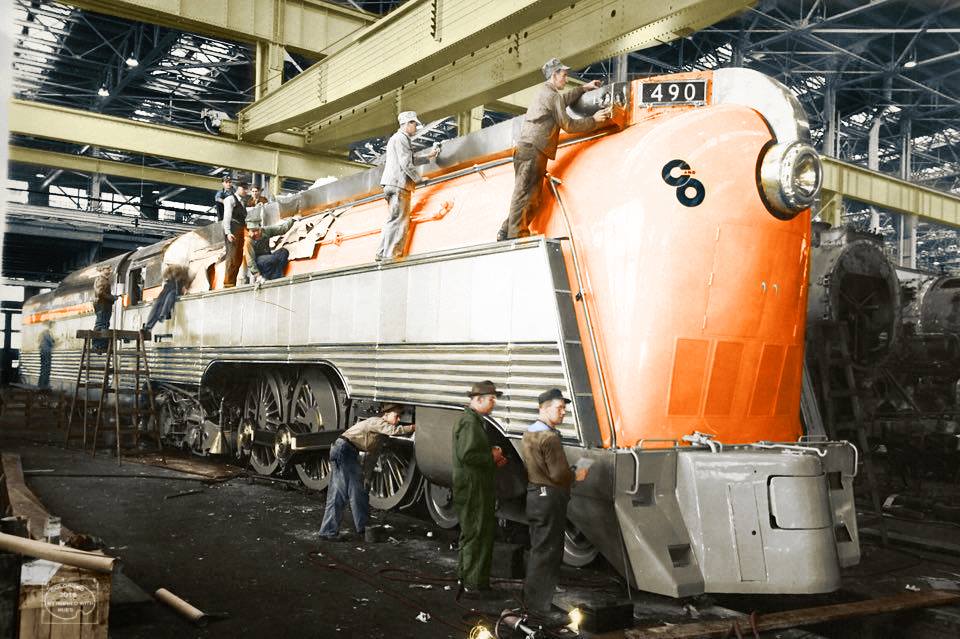
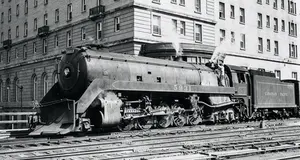
Chesapeake & Ohio L-1 No. 490 at the Huntington heavy repair shops in 1947. The photograph has been colorized by Patty Allison. The photographer of the underlying print is unknown. Alco’s Richmond works built 490 in 1926 as an F-19 Pacific, and Huntington rebuilt it as a Hudson in 1946.
On this page: At a glance · West of Hinton · The L-2 of 1941 · Specifications · Five homemade Hudsons · The L-2-A of 1948 · Name trains, then storage · Roster · No. 490
At a glance
| Item | Detail |
|---|---|
| Railroad | Chesapeake & Ohio. Three classes of 4-6-4: L-2, L-1, and L-2-A |
| Quantity | Eighteen. L-2 300–307. L-1 490–494. L-2-A 310–314 |
| Builders | Baldwin, thirteen engines, 1941–42 and 1948. The L-1s began as Alco Richmond Pacifics of 1926 and were rebuilt at Huntington in 1946–47 |
| Drivers | 78 in on the Baldwin engines. 74 in on the L-1, the Pacific diameter kept at the rebuild |
| Cylinders and boiler | L-2 and L-2-A: 25 × 30, 255 psi. L-1: 27 × 28, 210 psi |
| Tractive effort | L-2 and L-2-A: 52,103 lb, plus a booster. L-1: 49,237 lb, plus a 12,000-lb booster |
| Heaviest engine | L-2-A, 443,000 lb. With its tender, 836,000 lb |
| Where they ran | The level west end, from Hinton to Huntington, Cincinnati, and Detroit. The Greenbriers kept the mountain passenger trains |
| Retired | Stored by 1953 once the E8s had the regular passenger trains. L-1s left the roster from April 1953 to mid-1955. L-2-A scrapping began in 1955 |
| Survivor | 490 only. Purchased by the B&O Railroad Museum in 1968. On display in Baltimore since 1971 |
Weights, heating surfaces, tractive effort, and the booster figures are Steve Llanso’s transcription of the C&O diagram books and the Baldwin cards. The December 1946 book covers the L-2 and the L-1. The April 1947 book and Baldwin negative 14,639 cover the L-2-A. The weight comparison with a New York Central J-3a is Kevin P. Keefe’s, quoting the class cards. Information compiled October 10, 2026.
West of Hinton
The Chesapeake & Ohio was a coal railroad, and its new passenger power in the 1930s was built for the grades. The Greenbriers, Lima 4-8-4s, the first of them in 1935, took the mountain passenger trains. West of Hinton, West Virginia, the line to Huntington, Cincinnati, and Detroit was the level end. That was a 4-6-4 job: a six-coupled engine with a four-wheel trailing truck, free to run, and heavy enough for a long name train.
The railroad’s last new Pacifics were already on the property. Alco’s Richmond works completed five class F-19 engines, 490–494, on February 22 through February 26, 1926, works 66555–66559. They had 74-inch drivers, 27-by-28-inch cylinders, a 200-pound boiler, Baker valve gear, an Elesco feedwater heater, and Vanderbilt tenders. The engine weight was about 331,500 pounds, and the tractive effort about 46,900 pounds. Those five became the L-1s. The first Hudsons the railroad bought new were the L-2s.
The L-2 of 1941
Baldwin delivered 300–307 in December 1941 and January 1942. The works numbers run 64351–64358 in that order. Number 303 is recorded in December 1941, and 307 in January 1942. Robert R. Young took the chair of the Chesapeake & Ohio in 1942, so this order belongs to the year before his passenger program. The L-1 rebuilds and the later L-2-A order sit with that program, and with the M-1 turbines.
The L-2 is a conventional two-cylinder engine with the late equipment of a 1941 passenger locomotive. Baker valve gear moved 14-inch piston valves. The drivers are 78 inches, the cylinders 25 by 30 inches, and the boiler 255 pounds. Starting tractive effort is 52,103 pounds. A Franklin Type E booster on the trailing truck added 12,600 pounds and could stay cut in to 33 miles an hour. The factor of adhesion is 4.17. Roller bearings were on every axle. Number 300 also carried them on the side rods and the main rods.
The engine weighs 439,500 pounds, with 217,500 of that on the drivers and an axle load of 72,500. The tender, loaded, weighs 393,000 pounds and holds 21,000 gallons and 30 tons of coal. Engine and tender together are 832,500 pounds. An Elesco Type E feedwater heater sat on the boiler. The railroad rated the class to pull a fifteen-car train at 90 miles an hour on tangent level track. The published length is 108 feet.
Number 300 was also the engine fitted, about 1948, with Union Pacific-style elephant-ear smoke deflectors. A Cincinnati view of February 13, 1953, shows them gone. The steamlocomotive.com account names 300 as one of two Chesapeake & Ohio locomotives given that deflector.
Specifications
| Specification | L-2, 300–307 | L-2-A, 310–314 | L-1, 490–494 |
|---|---|---|---|
| Builder | Baldwin | Baldwin | Alco, Richmond, 1926. Rebuilt at Huntington, 1946–47 |
| Works numbers | 64351–64358 | 73533–73537 | 66555–66559, the Pacific numbers. Huntington issued none |
| Built | December 1941–January 1942 | August 1948. Ordered 1947 | Pacifics completed February 22–26, 1926. Rebuild 1946–47. No. 490 in 1946 |
| Valve gear | Baker. 14-inch piston valves | Franklin rotary-cam poppet valves | Franklin Type A oscillating-cam poppet valves |
| Driver diameter | 78 in | 78 in | 74 in |
| Cylinders | 25 × 30 in | 25 × 30 in | 27 × 28 in |
| Boiler pressure | 255 psi | 255 psi | 210 psi |
| Tractive effort | 52,103 lb | 52,103 lb | 49,237 lb |
| Booster | Franklin Type E, 12,600 lb, to 33 mph | 14,200 lb | Franklin Type E-1, 12,000 lb, to 35 mph. With the booster, 61,237 lb |
| Factor of adhesion | 4.17 | 4.21 | 4.11 |
| Weight on drivers | 217,500 lb. Axle load 72,500 lb | 219,500 lb | 202,500 lb. Axle load 67,900 lb |
| Engine weight | 439,500 lb | 443,000 lb | 388,700 lb |
| Tender, loaded | 393,000 lb | 393,000 lb | 355,300 lb |
| Engine and tender | 832,500 lb | 836,000 lb | 744,000 lb |
| Water / coal | 21,000 gal / 30 tons | 21,000 gal / 30 tons | 18,000 gal / 28 tons |
| Grate | 90 sq ft | 90.20 sq ft | 80.70 sq ft |
| Firebox | 460 sq ft | 405 sq ft | 281 sq ft |
| Tubes and flues | 50 tubes, 2.25 in. 198 flues, 3.5 in. Length 18 ft | Same counts and length as the L-2 | 41 tubes, 2.25 in. 195 flues, 3.5 in. Length 20.50 ft |
| Evaporative / superheater | 4,233 / 1,810 sq ft. Combined 6,043 | 4,178 / 1,785 sq ft. Combined 5,963 | 4,414 / 2,001 sq ft, Type E. Combined 6,415 |
| Feedwater heater | Elesco Type E | Feedwater heater | Worthington, taken from an F-17 |
| Driver / engine / overall wheelbase | 14 ft / 41.47 ft / 91.69 ft | 14 ft / 41.46 ft / 93.87 ft | 13 ft / 37.96 ft / 87.77 ft |
| Published length | 108 ft 0 in | 108 ft 0 in | The diagram records the wheelbases |
The L-2 firebox figure of 460 square feet includes two thermic syphons at 96 square feet, a combustion chamber at 81, and arch tubes at 19. The tube and flue heating surface under that firebox is 3,773 square feet. The L-2-A kept those tube and flue counts and that 3,773 square feet. Its firebox is the part that changed: four security circulators contribute 60 square feet of a 405-square-foot firebox, in place of the syphons and the arch tubes. The adhesive weight on an L-2-A is the 219,500 pounds on the drivers.
Five homemade Hudsons
The L-1s were rebuilt for The Chessie, the daylight train that was also the reason for the M-1 turbines. Huntington did the work in 1946 and 1947. Number 490’s rebuild date is 1946. The shops issued no new works numbers. The road numbers stayed 490–494.
Karen Parker’s account of the rebuild, in the Chesapeake and Ohio Historical Magazine for May 2006, is the itemized one. Huntington gave each engine a new one-piece cast frame with integral cylinders and the main air reservoir. Roller bearings went on every axle and into the main and side rods. Multiple-bearing crossheads replaced the F-19’s alligator crossheads. The drivers were new, and cross-counterbalanced for speed. Inside the boiler everything was new, and the outer shell was reused. The firebox was renewed and otherwise left as it was. There was no combustion chamber. Parker’s note is that the boiler’s length stood in the way of one.
A Type E superheater replaced the Pacific’s Type A. Superheater surface went to 2,001 square feet, about 65 percent more, and the superheat to about 250 degrees against about 150. Boiler pressure rose from 200 pounds to 210. The cylinders stayed 27 by 28 inches and received Franklin Type A oscillating-cam poppet valves. A four-wheel trailing truck carried a Franklin Type E-1 booster of 12,000 pounds, usable to 35 miles an hour. A Worthington feedwater heater came off an F-17 Pacific, and that F-17 received the F-19’s Elesco. The cab was new, and large. The museum’s label for 490 adds a front-end throttle.
The finished engine weighs 388,700 pounds, up from about 331,500 as a Pacific, with 202,500 on the drivers and an axle load of 67,900. Tractive effort is 49,237 pounds, and 61,237 with the booster cut in. The tender weighs 355,300 pounds loaded and carries 18,000 gallons and 28 tons of coal. Engine and tender together are 744,000 pounds.
The casing was stainless steel, and at the rebuild the sloped nose and the upper casing were the railroad’s orange, the color it had used from 1889 into the 1920s. About 1948 the engines received the yellow livery. Crews called them Yellowbellies. The tender was cased in fluted stainless steel so that it would meet the Budd cars. Number 494 left Huntington without the streamlined cowl. The other four wore it.
Eugene Huddleston’s anecdote, as Parker recorded it, is the speed story that belongs with the class. An engineer with six heavyweight cars found the engine riding so easily that only the dynamic augment, once he was past the speed the counterbalance was set for, told him he was at 95 miles an hour. That is one trip. It is not a figure on the diagram.
When The Chessie was not launched, the five L-1s went into the regular passenger and mail pool. Their later assignments, in Parker’s account, were Charlottesville–Washington and Charlottesville–Newport News.
The L-2-A of 1948
In 1947 the railroad ordered five more Hudsons from Baldwin. They arrived in August 1948 as class L-2-A, numbers 310–314, works 73533–73537. They are the last new express-passenger steam locomotives a U.S. railroad bought from a commercial builder, and they are Baldwin’s last passenger steam. Norfolk & Western J 611 was built at Roanoke in 1950, a shop-built passenger engine on the Class J page. Baldwin’s last steam locomotives for a U.S. railroad were the class H-6 2-6-6-2s of 1949, numbers 1300–1309, on the steam roster.
The cylinders, the 255-pound boiler, the 78-inch drivers, and the 52,103-pound tractive effort repeat the L-2. The engine is 3,500 pounds heavier, at 443,000, and the weight on the drivers is 219,500. Keefe’s comparison is the New York Central J-3a of 1938, at 360,000 pounds. The loaded tender stays 393,000 pounds, so engine and tender are 836,000. The booster is rated at 14,200 pounds. The factor of adhesion is 4.21.
The machinery is the late-steam list. Franklin rotary-cam poppet valves replaced the L-2’s piston valves. The frame is a one-piece cast-steel bed with the cylinders cast in. Roller-bearing journals are 13 inches on the main driver, 12½ inches on the other drivers, 8¼ inches on the engine truck, and 7 inches on the tender trucks. The air brake acts on every engine wheel and every tender wheel. A mechanical stoker and a feedwater heater are on the specification. Keefe adds a cast-steel pilot and a combined steam-and-sand dome. The published length, again, is 108 feet. The engine-and-tender wheelbase is 93.87 feet, longer than the L-2’s 91.69.
Name trains, then storage
Thomas W. Dixon, Jr., in Chesapeake & Ohio Passenger Service, 1847–1971, puts three name trains on this west-end work. The Sportsman ran Washington and Newport News to Cincinnati and Detroit. The F.F.V. and the George Washington ran Washington and Newport News to Cincinnati and Louisville. Parker’s territory for the Hudsons is the same west end in shorter form: Hinton to Huntington, Cincinnati, and Detroit. The Greenbriers stayed with the mountain passenger trains.
Passenger diesels arrived late in 1951. Through 1952 the Hudsons still ran secondary trains, extras, and standby. By 1953 enough E8s had dieselized the regular passenger trains, and the big 4-6-4s were stored. Off the name trains they were finished. A Greenbrier could go into freight. A Hudson of this weight, with 74- or 78-inch drivers, was a passenger engine. Scrapping of the L-2-A began in 1955. None of the thirteen Baldwin engines was saved.
The L-1s left on their own schedule. The first two were retired in April 1953. The other three were gone by mid-1955. H-6 number 1308 made the railroad’s last steam run, on February 29, 1956.
| When | What the record shows |
|---|---|
| February 22–26, 1926 | F-19 Pacifics 490–494 completed at Alco, Richmond |
| December 1941–January 1942 | L-2 300–307 delivered by Baldwin |
| 1942 | No. 490, still a Pacific, comes off the George Washington. Heavier 4-8-4s have the mainline passenger trains. The F-19s go to secondary trains and, during the war, to troop trains |
| 1946–47 | Huntington rebuilds 490–494 as L-1 Hudsons. No. 490’s rebuild is 1946 |
| About 1948 | The yellow livery. No. 300 carries elephant-ear deflectors for a time |
| August 1948 | L-2-A 310–314 delivered |
| 1950 | No. 490 on the Caravan of Progress |
| Late 1951–1952 | Passenger diesels arrive. Hudsons hold secondary trains, extras, and standby |
| 1953 | Regular passenger trains dieselized. The Baldwin 4-6-4s stored. First two L-1s retired in April. No. 490 leaves passenger service |
| 1955 | Remaining L-1s retired by mid-year. L-2-A scrapping begins |
| February 29, 1956 | Last C&O steam, H-6 1308 |
Roster
| No. | Class | Builder | Works no. | Built | Disposition | Notes |
|---|---|---|---|---|---|---|
| 300 | L-2 | Baldwin | 64351 | Dec. 1941–Jan. 1942 | Stored by 1953. Scrapped | Roller bearings on the side rods and the main rods. Elephant-ear deflectors from about 1948, gone by February 13, 1953, at Cincinnati |
| 301 | L-2 | Baldwin | 64352 | Dec. 1941–Jan. 1942 | Stored by 1953. Scrapped | |
| 302 | L-2 | Baldwin | 64353 | Dec. 1941–Jan. 1942 | Stored by 1953. Scrapped | |
| 303 | L-2 | Baldwin | 64354 | December 1941 | Stored by 1953. Scrapped | Recorded as December 1941 |
| 304 | L-2 | Baldwin | 64355 | Dec. 1941–Jan. 1942 | Stored by 1953. Scrapped | |
| 305 | L-2 | Baldwin | 64356 | Dec. 1941–Jan. 1942 | Stored by 1953. Scrapped | |
| 306 | L-2 | Baldwin | 64357 | Dec. 1941–Jan. 1942 | Stored by 1953. Scrapped | |
| 307 | L-2 | Baldwin | 64358 | January 1942 | Stored by 1953. Scrapped | Recorded as January 1942 |
| 310 | L-2-A | Baldwin | 73533 | August 1948 | Stored by 1953. Scrapping from 1955 | |
| 311 | L-2-A | Baldwin | 73534 | August 1948 | Stored by 1953. Scrapping from 1955 | |
| 312 | L-2-A | Baldwin | 73535 | August 1948 | Stored by 1953. Scrapping from 1955 | Works number recorded for 312 |
| 313 | L-2-A | Baldwin | 73536 | August 1948 | Stored by 1953. Scrapping from 1955 | |
| 314 | L-2-A | Baldwin | 73537 | August 1948 | Stored by 1953. Scrapping from 1955 | |
| 490 | L-1 | Alco, Richmond. Huntington rebuild | 66555 | Feb. 22, 1926. Rebuilt 1946 | B&O Railroad Museum, Baltimore, since 1971 | Only surviving C&O Hudson. Franklin Type A poppet valves. Caravan of Progress, 1950 |
| 491 | L-1 | Alco, Richmond. Huntington rebuild | 66556 | Feb. 23, 1926. Rebuilt 1946–47 | Scrapped. Class retired April 1953–mid-1955 | |
| 492 | L-1 | Alco, Richmond. Huntington rebuild | 66557 | Feb. 24, 1926. Rebuilt 1946–47 | Scrapped. Class retired April 1953–mid-1955 | |
| 493 | L-1 | Alco, Richmond. Huntington rebuild | 66558 | Feb. 25, 1926. Rebuilt 1946–47 | Scrapped. Class retired April 1953–mid-1955 | |
| 494 | L-1 | Alco, Richmond. Huntington rebuild | 66559 | Feb. 26, 1926. Rebuilt 1946–47 | Scrapped. Class retired April 1953–mid-1955 | Left Huntington without the streamlined cowl |
The Baldwin works numbers follow each builder’s consecutive block. Three engines pin the line: 302 is 64353, 303 is 64354, and 307 is 64358, and on the L-2-A, 312 is 73535. The L-1 works numbers are the 1926 Richmond numbers. Nothing of 300–307 or 310–314 survives.
No. 490
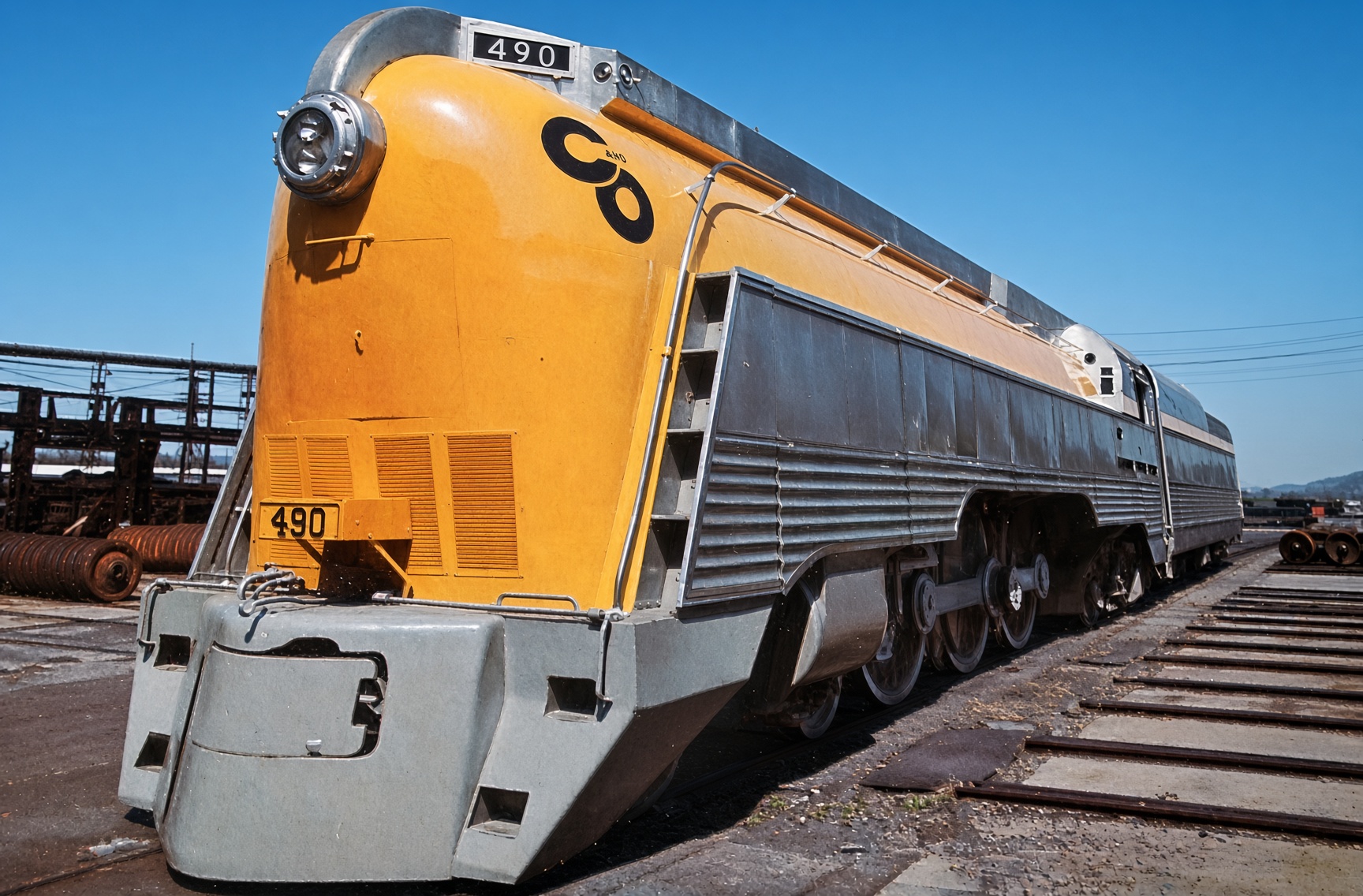
Chesapeake & Ohio 4-6-4 #490 (L-1) is seen here at the shops in Huntington, West Virginia on April 17, 1971. These streamlined Hudsons (five in all) were rebuilt from F-19 Pacifics during the late 1940s for service on the never-launched "Chessie. The B&O Railroad Museum had purchased the engine in 1968, and Huntington was doing the cosmetic work before the engine went on display in Baltimore. This unit is the only surviving example from the class. John Corns photo.
As an F-19, 490 drew the Sportsman from 1930, on the Detroit and Cincinnati runs. From 1932 to 1942 it was on the George Washington between Cincinnati and Washington. In 1942 the heavier 4-8-4s took the mainline passenger trains, and 490 came off that job. The Pacifics spent the rest of the war on secondary trains and on troop trains. The Hudson rebuild came after that.
In 1950 the engine left ordinary passenger work long enough to tour with the Caravan of Progress, a train of the railroad’s newest equipment. It came off passenger service in 1953 and was stored at Huntington. The museum’s own line is that 490 was one of the last engines to pull a passenger train on the Chesapeake & Ohio. In 1968 the B&O Railroad Museum purchased it and sent it back to Huntington for a cosmetic restoration. It has been on display in Baltimore since 1971. Wikipedia records that the engine was moved indoors in 2005.
It is the only surviving Chesapeake & Ohio Hudson, and the only surviving L-1. The Franklin Type A poppet valves are still on the engine.
Related reading on American-Rails.com
- Chesapeake & Ohio · C&O steam locomotives · C&O diesel locomotives
- F-19 Pacifics · Greenbriers · C&O Mountains · M-1 steam turbines
- The Chessie · Sportsman · F.F.V. · George Washington
- 4-6-4 Hudson type · New York Central Hudsons · Baldwin Locomotive Works
- Norfolk & Western · N&W Class J
Sources
- Llanso, Steve. Locobase 179, Chesapeake & Ohio class L-2, on steamlocomotive.com. Baldwin builder’s cards at the DeGolyer Library, Southern Methodist University, and the C&O diagram book of December 1946, supplied in May 2005 by Allen Stanley from the Rail Data Exchange. Works 64351–64358, December 1941–January 1942. Cylinders 25 by 30, 255 psi, 78-inch drivers, Baker gear, 14-inch piston valves, tractive effort 52,103 pounds, Franklin Type E booster of 12,600 pounds usable to 33 mph, factor of adhesion 4.17. Weights 217,500 on the drivers, axle load 72,500, engine 439,500, tender 393,000, total 832,500. Water 21,000 gallons, coal 30 tons. Grate 90 square feet. Firebox 460, including two thermic syphons at 96, a combustion chamber at 81, and arch tubes at 19. Evaporative 4,233, superheater 1,810, combined 6,043. Tubes 50 of 2.25 inches, flues 198 of 3.5 inches, length 18 feet. Wheelbases 14, 41.47, and 91.69 feet. Elesco Type E feedwater heater. The fifteen-car, 90-mile rating on tangent level track. Philip Shuster, Eugene L. Huddleston, and Alvin F. Staufer, C&O Power (1965), p. 234, is the book cited with that entry.
- Llanso, Steve. Locobase 16231, class L-2-A. Baldwin negative 14,639 at the DeGolyer Library, and the C&O diagram book of April 1947, supplied in August 2013 by Allen Stanley. Works 73533–73537, August 1948. Same cylinders, pressure, drivers, and 52,103-pound tractive effort. Booster 14,200 pounds. Factor of adhesion 4.21. Drivers 219,500, engine 443,000, tender 393,000, total 836,000, water 21,000 gallons, coal 30 tons. Grate 90.20. Firebox 405, with four security circulators contributing 60 square feet, the syphons and the arch tubes omitted. Evaporative 4,178, superheater 1,785, combined 5,963. The same tube and flue counts and the same 18-foot length as the L-2. Franklin rotary poppet valves. Engine wheelbase 41.46 feet, overall wheelbase 93.87 feet. One-piece cast-steel bed with integral cylinders, a feedwater heater, a mechanical stoker, and the air brake on every engine and tender wheel. Roller-bearing journals 13 inches on the main driver, 12½ inches on the other drivers, 8¼ inches on the engine truck, and 7 inches on the tender trucks. The comparison table leaves the L-2-A axle-load cell blank. C&O Power, p. 234, is cited again here.
- Llanso, Steve. Locobase 9382, class L-1. C&O diagram book of December 1946, Allen Stanley, May 2005. Karen Parker, “The C&O’s Homemade Hudsons,” Chesapeake and Ohio Historical Magazine (May 2006), as Llanso summarizes the rebuild: the new cast frame, roller bearings on the axles and in the rods, multiple-bearing crossheads, cross-counterbalanced drivers, a new boiler interior on the old shell, a renewed firebox, no combustion chamber, the Type E superheater at 2,001 square feet and about 250 degrees against about 150, 210 psi, the same 27-by-28 cylinders with Franklin Type A oscillating-cam poppet valves, the four-wheel truck and Type E-1 booster, the Worthington heater traded off an F-17 for the F-19’s Elesco, and the new cab. Chris Hohl to Locobase, January 29, 2026, for the booster at 12,000 pounds, usable to 35 mph. Diagram figures: drivers 202,500, axle load 67,900, engine 388,700, tender 355,300, total 744,000, water 18,000 gallons, coal 28 tons, grate 80.70, firebox 281, evaporative 4,414, superheater 2,001, combined 6,415, tractive effort 49,237, factor of adhesion 4.11. Tubes 41 of 2.25 inches, 171 fewer than the F-19, and 195 flues of 3.5 inches, 147 more, at 20.50 feet. Wheelbases 13, 37.96, and 87.77 feet. Huddleston’s 95-mile anecdote with six heavyweight cars, and the retirement of the first two L-1s in April 1953 and the other three by mid-1955, are in the same entry. C&O Power, p. 255.
- Wes Barris, steamlocomotive.com, Chesapeake & Ohio 4-6-4 introduction. Roller bearings on all L-2 axles, and on the side and main rods of 300. Elephant-ear deflectors on 300 from about 1948, one of two C&O locomotives so fitted. The L-1 cowl, yellow and silver, the fluted stainless tender, and 494 without a cowl. The L-2-A as Baldwin’s last passenger steam and the heaviest Hudsons. The class table: L-2 300–307 of 1941, L-1 490–494 of 1946–47, L-2-A 310–314 of 1948.
- Keefe, Kevin P. “Heaviest 4-6-4 Hudsons: Chesapeake & Ohio’s L2a.” Classic Trains, trains.com, June 30, 2023. Eighteen Hudsons in all. The five L-2-A engines of 1948, numbers 310–314, at 443,000 pounds, 3,500 pounds over the eight L-2s of 1941, against a New York Central J-3a at 360,000. Poppet valves, a cast-steel pilot, and a combined steam-and-sand dome. Eugene Huddleston, through the same article, on the end of the big engines: passenger diesels late in 1951, secondary trains and extras and standby through 1952, storage by 1953 once the E8s had the regular passenger trains, and L-2-A scrapping from 1955. Off the passenger trains, the 4-6-4s had less freight work in them than the Greenbriers.
- B&O Railroad Museum, collection label for C&O No. 490, borail.org/collection/co-no-490/, read October 10, 2026. Built by Alco in 1926. Sportsman from 1930, Detroit and Cincinnati. George Washington, Cincinnati–Washington, 1932–1942. Off the main line in 1942 when heavier 4-8-4s arrived. Secondary trains and wartime troop trains. Rebuilt at Huntington in 1946. The shell painted C&O orange, the 1889–1920s color, and the yellow from about 1948. Yellowbellies. Rebuilt for The Chessie, then assigned to ordinary passenger trains when that train was not launched. Caravan of Progress, 1950. First diesels in 1951. No. 490 retired from passenger service in 1953 and stored at Huntington. Purchased in 1968, cosmetic restoration at Huntington, on display in Baltimore since 1971. The label also lists a front-end throttle, roller bearings, the booster, cross-counterbalanced drivers, poppet valves, and the enlarged cab. The 2005 move indoors is the date in the Wikipedia article on 490. The museum’s word for 1968 is purchased.
- Dixon, Thomas W., Jr. Chesapeake & Ohio Passenger Service, 1847–1971. The Sportsman, the F.F.V., and the George Washington as the name trains west of Hinton. Parker’s account of the Hudsons supplies the territory, Hinton to Huntington, Cincinnati, and Detroit, and the late L-1 assignments between Charlottesville and Washington and between Charlottesville and Newport News.
- The F-19 figures used as the before line, 74-inch drivers, 27-by-28 cylinders, 200 psi, and about 46,900 pounds of tractive effort, are the ones already on this site’s Pacific page, with the Richmond works block 66555–66559 and the February 22–26, 1926 completion. The published 108-foot length of the Baldwin engines is the length given for both classes in the equipment summaries. The Norfolk & Western J of 1950 is shop-built at Roanoke, and the H-6 2-6-6-2s of 1949 and the last steam run of 1308 on February 29, 1956, are the steam roster’s dates.
Recent Articles


-
Union Pacific Dispatchers Will Vote on ATDA Representation
Nov 01, 26 12:00 AM
 The National Mediation Board has authorized a representation election for Union Pacific train dispatchers. The American Train Dispatchers Association announced the decision on October 29, 2026.
-
Wabash Diesel Roster (All-Time)
Oct 31, 26 12:35 AM
 Wabash diesel locomotives, each frame once, through the lease at 12:01 a.m. on October 16, 1964.
-
Wabash Steam Roster (Built Since 1900)
Oct 31, 26 12:30 AM
 Wabash steam locomotives built since 1900. Moguls, Mikados, Mountains, and the O-1 Northerns.
-
Wabash Railroad: Map, Rosters, History, Logo
Oct 31, 26 12:28 AM
 History of the Wabash Railroad, from the Northern Cross of 1838 to the Norfolk & Western lease at 12:01 a.m. on October 16, 1964. Follow the Flag. Steam and diesel rosters are separate pages.
-
Court Clears $257.7 Million in Notes for Brightline Florida
Oct 31, 26 12:18 AM
 A New Jersey bankruptcy court on October 29, 2026 authorized $257.7 million in notes for Brightline Trains Florida. The operating company is not one of the 17 debtor holding companies.
-
Brightline West Still Waiting on a $6 Billion Federal Loan
Oct 31, 26 12:11 AM
 Brightline West said October 27, 2026 that it is still working through a $6 billion federal loan and still talks about opening in 2029. The Florida restructuring is a separate company.
-
BNSF Reopens the Gallup Subdivision After New Mexico Flooding
Oct 31, 26 12:06 AM
 BNSF said October 28, 2026 that both Gallup Subdivision main tracks are back after flooding near Laguna, New Mexico. The El Paso Subdivision was still out of service.
-
CSX Says Interchange Is Moving Again After a Technology Outage
Oct 31, 26 12:01 AM
 CSX said October 29, 2026 that interchange with other Class I railroads is moving again after a technology outage that began October 27. Dispatching and positive train control stayed up.
-
Baldwin "Baby Face" Locomotives: Specs, Photos, Roster
Oct 30, 26 11:01 PM
 Baldwin's Babyface cab on the early road diesels: 50 short-cab units, 1946-1948, plus the related Centipede. Construction numbers, specs, and the sharknose that followed.
-
California High-Speed Rail Chief Resigns
Oct 30, 26 08:36 PM
 Ian Choudri resigned October 28, 2026 as chief executive of the California High-Speed Rail Authority. The board named Joe Stephenshaw interim chief executive.
-
The 1910 Portal Bridge Is Handed Over for Demolition
Oct 30, 26 04:03 PM
 Amtrak handed the 1910 Portal Bridge over for demolition on October 29, 2026, during the final cutover to Portal North. Regular NJ Transit and Amtrak schedules are expected November 15.
-
Union Pacific-Norfolk Southern Merger Review Runs to 2027
Oct 30, 26 03:59 PM
 Union Pacific says the Surface Transportation Board's review of the Norfolk Southern merger gathers information through May 28, 2027. A closing still depends on board approval.
-
Amtrak Board Will Hear Restructuring Comments on November 10
Oct 30, 26 03:41 PM
 Amtrak's board will hear public comments on its restructuring on November 10, 2026, from 2 to 3 p.m. Eastern. Written comments were due October 30. A proposal goes to the board in December.
-
Canadian Pacific Selkirk 5931 Restored in Calgary
Oct 30, 26 01:36 PM
 Heritage Park in Calgary unveiled a cosmetic restoration of Canadian Pacific 2-10-4 No. 5931 on October 27, 2026. One of two surviving Selkirks. It stays on display.
-
Gettysburg Railway to Host Steam for Lincoln
Oct 30, 26 01:18 PM
 Northern Central Railway of York No. 17 will recreate Lincoln's arrival at Gettysburg on November 18, 2026, with public steam trips November 19-21.
-
NC&StL No. 576 to Steam for the Public in Nashville
Oct 30, 26 01:00 PM
 Nashville Steam will fire NC&StL 4-8-4 No. 576 for the public on November 7, 2026, 9 a.m. to 3 p.m., at 220 Willow Street. Admission is free.
-
Pennsylvania Railroad E8s Join the T1 Trust
Oct 30, 26 12:38 PM
 The T1 Trust has acquired former Pennsylvania Railroad E8A diesels 5702A and 5761A from the Fort Wayne Railroad Historical Society. They are bound for Cumberland.
-
Ligonier Valley Railroad: History, Roster, Timetable
Oct 30, 26 12:03 PM
 The Ligonier Valley Railroad ran 10.5 miles from Latrobe to Ligonier, Pennsylvania. Opened December 1, 1877. Last day August 31, 1952.
-
Toledo, Peoria & Western Diesel Roster (All-Time)
Oct 30, 26 10:25 AM
 Toledo, Peoria & Western diesel locomotives, each frame once. Thirteen Alcos, three Lima-Hamilton switchers, and 26 Electro-Motive units.
-
Toledo, Peoria & Western Steam Roster
Oct 30, 26 09:14 AM
 Toledo, Peoria & Western steam locomotives from the Rogers Consolidations of 1895 through the 4-8-4s of 1937
-
Toledo, Peoria & Western Railway: Map, Roster, History
Oct 29, 26 11:12 PM
 History of the Toledo, Peoria & Western. The Peoria & Oquawka, George P. McNear, the Santa Fe and Pennsylvania years, and the railroad that came back in 1989.
-
Cotton Belt Diesel Roster (All-Time)
Oct 29, 26 07:58 PM
 St. Louis Southwestern diesel locomotives, each frame once. Baldwin switchers, F units, and new Cotton Belt-lettered power through the GP60s of May 1990.
-
Cotton Belt Steam Roster (Built Since 1900)
Oct 29, 26 06:52 PM
 St. Louis Southwestern steam locomotives built since 1900. Consolidations, Ten-Wheelers, and twenty class L-1 4-8-4s. The quantity column is 297.
-
Cotton Belt Railroad: Map, Logo, History, Rosters
Oct 29, 26 10:56 AM
 History of the St. Louis Southwestern, the Cotton Belt Route. The Tyler Tap, Paramore's silver spike, the Thebes Bridge, the Blue Streak, and Southern Pacific control. Steam and diesel rosters are sep…
-
Pere Marquette Steam Roster (Built Since 1900)
Oct 28, 26 11:54 PM
 Pere Marquette steam locomotives built since 1900. Consolidations, Mikados, Pacifics, and 39 Berkshires. The quantity column is 503.
-
Pere Marquette Diesel Roster (All-Time)
Oct 28, 26 11:48 PM
 Pere Marquette diesel locomotives, each frame once. Two SW1s, 14 NW2s, three GE 70-tonners, eight E7As, and six BL2s delivered lettered Chesapeake and Ohio. The quantity column is 33.
-
Pere Marquette Railway: Map, Logo, Rosters, History
Oct 28, 26 11:44 PM
 History of the Pere Marquette Railway. Timber roads, the Prince years, the Van Sweringens, the Ludington car ferries, and the Chesapeake and Ohio merger of June 6, 1947.
-
Nickel Plate Road (Railroad): Map, History, Rosters
Oct 28, 26 10:51 PM
 History of the Nickel Plate Road, the New York, Chicago and St. Louis. The Seney syndicate, the Van Sweringens, the Berkshires, and the Norfolk and Western absorption at 12:01 a.m. on October 16, 1964…
-
Nickel Plate Diesel Roster (All-Time)
Oct 28, 26 10:48 PM
 Nickel Plate diesel locomotives, each frame once. Alco switchers and PAs, GP7s and GP9s, and the GP30s. The quantity column is 440. The 1950 fleet was 117.
-
Nickel Plate Steam Roster (Built Since 1900)
Oct 28, 26 10:43 PM
 Nickel Plate steam locomotives built since 1900, including the Lake Erie and Western, the Clover Leaf, and the Wheeling engines that took Nickel Plate numbers. The quantity column is 786.
-
EMD "E9" Locomotives: Specs, Roster, History
Oct 28, 26 10:37 PM
 EMD E9 cab units and boosters, 2,400 horsepower, built April 1954 through January 1964. Gear ratios, specifications, and the production roster by owner, serial, and order.
-
NYC 4-6-4 #5344, "Commodore Vanderbilt"
Oct 28, 26 04:31 PM
 NYC J-1e Hudson 5344, the Commodore Vanderbilt. Alco, November 1931. Carl Kantola’s shroud, December 1934, then a Dreyfuss bullet nose in 1939. Scrapped at Collinwood in 1954.
-
New Jersey, Indiana & Illinois Railroad: A South Bend Shortline
Oct 28, 26 11:05 AM
 The New Jersey, Indiana & Illinois, the Jersey Line, ran from South Bend to Pine. Singer built it in 1905. Wabash stock control came in 1926. Two diesels, and the steam the record names.
-
Monon Diesel Roster (All-Time)
Oct 28, 26 10:13 AM
 Monon diesel locomotives, each frame once. F3s, nine BL2s, the C420s, and eight U23Bs. The quantity column is 96. The 1951 fleet was 57.
-
Monon Steam Roster (Built Since 1900)
Oct 28, 26 10:09 AM
 Monon steam locomotives built since 1900. Twelve-Wheelers, Mikados, light Pacifics, and thirteen six-wheel switchers. The quantity column is 148.
-
Monon Railroad: Map, Photos, History, Logo
Oct 28, 26 09:55 AM
 History of the Monon, the Hoosier Line. The New Albany & Salem, the X at Monon, Barriger's streamliners, and the Louisville & Nashville merger of July 31, 1971.
-
Missouri-Kansas-Texas Diesel Roster (All-Time)
Oct 28, 26 09:48 AM
 All-time diesel roster of the Missouri-Kansas-Texas. 406 locomotives, each frame once. Baldwin switchers, Alco cab units, F units, Geeps, and the SD40-2s.
-
Missouri-Kansas-Texas Steam Roster (Built Since 1900)
Oct 28, 26 09:43 AM
 Missouri-Kansas-Texas steam locomotives built since 1900. Moguls, Mikados, Pacifics, and the narrow-gauge shop tanks. The quantity column is 715.
-
Missouri-Kansas-Texas Railroad (Katy): Map, History, Rosters
Oct 27, 26 11:02 PM
 History of the Missouri-Kansas-Texas, the Katy. The race into Indian Territory, Gould, the 1923 railroad, the Texas Special, and the 1988 sale. Steam and diesel rosters are linked.
-
Soo Line Diesel Roster (All-Time)
Oct 27, 26 10:55 PM
 All-time diesel roster of the Soo Line and the Wisconsin Central. 786 locomotives, each frame once. Cab units, Geeps, the Milwaukee Road engines, and the SD60s. The South Shore's 24 stay on that page.
-
Soo Line Steam Roster (Built Since 1900)
Oct 27, 26 10:49 PM
 Soo Line and Wisconsin Central steam locomotives built since 1900. Consolidations, Mikados, Pacifics, 21 Mountains, and four Lima 4-8-4s.
-
Soo Line Railroad: Map, Logo, History, Rosters
Oct 27, 26 10:24 PM
 The Soo Line, from the flour millers' railroad around Chicago to the Sault, the Wisconsin Central, and the Milwaukee Road. Steam quantity 422. Diesels 786. Canadian Pacific took full control in 1990.
-
Minneapolis, Northfield and Southern Railway: Map, History, Rosters
Oct 27, 26 10:32 AM
 The Minneapolis, Northfield & Southern, the Dan Patch Line that became a Twin Cities belt. Steam, gas-electric mules, motor cars, and the 22 diesels, through the Soo Line.
-
Minneapolis & St. Louis Diesel Roster (All-Time)
Oct 27, 26 10:27 AM
 All-time diesel roster of the Minneapolis & St. Louis. 97 locomotives, each frame once. Switchers from 1938, 35 RS-1s, the FT and F-unit cabs, two SD7s, and 23 GP9s. Builder numbers included.
-
Minneapolis & St. Louis Steam Roster (Post 1900)
Oct 27, 26 10:25 AM
Minneapolis & St. Louis steam locomotives built since 1900. Moguls, Consolidations, 35 Mikados, and five Pacifics. -
Minneapolis and St Louis Railway: "The Peoria Gateway"
Oct 27, 26 09:52 AM
 The Minneapolis & St. Louis, the Tootin' Louie, from the 1870 charter to the Peoria Gateway and the Chicago & North Western sale on November 1, 1960.
-
Alco "PA" Locomotives: Restoration, Specs, Engine, Rosters
Oct 27, 26 12:12 AM
 Alco's PA passenger cab, 297 locomotives built from 1946 to 1953. The 244 engine, the production roster, the Delaware & Hudson PA-4s, and Nickel Plate Road 190.
-
Milwaukee Road Diesel Roster: (All Time)
Oct 26, 26 01:44 PM
 All-time diesel roster of the Milwaukee Road. 1,208 locomotives, each frame once. Alco, Baldwin, Davenport, EMD, Fairbanks-Morse, General Electric, and Whitcomb, with builder numbers.
-
Milwaukee Road Steam Roster (All-Time): Post-1900
Oct 26, 26 01:38 PM
 Milwaukee Road steam locomotives built since 1900. Prairies, Mikados, the N-class articulateds, the S-class 4-8-4s, and the Hiawatha Atlantics and Hudsons. Quantity column 1,974. Unique frames 1,951.
-
Milwaukee Road: Map, Electrification, Logo, History
Oct 26, 26 01:20 PM
 The Milwaukee Road, from the Milwaukee & Mississippi of 1850 to the Pacific Coast Extension, the Hiawathas, and the Soo Line sale. Why Lines West should have stayed.