Oneida & Western Railroad: Map, History, Timetable
Published: October 14, 2026
By: Adam Burns
The Oneida & Western Railroad was a Tennessee short line from the Cincinnati, New Orleans & Texas Pacific at Oneida west across the Big South Fork of the Cumberland and up onto the plateau at Jamestown. The company began as the Jamestown Railroad, incorporated on October 29, 1912. On August 5, 1913, the charter was amended, the name became the Oneida and Western, and the route was aimed from Oneida toward Albany, Kentucky. Construction started at Oneida on November 4, 1913. The track reached East Jamestown, 30 miles, in 1921, and Jamestown on December 10, 1930.
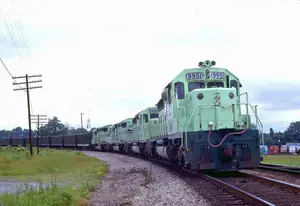
Coal, lumber, mail, and passengers moved over that grade until the last revenue train, on March 4, 1954. The mint-green SD40-2s of 1979 used the same name and ran on other railroads. Their story is the Shamrock Coal page.
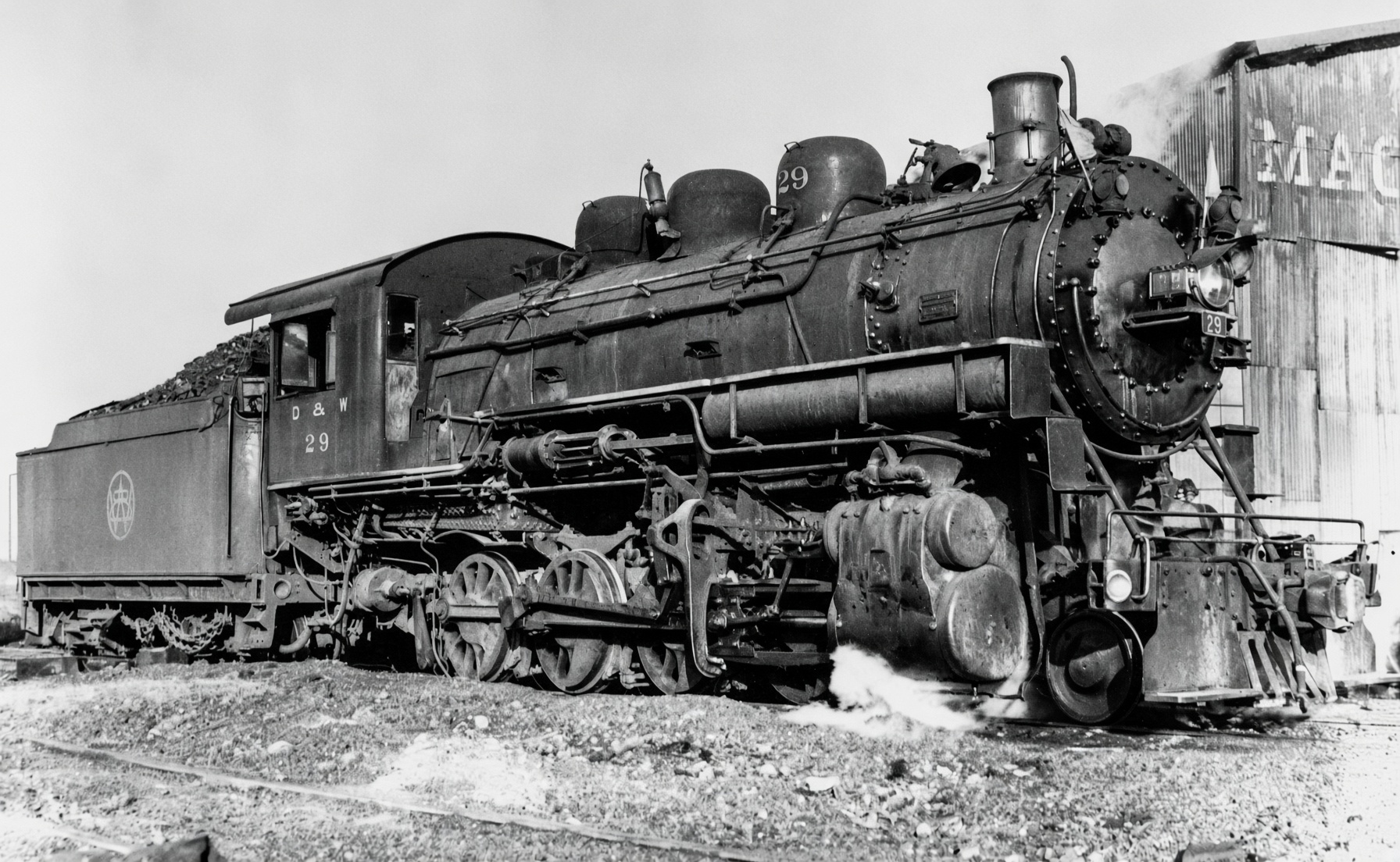
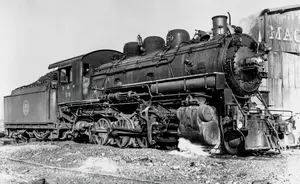
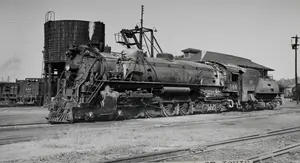
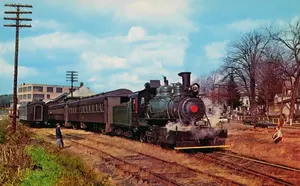
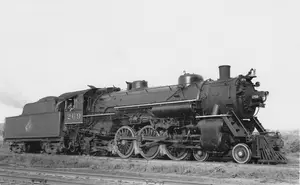
Oneida & Western 2-8-0 No. 29 at Oneida, Tennessee, on November 22, 1951. Alco-Richmond works number 65287, built in 1923 as Birmingham Southern 35. On this day the engine is lettered Oneida & Western 29.
On this page: The charter · Building the line · At a glance · The 1930 Guide · Jamestown · Coal, lumber, and the mail · The engines · The last train · The name in 1979
The charter
The timber and the coal west of Oneida sat in country the main lines did not touch. Pickett County, Fentress County, and the Big Survey in western Scott County were cut by the gorge of the Big South Fork. Stearns Coal & Lumber, which held the Big Survey, tried floating logs down the river to a dam in Kentucky. Most of the logs sank. Stearns then built the Kentucky & Tennessee Railroad south out of Stearns, Kentucky. A railroad from the Cincinnati Southern up the plateau toward Jamestown had been talked about since Rugby was settled in the late nineteenth century.
Elmer Sulzer, in Ghost Railroads of Tennessee, records the company that was actually chartered. The Jamestown Railroad was incorporated on October 29, 1912, by the Tennessee Coal and Lumber Company of Glenmary, to build from Glenmary to Jamestown. H. Clay Smith remembered that mill as the work of the Hagemeyer brothers, begun at Glenmary in 1908. On August 5, 1913, the charter was amended. The name became the Oneida and Western Railroad Company, and the line it was authorized to build ran from Oneida toward Albany, Kentucky, by way of Jamestown.
Stearns fought the new road in court, on the claim that the builders had no proper legal right to put down the track. Dr. Frank C. Thomas, a later president of Stearns, told the local historians that the suit itself named a company called the Oneida & Western, and that the naming was what made the corporate body real. The amended charter of August 5, 1913, is the date the company carries. Benita J. Howell’s account of the Big South Fork names the owners as O. H. Anderson, J. T. Anderson, Hall Hagemeyer, Bartlett Hagemeyer, and W. C. Anderson, with William Ray, D. M. Speck, and Wales Christian of Monterey among the others who held an interest. Speck, Christian, and Hagemeyer are station names on the finished railroad. The offices were in Oneida.
Building the line
Sulzer’s mile-by-mile account, as the Scott County chronicle prints it, starts in November 1913 at Oneida, at the junction with the Cincinnati, New Orleans & Texas Pacific, the Southern Railway line between Cincinnati and Chattanooga. By June 1915 the grade had reached Bridge No. 6, near the Big South Fork, 10.2 miles from Oneida. Another five miles reached Gernt in 1916. Three more miles reached Christian the same year. The next 6.8 miles, to Stockton, took two years. In 1921 five further miles reached East Jamestown. The total was 30 miles. Jamestown itself was still ahead.
The river crossing is a Whipple through truss, a secondhand span the Nashville Bridge Company reassembled at the Big South Fork in June 1915. The nomination prepared for the bridge gives the span as about 200 feet, wrought iron and cast iron, the east end on an iron bent and a concrete pier and the west end on a sandstone boulder. Between the river and Buck Ford the builders cut a slot they called the Big Cut, a rock face about 90 feet high. Eagle Construction did part of the work. Most of it was Oneida & Western crews, with A. M. Cook as contractor. Steam shovels cut the grade. Mules pulled the pans. A rail dog lifted the rails onto hand-hewn ties. In 1921 a water boy earned 15 cents an hour and a section hand 25 cents, on a ten-hour day.
Once across the river the line climbed from White Oak Creek to the top of the plateau. Steve Llanso’s reading of the Baldwin specification, by way of the same local history, gives the finished 1921 railroad maximum grades of 4 percent and curves of 20 degrees, a radius of 288 feet. Baldwin’s new Consolidation, No. 20, arrived in June 1916, when the track had reached Gernt and the measured distance from Oneida was 15.2 miles.
At a glance
| Item | Detail |
|---|---|
| Headquarters | Oneida, Tennessee. In the January 1930 Official Guide the traffic department was in Cincinnati |
| Incorporated | October 29, 1912, as the Jamestown Railroad. Amended August 5, 1913, as the Oneida and Western Railroad Company |
| State | Tennessee. Scott County and Fentress County |
| Gauge | 4 feet, 8½ inches |
| Route, 1921 | 30 miles, Oneida to East Jamestown. The March 1929 timetable in the January 1930 Guide still ends there |
| Jamestown | About 7 miles beyond East Jamestown, opened December 10, 1930 |
| Connection | Oneida, with the Southern Railway System (Cincinnati, New Orleans & Texas Pacific) |
| Grades | Maximum 4 percent, and 20-degree curves, on the 1921 line |
| New steam | One engine, Baldwin 2-8-0 No. 20, June 1916, works number 43529. The rest of the power was secondhand |
| Featured engine | 2-8-0 No. 29 at Oneida, November 22, 1951. Alco-Richmond 65287, built in 1923 as Birmingham Southern 35 |
| Last revenue train | March 4, 1954. Audney Acres, engineer |
| The 1979 trains | Shamrock Coal, reporting mark OWTX, eight SD40-2s on Class I track, 1979–1987 |
The 1930 Guide
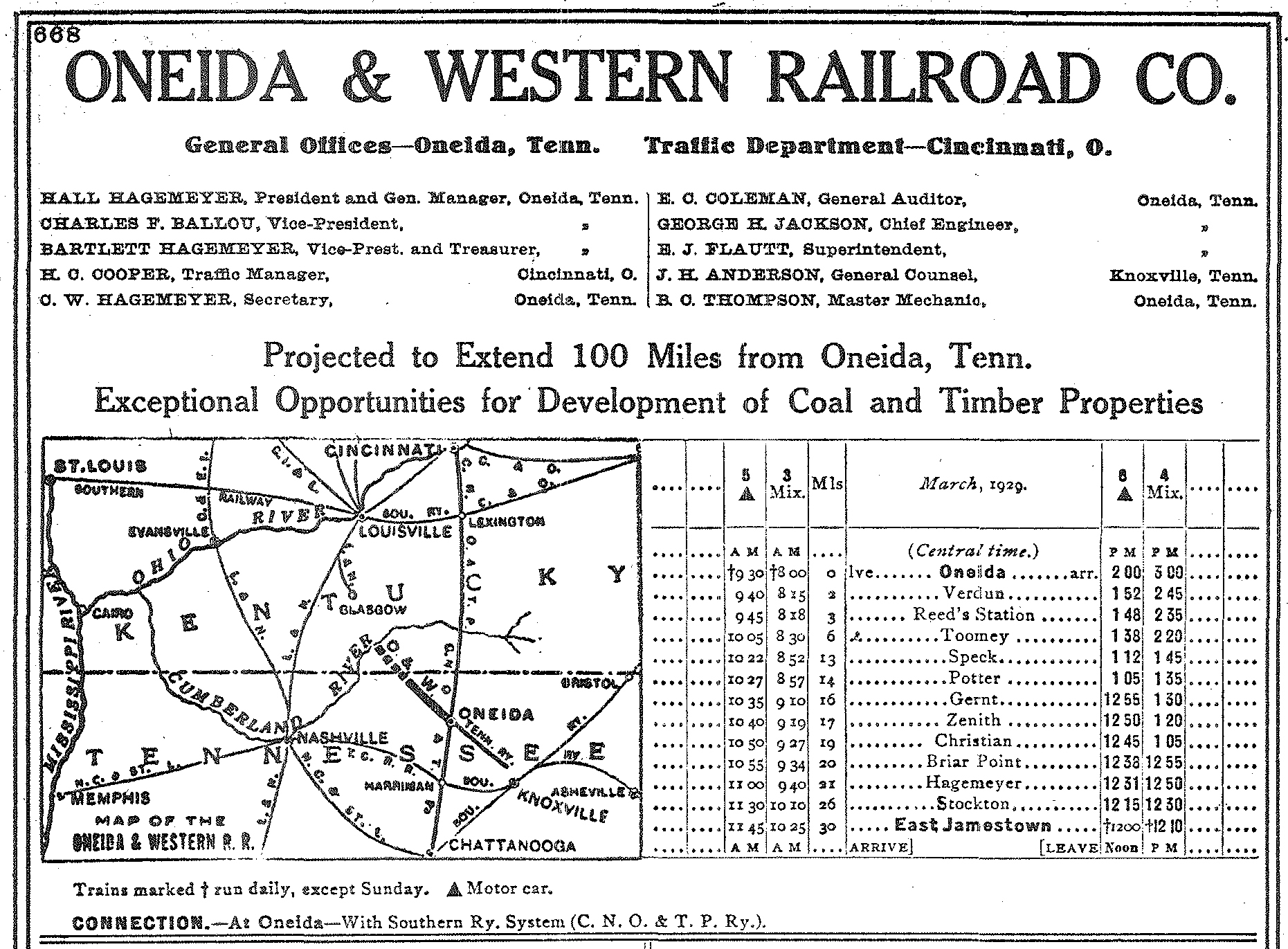
The Oneida & Western in the Official Guide of the Railways, January 1930, page 668. The timetable is dated March 1929 and ends at East Jamestown, mile 30. Jamestown opened on December 10, 1930. General offices were in Oneida. The traffic department was in Cincinnati.
The page is an advertisement as well as a timetable. Under the officers it says the railroad was “Projected to Extend 100 Miles from Oneida, Tenn.,” and it offers “Exceptional Opportunities for Development of Coal and Timber Properties.” The small map sets Oneida on the Southern between Cincinnati and Chattanooga, with Nashville, Knoxville, and Louisville around it. The connection line at the bottom is specific: at Oneida, with the Southern Railway System, the Cincinnati, New Orleans & Texas Pacific.
Hall Hagemeyer is president and general manager, at Oneida. Charles F. Ballou is vice president. Bartlett Hagemeyer is vice president and treasurer. C. W. Hagemeyer is secretary. E. C. Coleman is general auditor. H. C. Cooper, in Cincinnati, is traffic manager. George H. Jackson is chief engineer. E. J. Flautt is superintendent. J. H. Anderson, in Knoxville, is general counsel. B. O. Thompson is master mechanic.
The table itself is dated March 1929, and it is printed in Central time. Trains 3 and 4 are mixed. Trains 5 and 8 are motor cars. All four run daily except Sunday. Mixed train 3 leaves Oneida at 8:00 a.m. and reaches East Jamestown at 10:25 a.m. Motor car 5 leaves Oneida at 9:30 a.m. and arrives at 11:45 a.m. Motor car 8 leaves East Jamestown at noon and is back in Oneida at 2:00 p.m. Mixed train 4 leaves East Jamestown at 12:10 p.m. and reaches Oneida at 3:00 p.m.
| Miles | Station |
|---|---|
| 0 | Oneida |
| 2 | Verdun |
| 3 | Reed’s Station |
| 6 | Toomey |
| 13 | Speck |
| 14 | Potter |
| 16 | Gernt |
| 17 | Zenith |
| 19 | Christian |
| 20 | Briar Point |
| 21 | Hagemeyer |
| 25 | Stockton |
| 30 | East Jamestown |
Those miles are the March 1929 table, and they are the same list Sulzer published. The west end of the table is East Jamestown. The Guide went to press before the extension opened.
Jamestown
On June 9, 1930, the railroad applied to extend about seven miles from East Jamestown into Jamestown. By then the Tennessee Lumber and Coal Company owned the Oneida & Western, and it told the state that the best timber along the existing line had already been cut. The Scott County News of December 13, 1930, reported that the extension would open on Saturday, December 10. The paper named Hall Hagemeyer, president; George Jackson; auditor Carl Coleman; and A. M. Cook, the contractor. Jamestown planned a celebration. The News said the town would be “linked up to the outside world by rail.”
A 1936 schedule in the local chronicle, after that opening, is a shorter card than the 1929 table. A motor car left Oneida daily except Sunday at 7:00 a.m. and reached Jamestown at 10:00 a.m. A mixed train left Jamestown at 11:00 a.m. and reached Oneida at 2:20 p.m. The ride from Oneida to Jamestown took about three hours. Howell records that the old passenger coach had been sold and that the mail, and the passengers who remained, rode a Chevrolet truck fitted with railroad wheels, and later a gasoline car numbered M-4.
Coal, lumber, and the mail
The railroad’s freight was timber first, and then coal. Smith remembered logs from western Fentress County and from Pickett County pulled up a long incline and loaded for the band mill at Verdun, two miles out of Oneida. For a time that mill ran night and day. Coal came on at Potter and Zenith from the late 1920s, and the Zenith tipple stood over the track at mile 17. Livestock, farm products, and poultry moved east to the Southern at Oneida. Groceries and manufactured goods moved west into the hollows. The company made money on that trade into the late 1920s.
Sulzer left one story from the First World War that the county still tells. The railroad deadheaded its coach to East Jamestown, loaded twenty or thirty Fentress County recruits, and brought them back to Oneida for the Southern. Auditor Willard E. Bond rode with them. They were young, quiet, and, he thought, frightened. Years later one of them gave a picnic and invited Bond. The recruit was Alvin C. York.
The Oneida depot stood on Alberta Street, on the ground the First National Bank later used for its main office. The company’s red-brick office, with the owners’ rooms upstairs, stood across U.S. 27 from the bank. The Jamestown depot stood on Highway 52 at the south end of town. Out along the line there were mine camps, section camps, and timber camps, East Laurel among them, and a swinging bridge at Gernt that people on the motor car used as a picnic stop.
The engines
The only locomotive the Oneida & Western bought new was No. 20, a Consolidation from Baldwin in June 1916, works number 43529. The Baldwin specification, as Steve Llanso publishes it, gives Walschaert valve gear, slide valves as built, cylinders 19 by 26 inches, drivers of 50 inches, and a boiler pressure of 190 pounds. The engine weighed 142,000 pounds, with 126,000 on the drivers, and the tractive effort was 30,317 pounds. It was the engine that met a 4 percent grade and a 20-degree curve.
| Item | No. 20, as built |
|---|---|
| Builder | Baldwin |
| Works number | 43529 |
| Built | June 1916 |
| Type | 2-8-0 |
| Valve gear | Walschaert. Slide valves as built |
| Cylinders | 19×26 in |
| Drivers | 50 in |
| Boiler pressure | 190 psi |
| Engine weight | 142,000 lb |
| Weight on drivers | 126,000 lb |
| Tractive effort | 30,317 lb |
In 1926 a hostler left the engine out, and a freeze split the bridge pipes. The railroad sent No. 20 back to Baldwin. The rebuild replaced the slide valves with piston valves arranged for outside admission, the piping Richard Leonard later pointed out on the engine: two pipes off the top of the valve chamber, where a rebuilt engine usually has one in the center. In July 1937 the Oneida & Western sold No. 20 to Birmingham Rail & Locomotive. The Rahway Valley Railroad of Kenilworth, New Jersey, bought it on July 28, 1937, for $8,159, and numbered it 15. It last worked a Rahway Valley train on November 28, 1953. Nelson Blount bought it in 1959. It is on display at Steamtown in Scranton, still carrying the Rahway Valley number.
No. 29, in the photograph at the top of this page, was one of the secondhand engines. Alco’s Richmond Works built it in 1923, works number 65287, as Birmingham Southern 35. It became Chattahoochee Valley 35, still with that number, and then the Oneida & Western’s 29. The November 22, 1951, photograph shows the number it wore at Oneida. After the Oneida & Western shut down, the Alabama Central kept the number 29. The engine pulled that railroad’s last revenue freight on May 26, 1961, and it is displayed at the Alabama Mining Museum in Dora, Alabama.
Willie Douglas, who fired on the Oneida & Western for decades and who fired the first engine over the finished line and the last engine in 1954, later counted twelve locomotives in the railroad’s life. All of them were used engines except No. 20. The oldest, in his count, was an engine built in 1899. The pair he remembered as the best were Alco-Pittsburgh engines of May 1902, consecutive serial numbers, bought from the Southern. The two engines that can be specified from a builder card and a photograph are No. 20 and No. 29.
The last train
Highways and trucks, new in the early 1930s, took the freight the short line had carried, and the passenger coach was already gone. In 1942 the Crown-Healy company of Chicago bought the railroad to haul material for a Tennessee Valley Authority dam on Wolf Creek. The war stopped the dam. Crown-Healy lost the work when the bids were taken again, and in 1946 it applied to abandon the line. Jewell Ridge Coal bought the property that year, meaning to open mines along the Big South Fork and to work the mine at Zenith. Those mines were not developed. In February 1953 Jewell Ridge applied to abandon the railroad.
People in Fentress, Scott, Pickett, and Cumberland counties fought the case. Smith recorded that it went to court in Crossville, and that the ruling let the charter die. The last revenue train ran on March 4, 1954. Audney Acres was the engineer, Willie Massey the conductor, George Parnell the fireman, and Harrison Terry the brakeman. Smith said it left Jamestown with five loads and three empties. The steel was taken up for scrap. The engines were sold. The office went to the Plateau Electric Cooperative. The right of way from Oneida to Verdun, and land around Oneida, went to Carl Coleman. From Verdun to the county line the grade was given to Scott County as a public road, and Fentress County received the grade on its side of the line.
The bridge is still there. It stands in the Big South Fork National River and Recreation Area, set aside in 1974, and it carries the road across the river. Scott County’s piece of the grade runs as a county road out to White Oak Creek. Beyond that, the national area keeps the old line as a trail. The Big Cut and the Whipple span are still on the ground.
The name in 1979
A quarter century after Audney Acres brought the last revenue train into Oneida, B. Ray Thompson of Shamrock Coal put the name back on a set of new locomotives. The Oneida & Western of 1979–1987 was the reporting mark OWTX on eight SD40-2s and two trains of rotary-dump gondolas, running on the Louisville & Nashville and its successors between Kentucky and South Carolina. Those engines worked that coal run. The Tennessee grade had already been a road and a trail for twenty-five years.
Sources
- Josetta Griffith, ed., “The Oneida & Western Railroad,” FNB Chronicle, Vol. 8, No. 2 (Winter 1997). The chronicle prints Elmer Sulzer, Ghost Railroads of Tennessee (1975), on the charter, the construction miles, and the Alvin York movement; H. Clay Smith, Dusty Bits of the Forgotten Past (1985), on the Hagemeyers, the Verdun mill, the Crossville case, and the last train; and Benita J. Howell on the owners, the mail bus, and the M-4. The 1936 schedule and the station list are in the same article. Willie Douglas’s count of twelve locomotives is from a 1978 Independent Herald piece quoted there.
- The Official Guide of the Railways, January 1930, p. 668. The featured map and timetable. The table is dated March 1929 and ends at East Jamestown. Officers, the Cincinnati traffic office, and the Southern connection are on that page.
- Scott County News, December 13, 1930, as quoted in the chronicle. The December 10, 1930, opening, and the Tennessee Lumber and Coal Company.
- Steve Llanso, Locobase 14351, from the Baldwin specification in the DeGolyer Library, Southern Methodist University, Vol. 53. No. 20’s works number, date, and as-built dimensions, the 15.2 miles to Gernt, and the 4 percent grades and 20-degree curves of the 1921 line.
- Richard Leonard, RailArchive.net, on the outside-admission piston valves fitted when Baldwin rebuilt No. 20. The Rahway Valley equipment list dates the sale July 28, 1937, at $8,159, and the last Rahway Valley trip November 28, 1953.
- Steve Llanso’s note on Birmingham Southern 35, in the Class 36/386 entry: sold to the Chattahoochee Valley, then to the Oneida & Western, which renumbered it 29, and then to the Alabama Central, which kept 29. Alco-Richmond works number 65287. The American-Rails Consolidation survivor list gives the Alabama Central’s last revenue freight as May 26, 1961, and the display at the Alabama Mining Museum in Dora.
- Oneida and Western Bridge, National Register of Historic Places nomination, Tennessee Historical Commission. The Whipple span of about 200 feet, the Nashville Bridge Company installation, Crown-Healy in 1942, the 1946 abandonment application, Jewell Ridge, and the February 1953 application. The Scott County encyclopedia and the bridge page supply June 1915 for the reassembly and November 4, 1913, for the start of construction at the Cincinnati Southern.
Recent Articles


-
Oneida & Western Railroad: Map, History, Timetable
Oct 14, 26 03:26 PM
 Oneida & Western Railroad, a Tennessee short line from Oneida to Jamestown. Chartered in 1912, opened to East Jamestown in 1921, and to Jamestown on December 10, 1930. Last revenue train March 4, 1954…
 -
Oneida and Western Railroad (Shamrock Coal Company)
Oct 14, 26 03:20 PM
 Shamrock Coal's mint-green coal trains, 1979–1987. Eight EMD SD40-2s, OWTX 9950–9957, order 786246. Two 72-car gondola sets. Louisville & Nashville, then CSX. Sold to BC Rail.
 -
Rhode Island Railroad Museums (2026): A Complete Guide
Oct 14, 26 03:03 PM
 Rhode Island railroad museums—the Friends’ museum in the 1875 Kingston depot, on the old New York, Providence and Boston. Confirm what is on view.
 -
Original Norfolk Southern Diesel Roster (All-Time)
Oct 14, 26 12:40 PM
 All-time diesel roster of the original Norfolk Southern Railway. 59 locomotives: Baldwin switchers and AS-416s, three GE 70-tonners, 17 GP18s, and seven GP38s. Serials and order numbers.
 -
Original Norfolk Southern Railway: Map, Rosters, History
Oct 14, 26 10:09 AM
 The original Norfolk Southern Railway, chartered in 1870 as the Elizabeth City & Norfolk. Norfolk to Charlotte. Merged into the Southern Railway on January 1, 1974. Baldwin diesels and the GP18s and G…
 -
Nebraska Railroad Museums (2026): A Complete Guide
Oct 14, 26 10:00 AM
 Nebraska railroad museums—the Durham Museum, Kenefick Park, Cody Park, and the Golden Spike Tower over Bailey Yard. Confirm hours on each site.
 -
Nevada Railroad Museums (2026): A Complete Guide
Oct 14, 26 09:51 AM
 Nevada railroad museums—Carson City, Boulder City, the Nevada Northern at East Ely, and the Virginia City depot. Confirm hours on each site.
 -
Montana Railroad Museums (2026): A Complete Guide
Oct 14, 26 12:17 AM
 Montana railroad museums—the Livingston depot, Fort Missoula’s Willamette, the Harlowton Milwaukee depot, and the Whitefish station. Confirm hours on each site.
 -
"Jawn Henry" Locomotive: Specs, Diagram, Photos
Oct 14, 26 12:03 AM
 Norfolk & Western No. 2300, class TE-1, the steam turbine-electric Jawn Henry. Baldwin-Lima-Hamilton, Westinghouse, and Babcock & Wilcox, May 1954. Specifications, the road tests, and the Dece…
 -
Atlantic and Danville Railway: Serving Southern VA
Oct 13, 26 04:32 PM
 Atlantic and Danville Railway, chartered in 1882, incorporated September 1883. Three-foot line to Claremont, then Norfolk to Danville. Southern lease from September 1, 1899, to July 1, 1949. Alco RS2s…
 -
Norfolk, Franklin and Danville Railroad: Map, Roster, History
Oct 13, 26 04:26 PM
 Norfolk, Franklin and Danville Railway, chartered October 2, 1962, and operating from November 1, 1962. Norfolk to Danville, 210.8 miles. Two Alco RS36s and four RS11s. Merged into the N&W on December…
 -
Norfolk & Western Diesel Roster (All-Time)
Oct 12, 26 11:59 PM
 Norfolk & Western diesel roster, all-time. 1,464 locomotives built new for the railroad, from the 1955 GP9s and RS-3s through the C36-7s, plus the merger fleets.
 -
Norfolk & Western Steam Roster (Post 1900)
Oct 12, 26 11:52 PM
 Norfolk & Western steam since 1898. The Roanoke grid: 1,266 locomotives, the J, the A, and the Y, and the last road steam on May 7, 1960.
 -
Norfolk & Western Railway: Map, Logo, Rosters, History
Oct 12, 26 11:45 PM
 The Norfolk & Western, from the City Point Railroad of 1838 to Norfolk Southern. Pocahontas coal, Roanoke steam, and the 1964 expansion.
 -
Louisiana Railroad Museums (2026): A Complete Guide
Oct 12, 26 11:24 PM
 Louisiana railroad museums—the DeQuincy depot, the Long Leaf sawmill, Jackson’s model railroad, and Southern Pacific 745. Confirm hours on each site.
 -
Michigan Railroad Museums (2026): A Complete Guide
Oct 12, 26 11:14 PM
 Michigan railroad museums—Pere Marquette 1225 at Owosso, Durand Union Station, The Henry Ford, and the Mount Clemens depot. Confirm hours on each site.
 -
Mississippi Railroad Museums (2026): A Complete Guide
Oct 12, 26 10:52 PM
 Mississippi railroad museums—McComb’s rebuilt Illinois Central depot and Illinois Central 2542, and the Casey Jones museum at Water Valley. Confirm hours on each site.
 -
The "E2b": PRR's Experimental Freight Electrics
Oct 12, 26 10:33 PM
 PRR class E2b: six GE B-B freight electrics, 4939–4944, 2,500 hp, 11 kV AC. Specifications, roster, and the 1964 scrap.
 -
Alaska Railroad Museums (2026): A Complete Guide
Oct 12, 26 10:10 PM
 Alaska railroad museums—the Museum of Alaska in Wasilla, Tanana Valley No. 1 at Pioneer Park, and the Engine 557 shop. Confirm hours on each site.
 -
Western and Atlantic Railroad: Map, History, Timetables
Oct 12, 26 09:55 PM
 The Western & Atlantic Railroad of the State of Georgia, authorized December 21, 1836, from Atlanta to Chattanooga. The state still owns the 137.33-mile line. CSX leases it. The through railroad opene…
 -
Nashville, Chattanooga & St. Louis Steam Roster (Post 1900)
Oct 12, 26 09:52 PM
 Nashville, Chattanooga & St. Louis steam since 1900. Drury's class grid: Consolidations, 51 Mikados, three 2-8-8-2s, Pacifics, and 25 4-8-4s. Last steam was January 4, 1953.
 -
Nashville, Chattanooga & St. Louis Diesel Roster (All-Time)
Oct 12, 26 09:27 PM
 Nashville, Chattanooga & St. Louis diesel roster, all-time. Switchers from 1941, 37 GP7s, and the F3s and F7s. The quantity column totals 132 locomotives.
 -
Nashville, Chattanooga and St. Louis Railway: Map, History, Logo
Oct 12, 26 08:41 PM
 The Nashville, Chattanooga & St. Louis, the Dixie Line. Charter of December 11, 1845, the Cumberland tunnel, and the Louisville & Nashville merger of August 30, 1957.
 -
Idaho Railroad Museums (2026): A Complete Guide
Oct 12, 26 02:44 PM
Idaho railroad museums—Nampa’s 1903 depot, Wallace’s Northern Pacific depot, and Boise’s 1925 Union Pacific depot. Confirm hours on each site. -
Hawaii Railroad Museums (2026): A Complete Guide
Oct 12, 26 12:50 PM
Hawaii railroad museums—the Hawaiian Railway Society at Ewa Beach and the Laupahoehoe Train Museum on the Big Island. Confirm hours on each site. -
Marietta and Cincinnati Railroad: Map, History, Timetable
Oct 12, 26 11:44 AM
 Marietta and Cincinnati Railroad, chartered March 8, 1845 as the Belpre & Cincinnati. Opened in April 1857, sold under foreclosure December 9, 1882, and succeeded by the Baltimore & Ohio Southwestern…
 -
Tennessee Railroad Museums (2026): A Complete Guide
Oct 12, 26 11:39 AM
 Tennessee railroad museums—TVRM and Southern 4501 in Chattanooga, the Tennessee Central museum in Nashville, Casey Jones in Jackson, and the depots at Cookeville, Cowan, and Townsend.
 -
Virginia Railroad Museums (2026): A Complete Guide
Oct 12, 26 09:40 AM
 Virginia railroad museums—Roanoke’s Virginia Museum of Transportation and the O. Winston Link Museum, the C&O center at Clifton Forge, and the depots in Richmond, Fairfax Station, Suffolk, Parksley, a…
 -
Louisville & Nashville Diesel Roster (All-Time)
Oct 12, 26 12:15 AM
 Louisville & Nashville diesel roster, all-time. Switchers from 1939, the cab units, and EMD, Alco, and GE hoods through the SD50s. The quantity column totals 1948 locomotives, plus 29 yard slugs.
 -
Louisville & Nashville Steam Roster (Post 1900)
Oct 11, 26 05:44 PM
Louisville & Nashville steam since 1900. Drury's class grid: Consolidations, 165 heavy Mikados, 42 Big Emma 2-8-4s, Pacifics, and 22 Mountains. Last steam January 1957. -
Louisville and Nashville Railroad: Map, Rosters, History
Oct 11, 26 05:39 PM
 Louisville & Nashville, the Old Reliable. Charter of March 5, 1850, Milton H. Smith, the 921-mile main line, Big Emma, and the December 29, 1982 merger. Steam and diesel rosters are companion pages.
 -
Oregon Railroad Museums (2026): A Complete Guide
Oct 11, 26 05:19 PM
 Oregon railroad museums—the Oregon Rail Heritage Center, Brooks trolleys, Canby’s 1891 depot, Medford’s Willamette, and Train Mountain. Confirm hours on each site.
 -
Texas Railroad Museums (2026): A Complete Guide
Oct 11, 26 05:15 PM
 Texas railroad museums—Frisco’s Big Boy 4018, Galveston’s Santa Fe depot, Temple’s 1911 station, Plano’s interurban, and Fort Worth & Denver 304. Confirm hours on each site.
 -
Wisconsin Railroad Museums (2026): A Complete Guide
Oct 10, 26 11:51 PM
Wisconsin railroad museums—Green Bay’s Big Boy 4017 and Eisenhower’s A4, Mid-Continent at North Freedom, East Troy’s interurban, and the Riverside & Great Northern. Confirm hours on each site. -
Interstate Railroad (Virginia): Map, Roster, Logo, History
Oct 10, 26 11:22 PM
 Interstate Railroad, a Virginia coal road chartered February 18, 1896. Andover shops. Ten Alco RS3s, 30–39. Southern control in 1961. The company ended October 31, 1985.
 -
North Carolina Railroad Museums (2026): A Complete Guide
Oct 10, 26 11:16 PM
North Carolina railroad museums—Spencer Shops, Wilmington’s Atlantic Coast Line 250, Hamlet’s Seaboard depot, and the New Hope Valley Railway. Confirm hours on each site. -
New Mexico Railroad Museums (2026): A Complete Guide
Oct 10, 26 10:54 PM
 New Mexico railroad museums—Santa Fe 2926 in Albuquerque, the Clovis depot, Alamogordo’s Toy Train Depot, and Belen. Confirm hours on each site.
 -
New York Railroad Museums (2026): A Complete Guide
Oct 10, 26 09:33 PM
 New York railroad museums—Phoenicia, Medina’s New York Central freight house, the Transit Museum, Long Island 35 and 39, and GG1 4933. Confirm hours on each site.
 -
Columbia, Newberry & Laurens Railroad: History, Timetable, Roster
Oct 10, 26 09:08 PM
 Columbia, Newberry & Laurens Railroad, Columbia to Laurens, 75 miles. Chartered in 1885. Five Atlantic Coast Line GP7s, 100–104. Merged into the Seaboard System on April 30, 1984.
 -
New Haven Diesel Roster (All-Time)
Oct 10, 26 06:35 PM
 New Haven diesel roster, all-time. 558 road numbers: 60 DL-109s, 30 FA-1s, 27 PA-1s, 60 FL9s, and the switchers from HH600 0900. Serials and order numbers.
 -
New Haven Steam Roster (Post 1900)
Oct 10, 26 06:31 PM
New Haven steam since 1900. Drury's class grid: 226 Moguls, 33 Mikados, 50 Santa Fes, 70 Mountains, 141 Pacifics, and 10 Hudsons. Last fan trip July 19, 1953. -
New Haven Railroad: Rosters, Map, Logo, History, Trains
Oct 10, 26 06:26 PM
 New York, New Haven and Hartford. The Shore Line, Hell Gate, the 1952 map at 1,838.89 miles, and the railroad Penn Central took at 11:59:59 p.m. on December 31, 1968.
 -
C&O's 4-6-4 "Hudson" Locomotives (Class L): Specs, Roster, History
Oct 10, 26 05:36 PM
 Chesapeake & Ohio Class L 4-6-4 Hudsons. Eight L-2s, five L-1 rebuilds, five L-2-As. Specs, Baldwin works numbers, and the roster. No. 490 survives.
 -
Alton Railroad: Map, History, Timetables
Oct 09, 26 10:31 PM
 Alton Railroad, chartered February 27, 1847 as the Alton & Sangamon. Chicago, St. Louis, and Kansas City, the 1937 Official Guide, and the May 31, 1947 merger into the Gulf, Mobile & Ohio.
 -
Mobile & Ohio Steam Roster (Post 1900)
Oct 09, 26 12:26 PM
 Mobile & Ohio steam since 1900. Drury's class grid: 48 six-wheel switchers, 107 Ten-Wheelers, 15 Consolidations, 58 Mikados, and 14 Pacifics. Last revenue steam October 7, 1949.
 -
Mobile & Ohio Railroad: History, Map, Timetable
Oct 09, 26 11:31 AM
 Mobile & Ohio Railroad, chartered in 1848. Columbus on April 22, 1861, the Cairo & St. Louis, the March 1940 Official Guide, and the September 13, 1940 merger into the Gulf, Mobile & Ohio.
 -
Gulf, Mobile & Northern Steam Roster (Post 1900)
Oct 09, 26 10:42 AM
 Gulf, Mobile & Northern steam since 1900. Drury's class grid: Ten-Wheelers, Mikados, Russian Decapods, Pacifics 425 and 426, and three light 4-8-2s. Last revenue steam October 7, 1949.
 -
Gulf, Mobile & Ohio Diesel Roster (All-Time)
Oct 09, 26 10:41 AM
 Gulf, Mobile & Ohio diesel roster, all-time. The 1935 boxcab, DL-107s, 55 FA-1s, F3s and F7s, the Ingalls 4-S, GP30s through GP38-2s, and 21 SD40s. Serials and order numbers.
 -
Gulf, Mobile & Northern Railroad: History, Rebel Route
Oct 09, 26 10:36 AM
 Gulf, Mobile & Northern, from the 1890 Mobile, Jackson & Kansas City to the Rebel and the September 13, 1940 merger into the Gulf, Mobile & Ohio. Steam roster is the companion page.
 -
Gulf, Mobile & Ohio Railroad: Map, Photos, Trains, History
Oct 08, 26 11:48 PM
 Gulf, Mobile & Ohio, chartered in 1938 and merged September 13, 1940. The Mobile & Ohio, the Alton on May 31, 1947, the Rebel Route, and Illinois Central Gulf on August 10, 1972.