Missouri Pacific Steam Roster (Built Since 1900)
Published: November 7, 2026
By: Adam Burns
George H. Drury’s table of Missouri Pacific steam locomotives built since 1900 is the list on this page. Two Sedalia rebuilds are written down in both forms, so the frames, counted once, are 1,407. The company story is the Missouri Pacific page. Texas & Pacific steam is a separate chapter and a separate roster.
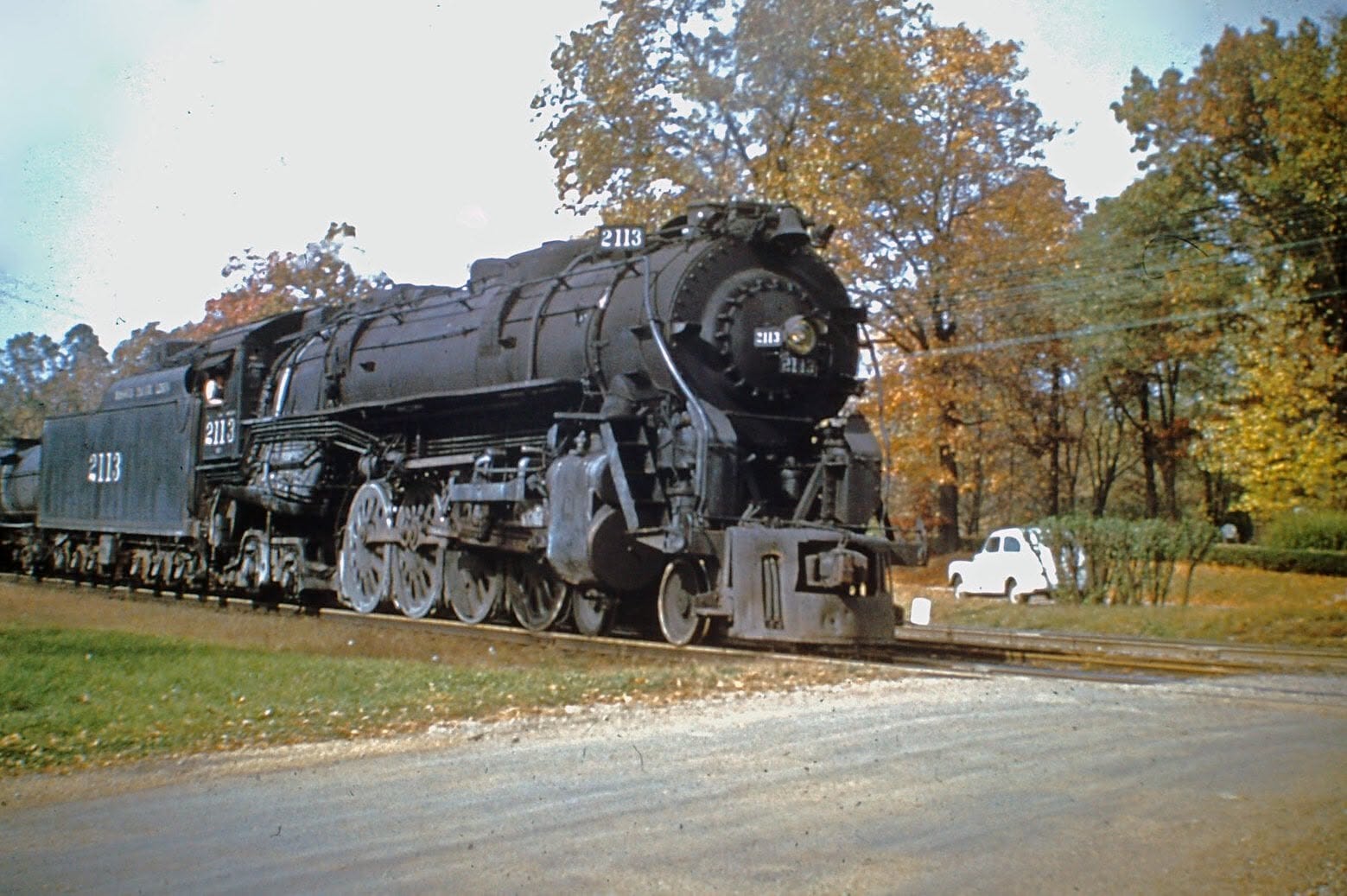
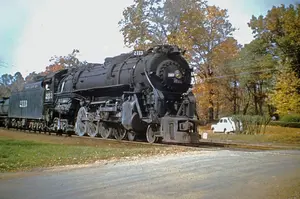
Missouri Pacific 4-8-4 2113 at Kirkwood, Missouri, just southwest of St. Louis, on a fall afternoon in October 1950. Shop forces rebuilt 2113 from a 2-8-4 in 1940. It is one of 2101–2125. Joe Collias photo.
On this page: At a glance · The 1905 numbers · Switchers · Freight power · Passenger power · Mountains and Northerns · Roster
At a glance
| Item | Detail |
|---|---|
| Railroad | Missouri Pacific, including the International-Great Northern, the New Orleans, Texas & Mexico, and the St. Louis, Brownsville & Mexico. Company Missouri Pacific |
| Scope | Built since 1900. Drury’s table, 76 rows |
| Quantity column | 1,439 |
| Frames, counted once | 1,407. The 25 Berkshires 1901–1925 and the 7 USRA Mountains 5301–5307 are listed again after the Sedalia rebuilds |
| Last road steam | April 7, 1955. Consolidations 40 and 104, Bush to Dupo, Illinois |
| Last steam in service | 0-6-0 No. 9301, until November 1955 |
| Diesels | 2,404 locomotives |
The 1905 numbers
In 1905 the railroad sorted the numbers by the work. Freight power took everything below 5000. Passenger power took 5000 through 8999. Switchers took 9000 through 9999. The class mark put letters on the wheel arrangement and a figure on the driver diameter. P was a Pacific, MK a Mikado, MT a Mountain. A locomotive whose drivers measured 63 inches over the tire carried 63 in the class. One Ten-Wheeler class is TN-56½.
The table below follows Drury row for row, including locomotives that came with the International-Great Northern, the New Orleans, Texas & Mexico, the St. Louis, Brownsville & Mexico, and the smaller Texas roads named in the notes. Where a number was used twice because the shops rebuilt the engine, both lines stay in the quantity column and the frame is counted once in the 1,407.
Switchers
The 0-6-0s in the table come to 149. No. 9301, class SW-51, was the last steam locomotive on the railroad, still at work in November 1955. It had 51-inch drivers, 21-by-28-inch cylinders, piston valves, Walschaerts gear, and a weight of 160,500 pounds, with a tractive effort of 39,100 pounds. The five rows of 0-8-0s come to 85, the figure Drury gives for the eight-wheel switchers. They followed the United States Railroad Administration design as the Missouri Pacific modified it, heavier by 12,000 to 18,000 pounds and with 7,750 pounds more tractive effort. Later engines had cast frames and a front-end throttle ahead of the stack.
Freight power
Consolidations 1–172, class C-63, were the first locomotives after the 1905 renumbering. They had 22-by-30-inch cylinders, 63-inch drivers, and slide valves. The first 76 used Stephenson gear. The rest used Walschaerts. Many were later rebuilt with piston valves, Baker gear, stokers or oil, and new cast frames. In 1942 the North Little Rock shops assembled No. 173 from remnants of that class, spare parts, and a new tender. It is in the quantity column. The C-55s numbered 401–487 are carried as 84 locomotives.
The big Mikado purchases were 1201–1280, then the United States Railroad Administration light 2-8-2s 1301–1325, then 1401–1570. Schenectady built 1201–1250 in 1911, fifty engines, and Baldwin built 1251–1280 in 1913 and 1914. They had 63-inch drivers, 27-by-30-inch cylinders, 170 pounds of boiler pressure, and a tractive effort of 50,160 pounds. The 1401–1570 series followed the Administration heavy Mikado, with a larger boiler, a cast trailing truck, and mechanical stokers. They were the first Missouri Pacific locomotives with a head brakeman’s shelter on the tender deck. Engines 1536–1570 had extra space between the second and third drivers because they were built while the three-cylinder 1699 was on test.
No. 1699, built by Schenectady in 1925, was tested at Altoona before delivery. In 1937 the shops converted it to two cylinders and renumbered it 1571. That number sits outside 1401–1570. It is the same frame, listed once. The smokebox door, set a little above center, was the visible difference from the 170 copies of the Administration engine.
Berkshires 1121–1125 were the International-Great Northern’s first 2-8-4s, close in design to the Chicago & North Western J-4. Lima’s 1901–1925 of 1930 used the same cylinder and driver dimensions and weighed 412,200 pounds. They worked St. Louis–Kansas City. In 1940 and 1942 Sedalia lengthened the boilers, rolled new cast underframes with 75-inch drivers, and turned the same 25 frames into 4-8-4s 2101–2125. The cylinders stayed 28 by 30. Boiler pressure went to 250 pounds. Both numbers are in the table. The frames are in the 1,407 once.
The only articulated locomotive was 2-8-8-2 No. 4000, Baldwin, 1912, class ML-55, assigned to the hump at Dupo, Illinois. In the 1920s the 0-8-0s took the hump and the Mallet was stored. It came back in 1927 with a 12-wheel tender and Bethlehem auxiliary engines on both trucks, worked the Dupo hump until 1947, and then, with the boosters removed, handled transfer trains across the Mississippi River bridge and an occasional helper turn on Kirkwood Hill.
Eight Russian Decapods, 941–948, were the secondhand 2-10-0s, bought from the Southern Railway, the St. Louis & Hannibal, and the Marion & Eastern, converted to oil, and sent to the New Orleans, Texas & Mexico. The Santa Fe type 2-10-2s were 1701–1729. Numbers 1701–1714 had been Iron Mountain 1501–1514. Numbers 1715–1719 came from the Wabash in 1942 and went to helper service on Kirkwood Hill. Numbers 1720–1729 were rebuilt late in the Second World War with roller bearings, lightweight rods, trailing-truck boosters, and large tenders.
Passenger power
Brooks built the Atlantics 5501–5540 with 79-inch drivers, the highest on the railroad. Fifteen arrived in 1904, two years after the first 4-6-2s, and twenty-five more, through 5540, arrived in 1907. After 1941 many received cast trailing trucks. In 1942, Nos. 5513 and 5538 were given 73-inch drivers and assigned to light, fast freight on level track.
The Missouri Pacific and the Iron Mountain took their last new Ten-Wheelers in 1900–1902, 101 engines, renumbered 2301–2401 in 1905, with 61-inch drivers. Two engines of that weight, 158,500 pounds, were still on the Gurdon–Norman, Arkansas, run in the summer of 1955 because the bridges would not carry a heavier diesel. Diesels took the job by September 1955, after the bridges were replaced or strengthened. The smaller Ten-Wheelers in the table came with the Gulf and Texas roads. Numbers 371–378 were rebuilt in the railroad’s own shops.

Missouri Pacific 4-6-2 1159, class P-73, with train 1, the Sunshine Special, southbound at San Marcos, Texas, in August 1945. No. 1159 is one of 1156–1161, built for the St. Louis, Brownsville & Mexico. Emery Gulash photo.
Drury calls 6501–6521 the first Pacifics built for service in North America. Nine, then numbered 1115–1123, went to the Missouri Pacific, and twelve, 1616–1627, went to the Iron Mountain. In 1905 the class was rebuilt as P-69 with superheaters, outside piston valves, and Baker valve gear, one engine excepted, which received Walschaerts. The class is listed once. Pacific 6000, the three-cylinder experiment of 1925, left that identity in the rebuilding of 1942, when it became the two-cylinder, oil-burning 6001, with roller bearings and an Elesco exhaust-steam injector. The table’s retired cell, “by 1935,” marks the end of the three-cylinder locomotive. No. 6001 is the same frame.
Pacifics 6601–6629 include 6445–6454, renumbered 6601–6610. The class joined the boiler and cylinders of the Administration heavy Pacific to the 73-inch drivers of the light Pacific. Engines 6614–6619 were oil burners with 12-wheel tenders for the Sunshine Special. The St. Louis, Brownsville & Mexico Pacifics 1156–1161, including 1159 at San Marcos, carried Worthington BL heaters, air pumps on the pilot, and extra-large tenders.
Mountains and Northerns
The St. Louis, Iron Mountain & Southern was the second railroad to buy 4-8-2s. Schenectady delivered 5201–5207 in 1913, light engines at 296,000 pounds, with the main rods connected to the third pair of 63-inch drivers. The seven United States Railroad Administration light Mountains, 5301–5307, were rebuilt at Sedalia in 1939 as 5321–5327, class MT-75, with 75-inch disk drivers. Both numbers are in the table. The later Mountains 5335–5344, five from Brooks in 1927 and five from Schenectady in 1930, had 73-inch drivers, 27-by-30-inch cylinders, 250 pounds of pressure, and a weight of 386,700 pounds.
Northerns 2101–2125 are the Berkshires described above. No. 2113, in the Kirkwood photograph, is one of them. The retired years in the table run from 1949 through 1953. Baldwin’s 2201–2215 of 1943 were a War Production Board engine. Railroads had to pool orders and use a design already in production, and the Missouri Pacific chose the Denver & Rio Grande Western’s 1800-class Northern of 1938. Baldwin built the Missouri Pacific engines at the same time as a Northern Pacific 4-8-4 order. The Missouri Pacific locomotives had 73-inch drivers, 26-by-30-inch cylinders, 285 pounds of boiler pressure, and about 16,000 pounds more weight than the Rio Grande engines. They lasted until 1956.
The last road trip was on April 7, 1955. Consolidations 40 and 104 pulled a train of nine dead 2-8-0s and a 2-8-2 from Bush to Dupo, Illinois, for scrapping. Switcher 9301 worked on until November.
Roster
The quantity column is Drury’s. A leading hyphen in a retired cell, printed here as “by,” means the engines were gone by that year. A trailing hyphen means retirements began in that year and continued. Builder names are spelled out from Drury’s abbreviations. “Schen” in the book is Schenectady. “IGN” in a builder cell is the railroad’s own shops.
| Type | Class | Numbers | Qty | Builder | Built | Retired | Notes |
|---|---|---|---|---|---|---|---|
| 0-6-0 | SW-51 | 9301–9320 | 20 | Alco | 1920–1921 | by 1955 | |
| 0-6-0 | SW-51 | 9401–9475 | 75 | Brooks, Richmond, Baldwin | 1902–1910 | 1949–1950 | |
| 0-6-0 | SW-51 | 9501–9543 | 43 | Cooke, Manchester, Schenectady | 1903–1904 | 1932–1948 | |
| 0-6-0 | SW-52 | 9580, 9581 | 2 | Baldwin | 1905 | ||
| 0-6-0 | SW-53 | 9583 | 1 | Baldwin | 1910 | ||
| 0-6-0 | SW-52 | 9584–9587 | 4 | Baldwin | 1906 | ||
| 0-6-0 | SW-52 | 9588–9591 | 4 | Baldwin | 1921 | ||
| 0-8-0 | SW8-51 | 9601–9605 | 5 | Alco | 1927 | by 1955 | |
| 0-8-0 | SW8-51 | 9606–9610 | 5 | Alco | 1927 | by 1955 | |
| 0-8-0 | SW8-51 | 9701–9720 | 20 | Baldwin | 1924–1925 | by 1955 | |
| 0-8-0 | SW8-51 | 9721–9750 | 30 | Lima | 1926, 1929 | by 1955 | |
| 0-8-0 | SW8-51 | 9761–9785 | 25 | Alco | 1927 | by 1956 | |
| 2-8-0 | C-63 | 1–172 | 172 | Baldwin, Brooks, Schenectady | 1905–1910 | 1937– | |
| 2-8-0 | C-63 | 173 | 1 | MP | 1942 | 1956 | Assembled at North Little Rock |
| 2-8-0 | C-55 | 401–487 | 84 | Brooks | 1903–1904 | 1949–1955 | |
| 2-8-0 | C-55 | 501–545 | 45 | Brooks, Baldwin | 1901–1903 | 1925–1945 | |
| 2-8-0 | C-54 | 1001–1003 | 3 | Alco | 1913–1914 | by 1935 | SAU&G |
| 2-8-0 | C-50 | 1004, 1005 | 2 | Baldwin | 1907 | by 1935 | SAU&G |
| 2-8-0 | C-55 | 1006–1008 | 3 | Brooks | 1906 | 1935–1948 | SAU&G |
| 2-8-0 | C-51 | 1009 | 1 | Baldwin | 1920 | 1948 | SAS |
| 2-8-0 | C-57 | 1011–1030 | 20 | Baldwin | 1914 | by 1949 | StLB&M |
| 2-8-0 | C-55 | 1031–1040 | 10 | Baldwin | 1907 | NOT&M | |
| 2-8-0 | C-57 | 1051–1073 | 23 | Baldwin, Schenectady | 1912, 1913 | I-GN | |
| 2-8-2 | MK-63 | 1201–1280 | 80 | Alco, Baldwin | 1911–1914 | by 1954 | |
| 2-8-2 | MK-63 | 1301–1325 | 25 | Lima, Baldwin, Alco | 1919 | 1949–1955 | USRA |
| 2-8-2 | MK-63 | 1401–1570 | 170 | Alco | 1921–1925 | 1949–1955 | |
| 2-8-2 | MK- | 1699 | 1 | Schenectady | 1925 | 1953 | Three cylinders. Renumbered 1571 in 1937 |
| 2-8-2 | MK-63 | 1101–1110 | 10 | Baldwin | 1921, 1924 | 1949–1955 | I-GN |
| 2-8-2 | MK-63 | 1111–1120 | 10 | Brooks | 1926 | 1949–1955 | StLB&M |
| 2-8-4 | BK-63 | 1121–1125 | 5 | Alco | 1928 | 1953–1954 | |
| 2-8-4 | BK-63 | 1901–1925 | 25 | Lima | 1930 | Rebuilt to 4-8-4 | |
| 2-10-0 | D-52 | 941–948 | 8 | Alco | 1918 | Russian Decapod | |
| 2-10-2 | SF-63 | 1701–1714 | 14 | Brooks | 1916 | 1953 | |
| 2-10-2 | 1715–1719 | 5 | Brooks | 1917 | 1953 | Ex-Wabash | |
| 2-10-2 | SF-63 | 1720–1729 | 10 | Baldwin | 1926 | 1955 | |
| 2-8-8-2 | ML-55 | 4000 | 1 | Baldwin | 1912 | 1946 | |
| 4-4-0 | E-63 | 914 | 1 | Baldwin | 1905 | StLB&M | |
| 4-4-0 | E-67 | 927 | 1 | Baldwin | 1904 | StLB&M | |
| 4-4-0 | E-63 | 953 | 1 | Baldwin | 1905 | SB&RGV | |
| 4-4-2 | A-79 | 5501–5540 | 40 | Brooks | 1904, 1907 | 1937–1948 | |
| 4-6-0 | TN-56½ | 236 | 1 | Baldwin | 1920 | Sugar Land | |
| 4-6-0 | TN-57 | 212 | 1 | Baldwin | 1910 | Rio Grande City | |
| 4-6-0 | TN-57 | 213, 214 | 2 | Baldwin | 1916 | Sugar Land | |
| 4-6-0 | TN-57 | 233 | 1 | Cooke | 1905 | NOT&M | |
| 4-6-0 | TN-57 | 235 | 1 | Baldwin | 1912 | SAU&G | |
| 4-6-0 | TN-57 | 285 | 1 | Cooke | 1901 | I-GN | |
| 4-6-0 | TN-57 | 299 | 1 | Alco | 1913 | SAU&G | |
| 4-6-0 | TN-60 | 310 | 1 | Alco | 1907 | H&BV | |
| 4-6-0 | TN-61 | 2301–2401 | 101 | Brooks | 1900–1902 | ||
| 4-6-0 | TN-61 | 2402, 2403 | 2 | Baldwin | 1901 | ||
| 4-6-0 | TN-63 | 252–261 | 10 | Baldwin | 1905 | ||
| 4-6-0 | TN-63 | 291 | 1 | Rhode Island | 1902 | StLB&M | |
| 4-6-0 | TN-63 | 297 | 1 | Alco | 1913 | I-GN | |
| 4-6-0 | TN-63 | 301–306 | 6 | Dickson | 1903 | SAU&G | |
| 4-6-0 | TN-63 | 315–360 | 46 | Cooke, Baldwin, Brooks | 1901–1908 | NOT&M | |
| 4-6-0 | TN-67 | 320, 333, 339 | 3 | Cooke | 1901–1903 | I-GN | |
| 4-6-0 | TN-67 | 361, 362 | 2 | Baldwin | 1903 | I-GN | |
| 4-6-0 | TN-67 | 371–378 | 8 | IGN shops | 1921–1925 | NOT&M | |
| 4-6-0 | TN-67 | 379–384 | 6 | Baldwin | 1911 | I-GN | |
| 4-6-0 | TN-69 | 385–389 | 5 | Alco | 1921 | I-GN | |
| 4-6-0 | TN-69 | 7501–7529 | 29 | Brooks | 1901–1902 | NOT&M | |
| 4-6-2 | P-73 | 6000 | 1 | Schenectady | 1925 | by 1935 | Three cylinders. Rebuilt as 6001 in 1942 |
| 4-6-2 | P-73 | 6401–6439 | 39 | Schenectady, Brooks | 1910, 1912 | 1952 | |
| 4-6-2 | P-73 | 6440–6444 | 5 | Schenectady | 1921 | ||
| 4-6-2 | P-69 | 6501–6521 | 21 | Brooks | 1902–1903 | by 1953 | |
| 4-6-2 | P-73 | 6601–6629 | 29 | Schenectady | 1924, 1925 | 1949–1954 | Includes 6445–6454, renumbered 6601–6610 |
| 4-6-2 | P-73 | 1151–1155 | 5 | Alco | 1926 | 1954 | I-GN |
| 4-6-2 | P-73 | 1156–1161 | 6 | Alco | 1927 | 1954 | StLB&M |
| 4-8-0 | TW-55 | 1801–1819 | 19 | Brooks | 1901, 1903 | ||
| 4-8-2 | MT-63 | 5201–5207 | 7 | Schenectady | 1913 | 1948 | |
| 4-8-2 | MT-69 | 5301–5307 | 7 | Richmond | 1919 | To 5321–5327 | USRA |
| 4-8-2 | MT-73 | 5308–5316 | 9 | Schenectady | 1921, 1923 | by 1955 | |
| 4-8-2 | MT-73 | 5335–5344 | 10 | Brooks, Schenectady | 1927, 1930 | by 1956 | |
| 4-8-2 | MT-75 | 5321–5327 | 7 | MP | 1939 | 1954 | Ex-5301–5307 |
| 4-8-4 | 2101–2125 | 25 | MP | 1940–1942 | 1949–1953 | ||
| 4-8-4 | 2201–2215 | 15 | Baldwin | 1943 | 1956 |
Notes in the last column use Drury’s abbreviations. H&BV is the Houston & Brazos Valley. I-GN is the International-Great Northern. NOT&M is the New Orleans, Texas & Mexico. SAS is the San Antonio Southern. SAU&G is the San Antonio, Uvalde & Gulf. SB&RGV is the San Benito & Rio Grande Valley. StLB&M is the St. Louis, Brownsville & Mexico. USRA is the United States Railroad Administration. The class cell for 2101–2125 is blank in the table. Those 25 locomotives are Berkshires 1901–1925 after the Sedalia rebuild, and the retired years are 1949–1953.
Related reading
- Missouri Pacific Railroad: Map, Locomotives, Logo, History
- Missouri Pacific Diesel Roster (All-Time)
- Texas and Pacific Steam Locomotives: Texas Types and Mountains
- International-Great Northern Railroad: Map, History, Timetables
- The “Colorado Eagle”: MP’s Premier St. Louis-Denver Train
- “Texas Eagle” (Train): Schedule, Route Map, Timetable
Sources
- George H. Drury, Guide to North American Steam Locomotives, revised edition, Missouri Pacific chapter, pages 218–223. The table, the class notes, and the closing dates.
- Joe G. Collias, Mopac Power (Howell-North Books, 1980).
- Lloyd E. Stagner, “Those Sedalia 4-8-4s,” Trains, May 1984, pages 20–28.
- Missouri Pacific Historical Society, mopac.org.
Recent Articles


-
WM's 4-6-6-4 Locomotives (M-2): Specs, Roster, History
Nov 07, 26 04:37 PM
 Western Maryland class M-2, twelve Baldwin 4-6-6-4s numbered 1201-1212, built in 1940 and 1941 for Hagerstown-Connellsville fast freight. Roster, specifications, and retirement in 1952-1953.
-
Missouri Pacific Diesel Roster (All-Time)
Nov 07, 26 04:26 PM
 Missouri Pacific diesel roster, 2,404 locomotives in 61 rows. Alco 271, Baldwin 110, EMD 1,742, GE 281. Texas and Pacific locomotives are on their own page. The 1963 ownership figure is 724.
-
Missouri Pacific Steam Roster (Built Since 1900)
Nov 07, 26 04:21 PM
 Missouri Pacific steam locomotives built since 1900. Drury quantity column 1,439. Sedalia rebuilds counted once, 1,407 frames. Last steam was 0-6-0 9301 in November 1955.
-
Missouri Pacific Railroad: Map, Locomotives, Logo, History
Nov 07, 26 04:19 PM
 The Missouri Pacific was a large Midwestern that carried a long history of financial difficulty until later years.
-
LIRR Service Changes Start on November 9
Nov 07, 26 03:15 PM
New Long Island Rail Road schedules start on every branch on Monday, November 9, 2026. Midday and weekend times change. Rush hour does not. Babylon service returns in stages. -
Draft EA Reviews Norfolk Southern Track in London, Ohio
Nov 07, 26 11:35 AM
 The Surface Transportation Board environmental office issued a draft assessment on November 6, 2026, for about 0.96 miles of Norfolk Southern track in London, Ohio. Comments are due November 20.
-
Metrolink Lines Will Not Run on Three Routes November 7
Nov 07, 26 10:53 AM
 Metrolink will not run the Ventura County, Orange County, or Inland Empire-Orange County lines on November 7 and 8, 2026. The advisory says no substitute transportation will be provided.
-
Hartford Line Adds a Weekday Round Trip on November 16
Nov 07, 26 10:48 AM
 Connecticut said the Hartford Line adds a weekday New Haven-Hartford round trip on November 16, starts a morning train in Springfield, and extends weekend stops to Windsor and Windsor Locks.
-
Board Issues a Policy Statement on Rail Preemption
Nov 07, 26 10:44 AM
The Surface Transportation Board placed a policy statement on public inspection for the November 9 Federal Register. It reviews existing preemption precedent and says it makes no binding determination… -
NJ Transit Restores Lines After the Newark Drawbridge Stop
Nov 07, 26 10:37 AM
 NJ Transit said Morris and Essex service between Hackettstown and Dover, and Montclair-Boonton service between Hackettstown and Montclair State University, resumed after the Newark Drawbridge stop.
-
EMD "SD35" Locomotives: Data Sheet, Specs, Roster
Nov 06, 26 10:35 PM
 EMD SD35, 2,500 horsepower, 16-cylinder 567D3A, built June 1964 through January 1966. 360 locomotives. Specifications and the production roster by owner, serial, and order.
-
EMD "SDP35" Locomotives: Data Sheet, Specs, Roster
Nov 06, 26 10:32 PM
 EMD SDP35, the steam-generator SD35. 35 locomotives, July 1964 through September 1965. Seaboard Air Line 1100-1119, Atlantic Coast Line 550, Louisville and Nashville 1700-1703, Union Pacific 1400-1409…
-
RJ Corman Will Be Replaced on Part of the Luzerne Lines
Nov 06, 26 01:34 PM
A November 6, 2026 notice says Wilkes-Barre Terminal Railway would acquire about 59.65 miles in Luzerne County and replace R.J. Corman as operator on part of the line. The earliest date is November 22… -
NS Names a Student Hub at the University of Georgia
Nov 06, 26 12:03 PM
 Norfolk Southern said a 100,000 dollar gift named a student-organization hub in Driftmier Engineering Center. The University of Georgia marked the naming on October 26. The space is for 23 clubs.
-
Union Pacific Filed Its Vena Recording Certification
Nov 06, 26 11:56 AM
 Union Pacific filed a November 5, 2026 verified statement that the confidential label is off the March 17 Vena recording and that parties of record received a copy at 3:30 p.m. Eastern.
-
OmniTRAX Adds Tenants at Its Blue Island Hub
Nov 06, 26 10:26 AM
 OmniTRAX has signed new construction-company leases at its 90-acre Blue Island, Illinois, hub and is planning a second phase.
-
Veterans and Active-Duty Members Exceed 16 Percent of Norfolk Southern
Nov 06, 26 10:14 AM
Norfolk Southern said on November 5, 2026, that more than 3,000 veterans and active-duty service members are more than 16 percent of its workforce. This year grants are $100,000 and $50,000. -
BNSF: Merger Would Put Half of U.S. Rail Shipments Under One Railroad
Nov 06, 26 10:00 AM
BNSF chief marketing officer Tom G. Williams told customers on November 3, 2026, that a Union Pacific-Norfolk Southern merger would put about half of U.S. rail shipments under one railroad. Nothing is… -
Amtrak Opens a Winter Fare Sale
Nov 06, 26 09:28 AM
Amtrak opened a Winter Wanderlust sale on November 5, 2026. Book by November 12 for travel from December 1, 2026, through March 14, 2027. Blackout dates apply. Coach and Acela Business only. -
CN and CPKC Report October Grain Records
Nov 06, 26 08:50 AM
 CPKC reported October 2026 grain records in Canada and the United States. CN reported 3.54 million metric tonnes across Canada. The releases do not print a combined total.
-
New Brunswick Transload Gets CN Rail Service
Nov 06, 26 08:49 AM
 CN said on November 4, 2026, that it has started serving AD Gagnon Transload Services near Grand Falls, New Brunswick. The site is three kilometres from the Trans-Canada Highway and lists room for 106…
-
Together, Freight and Passenger Rail Can Grow, Union Pacific Says
Nov 06, 26 08:47 AM
 Union Pacific said on November 5, 2026, that passenger obligations would remain if it combines with Norfolk Southern. The capacity claim is a Union Pacific analysis, not a Surface Transportation Board…
-
FM "C-Liner" Locomotives: Specs, Roster, Photos
Nov 05, 26 11:19 PM
 Fairbanks-Morse Consolidation Line cab units, the C-Liners. 165 locomotives, Beloit and Kingston, March 1950 through February 1955. Models, specs, and production rosters.
-
Atlanta, Birmingham & Coast Railroad: Map, History, Roster
Nov 05, 26 12:03 PM
 Atlanta, Birmingham & Coast, from Brunswick and Waycross to Atlanta and Birmingham. Atlantic Coast Line control at the close of 1926. Merged in January 1946 as the Western Division. Steam roster of th…
-
El Paso & Southwestern Railroad: Map, History, Logo
Nov 05, 26 12:00 PM
 The El Paso & Southwestern, the Phelps Dodge copper railroad from Tucson to the Rock Island at Tucumcari. Southern Pacific control on October 31, 1924.
-
Brightline Says Orlando Service Has Resumed
Nov 05, 26 11:55 AM
 Brightline said on November 5, 2026, that trains to and from Orlando have resumed after weather suspensions in Brevard County. Later that morning the departures page still showed the Orlando segment s…
-
Metra Customers Must Sign Up Again
Nov 05, 26 11:43 AM
Metra says customers who want service alerts must sign up again at metratracker.com. The November 2 story says the new system has launched and the old email list is shut down. A notice on the same pag… -
Norfolk Southern Packs Six Projects Into One Window
Nov 05, 26 11:38 AM
 Norfolk Southern used one 26-hour window on the W Line for six projects in Indiana and Kentucky, including three bridge replacements. The October 27 account does not give the calendar day of the work.
-
CSX: More Time to Comment on an Inspection Waiver
Nov 05, 26 11:29 AM
The Federal Railroad Administration extended comments on a CSX petition for relief from some qualified mechanical inspector rules until December 2, 2026. The November 2 notice does not grant the waive… -
Brightline Expects Orlando Service on Thursday
Nov 05, 26 09:21 AM
Brightline said on November 4, 2026, that it expects trains to and from Orlando to resume on Thursday, November 5. South Florida stations kept running. The departures page still showed the Orlando seg… -
Union Pacific: More Time to Comment on an Inspection Waiver
Nov 05, 26 09:15 AM
The Federal Railroad Administration extended comments on a Union Pacific petition for relief from some qualified mechanical inspector rules until December 2, 2026. The November 2 notice does not grant… -
Wisconsin Opens Comments on the 2027 Freight Plan
Nov 05, 26 09:03 AM
 WisDOT opened the draft 2027 State Freight Plan for comment through December 1, 2026. The plan covers freight rail with highways, harbors, aviation, and intermodal links. Completion is expected in sum…
-
U.S. Rail Traffic Rose 3.5 Percent in the Week Ending October 31
Nov 05, 26 08:52 AM
U.S. railroads moved 514,080 carloads and intermodal units in the week ending October 31, 2026, up 3.5 percent from a year earlier, the Association of American Railroads said on November 4. -
Muni and Bay Area Transit Measures Pass
Nov 05, 26 08:49 AM
 San Francisco Municipal Transportation Agency said on November 4, 2026 that Proposition H and a regional transit measure passed. Proposition H is about 160 million dollars a year for Muni. The regiona…
-
Ground Rules Set for Responsive Applications
Nov 05, 26 08:47 AM
Decision No. 46, served November 4, 2026, denies a request to add Walsenburg to the Union Pacific interchange list and sets what CPKC and CN must include in responsive applications. Four CPKC proposal… -
Video of the Vena Address Must Be Released
Nov 05, 26 08:42 AM
The Surface Transportation Board on November 4, 2026 denied the Union Pacific appeal and ordered the March 17 shipper-conference recording released to the parties by 5:00 p.m. Eastern on November 5. C… -
Chicago & North Western Iron Ore C628s
Nov 04, 26 11:47 PM
 Chicago and North Western C628s 6701-6730, the ex-Norfolk and Western high-hoods, in Upper Peninsula iron-ore service from the mid-1970s until December 21, 1986, and what happened to each unit.
-
Warrenton Railroad: Serving Warrenton, NC (1884-1985)
Nov 04, 26 10:33 PM
The three-mile Warrenton Railroad, from Warren Plains to the North Carolina county seat. Chartered January 28, 1871. First train November 8, 1884. Closed in 1985. -
Rio Grande Steam Locomotives (Since 1900)
Nov 04, 26 11:40 AM
 Denver & Rio Grande Western steam locomotives built since 1900. Standard gauge quantity 435 and narrow gauge 48. Challengers, 2-8-8-2s, Mountains, Northerns, and the K-27, K-28, K-36, and K-37.
-
Rio Grande Diesel Locomotives (All-Time)
Nov 04, 26 11:39 AM
 Denver & Rio Grande Western diesel locomotives, each frame once. 554 units, from the 1941 NW2 through the 1990 GP60s. FT, F3, F7, and F9 sets are not counted again under their 1950 numbers.
-
Rio Grande Railroad: Map, Logo, History, Rosters
Nov 04, 26 11:34 AM
 Denver & Rio Grande Western history, from William Jackson Palmer and the October 27, 1870 charter through the Royal Gorge, the Moffat route, the California Zephyr, and Union Pacific common control…
-
Lindblom Gift Expands the Fort Wayne Restoration Shop
Nov 04, 26 11:14 AM
 Art Lindblom gave the Fort Wayne Railroad Historical Society more than $1.4 million, its largest single gift, to expand the New Haven shop. The addition is planned for late 2026 and early 2027. A sepa…
-
Design Contract Awarded for the Forest Park Branch
Nov 04, 26 11:09 AM
The Chicago Transit Board approved a design contract for about 13 miles of Blue Line track from the Illinois Medical District to the I-290 Bridge. The release summary calls it a $17 million contract… -
Kanawha River Railroad: The Norfolk Southern Lease Is Renewed
Nov 04, 26 10:51 AM
 Kanawha River Railroad filed to keep leasing 309.45 miles from Norfolk Southern in West Virginia and Ohio. The second amendment is dated August 17, 2026. The Board has not set the date the exemption t…
-
Short Line Center Awarded a $5.625 Million Grant
Nov 04, 26 10:35 AM
The American Short Line and Regional Railroad Association received a $5.625 million CRISI grant on October 20, 2026, for the Short Line Training Center. A 25 percent match brings the project to $7.5 m… -
Palestine and Rusk Track Rebuild Finishes Its First Phase
Nov 04, 26 09:13 AM
 The Texas & Eastern Railroad has finished the first phase of a roughly $30 million track project between Palestine and Rusk. Phase I used a $13.4 million CRISI grant. Phase II, at $8.54 million, adds…
-
Manhattan, Brooklyn, Queens, and the Bronx Get Subway Power Design
Nov 04, 26 09:12 AM
STV said on November 2, 2026, that MTA Construction and Development selected the firm to manage design of 10 subway substations and 12 circuit breaker houses in four New York boroughs. No contract pri… -
Chicago's Regional Transit Budget Goes Out for Comment
Nov 04, 26 09:07 AM
The Northern Illinois Transit Authority opened its first regional budget for comment through December 4, 2026. The proposal is $5.04 billion for 2027 operations and $9.73 billion in capital work throu… -
VIA Rail Finishes the Toronto Maintenance Centre
Nov 04, 26 09:05 AM
VIA Rail completed a four-year modernization of its Toronto Maintenance Centre on November 2, 2026. The Government of Canada invested $310 million. The shop supports 32 Corridor trainsets and will sus… -
Brightline Suspends Orlando Service for High Water
Nov 04, 26 09:02 AM
Brightline suspended trains between Orlando and West Palm Beach on November 2, 2026, because of high water in Brevard County. A later post the same day kept the suspension until 2:00 p.m. on November…