Long Island Rail Road Steam Locomotives: History, Roster & Photos
Published: September 21, 2026
By: Adam Burns
Steam on the Long Island Rail Road ended in public on October 8, 1955, at Hicksville. G5s Ten-Wheelers 35 and 39 stood there for a ceremony the railroad called Operation Changeover, with new Alco RS-3s and new Pullman-Standard coaches beside them. It was a commuter railroad’s version of the last steam run: a station platform, a crowd, and two engines that had spent their lives starting and stopping trains every few minutes.
The owned classes after 1898 are a short list. Edward M. Koehler Jr. tallied them for an NRHS note in 2024: tank engines, a handful of dual-service Ten-Wheelers, Pennsylvania Consolidations sent over for freight, nine switchers, and thirty-one G5s built new at Juniata. George H. Drury’s steam guide never gave the Long Island a chapter. A locomotive-by-locomotive account of everything before the October 1898 renumbering is Vincent F. Seyfried’s history of the railroad, and it is not repeated here.
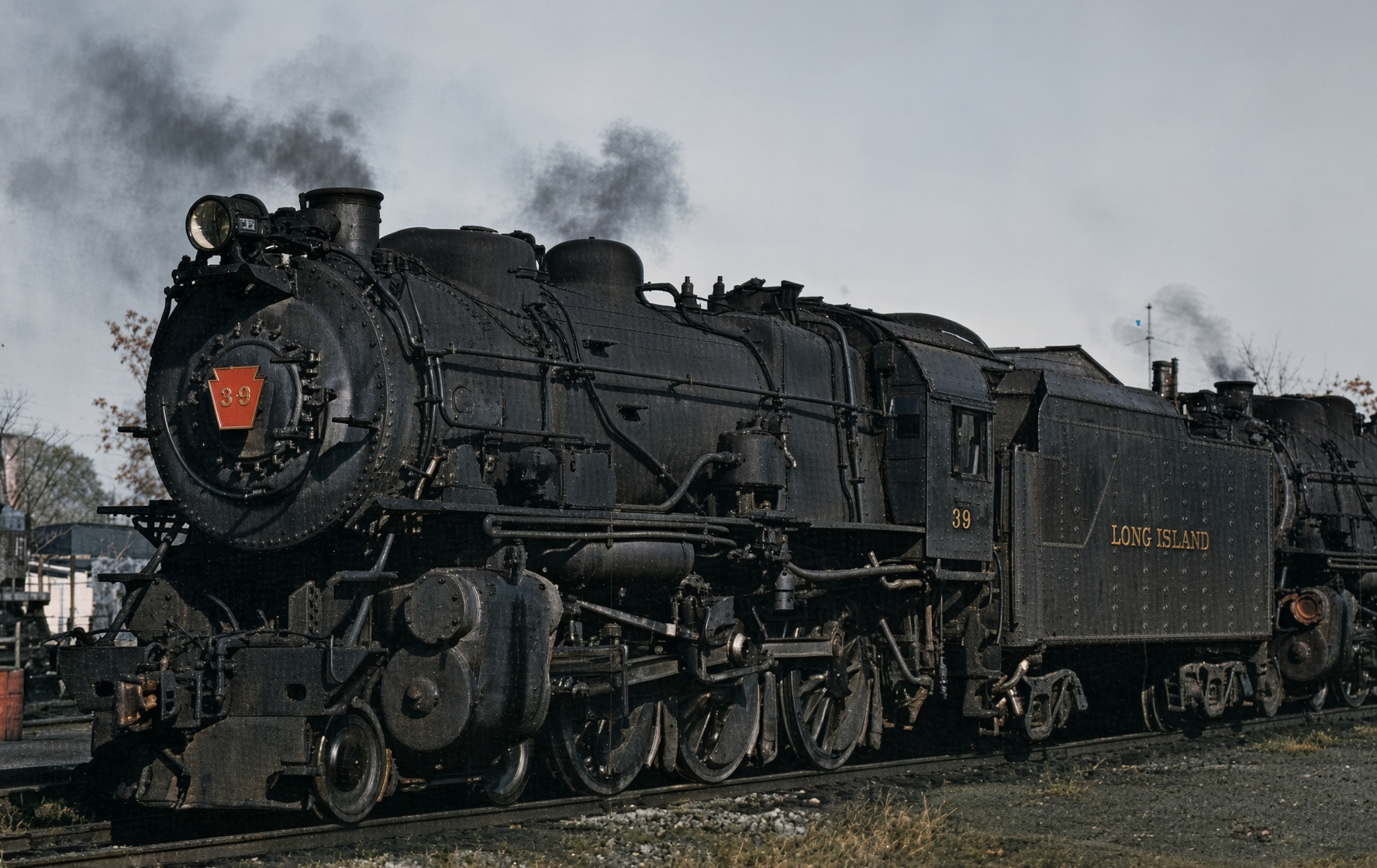
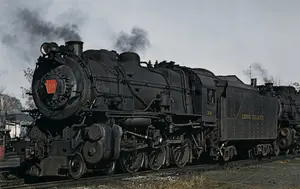
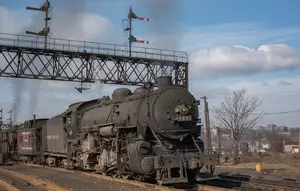
Long Island Rail Road 4-6-0 #39 (Class G-5s) is seen here at Oyster Bay, New York in September, 1954, between assignments about a year before her retirement (1955). Art Huneke photo.
On this page: At a glance · Ariel, Post Boy, and the years before 1898 · Pennsylvania designs · The G5s, and Hicksville · Post-1898 classes · H10s former numbers · What was leased
At a glance
| Item | Detail |
|---|---|
| Railroad | Long Island Rail Road. Company Long Island Rail Road |
| This roster | Owned steam classes from the October 1898 renumbering through the end of steam. Earlier engines are in the narrative |
| First locomotives | Ariel and Post Boy, Baldwin, for the Brooklyn & Jamaica. In service with the opening on April 18, 1836 |
| The modern engine | G5s 4-6-0, Juniata, 31 locomotives, 20–50, 1924–1929. A Pennsylvania commuter design, with a larger tender than the parent’s own G5s |
| Freight | H10s 2-8-0, 101–119, nineteen engines, all ex-Pennsylvania, built 1913–1916, to the Long Island in 1928 and 1929 |
| Last active steam | September–October 1955: G5s 21, 24, 32, 35, 38, 39, and 50, and H10s 108, 111, and 113 |
| Last public steam | October 8, 1955, Hicksville. G5s 35 and 39 |
| What survives | 35, held for Nassau County, at the Oyster Bay Railroad Museum. 39 at the Railroad Museum of Long Island. See No. 39 |
Classes follow Koehler. G5s years follow the Railroad Museum of Long Island. H10s former numbers follow Dave Keller. Information compiled September 21, 2026.
Before the Pennsylvania sent engines
The first two locomotives were Baldwins, the Ariel and the Post Boy, built for the Brooklyn & Jamaica and in steam when that road opened on April 18, 1836. By 1844, the year the main line reached Greenport, Ediger counted eleven locomotives. For the next half century the roster was whatever a railroad of that size bought, inherited, or absorbed when Austin Corbin gathered the island’s other companies in the 1880s: Americans, Ten-Wheelers, and the usual switchers, renumbered more than once.
In October 1898 the railroad put those engines into a new number scheme, blocked by wheel arrangement. The G5s and the H10s still follow it. The H6sb Consolidations and the C51 switchers, which arrived later and from outside, do not. Reconstructing every pre-1898 number is a different book.
The first twentieth-century class that was the Long Island’s own, and not a Pennsylvania hand-me-down, was a suburban tank. Class S51, five 2-6-2Ts numbered 20–24, was on the roster from 1904 to 1911. They were not a Pennsylvania design. Their road numbers went back into the pool, and the G5s would wear 20–24 a generation later. Six dual-service Ten-Wheelers, class G53sd, numbers 141–146, were built in 1917. They also sit outside the Pennsylvania’s own class book. Three of them were still around in the late 1940s, which is why an old snapshot of the roster shows a quantity of three. Six is the number built.
Consolidations, switchers, and a parent company’s parts bin
Once the Pennsylvania owned the railroad, the easy way to get an engine was to take one Altoona already understood. Fifteen H6sb 2-8-0s, numbered 300–314, arrived between about November 1922 and January 1923. The 300 series sits outside the 1898 scheme. The first 307 was replaced by a second 307 after August 1935. By 1949 only about four were left. They were gone before the public end of steam.
The freight engine of the late steam railroad was the H10s. Nineteen of them, 101–119, came from the Pennsylvania in two batches: 101–109 in 1928 and 110–119 in 1929. All nineteen had been built for the Pennsylvania, or for a Pennsylvania family road, between 1913 and 1916. One, No. 102, was a Juniata product. The others were Baldwin, Lima, Alco’s Pittsburgh works, or Alco’s Brooks works. Dave Keller’s former-number list is printed below. The last three in service were 108, 111, and 113, retired in October 1955 with the last of the G5s.
Yard work in the same era fell to class C51s and C51sa 0-8-0s, Alcos, in Koehler’s tally nine locomotives numbered 251–259, built across several lots from 1916 to 1924. His own lot-by-lot lines do not add up to that summary, and a 1949 count of what was still on the property is a different number again. The row in the table is the summary. The lot list is not reproduced.
Thirty-one Ten-Wheelers
The G5s was William F. Kiesel Jr.’s answer to a commuter train: a 4-6-0 that could get ten or more steel coaches moving, hold something over 70 miles an hour between stops, and do it again all day. The Pennsylvania built ninety of them in 1923–1925 for its own branch lines. Juniata then built thirty-one more for the Long Island, numbered 20–50, with a larger tender than the parent’s engine, on the order of the 110P82a and about 12,730 gallons. The Railroad Museum of Long Island’s year groups, which put No. 39 in 1929, are the ones in the table. No. 39’s Juniata serial is 4207. Working pressure was 205 pounds, cylinders 24 by 28 inches, drivers 68 inches, tractive effort about 41,300 pounds, valve gear Walschaerts. The full card is on the page for 39.
They carried the passenger railroad wherever the third rail stopped. Oyster Bay, the outer Port Jefferson branch, the Main Line toward Greenport, and the Montauk branch were G5s country into the middle 1950s. Pennsylvania K4s Pacifics, E6s Atlantics, and extra G5s also ran on the island on lease. The owned classes are the table further down. The leased engines kept their Pennsylvania numbers.
Eighteen steam locomotives were still active on January 1, 1953, and that pool held together until December 1954, when six H10s (104, 106, 107, 112, 114, and 117) were set aside. G5s 22 and 28 made their last markups in July 1955. In September and October the engines still in steam were G5s 21, 24, 32, 35, 38, 39, and 50, and H10s 108, 111, and 113. The ceremony at Hicksville on October 8 used 35 and 39. No. 35 was held back for Nassau County and is at the Oyster Bay Railroad Museum. Suffolk County declined 39. She was displayed, and she is the locomotive the Railroad Museum of Long Island has in a restoration partnership with the Strasburg Rail Road. One of the RS-3s that stood with them that day, No. 1556, is in the same museum’s collection at Riverhead.
Owned classes, 1898–1955
Quantities are as built, or as received, and not the count of whoever was left in 1949. A dash is a figure the sources used here do not settle.
| Type | Class | Numbers | Qty | Builder | Built | Retired | Notes |
|---|---|---|---|---|---|---|---|
| 2-6-2T | S51 | 20–24 | 5 | — | 1904–1911 on the roster | 1911 | Suburban tanks. Not a Pennsylvania design. Numbers later reused by the G5s |
| 4-6-0 | G53sd | 141–146 | 6 | — | 1917 | — | Dual-service Ten-Wheelers. Not a Pennsylvania design. Three were still in the late-1940s survivor count |
| 0-8-0 | C51s / C51sa | 251–259 | 9 | Alco | 1916–1924 | c. 1950–51 | Koehler’s post-1926 tally. His lot-by-lot lines do not add to the same nine engines, so only the summary is printed |
| 2-8-0 | H6sb | 300–314 | 15 | ex-PRR | to LIRR Nov. 1922–Jan. 1923 | by the late 1940s | Outside the 1898 number scheme. A second 307 replaced the first after August 1935. About four were left in 1949 |
| 2-8-0 | H10s | 101–109 | 9 | ex-PRR | built 1913–1916; to LIRR 1928 | 1954–55 | Former numbers in the next table. Only 102 was built at Juniata |
| 2-8-0 | H10s | 110–119 | 10 | ex-PRR | built 1915–1916; to LIRR 1929 | 1954–55 | 108, 111, and 113 were the last three, retired October 1955 |
| 4-6-0 | G5s | 20–23 | 4 | PRR Juniata | Jan. 1924 | 1955 | Larger tender than a Pennsylvania G5s, about 12,730 gallons |
| 4-6-0 | G5s | 24–28 | 5 | PRR Juniata | Jan. 1925 | 1955 | 22 and 28 last marked up in July 1955 |
| 4-6-0 | G5s | 29–38 | 10 | PRR Juniata | 1928 | 1955 | 35 is at the Oyster Bay Railroad Museum |
| 4-6-0 | G5s | 39–50 | 12 | PRR Juniata | 1929 | 1955 | 39, serial 4207, at the Railroad Museum of Long Island. 39 and 35 at Hicksville on October 8, 1955 |
G5s year groups are the museum’s. Koehler’s summary puts 29–39 in 1928 and 40–50 in 1929. Serial 4207 places 39 in the 1929 group, with the museum.
H10s 101–119, and the Pennsylvania numbers they came with
Every H10s on the Long Island had already been a Pennsylvania engine, or an engine of a Pennsylvania-controlled road. Keller’s list is the former road number, the build year, and the builder.
| LIRR | Former PRR | Built | Builder | Notes |
|---|---|---|---|---|
| 101 | 7146 | 1913 | Baldwin | To LIRR 1928 |
| 102 | 7174 | 1913 | PRR Juniata | The only H10s in this lot built by the Pennsylvania itself |
| 103 | 7205 | 1913 | Baldwin | |
| 104 | 7732 | 1915 | Lima | Set aside December 1954 |
| 105 | 7558 | 1913 | Alco–Pittsburgh | |
| 106 | 7140 | 1913 | Baldwin | Set aside December 1954 |
| 107 | 7616 | 1915 | Baldwin | Set aside December 1954 |
| 108 | 7152 | 1915 | Baldwin | One of the last three, October 1955 |
| 109 | 7952 | 1916 | Alco–Brooks | |
| 110 | 8610 | 1916 | Alco–Brooks | To LIRR 1929 |
| 111 | 8239 | 1916 | Alco–Brooks | Last three, October 1955. Brooks serial 55765 |
| 112 | 8246 | 1916 | Alco–Brooks | Set aside December 1954 |
| 113 | 9732 | 1916 | Alco–Brooks | Last three, October 1955 |
| 114 | 8222 | 1915 | Lima | Set aside December 1954 |
| 115 | 8814 | 1916 | Lima | Built for the Vandalia |
| 116 | 9888 | 1915 | Baldwin | |
| 117 | 7931 | 1915 | Lima | Built for the Little Miami. Set aside December 1954 |
| 118 | 8527 | 1913 | Baldwin | |
| 119 | 8566 | 1913 | Baldwin |
Engines that worked the island and were not on the list
The Pennsylvania parked its own power on the Long Island whenever the commuter peaks, or a bad stretch of maintenance, required it. Leased E6s Atlantics, K4s Pacifics, B8 switchers, and G5s that still carried Pennsylvania numbers show up in photographs and in the 1949 snapshot of what was burning coal that year. A snapshot is a count of survivors and visitors. It is not a builder’s list, and those leased engines never took a Long Island class number that belongs in the table above. The Pennsylvania’s own preserved G5s is No. 5741, at the Railroad Museum of Pennsylvania. She is a clue to what 20–50 were, and she is not a Long Island locomotive.
Related reading
Sources
- Edward M. Koehler Jr., “LIRR Motive Power History: Steam, 1898–1955,” NRHS list, March 22, 2024, via trainsarefun.com. Class summary, the H6sb arrival, the second 307, and the post-1926 tally of eighty locomotives in the five modern classes.
- Railroad Museum of Long Island, collection note on G5s 39. Year groups, the Hicksville ceremony, and No. 35 at Oyster Bay.
- Dave Keller, H10s former-number list, trainsarefun.com. Engines 101–119, former Pennsylvania numbers, builders, and years.
- Koehler and Keller notes gathered in the April 2025 Semaphore, via trainsarefun.com. The eighteen engines of January 1953, the December 1954 set-aside, and the ten still active in September and October 1955.
- George H. Ediger, “Long Island Rail Road,” Trains, March 1949. Eleven locomotives by 1844.
- This site’s No. 39 page. Juniata serial 4207 and the principal dimensions. The restoration photograph on that page is not reused here.
Recent Articles


-
Long Island Rail Road Steam Locomotives: History, Roster & Photos
Sep 21, 26 09:50 PM
 Long Island steam—G5s 20–50, H10s 101–119, last steam at Hicksville October 8, 1955. Post-1898 class roster.
 -
Long Island Rail Road: Map, History, Pictures, Logo
Sep 21, 26 08:27 PM
 Long Island Rail Road—Brooklyn & Jamaica 1836, Greenport 1844, Pennsylvania control 1900, Penn Station 1910. MTA since 1968. Steam and diesel rosters.
 -
Oregon Coast Scenic Railroad (2026): Sunset Dinner and Moonlight
Sep 21, 26 02:40 PM
 2026 Oregon Coast Scenic does not post the old four-course Sunset Dinner. The evening ride is the 21+ Moonlight Excursion from Garibaldi, with pre-ordered sandwiches. Confirm on oregoncoastscenic.org.
 -
Adirondack Dinner Train (2026): Dates, Tickets & What to Expect
Sep 21, 26 01:38 PM
 2026 Adirondack Dinner Train—Utica Union Station, 6 p.m., about 3 hours to Remsen. First Class from $139. Chef Patrick O’Connor. Confirm on adirondackrr.com.
 -
Lehigh Valley Steam Locomotives: History, Roster & Photos
Sep 21, 26 01:31 PM
 Lehigh Valley steam—Camelback Consolidations, 2-10-2s, K-class Pacifics, six Mountains, Wyoming 4-8-4s. Post-1900 roster after Drury. Last steam September 14, 1951.
 -
Lehigh Valley Diesel Roster: All-Time
Sep 21, 26 01:23 PM
 Lehigh Valley diesel—boxcabs 1926, FTs 1945, F3/F7, FA/PA, C628 Snowbirds, GP38-2s, U23Bs. All-time roster with serials and orders. Last steam September 14, 1951.
 -
Lehigh Valley Railroad: Map, Roster, Logo, History
Sep 21, 26 01:09 PM
 Lehigh Valley—DLS&S 1847, named January 7 1853, Mauch Chunk–Easton September 12 1855. Route of the Black Diamond. Jersey City–Buffalo. Conrail April 1 1976.
 -
Wisconsin Great Northern Dinner Train (2026)
Sep 21, 26 12:47 PM
 2026 Wisconsin Great Northern dinner train—Trego, $105, Namekagon River. January 8–31 and May 5–December 17. Confirm on spoonertrainride.com.
 -
Lehigh and New England Railroad: Map, Rosters, History
Sep 21, 26 12:33 AM
 Lehigh & New England—South Mountain & Boston 1873, named April 2 1895. Anthracite, cement, Maybrook. Last Camelbacks, Alco FAs. Voluntary shutdown October 31 1961.
 -
TVRM Chattanooga Dinner Train (2026): Dates, Tickets & What to Expect
Sep 21, 26 12:20 AM
 2026 TVRM Chattanooga Dinner Train Experience—Grand Junction, select Fri/Sat March 6–October 24, three-course, 2–3 hours, from $110. Confirm on tvrail.com.
 -
Lehigh and Hudson River Railroad: Map, Rosters, History
Sep 20, 26 11:55 PM
 Lehigh & Hudson River—Warwick Valley 1860, Railway April 1 1882. Easton–Maybrook bridge road, Alphabet Route, Alco RS-3s and C420s. Conrail April 1 1976.
 -
Royal Gorge First Class Dinner Train (2026)
Sep 20, 26 11:47 PM
 2026 Royal Gorge Route First Class Lunch & Dinner—Cañon City, about 2 hours, from $199+, 12+. Confirm on royalgorgeroute.com.
 -
GE "44-Tonner" Locomotives: Roster, Specs, History
Sep 20, 26 11:09 PM
 GE 44-ton switcher—90,000-pound rule, Caterpillar D17000 center-cab, Sept 4 1940 CB&Q 9103 through Oct 1956 Dansville & Mount Morris 1. Phases, serial roster, PRR 46.
 -
Strasburg Rail Road Dining (2026): Dinner on the Rails & Elegant Expre
Sep 20, 26 11:00 PM
2026 Strasburg Rail Road seated meals—Dinner on the Rails, Elegant Express, Valentine dinner. Lee E. Brenner diner. Confirm on strasburgrailroad.com. -
International-Great Northern Railroad: Map, History, Timetables
Sep 20, 26 10:43 PM
 International–Great Northern—Houston & Great Northern 1866, International Railroad 1870, merged Sept 30 1873. Palestine, Longview–Laredo, Gould, Missouri Pacific March 1 1956.
 -
Nevada Northern Taste of Italy Dinner Train (2026)
Sep 20, 26 03:25 PM
 2026 Nevada Northern Taste of Italy—adults-only multi-course Italian dinner, steam when healthy, East Ely. Sep. 19 gala listed. Confirm on nnry.com.
 -
Cape Cod Dinner Train (2026): Dates, Tickets & What to Expect
Sep 20, 26 02:53 PM
 Cape Cod Central Dinner Train—Hyannis, Buzzards Bay, and Falmouth. Four-course, 3–3½ hours, from $99.99. Confirm on capetrain.com.
 -
Erie Steam Locomotives: History, Roster & Photos
Sep 20, 26 11:55 AM
 Erie Railroad steam—Camelback 2-8-0s, 155 N-1 Mikados, 105 Berkshires, K-class Pacifics, Triplexes. Post-1900 roster after Drury. Last steam March 17, 1954.
 -
Erie Railroad Diesel Roster: All-Time
Sep 20, 26 11:47 AM
 Erie Railroad diesel—boxcabs 1926, FTs 1944, F3/F7, FA/PA, GP7/GP9, Baldwins, Limas. All-time roster with serials, orders, classes. Last steam March 17 1954. EL October 17 1960.
 -
Erie Railroad: Map, Passenger Trains, Logo, History
Sep 20, 26 11:44 AM
 Erie Railroad—New York & Erie 1832, Piermont–Dunkirk May 14 1851, six-foot then standard June 1880, Chicago 1883. High-and-wide fourth way. Erie Lackawanna October 17 1960.
 -
Colebrookdale Railroad Dining (2026): Secret Valley Dinner Train
Sep 20, 26 11:36 AM
 2026 Colebrookdale Railroad dinner in Boyertown—Secret Valley Dining Class, about 2 hours. Saturday evenings. Confirm on colebrookdalerailroad.com.
 -
Boone & Scenic Valley Wolf Dinner Train (2026)
Sep 19, 26 08:15 PM
 2026 Boone & Scenic Valley Wolf Dinner Train—Des Moines River valley, Bass Point Creek High Bridge, Union Pacific dining cars. Confirm on bsvrr.com.
 -
C&NW 4-6-2s 1617 & 1620: Minnesota 400 Yellow Jackets
Sep 19, 26 11:28 AM
 C&NW Class E Pacifics 1617 and 1620—Alco Schenectady 1917, yellow-and-green E-4-style shrouds 1941 for the Minnesota 400. Crews called them Yellow Jackets. Renumbered 617/620. Scrapped 1956.
 -
Erie Lackawanna Diesel Roster: All-Time
Sep 19, 26 10:13 AM
 Erie Lackawanna diesel—Erie and DL&W inheritance, GP35s, U25Bs, SD45/SDP45/SD45-2, U34CH. All-time roster with serials and orders. Conrail April 1 1976.
 -
Erie Lackawanna Railway: Map, History, Logo
Sep 19, 26 10:06 AM
 Erie Lackawanna Railway—Erie and DL&W, October 17 1960–March 31 1976. Von Willer, White revival, Dereco, Agnes, Conrail. High-and-wide Chicago main. Map, logo, what remains.
 -
"Empire State Express" (1941 Train): Timetables, Route, Consist
Sep 18, 26 10:59 PM
 NYC Empire State Express—George Daniels 1891 day train, 999’s 112.5 mph claim, Budd stainless streamliner December 7 1941, Cleveland and Detroit sections, diesels, 1967 name drop. Timetables, consist…
 -
New York Central 4-6-4s 5426 & 5429: Empire State Express Hudsons
Sep 18, 26 10:32 PM
NYC J-3a Hudsons 5426 and 5429—Alco 1937, Budd stainless shrouds 1941 for the Empire State Express. Pearl Harbor inaugural. Shrouds off by 1950. Neither preserved. -
"Stourbridge Lion" Locomotive: Facts, History, Photos
Sep 18, 26 10:27 PM
 Stourbridge Lion—Foster, Rastrick 0-4-0, first steam locomotive in the United States. Horatio Allen, Honesdale, August 8, 1829. Too heavy for D&H gravity track. Boiler in Baltimore; Colonie replic…
 -
Delaware & Hudson Steam Roster (Post 1900)
Sep 18, 26 10:01 PM
 Delaware & Hudson steam—Camelback 2-8-0s, Loree high-pressure compounds, Class K 4-8-4s, forty Challengers. Post-1900 class roster after Drury. Last steam July 21, 1953.
 -
Boston & Maine Steam Roster (Post 1900)
Sep 18, 26 02:57 PM
 Boston & Maine steam—B-15 Moguls, K-8 Consolidations, P-4 Lima Pacifics, T-1 Limas, R-1 Mountains. Post-1900 class roster after Drury. Last steam July 23, 1956.
 -
Boston & Maine Diesel Roster (All-Time)
Sep 18, 26 01:25 PM
 Boston & Maine diesel—boxcab 1100 1935, Flying Yankee 6000, FTs, E7s, BL2s, GP7/GP9, GP38-2s and GP40-2s. All-time roster. Last steam July 23, 1956.
 -
Mid-Continent Railway Museum Dining (2026)
Sep 18, 26 01:21 PM
 2026 Mid-Continent dining in North Freedom—select-date seated meals in luxury cars, reservations required. Pizza Limited June 28. Confirm on midcontinent.org.