Long Island Rail Road: Map, History, Pictures, Logo
Last revised: September 21, 2026
By: Adam Burns
The Long Island Rail Road is the commuter railroad of Long Island, and it has been one since the first train ran from Brooklyn to Jamaica on April 18, 1836. It was chartered to do something else. The early company wanted to be the fast way from New York to Boston: rail to Greenport, at the eastern tip of the North Fork, and a steamer across the Sound to Stonington. That gamble lasted about four years. What survived it is the busiest commuter railroad in the United States, still carrying its own name, now under the Metropolitan Transportation Authority.
The map is a fan. Almost everything of consequence still passes Jamaica, in Queens. West of there the railroad reaches Penn Station, Atlantic Terminal in Brooklyn, Long Island City, and, since January 25, 2023, Grand Central Madison. East of Jamaica the branches run to Port Washington, Port Jefferson, Oyster Bay, Far Rockaway, Long Beach, Hempstead, West Hempstead, Babylon, Montauk, and Greenport. Freight, since 1997, has been operated by private short line New York & Atlantic.
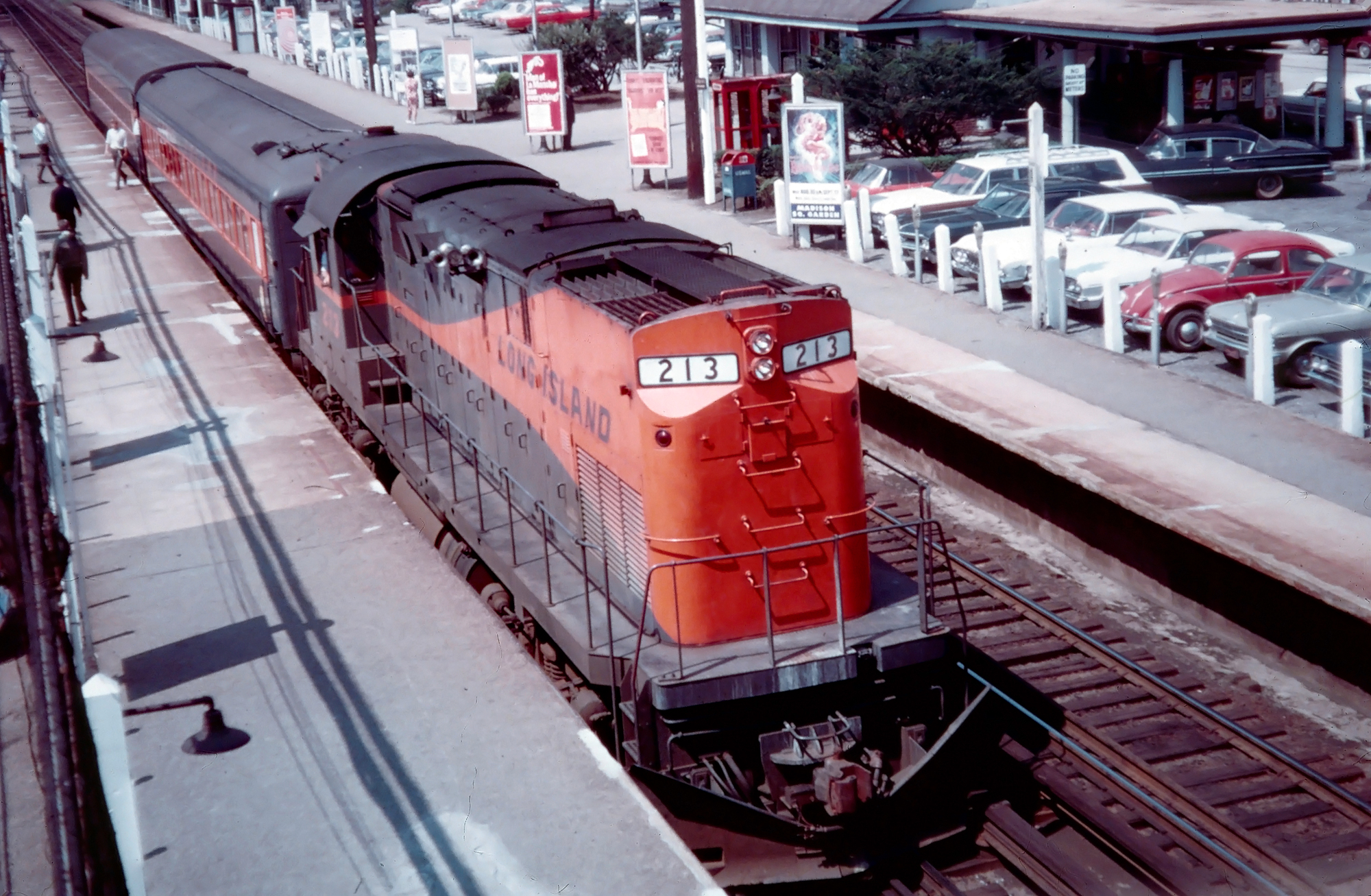
Alco C-420 #213 with a passenger train at Mineola, New York, in 1964. American-Rails.com collection. The thirty C-420s, 200–229, were the railroad’s main-line diesel from the mid-1960s until the GP38-2s arrived in 1976 and 1977.
On this page: At a glance · Brooklyn, Jamaica, and Greenport · Corbin’s island · The Pennsylvania and Penn Station · System map (1969) · A commuter railroad in bankruptcy · January 20, 1966 · Third rail · Freight, and the New York & Atlantic · The railroad now
At a glance

A Pennsylvania-era Long Island Rail Road mark, the keystone the parent company had already made famous. Author’s work.
| Item | Detail |
|---|---|
| Railroad | Long Island Rail Road. Equipment mark LI. Slogan Route of the Dashing Commuter |
| Headquarters | Jamaica, Queens. Under the Pennsylvania, the corporate address was often Philadelphia |
| Where | Long Island: Brooklyn, Queens, Nassau, Suffolk. Manhattan terminals at Penn Station and Grand Central Madison |
| Genesis | Brooklyn & Jamaica Railroad, incorporated April 25, 1832. Long Island Rail Road incorporated April 24, 1834, to lease that road and build east |
| First trains | April 18, 1836, Brooklyn–Jamaica. The first railroad on Long Island |
| Dates | April 18, 1836–. Still operating |
| Gauge | 4 ft 8½ in |
| Route-miles | A little over 300 today, on the order of 124 stations. A 1930 figure in print is 397. Another peak figure is about 378. The two do not describe the same map |
| Principal lines | Long Island City and Hunterspoint Avenue–Jamaica; Flatbush Avenue–Jamaica; Woodside–Port Washington; Jamaica–Hicksville–Ronkonkoma–Greenport; Hicksville–Port Jefferson; Mineola–Oyster Bay; Floral Park–Hempstead; Jamaica–Babylon–Montauk; Hicksville–Babylon; Valley Stream–Far Rockaway and West Hempstead; Lynbrook–Long Beach |
| Shops | Morris Park, in Queens, for the steam and diesel years. Hillside is the modern maintenance complex |
| Into Manhattan | Penn Station September 8, 1910. Grand Central Madison January 25, 2023 |
| Last steam | October 8, 1955, Hicksville. G5s 35 and 39. The story of 39 is its own page |
| Pennsylvania control | 1900. The price long attached to the purchase is $6 million. Sold back to New York on January 20, 1966 |
| Public owner | Metropolitan Commuter Transportation Authority, 1966. The MTA has operated the railroad since 1968 |
| Freight | New York & Atlantic Railway, Anacostia & Pacific, from May 12, 1997 |
| Rosters | Steam · Diesel |
Dates follow the railroad’s own chronology, Ediger and Morgan in Trains, the New York Times of August 31, 1966, and the contemporary account of the January 20, 1966, closing. Information compiled September 21, 2026.
A railroad aimed at Boston
The Brooklyn & Jamaica was incorporated on April 25, 1832, to build from the East River at Brooklyn out to Jamaica. The Long Island Rail Road was incorporated on April 24, 1834, to lease that company and keep going. The first locomotives were the Ariel and the Post Boy, Baldwins, ordered for the Brooklyn & Jamaica. Service opened April 18, 1836. George H. Ediger, writing in Trains in March 1949, counted eleven locomotives on the property by 1844.
The reason for the long main line was a boat. Rails reached Greenport on July 27, 1844, with excursion trains, and revenue service began two days later, on July 29. At Greenport, Cornelius Vanderbilt’s steamers crossed Long Island Sound to Stonington, Connecticut, and the Old Colony finished the trip into Boston. The rail-and-water route cut New York–Boston from something like sixteen hours to something like eight. It was a clever piece of geography, and it depended on nobody building a railroad along the Connecticut shore.
Somebody did. The New York & New Haven opened an all-rail route in 1848, the line that became the Shore Line and, much later, part of the Northeast Corridor. The Greenport boats lost the through passenger. The Long Island was left with a main line that ran the length of the island to a dock that no longer mattered, and with a local business that could not yet pay for it. The company went into bankruptcy on March 4, 1850, and came out, under the same name, on January 25, 1851. A charter amendment of April 21, 1862, let it build anywhere east of Jamaica. That sentence is the modern railroad: branches, not a bridge route.
Branches, beaches, and Austin Corbin
The branches came in a rush once the Boston dream was dead. Hicksville was already on the main line. The line toward Cold Spring reached Syosset in 1854 and Northport on April 15, 1868. The Smithtown & Port Jefferson, organized in 1870, opened into Port Jefferson on January 13, 1873. Locust Valley and the Oyster Bay branch date from April 19, 1869. Sag Harbor, reached by way of Manorville, opened May 9, 1870. Far Rockaway’s railroad is an 1869 line. The south shore to the Hamptons and Montauk was the Brooklyn & Montauk, opened in 1881. Manhattan Beach opened July 19, 1877. Long Beach opened in 1880. Port Washington was finished in 1898.
Austin Corbin took control in 1880 and spent the next decade buying the competitors that had sprung up on the island: north shore, south shore, and the beach lines. By about 1900 the Long Island was the railroad of Long Island, a commuter carrier into Brooklyn and a summer railroad to the ocean, with a thin freight business in produce, coal, and whatever the island manufactured. A 1959 booklet the railroad published for itself claimed a long list of “firsts,” including a steam whistle in 1836, piggyback in 1885, and an all-steel passenger car in 1905. Treat that booklet as advertising. The 1885 “piggyback” was farm wagons on flatcars, which is a real practice and a different thing from modern trailer-on-flatcar. The steel-car claim and the whistle claim are the company’s, and they are not settled here.
What is solid is the shape Corbin left. The island’s other steam railroads had been gathered in. The ferries at Long Island City still did the last mile into Manhattan, because no one had yet dug under the East River.
Cassatt, the tunnels, and September 8, 1910
The Pennsylvania Railroad took control in 1900. The figure repeated for a century is $6 million. Alexander J. Cassatt wanted a station in Manhattan for the Pennsylvania’s own trains, which then ended in Jersey City, and the Long Island was the other half of the same idea: tubes under the Hudson, a station under Thirty-second Street and Seventh Avenue, and tubes under the East River to Queens. Samuel Rea carried the project. Charles M. Jacobs engineered the tunnels. Work was underway from 1901.
The North River tunnels, under the Hudson, were holed through on September 11, 1906. The East River tunnels were finished in 1909. Long Island trains began using Penn Station on September 8, 1910. The station opened to all of its traffic on November 27, 1910. David P. Morgan, in Trains for December 1952, noted that the tunnels let the Long Island give up a fleet of nine ferries. For the first time the commuter could stay on the train from Jamaica to a platform in Manhattan.
Electrification had already started, in 1905, with third rail. It spread over the lines that fed the tunnels, because steam could not run the East River bores. Under the Pennsylvania, something under a third of the route-miles sat under third rail. The East End, and the outer ends of Port Jefferson, Oyster Bay, and Montauk, stayed with steam. That split is still the railroad’s personality. The city side is an electric subway that happens to use railroad cars. The island side, past the third-rail gaps, was a steam railroad until 1955 and a diesel railroad after that.
The Pennsylvania also handed the Long Island its modern steam engines. Juniata built thirty-one G5s Ten-Wheelers between 1924 and 1929, and the parent sent over H6 and H10 Consolidations for freight. Those classes, and the earlier engines the 1898 number scheme replaced, are on the steam roster. George H. Drury’s steam guide never gave the Long Island a chapter.
System map (1969)
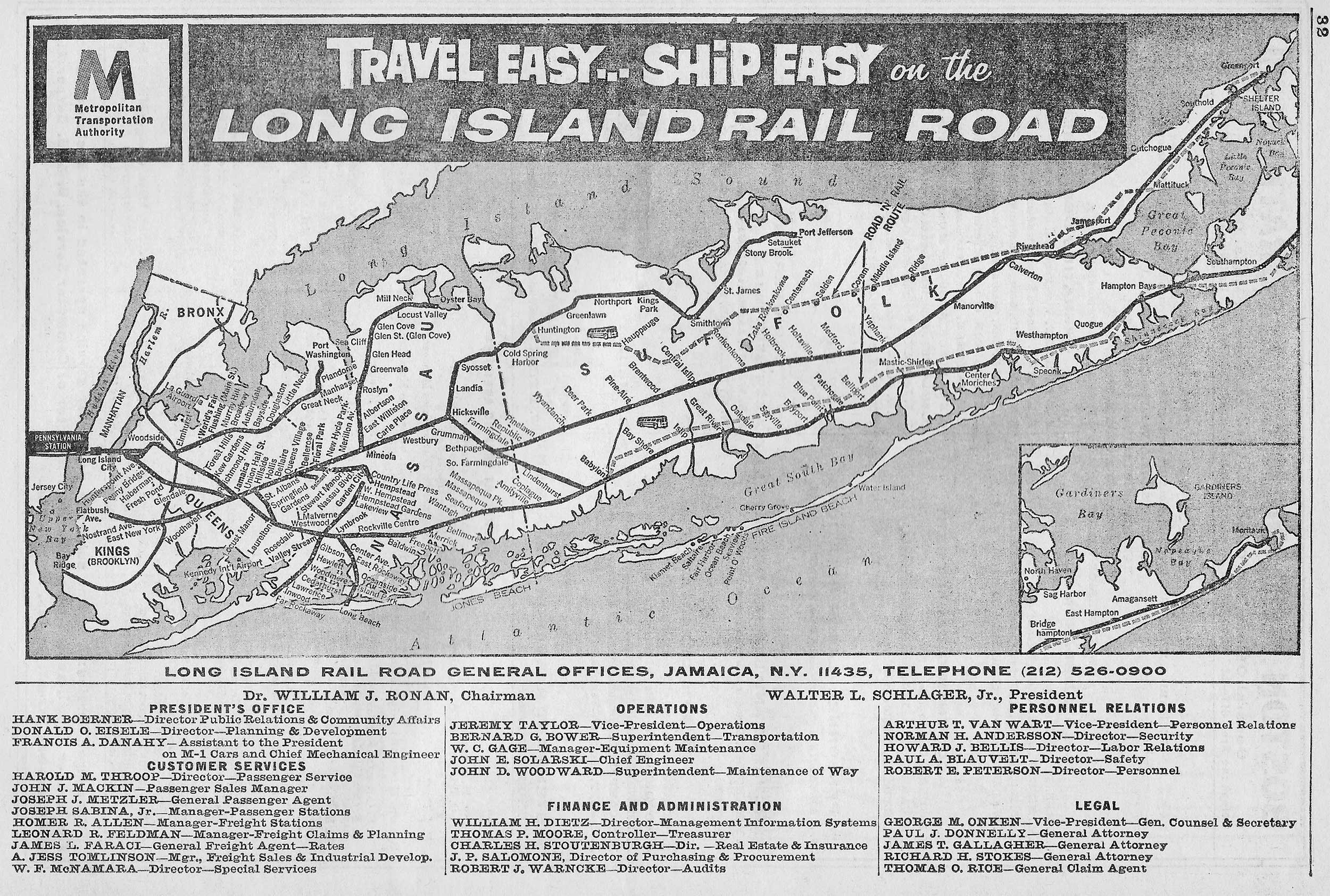
An official 1969 system map. Author’s collection. The public railroad was already three years into state ownership. The map is still the fan: Jamaica in the middle, Manhattan and Brooklyn to the west, the forks of the island to the east.
Read it from Jamaica. West, one pair of routes drops to Flatbush Avenue and another runs to Long Island City and Hunterspoint Avenue, with the Penn Station lines leaving the map into the tunnels. North of the Main Line are Port Washington, Port Jefferson, and Oyster Bay. South are Far Rockaway, Long Beach, the West Hempstead branch, Babylon, and the long Montauk branch through the Hamptons. The Main Line itself is the old Greenport railroad, by Hicksville, Farmingdale, and Ronkonkoma, still the spine, long after the Stonington boats were gone. South Farmingdale is a place on that history. It is not a separate railroad from Hicksville to Greenport.
The only Class I that lived on tickets
Ediger’s 1941 numbers explain the company better than a route description. Total revenue was $25.4 million. Passenger tickets were $16.5 million of that. Freight was $8.9 million. The Long Island was the only American Class I whose passengers paid it far more than its freight did. In the Pennsylvania years the summer schedule ran 813 passenger trains a day, and the winter schedule 746. That is a railroad measured in headways, not in tonnage.
It is also why the company broke. Morgan’s account is that the New York Public Service Commission held commutation fares nearly still from 1918 to 1947, while the tax bill rose from $1.4 million in 1921 to $3.8 million by 1948. Subways, parkways, and the bridges off the island took the discretionary trip. The Pennsylvania lost money in 1946 for the first time in its modern history and was no longer willing to cover the subsidiary. The Long Island announced bankruptcy on February 2, 1949, and filed on March 2, 1949. The Pennsylvania kept the stock. The railroad kept running, in gray paint and in the papers.
On November 22, 1950, two trains collided at Richmond Hill, in Queens. That wreck, and the others of the same season, made the bankruptcy a public subject. The state answered with a rehabilitation. On August 12, 1954, a twelve-year, $65 million program was announced under Thomas M. Goodfellow, a Pennsylvania man who became the Long Island’s president. New coaches, the ten RS-3s that finished steam, and a diesel roster that finally matched the job all belong to that decade. The public end of steam was Hicksville, October 8, 1955.

C-420s #203 and #208 at Jamaica yard in 1970, four years after the state bought the railroad and two years after the MTA became the operator. American-Rails.com collection.
Sixty-five million dollars, at Jamaica
The legislature created the Metropolitan Commuter Transportation Authority in 1965 for this purchase. A down payment of $10 million went over on December 22, 1965. On January 20, 1966, William J. Ronan delivered the remaining $55 million at the railroad’s Jamaica offices. The price was $65 million. The seller was the Pennsylvania. The New York Times of August 31, 1966, looking back, said the authority had bought the bankrupt railroad the previous January for that sum, and that the first phase of a three-year modernization was already underway, including platforms being raised for new cars. The MTA, as the authority was reconstituted, has operated the Long Island since 1968. The railroad was not renamed. The mark on the equipment stayed LI.
The car that symbolized the new owner was the M1, built by Budd from 1968, a high-platform electric multiple-unit that made the old MP54 look like what it was. Diesel territory got GP38-2s and, for a few years more, the Alco C-420s. Twelve of those C-420s, 200–211, went to the Delaware & Hudson on lease in 1977, still in MTA paint. They were back, or gone elsewhere, by the end of that year.
Third rail, and the cars that are not locomotives
From 1905 the western railroad has been an electric railroad. Third rail, direct current, feeds the lines into Penn Station and, now, into Grand Central Madison. The East River tunnels still do not allow a diesel to lead a train. That single rule is why the dual-mode DM30AC exists, and why most passengers never see a locomotive at all. They ride M7s and M9s, the descendants of the M1 idea: a married pair, a motorman, high platforms, and a schedule counted in minutes.
The Pennsylvania-era electric car was the MP54 and its steel relatives. The Long Island liked to say it had retired its last wooden passenger car in 1927, which fits the modernization that also brought the G5s. Those cars are a fleet of their own, and so are the M1s, M3s, M7s, and M9s. A handful of electric locomotives, DD1s among them, worked the tunnels and the yards in the Pennsylvania years.
What the New York & Atlantic took
Passenger service was the whole point, and freight was the part the state was willing to contract out. On May 12, 1997, the New York & Atlantic Railway, an Anacostia & Pacific company, took the freight franchise. Joe Greenstein, in Trains for May 1999, described a railroad of about 269 miles, from Fresh Pond and Jamaica out to Port Jefferson, Montauk, and Southold, plus Bay Ridge and Maspeth, moving about 28,000 carloads a year with 13 locomotives and 41 people, up from eight locomotives at the start. Those are 1999 figures. They are the right way to remember the handover, and they are not a description of the franchise in 2026. The New York & Atlantic’s locomotives are not Long Island locomotives, and they are not on the diesel roster.
Penn Station, Grand Central, and a Friday train to Montauk
The railroad people ride in 2026 is still the 1836 company, which is a strange sentence to be able to write about an American railroad. Electric trains fill Penn Station’s lower level. Grand Central Madison, the East Side Access terminal deep under Grand Central, opened on January 25, 2023, and gave the Long Island a second Manhattan station for the first time since the ferries. A third Main Line track between Floral Park and Hicksville was finished in 2022, which is the unglamorous project that actually adds trains. On summer Fridays the Cannonball still runs for the Hamptons and Montauk, a diesel-territory train with a name older than the MTA.
East of the third rail, the locomotive is an EMD DE30AC, or a DM30AC if the train has to come through the tunnels into Penn Station. Twenty-three of each were built in 1997–99, at EMD’s shop in the old Super Steel plant in Schenectady. One dual-mode was later rebuilt as a straight diesel, and two others are gone, so the fleet in service is 24 DE30ACs and 20 DM30ACs. The diesel roster has the builder numbers. The steam roster ends with the two Ten-Wheelers that stood at Hicksville in 1955. Both still exist. No. 39 is the one this site has already followed.
Related reading
- Long Island steam roster · Long Island diesel roster
- G5s No. 39
- Commuter rail · Pennsylvania Railroad
- GE 44-tonner · Delaware & Hudson diesels
Sources
- George H. Ediger, “Long Island Rail Road,” Trains, March 1949. Revenue for 1941, the eleven locomotives of 1844, and the summer and winter train counts.
- David P. Morgan, “Long Island: Which Plan D’Ya Read,” Trains, December 1952. The fare freeze, the tax figures, and the nine ferries.
- New York Times, August 31, 1966. The authority had bought the railroad the previous January for $65 million.
- Contemporary account of the closing at Jamaica: $10 million on December 22, 1965, and the remaining $55 million on January 20, 1966, William J. Ronan for the Metropolitan Commuter Transportation Authority.
- Joe Greenstein, “Long Island’s Freight Revival,” Trains, May 1999. New York & Atlantic mileage, carloads, and locomotives as of that article.
- Edward M. Koehler Jr., “LIRR Motive Power History: Steam, 1898–1955,” NRHS list, March 22, 2024, via trainsarefun.com. The steam classes summarized on the companion page.
- Railroad Museum of Long Island, notes on G5s 39, including the October 8, 1955, ceremony at Hicksville.
- The Diesel Shop, Long Island Rail Road roster, rebuilt February 11, 2026, read against Dave Keller’s motive-power pages at trainsarefun.com. The diesel companion is the unit list.
Recent Articles


-
J. Edgar Thomson: Net Worth, Pennsylvania Railroad, Biography
Nov 20, 26 12:25 AM
 J. Edgar Thomson was born in Springfield, Delaware County, Pennsylvania, on February 10, 1808. He died in Philadelphia on May 27, 1874. No opened inventory states a total.
-
Thomas A. Scott: Net Worth, Railroads, Biography
Nov 20, 26 12:06 AM
 Thomas A. Scott was born at Loudon, Pennsylvania, on December 28. The year is 1823 in one biography and 1824 on the funeral plate. He died near Darby on May 21, 1881. No opened inventory states a tota…
-
Henry Villard: Net Worth, Railroads, Biography
Nov 19, 26 11:41 PM
 Henry Villard was born Ferdinand Heinrich Gustav Hilgard at Speyer on April 10, 1835, and died early on November 12, 1900, at Thorwood Park, near Dobbs Ferry. He was 65. A court recital put the person…
-
J.P. Morgan: Net Worth, Railroads, Biography
Nov 19, 26 07:03 PM
 John Pierpont Morgan was born in Hartford on April 17, 1837, and died in Rome on March 31, 1913, at 12:05 p.m. Rome time. He was 75. A 1916 New York appraisal put the gross estate at $78,149,024, excl…
-
Daniel Willard: Net Worth, Baltimore and Ohio, Biography
Nov 19, 26 06:51 PM
 Daniel Willard was born on January 28, 1861, and died on July 6, 1942. He was 81. He was president of the Baltimore and Ohio from January 15, 1910 until 1941. No opened record states a fortune. Time p…
-
Cyrus K. Holliday: Net Worth, Santa Fe, Biography
Nov 19, 26 06:03 PM
 Cyrus Kurtz Holliday was born April 3, 1826, and died in Topeka on March 29, 1900. He was 73. He founded Topeka, wrote the Atchison and Topeka charter, and was the railroad's first president. He l…
-
N&W 2-6-6-4 Locomotives (Class A): Specs, Roster, History
Nov 19, 26 05:39 PM
 Norfolk & Western Class A. Forty-three simple 2-6-6-4s, 1200 to 1242, built at Roanoke from 1936 to 1950 for time freight and used on passenger trains when assigned. Diagram specs, the 114,000-pou…
-
Jay Cooke: Net Worth, Civil War, Biography
Nov 19, 26 05:05 PM
 Jay Cooke was born at Sandusky on August 10, 1821, and died the night of February 16, 1905, at Ogontz. He was 83. Jay Cooke and Company opened January 1, 1861, and suspended September 18, 1873. He sol…
-
Daniel Drew: Net Worth, Erie Railroad, Biography
Nov 19, 26 04:44 PM
 Daniel Drew was born at Carmel on July 29, 1797, and died the night of September 18, 1879, age 82. He was Erie treasurer, not president. The settlement of July 2, 1868, put him out of that office.
-
James Fisk Jr.: Net Worth, Robber Baron, Biography
Nov 19, 26 02:47 PM
 James Fisk Jr. was born on April 1, 1835, and died the morning of January 7, 1872, at the Grand Central Hotel. He was 36. Edward S. Stokes shot him the afternoon before. He was an Erie director from O…
-
Chehalis-Centralia Polar Express Seats Are Sold Out
Nov 19, 26 02:43 PM
Chehalis-Centralia marks its Polar Express departures sold out. Diesel No. 6 is pulling while steam No. 15 is repaired. The business-car page still prints $260, $390, and $520. -
Cumbres & Toltec Lists Santa's Holiday Express
Nov 19, 26 02:38 PM
 Cumbres & Toltec lists Santa's Holiday Express for December 5-6 in Chama and December 12-13 in Antonito. Coach is $25. The Chama trip will not run to Dalton.
-
Florida Railroad Museum Lists the North Pole Express
Nov 19, 26 02:28 PM
 The Florida Railroad Museum lists the North Pole Express from November 27 through December 22, 2026. The trip is 3.75 hours. The museum will be closed November 21 and 22.
-
George Jay Gould: Net Worth, Railroads, Biography
Nov 19, 26 02:18 PM
 George Jay Gould was born in New York on February 6, 1864, and died on May 16, 1923, at his villa in France. The company pages date his father's portfolio to 1896. The Panic of 1907 broke the tran…
-
Jay Gould: Net Worth, Railroads, Biography
Nov 19, 26 01:43 PM
 Jason Gould, called Jay, was born at Roxbury on May 27, 1836, and died the morning of December 2, 1892. Erie president from October 1868 until 1872. From 1879 the Missouri Pacific was the center of th…
-
Mark Hopkins Jr.: Net Worth, Railroads, Biography
Nov 19, 26 11:53 AM
 Mark Hopkins Jr., born at Henderson on September 1, 1813, died at Fort Yuma on the night of March 29, 1878. Treasurer of the Central Pacific from June 28, 1861, until he died in that office. The 1881…
-
Leland Stanford: Net Worth, Railroads, Biography
Nov 19, 26 12:36 AM
 Amasa Leland Stanford, Watervliet 1824 to the Palo Alto house in June 1893, president of the Central Pacific and, until February 28, 1890, of the Southern Pacific. The 1893 inventory was about 17 mill…
-
Charles Crocker (Railroads): Robber Baron, Net Worth, Biography
Nov 19, 26 12:23 AM
 Charles Crocker, Troy 1822 to August 14, 1888, built the Central Pacific and drove the Siskiyou spike. He did not die president of the Southern Pacific. The opened biographies state no estate total.
-
Edward H. Harriman (Railroad): Facts, Robber Baron, Biography
Nov 19, 26 12:18 AM
 Edward Henry Harriman, February 25, 1848, to September 9, 1909, president of the Union Pacific from 1904 until he died in that office. The Courier-Journal put the known estate on the public record at…
-
Collis P. Huntington: Net Worth, Railroads, Biography
Nov 18, 26 11:26 PM
 Collis Potter Huntington, 1821 to 1900, vice president of the Central Pacific and president of the Southern Pacific from February 28, 1890, until he died in that office. The will stated no total. The…
-
Detroit Terminal Railroad: History, Roster
Nov 18, 26 10:47 PM
 The Detroit Terminal Railroad was a Detroit and Highland Park belt line, incorporated December 8, 1905. The November 1944 Guide listing gives 17.994 miles of first main track.
-
James J. Hill: Net Worth, Railroads, Robber Baron, Facts
Nov 18, 26 09:19 PM
 James J. Hill, 1838 to 1916, built the Great Northern from the St. Paul and Pacific to Puget Sound and left the chair in 1912. The fortune was estimated at $63 million. He left no will.
-
Cornelius Vanderbilt: Biography, Facts, Net Worth
Nov 18, 26 05:21 PM
 Cornelius Vanderbilt, 1794 to 1877, assembled the New York Central and Hudson River from the Harlem, the Hudson River Railroad, and the original New York Central, and died in office. The estate was ab…
-
Pacific Great Eastern Railway: All-Time Diesel Roster
Nov 18, 26 12:24 PM
 All-time diesel roster of the Pacific Great Eastern, the British Columbia Railway, and BC Rail. Classes, road numbers, and builder data from Paul Crozier Smith, Canadian Rail no. 547 (2012).
-
Pacific Great Eastern Railway: Map, History, Roster
Nov 18, 26 10:22 AM
 The Pacific Great Eastern, incorporated February 27, 1912, became the British Columbia Railway Company on March 30, 1972. On the October 26, 1969 Official Guide, 861.9 miles were under operation. Cana…
-
Northern Alberta Railways: Map, History, Timetables
Nov 17, 26 11:52 PM
 Northern Alberta Railways, reporting mark NAR, was incorporated June 14, 1929, and owned jointly by Canadian National and Canadian Pacific. On the October 27, 1968 freight timetable, Dawson Creek is 4…
-
Yakima Valley Transportation: History, Timetable, Photos
Nov 17, 26 10:51 PM
 Yakima Valley Transportation opened Christmas Day, 1907. Union Pacific bought it June 9, 1909. Last city car February 1, 1947. Last freight November 18, 1985. Line car A and steeplecab 298 stayed in Y…
-
"20th Century Limited" (Train): Map, Consist, Schedule, Interior
Nov 17, 26 05:03 PM
 The 20th Century Limited was the flagship passenger train of the NYC, operating until 1967 (just prior to the Penn Central merger).
-
Western Pacific Diesel Roster (All-Time)
Nov 17, 26 04:52 PM
 Western Pacific all-time diesel roster. Why the switchers, covered wagons, road switchers, and General Electric units were bought, where they worked, and what Union Pacific inherited on December 22, 1…
-
Western Pacific Steam Roster (Built Since 1900)
Nov 17, 26 04:49 PM
 Western Pacific steam locomotives built since 1900. Drury quantity column 201. Thirteen rows. Mikado 329 made the last regular steam run in June 1953.
-
Western Maryland Scenic Lists Polar Express Fares
Nov 17, 26 03:30 PM
 Western Maryland Scenic lists Polar Express tickets from November 21 through December 24, 2026. Coach is $40, plus a $5 heritage fee. Excursions are diesel while No. 1309 is inspected.
-
Western Pacific Railroad: Map, History, Logo, Rosters
Nov 17, 26 11:12 AM
 The Western Pacific, organized in San Francisco on March 3, 1903, the Feather River Route to Salt Lake City, and the Union Pacific acquisition completed on December 22, 1982.
-
Spokane, Portland & Seattle Diesel Roster (All-Time)
Nov 17, 26 10:53 AM
Spokane, Portland and Seattle all-time diesel roster. Why the Alcos, Baldwins, and Electro-Motive units were bought, where they worked, and which numbers Burlington Northern inherited. -
Spokane, Portland & Seattle Steam Roster (Built Since 1900)
Nov 17, 26 10:46 AM
 Spokane, Portland and Seattle steam locomotives built since 1900. Drury quantity column 121. Rebuilds counted once, 115 frames. Last steam run was June 23, 1956.
-
Spokane, Portland & Seattle Railway: Map, History, Photos
Nov 17, 26 10:10 AM
 The Spokane, Portland and Seattle, organized August 22, 1905 as the Portland and Seattle, the north-bank line to Portland, and the Burlington Northern merger at 12:01 a.m. on March 2, 1970.
-
Pacific Electric Railway: Car Roster
Nov 16, 26 12:15 AM
 Pacific Electric cars by order: the St. Louis 800s and 950s, Jewett Tens, Standard Steel 1100s, Pressed Steel and Pullman 1200s, and the city-car number catalog.
-
Pacific Electric Railway: Locomotive Roster
Nov 16, 26 12:02 AM
 Pacific Electric box motors, Baldwin-Westinghouse electrics, company-built locomotives, and the General Electric diesels numbered 1650-1654 in 1947.
-
Pacific Electric Railway: Map, Logo, History, Photos
Nov 15, 26 11:38 PM
 The Pacific Electric Red Cars of Los Angeles, Henry Huntington, the Great Merger of September 1, 1911, and the last Long Beach train on the morning of April 9, 1961.
-
Spokane International Railroad: Map, History, Photos
Nov 15, 26 06:54 AM
 The Spokane International, chartered January 1, 1905, from Spokane to Eastport, Idaho, its steam locomotives and Alco RS-1s, and Union Pacific control on October 6, 1958.
-
Northwestern Pacific Railroad: History, Map, Timetable
Nov 15, 26 12:38 AM
 The Northwestern Pacific, incorporated January 8, 1907, by the Southern Pacific and the Santa Fe, the Willits to Shively line, general traffic on July 1, 1915, and the later operators north of San Fra…
-
Northern Pacific Diesel Roster (All-Time)
Nov 14, 26 09:17 PM
 Northern Pacific all-time diesel roster. Alco, Baldwin, Electro-Motive, and General Electric serials, orders, and build dates.
-
Northern Pacific Steam Roster (Built Since 1900)
Nov 14, 26 07:44 PM
Northern Pacific steam locomotives built since 1900. Last steam run was January 17, 1958. -
Northern Pacific Railway: Map, Logo, History, Rosters
Nov 14, 26 12:15 AM
 The Northern Pacific, chartered July 2, 1864, from Jay Cooke and the panic of 1873 to the last spike at Gold Creek in 1883, Stampede Tunnel in 1888, and Burlington Northern at 12:01 a.m. on March 2, 1…
-
The Pacific Extension (Milwaukee Road): Map, Abandonment, History
Nov 13, 26 11:52 PM
 The Milwaukee Road Pacific Extension, from Mobridge to Tacoma. A shorter northern transcontinental, the mountain electrification, and the decision to take the line up.
-
Colorado Railroad Museum Lists Polar Express Fares
Nov 13, 26 11:44 PM
The Colorado Railroad Museum lists 2026 Polar Express train tickets through December 23. Standard seats are $80 and $100. First Class is sold by the table. Shows are at 5, 6:30, and 8 p.m. -
Essex Steam Train Lists the North Pole Express
Nov 13, 26 11:24 PM
 The Essex Steam Train lists North Pole Express dates from November 20 through December 23, 2026. Coach is $60 or $70. The railroad says questions about this train are not taken by phone.
-
Tennessee Valley Lists the North Pole Limited
Nov 13, 26 11:17 PM
The Tennessee Valley Railroad Museum lists the North Pole Limited on select dates from November 13 through December 23, 2026. Traditional tickets are $38 and $45. The page does not print a clock grid. -
Great Northern Diesel Roster (All-Time)
Nov 13, 26 10:59 PM
 Great Northern all-time diesel roster. Alco, Baldwin, Electro-Motive, and General Electric serials, orders, and build dates. Cascade electrics stay on the company page.
-
Alco "DH-643" Locomotives: Specs, Roster, Data Sheet
Nov 13, 26 10:39 PM
 Alco DH-643: 4,300 hp diesel-hydraulic C-C road switcher. Three built for the Southern Pacific in September 1964. Specs, drive, and the production roster.
-
Virginia Scenic Lists the 2026 Santa Express
Nov 13, 26 10:26 PM
 Virginia Scenic Railway lists the Santa Express from November 28 through December 23, 2026. The ride is about 60 minutes. The page says it is not a scenic excursion. Coach is $50.