
EMC "E3" Locomotives: Data, Specs, Roster
Last revised: August 27, 2024
By: Adam Burns
The E3 was the third generation cab design Electro-Motive produced, intended for use in passenger service. It was also one of the last models EMC manufactured before becoming an official division of General Motors.
The E3 was different from the earlier three models and three distinct ways:
- Firstly, it used a new prime mover developed by General Motors and not the troublesome 201-A model from the Winton Engine Company.
- Secondly, it could produce greater horsepower.
- Thirdly, it was the first model cataloged to the general industry (the EA, E1, and E2 were basically "experimental" designs tested and purchased by the Baltimore & Ohio, Santa Fe, and Union Pacific).
Today, one example of the model survives, Atlantic Coast Line E3A #501. The locomotive is restored back into its original ACL passenger livery (purple and silver) and on display at the North Carolina Transportation Museum, in Spencer (usually tucked away in the roundhouse).
Photos
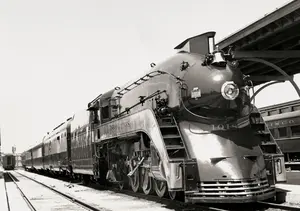
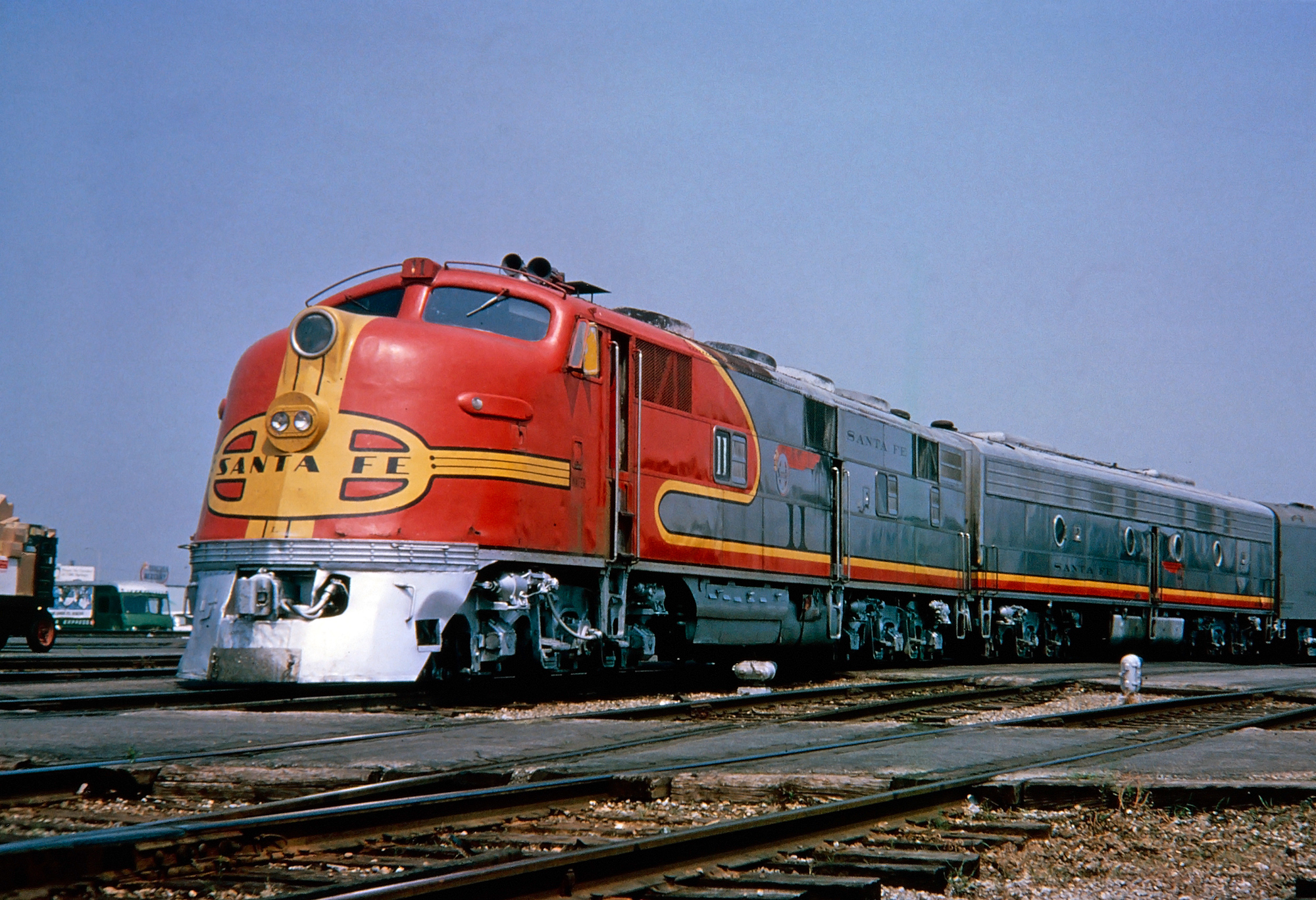 Santa Fe's only E3A, #11-L, awaits departure from Dallas Union Station, circa 1960. Mac Owen photo. The unit, acquired in 1939, remained in service for nearly 30 years. She was finally retired on June 28, 1968. American-Rails.com collection.
Overview
The E3 began production in March, 1939 as the builder's third passenger diesel model. As mentioned above it was Electro-Motive's first to feature a GM prime mover, in this case the model 567, featuring two engines. With each 567 able to produce 1,000 horsepower, the E3 was rated at 2,000 horsepower.
As with the EA, E1, and E2, the E3 featured an A1A-A1A truck setup (three axles per truck whereby the center axle was unpowered) and using GM's original model D7 traction motor it could produce around 31,000 pounds of continuous tractive effort (and 56,500 pounds of starting effort).
Not exactly an impressive number for a main line locomotive but then again it was powering only passenger service and not heavy freight trains up steep grades.
Once again, the E3 was very long (much longer its freight counterpart, the FT) at 71-feet, weighing 157.5 tons (the accompanying B unit weighed in at 145 tons).
However, Electro-Motived updated the carbody from earlier models. The E3 featured more straightforward streamlining with a long, sloped, "slant nose" that became closer to the classic trademark of later models it built under the EMD banner, beginning with the FT and used on every subsequent freight and passenger model.
This slant nose replaced the original "shovel nose" EA model, termed such as its front nose featured a slightly more raked design without the addition of a protruding, center headlight.
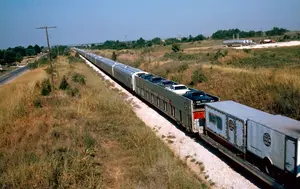
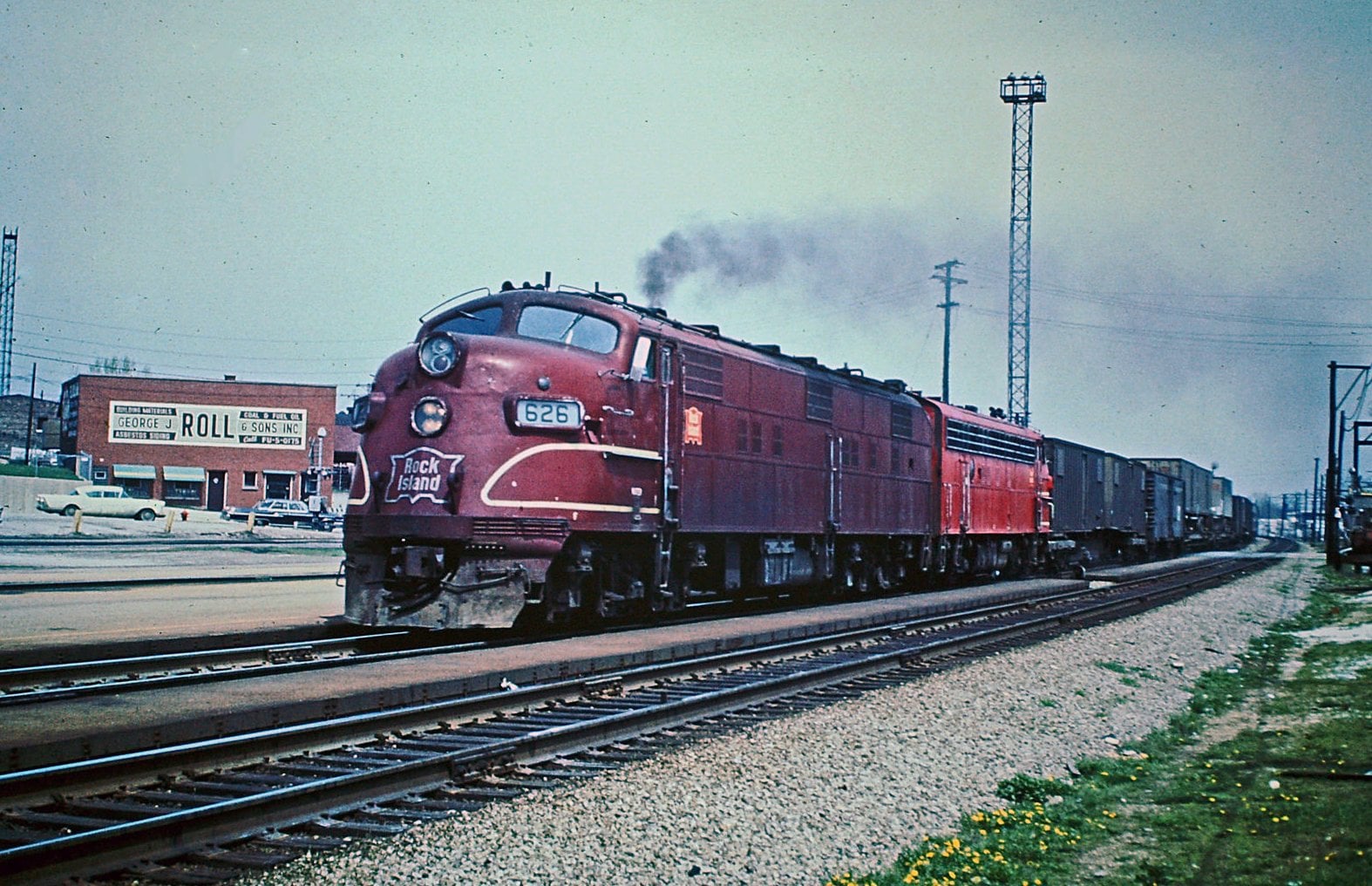 An aging Rock Island E3A (built in 1939) has the "Cornhusker" at Blue Island, Illinois in 1967. The train appears to consist largely of mail/express and intermodal business. Note the New York Central "Flexi-Van" car directly behind the locomotives.
Unfortunately, the E3 was a rather unsuccessful model, partly because railroads were not yet sold on diesels as a main line locomotive (that would come with the aforementioned FT, which began demonstrations in 1939).
While just seventeen E3s were built, eight Class I railroads did purchase at least one with the Chicago & North Western owning the most (four).
The Santa Fe and Union Pacific also purchasing one cabless, booster (B) unit each. Other lines to purchase the locomotive included UP (an A-B set), ACL (2), Santa Fe (an A-B set), Rock Island (2), Florida East Coast (2), Kansas City Southern (2), and Missouri Pacific (2). Additionally, EMC's one demonstrator, #822 was eventually sold to the KCS and listed as #1 by the railroad.
Data Sheet and Specifications
| Entered Production | 9/1938 (Demonstrator #822) |
| Years Produced | 9/1938 - 6/1940 |
| Engine | 567 (2) |
| Engine Builder | GM |
| Horsepower | 2000 |
| RPM | 800 |
| Cylinders | 12 |
| Length | 71' 1 ¼" |
| Height (Top Of Rail To Top Of Cab) | 13' 11" |
| Height (Top Of Rail To Top Of Roof Horn) | 14' 0" |
| Width | 10' 7" |
| Weight | 315,000 Lbs (A Units): 290,000 Lbs (B Units) |
| Fuel Capacity | 1,200 Gallons |
| Air Compressor | Gardner-Denver |
| Air Compressor Model | WBO |
| Air Brake Manufacturer | Westinghouse |
| Air Brake Schedule | HSC |
| Trucks | A1A |
| Truck Type | Blomberg |
| Truck Wheelbase | 14' 1" |
| Wheel Size | 36" |
| Steam Generator Manufacturer | Vapor-Clarkson |
| Steam Generator Capacity | 1200 Lbs/Hr |
| Traction Motors | D7 (4), GM |
| Primary Generator | D4 (2), GM |
| Auxiliary Generator | Delco |
| MU (Multiple-Unit) | Yes |
| Dynamic Brakes | No |
| Gear Ratio | 52:15 |
| Tractive Effort (Starting) | 56,500 Lbs at 25% |
| Tractive Effort (Continuous) | 31,000 Lbs at 11 mph |
| Top Speed | 116 mph |
Production Roster
E3A
Total Built = 17
| Owner | Road Number | Serial Number | Order Number | Completion Date | Quantity |
|---|---|---|---|---|---|
| Electro-Motive (Demonstrator) | 822* | 822 | E254 | 9/1938 | 1 |
| Union Pacific | LA5 | 893 | E225 | 3/1939 | 1 |
| Chicago & North Western | 5001A-5002A, 5001B-5002B | 930-933 | E246 | 5/1939-6/1939 | 4 |
| Chicago, Rock Island & Pacific | 625-626 | 934-935 | E245 | 7/1939 | 2 |
| Missouri Pacific | 7000 | 936 | E252 | 10/1939 | 1 |
| Missouri Pacific | 7001 | 937 | E253 | 10/1939 | 1 |
| Kansas City Southern | 2 | 938 | E255 | 8/1939 | 1 |
| Atchison, Topeka & Santa Fe | 11 | 954 | E263 | 8/1939 | 1 |
| Florida East Coast | 1001-1002 | 956-957 | E266 | 11/1939 | 2 |
| Atlantic Coast Line | 501-502 | 958-959 | E267 | 11/1939 | 2 |
| Kansas City Southern | 3 | 1034 | E293 | 6/1940 | 1 |
* Became Kansas City Southern #1.
E3B
Total Built = 2
| Owner | Road Number | Serial Number | Order Number | Completion Date | Quantity |
|---|---|---|---|---|---|
| Union Pacific | LA6 | 894 | E226 | 3/1939 | 1 |
| Atchison, Topeka & Santa Fe | 11A | 955 | E264 | 9/1939 | 1 |
For the companies that did purchase the E3 they remained in use for a number of years before finally be bumped from service, most of the time due to EMD's newer models like the E7, E8, and E9 (the last ever offered). After the E3 was cataloged EMD continued to struggle with its passenger models, both the E4 and E5 also sold poorly.
However, beginning with the E6, which was offered just before the start of World War II, the builder finally found success thanks in no small part to successful marketing campaign of FT. As a result designs like the aforementioned E7, E8, and E9 proved very successful selling more than 1,000 examples combined.
Sources
- Foster, Gerald. A Field Guide To Trains. New York: Houghton Mifflin, 1996.
- Hayden, Bob. Diesel Locomotives: Cyclopedia, Volume 2 (Model Railroader). Milwaukee: Kalmbach Publishing Company, 1980.
- Marre, Louis A. Diesel Locomotives: The First 50 Years, A Guide To Diesels Built Before 1972. Milwaukee: Kalmbach Publishing Company, 1995.
- Pinkepank, Jerry A. Diesel Spotter's Guide. Milwaukee: Kalmbach Publishing Company, 1967.
- Solomon, Brian. EMD Locomotives. Minneapolis: MBI Publishing Company, 2006.
Recent Articles


-
Delaware Railroad Museums (2026): A Complete Guide
Oct 05, 26 02:43 PM
 Delaware railroad museums—Wilmington & Western at Greenbank, the Harrington tower and N5 caboose, Felton's 1868 depot, and the Selbyville station museum.
 -
C&O's M-1 Steam Turbine Locomotives: Specs, Roster, History
Oct 05, 26 12:13 PM
 Chesapeake & Ohio Class M-1 steam-turbine-electrics. Three Baldwin-Westinghouse locomotives, 500–502, built 1947–48 for The Chessie. Specs, the 2-C1+2-C1-B arrangement, and a roster. All scrapped…
 -
N&W 2-6-6-2 Locomotives (Class Z): Specs, Roster, History
Oct 05, 26 11:44 AM
 Norfolk & Western Class Z 2-6-6-2s. One hundred ninety compound Mallets, 1300–1489, from Richmond, Baldwin, and Schenectady, 1912–1918. Diagram specs, the Z-1b rebuilds, Z-2 1399, and a roster. No…
 -
Scenic Train Rides (USA 2026): State Guide to Tourist Railroads
Oct 04, 26 12:17 AM
 Scenic and tourist train rides in all 50 states for 2026. Colorado narrow gauge, Pennsylvania steam, Alaska’s White Pass, and the states with no full-size ride this month. Confirm on the railroad.
 -
Wyoming Scenic Train Rides (2026): A Complete Guide
Oct 03, 26 12:07 AM
 Wyoming has no full-size tourist railroad on the calendar in October 2026. Cheyenne Depot Museum and Douglas Railroad Museum are static. Union Pacific 4014’s posted public trip is a November run to De…
 -
Washington Scenic Train Rides (2026): A Complete Guide
Oct 02, 26 11:53 PM
 Washington tourist trains in 2026—Mount Rainier Scenic at Elbe, the Northwest Railway Museum, and Chehalis-Centralia. Lake Whatcom has no 2026 date on its ticket page.
 -
Wisconsin Scenic Train Rides (2026): A Complete Guide
Oct 02, 26 11:48 PM
 Wisconsin tourist trains in 2026—Wisconsin Great Northern, Osceola & St. Croix Valley, Mid-Continent, East Troy, and the National Railroad Museum.
 -
Pennsylvania Railroad Class Q2 4-4-6-4: Specs, Roster, History
Oct 02, 26 11:28 PM
 Pennsylvania Railroad Class Q2 4-4-6-4 duplexes. Twenty-six engines, 6131 and 6175–6199, Altoona 1944–45. Form 109-J specs, the 7,987 hp test of 6175, and a roster. All scrapped.
 -
Utah Scenic Train Rides (2026): A Complete Guide
Oct 02, 26 11:18 PM
 Utah tourist trains in 2026—Heber Valley Railroad from Heber City. Golden Spike at Promontory is a locomotive demonstration, not a line-haul ride.
 -
South Dakota Scenic Train Rides (2026): A Complete Guide
Oct 02, 26 11:06 PM
 South Dakota’s 2026 scenic train is the Black Hills Central 1880 Train, Hill City to Keystone. Steam is the summer assignment. Confirm the engine.
 -
Oregon Scenic Train Rides (2026): A Complete Guide
Oct 02, 26 11:04 PM
 Oregon tourist trains in 2026—Oregon Coast Scenic from Rockaway Beach, Mount Hood at Hood River, Eagle Cap from Elgin, and the Oregon Rail Heritage Center in Portland.
 -
Oklahoma Scenic Train Rides (2026): A Complete Guide
Oct 02, 26 10:36 PM
 Oklahoma has no full-size scenic railroad on an October 2026 calendar. Oklahoma Railway Museum Halloween and Polar trains, the El Reno trolley, and the Heartland Flyer.
 -
North Dakota Scenic Train Rides (2026): A Complete Guide
Oct 02, 26 01:14 PM
North Dakota has no tourist railroad on a 2026 calendar. Ride Amtrak’s daily Empire Builder. The Fort Lincoln Trolley in Mandan is not a current ticket. -
Nebraska Scenic Train Rides (2026): A Complete Guide
Oct 02, 26 10:11 AM
 Nebraska has no full-size scenic railroad in 2026. The Omaha Zoo Railroad runs weekends through October 4. Ride Amtrak’s California Zephyr across the state.
 -
Missouri Scenic Train Rides (2026): A Complete Guide
Oct 02, 26 09:56 AM
 Missouri tourist trains in 2026—Branson Scenic Railway and the St. Louis, Iron Mountain & Southern at Jackson. Belton has no 2026 schedule posted.
 -
Minnesota Scenic Train Rides (2026): A Complete Guide
Oct 02, 26 09:52 AM
 Minnesota tourist trains in 2026—North Shore Scenic Railroad in Duluth, the Duluth River Train, and the Como-Harriet streetcar.
 -
Kansas Scenic Train Rides (2026): A Complete Guide
Oct 02, 26 09:32 AM
 Kansas tourist trains in 2026—the Abilene & Smoky Valley Railroad. Santa Fe 3415 is in overhaul. Midland Railway at Baldwin City is closed.
 -
Iowa Scenic Train Rides (2026): A Complete Guide
Oct 02, 26 08:41 AM
 Iowa tourist trains in 2026—Boone & Scenic Valley across the Bass Point Creek High Bridge, and Midwest Central’s December North Pole trains
 -
Indiana Scenic Train Rides (2026): A Complete Guide
Oct 02, 26 08:35 AM
 Indiana tourist trains in 2026—French Lick Scenic Railway, Nickel Plate Express, Hoosier Valley, and Hesston. Whitewater Valley is suspended.
 -
Illinois Scenic Train Rides (2026): A Complete Guide
Oct 02, 26 12:28 AM
 Illinois tourist trains in 2026—Illinois Railway Museum, Monticello Railway Museum, Fox River Trolley, and Silver Creek & Stephenson.
 -
Texas Scenic Train Rides (2026): A Complete Guide
Oct 02, 26 12:14 AM
 Texas tourist trains in 2026—Texas State Railroad, Grapevine Vintage Railroad, Austin Steam Train's Hill Country Flyer, and the Galveston Railroad Museum.
 -
Tennessee Scenic Train Rides (2026): A Complete Guide
Oct 02, 26 12:03 AM
Tennessee tourist trains in 2026—Tennessee Valley Railroad Museum, Dollywood Express, Three Rivers Rambler Christmas trains, and the Tennessee Central Railway Museum. -
South Carolina Scenic Train Rides (2026): A Complete Guide
Oct 01, 26 11:52 PM
 South Carolina's tourist train is the South Carolina Railroad Museum in Winnsboro—Blue Granite Express, pumpkin trains, and Santa trains on the old Rockton & Rion.
 -
Mississippi Scenic Train Rides (2026): A Complete Guide
Oct 01, 26 11:38 PM
 Mississippi has no regular tourist railroad in 2026. Ride Amtrak through the state, or book the excursion lines in Alabama, Tennessee, Louisiana, or Arkansas.
 -
Louisiana Scenic Train Rides (2026): A Complete Guide
Oct 01, 26 02:52 PM
 Louisiana has no regular full-size tourist railroad in 2026. New Orleans Polar Express returns December 11–31. Museums at Long Leaf, DeQuincy, and Jackson.
 -
Kentucky Scenic Train Rides (2026): A Complete Guide
Oct 01, 26 02:45 PM
 Kentucky tourist trains in 2026—Big South Fork Scenic Railway, Bluegrass Scenic Railroad, Kentucky Railway Museum, and My Old Kentucky Dinner Train.
 -
Georgia Scenic Train Rides (2026): A Complete Guide
Oct 01, 26 02:27 PM
 Georgia tourist trains in 2026—Blue Ridge Scenic Railway, SAM Shortline, Azalea Sprinter, Savannah shop rides, and what to confirm at Stone Mountain.
 -
Arkansas Scenic Train Rides (2026): A Complete Guide
Oct 01, 26 01:02 PM
 Arkansas tourist trains in 2026—Arkansas & Missouri through the Boston Mountains, and the Eureka Springs & North Arkansas dinner and excursion trains.
 -
Alabama Scenic Train Rides (2026): A Complete Guide
Oct 01, 26 12:59 PM
Alabama tourist trains in 2026—Heart of Dixie Railroad Museum at Calera, North Alabama Railroad Museum at Chase, and the Wales West Light Railway at Silverhill. -
The Circus Train: How Such Attractions Reached Distant Cities
Oct 01, 26 12:22 PM
 How circuses moved by rail: Coup's 1872 flats, the Ringling train's sections and car counts, the 1918 Hammond wreck, and the last show on May 21, 2017.
 -
West Virginia Halloween Train Rides (2026)
Oct 01, 26 12:19 PM
 2026 West Virginia Halloween train. Cass Scenic Halloween Train, October 30 and 31, steam, 5:00 p.m. from Cass Depot. Adult $75. About two hours to Whittaker. Family ride.
 -
Wisconsin Halloween Train Rides (2026)
Oct 01, 26 12:11 PM
2026 Wisconsin Halloween trains. Mid-Continent Pumpkin Special October 24–25, adult $24, pumpkins extra. Halloween Flyer October 24 at 4:30 p.m., adult $30. Osceola Pumpkin Express boards in Osceola… -
Utah Halloween Train Rides (2026)
Oct 01, 26 12:00 PM
 2026 Utah Halloween trains at Heber Valley Railroad. Pumpkin Train, about 40 minutes, with a cookie and a pumpkin. Halloween Express, about 90 minutes to Grim Hollow, Monday, Thursday, and Friday even…
 -
Texas Halloween Train Rides (2026)
Oct 01, 26 11:28 AM
 2026 Texas Halloween train. Texas State Railroad Spooky Special, adult-only, October 24. Boards Palestine at 5:00 p.m. About five hours to Rusk and back. Dinner on the grounds. Not steam. No fare on t…
 -
Tennessee Halloween Train Rides (2026)
Oct 01, 26 12:15 AM
 2026 Tennessee Halloween trains. Tennessee Valley Railroad Museum Rails, Wizards & Spells, selected days September 18 through October 25, from $35, about 2.5 hours. Spells & Potions tea from $60. The…
 -
Frisco's "Firefly" (Train): Consist, Route, Timetable
Sep 30, 26 11:37 PM
 Frisco Firefly—daylight streamliner, Kansas City to Tulsa and Oklahoma City. Trains 117 and 118. Pacifics 1018, 1026, and 1031. Last run May 22, 1960.
 -
South Carolina Halloween Train Rides (2026)
Sep 30, 26 11:29 PM
 2026 South Carolina Halloween train. South Carolina Railroad Museum Pumpkin Patch Express, the two Saturdays before Halloween. About three miles to the Greenbriar pavilion. Pumpkin for children 12 and…
 -
Oregon Halloween Train Rides (2026)
Sep 30, 26 08:10 PM
2026 Oregon Halloween train. Sumpter Valley Railroad Halloween Express at the Sumpter Depot, calendar window October 31 at 11:00 a.m. through November 1 at 12:30 p.m. Fare and the individual clocks ar… -
Oklahoma Halloween Train Rides (2026)
Sep 30, 26 03:45 PM
2026 Oklahoma Halloween train. Oklahoma Railway Museum, October 30 and 31, from Oakwood Station in Oklahoma City. Adults $15, children 3–12 $8. A candy bag with the ride. -
McCloud River Railroad: Serving The Timber Industry (1897-2009)
Sep 30, 26 03:37 PM
 McCloud River Railroad—Mount Shasta City to McCloud, Hambone, and Burney. Opened August 1, 1897. Alco No. 25 and EMD SD38s. Dinner train through January 2010. Railbikes in 2026; a dinner train is stil…
 -
Nevada Halloween Train Rides (2026)
Sep 30, 26 03:30 PM
2026 Nevada Halloween trains in Ely. Nevada Northern Pumpkin Patch Caper and Haunted Ghost Train. Adult tickets start at $45. Dates are on the railroad’s ticket calendar. Boulder City stays off until… -
Missouri Halloween Train Rides (2026)
Sep 30, 26 11:12 AM
 2026 Missouri Halloween trains. St. Louis Iron Mountain & Southern Pumpkin Patch Train on October 3, 4, 10, and 11, and Halloween Express on October 31 at 1:00 p.m. Jackson depot. No fare on the sched…
 -
Minnesota Halloween Train Rides (2026)
Sep 30, 26 11:06 AM
 2026 Minnesota Halloween trains. North Shore Scenic Great Pumpkin Train in Duluth, October 15–18. Everyone gets a pumpkin. Terror Train is October 30, an adult costume party, about three hours. Fares…
 -
Maryland Halloween Train Rides (2026)
Sep 30, 26 10:42 AM
 2026 Maryland Halloween trains. Western Maryland Scenic Pumpkin Patch Limited, October 17, 18, 24, and 25, $14. Colesville Trolleyween October 24, 25, and 31.
 -
West Side Lumber Company Railroad: Roster, History, Lines
Sep 30, 26 09:45 AM
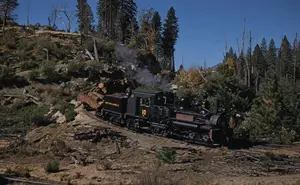
 West Side Lumber at Tuolumne, California. Three-foot Shay and Heisler logging railroad. Lima shop numbers, builder specs, and where the engines are in 2026.
 -
Kansas Halloween Train Rides (2026)
Sep 30, 26 09:41 AM
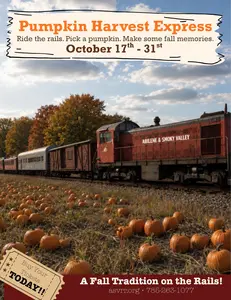
 2026 Kansas Halloween train. Abilene & Smoky Valley Pumpkin Harvest Express, October 17 through 31. About one hour. Shop prices $35.56 to $41.02. Everyone picks a pumpkin.
 -
Iowa Halloween Train Rides (2026)
Sep 29, 26 11:58 PM
2026 Iowa Halloween train. Boone & Scenic Valley Pumpkin Express, October 10, 10:00 a.m. from 225 10th Street. About 1 hour 15 minutes. Children pick a pumpkin. -
Arizona Halloween Train Rides (2026)
Sep 29, 26 11:43 PM
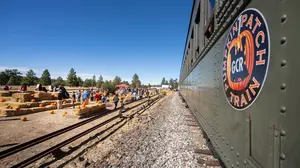
 2026 Arizona Halloween train. Grand Canyon Railway Pumpkin Patch Train from Williams, $39 with a pumpkin included. Select October dates on the ticket calendar. Haunted train cars are optional.
 -
Nevada Northern Halloween Trains (2026)
Sep 29, 26 06:18 PM
Nevada Northern 2026 Halloween trains in Ely. Pumpkin Patch Caper to Keystone Gulch and the Haunted Ghost Train. Adult tickets start at $45. Dates are on the railroad’s calendar. Confirm on nnry.com. -
Grand Canyon Railway Pumpkin Patch Train (2026)
Sep 29, 26 02:42 PM
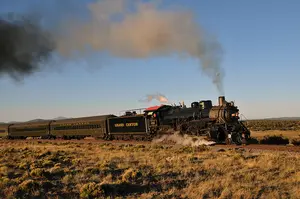
Grand Canyon Railway Pumpkin Patch Train—select October 2026 dates from Williams, $39 with a pumpkin included. Haunted train cars are optional. Days are on the ticket calendar. Confirm on thetrain.com…









%20has%20the%20%22Cornhusker%22%20at%20Blue%20Island%2C%20Illinois%20in%201967.%20The%20train%20appears%20to%20consist%20largely%20of%20mail%2Fexpress%20and%20intermodal%20business.%20Note%20the%20New%20York%20Central%20%22Flexi-Van%22%20car%20directly%20behind%20the%20locomotives.)