Western Rail Coalition: Returning Passenger Trains To Colorado
Published: February 25, 2026
Colorado’s passenger-rail conversation is often framed as two separate stories: a Front Range “spine” along I-25, and a harder, longer-term quest to offer real alternatives to the I-70 mountain drive. The Western Rail Coalition (WRC) sits squarely in the second camp. It is not a state agency or an operator; it’s a coalition of elected officials, transportation advocates, business voices, and engaged residents working to build momentum for passenger rail west of the Front Range—especially in the I-70 mountain corridor.
What makes the WRC worth watching is that its agenda overlaps with a project that is moving through the public process: CDOT’s “Colorado Mountain Rail” (often shortened to Mountain Rail)—a state-led effort that aims to restore passenger rail along the existing line from Denver toward northwest Colorado. The coalition’s broader vision extends beyond that first CDOT corridor, pitching a network that could eventually connect mountain valleys, airports, resort communities, and Western Slope cities with the Front Range—mostly by leveraging existing rail rights-of-way and focusing on phased rollouts.
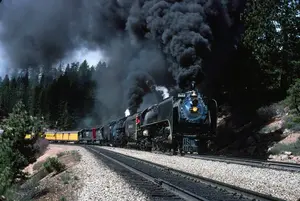
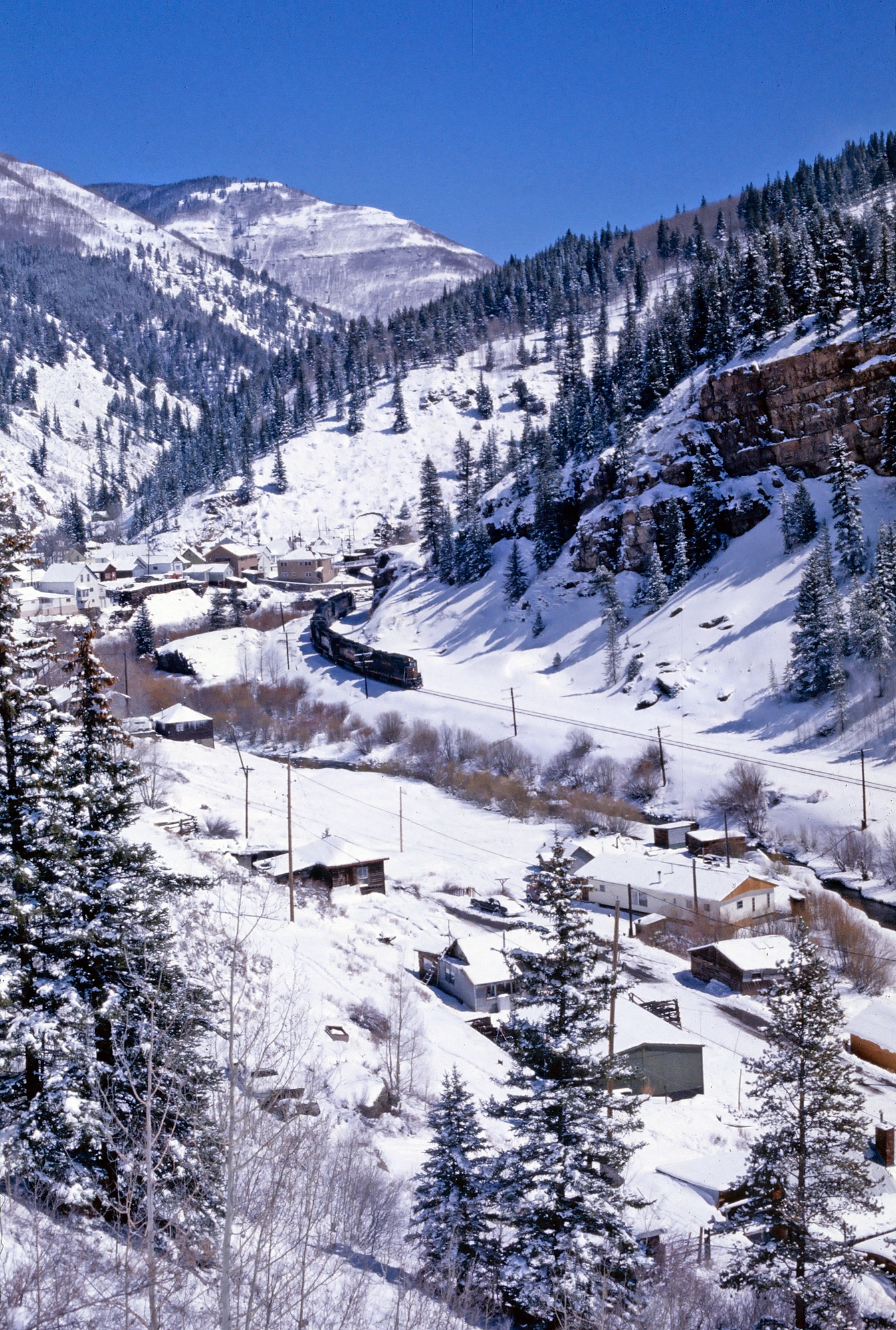 A seven-unit helper set of Rio Grande power runs light through Red Cliff, Colorado on Tennessee Pass in March, 1981. American-Rails.com collection.
The Western Rail Coalition describes itself as a Rocky Mountain region group formed to support the study and advancement of expanded passenger rail in the I-70 Mountain Corridor west of the Front Range, with technical support from advocates at Greater Denver Transit.
In practical terms, the coalition plays three roles:
- Vision-setter: it publishes maps, concept papers, and a menu of “Western Rail” corridors—some near-term, many aspirational.
- Pressure-and-partnership builder: it has urged the state to expand study scopes (notably around Tennessee Pass and the Eagle River Valley) and to pursue public-private approaches.
- Bridge to projects already underway: it points to CDOT’s Mountain Rail work as the most tangible “starter” for broader west-of-Denver passenger service.
That last point matters because the coalition’s biggest credibility boost is that Colorado has already taken a major step toward enabling more mountain passenger service: a long-term access agreement with Union Pacific for the Moffat Tunnel route (the core gateway through the Continental Divide on the Denver–Bond–northwest Colorado line).
CDOT Mountain Rail (Denver–Granby first)
The corridor
CDOT’s Mountain Rail program is focused on using the existing rail line from Denver to Craig, with station locations still under consideration in many communities. The Western Rail Coalition frames this alignment as the “Central Corridor” (Denver to Bond and then west toward Grand Junction via Glenwood Canyon) plus the branch north toward Steamboat Springs and Craig.
The key enabler: the Moffat Tunnel access deal
In May 2025, Colorado and Union Pacific signed a 25-year passenger-rail access arrangement tied to UP’s continued use of the Moffat Tunnel—an agreement the governor’s office described as establishing Colorado’s license for up to three daily roundtrips (or up to a set number of annual train miles) for Mountain Passenger Rail, with room to expand in later phases.
When service might begin
- This is the one corridor where the public record now supports a real timeline:
- CDOT’s Mountain Rail progress report anticipates initial phase service starting in late 2026, likely operating between Denver and Granby as a starter segment.
- CDOT performance materials have set a specific target: implement daily Denver–Granby service by November 1, 2026.
The governor’s office has similarly pointed to a daily year-round roundtrip to Granby by 2026, with flexibility to expand later toward Winter Park, Steamboat Springs, Hayden, and Craig.
Bottom line: If you’re asking “when do trains actually start running,” the clearest answer today is: Denver–Winter Park/Fraser–Granby service is targeted for late 2026 (with a November 1, 2026 goal).
What happens after Denver–Granby?
Beyond that starter segment, CDOT planning documents outline multiple service patterns—including options that eventually reach Craig and add local overlays in the Yampa Valley area—while emphasizing that later phases depend on infrastructure, equipment, operating agreements, and funding partnerships.
This “phased implementation” approach is where the Western Rail Coalition’s broader wish list intersects reality: a first train to Granby can demonstrate demand, build operating muscle, and create political momentum for extensions.
1. Central Corridor: Denver–Glenwood Springs–Grand Junction (more intrastate trains)
The idea
The Central Corridor is essentially Colorado’s most famous existing passenger route: the Union Pacific line used by Amtrak’s California Zephyr, the seasonal Winter Park Express, and the tourist-focused Canyon Spirit (formerly Rocky Mountaineer). The coalition argues that demand for shorter “intra-Colorado” trips (especially Denver–Glenwood Springs/Grand Junction) is strong and that additional service could complement the Zephyr rather than compete with it.
How it’s doing
The coalition’s own materials explicitly tie near-term progress in this corridor to CDOT’s Mountain Rail work—because Mountain Rail uses the same core gateway through the Moffat Tunnel and the line toward Bond.
But there is an important reality check: additional year-round intrastate trains between Denver and Grand Junction would require capacity, operating slots, station work, equipment, and negotiated host-railroad terms beyond the initial Denver–Granby phase. CDOT’s planning emphasizes that major projects will be phased and that equipment availability can be a near-term constraint (often pointing toward used equipment for initial service because new trainsets take years to procure).
When could it start?
No public document sets a firm start date for added Denver–Glenwood–Grand Junction frequencies as a state service. The best grounded answer today is:
- The earliest “new” mountain service now on the books is Denver–Granby in late 2026, enabled by the UP access deal.
- Any extension west beyond Granby (toward Bond and the Western Slope) is described as a future phase, not a committed launch.
2. Yampa Valley: Bond–Steamboat Springs–Hayden–Craig (service restoration)
The idea
The coalition highlights the Craig Branch north from Bond through communities such as Oak Creek, Steamboat Springs, and Hayden (Yampa Valley Regional Airport), noting that passenger service ended decades ago and that freight traffic is currently minimal compared with historical levels.
How it’s doing
This corridor is being folded into CDOT’s broader Mountain Rail concept—at least as an eventual endpoint. CDOT’s documents include service options that extend trains to Craig and add a local overlay in the Yampa Valley area, while noting that local participation may be required for certain local-pattern service costs.
When could it start?
The public-facing timeline still points to Denver–Granby first, then later extension phases. The coalition’s own Mountain Rail page mirrors that: late-2026 starter service first, with hopes to extend to Steamboat Springs and Craig later.
So, for the Yampa Valley: no firm “service begins” date yet, but it is at least attached to an active CDOT project pipeline.
3. Tennessee Pass Corridor: Pueblo–Leadville–Minturn–Dotsero (and an “Eagle Valley” starter)
The idea
If Mountain Rail is the corridor that already has state momentum, Tennessee Pass is the corridor that has romance and a complicated set of ownership/lease questions.
The Western Rail Coalition notes that the Tennessee Pass line runs roughly 222 miles from Pueblo up the Arkansas River Valley, over Tennessee Pass, then down the Eagle River to Dotsero—remaining largely intact but dormant for decades after Union Pacific deemed it surplus following the mid-1990s merger era.
The coalition’s “initial phase”: Eagle Valley passenger rail
WRC’s Tennessee Pass page describes an initial phase focused on passenger service in the Eagle Valley, and the coalition amplified that concept in a letter urging the state to explore an “Eagle River Valley Service.”
That letter is notable because it claims a time-sensitive window: it says Union Pacific’s out-of-service Tennessee Pass Line is leased to Rio Grande Pacific Corporation, which the coalition describes as interested in operating a local passenger service with modern, low-emission rail vehicles—but that continued interest depends on clear state/local support and may not survive if the lease is not renewed.
How it’s doing
Public reporting has shown local officials discussing task forces and participation steps to explore passenger rail feasibility on the line. The coalition also continues to press for CDOT to pursue a formal service development plan that would quantify costs and benefits.
When could it start?
Unlike Mountain Rail, Tennessee Pass service does not have a state-set launch date. Based on what’s public:
- WRC’s Eagle Valley concept is framed as potentially faster if pursued as a public-private partnership, but it still calls for CDOT dialogue and a study/SDP process.
- Without a published CDOT implementation timeline for this corridor, any start date would be speculative.
A realistic read: Tennessee Pass/Eagle Valley is in advocacy-and-feasibility territory, not “construction-to-service” territory—yet.
4. Uncompahgre Valley: Grand Junction–Delta–Montrose (a Western Slope regional)
The idea
The coalition proposes passenger trains on the line between Grand Junction and Montrose, with intermediate stops (Delta, Olathe, Montrose Regional Airport), arguing that low freight volumes could allow frequent all-day passenger operations.
How it’s doing / when service begins
WRC’s own language is consistent: it supports “studying what would be required.” No public launch date is identified.
5. I-70 “Truck Train”: rolling-road freight as an I-70 relief valve
The idea
This is the coalition’s most unconventional proposal: a “rolling road” system that would load trucks/semitrailers onto low-floor rail wagons between Denver and Grand Junction, carrying drivers in passenger cars—an alpine model inspired by European services.
Status
This is best understood as an advocacy concept meant to broaden the I-70 conversation beyond “add lanes vs. do nothing.” There’s media coverage of similar ideas being floated locally, but it is not currently paired with a state implementation date in the way Mountain Rail is.
How the Front Range project fits into the Western Rail story
The Western Rail Coalition also points readers toward the separate Front Range Passenger Rail effort—an intercity service plan along the I-25 corridor from Fort Collins through Denver to Pueblo (with possible extensions north to Wyoming and south toward New Mexico).
While that’s not “Western Colorado,” it matters because a Front Range spine can feed mountain services (and vice versa). Colorado legislative materials for the Front Range project have indicated a planning path that included completion targets and a potential sales tax election timeframe.
In other words: Colorado’s passenger rail future is likely to be built as an ecosystem—Front Range ridership and governance can strengthen the case for mountain expansions, while mountain ridership and congestion relief can strengthen the argument for statewide rail investment.
When might passengers actually ride these trains?
Here’s the most grounded “corridor-by-corridor” outlook based on what is public today:
- Most likely first: CDOT Mountain Rail Phase 1 (Denver–Granby, with Winter Park/Fraser in the mix) — targeted for late 2026, with a published goal of daily service by Nov. 1, 2026.
- Next plausible expansions (but not scheduled yet): extensions and added frequencies along the Mountain Rail corridor toward Steamboat Springs/Craig, depending on agreements, infrastructure, equipment, and funding.
- Active advocacy / feasibility stage: Tennessee Pass and the Eagle Valley concept—supported by local discussions and coalition pressure, but without a state-set start date.
- Concept + “study it” stage: Uncompahgre Valley, additional Denver–Grand Junction frequencies, and other vision concepts (Roaring Fork, etc.).
Passenger rail is often less constrained by “does the idea work?” than by “can the coalition hold long enough to fund, negotiate, and phase it?” The Western Rail Coalition is trying to solve that political problem for Western Colorado by:
- keeping attention on corridors that are easy to ignore when statewide planning focuses on the Front Range,
- pushing CDOT to look beyond a single corridor and consider near-term wins through partnerships (like the Eagle Valley concept),
- and anchoring its vision to the first tangible milestone Colorado has landed: a long-term UP access arrangement that enables CDOT to start building actual mountain passenger service.
If Colorado hits its late-2026 Denver–Granby target, the Western Rail Coalition’s next challenge will be turning “starter line success” into a credible roadmap for the harder corridors—where service development plans, governance, and operating funding will decide whether Western Rail becomes a network…or remains a map.
Recent Articles


-
Bessemer & Lake Erie Railroad: "The Bessemer Road"
Sep 15, 26 05:20 PM
 Bessemer & Lake Erie—Bear Creek 1865, Carnegie 1897, U.S. Steel 1901. Ore south from Conneaut, coal north. 2-10-4s, Missabe sister road. CN May 10, 2004. Complete corporate history.
 -
Bangor and Aroostook Railroad: "Serving Northern Maine"
Sep 15, 26 05:05 PM
 Bangor & Aroostook—chartered February 13, 1891, first trains January 1, 1894. Potatoes, paper, Searsport, State of Maine reefers. MM&A 2003, Lac-Mégantic 2013, CP 2020, CPKC today. Complete co…
 -
Baltimore & Ohio Chicago Terminal Railroad: Map and History
Sep 15, 26 03:11 PM
 B&OCT—formed January 6, 1910 to buy Chicago Terminal Transfer. Grand Central, Barr Yard, 78 route-miles. Assigned B&O steam. Complete diesel roster. CSX paper subsidiary, mark BOCT.
 -
The "Alphabet Route" (Railroad): Photos and History
Sep 15, 26 02:53 PM
 Alphabet Route—eight railroads, not one company. P&WV to Connellsville February 11, 1931. Alpha Jets Chicago/St. Louis–New York/Boston. NKP, W&LE, P&WV, WM, Reading, CNJ, L&HR, New Hav…
 -
Milwaukee Road Livestock Operations: Cattle, Dakotas & Montana
Sep 15, 26 02:36 PM
 Milwaukee Road livestock traffic—Dakota and Montana cattle, Iowa hogs, Chicago markets, 28-hour law, head-end stock cars. By 1974 mostly Montana. Rick Burn’s Helena speech. Operations history, not the…
 -
Spirit of Jasper Ride & Dine (2026): Season Pause
Sep 15, 26 02:29 PM
 Spirit of Jasper Ride & Dine in Jasper, Indiana—seated meal on board. Operator: not running public trains for 2026. Depot remains open as a rental. Confirm on spiritofjaspertrain.com.
 -
South Carolina Canal & Rail Road Company: Map and History
Sep 15, 26 01:59 PM
 South Carolina Canal & Rail Road—chartered December 19, 1827. Best Friend of Charleston, 136 miles Charleston–Hamburg October 1833, Aiken inclined plane. South Carolina Railroad 1844, Southern 189…
 -
The Practice of Double-Heading: The Steam Era
Sep 15, 26 01:43 PM
 Doubleheading—two locomotives on the point, each with its own steam crew. Not a rear helper, not diesel MU. How it worked, PRR 1877, mountain grades, and what MU ended.
 -
Mohawk and Hudson Railroad: Map, Pictures, Locomotives
Sep 15, 26 01:20 PM
 Mohawk & Hudson Railroad—New York’s first railroad, chartered April 17, 1826. DeWitt Clinton, inclined planes, Albany & Schenectady 1847, first New York Central May 17, 1853. Complete corporat…
 -
Essex Clipper Dinner Train (2026): Dates, Tickets & What to Expect
Sep 15, 26 01:09 PM
 2026 Essex Clipper Dinner Train in Essex, CT—2.5 hours, four-course meal $129.99, 18+. Fall dates through Oct. 25. Confirm on essexsteamtrain.com.
 -
Camden & Amboy Railroad: Map, History, Photos
Sep 15, 26 12:53 PM
 Camden & Amboy Railroad—chartered February 4, 1830. Joint Companies monopoly with the Delaware & Raritan Canal, John Bull, T-rail. United New Jersey 1872, PRR 999-year lease 1871. Complete corpora…
 -
Cafe Lafayette Dinner Train (2026): Dates, Tickets & What to Expect
Sep 15, 26 12:47 PM
2026 Cafe Lafayette Dinner Train in North Woodstock, NH—2 hours, 20 miles, five-course meal from $125. May–October. Confirm on nhdinnertrain.com. -
Christmas Train Ride Locations (2026): A Complete Guide
Sep 15, 26 10:47 AM
 2026 Christmas train rides by state—Santa, North Pole Express, and holiday trains. Not Polar Express. State guides and product pages. Confirm dates on each railroad.
 -
Baltimore & Ohio Railroad: Linking 13 Great States With The Nation
Sep 15, 26 10:22 AM
 Baltimore & Ohio Railroad—first U.S. common carrier, chartered February 28, 1827. Wheeling 1853, Chicago 1874, C&O control 1963, Chessie 1973, into CSX April 30, 1987. Complete corporate history.
 -
Delaware & Hudson Railway: The Bridge Line
Sep 15, 26 09:59 AM
 Delaware & Hudson Railway—Wurts brothers canal 1823, gravity railroad 1829, Stourbridge Lion, Bridge Line to Montreal. Guilford 1984, CP 1991, NS south line 2015, CPKC north.
 -
Delaware & Hudson Diesel Roster (All-Time)
Sep 15, 26 12:17 AM
 All-time Delaware & Hudson diesel roster—Alco S-2s through C-628s and PA-4s, GE U-boats, Baldwin RF-16s, EMD SD45s and GP38-2/GP39-2s. Serials, dates, dispositions.
 -
Granite Railway, Our Country's First Railroad
Sep 14, 26 11:28 PM
 Granite Railway of Quincy, Massachusetts—chartered March 4, 1826, opened October 7, 1826. Gridley Bryant, 5-foot gauge, horses, Bunker Hill Monument stone. First commercial U.S. railroad.
 -
Milwaukee Road Skytop Lounges: History, Specs & Floor Plans
Sep 14, 26 11:09 PM
 Milwaukee Road Skytop observation cars—Brooks Stevens, 1948. Four Rapids parlor-lounges from Milwaukee Shops, six Creek sleeper-lounges from Pullman-Standard. Floor plans, roster, preservation.
 -
West Virginia Christmas Train Rides (2026): A Complete Guide
Sep 14, 26 11:02 PM
2026 West Virginia Christmas trains—Potomac Eagle North Pole Express in Romney and Christmas at Cass. Not Polar Express. Elkins Polar is not listed for 2026. -
Railroads Of Today: Class I Map, PSR & the 2026 Industry
Sep 14, 26 10:30 PM
 U.S. freight rail in 2026—six Class I railroads on a nearly 140,000-mile network. PSR as everyday practice, how the STB works, traffic mix, short lines and regionals.
 -
Railroad History (USA): Timeline, Facts & How the Network Was Built
Sep 14, 26 10:03 PM
 Full U.S. railroad history hub—origins and inventors, Golden Age peak mileage, Civil War and transcontinental, streamliners, ICC regulation, Penn Central and Conrail, Staggers Act, PSR, and today’s Cl…
 -
Railroads In The 2020s: CPKC, East Palestine & the UP–NS Case
Sep 14, 26 09:51 PM
 U.S. railroads 2020–2026—Class I mileage 91,773 in 2020. COVID traffic drop, CPKC April 14 2023, East Palestine Feb. 3 2023, UP–NS $85 billion case still before the STB.
 -
Railroads In The 2010s: PSR, Coal’s Decline & Positive Train Control
Sep 14, 26 03:51 PM
 U.S. railroads 2010–2020—Class I mileage 95,573 to 91,773. Buffett closed BNSF Feb. 12 2010, Harrison at CP June 29 2012 and CSX 2017, PTC deadline Dec. 31 2018.
 -
Virginia Christmas Train Rides (2026): A Complete Guide
Sep 14, 26 03:46 PM
 2026 Virginia Christmas trains—Virginia Scenic Railway Santa Express from Staunton, about 60 minutes. Confirm dates. Not Polar Express.
 -
MARC Train: Maryland Commuter Rail History, Lines & Roster
Sep 14, 26 01:16 PM
 MARC Train history—Maryland Rail Commuter 1984, B&O and PRR corridors, Penn/Camden/Brunswick lines, Silver Spring 1996, all-time locomotive roster.
 -
Railroads In The 2000s: Merger Freeze, Wisconsin Central & Buffett
Sep 13, 26 07:57 AM
 U.S. railroads 2000–2010—Class I mileage 99,250 to 95,573. STB merger freeze March 17 2000, CN–WC Oct. 9 2001, BNSF Railway Jan. 24 2005, Buffett Nov. 3 2009.
 -
Railroads In The 1990s: Mega-Mergers, Conrail’s Split & the STB
Sep 13, 26 12:13 AM
 U.S. railroads 1990–2000—Class I mileage 119,758 to 99,250. BNSF Sept. 22 1995, UP–SP Sept. 11 1996, Conrail split June 1 1999, ICC Termination Dec. 29 1995.
 -
Railroads In The 1980s: Staggers, Mega-Mergers & Conrail’s IPO
Sep 12, 26 11:12 PM
 U.S. railroads 1980–1990—Class I mileage 164,822 to 119,758. Staggers Oct. 14 1980, CSX and Norfolk Southern, UP–Missouri Pacific–Western Pacific, Conrail IPO March 26 1987.
 -
Wabash Class O-1 4-8-4s: History, Roster & Specifications
Sep 12, 26 11:01 PM
 Wabash Class O-1 4-8-4s—Baldwin 1930–31, twenty-five engines 2900–2924. Fast freight, complete roster, specifications. None preserved.
 -
Staggers Rail Act of 1980: Statute, Contract Rates & the ICC
Sep 10, 26 11:23 PM
 Staggers Rail Act, Pub. L. 96-448, signed October 14, 1980. Harley Staggers, S.1946, contract rates, 180% variable-cost test, abandonments, short lines.
 -
Rock Island E8A 652: Bicentennial Independence Paint & History
Sep 10, 26 10:42 PM
 Rock Island E8A 652—EMD March 1952, serial 15199. 20th Century Railroad Club Independence bicentennial scheme, Peoria and Quad Cities Rockets, Midland Railway, Manly Junction Museum.
 -
Vermont Christmas Train Rides (2026): A Complete Guide
Sep 10, 26 10:37 PM
2026 Vermont Christmas trains—Okemo Valley Holiday Express from Chester Depot Dec. 19–20. Polar is Burlington Dec. 5–6 only. -
Railroads In The 1970s: Penn Central, Amtrak & Conrail
Sep 10, 26 10:18 AM
 U.S. railroads 1970–1980—196,479 miles at the decade’s start. Penn Central bankruptcy June 21 1970, Amtrak May 1 1971, 3R/4R Acts, Conrail April 1 1976, Rock Island 1975, Milwaukee 1977.
 -
Railroads In The 1960s: Mergers, Passenger Collapse & Penn Central
Sep 10, 26 10:03 AM
 U.S. railroads 1960–1970—207,334 to 196,479 miles. Erie Lackawanna 1960, C&O–B&O 1963, N&W–Nickel Plate 1964, SCL 1967, Penn Central Feb. 1 1968.
 -
South Carolina Christmas Train Rides (2026): A Complete Guide
Sep 10, 26 08:36 AM
 2026 South Carolina Christmas trains—South Carolina Railroad Museum Santa Train in Winnsboro. Confirm December dates. Not Polar Express. Drop light-festival padding.
 -
Steam Locomotive Feedwater Heaters: Elesco, Coffin & Worthington
Sep 10, 26 08:29 AM
 Steam locomotive feedwater heaters—open Worthington vs closed Elesco and Coffin. How they work, how to identify them on a smokebox, and why not every engine had one.
 -
Oregon Christmas Train Rides (2026): A Complete Guide
Sep 10, 26 08:22 AM
2026 Oregon Christmas trains—Portland Holiday Express, Garibaldi Candy Cane Express, Sumpter Valley Christmas Trains Dec. 11–13. Polar is Mount Hood. -
Lake Shore & Michigan Southern: Map, History, Timetables
Sep 10, 26 08:12 AM
 Lake Shore & Michigan Southern Railway—Erie & Kalamazoo 1833, Michigan Southern to Chicago 1852, LS&MS April 6 1869, Vanderbilt, Ashtabula 1876, NYC merger Dec. 22 1914. 1910 map and Official Guide.
 -
Big Four Route (CCC&StL): Map, History
Sep 10, 26 12:19 AM
Cleveland, Cincinnati, Chicago & St. Louis Railway—Bee Line 1868, Ingalls’s first Big Four 1880, CCC&StL June 30, 1889, NYC lease Feb. 1, 1930. 1910 and 1930 maps, what still runs. -
Railroads In The 1950s: Diesel, the Interstate & Passenger Collapse
Sep 10, 26 12:15 AM
 U.S. railroads 1950–1960—223,779 to 211,459 miles. Interstate June 29, 1956, dieselization, passenger collapse, TOFC, 1957–58 recession, NYO&W 1957, N&W–Virginian 1959.
 -
New Jersey Christmas Train Rides (2026): A Complete Guide
Sep 10, 26 12:06 AM
 2026 New Jersey Christmas trains—Black River & Western Santa Express from Flemington and Pine Creek Christmas trains in Wall Township. Polar is Whippany and Phillipsburg.
 -
New Mexico Christmas Train Rides (2026): A Complete Guide
Sep 09, 26 11:57 PM
 2026 New Mexico Christmas trains—Cumbres & Toltec Santa’s Holiday Express from Chama Dec. 5–6 (and Antonito, Colo., Dec. 12–13). Coach $25/$15. Not Polar Express.
 -
Grand Trunk Railway: Map, History, Timetables
Sep 09, 26 11:47 PM
 Grand Trunk Railway of Canada—charter Nov. 10, 1852, Montreal–Toronto 1856, Portland, Sarnia, Victoria Bridge, St. Clair Tunnel 1891, Great Western 1882, GTPR, CN Jan. 20, 1923. 1893 map and Official…
 -
Troop Trains In World War II: Sleepers, Kitchen Cars & Movements
Sep 09, 26 11:42 PM
 WWII U.S. troop trains—almost 44 million armed-services passengers, Pullman troop sleepers, ACF kitchen cars, hospital trains, monthly movement tables 1942–45. Not the Military Railway Service. ODT an…
 -
Railroads In The 1940s: War Traffic, Last Steam & the Diesel Flood
Sep 09, 26 11:37 PM
 U.S. railroads 1940–1950—233,670 to 223,779 miles. World War II as the decade’s center, last new steam, diesel flood after V-J Day, 1945 car orders, California Zephyr 1949.
 -
Railroads In World War II: ODT, Record Traffic & Private Operation
Sep 09, 26 03:00 PM
 U.S. railroads in World War II—Lend-Lease freight, Pearl Harbor, Office of Defense Transportation, 1944 peak ~740 billion ton-miles, Dec. 1943–Jan. 1944 seizure. Private operation, not a USRA sequel.
 -
Montana Christmas Train Rides (2026): A Complete Guide
Sep 09, 26 02:54 PM
2026 Montana Christmas trains—Charlie Russell Chew Choo North Pole Adventure from Hanover/Lewistown, Nov. 27–Dec. 19, $71, about 1.5 hours. Not Polar Express. -
Railroads In The 1930s: Depression, Streamliners & the FT
Sep 09, 26 09:32 AM
 U.S. railroads 1930–1940—249,052 to 233,670 miles. Section 77, Eastman, Motor Carrier Act, M-10000 and Pioneer Zephyr 1934, EMC FT 1939. Decade frame, not the streamliner encyclopedia.
 -
Sugar Cane Train (Lahaina): LK&P History, Roster & 2026 End
Sep 09, 26 08:19 AM
 Lahaina, Kaanapali & Pacific Sugar Cane Train—3-foot tourist line 1970–2014. Anaka, Myrtle, 2023 and 2025 fires, September 2026 scrapping. Roster, Hahakea trestle, Pioneer Mill corridor.
 -
Massachusetts Christmas Train Rides (2026): A Complete Guide
Sep 09, 26 08:16 AM
 2026 Massachusetts Christmas trains—Shelburne Falls Moonlight Magic Friday Nov. 27; Edaville Festival of Lights in Carver. Polar is Cape Cod Central in Buzzards Bay.