EMD "FT" Locomotives: Specs, Roster, History
Last revised: February 28, 2025
By: Adam Burns
After dabbling in early diesel-electric boxcabs in 1935, and then introducing the first streamlined versions in 1937/1938 for the Baltimore & Ohio and Santa Fe (EA/E1), Electro-Motive forever changed railroading with the FT of 1939.
This four-unit set of streamlined cab locomotives made a quiet introduction to the industry in November, 1939 when Electro-Motive released the now-famous demonstrator set, #103, for testing without fanfare.
However, during the course of its 11-month, nationwide parade it wowed time and time again, proving diesels were more than capable of permanently retiring the steam locomotive in main line freight service.
The reason for EMC's success? Years of research in diesel locomotive development via motorcars, boxcabs, small switchers, and an early line of streamlined passenger diesels; a reliable power plant; studying historical applications of the most successful steam locomotives; months of fine tuning the #103 demonstrator set; and finally, excellent customer service.
In fact, Electro-Motive proved so successful that it not only retired the steam engine but would also eventually put the builders of these locomotives out of business.
Today, half of the original #103 demonstrator set is preserved; the lead "A" unit is on display at the Museum of Transportation in St. Louis while one of the "B" units is owned by the Virginia Museum of Transportation in Roanoke.
Photos
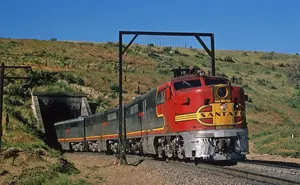
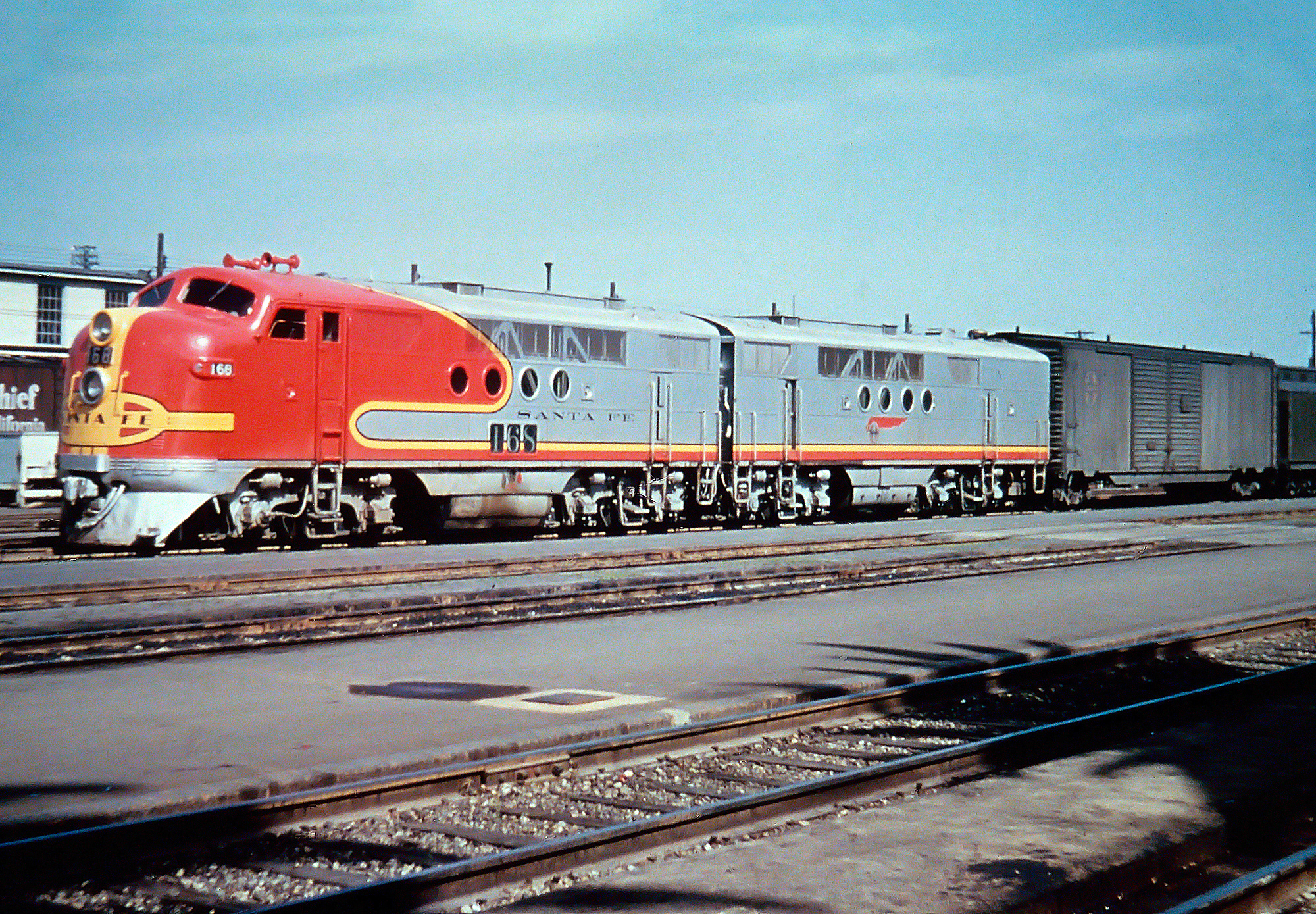 A handsome, A-B set of Santa Fe FT's, led by #168-L, have arrived at San Diego, California with what appears to be a mail/express train, circa 1950. American-Rails.com collection.
History
After witnessing the early streamliner's success in the mid-1930s, notable Union Pacific's M-10000 and Burlington's Pioneer Zephyr, Brian Solomon notes in his book, "The American Diesel Locomotive," Electro-Motive parent General Motors became convinced that the diesel locomotive could displace steam as standard power in main line service.
And there was great monetary potential in such a market as it was estimated the conversion from steam to diesel would cost the industry $4 billion. This belief led to the early boxcab's development and then the first "E" series streamlined models, designed by Electro-Motive's chief engineer Richard "Dick" Dilworth.
As Mike Schafer points out in, "Vintage Diesel Locomotives," Dilworth was also heavily involved in the FT project. Dilworth was a self-taught mechanical and electrical engineer who knew diesel engines very well, dating back to his days at General Electric when the company was involved in early diesel-electric switchers.
In developing the FT he was after a design not only capable of withstanding the everyday beating and pounding required in standard road service but also powerful enough to handle a heavy freight train.
Using General Motors' then-relatively new 12-cylinder model 567/567A prime mover, capable of producing 1,350 horsepower, Dilworth experimented with a locomotive concept that featured two engines on a single frame. Next, he equipped each locomotive with a pair of two-axle trucks powered with GM's model D7b traction motors.
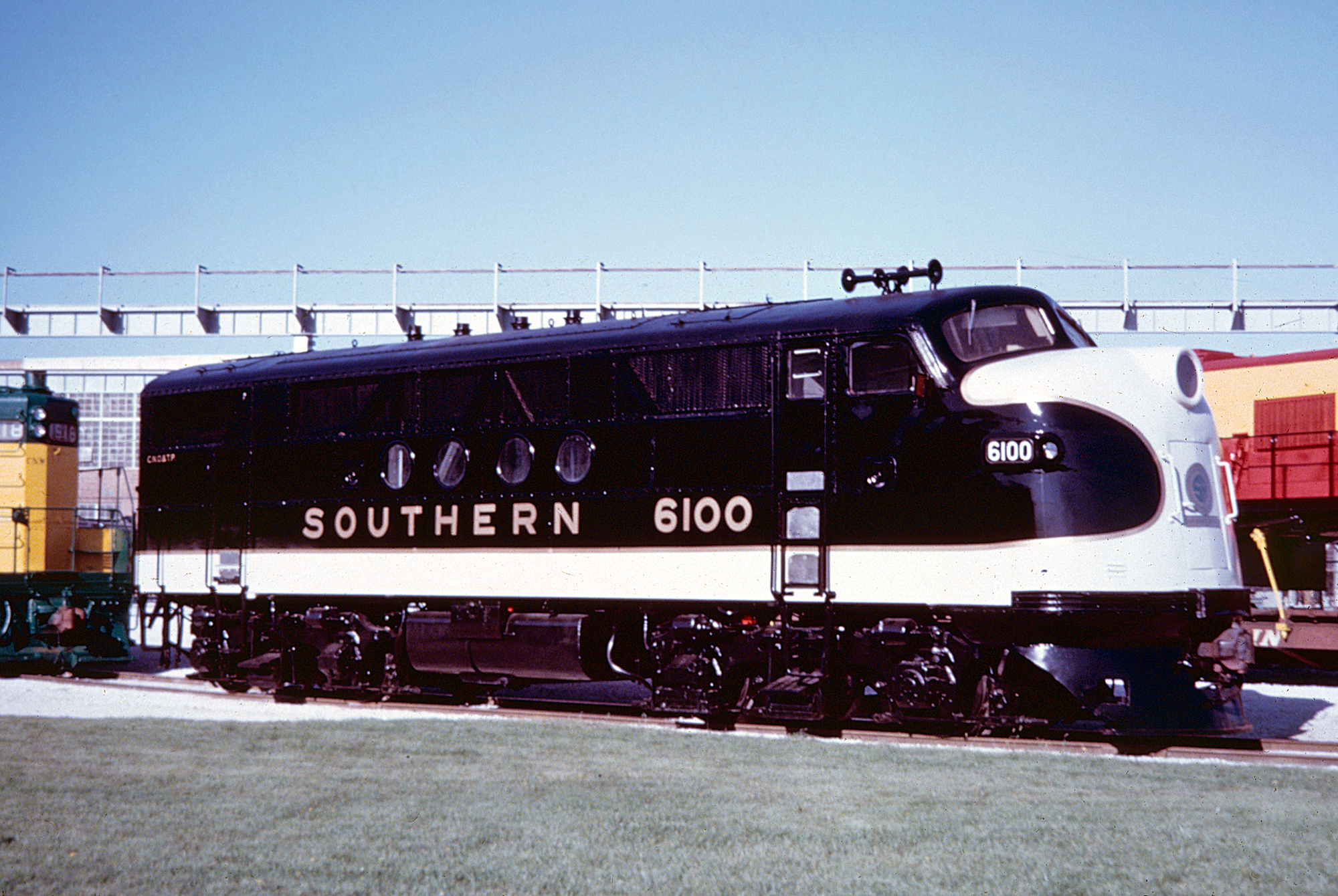 Southern Railway/CNO&TP FTA #6100, part of the famous #103 demonstrator set that toured the country in 1939, is seen here on display for Electro-Motive's 50th Anniversary celebration open house at La Grange, Illinois; September 9, 1972. American-Rails.com collection.
The two units were semi-permanently coupled using a drawbar instead of a standard knuckle coupler, which officially gave the set a 2,700 horsepower rating. By adding another A-B pair, creating an A-B-B-A lashup, a four-unit set could produce an eye-popping 5,400 horsepower.
Such power rivaled nearly any steam locomotive of the era, albeit via four units instead of one. It was this A-B-B-A set that General Motors sent to market in 1939 as the FT. The new locomotive was given a beautiful streamlined carbody designed by the company's new styling department, then headed by legendary industrial designer Leland Knickerbocker.
- Knickerbocker created many of the colorful paint schemes from the early diesel era, including Santa Fe's classic "Warbonnet" livery. -
The FT was the first to sport the now-classic "bull dog" nose that was applied to all of EMD's future cab models. The decision to wrap the locomotive in a streamlined carbody was interesting, considering it was primarily intended to handle freight assignments (although could be optionally equipped for passenger service).
As Brian Solomon notes in his book, "Electro-Motive: E Units And F Units," the reasoning was multifaceted and included redundancy (as an outgrowth of the early streamlined "Es"), advertising GM's new product, and even safety as the frame was designed to fracture behind the cab in the event of a collision thus offering the crew a level of protection (the locomotive also featured front end plows and anti climbers).
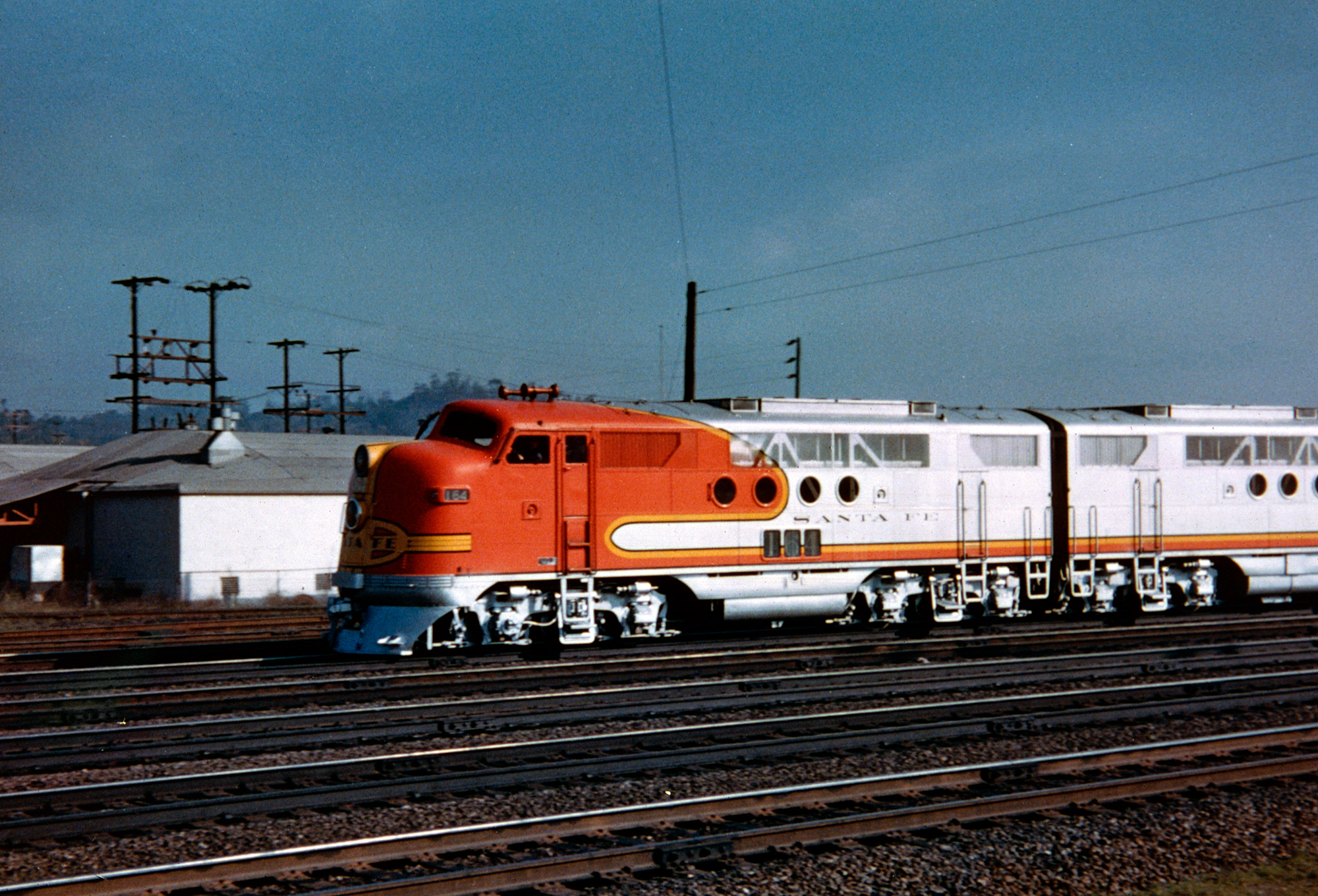 Santa Fe FT's sporting their Warbonnet livery, led by #164-L, near Los Angeles Union Passenger Terminal in March, 1947. Russ Cole photo. American-Rails.com collection.
Demonstration Tour (1939)
Officially, the FT stood for Freight, Twenty-seven hundred horsepower (two units). The demonstrator set embarked on a cross-country tour in November, 1939 featuring A units #103 and #103A and B units #103(b) and #103A(b). Interestingly, while General Motors had heavily advertised its early "Es" and diesel switchers, the demonstrator set was released quietly from La Grange with little fanfare.
During the following eleven months the four-unit set operated on 20 Class I railroads, covering some 83,764 miles in 35 different states. In the process, it convinced the industry of diesels' superiority in main line service. Its efficiency, turnaround times, reliability, and speed was simply unmatched.
The "Railway Mechanical Engineer" from April, 1941, which was reprinted in the "Train Shed Cyclopedia: No. 58" from June, 1977, details this supremacy when the Santa Fe sent its A-B-B-A set #100 on a demonstration run from Argentine Yard in Kansas City to Los Angeles between February 8 - February 15, 1941.
In addition to freight cars, the train included a dynamometer car and five business cars so that AT&SF officers could see the railroad's first main line diesel-electrics in action. The "Railway Mechanical Engineer" articles notes the following:
"No particular attempt was made for a speed record either by means of unusually high operating speeds or reduced delays on the road and at terminals. As a matter of fact, the running time for this trip of 1,761.8 miles was 54 hr., 35½ min., which gives an average running speed of 32.3 mph.
The locomotive demonstrated ample reserve capacity to handle heavier trains than the one used in the test and at substantially higher speeds. For example, the test train, with a maximum of 68 cars and 3,150 tons, was handled successfully over ascending grades up to 1.6 per cent westbound, without a helper, and at a speed generally of about 30 mph. The maximum speed attained during the run was 68 mph between Amarillo, Tex., and Clovis, NM, this portion of the road being predominantly a 0.6 per cent ascending grade.
On descending grades, the locomotive gave an excellent account of itself due to the dynamic brake. This feature was used at four places during the run for a total of 83 miles; namely, from Mountainair, NM, to Belen, 17.5 miles; Supai, Ariz., to Ash Fork, 20.0 miles; Louise, Ariz., to Yucca, 23.0 miles; and Summit, Cal., to San Bernardino, 22.5 miles. Maximum grades on these four mountains ranged from 1.27 to 3 per cent. At a speed of 20 mph, the retarding effect exerted behind the locomotive was 48,000 lb., and the horsepower 2,560. At 29 mph, the corresponding figures were 35,200 lb., and the horsepower 2,730.
In negotiating the 3 per cent descending grade westward from Summit, the train length was limited to 50 cars in accordance with customary Santa Fe practice and the retaining valves were set up as an added safety measure.
Where the dynamic retarding brake was used, it was necessary to set the train air brake only about one-fourth as much as usual. There was no evidence of excessive wheel heating throughout the run and when stops were made after descending heavy grades, the wheels never much exceeded bare hand temperature.
The total energy absorbed by the dynamic brake during its use on this run is estimated at 19,700 million foot pounds, or approximately 10 per cent of the entire energy that was used to move the train throughout the test run.
The next most significant thing about this Diesel freight locomotive test run was the fact that a total of seven steam locomotives would ordinarily have been required to take the same train from Argentine to Los Angeles, with not less than 28 stops for water, on 12 of which fuel would also have been taken.
The Diesel locomotive made the entire trip with only four stops for fuel and the addition of a little engine cooling water; namely, at Wellington, Kan., Clovis, NM, Winslow, Ariz., and San Bernardino, Cal. The locomotive was serviced at Los Angeles and could have started the return trip, if necessary, with practically no delay."
Another reason for the FT's success was its application of dynamic braking, as noted in the previous "Railway Mechanical Engineer" excerpt; it was the first diesel locomotive to employ the technology. Although this technology was not featured on the original #103 demonstrator set it was included on the first production set completed in December, 1940; Santa Fe #100 previously highlighted.
Just as electric locomotives were efficient in using the overhead catenary for regenerative braking by returning voltage back into the system, dynamic brakes worked by using the traction motors to retard the train's progress.
The March, 1945 issue of Diesel Railway Traction highlighted the FT's dynamic brakes:
"The main generator is used to furnish excitation for the traction motors, which become separately excited generators. The main generator fields are controlled in turn by a hand-operated rheostat in the driver's cab.
The traction motor armatures are connected to the air-cooled grids mounted in the roof of the locomotive; motor-driven blowers which supply cooling air to the grids are connected electrically with the grids and so act as part of the load."
To prevent engineers from overloading the grids, or traction motors, a red mark on the dial of the transition meter, as well as an accompanying flashing light, warned of the maximum intensity of braking that was permitted.
This feature not only
prolonged the life of both the wheels and brake shoes but also allowed
the locomotive to hold back very heavy trains on steep grades for an increased level of safety (and it is still used in modern day diesels).
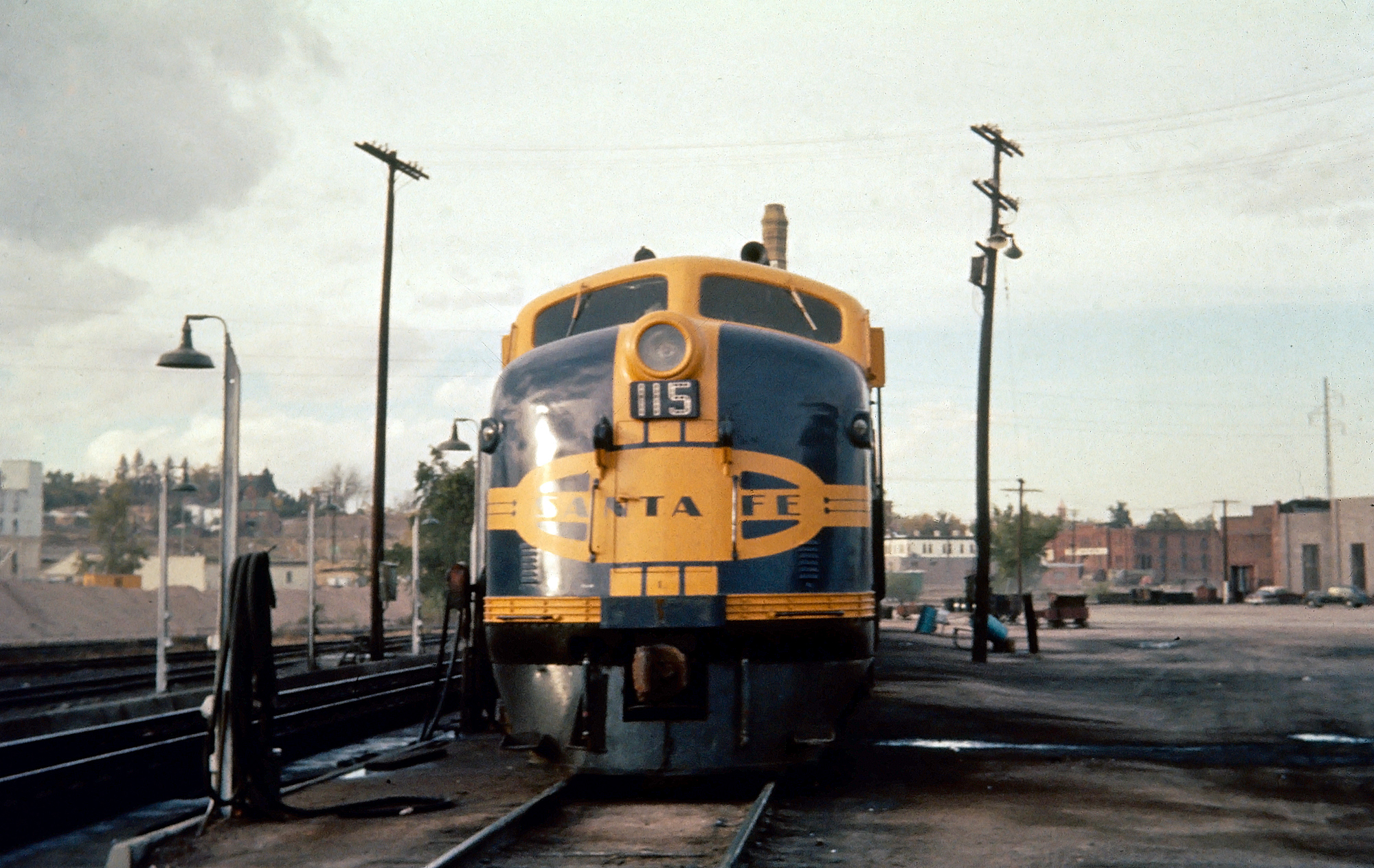 Santa Fe FTA #115-L lays over at Colorado & Southern's Rice Yard in Denver, circa 1954. American-Rails.com collection.
Specifications
One of the FT's key selling points was its tremendous starting tractive effort; on average this figure was 228,000 pounds, higher than practically any steam locomotive type ever developed. Whereas a steam engine produces its greatest tractive effort at-speed, diesels generate their highest rating when starting.
The #103 set was so powerful it often pulled apart trains as crews were unfamiliar with the new technology and knowing just how much initial exertion to apply. The FT's four-axle, B-B trucks were a primary reason for this high adhesion; these trucks were not only equipped with traction motors on each axle (unlike the early "E's" A1A-A1A trucks whose center axle was unpowered) but also enabled the locomotives to place their entire weight on the driving wheels. The trucks were designed by Martin Blomberg, who adapted them from his successful A1A trucks used on the early "Es."
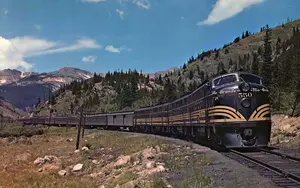
 Rio Grande FTs, including #550 closest to the photographer, are seen here at the Burnham Shops in Denver, Colorado on February 15, 1948. Richard Kindig photo.
Reception
The FT's ability to not only demonstrate its superiority in main line service but also change more than a century of deep-rooted culture is a testament to the product General Motors introduced in 1939. The fact that the builder also accomplished this feat in such a short period of time is equally as impressive.
Another issue facing GM was illustrating how a four-unit FT set was actually a single locomotive and not individual units. Otherwise, unions would require each to be fully crewed, thus eliminating many of the FT's cost savings. To accomplish this, Electro-Motive constructed a cabless "B" unit that was semipermanently coupled to an "A" unit. This pair was then semipermanently coupled to another A-B pair for a complete 5,400 horsepower set.
Yet another significant hurdle was convincing railroads to completely change how they acquired new motive power by purchasing mass-produced locomotives that were practically identical except for paint schemes and other minor variations.
This was almost unheard of up until that time when railroads typically custom-designed steam engines to fit their specific needs, working in conjunction with the manufacturer(s). In other cases, company steam shops simply designed and built locomotives from the ground up. However, GM was so confident in its product it believed it could win over the skeptics and this belief proved correct, not only with the FT but also future models like the F3 and F7.
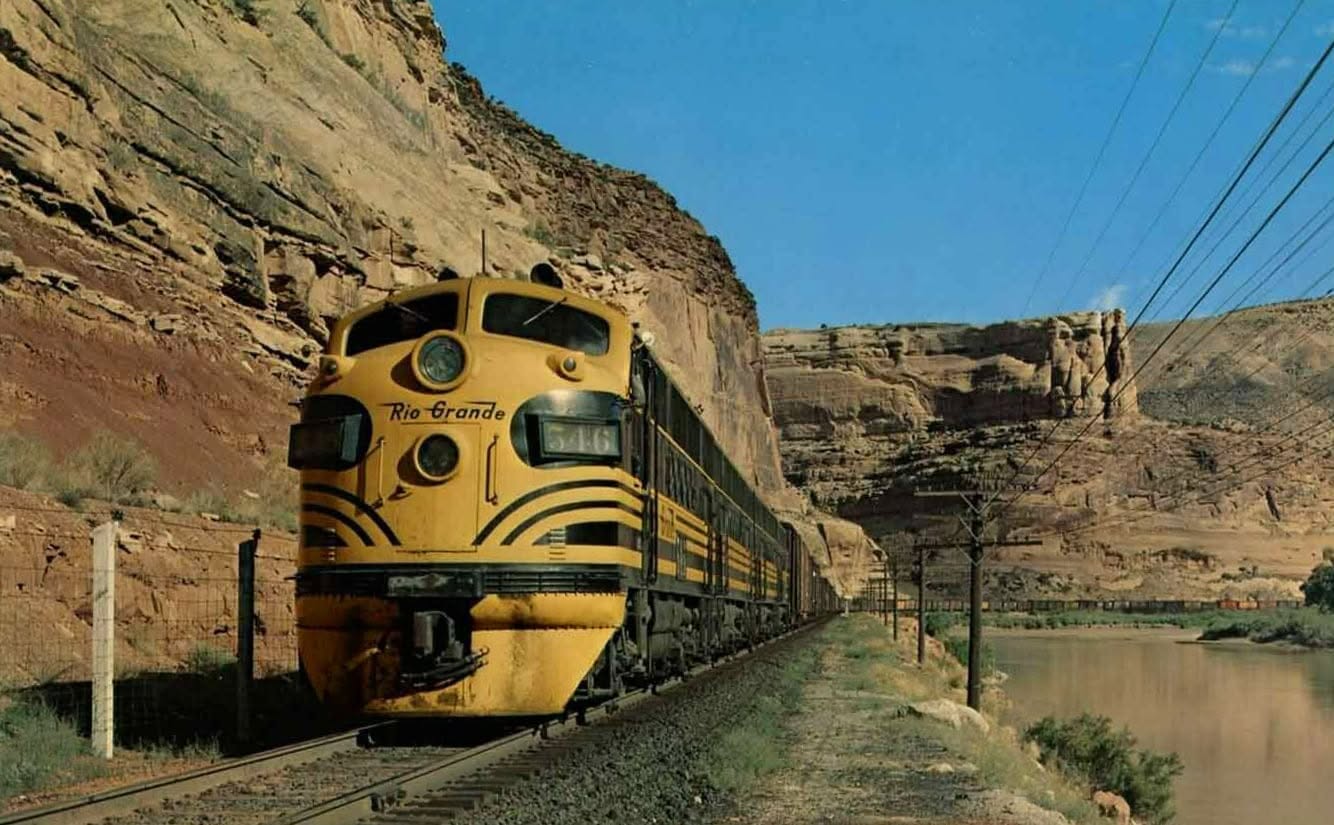 A handsome set of Rio Grande FTs, led by #546, have a long freight westbound freight passing through Utah's Ruby Canyon (not far from the Colorado state line) along the Colorado River in August, 1948. Otto Roach photo.
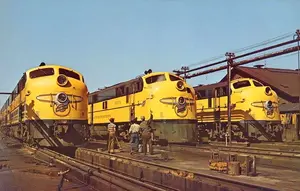
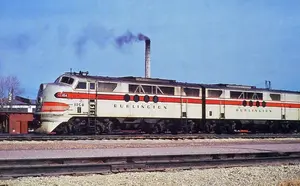
 A handsome set of well-maintained Chicago, Burlington & Quincy FT's are seen here at Galesburg, Illinois on July 1, 1956. Although new in appearance, these locomotives were 12 years old by the date of this photo.
Data Sheet
| Entered Production | 3/1939 (Demonstrator Set #103) |
| Years Produced | 3/1939 - 11/1945 |
| Engine | 567, 567A |
| Engine Builder | GM |
| Horsepower | 1350 |
| RPM | 800 |
| Cylinders | 16 |
| Length (FTA) | 48' 3" |
| Length (FTB) | 47' 6" |
| Total Length (A-B-B-A set) | 193' |
| Height (Top Of Rail To Top Of Cab) | 14' ½" |
| Width | 9' 10" |
| Weight (FTA) | 230,000 Lbs |
| Weight (FTB) | 228,000 Lbs |
| Weight (A-B-B-A set) | 923,600 Lbs |
| Fuel Capacity | 1,200 Gallons |
| Air Compressor | Gardner-Denver |
| Air Compressor Model | WBO |
| Air Brake Manufacturer | Westinghouse |
| Air Brake Schedule | 8EL |
| Trucks | B-B |
| Truck Type | Blomberg |
| Truck Wheelbase | 9' |
| Wheel Size | 40" |
| Traction Motors | D7b (4), GM |
| Primary Generator | D8, GM |
| Auxiliary Generator | Delco (A8102) |
| Alternator | D14 |
| MU (Multiple-Unit) | Yes |
| Dynamic Brakes | Yes |
| Gear Ratio | 62:15 |
| Tractive Effort (Starting) | 228,000 Lbs (Four Unit Set) |
| Tractive Effort (Continuous) | 32,500 Lbs (Four Unit Set) |
| Top Speed | 65 mph |
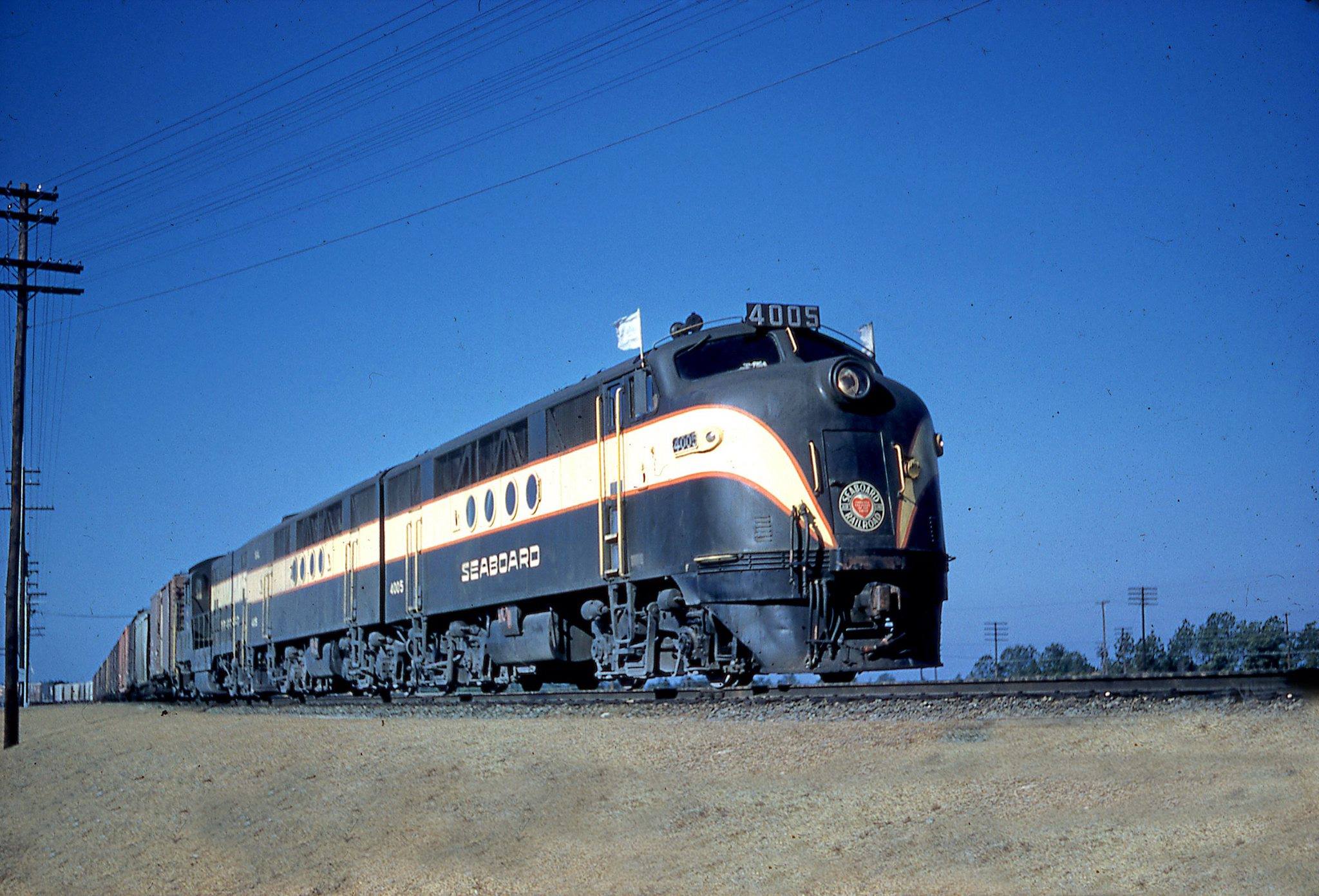 An A-B set of Seaboard Air Line FT's lead a mixed freight near Hamlet, North Carolina circa 1962. Wiley Bryan photo/Warren Calloway collection.
Production Rosters
FTA
Total Built = 555
| Owner | Road Number | Serial Number | Order Number | Completion Date |
|---|---|---|---|---|
| Electro-Motive (Demonstrator, became Southern [Cincinnati, New Orleans & Texas Pacific] 6100A) | 1030, renumbered 103 | 1030a | E390 | 3/1939 |
| Electro-Motive (Demonstrator, became Southern [Cincinnati, New Orleans & Texas Pacific] 6100D) | 1031, renumbered 103A | 1031a | E390 | 3/1939 |
| Santa Fe | 100-101 | 1198-1199 | E351 | 12/1940 |
| Santa Fe | 101, 101C | 1200-1201 | E351 | 3/1941 |
| Great Northern | 5700A-5701A | 1221a-1222a | E360 | 4/1941, 6/1941 |
| Southern (Cincinnati, New Orleans & Texas Pacific) | 6101A, 6101D | 1336a-1337a | E391 | 7/1941 |
| Milwaukee Road | 40A, 40D | 1365-1366 | E397 | 10/1941 |
| Great Northern | 5900A, 5900B, 5600A | 1383-1385 | E401 | 10/1941 |
| Santa Fe | 104 | 1406 | E409 | 11/1941 |
| Western Pacific | 901, 901C - 903, 903C | 1410-1415 | E411 | 11/1941 - 1/1942 |
| Denver & Rio Grande Western | 540, 540C - 542, 542C | 1435-1440 | E422 | 1/1942 - 2/1942 |
| Santa Fe | 105-112 | 1477-1484 | E439 | 3/1942 - 5/1942 |
| Santa Fe | 113-118 | 1485-1490 | E439 cont'd | 10/1942 - 2/1943 |
| Santa Fe | 119 | 1491 | E439 | 5/1943 |
| Seaboard Air Line | 4000-4005 | 1570-1575 | E451 | 6/1942 |
| Great Northern | 400A, 400D | 1585-1586 | E453 | 12/1943 |
| Baltimore & Ohio | 1(a), 1(d) - 5(a), 5(d) [Odds] | 1633-1638 | E470 | 8/1942 - 9/1942 |
| Baltimore & Ohio | 7(a), 7(d) - 11(a), 11(d) [Odds] | 1639-1644 | E470 | 8/1943 - 10/1943 |
| Southern (New Orleans & North Eastern) | 6800A-6803A | 1657-1660 | E485 | 7/1942 |
| Great Northern | 402A, 402D, 404A, 404D | 1721-1724 | E481 | 1/1944 |
| Great Northern | 406A, 406D - 410A, 410D (Evens) | 1756-1761 | E495 | 3/1944 - 5/1944 |
| Milwaukee ROad | 41A, 41D | 1774-1775 | E498 | 7/1943 |
| Santa Fe | 120-129 | 1779-1788 | E501 | 6/1943 - 10/1943 |
| Southern | 4100A, 4100D - 4101A, 4101D | 1819-1822 | E503 | 10/1943 - 11/1943 |
| Rock Island | 99-94 (Reversed) | 1840-1845 | E510 | 4/1944 |
| Seaboard Air Line | 4006-4009 | 1865-1868 | E518 | 8/1943 - 10/1943 |
| New York Central | 1600-1603 | 1888-1891 | E522 | 6/1944 |
| Denver & Rio Grande Western | 543 - 545 (1st and 4th Units in A-B-B-A set) | 1892-1897 | E524 | 5/1943 - 6/1943 |
| Denver & Rio Grande Western | 546 - 547 (1st and 4th Units in A-B-B-A set) | 1898-1901 | E524 | 12/1943 |
| Denver & Rio Grande Western | 548 (1st and 4th Units in A-B-B-A set) | 1902-1903 | E524 | 3/1944 |
| Boston & Maine | 4200A-4205A | 1916-1921 | E523 | 09-12/43 |
| Great Northern | 412A, 412D - 424A, 424D (Evens) | 1938-1951 | E529 | 06-10/44 |
| Boston & Maine | 4206A-4207A | 1975-1976 | E541 | 2/1944 |
| Boston & Maine | 4208A | 1977 | E541 | 10/1944 |
| Northern Pacific | 6000A, 6000D - 6002A, 6000D | 1978-1983 | E531 | 2/1944 - 5/1944 |
| Boston & Maine | 4209A-4211A | 1991-1993 | E541 | 10/1944 |
| Southern | 4102A, 4102D | 2010-2011 | E503 | 11/1943 |
| Atlantic Coast Line | 300-305 | 2013-2018 | E549 | 9/1943 - 11/1943 |
| Santa Fe | 130-142 | 2024-2036 | E551 | 10/43-04/44 |
| Missouri Pacific | 501-504 | 2072-2075 | E554 | 11/1943 - 12/1943 |
| Missouri Pacific | 505-508 | 2076-2079 | E554 | 9/1944 - 10/1944 |
| Southern (Cincinnati, New Orleans & Texas Pacific) | 6102A, 6102D | 2089-2090 | E503 | 12/1943 |
| Western Pacific | 904, 904C - 906, 906C | 2096-2101 | E559 | 6/1943 - 9/1943 |
| Chicago, Burlington & Quincy | 100A, 100D - 102A, 102D | 2108-2113 | E561 | 12/1943 - 2/1944 |
| Chicago, Burlington & Quincy | 103A, 103D - 111A, 111D | 2114-2131 | E561 | 5/1944 - 7/1944 |
| Seaboard Air Line | 4010-4011 | 2156-2157 | E563 | 11/1943 |
| Chicago, Burlington & Quincy | 112A, 112D - 114A, 114D | 2187-2192 | E561 | 8/1944 - 9/1944 |
| Atlantic Coast Line | 306-311 | 2202-2207 | E567 | 12/1943 - 1/1944 |
| Atlantic Coast Line | 312-314 | 2214-2216 | E569 | 2/1944 - 4/1944 |
| Santa Fe | 143-151 | 2224-2232 | E572 | 4/1944 - 7/1944 |
| Santa Fe | 120C-121C, 152, 152C, 122C-123C | 2233-2238 | E572 | 10/1944 |
| Santa Fe | 153, 153C, 124C-125C, 154, 154C, 126C-127C, 155, 155C, 128C-129C, 156, 156C, 130C-131C, 157, 157C | 2266-2283 | E572 | 10/1944 - 12/1944 |
| St Louis Southwestern Railway (Cotton Belt) | 900A, 900D, 905A, 905D, 910A, 910D | 2306-2311 | E581 | 6/1944 - 7/1944 |
| Seaboard Air Line | 4012-4015 | 2318-2321 | E583 | 1/1944 - 2/1944 |
| Seaboard Air Line | 4016-4021 | 2322-2327 | E583 | 9/1944 - 10/1944 |
| Rock Island | 93-90 (Reversed) | 2387-2390 | E597 | 5/1944 - 6/1944 |
| Rock Island | 89, 88 | 2391-2392 | E597 | 9/1944 |
| Atlantic Coast Line | 315-317 | 2401-2403 | E569 | 4/1944 - 5/1944 |
| Boston & Maine | 4212A-4223A | 2404-2415 | E600 | 10/1944 - 11/1944 |
| Erie | 700A, 700D - 705A, 705D | 2533-2544 | E609 | 10/1944 - 11/1944 |
| Northern Pacific | 6003A-6006A, 6003D-6006D | 2557-2564 | E611 | 7/1944 - 10/1944 |
| Santa Fe | 132C-133C, 158, 158C, 134C-135C, 159, 159C, 136C-137C, 160, 160C, 138C-139C, 161, 161C, 140C-141C, 162, 162C, 142C-143C, 163, 163C, 144C-145C, 164, 164C, 146C-147C, 165, 165C, 148C-149C, 166, 166C-167, 167C | 2573-2610 | E613 | 12/1944 - 2/1945 |
| Milwaukee Road | 42A, 42D - 47A, 47D | 2613-2624 | E615 | 7/1944 - 9/1944 |
| Atlantic Coast Line | 318-323 | 2652-2657 | E620 | 12/1944 |
| Southern | 4103A, 4103D - 4104A, 4104D, 4105A - 4105D, 4106A, 4106D | 2664-2673 | E622 | 12/1944 |
| Lehigh Valley | 500-503 | 2695-2698 | E625 | 1/1945 |
| Delaware, Lackawanna & Western | 651A-654A | 2703-2706 | E627 | 5/1945 |
| Delaware, Lackawanna & Western | 601A, 601C - 604A, 604C | 2711-2718 | E628 | 4/1945 - 5/1945 |
| Chicago, Burlington & Quincy | 115A, 115D | 2725-2726 | E561 | 9/1944 |
| Denver & Rio Grande Western | 549 - 551 (1st and 4th Units in A-B-B-A set) | 2771-2776 | E632 | 8/1944 - 10/1944 |
| Western Pacific | 907, 907C - 911, 911C | 2783-2792 | E633 | 7/1944 - 8/1944 |
| Western Pacific | 912, 912C | 2793-2794 | E633 | 11/1944 |
| Reading | 250A-259A | 2807-2816 | E634 | 1/1945 - 2/1945 |
| Northern Pacific | 6007A-6010A, 6007-6010D | 2836-2843 | E636 | 12/1944 - 1/1945 |
| Southern | 4107A, 4107D - 4108A, 4108D | 2885-2888 | E644 | 2/1945 - 3/1945 |
| Great Northern | 301A, 301C - 305A, 305C | 2915-2924 | E645 | 3/1945 - 4/1945 |
| Great Northern | 426A, 426D, 428A, 428D | 2930-2933 | E645 | 3/1945 |
| Minneapolis & St Louis | 445A, 445C, 545A, 545C | 3100-3103 | E651 | 4/1945 |
| Chicago & North Western | 5400A, 5400D - 5401A, 5401D | 3115-3118 | E653 | 5/1945 |
| New York, Ontario & Western | 801-808 | 3123-3130 | E654 | 5/1945 |
| New York Ontario & Western | 601 | 3139 | E654 | 5/1945 |
| St Louis Southwestern Railway (Cotton Belt) | 915A, 915D, 920A, 920D | 3227-3230 | E663 | 6/1945 |
| Milwaukee Road | 35A, 35D - 39A, 39D | 3245-3254 | E665 | 7/1945 |
| Santa Fe | 168,C, 150C-151C, 169, 169C, 119C, 118C, 177, 177C, 176, 176C, 105C, 170, 170C, 117C, 116C, 171, 171C, 115C, 114C, 172, 172C, 113C, 112C, 173, 173C, 111C, 110C, 174, 174C, 109C, 108C, 175, 175C, 107C, 106C | 3299-3335 | E669 | 5/1945 - 8/1945 |
| Missouri Pacific | 509-512 | 3358-3361 | E672 | 7/1945 |
| Southern | 4120, 4123-4125, 4121, 4126, 4122, 4127 | 3396-3403 | E678 | 8/1945 |
| Great Northern | 252A, 300A, 300C, 256A-258A | 3492-3497 | E689 | 10/1945 - 11/1945 |
| Santa Fe | 178, 178C - 179, 179C | 3709-3712 | E709 | 8/1945 |
| Rock Island | 70, 70A - 73, 73A | 3745-3752 | E713 | 11/1945 |
FTB
Total Built = 541
| Owner | Road Number | Serial Number | Order Number | Completion Date |
|---|---|---|---|---|
| Electro-Motive (Demonstrator, became Southern [Cincinnati, New Orleans & Texas Pacific] 6100B) | 1030(B), renumbered 103(B) | 1030 | E390 | 5/1939 |
| Electro-Motive (Demonstrator, became Southern [Cincinnati, New Orleans & Texas Pacific] 6100C) | 1031(B), renumbered 103A(B) | 1031 | E390 | 5/1939 |
| Santa Fe | 100A-101A | 1202-1203 | E352 | 12/1940 |
| Santa Fe | 100B-101B | 1204-1205 | E352 | 3/1941 |
| Great Northern | 5700B-5701B | 1221-1222 | E360 | 4/1941 - 6/1941 |
| Southern (Cincinnati, New Orleans & Texas Pacific) | 6101B, 6101C | 1336-1337 | E391 | 7/1941 |
| Santa Fe | 100C-101C, 102A, 102B, 102C - 103A, 103B, 103C | 1340-1347 | E393 | 8/1941 - 9/1941 |
| Milwaukee Road | 40B, 40C | 1367-1368 | E398 | 10/1941 |
| Great Northern | 5900C | 1386 | E402 | 10/1941 |
| Great Northern | 5600B | 1387 | E417 | 10/1941 |
| Santa Fe | 104A-104C | 1407-1409 | E410 | 11/1941 |
| Western Pacific | 901A, 901B - 903A, 903B | 1416-1421 | E412 | 11/1941 - 1/1942 |
| Denver & Rio Grande Western | 540A, 540B - 542A, 542B | 1441-1446 | E423 | 1/1942 - 2/1942 |
| Santa Fe | 105A, 105B, 105C - 112A, 112B, 112C | 1492-1515 | E440 | 3/1942 - 5/1942 |
| Santa Fe | 113A, 113B, 113C - 118A, 118B, 118C | 1516-1533 | E440 | 10/1942 - 2/1943 |
| Santa Fe | 119A-119C | 1534-1536 | E440 | 5/1943 |
| Seaboard Air Line | 4100-4105 | 1576-1581 | E452 | 6/1942 |
| Great Northern | 400B | 1587 | E454 | 12/1943 |
| Baltimore & Ohio | 1(b), 1(c) - 5(b), 5(c) [Odds] | 1645-1650 | E471 | 8/1942 - 9/1942 |
| Baltimore & Ohio | 7(b), 7(c) - 11(b), 11(c) [Odds] | 1651-1656 | E471 | 8/1943 - 10/1943 |
| Southern (New Orleans & North Eastern) | 6800B-6803B | 1661-1664 | E486 | 7/1942 |
| Great Northern | 402B, 402C, 404B, 404C | 1725-1728 | E482 | 1/1944 |
| Great Northern | 400C | 1762 | E454 | 12/1943 |
| Great Northern | 406B, 406C - 410B, 410C (Evens) | 1763-1768 | E496 | 3/1944 - 5/1944 |
| Milwaukee Road | 41B, 41C | 1776-1777 | E499 | 7/1943 |
| Santa Fe | 120A, 120B, 120C - 129A, 129B, 129C | 1789-1818 | E502 | 6/1943 - 10/1943 |
| Southern | 4100B, 4100C - 4101B, 4101C | 1823-1826 | E504 | 10/1943 - 11/1943 |
| Rock Island | 99A-94A (Reversed) | 1846-1851 | E511 | 4/1944 |
| Seaboard Air Line | 4106-4109 | 1869-1872 | E519 | 8/1943 - 10/1943 |
| Denver & Rio Grande Western | 543 - 545 (2nd and 3rd Units in A-B-B-A set) | 1904-1909 | E525 | 5/1943 - 6/1943 |
| Denver & Rio Grande Western | 546 - 547 (2nd and 3rd Units in A-B-B-A set) | 1910-1913 | E525 | 12/1943 |
| Denver & Rio Grande Western | 548 (2nd and 3rd Units in A-B-B-A set) | 1914-1915 | E525 | 3/1944 |
| Great Northern | 412B, 412C - 424B, 424C (Evens) | 1952-1965 | E530 | 6/1944 - 10/1944 |
| Boston & Maine | 4200B-4205B | 1969-1974 | E540 | 9/1943 - 12/1943 |
| Northern Pacific | 6000B, 6000C - 6002B, 6002C | 1984-1989 | E532 | 2/1944 - 5/1944 |
| Boston & Maine | 4206B-4207B | 1994-1995 | E542 | 2/1944 |
| Boston & Maine | 4208B-4211B | 1996-1999 | E542 | 10/1944 |
| Atlantic Coast Line | 300B-302B | 2019-2021 | E550 | 9/1943 - 11/1943 |
| Southern | 4102B, 4102C | 2022-2023 | E504 | 11/1943 |
| Santa Fe | 130A/130B/130C - 137A/137B/137C, 138A, 138B | 2037-2062 | E585 | 10/1943 - 3/1944 |
| Missouri Pacific | 501B-504B | 2080-2083 | E555 | 11/1943 - 12/1943 |
| Missouri Pacific | 505B-508B | 2084-2087 | E555 | 9/1944 - 10/1944 |
| Southern (Cincinnati, New Orleans & Texas Pacific) | 6102B, 6102C | 2091-2092 | E504 | 12/1943 |
| Western Pacific | 904A, 904B - 906A, 906B | 2102-2107 | E560 | 6/1943 - 9/1943 |
| Chicago, Burlington & Quincy | 100B, 100C - 102B, 102C | 2132-2137 | E562 | 12/1943-2/1944 |
| Chicago, Burlington & Quincy | 103B, 103C - 111B, 111C | 2138-2155 | E562 | 5/1944 - 7/1944 |
| Seaboard Air Line | 4110-4111 | 2158-2159 | E564 | 11/1943 |
| New York Central | 2400-2403 | 2183-2186 | E522 | 6/1944 |
| Chicago, Burlington & Quincy | 112B, 112C - 114B, 114C | 2193-2198 | E562 | 8/1944 - 9/1944 |
| Atlantic Coast Line | 303B-305B | 2199-2201 | E550 | 11/1943 |
| Atlantic Coast Line | 306B-311B | 2208-2213 | E568 | 12/1943 - 1/1944 |
| Atlantic Coast Line | 312B-317B | 2217-2222 | E570 | 2/1944 - 5/1944 |
| Santa Fe | 143A/143B/143C - 151A/151B/151C | 2239-2265 | E573 | 4/1944 - 7/1944 |
| St Louis Southwestern Railway (Cotton Belt) | 900B, 900C, 905B, 905C, 910B, 910C | 2312-2317 | E582 | 6/1944 - 7/1944 |
| Seaboard Air Line | 4112-4115 | 2328-2331 | E584 | 1/1944 - 2/1944 |
| Seaboard Air Line | 4116-4121 | 2332-2337 | E584 | 9/1944 - 10/1944 |
| Santa Fe | 138C, 139A/139B/139C - 142A/142B/142C | 2338-2350 | E585 | 3/1944 - 4/1944 |
| Rock Island | 93A-90A (Reversed) | 2393-2396 | E598 | 5/1944 - 6/1944 |
| Rock Island | 89A, 88A | 2397-2398 | E598 | 9/1944 |
| Boston & Maine | 4212B-4223B | 2416-2427 | E601 | 10/1944 - 11/1944 |
| Erie Railroad | 700B, 700C - 705B, 705C | 2545-2556 | E610 | 10/1944 - 11/1944 |
| Northern Pacific | 6003B-6006B, 6003C-6006C | 2565-2572 | E612 | 7/1944 - 10/1944 |
| Santa Fe | 167A, 167B | 2611-2612 | E613 | 2/1945 |
| Milwaukee ROad | 42B, 42C - 47B, 47C | 2625-2636 | E616 | 7/1944 - 9/1944 |
| Atlantic Coast Line | 318B-323B | 2658-2663 | E621 | 12/1944 |
| Southern | 4103B/4103C - 4104B/4104C, 4106B, 4106C | 2674-2679 | E623 | 12/1944 |
| Lehigh Valley | 500B-503B | 2699-2702 | E626 | 1/1945 |
| Delaware, Lackawanna & Western | 651B-654B | 2707-2710 | E627 | 5/1945 |
| Delaware, Lackawanna & Western | 601B-604B | 2719-2722 | E628 | 4/1945 - 5/1945 |
| Chicago Burlington & Quincy | 115B, 115C | 2727-2728 | E562 | 9/1944 |
| Denver & Rio Grande Western | 549 - 551 (2nd and 3rd Units in A-B-B-A set) | 2777-2782 | E632 | 8/1944 - 10/1944 |
| Western Pacific | 907A, 907B - 911A, 911B | 2795-2804 | E633 | 8/1944 - 9/1944 |
| Western Pacific | 912A, 912B | 2805-2806 | E633 | 11/1944 |
| Reading | 250B-259B | 2817-2826 | E634 | 1/1945 - 2/1945 |
| Northern Pacific | 6007B-6010B, 6007C-6010C | 2844-2851 | E636 | 12/1944 - 1/1945 |
| Southern | 4107B, 4107C - 4108B, 4108C | 2889-2892 | E644 | 2/1945 - 3/1945 |
| Great Northern | 301B-305B | 2925-2929 | E645 | 3/1945 - 4/1945 |
| Great Northern | 426B, 426C, 428B, 428C | 2934-2937 | E645 | 3/1945 |
| Minneapolis & St Louis | 445B, 545B | 3108-3109 | E651 | 4/1945 |
| Chicago & North Western | 5400B, 5400C - 5401B, 5401C | 3119-3122 | E653 | 5/1945 |
| New York, Ontario & Western | 801B-808B | 3131-3138 | E654 | 5/1945 |
| New York, Ontario & Western | 601B | 3141 | E654 | 5/1945 |
| St Louis Southwestern Railway (Cotton Belt) | 915B, 915C, 920B, 920C | 3231-3234 | E663 | 6/1945 |
| Milwaukee Road | 35B, 35C - 39B, 39C | 3255-3264 | E665 | 7/1945 |
| Santa Fe | 177A, 177B, 176B | 3336-3338 | E669 | 6/1945 |
| Missouri Pacific | 509B-512B | 3362-3365 | E672 | 7/1945 |
| Southern | 4116-4119 | 3404-3407 | E678 | 8/1945 |
| Great Northern | 252B, 254B-258B | 3498-3503 | E689 | 10/1945 - 11/1945 |
| Santa Fe | 178A, 178B - 179A, 179B | 3713-3716 | E709 | 8/1945 |
| Rock Island | 70B | 3753 | E713 | 11/1945 |
| Rock Island | 71B-73B | 3755-3757 | E713 | 11/1945 |
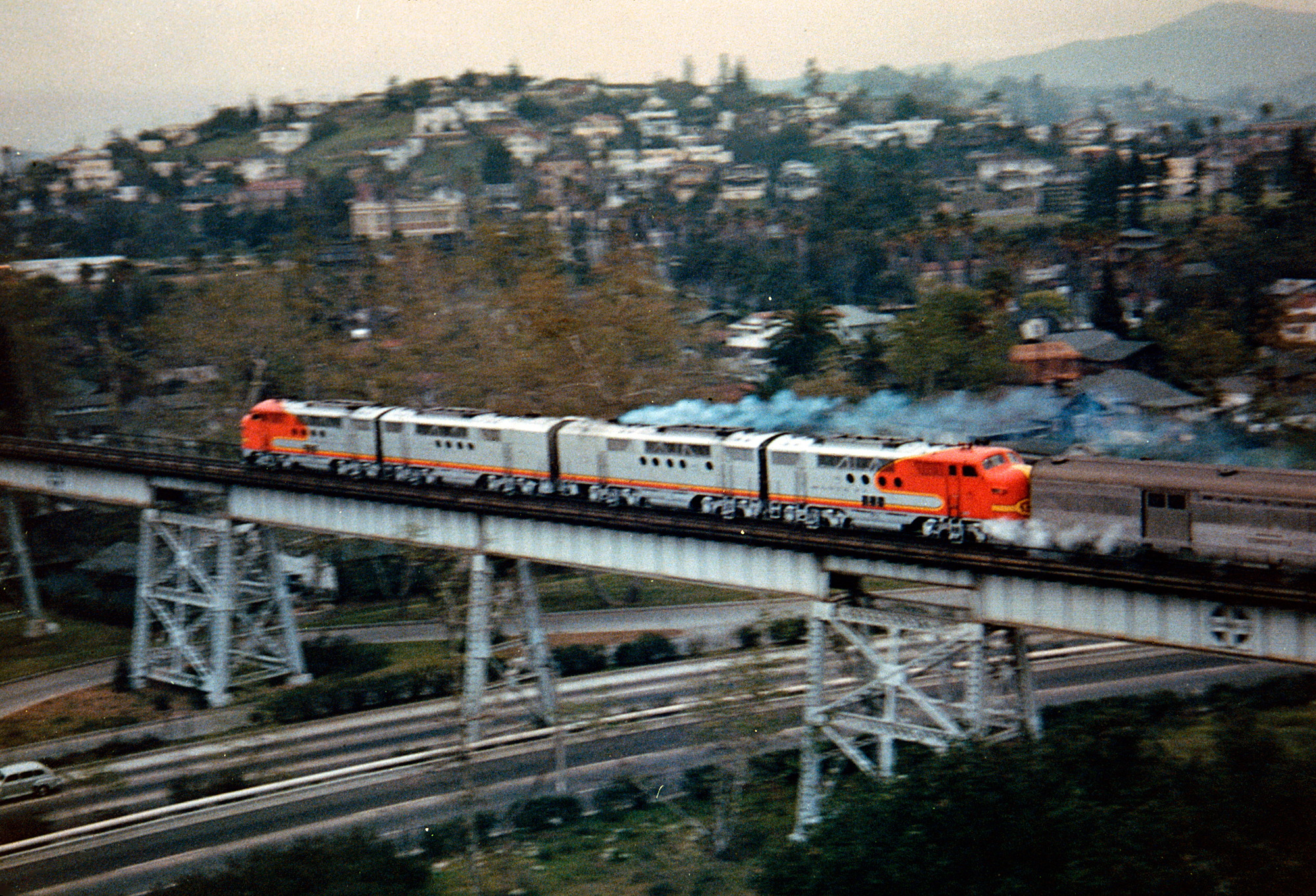 An A-B-B-A set of Santa Fe FT's are westbound as they cross the Arroyo Seco Bridge, spanning the Arroyo Seco Parkway in Los Angeles; March, 1947. Russ Cole photo. American-Rails.com collection.
In the end several Class 1s, from the Missouri Pacific and Milwaukee Road to the Baltimore & Ohio and Boston & Maine purchased the FT. None were more enamored, however, than the Santa Fe, which acquired an impressive 32o examples between December, 1940 and August, 1945.
By the time production had ended in November, 1945, Electro-Motive had sold 1,096 units. It led to the later F3 and F7, models which saw even greater sales.
Today, five FT units are preserved:
- Demonstrator A unit #103 at the National Museum of Transportation (St. Louis)
- Demonstrator B unit #103(b) at the Virginia Museum of Transportation (Roanoke)
- Northern Pacific FTA #5401D at the Puebla Museum in Mexico
- Southern Railway FTB #4100C at the National Museum of Transportation (St. Louis)
- Southern Railway FTB #4103B at the Southeastern Railway Museum (Duluth, Georgia)
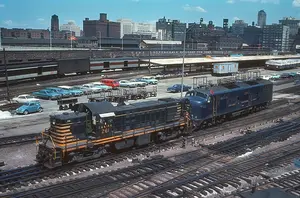
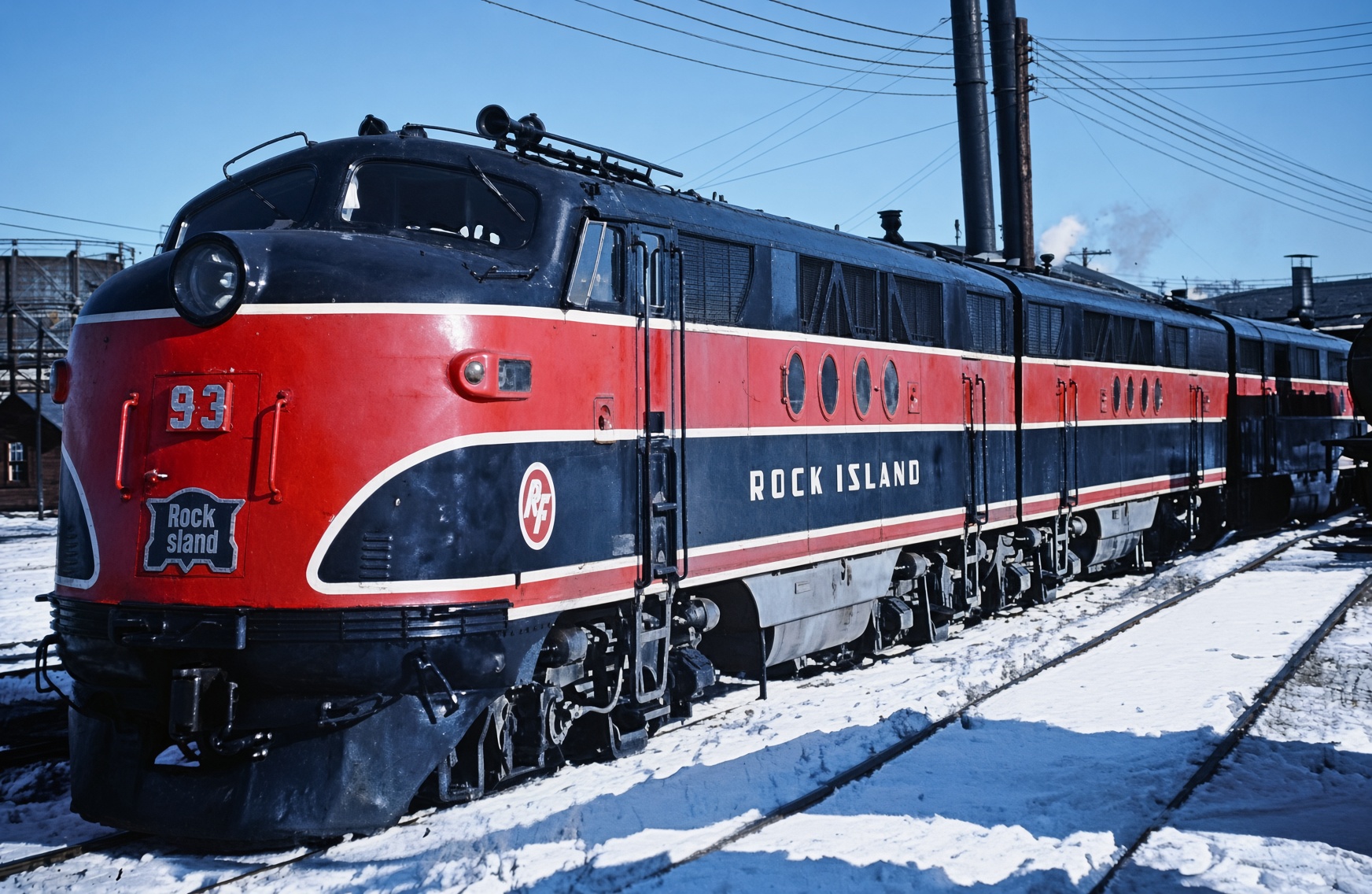 A set of Rock Island FT's are seen here in Council Bluffs, Iowa on December 24, 1952. Acquired in May, 1944 these particular FT's had already witnessed nearly a decade of service. Note #93's "RF" logo which stood for "Rocket Freight," meant to evoke the company's high-speed freight service.
Sources
- Boyd, Jim. American Freight Train, The. Osceola: MBI Publishing, 2001.
- Foster, Gerald. A Field Guide To Trains. New York: Houghton Mifflin, 1996.
- Gregg, Newton K. Train Shed Cyclopedia, No. 58: Locos Of The 40's & 50's (Diesel) Part 7, from the 1941 Loc Cyc and Railway Mechanical Engineer. Novato: Simmons-Boardman Publishing Company, 1977.
- Hayden, Bob. Diesel Locomotives: Cyclopedia, Volume 2 (Model Railroader). Milwaukee: Kalmbach Publishing Company, 1980.
- Marre, Louis A. Diesel Locomotives: The First 50 Years, A Guide To Diesels Built Before 1972. Milwaukee: Kalmbach Publishing Company, 1995.
- Pinkepank, Jerry A. Diesel Spotter's Guide. Milwaukee: Kalmbach Publishing Company, 1967.
- Solomon, Brian. American Diesel Locomotive, The. Osceola: MBI Publishing, 2000.
- Solomon, Brian. EMD Locomotives. Minneapolis: MBI Publishing Company, 2006.
- Solomon, Brian. Electro-Motive E-Units and F-Units: The Illustrated History of North America's Favorite Locomotives. Minneapolis: Voyageur Press, 2011.
Recent Articles


-
Duluth, South Shore, and Atlantic Railway: Map, Roster, Timetables
Oct 21, 26 11:21 PM
 Duluth, South Shore & Atlantic Railway, the South Shore. Marquette to the Sault, St. Ignace, Houghton, and Duluth-Superior. Soo Line on January 1, 1961. Twenty-four diesels.
 -
Detroit, Toledo and Ironton Diesel Roster (All-Time)
Oct 21, 26 02:55 PM
 All-time diesel roster of the Detroit, Toledo and Ironton. 119 frames, each counted once. Serials and builder order numbers included. Last steam was December 24, 1955.
 -
Detroit, Toledo and Ironton Steam Roster (Post 1900)
Oct 21, 26 02:49 PM
 Detroit, Toledo and Ironton steam locomotives built after 1900. Drury's class grid. The quantity column prints 141. Counted once, the frames are 137. Last steam was Mikado 805 on December 24, 1955.
 -
Detroit, Toledo and Ironton Railroad: Map, Roster, History
Oct 21, 26 02:40 PM
 Detroit, Toledo & Ironton, reporting mark DTI, from Detroit to Ironton, Ohio. Railway organized May 2, 1905. Railroad articles filed February 21, 1914. Henry Ford, 1920 to 1929. Steam and diesel r…
 -
Iowa, Chicago and Eastern Railroad: Roster, Map, History
Oct 21, 26 01:04 PM
 Iowa, Chicago & Eastern Railroad Corporation, reporting mark ICE. About 1,125 miles and about 275 miles of trackage rights from the I&M Rail Link. Operations at 12:01 a.m. July 30, 2002. Canad…
 -
Rapid City, Pierre & Eastern Railroad: Route, Roster, Overview
Oct 21, 26 10:16 AM
 Rapid City, Pierre & Eastern Railroad, reporting mark RCPE. Genesee & Wyoming Class II. Agreement of January 2, 2014, Finance Docket 35799. Freight service from June 1, 2014, on the Dakota, Mi…
 -
Dakota, Minnesota & Eastern Railroad: Roster, Map, History
Oct 21, 26 12:26 AM
 Dakota, Minnesota & Eastern Railroad, reporting mark DME. The July 2, 1986 Chicago & North Western sale, 826 miles and 139 miles of trackage rights. Canadian Pacific control October 30, 2008…
 -
Detroit and Mackinac Railway: Map, Roster, History
Oct 20, 26 11:58 PM
 Detroit & Mackinac Railway, the Turtle Line. Bay City to Cheboygan along Lake Huron. Incorporated December 29, 1894. Lake State Railway leased the operation in 1992 and bought the lines in 1997. E…
 -
Davenport, Rock Island and Northwestern Railroad
Oct 20, 26 11:22 PM
 Davenport, Rock Island and North Western Railway, the DRI Line. Clinton to East Moline across the Crescent Bridge. Burlington and Milwaukee. Merged into the Soo Line on June 29, 1995. Eighteen diesels…
 -
Chicago Great Western Steam Roster (Post 1900)
Oct 20, 26 11:17 PM
 Chicago Great Western steam locomotives built or rebuilt since 1900. Drury's class grid. 320 frames, each once. The quantity column prints 376 because a rebuild is listed again. Last steam in the reti…
 -
Chicago Great Western Diesel Roster (All-Time)
Oct 20, 26 10:47 PM
 All-time diesel roster of the Chicago Great Western. 157 frames, each counted once. Serials and builder order numbers included. Steam was gone by 1950. The 1963 glance figure of 141 is one year's flee…
 -
Chicago Great Western Railway: Map, Photos, History, Rosters
Oct 20, 26 10:43 PM
 The Chicago Great Western, the Corn Belt Route, linked Chicago, the Twin Cities, Omaha, and Kansas City from September 27, 1885, until the Chicago & North Western merger at 12:01 a.m. on July 1, 1968…
 -
Chicago, South Shore & South Bend Railroad: "The South Shore Line"
Oct 20, 26 05:48 PM
 Chicago South Shore & South Bend, the South Shore Line, from the 1901 Air Line through Samuel Insull's 1925 rebuild, the orange cars, the 800s, and the railroad NICTD and Anacostia still run.
 -
Northwestern Virginia Railroad: Map, History, Timetable
Oct 20, 26 04:18 PM
 Northwestern Virginia Railroad, chartered February 14, 1851, Grafton to Parkersburg, 104 miles. Opened May 1, 1857. Foreclosure sale February 15, 1865, as the Parkersburg Branch. Twenty-three tunnels…
 -
"Exposition Flyer" (Train): Consist, Timetable, History
Oct 20, 26 03:29 PM
 Exposition Flyer, Chicago to Oakland, June 10, 1939 to March 20, 1949. Burlington, Rio Grande, and Western Pacific. Heavyweight cars, then diesels and a vista-dome. Replaced by the California Zephyr.
 -
Chicago, St. Paul, Minneapolis & Omaha Railway, "The Omaha Road"
Oct 20, 26 02:13 PM
 The Omaha Road, reporting mark CMO. Formed May 26, 1880. North Western management on December 16, 1882. Leased January 1, 1957. Class K-1 No. 183 and the sublettered diesels.
 -
Chicago and Western Indiana Railroad: Map, Rosters, History
Oct 20, 26 01:17 PM
 Chicago and Western Indiana, chartered June 5, 1879. Five equal owners, Dearborn Station, and two main lines. Dolton suburban mile 16.6. Fifteen diesels. Railroad service ended in 1994. The Illinois c…
 -
Railroad Tell-Tales: Protecting The Brakeman
Oct 20, 26 12:58 PM
 Railroad tell-tales: hanging ropes that warned a man on a freight-car roof of a low bridge or tunnel. The 1897 bridge-warning report, the 1905 Wisconsin statute, retainers, and why the roof walk outla…
 -
Chicago & North Western Steam Roster (Post 1900)
Oct 20, 26 12:54 PM
 Chicago & North Western steam locomotives built since 1900, and the Omaha Road list beside it. Drury's parent quantity column sums to 1,445, with four rows left blank. The Omaha Road column sums to 24…
 -
Chicago & North Western Diesel Roster (All-Time)
Oct 20, 26 12:49 PM
 All-time diesel roster of the Chicago & North Western. 2,494 frames, each counted once, including Chicago Great Western, Minneapolis & St. Louis, and Omaha Road units that received North Western numbe…
 -
Chicago and North Western Railroad: Map, History, Logo
Oct 20, 26 12:37 PM
 The Chicago & North Western, chartered as the Galena & Chicago Union in 1836 and formed in June 1859. Granger railroad of the 400s, the Cowboy Line, and Powder River coal. Union Pacific common control…
 -
Chicago & Illinois Midland Steam Roster (Post 1900)
Oct 20, 26 12:30 AM
 Chicago & Illinois Midland steam locomotives built since 1900. Drury's class grid, 57 engines. Twenty-six 2-10-2s, including nine from the Wabash and nine from the Atlantic Coast Line. Last road steam…
 -
Chicago & Illinois Midland Diesel Roster (All-Time)
Oct 20, 26 12:20 AM
 All-time diesel roster of the Chicago & Illinois Midland. 28 frames, each counted once. Six SW1200s, five SD9s, the only two RS1325s, two SD18s, six SD38-2s, and four SD20s. Serials included.
 -
Chicago and Illinois Midland Railroad: Map, Rosters, History
Oct 20, 26 12:17 AM
 The Chicago & Illinois Midland moved Illinois coal for Commonwealth Edison, Taylorville and Springfield to Pekin, with Peoria over the Peoria & Pekin Union. The 1906 railway began operating February 1…
 -
Chicago & Eastern Illinois Diesel Roster (All-Time)
Oct 19, 26 04:23 PM
 All-time diesel roster of the Chicago & Eastern Illinois. 143 frames, each counted once. Switchers, F3s, FP7s, E7s, the BL1, and the GP7s through GP35s. Serials included.
 -
Chicago & Eastern Illinois Steam Roster (Post 1900)
Oct 19, 26 04:19 PM
Chicago & Eastern Illinois steam locomotives built or rebuilt since 1900. 146 Consolidations, 60 Mikados, and 24 Pacifics. Drury's class grid. Last steam was Mikado 1944 at Vincennes on May 5, 1950. -
Chicago and Eastern Illinois Railroad: Map, Rosters, History
Oct 19, 26 03:57 PM
 The Chicago & Eastern Illinois ran from Chicago to Evansville, St. Louis, and Thebes. First company of the name, August 28, 1877. The remainder merged into the Missouri Pacific on October 15, 1976. St…
 -
Rock Island Diesel Roser: All-Time
Oct 19, 26 11:05 AM
 Chicago, Rock Island and Pacific diesel locomotives, 1,029 frames counted once. Switchers, cab units, road-switchers, two acquired slugs, five RDCs, and bi-power 10000. Serial and order are separate c…
 -
Rock Island Steam Roster: Post 1900
Oct 19, 26 11:01 AM
Chicago, Rock Island and Pacific steam locomotives built or rebuilt since 1900. Drury's class grid, 1,482 frames counted once, including 85 4-8-4s. Last revenue steam was July 1953. -
Rock Island Railroad: Map, Pictures, Logo, History
Oct 19, 26 10:51 AM
 The Chicago, Rock Island and Pacific ran from Chicago to the Twin Cities, Denver, Tucumcari, and the Gulf. First train October 10, 1852. Directed service ended March 23, 1980. Steam and diesel rosters…
 -
EMD "F7" Locomotives: Cab, Top Speed, Specs, Rosters
Oct 19, 26 12:27 AM
 EMD F7 cab units and boosters, 1,500 horsepower, built February 1949 through December 1953. Gear ratios, specifications, and the production roster by owner, serial, and order.
 -
Harlem Transfer Company: An NYC Terminal System
Oct 19, 26 12:01 AM
 Harlem Transfer Company, the Lackawanna's offline freight terminal on the Bronx side of the Harlem River at East 135th Street. Carfloats to Hoboken, boxcab No. 2, and GE 44-tonner 53.
 -
Belpre Industrial Parkersburg Railroad: Roster, History, Photos
Oct 18, 26 11:44 PM
 Belpre Industrial Parkersburg Railroad, a Class III short line leasing about 46.9 miles of CSX track at Parkersburg since 2020. The Ohio River bridge, the Marietta Subdivision, and five GP38-3s.
 -
Chicago, Peoria & St. Louis Railroad: Map, Timetables, History
Oct 18, 26 10:57 PM
 Chicago, Peoria & St. Louis Railroad, an Illinois line from Pekin and Peoria through Springfield to Madison. Chartered in 1853. Sold in parcels on November 20, 1924. The Pekin line is today the Illino…
 -
Chicago, Burlington & Quincy Diesel Roster (All-Time)
Oct 18, 26 10:54 PM
 All-time diesel roster of the Chicago, Burlington & Quincy. 951 parent frames, 72 Colorado & Southern, and 36 Fort Worth & Denver, each counted once. Serials included.
 -
Burlington Railroad (CB&Q): Map, History, Rosters, Photos
Oct 18, 26 10:49 PM
 The Chicago, Burlington & Quincy, the Burlington Route, ran from Chicago to Denver, the Twin Cities, and the Gulf. Steam built since 1900 and the diesel fleets are companion rosters. Burlington Northe…
 -
Chicago, Burlington & Quincy Steam Roster (Post 1900)
Oct 18, 26 10:33 PM
 Chicago, Burlington & Quincy steam locomotives built or rebuilt since 1900. 429 Prairies, 383 Mikados, the Hudsons, and the O-5 4-8-4s. Drury's class grid.
 -
Virginian Railway's 2-6-6-6 Locomotives (Class AG)
Oct 18, 26 01:38 PM
 Virginian Railway class AG. Eight Lima 2-6-6-6s, Nos. 900-907, built in 1945 for the east end. Billed at 753,000 pounds. Scrapped in 1960.
 -
Pennsylvania (PRR) Steam Roster: Post 1906
Oct 18, 26 01:05 PM
ennsylvania steam after 1906—H8, H9, and H10 Consolidations, 574 L1s Mikados, 598 I1s Decapods, 425 K4s Pacifics, 301 M1 Mountains. Drury’s grid. Last steam November 30, 1957. -
Chicago, Aurora and Elgin Railroad: The "Roarin' Elgin"
Oct 18, 26 10:54 AM
The Chicago, Aurora & Elgin, the Roarin' Elgin, ran 600-volt third-rail trains from Chicago to Aurora, Batavia, and Elgin. Passenger service ended at noon on July 3, 1957. Freight ended June 11, 1959. -
Algoma Central Railway: Map, Logo, Rosters
Oct 17, 26 10:49 PM
 Algoma Central Railway, Sault Ste. Marie to Hearst. Wisconsin Central on February 1, 1995. Fifty-nine steam locomotives and forty-two diesels.
 -
Akron, Canton and Youngstown Railroad: Map, History, Rosters
Oct 17, 26 05:49 PM
 Akron, Canton and Youngstown Railroad, Mogadore to Delphos. The rails never reached Canton or Youngstown. Norfolk & Western control on October 16, 1964. Twenty-six diesels and the historical society's…
 -
Georgia Railroad: Map, History, Logo, Rosters
Oct 17, 26 12:59 PM
 Georgia Railroad, the Georgia Railroad and Banking Company, Augusta to Atlanta, with the Athens branch and the Macon Road. Mark GA. The railroad properties were sold on November 4, 1982.
 -
West Point Route (Railroad): Map, History, Logo
Oct 16, 26 11:26 PM
 The West Point Route was a trademarked name comprising the Atlanta & West Point and Western Railway of Alabama, which were controlled by the Georgia Railroad.
 -
Virginian Railway Diesel Roster (All-Time)
Oct 16, 26 11:11 PM
 All-time diesel roster of the Virginian Railway. 40 Fairbanks-Morse H16-44s, 25 H24-66 Train Masters, and one GE 44-tonner. Serials included.
 -
Virginian Railway Steam Roster (Post 1900)
Oct 16, 26 10:55 PM
 Virginian Railway steam locomotives built since 1900. Mikados, 2-8-8-2s, the Triplex, class AE 2-10-10-2s, and the 1945 2-6-6-6s.
 -
Virginian Railway: Map, Rosters, History, Electrification
Oct 16, 26 10:51 PM
 Virginian Railway, Deepwater to Norfolk. Combined in 1907 and completed in 1909. Electrified from Roanoke to Elmore. Absorbed by the Norfolk & Western on December 1, 1959.
 -
Baldwin "Centipede" Locomotives: Specs, Roster, Photos
Oct 16, 26 03:58 PM
 Baldwin DR-12-8-1500/2 Centipede—2-D+D-2, two 608SC engines, 3,000 hp. SAL 4500 from the 1943 test bed. 54 on the serial list, 52 sold. PRR BP60 then BH50. None preserved.
 -
Louisville & Nashville Class M-1 2-8-4s: The Big Emmas
Oct 16, 26 03:52 PM
Louisville & Nashville class M-1, 42 Big Emma 2-8-4s. Baldwin in 1942 and 1944, Lima in 1949. Coal trains from Neon to DeCoursey. No locomotive survives. -
Tennessee, Alabama and Georgia Railway: Map, History, Rosters
Oct 16, 26 03:21 PM
 Tennessee, Alabama and Georgia Railway, Chattanooga to Gadsden. The May 1929 card is 91.7 miles. Southern stock control closed on a January 1, 1971 schedule. Five diesels and Prince's steam list.