
Alco "RSD4" Locomotives: Data Sheet, Roster, Specs
Last revised: December 27, 2024
By: Adam Burns
The RSD4 was Alco's fourth installment of its six-axle Road
Switcher (RS) series built at the same time as the RS3. Essentially,
the design was a C-C version of that model (Alco had also produced an
A1A-A1A RSC3).
Unfortunately, it was one of the least successful with fewer than 50 produced by the time production had ended during its two year production run. Perhaps most notable was the incredible tractive effort it offered, by far the most of any RS model produced up until that time.
Overview
Alas, railroads still had yet to embrace the six-axle concept, another reason for the design's poor sales. If one wanted to catch these rare locomotives in action by the 1980's, a good place to start was the Chicago & North Western.
Also known as the "Cheap & Nothing Wasted," C&NW was really pinching pennies in those days; they rebuilt older locomotives, purchased used first-generation power, and continued operating Alco's long after most other Class I's had sold or scrapped theirs.
The RSD4's could be found working the railroad's famous "Alco Line," a secondary corridor which stretched from Winona, Minnesota to Rapid City, South Dakota.
Photos
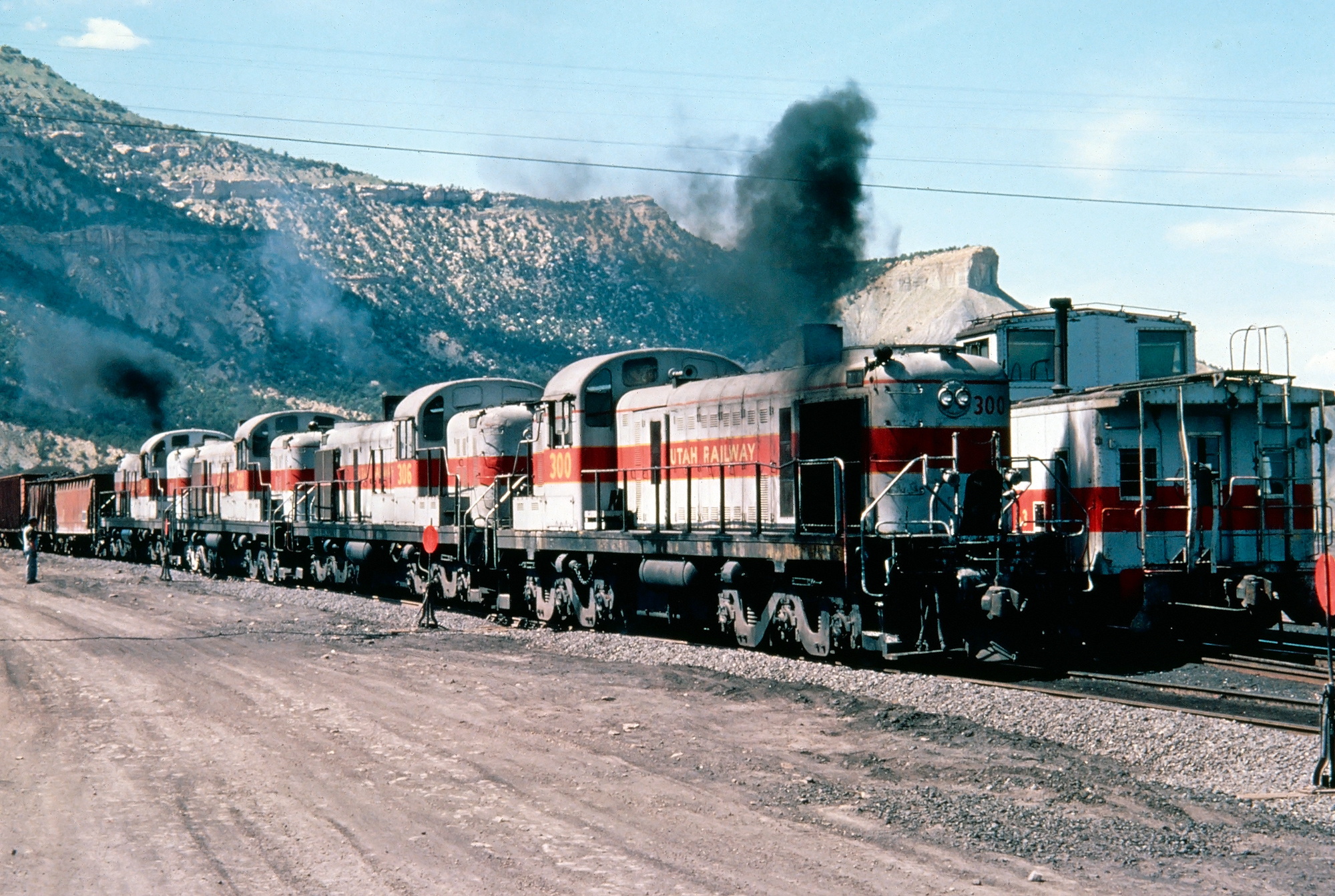 Utah Railway RSD-4's #300, #301, and #304, along with RSD-5 #306, burble and belch away as they work the loadout at Mohrland, Utah during the 1970s. American-Rails.com collection.
Remaining first-generation Alco's were sent here to streamline maintenance and it was a railfan's paradise. One could find RS11's, RS3's, RSD4's, RSD5's, C425's, RS36's, and others pulling freights that creaked and weaved along decaying trackage.
The RSD4 line was built for two years, between 1951 and 1952 at the same time as the RS3. The locomotive featured Alco's standard, but troublesome, 244 model prime mover allowing for 1,600 horsepower.
As with the original six-axle model (RSD1) the RSD4 was meant to provide a sizable increase in tractive effort. The model had a slight design flaw as there was insufficient space for the unit's main generator, which was corrected with the RSD5 featuring a longer hood and carbody.
As a result of this change the RSD5 sold much better than the RSD4 with nearly six times more units produced during the time Alco cataloged the locomotive, from 1952 through 1956.
Significance
One important historical note about; from a technical standpoint, the model was the very first C-C design (meaning all six axles were powered) that Alco offered standard in its catalog.
The RSD1 was merely a specialty order for the US Army and the RSC2 and RSC3 locomotive were A1A-A1A designs whereby the center axle was not powered (i.e., lacking traction motors).
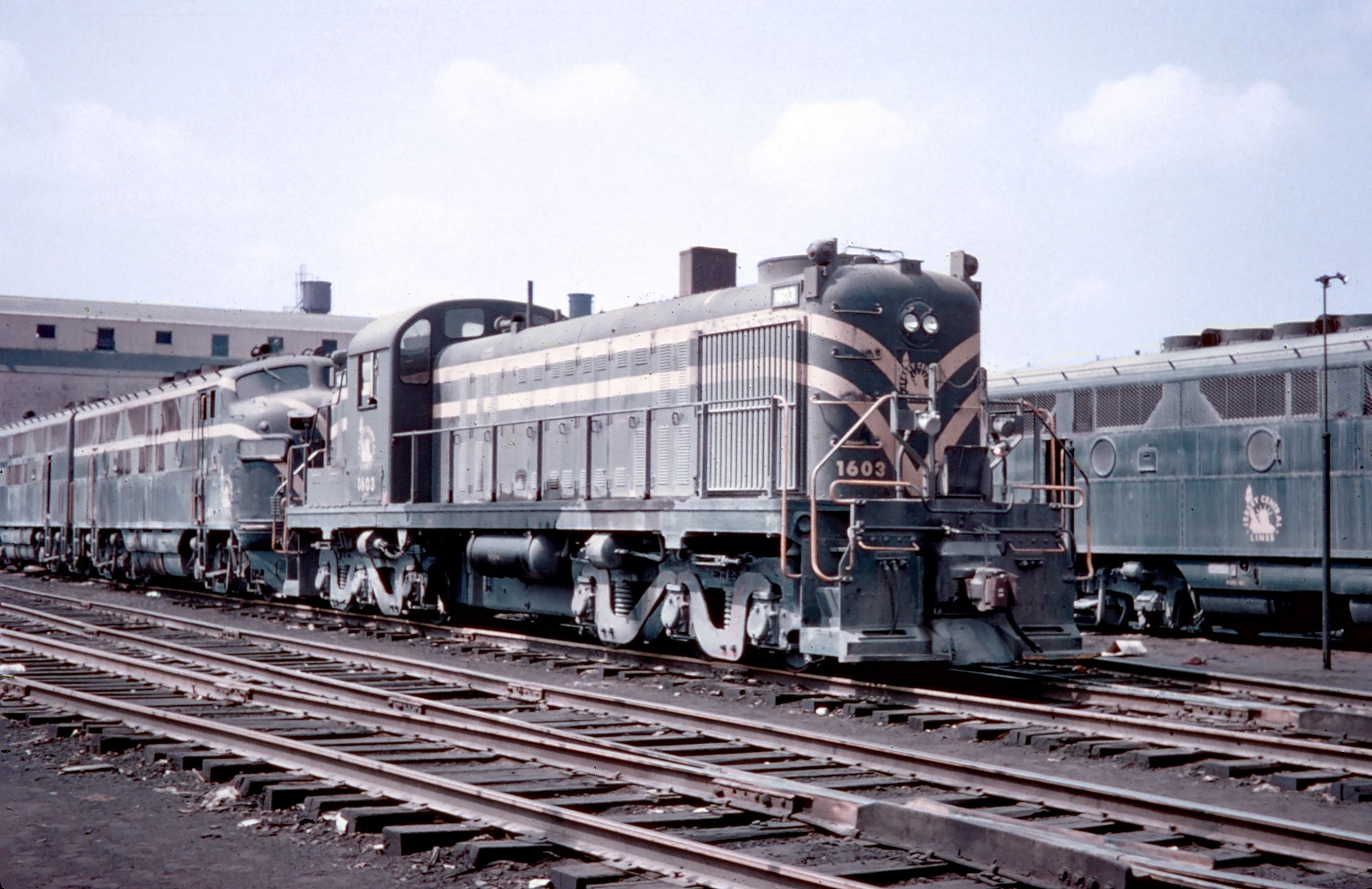 Jersey Central RSD4 #1603 was photographed here at the road's terminal in Jersey City, New Jersey in 1964. American-Rails.com collection.
With the RSD4's six motors the model could produce a starting tractive effort rating of 89,000 pounds and 78,750 continuous. This was nearly a 33% increase over the RSC3 which could produce 60,100 pounds starting tractive effort and 52,500 continuous.
Data Sheet and Specifications
| Alco Class | 606-DL-360 |
| Entered Production | 3/1951 (Chicago & North Western #1515) |
| Years Produced | 5/16/1950-8/1956 |
| Model Specification | E1663/A |
| Engine | 244, V-12 |
| Horsepower | 1,600 |
| RPM | 1,000 |
| Carbody Styling | Alco |
| Length (Between Coupler Pulling Faces) | 55' 11.75" |
| Weight | 360,000 Lbs. (Optionally reduced to 270,000 Lbs.) |
| Dynamic Brakes | Optional |
| Trucks | C-C |
| Truck Type | Trimount |
| Truck Wheelbase | 12' 6" |
| Wheel Size | 40" |
| Traction Motors | GE 752 (6) |
| Traction Generator | GT581 |
| Steam Generator | - |
| Gear Ratio | 74:18 |
| Tractive Effort Rating | 78,750 Lbs. at 5.5 MPH |
| Top Speed | 60 MPH |
Production Roster
Total Built = 36
| Owner | Road Number(s) | Serial Number(s) | Date Built |
|---|---|---|---|
| Santa Fe | 2100 | 78218 | 6/1951 |
| Santa Fe | 2101 - 2105 | 78386-78390 | 6/1951 - 9/1951 |
| Santa Fe | 2106 - 2109 | 78741-78744 | 9/1951 - 10/1951 |
| Chicago & North Western | 1515 - 1517 | 78214-78216 | 3/1951 - 4/1951 |
| Chicago & North Western | 1619, 1620 | 80445, 80446 | 8/1952 |
| Central Railroad of New Jersey | 1601 - 1606 | 78745-78750 | 11/1951 - 1/1952 |
| Central Railroad of New Jersey | 1607, 1608 | 78946, 78947 | 1/1952 |
| Central Railroad of New Jersey | 1609 - 1614 | 78949-78954 | 1/1952 - 2/1952 |
| Kennecott Copper Corporation | 201 | 78217 | 5/1951 |
| Utah Railway | 300 | 78948 | 1/1952 |
| Utah Railway | 301, 302 | 78955, 78956 | 2, 3/1952 |
| Utah Railway | 303, 304 | 80284, 80285 | 7/1952, 8/1952 |
| Utah Railway | 305 | 80444 | 8/1952 |
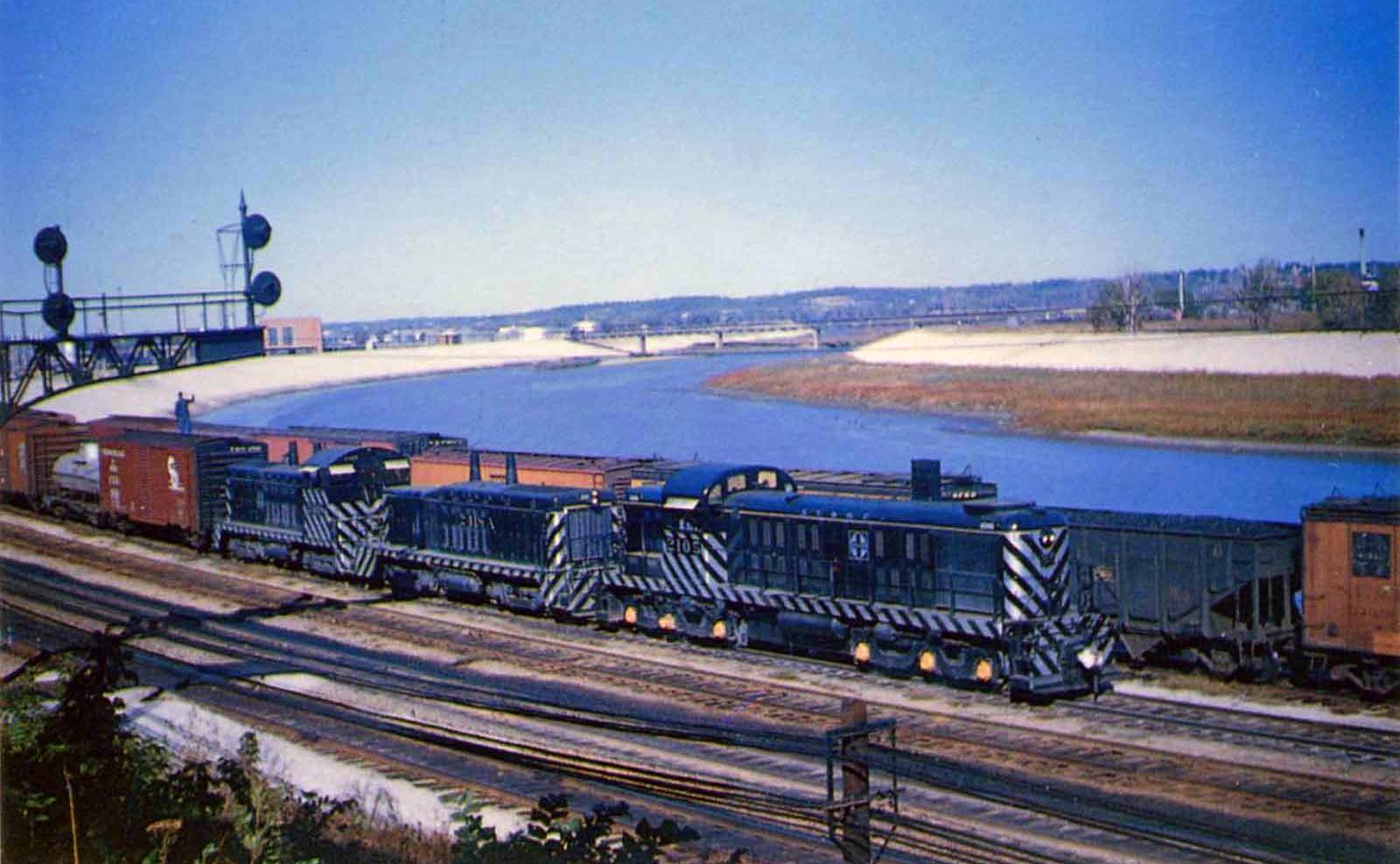 Santa Fe RSD4 #2105 and a cow-calf set (TR4 #2418/#2418A) work yard service in Argentine, Kansas at the east end of Argentine Yard along the Kansas River on October 17, 1954. Mac Owen photo.
Internally, the RSD4 was supplied with parts from General Electric (its model 752 traction motor) and Westinghouse (air brakes and compressors). It kept the same frame as the RS3, remaining at a length of 55 feet, 11 inches.
However, the one striking difference aside from its six axles was the weight; at 180 tons the RSD4 weighed nearly 70 tons more than the RS3 (of course, this weight also added to its increased tractive effort).
Use
The five railroads that ultimately did
purchase the model used them as intended, in heavy freight service.
This include the Atchison, Topeka & Santa Fe, Utah
Railway, Central Railroad of New Jersey, Kennecott Copper Corporation, and the
Chicago & North Western.
Today at least one RSD4 remains preserved, and operational, Kennecott Copper Corporation #201 (the only RSD4 the company ever owned).
Sources
- Foster, Gerald. A Field Guide To Trains. New York: Houghton Mifflin, 1996.
- Kirkland, John F. Diesel Builders, The: Volume Two, American Locomotive Company And Montreal Locomotive Works. Glendale: Interurban Press, 1989.
- Pinkepank, Jerry A. Diesel Spotter's Guide. Milwaukee: Kalmbach Publishing Company, 1967.
- Solomon, Brian. Alco Locomotives. Minneapolis: Voyageur Press, 2009.
Recent Articles


-
Building A T1 Again: The PRR 5550 Project
Feb 15, 26 06:10 PM
 Today, a nonprofit group, the PRR T1 Steam Locomotive Trust, is doing something that would have sounded impossible for decades: building a brand-new T1 from the ground up.
 -
PRR T1 No. 5550’s Cylinders Nearing Completion
Feb 15, 26 12:53 PM
 According to a project update circulated late last year, fabrication work on 5550’s cylinders has advanced to the point where they are now “nearing completion,” with the Trust reporting cylinder work…
 -
Santa Fe 3415's Rebuild Nears Completion
Feb 15, 26 12:14 PM
 One of the Midwest’s most recognizable operating steam locomotives is edging closer to the day it can lead excursions again.
 -
Ohio Pizza Train Rides
Feb 15, 26 10:59 AM
 Among Lebanon Mason & Monroe Railroad's easiest “yes” experiences for families is the Family Pizza Train—a relaxed, 90-minute ride where dinner is served right at your seat, with the countryside slidi…
 -
Wisconsin Pizza Train Rides
Feb 15, 26 10:57 AM
 Among Wisconsin Great Northern's lineup, one trip stands out as a simple, crowd-pleasing “starter” ride for kids and first-timers: the Family Pizza Train—two hours of Northwoods views, a stop on a tal…
 -
Illinois "Pizza" Train Rides
Feb 15, 26 10:55 AM
 For both residents and visitors looking to indulge in pizza while enjoying the state's picturesque landscapes, the concept of pizza train rides offers a uniquely delightful experience.
 -
Tennessee's ~ Murder Mystery ~ Dinner Train Rides
Feb 15, 26 10:50 AM
 Amidst the rolling hills and scenic landscapes of Tennessee, an exhilarating and interactive experience awaits those with a taste for mystery and intrigue.
 -
California's ~ Murder Mystery ~ Dinner Train Rides
Feb 15, 26 10:48 AM
 When it comes to experiencing the allure of crime-solving sprinkled with delicious dining, California's murder mystery dinner train rides have carved a niche for themselves among both locals and touri…
 -
Virginia's Dinner Train Rides In Staunton!
Feb 15, 26 10:46 AM
 If you’ve ever wished you could pair a classic scenic train ride with a genuinely satisfying meal—served at your table while the countryside rolls by—the Virginia Scenic Railway was built for you.
 -
New Hampshire's Dinner Train Rides In N. Conway
Feb 15, 26 10:45 AM
 Tucked into the heart of New Hampshire’s Mount Washington Valley, the Conway Scenic Railroad is one of New England’s most beloved heritage railways.
 -
Union Pacific 4014 Begins Coast-To-Coast Tour
Feb 15, 26 12:30 AM
 Union Pacific’s legendary 4-8-8-4 “Big Boy” No. 4014 is scheduled to return to the main line in a big way this spring, kicking off the railroad’s first-ever coast-to-coast steam tour as part of a broa…
 -
Amtrak Introduces The Cascades Airo Trainset
Feb 15, 26 12:11 AM
 Amtrak pulled the curtain back this month on the first trainset in its forthcoming Airo fleet, using Union Station as a stage to preview what the railroad says is a major step forward in comfort, acce…
 -
Nevada Northern Railway 2-8-0 81 Returns
Feb 14, 26 11:54 PM
 The Nevada Northern Railway Museum has successfully fired its Baldwin-built 2-8-0 No. 81 after a lengthy outage and intensive mechanical work, a major milestone that sets the stage for the locomotive…
 -
Metrolink F59PH 851 Preserved In Fullerton, CA
Feb 14, 26 11:41 PM
 Metrolink has donated locomotive No. 851—its first rostered unit—to the Fullerton Train Museum, where it will be displayed and interpreted as a cornerstone artifact from the region’s modern passenger…
 -
Oregon's Dinner Train Rides Near Mt. Hood!
Feb 14, 26 09:16 AM
 The Mt. Hood Railroad is the moving part of that postcard—a century-old short line that began as a working railroad.
 -
Maryland's Dinner Train Rides At WMSR!
Feb 14, 26 09:15 AM
 The Western Maryland Scenic Railroad (WMSR) has become one of the Mid-Atlantic’s signature heritage operations—equal parts mountain railroad, living museum, and “special-occasion” night out.
 -
Colorado Wild West Train Rides
Feb 14, 26 09:13 AM
 If there’s one weekend (or two) at the Colorado Railroad Museum that captures that “living history” spirit better than almost anything else, it’s Wild West Days.
 -
South Dakota Beer Tasting Train Rides
Feb 14, 26 09:11 AM
 While the 1880 Train's regular runs are a treat in any season, the Oktoberfest Express adds an extra layer of fun: German-inspired food, seasonal beer, and live polka set against the sound and spectac…
 -
Kentucky Wild West Train Rides
Feb 14, 26 09:10 AM
 One of KRM’s most crowd-pleasing themed events is “The Outlaw Express,” a Wild West train robbery ride built around family-friendly entertainment and a good cause.
 -
Pennsylvania "Wild West" Train Rides
Feb 14, 26 09:08 AM
 The Keystone State is home to a variety of historical attractions, but few experiences can rival the excitement and nostalgia of a Wild West train ride.
 -
Indiana "Wild West" Train Rides
Feb 14, 26 09:06 AM
 Indiana offers a unique opportunity to experience the thrill of the Wild West through its captivating train rides.
 -
B&O Observation "Washington" Cosmetically Restored
Feb 14, 26 12:25 AM
 Visitors to the B&O Railroad Museum will soon be able to step into a freshly revived slice of postwar rail luxury: Baltimore & Ohio No. 3316, the observation-tavern car Washington.
 -
Southern 2-8-2 4501 Returns To Classic Green
Feb 14, 26 12:24 AM
 Tennessee Valley Railroad Museum officials announced that Southern Railway steam locomotive No. 4501—the museum’s flagship 2-8-2 Mikado—will reappear from its annual inspection wearing the classic Sou…
 -
Illinois Murder Mystery Dinner Train Rides
Feb 13, 26 12:04 PM
 Among Illinois's scenic train rides, one of the most unique and captivating experiences is the murder mystery excursion.
 -
Vermont ~ Murder Mystery ~ Dinner Train Rides
Feb 13, 26 12:00 PM
 There are currently murder mystery dinner trains offered in Vermont but until recently the Champlain Valley Dinner Train offered such a trip!
 -
Missouri Ice Cream Tasting Train Rides
Feb 13, 26 11:47 AM
 Among the Iron Mountain Railway's warm-weather offerings, the Ice Cream Express stands out as a perfect “easy yes” outing: a short road trip, a real train ride, and a built-in treat that turns the who…
 -
Florida "Wild West" Train Rides
Feb 13, 26 09:53 AM
 This article delves into wild west rides throughout Florida, the historical context surrounding them, and their undeniable charm.
 -
West Virginia "Wild West" Train Rides
Feb 13, 26 09:49 AM
 While D&GV is known for several different excursions across the region, one of the most entertaining rides on its calendar is the Greenbrier Express Wild West Special.
 -
Alabama "Wild West" Train Rides
Feb 13, 26 09:47 AM
 Although Alabama isn't the traditional setting for Wild West tales, the state provides its own flavor of historic rail adventures that draw enthusiasts year-round.
 -
Michigan "Wild West" Train Rides
Feb 13, 26 09:46 AM
 While the term "wild west" often conjures up images of dusty plains and expansive deserts, Michigan offers its own unique take on this thrilling period of history.
 -
Grand Trunk Western 4-6-2 No. 5629
Feb 13, 26 12:10 AM
 Included here is a detailed look at 5629’s build date and design, key specifications, revenue career on the Grand Trunk Western, its surprisingly active excursion life under private ownership, and its…
 -
New York Easter Train Rides
Feb 12, 26 01:19 PM
 New York is home to several Easter-themed train rides including the Adirondack Railroad, Catskill Mountain Railroad, and a few others!
 -
Missouri Easter Train Rides
Feb 12, 26 01:13 PM
 The beautiful state of Missouri is home to a handful of heritage railroads although only one provides an Easter-themed train ride. Learn more about this event here.
 -
Arizona's Wild West Train Rides
Feb 12, 26 01:05 PM
 Let's delve into the captivating world of Arizona's Wild West train adventures, currently offered at the popular Grand Canyon Railway.
 -
Missouri's Wild West Train Rides
Feb 12, 26 12:49 PM
 In Missouri, a state rich in history and natural beauty, you can experience the thrill of a bygone era through the scenic and immersive Wild West train rides.
 -
Maine's Tea Tasting Train Rides
Feb 12, 26 12:42 PM
 Tea trains aboard the historic WW&F Railway Museum promises to transport you not just through the picturesque landscapes of Maine, but also back to a simpler time.
 -
Pennsylvania Tea Tasting Train Rides
Feb 12, 26 12:09 PM
 In this article, we explore some of the most enchanting tea train rides in Pennsylvania, currently offered at the historic Strasburg Rail Road.
 -
Nevada St. Patrick's Day Train Rides
Feb 12, 26 11:39 AM
 Today, restored segments of the “Queen of the Short Lines” host scenic excursions and special events that blend living history with pure entertainment—none more delightfully suspenseful than the Emera…
 -
Minnesota Ice Cream Tasting Train Rides
Feb 12, 26 10:22 AM
 Among MTM’s most family-friendly excursions is a summertime classic: the Dresser Ice Cream Train (often listed as the Osceola/Dresser Ice Cream Train).
 -
Wisconsin's Wild West Train Rides
Feb 11, 26 10:54 PM
 Through a unique blend of interactive entertainment and historical reverence, Wisconsin offers a captivating glimpse into the past with its Wild West train rides.
 -
Georgia's Wild West Train Rides
Feb 11, 26 10:44 PM
Nestled within its lush hills and historic towns, the Peach State offers unforgettable train rides that channel the spirit of the Wild West. -
North Carolina's Wild West Train Rides
Feb 11, 26 02:36 PM
 North Carolina, a state known for its diverse landscapes ranging from serene beaches to majestic mountains, offers a unique blend of history and adventure through its Wild West train rides.
 -
South Carolina's Dinner Train Rides
Feb 11, 26 02:16 PM
 There is only location in the Palmetto State offering a true dinner train experience can be found at the South Carolina Railroad Museum. Learn more here.
 -
Rhode Island's Dinner Train Rides
Feb 11, 26 02:08 PM
 Despite its small size, Rhode Island is home to one popular dinner train experience where guests can enjoy the breathtaking views of Aquidneck Island.
 -
New York Tea Tasting Train Rides
Feb 11, 26 01:56 PM
 Tea train rides provide not only a picturesque journey through some of New York's most scenic landscapes but also present travelers with a delightful opportunity to indulge in an assortment of teas.
 -
California Tea Tasting Train Rides
Feb 11, 26 01:37 PM
 In California you can enjoy a quiet tea train experience aboard the Napa Valley Wine Train, which offers an afternoon tea service.
 -
Tennessee Tea Tasting Train Rides
Feb 11, 26 01:19 PM
 If you’re looking for a Chattanooga outing that feels equal parts special occasion and time-travel, the Tennessee Valley Railroad Museum (TVRM) has a surprisingly elegant answer: The Homefront Tea Roo…
 -
Maine Ice Cream Tasting Train Rides
Feb 11, 26 11:58 AM
 The Maine Narrow Gauge Railroad & Museum’s Ice Cream Train is a family-friendly Friday-night tradition that turns a short rail excursion into a small event.
 -
North Carolina Ice Cream Tasting Train Rides
Feb 11, 26 11:06 AM
 One of the most popular warm-weather offerings at NCTM is the Ice Cream Train, a simple but brilliant concept: pair a relaxing ride with a classic summer treat.
 -
Pennsylvania "Wild West" Train Rides
Feb 10, 26 12:04 PM
 The Keystone State is home to a variety of historical attractions, but few experiences can rival the excitement and nostalgia of a Wild West train ride.


%20work%20yard%20service%20in%20Argentine%2C%20Kansas%20at%20the%20east%20end%20of%20Argentine%20Yard%20along%20the%20Kansas%20River%20on%20October%2017%2C%201954.%20Mac%20Owen%20photo.)