Railroad Freight Cars (USA): Types, History, AAR Codes & Modern Designs
Last revised: August 13, 2026
By: Adam Burns
The freight car has a long history that begins with England’s primitive railways of the 1820s and earlier mining tramways. The earliest vehicles were wood, ran on horse- or mule-powered lines, and carried coal or stone. In the United States the Granite Railway of Massachusetts is recognized as the first such operation, opening in 1826 to move granite from a Quincy quarry to a dock on the Neponset River at Milton.
Mike Del Vecchio notes in Railroads Across America that iron rails appeared at Whitehaven, Cumberland, about 1740 and the flanged wheel at Loughborough, Leicestershire, in 1789. Once the Granite Railway and pioneering common carriers—Baltimore & Ohio, Delaware & Hudson, South Carolina Canal & Rail Road, Camden & Amboy—were underway, American freight equipment evolved from simple flats into specialized types: boxcars, gondolas, hoppers, tanks, reefers, and the postwar intermodal and autorack fleet that dominates today’s yards.
This hub covers that development, the swivel truck that let American cars grow large, common AAR mechanical designation codes used on waybills and car records, modern specialization, and a directory into American-Rails.com type profiles.
On this page: At a glance · Origins · Early American types · Trucks & growth · Specialization · Lettering & AAR codes · Car types directory · Modern designs · Related reading
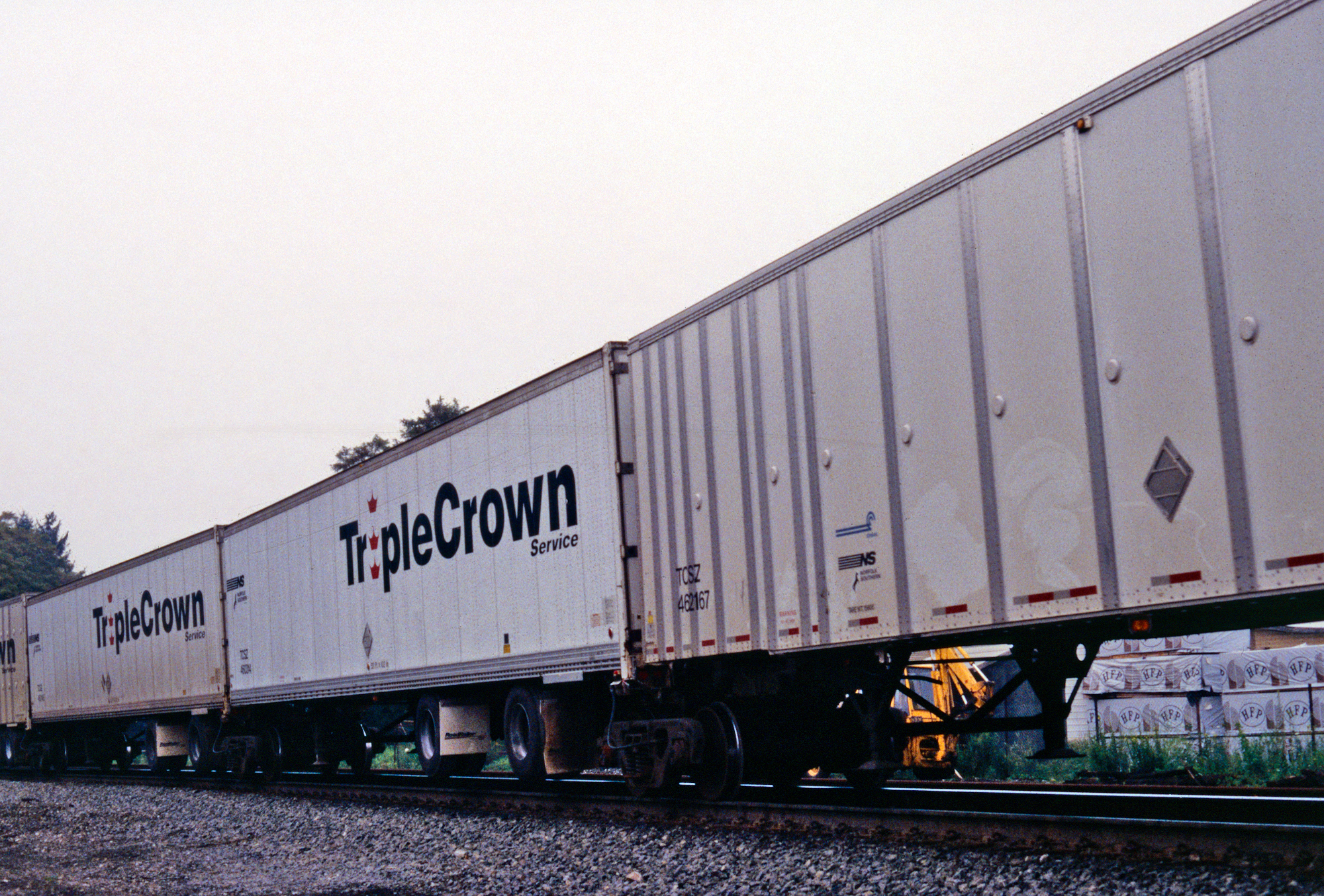
Conrail’s “TripleCrown” RoadRailer service is seen here passing through Gallitzin, Pennsylvania, along the former PRR in July 1994. American-Rails.com collection.
At a Glance
| Topic | Notes |
|---|---|
| English / tramway roots | Coal and stone wagons on early tramways; Stockton & Darlington opens Sept. 1825 |
| U.S. granite tramway | Granite Railway (Quincy–Milton), 1826 |
| Earliest common freight car | Simple flatcars (single axle at each end on early B&O practice) |
| B&O gondola origin (cited) | ~1832: flatcar with short side boards for flour barrels |
| Covered gondola / boxcar path | Mohawk & Hudson covered gondola, 1833; boxcar evolves as the universal covered car |
| Swivel truck | Four-wheel trucks (one each end) on B&O by the 1830s; springs among earliest improvements (Schafer) |
| Hopper lineage | “Jimmy” hopper practice on Lehigh Coal & Navigation / Mauch Chunk Switchback, 1827 |
| Tank car driver | Oil after Drake at Titusville, Pa. (Aug. 1858); early flatcar-mounted vats → horizontal tanks |
| Major modern families | Box, gon, hopper, tank, flat, reefer; plus autorack and well/spine intermodal (post–WWII growth) |
| Boxcar fleet (Solomon) | ~251,000 standard + ~179,000 insulated/special in 1980 → ~95,514 combined by 2010 |
Origins: Tramways to Common Carriers
After the Stockton & Darlington opened in England in September 1825, railroad technology crossed the Atlantic quickly. Early American practice leaned heavily on English influence. When the B&O opened its original ~13-mile line from Baltimore to Ellicott’s Mills (Ellicott City), passenger cars still echoed stagecoaches while freight rode rudimentary flatcars with a single axle at each end.
The first freight cars were simple flats. As shippers demanded better protection and denser loading, new types appeared: gondola, hopper, boxcar, tank. Each answered a commodity problem—weather, bulk flow, liquids, perishables—rather than a pure engineering fashion.
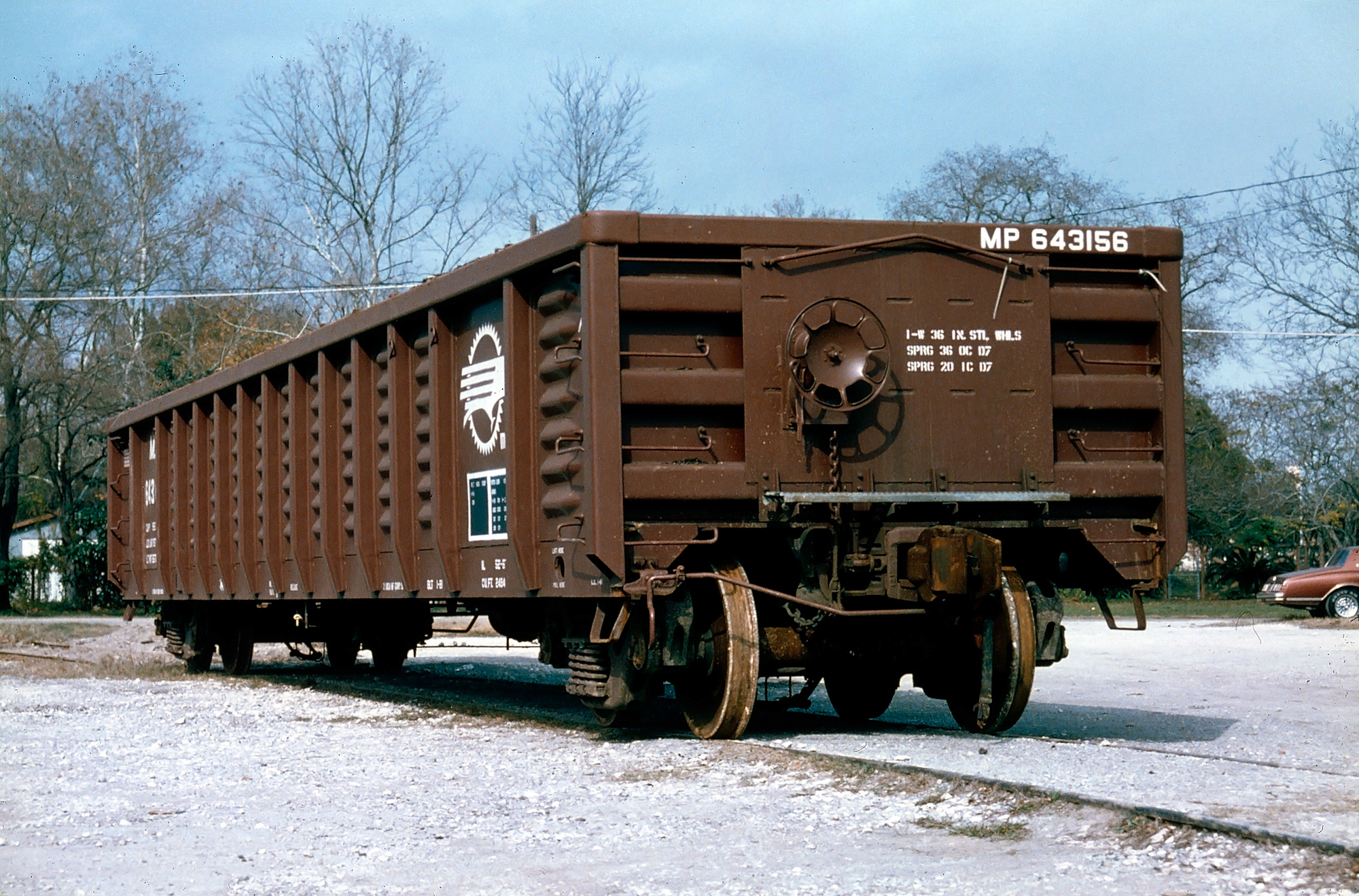
A former Missouri Pacific gondola is seen here at Austin, Texas, in early December 1984. Mike Bledsoe photo. American-Rails.com collection.
Early American Types: Flat, Gondola, Hopper, Box
Another B&O invention still in daily use is the gondola. About 1832 the railroad took a basic flatcar and added short side boards so barrels of flour would not roll off. Limitations of open equipment were obvious: lading sat in the weather, and two rigid axles gave almost no suspension. Liquids and free-flowing products could ride sealed barrels on open cars, but a covered body was more efficient. That path led to the Mohawk & Hudson’s first covered gondola in 1833 and, over time, to the classic boxcar.
Aggregate and coal hoppers descend from early mining tram practice. The “jimmy” hopper lineage is often tied to the Lehigh Coal & Navigation Company (Mauch Chunk Switchback Railway) in 1827. Even so, some roads—including the B&O—still used flatcar-and-bin coal setups well into the later nineteenth century.
The boxcar became the great general-purpose car of the classic era: lumber, merchandise, packaged goods, and for a time automobiles, often in solid trains through mid-century. Brian Solomon notes in Field Guide To Trains: Locomotives And Rolling Stock roughly 251,000 standard and 179,000 insulated/specially equipped boxcars in service through 1980. By 2010, after deregulation, mergers, manufacturing shifts, and intermodal growth, the combined total had fallen to about 95,514. Railroads liked the boxcar’s versatility; shippers kept pushing specialty equipment that loaded faster and protected product better.
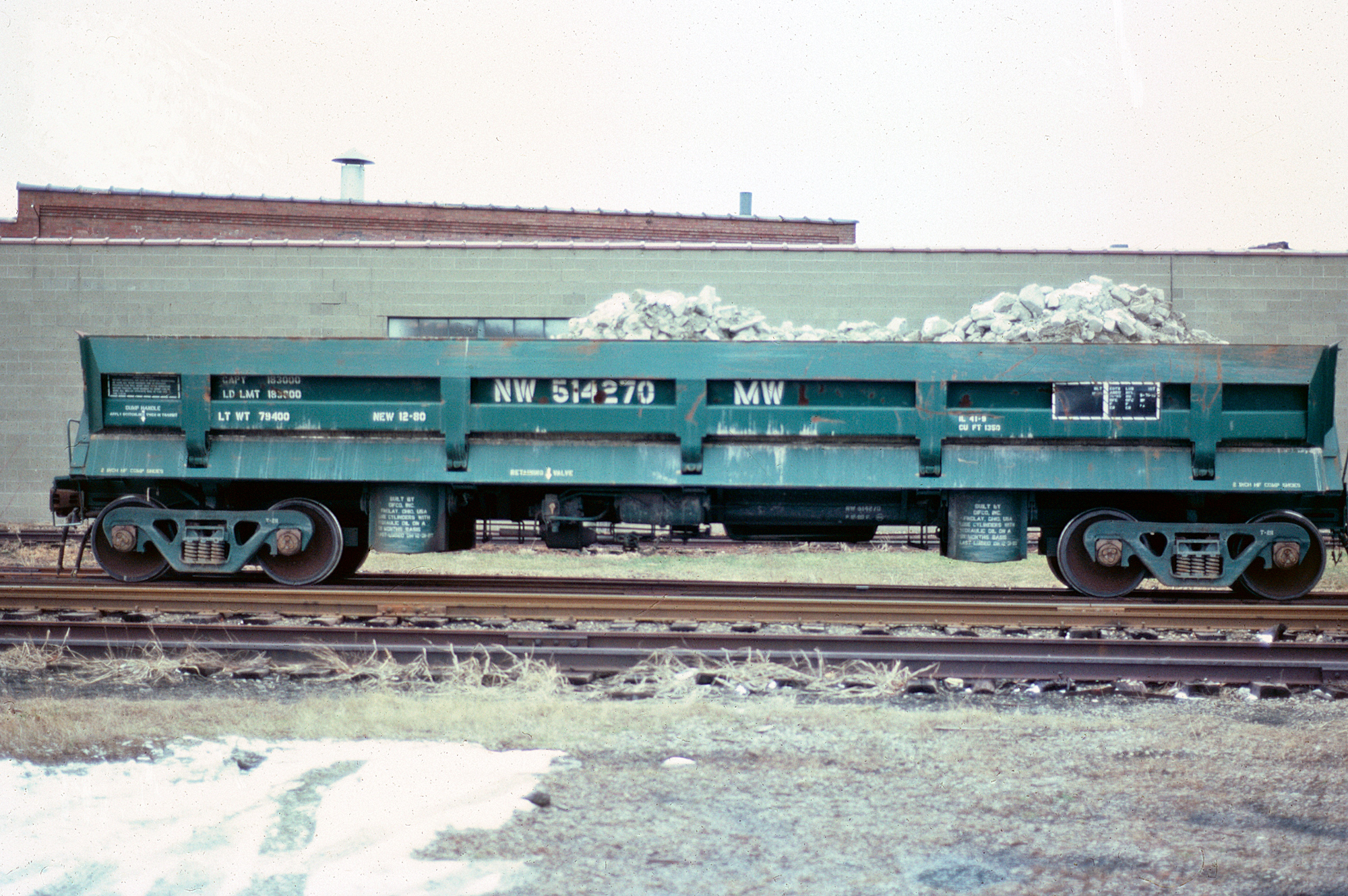
Norfolk & Western side dump car #514270 is seen here hauling what appears to be a load of riprap for right-of-way stabilization in March 1983. These cars are often employed in such applications for maintenance-of-way (MOW). American-Rails.com collection.
Trucks, Springs, and American Scale
Mike Schafer’s Freight Train Cars lists springs among the earliest freight-car improvements. By the 1830s the B&O used the first practical four-wheel trucks—one assembly under each end of the car. The original inventor is lost to history; the advantages were not. An iron (later steel) frame held two axles with springs between them and swiveled on a center bolster under the carbody.
Benefits included better structural support, less track wear (weight spread over more wheels), and easier curving. The truck was one of the few early devices the industry adopted relatively quickly—unlike automatic air brakes, knuckle couplers, and standard gauge, which took years of politics and wrecks to settle. Schafer argues that after the swivel truck, American railroads diverged from English practice: locomotives and cars grew larger, free of the width constraints of England’s high-level station platforms.
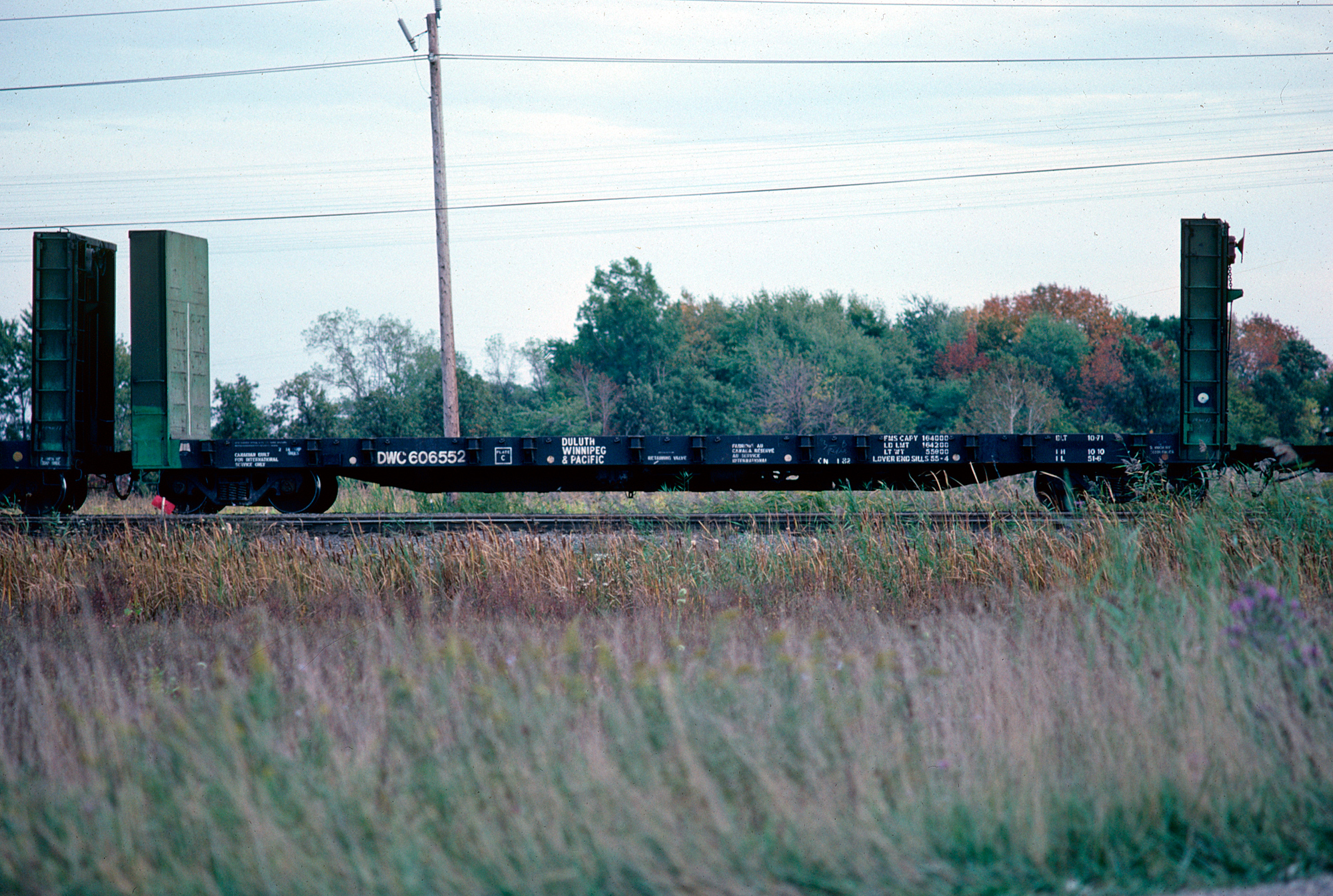
A Duluth, Winnipeg & Pacific 50-foot bulkhead flatcar (51′ 6″ inside length) is seen here in service during September 1982. American-Rails.com collection.
Specialization: Tanks, Steel, and Seven Families
One of the first truly specialized designs was the tank car, driven by oil after Edwin L. Drake’s strike at Titusville, Pennsylvania, in August 1858. Crude could not ride a plain gon or box. Early answers were flatcars with horizontal vats; within a few years the familiar horizontal tank, center dome, and safety valve took over. Steel tanks appeared in the 1890s, though wood barrel-style tanks on steel underframes lingered into the early twentieth century. Later tanks grew larger and handled everything from water to chlorine and other hazmat.
Wood-to-iron/steel construction for car structure advanced from the 1880s (sills, trusses, frames) until steel dominated almost every component. Even so, outside-braced wood boxcars and gondolas still turned up on local sidings into the 1960s. Age and interchange rules eventually forced remaining wood equipment out of regular service.
Basic freight designs fall into a small set of families. Classic lists often name seven: boxcars, gondolas, hoppers, tank cars, flatcars, well/spine intermodal cars, and autoracks. Reefers, stock cars, ore jennies, ladle cars, and cabooses sit alongside as specialized or historical types. Well/spine cars and multi-level autoracks are largely postwar answers to trailers, containers, and finished vehicles.
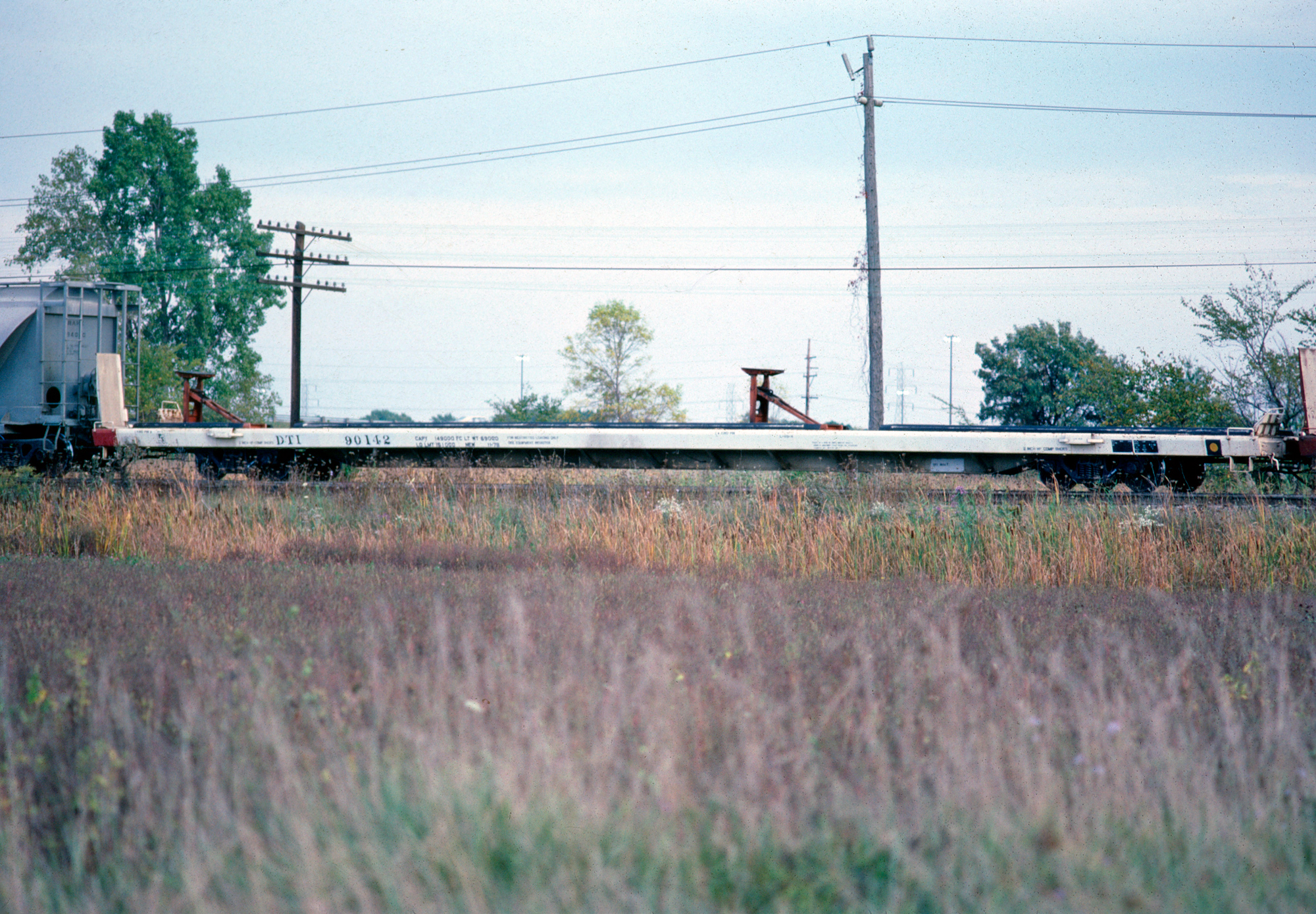
A Detroit, Toledo & Ironton 85-foot flatcar, #90142, is seen here in service during September 1982. These cars typically handled truck trailers. American-Rails.com collection.
Lettering and AAR Mechanical Designation Codes
Clerks and computer systems use short codes on waybills, lading documents, and equipment registers to identify car type and service. The tables below summarize common Association of American Railroads–style mechanical designations long carried on this site. Codes and subclasses evolve; treat this as a field guide, not a live UMLER dump.
Boxcars
| Code | Meaning |
|---|---|
| XM | General service; side or side-and-end doors |
| XI | General service; insulated; side or side-and-end doors |
| XAR | General service; automobile loading racks |
| XAP | General service; auto-part loading racks |
| XME | Merchandise service; wood-lined; equipped to secure freight |
| XML | Stanchions and crossbars to secure freight |
| XMP | Equipped for a specific freight |
Flatcars
| Code | Meaning |
|---|---|
| FM | General-service flat |
| FD | Depressed-center flat |
| FC | Piggyback / trailer flat |
| FA | Autorack |
| LP | Bulkhead flat |
Gondolas
| Code | Meaning |
|---|---|
| GB | Mill gondola; fixed or drop ends |
| GS | Fixed sides/ends with drop bottom |
Hoppers
| Code | Meaning |
|---|---|
| HM | Twin-bay open hopper |
| HT | Triple- or quadruple-bay open hopper |
| HD | Twin-bay ballast car |
| LO | Covered hopper |
Refrigerator cars (reefers)
| Code | Meaning |
|---|---|
| RB | Bunkerless (no ice); insulated only |
| RBL | Bunkerless insulated; changeable interior loading fixtures |
| RS | Ice bunkers |
| RSB | Ice bunkers; circulation fans; mechanical loading devices |
| RSM | Ice bunkers; beef rails |
Special service and tanks
| Code | Meaning |
|---|---|
| LF | Container / well car |
| TA | Standard tank car |
| TG | Standard tank; glass lined |
Freight Car Types (Directory)
Each major type has a dedicated American-Rails.com profile. Use this hub as the map:
| Type | Role (summary) | Profile |
|---|---|---|
| Boxcar | Enclosed general merchandise and specialized loadings | Boxcars |
| Gondola | Open-top bulk, scrap, mill products; coil and high-side variants | Gondolas |
| Hopper | Coal, aggregates, ballast; open multi-bay designs | Hoppers |
| Tank car | Liquids and gases under pressure or atmospheric service | Tank cars |
| Refrigerator car | Perishables; ice-era bunkers to mechanical reefers | Reefers |
| Livestock car | Open-slat stock cars for cattle, hogs, etc. (historic service) | Livestock cars |
| Ladle car | Molten metal / steel-mill specialty equipment | Ladle cars |
| Ore jenny | Short ore hoppers for iron ranges and related bulk | Ore jennies |
| Well / intermodal | Containers in wells; double-stack and related designs | Well cars |
| Flatcar | Open deck; bulkhead, depressed-center, TOFC, and special flats | Flatcars |
| Autorack | Multi-level finished vehicles | Autoracks |
| Caboose | End-of-train crew office (largely retired from Class I freights) | The caboose |
| B&O Wagontop | Distinctive B&O house-car design family | Wagontop cars |
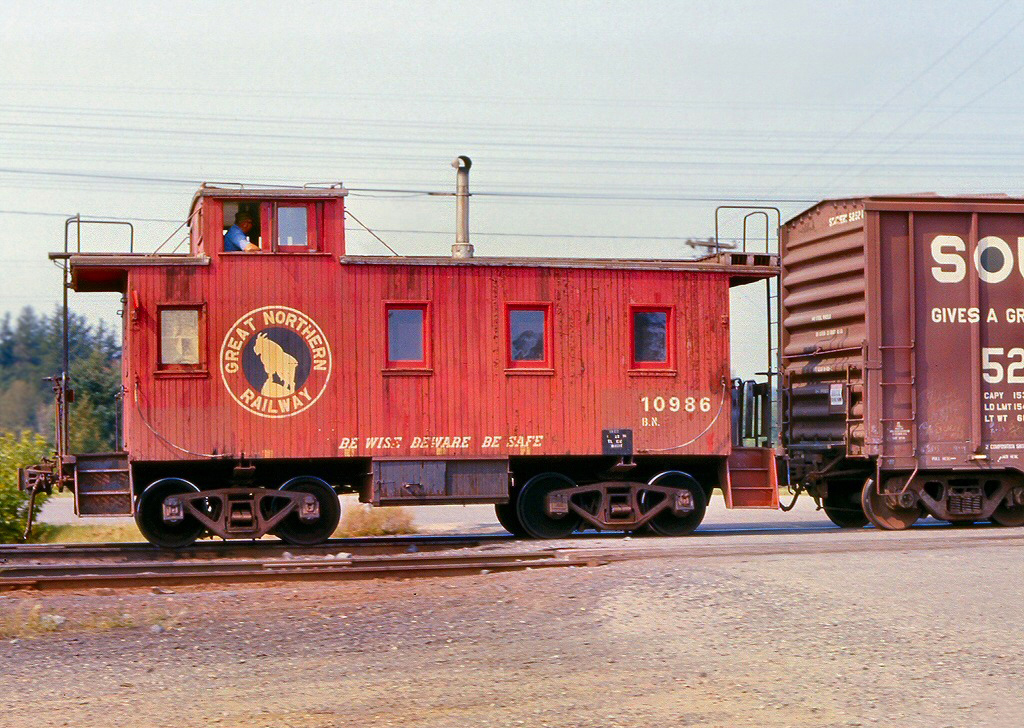
An aging wooden Great Northern caboose still looks good as it rides along on a Burlington Northern freight, which is operating over the Duluth, Missabe & Iron Range at Iron Junction, Minnesota, during August 1976. Rob Kitchen photo.
Modern Designs and Today’s Fleet
Specialization still defines freight railroading. The flatcar alone has split into spine cars for trailers, bulkhead flats for pulpwood and lumber, depressed-center flats for heavy transformers and machinery, and other center-sill specials. Gondolas appear as mill gons, coil cars for rolled steel, and high-side coal gons. Covered hoppers (LO) haul grain, plastic pellets, cement, and sand in unit trains that would have been unthinkable as pure boxcar business.
The utilitarian boxcar refined into stock cars (open slats for livestock) and refrigerator cars. Reefers date from the 1850s; ice and insulation dominated for generations, with icing stations along major routes, until mechanical refrigeration removed most ice handling. Mechanical reefers remain common; the stock car has effectively left regular North American service.
Intermodal equipment—well cars, spine cars, RoadRailers and related concepts—and multi-level autoracks moved freight railroading toward containers, trailers, and factory-fresh vehicles. Unit coal, grain, crude, and intermodal trains show how car type and train design now travel together. For the industry side of who runs those trains, see Class I railroads, regionals, and short lines.
Related Reading on American-Rails.com
- Passenger car types · Railroad history · Diesel locomotives
- Boxcars · Hoppers · Tanks · Well cars · Autoracks
- Caboose · Reefers · Flatcars
- Class I railroads · Yards · Home
Sources
- Del Vecchio, Mike. Railroads Across America. Osceola: MBI Publishing, 1998.
- Schafer, Mike, and McBride, Mike. Freight Train Cars. Osceola: MBI Publishing, 1999.
- Solomon, Brian. Field Guide to Trains: Locomotives and Rolling Stock (boxcar fleet figures as cited in long-running AR research)
- American-Rails.com type profiles linked in the directory above
- See also the master bibliography on Resources / Works Cited
Freight car hub revised August 2026 while retaining core research on tramway origins, B&O gondola and truck practice, Mohawk & Hudson covered gondola, hopper and tank development, Solomon boxcar counts, and modern specialization.
Recent Articles


-
Greenbrier, Cheat & Elk Railroad: Western Maryland's Logging Line
Sep 26, 26 11:59 PM
 Greenbrier, Cheat and Elk—the logging railroad the Western Maryland bought in 1927. Cass to Spruce, Summit Cut at 4,066.6 feet, Elk River Branch, Laurel Bank.
 -
Elkins (Western Maryland): Yard, History, Operations
Sep 26, 26 11:56 PM
 Western Maryland at Elkins—the Elkins Division yard, roundhouse, and wash rack. Belington, Durbin, Black Fork, and the Elk River branches met here.
 -
B&O's "Cincinnatian" (Train): Route, Consist, Timetable
Sep 26, 26 11:51 PM
 B&O Cincinnatian—Mount Clare five-car streamliner, January 19, 1947, trains 75 and 76. P-7d Pacifics 5301–5304. Detroit–Cincinnati from June 25, 1950, trains 53 and 54. Last run April 30, 1971.
 -
The Semaphore: Railroading's Classic Signal
Sep 26, 26 11:51 AM
 Railroad semaphore signals: blade and spectacle, lower quadrant and upper quadrant, US&S Style B and GRS Model 2A, Robinson’s track circuit, and the last blades on the Raton Subdivision.
 -
Black Fork Grade (Western Maryland): History and Operations
Sep 26, 26 11:47 AM
 Black Fork Grade—the Western Maryland climb through Blackwater Canyon. Thomas to Hendricks, past 3 percent, an H-9 and ten loads, helpers off at Fairfax.
 -
Western Maryland Steam Locomotives: History & Roster
Sep 26, 26 11:39 AM
 Western Maryland steam—H-9 Consolidations, I-2 Decapods, Lima 2-8-8-2s, Baldwin Challengers, and twelve Baldwin Potomac 4-8-4s. Post-1900 roster.
 -
Western Maryland Diesel Roster: All-Time
Sep 26, 26 11:32 AM
 Western Maryland diesels—S1 102 in 1941, fourteen F7 boosters, BL2s, hammerhead RS3s, Circus SD40s, and Chessie GP40-2s. Serials and order numbers.
 -
The Dutch Line (Western Maryland): History, Map, Operations
Sep 25, 26 09:38 PM
 Western Maryland Dutch Line—the Hanover Subdivision. Emory Grove to Highfield via Hanover and Gettysburg, York branch 1893, stone trains, and the route CSX still runs.
 -
The Durbin Branch (Western Maryland): History, Map, Operations
Sep 25, 26 09:13 PM
 Western Maryland Durbin Branch—the Coal & Iron Railway, 46.9 miles Elkins to Durbin, opened July 27, 1903. Mixed train until April 10, 1959. H-7B Consolidations.
 -
Western Maryland Railway: Map, Rosters, Logo, History
Sep 25, 26 10:24 AM
 Western Maryland Railway—the Fast Freight Line. Baltimore, Carroll & Frederick, May 27, 1852. Connellsville Extension 1912. Chessie, then into the B&O May 1, 1983.
 -
Illinois Dinner Train Rides (2026): A Complete Guide
Sep 25, 26 09:52 AM
 2026 Monticello Railway Museum Murder Mystery Dinner Train—June 13, July 11, August 1, and September 5 have run. Three courses, about 2 hours, $112. Confirm on mrym.org.
 -
Georgia Dinner Train Rides (2026): A Complete Guide
Sep 25, 26 12:29 AM
 2026 Azalea Sprinter dinner train from Nashville and Willacoochee, Georgia—2½ hours. Club Car adult $147, Executive adult $177. Confirm on azaleasprinter.com.
 -
Baldwin "Centipede" Locomotives: Specs, Roster, Photos
Sep 25, 26 12:02 AM
 Baldwin DR-12-8-1500/2 Centipede—2-D+D-2, two 608SC engines, 3,000 hp. SAL 4500 from the 1943 test bed. 54 on the serial list, 52 sold. PRR BP60 then BH50. None preserved.
 -
Florida Dinner Train Rides (2026): A Complete Guide
Sep 24, 26 11:56 PM
 2026 Seminole Gulf Murder Mystery Dinner Train in Fort Myers—five courses cooked onboard, 3½ hours, $129 or $135 Saturday, plus tax and gratuity. Confirm on semgulf.com.
 -
West Virginia Northern Railroad: Map, Photos, History
Sep 24, 26 11:27 PM
 West Virginia Northern—Kingwood to Tunnelton, 11 miles of Preston County coal. Narrow gauge 1888, standard gauge 1895. Last freight February 19, 1991. Consolidations 8 and 9 survive.
 -
Rutland Railroad: Map, Rosters, History, Logo
Sep 24, 26 01:18 PM
 Rutland Railroad—Follett’s Champlain & Connecticut River, November 1, 1843. Bellows Falls–Burlington December 18, 1849. Green Mountain Gateway. Last train September 25, 1961. Vermont Railway Janua…
 -
Arkansas Dinner Train Rides (2026): A Complete Guide
Sep 24, 26 01:12 PM
 2026 Eureka Springs & North Arkansas Dinner Train—Eurekan dining car, about 2 hours, $53.62 tax included, opens May 9, Tuesday, Wednesday, Friday, and Saturday. Confirm on esnarailway.com.
 -
Arizona Dinner Train Rides (2026): A Complete Guide
Sep 24, 26 01:01 PM
 2026 Arizona has no plated dinner train. Grand Canyon Railway sells snacks in the cars and meals in Williams or at the rim. Verde Canyon includes a charcuterie tray.
 -
Rail News, The Latest
Sep 24, 26 12:36 PM
This page provides a portal to the latest in rail news, from preservation and restortation subjects to other notable topics. -
Cotton Belt 819 Moved Outside at Pine Bluff for Evaluation
Sep 24, 26 12:35 PM
 Cotton Belt 819 left the Pine Bluff shop on September 22, 2026, first time outside in about 30 years. RDG Steam Services is evaluating the engine. No donation link posted.
 -
Reading Steam Locomotives: History, Roster & Photos
Sep 24, 26 12:14 PM
 Reading steam—Wootten fireboxes, Camelback Consolidations, Mallets, K-1 Santa Fes, G-3 Pacifics, T-1 4-8-4s. Post-1900 roster after Drury. Rambles ended October 17, 1964.
 -
Reading Diesel Roster: All-Time
Sep 24, 26 12:10 PM
 Reading diesel roster—AGEIR boxcabs, FTs, FA-1s, RS-3s, Train Masters, GP30s through GP39-2s. Serials and order numbers. Conrail April 1, 1976.
 -
Reading Railroad: Map, Logo, History, Rosters
Sep 24, 26 12:08 PM
 Reading Company—Philadelphia & Reading, 1833. Anthracite, Port Richmond, Reading Terminal. Operating company January 1, 1924. Conrail April 1, 1976.
 -
Nevada Dinner Train Rides (2026): A Complete Guide
Sep 24, 26 12:02 PM
 2026 Nevada Northern Taste of Italy—adults-only gala from East Ely. The September 19 date has run. Confirm any later night on nnry.com.
 -
North Carolina Dinner Train Rides (2026): A Complete Guide
Sep 24, 26 11:24 AM
 2026 North Carolina dinner trains—NCTM Wine & Dine in Spencer sold out February 13–15. GSMR First Class is the plated meal on the Nantahala Gorge excursion. Confirm on the railroad.
 -
Railway Express Agency (REA): Signs, Trucks, Logo & History
Sep 24, 26 09:40 AM
 Railway Express Agency—railroad-owned express company. Incorporated December 7, 1928. Operations March 1, 1929. Red diamond, green trucks. Last regular express November 7, 1975.
 -
Michigan Dinner Train Rides (2026): A Complete Guide
Sep 24, 26 09:28 AM
 2026 Steam Railroading Institute dining in Owosso—select evenings, no public dinner dates posted. Confirm on michigansteamtrain.com.
 -
Pittsburgh and West Virginia Railway: Map, Rosters, History
Sep 24, 26 12:24 AM
 Pittsburgh & West Virginia—the Hi-Line. Wabash-Pittsburgh Terminal 1904. Railway January 29, 1917. Connellsville February 11, 1931. N&W lease October 16, 1964. Wheeling & Lake Erie from May 17, 1990.
 -
Indiana Dinner Train Rides (2026): A Complete Guide
Sep 24, 26 12:13 AM
2026 Spirit of Jasper Ride & Dine is paused. No public trains. Depot at 201 Mill Street stays open as a rental. Confirm on spiritofjaspertrain.com. -
New Jersey Dinner Train Rides (2026): A Complete Guide
Sep 24, 26 12:01 AM
2026 Woodstown Central Dining in Motion—private table of four from $190, about an hour, Salem County. Confirm on woodstowncentral.com. -
Maryland Dinner Train Rides (2026): A Complete Guide
Sep 23, 26 05:19 PM
 2026 Western Maryland Scenic Allegheny Mountain Dinner Train—Cumberland, 3 hours, 21+, Saturday 7 p.m. Confirm on wmsr.com.
 -
Pittsburgh and Lake Erie Railroad: Map, Rosters, Photos
Sep 23, 26 03:28 PM
 Pittsburgh & Lake Erie—the Little Giant. Chartered 1875, Pittsburgh to Youngstown February 10, 1879. New York Central from 1883. Independent May 15, 1979. Last day September 11, 1992.
 -
Kansas Dinner Train Rides (2026): A Complete Guide
Sep 23, 26 01:11 PM
 2026 Abilene & Smoky Valley Smoky Valley Limited—two hours from the Rock Island Depot, about $72–$110, dates into December 31. Confirm on asvrr.org.
 -
The Belpaire Firebox: Simplicity and Greater Power
Sep 23, 26 01:03 PM
 Belpaire firebox—Alfred Belpaire, 1864. Square crown, straight staybolts at right angles. Pennsylvania standard after the 1880s. Great Northern was the other big user.
 -
Pennsylvania Railroad (PRR) Electric Roster: All Classes
Sep 23, 26 12:57 PM
Pennsylvania Railroad electrics—DD1s into Penn Station, P5s, 139 GG1s, B1 switchers, and 66 E44s. Class roster, 1905–1963. No unit-by-unit GG1 list. -
Penn Central Diesel Roster: All-Time
Sep 23, 26 12:46 PM
 Penn Central diesel roster—PRR classes on NYC, PRR, and New Haven power. New orders carry serials. GP38-2s are 7940-8162. Conrail April 1, 1976.
 -
Penn Central Railroad: Map, History, Logo
Sep 23, 26 12:32 PM
 Penn Central—Pennsylvania and New York Central merged February 1, 1968. New Haven January 1, 1969. Section 77 bankruptcy June 21, 1970. Conrail April 1, 1976.
 -
Iowa Dinner Train Rides (2026): A Complete Guide
Sep 23, 26 11:42 AM
 2026 Boone & Scenic Valley Wolf Dinner Train—Saturdays May–October, Union Pacific dining cars, Bass Point Creek High Bridge. Confirm on bsvrr.com.
 -
Pennsylvania-Reading Seashore Lines: Map, Roster, History
Sep 23, 26 12:32 AM
 Pennsylvania-Reading Seashore Lines—Atlantic City Railroad renamed July 15, 1933. Pennsylvania two-thirds, Reading one-third. Camden to Atlantic City, Cape May, and Millville. Conrail April 1, 1976.
 -
Wisconsin Dinner Train Rides (2026): A Complete Guide
Sep 23, 26 12:28 AM
2026 Wisconsin Great Northern dinner train in Trego—$105, Namekagon River, January 8–31 and May 5–December 17. Mid-Continent’s remaining 2026 calendar is snack and scenic. Confirm on the railroad. -
New Hampshire Dinner Train Rides (2026): A Complete Guide
Sep 23, 26 12:21 AM
2026 Cafe Lafayette Dinner Train in North Woodstock—five courses, 2 hours, from $125. Children under 6 not allowed. Confirm on nhdinnertrain.com. -
PRR "GG-1" Locomotives: Roster, Photos, Specs
Sep 23, 26 12:13 AM
 PRR GG1 electric: 139 locomotives, 4800–4938, built 1934–1943. Specs, Loewy shell, Amtrak numbers, and the last revenue trip on October 28, 1983.
 -
Montana Dinner Train Rides (2026): A Complete Guide
Sep 23, 26 12:04 AM
2026 Charlie Russell Chew Choo from Hanover, near Lewistown—4.5 hours, prime rib, adult $151. Remaining listed dates sold out. Confirm on montanadinnertrain.com. -
Kentucky Dinner Train Rides (2026): A Complete Guide
Sep 22, 26 11:52 PM
2026 My Old Kentucky Dinner Train in Bardstown—four courses, 2.5 hours, adult $116. Confirm on kydinnertrain.com. -
Tennessee Dinner Train Rides (2026): A Complete Guide
Sep 22, 26 11:45 PM
2026 TVRM Chattanooga Dinner Train—Grand Junction, select Fri/Sat March 6–October 24, 6 p.m., from $110. Confirm on tvrail.com. -
The Trainphone: PRR's Wireless Radio System
Sep 22, 26 11:17 PM
 Pennsylvania Trainphone—Union Switch & Signal inductive telephone. Bel-Del trial 1941, Frenchtown November 29, 1943. Carriers at 88 kHz and 144 kHz. Out of service April 30, 1967.
 -
Pennsylvania (PRR) Steam Roster: Post 1906
Sep 22, 26 11:13 PM
 ennsylvania steam after 1906—H8, H9, and H10 Consolidations, 574 L1s Mikados, 598 I1s Decapods, 425 K4s Pacifics, 301 M1 Mountains. Drury’s grid. Last steam November 30, 1957.
 -
Pennsylvania Railroad (PRR) Diesel Roster: All-Time List
Sep 22, 26 10:59 PM
 Pennsylvania diesel roster—SW 3908 in June 1937, then Alco, Baldwin, EMD, Fairbanks-Morse, GE, and Lima. Serials and Alco order numbers. Penn Central February 1, 1968.
 -
Pennsylvania Railroad: Map, Logo, History, Rosters
Sep 22, 26 10:02 PM
 Pennsylvania Railroad—chartered April 13, 1846, Harrisburg–Pittsburgh, Horseshoe Curve 1854, Penn Station 1910. Standard Railroad of the World. Penn Central February 1, 1968.
 -
Pennsylvania Dinner Train Rides (2026): A Complete Guide
Sep 22, 26 04:48 PM
 2026 Pennsylvania dinner trains—Colebrookdale Dining Class in Boyertown and Strasburg Dinner on the Rails. Confirm on each railroad.