Ladle Rail Car: Transporting Molten Metal
Published: July 30, 2024
By: Adam Burns
The ladle rail car, a specialized piece of industrial rail equipment, plays a crucial role in the steelmaking process. Designed to transport molten metal from one part of a steel plant to another, these robust rail cars are engineered to withstand extreme conditions and handle heavy loads.
When steel production was at peak capacity in the U.S. through the mid-20th century these cars, as well as the similar bottle car, could be found in widespread use at various mills around the country.
This article delves into the purpose and history of the ladle car, exploring its evolution, design, and significance in the steel industry.
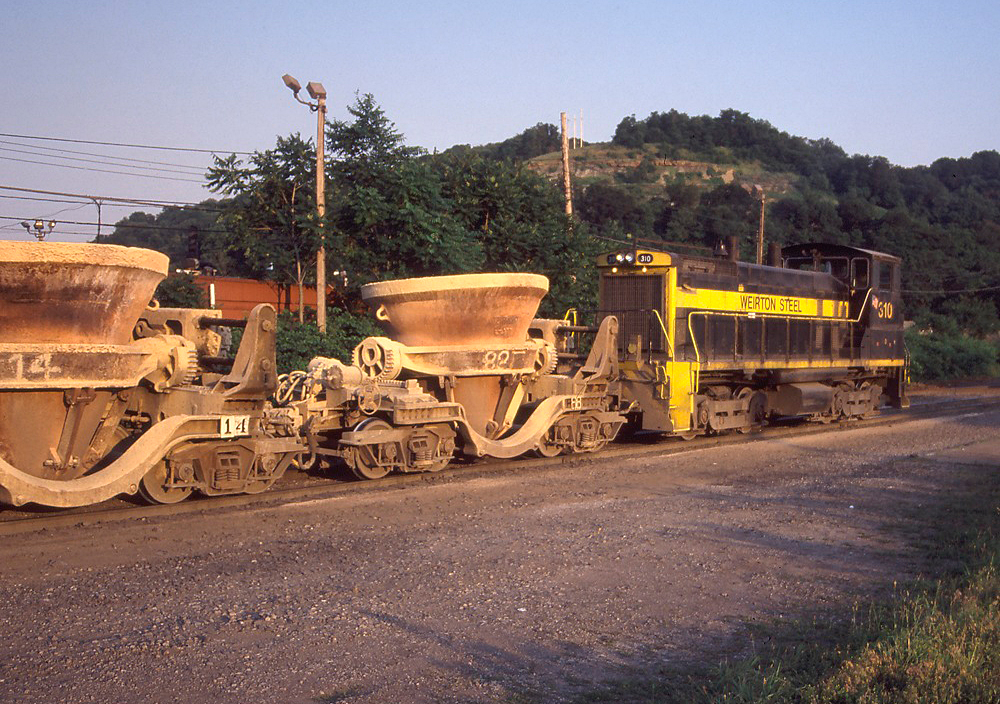 Weirton Steel SW1500 #310 moves a cut of empty ladle cars around the plant at Weirton, West Virginia on June 23, 2003. Wade Massie photo.
Purpose
Transportation
The primary function of ladle cars is to transport molten metal—predominantly molten iron or steel—within steel plants. Once molten metal is tapped from a blast furnace or an electric arc furnace (EAF), it needs to be transported to various other processing units such as the steel refining and casting units. Ladle cars provide a reliable and efficient means to carry this superheated material safely.
Managing Extreme Conditions
The cars are engineered to withstand the harsh conditions of steel plants. These conditions include high temperatures, significant weight loads, and constant exposure to potentially corrosive materials.
The ladle itself, sitting atop the rail car, is made from refractory material capable of enduring the intense heat of molten metal, which can reach temperatures exceeding 2,500 degrees Fahrenheit (1,370 degrees Celsius).
Enhancing Plant Efficiency
By facilitating the smooth movement of molten metal, the cars play a role in enhancing the overall efficiency of steel production.
Quick and safe transport of molten material ensures that the processes downstream, such as refining, casting, and rolling, can continue without delay, thus optimizing the plant's productivity.
Historical Background
The origins of ladle cars can be traced back to the late 19th and early 20th centuries, a period marked by rapid industrialization and advances in steelmaking technologies.
As steel plants grew in scale and complexity, the need for specialized equipment to handle various stages of production became evident. Rail-based transportation within plants offered a practical and efficient solution, leading to the development of early ladle cars.
Evolution of Design
Over the decades, the design of the cars has evolved to meet the changing demands of the steel industry. Early models were relatively simple in construction, often resembling modified flatcars with a basic ladle mounted on top. As technology advanced, more sophisticated designs emerged, featuring improved materials, enhanced insulation, and greater capacity.
Modern ladle cars are characterized by their robust construction, often incorporating advanced materials and technologies to ensure safety and efficiency.
They are equipped with specialized features such as tilting mechanisms for pouring molten metal, insulated ladles to maintain temperature, and reinforced frames to handle the immense weight of the molten load.
Integration with Technological Advancements
The integration of modern technology has further revolutionized ladle cars. Automation and remote control systems have been introduced to enhance operational safety and precision. Advanced monitoring systems track temperature, weight, and structural integrity, providing real-time data to ensure optimal performance.
Design and Construction
Refractory Materials
One of the most critical components of a ladle car is the refractory material used to line the ladle. This material must be capable of withstanding extreme heat and thermal shock while also providing insulation to keep the molten metal at a consistent temperature during transport. Common refractory materials include magnesite, alumina, and silica.
Insulation and Safety Features
Ladle cars are designed with multiple layers of insulation to protect the metal structure and ensure the safety of personnel and equipment in the vicinity. These layers include refractory bricks, insulation bricks, and ceramic fibers, all working together to minimize heat loss and prevent overheating of the car's exterior.
Safety features are paramount in the design of ladle cars. These include robust locking mechanisms to secure the ladle in place, emergency cooling systems to manage unexpected temperature spikes, and reinforced frames to handle the dynamic forces exerted by the movement of molten metal.
Capacity and Load Management
Ladle cars come in various sizes and capacities, depending on the specific needs of the steel plant. Standard capacities range from 50 to 300 metric tons of molten metal. The design must account for the immense weight of the load, employing reinforced steel frames and heavy-duty bogies to ensure stability and durability.
Mobility and Flexibility
The mobility of the cars is facilitated by robust rail wheels and axles, designed to handle the weight and stress of regular operation.
Many modern ladle cars are also equipped with tilting mechanisms, allowing for precise pouring of molten metal into molds or refining units. These tilting systems can be manually operated or automated, depending on the level of technology employed in the plant.
Significance in the Steel Industry
Enhancing Safety
One of the most critical contributions of ladle cars to the steel industry is the enhancement of safety. Transporting molten metal involves significant risks, including potential spills, exposure to extreme heat, and structural failures.
Ladle cars are designed to mitigate these risks through robust construction, advanced materials, and multiple layers of safety features.
By providing a secure and reliable means of transporting molten metal, the cars help protect workers and infrastructure within steel plants. This focus on safety is paramount in an industry where the margins for error are exceedingly slim.
Improving Efficiency
The efficiency of steel production processes is directly influenced by the ability to transport molten metal quickly and safely. Ladle cars play a vital role in this regard, ensuring that molten material can be moved seamlessly from furnaces to refining units and casting processes. This efficient transport minimizes downtime and ensures that each stage of production can proceed without unnecessary delays.
Supporting Specialized Processes
Ladle cars are indispensable in supporting specialized steelmaking processes. For example, in secondary refining, where the composition of steel is precisely controlled through alloying and deoxidation, the timely and controlled transport of molten metal is crucial. The flexibility and precision offered by the cars enable these specialized processes to be carried out with high accuracy.
Facilitating Innovation
As the steel industry continues to evolve, ladle cars remain at the forefront of innovation. The integration of advanced materials, automation, and real-time monitoring systems reflects the ongoing commitment to improving safety, efficiency, and performance.
These innovations not only enhance the capabilities of the cars but also contribute to the broader advancement of steelmaking technologies.
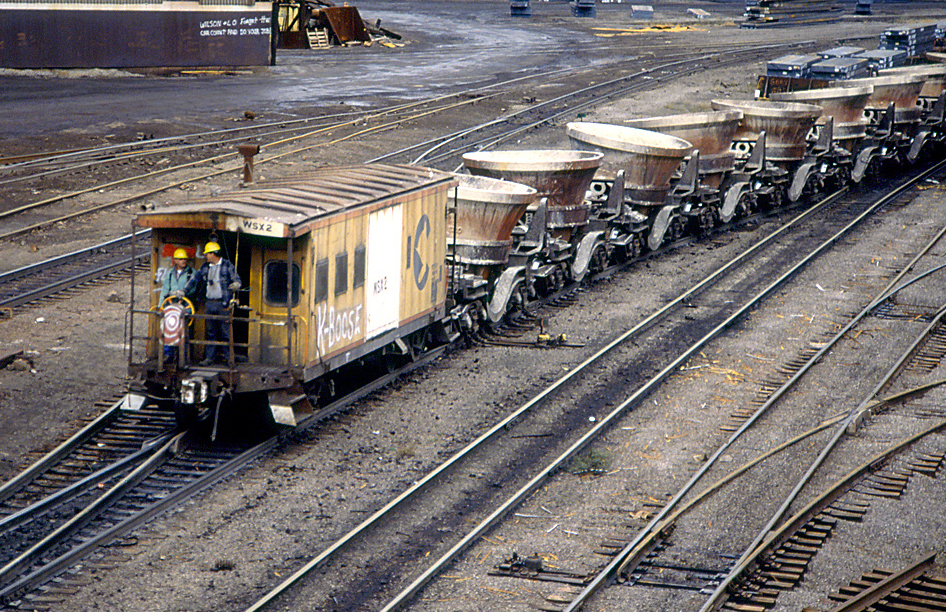 A modified Chessie caboose trails a long cut of ladle cars at the Weirton Steel plant on October 15, 1991. Wade Massie photo.
From its early origins in the burgeoning steel industry of the late 19th century to its vital role in modern steel production, the ladle car has continually evolved to meet the demands of a dynamic and challenging environment.
Its design, construction, and operation reflect a deep commitment to safety, efficiency, and innovation, ensuring that it remains an indispensable asset in the production of steel.
As the steel industry continues to advance, the ladle car will undoubtedly play a central role in shaping its future, supporting new technologies and processes that drive the industry forward.
Whether through enhanced materials, automated systems, or real-time monitoring, the car exemplifies the ongoing quest for excellence in an ever-evolving industrial landscape.
Recent Articles


-
Mobile & Ohio Steam Roster (Post 1900)
Oct 09, 26 12:26 PM
 Mobile & Ohio steam since 1900. Drury's class grid: 48 six-wheel switchers, 107 Ten-Wheelers, 15 Consolidations, 58 Mikados, and 14 Pacifics. Last revenue steam October 7, 1949.
 -
Mobile & Ohio Railroad: History, Map, Timetable
Oct 09, 26 11:31 AM
 Mobile & Ohio Railroad, chartered in 1848. Columbus on April 22, 1861, the Cairo & St. Louis, the March 1940 Official Guide, and the September 13, 1940 merger into the Gulf, Mobile & Ohio.
 -
Gulf, Mobile & Northern Steam Roster (Post 1900)
Oct 09, 26 10:42 AM
 Gulf, Mobile & Northern steam since 1900. Drury's class grid: Ten-Wheelers, Mikados, Russian Decapods, Pacifics 425 and 426, and three light 4-8-2s. Last revenue steam October 7, 1949.
 -
Gulf, Mobile & Ohio Diesel Roster (All-Time)
Oct 09, 26 10:41 AM
 Gulf, Mobile & Ohio diesel roster, all-time. The 1935 boxcab, DL-107s, 55 FA-1s, F3s and F7s, the Ingalls 4-S, GP30s through GP38-2s, and 21 SD40s. Serials and order numbers.
 -
Gulf, Mobile & Northern Railroad: History, Rebel Route
Oct 09, 26 10:36 AM
 Gulf, Mobile & Northern, from the 1890 Mobile, Jackson & Kansas City to the Rebel and the September 13, 1940 merger into the Gulf, Mobile & Ohio. Steam roster is the companion page.
 -
Gulf, Mobile & Ohio Railroad: Map, Photos, Trains, History
Oct 08, 26 11:48 PM
 Gulf, Mobile & Ohio, chartered in 1938 and merged September 13, 1940. The Mobile & Ohio, the Alton on May 31, 1947, the Rebel Route, and Illinois Central Gulf on August 10, 1972.
 -
New Jersey Railroad Museums (2026): A Complete Guide
Oct 08, 26 11:37 PM
 New Jersey railroad museums—Whippany, Maywood, Pine Creek, Mahwah’s Erie depot, Phillipsburg, and Boonton. Confirm hours on each site.
 -
New Hampshire Railroad Museums (2026): A Complete Guide
Oct 08, 26 11:34 PM
 New Hampshire railroad museums—North Conway, the Flying Yankee, Ashland, Gorham, Raymond, and Sandown. Confirm hours on each site.
 -
Missouri Railroad Museums (2026): A Complete Guide
Oct 08, 26 11:00 PM
 Missouri railroad museums—the National Museum of Transportation, Patee House, Frisco 4524, the Chicago & Alton depot, and Marceline. Confirm hours on each site.
 -
Milwaukee Road X3800: Deer Lodge’s Shop Goat
Oct 08, 26 04:28 PM
 Milwaukee Road X3800, the a home-built shop goat that served the Deer Lodge, MT yard. It was a 220-volt DC switcher, powered through an extension cord that moved electrics into a roundhouse where the…
 -
Key West Extension (Overseas Railroad): History, Construction, Decline
Oct 08, 26 03:59 PM
 Henry Flagler's Overseas Railroad, Miami to Key West, 1905–1935. The Seven Mile Bridge, the 1935 Labor Day Hurricane, and the road that became U.S. 1.
 -
Florida East Coast Steam Roster (Post 1900)
Oct 08, 26 02:34 PM
 Florida East Coast steam since 1897. Seventeen Ten-Wheelers, twenty Atlantics, eighty-seven Pacifics, ninety Mountains, fifteen Mikados, and the switchers.
 -
Florida East Coast Diesel Roster (All-Time)
Oct 08, 26 02:12 PM
 Florida East Coast diesel roster, all-time. E units from 1939, F3s, BL2s, GP7s and GP9s, the GP40-2 orders, 22 SD40-2s, and 24 ES44C4s. Serials and EMD order numbers.
 -
Florida East Coast Railway: Map, History, Rosters
Oct 08, 26 01:46 PM
 Florida East Coast Railway, Henry Flagler's line from Jacksonville to Miami and Key West. Receivership in 1931, the 1963 strike, Grupo México in 2017, and Brightline on the same track.
 -
Minnesota Railroad Museums (2026): A Complete Guide
Oct 08, 26 10:32 AM
Minnesota railroad museums—the Lake Superior Railroad Museum, Two Harbors, Jackson Street, Willmar’s Great Northern 2523, and Currie. Confirm hours on each site. -
Maine Railroad Museums (2026): A Complete Guide
Oct 08, 26 09:24 AM
 Maine railroad museums—Seashore Trolley, the two-foot lines at Portland, Alna, and Phillips, Boothbay, and the Bangor & Aroostook depots. Confirm hours on each site.
 -
Massachusetts Railroad Museums (2026): A Complete Guide
Oct 08, 26 12:08 AM
 Massachusetts railroad museums—Berkshire Scenic at Lenox, Shelburne Falls trolley No. 10, Edaville, Chatham’s 1887 depot, and Lowell. Confirm hours on each site.
 -
Clinchfield Steam Roster (Post 1900)
Oct 07, 26 12:09 PM
 Clinchfield steam since 1900. Fifteen H-4 Consolidations, K-1 Mikados, M-2 and M-3 Mallets, L-class 2-8-8-2s, eighteen Challengers. Class grid after Drury. Last steam April 16, 1954.
 -
Clinchfield Diesel Roster (All-Time)
Oct 07, 26 12:05 PM
 Clinchfield diesel roster, all-time. F3A 800, FP7 200, the F7s, GP7s, 25 SD40s, 18 SD45-2s, seven U36Cs, and the Family Lines hoods. Serials and EMD order numbers.
 -
Clinchfield Railroad: Map, Steam Locomotives, Roster, Logo
Oct 07, 26 12:02 PM
 Clinchfield Railroad, Elkhorn City to Spartanburg. George L. Carter, the Carolina, Clinchfield & Ohio, the 1924 lease, coal, the loops, and CSX. Steam and diesel rosters are companion pages.
 -
Kentucky Railroad Museums (2026): A Complete Guide
Oct 07, 26 11:39 AM
 Kentucky railroad museums—the Kentucky Railway Museum, Bowling Green’s L&N depot, Paducah, Versailles, and Covington. Confirm hours on each site.
 -
Kansas Railroad Museums (2026): A Complete Guide
Oct 07, 26 11:26 AM
 Kansas railroad museums—Santa Fe 3768 at Wichita, Santa Fe 132 in Topeka, the Great Overland Station, and Abilene. Confirm hours on each site.
 -
Cincinnati, New Orleans and Texas Pacific Diesel Roster (All-Time)
Oct 07, 26 10:38 AM
 All-time diesel roster of Southern locomotives lettered for the Cincinnati, New Orleans and Texas Pacific. Serials, order numbers, and builder dates.
 -
Cincinnati, New Orleans and Texas Pacific Railway
Oct 07, 26 10:31 AM
 Cincinnati, New Orleans and Texas Pacific Railway, incorporated September 8, 1881, to lease Cincinnati’s railroad to Chattanooga. Queen and Crescent route, Rathole, and the 2024 sale to Norfolk Southe…
 -
Indiana Railroad Museums (2026): A Complete Guide
Oct 07, 26 12:26 AM
 Indiana railroad museums—Nickel Plate 765, Elkhart’s New York Central collection, French Lick, Linden’s junction depot, and Haley Tower. Confirm hours on each site.
 -
"Triplex" Steam Locomotive: Specs, History, Photos
Oct 06, 26 11:52 PM
 Erie class P-1 Triplex 2-8-8-8-2s. Three Baldwin compounds, 2603–2605, later 5014–5016, built 1914 and 1916. Matt H. Shay, the 1930 class card, and Virginian XA 700.
 -
Illinois Railroad Museums (2026): A Complete Guide
Oct 06, 26 11:47 PM
 Illinois railroad museums—the Illinois Railway Museum, Monticello, the Pioneer Zephyr, Galesburg’s Burlington 3006, and the depots. Confirm hours on each site.
 -
Iowa Railroad Museums (2026): A Complete Guide
Oct 06, 26 11:41 PM
 Iowa railroad museums—the Union Pacific Railroad Museum, RailsWest, Sioux City, Boone, and the National Hobo Museum in Britt. Confirm hours on each site.
 -
Charleston and Western Carolina Diesel Roster (All-Time)
Oct 06, 26 11:29 PM
Charleston and Western Carolina diesel roster. Twenty-one GP7s, two SW7s, two SW9s, and six F7As, all built 1950–1952. Serials, order numbers, and ACL and SCL numbers. -
Charleston and Western Carolina Railway: Map, History, Timetables
Oct 06, 26 11:18 PM
 Charleston and Western Carolina Railway, incorporated September 16, 1896. Port Royal to Spartanburg, with branches to Anderson and Greenville. Merged into the Atlantic Coast Line on December 31, 1959.
 -
Central of Georgia Steam Roster (Post 1900)
Oct 06, 26 04:00 PM
 Central of Georgia steam since 1900. Cooke Consolidations, Harriman Mikados, 32 Mountains, and eight Lima 4-8-4s. Class grid after Drury. Last steam May 1953.
 -
Central of Georgia Diesel Roster (All-Time)
Oct 06, 26 03:44 PM
 Central of Georgia diesel roster. SW1 No. 1 in 1939, E7s and E8s, nine F3As, 39 RS3s, GP7s through SD35s. Serials and order numbers.
 -
Central of Georgia Railway: Map, Logo, History, Rosters
Oct 06, 26 03:42 PM
 Central of Georgia Railway, from the 1833 Savannah charter to Southern control on June 17, 1963. Map, logos, Nancy Hanks II, and links to the steam and diesel rosters.
 -
Georgia Railroad Museums (2026): A Complete Guide
Oct 06, 26 03:33 PM
Georgia railroad museums—Savannah’s Central shops, Duluth, the General at Kennesaw, the Texas in Atlanta, Tifton, Waycross, and Albany. Confirm hours on each site. -
Florida Railroad Museums (2026): A Complete Guide
Oct 06, 26 03:18 PM
 Florida railroad museums—Boca Raton, Winter Garden, Whitehall, the Gold Coast, Parrish, Fort Myers, Milton, and Plant City. Confirm hours on each site.
 -
Connecticut Railroad Museums (2026): A Complete Guide
Oct 06, 26 01:05 PM
 Connecticut railroad museums—the Shore Line Trolley, East Windsor, the Naugatuck Railroad, Danbury Union Station, Willimantic, and the SoNo tower. Confirm hours on each site.
 -
Colorado Railroad Museums (2026): A Complete Guide
Oct 06, 26 12:47 PM
 Colorado railroad museums—Golden, the Forney’s Big Boy 4005, Pueblo’s Santa Fe 2912, and the depots at Castle Rock, Limon, and Ridgway. Confirm hours on each site.
 -
Atlantic Coast Line Steam Roster (Post 1900)
Oct 06, 26 12:44 PM
 Atlantic Coast Line steam since 1900. Copper Head Ten-Wheelers, 235 P-5 Pacifics, Q-1 Santa Fes, twelve R-1 4-8-4s. Class grid after Drury. Last steam June 30, 1955.
 -
Atlantic Coast Line Diesel Roster (All-Time)
Oct 06, 26 11:57 AM
 Atlantic Coast Line diesel roster. HH660 1900 in 1939, E3s for the Champion, FTs and F2s, GP7s 100–279, GP30s, U25Cs, and the 1967 SCL numbers. Serials and orders.
 -
Atlantic Coast Line Railroad: "Standard Railroad of the South"
Oct 06, 26 11:53 AM
 Atlantic Coast Line, the Standard Railroad of the South. April 21, 1900 to July 1, 1967. Plant System, L&N, Clinchfield, the Champion, and the Seaboard Coast Line merger.
 -
California Railroad Museums (2026): A Complete Guide
Oct 06, 26 09:50 AM
California railroad museums—the California State Railroad Museum, Perris, Portola, Railtown 1897, and the depots that still stand. Confirm hours on each site. -
Arizona Railroad Museums (2026): A Complete Guide
Oct 06, 26 09:46 AM
Arizona railroad museums—the Arizona Railway Museum in Chandler, Southern Pacific 1673 at Tucson, and the McCormick-Stillman park in Scottsdale. -
Arkansas Railroad Museums (2026): A Complete Guide
Oct 06, 26 09:07 AM
 Arkansas railroad museums—Cotton Belt 819 at Pine Bluff, the Fort Smith trolley, the Mammoth Spring depot, and the Eureka Springs railway.
 -
Alabama Railroad Museums (2026): A Complete Guide
Oct 06, 26 09:03 AM
Alabama railroad museums—Heart of Dixie at Calera, the North Alabama museum at Chase, Huntsville’s 1860 depot, and Fort Payne. Confirm hours on each site. -
Pennsylvania Railroad Museums (2026): A Complete Guide
Oct 06, 26 12:09 AM
 Pennsylvania railroad museums—Strasburg, Steamtown, the Horseshoe Curve, the East Broad Top, and the depots and towers in between. Confirm hours on each site.
 -
Maryland Railroad Museums (2026): A Complete Guide
Oct 05, 26 11:53 PM
 Maryland railroad museums—the Baltimore roundhouse, Ellicott City station, Bowie, Gaithersburg’s Buffalo Creek & Gauley 14, and the Western Maryland collections.
 -
Ohio Railroad Museums (2026): A Complete Guide
Oct 05, 26 05:51 PM
 Ohio railroad museums—the Age of Steam Roundhouse, Bellevue, Worthington, Conneaut’s Nickel Plate 755, and the Dennison depot. Confirm hours on each site.
 -
Delaware Railroad Museums (2026): A Complete Guide
Oct 05, 26 02:43 PM
 Delaware railroad museums—Wilmington & Western at Greenbank, the Harrington tower and N5 caboose, Felton's 1868 depot, and the Selbyville station museum.
 -
C&O's M-1 Steam Turbine Locomotives: Specs, Roster, History
Oct 05, 26 12:13 PM
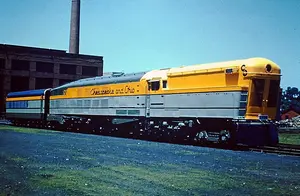
 Chesapeake & Ohio Class M-1 steam-turbine-electrics. Three Baldwin-Westinghouse locomotives, 500–502, built 1947–48 for The Chessie. Specs, the 2-C1+2-C1-B arrangement, and a roster. All scrapped…
 -
N&W 2-6-6-2 Locomotives (Class Z): Specs, Roster, History
Oct 05, 26 11:44 AM
 Norfolk & Western Class Z 2-6-6-2s. One hundred ninety compound Mallets, 1300–1489, from Richmond, Baldwin, and Schenectady, 1912–1918. Diagram specs, the Z-1b rebuilds, Z-2 1399, and a roster. No…